Published by the Public Risk Management Association
www.primacentral.org
JULY 2010
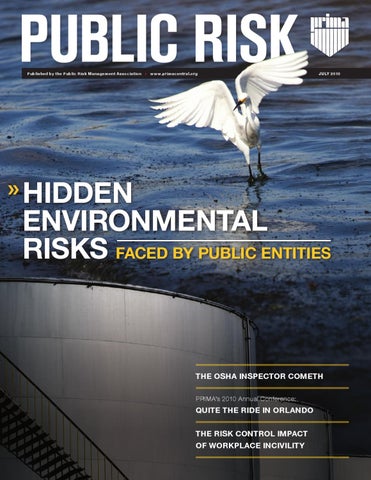
HIDDEN ENVIRONMENTAL RISKS FACED BY PUBLIC ENTITIES
THE OSHA INSPECTOR COMETH PRIMA’s 2010 Annual Conference:
QUITE THE RIDE IN ORLANDO THE RISK CONTROL IMPACT OF WORKPLACE INCIVILITY
PRIMA INSTITUTE The Industry’s Premier Risk Management Training Program September 13–16, 2010
Do you manage risk for:
Cities
Counties
San Antonio, Texas
Municipalities
Schools
Parks and Recreation
Pools
And have less than two years of experience?
The PRIMA Institute Foundations of Risk Management Program is for you!
T
his four-day program is a first-class, best-in-the-industry training program for those with less than two years of experience in the risk management arena who wish to get grounding in the technical and management aspects of their jobs. This comprehensive program provides the core competencies of risk management. The five-step risk management process applies to every risk in your entity—liability, property and workers’ compensation. A look at the big picture will show you how risk management fits into your organization’s overall structure.
Register by July 19 to receive discounted rates! Visit www.primacentral.org for more information.
Volume 26, No. 6 | July 2010 | www.primacentral.org
The Public Risk Management Association promotes effective risk management in the public interest as an essential component of public administration.
EXECUTIVE DIRECTOR Lisa Lopinsky, CAE
CONTENTS
PRESIDENT Laura Peterson, JD, MPA State Risk Manager/ Agency General Counsel State of Nebraska Lincoln, NE PAST PRESIDENT Ron Hayes Risk Manager Calcasieu Parish School Board Lake Charles, LA
6
11
DIRECTORS Betty Coulter Risk Management Director City of Asheville Asheville, NC
6 HIDDEN ENVIRONMENTAL RISKS FACED BY PUBLIC ENTITIES
Matt Hansen, MPA Director, Risk Management Division City & County of San Francisco San Francisco, CA
By Jon Peeples and Michael Sobel
Dan Hurley, CSP, ARM-P, MS Senior Director, Risk Management & Safety Norfolk Public Schools Norfolk, VA
11 THE OSHA INSPECTOR COMETH
John J. Nacht, ARM Risk Management Program Administrator State of Washington, Employment Security Dept. Olympia, WA
By David F. Coble, MS, CSP
Dave Parker, ARM-P Risk Manager Pima County Sheriff’s Department Tucson, AZ
14 PRIMA’s 2010 Annual Conference: QUITE THE RIDE IN ORLANDO
Marilyn Rivers, CPCU, ARM, AIC Director of Risk and Safety City of Saratoga Springs Saratoga Springs, NY
By Jennifer Ackerman, CAE
EDITOR Jennifer Ackerman, CAE Senior Manager, Communications 703.253.1267 • jackerman@primacentral.org
16 THE RISK CONTROL IMPACT OF WORKPLACE INCIVILITY
ADVERTISING Donna Stigler 888.814.0022 • donna@ahi-services.com
By Michael G. Fann, ARM-P, MBA
16 IN EVERY ISSUE 4 News Briefs | 19 Advertiser Index | 20 Member Spotlight
PRESIDENT-ELECT Cindy B. Mallett, AIC, CWCP, ARM-P Risk Manager City of Gainesville Gainesville, GA
Public Risk (ISSN 0891-7183) is published 10 times per year by the Public Risk Management Association, 500 Montgomery Street, #750, Alexandria, VA 22314 tel: 703.528.7701 • fax: 703.739.0200 email: info@primacentral.org • Web site: www.primacentral.org Opinions and ideas expressed are not necessarily representative of the policies of PRIMA. Subscription rate: $140 per year. Back issue copies for members available for $7 each ($13 each for non-PRIMA members). All back issues are subject to availability. Apply to the editor for permission to reprint any part of the magazine. Periodical postage paid at Alexandria, VA, and additional mailing offices. POSTMASTER: Send address changes to PRIMA, 500 Montgomery Street, #750, Alexandria, VA 22314. Copyright 2010 Public Risk Management Association Reprints: Contact the Reprint Outsource at 717.394.7350.
JULY 2010 | PUBLIC RISK
1
A Tradition of Consistency “We’ve enjoyed a reinsurance relationship with Genesis and General Re for more than 20 years. They’re solid and reliable, coming through for us on some big, difficult losses. They’ve also demonstrated their flexibility by working with us on innovative new coverages for our member cities. That’s important to our pool. With Genesis, there are never surprises. We’ve enjoyed a tradition of consistency that the League of Minnesota Cities Insurance Trust needs.” — Peter Tritz, Executive Director League of Minnesota Cities Insurance Trust
Visit our website at www.GenesisGov.com
Genesis Underwriting Management Company, 120 Long Ridge Rd, Stamford, CT 06902
A.M. Best A++ XV
S&P AA+
A Berkshire Hathaway Company
Message from PRIMA President Laura Peterson
DON’T RISK STANDING IN THE WAY OF PROGRESS
B
rooks Atkinson said, “This nation was built by men who took risks-pioneers who were not afraid of the wilderness, business men who were not afraid of failure, scientists who were not afraid of the truth, thinkers who were not afraid of progress, dreamers who were not afraid of action.” What kind of risk manager are you? What kind of risk management program do you have? Do you provide the kind of advice and programs that support your entity’s leaders and activities even when they are attempting to overcome challenges or taking risks that help pave the future? Or are you standing in the way of progress by invoking the idea of safety or risk avoidance? Before I became the Nebraska State Risk Manager, I served as general counsel to a state agency. In both of these roles, I advise managers and leaders in state government on actions and activities they are considering. I found there is always a safe option, the option that says, “No, don’t do that new activity, it’s way too dangerous or there are so many things that could go wrong.” But, a wise mentor, widely recognized as a leader within our government, said to me, “Laura, you can’t stand in the way of ideas, even if in the long run those ideas crash and burn. If we don’t try things, we don’t move forward.” I took his words to heart and I have tried to provide advice and a risk management program that find ways to support and encourage managers and programs rather than discourage them. As I assume the role as PRIMA President, I want to assure you that PRIMA is here to support you and your entity as you work to weather the current financial storm, to address whatever issues, expected or unexpected, that arise in your path of progress and ensure that risk management is recognized as a key participant whenever your entity makes important decisions.
As we move forward from our recently concluded annual conference in Orlando, a new leadership team is in place at PRIMA for the coming year. I look forward to leading this dedicated team that now includes two new board members, Betty Coulter, from the City of Asheville, North Carolina and Matt Hansen from the City & County of San Francisco, California, and a new president-elect, Cindy Mallett from the City of Gainesville, Georgia. Along with the other members of PRIMA’s Board, your leadership team will be working to guarantee the viability and stability of PRIMA during these challenging financial times but we will also be working to make sure PRIMA is here when you need us and how you need us to support you and your risk management programs. Your success and the success of risk management programs and the risk management profession is PRIMA’s primary focus. I encourage you to stay in touch with me and any member of PRIMA’s leadership team. We want to hear about your successes and we want to hear what you need from us to ensure those successes. I look forward to the year ahead. In keeping with the theme from Annual Conference, I know it will be “quite the ride.” Sincerely,
As I assume the role as PRIMA President, I want to assure you that PRIMA is here to support you and your entity as you work to weather the current financial storm, to address whatever issues, expected or unexpected, that arise in your path of progress and ensure that risk management is recognized as a key participant whenever your entity makes important decisions.
Laura Peterson, JD, MPA 2010-2011 PRIMA President State Risk Manager / Agency General Counsel State of Nebraska
JULY 2010 | PUBLIC RISK
3
News Briefs
NEWS
BRIEFS DOCUMENT SAYS NUMBER OF TERROR ATTEMPTS ON U.S. IS AT ALL-TIME HIGH Just weeks after the failed car bombing of New York’s Times Square, the Department of Homeland Security says “the number and pace of attempted attacks against the United States over the past nine months have surpassed the number of attempts during any other previous one-year period.” That grim assessment is contained in an unclassified DHS intelligence memo prepared for various law enforcement groups, which says terror groups are expected to try attacks inside the United States with “increased frequency.” CNN obtained a copy of the document, dated May 21, which goes on to warn, “we have to operate under the premise that other operatives are in the country and could advance plotting with little or no warning.” The intelligence note says recent attempted terror attacks have used operatives and tactics which made the plots hard to detect.
CENSUS BUREAU ADOPTS STRICT JOBS SCREENING AFTER INCIDENTS The Census Bureau is adopting stricter rules for screening new hires after a registered sex offender using an alias got a job as a census taker in New Jersey, the bureau’s director said. Robert M. Groves said that applicants whose name, age, gender and Social Security number do not match background records will be held up for more inquiries instead of being sent for FBI fingerprint checks, reports The Washington Post. Applicants whose fingerprints are not legible, as sometimes happens with older people whose fingerprint ridges have worn down, will not be hired until their identities and backgrounds can be confirmed. And when there is “evidence of criminality” by a census worker, Groves promised swifter intervention to ensure that they no longer have contact with the public.
4
PUBLIC RISK | JULY 2010
W W W.PRIMACENTRAL .ORG
GULF OIL SPILL: SENATORS DISAGREE OVER LIABILITY LIMITS Senate leaders disagreed on how hard the government should press oil companies to pay for oil spills such as BP’s well blowout in the Gulf of Mexico, reports The Los Angeles Times. Sen. Charles E. Schumer of New York, the third-ranking Democrat in the Senate, endorsed lifting the $75-million congressionally mandated cap on oil company liability, but Senate Republican leader Mitch McConnell of Kentucky said caps could be an important incentive to keep the private sector exploring for energy resources. “The danger in taking the cap too high is that you end up with only massive, very large oil producers able to meet that cap and produce in the gulf,” McConnell said on NBC’s “Meet the Press.” The minority leader said distress over the leak should not lead to policies that dramatically limit offshore drilling. “As horrible as this is, it’s important to remember that we get 30 percent of our oil from the gulf, and if you shut that down, you’d have $14 [per gallon] gasoline,” McConnell said. McConnell and others noted that BP had pledged to pay costs incurred by the spill, regardless of the cap.
EARLY RETIREE REINSURANCE PROGRAM COULD BENEFIT ENTITIES According to a release from the White House, rising costs have made it difficult for employers to provide quality, affordable health insurance for workers and retirees while also remaining competitive in the global marketplace. Many Americans who retire without employer-sponsored insurance and before they are eligible for Medicare see their life savings disappear because of exorbitant rates in the individual market. The Early Retiree Reinsurance Program will provide much-needed financial relief for employers so retirees can get quality, affordable insurance starting this year. For more information on this program, visit www.whitehouse.gov.
JULY 2010 | PUBLIC RISK
5
Hidden Environmental Risks
HIDDEN ENVIRONMENTAL RISKS FACED BY PUBLIC ENTITIES
By Jon Peeples and Michael Sobel
Today, there is growing uncertainty regarding the potential liabilities commercial, private and public entities face because of changes in environmental regulation on a local, state, federal and even global level. The Environmental Protection Agency (EPA) is reconsidering many revisions in environmental regulation implemented during the previous administration. Much of this reconsideration is due to ever-increasing concerns about anticipated exposures—whether from global warming, pharmaceuticals in the drinking water, particulates polluting the air after leaving emission stacks or the impacts to groundwater due to gas and oil drilling. Such increased regulation may result in financial responsibility on the part of public, private and commercial entities, a responsibility they may not have considered significant in the past. While these potential risks will be studied and debated on an on-going basis, environmental issues are of great concern to municipalities and school districts, whether urban or rural. Many times, certain types of harm to the environment are not identified as potential liabilities for a municipality or school district, because most environmental impacts are thought of as catastrophic events that are unlikely to occur “in my own backyard.� This is especially true for public entities, since there is a perception that they do not have the same exposures and potential liabilities as industrial and commercial entities. The truth is, environmental pollution can expose public entities to financial liability as well. Consider, for example, an ongoing situation in a county located in a western state in the United States. Recently, more than 400 current and past residents of a county-owned housing complex sued the county, the developer and the previous property owner, contending that they were exposed to toxins while living on the property. The site was a former oil storage facility long before it was bought by the county for $1 and developed into a multi-tenant housing complex in the 1970s. But the county did not perform an environmental review before its acquisition, so no hazards were identified or disclosed at the time of the purchase.
6
PUBLIC RISK | JULY 2010
W W W.PRIMACENTRAL .ORG
The civil lawsuit contends that contamination within the property caused various negative health effects, including cancer, anemia, respiratory distress and asthma in its residents. The plaintiffs sued for back rent, medical costs and wrongful deaths of at least 38 former residents due to exposure to environmental hazards and the county’s lack of notice of these hazards. Within the past year, the county supervisors voted to close the complex and relocate the residents. The total damages, including indemnity, defense costs and relocation costs, are unknown at this time but it can reasonably be anticipated that when the suit is finally finished, it could cost the county millions. Most people do not equate major potential environmental damage with something as benign as a housing complex. However, in the environmental risk arena, very often it is what you do not see that has a lasting effect on persons and property. Environmental hazards can arise from the general services, property management and operations that most public entities provide or use. While some environmental impacts present true catastrophic exposures, most are smaller and may occur fairly frequently. This type of claim and the resulting loss tends to be a drain on public resources, time and money. To further illustrate, consider the following actual case studies of first-party loss or litigation involving public entities. These cases were selected to demonstrate the everyday nature of risk exposures that may create environmental liabilities.
CASE STUDY #1: REMEDIATION COSTS A middle school was recently shut down for two days due to a possible mercury spill in the building. It was reported
that a student brought a vial of mercury to school to show to friends. When the teacher discovered a small amount of a substance thought to be mercury in the cafeteria, 53 students were taken to the hospital by bus and an environmental consulting company was brought in to conduct the clean-up and air testing. The school was re-opened after air testing came back with a negative finding. The bus that drove the students to the hospital was also taken out of service to be cleaned and tested for contamination. The total potential cost has not yet been calculated, but will in the end likely reach thousands of dollars.
Most people do not equate major potential environmental damage with something as benign as a housing complex. However, in the environmental risk arena, very often it is what you do not see that has a lasting effect on persons and property.
CASE STUDY #2: LEGAL DEFENSE COSTS A county was sued by local farmers for damages associated with an aquifer used during drought periods that had become contaminated, allegedly by a county landfill. The farmers took the case to court, even though the landfill met all federal engineering requirements and the county could prove that the landfill liner was undisturbed. Groundwater monitoring results
JULY 2010 | PUBLIC RISK
7
Hidden Environmental Risks from the 12 monitoring wells associated with the landfill were also below regulatory cleanup criteria. The court ruled in favor of the county and no damages were awarded. But, the total court costs incurred by the county exceeded $150,000.
CASE STUDY #3: TOXIC FUMES Custodians at a high school were cleaning the air conditioning units with a commonly used cleaning solvent. The spent solvent was disposed of in a school dumpster with other school waste. Waste handlers removed the waste from the dumpster and brought it to a local non-hazardous landfill. Six of the waste handler’s employees became sick and the landfill required remediation. Bodily injury claims amounted to $35,000. The cost for remediation of the landfill is still undetermined.
CASE STUDY #4: POTENTIAL SOIL CONTAMINATION City officials were unaware that a city sewage pipe was partially blocked by a tree root. During a large rainstorm, the affected pipe was unable to carry raw sewage and storm water to the local treatment facility. Both the raw sewage and storm water backed up onto the street and even onto the lawns of several homeowners in the community. Concerned about the health of residents and in the face of negative press coverage, the city removed the lawns of all residents in the area and conducted soil and groundwater sampling to ensure that contamination had not occurred. The total cost for lawn removal, reseeding and sampling was $82,000.
CASE STUDY #5: HERBICIDE SPRAYING MISAPPLICATION Spraying operations were conducted around a county-leased and -operated boat ramp. The chemical mixture that was applied is alleged to have eradicated about one-third of the lake’s fish population. Homeowners on the lake sued the county for $350,000 in damages.
CASE STUDY #6: CROP CONTAMINATION A county-owned tank truck was en route to spray more than 100 miles of county roads for weed control. The vehicle was in a roll-over accident and ended up on its side in a watermelon field. Approximately 2,500 gallons of herbicide spilled over a wide area of the field, contaminating or destroying a large part of the crop, just two weeks before harvest. Damages, including remediation of a half-acre parcel, amounted to $96,000.
CASE STUDY #7: SOIL REMEDIATION An oil pipe burst inside a school’s boiler room, spilling 1,800 gallons of heating oil into a floor drain that led to a swale outside of the school. The spill occurred during a heavy rain storm and the oil flowed onto adjacent properties, including a playground. A cleanup crew was brought in to determine the impact of the spill and remove the contaminated soil. The cleanup cost was estimated to be nearly $1 million and does not include potential restitution to nearby property owners.
ENVIRONMENTAL INSURANCE Whether these situations and resulting claims could have been prevented may be debated, but there is no debate that environmental insurance products are available that could provide coverage for each of these events. In addition, environmental liability insurance products provide coverage for more traditional public entity-related environmental risks, such as those resulting from underground storage tanks, landfills, airports and maintenance garages. Three types of environmental insurance products are available to the public sector: Premises Pollution Liability: This policy is designed to provide insurance for covered pollution conditions at or emanating from, covered locations, owned or leased by the named insured. The coverage normally applies on a gradual, as well as a sudden and accidental, basis, for both third party and on-site environmental damage. The typical public sector locations that may be insured on this type of policy include: landfills, maintenance garages, hospitals, schools, offices, parks, golf courses, water and wastewater treatment plants. Contractors Pollution Liability: This policy generally provides insurance for sudden and accidental pollution events from covered operations conducted by or on behalf of, the named insured. This policy is designed to prevent gaps in coverage due to pollution-related exclusions to Commercial General Liability (CGL) programs. Coverage may include onsite and offsite remediation costs, third-party bodily injury and property damage claims and legal defense expense and
8
PUBLIC RISK | JULY 2010
W W W.PRIMACENTRAL .ORG
can be offered on either a claims-made or occurrence basis. Typical operations covered by this policy include: building maintenance, street and road maintenance, wastewater treatment, pesticide and herbicide spraying, sewer and water line maintenance and construction. Underground Storage Tank Liability: This policy normally provides insurance for releases from an underground or above ground storage tank or associated piping. Coverage often includes: remediation costs, third-party bodily injury and property damage claims and legal defense expense. This policy can be structured to satisfy federal or state storage tank financial responsibility requirements and provides the attendant insurance certificates.
A PROACTIVE APPROACH TO EVALUATING HEALTH, SAFETY AND ENVIRONMENTAL RISKS AND EXPOSURES Many environmental exposures can be mitigated in response to regulatory compliance constraints to avoid or lessen the impact of an environmental claim. Engaging an environmental consulting firm to evaluate potential regulatory or occupational exposures when considering overall environmental risk is a negligible expense, especially when compared to the potential costs of an environmental claim. To illustrate best practices in environmental, health and safety risk control, consider the example of the countyowned housing complex built on contaminated former oil storage facility, purchased for the price of $1, as previously outlined in this article. The site history and potential for existing contamination could have been identified through an environmental database search, which provides the site history, former owners and operators and records of spills or remediation completed at the site. This database search, coupled with an environmental site assessment completed by an environmental professional engineer, would have cost the county less than $5,000. The actual final cost was considerably higher. Public entity risk managers need to understand the various potential environmental hazards that can affect public entities’ everyday operations, to fully appreciate their potential pollution liabilities. These exposures do not need to be shouldered alone. Environmental insurance and proactive environmental consulting services are available as effective and affordable tools to address potential pollution liabilities.
FOUR COMMON PUBLIC ENTITY OPERATIONS THAT COULD RESULT IN ENVIRONMENTAL EXPOSURES Most public entities will encounter the following four operations, which may not normally be seen as potential environmental exposures to public entities, but often, in fact, cause serious damage leading to significant liability. OPERATION 1: “Midnight dumping: is the illegal disposal of wastes, household goods, used oil, electronics, batteries and so forth, on public land controlled by the municipality. Potential Pollution Liability The public entity may be responsible for costs related to the investigation, transportation and disposal of these items and potential cleanup, if they contaminated the land. OPERATION 2: The application of pesticides, herbicides or fertilizers to park land, golf courses, agricultural operations and open land and the potential effect that run-off from these chemicals may cause to nearby streams, ponds, rivers or other bodies of water. Potential Pollution Liability A public entity may be required to pay investigation and cleanup costs from these impacts, as well as pay fines, penalties or economic damages due to the use loss of a particular resource. OPERATION 3: Alleged exposure to toxins by students and faculty within public schools and universities, arising from asbestos, lead paint, mold, legionella and chemicals (e.g., mercury that is used regularly in educational or research laboratories, thermometers and energy efficient fluorescent lighting). Potential Pollution Liability A public entity could pay defense costs, investigatory and abatement costs, relocation costs and potential damages, due to alleged bodily injury claims. OPERATION 4: In hospitals, medical facilities and emergency care operations, exposures to infectious and radioactive wastes from the handling, storage and transportation of “red bags” (bags used to transport medical waste), could cause indoor air quality issues, leading to facility-borne illnesses. Potential Pollution Liability The entity may be liable for investigation and abatement costs, as well as for interruption costs associated with the possible evacuation of rooms within the facility.
These operations do not present what would generally be seen as serious environmental hazards. Instead, these constitute the normal operation of municipalities and schools. But, in each case, a public entity will need to allocate time and funds to address these issues.
Jon Peeples is vice president, ACE Environmental Risk. Michael Sobel is vice president, ACE Public Entity Unit.
JULY 2010 | PUBLIC RISK
9
in harmony,
ACE insures progress
Property & Casualty Accident & Health Life
It takes the right people, a strong balance sheet, worldwide capabilities and a flexible approach to understand the delicate balance between industry and the environment. These are the strengths of ACE and our innovative environmental liability insurance. We take on the responsibility of your risks so that you can take on the responsibility of making things happen. We call this insuring progress. Visit us at aceusa.com of insuring progress 25 years ÂŽ
Š 2010 ACE Group. Coverages underwritten by one or more of the ACE Group of Companies. Not all coverages available in all jurisdictions.
The OSHA Inspector Cometh
THE OSHA INSPECTOR COMETH
By David F. Coble, MS, CSP
When an OSHA compliance officer arrives at your work place, your goal is to let that inspector in and get that inspector out as quickly as you can. OSHA inspectors are there to find violations and issue citations and penalties. Treat an OSHA inspector as you would any law enforcement officer – with respect and with care in what you say and how you say it. I worked for North Carolina OSHA for 12 years and had very few problems with employers or employees. And you won’t have a problem either if you are prepared and know what to expect.
WHY OSHA MAY VISIT
OSHA’s top priority inspection is an imminent danger situation. However, these cases are extremely rare. Examples in the past have been unshored excavations, locked exits and overexposure to lead. Should an imminent danger situation be alleged by OSHA, you would want to stop the operation immediately.
OSHA’s next priority is fatality and catastrophe investigations. Virtually all work-related fatalities and catastrophes where three or more employees are hospitalized will be investigated by OSHA, if they have jurisdiction and learn of the incident. In addition, numerous newsworthy incidents are also investigated. During my OSHA days, I remember watching the 11:00 p.m. news one evening and the news camera was showing a large fire at a furniture plant in my territory. There were no reports of injuries, but I decided to go take a look. OSHA‘s third priority is to investigate complaints about safety and health hazards. The complainant can ask to remain anonymous. If you find out who filed the complaint, keep in mind that discriminating against that person is not legal. Fix the hazards and improve your management systems if you don’t want complaints.
JULY 2010 | PUBLIC RISK
11
The OSHA Inspector Cometh
Regardless of why OSHA may be visiting, you will want to be prepared. Preparation includes not only meeting the standards, but having proper safety and health policies and procedures in place to prevent injury and illness… Adequate preparation for an OSHA inspector should also include not just meeting the standards, but having the safety and health management systems in place to protect workers and the public.
The next priority for OSHA is special emphasis programs and targeted inspections. Examples currently include refineries, construction, nursing homes, combustible dusts exposures and employers who have a lost workday incident rate greater than 14. And, lower on the priority list are general schedule inspections where your facility pops out of the computer. It’s just your turn. Regardless of why OSHA may be visiting, you will want to be prepared. Preparation includes not only meeting the standards, but having proper safety and health policies and procedures in place to prevent injury and illness. Remember that OSHA is not a safety and health agency, nor are the OSHA standards safety and health standards. OSHA is a minimum compliance agency and the standards are minimum compliance rules. You can be in compliance but still have hazards. For example, an employee can fall off of a fixed ladder up to 20 feet and no violation has occurred. But do you want your employees exposed to falling 20 feet? Adequate preparation for an OSHA inspector should also include not just meeting the standards, but having the safety and health management systems in place to protect workers and the public.
WRITTEN POLICIES REQUIRED BY OSHA The typical employer may be required by OSHA standards to have 10-to-20 written policies. For most employers, these would include: • • • • • • • • • •
Emergency Action Plan Fall Protection Program Lockout/Tagout Program Confined Space Entry Program Hazard Communication Program Electrical Safety Work Practices Hearing Conservation Program Welding, Cutting and Burning Procedures Respiratory Protection Program Bloodborne Pathogens Program
Other policies could be required depending on exposures in your workplace and the activities that your employees perform such as exposure to asbestos and laboratory safety and health. In addition to the OSHA-required policies and procedures, you should consider developing other policies to safeguard employees, including those who work alone, employees who perform repetitive tasks or employees who use high-pressure washers. OSHA does not require these specific written policies, but you would surely impress the OSHA inspector if you had them.
12
PUBLIC RISK | JULY 2010
So, what is most important about your written safety and health policies? First, have they been developed? Second, can you find them? I have been sitting in a plant manager’s office beginning an OSHA inspection and asked for a written safety policy. It’s not unusual for the plant manager to call in the safety manager or secretary and say, “Can you get our emergency plan for this gentleman?” Soon, I can hear file drawers slamming in the background and cursing, “Where is that thing?”
TRAINING AND INSPECTION RECORDS There are more than 300 OSHA training requirements and more than 400 OSHA inspection requirements. Find out which ones apply to you, develop the systems to meet the requirements and keep records of your activities. There are two ways to try to prove to an OSHA inspector that you comply with the training and inspection requirements: documentation and conversation. Experienced OSHA inspectors have heard most of the excuses; document all safety and health activities, especially training and inspections.
HANDLING THE OSHA INSPECTOR The inspector will tell you why they are at your facility: perhaps to look at a complaint item or perhaps to conduct a wall-to-wall inspection. Think about the route that you want to lead the inspector to the items that will be examined. Walk the inspector through areas that will flatter your safety and health positives. You don’t have to show your dirty laundry until asked. Send out through the grapevine that the OSHA inspector has arrived. At least housekeeping might improve a little before the inspector actually gets out in the workplace! Caution supervisors about making statements or admissions. I was in a maintenance shop one time and I was
W W W.PRIMACENTRAL .ORG
CALENDAR OF EVENTS The Public Risk Management Association (PRIMA) hosts or sponsors a wide variety of educational programs for public risk practitioners. These meetings and events provide an optimum forum for public risk professionals to acquire new knowledge or skills, exchange ideas and expand peer networks. PRIMA’s calendar of events is current at time of publication. For the most up-to-date schedule, visit www.primacentral.org.
telling the supervisor that the V-belt drive on a drill press was not guarded according to the standard. The supervisor asked me, “Are you going to cite me for that?” I said, “Yes, sir. It is a violation and here are a couple of ways to guard this.” He turned to his left and pointed to another drill press over in the corner and said, “Well, you didn’t cite me for that one over there when we walked by it!” Oops, I missed that one. Don’t bring it up; just fix it. Don’t argue, but discuss and ask questions if you don’t understand. Be truthful even when the inspector doesn’t understand. I was suspicious of those managers who wanted to argue with everything I pointed out and those managers who agreed with everything I pointed out. I made sure those facilities received a follow-up inspection to see if the hazards were corrected. Listen closely to the comments made by the inspector during the inspection and closing conference. Take good notes. Take pictures of the same items that the inspector is photographing. Take a camera angle that flatters you. Take side-by-side industrial hygiene samples and assure that OSHA’s meters have been calibrated. When the inspector wants to interview an employee, provide them privacy. The inspector can ask the supervisor to leave. I tried to interview employees in their work area where they were more comfortable and I tried to pick employees who looked as if they had a few moments to talk. OSHA inspectors will work with you to try to stay out of the way as much as they can. And, one more piece of advice. Never, never, never leave the inspector alone in your facility. First, the inspector might get hurt. Second, the inspector will only see what the employees want the inspector to see and that could be a disgruntled employee showing the inspector around.
IS THE OSHA INSPECTOR THERE TO HELP? It depends on how you define “help.” The enforcement arm of OSHA is at your facility to determine if you meet the minimum requirements. On the other hand, if you are prepared, OSHA inspectors have generally acquired a breadth of knowledge. They’ve seen a lot. Use your OSHA inspection as a learning experience. You can deal with the citations and penalties, if there are any, later.
WEBINARS 2010 September 15 Key Issues in Loss Mitigation— Is Your Organization Prepared to Respond? October 13 Protecting our Children: Keeping our Communities and Schools Safe November 17 Winning Strategies for Contractual Risk Transfer
MEETINGS & EVENTS 2010 September 13-16, 2010 PRIMA Institute San Antonio, TX Crowne Plaza Riverwalk
PRIMA ANNUAL CONFERENCES June 5–8, 2011 PRIMA 2011 Annual Conference Portland, OR Portland Convention Center June 3–6, 2012 PRIMA 2012 Annual Conference Nashville, TN Opryland Hotel June 2-5, 2013 PRIMA 2013 Annual Conference Tampa, FL Tampa Convention Center
David Coble, MS, CSP, is the president of Coble, Taylor and Jones Safety Associates.
JULY 2010 | PUBLIC RISK
13
Annual Conference Recap
PRIMA’s 2010 Annual Conference:
in Orlando! By Jennifer Ackerman, CAE
Risk managers from near and far traveled to Orlando on June 6 to kick off PRIMA’s 31st Annual Conference: Risk Management—It’s Quite the Ride. Attendees strapped themselves in for three days of education, networking and fun, with more than 850 of their risk management peers at the industry’s largest conference dedicated to risk management in the public sector. PRIMA President Ron Hayes convened the conference on Monday, June 7, with the state of the association address. Hayes highlighted some of the results of PRIMA’s recent member needs survey, as well as remarking on some of PRIMA’s new products and services like the Risk Manager’s Briefing Kit. Hayes also gave a heartfelt thanks to the conference sponsors, exhibitors and volunteer leaders who supported PRIMA’s conference. Following the morning general session, attendees spent the first day of the conference in educational sessions learning about topics such as school transportation threats and community safety leadership. Risk managers gathered for PRIMA’s Awards Luncheon on Monday afternoon to honor their own. Awards were presented for achievement in risk management programs, products and pools, in addition to awarding PRIMA’s Public Risk Manager of the Year prize to Mike Pennacchio, risk manager for the Incline Village General Improvement District in Incline Village, Nev. “Mike’s commitment to his entity’s fiscal well-being made him a standout in a very competitive field of candidates this year,” said Lisa Lopinsky, CAE, PRIMA executive director. “He has shown the kind of dedication to public sector safety and accountability that personifies PRIMA’s Public Risk Manager of the Year.”
1414 PUBLIC RISK | JULY 2010
W W W.PRIMACENTRAL .ORG
Throughout Monday and Tuesday, attendees crowded into the PRIMA Exhibit Hall to learn about new products and services for public sector risk managers from more than 100 exhibitors. Tuesday also featured a general session panel discussion by three insurance industry leaders, Patrick Gallagher, Arthur J. Gallagher UK Ltd; Mike Klein, Travelers and Patricia Roberts, Genesis Underwriting Management Company. The session, moderated by Ron Hayes, focused on the uncertainty on the horizon the insurance industry and what risk managers can expect going forward. Klein said that today, more than ever, public entities need to be vigilant about contractual risk transfer. Gallagher commented that while employee-related claims are down, there is a potential for an increase due to entity layoffs. “Employment practices liability is not somewhere to cut this year,” he said. Members of the panel also commented on the massive oil spill in the Gulf of Mexico. “Obviously, there were not enough safety regulations and changes will need to be made,” said Roberts. “It’ll take years to sort through.” After a long day of educational sessions, attendees headed to the beach at SeaWorld’s Discovery Cove for PRIMA Polynesia. Attendees strolled down beautiful nature trails and experienced up-close interactions with exotic animals and beautiful tropical birds. From there, the event moved
to Discovery Cove’s white-sand beaches and shimmering dolphin lagoons. On Wednesday, attendees wrapped up three days of education and networking. The final day of the conference featured PRIMA’s Annual Membership Luncheon, where the new slate of officers and directors was installed, including PRIMA’s 2010–2011 president, Laura Peterson, JD, MPA, president-elect, Cindy Mallett, AIC, CWCP, ARM-P and two new PRIMA board members: • Betty Coulter Risk Management Director City of Asheville, NC • Matt Hansen, MPA Director of Risk Management City and County of San Francisco, CA PRIMA would like to thank the 2010 Annual Conference Planning Committee members for their hard work and dedication, which helped make the event a success. We look forward to seeing you in Portland next year for the 2011 Annual Conference, June 5–8! To view more photos from PRIMA’s 2010 Annual Conference, visit www.primacentral.org.
JULY 2010 | PUBLIC RISK 1515
The Risk Control Impact of Workplace Incivility
THE RISK CONTROL IMPACT OF
WORKPLACE INCIVILITY
By Michael G. Fann, ARM-P, MBA
Risk control is defined as “reducing the frequency and severity of potential losses by preventing loss-causing events and by taking measures to ensure that losses are kept to a minimum when an event occurs.”1 When a new program, product, service or operation presents itself, the responsible risk manager immediately begins to evaluate the political, legal, regulatory, financial, technological, economic, natural and competitive risk exposures. Each of these assessment areas deserve the risk professional’s attention and require discerning critical thinking. If risk reduction is desirable—that is, engaging calculated methods to change the likelihood of loss occurrence by allocating resources where they matter most and digging deep to treat the root causes of loss2 —then many would find it valuable to invest time and energy in examining how poorly, or beneficially, their work environment would be rated on the “civility scale.” After being a somewhat discerning observer
16
PUBLIC RISK | JULY 2010
of the public entity workplace for roughly 25 years, it has become fairly obvious that foundational human behaviors (some subconsciously and others overt, validated and reinforced) dictate whether the organization has a productive work environment or an environment conducive to hostility, or at least one that is counter-productive. While much (some would say too much) of risk management focuses on “compliance with minimum standards,” in many organizations “behavior” doesn’t get the same attention. However, many risk managers and other professionals will tell you that the overall morale within an organization is one of the clearest indicators of its claims experience in the near term. So, if many understand the importance of civil behaviors within the workplace, then what could possibly be the reason that, in a recent survey on civility by U.S. News & World Report, as many as 89 percent of Americans observe that incivility is a serious problem in our culture today?
W W W.PRIMACENTRAL .ORG
How does one go about fundamentally changing their workplace, making civility a critical value in their organization? You talk about it all the time. You make civility a part of every presentation, a message in every conversation and a seed to be planted at every opportunity.
CIVILITY From a legal perspective, most organizations begin to address the subject of civility at the constitutional level. The protected classes, outlined in Titles VI and VII for “equal protection” purposes, of race, religion, color, national origin, sex, age and disability are designed to ensure that no harassment or other discriminatory behavior is occurring. However, a number of organizations have now adopted a Productive Workplace Policy designed to address harassment or other disruptive behavior, for practically any reason, that substantially inhibits a person’s ability to accomplish their job tasks effectively. This could be used to prohibit personality-based harassing behavior or even undesirable horseplay. Ultimately, an organization’s policies should have a goal to remove harassment or a hostile work environment such that the behaviors do not become so pervasive that the working conditions are unduly oppressive. In summary, these legal standards need to lead the entity to establish norms for acceptable behavior such that staff is respectful in what they say, respectful in what they show and respectful in all they do.
Ultimately, an
ments where the other person or group of people simply do not have the same desire. You must choose to be respectful even when the other person does not.
organization’s policies should have a goal to
Walt Disney remarked that everyone in life is one of two different kinds of people: either a life-enhancer or a well-poisoner. Life-enhancers are typically easy to identify and hopefully every reader has at least one or two of these folks in his or her life. These are people you absolutely enjoy being around. They have some enthusiasm or passion about something and they tend to uplift and encourage the people they are around. Some well-poisoners are easy to identify. They are just grumbly, grouchy, negative people. Other well-poisoners are not so easy to identify but are just as effective at injecting poison into your life. Some of these people are well-meaning, loving folks that want to “protect” you from disappointment in unfulfilled hopes and dreams. How many of us have been excited about the prospects of a potential career change, promotion or substantial raise in pay only to hear Aunt Mabel sweetly say, “Now don’t get your hopes up”? Just one of any number of droplets of poison and hopelessness that people drop into your well each and every day.
remove harassment or a hostile work environment such that the behaviors do not become so pervasive that the working conditions are unduly oppressive.
YOUR PERSONAL OUTLOOK
As others impact us, we need to be conscious that our words and actions are impacting them as well. Are the messages we’re sending positive or negative? Are we lifting people up or tearing them down?
Civility is generally defined as a polite act or expression, showing regard for others, or acts that contribute to smoothness and ease in dealings with people. One might say it is simply giving consideration to others before you act. Sounds simple and it truly is. But is it easy? All too often in our current culture, those who truly desire to treat others with civility will have to do so in circumstances and environ-
While civility encompasses politeness, respect, affirmation, self-restraint and tolerance, it might also be said that, at least in the workplace, the Golden Rule might not be enough any more. Perhaps a Platinum Rule should be followed that suggests we try to treat others, at least to a reasonable sensitivity, the way they would like to be treated.
JULY 2010 | PUBLIC RISK
17
The Risk Control Impact of Workplace Incivility
If it is our desire to reduce the frequency and severity of potential losses by preventing loss-causing events, then an assertive program at promoting civility within your organization will aid in the effort to ensure that losses are kept to a reasonable minimum.
IS IT ME OR IS IT YOU? Refer back to the Civility Survey by U.S. News and World Report. This survey was conducted in the aftermath of three internationally-televised examples of inappropriate behavior by people who likely knew better. On the heels of an elected official yelling out that the president of the United States was a liar, a champion tennis player making extreme threats to a linesperson for a perceived bad call and an internationally-known music artist perhaps intentionally embarrassing a winner at an awards show because he felt someone else should have won, this survey revealed that 89 percent of the people interviewed said that incivility was a serious problem in today’s society and 90 percent of those same people said that they were not personally rude. While it’s possible that only 10 percent of the population could be causing this perception, it is not likely. Some of us in the 90 percent need to be honest with ourselves and acknowledge that, at least on occasion, “It wasn’t just you, perhaps it was me.” We must overcome the “blindspot” of comparing others’ actions to our intentions. As Shakespeare wrote, “To thine own self be true.”
INCIVILITY
PARTING THOUGHTS
Uncivil behaviors are characteristically rude and discourteous, displaying a lack of regard for others and may include an ambiguous intent to harm the target. This behavior might manifest as acts or words whose purpose is to insult, humiliate, embarrass or injure the dignity of others. It may include scape-goating, backstabbing, perpetuating rumors and possibly unethical or dishonest behavior.
If it is true, in fact, that the 89 percent are accurate and we live in a society where incivility has become a serious cultural problem, then where do we begin? While it may be true that we live in the most uncivil times in recent history, this is certainly not a new problem. Our culture did not get to this point overnight and there certainly is no quick fix. You’ll likely have to begin small and slowly. Within your organization you may have to start with one person... you.
In a basic risk assessment, potential causes of workplace incivility, or a toxic work environment, could be an authoritative management style, inconsistent or unpredictable supervision, acceptance of disrespectful behavior, inadequate conflict resolution process or training or basic personal insecurities. All of these causes may serve to reduce morale and productivity and contribute to increases in workplace injuries, employment liability claims and exposure to workplace violence from disgruntled employees. END NOTES:
A CULTURE OF CIVILITY
1. Risk Management for Public Entities – Head, Wong - IACPCU, pg 11.
At its foundation, the battle of workplace civility finds “respect” and “entitlement” in conflict. Respect is an intentional act born of humility and confidence. Entitlement is an attitude and worldview that is born of selfishness and arrogance. As
18
So, how do you build a culture of civility within your organization? It begins with leadership. It’s preferable that the positional leaders within your organization set the example for the staff. But that is not always a practical reality. Therefore, someone who possesses true passion for people and desires to set the proper example must lead in this area. Once leadership buys into the critical importance of civility within the workplace, out of that leadership should grow policy, training and (eventually) a culture change. The culture change occurs when there is top-down commitment, civility is frequently referenced as a core value and you begin to hear the staff “talk about it all the time.” A culture where leaders model civility for others, the organization has clearly defined expectations for how employees are to treat each other and civil behavior is openly rewarded is certainly possible to achieve. Roadblocks occur due primarily to arrogance and insecurity. People remain difficult because they either have too high or too low an opinion of themselves.
These behaviors result in lowered morale of employees and reduced team effectiveness that costs the organization in terms of lost work time and productivity, higher turnover, work avoidance, higher health costs due to stress and potentially higher costs due to increased litigation.
2. ISO 31000
entitlement battles respect within each of us, the daily victor is revealed in our words and actions in the way we treat others.
PUBLIC RISK | JULY 2010
Every major change takes place with one initial first step. To take that step, you should decide before you start that you won’t wait for someone to be nice to you and that you won’t be “keeping score”… that is, you’ll likely have to “let some things slide” coming from others. This is especially true of relatively small slights that you know could possibly be unintentional. Mahatma Gandhi said, “You must be the change you want to see in the world.” So be the one to change first. The biggest risk for your organization is not creating or maintaining a culture of anger and incivility… but rather creating a culture of indifference where employees no longer care. If it is our desire to reduce the frequency and severity of potential losses by preventing loss-causing events, then an assertive program at promoting civility within your organization will aid in the effort to ensure that losses are kept to a reasonable minimum. Michael G. Fann, ARM-P, MBA, is director of loss control for the TML Risk Management Pool in Brentwood, Tenn.
W W W.PRIMACENTRAL .ORG
Advertiser Index
ADVERTISER INDEX ACE USA. . . . . . . . . . . . . . . . . . . . . . . . . . . . . . . . . . . . . . . . . . . . . . . . . . . . . . . . . . . . . . . . . . . . . . . . . . . . . . . . . . . page 10 Genesis Underwriting Mgmt. Co.. . . . . . . . . . . . . . . . . . . . . . . . . . . . . . . . . . . . . . . . . . . . . . . . . . . . . . . . . . . . . . . . . page 2 Munich Reinsurance America. . . . . . . . . . . . . . . . . . . . . . . . . . . . . . . . . . . . . . . . . . . . . . . . . . . . . . . . . Outside Back Cover States Self-Insurers Risk Retention Group, Inc.. . . . . . . . . . . . . . . . . . . . . . . . . . . . . . . . . . . . . . . . . . . . . Inside Back Cover
Has your entity launched a successful program? An innovative solution to a common problem? A money-saving idea that kept a program underbudget? Each month, Public Risk features articles from practitioners like you. Share your successes with your colleagues by writing for Public Risk magazine! For more information, or to submit an article, contact Jennifer Ackerman at jackerman@primacentral.org or 703.253.1267.
RISKWATCH RiskWatch is PRIMA’s weekly e-news service that delivers handpicked, high-quality news articles relating to the public risk management industry directly to your email inbox. In addition, RiskWatch will provide PRIMA members with valuable association-related news. Distributed each Thursday, RiskWatch is an excellent opportunity for you to increase the value of your PRIMA membership and share valuable knowledge with your peers!
Want others in your entity—such as your senior management—to receive this new benefit of PRIMA membership? Subscribe up to two additional recipients in your entity by contacting Jessica Konrath at jkonrath@primacentral.org and provide the name, title and email address of your colleague(s).
JULY 2010 | PUBLIC RISK
19
Member Spotlight
MARYLAND INSURANCE POOL CREATES LOSS CONTROL CREDIT PROGRAM Each month, Public Risk features a member who has gone above and beyond
I
n an effort to increase its members’ control efforts, Maryland’s Local Government Insurance Trust (LGIT) created a loss control credit program to return a portion of the pool’s surplus to its members while gaining valuable information about the members’ loss control programs.
in a feature column titled “Member Spotlight.” Do you know someone who deserves recognition, has made a contribution or excelled in their profession? If so, we’d like to hear from you for this exciting column, as PRIMA shines the spotlight on its members. To be considered for the Member Spotlight column,
“Our primary goal was to reward those members who have engaged in exceptional loss control activities,” said Tim Ailsworth, executive director. “The board of trustees approved an amount of $300,000 to fund the new program.” Participating members were required to complete an online survey tailored to the primary liability lines of coverage that each member has in effect, including general liability, law enforcement, public officials’ liability, automobile and physical damage. The resulting survey scores were weighted by the primary liability line of coverage based on the ratio of the pool’s aggregate loss costs for that line to the total aggregate loss costs of the prior year.
were deficient in their risk management efforts and provide constructive recommendations to improve them. Of the 165 LGIT members eligible to participate, 88 responded and each received a share of the $300,000 available for the program. “What made this program unique was that it demonstrated an innovative way to gather valuable loss control information from the pool membership and provided a quick and easy way to respond to member deficiencies with recommendations for improvement directly related to the specific areas of loss control questioned in the survey,” said Ailsworth. Ailsworth says that this type of program can be utilized in organizations that provide risk management services. “Certainly the monetary reward is a major component of the program, but a similar program could be developed with smaller or no direct incentive other than an inventory of loss
contact Jennifer Ackerman at jackerman@primacentral.org or 703.253.1267.
“Our primary goal was to reward those members who have engaged in exceptional loss control activities,” said Tim Ailsworth, executive director. “The board of trustees approved an amount of $300,000 to fund the new program.” “The money was allotted to survey respondents on a first come, first served basis,” said Ailsworth. “Qualifying participants received a credit of five percent of their primary liability premium for the fiscal year 2010 renewal.” The scoring process of the survey provided an added benefit: the ability of LGIT’s loss control staff to see where members
20
PUBLIC RISK | JULY 2010
control efforts,” he said. “The key component to expanding member loss control awareness is the feedback with set recommendation to all negative survey responses.” For more information on LGIT’s loss control credit program, contact Tim Ailsworth at tailsworth@lgit.org or Larry Bohlen at lbohlen@lgit.org.
W W W.PRIMACENTRAL .ORG
How do you find security and
safety in an evolving market?
You join States.
OUR GOAL IS A LONG-TERM PUBLIC ENTITY RISK MANAGEMENT PARTNERSHIP, NOT MARKET SHARE States, as a group captive, is a member-owned insurance company domiciled in Vermont. For over 20 years, the Company has operated as a financially strong, well-managed and highlyregulated national program providing its members with a broadly interpreted coverage form that is second to none in the industry. States members receive excellent claims and loss control support and specialized public entity-oriented services from an experienced, service-driven staff of professionals. Our “Partners in Protection” have a long and proven history of reliability, accountability, and well-earned trust. Despite challenges in the economy, States has maintained premium stability and continues its record of sound financial results for partner members. The States concept works. Premiums paid by members are investments in their own Company. States’ focus is to be a viable, long-term solution for its owner-members. Cindy LoPiccolo, one of these owners, is proud to be a part of a public entity risk management success story. We know you will be too.
CINDY LOPICCOLO, MMC Senior City Recorder/Executive Analyst City Manager's Office Park City Municipal Corporation, Utah
FOR INFORMATION CONTACT:
States Self-Insurers Risk Retention Group, Inc. at 1-800-640-0345, extension 3357, or visit our website at www.statesrrg.com 222 South Ninth Street, Suite 1300 Minneapolis, Minnesota 55402-3332
To see whether a risk poses a threat, don’t we have to see the big picture?
The future is like an iceberg. Most of the time what we can see before our eyes is only half the story. So how do we know the unknowable? Only those with relentless drive, expertise and foresight can see the whole picture — the risk that lies beyond. At Munich Re, seeing more is what we do. We work in interdisciplinary teams, each pair of eyes viewing something from a different perspective, all focusing on the best solution. With our worldwide network we can pinpoint complex global patterns when they arise. When it comes to grasping our future, we are never satisfied with half the story. To find out what lies beyond, visit our U.S. website at www.munichreamerica.com NOT IF, BUT HOW
Products and services provided by Munich Reinsurance America, Inc.