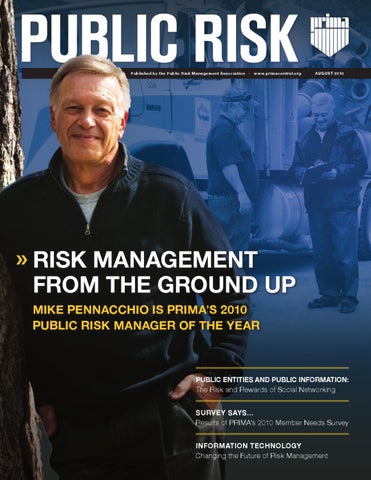
Published by the Public Risk Management Association
www.primacentral.org
August 2010
Risk Management from the Ground Up Mike Pennacchio is PRIMA’s 2010 Public Risk Manager of the Year
Public Entities and Public Information: The Risk and Rewards of Social Networking Survey Says… Results of PRIMA’s 2010 Member Needs Survey Information Technology Changing the Future of Risk Management
To see whether a risk poses a threat, don’t we have to see the big picture?
The future is like an iceberg. Most of the time what we can see before our eyes is only half the story. So how do we know the unknowable? Only those with relentless drive, expertise and foresight can see the whole picture — the risk that lies beyond. At Munich Re, seeing more is what we do. We work in interdisciplinary teams, each pair of eyes viewing something from a different perspective, all focusing on the best solution. With our worldwide network we can pinpoint complex global patterns when they arise. When it comes to grasping our future, we are never satisfied with half the story. To find out what lies beyond, visit our U.S. website at www.munichreamerica.com NOT IF, BUT HOW
Products and services provided by Munich Reinsurance America, Inc.
Volume 26, No. 7 | August 2010 | www.primacentral.org
The Public Risk Management Association promotes effective risk management in the public interest as an essential component of public administration.
Executive Director Lisa Lopinsky, CAE
Contents
President Laura Peterson, JD, MPA State Risk Manager/ Agency General Counsel State of Nebraska Lincoln, NE Past President Ron Hayes Risk Manager Calcasieu Parish School Board Lake Charles, LA
6
11
President-Elect Cindy B. Mallett, AIC, CWCP, ARM-P Risk Manager City of Gainesville Gainesville, GA Directors Betty Coulter Risk Management Director City of Asheville Asheville, NC
6 Risk Management from the Ground Up Mike Pennacchio is PRIMA’s 2010 Public Risk Manager of the Year
Matt Hansen, MPA Director, Risk Management Division City & County of San Francisco San Francisco, CA
By Jennifer Ackerman, CAE
Dan Hurley, CSP, ARM-P, MS Senior Director, Risk Management & Safety Norfolk Public Schools Norfolk, VA
11 Public Entities and Public Information:
John J. Nacht, ARM Risk Management Program Administrator State of Washington, Employment Security Dept. Olympia, WA
The Risk and Rewards of Social Networking By Paree Roper
Dave Parker, ARM-P Risk Manager Pima County Sheriff’s Department Tucson, AZ
14 Survey Says…
Marilyn Rivers, CPCU, ARM, AIC Director of Risk and Safety City of Saratoga Springs Saratoga Springs, NY
Results of PRIMA’s 2010 Member Needs Survey By Jennifer Ackerman, CAE
Editor Jennifer Ackerman, CAE Senior Manager, Communications 703.253.1267 • jackerman@primacentral.org
16 Information Technology
Advertising Donna Stigler 888.814.0022 • donna@ahi-services.com
Changing the Future of Risk Management By Bruce Kaechele
16 In Every Issue 4 News Briefs | 19 Advertiser Index | 20 Member Spotlight
Public Risk (ISSN 0891-7183) is published 10 times per year by the Public Risk Management Association, 500 Montgomery Street, #750, Alexandria, VA 22314 tel: 703.528.7701 • fax: 703.739.0200 email: info@primacentral.org • Web site: www.primacentral.org Opinions and ideas expressed are not necessarily representative of the policies of PRIMA. Subscription rate: $140 per year. Back issue copies for members available for $7 each ($13 each for non-PRIMA members). All back issues are subject to availability. Apply to the editor for permission to reprint any part of the magazine. Periodical postage paid at Alexandria, VA, and additional mailing offices. POSTMASTER: Send address changes to PRIMA, 500 Montgomery Street, #750, Alexandria, VA 22314. Copyright 2010 Public Risk Management Association Reprints: Contact the Reprint Outsource at 717.394.7350.
August 2010 | Public Risk
1
PRIMA Institute The Industry’s Premier Risk Management Training Program September 13–16, 2010
Do you manage risk for:
San Antonio, Texas
Cities Counties Parks and Recreation
Municipalities Pools
Schools
And have less than two years of experience?
The PRIMA Institute Foundations of Risk Management Program is for you!
T
his four-day program is a first-class, best-in-the-industry training program for those with less than two years of experience in the risk management arena who wish to get grounding in the technical and management aspects of their jobs. This comprehensive program provides the core competencies of risk management. The five-step risk management process applies to every risk in your entity—liability, property and workers’ compensation. A look at the big picture will show you how risk management fits into your organization’s overall structure.
Visit www.primacentral.org for more information.
Message from PRIMA President Laura Peterson
Social Studies
T
his issue’s cover story features the 2010 Public Risk Manager of the Year, Mike Pennacchio, risk manager for Incline Village General Improvement District, who was recently honored for his service to his public entity and public risk management. Mike is a credit to government service and the risk management profession and I want to take a moment to personally thank him for all he has done and will continue to do. It is people like Mike and all of the PRIMA achievement award winners who make it such a privilege and honor to serve on the PRIMA board and as PRIMA president. I never cease to be amazed at the quality and dedication of public risk managers and risk professionals serving the public sector. You have wonderful ideas, programs and approaches to both the traditional and emerging activities and risks of your entities. One such emerging activity is social networking technology and Web sites. I want to confess right upfront that in my personal life, I am a frequent (some might say addicted) participant in one social networking Web site. In addition to my personal participation, I am serving a public entity, the state of Nebraska, which recently entered into the social media craze with pages for the state and many public officials. I hope you are also aware that PRIMA launched its Facebook page earlier this year. I am an unabashed fan of social networking for both personal and professional use. It allows me to keep up on current events (as well as potential opportunities and risks) across the state I serve and it allows me to keep in touch with friends and professional colleagues with much more frequency and intimacy than I did prior to the availability of the social networking sites. Certainly social networking is not without its risks and need for policies, procedures and a healthy amount of
caution. The state of Nebraska experienced this first hand when a few correctional officers, who were obviously not representative of the majority of good, hardworking, professional employees of the state, posted comments on one of their personal Facebook pages regarding the pleasure they could derive from treating inmates poorly or even violently. Yes, this resulted in bad press, employment actions and the potential of claims against the state. However, like any other advancement in society, we must find and embrace the opportunities, use our professional skills and experience to manage the associated risks and move forward with the times and technology. Read Paree Roper’s article on this topic on page 11 and visit the PRIMA Cybrary to find a number of policies and procedures your wise colleagues have developed to deal with the risks of social networking; then, armed with knowledge and a risk mitigation plan, you can go forth and recognize all the benefits awaiting you and your entity. I encourage you to visit PRIMA’s new Facebook page at www.facebook.com/primacentral, and become PRIMA’s “friend.” As always, I also encourage you share your successes whether related to social networking or any other success. Through our individual successes we will collectively succeed. Sincerely,
I never cease to be amazed at the quality and dedication of public risk managers and risk professionals serving the public sector. You have wonderful ideas, programs and approaches to both the traditional and emerging activities and risks of your entities.
Laura Peterson, JD, MPA 2010-2011 PRIMA President State Risk Manager / Agency General Counsel State of Nebraska
August 2010 | Public Risk
3
News Briefs
News
Briefs Philadelphia Sheriff’s Office Now Says It Will Cut Overtime Spending Pressured by budget officials, the Philadelphia Sheriff’s Office said it was launching a plan to reduce overtime spending, reports the Philadelphia Inquirer. The announcement came a week after the office said cuts would be difficult, as its overtime was largely driven by the court system, which is run by a separate entity. The city’s budget director, Steve Agostini, said the office was on track to overspend its $12.3 million budget this year by $2.2 million. The Sheriff’s Office is responsible for transporting more than 1,500 prisoners daily, and oversees safety in 116 courtrooms and for 144 city judges. Among other duties, deputies are also responsible for building security at the criminal justice center, traffic court and family court, and for enforcing court orders involving personal property, warrants and writs. Under the new plan, fewer deputies will be assigned to family court, a second shift will be initiated in traffic court, and deputies in various courtrooms will work on staggered schedules.
New Lawsuit Filed Over 2007 Utah Mine Disaster Insurance companies for a co-owner of the Crandall Canyon mine are suing the Utah mine’s operator in more fallout from the deadly 2007 collapse that killed six miners and three rescuers, reports the Associated Press. Six of Intermountain Power Agency’s insurance firms, plus Lloyd’s of London, filed the lawsuit against Pepper Pike, Ohio-based Murray Energy Corp., its Utah affiliates and a Colorado engineering company. The lawsuit filed in Utah’s 3rd District Court contains no dollar figures or new allegations. It blames Murray Energy for the disaster in central Utah and demands that the company pay for abandoned equipment left inside the shuttered mine.
4
Public Risk | August 2010
w w w.primacentral .org
Maywood, Calif., to Hire Others to Run the City Maywood, a small working-class community south of downtown Los Angeles, plans to lay off all its employees, disband its police department and turn over its entire municipal operations to a neighbor—an action that appears to be without precedent among California cities. The Los Angeles Times reports that several cities in the state have said that they are close to bankruptcy because of the sharp drop in sales and property tax revenues caused by the deepest recession in decades. But experts who track California cities say Maywood is the only case they know of in which a city has dismissed all top positions except for the city manager, city attorney and elected officials. Under the plan adopted by the City Council on Monday night, council members would continue to be paid to set policy, but all services would be contracted out. Maywood officials said they had no choice but to adopt the drastic plan.
Missouri VA Hospital May Have Infected 1,800 Veterans with HIV A Missouri VA hospital is under fire because it may have exposed more than 1,800 veterans to life-threatening diseases such as hepatitis and HIV, reports CNN. John Cochran VA Medical Center in St. Louis has recently mailed letters to 1,812 veterans telling them they could contract hepatitis B, hepatitis C and human immunodeficiency virus (HIV) after visiting the medical center for dental work, said U.S. Rep. Russ Carnahan.
Celebrating 20 years of serving you.
Multi-Line Public Entity Package A.M. Best “A” Rated Carrier
(Coverage also available as reinsurance)
Target Classes
Cities, Townships, Villages • Counties • Scholastic Risks, Higher Education Risks
Program Highlights • All Lines Basket Aggregate for SIR • Clash Cover for SIR • Unintentional E&O Clause for Property • Sexual Abuse & Harassment Covered
• Employee Benefits Liability in POL • Occurrence & Claims Made Available • Broad Incidental Med Mal Offered • No Coinsurance Clause
Lines of Coverage Available Law Enforcement Liability • Public Officials • Comprehensive General Liability Crime • Automobile • Property • Workers’ Compensation & Employers’ Liability For additional information or to submit a new submission, please contact: Midlands Management Corporation • PublicEntity@midman.com Phone: 800.800.4007 • www.midlandsmgt.com
August 2010 | Public Risk
5
Risk Management from the Ground Up
Risk Management from the Ground Up Mike Pennacchio is PRIMA’s 2010 Public Risk Manager of the Year By Jennifer Ackerman, CAE
Imagine the challenges of creating a risk management department from scratch. There are no safety manuals, no claims history to speak of and no loss control programs. Add to that the fact that the entity is located in a mountainous region of northern Nevada, with the potential of being cut off from nearby cities in the event of a disaster AND it includes a ski resort with the possibility of high-dollar liability claims. This is what Mike Pennacchio faced in 1985, when he was appointed the first risk manager for the Incline Village General Improvement District (IVGID) in Incline Village, Nev. Pennacchio was recently named the Public Risk Management Association’s 2010 Public Risk Manager of the Year. Pennacchio is the 17th public entity risk manager to receive this honor since its inception in 1994. The Public Risk Manager of the Year award was established to reward a risk manager who has effectively coordinated and managed a risk management program for a public entity facing out-of-the-ordinary challenges. He was chosen for this prestigious award by a panel of his peers. “Mike’s commitment to his entity’s fiscal well-being made him a standout in a very competitive field of candidates this year,” said Lisa Lopinsky, CAE, PRIMA executive director. “He has shown the kind of dedication to public sector safety and accountability that personifies PRIMA’s Public Risk Manager of the Year.”
6
Public Risk | August 2010
w w w.primacentral .org
“Mike’s commitment to his entity’s fiscal well-being made him a standout in a very competitive field of candidates this year,” said Lisa Lopinsky, CAE, PRIMA executive director. “He has shown the kind of dedication to public sector safety and accountability that personifies PRIMA’s Public Risk Manager of the Year.”
Where to Begin? IVGID is a utility and recreational district with 9,300 full-time residents. The district employs 116 full-time employees and 442 part-time or seasonal employees. The utility district provides water, sewer and trash operations for residents and guests of Incline Village and Crystal Bay. The recreation district operates a recreation center for 105 recreational programs, a ski resort, a championship and an executive golf course, a tennis complex and parks department that oversees a number of beaches, a boat ramp and ball fields. Pennacchio’s first order of business was to get buy in from all of IVGID’s departments for the establishment of a district-wide safety program. “The fist step was to establish a safety committee of the employees’ peers and through that committee develop an operations and safety manual,” said Pennacchio. “The manual addressed safety functions and training such as vehicle operations, accident reporting, workers’ comp, security operations and safety and loss control.” From there, Pennacchio began to take a hard look at the District’s claims. Since there was no data available prior to 1985, Pennacchio had to use the current years’ claims to identify trends and problems. “In the first five recorded years, the District averaged 15 liability claims with an average annual cost of $98,885,” said Pennacchio. “Since that time, the high-risk ski resort has doubled its ski area and employee size, the District elected to operate its two golf courses and the recreation department moved into a new rec center that subsequently doubled its recreation programs.”
With these new additions, the District increased its liability risks, yet today, it averages only four liability claims per year, with an average annual cost of $13,954. This is directly related to the implementation of Pennacchio’s risk management plan. Pennacchio also points out that every three years, the District puts its ski liability program out for bid, though there are only three viable insurance markets for this kind of coverage. Despite annual increases in revenue, the District has been able to maintain a flat premium rate in ski resort liability premiums during the last ten years based on its excellent claims history.
Get in the Pool! After experiencing a triple digit increase in premiums during a hard insurance marketing for public entities and then being dropped by its insurance carrier in 1989, the District needed to find a new insurance solution. And fast. Pennacchio decided to pursue membership in an insurance pool. He presented the District’s goals and objectives, as well as its safety programs, to the board of the Nevada Public Agency Insurance Pool (NPAIP). At the time, the NPAIP board was made up of only 12 entities of cities and counties. There were no special districts represented. IVGID was the first special district to join NPAIP in 1990. “We joined NPAIP in order to increase our comprehensive liability coverage limits and add liability risks such as floods and earthquakes, the latter of which are a real concern in our area,” Pennacchio said. “Upon joining the pool, we realized a $62,000 premium decrease in the first year.” Since then, NPAIP has grown to 103 members with Pennacchio sitting on its board.
August 2010 | Public Risk
7
Risk Management from the Ground Up
In the 20 years since joining the pool, IVGID has enjoyed more than $1.97 million in premium savings.
Self-Sufficient In 1992, the District was averaging a steady 6 percent annual premium increase in its state-run guaranteed insurance program. Pennacchio, faced with continually rising costs, applied to the State Division of Industrial Relations to allow IVGID to become self-insured. Upon approval, Pennacchio converted the District to a self-insured workers’ compensation program in July 1992. “Calculating a decrease in each risk class rate, including modification factors, as well as securing excess insurance with a $300,000 self-insured retention, we realized a $52,000 premium savings in the first year,” Pennacchio said. Just to be certain that its workers’ comp program was charging adequate premiums to its departments, the District’s risk management department conducted premium audit every three years. “This allowed us to keep check on ourselves and adjust the standard rates for each risk class, as necessary,” said Pennacchio. The cost savings were seen immediately. For example, under the state-run program, the ski resort was being charged a rate of 27.66 per $100 of payroll, but under the self-insured program, the rate dropped to 11.2 in the first year. Since entering the self-insured market in 1992, the District has seen $3.05 million in cost savings and now has a workers’ compensation reserve of more than $1.3 million.
8
Public Risk | August 2010
“In 2004, to confirm that the self-insured program was providing savings in both premiums and reserves, we received a bid from a Nevada workers’ compensation insurance pool,” Pennacchio said. “The analysis proved that Incline Village could still save over $200,000 a year by remaining self-insured.”
Simply “B” Safe To encourage all of the District’s employees to keep safety on their minds, Pennacchio and the safety committee created a safety incentive program called Simply “B” Safe. The program ties-in various risk management functions each month and awards points to employees for their involvement in various safety events. One event is the monthly “treasure hunt” where a questionnaire is distributed by the safety committee to all departments. The questionnaire requires all employees to page through the District’s safety manual and look at safety bulletin boards in order to answer 8-to-10 questions. Correct answers earn employees’ points toward yearly cash incentives. “There is also Safety Week, where different safety venues are attended by employees,” said Pennacchio. “One venue is called the Horror Room, where a room is altered with safety issues. An employee has five minutes to write down the safety issues he or she observes.” Cash and prizes are awarded during Safety Week, including points toward the Simply “B” Safe program. At the end of the fiscal year, cumulative points are redeemed for cash awards, the amount of which is dependent on the total number of points accrued. “Approximately 90 percent of all District employees participate in the safety incentive program,” said Pennacchio.
w w w.primacentral .org
Pennacchio is a member of the Washoe County Homeland Security Counsel and also a member of the FBI’s Sierra Nevada Domestic Terrorism Working Group. Congratulations, Mike Pennacchio, on your career of risk management excellence!
We help protect your assets – great and small. Reducing claims does more than eliminate financial losses, it also ensures greater safety for those you serve. At Carl Warren & Company, we help you spot claims trends and potential problems that could lead to claims. Our claims veterans, expert loss-trend analysis, and online claims tracking system help you see the issues and institute corrective measures to protect the people who count on you. Carl Warren & Company. We do more than process claims – we protect people. To find out more about our award winning employee-owned company, visit us at www.carlwarren.com or call 1-800-572-6900. LO
YEE
-OW
N
D
www.carlwarren.com
MEENNTT TTOO IT M M IT MM 110000%% CCOOM O
G
1-800-572-6900
E
LD
EST. 1944
LEVE
L CL AIM
ICE
To better prepare Incline Village for potential disaster, Pennacchio created a satellite Emergency Operations Center and developed live disaster training exercises that included exercises in wild fires, avalanches, ski lift disasters and terrorism. Pennacchio conducted a live terrorism exercise that included the evacuation of the entire Incline Middle School, the deployment of the county’s SWAT team, the deployment of medical teams from the North Lake Tahoe
Pennacchio’s civic duties extend to the Nevada state legislature. In 1987, Pennacchio authored the Nevada Revised Statute 455A: Skier Safety Act, which was enacted by the legislature at the time and amended in 2005 to include snowboarders.
RV
Risk Management in the Community
During this disaster, Pennacchio trained with FEMA staff and submitted FEMA and Nevada State disaster documentation for reimbursement of the District’s wetland dikes that were damaged during the flood.
P
“The low frequency and severity of claims is the result of risk management orientations and support for our loss control programs, including the safety incentive program, or Simply ‘B’ Safe,” said Pennacchio.
Fire Protection District and the opening of a triage center at the local hospital to receive simulated injured teachers and students. All of the exercise trainings helped to prepare him to be the District’s disaster coordinator and federal relief liaison for the Sierra Nevada Flood of 1997.
EM
For the last five years, IVGID has had a steady decrease in both the frequency and severity of liability claims. As a direct result of the loss control and prevention programs instituted by Pennacchio, the District over the last five fiscal years, has averaged only three liability claims and one ski resort claim, with an average annual total cost of $13,594.
SE
August 2010 | Public Risk
9
A Tradition of Consistency “We’ve enjoyed a reinsurance relationship with Genesis and General Re for more than 20 years. They’re solid and reliable, coming through for us on some big, difficult losses. They’ve also demonstrated their flexibility by working with us on innovative new coverages for our member cities. That’s important to our pool. With Genesis, there are never surprises. We’ve enjoyed a tradition of consistency that the League of Minnesota Cities Insurance Trust needs.” — Peter Tritz, Executive Director League of Minnesota Cities Insurance Trust
Visit our website at www.GenesisGov.com
Genesis Underwriting Management Company, 120 Long Ridge Rd, Stamford, CT 06902
A.M. Best A++ XV
S&P AA+
A Berkshire Hathaway Company
Public Entities and Public Information
Public Entities and Public Information: The Risk and Rewards of Social Networking
By Paree Roper
Facebook. MySpace. YouTube. LinkedIn. These web applications have become an integral part of our lives in ways we never imagined. On a personal level, I count more than 300 friends so far on my own Facebook page and have discovered long-lost acquaintances, shared photos of important events and, on occasion, have made the choice of ignoring a request to be someone’s friend (in one case, it was a former bully).
(Internet slang for losing their job) for something they said about an employer in an email, blog or a posting on Facebook. Some citizens start online petitions decrying the lack of attention to their specific issue. And to top it off, no one has to wait for the six o’clock news or even radio news at the top of the hour in order to receive this information. Communication is instantaneous and the word “viral” has taken on additional meanings as a result.
The use of social media has not been limited to individuals. Cities, states, counties and other public entities are communicating with constituents as well. YouTube is a favorite of many police departments for distributing information on wanted and missing persons. Governments are using online polls and blogs in order to find out what citizens expect of them concerning services. However, this technology does have another side. YouTube postings have also shown cell phone videos of a controversial shooting at a BART train station by a transit policeman in Oakland, Calif. There have been many instances where an employee was “dooced”
Clearly, there has been a shift in the way that information is disseminated and the public sector is right in the middle of all this change. There are some risks that are easily foreseen with this technology, but there are also tentacles on this animal that have as of yet to reveal themselves. Like so many issues related to Internet technology, solutions to these risks are constantly evolving and there is not one central repository for information that can guide one through the thicket. But the news is not all negative by any means. These platforms have the potential for allowing a public entity to
August 2010 | Public Risk
11
Public Entities and Public Information
Clearly, there has been a shift in the way that information is disseminated and the public sector is right in the middle of all this change. There are some risks that are easily foreseen with this technology, but there are also tentacles on this animal that have as of yet to reveal themselves. Like so many issues related to Internet technology, solutions to these risks are constantly evolving and there is not one central repository for information that can guide one through the thicket.
reach out in revolutionary ways. Some entities are in the forefront of this movement and are taking advantage of the “upside” of this phenomenon. Among the benefits that could occur are more efficient uses of human, physical and capital resources, more responsive governmental services and a higher degree of trust from constituents. The rewards could well be worth it and this article will take a cursory look at the dynamics that are happening on the Web, identify some of the risks and benefits that could occur and give some basic guidelines on how to tackle this issue.
So what is going on here? First of all, we need a definition of social media that makes sense. This definition comes from Andreas Kaplan and Michael Haenlein, professors of marketing at ESCP Europe, who define social media as “a group of Internet-based applications that build on the ideological and technological foundations of Web 2.0 and that allow the creation and exchange of user-generated content.” There are two key phrases in this definition that we need to examine: Web 2.0 and user-generated content. What is really happening here is akin to a major shift not only in technology, but in who controls that technology. Here is an analogy. Two roads meet in a rural area. One road carries a great deal of traffic in one direction while the other is not as heavily traveled, but there is a traffic signal to regulate flow. This is Web 1.0, where lots of information heads toward the user and a Webmaster acts in some ways as a traffic signal to make sure things run smoothly. Think of purchases made online back in the 1990s where items were added to a shopping cart. Back then, the flow of information was primarily from the Web site to the user. Fast forward and what was once a rural intersection is now a major interchange connecting a freeway with a major arterial. New developments have occurred along the roadway and traffic infrastructure has been upgraded. While there may still be the need for traffic signals (Webmasters), there are also ramps and flyovers where certain types of traffic (blogs, tweets, etc) can avoid the main interchange (the Web site). This is Web 2.0, where information not only goes from the Web site to the user, but the user can also make an impact through blogs, postings and other media. What does all this have to do with risk management? As risk managers, we often look for proper insurance coverage, time-tested solutions and, in the public sector, we borrow heavily from each other. We can keep doing this, but with so much of the Web 2.0 content completely out of our control and in the hands of users, we must learn additional ways of handling potential risks (and benefits as well).
Risks and Rewards The risks and issues are real. They can wreak havoc if left unchecked and can include:
12
Public Risk | August 2010
• Security. Web 2.0 has unique security vulnerabilities simply because of the many different directions in which information flows. There are those who make their living exploiting lapses in social networking sites in order to steal information. Social networking sites can also provide a gateway for denial of service attacks on an entity’s computer system or for spreading malware. If an entity decides to go with using social media as a tool, these particular vulnerabilities will always be present. • Improper disclosure or misuse of government information. Social media has provided many opportunities for people to connect and spread information. It has also fostered a very casual attitude toward the sharing of information that could lead some persons to share or reveal more than they should. For them, the line between personal and work-related exchanges is blurry. One inappropriate “tweet” could result in unanticipated headaches for the entity that must be responded to in a timely fashion. • Section 508 issues. This is the portion of the federal Rehabilitation Act of 1973 as amended (29USC 794d) that eliminates barriers and provides equal access to information technology for the disabled. The law applies to all federal agencies when they develop, procure, maintain or use electronic and information technology, but many states have codified the federal law or have created their own statutes or regulations. There is an upside to all this. Instantaneous communication via social media can work to an entity’s advantage. Witness the city of San Francisco. In a city known for its diverse and sometimes fractious politics, there are frequent “tweets” to constituents from members of the board of supervisors and YouTube broadcasts of Mayor Gavin Newsom’s press conferences. An RSS feed from the mayor recently discussed issues ranging from programs for eradicating homelessness to the announcement of free broadcasts of the World Cup in the city’s Civic Center. Here are some additional items to consider: • Social media can provide opportunities to correct misinformation. Public entities can use blogs, YouTube and other media to dispel rumors, supply proper details of an event or action and direct the public on where to tune in during future events so that they get information directly from the entity. • Social media may also be used internally so that departments can share information. In enterprise risk management, the phrase “tearing down the silos” is used extensively. Social media could provide a relatively inexpensive way to get folks in different departments to talk and recognize each other’s issues.
w w w.primacentral .org
Calendar of Events The Public Risk Management Association (PRIMA) hosts or sponsors a wide variety of educational programs for public risk practitioners. These meetings and events provide an optimum forum for public risk professionals to acquire new knowledge or skills, exchange ideas and expand peer networks. PRIMA’s calendar of events is current at time of publication. For the most up-to-date schedule, visit www.primacentral.org.
Webinars 2010
• Social media allows for instant feedback from citizens. Online surveys can provide public entities with timely information and give citizens a mechanism to air their concerns.
A few hints The issues surrounding social media risk management are complex and it will take more than just one article in order to articulate everything that needs to be said. Nevertheless, here are some tips to consider that help minimize the risks and optimize the “upside”: • Policies and procedures. If your entity’s communications policy has not been updated in order to reflect a Web 2.0 world, now may be the time to make changes. Share policies along with any procedures and best practices you may use (i.e. tools, data, code) with peers. The PRIMA Cybrary is a good place to start for some basic information. PRIMAtalk is a great place to get further help from peers. • Educate. Learn about the risks and benefits of social media and share them with staff and those affected. Keep abreast of the latest developments through using these technologies yourself. Form and join communities online and become familiar with this world. • Communicate. Make sure that your entity’s use of social media is in line with its mission. In addition, communicate what can and cannot be expressed within social media that represents your entity. • Security. IT departments are doing their best in order to maintain proper firewalls and other physical devices that keep computer systems safe. One way that we all can help is to use social media to raise awareness of cyber security within the organization. Let people know what is being done in terms of security and why it is being done. • Prepare. Brainstorm what could happen. Find out about ‘lessons learned” from other entities and from private industry. And most of all, be flexible in your thinking. Negative responses may grate, but they could also be opportunities for growth and correcting problems that may not have been anticipated. In the digital age, alternative voices can no longer be ignored. This article only skims the surface of the social networking issue. PRIMA will continue to bring new and updated information to members on this very timely issue that affects us all. Stay tuned for more articles in Public Risk, additional resources in the PRIMA Cybrary and most of all, “carpe diem.” You may be surprised at what happens.
September 15 Key Issues in Loss Mitigation— Is Your Organization Prepared to Respond? October 13 Protecting our Children: Keeping our Communities and Schools Safe November 17 Winning Strategies for Contractual Risk Transfer
Meetings & Events 2010 September 13-16, 2010 PRIMA Institute San Antonio, TX Crowne Plaza Riverwalk
PRIMA Annual Conferences June 5–8, 2011 PRIMA 2011 Annual Conference Portland, OR Portland Convention Center June 3–6, 2012 PRIMA 2012 Annual Conference Nashville, TN Opryland Hotel June 2-5, 2013 PRIMA 2013 Annual Conference Tampa, FL Tampa Convention Center
Paree Roper is PRIMA’s industry specialist.
August 2010 | Public Risk
13
Results of PRIMA’s 2010 Member Needs Survey
Survey Says… Results of PRIMA’s 2010 Member Needs Survey
By Jennifer Ackerman, CAE
Earlier this year, PRIMA conducted a comprehensive member needs survey. The purpose of the survey was to find out what we’re doing right, what we could be doing better and also, the challenges you face every day. The survey provided some interesting findings about the average PRIMA member, what do they do and what is on the horizon for the public risk management field. PRIMA conducted a similar survey in 2007. The survey was sent to all public entity members and received an impressive 29.5 percent response rate.
Who are your fellow PRIMA members? According to the survey, an overwhelming number of respondents—38 percent—are employed by a municipality while another 25 percent work for a county. The top three employers were rounded out by insurance pools, which employ 10 percent of survey respondents. PRIMA members also have dramatically varied levels of risk management experience. While 33 percent have more than 20 years of experience (up from 30 percent in 2007), nearly 16 percent only have 1–5 years of experience. The average age range of a PRIMA member is 51–60 years old, which means we will see many members retiring in the next 10–15 years. About two-thirds (66 percent) of participants hold professional designations or certifications, most frequently citing ARM (28 percent) or ARM-P (12 percent) as designations or certifications they have. According to the survey, PRIMA members are increasingly concerned about the issue of workers’ compensation. Litigation management and law enforcement liability also emerged as key industry issues faced by public risk managers. In contrast, in 2007, PRIMA members were most concerned about employee benefits, followed by catastrophic insurance and reasonable
14
Public Risk | August 2010
w w w.primacentral .org
force. Enterprise risk management was ranked last among industry issues and concerns. Not surprisingly, 75 percent of respondents were a member of a PRIMA chapter. Chapters got high marks for the networking opportunities they afford, while PRIMA was acknowledged as the “go to” resource for information.
How Did We Do? Overwhelmingly, PRIMA members were satisfied with the Association. In fact, PRIMA member satisfaction is up 5 percent from the 2007 member survey. Ninety-two percent of respondents were satisfied with their PRIMA membership and 97 percent would recommend PRIMA membership to others. What was chosen as the greatest member benefit? Overall, members perceive Public Risk magazine to be the most highly satisfactory benefit of PRIMA membership, followed closely by the PRIMA Cybrary and the PRIMA Annual Conference. PRIMA’s listserv, PRIMAtalk, was also a highly rated member benefit. The majority (62 percent) of respondents have attended the PRIMA Annual Conference at least once in the past three years. Of those who attended the conference, most (55 percent) say that the value received is equal to cost of attendance, including travel expenses and an impressive 30 percent believe that the value is greater than the cost. The main reasons cited for not attending PRIMA’s Annual Conference were that employers would not pay for the trip or they incurred too much time out of the office.
While PRIMA’s Annual Conference provides many valuable in-person education opportunities, the majority of respondents (55 percent) like to have a combination of classroom and online training for optimal learning. About equal numbers say they prefer online training only (22 percent) or classroom training only (21 percent).
Overwhelmingly,
Participants were asked about what professional memberships they hold besides PRIMA. They were then asked to assess these professional memberships in several areas. As shown in the table below, PRIMA excels in all areas tested by a large margin. More than two-thirds (68 percent) say that “PRIMA provides the best resources on risk management” compared to the other associations, and 60 percent feel that PRIMA offers the best national meetings.
fact, PRIMA member
PRIMA members were satisfied with the Association. In
satisfaction is up 5 percent from the 2007 member survey. Ninety-two percent of respondents were
What Do These Results Mean to You?
satisfied with their
As stated, the purpose of the survey was to better understand what we are doing right and what we need to do better. While PRIMA members are satisfied overall with the Association, there is always room for growth and improvement. PRIMA’s board of directors and staff will utilize the survey results as they develop the Association’s strategic plan and future direction.
PRIMA membership and 97 percent would recommend PRIMA membership to others.
Look for several more small surveys from PRIMA throughout the year as we work to refine our programming and learn more about what you need to stay ahead of the curve in your risk management career.
Considering the association memberships you hold, which organization: PRIMA
RIMS
ASSE
SHRM
IMPA-HR
State/ Local RM Assn
Other
Do you consider your primary resource membership?
56%
9%
2%
3%
2%
18%
10%
Provides the greatest networking opportunities?
45%
10%
3%
3%
2%
26%
11%
Provides the best resources on risk management?
68%
17%
0%
0%
0%
8%
6%
Provides the resources most relevant to your career?
56%
8%
2%
3%
2%
13%
15%
Provides the best education and training?
53%
12%
2%
3%
1%
15%
13%
Organizes the best national meetings?
60%
15%
1%
3%
1%
4%
15%
August 2010 | Public Risk
15
Technology: Changing the Future of Risk Management
Information Technology Changing the Future of Risk Management
By Bruce Kaechele
Over the last five years, KPMG estimates that risk managers have invested more than $8.4 billion on technology solutions designed to measure, monitor and mitigate risk. Not surprisingly, almost all of that was spent in the private sector to meet the demands of the 2002 Sarbanes-Oxley Act. While risk managers in the public sector have been slow to embrace these solutions, their private sector counterparts did not exactly welcome them either. In fact, spending on risk management applications in 2004 was 10 times higher than it was in 2003 as corporations attempted to comply with the legislation nearly two years later. Despite the delay in spending, private sector investments have produced many cost-effective and targeted risk management solutions—all of which are making their way to the public sector and redefining the way that risk managers approach their jobs.
Technology—Accelerating Change Every individual—from the most senior government worker to a student in high school—is impacted by technology. Its effects cannot and should not, be avoided. Technology creates change. This change, good or bad, is unavoidable and astute managers develop a technology vision to oversee its implementation and drive organizational benefits. To illustrate this, there is no better example than the mobile phone industry—an industry that is less than 25 years old and driven by continuous technological innovation. In 1973, Motorola introduced DynaTAC, the first consumer cell phone. Unfortunately, with a cost of $3,995 (over $8,000 in today’s currency), 30 minutes of talk time and a 10-hour recharge cycle, the birth of the cellular phone era was
16
Public Risk | August 2010
ushered in with barely a whimper. It took almost 20 years for the second generation, G2, to replace the original cellular platform. This new platform made mobile phones smaller, less expensive and easier to use. In 1984, approximately 92,000 annual subscriptions for cellular service were sold in the U.S. and by 1992, there were roughly 11 million cell phone subscribers. In three years, that number more than tripled to nearly 34 million and two years later, there were more than 55 million active mobile phone users in the U.S. and 214 million worldwide. Motorola introduced the RAZR in 2004 and more than 120 million units were sold in less than three years. At this point, technology was just beginning to change the habits of Americans. While it took more than 20 years to replace the original cell phone platform with the second generation (G2), just 10 years later (in one-half the time), G3 technology was introduced—offering high data speeds. Today, there are more than 260 million cell phone subscribers in the United States (85 percent of all Americans) and 4 billion worldwide.1 At the same time Motorola was competing against Nokia, Samsung and LG for market leadership, “smartphones” were introduced—empowering users to do more than rely on their phones for just conversation. Without much warning, Motorola was faced with two new competitors: Apple and Google. Suddenly “talk time” became a commodity and iPhone™ “apps” became the motivator for many buyers to purchase a G3 phone. Ironically, today it appears that the majority of Smartphone utilization is for purposes other than making phone calls. Why focus on the cellular phone industry when talking about risk management technology solutions? Because it provides many lessons concerning the role technology plays in changing behavior and, ultimately, impacting how we work. For example:
w w w.primacentral .org
The rate of technology innovation is accelerating and with it, the amount of change organizations and individuals are experiencing is accelerating as well. In many cases, the primary or intended use of the technology becomes secondary over time as new uses are engineered on the initial platform. The “user interface,” if properly designed, encourages use and expands the adoption of new technology while stimulating the development of new uses. Individuals and organizations are seeking a “single platform” rather than multiple platforms to become more productive. Early adopters of new technologies derive significant value and return on their investment while having influence on the future direction of the technology. Innovators in many cases are not the market leaders in a technology arena. Risk management technology solutions will have a significant impact on all organizations in the future, just as cellular technology has changed how people and institutions operate today. We can already see the effects of that by looking at how some risk managers are using technology.
Deploying Technology in the Risk Management Field Initially, the technology solutions developed for risk management focused on online training, with the goal of changing unsafe and unacceptable employee behavior in an effort to reduce incidents, claims and costs. This type of training might include topics such as the legal, mandated protocols required when a supervisor suspects an employee of abusing drugs. Prior to delivering this training online, organizations relied on a standard instructor-led training model, requiring the: 1) development of training materials (internally or by hiring an outside expert); 2) scheduling of employees (typically in groups of 25-35); 3) reservation of meeting space and coordination of logistics; 4) creation of training material or handouts; and 5) documentation of employee participation. Considering travel time and other expenses, the typical cost to train one employee on one topic might range from $26 to $42. More importantly, however, employees who were unable to attend the scheduled session never received the necessary training, increasing the organization’s overall risk.
management systems. By automating these functions, the cost to deliver training has dramatically decreased—to between $2 and $10 per course per employee. A large southern California city, for example, recently administered the state’s mandated AB-1825 sexual harassment training to all of its supervisors at a cost of $3 per employee—resulting in 100 percent compliance and savings estimated between $150,000 and $200,000. Other organizations that have implemented technology to help them better manage employee training have experienced similar cost savings: Location of Organization
Employees Trained
Net Savings
Michigan
1,400
$1,300,000
Florida
200
$324,000
Florida
50
$17,000
Georgia
700
$174,000
California
54
$41,000
Outside of the training arena, technology is also playing a critical role in other risk management functions, such as the monitoring of employee driving records. Historically, organizations tracked their drivers on a spreadsheet—annually preparing the state-mandated paperwork required to receive copies of their records. If employees were found to have excessive traffic tickets or convictions, they were prohibited from driving the employer’s vehicles in the future. The time and administrative costs to oversee this type of risk management program were substantial, to say the least. Take, for example, one large, northern California public entity, which had three dedicated staff members preparing, reviewing and filing paperwork with the state. Today, in California, there are four state-certified providers that deliver automated Employer Pull Notice (EPN) solutions—notifying organizations electronically, in near real-time, of any employee who has received a conviction, failure to appear, license suspension, or any other action taken against their driving privilege by the California Department of Motor Vehicles.
Today, technology is being used to deliver more than just training content. Online registration, testing, certificate creation and reporting are now included in many learning
August 2010 | Public Risk
17
Technology: Changing the Future of Risk Management Automating this function has reduced the staff required to manage the process to less than one full-time employee and eliminated lost records and errors. Technology solutions like these have succeeded not only because they reduce costs and administrative effort but, most importantly, because they are sustainable and deliver enterprise-wide accountability—enabling risk managers to decrease their risk exposure and, in turn, their organization’s total cost of risk.
Developing a Technology Vision To help overcome the technological divide that exists between the private and public sectors, today’s public sector risk managers need to develop a “technology vision.” In this vision, the risk manager first identifies what is possible and then builds the strategy required to reach the desired goal. In creating a detailed roadmap, the risk manager can clearly define the deliverables, resources, budgets and deadlines required—all of which are necessary to achieve the overall vision. Although many people consider this another element of operational or strategic planning, it is not. In fact, it is very different, since it relies on a model of the future that has not yet been realized. For example, when the DynaTAC was first introduced, technology vision would have anticipated 50 percent of the professional workforce having cell phones in 25 years and, in another 10 years, 80 percent of the total population owning cell phones. Had Motorola done that, how would it have planned its future communication infrastructure differently? While a good technology vision is necessary, it is not easy to develop. However, there are things that risk managers can do to nurture the vision and use it to their advantage, such as: Learning about emerging technologies, even if they do not appear to have a direct impact on the organization. Investigate eBooks, iPhones, streaming video, blogs and other seemingly useless technologies. Now, close your eyes and visualize a world where everyone is using that technology—what has changed? How is it being used? Keep in mind that it is not the fact that newspapers became obsolete due to the emergence of the Internet; newspapers never saw how the Internet would impact their industry until it was too late. Some newspapers with vision, like the Wall Street Journal, not only embraced the Internet, but created another revenue stream using it. End Notes: 1
NationMaster.com.
18
Identifying your core process and “product,” then visualizing your organization without it. Did the U.S. Post Office visualize overnight package delivery? Federal Express did. Did manufacturers of
Public Risk | August 2010
98 percent of television picture tubes in the U.S. visualize something other than the vacuum tube? Japanese manufacturers did, seeing a world with transistors. Be aware that being tied to a core process, service or product might feel like a boat anchor some day. Looking at what your peers in private sector are doing. In the book Moneyball, Michael Lewis noted that all management in major league baseball came from major league baseball. The industry never hired from outside and, consequently, innovation was non-existent. When Billy Beane, the manager of the Oakland Athletics, hired two Harvard MBAs to analyze data, the game was forever changed. Public sector risk managers also tend to hire and promote from within, which can lead to the same adherence to the status quo. Looking at your industry thought leaders and heretics. What are they saying and doing? What is behind their conclusions and actions? If they are right in five or 10 years, what are the implications to your organization? The time to explore topics like enterprise risk management or the value of an organizational presence on Facebook is not when 60 percent of your peers have adopted it, but instead, when two percent of the industry’s leaders are talking about it. Creating a sense of urgency and a commitment to change. Since there is little or no competition between public sector organizations, the need to view change as a natural process is often lost. Change frightens some and invigorates others. However, the only true fact is that change will come and the leading driver of change will continue to be technology. Creating a technology vision and learning how to use technology effectively as a risk management tool, is not easy. It typically only succeeds after hard work and some amount of failure. Take, for example, Thomas Watson of IBM who taught us that even great innovators find developing a vision of the future is not easy. Overall, though, the benefits of developing the vision and implementing technology to achieve that vision outweigh the negatives. By challenging the status quo and embracing change, you and your organization will see tangible results—results that will impact all stakeholders for generations to come. Bruce Kaechele is the president and CEO of TargetSafety.
w w w.primacentral .org
Advertiser Index
Advertiser Index Carl Warren & Company. . . . . . . . . . . . . . . . . . . . . . . . . . . . . . . . . . . . . . . . . . . . . . . . . . . . . . . . . . . . . . . . . . . . . . . . page 9 Genesis Underwriting Mgmt. Co.. . . . . . . . . . . . . . . . . . . . . . . . . . . . . . . . . . . . . . . . . . . . . . . . . . . . . . . . . . . . . . . . page 10 Midlands Management Corporation.. . . . . . . . . . . . . . . . . . . . . . . . . . . . . . . . . . . . . . . . . . . . . . . . . . . . . . . . . . . . . . page 5 Munich Reinsurance America. . . . . . . . . . . . . . . . . . . . . . . . . . . . . . . . . . . . . . . . . . . . . . . . . . . . . . . . . . . Inside Front Cover States Self-Insurers Risk Retention Group, Inc.. . . . . . . . . . . . . . . . . . . . . . . . . . . . . . . . . . . . . . . . . . . . . Inside Back Cover Travelers . . . . . . . . . . . . . . . . . . . . . . . . . . . . . . . . . . . . . . . . . . . . . . . . . . . . . . . . . . . . . . . . . . . . . . . . . Outside Back Cover
Has your entity launched a successful program? An innovative solution to a common problem? A money-saving idea that kept a program underbudget? Each month, Public Risk features articles from practitioners like you. Share your successes with your colleagues by writing for Public Risk magazine! For more information, or to submit an article, contact Jennifer Ackerman at jackerman@primacentral.org or 703.253.1267.
Go Online and Get Out of the Classroom! If you are agent/broker, business executive, risk manager, or an operational risk staff member, the in-depth knowledge you receive with an ARM designation will greatly benefit you and your entity. The Associate in Risk Management (ARM) designation requires completion of the 3-part ARM series: ARM 54–Risk Assessment; ARM 55–Risk Control; and ARM 56–Risk Financing. Prepare for these exams with the Public Risk Management Association's online tutorials—proven beneficial tools in the studying process. Upon purchase, you have 365 days of studying time. The tutorials fit your individual schedule, whether you are at work, at home, or on travel; they are available 24/7. Check out the PRIMA Online Programs section of our Web site, www.primacentral.org, and register today!
August 2010 | Public Risk
19
Member Spotlight
Denver Public Schools Uses Collaborative Approach to Maintain Safety Programs Each month, Public Risk features a member who has gone above and beyond
W
hen Denver Public Schools’ (DPS) fire safety education program was cut due to budget constraints in 2004, DPS’ risk management department had to get creative in order to continue this valuable program.
The collaboration allowed the system’s valuable fire safety program to continue without costing DPS any additional monies. It also allowed DPS to fulfill a portion of its mission, which is to include safety as “a facet of the instructional program of the district schools.”
“We were lucky enough to secure a private grant in 2004 that provided two years of fire safety programs at the elementary school level,” said Stephen Finley, risk manager. “After that, we had to put on our thinking caps.”
During the 2008-2009 school year, the Denver Firefighters’ Museum provided 600 first safety presentation to 16,581 students in 51 schools. The fire department conducted 647 Smoke Trailer presentations to 16,154 students in 50 schools and the Red Cross Mile High Chapter provided 238 emergency preparedness presentations to 5,918 students in 51 schools.
in a feature column titled “Member Spotlight.” Do you know someone who deserves recognition, has made a contribution or excelled in their profession? If so, we’d like to hear from
The result was a collaboration between DPS, the Denver Firefighters’ Museum, the Denver Fire Department, the American Red Cross and Community Resources, Inc.
you for this exciting column, as PRIMA shines the spotlight on its members. To be considered for the Member Spotlight column, contact Jennifer Ackerman at jackerman@primacentral.org
“What makes this program so unique is the collaborative approach we took,” said Finley. “Formerly, organizations with their own funding, such as the Denver Fire Department, would approach DPS to schedule programs in our schools. Budget cuts have required that we come up with innovative ways to fund these valuable programs.”
In December 2009, DPS fire safety education efforts paid off. Just days after a first grader attended the Simply Safe! program at his school, his house caught fire. He was able to put his learning into practice when he smelled smoke in the middle of the night and was able to crawl low to the ground under the smoke and awaken his family in time to get out safely.
or 703.253.1267.
“What makes this program so unique is the collaborative approach we took,” said Finley. “Formerly, organizations with their own funding, such as the Denver Fire Department, would approach DPS to schedule programs in our schools. Budget cuts have required that we come up with innovative ways to fund these valuable programs.”
“The fire department and firefighters’ museum secured grants from FEMA to fund the program,” Finley continued. “The Red Cross approached us with funding from Qwest. Community Resources, Inc., a non-profit which has provided enrichment programs to DPS schools for over 35 years, helped to schedule all the programs. The result was the Simply Safe! program.”
20
Public Risk | August 2010
Finley says that DPS’ collaborative approach could be used by any public entity that is faced with budget cuts to their safety education programs. For more information on the Simply Safe! program or DPS’ collaborative approach, contact Stephen Finley at stephen_finley@dpsk12.org.
w w w.primacentral .org
How do you find security and
safety in an evolving market?
You join States.
OUR GOAL IS A LONG-TERM PUBLIC ENTITY RISK MANAGEMENT PARTNERSHIP, NOT MARKET SHARE States, as a group captive, is a member-owned insurance company domiciled in Vermont. For over 20 years, the Company has operated as a financially strong, well-managed and highlyregulated national program providing its members with a broadly interpreted coverage form that is second to none in the industry. States members receive excellent claims and loss control support and specialized public entity-oriented services from an experienced, service-driven staff of professionals. Our “Partners in Protection” have a long and proven history of reliability, accountability, and well-earned trust. Despite challenges in the economy, States has maintained premium stability and continues its record of sound financial results for partner members. The States concept works. Premiums paid by members are investments in their own Company. States’ focus is to be a viable, long-term solution for its owner-members. Scott Kramer, one of these owners, is proud to be a part of a public entity risk management success story. We know you will be too.
SCOTT KRAMER RISK MANAGER MONTGOMERY COUNTY COMMISSION mONTGOMERY, ALABAMA
FOR INFORMATION CONTACT:
States Self-Insurers Risk Retention Group, Inc. at 1-800-640-0345, extension 3357, or visit our website at www.statesrrg.com 222 South Ninth Street, Suite 1300 Minneapolis, Minnesota 55402-3332
We can help you avoid unexpected twists, turns and face-plants. It’s easy to get turned around when insuring public entities—street signs one day, a school or maybe even a water park the next. At Travelers, we have dedicated risk control and claim services for any project that lands on your desk. Every step of the way, we’ll be your trusted partner to spot and minimize risks, efficiently handle claims and help you make informed decisions. For a partner who’s in-synch with the twists and turns of your community’s needs, contact your local independent agent. ©2008 The Travelers Companies, Inc. All rights reserved. The Travelers Indemnity Company and its property casualty affiliates. One Tower Square, Hartford, CT 06183
travelers.com