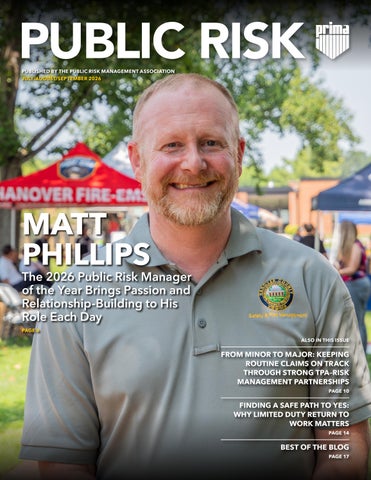
PUBLISHED BY THE PUBLIC RISK MANAGEMENT ASSOCIATION JULY/AUGUST/SEPTEMBER 2026
MATT PHILLIPS
The 2026 Public Risk Manager of the Year Brings Passion and Relationship-Building to His Role Each Day PAGE 6
ALSO IN THIS ISSUE
FROM MINOR TO MAJOR: KEEPING ROUTINE CLAIMS ON TRACK THROUGH STRONG TPA–RISK MANAGEMENT PARTNERSHIPS PAGE 10
FINDING A SAFE PATH TO YES: WHY LIMITED DUTY RETURN TO WORK MATTERS
PAGE 14
BEST OF THE BLOG
PAGE 17
The Public Risk Management Association promotes effective risk management in the public interest as an essential component of public administration.
JULY/AUGUST/SEPTEMBER 2026 | Volume 42, No. 3 | www.primacentral.org
CONTENTS
PRESIDENT Jennifer Hood, COSS Safety & Risk Director Montgomery County Government PAST PRESIDENT Steve M. LePock, II Risk Manager Virginia Beach City Public Schools PRESIDENT-ELECT Robert Warren, CRM Manager, Risk and Safety Trinity River Authority of Texas DIRECTOR Sherri Adams Risk Manager City of Kansas City Cathie T. Chancellor, JD, MS, CRM Risk Manager City of Norfolk Joe Costamagna, ARM Risk Manager Schools Insurance Authority
6
MATT PHILLIPS
Jeffrey L. Green, ARM-P Risk Manager County of Larimer Jamee Higgins, CRM Risk and Safety Manager City of Midland Michelle Jordan, CWCP Manager, Risk, Benefits & Compliance Clayton County Water Authority
The 2026 Public Risk Manager of the Year Brings Passion and Relationship-Building to His Role Each Day By Nick Baker
NON-VOTING DIRECTOR Jennifer Ackerman, CAE Chief Executive Officer Public Risk Management Association Alexandria, VA EDITOR Nick Baker 703.528.7701 nbaker@primacentral.org ADVERTISING Nick Baker 703.528.7701 nbaker@primacentral.org
10
From Minor to Major: Keeping Routine Claims on Track Through Strong TPA–Risk Management Partnerships
14
Finding a Safe Path to Yes: Why Limited Duty Return to Work Matters By Lori Newhouse
By Viviane Ruiz
17
Public Risk is published 4 times per year by the Public Risk Management Association, 700 S. Washington St., #218, Alexandria, VA 22314 tel: 703.528.7701 • fax: 703.739.0200 email: info@primacentral.org • Web site: www.primacentral.org Opinions and ideas expressed are not necessarily representative of the policies of PRIMA. Subscription rate: $140 per year. Back issue copies for members available for $7 each ($13 each for non-PRIMA members). All back issues are subject to availability. Apply to the editor for permission to reprint any part of the magazine. POSTMASTER: Send address changes to PRIMA, 700 S. Washington St., #218, Alexandria, VA 22314. Copyright 2026 Public Risk Management Association
Best of the Blog: Leadership Through the Eyes of Horses and Rethinking Police Vehicle Pursuit Policies
IN EVERY ISSUE | 3 PRESIDENT'S MESSAGE | 4 NEWS BRIEFS | 20 ADVERTISER INDEX
JULY/AUGUST/SEPTEMBER 2026 | PUBLIC RISK
1
BIG IDEAS. SMALL SETTING.
PRIMA INSTITUTE 2026 The Industry’s Premier Risk Management Educational Program
October 19–23 // Old Town Alexandria, VA PRIMA Institute 2026 (PI26) is an innovative educational symposium comprised of fundamental risk management curriculum, outstanding faculty, and excellent networking opportunities. PI26 is aimed at new and seasoned risk management professionals who want to learn more about emerging trends and best practices.
MESSAGE FROM PRIMA PRESIDENT JENNIFER HOOD
T
Serving to Lead: Reflections from PRIMA’s 2026 Annual Conference
he 2026 PRIMA Annual Conference in Fort Lauderdale, Fla., was a remarkable gathering of public risk management professionals from across the country. Throughout the week, attendees participated in outstanding educational sessions, shared innovative ideas, built meaningful connections, and celebrated the profession that plays such a critical role in protecting our communities. An event of this caliber does not happen without the dedication and support of many individuals and organizations. On behalf of PRIMA, I extend my sincere gratitude to our exceptional PRIMA staff, whose hard work behind the scenes ensured a successful and seamless conference experience. Thank you to the PRIMA Board of Directors for your leadership, vision, and commitment to our members. We are also deeply grateful to our corporate sponsors, whose partnership helps make these opportunities possible, as well as our speakers who generously shared their expertise and our exhibitors who showcased innovative solutions and engaged with attendees throughout the week. One of the highlights of the conference was the recognition of Matt Phillips as the 2026 PRIMA Risk Manager of the Year. This prestigious honor reflects Matt’s unwavering commitment to excellence, his leadership within the profession, and his dedication to advancing public risk management. His achievements serve as an inspiration to risk professionals everywhere and exemplify the impact one individual can have through service, vision, and hard work. As I shared during my inaugural speech, some of my earliest lessons about leadership came
Leadership begins with service. Sometimes we help others who feel stuck. Sometimes we sort through challenges and opportunities. Sometimes we shake things up when change is needed. And sometimes, we become the catalyst for transformation. from making peanut brittle growing up in private school. At four years old, my job was simply to butter the pans. As I grew older, I took on new responsibilities—sorting peanuts, teaching younger children, and helping spread the brittle evenly. But the job everyone wanted was adding baking soda. With one simple ingredient, the brittle transformed into something better than it had been before. Looking back, those experiences taught me lessons that still guide me today. Leadership begins with service. Sometimes we help others who feel stuck. Sometimes we sort through challenges and opportunities. Sometimes we shake things up when change is needed. And sometimes, we become the catalyst for transformation. Our profession needs leaders who are willing to serve first and who are not afraid to be the “baking soda”—the force that helps organizations grow, adapt, and become something even better. That is where true leadership begins. Many of PRIMA’s most respected leaders began their journeys by raising their hands to help. Through service, they gained experience, expanded their perspectives, and discovered ways to make a lasting difference. Leadership is not defined by a title; it is earned through a
willingness to contribute, support others, and advance a shared mission. The learning and professional development opportunities do not stop with the Annual Conference. PRIMA members are encouraged to continue investing in their growth by attending the PRIMA Institute (PI), taking place October 19–23, 2026, in Alexandria, VA. PI provides an immersive educational experience designed to deepen technical knowledge, strengthen leadership skills, and connect participants with experts and peers from across the public risk management profession. Whether you are new to risk management or a seasoned professional, the Institutes offer practical tools and insights that can immediately benefit your organization and your career. Join your fellow risk professionals at PI, go to PrimaCentral.org/ PRIMAInstitute to register. Again, thank you to everyone who attended this year’s conference. I am so humbled and excited to take this journey with you this year and cannot wait to see you all in New Orleans in 2027. Make the peanut brittle! Sincerely,
Jennifer Hood 2026-2027 PRIMA President
JULY/AUGUST/SEPTEMBER 2026 | PUBLIC RISK
3
NEWS BRIEFS
NEWS Briefs
STUDY: MORE INVESTMENT NEEDED IN PRESCRIBED BURNS, FOREST THINNING By Velvet Wu, The Sacramento Bee Researchers at UC Davis found that fuel treatments — including forest thinning, prescribed burns and removal of excess vegetation — can prevent billions of dollars in damage while also reducing wildfire severity. As firefighters continue to work to contain the Putah Fire, an escaped prescribed that has charred more than 800 acres, a study published by UC Davis researchers found that greater investment in treatments such as prescribed burns may be needed to effectively reduce wildfire damage. The researchers found that underused strategies known as fuel treatments — including forest thinning, prescribed burns and removal of excess vegetation — can prevent billions of dollars in damage while also reducing wildfire severity. “There’s a strong case to be made to sort of increase treatments in order to really make a bigger dent in this, the annual cost of wildfires,” said Frederik Strabo, the lead author of the study, which was published last month in the journal Science. The scientists’ work was the first large-scale study to assess the economic value of U.S. Forest Service fuel reduction treatments across the West using historic wildfire data. The UC Davis team analyzed data from nearly 300 wildfires across 11 states between 2017 and 2023 that encountered forest areas that had undergone fuel reduction treatment. They found that, on average, fires were more than 13% less likely to continue spreading immediately after encountering treated areas and avoided an estimated $2.8 billion in damages, including losses to buildings, carbon
4
dioxide emissions, and health and economic impacts, demonstrating the financial benefits of fuel treatments. Despite growing consensus in the scientific community about the effectiveness of fuel treatments in reducing wildfire damage, there had been little evidence of their economic value before the team’s study, Strabo said. He explained that uncertainty about the costeffectiveness of fuel treatments contributes to their underuse, emphasizing that scientifically proving the treatments’ economic value is important to agencies with limited budgets.
Fire’s Sonoma-Lake-Napa Unit, the Putah burn had been planned since 2018 after the area experienced four consecutive years of large wildfires that each burned thousands of acres. In 2014, the Monticello Fire burned 6,600 acres. The following year, the Rag Fire burned 8,000 acres. In 2016 and 2017, fires burned 5,700 acres and nearly 2,400 acres, respectively. Because all four fires were caused by vehicle malfunctions that ignited vegetation along roadsides, the burn was prescribed to reduce the risk of similar fires spreading into surrounding vegetation, Isham said.
“If they have a better understanding of whether or not those treatments pay off, that’s like the first step in sort of incentivizing them to increase the pace and scale of fuels treatments,” he said.
He emphasized that no structures were damaged and that Cal Fire is committed to containing the fire, but encouraged area residents to remain alert.
Escaped burns such as the Putah Fire are rare. A study of prescribed burns conducted in 16 of California’s 35 air districts that consistently reported burns between 2013 and 2020 found that only 1.76% escaped containment.
Read the full article at https://www.govtech. com/em/preparedness/study-more-investmentneeded-in-prescribed-burns-forest-thinning
According to Ryan Isham, deputy chief of Cal
PUBLIC RISK | JULY/AUGUST/SEPTEMBER 2026
This article appeared on GovTech.com and is reprinted with permission.
THIS NEW ENGLAND CITY HASN’T HAD A TRAFFIC DEATH IN THREE YEARS By Jared Brey, Governing Somerville, Mass., officials say their success is rooted in tried-and-true best practices for traffic safety.
and bus lanes and stepped up ticketing for distracted driving.
The city of Somerville, Mass., recently hit a milestone. Three years have passed since anyone died in a traffic collision on its streets.
The city is “emerging as a national Vision Zero leader,” says Maha Aslam, the transit and streets program manager at LivableStreets, an advocacy group based in Cambridge, Mass. LivableStreets recently published a report assessing the last decade of Vision Zero work in Somerville, Cambridge and Boston. It praised Somerville’s approach to community engagement around traffic-calming projects, which involves working closely with communitybased advocacy groups and being firm about making safety a priority over other goals.
That streak of fatality-free years overlaps with other trends in street safety. The overall number of crashes has gradually shrunk for the last three years, while serious traffic injuries decreased by 50 percent last year. The number of pedestrian and bike collisions are both trending downward over the last decade. It’s a stark contrast to what’s been happening in other parts of the country. In the years since the pandemic, American streets have become more dangerous, reversing years of improvements. In 2022, pedestrian deaths around the country hit a 40-year-high amid an increase in speeding and distracted driving. Pedestrian deaths have ticked downward again since then, but remain about 20 percent higher than they were in 2016, according to the Governors Highway Safety Association. Overall traffic deaths peaked at the beginning of the pandemic as well, with nearly 47,000 deaths in 2021, up from a recent low of about 35,400 in 2014, according to the National Safety Council. There were 42,789 traffic deaths in the U.S. in 2024.
“That approach is very, very effective. It helps communities build their expectations around how their feedback will be used,” Aslam says. Somerville officials acknowledge that the strategies they’re using aren’t unique or original. It’s the same playbook being used in Hoboken, N.J., another small, transit-rich city that has gone more than nine years without a traffic death. It incorporates many of the trafficcalming strategies promoted by the National Association of City Transportation Officials. “As a city we can never guarantee that something tragic isn’t going to happen, but we can reduce the chances,” says Somerville Mayor Jake Wilson.
Last year alone the city installed more than 70 traffic-calming features on its streets, including speed humps and painting stripes on crosswalks to increase visibility. It has monitored the impact of its infrastructure projects using automatic traffic recorders, and found many of them, particularly speed humps, to be effective at reducing vehicle speed, which is the primary cause of traffic injuries and deaths. On several streets, the city’s projects resulted in massive reductions in speeding, sometimes almost eliminating it. More than 80 percent of all vehicles were clocked above 25 miles per hour on parts of Cameron Avenue before a trafficcalming project was installed, according to a city report; after the project was completed, only 2 percent of cars exceeded the speed limit. “Speed kills,” says Brad Rawson, the city’s director of mobility. “Signage and posted regulations can keep honest people honest. But physical traffic calming, meaning designing streets that are relatively narrow and cannot be driven comfortably fast … those are the things that are moving the needle.” Read the full article at https://www.governing. com/infrastructure/this-new-england-cityhasnt-had-a-traffic-death-in-three-years This article originally appeared in Governing magazine and is reprinted with permission.
Somerville officials are pleased that their indicators of street safety are going in the right direction. They’re not exactly surprised. Since the city officially committed to Vision Zero in 2017, signing on to a global campaign to eliminate traffic deaths, it has gradually built out a strategy for reducing traffic collisions based on best practices in roadway design and enforcement. Interventions that naturally force drivers to slow down to navigate the roadway have been found to be much more effective than simple enforcement measures or education campaigns. Somerville has lowered speed limits all over the city, repainted and shortened crosswalks to reduce the amount of time pedestrians are in the roadway, added new speed humps, fixed sidewalks, expanded its bike-lane network, installed new bus stops
JULY/AUGUST/SEPTEMBER 2026 | PUBLIC RISK
5
MATT PHILLIPS THE 2026 PUBLIC RISK MANAGER OF THE YEAR BRINGS PASSION AND RELATIONSHIP-BUILDING TO HIS ROLE EACH DAY BY NICK BAKER, PRIMA
6
PUBLIC RISK | JULY/AUGUST/SEPTEMBER 2026
S
IMPLY PUT, MATT’S NOT A NINE-TO-FIVE PERSON. He lives and breathes safety and risk management.” That’s how Cathy Dickensheets, human resources director for Hanover County, VA, describes Matt Phillips, the 2026 PRIMA Public Risk Manager of the Year Award (PRMY) recipient.
JULY/AUGUST/SEPTEMBER 2026 | PUBLIC RISK
7
MATT PHILLIPS: 2026 PUBLIC RISK MANAGER OF THE YEAR
Under Matt’s leadership, his department implemented a range of programs focused on loss prevention and
control, like conducting safety and
risk assessments of all 24 schools and
high-risk departments, launching a fleet telematics pilot, and enhancing driver
“The opportunity to create lasting organizational improvements and help public entities better serve their communities is what continues to make this profession rewarding for me,” he said. Since joining Hanover County, Matt has developed a risk management program that shifted the county from a reactive to a proactive model. By being laser-focused on preventing claims and reducing costs, the county has seen noticeable results: •
The workers’ compensation loss ratio has been reduced from 200 percent to 62 percent.
•
Auto and property losses reduced from approximately $1.3 million in FY24 to approximately $141,000 in FY25.
•
Fire and EMS injuries have been reduced by 43 percent and lost-time days reduced by 56 percent.
training initiatives. He also expanded training like CPR/First Aid, defensive
driving, heat illness prevention, and more. “Matt is an incredible partner. The scope of work he’s responsible for is vast,” said Meredith Parker, Assistant Superintendent of Human Resources for Hanover County Public Schools. Located just north of Richmond, VA, Hanover County has nearly 110,000 residents, while the Hanover Public Schools system has more than 17,000 students. Matt’s role encompasses a variety of responsibilities, including administering workers’ compensation and safety programs, overseeing incident reporting and claims analytics, developing and implementing loss prevention programs, and coordinating training and compliance efforts. Matt has served as the safety and risk manager for Hanover County Government and Public Schools since 2021. Before working for Hanover County, he was employed with Dominion Energy for more than 14 years as a safety consultant. Matt said he chose public risk management as a career because it offers a unique opportunity to combine
8
strategic leadership, program development, and public service. “I enjoy building programs that help organizations proactively identify and address risks before they become problems,” he explained. “I’m passionate about fostering a culture where risk awareness, safety, and accountability are embedded into everyday decision-making rather than treated as separate initiatives.” Fonda Craig, senior safety consultant with the Virginia Risk Sharing Association, said, “When Matt came to Hanover County, he met with the various departments to gain an understanding of their operations and their exposures and challenges. In doing so, he was building those relationships, building trust, and improving communications. And what we’re seeing is a shift in the safety culture.” Matt said that public risk management allows him to work across an entire organization, helping departments solve challenges, improve operations, and achieve their goals while protecting people and resources.
PUBLIC RISK | JULY/AUGUST/SEPTEMBER 2026
Under Matt’s leadership, his department implemented a range of programs focused on loss prevention and control, like conducting safety and risk assessments of all 24 schools and high-risk departments, launching a fleet telematics pilot, and enhancing driver training initiatives. He also expanded training like CPR/First Aid, defensive driving, heat illness prevention, and more. “Whether it’s implementing an enterprise risk management framework, enhancing safety programs, reducing claims, or improving operational resilience, it’s rewarding to see the long-term impact of those efforts on employees, leadership, and the community we serve,” he said. Hanover County saw a 71 percent reduction in its total recordable incident rate and a 50 percent reduction in total injuries in schools from FY23 to FY24. Additionally, the county has achieved a hazard and risk correction rate exceeding 50 percent for items identified during proactive safety and risk assessments, improving performance and reducing claims across multiple lines. “I’ve worked with five different public risk managers and have friends at fire departments
Matt Phillips speaks to fellow risk managers at PRIMA26 in Fort Lauderdale after accepting the 2026 PRMY Award. "Public risk management is a team effort," he said.
throughout the nation. I don’t see or hear of the state, county, or city risk managers engaging with their fire departments as much as I do with Matt at all levels,” said Hanover Fire & EMS Battalion Chief Matt Rice.
means the most to me is that it highlights the importance of risk management in supporting organizational success, protecting employees, and serving our communities.”
Matt said his favorite part of risk management is creating positive organizational change. “I enjoy bringing people together from different departments to solve problems, improve processes, and develop solutions that make organizations safer, stronger, and more effective,” he said.
Public Works Director Randy Harmon said Matt has brought a proactive work culture to his department that’s helped his team feel more comfortable with safety and risk staff members visiting their locations. “Instead of them (public works staff) feeling like they’re going to get caught or get in trouble for something, it’s really a collaborative partnership.”
Matt said that being named the PRMY has been a humbling experience, but that the honor doesn’t belong to just him.
“Matt’s extremely knowledgeable. He loves safety,” Parker said. “I’ve never met someone who gets that excited about safety and prevention.”
“Public risk management is a team effort, and this recognition reflects the commitment of the many employees, leaders, and colleagues I’ve had the opportunity to work with throughout my career,” he said. “While it is gratifying to be recognized by peers in the profession, what
Matt said the best risk managers are not just technical experts – they’re trusted advisors who understand how the organization works and can help leaders make informed decisions. He recommends that risk managers just starting their careers should take the time to learn from
employees at all levels and seek opportunities to broaden their knowledge. “Success comes from building trust, communicating effectively, and helping others achieve their goals while managing uncertainty,” he said. “If you approach the profession with a service mindset and a commitment to continuous improvement, you’ll have the opportunity to make a meaningful impact.”
SCAN TO WATCH MATT PHILLIPS’ PRMY VIDEO
JULY/AUGUST/SEPTEMBER 2026 | PUBLIC RISK
9
FROM MINOR
TO MAJOR: Keeping Routine Claims on Track Through Strong TPA–Risk Management Partnerships BY VIVIANE RUIZ, DAVIES
10
PUBLIC RISK | JULY/AUGUST/SEPTEMBER 2026
A
SPRAIN TODAY SHOULDN’T BECOME A SURGERY NEXT YEAR. Yet in public sector workers’ compensation, routine claims can easily drift without early, coordinated support.
systems benefit from intentional coordination to keep routine claims moving in the right direction.
Catastrophic claims are costly and complex, but they are generally governed by clear operational controls. Routine claims, by contrast, are more likely to grow unchecked and drive longterm cost and disruption. These are the back strains, hallway slips and shoulder injuries that should resolve quickly—but sometimes don’t. These claims don’t derail overnight. They evolve gradually. And in environments as complex as public entities, even well-managed
WHY DOES MY ORGANIZATION NEED TO HELP INJURED EMPLOYEES SOONER RATHER THAN LATER? Most high-cost claims begin as straightforward injuries. What shifts their trajectory is rarely a single misstep. More often, it’s a series of small, understandable gaps: reporting delays, unclear medical direction, extended time away from work, or treatment plans that continue longer than clinically necessary. Individually, these decisions are reasonable. Over time, they
JULY/AUGUST/SEPTEMBER 2026 | PUBLIC RISK
11
FROM MINOR TO MAJOR
Timely triage, appropriate medical access, and early clinical oversight help ensure routine injuries follow conservative, recovery-focused treatment paths. can unintentionally reshape expectations and recovery paths. Public employers also operate within unique constraints. Union agreements, rigid job classifications and limited transitional duty options can narrow flexibility. Supervisors may be cautious about engagement, and job descriptions may not always reflect operational realities. Without early alignment, routine claims can gradually take on added complexity—often with avoidable consequences. This is where thoughtful collaboration between risk management and the TPA becomes especially valuable.
HOW FAST SHOULD MY ORGANIZATION INTERVENE FOR AN INJURED TEAM MEMBER?
The first seven-to-10 days of a claim are when strong internal protocols make the greatest difference. Early, intentional action—through aggressive reporting standards, clear supervisor expectations, prompt triage and active adjuster engagement—helps prevent routine claims from drifting before risk patterns take hold. AI-supported pattern recognition can add an additional layer of insight during this period, helping identify subtle signals that a claim may be beginning to creep. Used appropriately, these tools reinforce existing controls by highlighting patterns that warrant closer attention, while human judgment and established processes remain central to decision-making. Timely triage, appropriate medical access, and early clinical oversight help ensure routine
12
injuries follow conservative, recovery-focused treatment paths. Pharmacy oversight also plays a critical role, as short-term prescriptions can unintentionally extend beyond their intended use without early review. Early engagement isn’t about pressure—it’s about alignment.
WHAT INJURIES OR CONDITIONS DOES EARLY INTERVENTION HELP WITH MOST?
Below are some of the most frequent injuries and medical conditions where early support can significantly improve outcomes: MINOR HEAD INJURIES About 2.8 million new brain injuries occur annually in the United States. Early invention can help employees prevent non-traumatic brain issues (like concussions) from progressing into more serious complications. EXPOSURE RISKS Some employees regularly interact with high-risk groups or work in shared environments, increasing their susceptibility to airborne or bacterial infections like MRSA or tuberculosis. Proper education, guidance, monitoring, and treatment—or any combination thereof—help with both prevention and intervention. PAIN MANAGEMENT & ADDICTION SUPPORT Pain medications, especially opioids, play a major role in overdose deaths—accounting for nearly 76 percent of fatalities in 2023. This is where consistent monitoring and flagging of potential warning signs come into play, such
PUBLIC RISK | JULY/AUGUST/SEPTEMBER 2026
as medication usage that may exceed what’s necessary or safe. CATASTROPHIC CARE Roughly 11 million U.S. adults experience catastrophic medical events each year. This can include multiple traumatic injuries, third-degree and chemical burns, amputations, paralysis, strokes, severe puncture wounds, and other life-altering conditions. For any of these instances, immediate intervention and ongoing case management are critical to improving both short- and long-term outcomes.
WHAT HAPPENS IF MY ORGANIZATION DOESN’T INTERVENE FAST ENOUGH?
In the U.S., employers are responsible for paying indemnity benefits when employees miss work due to job‑related injuries. This typically amounts to covering two‑thirds (66.67%) of the injured worker’s regular wages. Because the average workers’ compensation leave lasts around six months, the financial impact can be significant. Employers may also incur additional costs if they need to pay overtime or bring in temporary staff to handle the absent employee’s responsibilities. On top of that, future insurance premiums can rise as carriers adjust rates to account for these increased expenses.
HOW CAN I HELP AN INJURED TEAM MEMBER RETURN TO WORK? Return-to-work remains one of the most effective tools for improving claim outcomes in the public sector. Injured employees recover three times faster with modified duty, but it
can be hard for you to determine on your own how to accommodate your employee’s short- or long-term needs. Limited or modified duties, when thoughtfully structured, can shorten disability duration and reduce dispute risk. An employee’s supervisor, supported with clear guidance, plays an important role in reinforcing recovery expectations. This is where third-party administrators (TPAs) experienced in Return-to-Work can help. Some TPAs have teams in place to provide personalized programming for each employee vs. a one-size-fits-all approach. They will work with both you and your employee to see what’s possible for duties that can be performed, whether that’s on-site or off-site. This helps keep your employees engaged in both your company and their recovery. In situations where it’s determined there is no existing job that fits their new needs, a TPA might offer job assessment, vocational coaching or placement assistance with a different employer.
EARLY INTERVENTION CASE STUDY: FEMORAL NECK FRACTURE
A 61-year-old electrician/foreman suffered a significant femoral neck fracture after falling five feet into a dumpster while retrieving equipment. He required ambulance transport and emergent surgical repair via closed reduction percutaneous pinning (CRPP). Early nurse case management ensured seamless post-operative care by coordinating prompt orthopedic follow-up, providing recovery education, arranging physical therapy, reinforcing safe mobility practices, and maintaining close communication with the employer to support a safe return to work. By eight weeks post-injury, the employee had fully recovered—completing all therapy, returning to work two weeks earlier, walking four miles daily, and preparing to resume running. Final Outcome: zero impairment, no permanent disability, no future medical needs, and a full return to pre-injury function.
Early case management drove both clinical and financial success by preventing treatment delays, avoiding unnecessary referrals, and facilitating an early return to work that reduced wage-loss exposure and supported rapid, cost-effective claim closure.
AI-enabled early pattern identification— routine claims are far more likely to stabilize and resolve efficiently. Routine injuries don’t have to become major claims. With structure, partnership and early coordination, they can remain exactly what they were meant to be—routine.
QUESTIONS TO ASK A TPA ABOUT EARLY INTERVENTION STRATEGIES
When you’re working with or looking to work with a TPA, ask what services they offer to support early intervention.
Viviane Ruiz is President of Workers’ Compensation, Casualty & Managed Care with Davies Group.
This can include supports such as 24/7 intake, rapid response triage, clinical oversight, direct communication with the claims adjuster, a case management team, comprehensive medical provider options, pharmacy utilization reviews, robust return-to-work programming, employee self-help resources, built-in tools to identify early red flags, and more. Other specific questions you can ask a TPA to ensure you are aligned: • Do their goals align with your organization’s risk management strategy? • What are their KPIs to measure success effectively? • What level of reporting and data access do they make available? • How are they proactive in identifying and communicating potential issues? • How do they leverage analytics and automation to improve outcomes? • How are they compliant with regulatory requirements? • What are their internal controls to prevent errors or fraud? • What is their responsiveness during critical incidents? When TPAs and risk management teams operate as true partners—combining strong early protocols, proactive medical and pharmacy strategies, thoughtful return-towork planning, empowered supervisors and
JULY/AUGUST/SEPTEMBER 2026 | PUBLIC RISK
13
FINDING A SAFE PATH TO YES: Why Limited Duty Return to Work Matters BY LORI NEWHOUSE, M.ED., CRC, CCM, SEDGWICK
I
N WORKERS’ COMPENSATION and absence management, the instinct is to focus on what the injured employee can’t do, but the more productive focus, not to mention the one that drives more impactful outcomes, is what they can do.
14
This shift to thinking about how to create a safe and practical way for an employee to return to work is the essence of finding a safe path to yes for limited-duty return to work (RTW). Done correctly, this opens the door to earlier recovery, stronger engagement, and a smoother road back for both the employee and the organization.
PUBLIC RISK | JULY/AUGUST/SEPTEMBER 2026
A safe path to yes begins with the understanding that work, when properly matched to medical restrictions, can be therapeutic and a key part of the healing process. Whether your organization calls it transitional work, modified work, or ‘light duty,’ the goal is the same: keep injured employees connected to the workplace or get them back as soon as
employees sense that modified work is seen as a burden, it undermines the whole effort. But when the culture frames it as a genuine bridge back to work, trust follows, and that, in RTW, is what actually moves people forward.
medically appropriate. The U.S. Department of Labor has also reinforced that early stay-atwork and RTW strategies assist in reducing the personal, operational, and economic costs associated with extended absence. The RTW process is often treated as an either/or scenario, with very little gray space. However, this approach misses an important opportunity that a thoughtful limited duty program can provide. By acknowledging that many employees are interested and capable of contributing meaningfully during recovery if the work is aligned to restrictions, monitored regularly, and adjusted as healing progresses, unnecessary barriers are removed to safe re-engagement. This is not about rushing people back before they are ready, but it is about making room for progress and ongoing momentum. For injured or ill employees, a safe path to yes can preserve routine, income stability, confidence, and connection to the workplace. Long absences often create additional stressors in the form of social isolation, fear about job security, loss of professional identity, and anxiety about whether returning will be harder. Limited duty can counter those pressures by offering a bridge back to productivity. For employers and claims partners, the advantages are equally significant, as they can see shorter disability duration, lower claim costs, reduced litigation risk, stronger retention, and a visible demonstration that employee well-being is more than a slogan. Industry guidance consistently notes that strong RTW programs support recovery
while also reducing operational disruption and workers’ compensation or disability exposure. The path to yes only has value if a disciplined process is followed to ensure the path is truly safe. First, decisions must be grounded in medical restrictions supplied by the employee’s provider and in the accurate assignment of limited-duty tasks. Functional job analysis and well-defined task descriptions help all parties involved identify work that is both productive and appropriate. Second, communication must be timely and consistent. Employees need to understand that limited duty is a support strategy, not a test of toughness. Supervisors need training on adhering to restrictions without stigma or skepticism, while medical providers must rely on information about available tasks to make realistic recommendations. Third, the plan must be temporary, purposeful, and regularly reviewed, given that restrictions can change and capacities can improve, meaning that assignments should evolve accordingly. The safest RTW programs are those that monitor progress closely and adjust before problems arise. Culture is often the invisible factor that separates successful RTW programs from others. The difference lies in leadership’s ability to have done the thinking before the injury happens. Those who consistently find a path to yes treat limited duty as a standing capability, not a case-by-case scramble. They’ve already identified transitional tasks, trained their supervisors, and set a tone that recovery and productivity aren’t mutually exclusive. When
Shifting from a wait-until-healed approach to a remain-at-work culture does not require high cost or lengthy implementation timeframes. In many organizations, the change starts slowly as leaders, supervisors, and employees pilot new processes, build confidence in modified duty options, and begin to see that productive work can safely coexist with recovery. Early on, progress may feel incremental, but once employees experience the benefits of staying engaged in safe work activity. As they continue to heal, supervisors will see that these arrangements can be sustainable, and the pace of adoption often accelerates. Over time, what once felt like an exception becomes the new normal. Injured employees will stay connected to work, supervisors will develop a habit of looking for safe ways to accommodate restrictions, and remain-at-work strategies will subtly shift from special intervention to standard practice of recovery and maintaining workforce stability. Another critical part of a path to yes is collaboration beyond the four walls of the employer. When internal supervisors are struggling to identify appropriate temporary tasks, employers can work with managed care partners, vocational experts, nurse case managers, TPAs, and RTW vendors to build a broader menu of suitable assignments. Those partners can then translate medical restrictions into practical work options, identify task banks that may not be obvious to frontline leaders, and match recovering employees to temporary duties that are meaningful rather than symbolic. This kind of collaboration matters because it turns limited duty from a reactive scramble into a structured problemsolving process. It also improves consistency by ensuring that restrictions are respected,
JULY/AUGUST/SEPTEMBER 2026 | PUBLIC RISK
15
FINDING A SAFE PATH TO YES: WHY LIMITED DUT Y RETURN TO WORK MATTERS
Culture is often the invisible factor that separates successful RTW programs from others. The difference lies in leadership’s ability to have done the thinking before the injury happens. assignments are documented clearly, and transitional work supports recovery instead of creating additional avoidable risk. Guidance on transitional RTW programs consistently points to planning, accurate job analysis, and insurer or claims-partner involvement as key enablers of successful modified duty. There are also times when the safest and most productive answer is not an immediate return to the employer’s worksite. If the organization cannot reasonably accommodate temporary restrictions, nonprofit-based or off-site transitional duty can provide an important alternative. For employees who can’t yet return to their own workplace, some RTW vendors offer an alternative through time-limited placements with community organizations. These assignments keep employees active and engaged, preserve routine, and align the work to whatever they’re capable of doing during recovery. Across many industries where worksite placements are challenging or non-existent, such as construction or trucking, RTW programs describe nonprofit placements as a practical way to reduce disability duration when onsite accommodation is not available. Used thoughtfully, these options reinforce the path to yes’s central message that if the original workplace is not the right setting today, the answer does not have to be “no.” It can still be a safe, medically appropriate, and productive “yes” somewhere else for a period of time. One of the most overlooked strengths of an effective limited duty program is the willingness to be creative with temporary tasks. Employers sometimes assume that if a recovering employee cannot perform the full scope of their regular job, there is
16
little meaningful work available. However, most businesses have an ongoing list of important tasks for the operation, but are not formally owned by one person, are repeatedly deferred because of competing priorities, or are completed inconsistently because they fall outside core production demands. This is where creativity becomes a competitive advantage. The strongest remain-at-work programs will address both questions: “What is this employee temporarily unable to do?” and “What valuable work exists that would benefit the organization if someone had the time and capacity to focus on it?” Guidance on transitional work consistently emphasizes the value of real job duties, functional job analysis, and early intervention. Still, in practice, the most successful programs go a step further and build a task mindset. That means looking across departments for work that improves service, supports compliance, strengthens safety, reduces backlog, organizes information, or prepares the business to run more efficiently tomorrow than it did yesterday. Transitional work is specifically intended to use real duties for a limited period to help workers remain at work or return as soon as medically possible. At the same time, national stay-at-work and return-to-work guidance similarly stresses that timely, effective work participation helps improve outcomes on the cost and employment front. When employers are creative about temporary assignments, they make that principle operational. They turn limited duty from a narrow accommodation exercise into a practical strategy for capturing work that matters. The possibilities are broader than many supervisors first realize. In almost any business,
PUBLIC RISK | JULY/AUGUST/SEPTEMBER 2026
some orders need to be expedited, follow-up calls to be made, inventory to be done, safety videos to review, file organization needed, forms that need to be updated, training materials that need to be assembled, records that need scanning, quality checks that need to be documented, and administrative loose ends that quietly drain efficiency when no one has time to address them. A recovering employee may be able to help with all of these and alleviate an ongoing list of to-dos that disrupt daily operations. In some settings, they may also assist with orientation materials, equipment logs, data entry, incident documentation, policy acknowledgments, or workplace housekeeping tasks that improve readiness and consistency. None of these assignments are “make-work” when they solve real business problems, and they often create value that was previously hidden because the need was dispersed across teams and never elevated into a formal role. Creative temporary tasking also helps preserve dignity for the employee. Instead of feeling sidelined, the worker sees that the organization is making a good-faith effort to keep them engaged in productive and purposeful activity in a safe environment. Supervisors benefit as well, because they begin to view restricted duty less as a disruption and more as an opportunity to complete neglected but meaningful work. Over time, this mindset strengthens the remain-at-work culture and reinforces the idea that contribution can take many forms during recovery. It also shows that the organization is committed to finding practical ways for employees to stay connected while continuing healing without being unnecessarily removed from the workplace. Ultimately, limited duty RTW is not just a claims tactic. It reflects how an organization values people during vulnerable moments. Finding a path to yes means asking, preparing earlier, and designing work that supports healing instead of postponing participation. When done well, it creates better outcomes for the injured worker, the employer, and the broader workforce. The goal is not simply to bring someone back, but to bring them back with a real opportunity to succeed. Lori Newhouse, M.Ed., CRC, CCM, is Senior Vice President, Clinical Operations, with Sedgwick.
BEST OF THE BLOG
LEADERSHIP THROUGH THE EYES OF HORSES AND RETHINKING POLICE VEHICLE PURSUIT POLICIES JULY/AUGUST/SEPTEMBER 2026 | PUBLIC RISK
17
BEST OF THE BLOG
LEADERSHIP THROUGH THE EYES OF HORSES BY MELISSA STEGER, WORKCOMPCOLLEGE.COM Risk management and horsemanship may seem worlds apart, yet both rely on the same principles: awareness, preparation, and trust. Horses are highly attuned to subtle changes in their environment and respond quickly to uncertainty or inconsistency. Risk managers operate in a similar space, constantly scanning for signals, anticipating disruption, creating stability, and responding quickly to issues. In both areas, success rarely comes from reacting after a problem appears. It comes from paying attention early and making thoughtful decisions before risk turns into consequence. My first experience as a solo horse owner taught me more about leadership than I expected. I used to believe that being clear, direct, and “right” was enough. In leadership and risk management, clarity matters. Standards matter. Accountability matters. But I’ve learned through both leading teams and working with my horses that it’s not the correction itself that builds or breaks trust.
What looks like alignment on the surface can actually be hesitation beneath the surface. That realization forced me to look inward. Boundaries are essential in every space with horses, leadership, and risk management. They create clarity and consistency. But when boundaries are delivered from frustration, fear, or control, they stop protecting the system and rather serve a selfish purpose. And demand without trust leads to defiant compliance at best and silence at worst. I’ve seen it in myself—moments where my correction was technically right, but relationally off. I solved the issue, but created a different kind of risk, leading to disengagement, hesitation, or reluctance to speak up. True risk management isn’t just about processes and controls. It’s about creating an environment where risks can be seen and shared early. And that requires emotional accountability.
It’s the energy behind it. Out at the barn, my horses don’t care about my role or responsibilities. They meet me exactly where I am. If I show up distracted or frustrated, they feel it immediately. And if I try to correct them without first checking myself, they don’t just resist, they disconnect. There have been moments in which I’m not proud. Times I’ve asked for something with more urgency than clarity. I may have gotten the behavior I wanted, but I could feel the shift. The brace. The hesitation. The loss of trust. My horses reflect not what I say, but how I show up. And a braced horse is a dangerous risk. One that is less aware, less connected, and more likely to react. I’ve come to see leadership the same way. In the workplace, we rely on feedback, performance management, and controls to mitigate risk. But if people don’t feel safe, they don’t speak up. And when information is withheld, risk doesn’t disappear; it quietly multiplies.
18
PUBLIC RISK | JULY/AUGUST/SEPTEMBER 2026
It requires me to pause before I respond. To set boundaries with clarity, not control. To say, “This doesn’t work,” without escalating energy. And just as importantly, to receive pushback or a “no” without taking it personally, because that’s often where the most valuable insight lives. My horses remind me of this every day. When one of them resists, it’s not defiance; it’s their way of communicating information. If I listen, the moment softens and the connection returns. If I push through, I may win in the moment, but I lose the relationship. And without the relationship, everything becomes harder, riskier, and potentially dangerous. The same is true in risk management and leadership. The most powerful risk management strategy isn’t found in a manual; it’s found in the quiet, consistent leadership that keeps people aligned and moving forward. Melissa Steger is Executive Vice President at WorkCompCollege.com.
Its recommendation is simply this: a highspeed pursuit should only happen if both of these conditions exist: 1. A serious violent felony has been committed 2. The suspect poses an immediate threat of committing another violent act if they are not stopped That means pursuits should not be happening for traffic violations, property crimes, or simple failure to yield. In most cases, the risks are too great. MOTORCYCLE PURSUITS: A SPECIAL RISK PERF’s report also emphasizes that motorcycle pursuits pose an especially great danger. Riders have little protection, so agencies are encouraged to prohibit or strongly discourage chasing motorcycles unless the threat is extreme, such as an active shooter fleeing. Similarly, officers on police motorcycles are generally advised not to engage in pursuits for their own safety.
RETHINKING POLICE VEHICLE PURSUIT POLICIES: PRIORITIZING SAFETY ON THE ROAD ASHLEY BONNER, TRIDENT PUBLIC RISK SOLUTIONS High-speed police pursuits have always carried serious risks, and in recent years, law enforcement agencies across the country have been rethinking how and when these chases should happen. While chasing a violent offender may sometimes be necessary, many pursuits actually start with minor violations. In 2023, the Police Executive Research Forum (PERF) released a landmark report stating police pursuits with fatal crashes kill more than one person every day1. That reality has pushed agencies to shift their focus toward one thing above all else: protecting human life. THREE TYPES OF PURSUIT POLICIES Most policies fall into one of three categories: Type A: Discretionary Officers have discretion to decide whether to initiate or continue a pursuit under a discretionary policy. It offers flexibility, but it also means officers must make high-pressure decisions in the moment – often with high adrenaline. Type B: Restrictive A restrictive policy allows pursuits only for
certain offenses, such as serious violent felonies. Supervisors keep a close eye on these chases to ensure the risks don’t outweigh the need to apprehend the suspect. Type C: Prohibitive Under prohibitive policies, pursuits are mostly off-limits except under extreme exigent circumstances. When they do occur, they must be tightly controlled and thoroughly justified. Nationwide, more and more agencies are moving toward restrictive or prohibitive approaches. The goal is simple: reduce unnecessary danger to officers and the public. THE REPORT THAT SHIFTED BEST PRACTICES A major turning point for police and sheriff departments is the previously mentioned report from the PERF, funded by the Department of Justice and the National Highway Traffic Safety Administration2. Because there are no national standards, this report is now considered one of the leading sources for modern pursuit guidelines.
USE OF FORCE AND NEW TECHNOLOGIES Modern pursuit policies also highlight the importance of clearly defining when certain tactics, like PIT maneuvers or stop sticks, can be used. Agencies are increasingly looking at alternatives as well. Tools like GPS-tracking darts, helicopters, and drones make it possible to monitor suspects without engaging in a dangerous, high-speed chase. A SAFER PATH FORWARD As technology advances and public expectations evolve, so do law enforcement policies. While catching dangerous criminals remains critical, pursuit policies today are moving toward a more thoughtful balance – one that prioritizes life, safety, and smarter policing. SOURCE: U.S. Department of Justice, Office of Community Oriented Policing Services. (2023). Vehicular pursuits: A guide for law enforcement executives on managing the associated risks. Police Executive Research Forum.
Ashley Bonner is Senior Risk Control Consultant with Trident Public Risk Solutions.
JULY/AUGUST/SEPTEMBER 2026 | PUBLIC RISK
19
ADVERTISER INDEX
ADVERTISER INDEX Evident. . . . . . . . . . . . . . . . . . . . . . . . . . . . . . . . . . . . . . . . . . . . . . . . . . . . . . . . . . . . . . . . inside front cover
HAS YOUR ENTITY LAUNCHED A SUCCESSFUL PROGRAM? An innovative solution
CALENDAR OF EVENTS PRIMA’s calendar of events is current at time of publication. For the most up-to-date schedule, visit www. primacentral.org.
to a common problem? A money-saving idea that kept a program under budget? Each
month, Public Risk features articles from practitioners like you. Share your successes with your colleagues by writing for Public Risk magazine! For more information, or to submit an article,
contact Nick Baker at nbaker@primacentral.org.
FIND US ON FACEBOOK! LINKEDIN!
PRIMA WEBINARS September 16 EPLI-CHROs and Other Employment Claims October 28 Roadway Safety, Defensive Driving, and Controlling Distractions November 18 Navigating Property Risk in Today’s Realities: Value Trends, Critical Asset Risks and Continuity Planning December 16 Artificial Intelligence and Digital Alerting: Essential Crash Mitigation Tools for Public Entities
PRIMA ANNUAL CONFERENCE June 13-16, 2027 PRIMA 2027 ANNUAL CONFERENCE New Orleans, LA Hyatt New Orleans
PRIMA INSTITUTE October 19–23, 2026 Old Town Alexandria, VA
ENTERPRISE RISK MANAGEMENT TRAINING December 1, 3, 7 and 9, 2026 Virtual
Keep up with what’s happening at PRIMA and connect with your risk management peers! Visit us at linkedin.com/company/prima-central/
20
PUBLIC RISK | JULY/AUGUST/SEPTEMBER 2026
PRIMA LEADERSHIP ACADEMY March 16-17, 2027 Alexandria, VA
2026 Register for PRIMA’s SEPTEMBER WEBINAR
FREE TO MEMBERS
EPLI-CHROs and Other Employment Claims SEPTEMBER 16 | 12:00 PM – 1:00 PM ET SPEAKERS: Ya’Sheaka C. Williams, Partner, Quintairos, Prieto, Wood & Boyer, P.A. Amanda Alexander, Partner/Owner, Alexander Law Join us for a focused session on navigating today’s complex employment-related risks and understanding how Employment Practices Liability Insurance (EPLI) can protect your organization. This webinar will highlight the key benefits of EPLI coverage, clarify the types of issues and claims these policies typically address, and walk you through best practices for responding to claims from regulatory agencies. Whether you’re looking to strengthen compliance or reduce organizational exposure, this session will offer practical insights you can use immediately. ATTENDEE TAKEAWAYS: 1. Benefit of having EPLI coverage 2. Educating on the issues/claims covered by EPLI policies 3. How to respond to claims from regulatory agencies
Register at primacentral.org/education/webinars
Create an ORGANIZATIONAL CULTURE that proactively MANAGES RISK
VIRTUAL SCHEDULE
ENTERPRISE RISK MANAGEMENT TRAINING DAY 1: DECEMBER 1 DAY 3: DECEMBER 7 12 – 2 PM EST 12 – 2 PM EST DAY 2: DECEMBER 3 DAY 4: DECEMBER 9 12 – 2 PM EST 12 – 2 PM EST
VISIT PRIMACENTRAL.ORG/ERMTRAINING