
©Teaching and Learning Case Studies
ISSUU Digital Publishing

Human influence on water efficiency: A story based on an innovation project with a hospital in Singapore
Sustainable Infrastructure Engineering (Building Services) Programme Singapore Institute of Technology, 10, Dover Drive, Singapore 138682
Corresponding Email: fadeyi.moshood@singaporetech.edu.sg
ABSTRACT
Water wastage caused by human behaviour can be largely due to human need or quest for comfort and convenience and lack or denial of awareness. Year 2 building services engineering students were tasked to conduct research that will inform the development of a solution that can potentially be used to reduce the negative effect of human behaviour on water consumption at Mouth Elizabeth Hospital, Singapore. The students were also required to write a story and made of video story based on the research to document and demonstrate how the research learning journey has developed their educational experience. The role of storytelling in developing the students’ critical and reflective thinking needed to induce learning to form an educational experience, i.e., knowledge, understanding, and practical and communication skills, was examined. The students developed the background knowledge and understanding required to fulfill the water efficiency innovation project requirement. A method of developing human capability for water-efficiency agenda achievement and providing the educational experience undergraduate students need in their journey to being job ready upon graduation is reported in this paper.
Keywords: Artistic research; Sustainability; Applied learning; Water efficiency; Innovation
PROLOGUE
Comfort, convenience, and the lack of awareness of humans have a deleterious effect on high water consumption. Humans often stay within their comfort zone, doing things at their convenience to remain in a state of freedom and physical and mental ease. However, humans often take things for granted as they do not feel the possible future consequences of their actions which could sprout a cascading effect. Unnecessary water usage can increase energy consumption used for water
Low S, Chian C, Low ZX, Low S, Nyiyaza T, and Fadeyi MO (2023). Human influence on water efficiency: A story based on an innovation project with a hospital in Singapore Teaching and Learning Case Studies #03 Sharleen Low, Casimir Chian, Zhen Xuan Low, Sherman Low, Tine Nyiyaza Students, project researchers, and story writers Moshood Olawale Fadeyi Module instructor, project designer and advisor, and story writing advisortreatment, leading to high volumes of burned fossil fuels released into the air, causing air pollution and climate change.
Singapore is considered one of the most water-stressed countries in the world and is heavily dependent on local catchments, imported water, NEWater, and desalinated water. She is ranked first in the Top Countries Facing Water Stress evaluation by the World Resources Institute with a rating of 5.0. But are Singaporeans willing to compromise their comfort and convenience in the preservation of the natural resources of their motherland? What can be done to ensure that their comfort and convenience remain uncompromised yet, simultaneously reduce water wastage?
“I want guys who will do critical and reflective thinking and come up with innovative and creative solutions that can impress me,” Professor Moshood said after delivering the task of having his students identify the specific human behaviour-related root causes contributing to high water consumption for a healthcare facility in Singapore. Stars shone in the students' eyes, and a team of members, Arthur, Jessie, and Andrew, was formed for the project. As the class ended, the newly founded team brainstormed ideas.
“Hmm... I have a friend from my previous school currently working at Mount Elizabeth Hospital. I will contact her and see if she can liaise with their facilities management team.” Arthur said as they were discussing the direction and plans for the project. Before conducting the zoom meeting, the team researched the various scenarios where water wastage could occur in the hospital. Places such as surgical rooms, kitchens, wards, toilets, and laboratories pose signs of water wastage.
Shortly after, Vincent from Mount Elizabeth’s facility management team got back to them, and they conducted a zoom meeting to discuss more on how the students can help to potentially reduce the high-water consumption in the hospital. A question was posed.
“Are you aware of any problems in your hospital that might be contributing to high water consumption?” Arthur asked Vincent during a virtual meeting through Zoom. Memories rush through his head as Vincent briefly recalls an incident that happened a few months ago.
Vincent was having his lunch break when a fellow hospital colleague came to his table carrying a tray of food. “May I sit?” Dr. Patrick Star looked at Vincent while his lips curved upwards. Vincent nodded while swallowing his sunny-side-up egg. Patrick put in the picture for Vincent. “I encountered something this morning…”
CHAPTER 1
It was like a day of no other. Dr. Patrick was doing his usual ward routine to facilitate patient care. Sounds of coughing could be heard as Patrick approached Ward 5. “Good morning, Charlene, I heard you were coughing while walking over, but I recall you were admitted for a leg fracture. Are you feeling alright?” It was clear that Patrick was concerned for his patient’s wellbeing.
After hearing from Charlene, Dr. Patrick understood that she had been feeling under the weather since she got admitted into the ward with symptoms such as coughing and breathing difficulty. Dr.
Patrick felt something was wrong and decided to conduct an in-depth check to identify the root cause of Charlene’s abnormal symptoms. The nurse then took samples of Charlene’s urine to run tests, and to their surprise, they found molecules of the legionella bacteria in Charlene’s urine sample.
Upon hearing the unsettling news, Dr. Patrick immediately consulted the head of the department of infectious diseases about his patient contracting legionella during her stay in the hospital ward. The higher management understood there was a possibility of an outbreak of legionella in one or multiple of the water points in the hospital. Being part of the facility management team, Vincent was tasked by his manager to do an investigation to figure out where the source of legionella was from.
Vincent did a literature review to obtain insights and understanding regarding legionella formation in water systems. He soon understood that legionella is bacteria that grow naturally in freshwater environments like rivers and lakes. Fortunately, the bacteria found in freshwater are generally in low amounts and do not lead to major diseases. However, for such cases to happen at a hospital is deemed absurd, and the root has to be removed
Further research showed that legionella poses a health risk when it is found in building water systems. Upon reading this, Vincent continued researching how legionella is formed in building water systems. The formation of legionella bacteria in potable water sources can occur under various factors, such as inadequate levels of disinfectant, change in water pressure, and water stagnation. When water does not flow well, this results in stagnation, promoting biofilm growth; this will reduce the water temperature to a comfortable level to allow legionella growth.
It also stated that legionella is more likely to grow in building stagnant water systems, where water does not flow well as stagnant water encourages biofilm growth, and it can be spread through contaminated water droplets, usually through the form of aerosolisation, aspiration (when water goes into the lung through drinking), or when they breathe in small droplets of water in the air that contains the bacteria. The water systems include hot and cold-water storage tanks, water heaters, water filters, taps, showerheads, cooling towers, and medical equipment such as CPAP (continuous positive airway pressure) machines.
Certain groups of people are at increased risk of getting legionnaires’ disease. This includes elderly 50 years or older, former smokers, and people with chronic diseases or weak immune systems. The article further explains concerns of waterborne risk beyond legionella as environmental factors that encourage legionella growth also allow for other bacteria that grow well in potable water systems, such as pseudomonas and nontuberculous mycobacteria. The article concludes that water management programmes are especially important in healthcare facilities to reduce the risk of infection among vulnerable patients, staff, and visitors.
“I need to gather a team now and investigate the building's water system.” While thinking to himself, he starts gathering possible places to collect water samples. Kitchen sinks, shower taps, drains, and even down to the air conditioning system fluid. Not a single location was left out. The team consisted of Vincent and his colleagues, who collected water samples from all water points around the hospital and sent them to A*STAR Laboratory to test the presence of legionella.
“I will email you the results in 3 days.” The staff at A*STAR Laboratory informed Vincent that many samples were to be tested. As each day passed, Vincent became increasingly anxious about the water samples sent for testing… thought in his mind, “Could there be a legionella outbreak in one of our water sources?”
As the third day of waiting slowly came to an end, he received an email from the A*STAR laboratory *ding*... he slowly hovered his mouse over to the email it wrote. ‘Lab sample results on Mount Elizabeth Hospital’ laid across its subject. Vincent prayed in his heart as he wished there was no legionella in the hospital… upon opening the email.
To his dismay, the email wrote, “Hi, Mr. Vincent! After testing the water sample collected from the hospital, we found traces of legionella presence in multiple water points. The highlighted points are the ones with legionella. They would require a five-minute flush to remove the legionella from the water point. Attached below are the steps for flushing.
While reading the emails regarding the multiple water points with the presence of legionella, Vincent observed a trend in the water points. The occurrence of the legionella bacteria was closely tied to wards that recently went through a period of closure. It appeared to Vincent that it only took five days of ward closure for signs of legionella to start showing.
Vincent then presented the lab results and the trend he had found in the legionella presence to the hospital health group for discussion. During the discussion, Vincent and the health group confirmed that the formation of legionella was due to the closure of unused wards for an extended period due to the lack of manpower to operate a ward.
The hospital health group then mentioned that the lack of manpower could not be resolved immediately, and there would always be one or multiple wards that would be closed. The team agreed on performing a flushing of five minutes for the wards that have been closed for five days or longer before reopening them to patients to prevent the legionella bacteria from growing due to the stagnant water collected at the water point.
The hospital health group then mentions they place high importance on this being a one-off incident and hopes that such an incident will never happen again in the hospital. To ensure it is carried through, Vincent, the head of facility management of the hospital, was tasked to ensure the fiveminute flushing is implemented for all wards that have been closed for five days or longer.
With direct instruction from the hospital health group, Vincent felt the pressure of neutralising the bacteria for good. He thought to himself, “Oh no, it is essential that the bacteria are eradicated after whatever we are about to do. What if it comes back and causes even more trouble to the patients? There goes my job and possible promotion.” This was the first time such an occurrence had occurred in Vincent’s 5 years career, and such an incident had to occur at a crucial time when the promotion was due for him.
This situation could go both ways. His promotion would be almost guaranteed if it turned out well by significantly removing the bacteria. However, if the flushing turned out to be ineffective and caused water wastage and further casualties, his chance could go down the drain. With his
reputation and job on the line, Vincent dedicated his time to planning the flushing routine and sought ways to make the job as efficient and effective as possible.
Vincent returned to the operation office and started ranting to his team. He said to them, “Guys, why did the bacteria appear out of nowhere? We have been here for two whole years! Everything has been going so well. Why did I suddenly get the bacteria predicament?! I can’t even pronounce the name properly, “legonalla”. What a joke!”
One of the technicians replied, “Boss, it's called legionella." Everyone, including Vincent, burst into laughter. The technician continued, "Perhaps it is not very common in Singapore, but in my home country, it was very common. If the water is stagnant for a long time, legionella will start to grow, and they will grow very fast.
Like mosquito babies, you know? My family members experienced the symptoms firsthand, and it was not comfortable. Lucky, I haven't got it yet, and I don’t want to,” laughed the technician. He continued, “it is very fortunate that you guys have such advanced equipment to be able to test the water and get the results in a matter of hours. Such technological advancement will help to decrease the likelihood of such occurrences from happening again.”
Vincent then replied with a dreadful voice, “Hopefully man, let’s just hope this flushing will be effective. If not, we will have more routine to do in the future.” It was then Vincent then began to formulate his plan.
CHAPTER 2
The guideline passed to Vincent required flushing all water sources in the closed ward for 5 minutes. The hospital had around one to two empty wards, which meant that the team had to flush these wards almost every week. In this case, the wards that were closed for more than five days will have to go through this routine of flushing for 5 minutes to ensure that the wards are fully operational for future patients.
On the first day, Vincent and his team began this new routine for one of the empty wards that had been closed for more than a week. The technicians begin by turning on the taps in the restroom located in each ward and followed by the pantry, treatment room, mechanical room, and more. Upon turning on all the taps, the technicians started a timer of five minutes and, thereafter, turned off all of them once the time was up.
Two weeks had passed after the initial flushing. Vincent had started to notice that the taps performing flushing were left on for more than five minutes due to the inconsistency of time taken by the technicians. Vincent decided to tag along with one of his technicians for the water flushing. He found the technician engaging in other activities while waiting for the 5 minutes to be up.
There were many other instances where the technician was distracted by other tasks, like on a phone call or grabbing a drink with his colleagues. Most activities occur when the “flushers” were not paying attention to the timing and only realise after the five minutes set is long gone. Vincent
quickly realised this might not be good in the long run and started daydreaming about what he could do better.
While he was thinking of how to resolve the issue, his lucky charm might have been secretly listening to what he said, and an email addressing the facility management team surfaced. The email read: A group of students from the Singapore Institute of Technology (SIT) are looking to address water wastage issues and are asking for a site visit opportunity.
Vincent immediately exclaimed through the office, “Yes, my hero is here! My saving grace has arrived!” Being out of school for almost 6 years has already made him forget what he had studied. Now, with the help of undergraduate students, the problem might have a solution. He replied to the email promptly and agreed to meet for a virtual meeting on Zoom before the site visit to learn more about the students' intentions.
CHAPTER 3
With a hopeful expectation in mind, Vincent attended the zoom session hosted by the SIT students, i.e., Arthur, Jessie, and Andrew, that claimed to be “The Innovators, for a discussion.” Vincent was fascinated by the students' passion for solving water wastage issues and recalled that he used to be like them during his university days.
Vincent loved the challenge of analysing a problem, identifying the factors that could be causing the problem, and constantly asking the whys. Vincent thought, “This must be a match made in heaven. Why are these students so similar to me?” As he was laughing to himself, a sound caught him off from his daydreaming.
“Mr. Vincent, hello, hello!”, one of the students tried to get his attention. Vincent told the students that this scene reminded him of his school days and was heartwarming. With similar likemindedness, they continued to have their discussions. Vincent shared with the students his whole experience with discovering the legionella bacteria in their wards and how the hospital developed this new routine of flushing the wards when the wards were not in use for more than five days.
As Vincent was explaining how a patient contracted legionella through their water system, an ecstatic student’s voice flooded the virtual meeting room. “Yes, this is the bacteria that our professor was talking about in the lecture the other day. Our professor told us that breeding grounds for bacteria constitute a major health risk. I can see how this might pose a big risk to the patients on top of their existing conditions.” Andrew exclaimed.
Vincent nodded with agreement and replied, “Yes, ensuring the safety of our patients' safety is a top priority, but with the current measure we have put in place, it seems like we have another issue: water wastage. I am glad you guys came in at the right time to provide insight on the given issue.” Vincent went on to provide his personal experience on the given routine.
“The flushing of each water point takes five minutes, but it seems that most of the time, it takes more than that due to human behaviour caused by distraction. For example, the staff will most
likely be using their phones, getting a drink, or attending to urgent tasks rather than staring at the water pouring from a tap. There was clearly a lack of awareness of keeping to the time set. An effort made to solve one health issue had evolved into a water wastage issue.”
Upon pondering for a while, Arthur shared his view, stating, “That is very true. Most of the problems arise from human behaviour as humans want value for themselves. Arthur said, “according to our professor, humans behave a certain way due to these three points: the need for comfort and convenience and the lack or denial of awareness.
Humans need to increase the ease they feel in their wellbeing, and the need to increase ease of doing things is usually prioritised over water consumption or saving the environment. Humans' lack or denial of knowledge and understanding about water consumption can also increase high water consumption.”
The meeting went on with more discussions between the Innovators and Vincent. After much discussion, the meeting ended with both parties agreeing on the core issue and the direction for solving the problem.
“This has been a fruitful meeting. I am glad that we identified the root cause behind the problem, and I hope that we can find out more about that and hopefully address it well. Do let me know if you guys need any information that may help your research. Once again, thank you, and good luck,” said Vincent. With that, the Innovators were on the journey to find the answers.
After a mentally gruelling but fruitful lecture in the morning with Professor Moshood, Arthur, Jessie, and Andrew arranged for a group meeting in school to discuss the directions for the project and brainstorm on a possible solution that can be developed to solve the problem.
Reflecting on the meeting they had with the facility manager, the students understood that the causes of the problem were human neglect, distraction with mobile phones and social interaction, and forgetfulness. These were all elements of human behaviour. Thus, they decided to devise a solution that could directly influence human behaviour to reduce water wastage.
CHAPTER 4
“How shall we approach developing the solution?” asked Arthur. Having experience developing prototypes, Andrew raised his hand and volunteered to tackle the prototype development.
Other parts of the project were split around the group members evenly, such as video production, creation of the story report structure, and solution prototype development. Out of it, Andrew was tasked with the solution prototype development, which was to develop the idea for a solution and develop a prototype version.
Andrew thought long and hard about the solution, pondering the ways to keep the solution innovative while maintaining the objective of influencing human behaviour. Having performed
prototypes with Arduino, he tried to incorporate the Arduino Uno R3 as the main prototyping microcontroller with the Arduino Integrated Development Environment (IDE) software.
One day, it struck him. “Wouldn’t it be great if human behaviour could be influenced by mobile phones since a main root cause of the problem was phone distraction?” He went on to research the possible ways of achieving it. What were the means to notify the user via mobile phone? SMS? Email? Push notification?
Push notification shined on him. He spent a few hours on how to do it, but it was too difficult for his level of expertise. However, after spending an abundance of time researching, he finally found inspiration for an alternative approach. He watched a video of a microcontroller utilising WiFi to send notifications via Telegram bot in the Arduino forum by one of the active users. Hence, he decided to go with the methodology of notification via a telegram bot as it would be more efficient and user-friendly. This ended up being the central idea for the prototype development.
Andrew's thought process was akin to the numerous balls of papers in the trash box, inside were written ideas that ended up scrapped. Just when he crushed his last ball of paper, he saw a spark. “What if I can use this project to send notifications to the user to enhance his awareness of time and help to keep track of time?” Andrew thought to himself.
Andrew met with his group members and spoke about his idea for the prototype device. They seemed pleased with the idea and accepted it as the prototype device. Arthur asked, “Could you elaborate more about the solution?”
“Sure, Arthur,” replied Andrew. “The solution will influence human behaviour through messages sent by a Telegram bot to the facility manager. So, whenever the facility manager turns on all the taps of the ward, he will place the solution near the tap and press the push button on the device.
From the start to the five-minute mark, when the tap is required to be closed, the Telegram bot will intermittently send messages to the user to notify time. When time gets very close to the fiveminute mark, it will send messages at a higher frequency to urge the facility manager to return to the location and prepare to turn off the tap to avoid water wastage.”
“Oh, that all seems excellent. So, what will you need for the prototype device?” asked Arthur. “The prototype device should mainly consist of a microcontroller, LEDs, a push button, and a breadboard as the main connecting building block. For the microcontroller, I have tried to incorporate the Arduino Uno R3 since I had previously developed prototypes with it before.
However, the Uno R3 did not have a WiFi module within it. So, I guess I will have to research, find and purchase a microcontroller with a WiFi module," Andrew answered as he earnestly explained to Arthur. “Sounds good! Do keep us in the loop regarding your progress. No rush! There is still ample time for prototype development.” Jessie assured.
They met up again for a project update meeting one week later. The small talk between them ate up quite some time, but the meeting began, nevertheless. “So, how is your prototype, Andrew?” asked Arthur. “Oh, it’s going great, actually!” Andrew ecstatically replied. “I selected and
purchased the Wemos D1 Mini as the microcontroller for the prototype due to it being extremely affordable, small in size, and compatible with Arduino and its IDE.
It features 1 analog input and 11 digital IO pins with interrupts, PWM, I2C, and one-wire supported pins functions. Integrated with a micro-USB port allows flexibility compared to other physically larger and rare ports. Although mine contains the micro-USB port, the newer versions contain a Type-C USB port. However, this should not have many detrimental effects.”
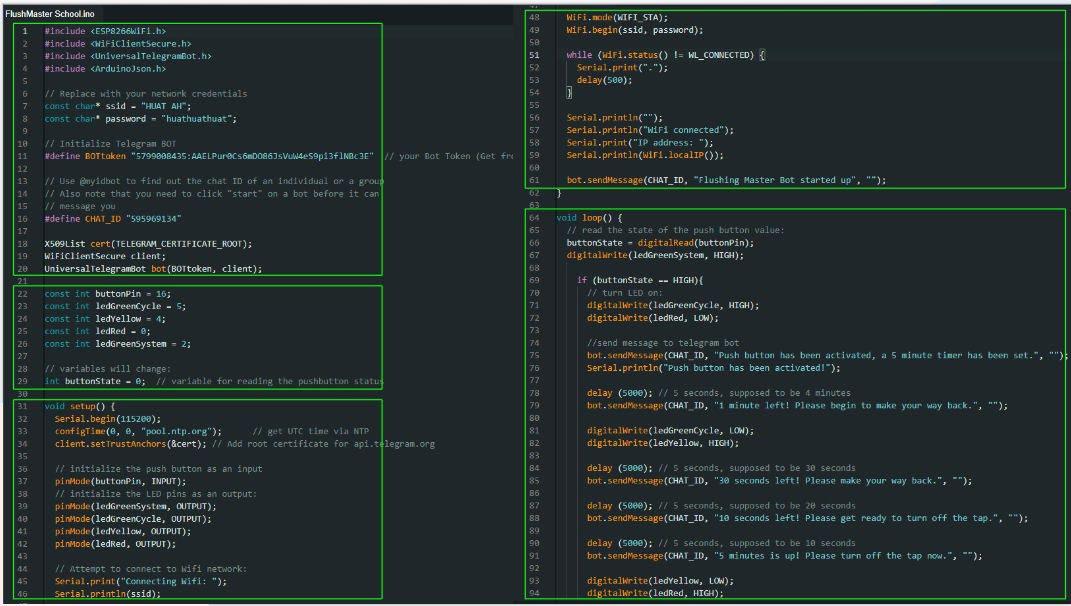
“So, how will the prototype device work?” Jessie posed. Andrew explained, “So here is how it works. The microcontroller holds 96 lines of programming code to act as the brain and decisionmaker for the device. When the device is connected to a power supply through the micro-USB port, the device will automatically kick start into a ready position and connect to the pre-configured WiFi in the environment.
Upon the initiation of the push button, a five-minute timer will start counting. After certain durations, the device will send messages to the user through the Telegram messaging application acting as a bot.”
“But how will this be relevant to the problem for our project?” Arthur questioned. Andrew responded shortly that the prototype would keep reminding the facility manager not to forget about the taps and keep track of time, influencing him to turn off the tap upon the five-minute mark.
“How about the cost? How much will the parts for the prototype device cost?” Arthur further questioned. Andrew answered, “Well, the Wemos D1 Mini and a set of push buttons only cost $12 to purchase from a seller listed on an e-commerce platform. For the rest of the components, I will simply reuse what I had from my earlier tertiary days, but the cost should not be great. The cost for a breadboard and other miscellaneous components such as jumper wire and soldering iron should only cost $6 for what the project requires. The total sum of the cost will round up to $20.”
Andrew further assured the quality of this device. As a prototype, he felt the cost was minor compared to the value this device would produce. Further development from the prototype will further reduce the cost and enhance durability and lifespan. It will not compromise the user's wellbeing. The lightweight device will solely positively influence the user, encouraging a more sustainable practice in tap flushing.
The group members, including Arthur and Jessie, were collectively convinced of the feasibility of the prototype. Andrew went on to work on his prototype, and Jessie volunteered to calculate how much water would be used for the flushing or purging with respect to time. The following were Jessie's thought process and what she wrote down in her notebook.
Assuming that each ward has two basin taps and one shower tap, and there are 15 rooms per ward, this means a total of 30 basin taps and 15 shower taps. Adopting the water efficient flow rates by the Public Utilities Board (PUB) Singapore, each basin tap and shower tap will consume 7 litres per minute and 10 litres per minute, respectively. After 5 minutes, a total of 85 litres will be used, and for 10 minutes, 170 litres will be used.
This means that the additional and unnecessary running of tap water for 5 minutes will waste 85 litres of water per tap. That is 50% of the original water flushing required. With 30 basin taps and 15 shower taps, the amount of water used will increase to 1800 litres and 3600 litres for 5 minutes and 10 minutes, respectively. Taking that one ward will be purged every five days for the whole hospital. This will mean 73 wards for purging in a year.
Taking the rate applicable for hospitals by PUB which will be $2.74 per cubic metre, when multiplying this rate by the amount of water used, 5 minutes and 10 minutes will consume $360 and $720 per year, respectively. The difference between $360 and 1800 litres of water per year will be the amount of resources that can be saved for the hospital and environment. From another angle, it also means that every extra minute of purging will cost $72 per year, and any more unnecessary usage of water will significantly cost more.
When Jessie showed this calculation to her group members, they were surprised by the details made to the calculation. After understanding the calculation, Arthur made a comment that since the prototype device only costs $20 and when considering the cost saving of $360 per year, the payback period will only be 0.7 months. This will enable the organisation to potentially ‘profit’ after 0.7 months of implementation. Not only that, as 93,600 litres of water can be saved yearly, in the long run, the numbers will further increase, and it will benefit the earth greatly as every effort counts.
Andrew showed the circuit diagram to his group members. The solution will consist of the microcontroller, Wemos D1 Mini, 4 Light-emitting Diodes (LEDs), a push button, resistors, and jumper wires. The various LED colours have different meanings. One of the green LEDs represents the system LED, which will turn on upon the device being powered up and started.
The other green LED represents the cycle LED, which will turn on whenever the push button is pressed to kickstart the 5 minutes cycle. The yellow LED will indicate the mid-way mark in the 5 minutes cycle, and the red LED will indicate the end of the 5 minutes cycle. The jumper wires are illustrated with the different colours of wiring, connecting the LEDs and push button to the microcontroller, Wemos D1 Mini.

In order for his group members to have a complete understanding of the solution, Andrew also presented the programming lines to his group members. The programming lines can be difficult to understand, so he helped to prepare a programming flowchart as well, as it helps less-experienced viewers to understand easier. He showed the following programming lines for the solution. And to simplify things, Andrew showed the programming flowchart for the solution, so his group members to understand the programming lines better.
After finalising the circuit, a fully functioning solution was produced. However, Andrew faced some technical performance issues and felt that the solution would be immensely improved with these issues being eradicated. Firstly, he found out that the microcontroller, Wemos D1 Mini, could only connect to data connections that are type WiFi Protected Access (WPA) 1.
However, the data connection in larger organisations, such as schools and hospitals, is integrated with WPA 2, and Wemos D1 Mini is unable to connect to WPA 2 networks as it has extra user authentication requirements, which the microcontroller is unable to tackle. After research, he
shortlisted several microcontrollers with WPA 2 connectivity capability, one of which is the AirboneM2M Enterprise Wifi Boards manufactured by Advantech.
Secondly, he found out that the structure of the solution could be further improved by replacing the breadboard, which acts as the main connecting body of the device, with Printed Circuit Boards (PCB). Based on his experience in prototype development, he was aware that after finalisation of prototype circuitry, the transition to PCB was desirable, which is a permanent circuit board, unlike breadboard. The PCB has a cleaner look, leading to ease of maintenance as it has no wirings due to soldering works. PCBs also have greater reliability and durability as compared to breadboards.
EPILOGUE
The team returned to consult Vincent and the healthcare facility management. Although they were pleased with the solution, they had some reservations and remarks regarding it. The first remark was the power source setup. When the solution was presented, it was connected to a retrofitted external power bank connected by a micro-USB cable, and the management had uncertainty with it. To help them with the uncertainty, Andrew suggested a rechargeable battery which is smaller in size, as a permanent fixture in the casing, and the management was happy with it.
The second remark was the stability of the circuit. The overall circuitry seems insecure, with the jumper wires on the breadboard being unstable. Andrew responded by saying that a further improvement would be transitioning to a PCB, which will have no wirings due to soldering works, and the management was satisfied with it.

The healthcare management informed the team that they would consider the solution and contact the students if further work was to be done.
It was time for the Team Innovators to present their work to their professor, Professor Moshood, and other students taking the module. “Each of you guys has done an excellent job.” Professor Moshood announced it to the team of bright-eyed students after hearing the solution they came up with. Upon hearing the joyful news, their smiles were like a sudden beam of sunlight illuminating even the darkest corner of the room. The team was satisfied with the journey of the Flush Master and went on their way in their undergraduate expedition.
The solution the group of SIT students had come up with did not compromise the comfort and convenience of humans yet managed to reduce the consumption of water, preventing wastage of water. It targeted the forgetfulness and inattentiveness of the human mind, which brought about awareness by prompting them to act when the time was running up.
-The End-
VIDEO COMMUNICATION OF THE STORY AND PROTOTYPE DEMONSTRATION
Aside from the written version, a video of the story and prototype demonstration is provided for effective communication of the story. Click on this link for the video. Refer to Appendix for all five students’ reflections, as submitted to the module instructor, of how they have benefited from the module learning journey designed to invoke their critical and reflective thinking that induces learning for developing an educational experience
ACKNOWLEDGEMENTS
The support of Mouth Elizabeth Hospital, Singapore, and its staff in conducting the research is gratefully appreciated. The support of the Singapore Institute of Technology in providing a conducive environment for applied learning and financial support for the research is gratefully acknowledged