08 Reimagining Musical Instruments with AI Scene 2: Global Literacy
12 Harmony with the World: Nurturing Global Literacy through Music
14 Educating for a Connected World: Music and Global Literacy Scene 3: Towards Flourishing
18 From Mountain Trails to Musical Scales
19 Reeling in Rhythms
20 Teaching Music and Playing Volleyball
21 Drawing on His Diverse Roots
STAR Highlights
We’d Love to Hear from You...
Editorial Team:
Dr Kelly Tang Master Teacher, Music
Loo Teng Kiat Master Teacher, Music
Seah Cheng Tat Academy Officer, Music
Felicia Toh Sze Hui Senior Academy Officer, Music
instagram.com/starmusicators vimeo.com/moestar
the aRts
SCENE 1: AI AND TECHNOLOGY
Keeping Music Human in an AI Age
5 minute read
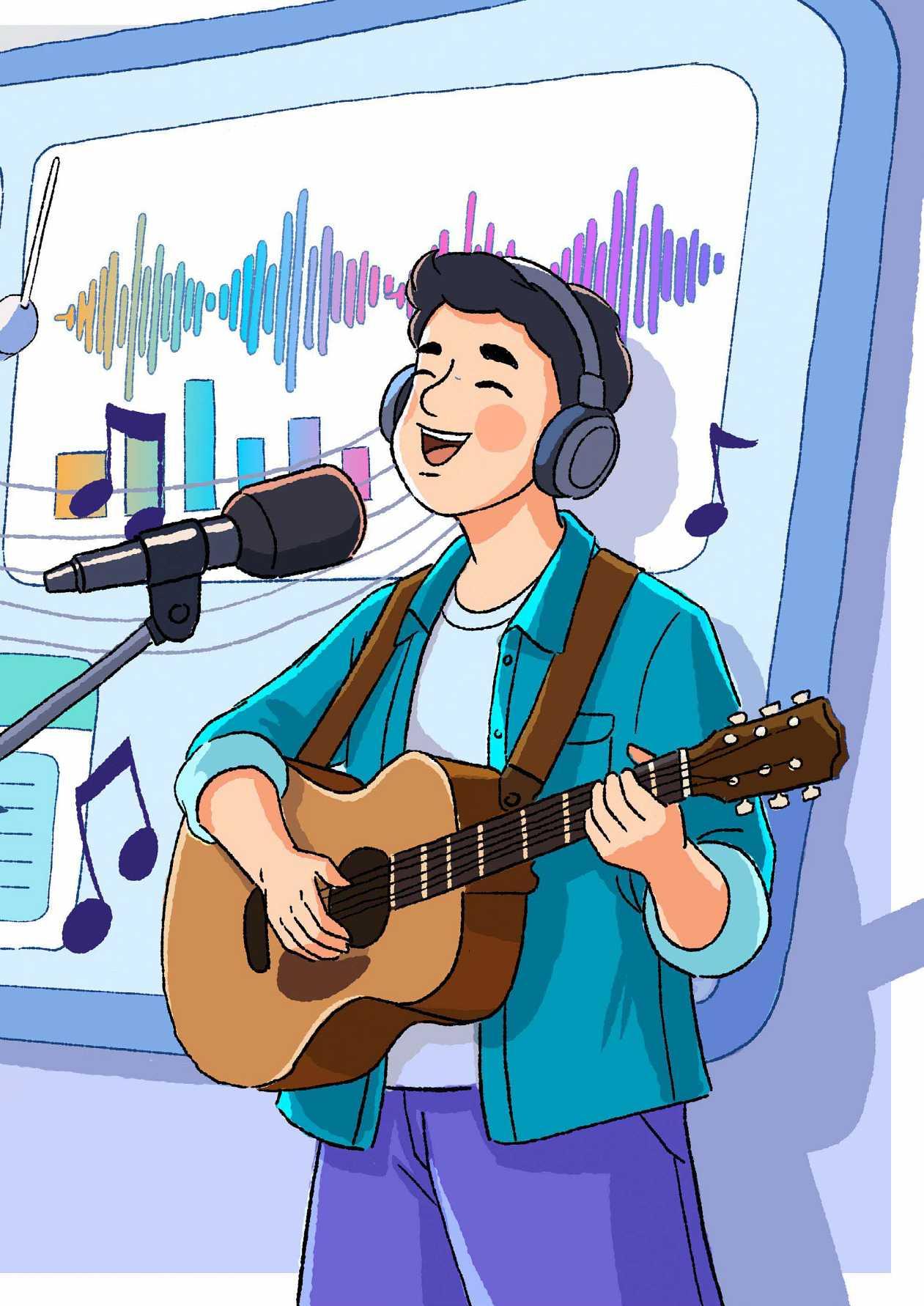
At Telok Kurau Primary School, Subject Head (Aesthetics) Mrs Sandy Tay explores how AI and digital tools can expand the possibilities of music creation for Primary 6 students while keeping their musical thinking and personal voice at the centre of learning. She designs lessons where technology supports, rather than replaces students’ ideas, so that they still experience the satisfaction of crafting and refining their own songs.
Sandy reflects, “I want my students to feel that the music still belongs to them, even when technology offers suggestions or shortcuts. AI should widen their creative playground, not take over the role of the composer.”
Exploring AI with Primary 6 Songwriters
• Sandy works mainly with Primary 6 students when introducing AI into music, as they are ready to handle more independence and deeper reflection about their creative choices.
• Sandy shares, “With my Primary 6 classes, I integrate AI into our songwriting and electronic music modules — where students are already creating melodies, experimenting with loops, and thinking about mood and expression.”
• “I always ask them to create something on their own first,” she explains. “They might start with a melody line, a short riff, or a rough lyric draft before any AI tool is introduced.”
“For me, AI is never the main composer,” Sandy says. “I position it as an extra layer that offers options and perspectives students may not have considered, so they can compare, refine or extend their ideas.”
• She adds, “The key is that they still have to listen carefully, make decisions and justify their choices. AI suggestions are not answers to copy, but ideas to evaluate.”
Using School-Based AI Tools to Scaffold Ideas
• In Sandy’s classroom, AI tools are introduced in structured ways so that students can explore ideas safely while still making their own musical decisions.
• Sandy explains, “For lyric work, I use the SchoolAI chatbot through teacher‑facilitated activities, so I can guide how prompts are written and supervise how students use the responses.”
• She adds, “Because it sits within the school’s Google ecosystem, students do not need separate accounts, giving teachers better oversight of student AI conversations and student safety.”
• “For melodic work, I get students to create their own melodies first using tools such as Chrome Music Lab,” Sandy says. “After that, they can export their work as MIDI files and explore possible chord suggestions in ChordSeqAI.”
• Sandy is careful to frame these AI generated suggestions critically: “The AI‑suggested chords are never treated as the ‘correct’ answer. Students compare them with chords they derive on their own and listen to how each option changes the mood and character of the piece.”
• Through these experiences, Sandy wants students to understand that AI can offer possibilities and contrasts, but that the final artistic direction still belongs to the composer.
Designing for Critical Evaluation
and Musical Ownership
• Sandy’s lessons are designed so that students do more than generate ideas quickly; they are expected to listen closely, evaluate thoughtfully and explain their musical choices.
• Sandy shares, “A central part of the lesson is helping students notice how different suggestions change the character of the music.”
• She adds, “I often ask them questions like, ‘Which version better matches your intention?’ or ‘How could you change the music, so it sounds more like you?’, because I want them to develop confidence in their own artistic voice.”
• She is also clear that assessment must remain grounded in authentic student thinking. “What I assess is not whether AI gave them an interesting idea,” Sandy explains. “I’m looking at how students shape the phrasing, structure, and expressive intent of the piece, because those are the musical decisions that show real ownership.”
• In this way, AI becomes a support for exploration and access, especially for students with different levels of musical background, without displacing the human processes of intention, interpretation and judgement.
Navigating the Challenges
• Sandy recognises that “AI can sometimes produce suggestions that sound impressive but are not always musically convincing or appropriate for our students with varying levels of musical experience.”
She notes, “Because AI generates ideas so quickly, some students are tempted to accept the first suggestion without listening deeply, so I need to slow them down to compare, critique and refine.”
For Sandy, these challenges are reminders to design tasks carefully so that AI prompts deeper thinking instead of replacing it.
Growing the Next Phase
• Sandy is keen to explore how AI might eventually help teachers identify patterns in students’ compositions and support reflective learning, while still keeping musical judgement in teachers’ hands.
• She hopes to continue experimenting with AI and electronic music tools as inclusive entry points, “so that all students, regardless of background, can experience the joy of creating and shaping their own sound worlds.”
• Sandy shares, “The most rewarding part of bringing AI into music is watching students who used to feel ‘not musical’ start to see themselves as composers.”
• She adds, “When AI offers ideas, but the students still make the final choices, they realise the music truly belongs to them, not to the technology.”
• These moments of growing confidence and ownership keep her excited about exploring new tools with her Primary 6 songwriters.
Rose Thorn Bud
Keeping Music Authentically Theirs
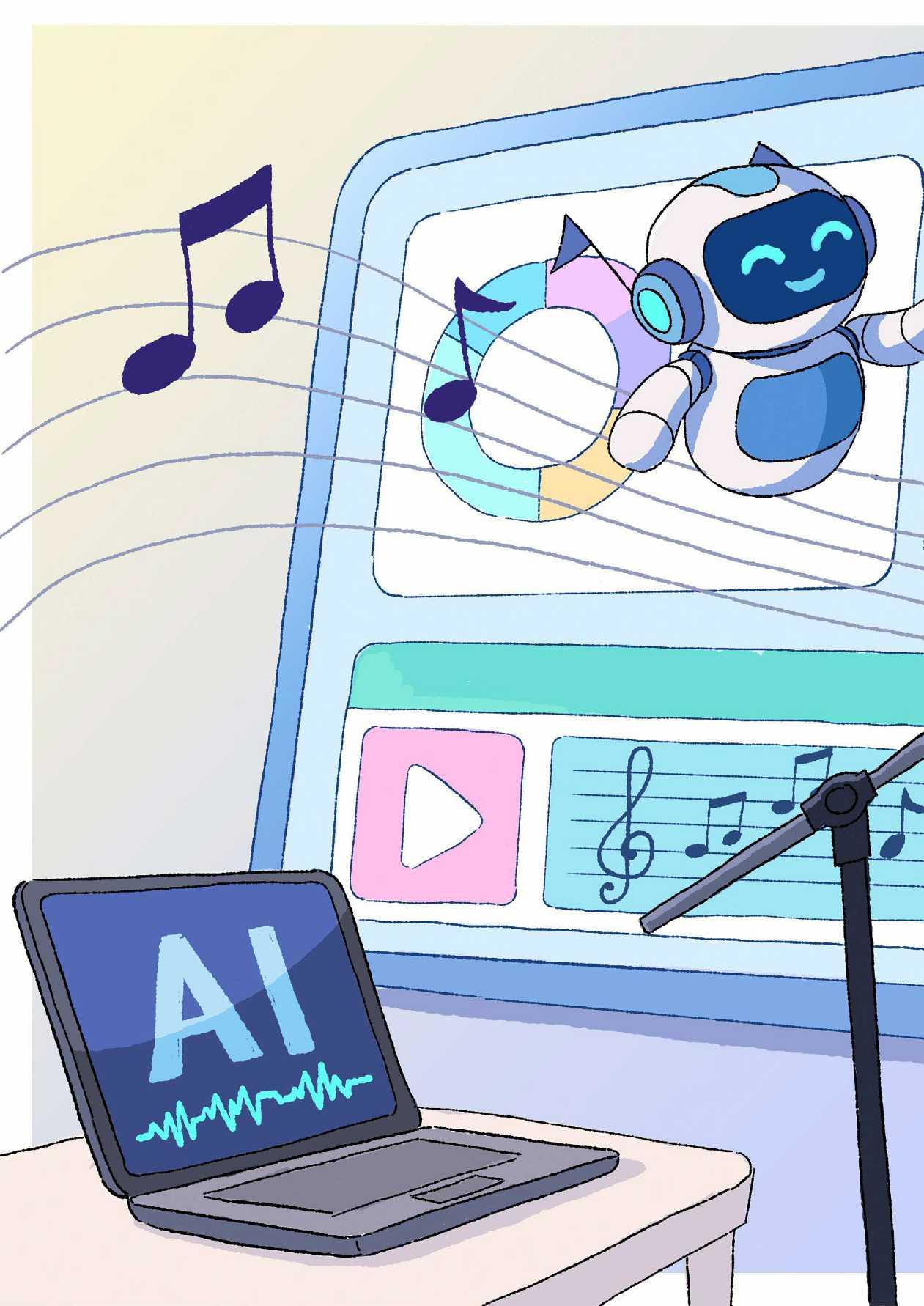
Reimagining Musical Instruments with AI
4 minute read
At Eunoia Junior College, Deputy Head (Aesthetics) Dr Gooi
Tah Choe has been exploring how AI could help bridge the gap between an A Level student’s musical imagination and the technical barriers of digital creation. Rather than treating AI as a shortcut to instant results, he is interested in how it can support deeper inquiry into sound, design, and musical intention.
Tah Choe reflects, “I found myself questioning how we might bridge the gap between an A Level student’s musical imagination and the daunting technical barriers of digital creation.” He describes “vibe coding” as a promising way forward. Vibe coding is a software development practice assisted by AI where natural language prompts are used to develop source codes to build personalised software tools.
Tah Choe says, “By using natural language to direct AI to create a musical instrument or an interactive acoustic environment, students can begin building bespoke musical interfaces or synthesisers without needing prior background in coding.”
Exploring “Vibe Coding” with A-Level Students
• Tah Choe’s interest in AI centres on how students can move more directly from imagination to musical creation, especially when traditional coding or technical production skills might otherwise feel out of reach.
• He shares, “Vibe coding allows students to become the true architects of their own creative vision. Instead of being blocked by the mechanics of programming, they can focus on what they want the instrument or sound environment to do musically.”
• For older students, this opens up possibilities not just for making sounds, but for designing entirely new ways of interacting with sound through digital tools and prompting in natural language.
Grounding Creativity in Acoustics and Inquiry
• Tah Choe is clear that creative freedom must still build on strong musical and acoustic foundations.
• He explains, “Before students begin creating instruments in this way, they need to grapple with core acoustic principles — how different waveforms can be combined, altered, and synthesised.”
• Once that baseline is established, he sees room for richer artistic and philosophical questions: “Must an instrument always faithfully cater to a musician’s precise intentions? Or could it be designed to produce emergent outcomes beyond the performer’s full control?”
• These provocations invite students to think not only as musicians, but also as designers, inventors, and critical thinkers about the very nature of instruments and performance.
Creating New Sonic Worlds
• Through AI supported design, Tah Choe sees possibilities for students to explore interdisciplinary ideas that would previously have been difficult to realise within the classroom.
• He shares that students could experiment with interactive systems where sound can be triggered by visual, physical, or environmental inputs or platforms that behave less like traditional instruments and more like contemplative musical spaces or interactive games.
• These AI generated instruments and environments can be refined by students and eventually used in performance contexts. They may be performed individually or within digital ensembles, opening up new forms of collaboration and peer dialogue.
Expanding What Students Can Imagine
• Tah Choe sees great potential in how AI can lower technical barriers for his students while preserving their artistic ownership.
• He reflects, “When students can materialise ideas that once felt technically unreachable, they begin to see themselves not just as performers, but as designers of new musical experiences.”
• This shift can broaden students’ sense of what composition, music making, and performance could become in a digital age.
Navigating the Classroom Realities
• Tah Choe sees great potential in how AI can lower technical barriers for his students while preserving their artistic ownership.
• He reflects, “When students can materialise ideas that once felt technically unreachable, they begin to see themselves not just as performers, but as designers of new musical experiences.”
• This shift can broaden students’ sense of what composition, music making, and performance could become in a digital age.
Slowing Down the Process
• What excites Tah Choe is not speed alone, but the reflective workflow that AI can make possible for his students when used thoughtfully.
• He notes, “Contrary to common belief, the experience of vibe coding is an important, slow conversation with AI to refine, troubleshoot, and realise students’ musical imagination and intentions.”
• He adds that a student’s first idea is rarely fixed from the outset; instead, it develops through repeated cycles of prompting, listening, evaluating, and refining.
• In this sense, the work aligns with what the OECD Digital Education Outlook 2026 describes as “Slow AI”, a mindful form of engagement where human agency and judgement remain central.
Exploring Effective Uses of Generative AI in Education, OECD Publishing, Paris, https://doi.org/10.1787/062a7394 en.
Further Exploration
Shaping Future Possibilities
Looking ahead, Tah Choe hopes AI can become a means of helping students listen, interact, and play in new ways, rather than simply producing screenbased outputs such as digital instruments and interactive interfaces.
• He reflects, “While AI can efficiently materialise our imaginations, students must realise that the machine is only a sandbox.”
• For him, the deeper purpose is clear: “The ultimate goal of building these instruments is not to trap students behind a screen, but to give them new ears to listen, interact, and play.”
AI instrument experiments referenced in this article: https://drumme.netlify.app/ https://rattle6001.netlify.app/ https://shapeshifter1.netlify.app/ https://patteroom.netlify.app/
Rose Thorn Bud
Harmony with the World: Nurturing Global Literacy Through Music
4 minute read
Global Literacy helps to broaden students’ horizons by introducing them to the wider world, beyond the walls of the classroom. As such, music lessons can offer musicking ways to engage with global issues, interconnections, and trends, helping students develop informed perspectives. They also provide opportunities to cultivate empathy, broader perspectives, and respect for diversity — qualities essential for 21st century learners.
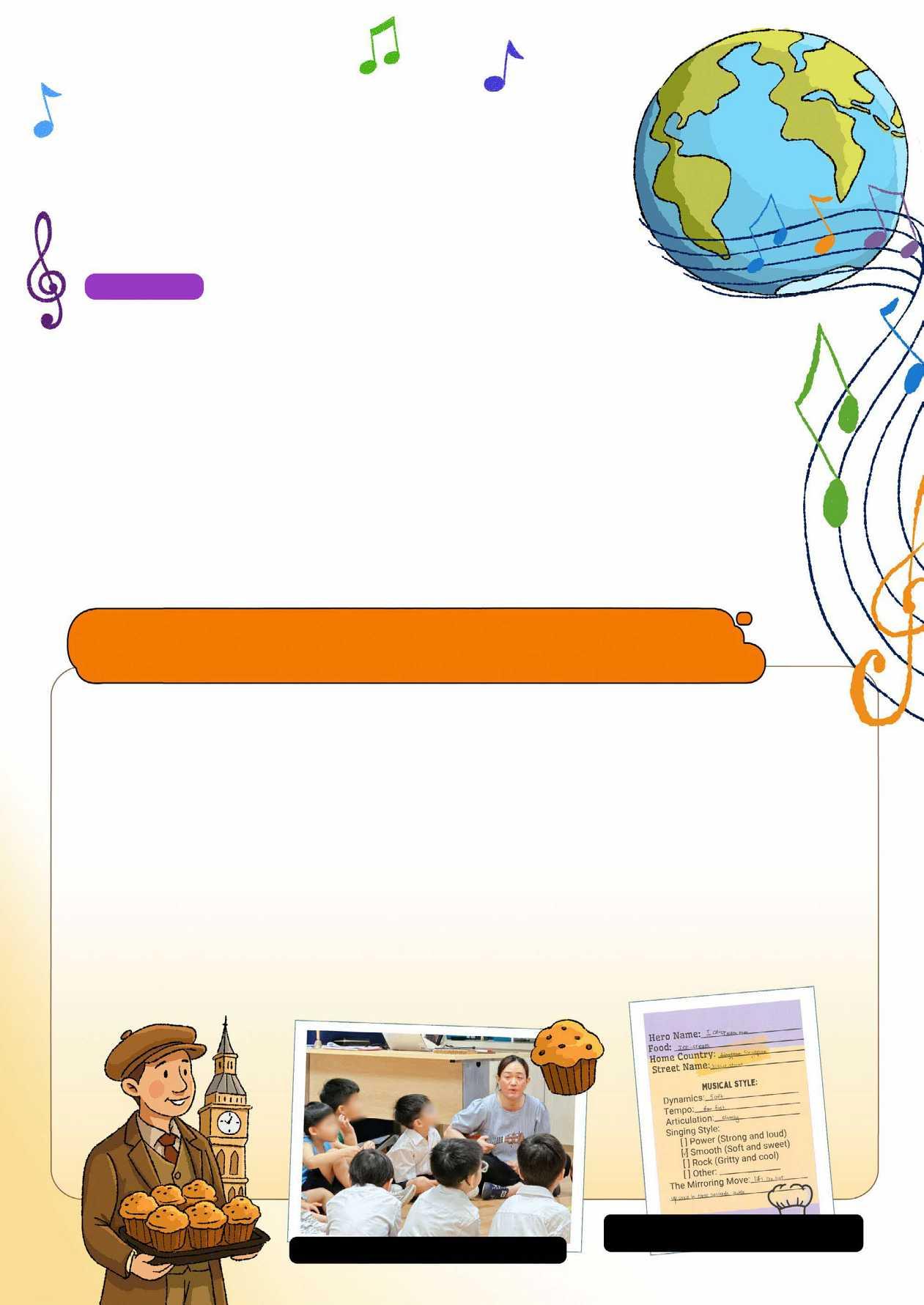
This lesson idea, “Harmony with the World”, was developed by STAR Champions (Primary) teachers, Mr Matthew Chan (Subject Head (Aesthetics), Hong Wen School), Mdm Koh Cheng Yeen (Senior Teacher, Kuo Chuan Presbyterian Primary School), and Mdm Rachel Tan (Senior Teacher, Anglo-Chinese School (Junior)), with the aim of nurturing Global Literacy (CGC 3.1) in Primary 3 students. The lesson centred on two familiar songs — “Do You Know the Muffin Man?” and “I Love the Mountains” — each offering a distinct lens through which students could explore and appreciate cultural diversity.
Exploring Culture Through “The Muffin Man” Song
• Being curious about the cultures of other countries: “Do You Know the Muffin Man?” opened discussions about food and culture by grounding the lesson in history.
• Students explored lyrics such as “Drury Lane,” learning that the song reflects life in Victorian London, where street vendors were a common sight. This reframed the familiar rhyme as a window into everyday life of that era, rather than simply a playful tune.
• Connecting cultures through food: Comparing Drury Lane to Maxwell Street or Lau Pa Sat in Singapore helped students recognise that, while urban spaces differ, the human need for food and community is universal. Noticing such differences without judgement is central to global citizenship, and food serves as a relatable bridge between cultures.
• Creative expression through music: A video clip was used to introduce British icons, after which students sang in three distinct character voices, each with its own musical qualities. In groups, they then created a version of the song to celebrate a “food hero” from another country through adapted lyrics and movement.
• Developing empathy and cultural appreciation: Guiding questions — such as “How does changing the food in the lyrics help us learn about life in another country?” and “How do these differences in food and places reflect each country’s culture?” — along with class discussions, further developed students’ empathy and appreciation of diversity.
Rachel in a musicking activity with her students
Students plan how they would like to adapt the lyrics, musical choices and movement to a song
Adapting Lyrics with “I Love the Mountains” song
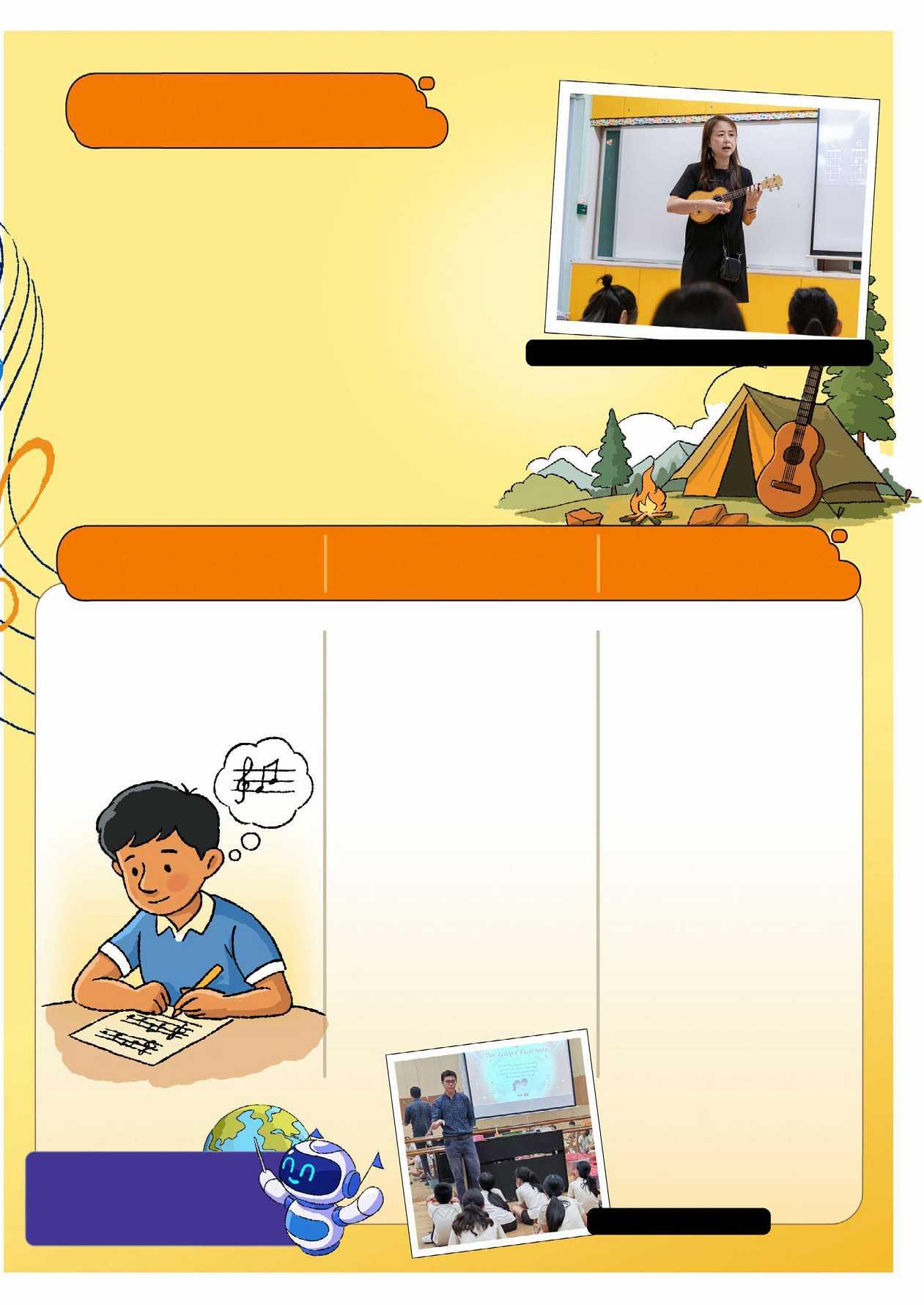
• Cultural exploration through song: “I Love the Mountains” is an American campfire song celebrating nature and the outdoors. Students composed their own versions by adapting the lyrics to a local or international setting of their choice, deepening their understanding of the song’s origins and meaning.
• Creative and musical expression: Students learnt to accompany themselves on the ukulele while reimagining the song in personally meaningful settings. This fostered creativity, collaboration, and self expression through collective decision making.
• Being open to and respecting differences: The activity sparked discussions through guiding questions such as “Why is it important to learn about other cultures?” and “How would you respond if a friend held different views or preferences about another culture?” These conversations encouraged students to be more open minded, respectful of differences, and appreciative of diversity.
Scaffolding to Support Students in Lyrics Writing
• Some students needed additional time and scaffolding to write lyrics that fit the rhythm and rhyme scheme appropriately.
Fostering Informed and Respectful Perspectives in a Safe and Open Space
• Students experienced genuine “aha!” moments when they discovered hidden stories in songs, connecting music to real places and people, and coming to see the world as a global map of neighbourhoods connected by shared human experiences.
• The approach created a safe and open space to uncover and address misconceptions or stereotypes that students may hold about other cultures.
• The lessons helped shape more positive attitudes and reduce negative assumptions about others, guiding students towards more informed and respectful understandings of diverse perspectives.
Curating Resources to Better Engage Students
• Looking ahead, several strategies could be explored to deepen students’ understanding of global literacy. Curating global contexts — including Asian and regional traditions — for students to choose from could guide them to engage more deeply with unfamiliar perspectives, encouraging them to think beyond their immediate experiences.
• Integrating digital storytelling tools and visual prompts, such as short videos of global settings, could also help students build background knowledge and connect more meaningfully with cultures beyond their own.
Through this music module, the team hopes to nurture students who are more aware, thoughtful, and respectful of the diverse world they are growing up in — and who find joy in discovering it through music.
Find out more about the lesson module “Harmony with the World” here.
Cheng Yeen revising ukulele chords for a song with her class
Matthew with his music class
Educating For A Connected World: Music And Global Literacy
4 minute read
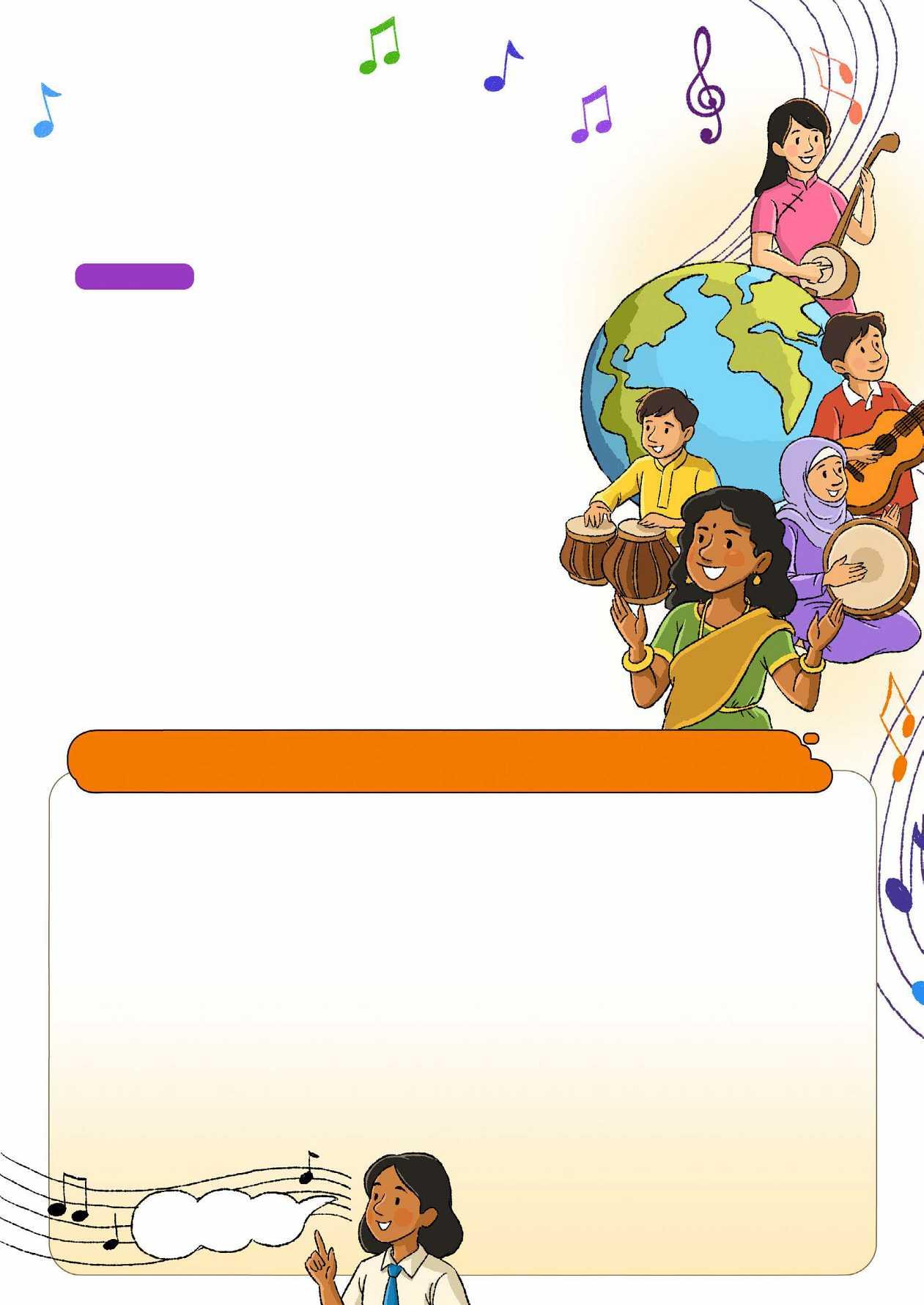
In music classrooms across Singapore, teachers are finding that the subject offers a unique and powerful entry point to global literacy, helping students develop the cross cultural awareness and empathy that our increasingly interconnected world demands. A peaceful and sustainable global community depends on responsible citizens who demonstrate mutual respect, embrace differences, think critically about events, and actively contribute to addressing shared problems. Cultivating global literacy in students not only equips them with the knowledge and skills needed to participate effectively in future workplaces but also supports their development into thoughtful and discerning global citizens. Research also suggests that students with higher levels of global literacy are more likely to act on global issues and engage actively in activities related to global citizenship (Hsu & Wang, 2010).
Mdm Teh Jane Khim (Teacher, St Anthony’s Canossian Secondary School) and Mdm Fu Chunyu Esther (Senior Teacher, Chung Cheng High School (Main)), shared in their STAR Champions (Secondary) Networked Learning Community how music lessons can be designed to foster and develop global literacy in students.
Ideas
• Students explore the art of reciting solkattu (a traditional way of learning and practising rhythms through vocalisation of rhythmic syllables within a tala (meter).
• Students create their own two bars of rhythmic patterns, reciting the solkattu with angas (rhythmic units with hand gestures) before transferring their patterns to the cajón.
• Students reflect on the concept of rhythm and meter, identifying similarities and differences between South Indian and Western music traditions. This provides opportunities for students to become more aware of the interconnections between different cultures and traditions of music.
• Students explore Indian music as an important part of Singapore’s multicultural heritage and its place within the broader Asian cultural context.
• Students deepen their understanding of how music reflects the culture, history, and values of different communities while recognising Indian music’s influence on global music trends through the study of Indian musical elements such as talas, ragas, and traditional instruments.
• Students engage in cross cultural comparisons, collaborative discussions, and reflective activities that prompt them to appreciate diverse perspectives. This cross cultural comparison develops students’ awareness of the interconnections between different musical cultures and traditions of musical cultures, which is a key dimension of global literacy.
Jane’s Lesson on South Indian Carnatic Music
Esther’s Lesson on Singapore’s Multicultural Music Heritage
Jane and Esther’s stories of Classroom Practices and Lesson
Jane’s Thorn Rose Bud
Challenging Students’ Assumptions and Fixed Mindsets
• Many students initially assumed that konnakol was only relevant to Indian musicians or drummers.
• The key challenge was helping students appreciate that the South Indian art of reciting rhythm syllables could be incorporated into other music traditions, including pop music, and that global literacy in music means being open to cross cultural connections.
• Compounding this was a practical constraint of limited time. Jane noted, “I was unable to bring students to the point where they could incorporate konnakol into their own rhythm compositions on the cajón to accompany pop songs.
Exploring Interconnections Across Musical Traditions
• Within the school’s Secondary 1 music curriculum, students typically learn to play the cajón after an introduction to note values and beats.
• Jane reflects, “However, as I wanted them to also develop global literacy through music, I decided to introduce the concept of konnakol while keeping to a meter (tala). Initially, my students found it amusing and even laughed as they recited the solkattu aloud, but when I taught them to do it with the hand claps and gestures (angas) to keep the 8 beat cycle (adi tala), they realised that it was challenging.”
• Working in pairs, students then composed their own two bars of rhythmic patterns, reciting the solkattu with angas before transferring their patterns to the cajón.
• Through this process, students developed a newfound awareness and respect for drummers who play traditional Indian instruments such as the Mridangam and Tabla, having experienced firsthand the complexity of such rhythmic traditions.
Esther’s Thorn Rose Bud
Students’ Depth of Understanding and Behavioural Change
• Some students may have engaged superficially with Indian music, focusing on musical facts without fully understanding its deeper cultural, historical, and societal significance.
• While reflections on Padlet capture valuable insights into students’ thinking, it remains difficult to determine whether this learning will consistently translate into respectful attitudes and behaviours beyond the music classroom.
References
Hsu, H. Y., & Wang, S. K. (2010). The exploration of New York City high school students’ global literacy. Multicultural Education & Technology Journal, 4(1), 43–67. https://doi.org/10.1108/17504971011034728
Uncovering Cultural Interconnections
• Looking ahead, Jane plans, “I will also show students videos of non Indian musicians who learnt the konnakol and incorporated it in their music making on Western instruments, helping to further challenge the perception that the practice is exclusive to one culture.”
• Future lessons on drumming could also be expanded to explore the concept of interlocking rhythms or polyrhythms, drawing on the Malay kompang tradition.
• Jane notes, “I have taught students the Rentak Masri — a popular and lively rhythm used in traditional Malay music and kompang playing — by using body percussion. The class was divided into three groups; each assigned a distinct rhythmic pattern. When all three groups performed simultaneously, they created the interlocking rhythms characteristic of the tradition.”
• These experiences resonated with students beyond music itself. Many reflected that they had come to appreciate the spirit of community or ‘gotong royong’, that is deeply embedded in Malay culture and musical practice.
• More broadly, these lessons reinforced the idea that music is universal, transcending race, language, and distance, uniting people as they learn to appreciate the richness of different musical traditions.
Engaging Through Music and Guided Reflection
• A range of hands on approaches, including performing talas, guided listening activities and peer discussions provided multiple entry points for students to experience Indian music actively. These approaches deepened cultural appreciation and sustained student interest throughout the lesson.
• Students engaged with key questions about cultural preservation, identity, and global influence, making learning authentic and meaningful.
• Structured reflection routines, such as “See Think Wonder”, “3 2 1 Exit Ticket”, and “I Used to Think… Now I Think…” encouraged students to examine their assumptions and develop empathy for different cultures.
• Many students demonstrated increased curiosity and appreciation towards Indian culture and music, suggesting that the integration of cultural learning with structured reflection can be a powerful approach to nurturing globally aware learners. They also grew in openness and respect for diverse cultures. (Read more on the Music Professional Learning Team (PLT) Project here.)
Extending Learning Through Comparative and Creative Inquiry
• To deepen learning, students could engage in a comparative cultural inquiry that examines the similarities and differences among Indian, Chinese, Malay, and Western music traditions.
• Additionally, a fusion composition or performance task could invite students to combine musical elements creatively from different cultures, while facilitating meaningful discussions around cultural respect, representation, and the responsibilities that come with cross cultural creative work.
• These experiences could strengthen students’ global perspectives, encouraging them to see musical traditions not in isolation, but as part of a broader, interconnected cultural landscape.
From Mountain Trails to Musical Scales
3 minute read
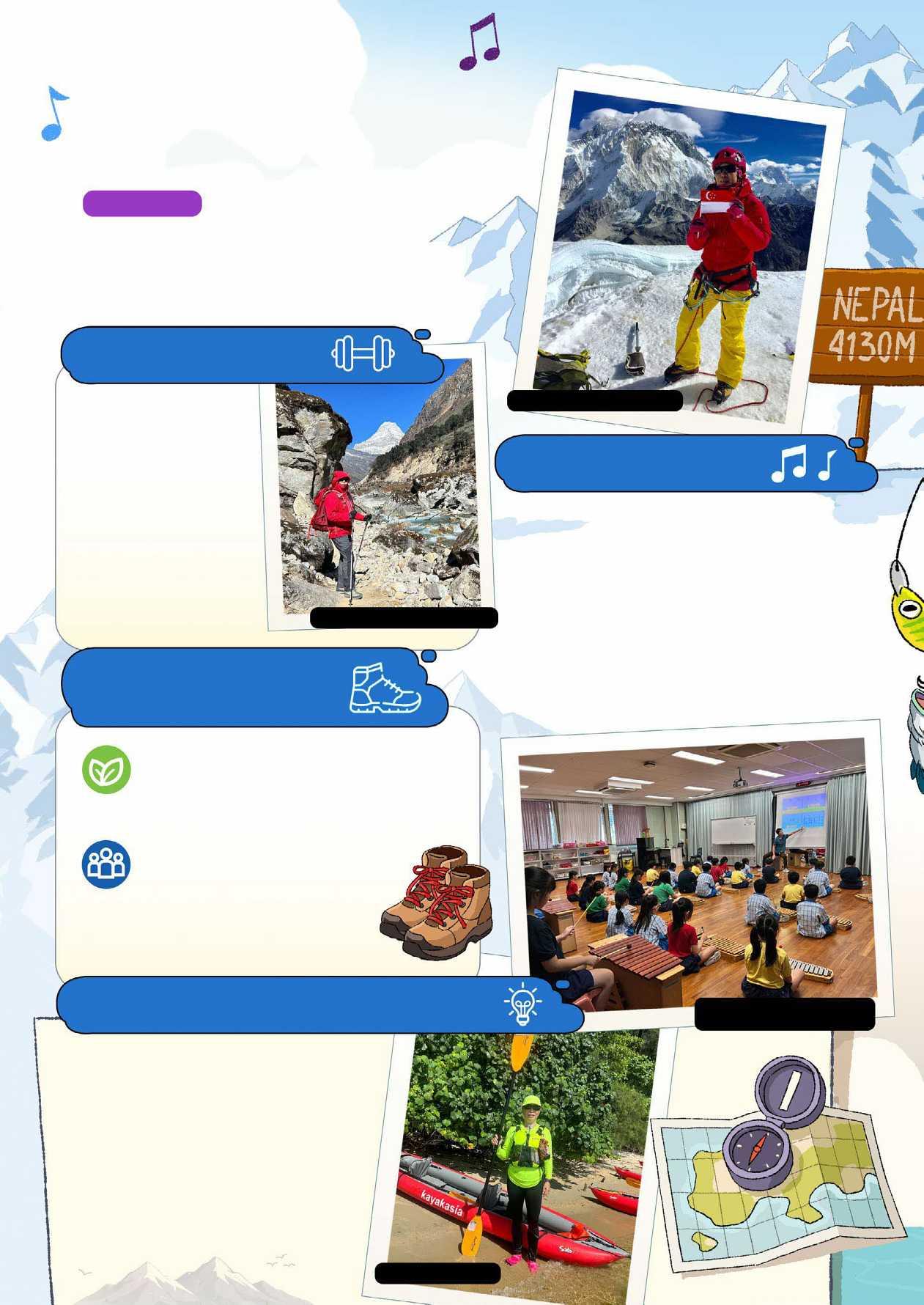
Ms Tan Mei Yin Angelina, a music teacher at Jiemin Primary School, loves nothing more than teaching music and exploring the world through trekking — even having scaled the formidable peaks of Nepal!
How does trekking keep you fit and healthy?
• Each trek requires six months of rigorous preparation: strength training, trail runs, stair climbing, swimming, and backpack loaded conditioning at Bukit Timah Nature Reserve.
• This training helps me maintain the high energy levels needed in school.
How does trekking keep you balanced, and help you relate to your school colleagues?
• Trekking outdoors reduces stress, refreshes my mind, calms me, and helps me focus. In the mountains, fresh air and nature restore a sense of calm and perspective. The interactions with local communities are priceless.
• Overcoming trekking challenges builds perseverance, a positive outlook, and the passion to achieve goals. This mindset helps me support my school colleagues.
What advice can you offer other music teachers?
Go out and explore! The world is our best classroom, offering endless opportunities for discovery and inspiration. Every new experience has something to teach us. As the saying goes, “life is like a box of chocolates, you never know what you’ll get!” (Forrest Gump, 1994).
References Zemeckis, R. (Director). (1994). Forrest Gump [Film]. Paramount Pictures.
How does trekking apply to teaching music?
• Trekking requires me to divide a daunting task into smaller, manageable steps. Similarly, in the music classroom, I break down my students’ long term learning goals into achievable milestones so that they experience incremental successes and become more confident through their learning, rather than feeling overwhelmed.
• Trekking provides me with real life stories that I can share with my students to motivate them to be more respectful, responsible, and resilient.
En route to Mera Peak, Nepal 2024
Kayaking at Punggol
Angelina teaching her students using the Orff approach
Lobuche East Peak, Nepal 2017
Reeling in Rhythms
3 minute read
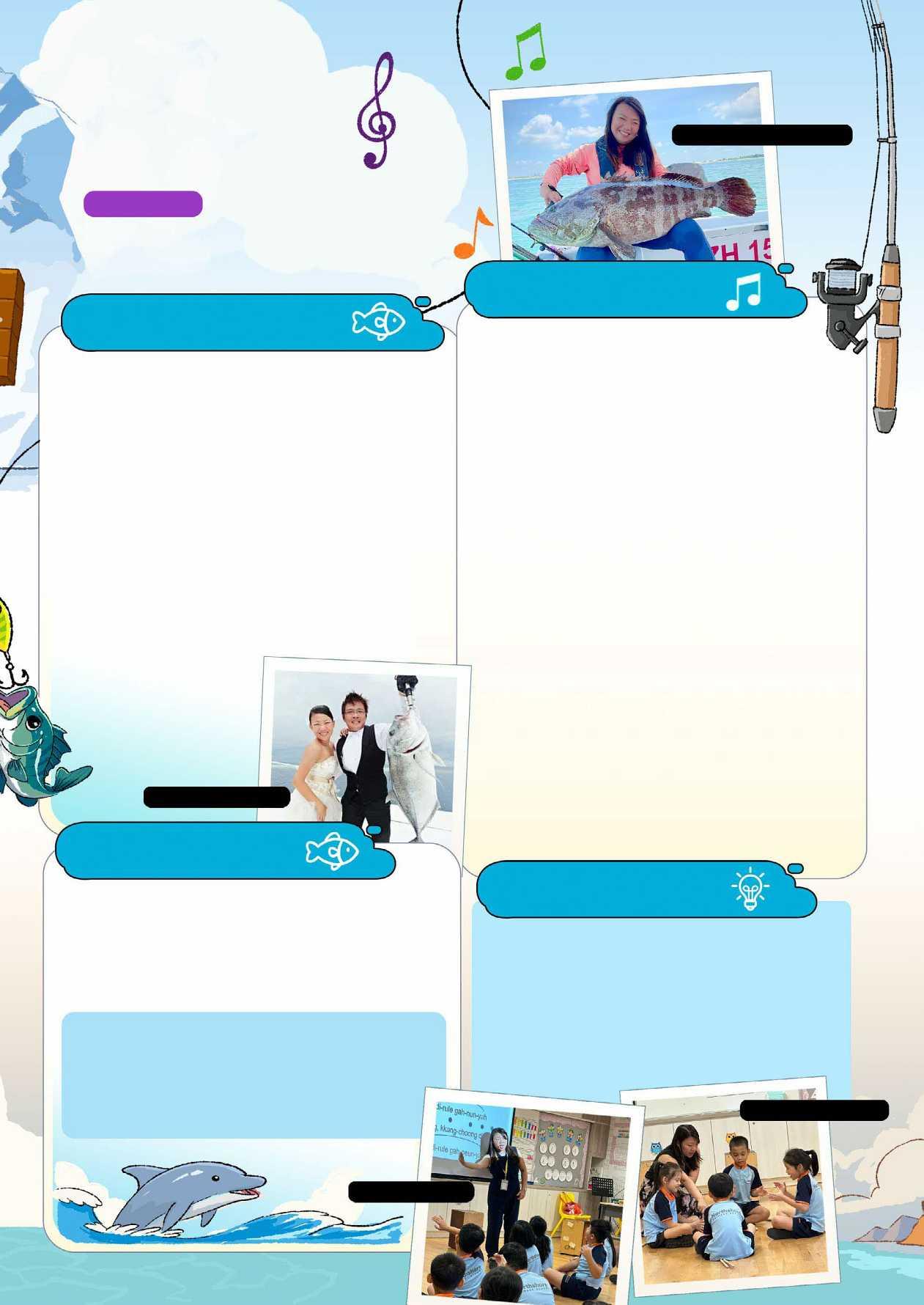
Ms Quah Hui Ling, Senior Teacher (Music) at Northshore Primary School, compliments her music teaching with her long time passion for deep sea fishing
How does deep sea fishing differ from common shore fishing?
• It was very simple when I started shore fishing in my teens. I used a handline with prawn as bait to catch small fish.
• This sparked my curiosity, so I explored offshore fishing, taking a boat out to deeper, open waters.
• Gaining more experience, I learned about how different species of fish occupy distinct waters and zones: top feeders, midwater swimmers, and bottom dwellers Understanding their behaviour, diet, and habitat is an important part of the fishing experience. Similarly, teachers who understand the individual needs of their students are better able to apply appropriate pedagogies in an intentional and targeted way.
• I eventually started using different active methods of sports fishing such as jigging, popping, “ajing” and long leader fishing, each demanding greater skill and expertise.
How does deep sea fishing stay exciting for you?
• No two trips are ever the same. Changing factors like water conditions, temperature, atmospheric pressure, and tides influence the outcome of each trip.
• Sometimes the fish are active, but at other times they are harder to find, making deep sea fishing both challenging and rewarding.
• Being away from the city and out in the open sea allows me to witness incredible sights in nature — such as hundreds of dolphins swimming alongside the boat, manta rays leaping out of the water, and sea turtles surfacing for air. These unexpected moments make every fishing trip an adventure.
How does deep sea fishing enrich your music teaching?
• Deep sea fishing gives me the courage to explore — qualities that I bring into preparing meaningful learning experiences for my students. Just as anglers prepare the right fishing gear for each trip, teachers need the relevant tools, strategies and activities to support their students’ learning.
• Deep sea fishing provides a meaningful balance to my daily routine as a teacher. Teaching is very energetic and people focused, so spending time outdoors allows me to recharge and clear my mind.
• Deep sea fishing reminds me to slow down and be patient as a teacher, to appreciate the process rather than focusing solely on outcomes.
• Sharing my fishing experiences with students helps me connect and build rapport with them authentically, fostering an environment where they feel more open to learning. Deep sea fishing also helps me relate better to my school colleagues, enabling us to teach and collaborate more effectively as a team.
• Deep sea fishing teaches me to deal with failure and disappointment as a teacher. Occasionally, a fishing line may break when a strong fish strikes, a shark may take the hooked fish, a lure may get stuck underwater, or bad weather may end the trip early. Instead of giving up, anglers adapt and try different approaches. Likewise, when my lesson does not go as planned, I adjust my teaching approach and explore other ways to engage my students.
What advice can you offer other music teachers?
• Apart from teaching, nurture passions and hobbies that excite you and keep your energy, creativity and curiosity alive.
• As in fishing, teaching is never about quick results. We must have patience, persistence, and to trust in the process. When teachers remain curious and open to exploration, that energy naturally inspires our students to learn with confidence and enthusiasm.
Hui Ling with a huge deep sea fish
A unique wedding photo
Hui Ling with her students
Hui Ling in music class
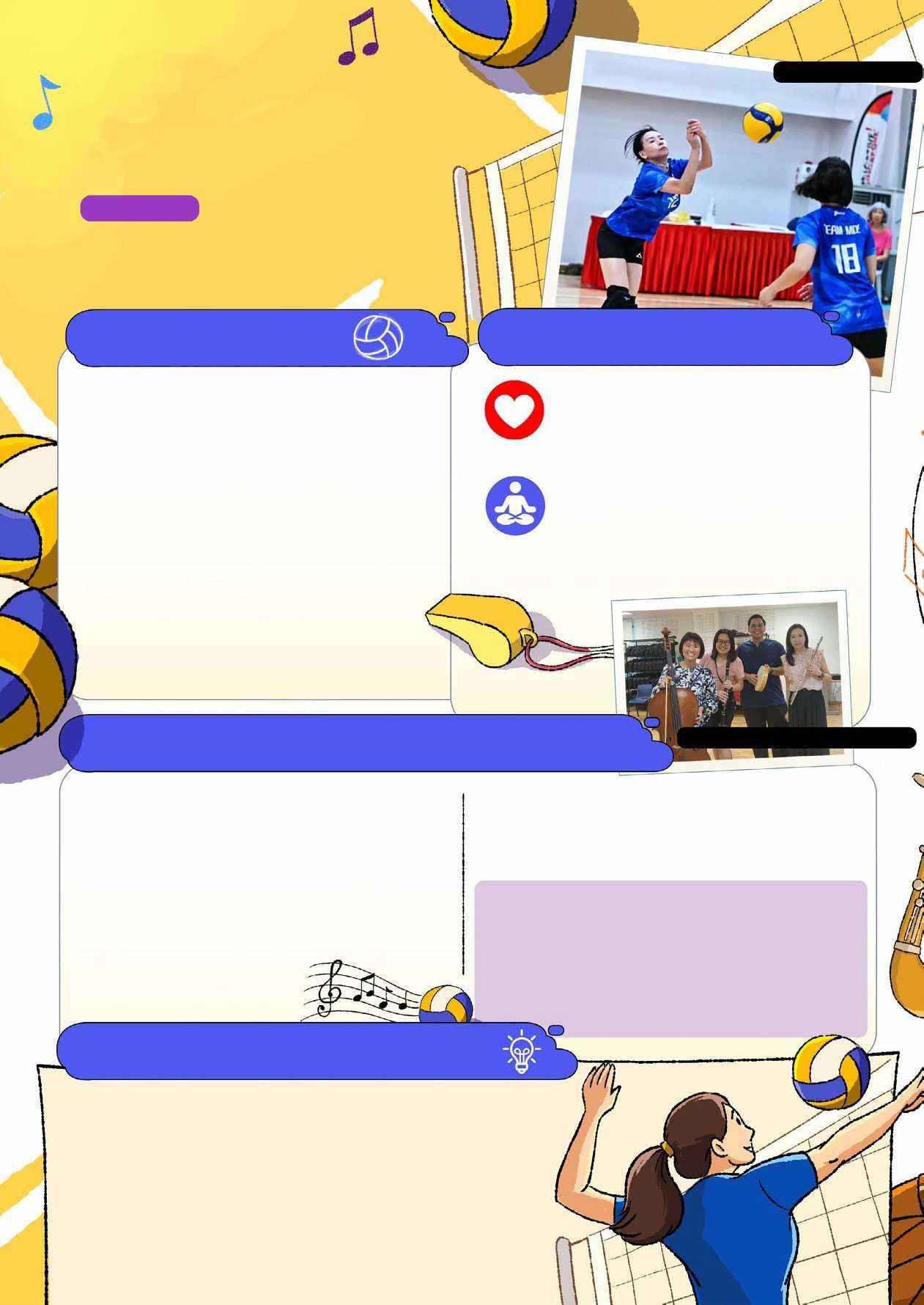
Teaching Music and Playing Volleyball
3 minute read
Ms Emily Tang Dan Li, a music teacher at Punggol Cove Primary School, shares about her passion for volleyball, and how it enriches her music teaching.
How does volleyball excite you and keep you active and fit?
• I used to be a member of my secondary school volleyball team. I returned to the sport when I joined MOE as a music teacher, participating in public service games and the MESCA MESRC annual games.
• Volleyball is a fun and exciting game. It is extremely fast paced, and the action never stops!
• Volleyball requires me to always be alert, to adapt instantly to changing situations, and to make quick decisions under pressure.
• Volleyball is very much a team sport. Each player specialises in a particular position (e.g. I am the wing spiker), but all team players must work together to win the game.
What lessons
How does volleyball keep you focused and balanced?
My love for volleyball parallels my commitment to teaching music. Having the passion for both volleyball and teaching keeps me motivated to pursue them for a lifetime.
As a music teacher of more than two decades, I constantly remind myself why teaching still fulfils me. When I need to recharge, volleyball allows me to step back and restore my emotional balance, so I can refocus amidst a busy teaching schedule.
do you draw from volleyball for teaching music?
• To improve our volleyball skills, MOE engages a coach to train us, and organises friendly matches to keep the team in peak competitive form. This reminds me to stay current, consistent and relevant in my teaching by attending workshops and keeping abreast of the latest pedagogies.
• Volleyball is not just about physical skills; it also builds my mental resilience to persevere and make the best of every game.
What advice can you offer other music teachers?
• The teamwork, positivity, and resilience developed through volleyball empower me to guide my students in applying these values to their academic learning, group work, and examinations.
• A volleyball player is receptive to feedback. If I make a mistake on the court, I learn from it and ensure I do not repeat the same mistake. Likewise, as a music teacher, if the way I implement a certain lesson activity or pedagogy does not work with my students, I reflect on how I can refine it to make it more engaging and effective, so that my students are set up for success.
• Always do your best to contribute to your music department, tapping on each other’s strengths to build a vibrant music culture in your school.
• As a good team player, communicate with fellow colleagues to bring out the best in yourself and others, as you nurture musical knowledge and skills in your students.
• As teachers, we need to practise self care to maintain our emotional well being and recharge by pursuing activities that bring us joy and renewal.
Emily (extreme right) with her school colleagues
Emily in a volleyball game
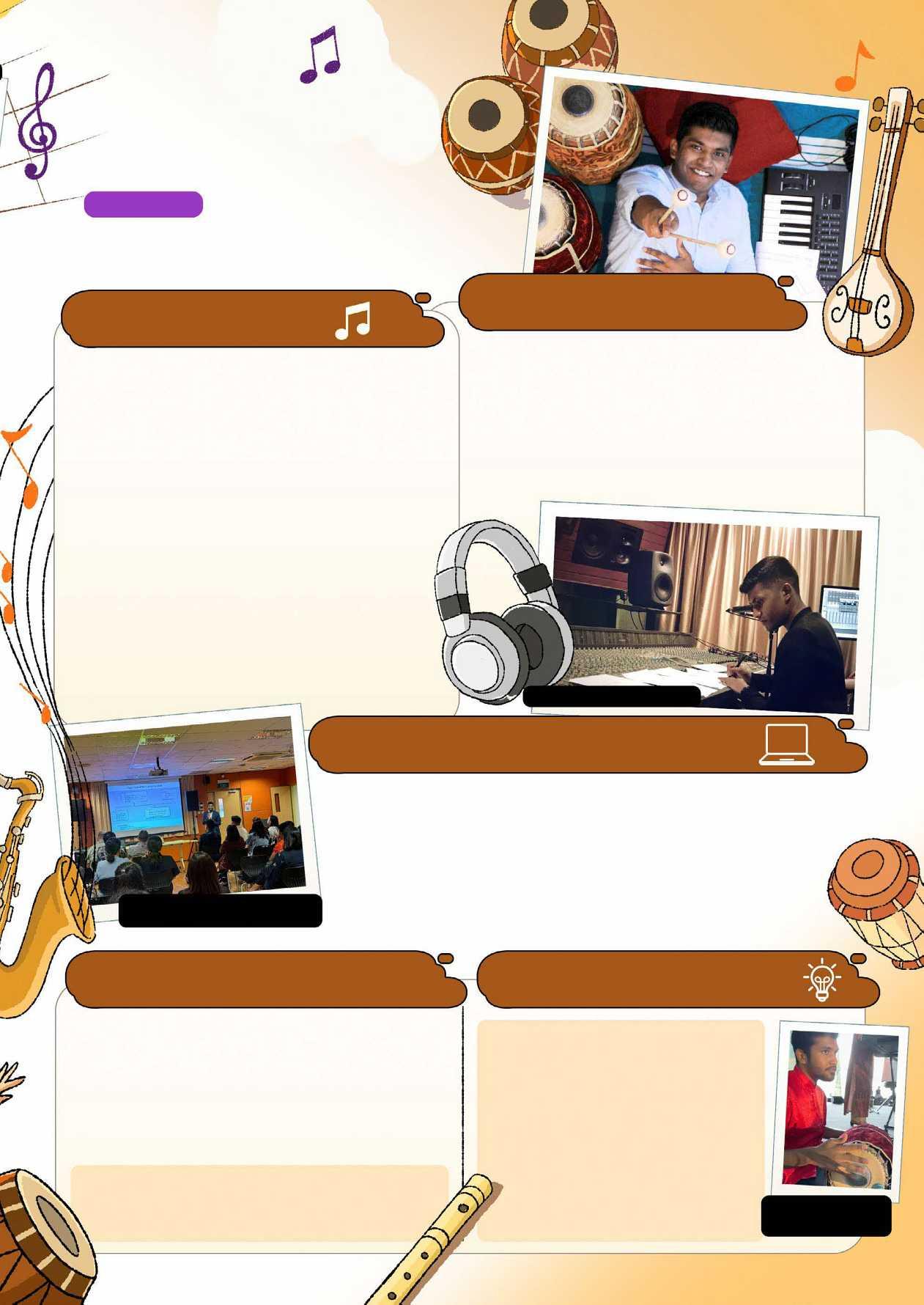
Drawing on His Diverse Roots
3 minute read
Mr Pavethren s/o Kanagarethinam, a music teacher at Assumption English School, draws on his diverse musical roots to compose, produce, and teach music.
What do music creation and production mean to you?
• As a percussionist in my primary school band, I was mesmerised by how composers use various instrumental timbres to evoke specific feelings. This inspired me to experiment with notating the musical lines that weave through the music.
• Being able to express my thoughts in this way was thrilling and deeply fulfilling, and I still carry that feeling today. This opened the path to music production and engineering in my late teens. I was impressed by the exceptional technical quality of soundtrack mixes in Tamil and Hindi films, which inspired me to create not only melodious tunes, but also technically well produced and immaculately engineered songs.
• This transported me, beyond music scoring, to the marvels of sound engineering, where music could be created, manipulated, and shaped through technology. In this pursuit, I was inspired by artists like A. R. Rahman, Hans Zimmer, and Yanni.
How does making music keep you balanced and passionate?
• I seek solace in playing or composing music. Musical exploration lets me tap into my artistic and creative instincts, counter balancing the teaching that I do for most of the day.
• I am thankful for supportive people who constantly encourage me to keep exploring through music. They fuel my passion to hone my craft in performance and composition.
How does today’s technology empower you and your students to make music in ways you never could?
• There is no better time to be a music producer and ‘creator’. Today’s technology has expanded musical capability and lowered the barrier to entry for aspiring musicians, as equipment that was once out of reach is now accessible to many more people.
• I am grateful for the diverse styles of music I learned. Each genre influences the others, leaving an indelible imprint on my music. Everything I create stems from my eclectic musical foundation.
• Music learning and music making are never linear processes. There is no one way to present music, and the beauty of music lies in its multifaceted nature.
• Ultimately, music making is a shared experience, and I have learned so much about respect and teamwork through collaborating with others across different musical genres.
• Applying this to music teaching, technology helps us scaffold many processes in the creating phase for students. For example, students need not know how to play the drums, but they can programme drum sounds using digital audio software.
What can you share with other music teachers?
• Every student has the ability to express himself/herself musically. The music teacher guides students to find the right tools to support their learning.
• It is essential for music teachers to connect with their musical roots. Our musical background grounds us as we stay abreast of rapid advancements in technology, and harness its possibilities for music teaching. This gives us greater credibility as educators, enabling us to teach with greater relevance and impact.
Describe how your creative process is influenced by diverse musical genres, like Indian Classical, Jazz, and Rock.
Engineering music in the studio
Pavethren shares the importance of creating music with music teachers
Harmonising heritage and innovation
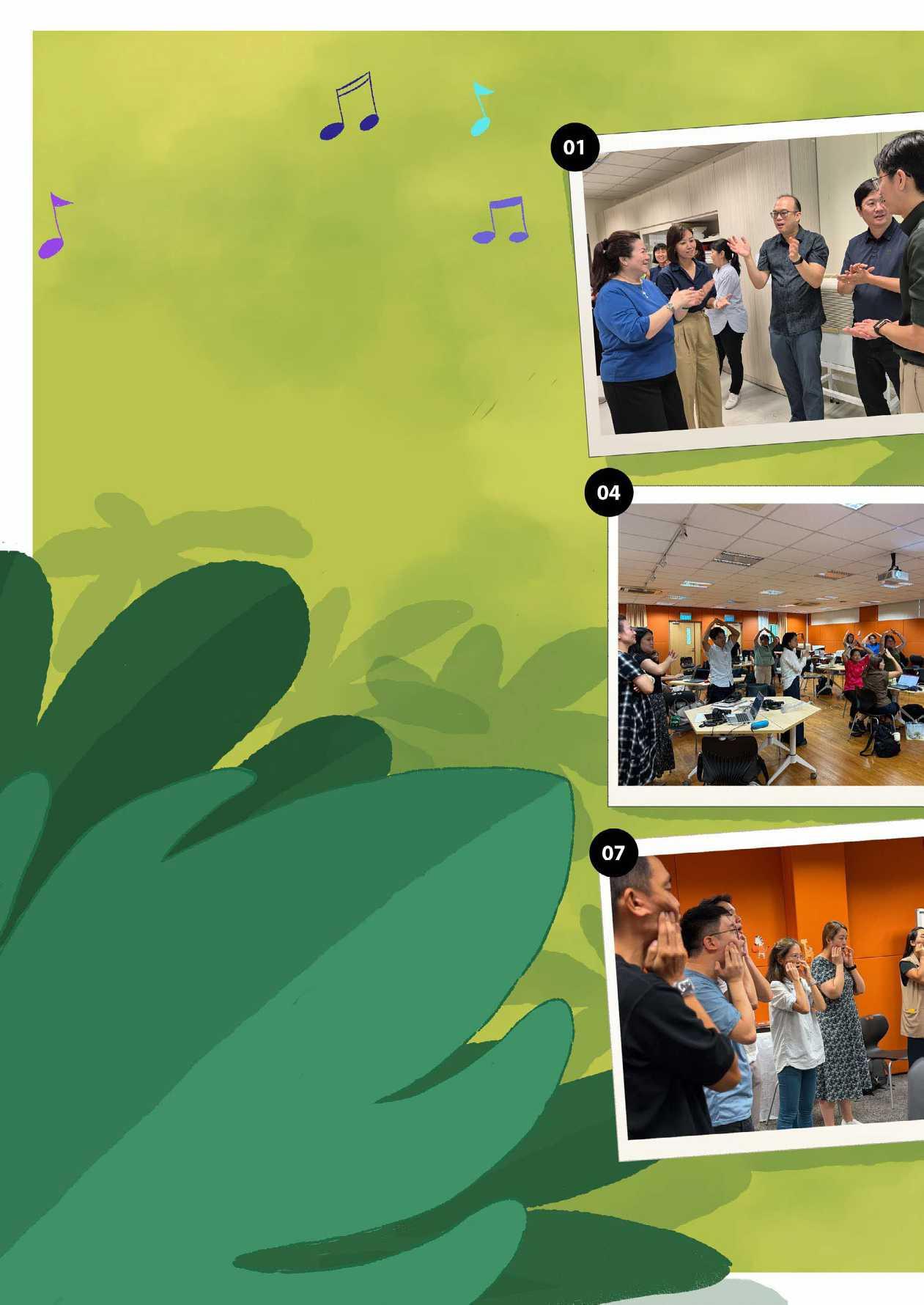
STAR Highlights
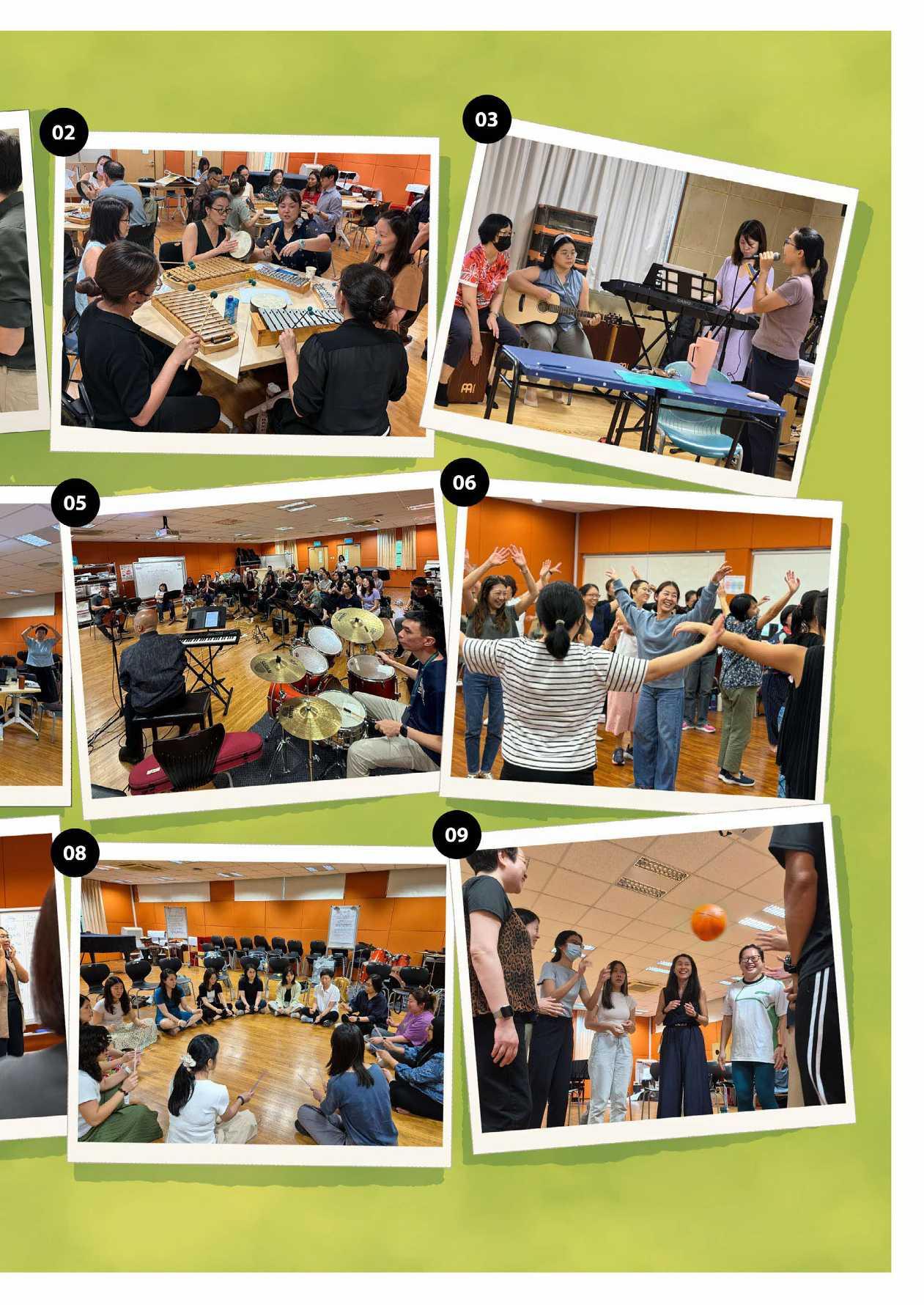
Catch up with the latest happenings that have taken place at STAR since our January 2026 issue of STAR Post and some exciting upcoming events and Professional Learning in 2026!
1. Lead Teacher & Senior Teacher Workshop
2. STAR Champions (Pri) Workshop
3. STAR Champions (Sec/JC) Workshop
4. Teaching ICT based Music Making Module 1: Creating Digital Resources for Music Teaching
5. Friends in Concert 2026 Welcome Session
6. Jazz Orff inspired Strategies for Teaching Music
7. Engaging With Songs (Sec)
8. Engaging With Songs: Prologue
9. Kodály Plus (Upper Primary)
Discover exciting professional learning opportunities awaiting you in 2026! Refer to the STAR Music Professional Learning Listing for all programmes available, including developmental programmes, such as Orff Approach to Music Education, Learning Jamoree, and Inclusive Music Classrooms — Supporting Diverse Learners.
We’d Love to Hear from You...
Lee Ley Har Deputy Director (Music)
Lee_Ley_Har@moe.gov.sg
+65 6664 1493
Chua Siew Ling Principal Master Teacher (Music)
Chua_Siew_Ling@moe.gov.sg
+65 6664 1554
Li Yen See Master Teacher (Music)
Chan_Yen_See@moe.gov.sg
+65 6664 1499
Kelly Tang Master Teacher (Music)
Kelly_Tang@moe.gov.sg
+65 6664 1561
Loo Teng Kiat Master Teacher (Music)
Loo_Teng_Kiat@moe.gov.sg
+65 6664 1544
Felicia Toh Sze Hui Senior Academy Officer (Music)