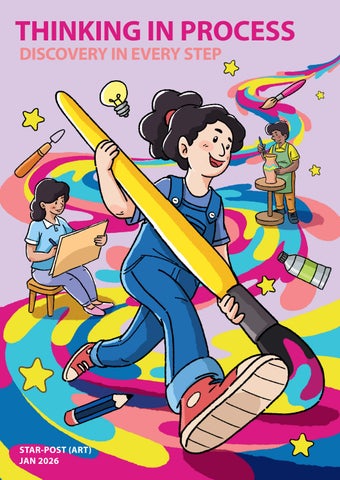
THINKING IN PROCESS DISCOVERY IN EVERY STEP
STAR-POST (ART) JAN 2026
Content Page 04 Foreword 06 Making Space for Art Making 08 Metacognition: The Key to Future-Ready Art Learners 12 AEDGE 2026: An Invitation to Start with Play 16 The Curator’s Playbook 18 What Struck You? 20 Welcome to the Fraternity!
3
4
Foreword rocess”. picks would be “p p to y m of e on , ar for 2025 AR’s Word of the Ye ST se oo ch to e tween er w If I e messy middle be th it Is d? en d an t riosity? n does it star at feeds restless cu does it look? Whe th s ow ok H bo s? es ad re oc lfpr eful is ha What arpen into purpos sh t’s rattan basket of tis lly ar ua e ad Th gr e? at th om tc e space ative marks idea and ou mon thread: it is th ok filled with tent m bo co ch a et es sk ar t’s sh en it t ud ape. ye , Or the st rent to each of us d learning takes sh ffe an e di s bl si ok vi lo s es es m oc co thinking be expression? Pr d knowing, where an g in ow kn t no ght between cy, we risk losing si en ci effi d an es outcom t, age that focuses on urage to experimen co an e In th ? p w lo no ve it e de is ey r beyond is where th Why emphas that serve them fa students, process s r Fo on f. iti el os its sp y di ne – ur rs of the jo what matte vise, and a voice in re to e nc lie si re e th iel the art room. Isabella Ong, Dan – ts tis ar ed ur at tion! Our fe l al, shaped by smal plores process in ac ic ex cl st cy is Po s R es A ST oc pr of This edition w the artistic ork. Leong - reveal ho ve ie ev en into meaningful w G d ild an bu lly ua Chong, ad gr ce encounters that exercises and chan gn learning how teachers desi e in am ex h Lo an bility. vi release of responsi un Wee San and Vi l ua Ch rs ad gr he e ac th Te t r or te eborah Mas ognition and supp ts, while curator D ac tis et ar rm he er st ac fo te r to ou experiences process for playfulness in the es at tiv ac 26 20 bitions. E EDG nceptualising exhi co r fo ok bo ay pl r Lim shares he es that shifted her iti tiv ac es ar sh ze the w Alexandrea Dro on on “Envisioning ho ss le ad 5 re y s, ar ea im id Pr on ’s w Loh Yi Hui If you’d like less to process, and ho t uc teaching. od pr om fr e h process-focused perspectiv ug ro th es om tc ningful ou us Future” led to mea assroom, then let cl t ar e th in e nc ents experie e journey our stud th to y ke is s es matters. oc So, if pr for one that truly te ca vo ad d an e, design, facilitat ading!
of re Enjoy the process
Ms Han Zi Rui Director (Art) Senior Assistant STAR
5
Making Space for Art Making WHAT GETS THE CREATIVE PROCESS GOING? FOR THESE THREE ARTISTS, IDEAS FOR ART MAKING TAKE SHAPE IN THE QUIET SPACES OF THEIR HOME, STUDIO AND EVERYWHERE IN BETWEEN.
By my bed, I keep a rattan basket where I pile my current reads. Right now, the stack includes Olivia Laing’s Gard en Against Time, Thomas Bernhard’s Woodcutters, J.R. Carpenter’s Measures of Weather and Tiffany Sia’s On and Off-Screen Imaginaries. In my Kindle, I am halfway through Sophy Robert’s The Lost Pianos of Siberia (for reading on the go). A reading arrangement that is restless and roaming. — Bedside table In my studio, I have a large table. A prod uctive day at the studio is one when this table is clear. There’s often clut ter around – books, tools and materials from past projects. Nonethe less, I usually settle into my day by first clearing this table. Then, I mov e on to complete the necessary labour – emails, grading and less on plans. An island of clarity forms amidst an invigorating mes s. — Work desk For work to happen, it begins with these
two tables I curate daily. Artist Isabella Ong
A typical day at the studio with no agenda often sees me standing before two large wooden shelves stacked with found and made objects I’ve collected over the years. I pick and choose a few, combining them to create a spontaneous assemblage. If it’s any good or to my liking, I’d usually feel it right away – some sort of finger-tingling, heart-pounding, eyes-ablaze kind of epiphany that lasts a mere split second. I know for a fact that this feeling rarely knocks on my door, so I frantically race to my notebook to flip to the spread where I store a list of ideas and incomplete projects, and actively search for some kind of resolution, or connection, to that strange thing I’ve just concocted. Sometimes the answer hits me as clear as day and grants me a starting point for a new body of work. Other times, I’m left with a humble “We’ll try again next time.” I believe there is value in dedicating time for boredom. Here lies a space for subconscious thoughts to resurface, and time and time again, I’ve found that these states of lull allow for second-guessing, for possibilities to coagulate. At the core of it lies a deep trust that the amalgamation of these little exercises will form the foundation of how I’d like to build my practice in time to come.
6
Artist Genevieve Leong
I’ve built a cycle between ideation and making within my process. Life as a freelancer can be hectic, so I’ve woven small rituals into my life by allowing multiple points of curiosity. When I can, I sketch illegible notes; on my phone, I type stray ideas, and when I’m free I wander – into random stores, locations, streets. These moments of serendipity refresh what I see, but they are also accompanied by a relentless asking. I try to have at least one question for whatever I encounter. Even a simple “why” can lead to unexpected surprises. At the core of this phase is to absorb intensely. When an idea takes form, I enter the making phase of my process. Here, I try things in small pockets of time for reflection. I make and listen. I also intentionally allow for failure. When I define failure, I have to define success. This helps me more critically understand what I’m trying to achieve, and more importantly, the limits of my conceptual ideas and physical material. Things rarely turn out as planned, and that’s the point. The misalignments, the unexpected results, the small differences are what I believe make creativity a form of labour. Together, these two phases create a cycle of expansion and consolidation that grounds my practice. While the forms and materials may change, this practice helps guide my creativity. Artist Daniel Chong
7
Metacognition: The Key to Fut What is Metacognition? Metacognition, often described as “thinking about one’s own thinking” 1, is the ability to notice, reflect on, and regulate our own cognitive processes. Simply put, it is the skill of understanding what’s happening in your mind. Imagine putting on a pair of special lenses that let you step back and observe your own thinking. This intentional pause to reflect helps us to monitor and adjust how we learn. In the classroom, this matters because metacognition helps students understand themselves as learners and take greater control of their learning. It lays the foundation for self-directed learning and Emerging 21st Century Competencies (21CC). 2
1. Weave Reflection into the Fabric of Learning Cheryl used to facilitate students’ reflections only at the end of a project, partly because time was tight. I always ask students to reflect at the end… but what if reflection came earlier?
PLAN
During the Critical Inquiry Project, Cheryl tried something new. She segmented her lessons, linking each segment to the metacognitive process of Plan, Monitor or Evaluate. Reflection became a natural part of learning, not an afterthought.
I’ll try a different brush next time.
I think my idea works better this way.
I can actually see how they’re thinking!
MONITOR
EVALUATE Ms Cheryl Lim Mei Tju Greenridge Secondary School
You’re right — reflection shouldn’t wait till the end. I’ve started adding ‘pit stops’ for thinking too!
8
Ms Jasmine Tan Jie Min St Anthony’s Canossian Secondary School
Her shift inspired others. Jasmine began adding focused reflection questions at key points of her lessons. These acted as thinking pit stops.
ture-Ready Art Learners Metacognition Thrives When Teachers Are Intentional The art classroom naturally supports metacognition because of the rich interplay between cognitive processes and social learning 3. But such thinking does not happen by chance — it requires intentional design and facilitation by teachers. Join Master Teachers Wee San and Vivian as they embark on a Critical Inquiry Project to investigate a key question: How might teachers nurture students’ metacognition in primary and secondary art classrooms? Flavell, 1979 Ambrose et al., 2010; OECD, 2030 3 Marshall & D’Adamo, 2018 1 2
Chun Wee San Master Teacher (Art)
Vivian Loh Master Teacher (Art)
2. Empower Students to take Charge of their Art Making To strengthen student voice and agency, Nurjannah engaged her students in goal setting and task planning. Before beginning the art task, she guided them to understand the requirements, reflect on their strengths and preferences, and identify strategies they already knew. This metacognitive process informed their next steps.
Before we start, what do you think you’ll do today?
Ms Nurjannah Ayub Cedar Primary School
Jasmine took this further in her classroom. Instead of launching into instructions immediately, she posed guiding questions that helped students make their own decisions. The result? Students stopped waiting around for directions and began steering their art making. They became more focused, took greater ownership, and Jasmine even gained time for one-on-one support. Art making shifted from teacher-driven to student-led.
What materials do you need?
What do you want to complete today?
9
Metacognition: The Key to Fut 3. Elicit Deeper Thinking through Intentional Questioning If reflection weaves thinking into the learning process, and autonomy places students in the driver’s seat, then intentional questioning propels them to think more deeply about their learning. To develop students’ artistic thinking, Jomanda and Syarinah guided students to consider the kinds of questions that artists often ask themselves as part of their creative process.
How can you use the principle of Dominance to express your chosen emotions?
What do I hope people will understand about the issues shown in my artwork?
Ms Jomanda Lau Cedar Primary School
What materials do I need? How can I use the materials to convey my ideas?
What would you do if you got stuck in the art making process?
Mdm Syarinah Sani New Town Primary School
The goal was for students to gradually internalise these questions, so that over time they could use them independently to guide their own thinking and decisions in art making.
Intentional Questioning Makes Thinking Visible Try asking process-oriented questions like: “How did you arrive at this idea?”
10
“What steps did you take?”
“How do you know that?”
These prompts help students articulate their thought processes - how they approach problems, make decisions, and solve tasks. Regularly engaging with such questions strengthens students’ capacity to self-question, self-monitor, and self-evaluate.
ture-Ready Art Learners What’s Next? Moving Forward… This Critical Inquiry journey into metacognition will continue. Much like the art making process itself, it will involve ongoing experimentation, reflection, and refinement. We are working towards our vision of a metacognitively rich art classroom where:
The teacher is: a designer of learning experiences and environments that intentionally nurture metacognition and support the gradual release of responsibility a role model who fosters a culture of growth by making thinking visible and encouraging reflective dialogue
The Students are: owners of their learning who actively and independently plan, monitor and evaluate their art making and learning processes confident in articulating their thinking for both personal reflection and peer learning
The Learning environment is: safe, supportive, and anchored by visual cues and accessible self-help resources that promote self-regulation flexible, with spaces designed to support both focused individual work and group collaboration
“Metacognition lies at the root of all learning.” - James Zull (2011) 11
EDGE: Art Educators’ Development EDGE 2026 : An Invitation to Start with Play This year’s edition of EDGE invited art educators to step beyond familiar routines and reconnect with their creative identities by beginning with play. In doing so, many rediscovered inspiration in their artistic practice, and new possibilities for their classrooms. For years, Art Educators’ Developmental and Generative Explorations (AEDGE) has celebrated the mastery of art teachers. Organised by the Singapore Teachers’ Academy for the aRts (STAR), each biennial art exhibition is a showcase of refined, conceptual, and beautifully resolved artworks. It is a space where deliberate thought meets honed technique, revealing the distinctive voice of every teacher-artist. But EDGE 2026 asked something different. Instead of preparing a finished work for display, this year’s open call invited teachers to design the EDGE logo (with the as an off-kilter “A”), as a starting point for artistic inquiry. This simple prompt disrupted familiar expectations and posed a far more provocative question: “What if you start with play?”
Stepping into Play: What Drew Teachers to EDGE 2026 Before the workshops even began, the teachers who signed up for EDGE 2026 came with deeply personal motivations. Many were seeking a return to themselves as artists, hoping to rediscover a part of their identity often set aside amid teaching, routines, and school responsibilities. Some joined to reconnect with the joy and curiosity that first drew them to art making; others were looking for a breathing space where they could slow down, notice more, and create without the weight of expectations. Some saw the open call as a chance to experiment with unfamiliar processes, revisit forgotten techniques, and stretch long-held artistic habits. Others were motivated by a desire to grow professionally as teacher-artists so they could better guide students through inquiry, material exploration, and contemporary art making practices. A few were simply drawn to the theme of “play,” intrigued by what it could mean for their creative and pedagogical journeys.
12
Across all motivations, one thread stood out: teachers sought to reconnect with freedom – creative, conceptual, and emotional.
tal and Generative Explorations Voices from the Play Studio Ms Sheila Chow Hui Niang Bendemeer Primary School Sheila joined EDGE because the theme of “play” spoke to her artistic instincts. Rediscovering papers from a previous workshop, she experimented with organic shapes and spontaneous textures, eventually arranging them into the letters A-E-D-G-E. She used Action Word cards to spark movement and direction, but allowed the materials to lead the way. For Sheila, play was a balance between guided prompts and intuition.
Ms Felicia Ting Pei Hwa Presbyterian Primary School Felicia saw EDGE as a chance to reconnect with the joy of artmaking. Her work reimagines the saying “all it takes is one idea” by highlighting how every idea is shaped by many invisible ones. The lightbulb became her symbol for unseen creative labour. Through the workshops, she learnt to let the process unfold more naturally and to embrace experimentation, a perspective she now hopes to model for her students by giving them room to explore without pressure.
13
EDGE: Art Educators’ Developmenta EDGE 2026 : An Invitation to Start with Play Ms Jessica Lai Kit Mun Peirce Secondary School Jessica’s artwork was inspired by a moment in Alice in Wonderland when the Caterpillar asks Alice, “Who are you?” She was fascinated by how childhood stories shape identity and how the mushroom in the narrative represents choice and possibility. The play-first approach pushed her to let go of resolution and accept that failure and uncertainty are part of the process. For Jessica, the making became the meaning. Mr Tay Li-Cheng Raffles Institution (JC) Although the play-first activities initially felt distant from his final idea, they encouraged him to loosen his reliance on polished outcomes. Growing up, he gravitated toward digital mediums for their precision, and his EDGE artwork reflects an effort to rediscover play through technology by approaching his digital tools with curiosity rather than control. This shift reminded him to focus on guiding process, not perfection — a mindset he hopes to bring back into his teaching.
What Teachers Said About Play “It was freeing to create without expectations. Just play, explore, and notice where the process leads.” — Ms Catherine Chua, Tampines North Primary School “This reminded me why curiosity matters. Wandering, experimenting, making unexpected connections – that’s what real creative learning looks like.” — Ms Low Sok Hui, Eunoia JC “The prompts reminded me that sometimes the best ideas begin with a small but meaningful trigger.” — Ms Desiree Tham, CHIJ Katong Convent School
14
al and Generative Explorations A Sneak Peek into EDGE 2026 EDGE 2026 is now in full swing, with participating teacher-artists experimenting, testing ideas, and engaging in inspiring conversations with invited artists. Their artworks will be showcased in the EDGE exhibition in January 2026, revealing how play can spark artistic inquiry.
Here’s what our teacher-artists have been up to so far: A glimpse into the creative process Teachers share how their ideas evolved through playful experimentation rather than from a predetermined final artwork. Stories of artistic risk-taking Educators demonstrated how they stepped boldly beyond their comfort zones to explore unfamiliar materials, tools, and modes of making. Insights into how play transforms practice Readers can glean fresh perspectives on how they can bring play into their own teaching, and reshape how students engage with art making. An open invitation to reimagine art EDGE 2026 invites all art educators to participate not just as spectators, but as thinkers and makers, reimagining what art can become when play leads the way.
In the Classroom: Where Play Becomes Possibility For many art educators, the biggest takeaway from EDGE 2026 wasn’t the artwork that eventually made it onto the display wall. Instead, it was everything they gained from the process itself. Through play, they rediscovered the joy of making without pressure, the courage to try without knowing, and the mindset of a learner once more. That renewed sense of curiosity and courage is already finding its way back into their classrooms. Teachers shared how beginning with play has informed their teaching and learning, shifting the way they guide exploration, respond to students’ ideas and make space for creative risk-taking. For Mdm Sharifah (Kranji Secondary School), the shift has been transformative. “Starting with play kept all options open. I didn’t fix my mind on a final medium. It sparked creativity in unexpected ways,” she said. By reclaiming play for themselves, art teachers are imparting more than techniques to their students. They are giving them the freedom to explore, experiment and wonder, turning the art classroom into a space of possibilities. By Felicia Chou Qi Ling (Concord Primary School), Erman Abu Bakar (Pei Hwa Presbyterian Primary School), and Nursheela Rustamaji (West Grove Primary School)
15
The Curator’s Playbook
Featuring Deborah Lim Independent Curator
Curation is about storytelling - and how we bring different works of art together shapes what others see, feel, and understand. This playbook unpacks how curating can spark new ways of thinking and learning in the art classroom.
EDIT & SELECT Curators administer the experience of art by selecting what is made visible. Every inclusion (and omission) shapes the story.
What connects these? What is the story we want to tell?
STORYTELLING Think of your exhibition as a narrative. What is your intention? What connects each work?
SPACE & FLOW Play with rhythm and distance. Give viewers time to breathe between works.
CONTEXT & CONNECTION Add cues for your audience - a student’s voice, a title, a quote.
16
FOCUS Highlight details that deserve a second look.
NOTES FROM CURATOR DEBORAH
WHAT ARE THE QUALITIES OF A CURATOR? • Good at research • Resourceful & adaptable • Comfortable wearing multiple hats
CURATOR’S MINDSET Curation is both plan and play - an act of framing ideas and inviting discovery.
DOCUMENTATION Capture the process. How the show comes together tells its own story.
Have students think more about their materials by: • showing them how artists push boundaries • experimentation • questioning the materials
Instead of seeing questions as a challenge, help students to see them as different voices. When planning for an exhibition in school, think of the following: • What is your contribution? • What is your intention? • How can you present connections that others may not have thought of? • How can you disrupt what the audience knows?
DIRECTION & PURPOSE Where do you want your viewer to go - physically and emotionally?
TRY THIS IN YOUR CLASSROOM! • Let students arrange artworks by theme rather than medium. • Invite students to interrogate the artworks. • Have students plan how visitors would encounter the exhibition and think about the story behind it.
17
What Struck You? Reflection on Play, Process and Structure workshop Attending the Play, Process and Structure workshop highlighted how meaningful outcomes can arise from purposeful, playful exploration. Activities like the blind clay exercise shifted the focus from product to process, revealing how mistakes can become valuable information and how constraints can spark creativity. Trial and error led to a visual dictionary, helping participants understand the affordances of the material and strengthening confidence in navigating the unknown. The hands-on experience deepened my appreciation for valuing and showcasing the process alongside the final product. Since the workshop, I have introduced more opportunities for process documentation within lessons while encouraging students to explore, experiment, and capture their ideas through sketches and material swatches. This led to the creation of the “Process Wall”, a dedicated space that highlights students’ thinking and experimentation as integral parts of learning. Art education nurtures students to See, Think, and Create meaningfully in an ever-changing world. These dispositions empower them to approach challenges with imagination, reflect on their experiences, and contribute thoughtfully and purposefully to their communities and beyond. Mrs Alexandrea Droze, White Sands Primary
Reflection on Ceramics Workshop: Future Artefacts It began with a single piece of clay, passed from hand to hand, reshaped each time until it no longer belonged to any one of us. In learning to let go, I discovered that creation could be a dialogue – between artists, and between intention and chance. That spirit guided my own future artefact: a pair of spectacles designed to help students focus, inspired by both Inuit snow goggles and steampunk invention. As I wrestled with fragile clay joints and layered meanings, I realised that making is less about control than curiosity – shaping not just artefacts, but the way we see.
18
Ms Lee Rui Ching, Pei Tong Primary School
Reflection on Pressing Matters workshop The Pressing Matters workshop introduced valuable techniques such as monotypes and screen printing, particularly the reduction method which involves painting on a blocking medium in layers. Working through the creative process taught me to prioritise process over perfection. I learnt to embrace multiple, possibly unsuccessful, copies, and to adopt a “just go” attitude instead of overthinking. The workshop also showed how accessible lino monotype printmaking can be, with simple cleanup making it practical for classroom implementation. I plan to introduce it to my students, leveraging its accessibility to enhance their printmaking experience. The facilitators provided insightful guidance, and shared tips and tricks that deepened my teaching approach. Ms Nicole Cheong, West Grove Primary School
Reflection on Design Literacy workshop The workshop deepened my understanding of purposeful, user-centred design. The activities on defining design constraints were refreshing and immediately applicable to my practice. Working through the structured process – from digital concept sketching to asset creation and the final pitching session – solidified my understanding of the digital medium’s potential. It highlighted the importance of iterative design, where rapid prototyping and easy revision are core advantages of digital tools. This learning experience reinforced that digital literacy is not just a technical skill, but a foundational creative language. It shifted my approach from teaching software features to digital problem-solving and critical evaluation of online information. I am now more deliberate in modelling professional workflows, including file organisation, version control, and digital etiquette, to prepare students for real-world digital environments. Miss Dasimah Jalil, Serangoon Secondary School
19
Welcome to the Fraternity!
Mr Loh Yi Hui CHIJ Primary (Toa Payoh)
As an art educator, I guide students to see art as a journey of exploration rather than a task to complete. Each project begins with curiosity, asking questions, researching ideas, and experimenting in their sketchbooks before committing to a final piece. This helps them move beyond their first idea and uncover new possibilities through trial and reflection. Throughout the process, I encourage short consultations where students share progress and learn from one another. Beyond technical skills, they learn to think critically, connect ideas, and make purposeful artistic choices.
P4 Topic: ‘My Living space’ (Diorama)
Process work is an essential part of the artistic journey. It is where students translate ideas into sketches, explore possibilities through multiple drafts, and refine concepts. Sometimes, their imagination stretches far beyond the given theme. That’s when I guide them to channel their creativity back towards the learning objectives without dampening enthusiasm. I encourage them to see the process as imaginative play, a space to explore while staying mindful of intent. A Primary 5 lesson on “Envisioning the Future” reminded me why this matters. Students began with a black-and-white picture reference and were tasked to extend it into a futuristic world. Initially, many designed familiar scenes – skyscrapers, transport systems or robots. Their ideas deepened when I encouraged them to develop a rationale or story behind their designs. Through sketching, discussion, and refinement, students expressed unique perspectives: some imagined environmental collapse while others envisioned harmony between nature and technology. They learnt that good art takes time to grow through revision and feedback, becoming more motivated when their ideas had purpose. Primary 5 Art Topic: Future of Singapore Top Left: Draft 1 Top Right: Student writeup Bottom Left: Final artwork Bottom Right: Sketchbook Draft 2
20
Student A’s Draft work 1
Student B’s Draft work 1
Student A’s Draft work 2
Student B’s Draft work 2
I see myself as a lifelong learner, growing alongside my students. I want to keep developing my artistic skills and exploring new ways to make lessons meaningful. Above all, I aim to create a space where students feel inspired to take risks and discover confidence in their artistic voice.
Our Team Chia Wei Hou
Master Teacher (Art) CHIA_Wei_Hou@moe.gov.sg
Ira Wati Bte Sukaimi
Master Teacher (Art) Ira_Wati_Sukaimi@moe.gov.sg
Han Zi Rui
Senior Assistant Director (Art) HAN_Zi_Rui@moe.gov.sg
Chun Wee San
Master Teacher (Art) CHUN_Wee_San@moe.gov.sg
Victoria Loy
Master Teacher (Art) Victoria_LOY@moe.gov.sg
Silvia Lim
Academy Officer (Art) Silvia_LIM@moe.gov.sg
Lim Kok Boon
Vivian Loh
Master Teacher (Art) Vivian_LOH@moe.gov.sg
Master Teacher (Art) LIM_Kok_Boon@moe.gov.sg
Nurulhuda Mustafa
Academy Officer (Art) Nurulhuda_MUSTAFA@moe.gov.sg
Seow Ai Wee
Principal Master Teacher (Art) SEOW_Ai_Wee@moe.gov.sg
21
2 Malan Road, Blk P, Singapore 109433 Tel: +65 6664 1561 Fax: +65 6273 9048 Published by the Singapore Teachers’ Academy for the aRts (STAR) All rights reserved. No part of this publication may be reproduced in whole or part without the prior consent of STAR.