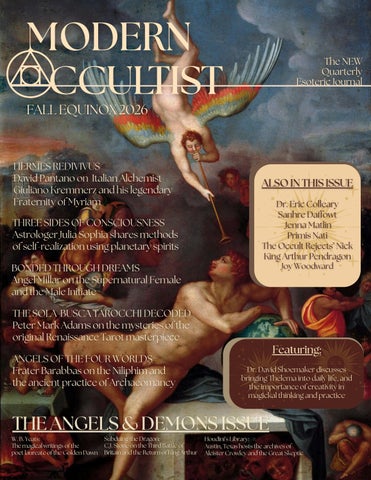
MODERN CCULTIST
The NEW Quarterly Esoteric Journal
FALL EQUINOX 2026
HERMES REDIVIVUS David Pantano on Italian Alchemist Giuliano Kremmerz and his legendary Fraternity of Myriam THREE SIDES OF CONSCIOUSNESS Astrologer Julia Sophia shares methods of self-realization using planetary spirits
ALSO IN THIS ISSUE Dr. Eric Colleary Sanhre Daffowt Jenna Matlin Primis Nati The Occult Rejects’ Nick King Arthur Pendragon Joy Woodward
BONDED THROUGH DREAMS Angel Millar on the Supernatural Female and the Male Initiate THE SOLA-BUSCA TAROCCHI DECODED Peter Mark Adams on the mysteries of the original Renaissance Tarot masterpiece ANGELS OF THE FOUR WORLDS Frater Barabbas on the Niliphim and the ancient practice of Archaeomancy
Featuring: Dr. David Shoemaker discusses bringing Thelema into daily life, and the importance of creativity in magickal thinking and practice
THE ANGELS & DEMONS ISSUE W. B. Yeats: The magical writings of the poet laureate of the Golden Dawn
Subduing the Dragon: C.J. Stone on the Third Battle of Britain and the Return of King Arthur
Houdini’s Library: Austin, Texas hosts the archives of Aleister Crowley and the Great Skeptic
MODERN CCULTIST PUBLISHERS C. M. Kushins
Diana Serhal
EDITOR IN CHIEF C.M. Kushins
MANAGING EDITOR Diana Serhal
DIRECTOR OF COMMUNICATIONS Elizabeth Baglia MODERN OCCULTIST MEDIA OFFICES Email modernoccultistmag@gmail.com Web www.modernoccultist.com Modern Occultist Magazine is a digital scholarly lifestyle publication for the modern reader of esoteric history and practices available online at www.modernoccultist.com. All rights reserved. No part of this publication may be reproduced, distributed, or transmitted in any form or by any means, including photocopying, recording, or other electronic methods, without the prior written permission of the publisher, except in the case of quotations embodied in digital and print reviews.
2026. Modern Occultist Media LLC. All Rights Reserved.
FALL EQUINOX 2026 2 MODERN OCCULTIST MAGAZINE
FALL EQUINOX 2026
M SUBDUING THE DRAGON
CONTENTS 12
W.B. YEATS: THE POET LAUREATE OF THE GOLDEN DAWN
27
A closer look at the master wordsmith’s magical writings and occult career
C.J. Stone on the Third Battle of Britain and the Return of King Arthur
HERMES REDIVIVUS David Pantano on Giuliano Kremmerz and the legendary Fraternity of Myriam
BEAST AMONG THE STACKS
OCCULT READS
ANGELS & DEMONS IN THE QUANTUM WORLD Examining the Chaos Magic and Quantum Theory implications of spiritual entities
56
42
A new season of exclusive book reviews and reccomendations
48
WHAT WE TALK ABOUT WHEN WE TALK ABOUT THE BOOKS OF THE DEAD
Inside the Austin archives of Aleister Crowley and Houdini’s personal library
52
58
The strange and fascinating history of the occult world’s favorite subject ... death!
3 MODERN OCCULTIST MAGAZINE
FALL EQUINOX 2026
CONTRIBUTORS Joy Woodward is an internationally acclaimed Pythagorean numerologist, reader, and healer, and founder of the Joy of Numerology, h and spiritually aligned tools rooted in ancient number wisdom. Peter Mark Adams is an author, poet and essayist specialising in the ethnography and visuality of ritual, sacred landscape, esotericism, consciousness and healing.
Frater Barrabbas is a practicing ritual magician and author who has studied magic and the occult for over forty years.
Dr. Eric Colleary is the Cline Curator of Theatre & Performing Arts at the Harry Ransom Center, an international humanities research library, archive, and museum.
Julia Sophia is an astrologer, tarot card reader, spiritual teacher, writer, and artist. She is the author of Quiet Portal to the Odd, Curious, and Poetic, a Substack on astrology, David Shoemaker is a clinical psychologist and myth, and contemporary spiritual author in private practice, specializing in Jungian culture. and cognitive-behavioral psychotherapy. David is the Chancellor and Prolocutor of the Temple of the Silver Star, a ceremonial and initiatory order based on the principles of Thelema, Qabalistic psychology, and similar traditions. He is also a long-standing member of Ordo Templi Orientis and A.’.A.’. and host of the Living Thelema podcast.
A practitioner of esotericism for more than three decades, Angel Millar is the author of The Three Stages of Initiatic Spirituality: Craftsman, Warrior, Magician, among other books.
Jenna Matlin holds an MS in organizational psychology and a BA in anthropology, with end-of-life doula training through INELDA as well as training in psychedelic integration support.
Nick is the host and The Occult Rejects Podcast and founder of the Occult Research Institute. Arthur Pendragon, more commonly known as King Arthur, is the reincarnation of the mythical Once and Future King. Or at least, that’s how he understands it.
David Pantano isan author, historian, translator, public speaker and yogi exploring the frontiers of consciousness. Sanhre Daffowt is the founder of The Order of Chaos Mystery School, focusing onastrology, esoteric philosophy, and practical occultism.
Primis Nati is the author of The Satanic Self, among other esoteric writings. MODERN OCCULTIST MAGAZINE
C. J. Stone, is an English author and journalist, best known for his columns in The Guardian Weekend and The Big Issue. . FALL EQUINOX 2026
4
The revival of deep public interest in psychic matters is only a matter of time, and then those things which have been of absorbing interest to the few will become of vital interest to the many. —Oliver Bland, The Adventures of a Modern Occultist (1920)
EDITOR’S DESK Welcome, Dear Reader, and Blessed Fall Equinox! The sun crosses the equator today, the balance point between light and dark we spent last night preparing for, and there's no better date on the entire calendar to release an issue built around exactly that same tension. Issue Four of Modern Occultist is officially here, and its theme, “Angels & Demons,” sits precisely where this magazine has always lived most comfortably: the space where genuine scholarship, lived practice, and honest myth-checking meet… This is, without exaggeration, the most stacked roster we've ever assembled in one issue, and we wanted to give readers a real sense of everything waiting inside before you dive in: Many full interviews anchor this issue, and the range is genuinely remarkable: Julia Sophia, astrologer and tarot reader, joins us fresh off co-authoring Uranus, Neptune, & Pluto for Weiser Books; Sanhre Daffowt brings his physics-forward take on chaos magic from Chaos Witchcraft, while Jenna Matlin, tarot reader and psychic medium, discusses the katabasis at the heart of The Tarot Book of the Dead; Scholar Peter Mark Adams joins us to talk Sola-Busca Tarocchi and Renaissance Neoplatonism, and King Arthur Pendragon, the former biker turned Pagan Druid leader, sits down with us on the fortieth anniversary of his own transformation... Frater Barabbas, an elder in the Alexandrian tradition and author of Liber Artis Archaeomancy and Liber Nephilim, brings the issue's most direct angelic and demonic grimoire work, while Dr. Eric Colleary, curator of theater and performing arts at the Harry Ransom Center at the University of Texas-Austin shares details about their incredible Aleister Crowley archive and new exhibition of Harry Houdini’s personal library and discusses the genuine crossroads between stage illusion and claimed occult power. Nick, the host of The Occult Rejects podcast and founder of the Occult Research Institute, joins us as well, alongside Primis Nati, whose debut The Satanic Self we are proud to champion as a stunning and original debut... Rounding out the roster: Angel Millar discusses the supernatural feminine archetype at the heart of Supernatural Woman and the Male Initiate, and numerologist Joy Woodward discusses her new Your Destiny Is in Your Numbers. This issue also features something we're especially proud of: David Pantano, famed historian behind The Hermetic Book of the Dead, has contributed an original essay, “Hermes Redivivus,” to the magazine. Italian journalist and esoteric researcher Gaetano Lo Monaco reviews Pantano's earlier work, The Magic of Giuliano Kremmerz, and C.J. Stone, co-author of The Trials of Arthur, returns with a feature piece on Arthur's own decades-long fight for Britain's Pagan landscape. Our Occult Reads section is doing heavy lifting this issue, with full reviews of every book represented in our interviews above, plus additional titles: The Toltec Legacy (Weiser), , From Now to Now (Hilaritas Press), The Magical Writings of W.B. Yeats (Aeon Spirit), and The Tarot of Marsilio, Volume 1: Down Here (Scarlet Imprint). Beyond the interviews and reviews, an in-depth history piece traces the genuine, tangled lineage of “books of the dead” across ancient spiritual systems, from Egypt to Tibet, and how that entire tradition eventually gave rise to H.P. Lovecraft's fictional Necronomicon. A companion profile, “W.B. Yeats, the Poet Laureate of the Golden Dawn,” examines the poet's own years inside the legendary magical order. And for readers who've followed our recent dive into chaos magic and quantum theory, “Angels and Demons in the Quantum World” takes that inquiry even further, asking whether angels and demons might function as genuine entities, genuine psychological archetypes, or something existing meaningfully in between. Every current running through this issue, ceremonial grimoire work, tarot history, numerology, agrarian Druidry, stage magic archives, chaos theory, keeps circling back to the same central question: what actually stands between us and the forces, entities, and archetypes we've spent millennia trying to name, summon, banish, or understand. Angels and demons have never really been opposites so much as two names for the same essential mystery, approached from opposite directions. This issue spends its full length exploring that mystery honestly … and we’re honored to have you, dear reader, back in our circle to share in the mystery…
s r o t i d the E
MODERN OCCULTIST MAGAZINE
FALL EQUINOX 2026
5
THE MODERN OCCULTIST INTERVIEW
with
Julia Sophia
James and I noted that religions offer paths, philosophers argue principles, and hippies suggest mind-expanding drugs to facilitate the search for meaning, yet there seemed to be no specific astrological method to carve out this path. Our inquiry also revealed that it is almost universally understood that we live in a world defined by opposites: day and night, up and down, and so on. States of being are only properly defined in relation to their polarity. And yet, a higher degree of awareness comes when we add a third factor that explains the meaning of the opposites.
Uranus, Neptune and Pluto: The Impact of the Astrological Outer Planets Red Wheel/Weiser, 2026
MODERN OCCULTIST Your new book’s central proposition is genuinely bold: that Uranus, Neptune, and Pluto are not three separate transpersonal forces but three facets of a single consciousness—a Holy Trinity of freedom, creativity, and evolution. Most astrological tradition treats them as distinct in character and effect.
Lao Tzu explained that it is the Tao that gives the meaning that reconciles yin and yang; Hindu philosophy, Brahma, Shiva and Vishnu have a similar correspondence. The spiritual path is not that of duality, it is the path of reconciliation of three principles. Threeness is weighty, which the book explains in more detail: twoness creates separation, introducing tension, and threeness adds reconciliation, harmony, and relationship. Thus our study of numbers intuitively lent itself to applying this to the outer planets and their symbolic essences, with Uranus representing freedom, Neptune representing creativity, and Pluto representing evolution. This midpoint, which we named Trinity Point, conjoins these fundamental life principles; it moves beyond the tension of twoness and adds a harmonizing force, an energetic resonance we can apply to our life.
“Lao Tzu explained that it is the Tao that gives the meaning that reconciles yin and yang; Hindu
What was the intellectual or intuitive moment that convinced you the Trinity framework wasn’t merely a useful metaphor but was actually describing something real about how these planets operate—and how did working with James Burgess, whose deep Sufi cosmological background shapes the book’s architecture, help sharpen or challenge that conviction?
philosophy, Brahma, Shiva and Vishnu have a
JULIA SOPHIA
separation, introducing tension, and threeness
Most of us begin our study of astrology and deepening of selfawareness by confirming that we behave much as our inner planets suggest. Before long, we then discover that the outer planets draw our attention beyond personal psychology into questions of collective existence and spirituality. Their transits often awaken an expanded dimension of awareness; we are reminded that unseen relationships bind seemingly separate things together and that we belong to something much greater than our capacity to fully comprehend or articulate. Whether we call that mystery Allah, God, Source, or simply Life itself is of little consequence; sooner or later, most of us find ourselves in dialogue with it.
MODERN OCCULTIST MAGAZINE
similar correspondence. The spiritual path is not that of duality, it is the path of reconciliation of three principles. Threeness is weighty, which the book explains in more detail: twoness creates adds reconciliation, harmony, and relationship.”
I had worked together with James for three years already and was familiar with his Sufi approach to spirituality, so we were intuitively aligned in our approach to integrate sufism. James’s knowledge certainly sharpened our focus and unique perspective on the matter: : in Sufism, this idea has resonance with the principle that unity and diversity are each an expression of the other. The highest and most sacred expression of all created forms is not more than the Creator,
FALL EQUINOX 2026
6
which gave rise to diversity. With the outer planets, we study the diversity of life expression at the highest level of sacredness and find this in merging freedom, creativity, and evolution. And when we have found how to engage with these energies consciously, we are able to employ them to boost our spiritual level, affirmingour access to our life's meaning and therefore the very source of our spiritual power.
MO The “Trinity Point”—your new midpoint calculation locating a practitioner’s “inner source of spiritual power”—is the book’s central practical innovation, grounded further through Sabian Symbols. Introducing a new technical tool into astrology is a significant move; the field has well-established midpoint traditions going back to Ebertin and the Hamburg School ... What does the Trinity Point reveal that conventional midpoint analysis—or a standard reading of each outer planet individually—cannot? And what does it demand of the astrologer who uses it—both technically and in terms of their own spiritual development? JS Midpoints, as Robert Hand already stated, can expand and deepen chart interpretations. Most midpoint calculations use two planets for reference, they excel at showing how planetary functions and archetypes blend and where their joint principles become more emphasised. Our proposition is the three-way midpoint. Simply adding an extra point into the equation is not particularly pioneering; I would say our central innovation lies in the spiritual and symbolic significance as well as the application of this midpoint of Uranus, Neptune, and Pluto. The Trinity Point pinpoints a deeper dimension of being: the place where the three sacred principles represented by the outer planets, freedom, creativity, andevolution, fuse into one unified spiritual impulse.
Calculating the Trinity and the Unity Point might look complicated at first sight, but it is in fact not technically demanding—I am not much of a number person myself, but I find the calculation straightforward! Once the Trinity Point, our inner source of spiritual power, and its polarity, the opposing Unity Point, its complementary movement outward, have been located, we consult the Sabian Symbols of each point’s degree to unlock its deeper meaning. The Sabian symbols provide the language through which these points become alive and personally relevant, and most importantly, they make us an active part of the interpretation process. A major perceptual shift occurs that realigns our self-image from seeker to troubadour (“I have found”). Having found our very own Trinity Point, we can then seek to express this wisdom through the Unity Point in the manner of a humble person looking for nothing. These points cannot be approached with the mindset of collecting another interpretive keyword or adding another layer of chart detail. They require contemplation; they require sensitivity to symbolism, and most importantly, they require the astrologer to wrestle personally with the very principles the points represent. The Trinity Point asks difficult questions: am I genuinely free, or merely reacting against restriction? Am I expressing creativity, or simply repeating familiar patterns? Am I evolving, or remaining attached to an identity I have already outgrown? Without confronting such questions in ourselves, our interpretation of the point remains theoretical. The Trinity and Unity Points become most meaningful when they are not merely analysed; they must be lived. In that sense, the astrologer's own spiritual development is not separate from the technique. It is part of the technique.
MO Your background is unusually interdisciplinary for an Astrologer: a BA in Liberal Arts and Sciences, an Oxford MSc in Medical Anthropology with a dissertation on therapeutic fasting as embodied bio-spiritual practice, and your foundation certificate from the London Faculty of Astrological Studies. How does the anthropologist in you sit with the astrologer? Does the academic training create productive tension—a kind of internal skeptic who sharpens the work—or has astrology revealed something that the academic framework simply couldn’t contain?
MODERN OCCULTIST MAGAZINE
JS
I love this question, and you have already put your finger on the crux of the matter. This very tension is indeed what has productively guided my esoteric inquiries over the years. Anthropology, in many ways, seeks to deconstruct—how meaning is created, how symbols and belief systems acquire force, and how social realities become naturalised. In its contemporary forms, it is largely non-essentialist. Astrology, on the other hand, as a symbolic language, constructs—patterns, correspondences, meanings, correlations. In this sense, it tends toward an essentialist understanding of meaning. So we have two seemingly incompatible, at least partially paradoxical, though perhaps not entirely irreconcilable epistemologies. For a while, I escaped this chasm by strategically compartmentalising them—the anthropologist by day, astrologer by night, metaphorically speaking. But this only postponed my direct engagement with the central tension between them. At Oxford, my dissertation on therapeutic fasting as embodied bio-spiritual practice then became my attempt to bridge academia and spirituality in an academic setting. I conducted qualitative research on the altered states of consciousness, spiritual experiences such as ecstasy, and thorough life-examination people experience when depriving themselves of food under medical guidance. However, I found even qualitative methodologies, the closest one can get to encroaching upon spiritual experiences in scientific materialism, simply unable to capture the subtler realms. This did not surprise me in the end, as these research methodologies were created to study the material realm and have a fundamentally different way of approaching knowledge and reality itself. It was worth a try, but I then decided not to continue my postgraduate studies in the form of conducting doctoral research, which would have been the next ‘logical’ step in my career. Paradoxically (I believe there is magic in paradoxes), after I had completed my studies and was no longer professionally obliged to employ a strictly anthropological lens, I started to relax my dialectical thinking. Relaxation, as a general disposition, tends to produce better results than resistance, and so I began to experimentally look for commonalities between anthropology and astrology more consciously. I found those to be the importance of narrative in determining human experience, the highly symbolic coded dimensions of reality, and the observation that meaning itself is a force with tangible social and material consequences. Now, I focus on these commonalities as a way forward, and would therefore say that my disposition has evolved in this way in the past years. Perhaps the best possible way to describe how I approach this new disposition is the Chariot card in Tarot: two sphinxes, one black, one white, attempt to pull a carriage in opposite directions, and it is up to the charioteer to hold the tension between opposites and direct their combined power with wisdom (note the trinity imagery!). I strive to embody this quality in all my studies, and I am grateful for the tension that moved me further along this journey: the cosmic dance between the critique of the deconstructing anthropologist and the softening of faith of the esoteric astrologer.
MO The book draws explicitly on Sufi cosmology to broaden the analysis of the outer planets—a tradition not commonly found in Western astrological literature. For readers who come to this book primarily as astrologers rather than students of Sufism, what is the single most important thing the Sufi cosmological framework contributes that they won’t find in conventional psychological or archetypal astrology—and how does it change what a Pluto transit, for instance, actually means? JS I would say that the single most important contribution the Sufi cosmological framework makes to astrology is shifting it from being primarily a language of psychology to being a language of consciousness. The seven planes describe progressively the subtler dimensions of reality: at the lower planes, consciousness is primarily occupied with survival, security, personal desires, social identity, and
FALL EQUINOX 2026
7
attachment to form. At the higher planes, awareness increasingly shifts toward meaning, unity, love, intuition, wisdom, and ultimately direct experience of the divine source. Each plane must be mastered. Given our understanding of the outer planets as three facets of a single spiritual process— freedom, creativity, and evolution—the Sufi framework helped us to move away from seeing them as disconnected planetary functions to expressions of one movement of consciousness seeking greater realization of itself. It is taught in Sufism that two drives of equal strength exist within us: the survival instinct and the religious instinct. Through the latter, we are drawn toward greater truth and higher consciousness. Let’stake the Pluto transit as an example to make sense of this. A conventional psychological interpretation might focus on themes of power, loss, shadow work, death-and-rebirth processes, or profound transformation. A Pluto transit might dismantle a career, relationship, identity, or belief system, and we are forced to leave familiar territory, often clinging to identities and patterns that once served us well in this process. All of that is valid. But the Sufi perspective asks an additional question: what level of consciousness is trying to emerge through this experience? I will briefly quote our book: “Pluto transits are ruthless imperatives— evolve or die! All life is growth; if we do not grow, we die. If we lack faith or energy or courage, we become stuck in an unevolved state because our lives have stagnated. Pluto deals with this, whether we like to change our self-defeating ways or not”. Pluto reveals when we have become too small for the person we are becoming, and its transits often coincide with questions of meaning, faith, destiny, mortality, and purpose. Sufism shows us that what we resist most fiercely may just prove to be the threshold birthing the next plane, moving towards transcendental consciousness. From this perspective, Pluto becomes an agent of initiation, a process of sacred evolution that compels movement between levels of awareness. A Pluto transit evolves our level of being.
accessible. However, growing up, it would take many years before I consciously engaged with esotericism again, as ‘normal’ life and its way of approaching reality took central stage and occupied me for quite a while. It was then in my early twenties when I was going through a difficult crisis of meaning that I finally turned to esotericism again. I was studying Medical Anthropology at Oxford at the time, living onsite the beautiful college grounds, with a lot of time on my hands and nowhere to go due to Covid. I started reading about Occult practices in the hopes of finding a reason or explanation for my crisis, and above all an indication as to when it would end—essentially the age-old, perennial human impulse to seek order, purpose, and pattern in the midst of chaos. The keyword ‘astrology’ appeared again and again as one of the methods of pattern recognition, self-understanding, and prediction, and soon after, I decided to look up my birth chart. The most memorable moment on the journey of becoming an astrologer was an uncanny revelation. I have kept a diary since early childhood, in which I habitually note down only important events, realisations, and emotional revelations. When I learned about astrological transits, I decided to review my diary entries to see if date ranges of my major astrological transits in life so far aligned with the timings and themes of important events noted in my diary. This retrospective inquiry yielded shocking results—the transits (I focused on outer planet and a few Saturn and Jupiter transits) aligned exactly in timing and symbolism with my diary entries. It was then that I was fully and finally ‘sold’ on astrology’s power. It seemed impossible to deny that I was onto something great; I could not have known or manipulated these diary entries from my childhood and teenage years when I was not acquainted with astrology. This was the final blow for my objective, scientifically minded inquiry into the nature of reality.
MO What was your personal start on your own journey on this path? JS Several key women in my mother’s friendship circle unknowingly sensitised me to the possibility of the esoteric path from a young age. When my mother visited her girlfriends, I would tag along, escape coffee and cake and drift through their houses unattended, browsing their bookshelves. These contained wondrous treasuries of forgotten knowledge and Occult curiosities. I’d then curl up in a corner with some newfound treasure—most often a book about myth, Kundalini energy, crystals, the life of yogis—and slip into a different world. These
“It is taught in Sufism that two drives of equal strength exist within us: the survival instinct and the religious instinct. Through the latter, we are drawn toward greater truth and higher consciousness. Let’stake the Pluto transit as an example to make sense of this. A conventional psychological interpretation might focus on themes of power, loss, shadow work, death-and-rebirth processes, or profound transformation.”
experiences cultivated an openness to Occult philosophy early onwards, which is why I think I never underwent a foundation-shaking ‘revolution’ or watershed moment that completely shattered my worldview and cosmology as an adult. This different way of knowing had been there from the very beginning, and had always felt intuitively
MODERN OCCULTIST MAGAZINE
FALL EQUINOX 2026
8
THE MODERN OCCULTIST INTERVIEW
with Peter Mark Adams
MODERN OCCULTIST
You describe The Game of Saturn as a “literary detective story,” making the case that the Sola-Busca tarocchi is not merely a beautiful Renaissance artifact but a functioning grimoire, encoding an active theurgical and demonic magical system descended from George Gemistos Plethon's neopagan cosmology. At what point in your research did you realize you weren't just decoding iconography—that you were looking at something that had been deliberately designed as operative magic, or a magical technology of its own? PETER MARK ADAMS I knew from the get go that I was striving to lever open something that had been cleverly and profoundly occluded; but it was not until half way through the project that I suddenly understood that I was not only dealing with Neoplatonic cosmology but a performative tradition - a literal pictorial grimoire - of the highest order of theurgical magic - the theurgical invocation of the Draconian current in the form of the god Amun.
MO The figure of Plethon is central to your argument—a Byzantine philosopher who attended the Council of Ferrara-Florence in 1438 and appears to have seeded a covert Saturnian paganism into the intellectual elite of Renaissance Italy, a full three centuries before Weishaupt's Illuminati. For readers encountering Plethon for the first time, how would you characterize his significance—and do you believe the transmission he carried from Constantinople was a conscious, deliberate act of esoteric implantation, or something more diffuse and opportunistic? PMA George Gemistus has been accurately described as “the Last Helene”— and that is exactly what he was. He actively proselytised both the Byzantine Emperor and his son to abandon Christianity revert the Byzantine Empire to the the worship pagan gods; he compiled a complete pagan liturgy—called the NOMOI, including prayers, songs, calendar, gestures and incenses for the worship of the ancient gods. In Italy between 1437 and his death around 1453 he argued in the Renaissance courts for the superiority of Platonism and privately circulated chapters of his pagan liturgy, the Nomoi. He gained powerful supporters in Ferrara, Florence, Rimini and Rome that evolved into the so-called “Platonic Academies”—such as that run by Marsilio Ficino in Florence—in those cities.
MO One of the book's most fascinating arguments is that the Sola-Busca encodes not just a cosmological worldview but a specific ritual praxis—
MODERN OCCULTIST MAGAZINE
THE GAME OF SATURN: D E C O D I N G T H E S O L A - B U S C A TA RO C C H I S C A R L E T I M P R I N T, 2 0 1 7 ; R E P R I N T E D 2 0 2 6
one centered on the invocation of Ammon-Saturn in his most primeval, serpent-dragon form, within a framework that you describe as coming as near to what the average person would consider satanic as it is possible to imagine. You are careful throughout to maintain scholarly distance from this material—but you've also spent years inside it. What effect, if any, has sustained immersion in this particular current had on you personally, or your views on your own form of in-depth scholarship? PMA I practice a form of “esoteric scholarship” that is guided by the forces that I seek to resurrect and return to our communal, esoteric community; this work is complemented by esoteric publishers such as Scarlet Imprint and Theion—practitioners who understand that publishing itself is an esoteric discipline and whose talismanic works are designed to connect the reader with the current that they engage with.
MO The Sola-Busca's complete absence of Christian iconography—at a time and place where such absence was not merely unconventional but potentially a capital offense—seems to you not incidental but central to the deck's meaning. (The deck's designer was making a statement, encoding a defiance, and The Game of Saturn traces this defiance back through the Watchers mythology, through Plethon's anti-Christian determinism, through the cult of Ammon.) What does it tell us about the Renaissance that such a document could be created, commissioned, and preserved within the very courts that publicly celebrated Christian civilization?
FALL EQUINOX 2026
9
PMA It tells us that hitherto mainstream scholarship has not been able to gain a purchase on reality as seen through the eyes of a Renaissance courtier or lord. That, as Francis Yates observed, they perceived the Hermetica and Neoplatonic texts as preceding the bible by many centuries and therefore - by virtue of their closer connection to the divine and the moment of creation - conveying a more accurate and truthful spiritual vision than the bible. For example, take the following lines and ask yourself what do they imply for our own self-fashioning:
“What a great miracle Man is, Asclepius, a being worthy of reverence and honour. He passes into the nature of a god as though he were himself a god; he understands the race of daemons, because he originates from the same source; he despises that part which is only human, he has put his hope in the divinity of the other part” Asclepius: A Secret Discourse of Hermes Trismegistus: 6.
MO What is one book, film, lecture, or teacher that helped shape your journey and personal philosophies that you would recommend to a new student or occult practitioner (or historian / academic)? PMA For me Aleister Crowley’s Moonchild was formative—but then so were Dennis Wheatley’s occult thrillers!
MO And finally, what is one daily activity that you believe is a MUST for all seekers of the occult philosophies and/or arts? PMA Cultivate a higher sense of purpose in the context of the larger teleological unfolding of consciousness on this and every other planet and order of being in the universe. This is the Work.
They clearly convey a message of total liberation from all authority.
MO The Sola-Busca is now held at the Pinacoteca di Brera in Milan—a museum piece, protected, publicly accessible, stripped of the initiatory context for which it was designed. Your book argues it may function as a terma—a Western analog to the Tibetan tradition of concealed treasureteachings that activate when encountered by the right person at the right moment. Do you believe the current—the living magical transmission encoded in the deck—survived five centuries of institutional custody? And if so, what can a reader do with that knowledge? PMA The nature of a magical current is timeless and only awaits us to summon it forth from the shadows; anyone may summon it; but take care what you wish for, for the Draconian current, in this form, is a fierce one that is capable of burning you unless directed towards a higher purpose, that’s to say, to something more significant than your own self aggrandizement! The reader should look towards their skills and knowledge and what they do best and seek to find a channel into which their talents can flow naturally—then the energy will work with them.
MO In your personal opinion—and to the benefit of new students and initiates—how would you describe “Occult Philosophy”? PMA The larger part of reality remains hidden from plain sight. Our challenge is to develop our sight to a level commensurate with that of the reality that we seek to interact with. This can only be done by a combination of disciplines in which healing work is foundational since his alone can cleanse the channels and return our perception to a higher order of seeing.
MO What was your personal start on your own journey on this path? PMA Initially as a tarot researcher and reader; then as a martial artist; a healer and now a channel for esoteric research and scholarship.
MO To this magazine, the concept of “modern occultism” can (and should) be equally viewed from both the academic and practical sides. What would you recommend to a person only now coming along to these subjects, and is uncertain if an objective academic career, or a true “practical path” may be right for them?
MODERN OCCULTIST MAGAZINE
FALL EQUINOX 2026
10
The Sola-Busca Tarocchi PETER MARK ADAMS Decoded In the Renaissance, the positioning of both astrology and astral magic was, as now, a source of contention between sceptics and believers. It was also a source of contention between its practitioners, mostly monks and priests, and the Church's inquisitors. The Church forbade the performance of ritual magic on the basis that it involved trafficking with demons. Renaissance hermeticists, most notably Marsilio Ficino, sought to reconcile astral magic with Christianity by reframing the debate in terms of an opposition between natural and demonic magic. He argued that since astral magic only utilised the inherent qualities of natural objects it was not mediated by demonic entities and was therefore compatible with Christianity. Needless to say, the Church, with good reason, had difficulty in accepting this proposition. Since ritual magic required a certain degree of literacy, extensive study, proficiency with astrology and ritual as well as access to relevant texts and ritual implements, its practitioners were often drawn from an extremely narrow circle. Necromancers were commonly individuals who were clerics, including university students and men in minor orders — often monks, friars, or diocesan priests… shadowy figures of what Richard Kieckhefer calls ‘the clerical underworld.’ For these ritualists, summoning demons for healing, exorcism or treasure hunting was, at least in their publicly espoused view, perfectly compatible with Christianity. In the late 15th century a bitter legal battle between the Carmelite friars of Bologna, who were summoning demons for such purposes, and a Dominican inquisitor ended with legal defeat for the inquisitor: all echelons of Bolognese society, from halter-makers to theologians and high ecclesiastics, did not see significant harm in the practice of demonic magic… Cacciaguerra's superiors in the Carmelite Congregation of Mantua, in particular, did not regard the invocation of demons as incompatible with their religious way of life.
MODERN OCCULTIST MAGAZINE
It is significant, to say the least, that such an influential sector of Bolognese society turned out in support of the practice of demonic magic. We are probably safe in assuming that similar attitudes were widely held across Europe, and certainly in those lands free of the Spanish inquisition. As far as the northern Italian States are concerned, until the middle of the sixteenth century no single central institution existed to coordinate and oversee the workings of all the judges; it is more appropriate to speak of single ‘inquisitors’ rather than ‘the inquisition.’ There is a strong suspicion—even today—that all magic, including Ficino's supposedly ‘natural’ magic, is mediated through the activity of daemonic intelligences. Given this view, the conclusion that inevitably follows is that all magic, aiming as it does at materialising some specific effect, is essentially daemonic, if not demonic, whether intended for good or ill. Renaissance practitioners amongst the clergy certainly understood this but saw nothing wrong or even unchristian about it—after all, hadn't Jesus commanded and exorcised demons? We should take note of the prevalence of this instrumentalist orientation with respect to both daemonic and demonic magic since we will encounter it again, in a variety of contexts. At the very least, it is a significant factor in the evaluation of the worldview underlying the deck's construction. At this early stage, we can say that it was characteristic of 15th century attitudes to the magical arts generally. A century later, we can still find traces of the same instrumentalist outlook and the deployment of similar arguments in defence of the practice of demonic magic.
From The Game of Saturn: Decoding the Sola-Busca Tarocchi by Peter Mark Adams. © 2017-26 by Peter Mark Adams. Used by permission from Scarlet Imprint, www.scarletimprint.com.
FALL EQUINOX 2026
11
FEATURE
SUBDUING THE DRAGON King Arthur and the Battle for the Soul of Albion C.J. Stone
Britain in the 90s was a wild, rebellious place. First of all there were the illegal raves blooming like strange blossoms in the British countryside: in fields and forests and out of the way places, by lakes, in quarries and on common land. The most famous—the greatest, the most extraordinary—of them all was Castlemorton Common Festival, a massive, week-long illegal rave held on common land near a village in Worcestershire, in May 1992. It attracted up to 50,000 people and became a defining point in Britain’s postwar identity. Conservative MP for South Worcestershire, Michael Spicer, in a speech to the House of Commons on the 29 June 1992, referred to the rave as an invasion. “On that day,” he said, “new age travellers, ravers and drugs racketeers arrived at a strength of two motorised army divisions, complete with several massed bands and, above all, a highly sophisticated command and signals system.” The Criminal Justice Act 1994 was brought in to stop these incursions by the barbarian hordes. The territories of the property owners were sacrosanct, it said. The middle classes needed protection. The Act famously defined music as “sounds wholly or predominantly
MODERN OCCULTIST MAGAZINE
characterised by the emission of a succession of repetitive beats.” Other targets included hunt saboteurs, squatters, and road protesters. There were a series of anti-roads protests throughout the 90s, including the so-called Third Battle of Newbury in 1996, against the construction of the A34 Newbury Bypass in Berkshire; there were ongoing battles about access to Stonehenge, and a number of illegal street parties led by Reclaim the Streets; also, in 1994 a series of marches against the Bill in London, culminating in a riot outside Hyde Park as sound systems tried to force entry into the grounds. And in the midst of all this, King Arthur returned. He was a heavy-duty biker-dude, president of notorious back-patch wearing outlaw motorcycle club, living in the back of a van on his sister’s council estate. The clubhouse was a squat. And then, one weird night in 1986, something happened. We use the word “weird” deliberately, in it’s original Anglo-Saxon sense, meaning “fate, chance, or the supernatural force that sets things in motion.” One of his fellow bikers offered him a quest. He said, “you are King Arthur” and, after a
FALL EQUINOX 2026
12
period of intense speculation lasting most of the night, Arthur accepted the challenge. He changed his name and has been wearing the mantle ever since. We have to be clear which Arthur we’re referring to here, as there’s more than one. Mostly Arthur is a literary creation: a figure of medieval romance literature built to reflect a chivalric ideal. The medieval Arthur wore plate armour and a golden crown and spent most of his time carousing in his castle sending his knights off on quests. But there was an earlier Arthur, possibly based upon a real historical figure, who turns up in the Welsh literature. This Arthur is much more down-toearth. He’s not a King, but rather an ameraudur (commander) or dux (war leader): head of a roving band of Romano-British cavalry men. Maybe “Arthur” is a title rather than a name. In ancient Brittonic, artos means "bear". He turns up everywhere in the British Isles, as evidenced by the number of places named after him. He would not have worn full-body plate armour, as it appears in the movies, as that hadn’t been invented yet. Possibly he would have dressed in leather. It’s light, protective, and it allows the wearer easy manoeuvrability. So we can imagine him: a Roman trained officer on horseback in the years after the Romans had left, taking advantage of the chaos, fighting the Saxons as they were making their incursions into the British landscape, surrounded by his Warband, offering their services to whatever isolated Romano-British kingdom was being threatened by the pagan hordes. And that’s how our Arthur sees himself: not as a knight in shining armour, but as a Dark Ages Battle Chieftain leading his trusty band of warriors into the fray, to save the Enchanted land of Albion from the ravages of late-stage capitalism, as it gnaws away at the landscape in its ongoing effort to extract profit for the already wealthy, to feed their off-shore bank accounts. There are myths describing dragons sleeping upon their hoards of gold. Doesn’t this describe what our billionaires are doing with their accumulated wealth? Actually there were two main battles at the time: the battle to free Stonehenge and the battle to stop the road building programme. You could say that he lost them both, but Arthur likes to tell the story in a different way. It may look like he lost, he says, but actually he won.
MODERN OCCULTIST MAGAZINE
In October 1998, Arthur took the British Government to the European Court of Human Rights, citing articles 9, 10 and 11 of the European Convention over access to Stonehenge: the right to freedom of thought, conscience and religion, the right of freedom of expression, and the right of freedom of assembly and association. His barrister was Keir Starmer, then a lowly human rights lawyer, before he became the head of the DPP and subsequently Prime Minister. In the end the Court decided in favour of the UK government, though by a majority, not a unanimous decision. So he lost. But the exclusion zone has never been implemented since. In other words, he won. Same with the road building programme. They managed to build the Newbury bypass, despite sustained opposition from people like Arthur, but the road building programme has been in abeyance ever since. So they won that one too.
The Trials of Arthur is the story of Arthur’s life, co-written with me. It is an unusual memoir. It is not written in the first-person singular, like most ghosted autobiographies, nor is it written in the third person, like standard biographies: rather it is written in the first person plural, “the Royal We”, reflecting the voices of both authors as they tangle with the text.
It was first published in 2003; it tells the story of a wayward kid, brought up on army camps and council estates, who became a soldier, and then a biker, who challenged the establishment and the law—for no other reason than the fact that he didn’t like being told what to do—but who had a spiritual awakening one strange night in 1986, when his real identity was revealed to him, and who remade himself as a champion: for the Land, for the Goddess, for the Stones, for the Underclass, for the Pagan spirit that lies in the heart of every man and woman residing in these ancient lands. The first edition was deficient. The first and final chapters were a rush job to beat the deadline, on the understanding that the publishers would ask for a rewrite. They did. They asked for a rewrite of the last chapter but left the opening alone. So that was how it was published: with a substandard opening chapter, an anathema to any selfrespecting author.
FALL EQUINOX 2026
13
Later, when the book went out of print, and Arthur got the rights back, we decided to rewrite it. Arthur had been busy and had already composed two new chapters of his own. I added another seven. We structured the book around the pagan calendar, with a series of chapters called “The Turning of the Year.” We added new appendices and the expanded book (20,000 words longer) was republished by The Big Hand in 2012, under the title The Trials of Arthur Revised Edition. Later again The Big Hand ceased trading and we were left without a publisher again. Arthur then republished the book on Amazon, but with certain crucial changes. We won’t tell you what those were. We’ll leave you to work it out. That version came out as The Trials of Arthur 2023 Revision. Neither the 2012, nor the 2023, editions had pictures. And so it might have remained, had I not had the urge to see it in the hands of a proper publisher again. Which is why we approached Hilaritas Press in the United States. They were enthusiastic. It was like they were waiting for us to turn up. You may know who they are. If you don’t, you should look them up. Suffice it to say that they publish the works of Robert Anton Wilson (RAW), amongst other interesting writers. That should tell you all you need to know. (And if you don’t know who RAW is: I feel sorry for you.) Our experience with Rasa (RAW’s friend) and Christine (his daughter) has been exemplary. The process of getting this fourth edition into print, with all its new additions and appendices—including new pieces by the authors, and a historic article by Keir Starmer (of all people!) plus 40 photographs, many of them in colour—was a joy. Never have two authors been better treated on their way to publication. So that’s it. A new book in an already crowded market of celebrity memoirs and self-help AI dross. All we can hope is that the secret spells we’ve woven into the text will do their work and alter reality. Did Arthur ever exist? Well he does now.
MODERN OCCULTIST MAGAZINE
FALL EQUINOX 2026
14
THE MODERN OCCULTIST INTERVIEW
with King Arthur Pendragon
MODERN OCCULTIST In 1986 you walked into a solicitor's office and made it official: not a stage name, not a nom de guerre, but a legal Change of Name Deed, John Timothy Rothwell becoming Arthur Uther Pendragon on paper, on your passport, on your driving license. Forty years on, with twenty-six court appearances (and a Crown Court witness statement from Professor Ronald Hutton behind you) does the name still feel like something you stepped into, or has the man and the myth simply become indistinguishable at this point? And for a new reader meeting you for the first time in this edition, what would you want them to understand about the difference between believing you are the once-and-future king and choosing, deliberately, to become him? KING ARTHUR PENDRAGON The two are indistinguishable because once you truly believe you are the once and future king you are left with no other choice other than to deliberately become him. The very thought once entertained like any manifestation, takes on a life of its own and once you resolve to follow through, it’s done. And what’s done cannot be undone.
Or alternately, King Arthur returned and did naught save sit on his backside and do nothing about it? That was a reality I most certainly could not entertain, I knew very little of Arthur at the time but the King Arthur I believed in, then and now, would and or could never let that happen.I have long held. The hardest thing in life is making a choice; the simplest is following it through.
MO The book is unusually honest about the omens that confirmed your path, particularly the encounter at Stonehenge, in the dark, in 1986, with a bird's wing brushing your forehead. Professor Hutton's foreword treats Druidry's lack of an unbroken lineage back to the Iron Age as simply a fact to be stated plainly, not a problem to be argued away. How do you personally hold the tension between the historical record, which Hutton lays out so carefully, and the lived, felt certainty of that night at the Stones? Does modern Druidry need an ancient pedigree to be real, or is authenticity something a tradition earns through the sincerity and consequence of its practice rather than its paperwork? KAP There are in modern times many differing Druid Orders some teaching,
MODERN OCCULTIST MAGAZINE
T H E T R I A L S OF A RT H U R : T H E B I K E R W H O WOU L D B E KING C O -W R I T T E N W I T H C J S T ON E HILARITAS PRESS, 2026
eighteen, and nineteen hundreds then there’s Warrior Orders like mine who draw their inspiration from the druids of yore who instilled fear into the Roman armies, and were known and respected log before the first Romans came to these Isles. It is these and the early Proto-druids before them who laid out the markers we see to this day at places and Temples such as Stonehenge. The Priest caste that envisaged and built such structures and celebrated the Longest the Shortest and equal days it is said by learned people such as Professor Ronald Hutton left no written works, and with the Greatest respect I would agree to differ. for they left it ‘written’ into the very landscape itself. The Temples and monuments themselves are the written language of our Ancestors. Many Pagan are aggrieved because here in the UK they claim that the Christians stole our sites, and it is true that many churches and alike were built on pre Christian Pagan sites. But I am of the opinion that it is the Very site itself that is Sacred and it matters not if you build a Temple, a Church or a synagogue etc. upon it. It is the Genus Loki, the spirit of the place that hold it Sacred and if we are following in the work of those Druids who went before in leading the people in Ritual and Celebration, who cares that we have no written record of what went before and also in the words of Professor Ronald Hutton, “If there’s no tradition then we’ll start one.”
MO This new Hilaritas edition arrives after a winding twenty-three-year publishing journey, Thorsons, then Big Hand Press, a self-published 2023 edition with alterations you've said were made “for magical
FALL EQUINOX 2026
15
purposes” as much as accuracy, and now this fully collaborative fourth edition. Without breaking the magic, can you tell us anything about what changes across the years since 2003, factual, tonal, or otherwise, have mattered most to you, and why getting this particular version right, in close collaboration with your editors, felt important enough to keep revisiting the book for over two decades? KAP Neither Chris or I were ever happy with what was in reality a work in progress, we had over the years and over the different issues our disagreements over what should and what should not have been included and in what order. but also our pride in what we had achieved working together. It’s a testament to out similarity in style of writing that the two chapters I wrote alone slipped right in and the reader would be hard pressed to spot which two they are. We (That’s the collective as well as royal) were never happy. Until now that is. This then, the fourth edition is the book that we envisaged when we embarked upon this project. The Book as it should always have been.
There were a few inaccuracies, some of which we only found out later that we have, with the benefit of hindsight changed, and a number of reordering and renaming of Chapters along with various additions along the way, but it never felt complete until now. Subtle changes, a word here a word there a single sentence put in or taken out for effect to change and thereby alter the Intent with which it is delivered to the reader. We did all this and much and more beside as Churchill (a Druid) is often miss-quoted when speaking of the previous Arthur of Myth and Legend. We tinkered with it yes for effect and make a more pleasurable reading experience. But also because we all though (and that goes to the Publishers and proof readers also) that we should do the best we possible could. We owe it to the legend and to the Giants (of literature and word and deed) upon whose shoulders we sit.
MO Your battles, the Newbury Bypass, the fight to reopen Stonehenge for free solstice access after the Battle of the Beanfield, the endless run-ins with police and councils, were fought as much on spiritual as political ground. The book frames each era as getting “the Arthur it deserves,” with yours forged specifically in the wreckage of Thatcher-era Britain. Looking at Britain and the wider world now, in 2026, what does the Arthur this particular moment deserves look like? Is the mission still fundamentally the same one you took up in the eighties, or has “Truth, Honour and Justice” needed to mean something different as the fights themselves have changed? KAP I often say for the purpose of clarity and generalization that there are three Arthurs and with them three Arthurian age. There’s a Pre-Roman archetypal Welsh, a Post Roman ‘Dark age’ British and a post Thatcher and that I am for point of reference the post Thatcher. Yes this Arthur began his ‘fight’ in the wreckage of Thatcher-era Britain as you put it but the fight continues to this day in the post Starner era, incidentally it was a young barrister by the name of Kier Starmer (Yes that one) who assisted me in the preparation of a case taken to the European court of Human rights in Strasburg listed as King Arthur v. The United Kingdom and he wrote an article prior to that about my legal exploits at Stonehenge for the Socialist Lawyer which we have managed to include in the book. There will always be more to do in the Ancient virtues of Truth of Honour and of Justice and though the tactics and the causes may change the reasons to take up the fight may not…..
MO C.J. Stone has described your collaboration as a genuine meeting of minds that took years to find its shared voice, the two of you eventually settling on writing in the “Royal We.” That's an unusually intimate way to
MODERN OCCULTIST MAGAZINE
build a book, the subject and the chronicler working out not just facts but tone, together, over decades. What has it meant to have your story told by someone who was there for so much of it rather than reconstructing it from the outside? And is there a story that never made it into any edition of the book, one you've always meant to tell, that you'd like to share with our readers here? KAP Chris was there “by my side” for some of this tale, and spoke and discussed much of what occurred with others who were present and had intimate knowledge of how when and why things happen and I of course have memories and details to add and share. Very early on we decided to talk about the King in the third person and often when writing, I still do. It makes life simpler to talk about myself in such a manner and as ‘our’ writing styles and sense of humor is so similar it made perfect sense. There are many tales, that did not make their way into the book and I shall in deed relate one such tale here for your readers. Following on from an Article I wrote for a Pagan publication “A Witches Athame” that appears in the appendix of the book where I discuss the legality of “our” Ritual tools, here in the UK and the carrying of them in public places. An Archdruid and leader of a Druid Order passed into the Summerland’s and his Archdruidess approached me as I had been the one who had encouraged him to form his Order and one of the first Senior Druids to recognize him. Apparently their were several contenders for the now vacant position to lead the Order. I went down to the Coast where the Order existed and along with the Arch druidess called a meeting on the beach. Suffice here to say I opened the circle and to everyone’s surprise (probably including my own) raised the Arch Druidess and former High Priestess to the position of Authority within the Order, stating that any may challenge that decision, there and then or remain silent. Needless to say none did. I had effectively forced her upon them by strength of will. That however merely sets the scene for what later occurred. Some years later after returning from a Druid Ceremony “her” Swordbearer (and that of the Order) was arrested with his covered sword when the police were called to attend a shop he had walked into. I had recently ‘won’ the right to carry my Sword as a Druid Swordbearer and received a phone call from the Archdruidess asking my advice. Later after much discussion and preliminary legal proceedings I appeared in Court as a “Mackensy Friend,” a legal term for a lay (unqualified) legal adviser. When I quoted legal president, the Clerk of the Court interrupted me thinking I had made an error and use my own name Pendragon v the United Kingdom. “No that’s right” I replied it was in fact me that set the president. We won that case and the Swordbearers Sword was in deed returned. Now here is the lesson, No matter how much ‘Magic’ you lay down you can only do what you can do, and you never know where it’s going. The young Swordbearer sometime later turned up in Glastonbury and was convinced by a number of local Druids, including another Archdruidess that Druids were Pacifistic in nature and that there was no need for such Swords. A stance I strongly disagree with. This led to the Swordbearer handing his Sword over to the local police to be destroyed under the Amnesty Act. So you see, you may never tell where Magical interventions may lead, or where other interventions may take it. As is of ‘times said, be careful what you wish for.
FALL EQUINOX 2026
16
THE MODERN OCCULTIST INTERVIEW
with
Jenna Matlin
the lesson I was trying to convey, the larger narrative arc of the journey, and an appropriate underworld character who could fit all of those things at once. I absolutely wrestled with these choices throughout the writing of the book.
MO Your case connecting tarot’s origins to the Danse Macabre is built on a genuinely elegant piece of evidence: every titled human figure in the Major Arcana also appears as a dance partner in the historical dance, while figures like physicians and merchants who appear in the Dance of Death never make it into the deck. How did you first notice that one-way pattern? Was it a single image that triggered the realization, or did it emerge gradually as you were cross-referencing the historical sources?
The Tarot Book of the Dead: A Chthonic Journey of Death, Mediumship, and the Art of Guiding Souls Red Wheel / Weiser Books, 2026
MODERN OCCULTIST First off, congratulations on such an original take on the Tarot Book of the Dead lineage. Here at Modern Occultist, we loved your book, particularly its structure. The entire book is a katabasis—a genuine descent into the underworld and back—opening not with the Fool, but with Death itself, and reordering the Major Arcana into four deliberate movements: the Plunge, the Depths, the Ascent, and the Return. At what point in writing did you realize the book needed that mythic architecture rather than a more conventional card-by-card reference structure? Was there an early draft that looked more like a standard guide before it became this kind of journey? JENNA MATLIN Thank you so much for your kind words and for having me be a voice in Modern Occultist. I so appreciate this time with you. None of my earlier tarot books, nor the way I read and teach tarot, is very standard in the sense of offering a guide that goes card by card with references, because I have found that this way of approaching tarot takes us out of the intuitive mind. My work is to spotlight the intuitive mechanisms as much as possible in my framework and approach. With that being said, I did originally think about writing simply a tarot and mediumship book rather than this whole journey. But it was when I started to become stalked by the archetype of Death in my regular life that I realized something much larger than my first idea was trying to be born. So, pretty much from the get-go of building this book, it had the mythological framework. Though I will say, it was not easy to tie a mythological framework to the historical underpinnings of each card, MODERN OCCULTIST MAGAZINE
JM I was looking at all of the earliest evidence I could find of the Dance of Death, from various frescoes and mural paintings in cemeteries and churches throughout Europe, as well as the woodblock prints themselves in the first few editions published within the first hundred years. I was able to find the one-to-one correlation from tarot to the dance, but that was also how I was able to definitively prove that the High Priestess is Prudence, and not the Pope or the Popess, as we have originally understood her to be.
The High Priestess does not appear in the dance. There is no female pope in the dance. Once I noticed that very particular exception (that she was missing) I asked, why was she missing? She is missing because she is not human; all of the humans are there. It was after that, I think, that I looked at it and went, but wait a minute. There are all of these other characters in the Dance of Death that don’t make it into tarot, but the opposite is not true. There are no figures with a title in tarot that are not also in the Dance of Death in some way. That’s what led me to the correlation that tarot must be derivative of the Dance of Death. The relationship is too close for the dance not to have been a major influence, and tarot comes afterward because it does not contain any titled personages who are not also present in the Dance of Death. I think the realization really just hit me as I was looking at it all.
MO Your appendix of messages from Spirit through tarot reframes reversed cards specifically as the deceased actively speaking, rather than the more conventional reading of a reversal as blockage or inversion. That is a unique and deeply spiritual departure from how most tarot readers are trained to read reversals. Can you walk us through the actual mediumship session, even in general terms, that first taught you reversals needed to mean something different in this specific context? JM I think I first started calling it “the Upside Down” because I was watching Stranger Things at the time and was like, Oh yeah, this is like an alternate mirror dimension, and this is how we can refer to it in tarot readings. It solves a major problem because tarot mediumship becomes FALL EQUINOX 2026
17
very complex very quickly. There are so many perspectives showing up and speaking to or about one another that there needed to be a very strong representational way for them to be discerned. But it was something that showed up on its own as I was working with the cards in this way.
MO Several endorsers of the book describe you as someone who has, in one reviewer’s words, “danced with Death to reclaim her own life,” and readers have described finishing individual chapters with what one called “a knot in my chest.” To do this work professionally—sitting with other people’s grief and their deceased loved ones on a near-daily basis —is to build a very different relationship with mortality than most people have ever had to. How has your own personal relationship with Death changed since you began this specific practice, compared with where it stood before? JM
My relationship with Death has absolutely changed as a result of working with Death through this book, in that I now see Death as a true friend, and a friend of life. It hit me one day—and this is so obvious, isn’t it?—that Death is not the cause of death. Other things cause death, or trigger Death’s approach. Death is a mercy when something can no longer function as it should. In so many areas of our lives, the death of things is often a mercy when we look back on it, even though it was very difficult to go through at the time. So, seeing Death as a humbler figure, a more graceful one—a friend rather than a marauding, frightening, robed entity—was a huge shift. I do feel that I am friends with Death, in a way. My work as a tarot medium has also given me unique insight into transition and the afterlife. It has helped me understand that while we, in our living bodies, often think about the underworld or Spirit as something like shades. Their lives are more corporeal to them, and we, and the lives they had with us, are more of the dream. That gives me great comfort as I move through my own life and contemplate its eventual end.
do since childhood. For me, stepping into my role (which I did in my thirties) was about embracing the most innate and true thing about me, something that had been there my entire life. I think it is a true calling for me, and I feel very fortunate that I am someone who gets to work in my true calling within this lifetime.
MO What is one book, film, lecture, or teacher that helped shape your journey and personal philosophies that you would recommend to a new student or occult practitioner? JM This could honestly be the longest answer in all of these questions, but for the sake of your article, I’m going to leave you only one, and that’s Rachel Pollack. I consider her a personal mentor of mine. Her ability to ask deep questions, to probe in directions with tarot that had never been probed before, to do the research, and to make the syntheses and connections she did is some of the foundational work upon which my book stands. I think it’s incumbent upon every tarot practitioner to read the work of the people who came before them, because their own readings are informed by these people. So they might as well get it straight from the source.
I think a must for all seekers is to spend some time, even if it’s only five minutes, in active contemplation and journaling. I find that too many practitioners are not journaling their own experiences. Maybe they find it tedious or unimportant, but recording those experiences is going to be one of the most important things you do as you take on any kind of ephemeral or hidden endeavor.
MO The book is explicitly written not just for tarot readers, but for death doulas, hospice carers, and grief workers—professions with their own established training, ethics, and vocabulary around death that do not usually intersect with tarot at all. What has the response been like from readers coming to this book from the death-positive and hospice-care world, specifically people who may never have picked up a tarot deck before? Has their reaction to the material differed in any notable way from readers coming to it as a tarot practitioner first? JM Well, the book at the time of this writing has not been publicly made available, so I have a very small data set from which to answer this question. And actually, there are probably more death workers and people in the death-positive movement who have a tarot deck than there are tarot readers who do any kind of death work. There is certainly overlap, and those who have a tarot deck and are engaged in death communities are the ones I think most capable of really getting the more subtle structures within the book and my intent with it. This was a major hope of mine. And also, you’re right: tarot practitioners may find themselves a little uncomfortable with these new practices and approaches that have not existed in the tarot world in any great number beforehand. I think that’s also really good, because that means we’re sitting at a growth edge. And that’s exactly the place that I want to be as a practitioner.
MO What was your personal start on your own journey, path, or chosen profession? JM I’ve been reading tarot and reading for others for a very long time. People often ask me; when did I know that I was different intuitively? And that’s the wrong question. I have perceived the world in the way I MODERN OCCULTIST MAGAZINE
FALL EQUINOX 2026
18
THE MODERN OCCULTIST INTERVIEW
Joy Woodward with
contradictions shaped the way I understand numerology. I would find different ways to calculate the same placement and want to know: Which one do I use? Why? Which one gives me the most nuanced, revealing information? So, I tested them. I took them into readings. I recognized which methods consistently revealed something meaningful and which ones left valuable insights out of view. That is where I struggle with some of the shortcuts I see online. I wouldn’t necessarily call the method wrong. I would call some of it lazy. Shortcuts can get you to a final number faster, but often strip away the nuance, the details, the good stuff. In my work, how you arrive at a number can be every bit as revealing as the number you end up with.
Yo u r D e s t i n y I s i n Yo u r N u m b e r s HarperOne, October 13, 2026
MODERN OCCULTIST You’ve been described as “widely respected for your depth of knowledge and commitment to preserving the integrity of authentic formulas and tradition” within Pythagorean numerology, at a moment when numerology content online is more abundant, and more wildly inconsistent, than it's ever been. What does “authentic” actually mean to you in practice? When you encounter a formula or interpretation circulating online that departs from the tradition you've spent nearly two decades studying, how do you personally distinguish a legitimate variant lineage from a simple error that's gone viral? JOY WOODWARD To me, authenticity isn’t sameness. It is stewardship. We are working with a sacred science whose foundations reach back more than 2,500 years. We inherit something ancient, and I believe we have a responsibility to study it deeply enough to understand its architecture. Study it. Research it. Understand not only the formulas, but why they work the way they do. Then find your voice within it. Numerology can, and should, evolve and speak to modern life. We can make it contemporary without dismantling what makes it work. Its core foundations are where the magic lives.
I have built a collection of more than seventy numerology books, dating back to the 1930s, many of them vintage and out of print. They contradict one another consistently. Working through those
MODERN OCCULTIST MAGAZINE
Consistency matters too. If you are teaching within a particular tradition, use its established methodology. Call the placements by their traditional names so people can follow the thread back to the source. If you modify something, explain why. There is room for evolution, interpretation and individual style. We can evolve a practice without muddying its origins. And check your sources. Always. Who is teaching you numerology? Are they a practicing numerologist who has spent years watching these formulas play out in actual lives? Are they a spiritual generalist who covers numerology alongside astrology, tarot, Human Design and everything else? Are they channeling numerology? Okay, interesting. Who or what are they channeling? I think research is one of the things we’ve lost in the web of online metaphysics. Something gets posted, repeated, turned into a meme, shared again, and before long repetition starts masquerading as authority. There is plenty of room for intuition in numerology. There is plenty of room for mystery. I just don’t think either requires us to get messy with the formulas.
“I think research is one of the things we’ve lost in the web of online metaphysics. Something gets posted, repeated, turned into a meme, shared again, and before long repetition starts masquerading as authority. There is plenty of room for intuition in numerology. There is plenty of room for mystery. I just don’t think either requires us to get messy with the formulas...”
FALL EQUINOX 2026
19
MO Your own site describes numerology as “a fabulous predictor of timing,” and your practice puts real weight on Personal Year, Month, and Day cycles alongside concepts like karmic debt. For a reader who has never tracked their own personal cycles before, what's the most common decision-timing mistake you see people make simply because they didn't know which numerical cycle they were actually standing in? And how far in advance can this kind of timing work reliably be planned around? JW I don't really think of it as a mistake; I think of it as a learning. The most common thing I see is someone taking action in the wrong season. We are conditioned to decide what we want, set a goal, make a plan and push until we get there. Numerology asks the question: Is this action supported by the divine timing of my life? The dream isn't necessarily wrong. The action may simply be out of season.
You can absolutely force something into being at the wrong time. It may even work. But it often comes with unnecessary obstacles, or requires a redo, a relaunch or a reinvention later because the timing wasn't aligned. You were pushing against the current instead of working with it. That is one of the greatest gifts of understanding your Personal Year cycle. It isn't about sitting back and waiting for a number to give you permission to live your life. It is about knowing when the energy supports initiation, patience, visibility, building, change, responsibility, introspection, material expansion or release. Flowing instead of forcing. Most of us are taught to plan a year ahead. Numerology gives us the extraordinary ability to zoom out and see the architecture of an entire nine-year cycle. I encourage people to give the Universe a little direction. Even if it is only one or two words for each year, what are you building toward? What might that year be asking of you? You don't need to know exactly what your life will look like eight years from now. In fact, I hope you don't. Your life can look completely different by the end of a nine-year cycle. New relationships. New learning. New rewards. Leave room for all of it. Leave room for mystery. Then you can zoom back in. The Personal Year gives you the larger theme. The Personal Month helps you work with the rhythm inside that year, and the Personal Day can refine the timing even further. I wouldn't map out every Personal Day for the next decade. That misses the point entirely.
instinctively? Where will they challenge each other? What karma do they share? Then I look at the opposing factors. Where do they have completely different expectations? Technically, a 1 and a 5 can make a great pair. There is independence, freedom, adventure and enough space for both people to be themselves. Add strong 4 and 6 energy elsewhere in those profiles and you have a completely different dynamic. Adventure and variety are suddenly meeting loyalty and dedication. None of these numbers makes the relationship incompatible. Together, they tell me where the friction may live. Stress Numbers take that further. They reveal what can come between two people under pressure and give us a key to how they are likely to deal with it. I also look at the Maturity Numbers because relationships have a long arc. Who you were when you fell in love may not be who you are becoming as you approach midlife. Then there is vibration, which no compatibility calculator can measure. Every number has a spectrum of expression. When we are living in the higher vibration of our numbers, those are the qualities we tend to resonate with and can emotionally access in other people. In the lower vibration, we can attract or trigger the most challenging expressions of those same numbers. Two profiles can look fabulous together on paper and still create a difficult relationship if the people involved are living those numbers differently. This is where intuition enters the reading. The formulas show me the patterns. Intuition helps me understand how they are actually being lived. Certain numbers need friction. It's part of their chemistry, their dynamic, it's part of their love story. Love Math is about finding more than a match. It can reveal karmic relationships, patterns two people may have come together to work through, and opportunities for healing. Sometimes you heal the pattern together. Sometimes you learn what you came to learn and move on. Numerology can help you recognize the Shakespearean tragedy before you're five acts in, reveal when your love story is more of a rom-com, or show you that you may just have found your everlasting love.
How far ahead can you plan? Mathematically, as far as you want. The cycles are predictable. Practically, I think the nine-year cycle is the sweet spot. Give it direction without trying to control every detail. Numerology isn't there to lock you into a future. It gives you a map of the terrain so you can move through it with greater awareness. The magic is in learning when to move, when to wait, when to build, and when to let go.
MO “Love Math” is one of the more distinctive threads of your public-facing work, and compatibility readings are clearly a significant part of what people come to you for. Numerological compatibility is often reduced, in casual online content, to a simple like-number-matches-like-number logic. What does your own Pythagorean approach to relationship compatibility actually involve that a quick online compatibility calculator leaves out entirely, and where have you seen it correctly predict friction between two people whose numbers looked, on paper, like an easy match? JW Different numbers crave different things. That is why I would never determine compatibility by simply comparing one number to another. We don't love a Life Path number. We love a whole person. In a compatibility reading, I want to see both profiles in their entirety and then read them together. I look for a minimum of three Concord matches across the entirety of both profiles. Where are the natural points of connection? Where do these people understand one another
MODERN OCCULTIST MAGAZINE
FALL EQUINOX 2026
20
MO Alongside your core Pythagorean formula work, your site also covers Angel Numbers, a tradition with a very different, considerably more recent cultural footprint and a much looser, more individually intuitive interpretive style than classical numerology's fixed calculations. How do you personally understand the relationship between these two currents? Do you see Angel Numbers as a genuine extension of the same numerical wisdom your formula-based work draws on, or as a distinct, complementary practice that simply happens to share a subject? JW I see them as distinct, but sharing a thread. Angel Numbers gained popularity with the digital age. Suddenly numbers were everywhere, illuminated on clocks, phones, screens and receipts, and people began noticing when the same sequences appeared again and again. To me, their popularity proves something fascinating: people are seeking meaning. Even outside the formal practice of numerology, numbers still speak a remarkably clear and consistent language.
Traditional Pythagorean numerology is formula based. Angel Numbers are synchronistic. Their origins may be separate, but it feels entirely natural that we would turn to numerology to help us understand the numbers that keep appearing in our lives. But synchronistic doesn't mean arbitrary. Some of what is circulating online is noise. I have applied the same research and discernment to Angel Numbers that I bring to every other area of my numerology work. There is mathematical structure within repeating numbers, including the relationship between 3, 6 and 9 and the fascinating role of 37 in generating repeating tripledigit sequences. Math and mysticism are not opposites. They are allies. Where Angel Numbers differ is in the context. With traditional numerology, I begin with the formula. With Angel Numbers, I begin with the moment. What were you thinking about? What question have you been asking? Why did this particular number get your attention? That is where intuition enters. I don't see Angel Numbers as a replacement for classical numerology, nor would I pretend they have the same history. I see them as a more recent, intuitive expression of something much older: our relationship with numbers and our instinct that they carry meaning beyond counting and quantity.
For a new student of numerology, I would absolutely begin with Juno Jordan. Read her work as a student, not as a set of commandments. Learn the foundations. Notice what makes you curious. Question what you don't understand. Then keep going. I certainly did.
MO And finally, what is one daily activity that you believe is a MUST for all seekers of the occult philosophies and/or arts? JW Protect your attention. The modern world is designed to steal it, commandeer it. Your phone dings and you reach for it. A notification flashes and your focus shifts. Emails fight for your click-through, manufacturing urgency that has nothing to do with your agenda. Ask yourself: What were you doing, thinking or feeling before you were interrupted?
Unplug. Find silence. Give yourself some part of every day when nothing is demanding your attention. No phone. No podcast. No one else's thoughts filling the void. It doesn't need to be a formal meditation practice or an elaborate ritual. Just create enough quiet to hear yourself think and, more importantly, notice what arrives when you aren't filling every empty space. If you seek the occult or the mystical, or simply have a desire to develop your intuition, you need to become sensitive to what is subtle. Synchronicity doesn't send a push notification. Intuition rarely shouts. Protect your focus with ferocity. Pay attention to what has your attention. In the silence, you will hear the guidance. The answers. The divine whispers.
When you understand the language of numbers, the Universe will speak to you through them.
MO What is one book, film, lecture, or teacher that helped shape your journey and personal philosophies that you would recommend to a new student or occult practitioner (or historian / academic)? JW Juno Jordan. I think of her as the godmother of modern numerology. Her Numerology: The Romance in Your Name, first published in 1965, is one of the books I return to again and again. Jordan devoted decades of her life to studying numbers, building upon the work of the numerologists who came before her and helping shape the modern Pythagorean system I practice today.
What I love about her work is that it gives us both a foundation and permission to keep learning. Numerology didn't stop evolving in 1965. Just as Jordan evolved what came before her, I have very thoughtfully and carefully modernized, ever so gently, a few of her teachings. Not because the foundations needed replacing, but because decades of working with these formulas in real people's lives can reveal places where there is more information available to us. I think that is how a living tradition survives. We don't casually rewrite it, and we don't preserve every interpretation in amber simply because it came first. We study it deeply enough to understand what we have inherited, respect the architecture, and make thoughtful refinements when the work supports them.
MODERN OCCULTIST MAGAZINE
FALL EQUINOX 2026
21
THE MODERN OCCULTIST INTERVIEW
Angel Millar
with
own life, I was having dreams of a beautiful, black-haired woman, who I thought must be my fylgja. And I was also practicing a ritual of entering a trance state to become inspired. When I did this, I heard a voice in my head, speaking very, very fast. In near-darkness, I would scribble down what I heard. It soon seemed that it was the voice of a goddess—one I hadn’t heard of; a Hindu goddess of beauty, war, and magic, it transpired.
P H O T O S C O U RT E S Y O F TAY L O R R E Y E S
SUPERNATURAL WOMAN AND THE MALE I N I T I AT E : B O N D E D T H RO U G H D R E A M S INNER TRADITIONS, 2026
MODERN OCCULTIST You open the book by insisting that Homer wasn't speaking metaphorically when he invoked the goddess and the muse, that ancient man genuinely experienced these figures as real rather than as poetic convention. What was the specific moment, in your own research or your own life, that convinced you to take that claim at full face value rather than treating it as an accepted literary device, the way most modern readers of Homer are trained to? ANGEL MILLAR The tendency of urbane modern people to believe that the gods, goddesses, and spirits of ancient peoples were just metaphors for natural phenomena or Jungian-type archetypes. It makes us feel sophisticated and respectable. But ancient people didn’t see them that way. In general, people believed that deities and spirits were real and that they exerted real powers.
In ancient Greece, some men devoted themselves to a particular nymph, and they could be possessed by their nymph. When this happened, the devotee would speak more eloquently, or poetically, and, sometimes, even prophetically. Again, the Old Norse peoples believed that a powerful man had a powerful fylgja or mannsfylgja. This was a supernatural woman who was attached to him. She reflected his character. Sometimes she would appear in dreams. She was the source of his luck (hamingja). And, if she abandoned him, he would die shortly after. I was writing a series of essays, and this theme kept reappearing. I wasn’t planning to write a book on the subject. At the same time, in my MODERN OCCULTIST MAGAZINE
I had always prided myself on being initiated by men. This is something very ancient, of course. But I came to realize that there was something beyond male initiation and the male secret society or mannerbund. That thing was initiation by a supernatural woman. Hence, the possession of the male devotee by the nymph in ancient Greece. And, hence, in Norse myth, Sigurd the dragon slayer is taught the runes (Mysteries) by a Valkyrie. Even well into the medieval period, in England, the faerie remained a source of male power and transformation. Because of my experiences, and because the theme kept appearing in my research, I decided to focus my attention on it, to explore this specific manifestation of the supernatural woman in ancient, especially European, societies, and to try to unearth her nature and function. I don’t think anyone has really done that before. She is a distinct initiatory figure, associated with the power of the word, inspiration, dreams, and death.
MO Your chapter “Anima and Anti-Anima” draws directly on Emma Jung's own writing, a primary source considerably less cited than her husband's, alongside Carl Jung's own theory. What did engaging with Emma Jung's own voice specifically add to your understanding of the anima and animus that Carl Jung's writing alone didn't give you? AM We all know the notion that the anima represents the feminine aspect of a man’s soul and the animus represents the masculine aspect of a woman’s soul. And, because of this aspect, we are attracted to the person who most closely embodies it. This makes intuitive sense. However, this isn’t really the theory. Emma Jung really contemplated the anima and animus seriously, and in relation to ancient myths. She mentions Odin and “wish maidens” (or Valkyries) in her work on the subject. As such, her writing on the subject appears, initially, as very occult. But the occultism, I believe, is a veneer. From her perspective, the theory is this: the anima or animus will lead us to more and more consciousness. Accordingly, a woman, for example, who has very little self-consciousness will have an underdeveloped animus. Consequently, she will be attracted to rough men who work with their hands. (I detect a hint of classism here.) If she can achieve greater self-consciousness,
FALL EQUINOX 2026
22
own life, I was having dreams of a beautiful, black-haired woman, who I thought must be my fylgja. And I was also practicing a ritual of entering a trance state to become inspired. When I did this, I heard a voice in my head, speaking very, very fast. In near-darkness, I would scribble down what I heard. It soon seemed that it was the voice of a goddess—one I hadn’t heard of; a Hindu goddess of beauty, war, and magic, it transpired. I had always prided myself on being initiated by men. This is something very ancient, of course. But I came to realize that there was something beyond male initiation and the male secret society or mannerbund. That thing was initiation by a supernatural woman. Hence, the possession of the male devotee by the nymph in ancient Greece. And, hence, in Norse myth, Sigurd the dragon slayer is taught the runes (Mysteries) by a Valkyrie. Even well into the medieval period, in England, the faerie remained a source of male power and transformation. Because of my experiences, and because the theme kept appearing in my research, I decided to focus my attention on it, to explore this specific manifestation of the supernatural woman in ancient, especially European, societies, and to try to unearth her nature and function. I don’t think anyone has really done that before. She is a distinct initiatory figure, associated with the power of the word, inspiration, dreams, and death.
MO Your chapter “Anima and Anti-Anima” draws directly on Emma Jung's own writing, a primary source considerably less cited than her husband's, alongside Carl Jung's own theory. What did engaging with Emma Jung's own voice specifically add to your understanding of the anima and animus that Carl Jung's writing alone didn't give you? AM We all know the notion that the anima represents the feminine aspect of a man’s soul and the animus represents the masculine aspect of a woman’s soul. And, because of this aspect, we are attracted to the person who most closely embodies it. This makes intuitive sense. However, this isn’t really the theory. Emma Jung really contemplated the anima and animus seriously, and in relation to ancient myths. She mentions Odin and “wish maidens” (or Valkyries) in her work on the subject. As such, her writing on the subject appears, initially, as very occult. But the occultism, I believe, is a veneer. From her perspective, the theory is this: the anima or animus will lead us to more and more consciousness. Accordingly, a woman, for example, who has very little self-consciousness will have an underdeveloped animus. Consequently, she will be attracted to rough men who work with their hands. (I detect a hint of classism here.) If she can achieve greater self-consciousness, her animus will appear to be more and more sophisticated, and she will be attracted to more intellectual-type men.
However, the anima and animus can appear in multiple forms. The anima, for example, can be an attractive woman or a group of women. I heard another early Jungian psychologist, in a lecture recorded decades ago, say that a child in a dream she had was her anima. The anima also appears in fairytales. And, behind all of these varied forms of the anima is a mother goddess, molding them to her shape, we are told. So, although on some level, the Jungian theory does resemble the belief in the supernatural woman—the fylgja—I think there are two problems with it: The anima or animus can be almost anyone—including multiple people at the same time. And it is ultimately about plugging us into society, and getting a better position within it, rather than about the genius or ecstasy.
MO The book opens with an epigraph from Aki Cederberg's Holy Europe, and you cite Cederberg again later, recounting his own dream of the god Frey. What drew you to his work specifically as a way into this book, and how do you see his approach to reawakening pre-Christian European
MODERN OCCULTIST MAGAZINE
tradition relating to the broader, cross-cultural argument you're making here? AM Aki’s dream of Frey is an example of someone, in our own time, dreaming of a god and being transformed by the experience. I speak about other dreams in Supernatural Woman, from those described in medieval Icelandic sagas to Charles Dickens’s vision of the Virgin Mary. But the important thing is the transformation. Too many people go through occult initiations, or have lucid dreams, and remain largely unchanged. Both Aki and I have been interested in Hinduism, and we are interested in ancient European paganism, of course. But I think we are also both aiming to uncover, and to discover, the primal patterns over which religious images, rituals, and explanations have been laid.
“One thing I see a lot is people inventing their own systems, from their own intuition. But, usually, these are created without any fundamental knowledge of the lore they are using as a foundation. Hence, for example, people attribute all sorts of meanings to particular runes because they have never read any of the rune poems in their original ancient languages. Traditions shouldn’t be fossilized, of course. They should be living. And we can create our own systems.”
We are interested in the authentic, and this demands real research and, at the same time, an ability to look at oneself. But we are also interested in culture, and in traditions, such as how Yule and Christmas have been celebrated, and why, for example, ham (originally associated with Frey) is still eaten by many Christians in northern Europe (and America). One thing I see a lot is people inventing their own systems, from their own intuition. But, usually, these are created without any fundamental knowledge of the lore they are using as a foundation. Hence, for example, people attribute all sorts of meanings to particular runes because they have never read any of the rune poems in their original ancient languages. Traditions shouldn’t be fossilized, of course. They should be living. And we can create our own systems. (The great artists and writers have pushed art and writing to a higher level. Great magicians have done the same. Austin Spare invented sigil magic. And Peter Carroll and Ray Sherwin invented Chaos Magic—and the former developed it into what it became.) The problem is claiming that one’s practice or tradition is ancient when it is new, especially when it is infused with contemporary beliefs. This might provide a simulacrum of ancient spirituality for those who want it. But, ultimately, it separates even more from it.
MO You draw a clear, sustained distinction throughout the book between the sacred feminine you're describing and what you call the “exploitative consumerism and over-sexualization” of contemporary media. For a reader who has largely only encountered sexuality through that consumerist lens, what would you say is the actual first, practical step toward experiencing it instead as the sacred initiatory process you're describing?
FALL EQUINOX 2026
23
AM To try to really understand your romantic and sexual partner, and to respect him or her. Boys, in particular, are now consuming a lot of sexual imagery before they reach puberty. So, even when they are older, they see sex and relationships through this lens. For them, sex is a kind of performance. They are performing, and they want the woman to perform. But there’s little intimacy and little connection. They are consuming each other. We have to work to create a deep connection with our partner, and, through it, come to respect the other sex.
Besides this, I think we have to decide who we want to be around in terms of friends. Cut off those people who will try to seduce your boyfriend or girlfriend behind your back, or who talk about the other sex in a degrading manner, or who are always making sexual remarks or jokes. These are signs of an addict; someone who can’t control himself (or herself). Beyond this, go to museums and spend time looking at classical images of women and men, and gods and goddesses. See how they are portrayed. See how the feminine and masculine are represented and exalted. Classical European art, Japanese art, ancient Chinese art, ancient Egyptian art, and Tibetan art; these are closer to each other than to contemporary art and entertainment.
MO Your foreword writer, Lua Valentia, frames this book as a deliberate alternative to what she calls today's “superficial yet enthralling gender wars.” Given how polarized public conversation about masculinity and femininity has become, what has the early response to this book looked like? Have you found readers on both sides of that divide receptive to the framework you're offering, or has the book's reception itself ended up reflecting some of that same polarization? AM Overall, Supernatural Woman and the Male Initiate has been well received. I was very gratified that Richard Gavin—author of The Infernal Masque and The Benighted Path, among other books, and a thinker whom I respect—called the book a “masterpiece.” I believe the reason it has been praised is that it is not concerned with politics du jour, but, instead, it is concerned with something far deeper and something that is integral to our being: Firstly, the sexual, male-female relationship, from which we all come, and, secondly, how we can be inspired and transformed by the other, to become a visionary, mystic, or genius. But it’s possible that the book has been well-received not only because it explores the masculine role in ancient cultures but because it implicitly
MODERN OCCULTIST MAGAZINE
talks about femininity: The feminine as the inspirer of the masculine, the supernatural woman as the guide of the flesh-and-blood man, the woman as the enchantress, priestess, sorceress, and muse.
MO In your personal opinion—and to the benefit of new students and initiates—how would you describe “Occult Philosophy”? AM Western philosophy is rooted in magic. And much of our culture is rooted in ancient (i.e., ancient Greek) philosophy. I think that is the first thing to understand. The first philosopher, as far as we know, was Thales of Miletus (born c. 624–620 BCE—died c. 548–545 BCE). He believed everything was created from water. He observed that water could change from a liquid to a gas (steam) or to a solid (ice). He probably also witnessed a volcanic eruption, and saw that even something blisteringly hot and fiery could appear as a liquid (or, as Thales might have said, a kind of water). Then Anaximenes (c. 545 BC) claimed that everything came from air. Heraclitus (540–480 BCE) claimed it came from fire. Then Empedocles (490–430 BCE) said everything comes from the roots of water, air, fire, and earth.
It is strange that so few occultists know this, including those who invoke the elements in their rituals and who claim to represent an ancient European tradition. The ancient philosophers’ notion of the elements was absorbed into ancient Greek medicine, which formulated the idea of the four humors. This became the basis of medieval European medicine and diet (as well as that of colonial America). As I discuss in Supernatural Woman, traditional foods such as fried pork, fried fish, beef stew, and even apple pie (the oldest surviving recipe of which dates to 1390 CE) were all created in relation to this theory of the four classical elements. They embody the elements as much as Hermeticism. Occultists often look down on the ordinary and the traditional. They assume that there is no magic in it. But they are wrong. Ordinary European culture was saturated with the elements, for example—not only the food, but the divisions of the day and of a person’s life; these were also likened to the four elements. Life was holistic; integral. The term “occult philosophy” usually refers to the symbolism and systems of occultists and to the theories that underpin them. Often, such systems are theorized to have an ancient, antediluvian origin, or a Divine origin. If my work is that of occult
FALL EQUINOX 2026
24
philosophy, it is so in a different way. Though they may be quite fascinating, I am less interested in understanding the occult or the primal via the Enochian alphabet or the rituals of the Hermetic Order of the Golden Dawn than I am in understanding them through the ordinary. This—the ordinary—is always our first initiator.
such brainwashing took place—at least, as far as he was aware.) As a consequence of their departure, Ian and Ingrid lost their apartment (“flat,” in British terminology), and moved in with Freya Aswynn. After a year, I woke up to discover that my lungs were bleeding. I quit the IOT immediately, and, over the next year, completely transformed myself.
MO What was your personal start on your own journey on this path?
But, there were some very positive aspects to the IOT as well: Although I was the youngest by about eight years for most of my time in the Order, the members of the London temple (Temple Misanthropy) were a tight-knit group. I was especially close to Nick, and I admired Brewster a lot. (He had the kind of presence you’d expect Crowley to have had.) And we were creative. Brewster gave a series of talks at Bullfrog’s Cafe in Greenwich, which I attended with Nick (I recall Aswynn attending at least once as well). Brewster later published the talks as Liber Cyber. Read was one of two musicians in the temple. He was also editor of Chaos International, a journal associated with the IOT. And he was planning to write a book on rune magic (or Germanic magic). He asked me to illustrate it, but that never came about. Ingrid had already translated Frater U∴D∴’s Practical Sigil Magic. Nick was writing a book. Steve Wilson—who joined a few months before I left—was writing.
AM I bought a book on astral projection and the elements when I was fifteen. I tried one of the astral projection exercises, but I didn’t understand how it was connected to the elements or where the elements came from. A year later, I bought Herman Slater’s Pagan Rituals and performed one of the simpler rituals. (Although I didn’t know it at the time, he was the proprietor of the somewhat infamous New York City-based occult shop, Magickal Childe) Then, at seventeen, I came across a shop selling occult books, Hippie clothes, and New Age-type ornaments—wooden boxes with brass moons on them, and the occasional pewter dragon. I started hanging around the shop, spending a lot of time with the owner. He was very into the runes and practiced a generic “paganism” that, in reality, was a watered-down version of Wicca, infused with a little Germanic flavor, and interpreted in a largely Freudian way. But I came into contact with different magical streams of thought, and started reading Aleister Crowley, Mircea Eliade, and a few other authors. Everyone hanging out at the shop had done so for less than a year. (That should have been a warning sign.) After a while, the shop owner formed a “circle” and we were all part of it. We’d participate in extremely simple “pagan” rituals out in the woods or somewhere in nature, or we’d perform a group “pathworking” visualization.
By nineteen, I’d asked too many questions and read too much Crowley not to fall under suspicion of the group. I was looking for something more. In early 1990, I purchased a newsletter from Atlantis bookshop in London, near the British Museum. In it was an article on the Illuminates of Thanateros. I wrote to the address given—a post office box entitled “BM Sorcery,” and received a letter from Ian Read—then Magister Templi of the London IOT temple. I was invited to a small get-together for potential IOT candidates being held at a pub in Pimlico a couple of weeks later. I met him and a couple of other members—Ingrid Fischer and Nick. I was a member of the IOT for about a year. It was an exceptionally tumultuous time, characterized by instability, personal pressures, and war—the Ice War, the Gulf War, combat magic, and the Satanic Panic (which saw even believing Christians prosecuted for “Satanic” crimes—all fabricated by out-of-control authorities). I don’t think people understand what it was like. There was immense psychological pressure on us. The lives of temple members declined in various ways. I recall one temple meeting, we sat in a wide circle, wearing our black robes. We all had to speak. Ian (“Frater Norvegicus” in the Order) spoke first. “I don’t know when it is coming,” he said, but, he told us, a great catastrophe was encroaching. I believe he was referencing the Nordic Fimbulwinter, that precedes total destruction of the gods and their enemies. Looking at recent history, and extrapolating plausible future scenarios from that, I’m not sure Ian was wrong. But being sensitive to cultural decay impacts a person’s psyche very significantly. We cannot bear the weight of history. So, we were really invoking Chaos, and it arrived: Charles Brewster (Frater Choronzon) was suffering from serious financial stress and trying to rectify the situation with a dose of combat magic against a particular corporation. Nick had a highly intelligent and very beautiful elfin girlfriend when I first met him. She clearly loved him. But they split up, and he moved to a room above a kebab shop (or some other kind of fast food shop), and was sleeping on the floor. Unexpectedly, Ian and Ingrid went to study Ice Magic in Germany, and said that they wouldn’t return. They came back shortly after (maybe a month or so later), claiming that the Ice Magic regime was close to brainwashing. (I should note that I spoke with Frater U∴D∴ a while ago, and he claims that no
MODERN OCCULTIST MAGAZINE
I was writing and painting. I contributed three drawings (created in black pen) to Chaos International. My first—a Baphomet figure with two women floating in the air next to the androgynous being—was used for the cover art of issue number nine. Perhaps as a kind of reaction against all of the war and negativity, there was a lot of energy. There was something in the air. This was 1990. Although the IOT was largely unknown, even on the occult scene (though Ian and Nick both spoke at the monthly “Talking Stick” event in London), something was bubbling up. In the USA, Thanateros journal was launched. (Brewster contributed to it.) Fields of the Nephilim had released their single “Psychonaut” a little earlier—the name deriving from Peter Carroll’s book. (I was told that the singer of Fields of the Nephilim had written to the London IOT, seemingly with an interest in joining.) And, although it was unrelated to us—or to Chaos Magic, as far as I know—the contemporary circus Archaos exploded in Britain, and was touring the country. As its name suggested, it was radically unlike traditional circuses. Few such groups are as creative as Temple Misanthropy, when I was a member from 1990 through the first half of 1991. For a long time, I felt very negatively about the personal problems we faced and the stresses we were under, but I’ve come to appreciate my experience in the IOT, and the people I knew, a lot more, and to realize that it was a truly seminal moment in my life. The early Hermetic Order of the Golden Dawn attracted similarly creative people, of course, albeit from rather more respectable social circles. Creatives give birth to things. They are rebels who are inspired. But I note that of the eight members of Temple Misanthropy, when I was a member, five of us became authors (including Brewster, who had already released Liber Cyber).
MO To this magazine, the concept of “modern occultism” can (and should) be equally viewed from both the academic and practical sides. What would you recommend to a person only now coming along to these subjects, and is uncertain if an objective academic career, or a true “practical path” may be right for them? AM A couple of decades ago, I was pondering going back to college to study esotericism at Exeter University, to get a degree in the subject— and, then, perhaps, go into teaching. Ultimately, I decided against it, but I’m sure that I regretted that decision for many years. More recently, I came to the conclusion that, for me, getting a degree in esoteric studies would have been the wrong decision. I am, ultimately, someone who thinks outside the box (and academia is as much as a box as anywhere else), and I am a creator—an author, an editor of a Masonic magazine, an artist, and a graduate of fashion design at Saint Martins College, London. Published in 2014, my book The Crescent and The Compass
FALL EQUINOX 2026
25
remains the only book in the English language to explore links between Freemasons and fringe Masons and Islam, and Islamic thinkers and Freemasonry, from around 1850. It was reviewed by the academic journal Correspondences and New Dawn magazine said it was “of vital importance” to our world today. The book adheres to scholarly convention, but it goes into areas that scholars won’t. I mention this book to make a point: You can be an artist or designer who writes serious, scholarly, rigorous books—that scholars themselves won’t write. And you can be an academic who creates technically incredible art that really says something. I think we need to think outside of the institutions, which are clearly in decline when it comes to quality. But to become great, you have to question what you think you know. People often question one set of assumptions so they can conform to another. I don’t mean that. I mean you have to really question. In my Supernatural Woman book, I talk about the genius in relation to mystical insight, shamanism, ecstatic states of consciousness, and dreams. Whether they are academics or practitioners, geniuses step into uncharted territory. Most people just repeat what is already out there. Let me illustrate this: Joseph Campbell—supposedly a great scholar of myth and spirituality—used to tell a story of a Samurai who was in a duel. The samurai had got the better of his opponent and was about to kill him with his sword. The opponent spat in the samurai’s face. Instead of killing him, the samurai sheathed his sword and walked off. It’s a great tale, and it’s been reproduced in numerous books since Campbell —who neglected to say where it came from. It’s not a samurai tale. It’s an Islamic tale of ’Ali, spoken of by the poet Rumi, among others. My guess is that Campbell read Rumi, forgot where he read the story, but used it anyway, turning it into a samurai tale. When I’ve mentioned this in conversation, people have said, “well, isn’t it possible” that it’s both an Islamic story and a samurai story. Of course, it’s possible. But “isn’t it possible?” is what people ask when they don’t want to think. If you want the truth, the question is, is it likely? And, here, the answer is no. No, because we know the origins of one story, and we know the name of the warrior—’Ali. But, unlike every other samurai story, we don’t know the name of the samurai or his lineage, or the origins of this story (before Campbell).
day, but for the last few years, I’ve practiced self-hypnosis instead,
usually in conjunction with mantra. The typical “insight meditation,” focusing on the breath, just made me feel frustrated. With selfhypnosis, my aim is to go into a deeper state of relaxation and, then, perhaps, to go into a state of trance. I’ve often entered hypnagogia and had fleeting but very beautiful dreams. The term hypnosis was only coined around the middle of the 19th century (from Greek: hypnos, “sleep,” and -osis, “condition”). Whether legitimate or not, the history of the practice is often traced back to the ancient Egyptian and ancient Greek sleep temples. One of the most significant figures of modern hypnosis is Franz Anton Mesmer, who was active in France during the late 18th century. “Mesmerism” was absorbed into the world of esotericism, and still influences German occultism, to some extent. Many founders of occult and spiritual traditions have practiced hypnosis—G. I. Gurdjieff (founder of the Fourth Way spiritual tradition), Louis Claude de Saint-Martin (the originator of the esoteric philosophy now known as “Martinism”), Gérard Encausse (founder of the Martinist Order), and Jean-Baptiste Willermoz (esoteric Freemason and founder of the Freemasonic Chevaliers Beneficient de la Cité-Sainte (The Knights Beneficent of the Holy City)), among others. Again, despite introducing Eastern meditation to magic (or “Magick”), in his poem “Pentecost,” Crowley says, “That all this meditation stuff Is self-hypnosis.”
Of course, there might be practical reasons for becoming either an academic or a practitioner of something, such as which is more likely to lead to an income. That’s an important consideration. But I think you have to ask yourself deeper questions:
Can I become a whole person (an academic and practitioner)? Can I defy the dogmas of the day and come to an original conclusion (even if that gets me into trouble with academia or with other practitioners)? Am I looking for a job, or am I looking for the truth? Do I have the guts to go against the grain? Do I have the guts to go against the people who go against the grain? Do I want stability, or do I want to embody my genius (which will cause disruption)? There may be a way to have a job and tell the truth, or to have stability and be a genius, but, if so, you need to ask these questions up front.
MO And finally, what is one daily activity that you believe is a MUST for all seekers of the occult philosophies and/or arts? AM You saved the easiest for last: Self-hypnosis. I used to meditate every
MODERN OCCULTIST MAGAZINE
FALL EQUINOX 2026
26
FEATURE
HERMES REDIVIVUS An Introduction to the Mystery of Giuliano Kremmerz & the Fraternity of Myriam David Pantano
“In creative magic, the imagination of things well defined, pictorial, chiseled in their finer and detailed particulars, is a will in action, it is creation.” —Giuliano Kremmerz
MODERN OCCULTIST MAGAZINE
In the final decade of the nineteenth century, Naples emerged as one of the hidden capitals of Western esotericism. It was there, in 1896, that Giuliano Kremmerz—born Ciro Formisano— founded the Fratellanza Terapeutico-Magica di Miriam (Therapeutic-Magical Fraternity of Miriam), a Hermetic initiatory order dedicated to healing, spiritual discipline, and psychic development. A year later he launched the journal Il Mondo Segreto (The Secret World), which served as the public voice of a distinctly Italian Hermetic revival. Kremmerz did not portray himself as an innovator inventing a new occult doctrine. Rather, he claimed to be transmitting a living initiatory current rooted in the ancient Hermetic and Egypto-Neapolitan traditions. He was trained within the Scala di Napoli, or Neapolitan Hermetic School, under Pasquale de Servis (known as Izar Bne Escur) and Giustiniano Lebano (Sairitis Hus), Grand Hierophant of the Great Egyptian Order.
FALL EQUINOX 2026
27
In 1909 Kremmerz drafted the Pragmatica Fondamentale, a
constitutional document redefining the statutes and aims of the Fraternity. The program of the Myriam rested on two principal foundations: the disciplined investigation of occult and supernormal human faculties, and the recovery of classical Hermetic, alchemical, and mythological wisdom that Kremmerz believed had been obscured by centuries of religious dogmatism. Unlike many occult movements of the period, which were strongly shaped by Theosophy, Kabbalah, or Asian religious systems, Kremmerz emphasized a Mediterranean and specifically Italic Hermetic identity. He founded the Schola Philosophica Hermetica Classica Italica and the Biblioteca Esoterica Italiana in an effort to restore the traditions of Orphism, Pythagoreanism, Platonism, and Renaissance Hermeticism associated with figures such as Dante, Giordano Bruno, Marsilio Ficino, and Giambattista Vico. His approach to esotericism was both initiatory and experimental. Kremmerz insisted that spiritual claims should be approached through disciplined practice and direct experience rather than blind faith or inherited authority. This emphasis on practical verification distinguished his school from more speculative occult systems. The publication of Il Mondo Segreto generated controversy within Neapolitan esoteric circles. Conservative initiates accused Kremmerz of revealing sacred teachings too openly. Yet he believed that the spiritual regeneration of Italy required a public articulation of Hermetic science. Many essays first serialized in the journal were later expanded into his major work, Avviamento alla Scienza dei Magi (Initiation into the Science of the Magi). At the heart of the Myriamic tradition stood a therapeutic and lunar spirituality symbolized by Myriam, Mary, and Isis. Members worked within ritual “chains” composed of initiates who performed synchronized operations involving sigils, fasting, ritual ablutions, prayers, and astrological timing. These operations were intended to cultivate and direct subtle forces toward healing individuals at a distance.
The Life of Giuliano Kremmerz Ciro Formisano was born on April 8, 1861, in Portici near Naples. Although he came from modest circumstances, he displayed unusual intellectual and psychic sensitivity from an early age. The decisive turning point in his life occurred when Pasquale de Servis rented a room in the family home. De Servis was reputed to be a healer and adept connected with the Egyptian initiatic tradition. Recognizing the potential of the young Formisano, he began instructing him in Hermetic doctrine and practice.
Together they witnessed the devastation caused by the cholera epidemic of 1884 in Naples. The suffering produced by the epidemic deeply affected Kremmerz and strengthened his conviction that occult knowledge should serve a therapeutic purpose. Before de Servis died in 1893, Kremmerz traveled to Argentina, where he completed medical studies, developed his healing practices, and accumulated financial resources. Returning to Italy, he entered the most active period of his public career. Between 1895 and 1912 he founded the Fraternity of Myriam, published his principal writings, and established himself as a prominent voice within Italian esotericism. Those who knew him personally described him as warm, humorous, and approachable despite his considerable erudition. He believed in reincarnation and spoke of death with characteristic irony, calling it a “round-trip ticket.” He insisted that the Myriam was not a religion or cult, but a schola—an academy devoted to the disciplined cultivation of the latent powers of the human being. After 1912 Kremmerz lived largely in exile in Beausoleil, France, where he continued corresponding with students and offering instruction. He died suddenly of an embolism on May 7, 1930.
For Kremmerz, Hermeticism was not occultism pursued for spectacle or power. It was a disciplined and ethical art aimed at restoring balance and relieving suffering.
The Egypto-Neapolitan Current
To understand Kremmerz, one must appreciate the broader Hermetic culture of Naples. For centuries the city served as a crossroads for esoteric transmission, combining elements of classical philosophy, alchemy, Freemasonry, and Egyptian symbolism. A central figure in this lineage was Raimondo di Sangro, Prince of San Severo (1710–1771), an extraordinary nobleman, alchemist, inventor, and patron of occult learning. Di Sangro played a prominent role in the Egyptian Rite lodges of Naples and sponsored excavations connected with the Temple of Isis at Pompeii. Within the outer structures of Egyptian Freemasonry there reportedly existed inner circles devoted to alchemical and initiatory work. From this milieu emerged the Egyptian rites of Memphis and Misraim, which preserved practices known collectively as the Arcana Arcanorum. These teachings focused on internal alchemy, spiritual regeneration, and contact with higher intelligences. Another influential figure was Alessandro Cagliostro, whose Egyptian Rite system and initiatory practices profoundly shaped later occult currents. Though persecuted by the Inquisition, Cagliostro’s influence survived within the private libraries and hidden circles of Naples.
MODERN OCCULTIST MAGAZINE
FALL EQUINOX 2026
28
Architecture of the Myriam
The Fraternity of Myriam was formally organized in 1896 and later codified through the Pragmatica Fondamentale. The school was divided into five hierarchical grades ranging from novice initiates to an operating college of twelve adepts. The central operative unit of the Fraternity was the healing chain. Members conducted daily ritual work according to cosmological and astrological rhythms, directing concentrated psychic force toward individuals requesting assistance. Kremmerz and his disciple Marco Daffi described the Fraternity as possessing both a human and divine dimension. “Fraternity” referred to the collective body of practitioners, while “Myriam” represented the higher lunar and astral current through which healing energies flowed. Importantly, Kremmerz encouraged experimentation rather than passive belief. Students were expected to verify teachings through experience and to cultivate personal discernment. The practical discipline of the Myriam included fasting, regulation of sleep, ritual purification, prayer, concentration exercises, and moral self-discipline. Practitioners were instructed to avoid what Kremmerz called “psychic contagion”—the harmful influence of degraded environments and destructive emotional states. The Fraternity also made extensive use of symbolism, sigils, astrological timing, and selected biblical texts such as the Psalms, which were regarded as powerful instruments for concentrating mental and psychic energy. Underlying the system was the belief that illness represents a disruption of energetic equilibrium and that properly directed psychic force, rooted in disciplined love and intention, could help restore harmony.
The Fourfold Constitution of the Human Being
At the center of Kremmerz’s philosophy stood a distinctive model of human nature. Drawing upon Egyptian, Pythagorean, and Hermetic traditions, he described the human being as composed of four interpenetrating bodies associated with elemental and planetary principles.
When consciousness stabilizes within what he called the “numinal node,” the initiate gains access to a higher equilibrium associated with the fifth element, Aether. From this center the individual may exert a constructive and healing influence upon others.
The Mystery of Myriam
The symbolism of Myriam occupies a central place within Kremmerzian doctrine. Myriam was not understood simply as a historical or religious figure, but as a symbol of the purified lunar and psychic constitution of the initiate. Kremmerz taught that sustained purification and ritual discipline could refine the Lunar body into what he termed the “Maria state”—a luminous and autonomous psychic condition capable of functioning independently of the ordinary personality. When members of the healing chain united their intention, their individual Maria states combined into a collective field of healing force called the Miriam itself. This idea illuminates the symbolic importance of one of Kremmerz’s mythological narratives: the story of Mamo Rosar Amru, the last Pontiff of Isis at Pompeii. Mamo begins as a figure of cold intellectual mastery but eventually learns that genuine initiation requires the integration of intellect with transformative love. The lesson encoded in the myth is that Hermetic healing depends not merely upon technical knowledge or ritual skill, but upon a refined form of spiritual love — an impersonal and luminous eros directed toward the restoration of harmony.
Karma, Fate, and Transformation Kremmerz developed a distinctive interpretation of karma and reincarnation. Unlike systems that regard karmic law as fixed and unalterable, he viewed karmic conditions as vibratory states accumulated within the Lunar body. Because these states are energetic rather than absolute, they can be modified through disciplined spiritual practice, ritual purification, fasting, and conscious transformation. Illness was therefore understood not as divine punishment but as a sign of imbalance within the human constitution. Since imbalance can
The Saturnian body corresponded to Earth and represented the physical organism. The Lunar body corresponded to Water and constituted the astral or “plastic” soul, the repository of sensations, emotions, and psychic impressions. The Mercurial body corresponded to Air and represented the rational and individualized mind. Finally, the Solar body corresponded to Fire and signified the divine principle within the human being. The goal of Hermetic practice was not the rejection of the body but the harmonization and integration of these four levels of existence. According to Kremmerz, illness arises when the denser Saturnian forces overwhelm the subtler dimensions of the individual. Healing occurs when equilibrium is restored through the transmission of organized vital energy. The initiatory path ultimately aimed at the realization of the Heros—an awakened being who has achieved equilibrium among all four dimensions and can act consciously through them. Kremmerz described the advanced initiatic state as a lucid and controlled trance in which the hidden faculties of the human organism become active. Yet he repeatedly emphasized that the purpose of these practices was not the pursuit of extraordinary phenomena but the attainment of inner centering and ethical transformation.
MODERN OCCULTIST MAGAZINE
FALL EQUINOX 2026
29
potentially be corrected, healing becomes possible. At the same time, Kremmerz acknowledged limits to Hermetic intervention. Some illnesses or life circumstances, he believed, reflected deeper karmic necessities that could not always be altered. This combination of optimism and restraint gave the Myriamic doctrine a certain philosophical moderation absent from more triumphalist occult systems.
A Difficult Legacy
Despite its ambitions, the history of the Fraternity of Myriam was marked by repeated internal tensions and disappointments. Kremmerz himself later admitted that the organizational structure of the school had created problems. Hierarchies intended to facilitate initiatory development often encouraged ambition, rivalry, and “degree-mongering.” The Fraternity also passed through difficult historical periods. Financial losses, internal disputes, and the eventual suppression of the academies by Fascist authorities weakened the movement considerably. Marco Daffi, who personally knew Kremmerz and later wrote an important history of the Fraternity, argued that the Myriam suffered from an unresolved contradiction. Its mission of mass therapeutic work required large numbers of participants, yet the cultivation of genuine adepts demanded intense personal transformation that could rarely occur within a large organization.
Unlike many occult schools that remain abstract or purely speculative, Kremmerz insisted that the true Hermetic school exists pro salute populi—for the health of the people. His project sought to explore a middle territory between materialistic reductionism and uncritical mysticism: a disciplined “science of the soul” grounded in direct experience and ethical responsibility. Many of the questions he raised remain strikingly contemporary: the relationship between consciousness and health, the possibility of psychosomatic influence, the role of intention in healing, and the connection between spiritual development and psychological transformation. Whether one accepts or rejects the metaphysical claims of the Myriam, Kremmerz’s work occupies an important place within the history of modern Western esotericism. He attempted to revive a therapeutic and initiatory understanding of Hermeticism rooted not merely in speculation but in practice. As the centennial of his death approaches, his legacy continues to inspire scholars, esoteric practitioners, and seekers interested in the neglected spiritual traditions of the West. The enduring appeal of the Myriam lies not only in its mysteries, but in its ethical aspiration: the conviction that inner transformation and the healing of others are ultimately inseparable dimensions of the same work.
Daffi suggested that the most remarkable healing results associated with the Myriam stemmed primarily from Kremmerz’s own extraordinary abilities rather than from the collective efficacy of the chain itself. Late in life Kremmerz reportedly confessed that his attempt to establish such a school had been premature—that he had “mistaken the calendar” and introduced the project before the historical conditions were favorable. These admissions lend a strikingly human dimension to his legacy. Kremmerz appears neither as an infallible occult master nor as a mere charlatan, but as a gifted and complex individual struggling to transmit an initiatory current under difficult historical circumstances. Despite institutional difficulties, the influence of Kremmerz and the Myriam has endured. Several organizations today claim continuity with the original Fraternity, the most prominent being the Naples-based Fratellanza Terapeutica-Magica di Miriam represented by Anna Maria Piscitelli, whose legal claim to the lineage was recognized by an Italian court in 2002. Kremmerz’s writings have also gained increasing scholarly and international attention. The interest of Julius Evola in Kremmerz helped introduce the Myriamic current to broader European audiences, while recent translations and studies have made the tradition more accessible to English-speaking readers. Part of the enduring fascination with Kremmerz lies in the coherence of his synthesis. His system united classical philosophy, Egyptian symbolism, Renaissance Hermeticism, magnetism, and therapeutic spirituality within a practical framework centered on healing and transformation.
MODERN OCCULTIST MAGAZINE
FALL EQUINOX 2026
30
THE MODERN OCCULTIST INTERVIEW
with
Nick host of “The Occult Rejects”
Nick is the host of The Occult Rejects and founder of the Occult Research Institute. His journey began with an interest in conspiracy theories before developing into a deeper study of ceremonial magic, Qabalah, planetary magic, meditation, and occult philosophy. Drawing from his background in the OTO, he brings together practitioners, researchers, and scholars from widely different traditions, with the goal of connecting serious historical research, practical experience, and overlooked areas of esoteric thought. MODERN OCCULTIST You come at this from an OTO background, but the show hosts everything from Voodoo to Plotinus to elemental witchcraft. Do you find yourself translating other traditions into ceremonial-magic terms to make sense of them, or has hosting so many different practitioners actually changed how you think about your own system? NICK I think the answer is both. Coming from an OTO and ceremonial-magical background, I naturally look for correspondences between systems, and Crowley’s 777 has had a major influence on the way I do that. It trains you to see how gods, angels, symbols, planets, elements, colors, herbs, stones, and spiritual ideas can occupy similar positions within different traditions. Because of that, I have seen how certain figures can sometimes function interchangeably within a ritual framework—not because the gods or deities are literally identical, but because they may express a similar force, principle, or symbolic role. A god, angel, spirit, or mythological figure from one culture may correspond to a figure from another system through ideas such as solar power, wisdom, death, fertility, warfare, healing, or transformation. The same thing happens with practical ritual materials. Different traditions may use the same herb, incense, crystal, color, or planetary association for a very similar purpose, even when those traditions developed in different places or used completely different theological language. You may find the same plant being used for purification, protection, love, divination, or altered states of consciousness across several systems. Seeing those patterns does make me believe there are certain recurring human experiences and symbolic relationships underneath the different vocabularies. At the same time, hosting people from different traditions has taught me not to assume that a correspondence means complete equivalence. 777 is an incredibly useful map, but it is still a map created through a
MODERN OCCULTIST MAGAZINE
T H E O C C U LT R E J E C T S & O C C U LT R E S E A RC H I N S T I T U T E
particular Western esoteric framework. Two deities may share a planetary or elemental correspondence without being culturally, historically, or spiritually identical. I try to use comparison as a doorway into understanding rather than using it to flatten every tradition into ceremonial magic. Studying the people named in the Gnostic Mass has also expanded the way I think. Once you seriously research those figures, you begin moving beyond Crowley alone and into philosophy, alchemy, Hermeticism, mysticism, Gnosticism, poetry, science, and religious history. The saints named in the Mass represent a much larger intellectual and spiritual ancestry. They show that Thelema did not appear in isolation. It was influenced by generations of thinkers who wrestled with questions about divinity, consciousness, nature, freedom, transformation, and the relationship between the human being and the cosmos. Gnosticism is obviously present in the Gnostic Mass, but so are philosophical and alchemical ways of thinking. Alchemy, for example, gives you a language for understanding ritual as transformation rather than simply worship. Philosophy forces you to examine what you actually mean when you speak about God, the soul, will, truth, or reality. Gnosticism introduces questions about direct knowledge, spiritual authority, and whether salvation or liberation comes through belief, initiation, experience, or awakening. What has changed most for me is that I no longer see my own system as the measuring stick for every other tradition. I still use my OTO background as a point of reference because that is where I began,
FALL EQUINOX 2026
31
but now I try to let a tradition explain itself before I start drawing comparisons. And honestly, hearing so many different people speak has changed how I understand the OTO as well. It has made me see which parts may be universal patterns of ritual and initiation, and which parts are specifically Thelemic assumptions that I once treated as universal truths. So, hosting practitioners from Voodoo, witchcraft, Gnosticism, the LeftHand Path, and other traditions has changed my relationship with my own system. I still recognize correspondences, and I still use ceremonial magic as one of my primary languages, but I no longer assume it is the only language capable of explaining what is happening. The show has made me look at the OTO and Thelema less as isolated systems and more as parts of a much larger conversation. Sometimes different traditions really do appear to touch the same forces through different gods, spirits, substances, symbols, and practices. The challenge is learning how to recognize those connections without erasing the differences that make each tradition what it is. Also, through researching the figures named in the Gnostic Mass, I began noticing that certain areas of occult history and thought are no longer explored as seriously as they once were. Seeing those gaps in the community has pushed me to deepen my own research and focus more closely on the subjects that I feel are being overlooked or inadequately covered.
MO The name itself, “Occultists,” “Rejects,” and “Mystics,” and the “Occult Research Institute” as a multi-contributor project suggest you're building something bigger than a podcast feed. What's the actual gap you saw that neither academic occult scholarship nor the more sensationalized corners of the internet were filling? What else can you tell us about the Institute, which is a truly amazing initiative? NICK The gap I saw was between two extremes. On one side, academic occult scholarship can be incredibly valuable, but it is often written for specialists and kept at a distance from the people who are actually practicing these traditions. On the other side, the internet tends to reduce the occult to shock value, conspiracy, aesthetics, or quick claims that are repeated without much historical or practical examination.
What seemed to be missing was a space where serious research, lived experience, and actual practice could exist in the same conversation. I wanted to hear from practitioners without treating everything they said as automatically true, but I also did not want to dismiss their experiences simply because they could not be easily measured or explained academically. I also noticed that many discussions focus heavily on famous names, dramatic rituals, and supernatural claims, while neglecting the deeper questions. What does ritual actually do to attention, memory, emotion, the body, and the nervous system? Why do different traditions use similar herbs, stones, colors, symbols, rhythms, and forms of repetition? How much of ritual is theological, how much is psychological, how much is physiological, and where do those categories overlap? Through researching the people named in the Gnostic Mass, I also realized how much material had fallen out of regular occult discussion. There were entire histories involving philosophy, alchemy, mysticism, science, poetry, and religious dissent that were rarely being explored outside of specialized circles. That made me feel that the occult community was sometimes inheriting symbols without fully investigating the people, ideas, and historical movements behind them. That is really the space I wanted The Occult Rejects to occupy. Not purely academic, not purely sensational, and not committed to defending one system. The goal is to examine occult traditions seriously, speak directly with the people practicing them, compare systems without flattening their differences, and investigate what may actually be happening beneath the language of magic. One of the main reasons I bring so many different people onto the show is that
MODERN OCCULTIST MAGAZINE
I do not believe I know everything, and I do not want to pretend that I do. The occult is far too broad for one person to speak with authority on every tradition, philosophy, historical period, or practice. Bringing other researchers and practitioners onto the show allows them to speak in their own voices and contribute knowledge that I may not have. I also think many of the great occultists of the past were polymaths. They were not studying only ritual or theology. They were engaging with philosophy, medicine, astronomy, mathematics, art, language, alchemy, politics, and science. That broader approach is something I want to encourage through The Occult Rejects and the Occult Research Institute. Instead of building everything around one personality or one system, I want to bring together people with different areas of expertise who can strengthen the larger body of research. A major inspiration for that structure was actually the way RZA built the Wu-Tang Clan. WuTang had a collective identity, but the individual members still had their own styles, careers, projects, and voices outside of the group. They could come together as something larger without losing what made each person distinct. That is similar to what I am trying to build. The Occult Rejects is the shared platform, but the people involved should still have their own outlets, research, identities, and areas of specialization. The Occult Research Institute website is meant to help create a home for that material and allow the work to grow beyond individual podcast episodes. I am not interested in positioning myself as the final authority on the occult. I would rather create a network where knowledgeable people can contribute what they know, challenge one another, preserve overlooked research, and still maintain their own voices. The goal is not to make everyone think the same way. It is to create something larger through the combined strength of people who bring different knowledge to the table.
MO After hosting a scholar like Dr. Angela Puca to specifically correct the record on the Left-Hand Path, what's the misconception you still find yourself correcting most often—and has your own read on the lefthand/right-hand framing shifted at all after years of sitting across from practitioners on both sides of it? NICK The misconception I still find myself correcting most often is the idea that the Left-Hand Path simply means evil, Satanism, selfishness, or doing whatever you want without consequences, while the Right-Hand Path represents morality, goodness, and spiritual discipline. That framing is convenient, but it falls apart once you actually speak with practitioners and examine how these terms have been used historically. A lot of people hear “Left-Hand Path” and immediately imagine shock value, inverted Christianity, or destructive behavior. Those things may appear in certain groups, but they do not define the entire category. For many practitioners, the focus is more on individual sovereignty, direct experience, self-deification, antinomianism, or refusing to surrender the
“What I have found in my many years of experience is that magic conforms to our imagination and our expectations. It is not a science; it is a highly subjective art form. Magical phenomenon seems to behave as if it were some kind of unnamed intelligent entity rather than a force of nature, so it can be capricious, quixotic, and often acts in an unexpected manner.”
FALL EQUINOX 2026
32
self into a larger religious authority. Even then, those ideas can mean very different things depending on the person or tradition. My conversation with Dr. Angela Puca helped reinforce how complicated the terminology really is. These categories are not timeless, universally agreed-upon divisions. They have histories, and they have often been used polemically—sometimes to define outsiders, condemn rivals, or force very different traditions into a binary they would never have used for themselves. After years of interviewing people on both sides, my own understanding has definitely shifted. I used to think the distinction was much cleaner than it actually is. Now I see the Left-Hand and Right-Hand Paths less as two permanently opposed teams and more as strategies, tendencies, or orientations that can overlap within the same practitioner. Someone may pursue union with a divine source while also emphasizing personal sovereignty. Another person may use transgressive symbolism but live according to an extremely strict ethical and disciplined system. Meanwhile, someone identifying with the Right-Hand Path can still be motivated by power, ego, hierarchy, or control. The label alone does not tell you the quality of the person or the seriousness of the practice. The show has also taught me that some practitioners do not fit comfortably into either category, and others may use the terms differently depending on whether they are discussing theology, ritual technique, ethics, or the ultimate goal of initiation. The binary can be useful as an entry point, but it becomes misleading when people treat it as a complete map of the occult. So, the main thing I find myself correcting is the assumption that Left-Hand Path means morally corrupt and Right-Hand Path means spiritually pure. Sitting across from actual practitioners has made me far more interested in what someone believes, what they practice, how disciplined they are, and what their system is intended to produce than in which side of a label they claim.
MO In your personal opinion—and to the benefit of new students and initiates—how would you describe “Occult Philosophy”? NICK In my personal opinion, occult philosophy is the study of the hidden principles believed to exist beneath religion, nature, consciousness, and reality itself. I do not think it should be reduced to spells, secret societies, supernatural claims, or ritual techniques. Those things may be expressions of occult philosophy, but they are not the whole of it. To me, figures like Empedocles, Plato, and Plotinus are some good examples of occult philosophy. Empedocles was not simply discussing the four elements as physical substances. He was also presenting a vision of reality governed by cosmic forces such as Love and Strife, with the human soul participating in a larger cycle of separation and return. Plato dealt with invisible forms, the immortality of the soul, divine intelligence, sacred number, and the idea that the visible world is only a partial reflection of a higher reality. Plotinus developed that further through the One, the Intellect, the World Soul, and the soul’s return toward its divine source.
I would even argue that religious texts, and religions themselves at their deepest levels, contain occult philosophy. Beneath the public teachings, moral laws, rituals, and institutions, there are usually deeper questions about creation, death, the soul, divine presence, revelation, transformation, and humanity’s relationship with the unseen. Mystical interpretations of Judaism, Christianity, Islam, Hinduism, Buddhism, and other religions often reveal philosophical systems that are far more complex than the surface-level versions most people encounter. Unfortunately, I think occult philosophy has become deeply misunderstood and, in many cases, dumbed down. It is often presented as a collection of correspondences, social-media quotes, aesthetic symbols, or claims about manifesting whatever you want. People may inherit the symbols and practices without ever studying the philosophical foundations that gave those symbols meaning. Some of that confusion may also come from the fact that occult knowledge was intentionally hidden. Sometimes secrecy was necessary because certain ideas could bring persecution, imprisonment, or death. In other cases, teachings were concealed through myths, symbols, allegories, initiation, and coded language because practitioners believed the knowledge could be misunderstood, abused, or reduced if it were given without preparation. However, secrecy can preserve knowledge and distort it at the same time. When teachings are passed through fragments, symbols, initiatory grades, or intentionally obscure language, later generations may inherit the shell of a system without understanding its original purpose. Sometimes people preserve the secret so successfully that they also lose the explanation. For new students and initiates, I would describe occult philosophy as the intellectual and spiritual foundation beneath occult practice. Ritual is not just something you perform. A symbol is not merely something you wear. A correspondence is not simply a list in a book. Each one emerges from a particular understanding of humanity, nature, divinity, and the cosmos. The real purpose of studying occult philosophy is not just to collect secrets. It is to learn how earlier thinkers understood reality, to question the assumptions within our own traditions, and to determine whether our practices are actually transforming the way we perceive ourselves and the world. Without that philosophical foundation, occultism can easily become empty performance. With it, the practice becomes part of a much older and deeper investigation into what human beings are, what reality is, and what may exist beyond the limits of ordinary perception.
Even when these thinkers are classified strictly as philosophers, many of the questions they were asking are the same questions later occult traditions continued to explore: What is the structure of reality? What is the soul? How does the visible world relate to the invisible? Can a human being transform consciousness and come into direct contact with a higher order of existence? I would include Gnosticism as well. Gnostic systems deal with hidden knowledge, the structure of the cosmos, the divine spark within humanity, the forces that keep human beings ignorant, and the possibility of liberation through direct knowledge or awakening. Those are clearly occult-philosophical concerns, even though different Gnostic groups expressed them through different myths and theological systems.
MODERN OCCULTIST MAGAZINE
FALL EQUINOX 2026
33
THE MODERN OCCULTIST INTERVIEW
with
Sanhre Daffowt
But every advancement in quantum physics has taken us further and further away from that simple materialist picture of reality. The deeper we investigate into reality, the stranger it becomes. Matter itself ceases to resemble the solid, independently existing substance that classical materialism imagined, while consciousness remains one of the greatest unresolved problems in science.
Chaos Witchcraft takes a radically different direction from Chaos
Magick simply because that is where the evidence has led me in 2026. I see no compelling reason to begin with the assumption that gods, spirits, and other forms of consciousness must be imaginary simply because that assumption was intellectually fashionable fifty years ago. If our understanding of reality changes, our models of magick should be allowed to change with it. Are the gods archetypes? Yes absolutely, but in a consciousness first understanding of reality, archetypes are just as real (if not more so) than you or I. CHAOS WITCHCRAFT: SPELLS, SIGILS, AND SPIRIT S T O E M P OW E R YO U R M AG I C K A L P R AC T I C E ( W I T H I V Y C O RV U S ) RED WHEEL / WEISER BOOKS, OCTOBER 2026
MODERN OCCULTIST You've described your own essay in This Is Chaos as “blasphemy” against the Chaos Magick that Peter Carroll originally articulated, reframing gods and spirits as genuinely real fourth-dimensional phenomena rather than convenient thoughtforms. That's a considerably bolder theological claim than most chaos magicians are willing to make out loud. What was the specific moment or experience that convinced you the entities you work with needed to be treated as more than useful fictions, and has that conviction ever been tested by an experience that didn't fit the framework? SANHRE DAFFOWT After my son was born in 2016 I could feel my father's presence in the room with us wherever we were. But I didn't believe in an afterlife. I had no theological framework that required me to interpret what I was experiencing that way. But his presence became stronger and stronger, and I think that opened the door.
Chaos Magick has always been about the pursuit of magick without resorting to the supernatural. When Liber Null was written in the 1970s, the materialist view of reality was heavily favored, including within the way people interpreted modern physics. Consciousness was likewise assumed to be a byproduct of the brain. But that has never been demonstrated in any laboratory. The assumption was that eventually science would explain how matter produces consciousness, and for decades people simply accepted that explanation was coming. MODERN OCCULTIST MAGAZINE
MO Chaos Witchcraft the book grew directly out of your essay of the same name in This Is Chaos. Expanding a dense theoretical essay into a full two-part book, theory first, then a complete practical system of spells, sigils, and spirit work, is a very different kind of writing challenge. What did you discover you needed to add, or were forced to cut, once you had a full book's worth of space to actually build out the practice half of the system rather than simply gesture toward it? SD Not a lot actually changed. The core ideas and practices of Chaos Witchcraft were already there. I was mostly just excited to finally have the space to explain them in detail and with the nuance they deserved. An essay forces you to compress everything down to the central argument, whereas the book gave me room to slow down, explain the philosophy behind the system, and then show what Chaos Witchcraft actually looks like as a practical magickal practice. So it was less about changing or cutting what I had already developed and more about finally being able to fully articulate it.
MO For a reader who has only ever practiced with someone else's script, a specific chant, a specific circle-casting, in a specific order, what's the actual first exercise you'd have them try to start feeling out that kind of improvisational confidence, without it just collapsing into randomness? SD I actually provide a number of rituals in the book. I see these primarily as magickal experiments that anyone can perform in order to experience these phenomena for themselves. But more importantly, I provide formulas for creating your own spells and rituals. The goal isn't to replace one rigid system with another set of scripts that have to be followed exactly. It's to teach you the underlying structure of ritual so that you understand what you're doing well enough to create your own. FALL EQUINOX 2026
34
Once you understand the formula, improvisation isn't randomness. It's informed creativity.
MO Your own path moved through LaVeyan Satanism before arriving at Chaos Magick, Hermetic philosophy, astrology, and Zen Buddhism, an unusually wide-ranging personal curriculum before you built your own synthesis out of it. Looking back, what did LaVeyan Satanism specifically give you that the traditions you moved on to didn't, and is there a piece of that early framework that's still quietly load-bearing in Chaos Witchcraft today, even if it's not labeled as such? SD Absolutely. LaVey's explanations of magick and philosophy are simple, relatable, and practical. Those are qualities I very deliberately wanted Chaos Witchcraft to have as well. While I certainly don't agree with everything in The Satanic Bible, I still consider it one of the most influential books on magick I have ever read. It showed me very early that occult philosophy doesn't have to be unnecessarily complicated or inaccessible to be powerful. That emphasis on making magick understandable and practical is absolutely still present in Chaos Witchcraft.
MO The Order of Chaos describes itself as built around three pillars: transformation, ritual, and community, and your own student testimonials consistently praise your ability to make dense material feel usable rather than overwhelming ... What's the most common misconception a total beginner walks into your Mystery School holding about what Chaos Magick actually is, and how do you personally unwind that misconception in the first real conversation you have with a new student? SD I try to never tell anyone that their beliefs are wrong. I am no guru, and I don't have all the answers. Instead, I do my best to meet people where they are and work with the beliefs they already hold, and simply ask: Are these beliefs working for you? Are you getting the results you want? If the answer is no, then I try to help them develop an understanding and belief system that is more coherent and more useful to them. For me, that's much more important than convincing someone that my worldview is the correct one.
MO In your personal opinion—and to the benefit of new students and initiates—how would you describe “Occult Philosophy”? SD To me, occult philosophy is the philosophical investigation of consciousness, reality, symbolism, Magick, spirituality, and those aspects of existence that aren't adequately explained by our ordinary material experience. It is an attempt to understand the deeper nature of reality and our relationship to it.
MO What was your personal start on your own journey on this path? SD My personal journey into the occult began when I was fourteen and trying to make sense of a world without my father. That's when I purchased my first copy of The Satanic Bible, and it became my introduction to occult philosophy and magick. Everything I do professionally today, however, really started with The Order of Chaos Podcast. It was born out of a simple desire to discuss occult topics with experts and fellow seekers. From there, it gradually grew into the work I do today.
MODERN OCCULTIST MAGAZINE
MO To this magazine, the concept of “modern occultism” can (and should) be equally viewed from both the academic and practical sides. What would you recommend to a person only now coming along to these subjects, and is uncertain if an objective academic career, or a true “practical path” may be right for them? SD I don't think those two paths need to be separated. In fact, I think the best occultists should strive to be both academics and practitioners. Study the history, philosophy, science, and cultural context behind what you're doing, but then actually practice it. Perform the rituals. Experiment with the techniques. Record your experiences and examine the results. Academic study without practice can leave you analyzing experiences you've never actually had, while practice without study can leave you accepting claims without understanding where they came from. I think modern occultism is strongest when those two approaches inform one another.
MO What is one book, film, lecture, or teacher that helped shape your journey and personal philosophies that you would recommend to a new student or occult practitioner (or historian / academic)? SD Personally, I think your own imagination is the greatest source of inspiration you could ever encounter. I would encourage any new practitioner to cultivate that before looking for someone else to tell them what occultism should look like. But if I were to recommend outside influences, for film I would choose The X-Files, not because it is some exposition on occult truth, but because it's a fun show that inspires the imagination. As for a lecturer and thinker, I would recommend Mitch Horowitz. Mitch is one of the most dedicated, and knowledgeable occult researchers in the world. His contributions to the field are enormous, and his integrity is uncompromising.
“I try to never tell anyone that their beliefs are wrong. I am no guru, and I don't have all the answers. Instead, I do my best to meet people where they are and work with the beliefs they already hold, and simply ask: Are these beliefs working for you? Are you getting the results you want? ... For me, that's much more important than convincing someone that my worldview is the correct one.”
MO And finally, what is one daily activity that you believe is a MUST for all seekers of the occult philosophies and/or arts? SD Journaling. Maybe even more so than meditation. Journaling is how we track our progress, understand our own thoughts, and recognize synchronicities across time. Memory is imperfect, and without a record it becomes very easy to reinterpret our experiences after the fact. A journal allows us to look back and see patterns, changes, successes, failures, and connections that we might otherwise miss. I believe a magician's most powerful tool is their journal.
FALL EQUINOX 2026
35
THE MODERN OCCULTIST INTERVIEW
with Primis Nati
MODERN OCCULTIST Your pen name (or, perhaps, Magical Motto), “Primis Nati,” carries the sound of something deliberately chosen rather than simply given, in keeping with a book so preoccupied with the difference between an identity handed to you and one you actively claim for yourself. What's the story behind the name, and how does the act of choosing it relate to the book's central argument that reclaiming a maligned symbol, whether that symbol is Satan or one's own name, can be genuine psychological work rather than mere provocation? PRIMIS NATI I chose “Primis Nati” for its association with the idea of the “firstborn,” but the meaning is multi-layered for me. On the most personal level, I identify with the idea of being firstborn, I’m the firstborn of a large family, and that role shaped a lot in my childhood. But more importantly, to me, it represents being the first born into something new. The Satanic Self is not simply an interpretation of an existing Satanic tradition. It is an attempt to articulate a distinct spiritual path, a new understanding and direction. There is also an initiatory meaning to it. “Firstborn” means the first to awaken, the first to see, the first to cross a threshold. In that sense, it reflects both spiritual awakening and my role in giving form and direction to this particular path.
There is another layer that I especially like. Christianity frequently speaks about being “born again,” with baptism or conversion representing a second, spiritual birth. The Satanic Self reverses that idea. Rather than treating our natural condition as fallen, corrupted, or something from which we need to be reborn, it asks us to reclaim the first birth: the natural Self that existed before it was taught to distrust its instincts, desires, body, and will. That connects directly to the larger argument of the book. Reclaiming a name or a symbol is not merely provocation. It can be genuine psychological and spiritual work. Christianity took older gods, instincts, symbols, and forms of rebellion and placed them inside the image of Satan. To reclaim Satan is therefore, in part, to reclaim aspects of ourselves that were given hostile names by someone else.
MO The “organic-versus-artificial society” framework is the spine the rest of the book hangs from, and it's a bold, sweeping claim to build an entire philosophy around. If you had to point to one historical or contemporary community you'd hold up as a working example of the “organic society” you describe, what would it be, and what do you think it would take for a reader living inside a thoroughly “artificial” institutional structure today to actually begin building organic relationships within it? MODERN OCCULTIST MAGAZINE
THE SATANIC SELF: A G U I D E T O M E TA P H Y S I C A L E M P OW E R M E N T 2024
PN That is a difficult question to answer with a single example, because one of the central points of organic society is that there is no single ideal form that every society should imitate.
An organic society is one that grows out of actual human relationships. Family, kinship, friendship, loyalty, mutual obligation, shared place, shared work, shared customs. Its structure develops from the relationships themselves rather than being designed primarily from above by abstract institutions. That is why I tend to look broadly at preChristian societies rather than point to one civilization as the model. Roman households, Germanic clans, tribal societies, and many other ancient communities could look very different from one another, but they often shared this underlying characteristic: larger social structures grew outward from smaller, real human bonds. I would not argue that we should simply recreate any one of them. The variety is actually important. Organic societies can evolve in many different directions because they arise from different peoples, environments, histories, and relationships. That natural variation is part of what distinguishes the organic from the artificial. An artificial society tends to work in the opposite direction. The institution comes first, and the human being is fitted into it. We become employees, citizens, consumers, students, demographic categories, case numbers, or members of administrative systems. Roles may sometimes be necessary, but they should not become the primary substance of human life.
FALL EQUINOX 2026
36
For someone living inside a modern artificial structure, I think the beginning is surprisingly simple: start building real relationships again. Strengthen the household. Know your family (provided it’s not toxic). Build friendships that are based on loyalty rather than convenience. Form communities and mutual relationships in which people actually know one another and have some genuine investment in one another's lives. You do not necessarily have to escape the artificial society first. You can begin growing the organic within it. That is really how organic society emerges in the first place. It is not designed into existence. It grows.
MO Your chapter on the family is arguably the book's most concrete and psychologically specific, tracing how a child's earliest experiences of validation or dismissal shape adult patterns of shame and compliance. You're careful to note that respecting a child's autonomy doesn't mean the child rules the household. In practice, where do you draw that line? What does an “empowered” parent actually do differently in the moment a child's authentic desire runs directly against a boundary that still needs to hold? PN I think the first distinction is between denying a desire and denying the legitimacy of the person who has the desire. A child can genuinely want something and still be told no. The problem begins when the parent teaches the child that the desire itself is shameful, selfish, foolish, or evidence that there is something wrong with them. An empowered parent can say, in effect: I understand that this is what you want. Your desire is real. You are allowed to be disappointed or angry that you cannot have it. But this boundary still needs to hold, and I am responsible for holding it.
At the same time, and this is maybe the most important factor here, I think the parent has an obligation to question the boundary itself. Every parent should ask: “Why am I saying no?” Is there a real issue of safety, responsibility, maturity, harm, or consequence here? Or am I simply reacting because this is not what children are “supposed” to do? Am I enforcing a meaningful boundary, or am I unconsciously reproducing a social norm that I have never examined? I think parents who take that question seriously may discover that a surprising number of their automatic prohibitions are not actually based on reason. Some are inherited habits. Some are conformity. Some are about appearances. Some are simply the reflexive assertion of authority. That does not mean parents should stop saying no. Children are still children, and parents have a responsibility to take good care of them. There are many boundaries that are completely legitimate and necessary, if it means safety or preventing harm. But parental authority should have a reason behind it, and the responsibility for having to be able to justify it falls back on the parent. To me, the ideal is neither permissiveness nor domination. It is an authority that holds the child's independence and developing will in high esteem. The parent does not ask, “How do I make this child obey me?” but rather, “What does this child actually need from me in this situation?” Sometimes the answer will still be no, but there should always be a good reason. “Because I say so” is not a valid reason. The difference is that the child learns two things at the same time: your Self is legitimate, and reality places limits upon all of us. That is very different from teaching a child that obedience itself is a virtue, or that authority is justified simply because it possesses power.
MO The book is unflinching in its critique of Abrahamic religious traditions on the subject of sexuality and bodily shame, and many readers who've experienced that shame firsthand will likely find real validation in those chapters. At the same time, some readers from within those very traditions describe finding their own paths toward embodied, sacred,
MODERN OCCULTIST MAGAZINE
shame-free sexuality without leaving their faith behind entirely. Do you see room in your framework for that kind of internal reclamation, or do you think authentic sexual empowerment ultimately requires stepping outside Abrahamic religious structures altogether? PN To be frank, I do believe that everyone should ultimately step outside of Abrahamic religious structures. But individuals within Christianity, Judaism, Islam, or any other tradition can develop a healthy, shame-free relationship with their sexuality, only because human beings are remarkably capable of reinterpreting the traditions they inherit. At the same time, I think we have to distinguish between what an individual is able to reclaim within a tradition and what the underlying structure of that tradition historically teaches.
Something I’ve noticed is that often, people born into a tradition, say Catholicism, will be much more lax about it all, than say a recent convert. The convert wants to embrace the core of the tradition with zeal, and this will always resurface the shame and anti-sex nature baked into it. Obviously, not every person who practices an Abrahamic religion will be anti-sex, but Abrahamic religious systems inherently treat the body, desire, and especially sexuality as things requiring regulation, suspicion, purification, or submission to an external moral authority. Someone can certainly resist that. They can reinterpret scripture. They can reject teachings they consider harmful. They can find fringe mystical or theological traditions that understand the body differently. They can build a version of their faith in which sexuality is embraced…but this is their own interpretation rather than the actual tradition. So really, how much of the inherited structure does someone have to reject before that reclamation becomes possible? If a person arrives at the conclusion that their body is not inherently shameful, that sexual desire is a natural and beautiful part of human existence, and that sexuality does not require justification before an external authority, then I would say they have already moved substantially toward the philosophical territory I am describing, whether or not they continue to call themselves Christian. The question then becomes, why still hold onto the Christian label? Genuine empowerment requires the individual to place lived reality above inherited doctrine. If the doctrine is wrong, why hold onto the institution that created it? Why try to redecorate the house if the foundation is rotten? That is where the deeper issue lies. The purpose is to reclaim ownership of the body and of desire. Sexuality is something that belongs to the Self rather than something whose legitimacy must continually be granted by an institution, priesthood, scripture, or god outside oneself.
MO Your chapter on rebellion draws a clear line between rebellion as “existential necessity” and rebellion as “teenage angst” or “contrarian posturing,” but in the heat of an actual confrontation, that distinction can be hard for a reader to feel in real time … What's the practical, in-themoment test you'd offer a reader trying to tell the difference between an act of genuine self-preserving rebellion and simple reactivity dressed up in the same language? PN The idea is to take responsibility for one’s self, not to be reactionary. The questions I would ask is: If the opposing force disappears, would I still choose this? Does this truely benefit me? If someone tells me to go left and I automatically go right, I am still allowing them to determine my direction. I may be resisting them, but I am not necessarily acting from myself, from my true will. Real rebellion serves the Self.
Reactivity is different. Reactivity often needs an enemy. It says, “They believe this, therefore I will believe the opposite.” That can feel rebellious, but it is still psychologically dependent upon the thing being resisted. Honestly, I feel that this is a real problem with other forms of
FALL EQUINOX 2026
37
Satanism. LaVey said “Satan has certainly been the best friend the church has ever had, as he has kept it in business all these years.” To a certain extent, LaVey’s Satanism is reactionary. The Satanic Self is all about a deeper, meaningful and real spiritual path that is not dependent on the church being shocked by something. The purpose of rebellion is not to become permanently oppositional. It is to become sovereign.
MO In your personal opinion—and to the benefit of new students and initiates—how would you describe “Occult Philosophy”? PN I would describe occult philosophy as the study and practice of what lies beneath the surface, looking into reality at its source. The word “occult” simply means “hidden.” Occult philosophy understands that reality contains dimensions, patterns, forces, and relationships that are not immediately apparent through ordinary perception or conventional ways of thinking. But I would make an important distinction here: occult philosophy is not simply a collection of supernatural beliefs. It does not mean suspending reason. In the pagan past, it would just be called “philosophy.” It is the study of consciousness, symbolism, will, identity, divinity, transformation, ritual, myth, and the relationship between the inner world and the outer world. Hermeticism, alchemy, paganism, ceremonial magic, mysticism, Satanism, and other esoteric systems, are really all pointing at the same thing, when understood properly. This is the same thing that The Satanic Self points at.
Another thing, real philosophy, occult philosophy, cannot just be read about, or learned in academia. It must be lived. A person can read endlessly about initiation, enlightenment, gnosis, magic, or transformation, but eventually the question becomes: what have you actually experienced? What has changed in you? What have you learned about yourself? What have you become capable of seeing that you could not see before? The occult path is ultimately a path of Self-knowledge. The old injunction “Know Thyself” is perhaps one of the most important occult teachings ever given. Ultimately the divine Self and the deeper spiritual reality are not two separate things. But this is something you have to see for yourself.
MO What was your personal start on your own journey on this path? PN My journey began in Christianity at around three years old. I vividly remember saying the “Jesus prayer” with my mom. I think that moment inspired in me, an occult awareness, ironically. I was raised within that framework, and for a long time I took it extremely seriously. It was the worldview through which I understood spirituality, morality, God, and the purpose of life. But even though I was very young, I was deeply interested in spiritual questions themselves, not merely in accepting the answers I had been given. I wanted my understanding to be real, true, profound. This served me well in the church, and I was greatly praised for my passion, and knowledge. But I keep digging, seeking, and asking questions, in my desire to grow spiritually. I began to examine Christianity more critically, especially its ideas about sin, human nature, authority, desire, and the relationship between the individual and the divine. Eventually, I reached a point where I could no longer remain within that worldview honestly. From there, my path became much broader.
I spent over a decade practicing and studying Buddhism, which aligned at the time with my way of thinking about consciousness, attachment, suffering, and spiritual practice. But I could not agree with the rejection of Self. I also explored Hinduism, paganism, mythology, occult philosophy, and other esoteric traditions. Each of those stages gave me something valuable, even when I ultimately disagreed with parts of
MODERN OCCULTIST MAGAZINE
them. Eventually, I began to notice that the pieces were pointing toward something I had not found fully articulated in any one existing tradition. That became The Satanic Self. So, my path into occult philosophy was not really a moment when I decided, “Now I am going to become an occultist.” It was a lifelong process of questioning, practicing, discarding, retaining, and synthesizing. The common thread has always been the same: I wanted to know what was true through experience, not simply what I had been told was true.
MO What is one book, film, lecture, or teacher that helped shape your journey and personal philosophies that you would recommend to a new student or occult practitioner? PN I would have difficulty naming only one, because what I would recommend depends very much on where someone is in their journey and what they are trying to work through. Despite the fact that I am not a Buddhist, I think Zen Mind, Beginner's Mind is an excellent book, and I would also recommend studying Dogen, even though I disagree with the conclusions that emerge from that tradition, particularly the tendency toward non-action or the dissolution of striving. If someone is coming out of Christianity, I would tell them to read the Gnostic Gospels and other early Gnostic texts. I would strongly recommend going to the ancient sources themselves. Read the Poetic Edda. Read ancient Greek and Roman prayers and hymns. That is probably my broadest recommendation: read primary sources whenever you can. Take the Iliad and the Odyssey. Both are profoundly occult works, although they are rarely approached that way today. To read them merely as literature is to miss their real function. The Odyssey is an occult initiation roadmap. The stories of Odin in the Poetic Edda and the Prose Edda might be the most valuable occult text we have.
As far as films…The Ninth Gate is one of the rare films that I think genuinely understands something about occult pursuit—unlike Eyes Wide Shut, interestingly produced in the same year. Eyes Wide Shut is a warning against occult knowledge; The Ninth Gate is an invitation to seek occult knowledge. Oh, and classical Greek philosophers too, rather than stuffy academics, were radical occultists when understood properly. Very much worth reading, especially Epicurus, who I think is too often overlooked.
MO And finally, what is one daily activity that you believe is a MUST for all seekers of the occult philosophies and/or arts? PN Develop a spiritual ritual. That ritual does not have to be elaborate. It may involve offerings, libations, prayer, mantras, chanting, meditation, incense, or some combination of these. What matters is that it is repeated with intention. Occult philosophy should not remain entirely intellectual. Ritual gives the philosophy a body. When you make an offering, speak a mantra, pour a libation, invoke a god or principle, or enter deliberately into a meditative state, you are doing more than thinking about an idea. You are teaching the deeper mind through repetition, symbol, gesture, sound, and action. That is enormously important. The conscious mind can say, “I am powerful,” or “The divine is within me,” but the subconscious mind does not necessarily believe something simply because we have stated it intellectually. Ritual allows those ideas to be impressed at a deeper level until they become something lived rather than merely understood.
The offering is not an act of submission to some distant external being. It should be an act of honoring “self to self.” Over time, the repetition of ritual changes you and builds power, which is really just confidence in who you already are. So, my advice would be simple: establish a daily rite.
FALL EQUINOX 2026
38
THE MODERN OCCULTIST INTERVIEW
with Frater
Barrabbas
humans were merely created in the image of God, but were inferior to the Sons of God. Also, as Samael, it was his role to test, persecute, and punish those who were singled out by Yahweh. Additionally, demons are typically associated with the source of evil, the Sitra Achra of the Qliphoth, so they are typically hostile or neutral to the human magicians who summon them. The only exception is Vassago, who is the demon of prophecy and has some compassion for humans. Angels are directed by the will of God to guard heaven and to function as teachers and inspirers to mortal people, but they lack an understanding of what it is to be a corporeal human being, with a mind, body and also a spirit. Only the Nephilim have crossed this barrier, so they can relate to us as we are, with all our strengths and weaknesses.
Liber Nephilim: A Grimoire of Fallen Angels & Liber Artis Archaeomancy: Mastering the Angels of the Four Worlds Crossed Crow Books, 2024 & 2026
MODERN OCCULTIST In Liber Nephilim, you make a genuinely provocative theological move: reframing the Nephilim’s corporeal descent not as a fall requiring punishment but as a manifestation requiring containment, and their imprisonment by the four archangels not as divine justice but as protection. That distinction—between a fall and a manifestation, between punishment and custody—has profound implications for how a practitioner approaches these spirits in evocation. What does a magician’s relationship with the Nephilim look like when understood through that reframing, and how does it differ practically from working with spirits that the tradition has always treated as unambiguously fallen? FRATER BARRABBAS What the Nephilim taught me is that they had a promethean spiritual alignment with humanity and had mingled their angelic nature with our human nature to produce off-spring. This is unique to any kind of relationship between spirits and humanity in the Western Mystery Tradition. Because this was the one fact that I was presented and working through, the mythic story that the Nephilim gave me fit the reality of their accord and compassion for humanity. None of the other angels or demons had this perspective about human beings, so it would be in their nature to desire to consciously help and spiritual advance the cause of their human family, with the hope that it would advance all the people, even those opposed to them. According to some myths, Satan fell from heaven by refusing to serve human beings, because mortal
MODERN OCCULTIST MAGAZINE
MO Your body of work consistently makes the case that Witchcraft and ritual magic are not merely compatible, but that Witches have been working themselves out of their own inheritance by ceding celestial and ceremonial methodologies entirely to the ceremonial tradition. From the septagram innovation in Talismanic Magic to the full angelic architecture of Liber Artis Archaeomancy, you’ve spent decades building a Paganrooted alternative to the Golden Dawn paradigm. At this stage in your practice, how do you understand the essential distinction between what you’ve built and what the Golden Dawn tradition offers—and what does a practitioner actually lose if they choose the Golden Dawn route instead? FB The differences between my system of magic and ceremonial magic are considerable. As technics of magic, they have some common ground, but they differ in the approach. First and foremost, godhead assumption is the primary state and mindset of the ritual magician who would practice my system of magic. While I will use a magic circle, it is to define the boundary between the sacred precinct of the temple and the outer profane world. What this means is that all magical operations and interactions with spirits occur within the magic circle and not without. There is no need nor requirement for the magician to hide behind a protective magic circle while engaging with spirits. Because a ritual magician is exposed directly to the spirits that they invoke or evoke, they rely on their godhead assumption to mitigate any potential harm that they might experience while engaging with these entities inside of their defined spiritual domain.
My system of magic uses internal cross-roads, gateways, pylons, and energy vortices that make the magical workings directly tangible through a process of immersion. Direct contact with the spirits conjured is startling different from what is practiced in ceremonial magic. Also, godhead assumption allows the magician to be fully inspired by their personal Deity so that the ritual script can be completely abrogated for a more impromptu approach. Immersion allows for spiritual
FALL EQUINOX 2026
39
transformation of the highest kind, since there is a direct contact between the magician and the conjured spirit. Oddly enough, I have discussed the idea of immersion with other practitioners and I have discovered that left-hand path magicians use the same kind of approach. With all of these differences, I believe that what I am proposing as a system of magic has a far greater flexibility than Golden Dawn magic. Keep in mind that the traditional practices that we have from GD teachings work with just elementals and talismanic magic. Invocation and evocation followed the patterns established during the Renaissance. Don’t get me wrong, the GD helped to advance magic into the 20th century, along with a lot of help from Aleister Crowley, but I believe that pure GD magic is quite behind the times. So, I don’t consider myself a ceremonial magician because I decided long ago that strictly following a tradition was too constraining. I also find that ceremonial magic is too wedded to the Abrahamic faiths, and I am too much of a pagan to follow such a path. Ceremonial magicians also treat my system of magic with a certain disdain, where one such individual referred to my magical system as “stinking of Witchcraft,” which I took as a badge of honor.
MO The Nephilim have been “largely left out of the grimoire tradition,” as you put it in Liber Nephilim—yet they appear in the Book of Enoch, one of the most influential texts on the entire Western magical tradition. That absence from practical grimoire work is a fascinating gap. What do you think accounts for that gap historically, and what does it tell us about the anxieties and theological politics that shaped which spirits made it into operative magical practice and which were, so to speak, kept imprisoned by the tradition itself? FB In my book Liber Nephilim I have an entire chapter on the one fallen angel who does appear in nearly every grimoire, including the Grmoirum Verum. That angel is Azazel, who also appears in the Bible as the demon filth-eater and as a scape-goat. Except just for Azazel (who is also known as Asael in the book “Enoch 1”), the other fallen angels are not known in the grimoires because they are specific to Jewish tradition, and particularly to books not included in the cannon of the Jewish or Christian Bible. That obscurity kept them from being used in the magical writings of the Renaissance and later. That Enoch had a relationship with these fallen angels, and that Dee and Kelly were razor focused on the supposed wisdom of Enoch makes their inclusion in that system fascinating, controversial and not accepted by most occultists. The obscurity worked well to keep the magical wisdom of the Nephilim out of the public purview until recently.
MO In Liber Artis Archaeomancy, you describe “Archaeomancy” itself as the magic of the Source—a system in which the magician doesn’t merely summon angelic beings into their space but travels into the Inner Planes to meet those beings within their own domains, engaging in “direct, living dialogue.” That’s a significant epistemological shift from the standard evocation model in which the operator commands from a position of protected authority. What does it require of the practitioner psychologically and spiritually to make that transition—to move from the circle as fortress to the circle as doorway? FB I have found that ceremonial magicians are typically unable to make that transition, and that Witches and Pagans are able to do so without too much trouble because it is what they do already when working their magic. I suspect that an entire theology and strong religious beliefs in the absolute nature of good and evil has made this perspective foundational, and that demons or neutral spirits are evil and must be sequestered when dealing with them. This would preclude someone
MODERN OCCULTIST MAGAZINE
from dealing with any of them directly, as I do. Those who are aligned to the Left Hand Path, however, find my approach is identical to theirs, with some modifications, such as the fact that I always assume my personal godhead before working any kind of magic. Among the right-hand path magicians, scrying is very popular, and also the development of elaborate and empowered ceremonial circles with an external and offset triangle of manifestation. These artifacts would seem to preclude any kind of exposure to whatever a magician would seek to manifest or illuminate through a shew stone or crystal ball. I have had discussions with these traditional magicians who hotly argued against my kind of magic and dismissed it as theatre and not traditional magic. These are grimoire purists, and they have little patience to consider any alternatives to their way of working magic.
“What I have found in my many years of experience is that magic conforms to our imagination and our expectations. It is not a science; it is a highly subjective art form. Magical phenomenon seems to behave as if it were some kind of unnamed intelligent entity rather than a force of nature, so it can be capricious, quixotic, and often acts in an unexpected manner.”
MO You’ve been building and refining this magical system for more than forty years, founding the Order of the Gnostic Star, holding lineage in the Alexandrian tradition, and producing a body of work that spans talismanic magic, evocation, elemental workings, and now two books dedicated entirely to angelic systems. Looking at the full arc of that work, what do you consider the single most important thing you’ve learned—something that the tradition as you inherited it got wrong, or simply never said, that your own decades of practice finally confirmed? FB One thing that I have learned, which is not stated anywhere and seems almost counter intuitive, is that there is no right or wrong way to work magic. I have witnessed terrible rituals, poorly written and performed, and somehow, despite my high-minded sense of esthetics being seriously offended, the magic works. This is not always true, but it would appear that when someone writes up a lot of rules about how magical rituals should be composed and performed, there is always someone who is very successful by breaking nearly all of those rules. This is the great lesson that Chaos magic taught most practitioners back in the 1990’s, but it goes beyond that.
What I have found in my many years of experience is that magic conforms to our imagination and our expectations. It is not a science; it is a highly subjective art form. Magical phenomenon seems to behave as if it were some kind of unnamed intelligent entity rather than a force of nature, so it can be capricious, quixotic, and often acts in an unexpected manner. I have also seen magical operations produce effects that are more in line with someone who has ironic sense of humor, or even one that is wickedly cruel. Magicians are not always the masters that they assume they are, and actually, they are less the master and more the unwitting target of an invisible and highly intelligent conscious being. Magic is, therefore, the great teacher, although unnamed and invisible, it teaches those who traffic with it to
FALL EQUINOX 2026
40
better at their art, if they are paying attention. If they are arrogant and inflexible, then they will experience some interesting blow-back when they work their magic. Another thing that is not talked about in magic circles are the magical failures. In the beginning of a magician’s career, they encounter more failures than successes. Trust me when I say that when a magical operation fails, it can also do so in a very unsubtle fashion, even causing the exact opposite to occur than what was planned. Failures are very important teaching moments and can even be seen as humorous in hindsight. Even the magic rites that produce nothing can teach someone what works and what will fail. However, there are no rules, so when magic fails to produce the expected results, it has more to do with the operator and what is going on inside their mind than it has regarding the supposed fundamentals of magic. Magicians typically don’t talk about their failures, and they especially don’t write about them in their books.
FB Meditation is the first and most important activity. A student must learn to master their own mind and to be able to enter trance and visionary states at will while performing elaborate rituals. The second most important practice is godhead assumption. It is a simple action, but it takes a profound alignment and connection to one’s personal Deity for it to be a truly empowering and transformative experience. My third choice is to take on a periodic discipline that captures the cycles of the sun and the moon, and to learn that nature itself, in the guise of the Old Gods, is the greatest teacher.
MO What was your personal start on your own journey on this path? FB I was a teenage witch who was fascinated with the occult, magic, paranormal practices, and especially Witchcraft. As a child, I had an overly powerful imagination, often had lucid dreams, daytime visions, and sometimes, I could talk to spirits. I kept this from everyone because I thought that it was just my personal thing and no one else’s business. I never thought it was crazy. This was back in the early 1970’s when there was no internet, and there were very few books available. The local library availed me nothing, but the occult bookstore in a neighboring town helped me to define what it was that I was experiencing and how to train and use it. In many ways, my life’s path was quite humorous and ironic, but I did find my way. When I reached adulthood, I found a coven of Alexandrian Witches and began my studies and initiations in earnest.
Everyone’s path is unique and different. There are some common elements to all of them, as far as I can tell, having talked about this subject with my magical peer group. The fact that I encountered the Goddess of the Witches in a tangible form even before I was an initiated Witch certainly made my path very intense and profound.
MO What is one book, film, lecture, or teacher that helped shape your journey and personal philosophies that you would recommend to a new student or occult practitioner? FB I think that one author who has helped me to articulate what I am practicing is Arthur Versluis. He is little known outside of small academic circles, but he seems to understand magic in a way that few, if any other academics have, according to their writings. His little book, The Philosophy of Magic is long out of print, but it is one of the best books I have ever read. Keep in mind that I work and develop magical ritual systems based on my own artistry, and not on whatever an academic has written about magic. I look for corroboration but not inspiration. Yet, I find Arthur’s writings, all of his books, are also inspiring to me. It is quite an interesting paradox. Arthur, in his book, explained the subject of alchemy in a mere fifteen pages what so many other academics, including Jung, could not state in whole books. It is just amazing to me that this man is not more widely known to the occult community.
MO And finally, what is one daily activity that you believe is a MUST for all seekers of the occult philosophies and/or arts?
MODERN OCCULTIST MAGAZINE
FALL EQUINOX 2026
41
FEATURE
BEAST AMONG THE STACKS Aleister Crowley's archive lives in Austin, Texas, waiting to be experienced… From the Editors of Modern Occultist
The box arrives on a foam cradle. No pens are permitted at the tables—pencils only, and the pencils are supplied. A staff member sets the grey clamshell down, opens it, and steps back. Inside are six notebooks. They're the working record of what happened in the Algerian desert in the autumn of 1909, when Aleister Crowley and Victor Neuburg walked out past Bou Saâda with a topaz, a notebook, and a scrying formula, and Crowley began calling the Thirty Aethyrs into vision one after another. Three hundred and thirty-seven pages, in his own hand, with his own corrections. What eventually became The Vision and the Voice. They're not in London, nor in not in a private Thelemic vault. They're in Box 5, Folders 1 through 3, on the University of Texas campus in Austin—and if you fill out a form, you can hold them in your own hands…
MODERN OCCULTIST MAGAZINE
FALL EQUINOX 2026
42
The Harry Ransom Center is one of the unique institutions in American letters, and its strangeness is entirely deliberate. It began in 1957, when Harry Huntt Ransom—an English professor who rose through the University of Texas to dean, vice president, president, and finally chancellor—founded what was then called the Humanities Research Center. The seed had been planted decades earlier: in 1917 the University bought the library of a Chicago businessman named John Henry Wrenn, and that founding collection needed somewhere to live. Ransom's ambition was to build on it until Texas could stand with the great European repositories. Within thirteen years, it did—Anthony Hobson's Great Libraries named the UT Austin library among the leading thirty-two in Western Europe and North America. For a scholar of ceremonial magic, that doctrine is worth more than the Gutenberg Bible in the lobby. Occult publishing has always been a business of tiny print runs, suppressed editions, private circulation, and texts that changed between drafts because the author's cosmology changed between drafts. An institution that collects the wastepaper is an institution where you can actually watch a magical system being built.
Master Therion Goes to Austin
The Crowley holdings are catalogued as Manuscript Collection MS01002: eighteen document boxes plus an oversize box, seven and a half linear feet, one galley folder, two oversize folders. The material runs from 1889 to 1989, with the bulk falling between 1901 and 1953. It came in by purchase and gift across four decades—the accession records run from 1960 to 2002—and it was processed into its present form by Chelsea S. Dinsmore in 2000, having previously been accessible only through a card catalog. The core of it arrived in 1966, and the story is a good one: John Frederick Charles Fuller had been Crowley's earliest serious disciple. He entered the A∴A∴ as Frater Per Ardua, won Crowley's essay competition on the Works with the study that became The Star in the West, co-edited the early Equinox, and served as supervising Neophyte to a young Charles Stansfeld Jones. He then broke with Crowley, went into the British Army, and became one of the most influential military theorists of the twentieth century—the prophet of armoured warfare, read attentively in Berlin as well as London. For decades afterwards he was notably reluctant to discuss the Beast. But he never sold the books. Fuller kept his Crowleyana all his life, and in 1966—the year he died—the collection was catalogued by the bookseller Keith Hogg as 666: Bibliotheca Crowleyana, with a seven-page introductory essay by Fuller himself. It amounts to his last word on Crowley, written more than half a century after their falling-out. The collection went to Texas. Copy after copy carries Crowley's inscription to Fuller: Amphora with an eight-line poem, New Year 1909; Clouds Without Water, dated 29 July 1909; Household Gods; The Star & the Garter, February 1908; Summa Spes, December 1907; The Tale of Archais, Christmas 1907; The Book of Lies annotated in Fuller's own hand throughout; the presentation copy of White Stains. And in Box 16, Folder 6 sits a copy of 666: Bibliotheca Crowleyana itself. The collection contains the sale catalogue of the collection. Series I, the Works, runs to thirteen and a half boxes across magical writings, poetry, and prose. For our readers, the magical subseries is where the pulse quickens. Liber AL vel Legis is present in depth: a copy of the holograph, page proofs from around 1909 carrying Crowley's revisions, the bound holograph of The Comment with corrections, and The Comment II—which includes photographs of the Stèle of Revealing and papers about its
MODERN OCCULTIST MAGAZINE
translation. The Vision and the Voice appears twice over, as the six 1909 notebooks and again as a 1952 typescript bearing Crowley's own commentary. John St. John, the minute-by-minute record of Crowley's magical retirement, survives as holograph across three bound notebooks with additional typescript notes—236 pages of a man documenting his own discipline in real time. An Evocation of Bartzabel: The Spirit of Mars occupies a bound notebook worked on between 1907 and 1915. Liber O vel Manus et Sagittae is here in holograph with revisions. So is The True Greater Ritual of the Pentagram, three pages, dated 1906. So is a Ritual of Initiation, twenty-seven pages. Then the diaries and records, which is where a biographer starts salivating: the Magical Record of 1907 as a corrected typescript; notes of astral travel dated 1898, from the Golden Dawn years; a 1902 diary; holograph diary fragments from 1907; and Rex de Arte Regia, the magical diary of Baphomet, 1914—the sex-magick record from the New York period. Liber Aleph survives as a 224-page carbon typescript. There's a nineteen-page typescript on the Abramelin operation dated 1900, the year of Boleskine. The poetry subseries is a bibliographer's playground—Aceldama in five bound sets of page proofs, the holograph Songs of the Spirit, Orpheus in four holograph volumes, the bound holograph of The Scented Garden, and the printer's mark-up of The Winged Beetle complete with paste-ups. If you want to watch Crowley revise, this is the shelf. Series IV is the section I'd send any serious student to first, because it isn't about Crowley at all. It's about the Orders: From the Golden Dawn: a bound notebook of holograph notes, diagrams and translations by Allan Bennett—Crowley's teacher, later ordained as the Buddhist monk Ananda Metteyya—though be warned that the finding aid renders him “Allen Bennet” and you'll miss him on a keyword search. A thirty-page manuscript of the Ceremony of the Equinox and the 0°=0° Neophyte ritual. Letters and papers concerning the 1901 dispute that tore the Order apart. Materials on the Enochian Tables. And a 140-page bound notebook in the hand of W. Wynn Westcott himself, containing the Clavicula Tabularum Enochi, the Chaldean Oracles of Zoroaster, a lecture on mystic analogy, and a treatise on purification of the soul—primary documents from one of the Order's three founders. Alongside it sits Fuller's 767-page holograph copy of Bennett's Golden Dawn manuscripts, made across 1906 and 1907, now held in oversize. From the A∴A∴: an Oath of a Probationer form filled out in the name of Jane Wolfe in 1921, together with four blank forms still bearing their wax seals. The 130-page holograph magical record kept by Victor Neuburg as a Probationer in 1909—filed, unhelpfully, under “Nemburg.” And a set of examination papers and a letter in the hand of Ida de Crooke, 1925. From the O.T.O.: forms completed by Jane Wolfe and Frank Bennett in 1921, typescript rites and explanatory essays spanning 1934 to 1945, and a sixty-five-page catalogue of O.T.O. archival holdings compiled in 1989. The correspondence series is small, half a box, but dense. The great bulk is Crowley writing to the novelist Louis Umfreville Wilkinson, his literary executor: twenty-three holograph letters plus typescripts of a further 188, and their subject matter runs directly into their shared occult work. Beyond that: twenty-five letters to Montgomery Evans, twenty-one to his solicitor Isidore Kerman largely concerning the handling of his affairs, eight to Sybil Meugens from 1903. Incoming mail is thinner but studded. Three letters from Austin Osman Spare. Letters from Frieda Harris, Nina Hamnett, Frank Harris, John Quinn, Betty May, Dorothy Olsen, R.W. Felkin. And in the outgoing folder, filed among the alphabetical miscellany, a letter from Aleister Crowley to Franklin Delano Roosevelt. The Personal Papers series is the least romantic and
FALL EQUINOX 2026
43
and among the most revealing: memoranda of agreement, legal writs, correspondence between Crowley's solicitors and people with complaints, and a folder of bills and receipts running 1911 to 1935. The Beast's unpaid tailor is in there somewhere.
And Down the Hall, the Greatest Skeptic of All...
Here's the coincidence that makes the Ransom Center genuinely astounding: Eight years before Fuller's Crowleyana reached Austin, the Center acquired the collection of the twentieth century's most relentless enemy of occult fraud. Harry Houdini died in 1926; his widow Bess sold his enormous library of magic and theatrical history to the New York real estate developer Messmore Kendall in 1927; and the Messmore Kendall Collection arrived in Austin in June 1958. One institution now holds the archive of the century's most renowned ceremonial magician and the library of the man who spent his final years taking on psychic mediums as his personal enermy. Which brings us to Houdini's Library, running at the Center from 29 August 2026 through 24 January 2027, organized by Dr. Eric Colleary, Cline Curator of Theatre and Performing Arts (and yes, the same Dr. Colleary you'll find interviewed elsewhere in this issue). The exhibition marks the centenary of Houdini's death and takes as its subject not the escapes but the collecting: a performer who built his act on a deep reading of the magicians who preceded him, and who spent years assembling books, manuscripts and ephemera documenting the global history of magic and theatre. The objects on display include a first edition of Reginald Scot's The Discoverie of Witchcraft (1584) and the handwritten travel diary of the actor David Garrick. Scot's book will need no introduction to readers of this magazine—it's the foundational English sceptical text on witchcraft, a debunking manual that inadvertently preserved a great deal of the conjuring and cunning-craft it set out to discredit, and a book without which the early modern grimoire tradition would look materially different. It's also the subject of a persistent claim that James I ordered every copy burned on his accession, which is repeated everywhere and evidenced almost nowhere. Enjoy the book; be skeptical of the anecdote. Dr. Colleary also has a comprehensive volume of his own, Houdini's Library, published this month by Abbeville Press. Between the exhibition, the book and the interview, this is the season to be paying attention to Austin.
Paying a Visit to the Works of the Beast
The part people don't believe: it's free, and you don't need academic credentials. The Ransom Center's reading room is open to any researcher with a photo ID and a stated purpose. Reading room hours run Monday through Saturday, 9 to 5, closed Sundays; the exhibition galleries run Tuesday through Friday, 10 to 5, with weekend hours from noon, closed Mondays. The building is at 300 West 21st Street. Register a research account before you travel, work through finding aid 00144 in advance, and request your material ahead of time; some items need lead time, some are restricted, and some, like the Wirth cards, will come to you only as facsimiles. Bring nothing but a laptop and your notes. They'll give you the pencil. And then, if you've asked for it, the box comes out on its foam cradle, and there are the six notebooks ... and the desert is a hundred and seventeen years ago and about four inches from your hands. MODERN OCCULTIST MAGAZINE
FALL EQUINOX 2026
44
THE MODERN OCCULTIST INTERVIEW
with Eric
Colleary
early exposure to stage magic came from performers who blended spiritualism and conjuring, and an early playbill in his collection shows that he and his young wife offered "spiritualistic entertainments" as part of their act in the 1890s. On both sides of the Atlantic at that time, the line between the séance room and the stage was thin. Houdini's mother, Cecilia Weiss, died in 1913. Nine years later, in June 1922, Lady Doyle held a séance for him in Atlantic City and produced pages of automatic writing she said came from his mother. It rang false to him immediately. Lady Doyle was sincere, which convinced Houdini that even honest people could deceive the grieving, and it sharpened his attention to those doing it deliberately for money. He began performing demonstrations of fraudulent séance methods, published A Magician Among the Spirits in 1924, and testified before Congress in 1926 in support of regulation. Cline Curator of Theatre & Performing Arts, Harry Ransom Center; The University of Texas at Austin, 2026 Houdini's Library (forthcoming book and current exhibition)
MODERN OCCULTIST Houdini's public legacy is famously split down the middle: the greatest escape artist of his age, and simultaneously one of the most aggressive debunkers of fraudulent Spiritualist mediums in American history, a crusade widely understood to be tangled up with his own grief and his desperate, private hope that his mother might somehow still be reachable.
The archive complicates the idea of a man secretly waiting to be proven wrong. In a magazine article called “How I Unmask the Spirit Fakers,” he notes that he is not a skeptic, and that his mind remains open, and that he is willing to be convinced if a medium can demonstrate genuine psychic power. In A Magician Among the Spirits (1924) he writes that he is "willing to believe, want to believe, will believe" if the spiritualists can produce substantiated proof, and that until they do, the evidence offered to him has not survived investigation.
“A typescript on astral travel and an 1811 Playbill
Now that you've spent years inside his actual library and papers for your accompanying book, does that documented record support the popular narrative of a heartbroken skeptic secretly hoping to be proven wrong? Or has the archive complicated that story in ways general audiences might not expect?
advertising Ornithomancy are both interesting sources
ERIC COLLEARY The library and papers show Houdini had a relationship with spiritualism that ran far deeper than a single wound. Houdini once bought more than twenty thousand books and pamphlets on spiritualism from a single Boston publisher. He acquired séance manuals, exposure pamphlets, histories, memoirs, the personal papers of famous mediums, trumpets, slates, and more. He annotated what he read and kept notes on which authors he found credible. This was sustained intellectual work carried out over decades.
good instruments for reading a society. Stage magic
His mother was almost certainly sympathetic to spiritualist ideas. He remembered being a boy after his father died, when she took him to a local medium hoping to locate missing insurance papers. Some of his
MODERN OCCULTIST MAGAZINE
that might help us understand something about how science and faith were trying to unlock the mysteries of human consciousness in their respective moments. Approached that way, both traditions are unusually absorbs whatever a culture finds plausible, exciting, or frightening at a given moment, and so does occultism.”
MO Your essay “Behind the Bookcase: Houdini as Collector” gets at something most treatments of Houdini skip entirely: not what he performed, but what he chose to keep, and why … What does the actual shape of his collection, the specific books, ephemera, and objects he prioritized acquiring over decades, tell you about him as a private
FALL EQUINOX 2026
45
person that the stage persona never let audiences see? Was there a category of material in his collection that genuinely surprised you when you first encountered it? EC What surprised me most was how much his library became an obsession. He spoke about it in most interviews. He brought it up in letters about completely unrelated topics. He spent a fortune assembling it and often told reporters how he was looking forward to retiring from the stage and spending his remaining years with his wife and his library. Some collectors hoard the material so they can say they own it, but Houdini pored over his collection and mined it for his books and articles. He spoke intelligently about it time and time again. He knew what he had and why it was important and often stayed awake through the night reading. It’s also clear how central his books were to his performances as a magician and escape artist. Magic tricks often have a genealogy that’s passed down to each performer. Knowing where the trick came from and the different ways different people performed them allowed Houdini to come up with more complex approaches to old tricks. His library made him a better performer.
MO You curated “The Golden Age of Magic Posters” back in 2019, and that particular art form leaned constantly on genuine occult iconography, pentagrams, demons, Egyptian imagery, alchemical symbolism, in service of what was, ultimately, a theatrical trick rather than a claimed spiritual practice ... From your vantage point inside these archives, how deliberately were stage magicians of that era borrowing the actual visual language of ceremonial and occult tradition to sell tickets? And did that borrowing ever run in the other direction, with real occult practitioners of the period adopting theatrical stagecraft to make their own claims more persuasive?
MODERN OCCULTIST MAGAZINE
EC The “Golden Age of Magic” (roughly the 1880s through the 1930s) coincided with enormous advances in color lithographic printing and with a Western appetite for Egyptian, Indian, and Chinese imagery. European and American magicians billed themselves as Indian fakirs, Chinese jugglers, and Egyptian mystics. The Egyptian Hall in London had been built in 1812 with an Egyptian revival facade, riding the enthusiasm that followed Napoleon's campaign, and by the time Maskelyne and Cooke took up residence there in 1873 they inherited a building that already promised something exotic.
The imagery was entirely deliberate, and we can see it in their surviving advertisements. A playbill in Houdini's collection for the conjurer Herman Boaz, printed in Berwick in 1811, advertises “Pyroteknomancy, Dactiliomancy, Ornithomancy, and Kapnomancy.” Those are invented pseudo-classical terms dressing up ordinary tricks in the vocabulary of ancient divination. The same playbill then flatters the audience by observing that in an age and country less enlightened, such wonders would inevitably have appeared supernatural. The performer is selling the occult and winking at it in the same paragraph. Decades later, Strobridge printed a poster for Herrmann the Great advertising "An Evening in Spiritland," which is a magician selling a séance as a night out. Ernest Thorn's "Dreamland" poster from around 1905 crowds a three-sheet with devils, ghosts, a sphinx, and an owl surrounding what was a conventional illusion act. Harry Kellar popularized the use of impish red devils in his posters that often still appear in magic advertisements today. It ran the other way constantly. The Fox Sisters, who set the whole spiritualist movement in motion in 1848, were touring their séances to packed theatres within a few years. The Davenport Brothers built the
FALL EQUINOX 2026
46
spirit cabinet into a full stage act and toured it before Napoleon III, Czar Alexander II, and Queen Victoria, and they never claimed or denied supernatural powers, which left audiences to decide for themselves and sold tickets either way. Maskelyne and Cooke launched their careers by exposing the Davenport cabinet in 1865 and then spent decades performing at the Egyptian Hall. A poster from 1872 bills Georgiana Eagle jointly as a Wizard Queen and a Mesmerist, and it was reported that Queen Victoria consulted her hoping to reach Prince Albert. The categories were not separate enough to run in one direction. Bartolomeo Bosco, whose papers Houdini collected, put it on his own portrait: "Je vous trompe, mais je vous trompe honnêtement." I deceive you, but I deceive you honestly. That is what separates the poster from the séance bill. The imagery could promise anything, because buying the ticket was the disclosure. Houdini understood the harder version of that bargain. Telling an audience in advance that you intend to deceive them, and then deceiving them while they watch for it, is considerably more difficult than asking them to believe.
MO Our own publisher has been especially grateful for your generosity and guidance regarding the Ransom Center's Aleister Crowley holdings, which sit in the same institution, and sometimes, we'd imagine, in strikingly similar boxes, as your stage magic archives. As a curator who has to handle both traditions with equal historical seriousness, do you find yourself drawing a hard line between “magic” as theatrical illusion and “magick” as claimed spiritual technology? Or does enough overlap and cross-pollination show up in the archival record that the distinction starts to blur the deeper you dig? EC I should say first that I am the performing arts curator, so my focus has been on our stage magic collections. The Crowley and Doyle collections, and other occult holdings, are often stewarded by our reference department, though there is obviously overlap. The question I ask of any object is historiographic. What circumstances led to this thing being made? Who engaged with it, and what does their engagement tell us about the moment they were living in? A typescript on astral travel and an 1811 Playbill advertising Ornithomancy are both interesting sources that might help us understand something about how science and faith were trying to unlock the mysteries of human consciousness in their respective moments.
Approached that way, both traditions are unusually good instruments for reading a society. Stage magic absorbs whatever a culture finds plausible, exciting, or frightening at a given moment, and so does occultism. These collections get used by interdisciplinary historians of religion, science, and politics, and that range is one of the pleasures of working at a research library.
MO Without giving away more than you're able to at this stage, is there a single item destined for Houdini's Library, whether in the book or the exhibition, that you're most looking forward to finally putting in front of the public? And for our readers who may be planning a visit to the Ransom Center themselves, what would you tell a first-time researcher walking into the performing arts holdings for the first time about how to actually get the most out of an archive this vast? EC I keep coming back to a letter written by Cagliostro. He was one of the most famous mystics in eighteenth-century Europe, an Italian adventurer born Giuseppe Balsamo who reinvented himself as Count Alessandro di Cagliostro and traveled the continent offering healing, alchemy, and divination to aristocratic clients. He was celebrated and distrusted in roughly equal measure, and he was ruined by the Affair of the Diamond Necklace, the 1785 fraud that swindled a cardinal, forged the signature of Marie Antoinette, and did lasting damage to the French monarchy on the eve of the Revolution. Cagliostro was acquitted and expelled from France. Four years later his wife denounced him to the Inquisition in Rome as a heretic, magician, and Freemason, and he was arrested and imprisoned. He died in a papal fortress.
Houdini's letter dates from that Roman imprisonment. Cagliostro addressed it to the French nation and all of Europe, proclaiming his innocence and denouncing the men who had jailed him, and signed it with the name he was born with: Io Giuseppe Balsamo. It was reportedly found among his papers in the Castel Sant'Angelo. Houdini regarded it as one of the great treasures of his collection. To get it, he also bought the papers of the Countess de la Motte, including her handwritten notes from the confrontation hearings in the necklace case, and ended up with what he called practically the complete court record. He wanted to form his own judgment of a man who stands somewhere between conjuring and the beginnings of spiritualism. What surprises people is how generous that judgment turned out to be. When a New York Times reporter in 1926 asked whether he condemned Cagliostro the way he condemned fraudulent mediums, Houdini refused. There was not any honest way at that time, he said, for an honest wonder-worker to make a living. To answer the second part of your question: For a first-time researcher, the material is vast, so the useful skill is narrowing it before you arrive. Search the finding aids and the library catalog for specific terms rather than broad ones. If tarot is your interest, search tarot and divination, but also search names like Austin Spare or Frieda Harris. Names surface material that subject headings miss. Then write to the reference team. Tell them your project, tell them what you have already found, and ask whether they know of anything else that might support it. That holds for any library, not just ours. At most libraries, you do not need academic credentials. Registration is free, and staff will show you how to handle the material. Come with a research question and stay open to the potentially better ones that surface while you work. And stay organized. I use a free program called Tropy to manage the reference images I take in archives.
MODERN OCCULTIST MAGAZINE
FALL EQUINOX 2026
47
FEATURE
ANGELS & DEMONS in the
quantum
From the Editors of Modern Occultist
world Consider the Goetic demon Marbas. According to the Ars Goetia, the first book of the seventeenth-century grimoire known as the Lesser Key of Solomon, Marbas is a great president of Hell, appearing first in the form of a great lion and then at the conjurer's command assuming a human shape. He answers truthfully on hidden and secret things, causes and cures diseases, gives skill in mechanical arts, and changes men into other shapes. He governs thirty-six legions of spirits. He responds to a specific sigil, a specific enn or invocatory formula, and a specific set of ritual conditions that have been documented, refined, and transmitted across centuries of Western ceremonial practice. Now consider what Stephen Mace, a Connecticut chaos practitioner writing in 1988, would make of Marbas. Mace would tell you that Marbas is a spirit in the precise technical sense he defines in Sorcery as Virtual Mechanics: a virtual form waiting in what he calls the level above physical event, a coherent cluster of agenda existing in a pre-actualized state, available to be charged into manifestation by a sufficiently skilled and energized operator. He would tell you that the thirty-six legions are not a literal military metaphor but a description of the spirit's scope: the range of phenomena in which this particular virtual form can actualize. And he would tell you that the lion's shape is not arbitrary decoration—it is the most accurate image the medieval mind had for a set of qualities whose deeper nature is syntactic rather than visual. Finally, take Christopher Langan, the controversial selftaught mathematician whose “Cognitive-Theoretic Model of the Universe” has been called the most ambitious theory of reality produced outside academic institutions in the twentieth century, would make of the same encounter. Langan would tell you that Marbas is a stable syntactic pattern in the Self-Configuring Self-Processing Language that reality is at its most fundamental level—a grammatical structure in SCSPL that pre-exists its actualization, available to any sufficiently tuned infocognitive operator (which is what he calls a conscious being) who can generate the free potential required to bring it into state-expression. He would tell you that the reason Marbas appears consistently across centuries, cultures, and grimoires is that SCSPL syntax is universal—its grammatical features are the same for every conscious being who accesses them, because they are features of reality itself, not of any particular tradition or imagination.
MODERN OCCULTIST MAGAZINE
FALL EQUINOX 2026
48
The Western esoteric tradition has always been caught between two unsatisfactory accounts of what angels and demons actually are. The first is the naive literalist position: they are real, discrete, personal beings with genuine autonomous existence, inhabiting specific planes or realms, possessed of genuine agency and genuine desire, who can be contacted, summoned, bound, and dismissed by practitioners who know the correct procedures. This position has the virtue of taking the tradition seriously and the disadvantage of requiring a cosmology that most modern practitioners find difficult to defend without embarrassment at dinner parties. The second is the psychologizing position: they are projections of the unconscious mind, symbolic representations of internal psychological dynamics that the ritual context makes accessible for integration and transformation. Jung popularized this reading, and it has the virtue of being acceptable to the secular modern mind while the disadvantage of draining the tradition of its power. If Marbas is merely a symbol for my own capacity for healing and mechanical ingenuity, why bother with the thirty-six legions, the sigil, the specific invocation? A therapist would be more efficient. What Mace and Langan offer, independently and from radically different directions, is a third account—one that preserves the genuine power of the tradition while providing it with a theoretical framework that does not require either naive supernaturalism or reductive psychologism. On this account, angels and demons are neither merely internal projections nor simple autonomous persons. They are syntactic realities: stable, cross-cultural, pre-existing patterns in the virtual or formal dimension of reality itself, which human consciousness can access, charge, bind, and be bound by. The ancient practitioners were not wrong. They were using the best vocabulary available to them to describe something they had genuinely encountered.
MODERN OCCULTIST MAGAZINE
Mace is explicit and precise about the ontological status of spirits. In the fourth section of Sorcery as Virtual Mechanics, he offers a technical definition: magick, he writes, works on the assumption that the psyche coalesces into distinct “spirits,” each with its own agenda, operating whenever it has energy to do so. The art of sorcery consists of identifying these spirits, defining them, binding them, enhancing or diminishing them as the sorcerer's will requires. Our psyches, in this account, consist of clusters of specific agenda—spirits in a virtual state —controlled by a central column of awareness and will. But Mace's framework extends beyond the individual psyche. The same virtual dynamic that operates within a human mind operates at every level of reality, from the subatomic to the civilizational. When a tension accumulates between two people, or between a community and its circumstances, or between a culture and its shadow, a virtual form exists on the level above that interaction—a syntactic shape that the accumulated energy will eventually actualize as a tangible event. In individual psychology, these virtual forms are demons: the spirit of a man's childhood violence, lying latent until intimacy activates it into a rage that destroys everything he loves. In the broader cultural field, they are what the ancients recognized as genuine powers: Ares not as a personality with sandals and a spear but as the virtual form of organized slaughter, pre-existing in the grammar of human interaction, waiting for a civilization sufficiently charged with unresolved aggression to call him forth. The genius of the ancient demonologists, on this reading, was not their cosmological literalism. It was their practical observation. Across centuries of careful, dangerous, often deeply uncomfortable ritual practice, the ceremonial magicians of Babylon, Alexandria, medieval Europe, and Renaissance Florence were doing something that no academic has fully credited: they were mapping the syntactic features of the virtual field as experienced by human consciousness.
FALL EQUINOX 2026
49
The Goetic system—seventy-two spirits, each with specific qualities, specific sigils, specific invocatory conditions—is not mythology, but rather, a field guide. This is where Langan's contribution becomes genuinely indispensable, because Mace's framework, powerful as it is, leaves a question unanswered: why would the virtual forms experienced by a medieval German demonologist match those experienced by a contemporary New Orleans Vodouisant or a Thelemite in London or a chaos practitioner in Connecticut? If virtual forms were simply products of individual or cultural imagination, we would expect them to be idiosyncratic, untransferable, mutually unrecognizable. But they are not. The convergences across traditions, between the Goetic Marbas and the Yoruba Ogun, between the Buddhist dakini and the Hermetic angel of Mercury, between the astral entities of the Golden Dawn and the lwa of Haitian Vodou, are too systematic to be coincidental. Langan's answer is this is, more or less, structural. In the CTMU, the syntax of SCSPL (the grammar from which all physical events and all conscious experiences are generated) is universal. It is the same for every infocognitive operator in the universe, because it is the universe's own self-description. The stable syntactic patterns that human practitioners have learned to access, charge, and bind are not cultural constructions. They are features of the universal grammar that any sufficiently skilled conscious being can navigate. The angel of Mercury and the Yoruba Ogun and the Buddhist deity Heruka are not the same being in the naive sense of sharing a single autobiography. They are convergent human maps of the same syntactic territory— approached from different directions, named in different languages, clothed in different symbolic vocabularies, but describing the same underlying formal structure. To Langan, this is why grimoires work. Not because their authors had access to secret knowledge unavailable to others, but because they were documenting genuine encounters with stable syntactic features of SCSPL. The sigil of Marbas is not an arbitrary symbol. It is a key, a formal shape that resonates with the virtual form it represents, in the same way that a word resonates with the concept it encodes. When a skilled practitioner charges that sigil with sufficient free potential, they are performing exactly what Langan calls “telic recursion”: directing free infocognitive energy toward a specific syntactic form, inviting that form to actualize as a stateexpression in their experiential field. The form that actualizes (Marbas, in his lion aspect, before assuming human shape) is not a hallucination. It is a genuine encounter with a feature of SCSPL syntax, rendered in the symbolic vocabulary the practitioner's infocognitive processing makes available. The distinction between angels and demons, in this framework, becomes formally precise rather than merely moral. It is not primarily a distinction between good and evil, though it has ethical implications. It is a distinction between levels of syntactic organization. Demons, in the Goetic and broader Western ceremonial tradition, are almost universally characterized by specificity: each governs a specific range of phenomena, serves specific functions, responds to specific conditions, and carries specific dangers. Marbas heals and teaches mechanics. Bune gives riches; Phenex teaches sciences and poetry. Their specificity is the key to their nature: they are local syntactic patterns, clusters of agenda that actualize in specific domains of human experience, with the characteristic virtuality Mace describes: real in their effects, elusive in their causal links, tending to vanish the moment their energy is spent.
MODERN OCCULTIST MAGAZINE
Angels, by contrast, are almost universally characterized by universality: they are not specialists but ambassadors, not local patterns but expressions of higher-order syntactic principles. The archangel Michael is not the patron of swordsmanship in the narrow sense that Marbas is the patron of mechanical arts. Michael expresses —in the terminology of Kabbalistic angelology—the organizing principle of the sphere of the Sun, which encompasses will, identity, sovereignty, the coherence of the self against dissolution. In SCSPL terms, Michael is a higher-order syntactic operator: a formal structure that governs a whole domain of lower-order syntax, the way a principle of grammar governs an entire class of sentence structures. And this is why angelic magic is traditionally considered both more powerful and more dangerous than Goetic work. To invoke a demon is to engage a local pattern, a specific cluster of virtual agenda, that can be bounded and dismissed once its energy is spent. To invoke an angel is to engage a higher-order syntactic principle that operates across entire domains of your experience simultaneously. Get it wrong, and you have not simply failed to bind a spirit; you have misaligned yourself with a structural feature of reality at a level above the local. The Holy Guardian Angel (HGA), the central project of the “Abramelin operation” and the highest aspiration of the Hermetic tradition and Thelema, occupies a unique position in this framework. In Langan's terms, the HGA would be the individual practitioner's own highestorder “infocognitive operator,” or the syntactic level at which their local consciousness interfaces most directly with the distributed syntax of SCSPL as a whole. Contact with the HGA is not contact with an external being in the naive sense. It is the moment at which the individual infocognitive element (the practitioner) achieves direct, stable communication with the universal SCSPL grammar of which it is an expression. Crowley's “Knowledge and Conversation of the Holy Guardian Angel” is, in Langan's vocabulary, the practitioner's infocognitive self-integration with the telic principle that governs their particular syntactic trajectory through SCSPL. Mace extends his framework in the third section of Sorcery as Virtual Mechanics to propose that the virtual dynamic operates across the entire spectrum of reality, from the quantum through the biological to the psychic. This extension provides a natural home for the elementals —sylphs of air, undines of water, gnomes of earth, salamanders of fire —that populate the magical cosmology from the Paracelsian Renaissance through the Hermetic Order of the Golden Dawn to contemporary neopagan practice. In Mace's terms, elemental spirits are virtual forms specific to the domains of the natural forces they represent: not metaphors for air and water and earth and fire, but genuine syntactic features of those domains, accessible to practitioners who generate sufficient resonance with them. The undine who appears to the Rosicrucian adept in the scrying mirror is the same syntactic feature of the watery domain that the coastal fisherman propitiates with offerings before each voyage—accessed differently, named differently, approached with different protocols, but encountered as the same formal reality. The grimoire is simply the more systematic approach. Langan's CTMU adds a certain amount of precision to this picture: if the virtual forms of elemental spirits are syntactic features of SCSPL at specific levels of physical organization—features of the SCSPL grammar that governs fluid dynamics, atmospheric chemistry, geological process—then their cross-cultural consistency is explained for the same reason that angelic and demonic cross-cultural consistency is explained. They are features of universal syntax, not cultural constructions. The sylph of Paracelsus and the Tibetan wind deity and the Greek Aeolus are convergent human maps of the same syntactic domain, rendered in different symbolic vocabularies.
FALL EQUINOX 2026
50
What this convergence of Mace and Langan ultimately suggests is something that the Western esoteric tradition has always suspected and never been able to say with theoretical confidence: the ancient practitioners were engaged in empirical investigation of a domain that conventional science has not yet developed the conceptual tools to address. The Babylonian exorcist who performed the Maqlu ritual against the spirits causing his patient's fever was not performing empty theater. He was accessing, through the formal language of his tradition, a virtual form associated with the domain of disease: charging it, naming it, binding it with the authority of the gods who in his cosmology governed the higher-order syntax, and dismissing it back into virtual latency. Whether or not his specific cosmological narrative was literally accurate in every detail, the underlying operation—the identification of a virtual form, the generation of sufficient energy, the focusing of that energy toward binding and dismissal—was structurally identical to what Mace describes in his practitioner's manual and what Langan would recognize as a local instance of telic self-organization. The Renaissance ceremonial magicians who spent years memorizing the Goetic seals and their corresponding invocations were not engaging in elaborate fantasy. They were building a detailed syntactic map of the virtual field as human consciousness can access it, with specific keys (the sigils) for specific syntactic features (the spirits), and specific protocols for generating sufficient free potential to engage those features without being consumed by them. The protocols were developed through exactly the kind of careful empirical refinement that produces good scientific methodology in any other domain. The fact that the conceptual vocabulary was theological rather than mathematical does not change the underlying epistemic quality of the enterprise.
traditions are convergent maps of the same syntactic territory, then the Vodouisant's protocols for working with Ogou Feraille and the Thelemite's protocols for the Mars current and the chaos practitioner's elemental fire workings all illuminate the same underlying structure from different angles. The practitioner who can triangulate across traditions is working with a more complete map than any single tradition provides. And finally (and most importantly), the Neither-Neither principle is not an optional technique. If Langan is right, then the free potential that Spare called Kia and Langan calls “Unbound Telesis” is the substrate from which the virtual forms draw their actualizing energy. Any practice that does not include a method for generating genuine free potential— undirected, uncharged, released from any particular identification—is working with a diminished energy supply. The ancient traditions knew this, which is why every serious magical system includes fasting, sexual abstinence, sleeplessness, or some other form of deliberate austerity as preparation for major workings. These are not necessarily moral requirements, but techniques for accumulating the free potential that telic recursion requires. If taken as a whole, this model presents that the angels and demons of the ancient world were real—and still are. They are syntactic features of a universal formal language, available to any practitioner who can generate sufficient free potential, define the appropriate form, and maintain sufficient central authority to direct the encounter rather than be directed by it. The grimoire writers knew this empirically, without the theoretical vocabulary to say it precisely. The only remaining question is whether you have the will to use them.
What Mace and Langan provide, together, is something the tradition has always needed but never had: a theoretical framework that is both sympathetic to the genuine content of magical experience and rigorous enough to be taken seriously as an account of how reality actually works. Neither of them is simply retrofitting modern physics onto medieval superstition. Mace is documenting how the virtual dynamic operates in practice; Langan is providing the formal ontology that explains why it operates that way. Between them, they make possible, for the first time, a genuinely modern angelology and demonology—one that takes the ancient maps seriously as maps, understands what they were mapping, and provides the theoretical tools to use them with a precision and a confidence that the tradition has always aspired to but never fully achieved. For the working practitioner reading this article, the implications are less abstract than they may appear. If angels and demons are syntactic features of a universal virtual field rather than either pure fantasy or simple autonomous persons, several things follow that are worth sitting with. Firstly, the grimoires are more reliable than the skeptics believe, and more dangerous than the credulous acknowledge. A syntactic feature of SCSPL is real in the strongest possible sense—more fundamental than any physical object, which is merely a state-expression of the underlying syntax. Engaging one without adequate preparation, without sufficient will and central authority (what Mace calls “the sorcerer's center,” what the tradition calls the magician's Word), is not merely futile. It is genuinely hazardous, for the same reason that misaligning yourself with a deep grammatical principle of reality is hazardous: the energy you generate will actualize, just not in the form or direction you intended. Secondly, cross-traditional study becomes not merely interesting but practically useful. If the Goetic Marbas and his analogues in other
MODERN OCCULTIST MAGAZINE
FALL EQUINOX 2026
51
FEATURE
W.B. YEATS From the Editors of Modern Occultist
You have almost certainly encountered W.B. Yeats without
knowing the full story.
If you have ever read “The Second Coming” and felt its opening lines land with the force of prophecy—“Things fall apart; the centre cannot hold; / Mere anarchy is loosed upon the world”—you were reading a poem generated, in large part, by an occult system. If you have come across the image of interlocking gyres in any discussion of cyclical history, esoteric cosmology, or the philosophy of historical ages, you were moving through conceptual territory that Yeats mapped in exhaustive detail across thousands of pages of automatic writing sessions conducted with his wife on their honeymoon. If you have ever wondered why the greatest poet of the twentieth century seemed, at the same time, to be writing a private mythology as elaborate and internally consistent as any grimoire, the answer is sitting quietly in the archives of the MODERN OCCULTIST MAGAZINE
The Poet Laureate of the Golden Dawn
Hermetic Order of the Golden Dawn, where William Butler Yeats spent the better part of three decades as one of its most serious and most senior practitioners. Biographer Richard Ellmann, writing the definitive twentiethcentury life of Yeats, acknowledged that had his subject died instead of marrying in 1917, he would have been remembered as “a remarkable minor poet who achieved a diction more powerful than that of his contemporaries but who, except in a handful of poems, did not have much to say with it.” What happened after 1917—and the occult autobiography that made it possible—is where the real story begins…
FALL EQUINOX 2026
52
William Butler Yeats was born on June 13, 1865, in Sandymount, Dublin, the eldest child of John Butler Yeats, a barrister turned painter, and Susan Pollexfen, daughter of a prosperous Sligo merchant family. His father was a committed skeptic and rationalist, a man constitutionally opposed to religious dogma of any kind; his mother's family, by contrast, were steeped in the folklore and ghost stories of Sligo, a county where the old Irish traditions sat close to the surface. Yeats spent much of his childhood shuttling between London and Sligo, and it was in Sligo—walking the countryside around Ben Bulben and Lough Gill, listening to the local legends of fairies and shape-shifters and the restless dead—that the texture of his imagination was first formed. Even in his youth, Yeats took the supernatural as a field of genuine devotion rather than poetic inspiration. He was twenty years old when he chaired the first meeting of the Dublin Hermetic Society, directing its agenda toward what he called “the wonders of Eastern philosophy.” He joined the Theosophical Society's Dublin lodge in 1887, drawn by Helena Petrovna Blavatsky's synthesis of Eastern mysticism and Western occult thought. He attended Blavatsky's London home, participated in her Esoteric Section for advanced students, and was eventually asked to leave in 1890—not for lack of commitment, but for the reverse: he kept agitating for practical magical experiments rather than the doctrinal study Blavatsky preferred, which she found, one suspects, professionally inconvenient coming from a poet who could actually argue the point. On March 7, 1890, the same year he published “The Lake Isle of Innisfree,” Yeats was initiated into the Hermetic Order of the Golden Dawn in London. He adopted the magical motto Demon est Deus Inversus: “The Devil is the reverse of God,” a phrase that captures, with characteristic Yeatsian precision, his lifelong fascination with the productive tension between opposing forces rather than any straightforward embrace of either. He was twenty-four years old, and he had just found the institution that would shape his intellectual life for the next thirty years.
A Golden Dawning
The Hermetic Order of the Golden Dawn, founded in 1888 by William Wynn Westcott, William Robert Woodman, and Samuel Liddell MacGregor Mathers, was by the mid-1890s the most significant occult organization in the English-speaking world. Its membership, which never exceeded a few hundred, was wildly disproportionate in its cultural influence: the actress Florence Farr, who became Yeats's great friend and collaborator; the Irish revolutionary Maud Gonne, who became his great obsession; Arthur Machen, who was quietly inventing the supernatural horror story; Algernon Blackwood, who was laying the groundwork for cosmic terror; Annie Horniman, who would go on to found the Abbey Theatre with Yeats himself; Constance Wilde; Moina Bergson, sister of the philosopher Henri Bergson; and, eventually, a young Aleister Crowley, whose admission to the order's Second Grade in 1899 would trigger the crisis that ended the original organization entirely. Initially, the order's curriculum drew on Rosicrucianism, Kabbalah, Hermeticism, astrology, tarot, and Enochian magic—a synthesis so comprehensive that Israel Regardie's later publication of its complete ritual system would become the standard reference for Western ceremonial magic for the rest of the twentieth century. Initiates progressed through a series of grades mapped onto the Kabbalistic Tree of Life, each imparting new knowledge and new practice.
MODERN OCCULTIST MAGAZINE
For Yeats, the order was not a distraction from his literary work. It was the laboratory in which his literary work was developed. He rose steadily through its grades over three decades, eventually reaching the sixth level of initiation and serving as Imperator of the Isis-Urania lodge—effectively the chief officer of the London temple. He wrote the order's initiation rituals. He conducted astral experiments with Florence Farr. He participated in what he later called “magical battles” with other adepts, convinced that the will could act directly on the psychic environment of a room. When Mathers, at Aleister Crowley's instigation, attempted to seize control of the London temple's assets and Vault of the Adepti in 1900, it was Yeats who organized the resistance, who called in the police when Crowley showed up at the premises in Highland dress and a black mask, and who led the vote to expel both Mathers and Crowley from the order. He then turned around and wrote “The Second Coming.”
Magic and Unrequited Love
Then came Maud Gonne, and no account of Yeats's occult life is separable from the central emotional experience she brought to it. Gonne was an Irish nationalist of extraordinary beauty and political ferocity, a Golden Dawn initiate in her own right, and the woman to whom Yeats proposed marriage repeatedly across several decades and was repeatedly refused. She was not, by any ordinary measure, the ideal object of a quiet poet's devotion: she organized protests, incited riots, was kept under surveillance by the British government, married a violent Irish nationalist named John
FALL EQUINOX 2026
53
MacBride who was subsequently executed for his part in the Easter Rising, and continued to decline Yeats's proposals with a regularity that he found both devastating and creatively indispensable. Their relationship was conducted partly on the astral plane. Both were serious Golden Dawn practitioners, and they undertook what Yeats described as a “spiritual marriage”—a union of souls conducted through shared vision and mutual working, explicitly distinct from any physical consummation, which Gonne refused. Yeats wrote poems to and about her for thirty years, encoding Golden Dawn symbolism into the imagery with a specificity that only a fellow initiate would fully register. “The Two Trees,” written as a gift for Gonne, is saturated with Kabbalistic imagery—its “holy tree” is the Tree of Life, its “bitter glass” is the Tree of Death, and the entire poem is a working disguised as a love poem, designed to protect its recipient from the forces it describes. As one scholar has observed, Yeats and Gonne were not simply poet and muse; they were two magicians in an extended ritual relationship, working on one another across the boundary of physical refusal. The poems that came out of this period—“When You Are Old,” “He Wishes for the Cloths of Heaven,” “No Second Troy”—are among the most celebrated in the English language. They are also, on close examination, profoundly occult documents. "He Wishes for the Cloths of Heaven" ends with a line that reads, in the Golden Dawn context, less like romantic vulnerability than like a prayer of submission to a higher working: “But I, being poor, have only my dreams; / I have spread my dreams under your feet; / Tread softly because you tread on my dreams.” The dreams are not metaphor. For Yeats, they were the operative material of the astral plane, the substance through which magical working was conducted. The beloved who treads on them is not simply being asked for emotional care. She is being asked not to destroy the ritual ground.
In October 1917, at the age of fifty-two, Yeats finally married. His bride was Georgie Hyde-Lees, a woman twenty-seven years younger, an accomplished astrologer and Golden Dawn initiate in her own right. The marriage was, by Yeats's own account, almost immediately overshadowed by his doubt about whether he had made the right choice, complicated by the fact that he had proposed to Gonne's daughter Iseult only months earlier and been refused. Four days into the honeymoon, in an act that biographers have read variously as inspired intuition, marital ingenuity, or genuine mediumistic ability, Georgie picked up a pen and began to write automatically. The messages that came through, she told her husband, were addressed directly to him. Yeats was captivated. He was also, as he later acknowledged, initially uncertain: he worried that what he was reading was Georgie's own unconscious mind producing material designed to comfort a doubting husband. Then, as he put it, “something else happened.” The communicating intelligences began to provide information he could not have obtained from Georgie's conscious knowledge, answers to specific technical questions about occult systems she had not studied, anticipations of ideas he had been developing privately for years. Whether one reads this as genuine contact with discarnate intelligences, as the collaborative products of two highly trained occult minds working in tandem, or as the creative unconscious operating at a level that ordinary waking thought cannot access, the material that emerged over the following years was extraordinary. The automatic writing sessions continued for nearly five years, producing roughly four thousand pages of manuscript. Yeats organized this material into A Vision, published privately in 1925 and revised in 1937—a book-length prose work describing a system of human personality and historical cycles so elaborate that Gary Lachman, writing in Quest magazine in 2025, compared it in scope and ambition to Jung's “Red Book.” The system's core symbol was the interlocking gyre: two interpenetrating cones spinning in opposite directions, representing the simultaneous expansion and contraction of opposing principles. History, in this model, moved in two-thousand-year cycles, each age giving way to its opposite as the gyres unwound. The current Christian era, beginning with the Annunciation, was approaching its completion. Something new, and not necessarily benign, was coming. “The Second Coming,” drafted in January 1919 as the world reeled from the aftermath of the First World War, the Russian Revolution, and the Spanish Flu, is the most famous single expression of this system. Its opening lines—the falcon losing the falconer, the centre failing to hold, “the ceremony of innocence” drowned—describe, in precise Yeatsian terms, the unwinding of the current gyre, the historical moment when a civilization's animating principle exhausts itself. The "rough beast, its hour come round at last," slouching toward Bethlehem to be born is the counter-civilization that Yeats's system predicted would emerge: not Antichrist in any simple Christian sense, but the obverse of everything the current age has valued, the new gyre beginning its two-thousand-year expansion. Yeats did not know exactly what it was. He knew, with the certainty of a man who had spent thirty years studying the grammar of historical transformation, that it was coming.
The Magical Writings
Aeon Spirit's new release, The Magical Writings of W.B. Yeats, arrives at a moment when Yeats's occult work is attracting more serious scholarly attention than at any time since his death. The volume assembles Yeats's own esoteric prose—his analysis of the Golden Dawn system, his investigations of the relationship between folklore and paranormal experience, his outline of a
MODERN OCCULTIST MAGAZINE
FALL EQUINOX 2026
54
proposed magical order of his own called the Castle of Heroes, which drew on Celtic mythology and natural symbolism—alongside the complete text of the original 1925 A Vision, presented as the capstone of the collection. For readers who know the poems but have not followed the occult infrastructure beneath them, this volume is the missing key. What strikes even a reader approaching this material for the first time is how seriously Yeats took the work. He was not dabbling. He was not adopting the occult as a source of poetic imagery in the way a poet might adopt Norse mythology or classical allusion for decorative effect. He believed, with full philosophical seriousness, that the invisible world was real, that it was structured, that it communicated with the visible world through symbolism and synchronicity and the altered states that his Golden Dawn training had taught him to access, and that the poet's proper function was to serve as the medium through which that communication moved into language. His 1901 essay “Magic,” which equated poetic composition with ritual incantation, was not a metaphor. It was a precise description of his method. This does not make the poems lesser ... but it makes them stranger, denser, more resistant to the casual reading that has domesticated them into the repertoire of greeting cards and commencement speeches. “Sailing to Byzantium” is not simply a beautiful meditation on aging and art; it is a working for the dissolution of the embodied self and the transfiguration of the soul into what Yeats calls “the artifice of eternity,” a phrase with very specific Hermetic implications about the nature of the immortal body. “Leda and the Swan” is not simply a disturbing mythological vignette; it is a meditation, in Yeatsian terms, on the violent intervention of divine force into human history that initiates a new gyre, the model for every such intervention his system described. These are not private games for initiates only. But they reward the reader who comes equipped with the key. Yeats resigned his position as Imperator of Isis-Urania in 1901, in the aftermath of the chaos caused by the Mathers-Crowley affair, but he maintained his association with the successor organizations —primarily the Stella Matutina, into which the Golden Dawn's London membership largely reformed—until at least 1922. He held the sixth grade of initiation for most of his adult life. He never publicly renounced the magical worldview that underpinned his work, and in his final years, as Mussolini's Italy and Hitler's Germany made the rough beast's arrival look less metaphorical than he had perhaps intended, he revised A Vision for the last time and continued writing poems of extraordinary intensity about the nature of the soul, the terror of history, and the imminence of the inhuman. He died on January 28, 1939, in Roquebrune-Cap-Martin, France, six years after receiving the Nobel Prize in Literature and eleven months before the outbreak of the war that would render his most famous prophecy uncomfortably literal. He was seventy-three. His last poems, collected in Last Poems, published posthumously in 1940, are as formally assured and as ontologically unsettling as anything he ever wrote. “Under Ben Bulben,” composed in the final weeks of his life, ends with the epitaph he composed for his own headstone at Drumcliff churchyard in Sligo, where he had asked to be buried:
I find in my diary of magical events for 1899 that I awoke at 3 A.M. out of a nightmare, and imagined one symbol to prevent its recurrence, and imagined another, a simple geometrical form, which calls up dreams of luxuriant vegetable life, that I might have pleasant dreams. I imagined it faintly, being very sleepy, and went to sleep. I had confused dreams which seemed to have no relation with the symbol. I awoke about eight, having for the time forgotten both nightmare and symbol. Presently I dozed off again and began half to dream and half to see, as one does between sleep and waking, enormous flowers and grapes. I awoke and recognized that what I had dreamed or seen was the kind of thing appropriate to the symbol before I remembered having used it. I find another record, though made some time after the event, of having imagined over the head of a person, who was a little of a seer, a combined symbol of elemental air and elemental water. This person, who did not know what symbol I was using, saw a pigeon flying with a lobster in his bill. I find that on December 13, 1898, I used a certain star-shaped symbol with a seeress, getting her to look at it intently before she began seeing. She saw a rough stone house, and in the middle of the house the skull of a horse. I find that I had used the same symbol a few days before with a seer, and that he had seen a rough stone house, and in the middle of the house something under a cloth marked with the Hammer of Thor. He had lifted the cloth and discovered a skeleton of gold with teeth of diamonds, and eyes of some unknown dim precious stones. I had made a note to this last vision, pointing out that we had been using a Solar symbol a little earlier. Solar symbols often call up visions of gold and precious stones. I do not give these examples to prove my arguments, but to illustrate them. I know that my examples will awaken in all who have not met the like, or who are not on other grounds inclined towards my arguments, a most natural incredulity. It was long before I myself would admit an inherent power in symbols, for it long seemed to me that one could account for everything by the power of one imagination over another, telepathy as it is called with that separation of knowledge and life, of word and emotion, which is the sterility of scientific speech. The symbol seemed powerful, I thought, merely because we thought it powerful, and we would do just as well without it. In those days I used symbols made with some ingenuity instead of merely imagining them. I used to give them to the person I was experimenting with, and tell him to hold them to his forehead without looking at them; and sometimes I made a mistake. I learned from these mistakes that if I did not myself imagine the symbol, in which case he would have a mixed vision, it was the symbol I gave by mistake that produced the vision. Then I met with a seer who could say to me, ‘I have a vision of a square pond, but I can see your thought, and you expect me to see an oblong pond,’ or, ‘The symbol you are imagining has made me see a woman holding a crystal, but it was a moonlight sea I should have seen.’ I discovered that the symbol hardly ever failed to call up its typical scene, its typical event, its typical person, but that I could practically never call up, no matter how vividly I imagined it, the particular scene, the particular event, the particular person I had in my own mind, and that when I could, the two visions rose side by side. From The Magical Writings of W.B. Yeats by W.B. Yeats (author) and John Michael Greer
(ed.). © 2026 by John Michael Greer. Used by permission from Aeon Spirit, www.spirit.aeonbooks.com.
“Cast a cold eye / On life, on death. / Horseman, pass by.”
MODERN OCCULTIST MAGAZINE
FALL EQUINOX 2026
55
CCULT
READS The book's real distinguishing feature is its living lineage. Rather than presenting Italian Hermeticism purely as historical curiosity, Pantano includes contemporary material from the Corpo dei Pari, an underground alchemical and Hermetic circle active since the late 1960s, alongside essays from current practitioners Valerio Tomassini and Gaetano Lo Monaco. That combination of Renaissance manuscript, mid-century occult journal, and living contemporary voice gives the anthology a genuine sense of unbroken, if deliberately obscured, transmission rather than a purely academic reconstruction. The closing sections, pairing Kremmerzian principles of spiritual transference with esoteric interpretations of ayahuasca experience, extend that same living-tradition approach into genuinely contemporary territory.
THE HERMETIC BOOK OF THE DEAD: Secret Rituals for Navigating the Astral Plane in the Afterlife
Edited and Translated by David Pantano, with contributions from Giuliano Kremmerz, Marco Daffi, Valerio Tomassini, and Gaetano Lo Monaco | Inner Traditions Every serious student of the afterlife's occult literature eventually runs into the same short list: the Egyptian Book of the Dead, the Tibetan Bardo Thödol, and precious little else translated into English. David Pantano's gorgeous, new The Hermetic Book of the Dead sets out to permanently expand that list, gathering, for the first time in English, a genuinely substantial body of Italian Hermetic writing on death, the astral plane, and rebirth, much of it never published outside small-circulation esoteric journals or private manuscript collections in the first place. The scale of the undertaking alone makes this a significant contribution to the field, regardless of where any individual reader ultimately lands on its more esoteric claims. Pantano's own credentials give the project real weight. A Torontobased historian, translator, and lecturer whose previous books include The Magic Door and Alchemical Hermeticism, he has spent years excavating a tradition that genuinely has been, in his own framing, treated as extinguished by most English-language esoteric scholarship. The book's eight parts move from foundational Hermetic parables through a full “Journey of the Soul” section built around the Ritual of Hamzur, a Kremmerzian working also known as the Ritual of Andromeda, into dedicated material on the Fraternity of Miriam's healing practices and a complete translation of the Flos Caeli, an anonymous 1676 alchemical manuscript on the Elixir of Life housed in Rome's Biblioteca Casanatense. Pantano's own introduction to that manuscript is a genuine piece of archival detective work, tracing its physical construction, its likely Renaissance origins, and its documented connection to the Casanatense's history as a repository for texts the Inquisition itself once deemed suspicious.
MODERN OCCULTIST MAGAZINE
One section deserves a direct, honest note rather than being passed over. The chapter “Magical Heroism,” examining esoteric currents in the work of D'Annunzio, Pound, Stefan George, Kremmerz, and Daffi, treats its subjects, including Julius Evola, named explicitly alongside Cincinnatus and Marcus Aurelius as an exemplar of Roman virtus, and Gabriele D'Annunzio's 1915 interventionist oratory, with an uncritical reverence that doesn't reckon with the darker political currents these particular figures are also, and inescapably, known for. Readers drawn to this book for its genuine translation work and archival scholarship should go in aware of this divisive inclusion.
THE TAROT BOOK OF THE DEAD: A Chthonic Journey of Death, Mediumship, and the Art of Guiding Souls By Jenna Matlin | Weiser Books
FALL EQUINOX 2026
56
Most tarot books that touch on the Death card spend a paragraph reassuring readers it “usually just means change” before moving briskly on to something more comfortable. Jenna Matlin's wonderful and ambitious The Tarot Book of the Dead does the opposite: it takes tarot's oldest, most avoided card at its word, and builds an entire initiatory system on the premise that the deck was never really about fortune-telling at all, but about learning to sit with mortality without flinching. The result is genuinely unlike anything else currently on tarot shelves, structured not as a reference guide but as a katabasis, a deliberate descent into the Underworld and back, with all twentytwo Major Arcana serving as way-stations along the route. That structure is the book's real architectural achievement. Matlin organizes the cards into four movements, Katabasis (the Plunge), Bythos (the Depths), Anodos (the Ascent), and Epanodos (the Return), reordering the familiar Major Arcana sequence into something closer to a hero's journey through grief itself, opening not with the Fool but with Death. Each card gets three distinct treatments: a first-person “Speaks” section written in the archetype's own voice, poetic and genuinely unsettling in the best way; a “Lesson” section grounding that voice in history, psychology, and Matlin's own clinical tarot-mediumship practice; and a hands-on “Challenge,” a spread or ritual exercise readers can actually use rather than simply read about. The historical scholarship underpinning all of this deserves particular praise, and it's rigorous enough to stand on its own outside the mediumship framework entirely. Matlin traces tarot's origins directly to the trauma of the fourteenth century, the Great Famine, the Hundred Years' War, and a Black Death that killed roughly sixty percent of Europe's population by 1400, arguing that the deck emerged from the same cultural moment that produced the Danse Macabre, the Ars Moriendi, and the memento mori tradition. Her strongest piece of evidence is elegantly simple: every human figure with a title in the tarot's Major Arcana, the Pope, the Emperor, the Hermit, the Fool, the Lovers, also appears as a dancing partner in the Danse Macabre woodcuts of the 1480s and 1500s, while the reverse isn't true; physicians, sailors, and merchants populate the Dance of Death but never made it into the deck. That one-way traffic of imagery, laid out with citations to historians like Michael Dummett, John Aberth, and Norman Cantor, makes a genuinely compelling case that tarot's true ancestor isn't a parlor game but a plague-era meditation on mortality that the deck has been secretly encoding all along. Where the book moves from history into direct practice, it's aimed squarely at a specific, underserved readership: working tarot mediums, death doulas, hospice carers, and grief workers, alongside anyone doing this work purely for themselves. Matlin, who has run a full-time tarot practice since 2012 and built an original approach to tarot mediumship around death and grief specifically, includes an appendix of card-by-card “Messages from Spirit,” a genuinely useful phrasebook distilled from what she describes as thousands of actual mediumship sessions, reframing reversed cards not as blockages but as the deceased actively speaking. It's the kind of specific, tested material that separates a book written from real clinical experience from one assembled purely from secondary sources. Matlin isn't interested in making death comfortable, and readers should come prepared for genuine emotional weight rather than tidy keyword lists. For readers of this magazine already comfortable with tarot as more than divination, as a genuine technology for meeting grief, ancestry, and the unseen, The Tarot Book of the Dead is an essential, meticulously researched addition to the shelf, and quite possibly the most historically rigorous argument yet made for what the Major Arcana were actually built to do. Death, Matlin insists from the book's very first page, is not the end of the reading; it's where the reading actually begins.
MODERN OCCULTIST MAGAZINE
THE TOLTEC LEGACY: Wisdom to Live by in the New Dawn By Michelle Rodriguez and Sergio Magaña | Watkins Publishing (Red Wheel/Weiser) It's not every day that a Fast and Furious star turns up as co-author on a book about Mesoamerican inner-duality teachings, and The Toltec Legacy leans into that astounding pairing rather than hiding from it. Michelle Rodriguez, known to most audiences for action roles across Fast and Furious, Avatar, and Dungeons & Dragons, teams here with Sergio Magaña, a working practitioner and teacher of Teotihuacan, Toltec, and Aztec spiritual knowledge, to build a book positioned around a specific, dramatic claim: that humanity is entering the Sixth Sun, a new era of transformation the Toltecs are said to have prophesied, and that their teachings on masculine and feminine inner duality offer a genuine roadmap through it. Magaña brings the credentials that give the book its practical backbone. He's spent years teaching what the publisher describes as thousands of students the spiritual techniques associated with these traditions, hosted his own radio program on the subject, and authored several previous books, including The Toltec Secret and Caves of Power, establishing him as a genuine, ongoing presence in this specific field of teaching rather than someone assembling material for a single crossover title. Rodriguez, for her part, arrives with a real, long-predating interest in esoteric and religious history, having studied figures ranging from Rudolf Steiner to Madame Blavatsky to the Rosicrucian mystics well before this collaboration; this is her first book, but not, by the publisher's account, a first exposure to the subject matter. The book's stated content moves between the comparative and the practical. One thread traces Toltec symbolism, pyramids, the rising serpent, structures the publisher likens to the Tree of Life, across other global wisdom traditions, an approach squarely in the tradition of comparative esotericism this magazine covers regularly. A more hands-on section promises actual techniques, including lucid dreaming as a tool for influencing waking consciousness and obsidian mirror meditation aimed at reprogramming the subconscious mind, practices drawn from genuine Mesoamerican ritual material (obsidian mirrors, in particular, have real documented ceremonial and divinatory use in the region) reframed here for contemporary spiritual practice.
The Toltec Legacy is ideally-positioned for readers drawn to practical,
comparative spirituality, particularly anyone interested in dream work, meditation with ritual objects, or the broader project of tracing shared symbolic language across global esoteric traditions.
FALL EQUINOX 2026
57
WHAT WE TALK ABOUT WHEN WE TALK ABOUT “BOOKS OF THE DEAD” The Strange, Tangled History of Occultism's Favorite Literary Subject
This season brings two genuinely significant new additions to the occult publishing world, David Pantano's The Hermetic Book of the Dead and Jenna Matlin's The Tarot Book of the Dead, arriving within months of each other and both, quite deliberately, claiming a title with an enormous amount of history attached to it. It's worth pausing on that title itself before diving into either book, because “Book of the Dead” turns out to be one of the strangest, most borrowed, most retroactively applied phrases in the entire history of Western occultism, one that's been used to describe genuine ancient funerary texts, a genuine but badly mistranslated Tibetan terma, and, at least once, a book that never existed at all.
The pattern repeated, deliberately, eighty-five years later. In 1927, Oxford University Press published what became known as The Tibetan Book of the Dead, the West's first real encounter with the Bardo Thödol, a genuine eighth-century terma text properly translated as “Liberation Through Hearing in the Intermediate State.” That English title wasn't a translation at all; Walter Evans-Wentz, credited as the book's author despite not actually performing the translation himself (that work was done by Lama Kazi DawaSamdup), chose “Tibetan Book of the Dead” specifically to invoke the already-famous Egyptian text in the Western spiritualist imagination it was being marketed to. Evans-Wentz layered his own Theosophical and Vedantist framework over material that was, by later scholarly consensus, neither Tibetan nor Buddhist in the way he presented it. The borrowed title worked exactly as intended: the book has never gone out of print, and it went on to shape everything from Carl Jung's psychological commentary to Timothy Leary's Psychedelic Experience, itself explicitly modeled on Evans-Wentz's structure.
Start with the original: the Egyptian Book of the Dead, source of the phrase's entire cultural weight, isn't actually what the ancient Egyptians called it. The name was coined in 1842 by the German Egyptologist Karl Richard Lepsius, cataloguing a Ptolemaic-era papyrus in the Berlin collection under the German title Todtenbuch. The Egyptians themselves called the collection Reu nu pert em hru, “The Spells of Coming Forth by Day” or “Emerging into the Light,” a considerably less morbid, more accurate description of a text meant to help the deceased actively navigate and pass through the underworld's dangers rather than simply memorialize the dead. There was never a single fixed “Book,” either; it was a customizable library of roughly two hundred individual spells, and no surviving papyrus contains all of them. Every copy was commissioned individually, tailored to its owner. Lepsius's title stuck anyway, and has shaped Western expectations of what a “book of the dead” should be ever since: singular, complete, morbid.
There's a third, darker branch of this same family tree, one that Modern Occultist has already spent an entire blog post untangling: the Necronomicon. Where Lepsius and Evans-Wentz borrowed a title to market real, if imperfectly rendered, ancient material, H. P. Lovecraft's fictional grimoire inverted the whole pattern. Here was a “Book of the Dead” that began as pure invention, a deliberately fake prop in a horror writer's fiction, that later occultists, most notably Kenneth Grant and the pseudonymous “Simon,” worked to retroactively make real, culminating in a 1977 published grimoire built specifically to give Lovecraft's fiction a physical, purchasable existence. If Lepsius and Evans-Wentz represent honest mistranslation in service of real texts, the Necronomicon represents the opposite temptation: manufacturing an ancient source rather than mislabeling one. And then, of course, Sam Raimi and Bruce Campbell brought the very concept into modern horror cinema— making the famed fictional grimoire the ultimate conduit of raising
From the Editors of Modern Occultist
MODERN OCCULTIST MAGAZINE
FALL EQUINOX 2026
58
hell on earth (and where chainsaw-handed demon-hunter Ash Williams sometimes hides his “stash”…) Set against that history, both new books make an unusually honest choice: neither pretends to be an undiscovered ancient scripture in the Lepsius or Evans-Wentz mold. Pantano's Hermetic Book of the Dead is explicit about its own nature as an edited, translated anthology, drawing on named historical sources, real Renaissance manuscripts, and identifiable twentieth-century Italian Hermetic writers, with its own translator's introductions doing the same kind of careful sourcing work this piece has just done. Matlin's Tarot Book of the Dead is, if anything, even more transparent about its own construction, an explicitly modern katabasis built from the Major Arcana and grounded in documented art-historical research into the deck's actual medieval origins, never claiming to channel or rediscover a lost original. It's worth noting, too, that both books arrive at the title from genuinely different directions, which says something about how flexible this particular genre convention has become. Pantano's book earns the phrase through direct lineage: it collects and translates material that Italian Hermeticists themselves, across four centuries, wrote and framed as guidance for the soul's postmortem journey, making his “Book of the Dead” a genuine anthology title in the same sense a collected letters or collected sermons might be. Matlin's earns it through structure and argument instead, building a case that the tarot's Major Arcana were always secretly a Book of the Dead in disguise, born from the same plague-era meditation on mortality that produced the Danse Macabre, and organizing her own book as a deliberate katabasis to make that argument experiential rather than purely academic. Two very different routes to the same three words, and neither one leaning on the borrowed authority the phrase originally traded in. That transparency matters, and it's worth naming as a genuine virtue rather than taking it for granted. The phrase “Book of the Dead” carries nearly two centuries of borrowed authority, invented completeness, and, in at least one case, outright fiction successfully passed off as ancient wisdom. Pantano and Matlin are both, in their own ways, claiming a title with all of that baggage attached, and both are doing it while showing their work rather than hiding it. In a genre with this particular title's history, that's not a small thing to get right.
MODERN OCCULTIST MAGAZINE
FALL EQUINOX 2026
59
beginning days after their 1917 wedding, out of which grew an entire symbolic system mapping human personality, historical cycles, and the nature of the afterlife onto interlocking geometric gyres and the phases of the moon. It remains one of the strangest major documents to emerge from twentieth-century literature, equal parts mystical cosmology and genuine attempt at systematic philosophy, and reading it in its rawer original form gives a much more direct sense of the material Yeats and his wife were actually working through together before later revision smoothed its edges.
THE MAGICAL WRITINGS OF W.B. YEATS: The Original 'A Vision' and Other Essays on Occultism By W.B. Yeats, edited and introduced by John Michael Greer | Aeon Spirit Most readers meet William Butler Yeats through “The Second Coming” or “Sailing to Byzantium,” canonical poems taught in classrooms with the occult scaffolding underneath them quietly filed away as biographical trivia. The Magical Writings of W.B. Yeats refuses that filing system entirely, gathering six of Yeats's own occult essays alongside the complete original 1925 edition of A Vision, and making the case, convincingly, that his magical practice wasn't background color for the poetry but its actual engine room. The collection opens strong with “Magic,” Yeats's own 1901 statement of belief, and it remains the anthology's clearest window into how seriously he took this work. Yeats lays out three doctrines he considered the foundation of nearly all magical practice: that the borders of individual minds are porous enough to flow into a single shared mind and energy; that memory works the same way, each person's recollection a fragment of one great memory belonging to Nature herself; and that this shared mind and memory can be deliberately called up through symbols. It's a genuinely serious piece of occult theory, not a poet's decorative flourish, and it doubles as one of the clearest surviving explanations of how the Hermetic Order of the Golden Dawn actually understood its own symbolic and imaginative technology to function. The other included essays round out a genuinely full picture of Yeats's occult career: Witches and Wizards and Irish Folk-Lore and Swedenborg, Mediums, and the Desolate Places show him working through the relationship between inherited Irish folklore and the paranormal on its own terms rather than importing Continental frameworks wholesale, while Hodos Chameliontos documents his attempt to found The Castle of Heroes, a proposed Celtic mystery order built around native Irish mythology rather than Egyptian or Rosicrucian symbolism, a genuinely ambitious project that collapsed amid the Golden Dawn's own internal political conflicts around the turn of the century. That failed order is one of occult history's more tantalizing footnotes, and having Yeats's own account of it collected here, rather than scattered across biographies, is real value on its own. The collection's real anchor, though, is “A Vision” itself, presented in its original, considerably stranger 1925 form rather than the more polished 1937 revision most readers encounter. The book emerged from an extraordinary domestic experiment: automatic writing sessions Yeats conducted with his wife, Georgie Hyde-Lees,
MODERN OCCULTIST MAGAZINE
Editor John Michael Greer brings genuine, relevant authority to the project rather than simply academic interest; a real initiate across Freemasonry, the Golden Dawn, the Martinist Order, and multiple Druid traditions, and a former Grand Archdruid of the Ancient Order of Druids in America, Greer edits and annotates from inside the same magical current Yeats was working within, rather than reconstructing it purely from the outside. That practitioner's perspective shows in the annotations, which orient readers toward the actual working significance of Yeats's terminology rather than treating it as literary curiosity alone. This is a genuinely handsome edition worth noting on its own terms, a hardback limited to a run of five hundred copies, suggesting Aeon Spirit understands exactly the collector's audience this material is aimed at. Readers coming to it purely for more of Yeats's verse should adjust expectations considerably; this is dense occult prose and a genuinely difficult symbolic system, not accessible poetry. But for readers of this magazine with any real interest in the Golden Dawn's history, automatic writing as a magical technology, or simply the underappreciated occult foundation beneath one of the century's most celebrated poets, this collection is a genuinely valuable, overdue piece of primary-source scholarship. Yeats spent decades insisting his magic and his poetry were never actually separate disciplines. This collection finally lets readers judge that claim directly, in his own voice, rather than taking a biographer's word for it.
FROM NOW TO NOW: Born into World War II, Liberated Decades Later By Marlis Jermutus, foreword by Dr. Zaida Rivene | Hilaritas Press Marlis Jermutus opens her own life story at its most disorienting point: a small child in wartime Germany, picking flowers on an active battlefield, too young to understand the danger and too fatherless to have anyone steering her away from it. From Now to Now traces the
FALL EQUINOX 2026
60
six decades that followed that image, war, sexual abuse, four marriages, three years in prison, and an eventual, hard-won spiritual clarity, and it does so with a directness that never once curdles into either self-pity or sanitized inspiration. The book's early chapters are its most unflinching. Born in 1942, Jermutus survived not just the war itself but its immediate aftermath, forming complicated bonds with the occupying Russian soldiers at age four and carrying forward, by her own account, a lifelong pattern in which every man who entered her life arrived simultaneously as father figure and invader. She was professionally trained as a German housekeeper, absorbed every lesson the role demanded, and then refused, decade after decade, to actually live inside it. What follows is not a tidy redemption arc but a genuinely lived one: four husbands, numerous lovers, and a restless, searching pattern of relationships that reads less like instability and more like a woman testing, repeatedly, which versions of intimacy might actually hold. The book's genuine narrative engine, though, is imprisonment and art, held together in the same sentence for good reason. Jermutus spent real time incarcerated, and remarkably, kept painting and holding exhibitions of her abstract work throughout, a detail Robert Anton Wilson's daughter Christina Pearson highlights in her own enthusiastic review of the book: an artist whose gallery showings ended, more than once, with her being escorted directly back to her cell. That image alone does more to establish Jermutus's relationship to art as genuine survival mechanism than any amount of description could. The book's connective tissue to the wider Hilaritas Press catalog runs deeper than publisher convenience. Jermutus became real, documented friends with both Robert Anton Wilson and Timothy Leary, introduced through her friend Tom Sperlich, Wilson and Leary's own European agent and a figure who appears by name in Wilson's Cosmic Trigger II. She credits Leary and Wilson's Eight Circuits Model of Consciousness directly as one of the frameworks that helped her locate genuine clarity after decades of carrying her early trauma, a real intellectual debt rather than a marketing tie-in. Publisher Richard “Rasa” Rasa's own note on translating the book, a two-year collaboration turning Jermutus's German and Denglish into English prose he readily admits he has “zero objectivity” about, adds a layer of genuine editorial intimacy uncommon in most memoirs. Christina Pearson's own review, included with the publisher's materials, is worth taking seriously on its own terms rather than as mere jacket-copy enthusiasm; she describes the book speaking “directly to my weary heart” as a fellow survivor of childhood abuse, and singles out Jermutus's deep, abiding connection to nature and unwavering commitment to art as the book's real emotional throughline. Additional voices lend the book further credibility beyond a single admiring reader: James Fadiman, co-founder of the Institute of Transpersonal Psychology, calls it “wonder to read, meaningful to reread,” while Leonard Orr, founder of the Rebirthing movement, describes contact with Jermutus, whether in person or through her art and writing, as genuinely healing for those who encounter it. That assessment holds up on the page. The book's prose grows noticeably more direct and unguarded as Jermutus herself heals across its pages, tracking her own psychological development in real time rather than narrating it from a safe, already-resolved distance. This is not always comfortable reading, and it isn't meant to be; readers should come prepared for genuine, unsanitized accounts of abuse and hardship rather than a tidy inspirational arc. But for readers of this magazine drawn to real stories of transformation earned through art, hard-won spiritual insight, and a refusal to be boxed into anyone else's expectations, From Now to Now offers something
MODERN OCCULTIST MAGAZINE
rarer than most memoirs manage: total, unguarded honesty about exactly what it cost, and exactly what it built. She was picking flowers on a battlefield before she could understand what either flowers or battlefields actually meant. Decades later, she understood both completely, and wrote it all down seeing the world with new eyes.
SUPERNATURAL WOMAN AND THE MALE INITIATE: Bonded through Dreams By Angel Millar | Inner Traditions Homer opens the Iliad with an invocation to a goddess, and the Odyssey with an appeal to a muse, and Angel Millar's amazing new Supernatural Woman and the Male Initiate takes those opening lines at their word rather than reading them as mere literary convention. Millar's central, quietly radical premise is that ancient man was not speaking metaphorically when he described being visited, guided, and transformed by a supernatural female presence, and that the same figure, however she's been renamed across cultures and centuries, has never actually stopped appearing. The book's real achievement is its range. Millar moves fluidly between the Old Norse fylgja and Valkyrie, the Zoroastrian daena, medieval English romance, and Jungian “depth psychology,” treating each tradition's account of an otherworldly female guide as a genuine variation on a single recurring phenomenon rather than isolated folklore. The chapter “Anima and Anti-Anima” is a particular standout, engaging directly and substantively with both Carl Jung's and, notably, Emma Jung's own writing on the anima and animus, an underused primary source that gives the chapter real analytical weight beyond the usual secondhand Jungian summary. Millar's discussion of the Old Norse fylgja, drawing on scholars including Jenny Jochens and John L. Greenway, is especially well grounded, carefully distinguishing documented saga evidence from later symbolic reinterpretation rather than collapsing the two. Millar's own credentials give the project real authority. Already the author of several previous books for Inner Traditions, including The Three Stages of Initiatic Spirituality and The Path of the WarriorMystic, alongside three books on Freemasonry, he writes as someone with genuine, sustained scholarly investment in initiatory and esoteric traditions rather than a casual visitor to the subject. That background shows in the book's structure, which moves deliberately from foundational material on dreams, ecstatic states, and the anima
FALL EQUINOX 2026
61
through dedicated chapters on ancient sexual mysticism and concrete “Elements of Initiation,” building toward a genuinely practical framework rather than stopping at pure description. The book's treatment of sacred sexuality deserves particular note for what it explicitly positions itself against. Millar draws a clear, sustained line between the sacred feminine as he presents it and the “exploitative consumerism and over-sexualization” of contemporary media, framing sexual initiation as a path toward reverence rather than conquest. That distinction runs throughout the book's discussion of ancient sexual mysticism, and it gives the material a considerably different register than the shock-value framing this subject sometimes receives elsewhere in the genre. Foreword writer Lua Valentia, herself the author of Advanced Chaos Magic (to be featured in our next issue of Modern Occultist!) frames the book as a deliberate alternative to what she calls “superficial yet enthralling gender wars,” and the text largely earns that framing by staying grounded in mythology, primary sources, and psychology rather than polemic. Readers should know this is a book aimed at a specific audience and a specific project: men seeking a structured, mythologically grounded framework for encountering and integrating a feminine archetypal principle, built explicitly around dreams, visionary experience, and ritual practice rather than casual reading. Women readers, and readers uninterested in the specifically gendered initiatory framework Millar is building, may find themselves engaging with the book more as comparative mythology than as a personal practice guide, which is a perfectly legitimate way to read it, but worth knowing going in. The sheer breadth of source material, moving confidently between Homer, Old Norse saga, Zoroastrian scripture, Victorian dream accounts from Charles Dickens, and Jungian analytical psychology, means individual readers will likely find some threads land harder than others. But that breadth is also the book's clearest strength: few writers currently working in this space are willing to hold that many traditions in view simultaneously without flattening them into a single generic archetype. For readers of Modern Occultist drawn to dreamwork, sacred sexuality, or the deep folkloric roots of Jungian psychology, Supernatural Woman and the Male Initiate offers a genuinely well-researched, structurally ambitious entry point, one that treats its central claim, that the goddess Homer invoked was never just a literary device, with the same seriousness ancient audiences once did.
“Sing, o goddess,” Homer asked. Millar spends an entire book taking the request literally. And history, it turns out, backs him up.
THE GAME OF SATURN: Decoding the Sola-Busca Tarocchi (10th Anniversary Edition) By Peter Mark Adams • Scarlet Imprint • 2017 / 2027 The Sola-Busca tarocchi is the oldest complete tarot deck in existence, and it is lying to you. That is the premise Peter Mark Adams builds his case on across three hundred pages of genuinely obsessive scholarship, and it is worth stating plainly, because The Game of Saturn is not a tarot book in any conventional sense. Adams says so himself: this is not a card-by-card divinatory guide, and readers hoping for one should look elsewhere. What it is instead is a literary detective story, a five-hundred-year-old cipher pursued through Renaissance esoterica, classical astrology, Ferrarese court politics, and a current of ritual practice its Venetian patrons had every reason to keep hidden. The deck presents itself as a Roman history lesson, its trumps named for Republican-era military figures, its court cards drawn from the Alexander Romance. Adams spends the first third of the book dismantling that surface reading. The imagery, he argues, doesn't merely decline to reference Christianity—practically unheard of for a tarot deck of any era—it actively encodes something else entirely: an “Alexandrian theme” borrowed from Hellenistic Egypt, a “Babylonian theme” reaching back to Mesopotamian astral religion, and beneath both, a Carthaginian substrate tied to the cult of Ba'al Hammon. The scholarship is dense and heavily annotated, and Adams is upfront about why: he wants future researchers able to follow, and correct, his reasoning, not simply accept it. That combination of rigor and audacity carries into the book's most striking claim, developed across its middle section: that the deck encodes an actual functioning cult of Saturn, practiced covertly among the Ferrarese and Venetian elite in the wake of Ferrara's catastrophic defeat by Venice. Adams builds this case out of the Rites of Ammon, planetary theurgy drawn from Iamblichean and lateantique magical practice, and—in the book's most unflinching chapter —sexual magic, where card after card yields readings involving talismanic ejaculate timed to astrological potency and coded homoerotic reference that would have been genuinely dangerous to depict openly in fifteenth-century Venice. Adams doesn't flinch from any of it, and he doesn't sensationalize it either; the tone throughout is closer to an art historian building a case file than an occultist making pronouncements, which is precisely what makes the darker material land. The book's final movement pulls back to diplomacy and espionage, situating the deck's commission within the actual political intelligence
MODERN OCCULTIST MAGAZINE
FALL EQUINOX 2026
62
networks linking Ferrara, Venice, and a Byzantine philosophical diaspora carrying Plethonic Neoplatonism west after Constantinople's fall. It's a lot of ground to cover, and Adams knows it—the appendices alone offer a second layer of argument for readers willing to go further, including his evidence that the deck's design derived from a literary rather than artistic source text. So, is Adams correct in his assessment? Some of the chain of inference, particularly the more granular astrological correspondences, will ask more of casual readers than the popularoccult audience typically expects, and readers wanting a gentler onramp to the deck's controversial reputation may want to pair this with a more general history of the Sola-Busca first. But the through-line is genuinely compelling, and Adams never asks you to take a leap he hasn't first built scaffolding for. Ten years on, The Game of Saturn remains the most serious piece of scholarship the Sola-Busca has ever received, and this anniversary edition arrives at a moment when interest in the deck (and in the darker, elite-restricted currents of Renaissance magic it may preserve) has never been higher. We're honored to welcome Peter Mark Adams as a contributor to this issue; his interview appears elsewhere in these pages.
THE TAROT OF MARSILIO, VOLUME 1: DOWN HERE By Christophe Poncet | Scarlet Imprint For decades, the reigning academic consensus on tarot history, most authoritatively stated by scholar Michael Dummett, has held that the cards were nothing more than a card game until French occultists like Court de Gébelin and Éliphas Lévi retroactively invented an esoteric pedigree for them in the eighteenth and nineteenth centuries. Christophe Poncet's The Tarot of Marsilio spends its first volume alone building a genuinely formidable case against that consensus, arguing that the Tarot de Marseille was designed in 1470s Florence, under the direct intellectual influence of Marsilio Ficino, translator of Plato and the Hermetic Corpus, as a working piece of Neoplatonic philosophy disguised as a deck of playing cards.
detective work of real rigor: tracing specific visual details in the standard 1760 Nicolas Conver Tarot de Marseille back through Renaissance artworks, philosophical commentaries, and manuscript sources to establish a documented chain of transmission rather than a speculative resemblance. The strongest single piece of evidence, and the one that does the most to move Poncet's thesis from intriguing to genuinely difficult to dismiss, involves a set of Cardinal Virtue frescoes discovered in the Esztergom Palace in Hungary, eventually attributed to Sandro Botticelli himself following a decade-long restoration. The Temperance fresco in particular bears an unmistakable resemblance to the Tarot de Marseille's own Temperance card, and Poncet makes a similarly compelling case for the eroded Justice fresco. The detail that makes this more than coincidence: those frescoes were lost when the palace burned during conflicts spanning the sixteenth and seventeenth centuries, and weren't rediscovered until the 1930s, meaning no eighteenth-century card designer could possibly have seen or copied them. If the resemblance is as precise as Poncet documents, the design lineage has to trace back to Botticelli's own era, when he moved in the same Florentine circle as Ficino himself. Poncet builds a similarly detailed case around the Chariot card, tracing specific details absent from Plato's own account of the “Chariot of the Soul” in the Phaedrus but present in Ficino's own commentary on that dialogue, details that then turn up, unmistakably, in the card's imagery. Taken card by card, the pattern Poncet assembles is less a single smoking gun than an accumulating weight of independently verifiable coincidences, each one individually explicable, collectively difficult to write off as chance. Poncet's research runs in direct, explicit conversation with Peter Mark Adams's The Game of Saturn, itself a Scarlet Imprint landmark on the SolaBusca Tarocchi, and the two scholars co-authored 2023's Two Esoteric Tarots specifically to place their findings in dialogue with one another. Adams, reviewing this volume for Paralibrum, didn't hedge his praise, calling it a new benchmark in tarot iconographic scholarship and noting that the combined weight of both researchers' work now decisively overturns Dummett's older orthodoxy. Where Adams's own work uncovered an elite, Saturnian theurgic current encoded in the Sola-Busca deck, Poncet traces a parallel, more popular current running through the deck that would eventually become the most widely reproduced tarot pattern in the world. Scarlet Imprint's production matches the seriousness of the scholarship. Issued as a lavishly illustrated 208-page hardback, with a now-sold-out fine edition of forty hand-bound copies in full red morocco and a standard run limited to 875, this is a book built for readers who take both the ideas and the object itself seriously. This is rich, specialist scholarship rather than a casual introduction to tarot; this is a work of art history and Renaissance intellectual history that happens to use tarot as its subject. But for readers of this magazine with any investment in the actual, documented origins of Western esotericism's most enduring visual system, Poncet's first volume alone justifies real anticipation for the two still to come. Botticelli's own hand was hidden inside a Hungarian palace for four centuries. Poncet has spent his own decades making sure it finally gets recognized inside the cards it helped design.
This is the first of a projected three volumes, and Down Here covers only eight of the twenty-two trump cards, the Chariot, the Devil, the Lovers, Strength, the Hermit, the House of God, Arcanum XIII, and the Fool, but the depth of the argument packed into those eight is genuinely staggering. Poncet's method throughout is iconographic
MODERN OCCULTIST MAGAZINE
FALL EQUINOX 2026
63
real archaeological scholarship, citing William F. Romain's work on the region's mound-building cultures, and he's explicit and unflinching about the history his own presence on that land represents, naming the “troubling history of displacement and genocide of the Indigenous inhabitants” directly rather than glossing past it in pursuit of a tidier spiritual narrative. That willingness to hold discomfort alongside reverence, rather than resolve it too easily, runs through the book's broader treatment of land, ancestry, and place.
THE CUNNING FARMER: Agrarian Magical Practices, Mythology, and Folklore By Todd Elliott, with a Foreword by John Michael Greer | Inner Traditions John Michael Greer opens his foreword to Todd Elliott’s masterpiece, The Cunning Farmer, with a complaint most readers of earth-centered spirituality books will recognize instantly: too many of them are written by city dwellers for whom nature is a weekend visit, dressed up in “fakelore,” alleged ancient traditions with suspiciously untraceable roots. Greer's verdict on Todd Elliott is unambiguous relief. Here, finally, is a book written by someone who has actually spent seventeen years working a ridgetop farm in Owen County, Kentucky, whose relationship to soil, season, and moonlight comes from genuine lived labor rather than research trips.
Elliott is equally direct about the book's more esoteric commitments. A dedicated section on baneful and entheogenic plants treats genuinely dangerous material with the seriousness it requires, and his framing of magic itself, as non-normative religious practice rather than something categorically separate from religion, gives the book a useful conceptual spine that keeps its many traditions from feeling like a loose grab bag. Readers should know going in that Elliott is unapologetic about the book's premises; his own introduction includes a direct, good-humored warning to skeptical readers that this is a book about magic, not despite it, and invites them to set aside disbelief rather than expecting the text to argue them into it. This is a substantial, full-color, 512-page volume clearly intended as a serious working reference rather than a quick read, and its genuine breadth, moving confidently across Western esotericism, East Asian energy practice, and Indigenous American archaeology in a single volume, will ask real patience of readers looking for a narrow, singletradition guide. But for readers of this magazine drawn to land-based practice, lunar and agricultural magic, or the deep folkloric roots connecting farming to the sacred, The Cunning Farmer offers something increasingly rare in this genre: a working practitioner's book, tested against real soil and real seasons rather than assembled from other people's research. Greer's own closing judgment is worth trusting here. A book about earth magic written by someone who has actually put a plow to the earth is exactly as uncommon as it sounds, and Elliott has written a genuinely worthy one.
That authenticity is the book's foundation, and it shows on nearly every page. Elliott writes with the specific, sensory authority of someone who has actually walked his fields under a full July moon and felt “the power, life, and spiritual vitality of all living things” as something palpable rather than metaphorical. His introduction lays out a genuinely moving personal reconciliation, the decades-long tension between farming as physically exhausting labor and farming as spiritual vocation, resolved not by choosing one over the other but by recognizing, as he puts it, that there was never truly a separation to begin with. The book's scope is genuinely ambitious without losing coherence. Elliott moves from land spirits and genius loci through lunar magic, weather work, and Reiki, into a substantial third section on theurgy, astrological magic, and underworld practice, before landing on plant magic, entheogens, and sacred forestry in its closing chapters. He draws openly and without contradiction from an unusually wide range of traditions: the Corpus Hermeticum, Neoplatonism, Golden Dawn Kabbalah, the Andalusian Picatrix, Taoist energy work, and his own inherited Anglican Christianity, practicing what he candidly describes as dual-faith devotion, keeping the Book of Common Prayer's daily office alongside grimoire-based angelic invocation. Rather than treating this eclecticism defensively, Elliott makes an actual case for it: that the names of the gods have changed across centuries while the underlying aims and techniques of genuine devotional practice largely haven't. The chapter recounting Elliott's pilgrimage to the Hopewell and Adena earthworks of southern Ohio is particularly fascinating, both for its research and for its ethical seriousness. Elliott grounds the visit in
MODERN OCCULTIST MAGAZINE
THE SATANIC SELF: A Guide to Metaphysical Empowerment By Primis Nati There's a particular kind of courage in a debut book that wears its thesis on its sleeve, and Primis Nati's The Satanic Self does exactly that: Satan, reclaimed not as adversary but as archetype, the symbolic core of a psychology built entirely around self-recognition, autonomy, and the refusal to be diminished. It's a lineage readers
FALL EQUINOX 2026
64
will recognize: LaVey's inward-turned Satanism, the broader LeftHand Path tradition of divinity-within rather than divinity-without, but Nati's particular contribution is pitching that lineage almost entirely as a psychological empowerment framework, organized less like a grimoire and more like a self-help book that happens to speak fluent occultism. The book's seventeen chapters move in a clear, deliberate arc: from the metaphysical self and its “vital energies,” through a fairly stark binary of “organic” versus “artificial” society, into chapters on family, sexuality, rebellion, and inner alchemy, before landing on magic and manifestation as practical application. That structure is the book's real strength. Nati clearly wants readers to walk away with something usable, and the chapters on family dynamics in particular land with real psychological specificity, tracing how a child's early experience of validation or dismissal shapes adult patterns of shame and compliance. It's pop psychology dressed in Luciferian language, but it's sincere, readable pop psychology, and there's real value in that accessibility for readers who might find a denser esoteric text, Grey's Lucifer: Princeps or Naglowska's own writing, a harder door to walk through first. Where the book asks more of its reader's patience is in its argumentative rigor. The organic-versus-artificial society framework that anchors the book's middle chapters is asserted more often than it's demonstrated, restated across many pages in slightly different language rather than built outward with historical or textual evidence. Readers looking for the kind of primary-source engagement found in the more academically grounded end of this genre will want to treat Nati's broader claims, particularly the sweeping characterization of Abrahamic religions as uniformly hostile to sexuality and individual autonomy, as provocations to think with rather than settled conclusions to accept outright. None of which undercuts what the book gets right. Its core insight, that reclaiming a maligned symbol can function as genuine psychological work rather than mere provocation, is a real and defensible idea, and Nati writes about shame, autonomy, and selfworth with an earnestness that never curdles into cynicism. The “Appendix of Prayers and Devotions” is a thoughtful, practical addition for readers wanting to take the book's philosophy into actual practice rather than leaving it purely theoretical. Readers approaching The Satanic Self should come expecting an accessible entry point into symbolic Satanism as a self-empowerment framework rather than a rigorously sourced work of esoteric scholarship, and should adjust expectations accordingly. But for a debut effort, it announces a genuine, original thesis and a writer clearly building toward something. We'll be curious to see where Nati takes it next. The light in the darkness, Nati insists, was always meant to be found within. This is truly a debut from an author we’re excited to see grow.
CHAOS WITCHCRAFT: Spells, Sigils, and Spirits to Empower Your Magickal Practice By Sanhre Daffowt, with Ivy Corvus | Weiser Books Chaos Magick has spent the better part of five decades as occultism's most deliberately unstable tradition, built from the start on the premise that belief itself is a tool rather than a destination. Sanhre Daffowt's Chaos Witchcraft, arriving from Weiser Books this October with a foreword from co-author Ivy Corvus, takes that instability and points it somewhere genuinely ambitious: directly at theoretical physics. Readers can get a real preview of the book's animating argument in Daffowt's own essay of the same title, published in the 2025 anthology This Is Chaos alongside contributions from Peter J. Carroll, Carl Abrahamsson, and Julian Vayne, with a foreword by Ronald Hutton. That essay reads like a working blueprint for the fuller system Weiser is now publishing in book form, and it's a genuinely useful place to understand what Daffowt is actually attempting. The core move is stated plainly and unapologetically: “physical reality is, to a large degree, a direct reflection of one's belief system.” From there, Daffowt builds what he calls the two foundational principles of Chaos Witchcraft. The first is panpsychism, the idea that consciousness runs through the fabric of reality itself rather than emerging solely from brains, a position he ties directly back to The Kybalion's principle of mentalism and to old animist traditions. The second is the many-worlds interpretation of quantum mechanics, which Daffowt reads not as a strictly materialist physics model but as license to treat gods, spirits, and alternate timelines as genuinely, structurally real, fourth-dimensional phenomena a sufficiently focused practitioner might actually access rather than merely visualize. It's a theistic reworking of a tradition, chaos magic, that has historically leaned agnostic or outright atheistic about the entities it works with, and Daffowt says so himself, calling his own essay “blasphemy” against orthodox Chaos Magick as Carroll originally framed it. Whether that reframing holds up as physics is a different question than whether it works as magick, and Daffowt is refreshingly candid about not fully collapsing the two. His central working example, the Tarot's Fool and Magician as two different relationships to perceived control over reality, does real conceptual work without requiring the reader to accept any particular interpretation of quantum mechanics as settled science. The “thought bomb” ritual he includes as a sample technique, casting a Chaos Circle, , invoking the fourth-dimensional elements of time, space, energy, and entropy, then releasing a built charge of visualized intention outward, is exactly the kind of
MODERN OCCULTIST MAGAZINE
FALL EQUINOX 2026
65
accessible, clearly-structured practical exercise that should translate well into the fuller book, where Weiser's own materials promise a complete second half devoted to spells, sigil craft, divination, and work with servitors and egregors. That two-part structure, dense theory first, hands-on practice second, appears to be Chaos Witchcraft’s real organizing principle, and it's a sound one for this material specifically. Daffowt's own path, by his account, moved from an early fascination with LaVeyan Satanism through Chaos Magick, Hermetic philosophy, astrology, and Zen Buddhism before arriving at this synthesis, and that eclectic, selfdirected route shows in how the book is pitched: not as a fixed tradition to be inherited, but as a personalized system readers are explicitly invited to build for themselves, “unbound by rigid traditions and guided instead by personal experience, experimentation, and intuition.” Testimonials from students of Daffowt's “Order of Chaos Mystery School” consistently praise exactly this quality, describing his teaching as unusually good at translating dense conceptual material into something a beginner can actually use without feeling lost in either direction, too abstract on one side or too dogmatic on the other. This is not a rigorous physics text, and Daffowt doesn't claim it is; the many-worlds framework here functions as productive metaphor and magickal cosmology more than as a defensible reading of quantum mechanics as working physicists understand it, and readers allergic to that kind of science-flavored occult language should adjust expectations accordingly. But Daffowt earns real credit for being upfront about exactly that tension rather than obscuring it, and for grounding his more speculative claims in a genuinely coherent, internally consistent system rather than scattered buzzwords. For readers of this magazine already comfortable with chaos magic's core premise, that belief is a technology rather than a fixed truth, Chaos Witchcraft is an invaluable addition to the tradition's growing twenty-first-century library, distinctive enough in its physics-forward framing to stand apart from Carroll's foundational texts while remaining recognizably faithful to chaos magic's core axioms. But for practitioners ready to treat their own belief system as raw material, this looks like exactly the kind of ambitious, occasionally blasphemous synthesis the tradition was built to produce.
Uranus, Neptune, and Pluto: The Impact of the Astrological Outer Planets By Julia Sophia & James Burgess | Red Wheel/Weiser
Most astrological guides to the outer planets settle for cataloguing what Uranus, Neptune, and Pluto disrupt, dissolve, and destroy, treating transformation as something that merely happens to a chart rather than something a person can consciously work with. Julia Sophia and James Burgess’ Uranus, Neptune, and Pluto sets out to do something more ambitious: reframe the three planets not as a trio of separate disruptive forces but as a single, unified Holy Trinity of spiritual qualities, Freedom, Creativity, and Evolution, offered as three faces of one deeper consciousness rather than three unrelated astrological headaches to be endured. The book's real innovation, and the concept holding the whole project together, is what the authors call the “Trinity Point,” a new midpoint calculation drawn from the natal positions of all three outer planets simultaneously. Rather than treating Uranus, Neptune, and Pluto as isolated transpersonal forces to be interpreted one at a time, Burgess and Sophia argue this single derived point offers a genuine window into an individual's highest spiritual potential, a specific, usable astrological technique rather than a purely philosophical reframing. For readers already comfortable with standard transit work, the Trinity Point gives them an actual new tool to calculate and apply, not just a new way to talk about tools they already have. That technique is grounded in genuinely eclectic source material. Burgess, founder of Sabian Mysteries and the Sacred 7 Academy, brings decades of work with the Sabian Symbols tradition pioneered by Marc Edmund Jones and Dane Rudhyar, along with a long-standing engagement with the Sufi teachings of Hazrat Inayat Khan, drawing specifically on the Sufi framework of the Seven Planes of Consciousness to help structure the book's spiritual cosmology. Julia Sophia's contribution brings a different, complementary rigor to the mix: a Faculty of Astrological Studies training situates her within the same London lineage that produced Liz Greene and Melanie Reinhart, while her Oxford graduate research in medical anthropology lends the book's psychological framing genuine academic grounding rather than borrowed vocabulary. The combination gives the book real range, moving comfortably between esoteric symbol systems and the kind of grounded, evidence-literate thinking that keeps spiritual astrology from drifting into pure abstraction. Structurally, the book earns its claim to serve multiple levels of reader. Beginners get a genuine on-ramp into what can otherwise be intimidating transpersonal territory, while advanced students are
MODERN OCCULTIST MAGAZINE
FALL EQUINOX 2026
66
given a comprehensive transit analysis covering how Uranus, Neptune, and Pluto interact with the luminaries and angles, exactly the kind of reference material a working astrologer actually needs at the chart table. The case studies woven throughout ground the more abstract Trinity Point material in real, specific application rather than leaving readers to guess how any of this translates into an actual reading.
Therapeutic-Magical Fraternity of Miriam. The volume was conceived to fill a publishing gap that, for more than a century, has limited international knowledge of the work of Giuliano Kremmerz (Ciro Formisano, 1861–1930), finally making available in English fundamental documents, ritual materials, and interpretative keys that have until now remained almost exclusively the preserve of Italian scholars.
What distinguishes the book's overall philosophy is its insistence that these three planets, so often treated purely as generational markers of crisis and upheaval, are better understood as a coherent spiritual curriculum. Uranus's freedom, Neptune's creativity, and Pluto's evolution aren't presented as three separate lessons a chart might deliver at different points in a lifetime, but as a single ongoing invitation, in the authors' own framing, to continually affirm light. That's a genuinely different emotional register than most outer-planet material offers, less about bracing for disruption and more about learning to recognize opportunity inside it.
The work is organized in a coherent and well-structured manner. Following Valerio Tomassini's Foreword and Pantano's Introduction, the reader is guided through a concise reconstruction of Kremmerz's life and the origins of the Fraternity of Miriam before proceeding directly to the original texts concerning Hermetic practice. The central core of the volume consists of translations of the Schola's fundamental booklets (Fascicles A-D), including the initiatory program, preliminary instructions, the rules of the First Degree, the First Contact, the Ritual of Kons, the Carmen Zike, therapeutic applications, astral extractions, the operative principles of ritual practice, the initiatory-zodiacal rituals of Sagittarius and Aries, and a collection of operative seals (drawn entirely from Booklet D of the Fraternity of Miriam). The volume concludes with an autobiographical epilogue by Pantano, a reflection on the magical hours of the Miriamic tradition, and several appendices devoted to the figure of Mamo Rosar Amru, thus offering readers a comprehensive historical and practical overview of the Kremmerzian universe.
Readers should know this is advanced synthesis work built on a foundation of real technical astrology, natal positions, midpoints, transit timing, rather than a purely inspirational read, and newcomers with no chart-reading background at all will want a foundational astrology text alongside it to get full value from the Trinity Point calculations. But for Modern Occultist readers already comfortable with natal and transit work and hungry for a genuinely new lens on the outer planets, rather than another restatement of the same generational-crisis framing, this collaboration between two astrologers working from meaningfully different traditions offers something the crowded outer-planet shelf has been missing. The outer planets have spent decades being treated as astrology's disruptors. Burgess and Sophia make a genuinely persuasive case that they were always meant to be read as a trinity instead.
One of the book's principal merits lies in its successful combination of historical-documentary scholarship with a critical reflection on the contemporary relevance of operative Hermeticism. Pantano does not merely translate and present Kremmerz's writings; rather, he proposes an interpretation aimed at distinguishing their essential core from the many layers of interpretation—and often outright mystification—that emerged throughout the twentieth century. From this perspective, particular importance is given to the clear distinction between writings authentically attributable to the Master and the apocryphal material circulating within contemporary esoteric circles, such as the so-called Secret Dossiers (also known as Spittle of the Moon) or the manipulated versions of the Corpus Totius Magiae, frequently and improperly attributed to Kremmerz and responsible for considerable historiographical confusion. Valerio Tomassini's Foreword is also of great interest, representing far more than a conventional preface. It offers a genuine initiatic interpretation of Miriam, understood not primarily as a historical organization but as an archetypal state of consciousness. According to Tomassini, the defining characteristic of Miriam is purity, the indispensable condition that allows the disciple to attain a higher vibratory level. Chastity is interpreted not simply as a moral injunction but as the complete transmutation of energy on the physical, psychic, and spiritual planes. Drawing upon imagery from Hermeticism, Kabbalah, Gnosticism, and, from a comparative perspective, certain doctrines of Tantric Yoga, the author describes the process by which the serpentine energy is sublimated until it is symbolically transformed into the Winged Dragon and finally into the Phoenix, nourished solely by the fire of the Sun.
The Magic of Giuliano Kremmerz: Initiation into the Mysteries of the Fraternity of Myriam By David Pantano | Manticore Press By Guest Reviewer Gaetano Lo Monaco
With The Magic of Giuliano Kremmerz: Initiation into the Mysteries of the Fraternity of Myriam, David Pantano offers the English-speaking public what currently stands as one of the most significant contributions devoted to Kremmerzian Hermeticism and the related
MODERN OCCULTIST MAGAZINE
Taken as a whole, The Magic of Giuliano Kremmerz presents itself as a work that combines documentary value, historical significance, and initiatic reflection. Although addressed primarily to students and practitioners of Western Hermeticism, the volume also offers scholars of the history of religions, esotericism, and traditional philosophy a valuable collection of materials that have been virtually unavailable in English. Pantano's work has the undeniable merit of presenting, for the first time to an international audience, the thought of Giuliano Kremmerz—whose Fraternity of Miriam represents its most complete operative expression—through an interpretation that successfully combines fidelity to the sources, comparative openness, and a critical awareness of the problems that have accompanied the transmission of Italian Hermeticism down to the present day.
FALL EQUINOX 2026
67
THE MODERN OCCULTIST INTERVIEW
with David
Shoemaker
writing the book. I also explore some of the advanced meditative techniques taught by Crowley in the system of A.’.A.’., and lots of other goodies. Besides all of that, my personal life changed immensely between the two books, and of course I hope I grew as a person, a teacher and a writer in the intervening years.
MO You're one of the few authors writing in this field with genuine clinical credentials to back it up, and Living Thelema makes a direct, unembarrassed case for psychotherapy as a companion to magical training, tracing Crowley's own qualified admiration for Jung along the way. Living Thelema: A Practical Guide to Attainment in Aleister Crowley's System of Magick (Weiser Books, 2022) & The Way of the Will: Thelema in Action (Weiser Books, 2024) (Orig. publication of Living Thelema: Anima Solis Books, 2013)
MODERN OCCULTIST Living Thelema opens with a confession: you grew up caught between an atheist philosophy professor father and a musician-theologian mother, and spent years looking for a path that could offer “wonder and mystery” without requiring you to check your brain at the door. More than a decade separates that book from The Way of the Will, and you write in its introduction that the world has changed enormously while the Great Work itself hasn't. Looking back at that original dilemma from your twenties, has your own answer to it shifted at all across these two books, or does the second volume simply go deeper into a resolution you'd already found by 2013? DAVID SHOEMAKER In retrospect, I suppose my upbringing was less like being “caught” in something, and more like being in a crucible created by both worldviews. In any case, working through the consequences of that benign conundrum was one of the central growth-producing challenges of my early adult years. The Way of the Will is very much a continuation and deepening of the same inner journey that led me to Thelema and esoteric work in the first place. It’s a more advanced companion piece to Living Thelema, and includes what I think is my clearest statement so far of the psychospiritual condition of modern humanity, as seen through the lenses of Qabalistic psychology and Thelema. I hadn’t quite been able to get all of it down in words in a satisfactory form until
MODERN OCCULTIST MAGAZINE
In the years since you first made that argument, has the broader Thelemic and occult community's relationship to psychotherapy actually shifted, in your experience? And is there a specific way you've seen “front-loading” spiritual work with real clinical self-knowledge save a student from a predictable pitfall further down the path?
Although the voice of the Holy Guardian Angel (HGA) has been whispering in your ear your entire life, the ultimate attainment is quite a bit like a spiritual orgasm —which is to say, you will know it when it happens! You will likely discover that everything you have been and experienced has been utilized as a tool to shape your attainment. You are more than you ever thought yourself to be, and simultaneously exactly as you always have been...”
DS I think the culture as a whole has continued to be increasingly embracing of the value of psychotherapy, and this includes Thelemic and occult communities. As with most things, however, those who have had bad experiences or axes to grind tend to speak the loudest in online communities, so the view can get distorted. The basic fact, in any case, is that balanced and self-aware individuals make the strongest aspirants to magical and mystical work, and psychotherapy is one excellent option to arrive at that state of being. In terms of the “front-loading” you describe: Most centrally, an understanding of the purely psychological
FALL EQUINOX 2026
68
ways we can trip ourselves up, or navigate through life more effectively, allows a magician to deal with situations “on their own plane”. For example, a psychologically self-aware person, with more tools on board, will be better able to deal with depression or anxiety via psychological means, then move on to use magical tools for magical aims. The pitfalls that often occur tend to arise from an unhelpful conflating of these things. Consider someone who is personally insecure, and is seeking validation or empowerment through magical work instead of addressing the underlying personal issue. They run a real risk of prioritizing a quest for psychological comfort over the central task of fulfilling their true and basic nature in their work in the world, which in Thelema we call the True Will. I’m not arguing that psychological tools shouldn’t be used to enhance our magick, or vice-versa. We just need to address things on their own plane first.
MO
The Way of the Will closes with something genuinely rare in this
literature: a detailed personal memoir of your own attainment of Knowledge and Conversation of the Holy Guardian Angel in December 2004, material you describe as so personal and intimate that you hesitated for nearly two decades before committing it to print. What ultimately tipped the balance toward sharing it now? And for a student approaching that same threshold today with almost no firsthand accounts to compare notes against, what's the single most important thing you'd want them to understand before they get there, without, of course, front-loading or defining an experience that has to remain entirely their own? DS Good question! The most basic answer is that I needed the time to digest the experience, build a life that honored it, and equilibrate the consequences of all of that on both inner and outer levels. This included my ongoing administrative work with A.’.A.’. and the Temple of the Silver Star, my musical work, my personal life and relationships, my work as a psychotherapist, and my writing career. The eventual result of all of that is that I arrived at a place where my public reflections on the experience of 2004 might carry a little more weight. So the inner work and the outer work dovetailed to arrive at a place where the experience could be given the right voice, and heard by the right ears.
Every student needs to learn to trust that they have a unique voice in the world, and that the world needs to hear it to be at its best. This is the fundamental concept of True Will. We discover who we are at our spiritual core, and offer it to the world. Find a spiritual home in a training system that works for you (which for some may mean working outside any organizations.) Follow the system with diligence and passion. Don’t assume that a flash of insight means anything, but also don’t assume it means nothing. Take good notes and watch for patterns. Be ready to completely overturn previous assumptions about yourself and the universe as you acquire new levels of skill and understanding. When you have passed the milestones of all the tests and training your system offers, and the time is right, pursue the formal Knowledge and Conversation working, in whatever form that takes for you. Although the voice of the Holy Guardian Angel (HGA) has been whispering in your ear your entire life, the ultimate attainment is quite a bit like a spiritual orgasm—which is to say, you will know it when it happens! You will likely discover that everything you have been and experienced has been utilized as a tool to shape your attainment. You are more than you ever thought yourself to be, and simultaneously exactly as you always have been. It will take some time to fully digest and equilibrate the experience—probably many years. In the meantime, you will have your one, true Teacher to guide your next steps.
MO Between the two books, you've written both a full chapter dedicated to alchemical symbolism as something to actually work with, and, in The
MODERN OCCULTIST MAGAZINE
Way of the Will, a chapter confronting the nature of evil and the shadow
side of the magician head-on.
You're also currently working on a new album exploring Thelemic themes musically. Do you find that creative and artistic work, composing, arranging, performing, functions as its own kind of alchemical or shadow-integration practice alongside your formal magical training? DS I have come to believe that when we undertake any creative work with an attitude of reverence for the act, and for our role as the channel (not the source) of the creative force, we open ourselves to the divine. My friend Robert Fripp (King Crimson guitarist and founder of Guitar Craft) might call this the “inexpressible benevolence of the creative impulse.” At this point in my life, musical creation is a form of worship, supplementary to the explicitly devotional ceremonial work I do on a daily basis, but no less important. It is also a deeply meditative act, especially during improvisation. Properly approached in these ways, music has an inherently cleansing and charging effect—for me at least— much like a well-performed banishing or invoking ritual.
My upcoming album, titled Kairos, is in many ways a musical and magical autobiography. Many of the pieces were originally conceived around the time in my magical career where I was actually engaged in the work they describe. For example, one piece was written around 1993 when I was first setting out on the magical path, and it describes the ascent through the elemental sephiroth on the Qabalistic Tree of Life. It had only existed as a rough demo, however, so I’m now giving it its proper voice. Another piece relates to the union with the HGA, and another is a dialogue between the Adept and Babalon. I’m quite happy with how it’s all shaping up. I have some wonderful collaborators working with me on the album. English visual artist Russell Mills (who has designed album covers for Brian Eno, David Sylvian, Nine Inch Nails and many others) has contributed and assisted with the cover art. One piece was recorded at Peter Gabriel’s Real World Studios in England last spring, with the assistance of some remarkable professional musicians and producers, such as Chris Hughes (producer and co-writer of early Tears for Fears material) and drummer Robert Brian (currently touring with Loreena McKennitt.) In addition, I am lucky to be working with some of my best friends as well: Richard Kaczynski contributed keyboards to one track, and there are lots of special moments from other collaborators. It’s a bit of a dream team for me, and I’m very excited to share the work with everyone this winter.
MO You trained directly under the great Phyllis Seckler, and The Way of the Will closes, movingly, with her own 1991 essay “Sun of Being” folded directly into your book rather than simply cited in a preface. What is the single piece of guidance from Soror Meral that you find yourself returning to most often? DS That’s an easy one. Soror Meral, to her core, adopted a devotional approach to the Great Work. Her relationship to the HGA, and her ongoing work of deepening that connection, is evident in nearly everything she taught and wrote, and in how she lived. She taught me that with genuine aspiration and connection to the HGA, all truly needed things would be provided. This is fundamental to the doctrine of True Will itself, of course. When we are living a life aligned with Will, and making our choices with that alignment firmly in mind, things flow, doors open, resources are provided. Most of the time, we don’t even need to do any additional ritual work at all – just strengthen our link to the HGA. This is a path of efficiency as well, since we’re not constantly (and perhaps desperately) hurling ourselves at rituals we supposedly need to do to get something. That’s a lot of wasted energy, unless we are very sure that the magical aim of the working is aligned with True Will.
FALL EQUINOX 2026
69
COMING DECEMBER 2026 ... THE WINTER SOLSTICE
MODERN CCULTIST FIRST ANNIVERSARY ISSUE!
GEOMANCY
The Winter Solstice issue of Modern Occultist comes in December, just in time to celebrate our first anniversary! We have another incredible lineup of guest contributors, exclusive interviews, and reviews—a brand new gathering of voices of contemporary magical practice, brought together this time exploring the ancient (and quite modern take on) GEOMANCY!
John Michael Greer
John Michael Greer is a widely read author, blogger, and astrologer whose work focuses on the overlaps between ecology, spirituality, and the future of industrial society. He served twelve years as Grand Archdruid of the Ancient Order of Druids in America, and remains active in Druid nature spirituality as well as several other initiatory traditions. He currently lives in Silver Spring, Maryland.
Todd Elliott
Todd Elliott is a farmer, earth worker, Reiki master, Druid, and was certified as an Astrological Magician by Renaissance Astrology. A lifelong student of mythology, religion, spirituality, folklore, and esoterica, he lives, works, writes, and studies on a small ridgetop farm in north central Kentucky, where he and his family ethically raise vegetables, fruits, and livestock.
Lua Astor
For over a decade, Lua Astor has devoted herself to Chaos Magic, metaphysics, spiritual sovereignty, and the creation of original occult systems. As the founder and High Priestess of the Order Specula, she has created her own space to distil that experience into a singular vision, offering an initiatory perspective on magick, elegance, and power.
MODERN OCCULTIST MAGAZINE
FALL EQUINOX 2026
70
MODERN OCCULTIST MAGAZINE
FALL EQUINOX 2026
71
MODERN CCULTIST FALL EQUINOX 2026
MODERN OCCULTIST MEDIA, LLC.
MODERNOCCULTIST.COM