Bf 109E-3
8262
GERMAN WWII FIGHTER
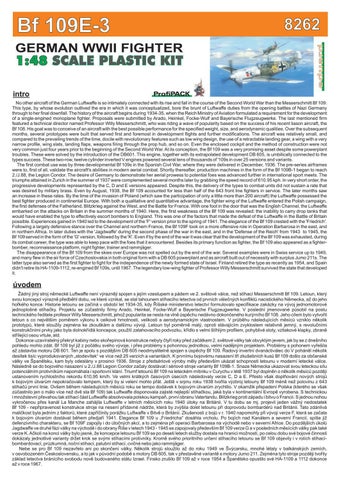
1:48 SCALE PLASTIC KIT intro No other aircraft of the German Luftwaffe is so intimately connected with its rise and fall in the course of the Second World War than the Messerschmitt Bf 109. This type, by whose evolution outlived the era in which it was conceptualized, bore the brunt of Luftwaffe duties from the opening battles of Nazi Germany through to her final downfall. The history of the aircraft begins during 1934-35, when the Reich Ministry of Aviation formulated a requirement for the development of a single-engined monoplane fighter. Proposals were submitted by Arado, Heinkel, Focke-Wulf and Bayerische Flugzeugwerke. The last mentioned firm featured a technical director named Professor Willy Messerschmitt, who was riding a wave of popularity based on the success of his recent liason aircraft, the Bf 108. His goal was to conceive of an aircraft with the best possible performance for the specified weight, size, and aerodynamic qualities. Over the subsequent months, several prototypes were built that served first and foremost in development flights and further modifications. The aircraft was relatively small, and compared to the prevailing trends of the time, docile with revolutionary features such as low wing design, the use of a retractable landing gear, a wing with a very narrow profile, wing slats, landing flaps, weapons firing through the prop hub, and so on. Even the enclosed cockpit and the method of construction were not very common just four years prior to the beginning of the Second World War. At its conception, the Bf 109 was a very promising asset despite some powerplant troubles. These were solved by the introduction of the DB601. This engine, together with its extrapolated development DB 605, is umbilically connected to the types success. These two-row, twelve cylinder inverted V engines powered several tens of thousands of '109s in over 25 versions and variants. The first combat use was by three developmental Bf 109s in the Spanish Civil War, where they were delivered in December, 1936. The pre-series airframes were to, first of all, validate the aircraft's abilities in modern aerial combat. Shortly thereafter, production machines in the form of the Bf 109B-1 began to reach 2./J.88, the Legion Condor. The desire of Germany to demonstrate her aerial prowess to potential foes was advanced further in international sport meets. The triumphs attained in Zurich in the summer of 1937 were complemented several months later by grabbing the speed record of 610.95 kph. In very short order, the progressive developments represented by the C, D and E versions appeared. Despite this, the delivery of the types to combat units did not sustain a rate that was desired by military brass. Even by August, 1938, the Bf 109 accounted for less than half of the 643 front line fighters in service. The later months saw an increase in these rates. By the time of the invasion of Poland (which saw the participation of only a little more than 200 aircraft) the Luftwaffe possessed the best fighter produced in continental Europe. With both a qualitative and quantitative advantage, the fighter wing of the Luftwaffe entered the Polish campaign, the first defenses of the Fatherland, Blitzkrieg against the West, and the Battle for France. With one foot in the door that was the English Channel, the Luftwaffe embarked on the attacks on Britain in the summer months of 1940. Here, the first weakness of the Bf 109 was revealed: the inability to carry drop tanks that would have enabled the type to effectively escort bombers to England. This was one of the factors that made the defeat of the Luftwaffe in the Battle of Britain possible. Experiences gained in 1940 led to the development of the 'F' version prior to the spring of 1941. The elegance of the Bf 109 crested with the 'Friedrich'. Following a largely defensive stance over the Channel and northern France, the Bf 109F took on a more offensive role in Operation Barbarosa in the east, and in northern Africa. In later duties with the 'Jagdwaffe' during the second phase of the war in the east, and in the 'Defense of the Reich' from 1943 to 1945, the Bf 109 served in the form of the 'G' version, followed by the 'K'. Even if by the end of the war it was clear that the development of the Bf 109 was exhausted, during its combat career, the type was able to keep pace with the foes that it encountered. Besides its primary function as fighter, the Bf 109 also appeared as a fighterbomber, reconnaissance platform, night fighter, trainer and rammjäger. The disappearance of the Bf 109 from the skies over Europe was not spelled out by the end of the war. Several examples were in Swiss service up to 1949, and many flew in the air force of Czechoslovakia in both original form with a DB 605 powerplant and as aircraft built out of necessity with surplus Jumo 211s. The latter type also served as the first fighter to fight for the independence of the newly formed state of Israel. Finland retired the type as recently as 1954, and Spain didn't retire its HA-1109-1112, re-engined Bf 109s, until 1967. The legendary low-wing fighter of Professor Willy Messerschmitt survived the state that developed it.
úvodem Žádný jiný stroj nìmecké Luftwaffe není výraznìji spojen s jejím vzestupem a pádem ve 2. svìtové válce, než stíhací Messerschmitt Bf 109. Letoun, který svou koncepcí výraznì pøedbìhl dobu, ve které vznikal, se stal tahounem stíhacího letectva od prvních váleèných konfliktù nacistického Nìmecka, až do jeho hoøkého konce. Historie letounu se zaèíná v období let 1934-35, kdy Øíšské ministerstvo letectví formulovalo specifikace zakázky na vývoj jednomotorové jednoplošné stíhaèky. Projektu se zúèastnily firmy Arado, Heinkel, Focke-Wulf a Bayerische Flugzeugwerke. V poslední jmenované pùsobil na postu technického øeditele profesor Willy Messerschmitt, jehož popularita se nesla na vlnì úspìchu nedávno dokonèeného kurýrního Bf 108. Jeho cílem bylo vytvoøit letoun s co nejvìtším pomìrem výkonu k celkové hmotnosti, velikosti a aerodynamickým vlastnostem. V prùbìhu následujících mìsícù vzniklo nìkolik prototypù, které sloužily zejména ke zkouškám a dalšímu vývoji. Letoun byl pomìrnì malý, oproti stávajícím zvyklostem relativnì jemný, s revoluèními konstrukèními prvky jako byla dolnokøídlá koncepce, použití zatahovacího podvozku, køídlo s velmi štíhlým profilem, pohyblivé sloty, vztlakové klapky, zbranì støílející osou vrtule, atd. Dokonce uzavíratelný pøekryt kabiny nebo skoøepinová konstrukce nebyly ètyøi roky pøed zaèátkem 2. svìtové války tak obvyklým jevem, jak by se z dnešního pohledu mohlo zdát. Bf 109 byl již z poèátku svého vývoje, i pøes problémy s pohonnou jednotkou, velmi nadìjným projektem. Problémy s pohonem vyøešila až zástavba motoru DB 601. Ten je spolu s pozdìjším DB 605 neodmyslitelnì spojen s úspìchy Bf 109. Øadový invertní dvanáctiválec do V pohánìl nìkolik desítek tisíc vyprodukovaných „stodevítek“ ve více než 25 verzích a variantách. K prvnímu bojovému nasazení tøí zkušebních kusù Bf 109 došlo za obèanské války ve Španìlsku, kam byly odeslány v prosinci 1936. Stroje z pøedsériové výroby mìly pøedevším ukázat schopnosti letounu v moderní letecké válce. Následnì se do bojového nasazení u 2./J.88 Legion Condor zaèaly dostávat i sériové stroje varianty Bf 109B-1. Snaze Nìmecka ukazovat svou leteckou sílu potenciálním protivníkùm napomáhala i sportovní klání. Triumf letounù Bf 109 na leteckém mítinku v Curychu v létì 1937 byl doplnìn o nìkolik mìsícù pozdìji ustanovením rychlostního rekordu 610,95 km/h. Ve velmi krátkých èasových úsecích následovaly verze C, D a E. Pøesto však doplòování nových strojù k bojovým útvarùm nepokraèovalo tempem, který by si velení mohlo pøát. Ještì v srpnu roku 1938 tvoøila výzbroj letouny Bf 109 ménì než polovinu z 643 stíhaèù první linie. Ovšem bìhem následujících mìsícù roku se tempo dodávek k bojovým útvarùm zrychlilo. V okamžik pøepadení Polska (kterého se však zúèastnilo jen o málo více než dvì sta Bf 109) tak Luftwaffe disponovala zajisté nejlepší stíhaèkou, jaká byla v kontinentální Evropì vyrobena. S technickou i množstevní pøevahou tak stíhací èást Luftwaffe absolvovala polskou kampaò, první obranu Vaterlandu, Blitzkrieg proti západu i bitvu o Francii. S jednou nohou vykroèenou pøes kanál La Manche zahájila Luftwaffe v letních mìsících roku 1940 útoky na Británii. V tu dobu se mj. projevil jeden vážný nedostatek Bf 109 - nepøipravenost konstrukce stroje na nesení pøídavné nádrže, která by zvýšila dolet letounu pøi doprovodu bombardérù nad Británii. Tato zdánlivá malièkost byla jedním z faktorù, které zapøíèinily porážku Luftwaffe v Bitvì o Británii. Zkušenosti z bojù v r. 1940 napomohly pøi vývoji verze F, která se zaèala k bojovým útvarùm dostávat bìhem pøedjaøí 1941. Elegance Bf 109 u „Friedricha“ dosáhla vrcholu. Po bojích nad Kanálem a severní Francií, spíše již defenzivního charakteru, se Bf 109F zapojily i do útoèných akcí, a to zejména pøi operaci Barbarossa na východì nebo v severní Africe. Do pozdìjších úkolù Jagdwaffe ve druhé fázi války na východì i do obrany Øíše v letech 1943 - 1945 se zapojovaly pøedevším Bf 109 verze G a v posledních mìsících války pak také verze K. Aèkoli na konci války bylo jasné, že koncepce letounu Bf 109 se po deseti letech služby dostala na hranici možností, po celou dobu své bojové èinnosti dokázaly jednotlivé varianty držet krok se svými stíhacími protivníky. Kromì svého prioritního urèení stíhacího letounu se Bf 109 objevily i v rolích stíhacíbombardovací, prùzkumná, noèní stíhací, palubní stíhací, cvièné nebo jako rammjäger. Nebe se pro Bf 109 nezavøelo ani po skonèení války. Nìkolik strojù sloužilo až do roku 1949 ve Švýcarsku, mnohé létaly v balkánských zemích, v osvobozeném Èeskoslovensku, a to jak v pùvodní podobì s motory DB 605, tak v pøestavìné variantì s motory Jumo 211. Zejména tyto stroje pozdìji tvoøily základ letectva bránícího svobodu novì budovaného státu Izrael. Finsko zrušilo Bf 109 až v roce 1954 a Španìlsko opustilo své HA-1109 a 1112 dokonce až v roce 1967.
ATTENTION
UPOZORNÌNÍ
ACHTUNG
ATTENTION
Carefully read instruction sheet before assembling. When you use glue or paint, do not use near open flame and use in well ventilated room. Keep out of reach of small children. Children must not be allowed to suck any part, or pull vinyl bag over the head. Pøed zapoèetím stavby si peèlive prostudujte stavební návod. Pøi používání barev a lepidel pracujte v dobøe vìtrané místnosti. Lepidla ani barvy nepoužívejte v blízkosti otevøeného ohnì. Model není urèen malým dìtem, mohlo by dojít k požití drobných dílù. Iire soigneusement la fiche d´instructions avant d´assembler. Ne pas utiliser de colle ou de peinture a ` proximité d´une flamme nue, et aérer la piece de temps en temps. Garder hors de portée des enfants en bas âge. Ne pas laisser les enfants mettre en bouche ou sucer les pièces, ou passer un sachet vinyl sur la tete. Von dem Zusammensetzen die Bauanleitung gut durchlesen. Kleber und Farbe nicht nahe von offenem Feuer verwenden und das Fenster von Zeit zu Zeit Belüftung öffnen. Bausatz von kleinen Kindern fernhalten. Verhüten Sie, daß Kinder irgendwelche Bauteile in den Mund nehmen oder Plastiktüten über den Kopf ziehen.
INSTRUCTION SIGNS
INSTR. SYMBOLY
BEND OHNOUT PLIER SIL VOUS PLAIT BITTE BIEGEN
OPTIONAL VOLBA FACULTATIF NACH BELIEBEN
SYMETRICAL ASSEMBLY SYMETRICKÁ MONTÁŽ MONTAGE SYMÉTRIQUE SYMMETRISCHE AUFBAU
DÍLY
TEILE
PLASTIC PARTS
A>
NOTCH ZÁØEZ L INCISION DER EINSCHNITT
8260 A
SYMBOLES
REMOVE ODØÍZNOUT RETIRER ENTFERNEN
APPLY EDUARD MASK AND PAINT POUŽÍT EDUARD MASK NABARVIT
PIECES
C>
F>
8260 F
8260 C
PARTS
OPEN HOLE VYVRTAT OTVOR FAIRE UN TROU OFFNEN
INSTRUKTION SINNBILDEN
E> D>
8260 E
8260 D
PE - PHOTO ETCHED DETAIL PARTS
eduard
COLOURS
BARVY
FARBEN AQUEOUS
Mr.COLOR C81
RUSSET
FLAT WHITE
H413
C113
YELLOW
RLM 04
C33
FLAT BLACK
H416
C116
BLACK GRAY
RLM 66
H47
C41
RED BROWN
H417
C117
LIGHT BLUE
RLM 76
H64
C17
DARK GREEN
RLM 71
Mr.METAL COLOR
GSi Creos (GUNZE)
2
PEINTURE
AQUEOUS
Mr.COLOR
H11
C62
H12
H65
C18
BLACK GREEN
RLM 70
MC213
H70
C60
GRAY
RLM 02
MC214
DARK IRON
H77
C137
MC218
ALUMINIUM
TIRE BLACK
STEEL
H 70 C60 RLM02 GRAY
A1 H 70 C60
A10
RLM02 GRAY
H 70 C60 RLM02 GRAY
E25
PE31
PE7
MC213 STEEL
PE32
PE15
H 70 C60
E24
RLM02 GRAY
REVERSE VIEW POHLED ZEZADU
H 70 C60 RLM02 GRAY
PE26 MC214 DARK IRON
E49
H 70 C60 RLM02 GRAY
E37
H 70 C60
H 12 C33
RLM02 GRAY
PE26
FLAT BLACK
H 70 C60
MC214
RLM02 GRAY
DARK IRON
E52
PE25
PE21
E44
E15 E15 E52
H 70 C60 RLM02 GRAY
E1 H 70 C60 RLM02 GRAY
H 70 C60
E1
RLM02 GRAY
H 70 C60
E3
RLM02 GRAY
E27
A
PE18
E50 PE21
H 416 C116
H 416 C116
RLM66 GRAY
E51
RLM66 GRAY
H 12 C33
E12
FLAT BLACK
PE19
E21
PE14
E3
E43
PE5
OPTIONAL: DECAL 30 PE16
PE6
PE8
PE3
PE20 PE13
H 70 C60 RLM02 GRAY
A
E55 PE9 PE4
H 70 C60 RLM02 GRAY
E12
PE10 E21
E19
H 70 C60
E34
RLM02 GRAY
H 70 C60 RLM02 GRAY
PE30 E43
PE28
E35 MC213 STEEL
H 70 C60 RLM02 GRAY
3
B
H 416 C116
C
D12
E22
RLM66 GRAY
B
D38 H 77 C137
PE1
TIRE BLACK
D37
D11 F2
PE2
D8
H 47 C41
MC218
H 12 C33
RED BROWN
ALUMINIUM
FLAT BLACK
PE12
H 70 C60
MC214
D7
DARK IRON
RLM02 GRAY
E23
H 416 C116 RLM66 GRAY
F2 H 12 C33
H 47 C41
H 12 C33
RED BROWN
FLAT BLACK
D39
FLAT BLACK
OPTIONAL: DECAL 29
H 70 C60
H 70 C60
RLM02 GRAY
RLM02 GRAY
REVERSE VIEW POHLED ZEZADU
MC214 DARK IRON
E2 E45 DO NOT GLUE! NELEPIT!
E16
E56
MC214
E17
DARK IRON
MC214 DARK IRON
MC218
E20
ALUMINIUM
E32
MC214 DARK IRON
E7 E31 REVERSE VIEW POHLED ZEZADU
E33
MC218 ALUMINIUM
E31 H 12 C33 FLAT BLACK
E29
E48 - FIRST E48 - PRVNÍ E18 - NEXT E18 - DRUHÝ
E46 E28
C
H 70 C60 RLM02 GRAY
H 12 C33
H 12 C33
FLAT BLACK
FLAT BLACK
E26
E18 E41
E48
MC218 ALUMINIUM
H 77 C137 TIRE BLACK
FOR CLOSED ENGINE & GUN COWLING GO TO THE PAGE 10. DO NOT USE FOLLOWING PARTS : E2, E16, E18, E26, E28, E29, E30, E31, E33, E45, E48, E53 PRO UZAVØENÝ KRYT MOTORU A ZBRANÍ JDÌTE NA STRANU 10. NEPOUŽÍVEJTE DÍLY : E2, E16, E18, E26, E28, E29, E30, E31, E33, E45, E48, E53 4
H 70 C60 RLM02 GRAY
E26 E53 APPLY DECAL- ENGINE SERIAL NUMBER SEE YOUR REFERENCE FOR THE EXACT NUMBER SÉRIOVÉ ÈÍSLO MOTORU- POUŽIJTE OBTISK DLE VLASTNÍCH PODKLADÙ
E30
H 77 C137 TIRE BLACK
D33
H 70 C60
H 12 C33
RLM02 GRAY
FLAT BLACK
D40 D23
D24
MC214
H 70 C60
DARK IRON
A1
RLM02 GRAY
H 70 C60 RLM02 GRAY
E11 H 70 C60 RLM02 GRAY
A10
OPEN NOSE OTEVØENÝ KRYT MOTORU
2 pcs. H 70 C60
MC214 DARK IRON
H 70 C60
D41
RLM02 GRAY
RLM02 GRAY
D30 D20
H 70 C60
H 70 C60
D18
RLM02 GRAY
RLM02 GRAY
D19 EXHAUST PIPES INSTALATION INSTALACE VÝFUKOVÝCH NÁTRUBKÙ
1.
2.
5 pcs. E39
E38 C81 RUSSET
C81
- ONE BY ONE, FROM BACK TO FRONT - JEDEN PO DRUHÉM, ODZADU DOPØEDU
RUSSET
- E38 FITS WITHOUT THE GLUE - E38 NENÍ NUTNÉ LEPIT
5
D2
D1 C1 D51
C2
MC214 DARK IRON
D17
C2
C3
D52 D43 C1
H 70 C60
MC214
RLM02 GRAY
DARK IRON
D17
D42 H 70 C60
MC214 DARK IRON
PE22
RLM02 GRAY
MC214 DARK IRON
PE22
PE23 PE24
D47
H 70 C60 RLM02 GRAY
C3
H 70 C60 RLM02 GRAY
D55
D3
D46 D3
D4 D4
D56
6
E13
A1, A10 H 70 C60
RLM02 GRAY
E6
E5
H 70 C60 RLM02 GRAY
D53
D5 D6
PE33
D13
D14 9
L D22
D29
D31
R
H 77 C137 TIRE BLACK
H 12 C33
MC218
D32
FLAT BLACK
ALUMINIUM
H 12 C33
D15
FLAT BLACK
C3
D50 D21
D15, D32 D31
H 70 C60
H 70 C60
RLM02 GRAY
RLM02 GRAY
D35
D56
D36
L R
H 70 C60 RLM02 GRAY
H 70 C60 RLM02 GRAY
D43 D22 C3 PE34 H 70 C60 RLM02 GRAY
D42 PE34 H 70 C60 RLM02 GRAY
8
THE CORRECT POSITION OF THE UNDERCARRIAGE LEGS SPRÁVNÁ POZICE PODVOZKOVÝCH NOH
D55
D49
FOR CLOSED NOSE SEE PAGE 10 PRO ZAVØENÉ KRYTY VIZ STR. 10 A3
A8
A10
PE35 A2 A5
F6
H 70 C60
E10
RLM02 GRAY
MC214 DARK IRON
E36 PE11
D34
H 70 C60
PE11
RLM02 GRAY
PE27
F3
H 70 C60 RLM02 GRAY
E47 H 65 C18 RLM70 GRAY
D44 OPEN F3
MC218 ALUMINIUM
PE17 H 70 C60
H 47 C41
RLM02 GRAY
RED BROWN
E8 MC218
F5
ALUMINIUM
CLOSED F3 F6 E42
PE29
H 12 C33 FLAT BLACK
F3 PE29
F5
9
FOR CLOSED ENGINE COMPARTMENT ONLY D23
E11 A1
A10
MC214 DARK IRON
E5
D16
A8
E6 A3 D34
A2 A5
F3 F6
10
F5
A Uffz. Karl Wolff, 3./JG 52, Pihen/Calais, France, August 1940 A very attractive scheme was carried by Bf 109E-3 White ‘15’, with which Uffz. Karl Wolff crashed on landing on August 30, 1940. It carried the standard scheme of RLM 02/71/65, and the light blue 65 extended up the fuselage sides. The light blue, which also wrapped around the leading edges of the wings, was subdued with overspray of colors used on the upper surfaces. Furthermore, the aircraft received white paint on surfaces such as the nose, rudder and wingtips, used first and foremost as quick identification features. The I. Gruppe JG 52 unit emblem appeared on the nose of the plane. A month after his hard landing in White ‘15’, Uffz. Wolff was shot down and taken prisoner. Jagdgeschwader 52 became the Luftwaffe’s most successful fighter unit mainly due to its operations over the Eastern Front. However, its successes began during the Battle of France, and later, the Battle of Britain. By the end of 1940, the unit’s pilots had already racked up 177 kills. On the other hand, losses were quite high as well. Just during the Battle of Britain, the unit lost 53 pilots. The unit was also odd in that its equipment over the course of the war was composed exclusively of Bf 109s. ÈESKOU VERZI TEXTU NALEZNETE NA www.eduard.com/s/8262
H65 18
32
38
7
H70 60
H11 62
19 ? 40
H11 62
LEADING EDGE ONLY H11 62
H65 18
10
H70 60
H417 117
H11 62
10
H11 62
3
H11 62
S7
H417 117
H11 62
H11 62
3
S7
H64 17 H64 17
H11 62
19 ? 40
H70 60
7
H65 18
38 31
H417 117
WHITE
H11 62
RLM 76
H417 117
RLM 02
H70 60
RLM 71
H65 18
RLM 70
H64 17
eduard 11
B Oblt. Josef Priller, Staffelkapitän 6./JG 51, France, Autumn 1940 Yellow ‘1’, W.Nr. 5057, was flown by the commander of 6. Staffel JG 51, Josef Priller, and underwent several camouflage color modifications through its career. According to some sources, the initial scheme was composed of RLM 70/71/65. However, it is easier to confirm later variations, when the underside light blue was extended up the sides of the fuselage, and quite high up at that. Later, this color was subdued by the application of irregular squiggles of RLM 02 and 71. Furthermore, the upper surfaces of the wing, originally composed of broken lines, were augmented in a similar manner as the fuselage sides. This was the appearance of the aircraft in the fall of 1940, and as depicted by our profile. At the time, the aircraft also received a yellow nose section and rudder. The extent of the front end yellow coloring is up for speculation. Some sources suggest this as it appears on the boxtop of this kit, while others claim that the yellow only covered the engine cowl and spinner, as shown in this profile. The emblem of II./JG 51 ‘Gott strafe England!’ (God punish England!) shown on the rear of the fuselage, is sprayed on without the usual white background, only with the black border around a black raven with an umbrella, symbolizing Neville Chamberlain. The Staffel marking in the form of the Ace of Hearts subsequently was used on Priller’s later aircraft as a personal marking. Here, it does not yet bear the well-known ‘Jutta’ inscription. The kill marks denoting Priller’s aerial victories on the tail in the form of vertical tabs with dates, partially obscured the Swastika. Beer lover Josef Priller attained 101 aerial victories in 1,307 operational flights between 1939 and 1945. The pictured aircraft was later inherited by another well-known Luftwaffe pilot, Hptm. Herbert Ihlefeld, who used it in 1941 in the Balkan campaign. ÈESKOU VERZI TEXTU NALEZNETE NA www.eduard.com/s/8262
H64 17
8
H65 18
37
H413 113
18 ? 39
7
20
H70 60
25
H413 113
H65 18
H64 17
7
H70 60
7
5
S7
H417 117
4
S7
H11 62 H64 17
18 ? 39
7
H65 18
H64 17
37
8
21
H417 117
12
RLM 04 YELLOW
H413 113
RLM 76
H417 117
RLM 02
H70 60
RLM 71
25
H65 18
H65 18
H70 60
RLM 70
H64 17
eduard
C Obstlt. Hans-Hugo Witt, Geschwaderkommodore JG 26, Dortmund, Germany, April 1940 This aircraft, which carried an unusual camouflage scheme for the noted period, was flown by the CO of JG 26, Obstlt. Hans-Hugo Witt in April, 1940. Upper surfaces were composed of fields of RLM 02 and 71, while the bottom carried the standard RLM 65. The Geschwaderkommodor tactical marking was supplemented by a simplified version of the ‘Schlageter’ emblem, the unit marking of JG 26. The mounted rider was marking of Stab/JG 26 and was found exclusively on the left side of the fuselage. Jagdgeschwader 26 participated in the Battle of France during this timeframe. Hans-Hugo led the unit until June 23, 1940, when he left at the age of 39 to take on several command functions in the Luftwaffe leadership. Witt is also known for being a survivor of the ill-fated Hindenburg flight on May 6, 1937. ÈESKOU VERZI TEXTU NALEZNETE NA www.eduard.com/s/8262
H65 18
11
27
28
H70 60
14
15
H417 117
19 ? 40
H417 117
H65 18
10
H70 60
10
3
S7
H417 117
3
S7
H64 17 H64 17
19 ? 40
15
H70 60
14
H65 18
28 11
H417 117
RLM 76
H417 117
RLM 02
H70 60
RLM 71
H65 18
RLM 70
H64 17
eduard 13
D 1./JG 2, Bassenheim, Germany, May 1940 The illustrated White ‘7’ flew in the spring of 1940 with Staffel JG 2 under the command of Spanish Civil War veteran Oblt. Otto Bertram. The aircraft carries the standard period camouflage scheme consisting of RLM 02/71 on the upper surfaces. The lower surface light blue RLM 65 extended quite high up the fuselage sides. An oddity on this aircraft is the application of older national markings on this newer scheme, including the smaller fuselage crosses with very thin border segments and the application of the Swastika such that it covered both the rudder and the fin. The emblem of JG 2 Richthofen appeared on both sides of the fuselage under the cockpit. Similarly, the Staffel marking of a leashed dog ‘Bonzo’ appeared on both sides, and was developed by Otto Bertram. The template for the marking was the comic character ‘Bonzo the Dog’, by the Brit George Studdy who’s drawings paradoxically appeared on aircraft of both sides. ÈESKOU VERZI TEXTU NALEZNETE NA www.eduard.com/s/8262
H65 18
35
6
22 ? 23 ? 24
12
H70 60
H417 117
19 ? 40
H417 117
H65 18
26
H70 60
26
26
S7
H417 117
H65 H70 18 60
S7
H64 17 H64 17
26
19 ? 40
H70 60
12
H65 18
6 22 ? 23 ? 24
34
H417 117
RLM 76
14
H417 117
RLM 02
H70 60
RLM 71
H65 18
RLM 70
H64 17
eduard
E 3./JG 51, Mannheim-Sandhofen, Winter 1939-1940 The illustrated aircraft is an example of the camouflage scheme and national marking application introduced at the end of 1939, specifically during the 'Sitzkrieg' period and during the defense of Germany against the first retaliatory raids by the RAF. The aircraft is painted in the standard scheme of RLM 70 and 71 on the upper surfaces. The paint is affected by heavy weathering and wear. The lower surfaces are in light blue, RLM 65. An interesting feature on this aircraft, and occasionally seen on others, is the very large rendering of the national marking on the wings. The fuselage Balkenkreuz also has a more slender centre cross segment. The Totenhand marking below the cockpit is the 3./JG 51 unit insignia, while the Kitzbuheler Gams marking, which was used by I./JG 51 from its beginnings, was a reminder of the influx of Austrian pilots to the unit in 1938, at a time when it carried the markings of I./JG 233. ÈESKOU VERZI TEXTU NALEZNETE NA www.eduard.com/s/8262
H413 113
16
33
36
H417 117 H65 18
13
9
H65 18
H64 17
19 ? 40
H413 113
113
H64 17
H65 18
H64 17
13
1
113
S7
H417 117
2 S7
H64 17 H64 17
19 ? 40
RLM 04 YELLOW
H413 113
RLM 76
H417 117
RLM 02
H70 60
H64 17
RLM 71
H65 18
H65 18
9
RLM 70
36 17
H64 17
33
eduard 15
Bf 109E-3
STENCIL VARIANTS
S30
S23
S37 S16
S38 ? S43 S45
S29
S34
87
S27
S27
S27
Rotring
S42
S11
S44
S10
S24 ? S32
S28
S20a S39
S40
S16
S14
S22a
S26
S17
S31
S31 S19
S19
S18
S18
S15
S12 S44 S23
S28
S24 ? S32
S22b S35
S20b
S26
S36 S15
16
© EDUARD M.A. 2012
www.eduard.com
eduard
Printed in Czech Republic