P-39L/N
8066
US WWII FIGHTER 1:48 SCALE PLASTIC KIT
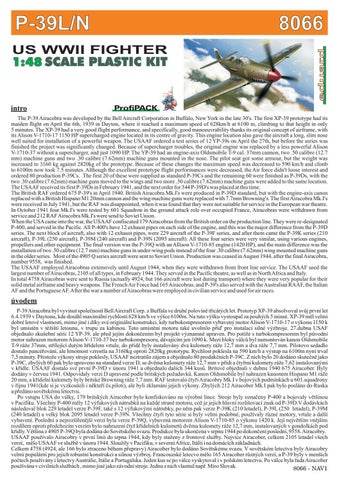
intro The P-39 Airacobra was developed by the Bell Aircraft Corporation in Buffalo, New York in the late 30's. The first XP-39 prototype had its maiden flight on April the 6th, 1939 in Dayton, where it reached a maximum speed of 628km/h at 6100 m, climbing to that height in only 5 minutes. The XP-39 had a very good flight performance, and specifically, good manoeuvrability thanks its original concept of airframe, with its Alison V-1710-17 1150 HP supercharged engine located in its centre of gravity. This engine location also gave the aircraft a long, slim nose well suited for installation of a powerful weapon. The USAAF ordered a test series of 12 YP-39s on April the 27th, but before the series was finished the project was significantly changed. Because of supercharger troubles, the original engine was replaced by a less powerful Alison V-1710-37 without a supercharger, and just 1090 HP. The YP-39 had an engine-axis Oldsmobile T-9 cal. 37mm cannon, two .50 calibre (12.7 mm) machine guns and two .30 calibre (7.62mm) machine guns mounted in the nose. The pilot seat got some armour, but the weight was increased to 3160 kg against 2820kg of the prototype. Because of these changes the maximum speed was decreased to 590 km/h and climb to 6100m now took 7.5 minutes. Although the excellent prototype flight performances were decreased, the Air force didn't loose interest and ordered 80 production P-39Cs. The first 20 of these were supplied as standard P-39Cs and the remaining 60 were finished as P-39Ds, with the two .30 calibre (7.62mm) machine guns moved to the wings and two more .30 calibre (7.62mm) machine guns were added to the same location. The USAAF received its first P-39Ds in February 1941, and the next order for 344 P-39D's was placed at this time. The British RAF ordered 675 P-39's in April 1940. British Airacobra Mk.I's were produced in P-39D standard, but with the engine-axis canon replaced with a British Hispano M1 20mm cannon and the wing machine guns were replaced with 7.7mm Browning's. The first Airacobra Mk.I's were received in July 1941, but the RAF was disappointed, when it was found that they were not suitable for service in the European war theatre. In October 1941 four Mk.I's were tested by 601 Squadron in the ground attack role over occupied France, Airacobras were withdrawn from service and 212 RAF Airacobra Mk.I's were send to Soviet Union. When the USA came into the war, the USAAF confiscated 179 Airacobras from the British order on the production line. They were re-designated P-400, and served in the Pacific. All P-400's have 12 exhaust pipes on each side of the engine, and this was the major difference from the P-39D series. The next block of aircraft, also with 12 exhaust pipes, were 229 aircraft of the P-39F series, and after them came the P-39K series (210 aircraft), P-39L (250 aircraft), P-39M (240 aircraft) and P-39N (2095 aircraft). All these four series were very similar, using various engines, propellers and other equipment. The final version was the P-39Q with an Allison V-1710-85 engine (1420 HP), and the main difference was the installation of two .50 calibre (12.7 mm) machine guns in under-wing pods instead of the four .30 calibre (7.62mm) wing mounted machine guns in the older series. Most of the 4905 Q series aircraft were sent to Soviet Union. Production was ceased in August 1944, after the final Airacobra, number 9558, was finished. The USAAF employed Airacobras extensively until August 1944, when they were withdrawn from front line service. The USAAF used the largest number of Airacobras, 2105 of all types, in February 1944. They served in the Pacific theatre, as well as in North Africa and Italy. In total 4758 Airacobras were sent to Russia (actually 4924, but 166 aircraft were lost during transport) where they were very popular for their solid metal airframe and heavy weapons. The French Air Force had 165 Airacobras, and P-39's also served with the Australian RAAF, the Italian AF and the Portuguese AF. After the war a number of Airacobras were employed in civilian service and used for air races.
úvodem P-39 Airacobra byl vyvinut společností Bell Aircraft Corp. z Buffala ve druhé polovině třicátých let. Prototyp XP-39 absolvoval svůj první let 6.4.1939 v Daytonu, kde dosáhl maximální rychlosti 628 km/h ve výšce 6100m. Na tuto výšku vystoupal za pouhých 5 minut. XP-39 měl velmi dobré letové vlastnosti, mimo jiné i díky své originální konstrukci, kdy turbokompresorem vybavený motor Alison V-1710-17 o výkonu 1150 k byl umístěn v těžišti letounu, v trupu za kabinou. Toto umístění motoru také uvolnilo příď pro instalaci silné výzbroje. 27.dubna USAF objednalo zkušební sérii 12 YP-39, ale před jejím dokončením byl projekt významně upraven. Pro potíže s turbokompresorem byl původní motor nahrazen motorem Alison V-1710-37 bez turbokompresoru, dávajícím jen 1090 k. Mezi bloky válců byl namontován kanon Oldsmobile T-9 ráže 37mm, střílející dutým hřídelem vrtule, do přídě byly instalovány dva kulomety ráže 12,7 mm a dva ráže 7,7 mm. Pilotovo sedadlo dostalo pancéřování, ale hmotnost vzrostla na 3160kg oproti 2820kg prototypu. Rychlost poklesla na 590 km/h a výstup na 6100m nyní trval 7,5 minuty. Přestože výkony stroje poklesly, USAAF neztratilo zájem a objednalo 80 produkčních P-39C. Z nich bylo 20 dodáno skutečně jako P-39C, zbylých 60 pak bylo upraveno na standard verze D, se dvěma kulomety ráže 12,7 mm v přídi a čtyřmi kulomety ráže 7,62 instalovanými v křídle. USAAF dostalo své první P-39D v únoru 1941 a objednalo daších 344 kusů. Britové objednali v dubnu 1940 675 Airacober. Byly dodány v červnu 1941. Odpovídaly verzi D upravené podle britských požadavků. Kanon Oldsmobile byl nahrazen kanonem Hispano M1 ráže 20 mm, a křídelní kulomety byly britské Browning ráže 7,7 mm. RAF testovalo čtyři Airacobry Mk.I v bojových podmínkách u 601.squadrony v říjnu 1941(kde si je vyzkoušeli i někteří čs.piloti), ale byli zklamáni jejich výkony. Zbylých 212 Airacober Mk.I pak bylo posláno do Ruska a předáno sovětskému letectvu. Po vstupu USA do války, 179 britských Airacober bylo konfiskováno na výrobní lince. Stroje byly označeny P-400 a bojovaly většinou v Pacifiku. Všechny P-400 měly 12 výfukových nátrubků na každé straně motoru, což je jejich hlavní rozlišovací znak od P-39D.V dodávkách následoval blok 229 letadel verze P-39F, také s 12 výfukovými nátrubky, po něm pak verze P-39K (210 letadel), P-39L (250 letadel), P-39M (240 letadel) a velký blok 2095 letadel verze P-39N. Všechny čtyři tyto série si byly velmi podobné, používaly různé motory, vrtule a další vybavení. Poslední a nejrozšířenější verzí byla verze P-39Q, vybavená motorem Alison V-1710-85 o výkonu 1420 k. Její největším vnějším rozdílem oproti předchozím verzím bylo nahrazení čtyř křídelních kulometů dvěma kulomety ráže 12,7 mm, instalovaných v gondolkách pod křídly. Většina z 4905 P-39Q byla dodána do Sovětského svazu. Produkce byla ukončena v srpnu 1944 po dokončení poslední, 9558. Airacobry. USAAF používalo Airacobry v první linii do srpna 1944, kdy byly staženy z frontové služby. Nejvíce Airacober, celkem 2105 letadel všech verzí, mělo USAAF ve službě v únoru 1944. Sloužily v Pacifiku, v severní Africe, Itálii i na domácích základnách. Celkem 4758 (4924, ale 166 bylo ztraceno během přepravy) Airacober bylo dodáno Sovětskému svazu. V sovětském letectvu byly Airacobry velmi populární pro jejich robustní konstrukci a silnou výzbroj. Francouzské letecvo mělo 165 Airacober různých verzí, a P-39 byly v menších počtech používány i letectvy Austrálie, Itálie a Portugalska. Jeden kus se po válce vyskytoval i v polském letectvu. Po válce byla řada Airacober používána v civilních službách , mimo jiné jako závodní stroje. Jednu z nich vlastnil např. Miro Slovak. 8066 - NAV1
ATTENTION
UPOZORNĚNÍ
ACHTUNG
ATTENTION
Carefully read instruction sheet before assembling. When you use glue or paint, do not use near open flame and use in well ventilated room. Keep out of reach of small children. Children must not be allowed to suck any part, or pull vinyl bag over the head. Před započetím stavby si pečlivě prostudujte stavební návod. Při používání barev a lepidel pracujte v dobře větrané místnosti. Lepidla ani barvy nepoužívejte v blízkosti otevřeného ohně. Model není určen malým dětem, mohlo by dojít k požití drobných dílů.
INSTRUCTION SIGNS
INSTR. SYMBOLY
BEND OHNOUT
OPTIONAL VOLBA
SYMETRICAL ASSEMBLY SYMETRICKÁ MONTÁŽ
OPEN HOLE VYVRTAT OTVOR
PARTS
INSTRUKTION SINNBILDEN
DÍLY
NOTCH ZÁŘEZ
SYMBOLES
REMOVE ODŘÍZNOUT
TEILE
APPLY EDUARDS MASK AND PAINT POUŽÍT EDUARD MASK NABARVIT
PIECES
PLASTIC PARTS
B>
A>
C> 14
9 15
16
17
19 51
18
13
14
50
23
8
37
6 11
11
12
9
1
2
18
54
12 17
7
39 21
57 55 18 58
1
6
6
3
10
32 33
49
59
36
-Parts not for use. -Teile werden nicht verwendet. -Pieces a ne pas utiliser. -Tyto díly nepoužívejte při stavbě. -
BARVY
2
H 12
33
H 13
3
PEINTURE
AQUEOUS
GSi Creos (GUNZE)
4
FARBEN Mr.COLOR
H 72 YELLOW FLAT BLACK
369
H 77
137
H 316
C316 370
RED
DARK EARTH TIRE BLACK WHITE AZURE BLUE
H 33
81
RUSSET
H 52
12
OLIVE DRAB
H 53
13
NEUTRAL GRAY
H 58
27
INTERIOR GREEN
MC214
DARK IRON
H 71
21
MIDDLE STONE
MC218
ALUMINIUM
Mr.COLOR SUPER METALLIC SM01
SUPER FINE SILVER
Mr.METAL COLOR
9
11
44
36
13
PE - PHOTO ETCHED DETAIL PARTS
5
Mr.COLOR
20 10 22
35
3
H4
32 33 34
21
15
6
AQUEOUS
27
eduard
4
COLOURS
29
4
16
26
43 31 28 19 17 8 42 30 30
15
6
60 5
2
15
25
5
4
1
26
18 7
48
16
11
6 3
3
20
8
5
45 53 20
56 55 47 4641 40
2 3
7
14 24
7
4
10
13
1
38
52
12
2
23
12
B4
B3
B8
H 58 27
H 12 33
6 B18
H 58 27
C31
A16 H 12 33
A15
H 58 27
A16
C47
H 58 27
A18 H 58 27
A18
H 12 33
A10
DECAL 27
PE17 PE21
DECAL 23
DECAL 25
MC214
DECAL 26 DECAL 24
PE8 PE23
A
PE17
PE15 PE23
PE24 PE6 PE24 3 PCS.
PE2
PE19
PE9
PE20
PE10
PE10, PE19 - MARKING
B
PE1 ONLY
PE22
A
C
B
H 58 27
PE3
PE4
B
PE7
PE4
A17
PE5
C 3
A17
5 H 12 33
C8 H 12 33
C32
H 58 27
H 58 27
C32 C46
H 58 27
A6
H 12 33
C43 H 12 33
B14
H 58 27
B9
C58
H 58 27
H 58 27
A9 H 58 27
B10
H 58 27
A1
WEIGHT ZÁVAŽÍ A2
A2
C17 4
H 12 33
B1 B2
A8 - MARKINGS A7 - MARKINGS
A8
B1
A7
A ,B,C D,E A13
A14
C52
B2
H 58 27
C11
H 58 27
PE29
4
MC218
PE28
C14 MC218
C49
B20
OPEN HOLES IF YOU WANT ADJUST THE BOMB OR FUEL TANK RACK ( SEE PAGE 7 ) VRTAT V PŘÍPADĚ POUŽITÍ BOMBY NEBO PŘÍDAVNÉ NÁDRŽE ( VIZ STRANA 7 )
B20
5
C56 C53
MC218
PE11 PE14
C57
MC218
PE12
C25
MC218
C10 H 58 27
H 58 27
C39
H 58 27
C3
C59
H 58 27
H 58 27
H 77 137
C3
MC218
C50
H 58 27
H 58 27 H 58 27
SM01
H 58 27
C13
C33
6
SM01
C15
C15 MARKING C ONLY
C3
C33 H 77 137
MC218
C2
C3 MARKING C ONLY
H 58 27
H 58 27
C18
C18 C35
H 58 27
C37
PE16 2 pcs.
H 52 12
H 53 13
MC214
C28 C27
C41
C42
MC214 MC214
B5
A4
B15
A3 B19 7
PE18 H 58 27
H 58 27
C60
C48
C60
SM01
MC218
H 77 137
C44
C12 C12
MC218
H 77 137
C22 SM01
PE27
H 58 27
C38
PE27 C24 H 58 27
8
C45 H 58 27
C24
H 58 27
3
2
H 58 27
1 PE13
PE26 PE25 B13
C4
C4 - MARKINGS A , B ONLY
2 H 33 81
A11 H 58 27
3
A11 H 33 81
C5 - MARKINGS
A ;C
MC214
37o C29
B16
C5 C6 - MARKING
C23
B
C30
B16
MC214
C30
C40
B6 C6
B16
C7 - MARKINGS
D;E
MC214
B16
C7
C21 MC214
C23
C20
B6 B17
C23 B6
MC214
C20
C23 B6 B6 - MARKING
B
ONLY
C21
MC214
C16 MC214
9
eduard
C2+C13 2 pcs.
C50+C59
2
3
2 pcs.
8066 2
C12+C12
3
C60+C60 1.)
6
1
6
2.)
1 4
10
A P-39N, s/n 4218354, Flown by 345th FS, North Africa / Alghero Airfield, Sardinia, late 1943 This aircraft was probably flown by the CO of the 345th FS Maj. Charles W. Hoover. He led this squadron from August 7 to December 27, 1943. According to squadron documents, he is credited with 1 ½ victories. Hoover downed a Bf 109 G from III./JG77 over Thelepte Air Base on January 15, 1943, but the date of his shared kill is not known. This Airacobra is the only known P-39 with sharksmouth flown in Mediterranean. The squadron's typical marking – the yellow stripes on the wings and on the tail, and the two-digit number, are missing. The squadron badge – the devil riding a hawk – is photographically documented on a few aircraft during the second half of 1943. The white surfaces on the tail and wings were probably intended to change the aircraft silhouette. For a time, this P-39 flew with reduced wing armament. 50 H52 12
H13 3
43 44
41
H316 316
48 H316 316
H53 13
49 H4 4
ČESKOU VERZI TEXTU NALEZNETE NA
H12 33
H316 316
www.eduard.com/s/8066
H13 3
40 H52 12
H53 13
40
H316 316
45 H316 316
48
42
H316 316
50
46
47
H52 12
H13 3
H53 13
WHITE
H316 316
YELLOW
H4 4
RED
H13 3
NEUTRAL GRAY
H53 13
H52
OLIVE DRAB 12
BLACK
H12 33
11
B P-39L, s/n 42-4514, 91st FS / 81st FG, Sidi Ahmed Air Base, Tunisia, September, 1943 This P-39 was manufactured in Olive Drab / Neutral Gray camouflage and the scheme depicted was applied on the aircraft in the United Kingdom. There is no information about the colors used, and the British desert scheme is an assumption on our part. As can be seen in period photos, a dark color was used to repair damaged surfaces. Again, the exact color is not known, but apart of the Olive Drab, some British or captured German or Italian color could have been used. The 81st FG moved to Morocco from the United Kingdom in late 1942 / early 1943. In October, 1943, the unit made its home in Sicilly, and in December of the same year in Italy. In February, 1944, the group was sent to India and re-equipped with P-47 Thunderbolts.
52 H72 C369
H13 3
56
H52 12
53
57
H52 12
H71 C21
51
H72 C369
58
H52 12
H4 4
H4 4
C370
H12 33
55 H72 C369
H71 C21
C370
H4 4
H52 12
H4 4
55
H52 12
ČESKOU VERZI TEXTU NALEZNETE NA www.eduard.com/s/8066
H4 4 H52 12
52
H71 C21
51
57 54
C370
H52 12
YELLOW
12
H4 4
RED
H13 3
AZURE BLUE
C370
MIDDLE STONE
H71 C21
DARK EARTH
H72 C369
OLIVE DRAB
H52 12
BLACK
H12 33
H52 12
H72 C369
H13 3
C P-39N, Flown by Lt. DeVore, 110th TRS/71st TRG, Gusap airfield, New Guinea, spring, 1944 The main task of the 110th Tactical Reconnaissance Squadron in the period from December 1943 to October 1944 was to support ground forces that fought against Japanese troops in New Guinea and the surrounding islands. The eagle was probably the unofficial squadron badge and was painted on the left cockpit door of most of the squadron´s Airacobras. The white tail was a quick identification marking of 5th Air Force single-engined aircraft. It was introduced during mid 1943. This aircraft was previously flown by the 40th FS / 35th FG as can be deduced from the red tail tip.
H13 3
H52 12
H316 316
35
38
37
39
36
H316 316
H53 13
17
ČESKOU VERZI TEXTU NALEZNETE NA www.eduard.com/s/8066
SM01
17
H316 316 H316 316
17
H52 12
34 H53 13
H316 316
H316 316
34
H316 316
H13 3
H316 316
36
WHITE
H316 316
CHROME
SM01
39
32
33
35
H52 12
H316 316
H53 13
RED
H13 3
NEUTRAL GRAY
H53 13
H52
OLIVE DRAB 12
BLACK
H12 33
13
D P-39N, Flown by Grigori A. Rechkalov, 16th GIAP, spring 1945 Rechkalov´s airplane, especially the one with the nose kill marks, was formerly considered to be an aircraft flown by another Soviet fighter ace, Pokryshkin. The initial letters RGA on the tail confirm that it was flown by Grigori A. Rechkalov. Rechkalov stayed with his regiment through the whole duration of WWII. In July, 1941, when the German armed forces began the war against the Soviet Union, the regiment was known as the 55th IAP. Rechkalov was awarded the Gold Star of the Hero of the Soviet Union twice – on May 24, 1943 and on July 1, 1944. He was credited with 51 individual and 4 shared victories at that time and was appointed the CO of the 16th GIAP. Rechkalov´s WWII score consists of 61 individual and 4 shared aerial victories. Many sources state that he flew two Airacobras – P-39N 42-8747 and P-39Q 44-2547. The detailed analysis of existing photos suggests the theory that Rechlov flew the P-39N only. The different serial number appeared on this aircraft when the damaged tail unit was repaired using spare parts from the P-39Q. H13 3
1 H52 12
H13 3
5
7
H316 316
3
9
H53 13
? ? 6
10
7 4
8 H52 12
H53 13
8
ČESKOU VERZI TEXTU NALEZNETE NA www.eduard.com/s/8066 H13 3
H316 316
10 9
2
H52 12
1
H53 13
14
WHITE
H316 316
CHROME
SM01
RED
H13 3
NEUTRAL GRAY
H53 13
H52
OLIVE DRAB 12
BLACK
H12 33
H13 3
E P-39N, Flown by Nikolai G. Sobolev, 21st GIAP, April 1943 This aircraft was one of ten P-39Ns that were purchased thanks to the fund-raising efforts of Kristina Shumkova, a collective farmer from Krasnoyar city. These Airacobras were handed over to the 21st GIAP pilots. The exact serial number of this aircraft is not known, but temporary documents state that three P-39Ns were painted with the inscription 'Krasnoyarskiy Komsomolets' – 42-9285, 42-9300 and 42-9295. This aircraft was flown by LtCol. Nikolai Sobolev. Sobolev was the CO of the 21st GIAP and the fighter ace is credited with 17 aerial victories (9 individual and 8 shared). He started to fly this aircraft from April 1942 but it was flown by other pilots as well. Sobolev was a member of 21st GIAP (till May 3, 1942 under the designation 38th IAP) from the very first day of WWII. He was appointed flight leader, and in June, 1942 he became the CO of the regiment, in September, 1943 the deputy CO of the 304th IAD and finally he joined the Military Air Academy. Sobolev was forced to leave the Soviet Air Force shortly after the war when the NKVD (military secret service) took an interest in him. 11 ? 12 ? 28
H52 12
13
21 18 ? 19 ? 20
30
H53 13
29
15
22 17 SM01
ČESKOU VERZI TEXTU NALEZNETE NA
31
www.eduard.com/s/8066
17
H52 12
17
31 H52 12
H53 13
31
28 ? 12 ? 11
31 30
16
H53 13
CHROME
SM01
NEUTRAL GRAY
H53 13
14
H52 12
29
H52
OLIVE DRAB 12
BLACK
H12 33
15
P-39L/N
STENCIL VARIANTS S5
S14
S23 S23 S30
S38
S40 S23
S35
S24
S34 S12 ? S11 S26 S20 S19 S2
S11 ? S12
S20 S7 S20
S21 CR HE OW RE N
S33
S17 S37
NO
PU
SH
S6 S33 S20 S20
S3
S15
S22
S20
S13
CR HE OW RE N
S26
S17
S18 S28
S10 S19
S13
S1
SH
S29
PU NO
S9 S28 S18
S15
S37
S29 S29 S29
S21
S21
S17 S17
S29 S29 S29 S29 S34 S36
S21
S39 S25
S8
S23 S24
S35 S32
S16 S34
16
© EDUARD M.A., 2014
www.eduard.com
S31 S40
S27
Printed in Czech Republic
S36 S34