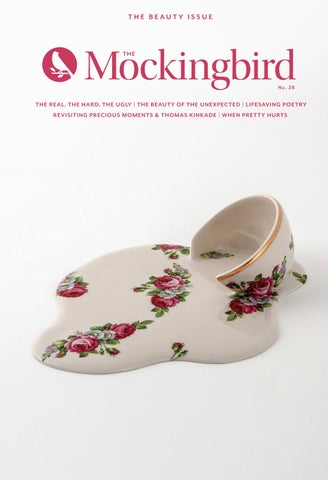
THE BEAUTY ISSUE
No. 28
THE REAL, THE HARD, THE UGLY | THE BEAUTY OF THE UNEXPECTED | LIFESAVING POETRY REVISITING PRECIOUS MOMENTS & THOMAS KINKADE | WHEN PRETTY HURTS
OFFICE
100 West Jefferson Street Charlottesville, VA 22902
4
561.414.3563 434.977.1227 E M A I L : magazine@mbird.com PHONE: FAX :
THE MOCKINGBIRD
Cover Art: Livia Marin, Broken Things, 2021. Porcelain, 15 x 19 x 5 cm, 193 g.
Winter 2026
E D I TO R
B OA R D O F D I R E C TO R S
CJ Green
B OA R D P R E S I D E N T
M A N AG I N G E D I TO R
Jonathan Adams
Meaghan Mitts
E X E C U T I VE D I R E C TO R
David Zahl
PUBLISHER
David Zahl
TRE ASURER
A S S I S TA N T E D I TO R
Cali Yee Ben Self
James Munroe S E C R ETA RY
Ginger Oakes
C O P Y E D I TO R
Ken Wilson
Scott Johnson Ginger Mayfield Reid Murchison Kevin Wrege
P O ET RY E D I TO R
Andy Eaton A RT D I R E C TO R
Tom Martin A D M I N I S T R AT I VE D I R E C TO R
Deanna Roche E D I TO R E M E R I T U S
Ethan Richardson
A four-issue subscription is $60. To subscribe to The Mockingbird, sign up at www.mbird.com/store or send a check to our address here. All monthly supporters of Mockingbird receive a complimentary subscription. The Mockingbird is a nonprofit magazine that seeks to connect the message of God’s grace with the concerns of everyday life. Our staff believes that grace, by its nature, is dynamic, unmerited, and expansive; we hope the range of voices in this issue reflects that nature. In surprising and down-to-earth ways, we aim to demonstrate how the Christian understanding of reality—what people are like, what God is like, and how the two intersect—bears out all around us. For more, visit our website, www.mbird.com.
This Page: Nacho Martín Silva, The Good, the Bad and the Ugly. A, 2021-2022. Oil on canvas, 55 1/10 × 77 1/5 in.
5
6
THE MOCKINGBIRD
Emiliana Henriquez, Tittawin, 2024. Oil on canvas, 30 × 24 in.
Contents
Essays 13 Pretty Hurts GRETCHEN RONNEVIK
Poetry
18 A Visit to the Precious
36 Little Blessing for Subplots
Moments Chapel
Small Formal Treatise on Beauty 50th Birthday
MATTHEW J. MILLINER
29
Flat Earth
JEANNE MURRAY WALKER
JANE ANDERSON GRIZZLE
86
51 Can Poetry Save Your Life?
By Dying Oak
ROSS BLANKENSHIP
PAUL J. PASTOR
79 Kind of Scary, I Guess?
118 Sleep Comes by Hearing
RANDY BOYAGODA
89
The Crystal Hand
Holy Ground RYAN ALVEY
The Call of Beauty NATALIE CARNES
Lists & Columns
100 The Whole Picture MICHAEL WRIGHT
26 The Confessional
114 London Calling
ANONYMOUS
JOY MARIE CLARKSON
33 Dear Gracie… SARAH CONDON
61
Interviews
Finding Beauty in the
Unexpected
39 JEANNE MURRAY WALKER
KATHLEEN NORRIS
From the Glossary
56
S OPHIE GILBERT
64
66
PAUL ELIE
94 On Our Bookshelf
109
A ARON ROSEN
98
Bible-Based Beauty Products
106
Running After Tops KEN WILSON
From the Soapbox
120
The Cheap Perfume Route DAVID ZAHL
7
O P ENE R
A Beauty Almost Hidden From Us
I
magine a preacher’s kid struggling to find his purpose in life. Beginning at age sixteen, he gets a job in the “art world” at a gallery. But in his twenties, he’s pretty sure contemporary art has sold out to commercial incentives, and so, frustrated (and also expecting to be fired), he resigns. He tries other jobs, but none stick. He tries bookselling but finds it dull; he tries seminary but fails the entrance exam; he goes to a coal mining town to serve the poor, but, despite his best intentions and committed efforts, his contract is not renewed. His personal life is, somehow, worse. He proposes to three women, is roundly rejected, moves in with a pregnant sex worker, and that relationship doesn’t last either. Meanwhile he paints—he has become an obsessive painter—but survives on his brother’s money, selling only a few drawings and one painting in his lifetime. After a striking act of self-harm— lopping off an ear—he continues to paint daily, mostly from a psych ward, and with little encouragement. His palette grows more vibrant even though his prospects do not. Ultimately, he takes his own life. As you’ve probably guessed by now, this is the broad-strokes tale of Vincent van Gogh, whose work now draws over two million visitors every year to the Amsterdam museum devoted to it. His orchards, cypresses, and starry nights, so laced with hope and pathos, bear a rich and singular beauty. A hundred years after he painted the “Portrait of Doctor Gachet,” it sold for 82 million dollars. The point is not that he was a misunderstood genius. It is that beauty operates on its own terms. Beauty cannot be coerced from an artist nor from the market; no one can force the beholder to recognize it. It seems only miraculous that what Van Gogh created in his labyrinth of dejection attests, generations later, to a kind of beauty that he himself may not have seen. Certainly, Van Gogh saw beauty in the works of others. One of his great inspirations was Charles Dickens. “I want to paint what Dickens has done with words,” he wrote. “I find all of Dickens beautiful.” The work of both men hinges on a similar understanding of beauty: for Dickens, it arises most reliably in humble, even tragic circumstances; glamor is often suspect. One moment early 8
THE MOCKINGBIRD
Shawn Huckins, Hand of a Young Man in Purple Satin Fabric, 2024. Oil and acrylic on canvas, 42 x 34 in.
9
in Bleak House illustrates this perfectly. A well-to-do philanthropist, Mrs. Pardiggle, pays a visit to the impoverished household of a brickmaker. She reads to them at length from the Bible, departing only after expressing her sincere hope that when she sees them next, the family will be “improved.” But Mrs. Pardiggle has completely missed what was right in front of her eyes: the brickmaker’s baby is deathly ill. In a gut-wrenching instant, the infant dies. Thankfully, the family is not without comfort. “An ugly woman, very poorly clothed, hurried in.” This woman—Mrs. Pardiggle’s polar opposite—bears bruises and marks of abuse. She has no words of wisdom, no Bible to quote. “She had no kind of grace about her but the grace of sympathy; but when she condoled with the [mother], and her own tears fell, she wanted no beauty.” Observing the scene, the narrator says: I thought it very touching to see these two women, coarse and shabby and beaten, so united; to see what they could be to one another; to see how they felt for one another, how the heart of each to each was softened by the hard trials of their lives. I think the best side of such people is almost hidden from us. It is a terrible scene, made beautiful only by the extension of sympathy, understanding, and unbidden presence. Beauty, like grace, arrives mysteriously. It surprises. A reminder of God’s presence in the world, beauty functions as grace itself. As such, it can manifest through conventionally ugly means. A dim shelter for the unhoused. Recovery meetings in a church basement lined with Calvinist Bible commentaries. An embarrassing apology. The centerpiece of the Christian faith, the cross itself, is the most beautiful ugly thing there is—a life sacrificed. This is what religious people so often get wrong about beauty. They think it is one’s responsibility to create. The dogmatic keep a tight leash on what’s “acceptable.” Easily digestible aesthetics must be adhered to. But beauty is narrowly defined in secular society too. There is, at present, a 400-plus billion dollar “beauty industry” aiming to “empower” individuals to attain higher levels of physical attractiveness and self-regard. Needless to say, this approach can be exhausting and, not infrequently, fruitless. Are “beautiful” people ever content with their looks? Not easily, as supermodel Emily Ratajkowski expressed in her memoir: “I’m always thinking…if only my nose was a little smaller, my whole life would be different.” When we approach beauty from a standpoint of control, it’s a mug’s game. 10
THE MOCKINGBIRD
Spot illustrations by Ruthy Kim
In this issue we look for the beauty in the ugly, and the ugly in the beauty. Gretchen Ronnevik writes about the truth of sad things; Michael Wright peers into the darkened vault of Thomas Kinkade’s most intimate paintings; Ross Blankenship praises poetry in the age of artificial intelligence; and Jane Anderson Grizzle investigates why everything that’s supposed to be “beautiful” looks the same. Other insights come from scholar Natalie Carnes, art historian Matthew J. Milliner, novelist Randy Boyagoda, and writer Joy Marie Clarkson. This issue also features four interviews, with two-time National Book Critics Circle Award finalist Paul Elie; prolific poet Jeanne Murray Walker; Atlantic culture critic Sophie Gilbert; and art historian Aaron Rosen. We have fresh poems by Jeanne Murray Walker, Ryan Alvey, and Paul J. Pastor, plus new writing by Kathleen Norris and a contribution by our copy editor extraordinaire, Ken Wilson. Sarah Condon offers new advice on postpartum bodies and in-law relations, and David Zahl connects our desire for beauty to our most fundamental need—the need to be loved. Through it all, we find the truest, most beautiful thing we know: that grace falls on the undeserving. After all, you’re not loved because you’re beautiful, you’re beautiful because you’re loved. — The Editors 11
12
THE MOCKINGBIRD
Ben Cowan, Blessing Leaf 4, 2025. Oil and acrylic on cast aqua-resin, 8x10 in.
By Gretchen Ronnevik
Pretty Hurts The Ugly Side of the Truth
N
ear the end of our family’s homeschooling journey, one of the graduating seniors in our group asked if I’d be a judge on her senior thesis panel. Her 20-page paper was a defense of Christians being allowed to listen to Emo music. Because I grew up listening to Christian radio, I had to look up what Emo music was: “a musical genre characterized by emotional, often confessional lyrics.” It was a style of hardcore punk, with “emo” standing for “emotional.” I listened to some Emo. It seemed to be “teenage angst” music. As I read her paper, I noted the particular arguments she was up against—that Emo music causes people to be depressed, even take their own life. In contrast, she laid out the benefits of having an outlet for pain, and the value of art that depicts suffering. The panel of judges (mostly chosen by the student’s mother) came in with their own agenda. It seemed most of them held the belief that Emo music focuses too much on
the ugly. Christians should set their minds higher—on the good, true, and beautiful, not all these sad, emotional complaints. As the judges kept asking if Emo music fit the description of beautiful, I kept asking: but is it true? And do we consider the truth beautiful, even if it does not bring immediate pleasure? Is there something beautiful in having our pain seen? Furthermore, what does the Bible say about expressing pain? It was a good discussion. Raising my kids in the classical educational tradition, I often heard that phrase “good, true, and beautiful” in regards to what students ought to study. It’s an idea that comes from Philippians 4, which ironically is a letter the Apostle Paul wrote about suffering. Christians for centuries have understood these three transcendentals as being interlinked and as inseparable as the Trinity. As I tried teaching my kids about setting their minds on the good, true, and beautiful, I kept circling back to this question personally: How do I teach my children about the ugly? How much do I expose 13
HUMOR
The Confessional
Dear God, You may have noticed my distinct walk. Because you created me with abnormally high arches, my feet resemble that of a large shorebird. As a result, my gait has a slight bounce to it. I guess it’s a fitting trait for a minister because it’s impossible to come off as intimidating when your natural body language communicates that you are, generally speaking, a jolly little fellow. Every so often, I try to reduce my bounce by gliding about as if on a moving sidewalk, but soon I grow tired of being so deliberate, and the bounce returns. Almost sounds like a horror movie. The Return of the Bounce! You also may have noticed that the length of my neck is two sizes too long. Should I ever participate in a footrace and my competitor and I were “neck and neck,” I would have a clear advantage. I have a distinct memory from fifth grade: Our teacher was explaining how dinosaur species with short, stout necks were generally stronger and more fierce than their longnecked contemporaries. A boy named Ian raised his hand and said that I would be “one of the weaker ones,” and the rest of the class nodded in agreement. Quickly, the teacher tried to list the benefits of being a long-necked dinosaur—the height advantage would allow me to reach for the tastier leaves on the higher branches; I could see farther and be on the lookout for any of the stronger dinosaurs. This happened twenty-seven years ago, and I think about it every day. While I have you, the rest of me is also falling apart. My hair is thinning. My gums are receding (not getting those back). I think my physical prowess peaked when I was eleven and it’s been all downhill from there. I feel like a butterfly morphing into a caterpillar.
26
THE MOCKINGBIRD
I know the Bible says you created my inmost parts, but it doesn’t really feel like I was “marvelously made.” No offense, but it feels like you kind of rushed. The psalms say my body was not hidden from you when you made me in secret, but, to be honest, most of the time I wish I was hidden. Most of the time I wish I was a secret. This body is not the one I would have chosen. I guess what I’m trying to say is I’d like a new body. Maybe one that doesn’t jiggle so much. I’ve read a lot of the Bible, but can’t find a warranty policy in there. Somewhere in Ezekiel, it says you will give me a new heart and put a new spirit in me, but, while you’re at it, how about some abs? Just one ab? Lord, have mercy.
27
50
THE MOCKINGBIRD
Louise Fago-Ruskin. The Catchers, 2008. C-type print.
By Ross Blankenship
Can Poetry Save Your Life?
M
ost people think of poetry, to the extent they think of it at all, as an esoteric art form; words arranged so as to be intentionally challenging. That the poet’s goal is to be hard to understand, to try to communicate something profound by being opaque. I don’t think this perception is entirely wrong. Sometimes I encounter a poem and cannot fathom what the meaning could possibly be, what thought or feeling the poet was trying to capture and convey. And yet I also agree with the 19th Century English essayist William Hazlitt who said, “Poetry is…the most vivid form of expression that can be given to our conception of anything,” and that “Wherever there is a sense of beauty…there is poetry in its birth.” One of my earliest memories is of poetry in its birth. This is not to say I was precocious (I wasn’t), or that I possess some special insight (I don’t), but I remember so clearly sitting at the old wooden desk in the window alcove of my childhood bedroom looking out at the rustling red and orange leaves of a towering oak tree and thinking something like “acorns have to fall from their place.” I’ve revisited this image in my mind so many times. I’ve tried to write it into a poem or two, but never have in a way that quite captures the moment. There was some inkling in my mind about the fact that acorns
had a place, and that their place was impermanent. That they could only move in one direction when they were released from their branches. Was I thinking about gravity, the laws of nature? Was I encountering some feeling about inevitability and transformation? Is it possible I was thinking existentially even then? It’s likely I have just imparted meaning on this simple memory, but I know that sitting at that desk, I halfdreamed, half-thought that I would one day be a poet. It is perhaps unsurprising then that the first subject I loved in school was Shakespeare. I knew in ninth grade I wanted to be an English major. There was something about the meter and the rhyme of poetry that made me feel as if I was on to something—that even if I couldn’t exactly explain it, there was some depth of meaning there to be discovered. What teenager can’t at least grasp at the longing in Juliet’s bittersweet salutation? “Good night, good night! Parting is such sweet sorrow / That I shall say good night till it be morrow.” I had a version of that experience in middle school, staying up all night on the phone caught in that cutesy argument with a crush: “No, you hang up!” But Shakespeare’s language—probably infused with the opulence of Baz Luhrmann’s interpretation, which was still popular at the time—gave that feeling such heft. 51
Q & A Wi t h
Sophie Gilbert
When Flaws Feel Like Resistance
W
hether criticizing the latent shame in the Sex and the City reboot, displays of conspicuous consumption on TV, or the harmful effects of widespread porn, Sophie Gilbert is always looking beneath the eerily smooth veneer of popular culture. A striking example is “Reclaim Imperfect Faces,” her razor-sharp critique in The Atlantic this past spring in which Gilbert laments the rising trend of “digital faces tweaked and pixelated into odd perfection.” These days, she writes, women are supposed to look like “porcelain ornaments.” To make her point she tries an experiment with an A.I. image generator. Prompting the bot to generate the picture of “a normal woman,” it instead produces “four extraordinarily beautiful women with curly hair, sculpted jawlines, and plump lips.” The more specific prompt “an average 42-year-old woman” yields “four Anne Hathaway look-alikes with monstrously oversized grins and visible clavicles, betraying only slight lines around their eyes.” It’s a telling experiment (and easy to replicate, if you are curious), which reveals not only the standards of today’s Artificial Intelligence but also that of average people. Gilbert is a National Magazine Award winner and Pulitzer Prize finalist in Criticism. Her new book, Girl on Girl: How Popular Culture Turned a Generation of Women Against Themselves, is a damning, kaleidoscopic inventory of popular culture in the last several decades. From Britney Spears to Sarah Palin, public facing women have been expected to embody an impossible combination of pure and sexy, youthful and mature. Around the turn of the century, she writes,
56
THE MOCKINGBIRD
Rachel Sharpe, Chrysalis, 2025. Oil on panel, 48 x 36 in.
57
I n t e r v i e w Wi t h
Paul Elie
CryptoReligious Art in an Explicit Age
W
hen Paul Elie writes a book, he takes his time. His first two, released in 2003 and 2012, were meticulously researched and lovingly composed. Both were nominated for National Book Critics Circle Awards. His latest, The Last Supper: Art, Faith, Sex, and Controversy in the 1980s (2025), follows in that pattern, engrossing readers with a flurry of anecdotes slowly braided together into a compelling cultural narrative. His theme? The explosion of “crypto-religious art” in the 1980s. As Elie explains, crypto-religious art incorporates religious words and images and motifs but expresses something other than conventional belief. It’s work that raises the question of what the person who made it believes, so that the question of what it means to believe is crucial to the work’s effect.
66
THE MOCKINGBIRD
Film still from Wings of Desire by Wim Wenders. Road Movies Filmproduction, 1987.
Of course, that effect may be unsettling for some, but for Elie, a Catholic, such art can often be a source of deep spiritual encouragement, and is, in any case, emblematic of today’s religious pluralism. As Elie explains, religion is not so much in decline as it is “surging out of bounds.” Of the dozens of artists profiled in the book (among them Andy Warhol, U2, and Toni Morrison), most, he writes, are not “anti-religious or irreligious. They’re crypto-religious. For them prayer, scripture, image, and ritual are material they claim as their own via the imagination and seek to complicate and deepen, not to do away with.” For those who can appreciate these unorthodox approaches, instead of viewing this variety as “akin to apostasy” to be resisted at all costs, Elie suggests such crypto-religious art may be just the kind of salve we need in our overly explicit, category-obsessed age. — Ben Self, interviewer
67
Two Poems T H E C RY S TA L H A N D Simply recording these tricky counterpoints declares faith. — Geoffrey Hill I dreamed a giant hand. Interred below The bedrock, where the surface water seeps Through stone itself, yet which denies the roots Of mighty trees, above forbidden caves. Perhaps it once was flesh. Then maybe bone. But I dreamed it had fossilized to quartz— Each finger’s phalanges now flecked with gold— A crystal hand. Of earth, yet not of earth. Its palm upturned, held open to receive— Or maybe give—or are those two the same? It held these cities, hills, our clans of moss. Yes—it held every love, and every loss.
86
THE MOCKINGBIRD
By Paul J. Pastor
BY DY I N G OA K It goes on. — Robert Frost What once was weak and mortal in the soil, Through you was lifted to uncommon life, And down long decades, seasoned in your trunk, Grew out to thickness and a mighty weight. In your lithe spring the thunder stamped your brow And gross winds bent you, hardened shaking twigs, But all was good, for deep it shoved your root And thick your bark and tough your strong core grew. And then the summer shone, when the green nuts Popped joyful from your secrecy of leaves, And you danced in your way in piebald sun And blew the puffball for the jesting wasps. Until fall came, and with it that still fog Which obscures both the future and the past And admits phantoms, shaped like those we love, But whose poses we cannot comprehend, And here we meet your winter. Now that rest Whose promise every rotten acorn hides And all your low blown leaves die unconfessed. Here, though we fall, our mighty gift abides.
87
Q & A Wi t h
Aaron Rosen
Seeing as a Form of Doing On Looking with Beauty, Not Only for It
A
rt historian and curator Aaron Rosen is a visionary thinker who works at the intersection of art, faith, and culture. With a doctoral degree from the University of Cambridge and academic appointments at institutions such as Wesley Theological Seminary and King’s College London, Rosen’s vocation spans teaching, curating, and public scholarship. He is the author of books including Imagining Jewish Art (2009), Art and Religion in the 21st Century (2015), Brushes with Faith (2019), and most recently Spiritual Traces (2025). He also runs The Parsonage, a gallery in coastal Maine that stages exhibitions focused on spirituality, ecology, and creativity. In this wide-ranging conversation, we reflect on how beauty reveals itself in unlikely places: in the cracks of our cultural narratives, in sacred and secular spaces, and in moments that refuse easy categorization. Rosen shares how beauty is not simply an aesthetic add-on but a transformative conduit of grace that opens new possibilities for connection and meaning. And he asks us to attend to questions like, What would Jesus see? What might we be missing in our hurried culture? And how does beauty ask us to pause, listen, and respond? — Meaghan Mitts, interviewer
Anne Mourier, Blanketed, 2022. Courtesy of The Parsonage Gallery.
109
By Joy Marie Clarkson
London Calling On Reel and Real Beauty
I
n the run up to her recent visit to London, my mother and I sent Instagram reels to each other of things we might do on her trip: an afternoon tea at Fortnum & Mason, a walk through Bloomsbury followed by a pint in a cozy pub, snacking and shopping our way through the impeccably instagrammable Seven Dials Market, replete with a café where different kinds of cheeses gently travel past you on a conveyor belt. I feel like I live in two cities: the London I see on Instagram reels and the real London where I live and work. And sometimes I feel self-conscious that people think I live in Reel London and imagine my life to be more glamorous than it is. It’s not just the reels, but the fact that London is a place that lives in people’s imaginations. In Gilmore Girls, Paris Geller declares that “London is the most romantic city in the world.” And that romance is particularly acute this time of year when London becomes the city of Christmas: of Hyde Park dusted in snow, Regent Street glowing with Christmas lights, ice-skating at the Somerset House, lessons and carols ringing out at Westminster Abbey, and Michael Caine with a Muppet on his shoulder. 114
Some social media users are particularly good at capturing the romance of London. Their lives, shared through a carousel of reels, pictures, stories, and tweets, look so interesting, so aesthetically pleasing. I follow them with interest. They get pastries from the trendiest bakeries; they wear beautiful dresses, tall boots, and sumptuous winter coats; they take pictures of their aesthetic wooden bookshelves in the North London flats; they attend chic events at the London Review of
THE MOCKINGBIRD
Books bookshop. Sometimes they take pictures of their dinners, a glass of champagne in manicured fingers overshadowing a tray full of oysters. Some of them even post pictures of their children, posed like beautiful props in a pre-Raphaelite painting as they pick daisies in St James’ Park. They take their children to art galleries and concerts. These beautiful vignettes stir up a strange and tangled mess of envy in me that it’s hard to unpick. I feel both embarrassed by and Courtesy of Unsplash user Flavio Vallone.
defensive of how ordinary my life is. I live in East London, a place I find (on a good day) more charming, more comfortable, and even more real in some important sense than the polished images you’ll find on reels. I love a good outfit, but my fashion choices are influenced by budget, comfort, and the need to look professional. I cook and eat a lot at home, both because I love baking but also because London is expensive. I love various corners of my home, but it is also often clut115