SEPTEMBER 2026
THE MOCKINGBIRD TIMES
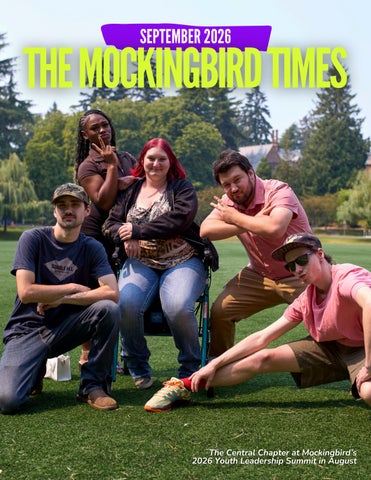
The Central Chapter at Mockingbird’s 2026 Youth Leadership Summit in August
IN THIS ISSUE 2 About The Mockingbird Times 3 “Seguir” 4 “Risen from Ashes” 5 A Survivor’s Guide to Surviving 7 “Spaghettios”
Poem by Cece, a Tacoma Chapter Member Art by Noah, a Tacoma Chapter Member By Chloe, a Tacoma Chapter Member
Art by Ender, a King County Chapter Member
8 9 Breaking the Quiet 11 “Afterbirth” nistries ce Spotlight: Street Youth Mi ur so Re 12 ster Care Villainization of Teens in Fo
By Zayn, a Tacoma Chapter Member
Article by Koncrete Rose, a YAEH Chapter Member
Poem by a Lived Experience Expert
By Corrina, a King County Chapter Member
13 Art by Oliver 14 Art by Kristen ts ergency Housing Voucher Cu Em 15 16 Beadwork by Mira A Tacoma Chapter Member
A Northern Chapter Member
Article by Weiss, a YAEH Chapter Member
Art by Mira, a Central Chapter Member
17 “a mother and a mom”
Poem by Zayn, a Tacoma Chapter Member
18 “Under the Twilight”
Art by Noah, a Tacoma Chapter Member
ABOUT THE MOCKINGBIRD TIMES The Mockingbird Times is a publication aiming to: amplify the voices of youth and young adults with lived experience in foster care and/or homelessness; change and expand the public perception of young people and the challenges they face; and educate communities about foster care, youth homelessness, and advocacy work. The Mockingbird Times was the first project launched after The Mockingbird Society was founded in 2000 and has since played a key role in our Youth Programs. Not only does the publication provide an opportunity to elevate the voices of our young advocates and the issues they’re facing, it also provides a picture of young leaders balancing their roles as powerful, positive change agents in our community with all the joys, challenges, and questions experienced by youth and young adults. The Times has historically been distributed across the state and nation and has been included as an insert in Real Change, a Seattle-based community newspaper. All young reporters and contributors (ages 13-26) from across Washington state are compensated for their submissions to The Mockingbird Times.
YOUTH LEADERSHIP SUMMIT 2026 The photos featured throughout this issue of The Mockingbird Times are from our recent Youth Leadership Summit! Summit is one of Mockingbird’s key annual events, when young people from across Washington state gather to learn about how to make change in their communities, get to know one another, and present their ideas and advocacy topics to leaders and lawmakers. For more information about Youth Leadership Summit, as well as an overview of the advocacy topics from each chapter, visit mockingbirdsociety.org or follow The Mockingbird Society on social media. Photo Credits: Michael B. Maine
2
SEGUIR A POEM BY CECE, A TACOMA CHAPTER MEMBER En un mundo gris camine perdida con el pecho lleno de noches largas y un silencio que pesaba. Las calles estaban llenas de gente pero mi alla se sentía vacía, como una estrella, apagada, olvidada en el cielo. Había días en que la luz parecia hecha para otros y yo solo existía entre sombras que no terminaban. Realmente no esperaba a nadie ni a nada, por que ese algo o alguien no llegaría. Y si sucedía, nunca me lo permitiría, seguiría con mi vida con lágrimas secas en las mejillas y fingiendo que lo superaría.
ENGLISH TRANSLATION: In a gray world, I walked lost, my chest heavy with long nights and a silence that weighed me down. The streets were teeming with people, yet my soul felt empty, like a burnt-out star, forgotten in the sky. There were days when the light seemed meant for others, while I merely existed amidst shadows that never ended. I truly waited for no one and for nothing, for that "something" or "someone" would never arrive; and even if it did, I would never allow it I would deny it with my very life with dried tears on my cheeks pretending that I had moved past it.
And I blame no one
for it would be selfish to claim that others hurt me,
Y no culpo a nadie when it was I
por que, algo egoísta sería decir que otros me lastimaron who allowed it to happen.
cuando fui yo quien
lo permitía.
3
RISEN FROM ASHES ART BY NOAH, A TACOMA CHAPTER MEMBER
Note from the artist: “This piece is a rework of the Lucifer painting, and represents the strength you feel doing your transition while also having distain for those around you that are ignorant. It features the phrase ‘Your eyes are like two stars’ in Italian.”
4
A SURVIVOR’S GUIDE TO SURVIVING: TIPS FROM MY UNHOUSED JOURNEY BY CHLOE, A TACOMA CHAPTER MEMBER Human beings' most basic needs are food,water and shelter. Beyond those needs are mental health needs, such as socializing, hygiene, self-care. Then there are essentials for current society, such as a phone and phone service, internet, and transportation. The most basic needs will keep a human being alive. Mental health care will ensure the person’s ability to persevere through hard times. Finally, societal needs ensure a person is able to continue to interact with the current world. Ensuring basic needs are being met when homeless is extremely difficult. During my journey, I constantly found myself at risk of being stuck without shelter or food. This stressor loomed over my life for multiple years. Resources that allowed me to remain sheltered ranged from homeless shelters, various people offering their couches to me, hotel vouchers, and finally organizational help to get my own place. I recommend that anyone who is struggling with finding shelter to reach out to people around them, shelters, and resources– even if it seems futile, continue to try. It’s like fishing – even if nothing is biting it doesn’t necessarily mean there isn’t any fish out there to catch. Try changing your bait (tactics) and you might get a bite- even if a small fish, a small fish will allow you to continue until you get your big catch. An example of this from my own life is that while I was waiting to be able to get into shelter, I asked for assistance from someone I had hardly known. I requested assistance and they offered me their couch along with other aid. This act of kindness allowed me to survive and get into a shelter later on. I later repaid their kindness by paying them money I earned later to show gratitude, as one should always try to give back to those who aided them in hard times, or at least attempt to do so. I recommend calling resources such as 211 and other organizations that specialize in aiding unhoused people. The other basic need is food and water. I recommend that if you're struggling to stay hydrated, obtain a water bottle and use water fountains or other free to use safe water sources. For food, if you’re able to access them, I recommend using Government SNAP benefits. While homeless, I was able to set up SNAP and obtain them. One can do this online, via phone, or in person at your local DSHS office. If you’re unable to obtain SNAP benefits or need more food resources, I recommend making use of foodbanks. I myself often was without a car while traversing, this made doing foodbank runs awkward at times. I found a solution to this problem by using a large backpack and a few reusable bags to disperse the weight of the groceries greatly eased the process. I also recommend looking around while shopping for special deals, such as offered cashback for the store, or discounts to stretch your funds father. Another important part of surviving is caring for your mental health. If your mental health deteriorates, then everything else in your life will as well. Integral parts of ensuring one's mental health is socializing, self-care, hygiene, sense of happiness, and purpose. Human beings are social creatures, or so I've been told- and sadly also learned first hand. I had a few months where I didn’t have any social interactions besides calling crisis lines. This was one of the worst experiences I’ve had in life. My hope and light felt gone, I almost didn’t crawl out of this pit, but thankfully I reached out and reconnected with people and began rebuilding myself, surviving. I know if I hadn’t reached out to crisis lines and reached out to friends I wouldn’t still be here; ergo it is very important to socialize and have friends to survive. Another important part of mental health care is self-care. This embodies multiple areas of life, from hygiene, self-reflection, to doing things that bring you joy. Personal hygiene is important. I noticed when I slack on my personal hygiene it worsens my depression and affects me mentally. Caring for myself and feeling refreshed also helped my brain “reset” or “wash away” the negatives of the day- it helped me relax. I am aware that being unhoused or unstable housing can also make getting ahold of basic necessities such as personal hygiene products- some ways I managed during rough times was foodbanks (often they random personal hygiene products) and the Dollar Tree. Even if you’re struggling to find spaces to shower, take advantage of restrooms and at least wash and rinse your face- you’d be amazed at
5
how that simple task can still help your mind. I also believe it’s important to journal on your journey. Life will be busy, full of events- it’s important to have somewhere else to store it all besides your head. This is where the journal comes in. Reflect on the events of the day, your emotions and vent about life. This will give you both a record and an outlet for the hardships of life. You’ll also be more easily able to go back and have a record of events and identify patterns. This will help foster self-growth. I also can not emphasize this enough: make sure you have something in life that brings you joy. If you don’t have something in life that brings joy you’ll struggle with negative emotions that will drag you down. Examples of things that can bring joy are hobbies that you love, pets you adore, shows and media that get you engrossed and rambling, etc. You just need something to add spice and glimmers to your daily life. In current society there are also certain things that have become a necessity.One example is a phone. Without a phone it’s difficult to tackle adult life. To get a job you’re expected to have a phone which you can use to communicate with your employer. You also need a phone to reach out to services, communicate, and other important adulting tasks. This means not having a phone in current society GREATLY puts you at a disadvantage. It also puts you at higher risk for your safety as in emergencies phones are important as you can call for help. Phones are also useful to use for travel; as without mine traversing via bus would become even more difficult. If you’re without a phone you can use the Government Lifeline Program to obtain one. The Lifeline Program will also help aid in getting data and minutes for said phone. You can also obtain discounted internet via government programs. If you’re unable to set up the internet where you live, but still need access to WiFi, you can also make use of Xfinity hotspot wifi. This will allow you to connect to Xfinity wifi at random locations which have Xfinity wifi already. I made use of this multiple times throughout times I was struggling. Lastly, I’d like to mention transportation. If you’re unable to move and traverse it is difficult to accomplish much of anything in current society. You gotta be able to get to work, appointments, errands, and more. If you’re without a car, this means you must be able to find alternative ways to get around. The bus is the solution here. Make use of the bus and download the Transit app to aid in traversing and planning your travels. If you’re constantly having to travel shorter distances, I recommend getting a bike. Finding a cheap bike isn’t as difficult as one might think– I personally found a bike for $50 dollars on Offerup. You simply need to look to buy a bike secondhand and look for a good deal in your area. While this can take a bit I promise it’s worth it in the ease it’ll add to traveling. Surviving is difficult, but using resources can help greatly. Thinking creatively and finding solutions to problems is important in surviving as well. While earlier I mentioned getting help from others, I also want to give a lesson of caution. Not everyone who gives help is good. while I did run into people who did help me and save me from sleeping out in the cold, I also ran into people who wanted to take advantage of me being in a vulnerable situation. I had multiple people who offered me help but wanted something from me. As a woman it typically was access to my body. I myself never did have to give up my body to secure shelter, but there were multiple times where people tried to coerce me/pressure me into that situation, and I am aware other women have had to do so to ensure they had a warm place to sleep and not freeze to death. I believe that people doing this to ANY human in this situation is deplorable, but alas it is a sad truth of this world. If you find yourself in an unsafe situation, reach out and try to get out as soon as possible. I myself for a short bit lived with an older woman in Puyallup who attempted to take advantage of me. Multiple times, this older woman tried to force herself onto me sexually, she also multiple times spoke about human trafficking- referencing past events and alluding that she wanted to do the same to me. I vividly recall her saying to me, “You’d be worth so much if you were trafficked,” and “Can I be your handler?”. I had already had a gut feeling about this woman being unsafe, but in my desperation I didn’t listen to my gut. This situation was unsafe, and impacted my mental health greatly. I was stuck there longer than I wanted, and unfortunately when I reported what had happened to the police, they did nothing besides telling me, "Maybe she's a lesbian," as if to excuse her attempts at forcing herself onto me.. I thankfully was able to move to a hotel away from this woman with help from a Government voucher. This situation was horrible, and I don’t want anyone else to go through anything similar, but going through it myself, I am aware of its reality. If you find yourself in a similar situation it is important to keep reaching out and attempting to find a way out. Even if one attempt doesn’t work (such as me reporting to the police) try another avenue to ensure your safety and be cautious. I am hopeful that this article can help offer advice, tips and be a guide to anyone going through similar hardships I have endured. It is not an easy journey, but surviving is important; continuing on past the struggle is the only way to reach the good parts of life. If you’re in hell, don’t stop and stay there. Keep surviving and walking on. Hell can’t last forever and the only way you’re gonna get out is if you keep moving towards better. In short, remember to reach out to help, use your resources, listen to your gut about your safety, and do your best to survive so that one day you may thrive.
FOLLOW CHLOE AND CHECK OUT HER ART ON INSTAGRAM: @KUROIKAMICHAN
6
“SPAGHETTIOS” ART BY ENDER, A KING COUNTY CHAPTER MEMBER
Note from the artist: “I drew this drawing during a particularly hard day of mine. I deal with really intense feelings of loneliness and it made me feel a bit better to doodle something out. I decided on drawing myself due to the fact that I often times don't like taking selfies but drawings of myself tend to actually make me feel better about myself!”
7
VILLAINIZATION OF TEENS IN FOSTER CARE BY ZAYN, A TACOMA CHAPTER MEMBER There is a select awareness of what foster youth go through, especially those who are teens. Some people see group homes and immediately think of “troublesome delinquents”. They stay wary of people without a true place to call home, and many do not know how to navigate a conversation with someone who has been in foster care. The stigma is exhausting, not because some youth cannot stray down dark paths when they lack solid support, but because it is assumed that all of us are “hard to handle”. Too often, the fault is placed on us for the cards we were dealt. I will admit that when I was young and naïve, I was fed bad stereotypes by my former mother, (who had previously been a foster parent which is quite ironic). She wanted to help a neighborhood teen who lived in a group home, but she warned us not to let him inside because “he might steal.” She made strict rules for him, while letting us play with other neighborhood kids with little to no supervision. At the time, I didn’t fully understand how unfair that was. He was treated like a possible problem before he had even done anything perceivably wrong. Everyone around him unanimously decided his placement in a group home said more about his character than his actual actions ever could. That kind of mindset follows foster youth everywhere: at school, social life, employment, and even in the same homes that are supposed support them. Teenagers in foster care are expected to be grateful for the bare minimum while also being judged for how they deal with trauma. If I was quiet, people labeled me detached and troubled. If I was upset, they took extra precautions in fear of their safety. Rarely do people stop and ask themselves what support we as teens are missing, or how many times we have had to start over and survive through life. That does not mean foster youth are perfect. No teenager is. But mistakes should not become proof that someone is inherently "bad", especially when that young person has had to grow up under circumstances most people can't imagine. This stigma is harmful because it makes safety even harder to find. When people assume the worst, they create the scenario in their mind and in turn, isolate youth in their judgement. We should not have to prove that we are safe, trustworthy, or "one of the good ones”. We should be allowed to be seen as normal from first impressions, not as a case to remember or kids to pity.
8
BREAKING THE QUIET BY KONCRETE ROSE
YAEH (YOUTH ADVOCATES ENDING HOMELESSNESS) CHAPTER MEMBER, YOUTH ADVOCATE, WRITER, LIVED EXPERIENCE LEADER, AND MUSICIAN There is a kind of silence that fills a room the moment I walk in with City Council members, lawmakers, administrators, and everyone deciding what youth survival is worth. It is not respect. It is not politeness. It is the silence that comes when people realize the truth is about to hit them and they are not ready. I do not bring a script. I bring lived experience, the kind the system was never ready to face. The stories behind every statistic they glance over. I do not speak to impress. I do not speak to flatter. I do not speak to soften. I speak because someone has to. I speak because the truth they hoped would never sit at their table has arrived. The moment I start talking, the room shifts. Conversations that felt abstract become urgent. People remember the youth they are debating are alive and waiting for decisions that will change their lives. Policy rooms are made for control, for order, for appearances. They are not made for a youth voice that refuses to shrink or be silenced. They like to say youth deserve a seat at the table, but most tables were never built for us. When they hand me the mic, they expect something safe, something digestible, something inspirational. They expect me to say the right things, the things that can be quoted later to show youth engagement. That is not what I bring. I will not shrink. I will not censor myself. I will not make my truth easy for people who never lived it. What they call testimony, I call survival notes. What they call public comment, I call policy correction. What they call youth perspective, I call the truth they missed while writing reports instead of asking us. I do not come to be tolerated. I come to be heard, and I come to make them think, even if it hurts. Seattle’s political world is full of plans that never take off, intentions that never grow legs, promises that never grow roots. Lawmakers debate while youth navigate the consequences. They talk about homelessness like it is theoretical. They discuss youth like we are not right there. They argue budgets like they are choosing between lunch options, not deciding who has shelter tonight. Youth cannot postpone pain. Youth cannot put their lives on hold while politicians argue. They walk away when the meeting ends. Youth do not always have a place to go. That is why I speak firmly. That is why I refuse to soften. I am direct because survival made me direct. The system made me fearless. Silence made me dangerous. And even when they do not admit it, policymakers feel that. When I speak, I do not sugarcoat. I do not edit to protect comfort. I say the truth. Your policy looks good on paper, but I lived the version that never got written. The cracks in your system are not accidents. Youth homelessness is not about youth failing. It is about systems failing youth. You cannot fix a problem you have never survived. Listen to us before you legislate us. These are not rehearsed lines. These are earned truths, and even the most comfortable rooms shift when they hear them.
9
People expect youth to be polite, quiet, grateful, careful, but I do not walk in trying to impress. I walk in holding the reality they forgot. That reality is heavy. When lawmakers see me, a Black, non-gender conforming, lived-experience youth, they tense. Not because of me, but because of what I represent: the truth they ignored, the consequences they never face, the pain they cannot carry, the perspectives they did not ask for, the failures they contributed to without realizing it. I am not aggressive. I am accurate. I am not emotional. I am honest. I am not disruptive. I am necessary. There is a difference between discomfort and danger. My truth is not dangerous. Silence is.
Some spaces pretend to welcome youth voice, but they are not ready for youth truth. They are ready for my presence. They are not ready for my power. People flip through notes, leaders prepare professional responses, staff smile politely to cover their unease, decision-makers brace themselves. I do not take it personally. If a truth does not disrupt a room, the room was not worth entering. I will not dim my voice to make anyone comfortable because comfort does not change policy. Comfort does not save lives. The victories are quiet. A youth whispering thank you for saying what they were scared to say. A policymaker admitting they changed their mind. A director messaging that we need to rethink everything. These moments do not make headlines, but they matter. They are the cracks where light enters, the openings where systems begin to shift. Accountability is not anger. Accountability is care. I speak to confront institutions, challenge patterns, expose harm, and demand alignment between values and action. My voice is not revenge. My voice is responsibility. I am not a guest in these rooms. I am a witness. I am a strategist. I am an expert. I am someone the system must reckon with. My presence is structural, my voice essential, and my role is not optional. Systems built without youth will always fail youth, and I will not be quiet. When I speak to policymakers, I do not shrink. I do not apologize for the weight of my truth. The system debates endlessly, delays endlessly, defends itself endlessly. But the truth walks in with me every time, and when I speak, the room gets quiet. The politics scatter. The truth takes the mic. Something shifts, even if it is small, even if it is silent, even if it is uncomfortable. I am Koncrete Rose, breaking the quiet, telling the truth, calling out the system, and opening the future wider for every youth who needs to be heard.
“If a truth does not disrupt a room, the room was not worth entering.”
“I will not dim my voice to make anyone comfortable because comfort does not change policy. Comfort does not save lives.”
FOLLOW KONCRETE ROSE’S ONGOING WORK ON YOUTUBE AT: KONCRETE ROSE GARDEN
10
AFTERBIRTH BY A LIVED EXPERIENNCE EXPERT Born to make men feel big by being small. Contorted to a visual distortion that screams for release, yet the suffering is praised as holy. Born to crave the praise and feed into the addiction of male validation, however fleeting it may be. Screaming no. Indistinguishable from it being said in the safety of my head or in the cruel atmosphere of others ears with it never having mattered to begin with. Knowing I cannot escape, my nightmares a constant reminder. Who am I if not someone reliable? What is reliability if not self sacrifice? What is myself if not a melting pot of the words of others, constantly churning and wanting some brightness to quench the darkness left long ago? When I try to say this is not who I am my rigidity and fear make my actions both contradictory and inevitable. Born to be in a delicate balance of both being nice enough to not die and not too nice to be alive. Born to die from what they feel is leading them on some path of ecstasy, as I take it away at the last second. But… You are a liar. You have a glass ego that you expected me to be the artificial foundation for. I was not born for you. I was not born for men. I was not born for the world. I was born for me.
11
STREET YOUTH MINISTRIES: A BEACON OF HOPE IN THE UNIVERSITY DISTRICT RESOURCE SPOTLIGHT BY CORRINA, A KING COUNTY CHAPTER MEMBER In the heart of Seattle's University District, a vital resource exists for young people experiencing homelessness: Street Youth Ministries (SYM). More than just a service provider, SYM offers a lifeline of support, connection, and opportunity to youth navigating the challenges of life on the streets. SYM's approach is holistic, recognizing that basic needs must be met before young people can focus on long-term goals. Their case management services are a cornerstone of this support. SYM assists youth in obtaining essential identifying documents like birth certificates and IDs, which are crucial for accessing housing, employment, and other vital services. They also connect young people with food resources, ensuring they have access to nutritious meals. Additionally, SYM provides clothing resources, offering practical assistance to those who may lack adequate attire. The SYM drop-in center, located in the U-District, is a safe and welcoming space for youth to connect, recharge, and access essential resources. For many, like this writer who once relied on the drop-in while experiencing homelessness, it's more than just a building; it's a haven. Here, young people can complete homework, charge their phones, stay warm, and simply hang out in a judgment-free environment. The drop-in provides snacks, clothing, and a sense of community that can be rare for those living on the streets. Beyond basic needs, SYM is committed to creating enriching experiences for the youth they serve. They organize fun events like trips to the pumpkin patch, rock climbing outings, and movie nights, providing opportunities for recreation, socialization, and positive memories. These activities help build confidence, foster a sense of belonging, and offer a break from the stresses of homelessness. SYM's impact extends beyond individual support. Their case management office, formerly the UDYC house but now operating as Roots Case Management, houses both Roots and UDYC, fostering collaboration and maximizing resources for youth. This partnership strengthens the network of support available and ensures that young people receive comprehensive and coordinated care. Street Youth Ministries is a testament to the power of community and compassion. By providing comprehensive support, a safe space, and enriching experiences, SYM empowers young people experiencing homelessness to build brighter futures. For more information about Street Youth Ministries and how you can get involved, reach out to the King County Engagement Coordinator.
12
ART BY OLIVER, A TACOMA CHAPTER MEMBER
13
ART BY KRISTEN, A NORTHERN CHAPTER MEMBER
Artist Note: “I recently made this artwork of a jellyfish for fun out with crayons but was going through a lot of chaos or uncertainty surrounding my next housing situation and my health. Now that a portion of those challeges are over I feel that the jellyfish tenticals are are great representation of complexity and chaos. Or thoughts being intertwined.”
14
EMERGENCY HOUSING VOUCHER CUTS BY WEISS, A YAEH (YOUTH ADVOCATES ENDING HOMELESSNESS) CHAPTER MEMBER
In the year 2020, a pandemic hit the world like a train and changed everything. Many people lost their jobs and the means to support themselves whilst everyone isolated away to avoid COVID-19. An unfortunate side effect of this was a loss of housing for tens of thousands of individuals and families, deepening a problem that was already difficult to address in our nation. As a response to this, in 2021 the Department of Housing & Urban Development (HUD) created the American Rescue Plan Act, creating Emergency Housing Vouchers (EHV’s) which issued 70,000 vouchers to provide housing assistance to individuals and families who were (or had been) homeless, at-risk of homelessness or housing instability, fleeing, or attempting to flee, domestic violence, dating violence, sexual assault, stalking, or human trafficking. I am one of those recipients of the EHV program. These vouchers were intended to last until the end of 2030, however due to the rapid increase in rent across the country the funding for the program was expended much faster than intended. When the opportunity to renew funding to meet the current conditions arose, the government shut down due to Congress’s failure to pass appropriations legislation for 2026. This left no way for the EHV program to continue, which has led to the program being prematurely cut. The funding will now only last until the end of this year, 2026. This will leave over 56,000 people at risk of homelessness with little preparation. As someone who experienced homelessness during the pandemic the EHV program helped me get housed, which enabled me to pursue my goals and work on myself. Now with the loss of funding and the end of my voucher, the local housing authority has sent out the notice earlier this year to let recipients know that our assistance is ending, however they are offering public housing assistance to those of us that are losing the federal assistance we gained. This allows us to choose from multiple locations across the local area to live when availability is offered. You can deny the first offer of availability for housing if it is not something that will work for you, but if you are offered another opening you must accept it or lose all assistance in totality. I would like to express the importance of housing assistance in these times. While it may no longer be the Covid days anymore, this doesn’t mean that it is any easier on individuals and families during our period of economic hardship. In my last article I detailed the funding cuts to nonprofits, and nonprofits are a front liner on the battle for housing rights and renters assistance. With organizations like this impacted as heavily as they are, this exacerbates the difficulty in keeping those who rely on assistance housed as well as being able to house anyone currently facing homelessness, creating an overload. Alongside this, with a main reason that the vouchers are ending being the drastic increases in rent since the pandemic it will be very difficult for people to be able to afford housing on their own, on top of a job market that is trending downward for various reasons I won’t get into (those are entire articles worth of analysis I won’t be doing here). It is vital that assistance, in whatever capacity is available, is maintained to avoid a deepening of the housing crisis in America. Now, despite how doom and gloom this all is, there are actions that can be taken to help address this or give it more attention to hopefully minimize the damage this loss of funding will cause. I will include a link in this article that will lead to the National Alliance to End Homelessness’s website on ways to help save the vouchers or look for alternative solutions, as well as expand upon the issues this article is speaking on. Source: https://endhomelessness.org/blog/saving-the-emergency-housing-vouchers/
15
BEADWORK BY MIRA, A CENTRAL CHAPTER MEMBER
16
A MOTHER AND A MOM BY ZAYN, A TACOMA CHAPTER MEMBER
Once there were two women, who never knew each other One you called your birth-mother the other you call your real mom Two different lives shaped to make your one. The first one gave you life The second one taught you to live it. The first gave you a body, the second was there to teach it how to work One gave you the chomosomes and genetics The other taught you to break the generational curse Now the age old question... Is who your parents are from heredity or environment? Which are you the product of?
17
UNDER THE TWILIGHT BY NOAH, A TACOMA CHAPTER MEMBER
18
THE MOCKINGBIRD TIMES
SHARE YOUR WRITING, POETRY & ART | SHARE YOUR PERSPECTIVE | SHARE YOUR STORY If you’re a lived experience expert and you paint, take photos, sketch, write, or create any other type of art, send in your work to be featured in The Mockingbird Times! Contact your Regional Engagement Coordinator or use the QR code below to contact us/submit your work.
CONNECT WITH US
SCAN THE QR CODE OR VISIT OUR LINKTREE TO CONNECT WITH US, LEARN MORE, AND SUBMIT YOUR WORK TO THE MOCKINGBIRD TIMES
mockingbirdsociety.org information@mockingbirdsociety.org @mbsociety
@mockingbird.society @Mb_society mockingbirdsociety