Learn how to strategize inventory for increased profits.
22// Sales Pro of the Year: Know the Basics
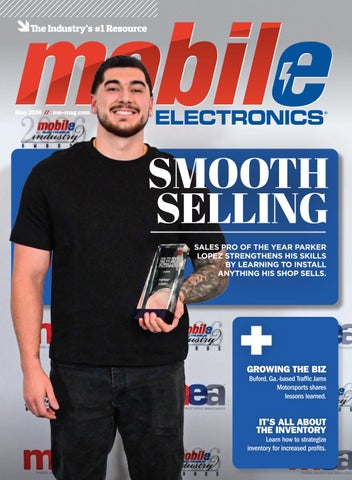
To strengthen communication and minimize issues, Sales Pro of the Year Parker Lopez said salespeople should understand the basics of installation and always ask for help when needed.
12// What’s Happening: Rise Up
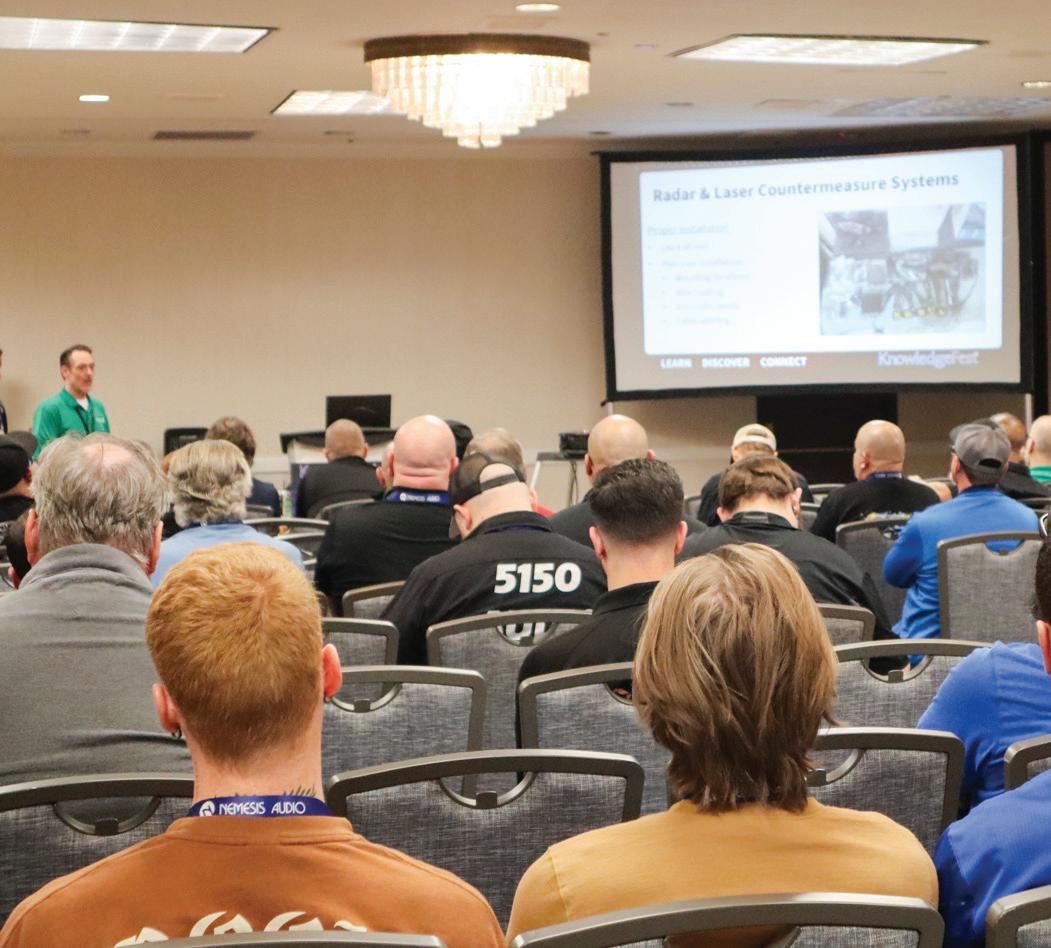
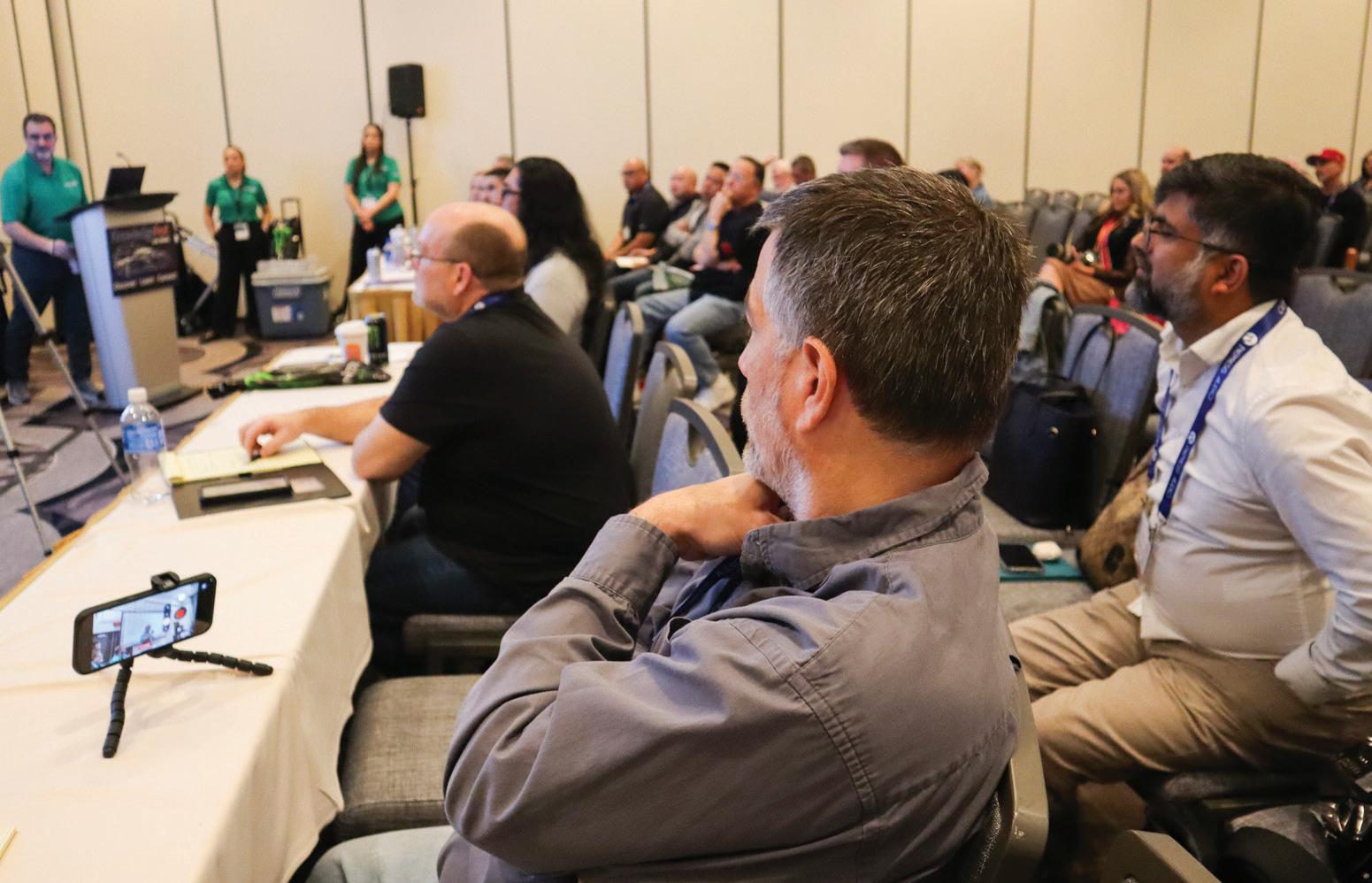
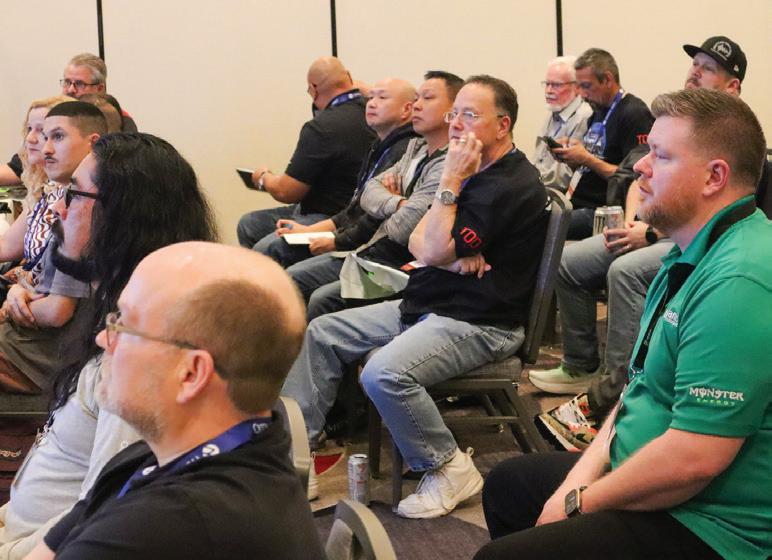
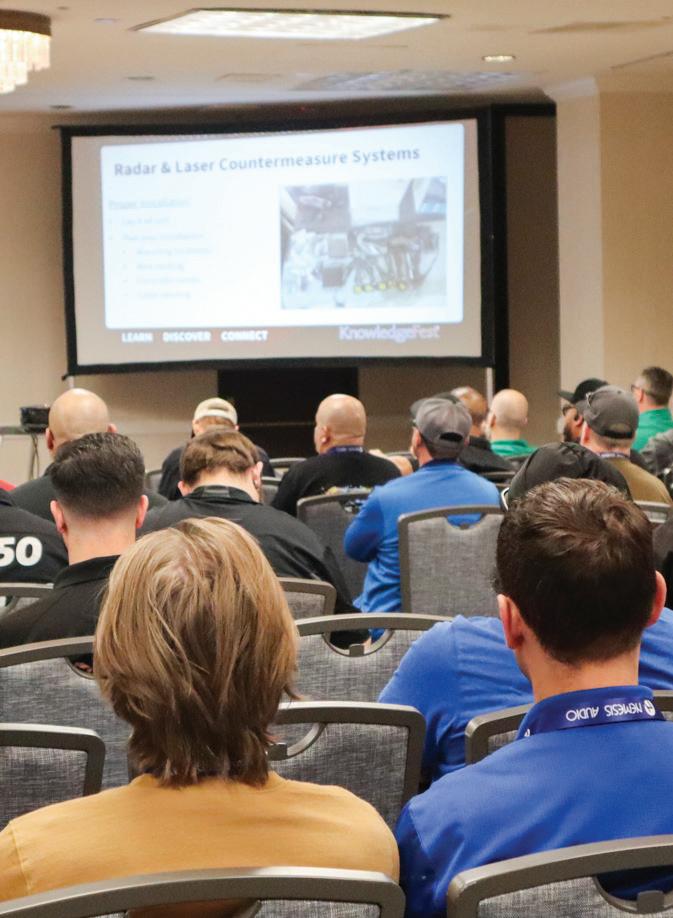
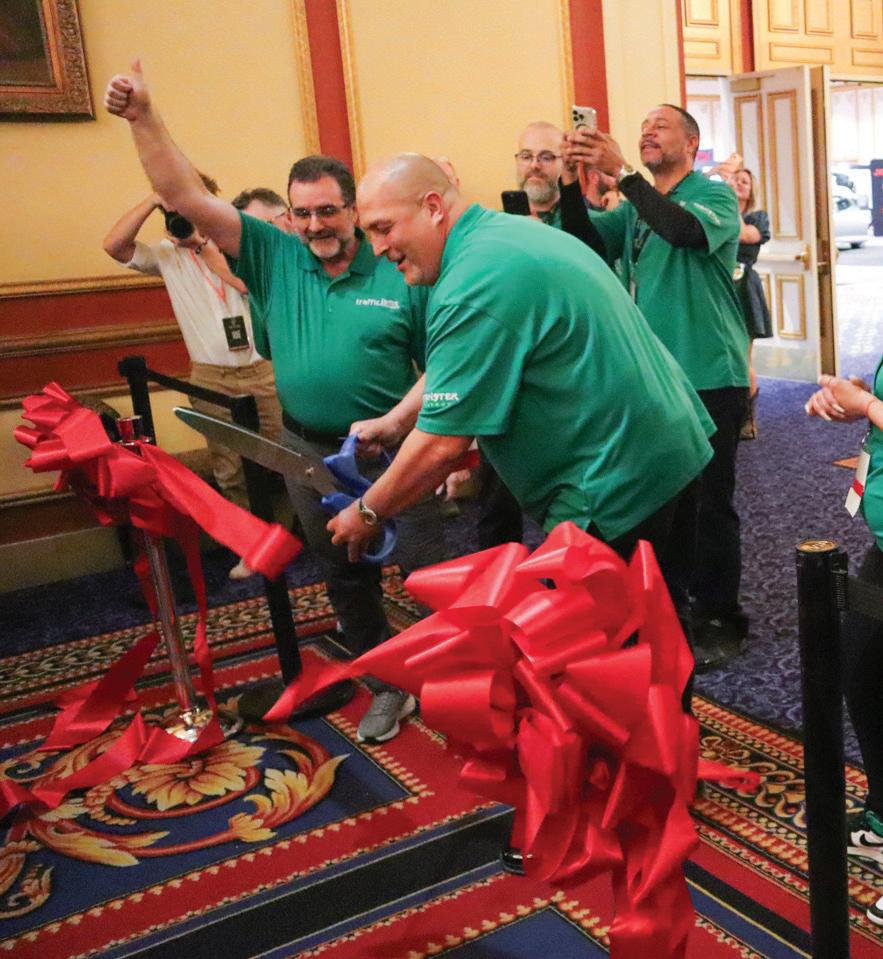
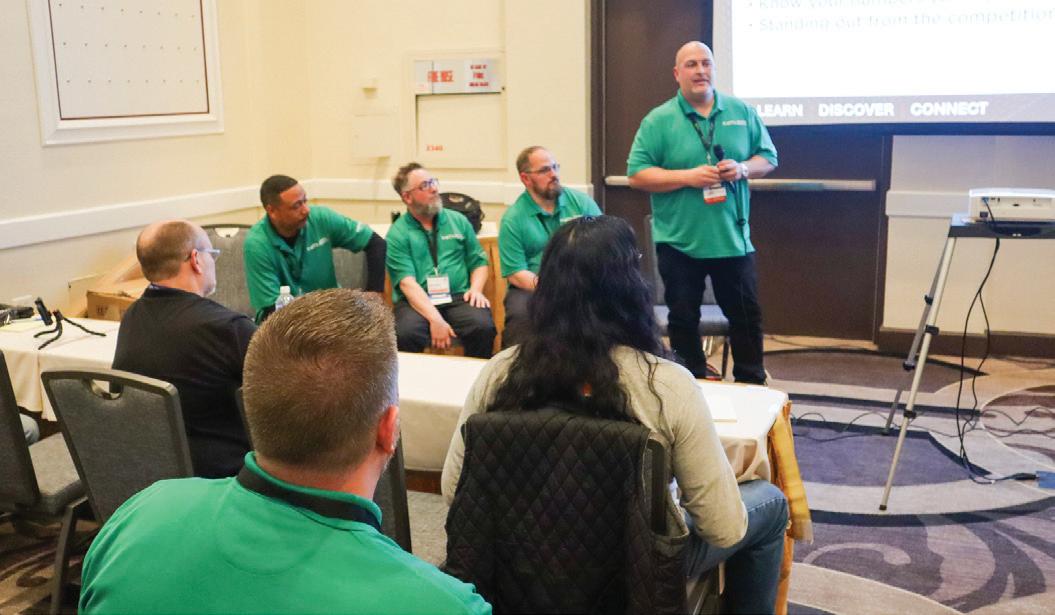
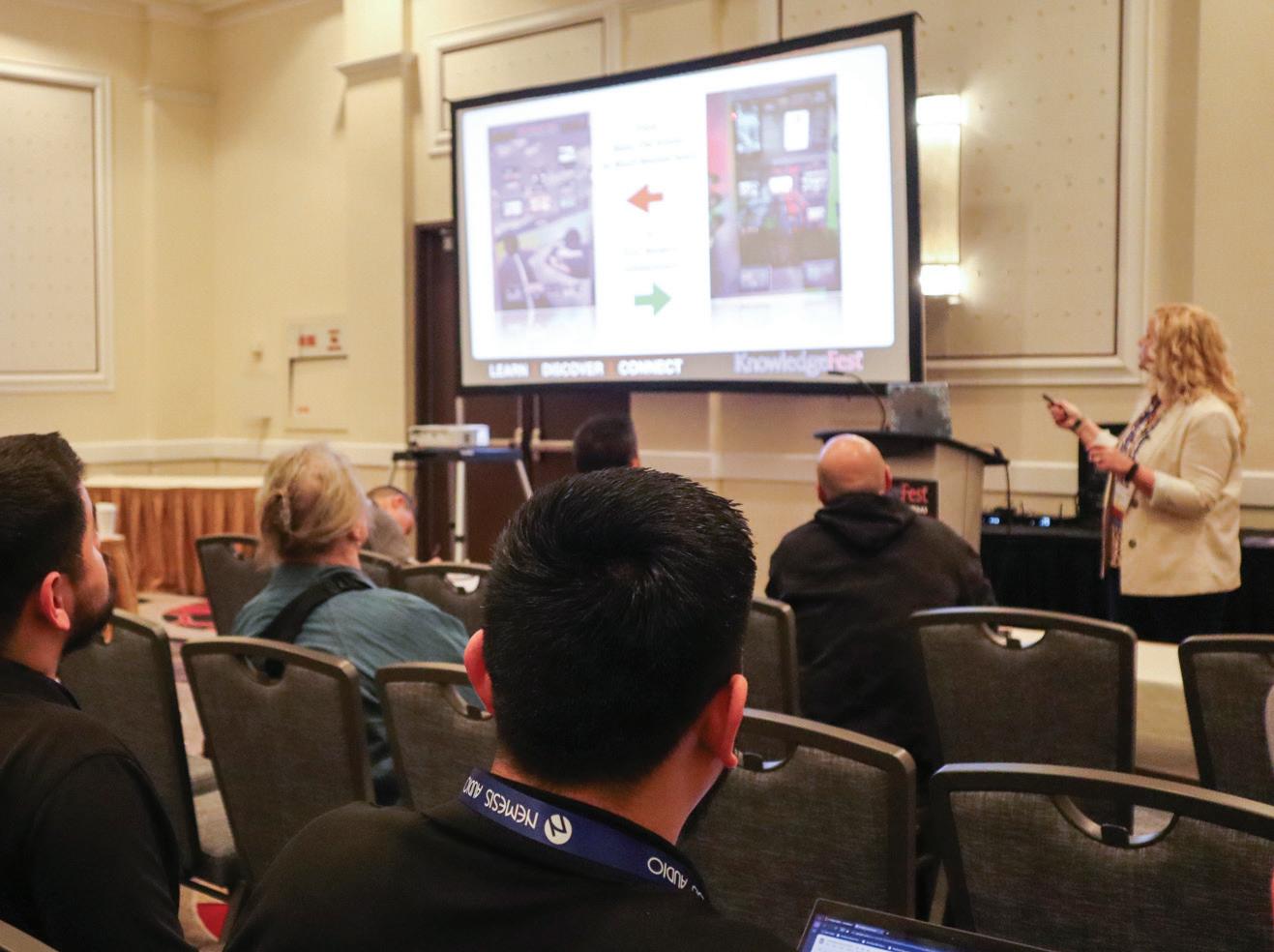
At KnowledgeFest Las Vegas, 2025 Retailer of the Year Traffic Jams Motorsports shared lessons learned in growing the business.
38// Strategy and Tactics: Profit-First Buying
How should a retailer decide what to stock? Kimberly Trainer shares the inventory strategy she employs at CarTunes, Inc.
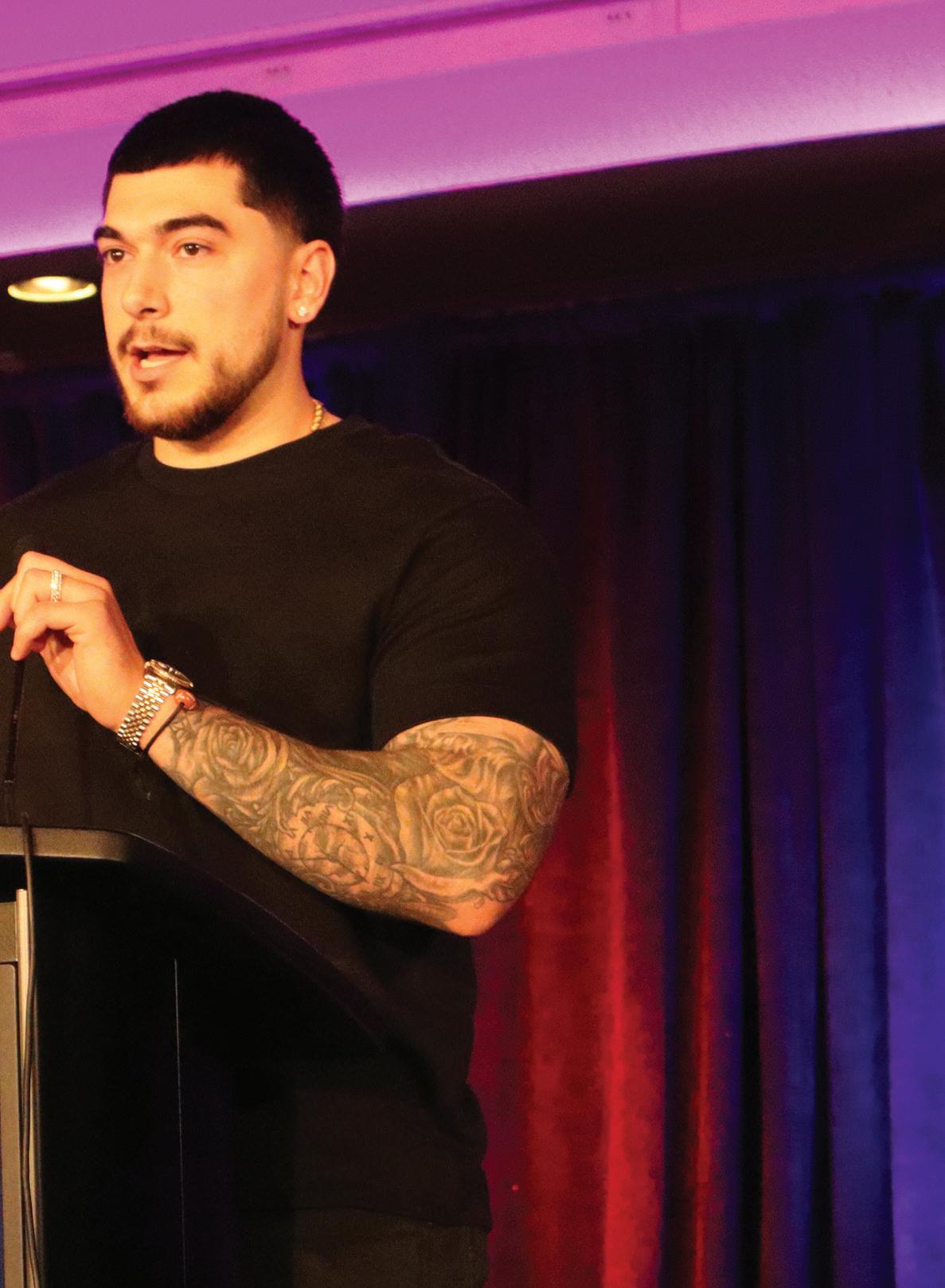
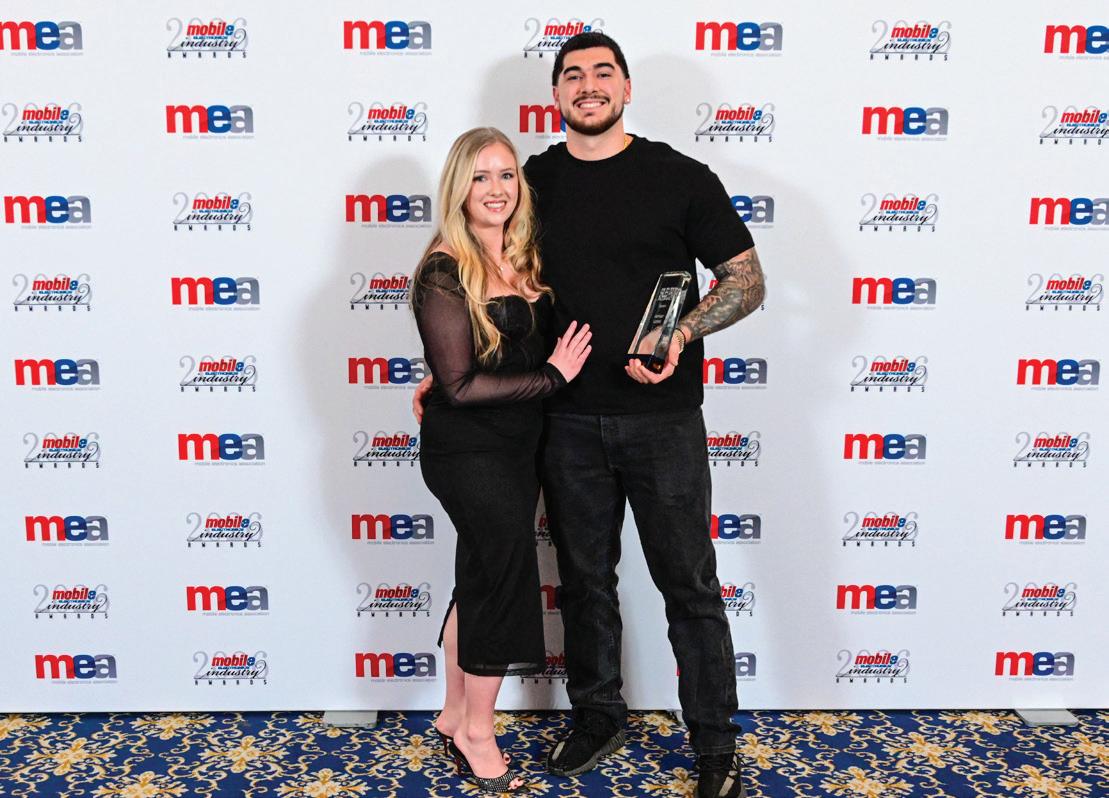
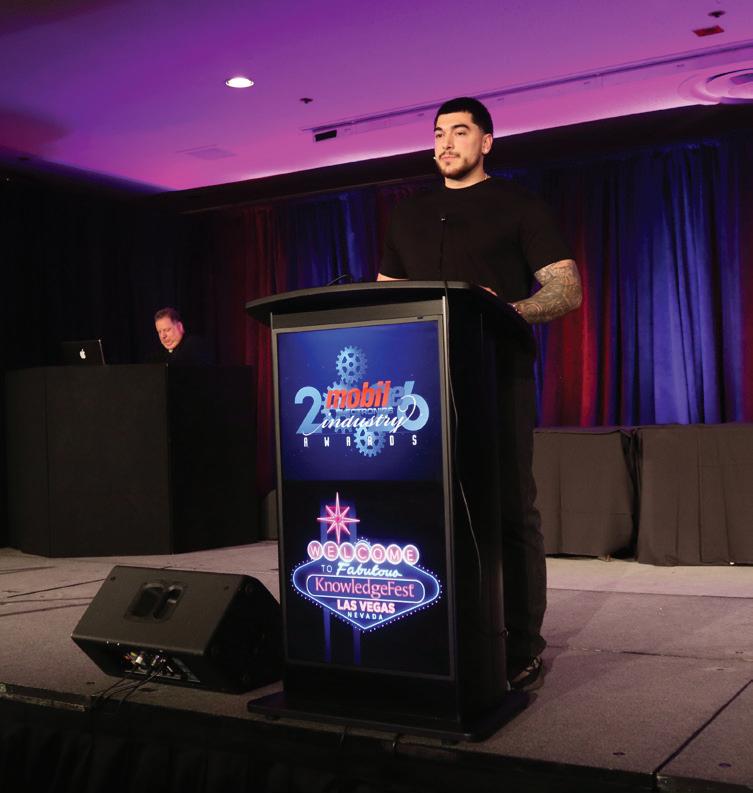
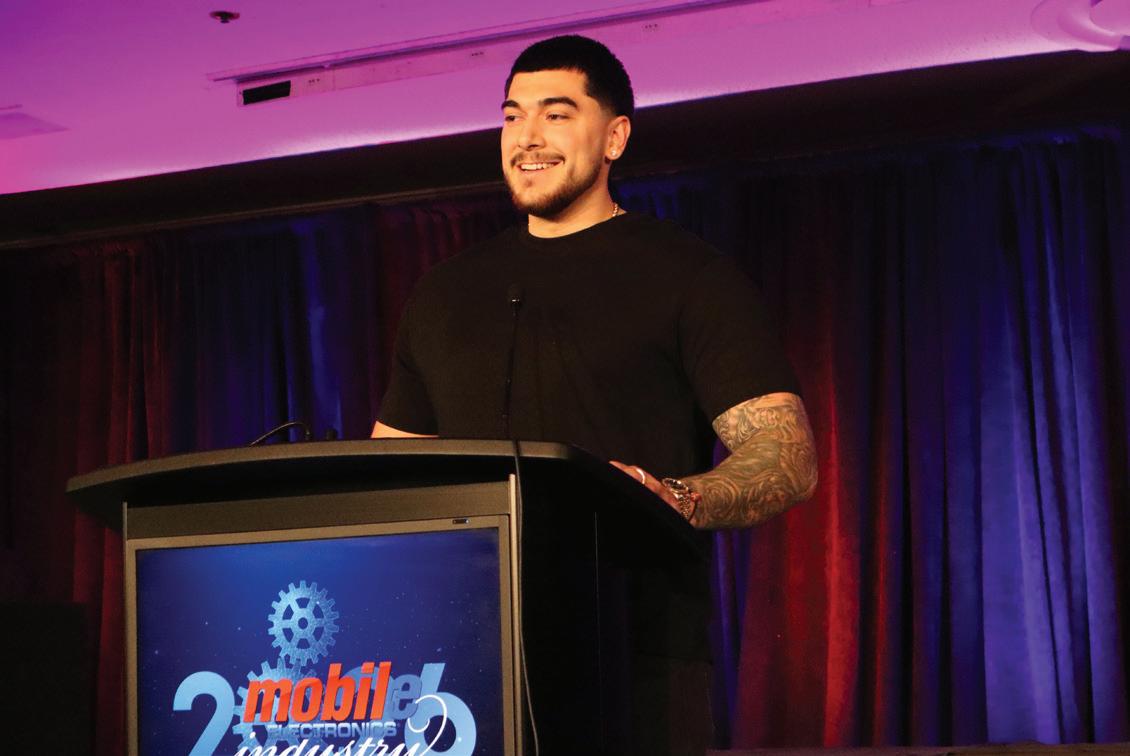
This year’s Sales Pro of the Year, Parker Lopez, stays prepared for every client interaction through continued training and education. Lopez, pictured here with his wife Kelsey, accepted his award at KnowledgeFest Las Vegas this past February.
EDITOR’SFORUMROSASOPHIA• EDITOR-IN-CHIEF
HOW ARE WE DOING?
Trust and consistency are essential to building relationships and ensuring good feedback from your customer base.
In this month’s Strategy and Tactics column, Kimberly Trainer of CarTunes, Inc. in Greenville, Miss. noted the importance of consistency. If a retailer isn’t consistent, she said, “You’ll just confuse your clients.” We’ve all experienced some form of inconsistency when dealing with a retail establishment, and I’m no exception. Recently, I lost the clutch slave cylinder in my 1993 Mazda B2200. I called to order the part and the salesperson who answered the phone promised it would be in-store the next morning. I had to limp there in my other car, which has an unreliable transmission, only to find the part had never actually been ordered. It’s a familiar scenario. Except, this time, I didn’t feel comfortable coming back again in the same car. While we’re talking about two different fields, automotive parts and mobile electronics retailers, a disappointed customer can be found just about anywhere. How might your business, or yourself as a salesperson or a technician, handle a similar situation?
EVERY MOMENT IS A TEACHING MOMENT
In this issue, the team at Buford, Ga.based Traffic Jams Motorsports shares what they’ve learned over the years, noting that it took a long time to cultivate positive store culture—something that’s required when it comes to building a lasting business. During a panel discussion at KnowledgeFest, owner Yamil Widy mentioned the importance of learning from bad reviews. He said, “If you get a bad review, it’s a teaching moment. You can look back at your business and say, ‘How did we fail this customer?’ Then you can retrain your staff in specific situations or change regulations in your shop.”
No matter what field we’re in, offering compassionate, consistent service should always be a priority. “ ”
It’s my feeling that mobile electronics retailers must work even harder to ensure a strong foundation, positive culture and a quality experience for customers. After all, as many in the industry will say, car audio isn’t a necessity. My local auto parts store will surely be around for many years to come. People will go there to buy batteries, motor oil and windshield wipers regardless of negative experiences. Perhaps it’s knowing the necessity of these automotive repair products that causes some companies to feel its okay to slide backward in terms of service. We, as an industry, have to rise above that. We have to be better.
IS YOUR STORE OFFERING CONSISTENT SERVICE?
When I told the salesperson at the auto parts store about my car troubles, he surprised me by offering to hand-deliver the new part after his shift ended. “Really?” I asked. “Are you sure?” He smiled and said, “It’s not something we ordinarily do, but consider it an attempt to make up for all the other times this has happened to you.”
If I’d intended to leave a bad review online, the salesperson kept it from happening by going above and beyond to assist me. He didn’t need to deliver the part, but he chose to help me. No matter what field we’re in, offering compassionate, consistent service should always be a priority. The salesperson’s simple act of kindness was a huge help to me, and in the end, the store kept my business. Mistakes happen. It’s how we handle those mistakes—and how we learn from them—that matters.
LESSON LEARNED
Industry Award winners Conrad Leduc, Parker Lopez and Jeremy “Taco” Patterson discuss the mistakes they’ve made and how the lesson changed their approach.
“My biggest mistake was matching attitude with a bad client. I’m an emotional person and when you only get one to two bad clients a year, you don’t end up with a lot of experience dealing with negative people. I can’t say I’ve been completely calm when someone is angr y, usually over something they don’t understand while we try to explain. Nowadays, things are different when it comes to a client who doesn’t want to listen to a professional opinion. If they simply don’t want to listen and let us be the professionals we are, we politely excuse ourselves from their job.”
- Conrad Leduc, Sudbury Car Audio, Sudbury, Ontario
“In the pas t, I made the mistake of giving a timeframe for a project. I learned not to promise a time because you never know what you might run into—especially while working on vehicles.”
- Parker Lopez, Car Stereo One, Toledo, Ohio
“I made the mistake of giving a customer an appointment date and not actually putting the appointment onto our schedule, resulting in a double-booking situation. I’ve battled ADD all my life, but I hate the way ADD medications make me feel. This results in mistakes of this nature happening occasionally. We usually have some fail-safes in place, but sometimes I just have to face the c ustomer and my team and own the mistake, and then do what I can do to make it right with everyone involved. That can be a delicate balance between my customer, and my team, who need to know they can trust me. From this, I have learned to try my very best to stay focused and, if anything, try to overcompensate by making multiple notes for myself of anything that I have to return to and follow up on.”
- Jeremy “Taco” Patterson, Speakerbox Autosound and Accessories, Huntsville, Ala.
2026 v/s 2025 by Month
The Mobile Electronics Association reports specialty retailer performance for the first quarter of 2026 as compared to 2025. Here are the findings.
First Quarter (Q1) 2026 v/s 2025
AVERAGE TRANSACTIONS PER STORE PER MONTH
204 in 2026 vs. 209 in 2025
AVERAGE DOLLARS PER STORE PER MONTH
$31,041 in 2026 vs. $31,079 in 2025
Key Observations
• The average dollar per transaction increased 5% from Q1 2026 vs. Q1 2025.
• The average dollars per store was flat from Q1 2026 vs. Q1 2025.
WHAT TO READ
Dude, Where’s My Flying Car?: A fascinating look at the past, present and incredible future of personal mobility
BY TIM JACKSON
Anyone out there remember The Jetsons, a cartoon series on ABC that launched back in 1962 and gave a humorous look at future technologies? Everyone on the show had a flying car, and now, more than 60 years later, the time may have actually arrived for that reality for us. Get ready for a fascinating look at the past, present and future of personal mobility as author Tim Jackson, a private pilot and aviation enthusiast as well as car aficionado, details what is next in this exciting space of transportation. His book challenges us to think critically, yet optimistically, about how we travel and to consider the impacts it will have on our lives, our communities and our planet. It’s a call to action for all of us to engage in conversations about the future of personal mobility and to work to create transportation systems that are safe, efficient and accessible for all. The journey toward flying cars is bound to be an exciting one, and Jackson outlines his guide to what is ahead.
Mindset: The New Psychology of Success
BY CAROL S. DWECK
In this book, Carol S. Dweck—a Stanford University psychologist—presents the power of mindset. While discussing the difference between a fixed mindset and a growth mindset, she also talks about “false growth mindset” and how to know the difference. Many industry professionals have spoken about growth mindset in recent years and what it means to them. But how can we harness this in our own lives, both personal and professional? Read this important book to learn more.
WHAT TO SEE
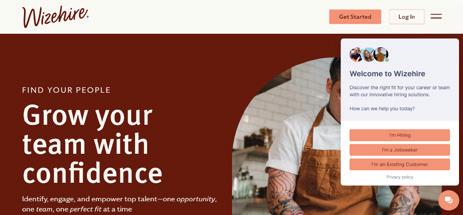
Wizehire
WWW.WIZEHIRE.COM
This hiring platform allows users to easily create and share a job posting to over 100 job boards. Wizehire helps to save time and simplify operations, using “research-driven screening methodologies,” according to the company’s website, to help business owners find the best fit for available opportunities. Visit the website to learn more.
WHAT TO
LISTEN
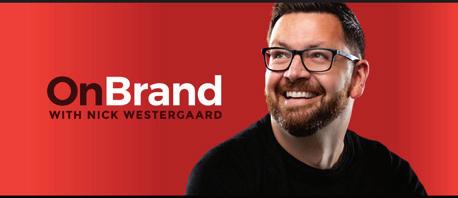
TO On Brand
WWW.NICKWESTERGAARD.COM/ON-BRAND-PODCAST
How do the big names do it? Adobe, Ben & Jerry’s, HBO, Maker’s Mark, the Minnesota Vikings, Salesforce and Whole Foods. The On Brand podcast helps organizations and individuals tell stronger stories and build better brands. Each week, host Nick Westergaard interviews marketing and communication thought leaders or those working for innovative brands. As a lecturer at the University of Iowa’s Tippie College of Business, he teaches how to craft standout presentations that drive action. He is the author of Brand Now and Get Scrappy.
RISING UP
At KnowledgeFest Las Vegas, 2025 Retailer of the Year Traffic Jams Motorsports shared lessons learned in growing the business.
WORDS BY ROSA SOPHIA
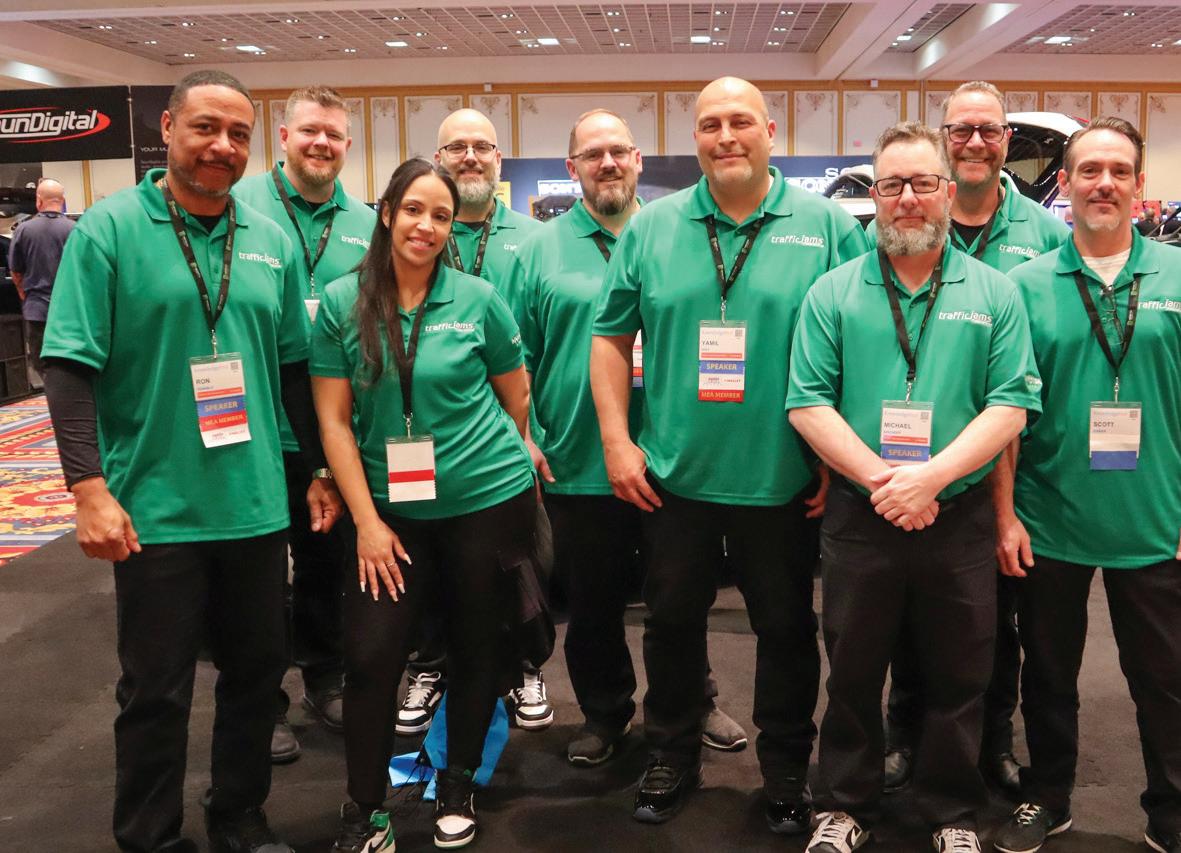
When it came time to open the show floor at KnowledgeFest Las Vegas this past February, Mobile Electronics Association President Chris Cook invited Yamil Widy of Buford, Ga.based Traffic Jams Motorsports to cut the ribbon. Widy and his team were invited to share their perspectives as a fast-growing business during a panel discussion at the show. In 2025, the store was named
Retailer of the Year, and Cook recalled Widy’s acceptance speech.
“You thanked some key people for lifting you up,” he said during the panel. “That’s what KnowledgeFest is all about—lifting others up. In 2018, your store went to Long Beach [for its first KnowledgeFest].” The conversation continued into what Cook referred to as improvement strategies “that Traffic Jams is doing every day. No one else will make
this happen for you. You have to make things happen for yourself.”
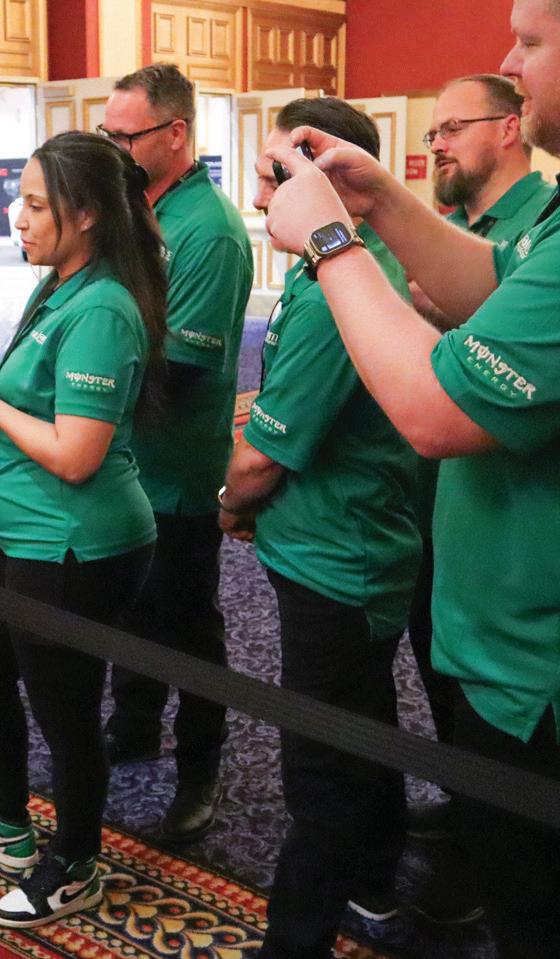
At multiple KnowledgeFest events, it’s hard to miss Widy and his team in their bright green uniform shirts. This alone, the team said, was a gamechanger to ensure everyone recognizes and remembers them. As owner, Widy has also learned to rely on his managers to help him make decisions. “These guys see the big picture. We all run this together. Without us, Traffic Jams
doesn’t work. Things have changed dramatically for us in the last three years, now that we have more people making decisions on our management team.”
Often, when people come in, they comment right away on how nice the place looks. Manager Ron Venable said, “We get that a lot. These things evolved. Each time we came to KnowledgeFest, we took something new back to the store. If you learn, you become better and better. Once you’ve engaged with the customer, they’re already happy.”
SETTING THE STAGE FOR A SALE
Traffic Jams Motorsports began in a 2,000-square-foot facility, Widy said.
Today, it’s grown to about 30,000 square feet. A store, Cook said, doesn’t need to be pretty but it should be functional. “The customer needs to know what you do before they even walk in the door. You’re setting the stage for the conversation,” he added, leading into a discussion about reviews and how important it is for a business to respond well to them—especially the bad ones.
“Some people don’t care about reviews,” Widy said. “If you get a bad review, it’s a teaching moment. You can look back at your business and say, ‘How did we fail this customer?’ Then you can retrain your staff in specific situations or change regulations in your shop. You also don’t want to have a hundred five-star
reviews because it looks fake. How you respond to reviews is very important.”
The Traffic Jams team responds to every review, he added. “You need to be communicating with those customers. Other customers are watching your responses, especially how you deal with bad reviews.”
The store has also begun recording video reviews in which a customer shares their experience and perspective. One review, shared during the discussion at KnowledgeFest, has been viewed over 15,000 times. “These are powerful,” Widy said.
As part of the customer experience at the shop, Traffic Jams continually rotates display cars in the showroom. “We just
finished a project we’d been working on for about a year, and that’s highlighted in our showroom right now.” Widy said this offers an opportunity for the customer to experience a demonstration and ask questions.
Another aspect of ensuring positive first impressions is cleanliness, which the team takes very seriously. When planning the facility’s remodel, Widy said he visited high-end dealerships for inspiration.
“Everything is so clean, nice and organized. I don’t believe in clutter. In the past, we had a crazy amount of displays and sometimes you’d lose your customer because they’re too busy playing with the displays. It was too easy for a sales guy to say, ‘Hey, that one has double-DIN radios,’ without even getting up. Now, we keep it as minimal as possible so we have more interaction with the customer.”
In 2018, at KnowledgeFest Long Beach, Widy said his “eyes were
CLASSROOM Q & A CLASSROOM Q & A
Attendee: You said you use about $40 worth of paint protection for each vehicle. Is that a cost that’s included somewhere on the invoice?
Widy: You should be charging shop supply. We use paint protection, seat covers—everything’s protected. Customers want to know their cars are being taken care of. If you ever had to repair a paint job, you know that $40 is nothing compared to what a paint job costs. These are little things. These are materials that you’re using to protect your customer’s investment, so you should be charging a good shop supply. We charge 10 percent on normal shop supplies. We also have premium supplies, and that’s a whole different thing. When Ben [Freeman] says, ‘I need a hundred dollars’ worth of magnets for this job,’ that’s not shop supply, that’s a premium supply that gets billed separately. But yes, make sure you’re billing on this. We’re fortunate enough that our 10 percent adds up to thousands of dollars each year, and that’s why we’re able to afford to buy all the stuff we need to protect these vehicles.
Attendee: Do you have a good relationship with other shops in your area?
Widy: One of our competitors, SK Customs, is here in the class right now. We play well with everyone, because at the end of the day, it’s a small community. Don’t make enemies with your competitors because that doesn’t help the industry at all. Learn how to work with each other.
Attendee: When it comes to disciplinary action, do you stay strict when it comes to following the rules?
Widy: Our employee handbook is always evolving. In the last last two weeks, myself
and Vanessa have had several revisions in a week. Things are going to change. We started small and we’re getting bigger, but stick to your guns. Do what your employee handbook says. Make sure that everyone is clear on any revisions. Don’t just change it and say nothing. During our hiring process, an employee has to sign paperwork saying they received and read the handbook. [Editor’s Note: MEA members in need of assistance can log in and review resources to download a handbook template to start with.]
Attendee: How do you compensate employees to attend these shows?
Widy: Every one of these guys is being paid to be here. This is a normal payday for them. The shop is incurring a huge cost to be here. The only thing they have to pay for is their flight. The company takes care of accommodations and meals. Right now, we have half our team here, and the other half back at home, running the business every day. You’ll see our team in different classes and trainings, and they have to present the material they learn to the rest of the team when we get back.
Attendee: When you bring in new products and new categories [like paint protection, wheels and tires, etc.] do you hire an expert [to work in that department]? How do you put your trust in someone? Did you take the time to learn all that yourself?
Widy: We’re always hiring. But when we add new categories, yes, we add an employee to each category. We have wheel and tire guys, 12-volt guys, vinyl wrap guys. We have an expert in every category we sell who train other guys in the shop. The expert can be a manager or a technician. We cross-train everyone.
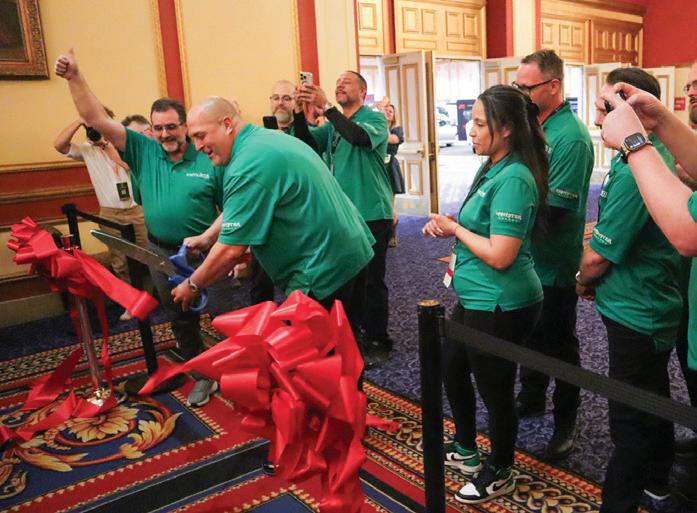
At KnowledgeFest Las Vegas this past February, Mobile Electronics Association President Chris Cook invited Yamil Widy of Buford, Ga.-based Traffic Jams Motorsports to cut the ribbon, welcoming attendees to the show floor.
opened” to the reality of things. “We weren’t as good as we thought we were. We attended classes and realized we were doing so many things wrong. We were losing revenue. We’ve always been blessed to have our bays full, but it felt like we were just spinning our wheels. We barely had enough to cover our monthly expenses. So, we decided to go out and see what we could learn instead of thinking we knew everything. It was a very humbling experience.”
Making changes can be overwhelming, and Widy warned that things don’t happen overnight.
BUILDING VALUE
Cross-training allows team members to assist where needed, and improves communication, he added. “We make sure every customer gets to meet the person who’s working on their vehicle. When you allow that connection, it takes it to a whole different level. You’ve got to train your tech to be able to sell, too, because that’s a key tool in your shop.”
He also shared details about the shop’s structure and the team’s daily habits, which help keep everything running smoothly. Venable said they now offer shop tours to every customer—something they didn’t do until about five or six years ago. “The biggest tool you have [for selling] is your team. You can’t build value without individual effort together.” Clients are “wowed” by the shop tour, he added. During a shop tour, staff are trained to greet the customer and introduce themselves, Widy said. “They don’t stop working, but they introduce themselves. I might go to David and say, ‘Hey, what’s going on in this car?’ And he’ll give a quick rundown, and the customer is happy to hear that. Nine times out of ten, when we’re finished the tour, they’re ready to leave their keys. And we have to say, ‘We have a schedule. We’re two or three or four weeks out.’ We make sure we get a deposit. If they’re willing to give you their keys, they’re willing to open their wallet right then and there. If you start
doing shop tours, you’ll close a majority of your sales.”
During the discussion on vendors, Cook asked, “How would you advise handling vendors to make it profitable for you as a retailer?”
“The most important vendor in your shop is you,” Widy said. “Vendors are
very important and we have to have that relationship. Vendors need us, and it has to be right [for the retailer].
Once you find that vendor, cultivate the relationship. Make sure your vendor is helping you grow your business.”
Most of all, he added, it’s okay to say no. “As a matter of fact, I recommend
for you to say no. If they come to you presenting a deal, ask yourself, ‘Why is it a deal? Is it worth it?’”
MAINTAINING STRUCTURE
When it comes to communicating with customers, salespeople need to be properly trained, Widy said. Cook
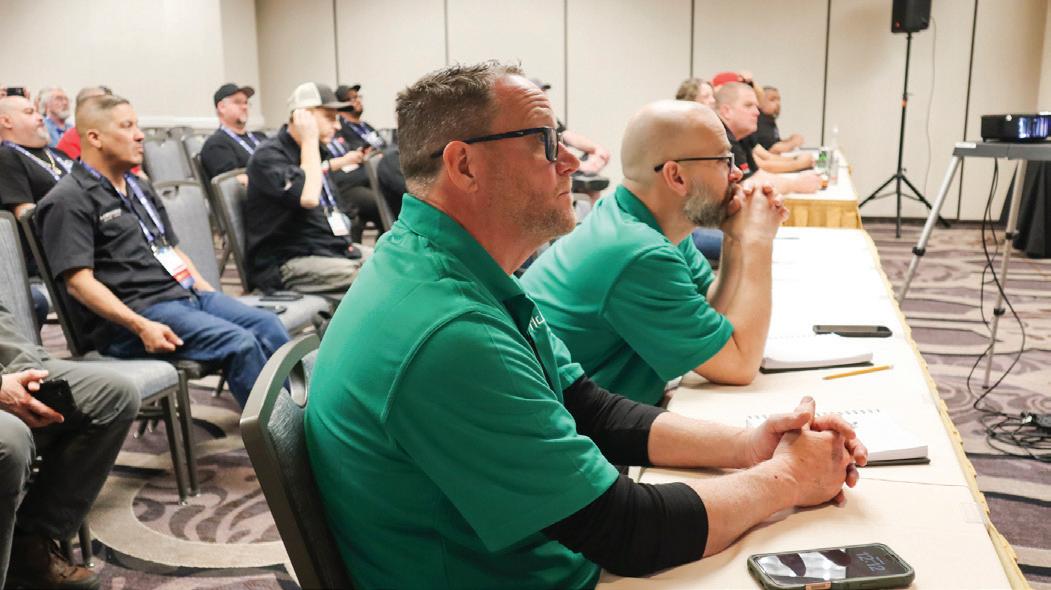
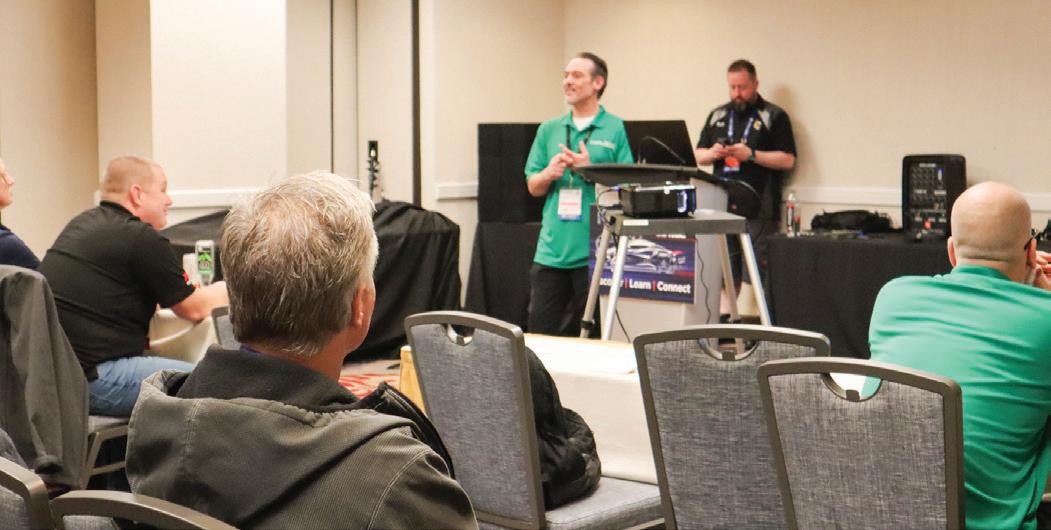
Without strong communication, profits disappear. The Traffic Jams team advocates for strengthening company culture before anything else.
”The most important vendor in your shop is you,” said Yamil Widy, adding that it’s okay to say no if a particular product doesn’t line up with the store’s goals.
noted that Dale Carnegie offers a standard course that teaches people to communicate more professionally. “It will change their life and career, and would be beneficial to you [as the retailer],” Cook said, adding that evening classes won’t interfere with the workday. “You can also get someone involved in Toastmasters, which is very inexpensive and helps people to open up and learn to feel comfortable.”
Traffic Jams believes in building community connections, both inside and outside the industry. “When we first came to KnowledgeFest, we were outsiders,” Widy recalled. “You need to build relationships. There are people out there who are willing to help, but if you don’t ask the questions, they can’t help you.”
This mindset also extends to looking beyond one’s own market for support and partnership, he added.
“Look outside your market. There are other avenues of revenue that you wouldn’t think about.”
A good structure is essential to any business’s daily operations, said Widy and his team. Staff arrive at 8:30 in the morning. At 8:45, everyone meets
in the front for the daily morning meeting. The meetings, they said, are crucial to communication.
“Don’t communicate, and you’ll see how quickly your profit will go out the window,” Widy said. “We go over our schedule for the day. Usually, we have between 40 and 50 cars on our premises that are being worked on. The meeting allows us to set the
expectations for everyone in the building, including sales and techs. Set the tone for the day.”
Traffic Jams never “burns the midnight oil. One of the things that will kill a shop is having these one, two or three o’clock in the morning work sessions,” he said, adding, “People will be tired, they won’t be able to focus and they won’t be 100 percent.”
KNOW THE BASICS
To strengthen communication and minimize issues, Sales Pro of the Year Parker Lopez said salespeople should understand the basics of installation and always ask for help when needed.
WORDS BY ROSA SOPHIA
Parker Lopez grew up around the industry, watching his father work. His dad, he said, has always been an employee of Toledo, Ohio-based Car Stereo One—the shop Parker owns today. From a young age, Lopez found himself drawn toward car audio, hanging out at the shop, learning about the install bay and the sales floor.
“I became a salesman here and then worked my way up to commission-based salesman, and then general manager,” he said. “I took ownership about three and a half years ago.”
This year, at KnowledgeFest Las Vegas, Lopez accepted the Sales Pro of the Year Award. His focus, he said, is to always stay informed so he can offer the best possible assistance to his clients.
“If I don’t know something, I do the research so I can help the client understand all the different things we do.”
Since taking ownership, he noted that he took on an important challenge: “I want to be able to install anything we do, whether it’s car audio, remote start, 12-volt accessories—but also
“
In sales, don’t set the expectation really high if you can’t achieve it. Instead, set the expectation where you know you can achieve it and then try to exceed that.”
wheels, tires, suspension, window tint and vehicle wraps.” He stressed that understanding the installation side of the business helps him to be a better salesperson. “Then, I’m knowledgeable on the product, but also on how it’s installed and what it takes. It helps me quote jobs better,” he explained, adding, “I can be the expert when the client comes in.”
SALESPEOPLE: LEARN THE INSTALLATION SIDE OF THE BUSINESS
During his early years, Lopez absorbed a lot. “When I was 12 or 13 years old, I would go up front and learn about products while my dad was working,” he said. “I got to the point where I was knowledgeable enough that when salespeople
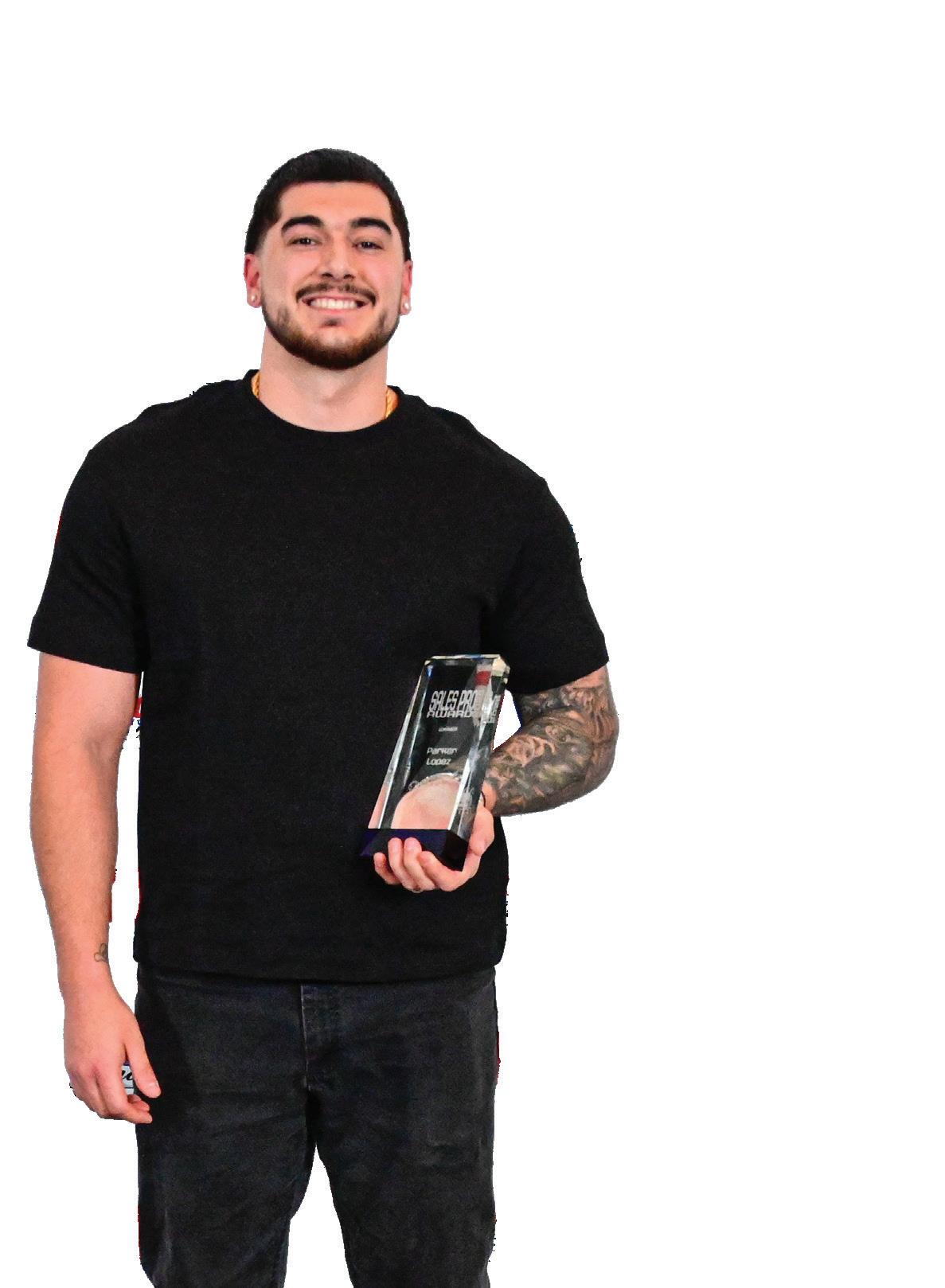
Parker Lopez, pictured here with his wife Kelsey, accepted his award for Sales Pro of the Year at KnowledgeFest Las Vegas this past February.
were busy, I was able to guide clients when they came into the store.”
After being hired as a salesman, he was able to move up rather quickly. Becoming the manager presented a new learning curve. “I was a good salesman, but I’d never managed people before.” He noted how important this position was for his professional growth. “As general manager, I had a lot of say in the company and day-to-day business. That was fortunate for me because I learned how to manage the store before I became the owner. By that point, some of the duties had become natural to me. A lot more comes into play when you’re the owner, handling things behind the scenes.”
Lopez still works nine to five as a salesperson while handling the ownership of the business. “I have a good,
solid team, so if I do need to step away, I can,” he said, noting that the business has 13 employees. The shop itself has been around for 47 years—a big name in the local area.
Lopez’s determination to know and understand each of the business’s numerous categories also helps him to better communicate with his team. All the technicians at Car Stereo One, he said, can talk to him about a project as if he were another installer.
“Then I might explain it to a salesperson, or I can explain it to a customer in terms they would understand.” He advised other salespeople in the industry to get familiar with the installation side of things. “If you don’t know the basics of the installation you’re selling, especially if it’s a newer product,
then quoting jobs and labor will be harder for you without having to get an installer or a technician off the job to help you with it.” Knowing the ins and outs of installation, he said, helps a sales professional tremendously.
A client won’t always be able to tell a salesperson what they want. “They might come in wanting better audio, but they’ll say they need a new head unit.” To that end, Lopez said, a sales professional should be able to communicate with the client to uncover what they’re actually looking for—what they really need.
NURTURE COMMUNICATION SKILLS
Looking back over his career, Lopez said the biggest mistake he made was over-promising and under-delivering. “For example, getting excited to close a big sale and promising something [I shouldn’t]. The more knowledge I have, the better [I’m able] to give the client a better expectation of time.”
He cautioned against setting too-soon timeframes. “Don’t set the expectation really high if you can’t achieve it. Instead, set the expectation where you know you can achieve it and then try to exceed it.”
Recently, Car Stereo One handled a big build for a repeat client—a very high-end suspension. The brand-new truck came directly from the dealership with zero miles on it, posing challenges because it was so new.
“I had to talk to the client over the phone to figure out what he wanted. He was out of town. Some of the [equipment] was newer product that we hadn’t used before. We had to make sure we had all the right parts,” Lopez explained. The challenge, he said, involved finding the right products by doing careful research.
“Reach out to people who can help you figure things out,” he advised, “especially the vendors you’re using. [They can help] make sure you’ll succeed and fulfill the client’s dream the first time, instead of having them come back and fix things later. Working with the vendor when it came to fitment helped us make sure that everything was perfect.”
Sales Pro of the Year
In any build, Lopez works very closely with his technicians. “I’ll go out to the vehicle with the client first and figure out their ideal picture of their dream system. Then, I give them some recommendations. Once we figure that out, we start to build a concept. When we talk with the installation technicians, we go over things we know the client wants.”
At Car Stereo One, a strong line of communication, and years of experience working together, means Lopez has a good idea of what the techs will want to do and the path they’ll take. Bringing a technician in on a sale, he said, can help increase a customer’s comfort level.
“The client seems better able to buy into what the salesman is saying because they have reassurance from the person who will be doing the installation.” It’s a good idea, he added, for salespeople to “use your technicians to help seal the deal.”
For a salesperson, understanding what goes on in the back—knowing the installation process—will help eliminate miscommunication, contribute to a positive store culture and minimize errors. When he’s training a new salesperson, Lopez said he’ll assign them to the back room with the technicians for a few days so they better understand what’s being done.
“It can help them. Sometimes there are clients who ask technical questions, and I feel like it helps the client feel comfortable when the salesperson is knowledgeable on the installation side,” he explained.
LISTEN CLOSE AND BUILD THE COMFORT LEVEL
A sales professional should be able to listen well and make a client feel comfortable, according to Lopez.
“These clients are spending a lot of money and they want to know they will get exactly what they’re looking for.”
He went on to advise other sales professionals to “make sure your customer feels comfortable about what they’re purchasing. Be knowledgeable about what they’re looking for—and if you aren’t, use your technicians to help you finish the sale.”
His goal for the next few years is to continue expanding the store, growing and scaling the business. “I also want to help in the industry as much as I can, giving back, maybe teaching classes,” he said, adding that he wants others in the industry to feel comfortable reaching out to him. “
As he moves forward in his career, Lopez endeavors to become the best version of himself he can possibly be. “I want to be better at what I do every day.” He’s always aiming to grow his knowledge so he can be of better service.
“In this industry, technology evolves so much that if you stop learning, you’ll be left behind.”
More sales. More installs. More revenue.
As a MEA member, you have access to the payment solutions through American First Finance (AFF) that will help you grow your business with bigger ticket sizes.
With our 50-state Listen Now, Pay Over Time solutions, your customers can get what they want.
$0 Merchant Discount Rate
Keep every dollar of every sale, no transaction fees cutting into your margin. This allows you to keep inventory stocked.
Reach Customers Others Can’t
AFF looks beyond traditional credit profiles, helping more customers move forward when other payment solutions may not fit their situation.
Built to Grow Your Average Ticket
AFF’s solution is purpose-built to help customers leave with the sound system, install package, and upgrades they want.
Onboarding & Training
Ongoing support from the AFF team, including on-demand and live session options.
Ready to put AFF to work in your shop?
Move your business to YesvilleTM and help more customers. All credit welcome.
Get Started Schedule a Call
WORDS BY ROSA SOPHIA
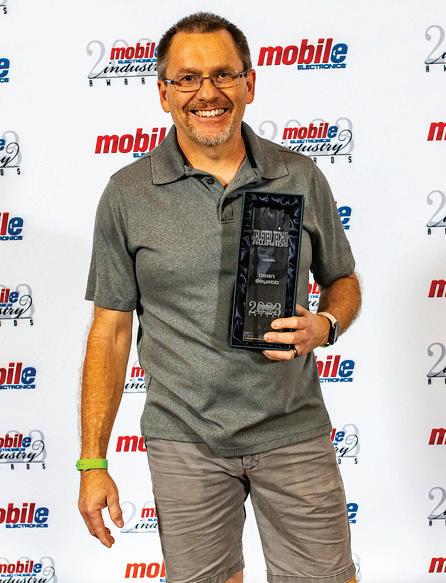
In 2023 at KnowledgeFest Las Vegas, Brian Mitchell was named Installer of the Year, while Dean Beyett won Trusted Tech. It was that year, Mitchell said, that he and Beyett began to consider sharing their thoughts with the industry on a podcast. Listeners can check out “Car Stereo Talk with Brian and Dean” at fivestarcarstereo.podbean.com.
Originally, Beyett started a podcast with coworker Fernando Lopez— this year’s Trusted Tech—but the two stopped recording episodes. However, previous episodes are still available.
At Clearwater, Fla.-based Five Star Car Stereo, Beyett said he’s noticing a trend: Plenty of clients are still coming in for basic speaker and radio installation, or an inexpensive subwoofer,
but he’s seeing less big-ticket items. “This is a time when your sales skills are really being put to the test. Your ability to show the value of what you’re doing is really taking hold right now,” he said. “People will spend the money, but they want to understand the value of what they’re getting. They’re looking harder at what you’re trying to do. Even a couple of years ago, it wasn’t as much
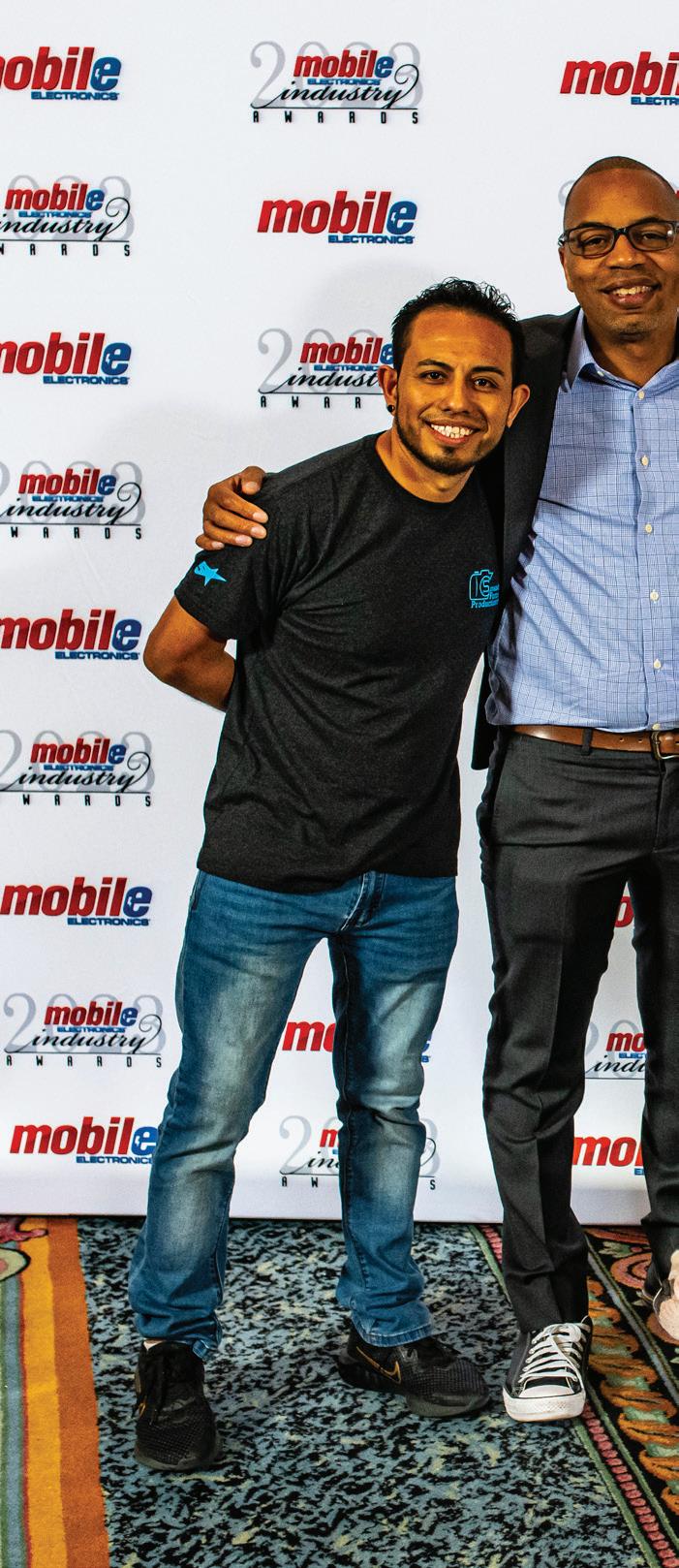
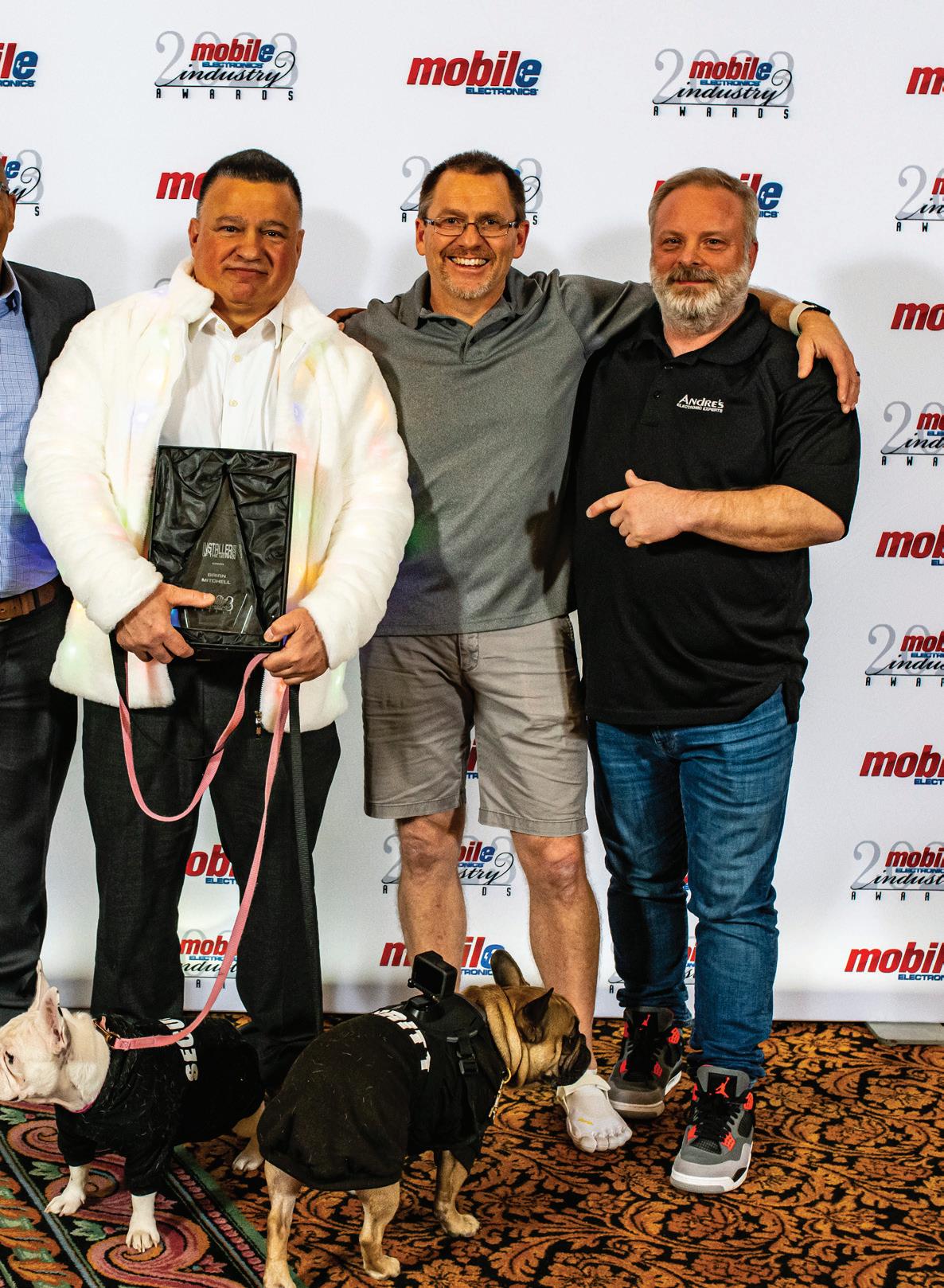
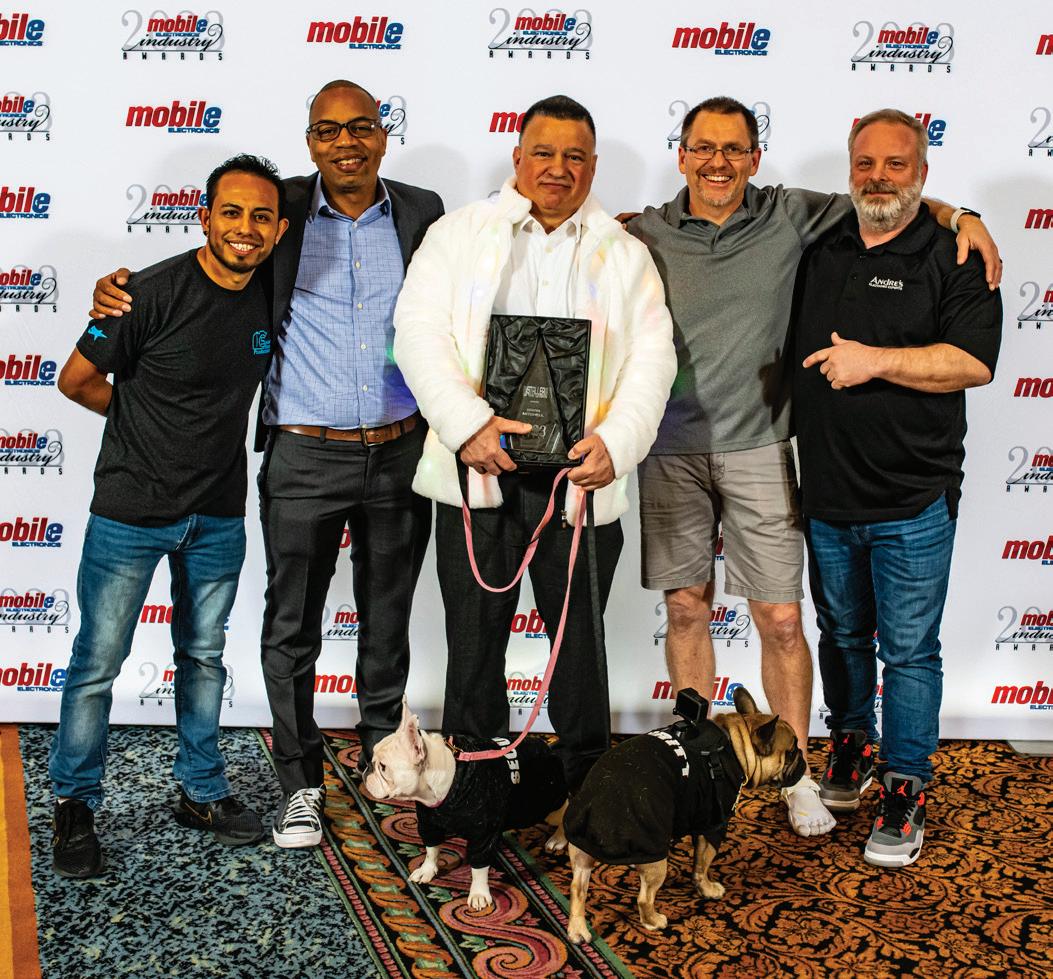
At the Industry Awards in 2023, Brian Mitchell was named Installer of the Year and Dean Beyett won Trusted Tech. From left to right: Fernando Lopez, 2026 Trusted Tech; Ata Ehdaivand of Rockville, Md.-based Absolute Electronix; Brian Mitchell; Dean Beyett; and Marty Adamschek, 2022 Installer of the Year.
“It
doesn’t
matter
where you’re
getting
training—whether
it’s
KnowledgeFest, MasterTech, or a local training where someone comes to your shop—continuing education is important because cars are changing so fast. You have to keep up with it all the time.”
- Brian Mitchell
like that. I’m noticing that people are being way more responsible with their money right now.”
The audience, Beyett said, is anyone in the industry who’s had the feeling, “Am I the only one?” Retailers, salespeople or techs might feel lonely in their experiences, wondering if anyone else has gone through something similar, he explained. “We wanted to share how we’re all thinking the same thing. It’s a different perspective on the same headaches. No topic is off the table.”
Some weeks, an episode might be positive—other weeks, negative. “Some
weeks, it’s like an episode of Seinfeld where we talk about nothing. Other times, it’s more specific and somewhat serious.”
Most importantly, Beyett said he and Mitchell want to show that “no matter where you are, where you’re at, or what you’re doing, you can listen and get something out of it. Episodes are about a half an hour long. We try to keep it light.”
Beyett envisions it this way: “I talk out of one side of the car, and Brian talks out of the other side. I’m in the driver’s side, he’s in the passenger side. We did that to be fun. We wanted it to feel like you’re sitting between us for the conversation.”
Together, the two friends hope to steer industry professionals in the right direction by sharing what they’ve learned. Of all the subjects available for discussion, Mitchell feels training is the most important.
“It has been for years, and still is,” he said. “It doesn’t matter where you’re getting training—whether it’s KnowledgeFest, MasterTech, or a local training where someone comes to your shop—continuing education is important because cars are changing so fast. You have to keep up with it all the time.”
“WHAT IS MOST IMPORTANT TO YOU?”
When it comes to closing the sale, retailers cite warranties, product features and essential questions to ask potential customers.
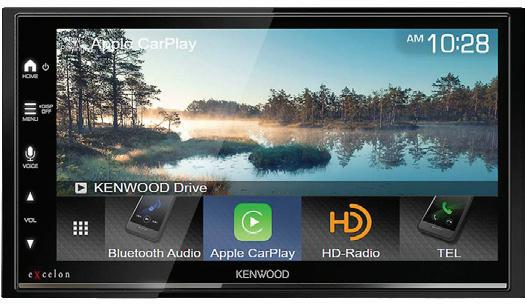
KENWOOD EXCELON DMX709S DIGITAL MULTIMEDIA RECEIVER
Submitted by: Jeff West, Benchmark Auto Sound & Security, Springfield, Ill.
Main Selling Features: “This product features Apple CarPlay / Android Auto and has excellent audio processing, and many system expansion options.”
Primary Objection: Price.
How to Overcome: “Having a two-year warranty versus one-year helps, and the audio processing is something that other competing units don’t have.”
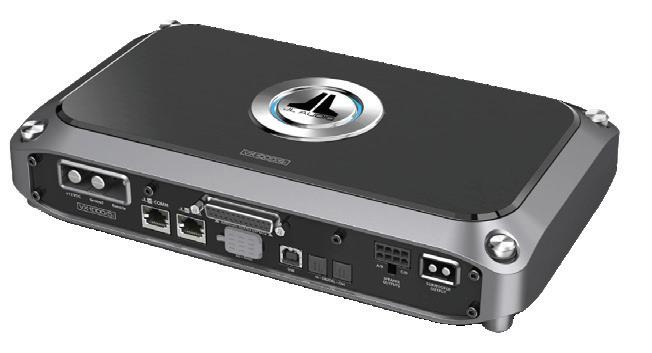
OTHER PRODUCTS RECOMMENDED BY SOUND INNOVATIONS
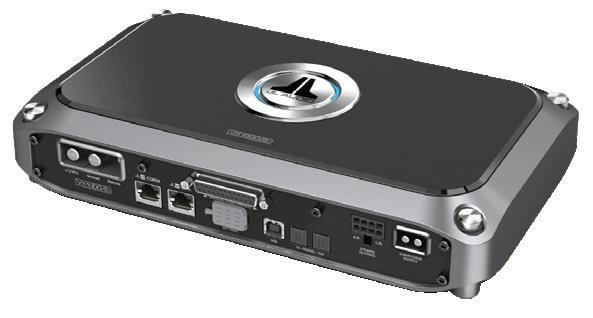
Scott Williams of Lawrence, KS-based Sound Innovations also praised JL Audio VX amplifiers, as well as the company’s C6. Helix DSPs and Focal FLAX were also among his top choices. He cited ease of use and quality of return on investment for all of these products.
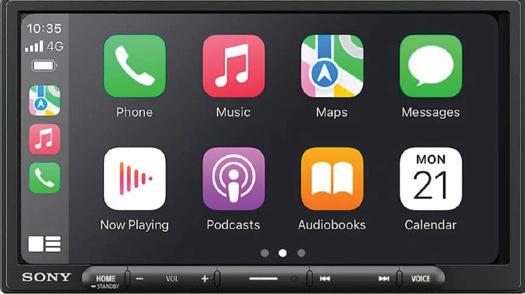
SONY XAV-AX4000 DIGITAL MULTIMEDIA RECEIVER
Submitted by: Scott Williams, Sound Innovations, Lawrence, KS
Main Selling Features: Ease of use.
Primary Objection: None.
How to Overcome: “When the customer chooses their compromise point, we are able to build a system that still makes sense and exceeds their goals. How good do you want it? How much do you want to spend? What is most important to you? [We explore all of this] while keeping the system design safe for future upgrades.”
Scott Williams of Lawrence, KS-based Sound Innovations also praised JL Audio VX amplifiers, as well as the company’s C6. Helix DSPs and Focal FLAX were also among his top choices. He cited ease of use and quality of return on investment for all of these products.
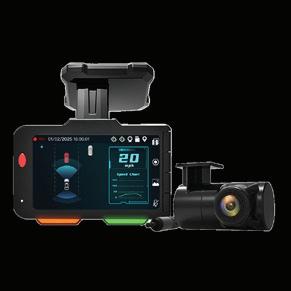
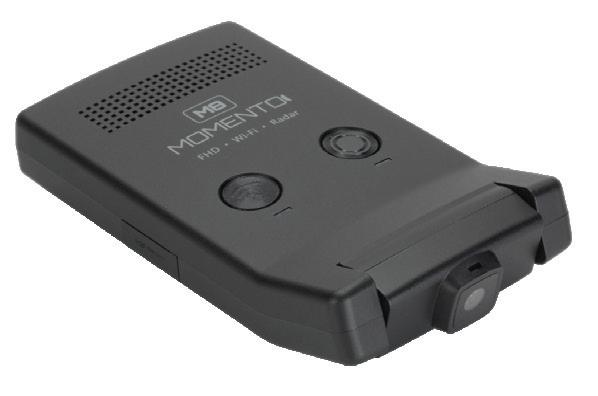
MOMENTO M8 WI-FI DASH CAMERA WITH RADAR MOTION DETECTION, GPS, VOICE CONTROL AND WIDEANGLE FULL HD RECORDING
Submitted by: James Halter, Stereo & Video Center, Tyler, Texas
Main Selling Features: Dependable and small footprint.
Primary Objection: Price.
How to Overcome: “We’ve had more radar and dash camera [installs] than in the past. With the Momento M8, we [talk about] tech support offered, plus easier warranty procedures if needed.”
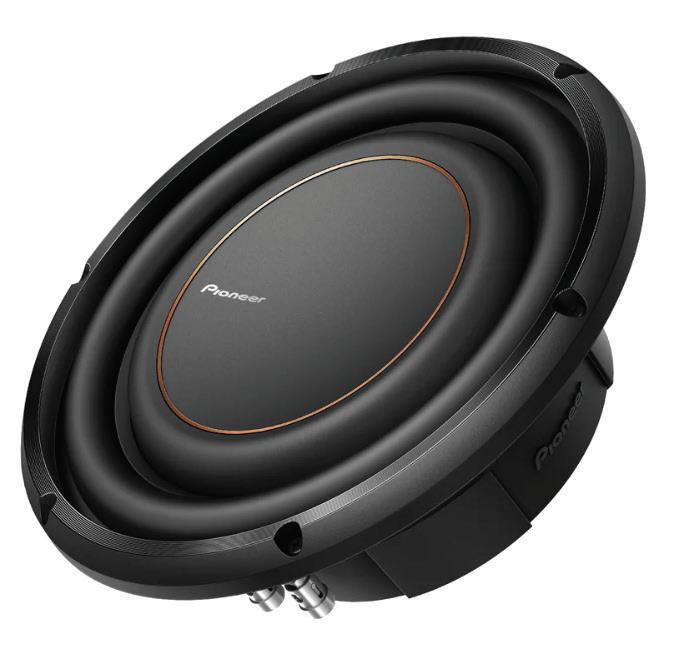
PIONEER D-SERIES SUBWOOFERS
Submitted by: David Bailey, Phase 4 Stereo, Idaho
Main Selling Features: “System upgrades, speakers and subwoofers are a big part of our business—replacing head units, not so much. These subwoofers offer the great sound and bass our customers are looking for.”
PROFIT-FIRST BUYING
How should a retailer decide what to stock? Kimberly Trainer shares the inventory strategy she employs at Car-Tunes, Inc.
WORDS BY ROSA SOPHIA
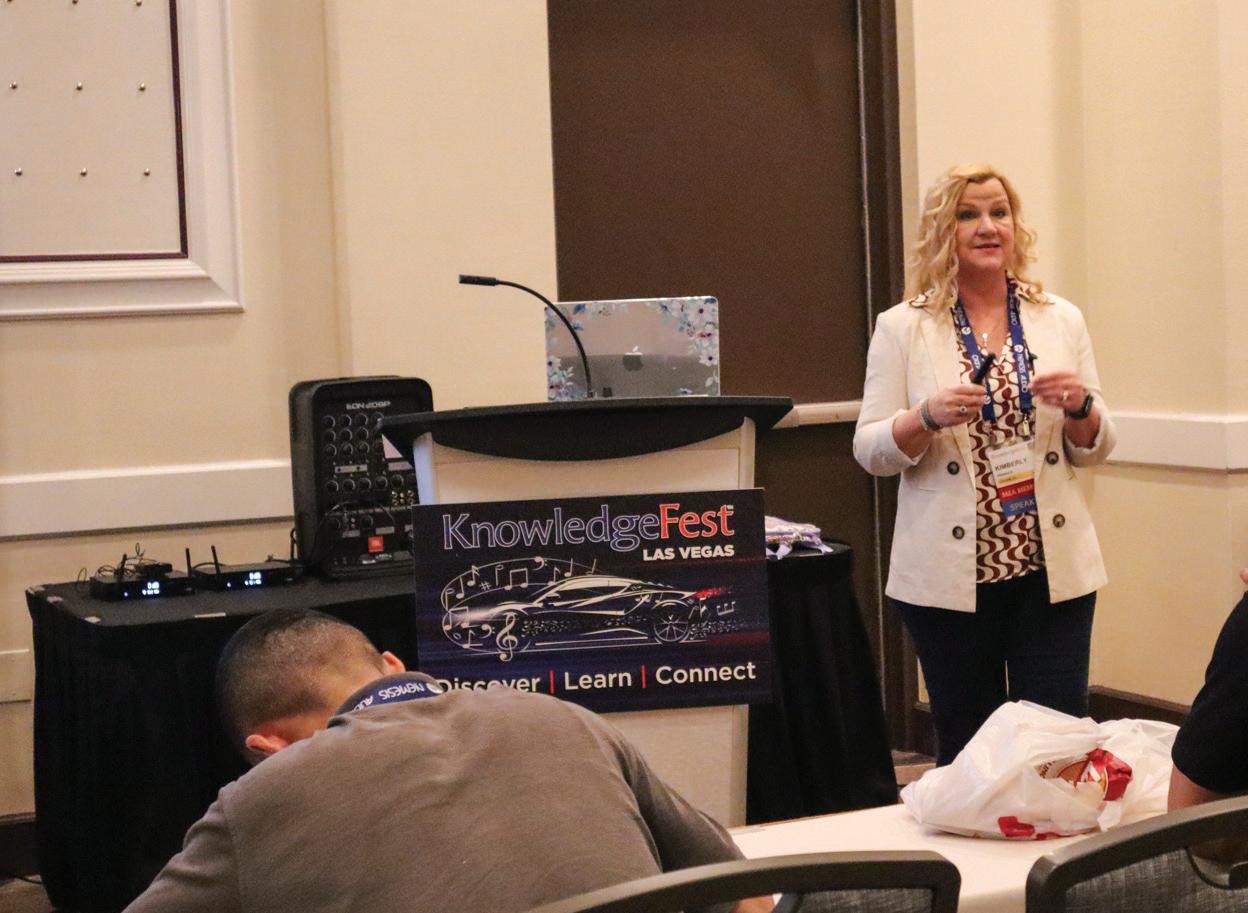
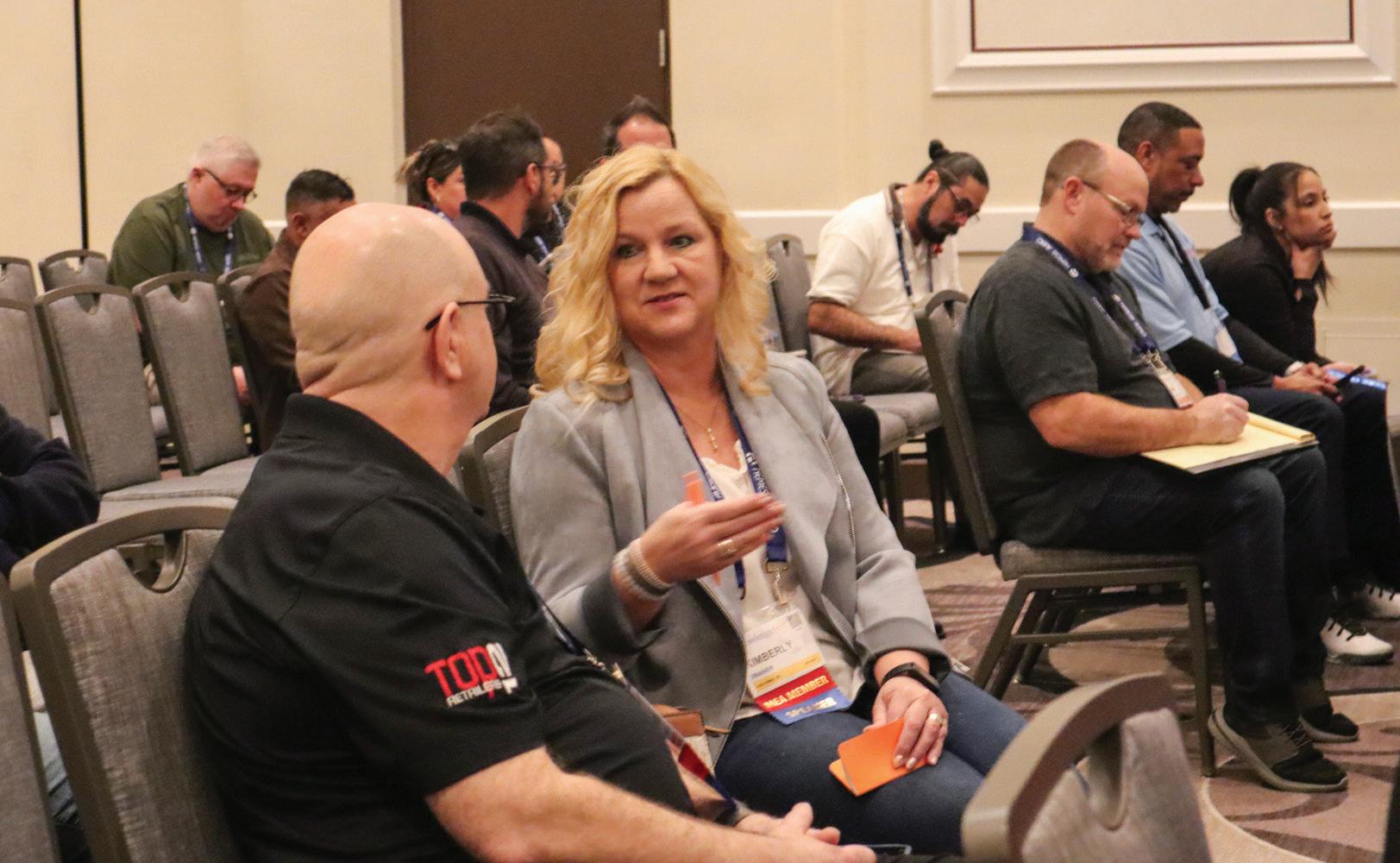
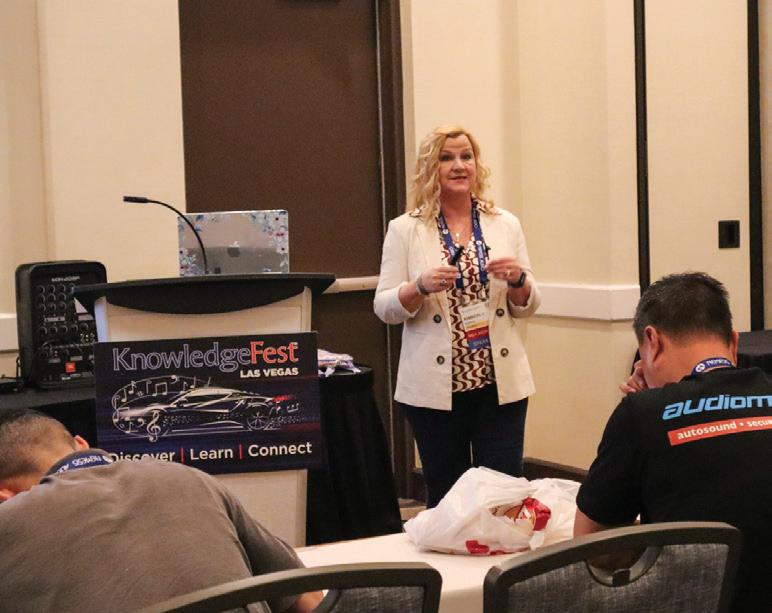
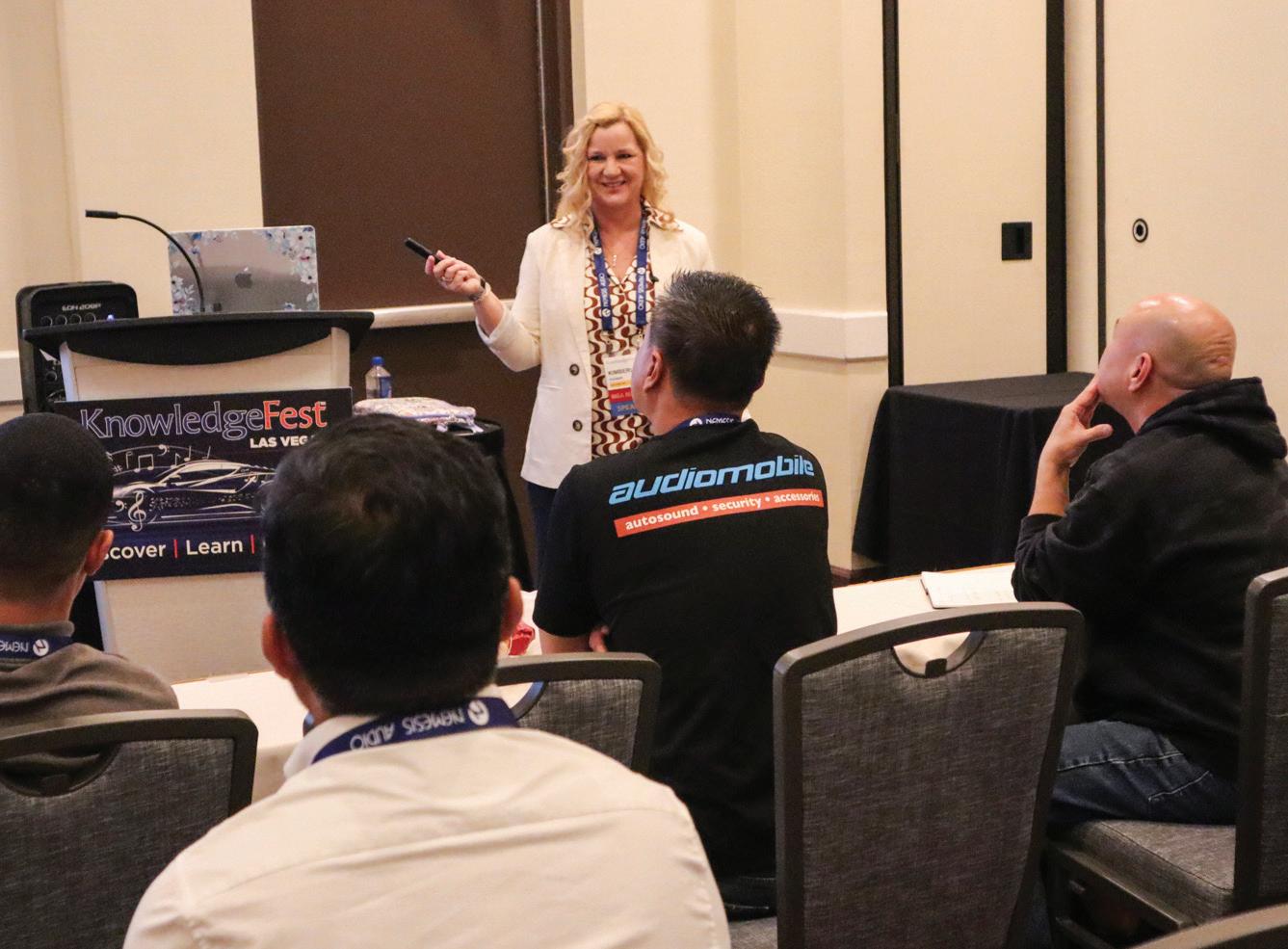
Through careful inventory planning, a business can reach its target audience and increase its profits, according to CarTunes, Inc. owner Kimberly Trainer, who taught a class on the subject at KnowledgeFest Las Vegas. “The separation between good and great businesses is the preparation that people are willing to put in to be the absolute best they can be,” she said. “The order in which you do things matters. You want clients to look
at you as the expert in your field.” This begins, she said, with planning. When it comes to inventory, Trainer stressed that everything should make sense and be related in some way. For example, Car-Tunes may not sell wheels and tires, but they do sell musical instruments. The shop made this choice after discovering that many of its clients were musicians. “I started making these connections, cultivating that client, and now
we have an entire instrument room. It’s the fastest-growing category we’ve ever added to our business.”
She warned retailers to be careful and intentional. Trying to do just about everything at once could mean a business is spreading itself too thin: “I think it’s important to simplify and get that inventory to a manageable level. The same thing goes with your product offerings. You have to really focus on what you’re
good at and promote that. If you jump in and out of categories, it’s going to diminish your claim as an expert. This week, you might tell customers, ‘This is the best thing,’ and next week, ‘We don’t do that anymore. There are too many problems with it.’ Maybe you really did have a problem with it, but you need to find a smooth transition, like replacing a product with a newer model.”
Be consistent, she said. If a retailer isn’t consistent, customers will say, “‘Whose side are you on?’ You’ll just confuse your clients.”
PLAN STORE INVENTORY FOR SUCCESSFUL SALES
Well-planned inventory leads to increased sales, Trainer noted. “It
starts with product knowledge. If you’re an owner, sales professional or an installer, you can’t do your job to its highest potential if you don’t know your products.” When it comes to understanding what inventory should be in the stock room, Trainer suggested learning from vendor reps or other respected industry professionals. “Ask other people how they go about it and you’ll get real answers.”
In the showroom at Car-Tunes, Inc., displays present “good, better and best” options, which she noted really
simplifies everything for both clients and staff. A store should also be actively seeking new products, otherwise, its current inventory will become outdated quickly. Trainer noted that it’s important to be discerning and not simply buy whatever a manufacturer’s rep wants to sell.
Reps, she said, are there to help. However, a rep isn’t just selling product to one store: “He wants to sell the product to everyone, right? But that product might not fit into what you have in your shop or the other brands you sell. Reps are the
good guys, but you can’t just buy whatever is a good deal.” That good deal, she added, might still be sitting in the stockroom five years later. Part of pre-planning inventory is making sure there’s space for it. “If I randomly buy a bunch of enclosures and I don’t have a plan on how I’ll sell them, that won’t work.”
MEET THE CLIENT WHERE THEY ARE
Technology becomes outdated quickly, and keeping these things in the showroom doesn’t create a good experience for the customer: “It’s not a good look and it’ll probably keep them from looking further.” Trainer also reminded the audience at KnowledgeFest not to buy what the customer is seeing on TikTok. She’s noticed a trend, she said, where customers will call the store asking about a product they’ve discovered online.
“One question we’ve had recently is, ‘Do you have a kill switch?’” Often, the customer is lacking information and doesn’t really know what they’re looking for, she added.
“The easiest way to overcome it, in the most profitable way, is to offer an alternative solution for a product that will actually solve their problem.”
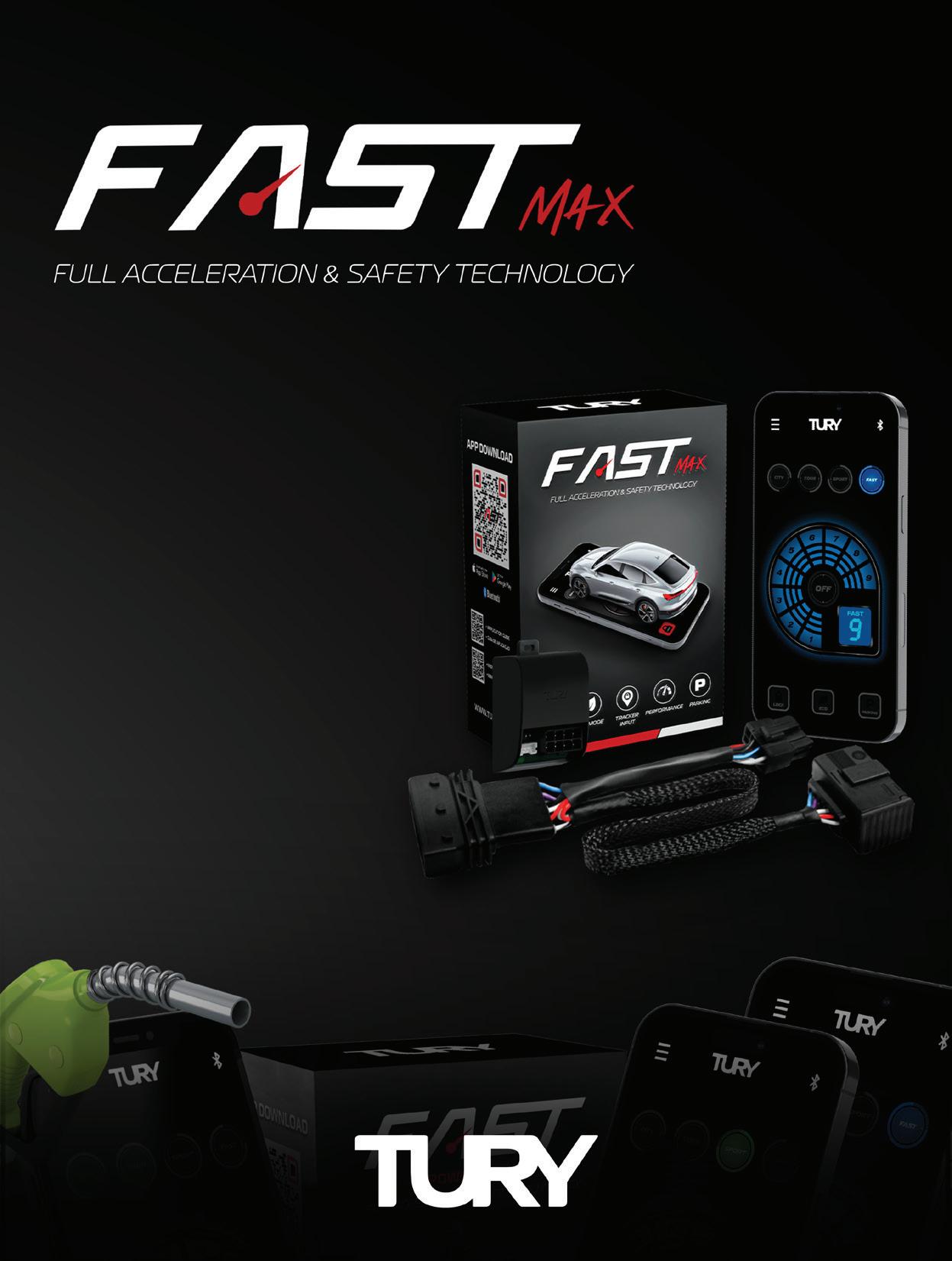
When it comes to a customer requesting a “kill switch,” Trainer recommends the TURY FAST MAX. “We wanted to find something that will be a valid solution. We tell them, ‘Yes, we do sell a kill switch, and you can control it through an app on your phone.’ As soon as you say that, they’re interested. Everyone wants a gadget on their phone.”
Next, she said, “We tell them there are other features in addition to that, like a feature that will help you save fuel in your car. A feature that will help beef up
your horsepower. And a feature that will keep a valet from hot-rodding your car. There’s extra value built into that ‘kill switch’ they wanted in the beginning.”
From there, other options can be added, such as a controller for inside the vehicle, or additional protection against theft. Trainer noted that while this sounds like sales strategy, “it’s truly all about inventory. Now, you know what to stock.”
At another point, people began coming into Car-Tunes saying, “I need a zero-gauge amp kit.” Trainer said she recognized they didn’t really know what it meant. “So, I thought, ‘How can we work this to our advantage?’ Whatever they’re asking for, find a product you have that will solve their problem. That’s part of choosing your inventory. You want to give them something that will make their lives easier—something that will solve
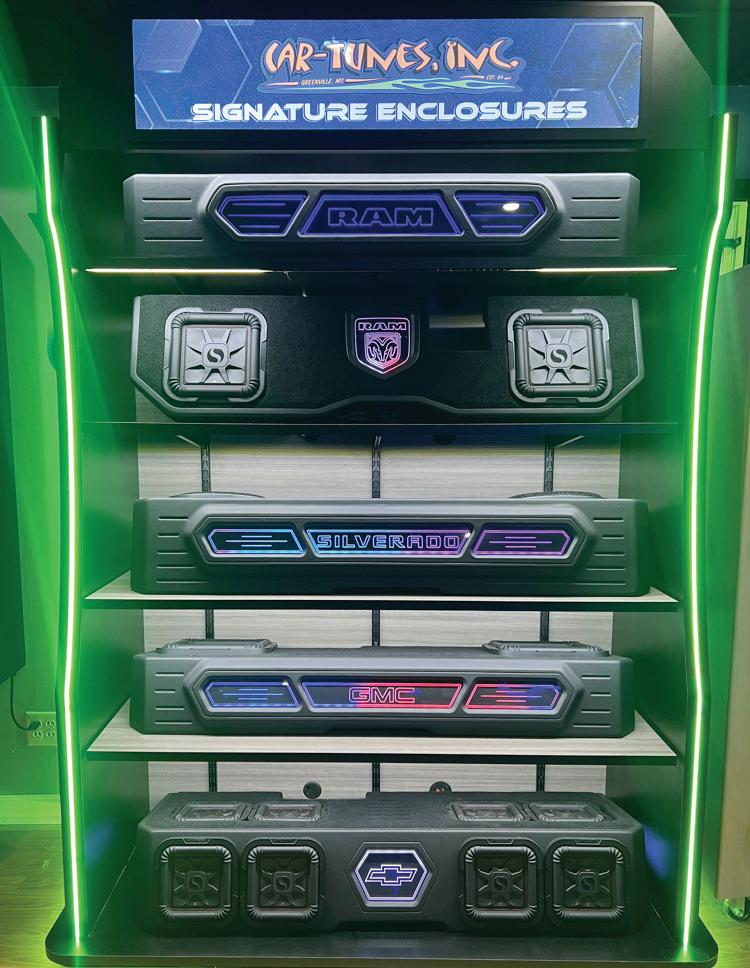
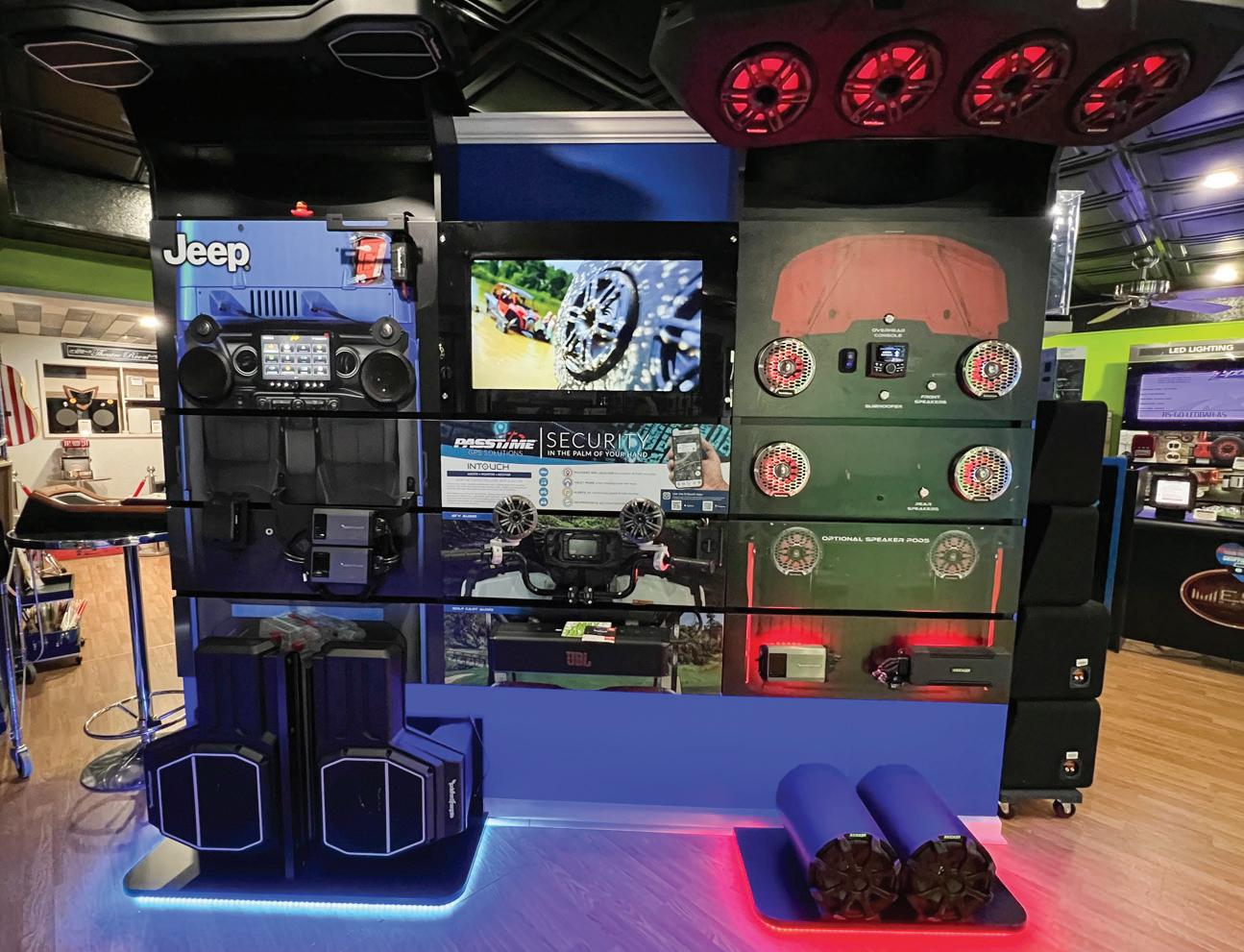
When it came to displaying inventory, Car-Tunes, Inc. consulted with 5 Axis Innovations, with a goal of saving time and making it easier for clients to come to a decision.
that problem that people on TikTok have told them about.”
In deciding what inventory to stock, she said a retailer should ask themselves, “Will this product be sellable? Because it doesn’t matter if you have really, really great inventory if you can’t sell it.”
UNDERSTAND THE NEEDS OF THE LOCAL MARKET
Due to being located in a warmer climate in Greenville, Miss., Trainer said the team at Car-Tunes had to find a different approach to selling remote starts. “The guys up north are killing it. A few years ago, I decided we had to figure out a different angle. What would appeal to our market? We went at it from a security and convenience standpoint. Now, we offer a remote start and security package. When you’re picking your inventory, consider, ‘What angle can I use?’ We all know manufacturers have cool technology, but how will we turn that into dollars?”
One way of getting a better understanding of the local market, she said, is to attend local events. “Look at how people are customizing their vehicles for ideas for your own customers. If you’re in an area where there are a lot of biker clubs, for example, go and check them out. See what kind of stuff they’re putting on their bikes. If they’re within your area, you should be selling those products. It depends on where you live when it comes to the kinds of vehicles you see in your shop.”
One of the fun aspects of working in the industry, Trainer added, is that “we often don’t know what’s coming through the door. We see different things all the time, and that’s something we really enjoy about what we do.”
Certain things, though, sell better than others. “These are important things to think about. If you’re marketing to your customer, it’s kind of like [that saying about] dressing for the job you
want. You want to offer the products for the client you want.”
FIRST, DO THE RESEARCH
When considering adding a new category or new inventory, Trainer said it’s important to do the proper research first.
At Car-Tunes, she and her son, Dalton, conducted research on wheels and tires to see if it might be a good idea to add the category to the business.
After learning how many local shops already handled this, as well as the cost involved, Trainer chose not to pursue it.
“I’m glad I did my homework,” she said, adding that a new product or category also requires the right people with the right skillsets to do the installation work.
“When we take on a new product, I like to let the employees install it in their own vehicles first. This will walk them through any problems they might encounter. Most of the time, I won’t
charge them for the product. If they go through this and love it in their own vehicle, we’ll be able to sell a lot of them.”
This, she noted, provides a good return on investment. “They’re telling every person who comes into the store how cool this thing is. If you’re not sure, you can practice on your employees’ vehicles in your shop before you dive into it with customers.”
Additionally, if a retailer is uncertain about a particular category, Trainer suggested speaking with their local reps about it, as they might be able to provide something to try out.
“They know the potential. Once we get in there and install it properly, we’re probably going to want to sell it,” she explained, adding, “Don’t invest without knowing the real cost involved in tools and training. And don’t compare yourself to another shop that sells a ton of something—because that’s a big pitfall in every industry, not just ours.”
Exclusive to MEA members, use Snap at no cost to you.
High approval amounts
Approval amounts range from $300 to $5,000 in lease-to-own financing, helping you increase your average order value.
Snap provides more consumers with an accessible financing solution.
Multiple ownership plans
Customers can use Snap's standard 12-18 month lease plan, or save on overall lease costs when they choose to complete their agreement early.3
WELL-DESIGNED DISPLAYS LESSEN CONFUSION AND INCREASE SALES
Recently, after a live install at an event, Trainer decided to acquire a manufacturer’s Jeep kits to sell at CarTunes, but when the product arrived, the box was as big as an entire table.
“I couldn’t even fit it in my stock room. This kit that sells for a little over $5,000 sat there for six months. I called up Jody Culbertson at 5 Axis Innovations and said, ‘I cannot sell this. What can I do?’” Culbertson, she said, was able to help by bringing a creative new display into the Car-Tunes showroom.
It’s essential to consider product placement when choosing inventory, Trainer said. “If you don’t have somewhere to display it, how do you plan to sell it?” Trainer has also taught on showroom design and organization at
KnowledgeFest, together with Culbertson, where she talks about strategizing displays to ensure clients are engaged and aware of all the categories a store offers. “Position things in the good, better and best category, so you can save time with your client and avoid overwhelming your staff.”
At some point, the old-style sound room became “too much going on at once,” she added. “You don’t want your customer to be more confused than when they got there. When we shifted to a slimmer, more effective process, we spent less time with the customer and it was very easy for them to know the good, better or best products.”
However, she said, salespeople at Car-Tunes always start by showing the best products first. “This one has all the features. If you want to spend
less money, you lose those features. We started talking about taking things away, and then our sales process began moving along quicker. Customers were very happy because they felt confident that they’d picked the right thing to solve their problem.”
To help with showroom design and product placement, Trainer suggested taking notes or creating a drawing. No matter how it’s handled, “if you have a chart for your displays that shows what products go in them, and what inventory you’ve purchased to put there, then everyone on the sales team knows. It makes everything very organized, planned and easy to execute.”
Don’t just put product in a glass case and expect to sell it: “If you do that, someone can just go online and see the same thing. You have to excite them. If you don’t, you’re going to lose them.”
READY TO RIDE
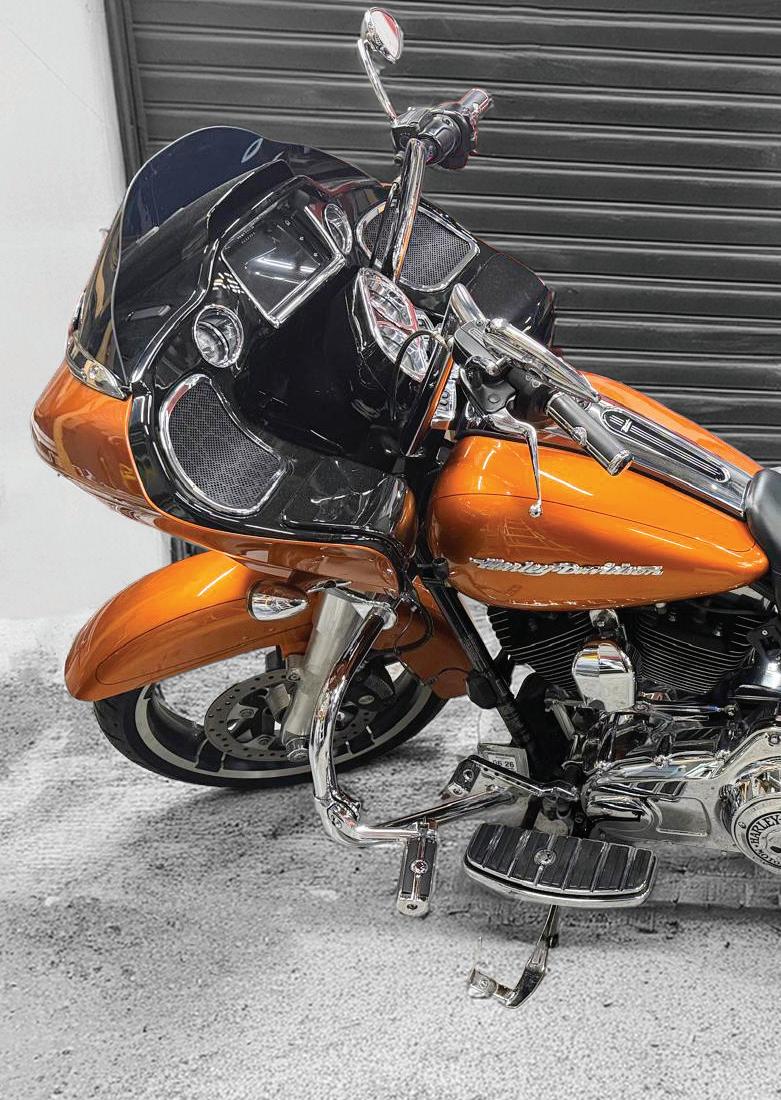
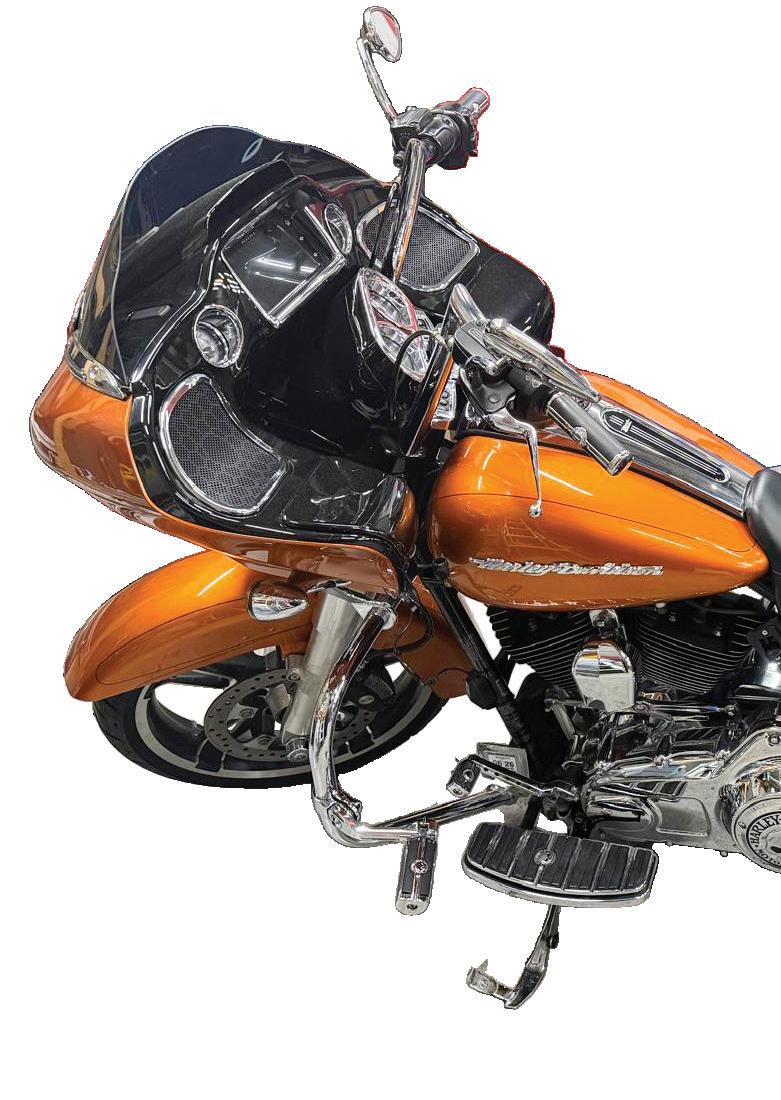
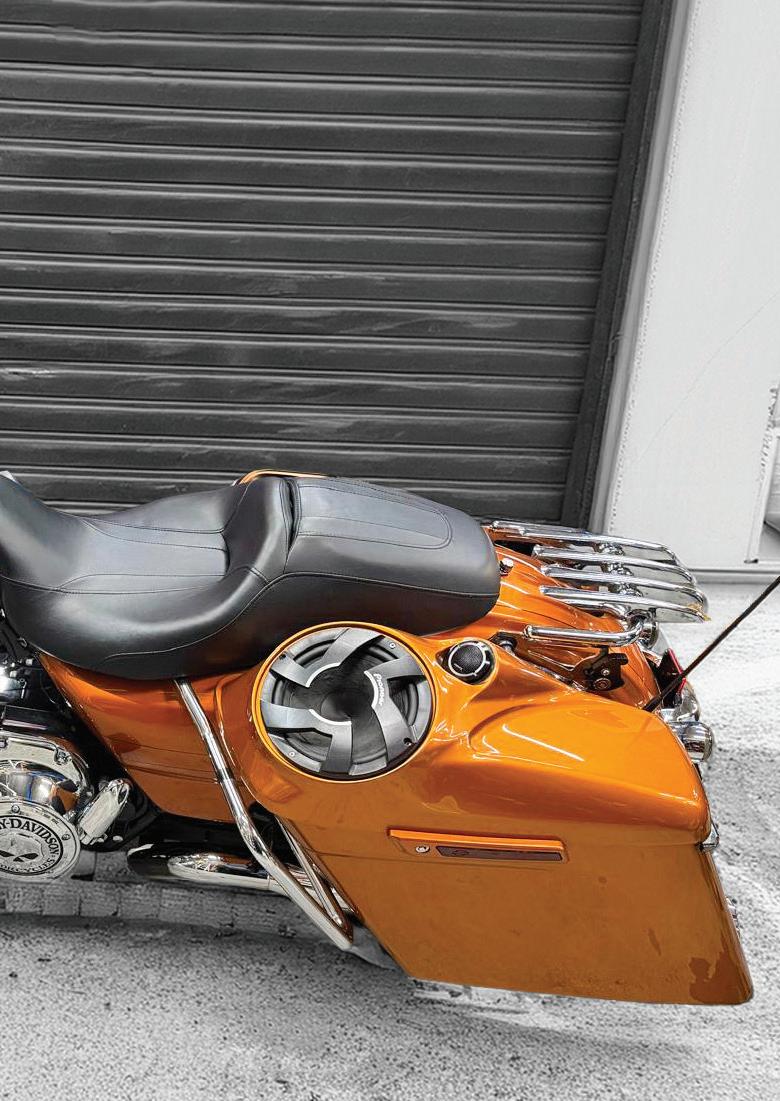
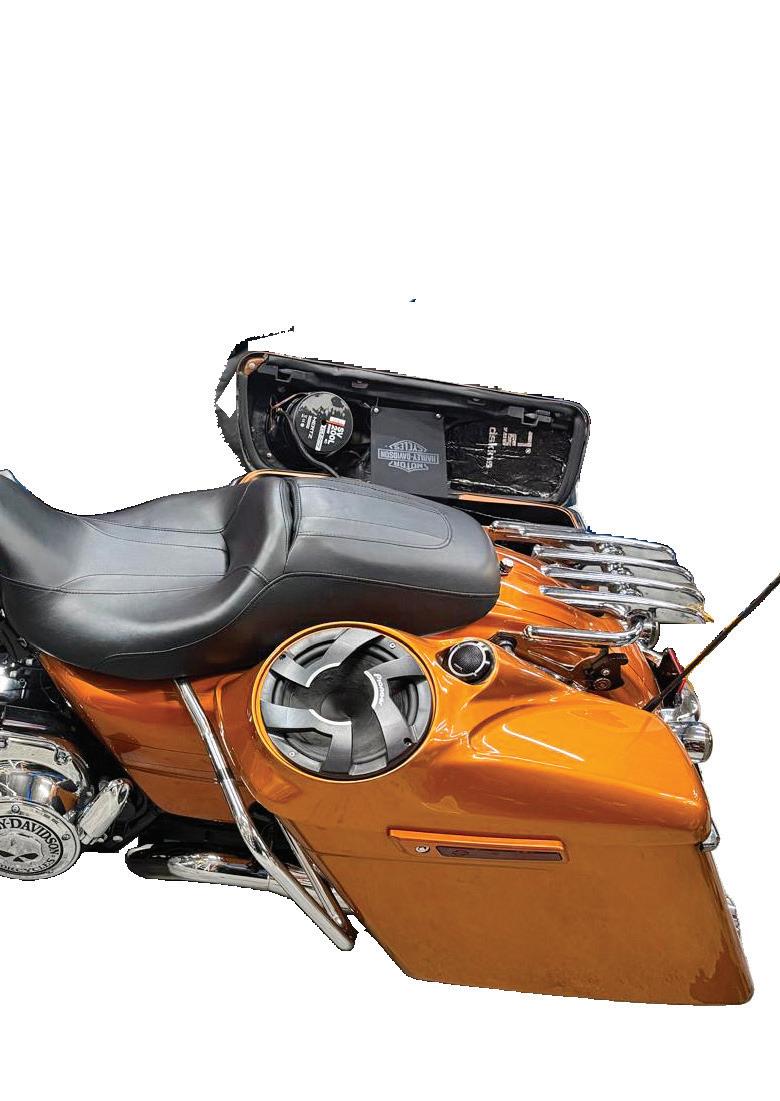
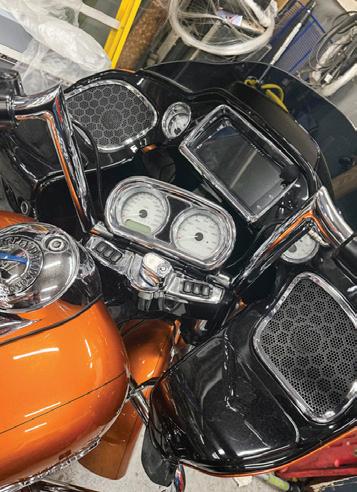
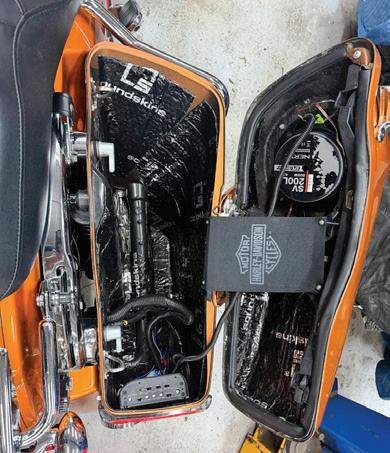
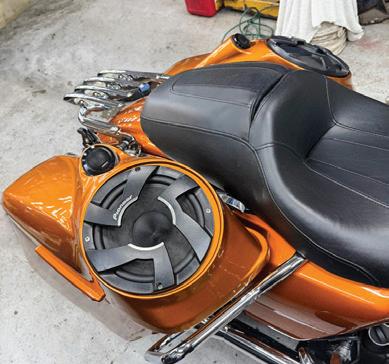
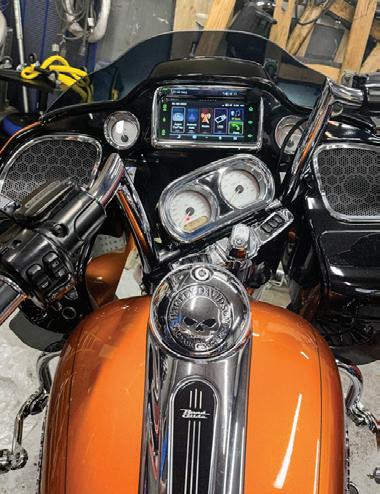
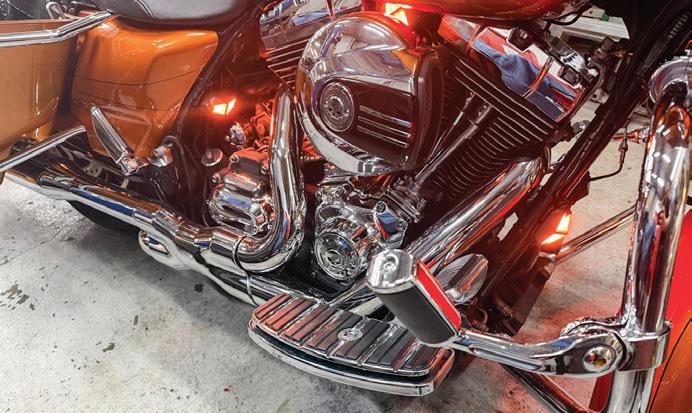
Sound Design’s demo motorcycle is designed to show clients what they can anticipate from the Hertz line of audio products.
SUBMITTED BY: RICHARD PAPPAS, SOUND DESIGN, NEW YORK, NY
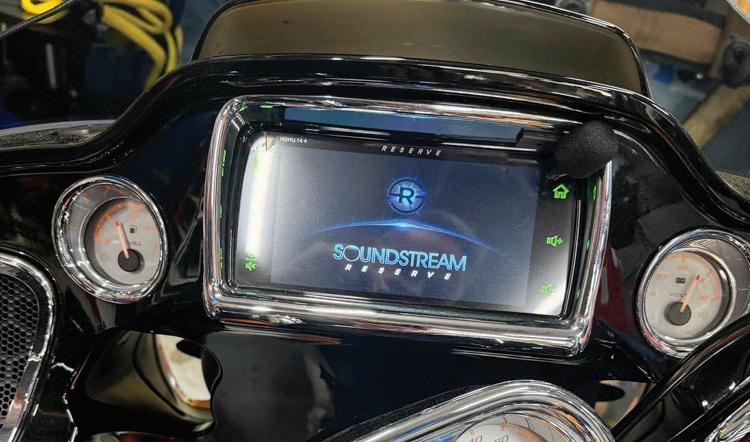
This 2015 Harley-Davidson motorcycle serves as a demo vehicle at Sound Design in the Bronx in New York City. Shop owner Richard Pappas aims to use the bike to show off the Hertz product line. Pappas said the build includes a Hertz SP 4.900 SPL Show Series 4-channel amplifier, 160 watts RMS x 4; Hertz ST 25A NEO SPL Show Series aluminum dome bullet tweeters; Hertz SV 200L 8-inch subwoofers in the rear saddle bags; and Hertz SPL Show SX 165 NEO SPL Show Series 6-1/2inch weather-resistant speakers. Finally, the motorcycle sports a brand-new Soundstream Reserve HDHU14+ Direct Fit radio. “The bike also has Soundskins sound dampening throughout the saddle bags and fairings,” Pappas said, adding, “Along with a Limitless Lithium HDV3 Harley-Davidson battery.”
FROM THE PRESIDENT THE TOP 10
“ The ones who are winning aren’t necessarily the biggest or the busiest. They’re the ones who are more intentional about how they operate. They’re not guessing. They’re improving.
Here are some of the reasons why retailers are heading to KnowledgeFest Atlantic City June 5-6.
KnowledgeFest has built its reputation as the place where the mobile electronics industry comes together to discover new products, sharpen technical skills, improve business operations and reconnect with people who understand the 12-volt specialist channel. This June 5-6 at Harrah’s Resort in Atlantic City, the event delivers a focused format designed to maximize value while minimizing time away from the store.
Atlantic City has become a preferred destination for retailers across the Northeast and Mid-Atlantic because it offers something important in today’s business climate: efficiency. Dealers can learn, buy, network and recharge in two focused days.
Here are the top 10 reasons to make plans now.
1. Distributor Technology Pavilions
One of the biggest additions this year is the introduction of distributor-driven Technology Pavilions featuring GoFast Solutions and DAS Companies. These dedicated areas bring dozens of leading brands into centralized buying and demonstration environments, making it easier to discover new products and solutions.
2. Exclusive Show Specials
KnowledgeFest Atlantic City is about education and profitability.
Retailers attending will have access to showonly opportunities from participating distributors and manufacturers. MEA is also supporting retailer purchasing with a 5 percent cashback incentive on qualifying show orders placed during the event, up to $1,000 per member.
3. A Focused Two-Day Format
Time away from the store matters. The Atlantic City event was designed to maximize impact without requiring retailers to spend an entire week traveling.
Attendees can arrive, learn, buy, and network in a concentrated two-day experience built around return on investment.
4. Education Built for Real-World Results
KnowledgeFest education stands apart because it focuses on practical application, not theory. Sessions cover sales improvement, fabrication techniques, profitability, inventory management, DSP tuning, leadership development and customer communication strategies. The goal is simple: give attendees ideas they can apply in their businesses immediately.
5. Networking That Matters
KnowledgeFest remains one of the best places in the industry to build meaningful relationships. Owners, managers, installers, manufacturers and distributors come together in an environment built for conversation and collaboration. Many retailers leave with new partnerships, fresh ideas, and connections that carry well past the event.
6. Discover New Products Before Your Competitors
Retailers attending will get hands-on access to the latest products, technologies, and integration solutions shaping the industry. Live demonstrations and direct manufacturer access provide context that cannot be replicated online.
7. Easy Access for Northeast Retailers
Atlantic City is one of the most accessible destinations for retailers throughout the Northeast and Mid-Atlantic. Thousands of specialty retailers are within driving distance, which reduces travel costs and makes it easier for businesses to bring multiple team members.
8. Built-In Networking Events
KnowledgeFest Atlantic City includes dedicated time for attendees to connect outside classrooms and exhibit areas. Events like the Beer and Business networking gathering and dealer appreciation party create authentic conversations and stronger industry relationships.
9. Learn From Successful Operators
Consumer expectations, vehicle technology, and economic conditions are changing every year. KnowledgeFest gives retailers the opportunity to hear directly from successful operators about what is working right now in sales, operations, marketing, and leadership.
10. Reconnect With the Industry
The most important reason to attend may be the simplest one: reconnecting with the industry itself. The mobile electronics business has always been relationship-driven. KnowledgeFest brings together professionals who are committed to helping the industry grow while investing in their own businesses and teams. KnowledgeFest Atlantic City is an investment in education, relationships, and longterm success.