2/ 202 6
MAGAZI NE FOR VISITORS
IN THIS ISSUE What’s in a place-name? Page 8
A brief history of Finnish hockey in three short chapters Page 10
A new chapter for contemporary art in Turku
WAM reopens its doors Page 21
A Royalist in Finland Page 24
A column by Heli Laaksonen
please leave this magazine for the next guest – thank you!
An ode to the front desk
Your sweetest stop in Turku
A chocolate shop in the heart of Turku Discover Finnish artisan chocolate, specialty coffee and sweet gifts – just steps from the Market Square. Taste something new, find your favourites and take a little piece of Finland home with you. Søt-suklaapuoti | Kauppiaskatu 11, Turku | +358 40 623 3326
Discover the Taste of Finnish Archipelago Located by the Aura River in the heart of Turku, Restaurant OOBU offers a unique dining experience where tradition meets modern flavors. Savor fresh seafood and locally sourced ingredients, from smoked salmon soup to lamb and fish dishes, all served in the elegant atmosphere of the historic Bassi House. All our dishes are gluten and lactose free, crafted with care to ensure a delightful dining experience for everyone. Whether you're looking for a relaxing lunch or an unforgettable dinner, OOBU is your gateway to the best of Finnish cuisine. Opening Hours: Lunch.......................................................................................................11:00-14:30 Tuesday........................................................................................ 11:00-22:00 Wednesday.......................................................................... 11:00-22:00 Thursday .................................................................................... 11:00-22:00 Friday................................................................................................... 11:00-23:00 Saturday ...................................................................................12:00-23:00 Sunday & Monday closed Book your table today and indulge in the flavors of the archipelago! Läntinen Rantakatu 9 20100 Turku www.oobu.fi info@oobu.fi +358 (0)20 128 09 00
Secure your table at OOBU now—scan the QR code and reserve your spot for an unforgettable dining experience!
CONTENTS Now, forever, Turku 6 What’s in a place-name? 8 A brief history of Finnish hockey in three short chapters 10 Map of Turku 12 Hotels providing Turku Times 14 Gone with the stars 16 Turku timeline 18 WAM reopens its doors 21 A Royalist in Finland 24 Captain Finland: How to make it in Finland, Part 4 26 An ode to the front desk – Column by Heli Laaksonen 28
Turku Times Magazine for Visitors Issue 2/2026 Autumn-Winter-Spring www.turkutimes.fi ISSN 2342-2823 (print) ISSN 2669-8285 (online)
Editor in chief Roope Lipasti
Graphic design & layout Petteri Mero Mainostoimisto Knok Oy
Sales manager Kari Kettunen kari.kettunen@aikalehdet.fi Tel. +358 40 481 9445
Sales manager Raimo Kurki raimo.kurki@aikalehdet.fi Tel. +358 45 656 7216
8
10
16
21
Published by Mobile-Kustannus Oy Betaniankatu 3 lh FI-20810 Turku, Finland Member of Finnish Magazine Media Association (Aikakausmedia) Publisher Teemu Jaakonkoski Printed by Newprint Oy
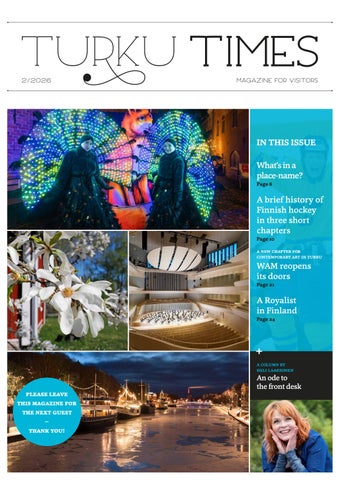
Cover photos Path of Light 2025. Photo: Rami Saarikorpi / City of Turku Magnolia flowers. Photo: Pasi Leino / City of Turku Music Centre Fuuga. Photo: Marc Goodwin / City of Turku River Aura. Photo: Vesa Aaltonen / City of Turku Heli Laaksonen. Photo: Suvi Elo
Digital edition of Turku Times: www.turkutimes.fi The magazine is available in hotel rooms in the city of Turku (see page 14). Next issue will be out in May 2027. 4
Church treasures amidst stone walls What gifts have the people of Turku bestowed upon their Cathedral through the centuries? Uncover the rare national treasures at Aboa Vetus. Altare et Urbs – Treasures and Donors of Turku Cathedral 6.3.2026–24.10.2027
Museum of archaeology and contemporary art Itäinen Rantakatu 4–6, Turku | avan.fi
photo: Jesse Tielinen photo: Suvi elo
Now, forever, Turku Turku’s vibrant food scene celebrates local ingredients at every level, from relaxed lunches and neighbourhood favourites to Michelin-starred dining. You can savour both local dishes and international cuisine on riverboats, in a former prison, or on rooftops with panoramic views of Turku. Our traditional market hall is also well worth visiting. Food is part of Turku’s identity – and we take pride in sharing its richness with every visitor. Whether you are a gourmet, an adventurous foodie, or a fan of local products, Turku offers a culinary journey to remember.
Dear readers, It is a pleasure to welcome you to Turku and to the world’s most beautiful archipelago. Turku is the oldest city in Finland, a place where history has been made for nearly 800 years. For centuries, we have pioneered, and many new ideas and innovations have entered Finland through Turku. However, history in Turku is not merely about preserving the past; it is the foundation on which we build the future – a carbon-neutral and international city where you can enjoy both proximity to nature and the vibrant pulse of urban culture.
The riverbanks are a true oasis
Culture for all senses
for both locals and visitors.
Turku is a city of experiences all year round. The Cultural Waterfront, stretching from Turku Cathedral to the sea, is the heart of urban culture, where culture lovers can enjoy numerous concerts, theatre performances, art exhibitions, a rich selection of museums, and a wide variety of events. Turku’s new Music Centre Fuuga is a world-class concert hall renowned for its acoustics and architecture. With its diverse concert programme, Fuuga offers music for every taste. Even if you’re not attending a concert, you can visit Fuuga to enjoy a meal, admire its unique architecture and art, and discover Turku from a new perspective from the rooftop terrace. When you visit Fuuga, be sure to stop by the newly renovated WAM Museum of Contemporary Art as well. This beautiful museum, located right next to Fuuga, showcases inspiring Finnish and international contemporary art. Along the river, you will find not only culture, but also beautiful scenery, atmospheric cafés, and top-tier restaurants. Turku’s food culture is diverse and of high quality, and the city is justly known as Finland’s culinary capital. Here, food is not just nourishment – it is culture, encounters and delicious experiences.
The capital of the world’s most beautiful archipelago Vibrating with modern urban culture, Turku is nestled in the embrace of the world’s most beautiful archipelago. Surrounded by over 40,000 islands and islets, it offers a truly maritime atmosphere. As a port city, the sea is an integral part of Turku’s identity. You can sense it just a few kilometres from the city centre on Ruissalo Island, where enchanting oak forests, pristine beaches and winding nature trails await. Turku is a unique combination of history, urban culture, and maritime experiences. Above all, Turku is a place where smiles are shared, and where everyone can feel at home. I hope the city captures your heart during your visit – and inspires you to return again and again. Warmly welcome to Turku, Piia Elo, Mayor of Turku 6
Welcome to Rioni, an authentic & family-owned Georgian restaurant at the heart of Turku.
GEORGIA'S BEAUTIFUL FOOD CULTURE IS WORTH EXPERIENCING
Our goal is to offer something more than just dining, a true Georgian experience! Yliopistonkatu 15, Turku turku@rioni.fi +358 50 468 8051 More information:
KHACHAPURI
KHINKALI
CHASHUSHULI
What’s in a place-name?
Finland is full of vulgar and just plain strange place-names.
A
Written by Roope Lipasti Translated by Christina Saarinen
strange fact about Finland: It has almost 3,000 place-names that contain the word paska, meaning “shit.” The most common is Paskalampi, “Shit Pond.” And that’s not all! Our country also has hundreds of places called Pillulampi, “Pussy Pond.” The latter usually comes from the shape of the pond, while the former refers to the darkness of the water: shallow and murky, with muddy bottoms – or as we say in Finnish, “shitty” places. Of course, it could also be that the names tell us something not only about the physical landscape, but also about the mental landscape of Finns... To some extent, the abundance of vulgar or obscene place-names is due to changes in the language: what sounds outrageous to modern ears may originally have been relatively innocent. For example, numerous place-names ending in perse, meaning “ass,” such as Hevonperse, Koiranperse, or Sianperse (“Horse’s Ass,” “Dog’s Ass,” and “Pig’s Ass,” respectively) often refer to a landform like a blind valley or a narrow cove. They’re places at the “back end.” One particularly famous and unique place-name is found in Turku: Pallivaha, or “Testicle Wax.” But in the Turku dialect, palli means “ball,” as in the shape, not “balls,” and vaha means “stone.” The name refers to a large round stone – it stands over ten meters high. Only later did palli acquire its other meaning. The village of Pöljä, located on Lake Siilinjärvi, is a somewhat similar case. Today, pöljä means “stupid,” but in the past, it meant a log or block of wood.
What sounds outrageous to
modern ears may originally have been relatively innocent.
8
Sometimes, place-names are purely nonsensical and sound like they were invented to torment tourists and sign-makers
ÄTERITSIPUTERITSIPUOLIL AUTATSIJÄNK Ä King of Titty Hill
Most of Finland’s vulgar place-names were discovered and preserved in the twentieth century, when researchers and mapmakers Terskanperä, “Penis Back,” in Siikalatva is a name that might make traveled the country interviewing local residents. Their respondents you choke on your morning coffee, but originally, terska was simply reported the names by which forests, ponds, and islands had always the name of a house and a word for difficult terrain. been called, not putting a shine on them. Other classics include Pillujoki, “Pussy River,” in Lapland; The mapmakers, in turn, faithfully wrote down the names and put Horonpohja, “Slut End,” in Joutsa; and Mulkkusaaret, “Dick Islands,” them on the map. Today, of course, new place-names follow modern in Sulkava, among many other places. All of these can be traced to sensibilities. Offensive or vulgar names are not accepted. descriptions of geographical features. Sometimes, however, residents do want to change a name they There are also many Hells in Finland. And we may not have any find problematic. In Pöljä, for example, changing the name has been mountains, but there are multiple places named “Titty Hill” and proposed several times with little success. These days, the people of one “Pussy Ridge.” Pöljä bear the name proudly, and it’s practically a brand. A few years ago, in a poll by Kotiliesi magazine, Finns voted The people of Horonpohja have also been interested in a change, Suolikulli, “Bowel-cock,” in Urjala as Finland’s most awful place-name. but it hasn’t gone through because horo once meant “sparse,” “spacious,” Velhonvittu, “Sorcerer’s Cunt,” in Lavia took a strong second place. or “crack.” Strangely, Pierupapinlähde, “Fart Priest’s Spring,” in Orimattila only Nonetheless, sometimes money talks: Kusipää, “Dickhead Fell,” in came in tenth. Inari was renamed as Kaunispää, “Beautiful Fell,” when the area was Sometimes, place-names are purely nonsensical and sound developed into a tourist ski resort. The thought was that the new name like they were invented to torment tourists and sign-makers: For sounded more like the kind of place tourists would like to visit. But example, Savukoski is home to the longest place name in Finland, if you did want to go to Kusipää, you can still find one in Sodankylä. Äteritsiputeritsipuolilautatsijänkä, which is partly in a Sámi language In some cases, a Paskalampi has also been changed to the more or some corrupted version of Sámi, and doesn’t really mean anything. Instagram-friendly Joutsenlampi, “Swan Pond,” or Mustalampi, “Black Perhaps it was meant to annoy the authorities when the property Pond,” if properties were developed along the shore and the existing register was created. name threatened the image of the area. Of course, it’s purely a matter of taste whether you’d prefer to live by Joutsenlampi or perhaps along the shore of Perseensilmälampi, Take a holiday in Dickhead “Asshole Pond.” The latter, if you’re interested, can be found in Ranua. s Because even lewd names are names and can therefore tell us something about history, they aren’t often changed. In Finland, the National Land Survey is responsible for the names of places. (Their website provided the examples for this article – what a great way to relive schoolboy humor!) As a rule, if a name has been used by locals and officially recorded, it’s retained on the map. Place-names are considered historical documentation of how people have described their environment. Usually, the obscenest place-names are also located off the beaten track, and don’t really bother anyone. Places in the vicinity of one’s own village were given more pleasant names.
SHIT POND
9
Photo: Claudio Bresciani / Lehtikuva
Sweden's Mats Sundin celebrates 5–6 goal against Finland during the quarterfinal ice hockey World Championships match in Helsinki 2003.
A brief history of Finnish hockey in three short chapters Written by Matti Mäkelä Translated by Christina Saarinen
Chapter one: The Book of Job
two-goal lead over Sweden. In 1975, one measly extra goal in either match against Sweden would have been enough. The team couldn’t make any of these happen. The most bitter Job moments occur in 1974, when Finland’s medal was snatched away due to goaltender Stig Wetzell’s doping scandal, and 1976, when an Olympic medal is lost to Germany by a goal ratio difference of 0.04. Then come the 1986 and 1991 Sweden matches, the outcomes of which would make even God and Satan, who conspired against Job, proud. Both times, Finland leads by two goals with a minute to go, and both times Sweden equalizes, denying Finland a medal in 1986, and a place in the playoff round five years later. The trials and tribulations seem to be over in 1995, when Finland finally wins the World Championship. That sigh of relief is premature, however, and over the next 20 years, Finland will play in the World Championship final seven times and leave the rink defeated in six of them. With Finland hosting the World Championship in 2003, a disaster comparable to floods, plague, boils, and locusts strikes: in the quarterfinal, Finland leads Sweden 5–1 in the second period, but ultimately loses 5–6.
Fans of the Red Sox baseball team, the pride of Boston, have been known to sport merch with the slogan “Job was the first Red Sox fan.” The unjust trials endured by the pious, God-fearing, upright Job of the Old Testament would suggest that in years past, he was also a fan of the Finnish national ice hockey team. Like the Red Sox, who languished without a championship for 86 years, the Finns participated in the Ice Hockey World Championship for 56 years before securing their first win. What makes Finland’s pain almost biblical is that the team came so close so many times. In 1970, Canada withdraws from the World Championship for seven years in protest of the ban on sending professional players to the games. Finland sees its chance, not for the championship but for the bronze: the Soviet Union and Czechoslovakia are too strong, but Sweden might be beatable. Again and again, the coveted bronze medal is nearly within reach, but always painfully lost at the last moment: In 1970, Finland needed to beat East Germany, which was at risk of being relegated to Pool B, or hold a 10
Chapter two: Fear and Loathing in the Hockey Rink
Chapter three: The Metamorphosis But then, all of a sudden, the Finnish hockey player awakes from restless dreams and finds himself transformed into a winner. Of the seven World Championships that have been held in the past eight years, Finland has won three. The last two were even in overtime, which had previously been almost as terrifying for Finns as a penalty shootout for the English national football team. Two Olympics have been held in that same period, with Finland taking home a gold and a bronze. For their part, Sweden – that old nemesis – has finally underperformed, resulting in two fourth places at the Olympics and two bronze medals at the World Championships. The change is being driven by a new generation of players, raised in the happiest country in the world, for whom believing in themselves and their team’s potential is a given. It’s a generation that – to paraphrase Muhammad Ali – is so good that it’s hard or even impossible to be humble. A generation for whom the idea of Finns as poor country cousins is incomprehensible. This new, brave world revealed itself for the first time in the final of the World Junior Championship in Helsinki in 2016. Finland scored and took the lead against Russia a couple of minutes before the end, but Russia got lucky and tied it up with just 6.9 seconds to go. In the bad old days, this would have been completely devastating for the Finnish team, but this time was different. Forward Kasper Björkqvist summed up the changed attitude in a short TV interview before the start of overtime: “This is hockey at its best. They managed to tie it up, but we’ll score the next goal.” And that’s what happened. Now that Finland’s winter of losses has turned into a glorious summer of victories, it’s perhaps good to return – to see how far we have come – to the darkest moment in Finnish ice hockey history, the 1960 Olympics in Squaw Valley, where Finland loses to Germany and drops to the consolation round, facing Japan and Australia as opponents. Turning the knife in the wound, the Finnish media compounds the shame by saying that Finland was now playing ice hockey in the Pacific series. s
How did things turn out this way? The topic has been discussed endlessly in Finland, and the explanations can be roughly divided into the psychological and the magical. The former is based on the idea that Finnish players simply couldn’t handle high-pressure situations: with victory in sight, the possibility of defeat created fear, which led to overly cautious playing and easy mistakes. According to the firm beliefs of kitchen psychologists, the Sweden games turned into perfect storms when this fear was combined with Finns’ weak self-esteem, little-brother complex, and envy of their richer and larger western neighbor. On the magical explanation side, it might be claimed that Finns are afflicted with bad luck in general, while Swedes’ luck never seems to run out. This luck is not limited to hockey alone, but can be seen, for example, in the fact that Sweden does not have a land border with Russia (which, of course, applies to most countries in the world), and that the Swede Thomas Wassberg beat the Finn Juha Mieto in the 15-kilometer cross-country skiing event at the Lake Placid Olympics by one hundredth of a second. Taking it even further, this toxic concoction can be given a dash of the Finnish national character, which some believe is prone to misery and melancholy and flourishes only in moments of defeat and sadness. Of course, Finnish sarcastic humor helps ease the pain. Consider how the outcome of World War II was described in Väinö Linna’s classic novel The Unknown Soldier: “The Union of Soviet Socialist Republics won, but plucky little Finland took a strong second place.”
The trials and tribulations seem to be over in 1995, when Finland finally wins the World Championship.
World Championship celebrations in 1995.
Photos: Ilkka Laitinen / Vapriikki photo archives
11
30
llo
19
7
inka
Mart
tra
Huovin k. Ases epän 11 k.
12
12
2
intie
2
entie
4 1
reentie
1
38
39
12
7
n ata ng Ba
atu
tu
tak
rinken
17
3
Ös
katu
55
Hopmannin
13
Ra
ka
an
4
Puut a
k.
an nin tm
H n ov 4 eido i nk 3 .
ik P om
1
tie
26
j, ink
Eer
j.
ojan
Vähäheikkilänkenttä
Vähä-Heikkilän Braheskolan koulu
14
nk
1
alta 20
llär My
42
7
VÄHÄHE LILLHEIKKILÄ
Päiväk.
.
ka katu tu
M 34
40
2 ä ri nk Myll
i 51 mi vami 6 eh eh en en
p
186
ta Uit
20 n
ata 19
Ku
95
j. luk Kiu 18 untt k. To äen m V
vsg
4
ka
Sir
T
4 järho
43
L1a
2
N
2
Nokiank.
k. 2
10
18
nk.
33
43
rh a 5 kat u
FataAm
a 24 31 tan
11
n gata
13
9
ng
4
Tonttu- u mäkiittaan2k9at 17y0llymäentie
tin k.
15 Korp p olaist3ie
antie Vaas 14
m
ol
kh
Tu
19
22 Vesik.
21
18
u
u
nk
i m r a
n iilo
rä Pe rik.
ie
Pohjantähdent.
2 Vä isä 6 5 länt. 7
tie
en
t
5 ähd
rto
2 Resii narait6 ti
Po s 2 tik .
3
t. 3
Orkola n
4
4
a-S 20 u om iväg 28 en
2
4
5 Uhrilä ht ee nkat u
Va kk
. 11
suont
Jalka
7
Har 10 v ahamaaVe nt. si v uo t avan 20 tie 1
17
Ko 1 llik .
4
Kult lähteaent.
23
ni 3
Ku
tu
3
10
kat
tu
8
k.
Martin- Tem kirkko link.ppe-
8
8
ka
5
ten
lais
.
nk aja3
IV
.
tink
M4a
4
2 val ven
nka 6 kijä 5 te en Tiil 3
ma
2
1
ta So
1
Sa
48
25
atu
u
3
Kompant.
8
n 2 ata 4 1
t
at ulik
T
3
M sil
2
18
7 at k
inin
Urs
9
n
5
Ille
Sat a
12
olg
ata
eg All 8
4
tsg
Sk
11
3
37 atan
37
46
ap
vin
ikatu
a erk ntv 6
Ha
16
14
ho
rva
nr
l Hjor
oikk
11
k.
Kie
tu nka 14
13
1
en
2
5
atu isk 14
ölä sity Kä 18
ieh
Katolinen kirkko
Martti
k.
1 on h Vil12
2
2. p
1 sto li ma Hu 18
20
um
1
Te
e inn
Ilka
Danie
Oja
16 155
rh uta2 u P 1
Martinsilta
52
1
4
9
90
a silt
7
r Jar
58
3
0
4
tål 34
S
26
nd ra 56 St
9
Palvelu- 5 e talo rinn 2 21
Fre
17 s Vilkkilänm r tu åla starinka mäki t S Me 16 0
1 8 tu iehenka rim3 5 7 35
k ku An
r to
8 annink. gm
t
4
12
st Vamä
11
23
4
6
r
kello
2
n
ta ga
14
3 Matruusinp.
6 Kaasu-
45
k
60
66
Jun
io
14 Un
V
rinp.
k. llin 1
nin
22 u kat
ivu
La
74
80
tan
e
en
Me1
.
ritu
Au
-
ink
Me
ki
1
sga
a
atu
R
en
ga
11
iva
a ol
t g ts 37 Saaris t o
Föri
am
t sa
u kat rin 4
rse
Pu
72
ett
u
ton
ich 1
Cr
2
u
67
7
2 atu luk
4
kat
. ink2
27
19 en
ttä nty
sar
5
52
3
10
k.
nin 48 53
57
n ata
49
tin
n Lä
1
1
ds-
tan ga38
riks EL-S poliisi-
45
ta an
Lä
3
laitos Oikeus- Päiväkoti talo
Sl
55
ri 5b 5
11
rin kka Pa 8
tar
V
La
4 man hr 1 Lo
k. 9 k. 14lowin 7 win ai 10 ailo ch h Mi 5 Mic 2
k.
59
on list
atu
ma
nk
Hu
1
ska
s-
u kat
14
2
1
1
13
1
at 3 nank n 2 iilili
e
ntin
39
15
20
39
7 u
8
T 6
7
M4
3
u kat2
atu
14
n na
in ttil 2 raniFi u k G u ni1 laa
Lo
Srk-koti ite 34 ers 1 Ruusukorttelin 4 Univ hyvinvointikeskus Mikaelin koulu 33 1 . Keskusk n paloasema iko
26
4 k. Kakolan
3
26
19
Mannerheiminpuisto
11
u
3
ren
ink
tu nka 2
na
An
VIII
3
jo ra
1 5 9 u Lyhytkat tie
o
rop en ein iim 2
u Ko
5
-
5
8
10
S
atu
k
16
atu
kat
vuo
Arv
koti
7
Telakkaranta
n ise rila me 10
tan
a dsg
r
gå
Kakolanmäki
2
akatu Hans 4
Forum Marinum
Mikaelinkirkko
23
ilän
8
u
6
9
Mit
1 k. gin 2
4
tu
ka Nuott a saa r en
22
Ra46
20
18
Ve
NORRSTAN
n iha
tap
k.
ikk
9 kea r Ko10
1
kat
42
7
71
19
en
He
u kat
d Trä
29
POHJOLA ojan
37
ok ist Pu 18
ne 17 huo 2 as 2
ir Sa 11
1 rintu Art sku ta
in-
tur
2
37
2 s Re
1 enk. k Aa
22
ge n
4 ikin He ku 3 tas 2 nti uu u 7 nt.Ntask
uti
1 rstink. Ki
nk. 3 taja 2 las Ka
5
-
an
h au
R4
tu 2
nka
i alm
IX atu
9 in m Fle 4
ja
1 Art stin Kir ku s lin- ta se Ak sku lku ta po
2
Copyright © City of Turku.
Nosturink.
2. lin
37
k. 2 timon lt o P Päiväkoti 1
Suomen Joutsen Miinalaiva Keihässalmi Tykkivene Karjala 6 Laivahostel ta Bore ran 72
Linnank80atu Turun linna
3
46
10
70
.
Satama
27
33
p.
ta
34 tu 2 Port Arthur Päivänka 0 ofia
M LinnanTopeliuksen fältti koulu
Ra
1
ja
83
ntie
39
3
11
4
52
6 sv 6 Veistämönra aukio 9 onk e i Taideakatemia V list aa0 65 r i Varvintori 13 Am 1 Linnan- Sigyn-sali Museoalus 12 a malmi Sigyn kuj Turun konservatorio 0 itio
ank 7 aud llih 6 Va 10
Viking Line terminaali
82
7 4. lin
85
1
Ra rin tava ne hd in
14
m
Ha
19
o sal 10
-
1
1
Ra
13
2
Palvelutalo
Sateenkaarenk.
5
20
nja
1
an puistoka t u 27
1 1. li
2
11
Hoviväenk.
1 3 5 Kuljetuskatu 2 4
Kaupunkiympäristö Kaupunkirakentaminen 4
Koulu Päiväkoti
buurink.
Karin 6 Hakolan kuja
Auriga Business Center
SATAMA HAMNEN
Silja Line erminaali 91
3
a
He10 rttu 4
1
Varastokatu 8 6
2
2 a Brahen k. b Eb
1
Päiväkoti
Kolmen Katariinan bulevardi
13 tuskatu
Kulje
26
Telikatu
10
Juh a n
5
Linnanaukko
Elisabet Wollen k.
.
105
14
Stockholmsgatan
Kr Steis tiina n bockin k. 7
htik Ra 1
28
33
Skeittihalli 37
9
15
is Ru 2
29
vikatu
tie tu
u
s Kir
Patterinhaka
3 Huolintaka
nkat
pu
tin
18
tu
ka
n isto
Kluu
e r in t ie
ion
ns
nsl
Ak
stin
12
Pa
1
12
e inti
sel
13
11
äv r-H eikkil ä
Sto 21
Nu
ISO-HEIKKILÄ STORHEIKKILÄ
13
21
3
nk. Latokari 2 4
Ka
4
Kir
29
2
8
K A U P PA .W I L H E L M I I N A . N E T
5
asatama
2
11
Latokartanonkatu
15
Jääränmaankatu
21
E6 1
2
Kanslersvägen
20
28
ta
Maaherrankatu
17
7
25
53
8
Iso-Heikkiläntie
4
YLIOPISTONKATU 18 TURKU
27
T
47
Otavanaukio
e
nti
ri hä
akatu
5
Tähtitorni
7 3 Iltat ä h dentie 2 8
12
32
29
The Most Beautiful Knitwear Revontulenkatu For This Season Palvelutalo 10
6
65
8 mp 1 P a H i in
1 k. ara av 2
H Kristiinankatu 6, 20100 Turku, @barbarturku, app.barbar.fi Härkämäki 13
ip e
ih Ri
K
Ammatti-instituu Juhannuskukkula
55
nti
in
81 kko 3 rin
j. nk rpa 4 e n To
tie
äen
äm ärk
e
llio . Ka kj
np.
3
8
45
9 tu aka Jun 5
ak 1 eli kj.
kila
9 8 7 Muh kurin m ä ki
46
35
18
1 6 un 7 tar 1 Kä p n i 2 Koulu V 7 e 10 10 ald yd 4 uja ö K nk 15 tu rlä . hä ka u g Kä t ka 3 are us kko n Ko hann in Ju sp 20eilip.
Ka
Ko
T
33
t. din
Ka
3
ti
äen
m ikku
mp 35 6 uo
32
u nn ha J u k j.
l
e ak
k Pu 7
Postikeskus
u sk 2 o tti ta
K i-
ja 2 ttiku i lsi Ka
Muhkurinmäki
kk aa am lin teht 3
11
k a tu
2
10
t ka po eri n-S
49
kat4u
n Inkilä
La
Pi e
en ämä Pitk 6
1
Sau
26
K
1 Pukkilant.
3
ie
jant kono
ähär
smoothie Naan bowls tsandwiches alin p i k a coffee tie
10 kkas u u Ulp 5 ontie
Turku 4 u lku
totie in puis
4
sku 2 nttita me 7 Pig 6 a 1 uj 2 liinik o Ka 1
LÅNGBACKA smoothies -
läntie Alaky 6
66
65
50
54
amiikk Kera kuja
59
19
63
1
uri
a tu iitunk
n Merikulmantie Wild, fresh and naturally Finnish Vehka PITKÄMÄKI
80
19
Kukkulakj.
30
43
karink Heinä16
u nkat 21 ähätalo V 15 16 23
8
lonp.
33
16
25
Rostocki nkatu 6
3
katu oren
Ave nink.lla-
u
Ku
Sa nt
1 u-
10
7
7
Un 3 ta
hk 1 on ku ja Ta 26
2
polku
10
10
ie
t 3
11
15
1
8
22
ak
Kirkkotie
Ty 3 4 k
4
16
Ter13 ho k
34
47
65
13
katu Vatselan
6 Re pellohtorinnk.
atu
1
rikin k
Hen 8
17
ola n
katu
8
Piis 13 pan -
vä Lyly
ägen
re ss 1 i ng Ko
4
2
3
V än
7
Aura å 49
50 25
Vu
alkj.
6 4
2
r i kinkatu
1
Jokikatu 12
Nahku rinpiha 1 5
4
38
2
hd e
Myllya
tu
aka
Pu
15
ata2n1 19
24
e n 11 katu
Henrikinkirkko
tr
Ukraine
ge
ks
2
1
It.R ant
1
3
rok 3 m 33 at 36 mu nals u ju
Ko
ata 1 n 3
ckg
Bä
olag
Poland e-
vä
Toiv
70
ds
Latvia
u Ha
ak. nk k. Lithuania sen Ho äen uk i l m Pe
L
19
n
Estonia
rsde ink. Hin son
Germany
7
Kirjasto Vasaramäen koulu Tu ken
Ny la
13
Sweden
17
2 4 Kul m akj. 3
38
24
5
Mäntyk. 6
9 2 Vasara enkj. mä4 10
Finland
Denmark
3
20
katu
12
Petäjä
e 5
Alitie 13
9
7
itu
1
36
3
n
ntie
K
Koivu katu
30
rvo
ge
27
rtio
8
Ylitie
pe 34 29 Pop tie nja atie 27 sta 3 uun a 12 k K Ra 10 tu 13 ka 5 2 2 Niitty 12 18 e Vasaramä nk a tu
22 20 14mmarin katu a ias H
ika
Norway
6
24
io
nkatu 1
uk ina erg 4
1
pp Kau
2
5
mb
Blo
17
Kuu
svä
K 1 iv
ie
sent
ok Hipp
. lak. Huvi 9 nak YOU HERE! Sau 2 sikARE j.
nti
u
35
10
5
atu
k.
Betan ia
2
18
inkA ä
KUPITTAA KUPPIS
10
1
kse
7
sen
tie
atu10
4
käi
tan
ga
aan
uk 2 sikj.
5
Le 24 mm
9
Urheiluhalli
LiikuntaPadel- palvelukeskus kentät JalkapalloKupittaan stadion monitoimihalli 6
nm
14
28
2 ka- k. Jouaisen h
min
em
12 nns1 Bru 1 20 tan
sga
ud
de Uu Ka
16
a
L k. llyn 9
u 9
12
a
6
19 Takamaa ntiVe i
2
1
9
Hotels providing1Turku Times are marked the map with numbered blue dots. The i1on 5 uom kj. can be found from number of yourThotel 11 17 the list on page 14.
9
1
g
is
tu
a tök
Pesäpallostadion Kupittaanpuisto Pyhän LuisteluDigitalHenrikin magazine mato Paviljonki Liikennelähde puisto Turku Times digitally Uimala Petanque www.turkutimes.fi kentät
u
4
en 0
Dentalia
puisto
KURJENMÄKI TRANBACKEN
21
nka tu
my 4 na Kii 5
3
n
pit
kat
en
tie en 1
1
Kupittaa EuroCity6 ElectroCity 1 BioCity 3 ICT- 8 3 Pharma- Joki City Jou 5 ka DataCity h 4 Citypolku Ammatti- Edu- 9 i k k City n 1 10 instituutti e L
ta ga
n Kaskenpuisto S 1 ski
ilä k k ei 9 17
K
Kompassisairaala 2
n
Ku
.
ä nm
oren7tie
kat
13
7
Kupittaan siirtolapuutarha
2 tiePalvelutalo
D
A 10
9 K 2 upi g 11 tta 2 n å 6 u rl 1 kat Seikkailu- ankuj
2 linink ge Kin
rje Ku
3 sk Ka
2
rön
kenttä
la kka6
G
18
tan
Luolavu
äh
V
5
16 ertr
tu 17
nka
8
ja tta soi 9
ie
ai
2
11
i Sav 1
2
12
on
sga
ski
Ka
1
8
Ky
45
an
k
uja 2
Ö
Häm
T-sairaala
13
ta ga
ste0 17 taan
ant raal 4
Palvelutalo Kaskenniitty
äh
Kotikunnas 5
1
10
12
13
20
6
20
Vähäheikkilän perhetukikeskus
0
7
8
Steinerkoulu
Sir
T
20
Kinakvarng.B,C ätilöp.
n-
5
k.
an
Päivystys Turun yliopistollinen keskussairaala TYKS Majakkasairaala A-sairaala Medisiina
3 kaivo n ä rje ntt u K ke
tu
Hämeensilta
U-sairaala
2
kat ivo Ka
u kat
1
6
9
11
ytie
e nti37
itu
v Hu
Koulu
Kaskenlinnan sairaala
3
1
a KPäiväkoti
9
tie ava0 l a J 2 e iti arn Sa 36
Kun
2
11
2
1
1
iss nall
39
Mäntymäen sairaala Terveysasema
Harakkakallio
6
o
10 u
kat
ren
14
ori Vu kj.
1
tie
Vah
27
4
Kerttulin nka lukio 3 arina
2
vuo
u
8
Mäntymäen perhekeskus
TALLBACKA
12
htit
6
rtio
kat
5
32
Koulu
46
V
28
30 33
tera
31
23
27
43
enk
H ähä 10
5
atu
e äm
9
Tä
Va
tu 10 nka 13 ske 11 Ka 9
II
26
koulu 29 en Palvelu- väg talo us Kirurginen kh sairaala
Käp
28
29
10
i- . vio nk Hoeude k 1
2
8 6
ori-
tu nka5
5
MÄNTYMÄKI
8
1
6
.
j.
6
1
Vu
pä a
isg
6
21
7 tiMAGAZINE PLEASE LEAVE 1THIS ne alhu K 2FOR THE NEXT GUESTn– Vinterin- YOU! tie THANK 6 7 Lyly 46
iste
37
57
Päiväkoti
ka 1
6
nk.
52
24
41
4
Pu
25
tu
3
5
ola
As
12
ie
EIKKILÄ
nka
Se
oiv
56
2
mä e
28
42
33
at5u0 45 k ä 1
tan Puropellon
9
ont am 1
m
4 . k an llel 3
.
15
Paja
8 . k en ieh
9
Ka
rtanonk11.
80
M
kio
au
n äe
ty än
Päivä- tu koti roka
j. enk aist Ask 53
1
2 12
I
0
11
u
kat
mä
lon Ta 8
25
27
35
itk6 nP 5
ne täi 62
K
öm
84
39
p up
70
11
77
tu nka21
nia
aanka
k. en 9
40
72
MAP-kirkkoT
9 4 13 Vyö12
1
47
Sir
S:t Olofsskolan
rity
4 k. ön Yrj 3 12
15
ta Be
ink
89
K
1
III
4 linrttu Ke 1
k.
tiok
opisto
m Hä
9
ll Ke3 atu 12 nk a1a 10 nm9 1 2Kotik. rninkatu
an
Var
3
M
kha en nk. Kiv aaja k 1
10
90
u
o Vu
Kuntorata
2
olk
Samppalinnan palloiluhalli 43
Koulu
1
de U3 u5
nn
inttig Rerinne n ste
elje nv tai s u Työväen-
5
Kesä13 teatteri 16 15 Luostarinmäen käsityöläis8 1 3 museo g. Sirkkala r e 2 t 2 skola 17 los 6
kj.
1
en rm tie Nu isto avo pu
Paavo Nurmen stadion
7
k rkon
Nu
1
2
1
linnan n R vuori e Kaupunginn i ä teatteri Uima-
Urheilupuisto
13
a stg
I
op
27
u kat
un
4
n
a tak n a Samppa-
Teatterisilta
tu
k. 14 en ieh
6
5
tu
ata
rag
Au
1
32
nt.
vi Ola
It
1
12
ra Au tu
tan
va 26 Ta Vartiovuori
Luostarivuoren stadion Fuuga rikuja koulu 3 tu 2 u Valtion Luostarivuoren 1 ka 1 u t t l Lyseon Lukio tarin W.Aaltosen Ku virastotalo s o museo Biologinen Lu 16 tu museo Ne Kesänka its a l a teatteri ytp kk
6
n3
9
Pa
40
u 2
u
Myllylta
5
kat
.
link
ke
Es
21 ne ti L än
8
i jok
ak
iukhov k. Rot sen
silta
Vähätori
Kaupungintalo Apteekkimuseo ja Qwenselin talo Auransilta atu
ant nR
Tuomiokirkko
e4e
YTHS Kirkkotien terveysasema
korkeakoulu
a n2k
Signum
s
Ko
Turun Akatemia5 talo Vanha Åbo Akademi Suurtori 2 Lukio Pääkirjasto Kerttulin 16vanhainTaiteen koti Aboa talo 20 inkj. Kirjasto- Vetus 16 in silta 21 Te
ska
tu
1
t nka28
L 32 12
2
ki
15 Tuomiokirkko-
6
pia
ka
tan
20
a inn
31
15
n na stii 4
Kri
20
halli
11
Akademi Gez sen eliuk- Tuo k. mio
5
Kuuvuo
sim Ve
r vie
up
12
8
3 n ta sga 4
ga 3
tu ka ten
9
1
u
ra Au
kat
5
ård
are
n Kela riki Ee Kauppa-
Turun VPK Sosiaali27 keskus Lukio 13 Iltalukio u 0
36
u kat
17
17
Terveysasema
1
Ka
lan
1
n
3
10
7 atu 6 nk he Bra
13
la-
o Pu
g mle Hu0
VII
24
2
lta-
11
3 rint. u Tu
skola Puolalan15 mäen lukio 14 KaupunkiOrtodoksinen ympäristö kirkko Vimma u 9 10 Lutherin kat 11 3 u t 8kirkko Luvat ja 2 ton Kauppaa s i k p a tori valvonta o h Betel- Konserni- Yli 16 14 kirkko hallinto Hansa10 29 2kortteli
n Puolalan ata 2 koulu
2
k
5
Mu
ais ink An 10
tan sga an pm Kö
tan
20
k. rin A ju 2
14
il t a
1
11
1
1
n mo
ga he Bra 18
ns
VI
1
Park 8 ink. Patr 10 iank Kauppa- .
1
P Kuuvuorenkenttä
tie ion11
nt Su
Kasarmialue
Yliopistonmäki
10
1 k s Ke
to Ku
3
n ata
22
Lo go m o
N
u
kat
nu
u 11 Va
Kaarinan 2 VPK
Educarium Publicum
2 Verkatehtaankatu Verkapiha Kasarminkatu 1 n Caloniankuja ata g 7 g s s LinjaArken 7 org ogomo d n Calonia r 2 ta reb ParkinArcanum Teh gå rlångga autoasema kenttä inp. a 1 Tu t a n 6 a d t 7 Kansallis1 n o u k a k e atu Synagoga . Turku ko B 17 Väst Arkkiu arkistosenk Uk Vesi 15 kat piispan. 7 Konserttitalo 8 Vesilinna linna 18 rin nk i ntie talo r k Ammatti1 23 Agr o7 eliu instituutti kuicol b 19 rep 14 i a PuuS nka h u 2 2 tu TuTSYK:n Na tori u 14 2 t 1 a k lukio 5 Turun yliopisto ä o t k is atu SibeliusPit atu Hor pu Taidemuseonink P k 6 n o 3 t r a en t n museo r okj. o Puolalan t al nk.4 ria 6 Ett Hem hanink 5 u o l Puolalan- T 6 koulu me Rosetta a e P i a a n tu ken -museo Åbo mäki Cygnaeus M 1 tu 12
rika
etu
Kyrko v
Assistentinkatu
2 Arwidssoninka tu 3
T
2
tie
en
12
tist
5
Tu pol omaa ku n-
5
23 14 e 6 konti a J a 3 16
koulu
. enk 2 i eh 26 okram Vu t. mä 8 Tör tu 1 2 sikatu7 0 ik a Uu 1
2
He
Holiday Club Caribia
iluk . Un arink k
7
ls
13
15
14
ingforsg
2
1
8
14
en k a
26
k
n o jan
29
Kairist
e
np u
3
nti
yde
aja nk 1 .
al a
tu
a nk
hla
n
a
.
ten ais ink ilta An s
utti
ka 5 tu
p Pis
1 k. n äe
9
ikin
Lonttinen Lo kin - 3 i s n l g e 29 H Keta 37 ink katu Tuomaana t u silta ran 25 tie
1 ont
1
k- u Kö unoV 1 p etu Niklankat 4 rim se 1 ara ie ieh Kö enk Ptiisint . 1 aari
Air
All 13 ink .
17
ata
tav Lo hjo i 4 sto Po den- nkj. Yrj änänkatu y ja 25
Urp
2
Lo ntKanku- S 5 uk rink. kj. kula-
nk.
e uh
6
8 7
Bilm
lan
2
k
5 kinä m
Päh
K
Ka
Turku Times is available
in these high standard Hotels 01 Centro Hotel
07 Hotel Helmi
13 Scandic Go Turku
Yliopistonkatu 12, 20100 Turku Tel. +358 2 211 8100 www.centrohotel.com
Tuureporinkatu 11, 20100 Turku Tel. +358 20 786 2770 www.hotellihelmi.fi
Eerikinkatu 30, 20100 Turku Tel. +358 30 030 8417 www.scandichotels.fi
02 Forenom Aparthotel Turku
08 Hotel Kakola
14 Scandic Hamburger Börs
Kristiinankatu 9, 20100 Turku Tel. +358 20 198 3420 www.forenom.com
Kakolankatu 14, 20100 Turku Tel +358 2 515 0555 www.hotelkakola.fi
Kauppiaskatu 6, 20100 Turku Tel. +358 30 030 8420 www.scandichotels.fi
03 Forenom Premium Apartments Turku Kakolanmäki
09 Original Sokos Hotel Kupittaa
15 Scandic Julia
Joukahaisenkatu 6, 20520, Turku Tel. +358 10 786 6000 www.sokoshotels.fi
Eerikinkatu 4, 20100 Turku Tel. +358 30 030 8423 www.scandichotels.fi
10 Original Sokos Hotel Wiklund
16 Scandic Plaza Turku
Eerikinkatu 11, 20100 Turku Tel. +358 10 786 5000 www.sokoshotels.fi
Yliopistonkatu 29, 20100 Turku Tel. +358 30 030 8421 www.scandichotels.fi
11 Park Hotel
17 Solo Sokos Hotel Turun Seurahuone
Michailowinkatu 1, 20100 Turku Tel. 020 198 3420 www.forenom.com
04 Hiisi Hotel Turku Seaport Toinen poikkikatu 4, 20100 Turku Tel. +358 20 778 0777 www.hiisihomes.fi
05 Holiday Club Caribia
photo: Jarmo Piironen / Visit Turku Archipelago
Kongressikuja 1, 20540 Turku Tel. +358 30 087 0900 www.holidayclubresorts.com
Rauhankatu 1, 20100 Turku Tel. +358 2 273 2555 www.parkhotelturku.fi
Eerikinkatu 23, 20100 Turku Tel. +358 10 786 4000 www.sokoshotels.fi
06 Hostel S/S Bore
12 Radisson Blu Marina Palace Hotel
18 Tuure Bed and Breakfast
Linnankatu 72, 20100 Turku Tel. +358 40 843 6611 www.hostelbore.fi
Linnankatu 32, 20100 Turku Tel. +358 20 123 4710 www.radissonblu.fi
Tuureporinkatu 17, 20100 Turku Tel. +358 2 233 0230 www.tuure.fi
14
AUTHENTIC INDIAN CUISINE IN TURKU
INTIAN HELMI BAR & GRILL Intian Helmi brings you the finest Indian cuisine With over 15 years of experience come and indulge in our authentic Indian dishes. Freshly prepared food using traditional techniques, a clay oven to lock in those flavours and the blends of different sauces that are famous all around the world and can be experienced right here.
Brahenkatu 14, 20100, Turku +358 41 318 6460
Gone with the stars In Finland’s winter sky, you can see the northern lights and a whole lot more.
T
Written by Roope Lipasti Translated by Christina Saarinen
Northern lights all over
urku-based amateur stargazer and astronomy evangelist Eeva-Kaisa Ahlamo has been interested in the topic since the age of four. As a first grader, she gave a presentation about stars to her entire school, one grade at a time: “The teacher was my assistant and helped with the slides. Later, she teased me about breaking off my lecture at some point and asking very seriously for her to return to the previous slide because I had forgotten to say that ‘Pluto’s orbit is backwards’ – whatever my precocious 7-year-old self might have meant by that.” Since then, the hobby has even taken Ahlamo to live in New Zealand for a couple of years to admire the stars of the southern hemisphere. Yet she has one personal characteristic that doesn’t lend itself to the hobby: “For a stargazer, I’m not much of a night owl. I have to decide already during the day if I’m going to stay up the following night. But because of the stars, I always take my summer vacation in September, for example, because at that time of year, it starts getting dark enough earlier.” It is dark quite a lot of the time in Finland, which is perfect for stargazing enthusiasts. The downside is that it is often also cloudy, especially in winter, which hinders one’s opportunities. And of course it’s too bright in the summer. Luckily, that still leaves several months to admire the sky.
Of course, one thing you can see at night in Finland is the northern lights. And not just in Lapland, but all over the country, though they are most concentrated in Lapland, and often more spectacular there. “Contrary to popular belief, the northern lights occur all year round and at all times of day. In the summer and during the day, the sky is just too bright to make them out. The northern lights are so visible in winter precisely because there is so much darkness. Personally, I’ve seen the best lights in August, but you have to stay up late so the sky is properly dark and gives the best contrast with the lights.” Ahlamo explains that the northern lights are related to the activity of the sun. The activity of our nearest star fluctuates in 11-year cycles, and we are currently moving toward quieter times. However, there will still be very good chances of seeing spectacular northern lights in the next couple of years, as long as the sky is clear and dark enough and a suitable solar storm tickles Earth’s atmosphere. The best places to spot the northern lights are anywhere it’s dark. City centers are bad because there’s too much light, but if you make your way to an even slightly darker place, where street lamps don’t shine directly in your face, the northern lights may appear: “Typically, they’ll look like a featureless grayish arc that hovers about a palm’s width above the northern horizon. Many people would mistake it for a cloud, if they even bothered to look in that direction. The biggest problem with spotting the northern lights is that people don’t really look up at the light-polluted sky,” Ahlamo says. Though people often imagine that freezing weather and the northern lights are related, she explains that isn’t the case: “The sun doesn’t ask whether it’s freezing on Earth! But when it’s cold, the sky is often cloudless, and in the cold season, it’s also dark.”
photo: Eeva-Kaisa Ahlamo
Start with wonder Ahlamo is not a professional astronomer – she works in communications. But she has been a northern lights safari guide in Lapland and led astronomy events in Finland and New Zealand. So perhaps it’s no surprise that she has her own telescope. But even though she usually has it along, it doesn’t always get used. “Often, I’ll end up looking at familiar objects with my naked eye or spotting satellites or things like that, and then I’ll realize I haven’t used the telescope at all. Stargazing isn’t actually a hobby that depends on equipment – unless you want it to. The greatest experiences can be had without it, when you look up at the sky and feel a connection with the universe. Your own problems seem pretty small if you look at them from beyond the orbit of Neptune!” Ahlamo advises beginners to start with wonder: “Just look up at the sky and wonder what all that stuff is, where does it come from, how does it work. That kind of wonder is innate to humans. Of course, as a hobby, the more you learn about things, the more you get out of it.”
Observing familiar planets When the weather is clear, it’s worth looking at the sky for more than just the northern lights. This winter, for example, there is quite the planetary cavalcade on offer, Ahlamo says: “The ringed planet Saturn will be hanging at due south at nightfall in early winter. It’s slightly yellowish, but not super bright. To see the rings, you’ll need a small telescope. As winter goes on, the planets Jupiter and Mars will also rise in the east during the evening. This winter, they’ll be next to each other in the constellation Leo. Jupiter is easy to recognize: it’s that really bright star low in the eastern sky. Mars, which is reddish, will be to its left, slightly lower.” And then, of course, are the constellations: 16
Elon Musk overhead
The starry sky is interesting and beautiful
The starry sky isn’t motionless, quite the contrary. For one thing, there are heaps of satellites up there: “They’re especially visible soon after sunset. The sun is still shining in Earth’s orbit then, and it illuminates the satellites with its light. Their solar panels are good reflectors.” How can you identify a satellite? “A good rule of thumb is that if it flashes, it’s an airplane. If it looks like a moving star and you can see it long enough to point it out to a friend, it’s a satellite. If you only have time to say ‘whoa!’ before it disappears, it was a shooting star,” Ahlamo says, adding: “Satellites usually move individually, but nowadays even in Finland you can see chains of multiple satellites, where they follow one another like a string of pearls. Those are Elon Musk’s famous Starlink satellites. The Finnish sky also has many polar orbit satellites, whose orbit passes over the poles. They’re often Earth observation satellites, used for research or even surveillance. The satellites are very close, less than 1,000 kilometers above Earth’s surface. From time to time, you can also see the International Space Station on the southern horizon as it travels around our planet.”
and inspires deep thoughts.
“The most famous constellation in the winter sky is Orion. It’s easy to recognize from Orion’s Belt, a tight row of three stars that is visible low in the southern sky in the winter. Orion itself is shaped like an hourglass, with the belt in the middle. In classical mythology, Orion was a hunter.” The North Star is a constant Orion is also a tool that can help novice stargazers find other stars, Ahlamo says. If you trace along the sky in the direction indicated by Orion’s Belt, down and to the left, you will soon find the brightest star in the sky, Sirius. Sirius is very close to the horizon and usually twinkles quite a bit because the star’s light has to pass through a lot of atmosphere before it reaches our eyes. “Harry Potter fans will know the character Sirius Black, who was named after this star. The upper right star in Orion’s hourglass is called Bellatrix. If you follow Orion’s Belt in the other direction, to the right and upwards, you will soon encounter the constellation Taurus, with a small star cluster riding on its back. That cluster is Pleiades, or the Seven Sisters. Those who have read Lucinda Riley’s books will be able to list the names of the stars in the cluster.” If you lose your sense of direction (and who wouldn’t), you can determine north using the Big Dipper: “The Big Dipper is a large group of stars resembling a scoop, which belongs to the constellation Ursa Major. In winter, the Big Dipper stands upright on its handle in the northeastern sky. If you find the two stars of the front edge of the bowl, you can use them to draw a line upwards relative to the open top of the bowl. The first brighter star you come across on this line is the North Star,” Ahlamo says. It’s located directly above the North Pole, so that direction is north. The North Star never moves from its position, while the rest of the starry sky appears to rotate around it counterclockwise.
A world-class time machine The starry sky is interesting and beautiful and inspires deep thoughts. In her star shows, Ahlamo likes to remind audiences that the sky is actually a huge time machine: “By looking into space, we look into the past. The speed of light is the fastest known speed in the universe, approximately 300,000 kilometers per second. When we hear how far away a star is in light-years, we also know how long the light we see now has been traveling through space. So that’s how far we’re looking into the past. For example, the Andromeda Galaxy is 2.5 million light-years away, so we’re seeing what it looked like 2.5 million years ago. But it’s good to remember that it also works the other way around: if there’s someone in Andromeda looking at us right now with a big telescope, they’ll see the first great apes learning to use tools. That’s when you start to understand the truths of the universe.” s
Eeva-Kaisa Ahlamo.
photo: Eeva-Kaisa Ahlamo
Eeva-Kaisa Ahlamo’s tips: How to photograph the northern lights The human eye has a hard time distinguishing colors in the dark, which is why the beauty captured in photographs never looks quite the same in real life. On the other hand, photographs can’t reproduce the movement that northern lights paint in the sky. You can photograph the northern lights with a mobile phone, but depending on the phone, you might need night mode, or a long exposure and a steady hand. The idea is to take an exposure of a few seconds, during which the camera shouldn’t move. Different phones have different options for how long of an exposure they can take. With interchangeable-lens cameras, photographers should choose the largest aperture and widest angle possible. Depending on the brightness and activity of the northern lights, you can then adjust the exposure and ISO accordingly. The faster the northern lights move, the shorter the exposure and the higher the ISO. And set the focus to infinity! 17
photos: City of Turku
Turku timeline
Written by Roope Lipasti
1229
1634
1917
The Pope orders the bishopric to be moved from Nousiainen to the new city of Turku. By the river Aura in Koroinen, there is a white memorial cross standing in the place where the Bishop’s little castle once was. It is a nice place to visit, as is the entire riverbank, where one can walk or go jogging.
The first map of Turku is published, and for a good reason, too: there were already 6,000 habitants, so the city was huge!
Finland declares independence.
1300 The Turku cathedral is inaugurated. It is the most beautiful cathedral in Finland. Not least because it is also the only proper cathedral in Finland.
1308 The first documented mention of the Turku Castle, although the construction probably began as early as the 1280s. Builders in Turku were in no hurry, as the castle wasn’t completed until 1588. The most magnificent Renaissance period in the history of Finland was seen in Turku castle during the reign of Catharina Jagiellon and Duke John (later king John III) 1562–1563.
1640 The University of Turku is established. Nowadays, Turku is still a renowned city of higher education with more than 40,000 students studying at six universities.
1642 Finlands first printing house is established in Turku. It prints books, among them the thesis Aboa Vetus et Nova by Mr Daniel Juslenius (1676–1752), in which he studies the birth of Turku. His conclusion was that the people in Turku are decendants of Jaafet, the third son of Noah.
Sweden loses Finland to Russia in 1809, and in 1812 Helsinki is declared as the new capital – something that still slightly upsets people in Turku.
1414
1827 Turku burns down and almost the whole city must be built again, which is the reason why Turku doesn’t have a medieval centre anymore.
Turku is not quite a Hanseatic city, but almost. It is one of the major cities in Sweden and its international trade is significant.
1543
1939–1945 Finland is at war with Russia. Turku suffers great damage during the bombings, among other buildings the castle is partly burned.
1956, 1976, 1989, 1990, 1991, 1993, 1995, 1999, 2000, 2001, 2010. TPS, the biggest ice-hockey club in Turku, wins the Finnish championship.
1812
The first bridge over river Aura is built. It was called The Pennybridge.
1500
1922 The University of Turku is established again, since the original Academy was moved to Helsinki after the great fire in 1827. Åbo Akademi University, the only university in Finland with Swedish as official language, was founded in 1918. (Åbo is the name of Turku in Swedish.)
1960–1980 Turku suffers from the so called “Turku sickness” – meaning that many beautiful old buildings were demolished in order to be replaced with modern blockhouses.
2011 Turku is the European Capital of Culture.
1900
2026
The first Christmas tree illuminated with electric lamps is erected in front of the Cathedral. The tradition became regular in the 1930s.
Turku is the sixth largest city in Finland with 210,000 inhabitants. It also is one of the nicest cities and most popular holiday destinations in Finland, with its historical attractions and magnificent archipelago. s
Mikael Agricola, the father of written Finnish, publishes his first book. It is also a milestone of Protestantism in Finland. 18
26 WORLD CLASS TABLES COLD DRINKS • WARM SERVICE GOOD TIME
BEST BILLIARD ROOM IN TOWN
BILLIARD Read BAR OPEN more POOL, SNOOKER, DARTS, POKER
YLIOPISTONKATU 14, TURKU
MON–THU FRI SAT SUN
14–01 14–02 14–02 14–01
PALONTORJUNTA JA POLIISI NAANTALISSA BRANDSKYDD OCH POLIS I NÅDENDAL FIREFIGHTING AND POLICING IN NAANTALI
1.9.2026–29.3.2027
Opening hours: Wednesdays 12:00–18:00
NEW WOMEN’S CLOTHING Lots of lovely new arrivals
Naantali Museum, Humppi Mannerheiminkatu 21 p. 02 435 2727 naantali.fi/museo
CARAMBA TURKU
Yliopistonkatu 24, 20100 Turku Tel. +358 44 242 4743 | www.carambahelsinki.fi
HUGO SIMBERG
ANNE KOSKINEN
2 Oct 2026 –17 Jan 2027
5 Feb –16 May 2027
TURKU ART MUSEUM AURAKATU 26 TUE–FRI 11–19 SAT–SUN 11–17 TURKUARTMUSEUM.FI
Photo: Raakkel Närhi, WAM
Wäinö Aaltonen's The Maiden of Finland welcomes visitors at the museum foyer.
WAM reopens its doors A new chapter for contemporary art in Turku
S
Text: Laura Boxberg
Turku’s iconic WAM Museum
of Contemporary Art is preparing to reopen its doors to visitors.
After undergoing a €17 million
renovation over the past four years, the museum is set to reopen on
31 October 2026. Its programme
et beside the River Aura, WAM is one of Turku’s most distinctive architectural landmarks. Designed by architects Matti and Irma Aaltonen and completed in 1967, the museum is widely regarded as one of Finland’s modernist architectural gems. Now, after an extensive renovation, the museum is entering a new chapter. Key parts of the original architecture have been restored, while new spaces and modern exhibition facilities make it possible to present larger and more immersive works. For visitors to Turku, the reopening offers a chance to discover both the museum’s architectural heritage and a fresh programme of contemporary art.
will bring together international
contemporary art, Finnish sculpture, and new ways for visitors to experience art.
21
A journey into a mysterious digital world The reopening exhibition will feature Sabrina Ratté’s Web of Wyrd, the first solo exhibition by the Canadian media artist in the Nordic countries. Based in Montreal, Ratté creates atmospheric works that combine 3D animation, analogue video, photography, prints and installation. At WAM, her works will transform the museum’s new ground-floor exhibition space into a dreamlike environment where it can become difficult to tell where the architecture ends and the artwork begins. The exhibition features eight works created during the 2020s. Drawing inspiration from science fiction, spirituality and animism, Ratté’s large-scale projections and images invite visitors into an otherworldly landscape. The experience will even extend beyond the gallery walls. As part of the opening programme, Ratté’s recent work Archipels will be projected onto WAM’s façade, turning the museum itself into part of the artwork. The work explores the dialogue between architecture and nature. In the video, imaginary plants grow like moss on stone, echoing how vegetation overtakes walls and ancient ruins. “It’s about circularity: we build, nature returns, and time flows in cycles. I love brutalist architecture, and projecting onto WAM’s modernistic facade creates a dialogue between its straight lines and the video’s organic forms”, says Ratté. Ratté’s work has previously been shown at institutions including the Centre Pompidou in Paris, Fotografiska Shanghai and the Museum of the Moving Image in New York.
Sabrina Ratté: Pharmakon: Nightshade, 2025 (still). Interactive installation.
Sabrina Ratté: Plane of Incidence I, 2024 (still). Single-channel video.
Photo: Tommi Vihko / WAM Turku City Art Museum
Meet Wäinö Aaltonen and Turku’s art collection The reopening is also an opportunity to get to know one of Finland’s best-known sculptors, Wäinö Aaltonen, whose work will feature prominently in the new collection exhibition Primal Force – Works from the Turku City Art Collection. The exhibition spans the history of the Turku City Art Collection from the 1960s to the present day. Alongside Aaltonen’s sculptures, visitors will encounter other significant works from the collection as well as more recent acquisitions, including works by Saara Ekström and Tommi Toija.
Alongside Aaltonen’s sculptures,
visitors will encounter other significant works from the collection.
The display brings together both the old and the new: some of the works have never been exhibited before, while others have returned to the same places where they were displayed decades ago. This creates a fascinating link between WAM’s past and its new chapter following the renovation. The exhibition takes its name from Aaltonen’s miniature sculpture Primal Force, created in 1915. The powerful figure in the work appears to sweep away classical marble columns, reflecting Aaltonen’s idea of art as a force for renewal and a challenge to tradition. Visitors can also explore Aaltonen’s life and work through a new audio play created especially for the exhibition. Wäinö Aaltonen: Primal Force, 1915. 22
Kati Rapia and Ilona Valkonen: Etta wearing Note 12, Tallinn, 2022.
Kati Rapia and Ilona Valkonen: Berta with Bengt wearing Note 6, Loviisa, 2021.
A new space for ideas, experiments and encounters
Culture on the Riverside WAM’s reopening also coincides with another major addition to Turku’s cultural scene: the October opening of the Turku Music Centre Fuuga, a new music venue next to the museum on the banks of the River Aura. Together, the two venues will create a new cultural destination along the river, making the area an especially interesting stop for visitors exploring Turku’s museums, architecture, music and riverside attractions. s
Photo: Jari Laurén
Another new feature awaiting visitors is WAMx, a flexible studio space dedicated to collaboration, experimentation and encounters between different artistic disciplines. Rather than following the traditional model of a long-running exhibition, WAMx will offer a faster-changing programme, giving artists opportunities to work with communities and respond to current themes. The opening WAMx project, Notes on the State of the World, brings together visual artist Ilona Valkonen and comics, collage and photography artist Kati Rapia. Their project looks towards the Baltic Sea and its environmental challenges. Working together with young people in the Turku archipelago, the artists will collect marine litter and organise photography workshops. The resulting work will become part of
an exhibition that also includes participatory performances using flowers, plants and found materials. For visitors, this means that WAMx will be a space where art is not simply something to look at, but something to encounter, discuss and take part in.
WAM MUSEUM OF CONTEMPORARY ART Itäinen Rantakatu 38, Turku | wam.fi Opening hours: Mon Closed Tue 10–18 Wed–Thu 11–19 Fri 10–18 Sat–Sun 10–17 on map (page 13) 23
photo: Harri Hinkka
Satu Jaatinen.
Photo: Jonne Räsänen/ Otava
Written by Roope Lipasti Translated by Christina Saarinen
W
A Royalist in Finland
hen they need to know what’s happening in the world’s royal families, Finnish journalists usually call nonfiction writer Satu Jaatinen to ask what to think about events and how to interpret them: “For example, when I saw the news that Harry and Meghan were moving back to England, I knew that the next morning the phone would be ringing non-stop,” Jaatinen says with a laugh. It all started when Jaatinen had been following royals as a hobby for a long time and noticed that journalists make a lot of mistakes, even with basic terminology. So she wrote the book Rojalistin käsikirja (“The Royalist Handbook”) to explain everything. Since then, she has also published a book about the queens of Finland, and most recently, a work titled Kuolla kuin kuningas (“To Die Like a King”). As a result, Jaatinen has become, almost by accident, the Official Royalist of Finland. She certainly isn’t alone: royals always seem to manage to keep the interest of Finns, regardless of our own status as a boring parliamentary democracy. Or maybe that’s precisely why.
24
Longing for sparkle
Jaatinen believes Finns’ interest in the sparkle of royalty is precisely a result of the typically unassuming Finnish culture: “Though that unassumingness is also a bit contradictory because at the same time, we have official state orders that hand out a slew of medals every year on Independence Day.” The Independence Day celebrations – which have a practically royal flair, in Finnish terms – are also full of gowns that often described as fit for a queen. Another example of Finns’ interest in royals: Currently, the Turku Cathedral, where the actual queen Kaarina Maununtytär is buried, is undergoing restoration. As part of the church renovation, her coffin was opened for a little look at how her corpse was doing, arousing huge interest – all the papers were full of stories about the Finnish queen! It came as no surprise to Jaatinen, considering Finland’s scanty contact with royals: “The kings of Sweden sometimes came to Finland, but actually, the Russian czars visited more often. Finland was a safe country
The kings of Sweden sometimes came
to Finland, but actually, the Russian czars visited more often.
close to St. Petersburg, and they didn’t have to worry about being assassinated here. But the clearest traces of monarchy that still remain in Finland are mostly in the names of city neighborhoods and streets, and in a few castles,” Jaatinen says. A glass sarcophagus with elephants for legs Royals are also a guilty pleasure. Many people roll their eyes and claim not to be interested, but deep down they might think differently: “Often, if I go on television, the host will say beforehand that they’re not interested in that sort of thing, but then afterwards, they might reveal who their favorite monarch is.” And how about Jaatinen, does she have a favorite? “Of the royals living today, Margrethe II of Denmark. She succeeded in running things like a professional, but still kept working hours. On Mondays, she had a day off, and that’s when she painted. She illustrated children’s books and put on art exhibitions. A fun curiosity is the glass sarcophagus she ordered for herself, which has elephants for legs and includes all sorts of symbols related to Denmark and herself. It’s like something out of Sleeping Beauty! I think that if you have the chance and the toys, you should go ahead and play with them. It’s good for royals to have a little fun!” The king of Finland Finland almost did have a monarch of its own. After Finland gained independence in 1918, there were efforts to form a kingdom, and the German prince Frederick Charles of Hesse was elected king of Finland. However, he never accepted the scut job, which was a shame because many arrangements had already been made: where he would set sail from to arrive in Finland, where he would land, what kind of guard of honor he would walk through, and so on. Uniforms had been ordered for his staff, and much more – Finns were fully on board with the idea of a king. What might life have been like as a kingdom? “From the king’s perspective, it would have probably been even more boring than the current president’s job. Perhaps it would have been similar to Sweden, where the ruler goes around shaking hands, accepting items and handing them out. It doesn’t actually have anything to do with power,” Jaatinen reflects. But it would be so grand! The royal palace would undoubtedly be in Helsinki. The original idea was that the king would initially reside in the current presidential palace. The main building of the Kaisaniemi Botanic Garden could have also served as a starter palace.
How do kings die, nonfiction writer Satu Jaatinen? “If royals themselves have the final word, the expression is ‘died peacefully in his sleep.’ But in fact, it’s only recently that kings have died like ordinary people. In the past, they either died on the battlefield or, quite often, were killed by a relative. In the early twentieth century, there was a significant spike in royals dying in car accidents. Partly it was because there weren’t many other people who could afford a car. “To this day, it’s very rare to die in a hospital, and hospitals are avoided until the last possible moment. It’s probably a fear of losing privacy and that images would get out of the king in a weak state – the underlying idea being that a weak ruler, sick in bed, is the same as a weak kingdom. “There’s also a lot of coded language around death. When it was said that people were ‘worried’ about Elizabeth II, it signaled she had maybe a day left. Of course, preparations had been made for her death. Elizabeth’s coffin had been ready for thirty years, and the death itself happened in the palace, with everything under control. The goal of monarchs is to be a bit like the Phantom, with the transition of power as smooth as possible: the old one simply disappears and a new one takes their place. “One of my favorite absurd kingly deaths is that of Charles II of England in the seventeenth century. He suffered from various lifestyle diseases – he had pretty much every possible venereal disease, and gout on top of that. Eventually, he suffered a stroke. Medical science being what it was, he had his blood let and was given various enemas, in addition to which he took ‘medicines’ that were intended specifically for him. The king had a laboratory where a concoction called ‘King’s Drops’ was prepared for him. It contained a lot of alcohol and powdered human skulls – from young men, who were full of vital energy. For some reason, the King’s Drops didn’t help, so other medications were tried, fifty-eight different remedies in all. “Throughout the treatments, the king was conscious and the room was full of all different kinds of people, from bishops to mistresses and bastard children. Charles finally died when they decided to drain several deciliters of blood from him.” Satu Jaatinen: Kuolla kuin kuningas (“To Die Like a King”), Otava 2026.
“A crown was even made sometime later – just for fun, since the drawings existed anyway. It was made of gold from Lapland and Finnish gemstones, mainly freshwater pearls. A throne was ready, too; it had belonged to the czar. He had several of them around the empire, including one in Finland. These days, it’s in the National Museum.” Look, it’s simply more comfortable to travel when you have your own chair waiting for you! s
25
e it o mak how t rt 4 and, pa l n i f in
BY ROOPE & ANTON LIPASTI FINNISH ARCHITECTURE TOURISM COLLAPSES. IS WORLD-RENOWNED. LOOK, WE HAVE CONCRETE!
FINLAND: THE COUNTRY OF HOPE AND GLORY WONDERFUL YOU FINNISH EAT FOOD! THIS?
I WANNA GO HOME.
THE GOVERNMENT IS IN TROUBLE: WHAT HAVE WE DONE WRONG? WE HAVE A TALKKUNA NOTHING IS MUSEUM GOOD ENOUGH AND EVERYFOR THOSE THING! FOREIGNERS!
IF THE CITY DOESN'T DO IT FOR THE TOURISTS... WE'LL TAKE THEM TO THE WOODS! LEAVE IT TO ME! OOH, CAPTAIN FINLAND!
...IT USED TO BE EVERYMAN'S RIGHT BUT NOWADAYS ALSO WOMEN MAY GO TO THE WOODS.
HOW OPEN-MINDED! CAPTAIN FINLAND TEACHES SURVIVAL SKILLS. HAVE SOME EW, COWBERRIES TART! BUT FREE!
SO YOU CAN GET YOUR FOOD FROM HERE! AH, WHAT A RELIEF
YOU CAN CAMP IN THE FORESTAND SAVE ON HOUSING!
FASCINATING, MR TRAMP, SMILE!
HOW LIBERAL! AND IN THE WINTER? THEN YOU CAN EAT TREE BARK.
IN FINLAND, ANYONE'S FREE TO PICK WHAT GROWS IN THE FOREST. IT'S CALLED EVERYBODY'S RIGHT...
THE DIVERSITY OF FINNISH NATURE IS WONDERFUL. NOW THIS IS THE LIFE!
CAPTAIN FINLAND, YOUR COUNTRY IS GREAT AFTER ALL! BUT CAN WE GO NOW?
YET ANOTHER COUPLE OF HAPPY CUSTOMERS!
TEHNED 26
World’s easiest bus ride:
Yliopistonkatu 29a 20100 Turku www.turunkasvisravintola.fi 050-3265122
Fresh, abundant and delicious vegetarian/vegan lunch buffet
Contactless payment
Single tickets are valid for
2 hours
WELCOME!
Jyväskylä Times | Lapland Times | Metropolitan Times Saimaa Times | Tampere Times | Turku Times
TIMES-LEHDET TAVOITTAVAT KOLME MILJOONAA
HOTELLIYÖPYJÄÄ VUODESSA Varmista näkyvyytesi: Puh. 045 656 7216 | Puh. 040 481 9445 | www.aikalehdet.fi
foli.fi
TURKU TI MES
COLUMN
An ode to the front desk
Written by Heli Laaksonen Translated by Christina Saarinen
I had received a small literary award and a large bouquet of flowers. I glided through the Helsinki November night toward the hotel room that had been reserved for me. If medium black had a trade name, it could be Helsinki November, but my mind was like the flowers: lily of the valley, freesia, lily and Indian grass. I burst into the hotel lobby, waving my arms and yelling as soon as I came in through the revolving door, in an utterly un-Finnish manner: I won a prize! The young man at the front desk stood up and exclaimed in shared delight: Why, congratulations! This calls for a fancier room! He tapped away at his computer for a moment and said: I upgraded you a little. I thanked him and was handed a key card belonging to one of the top rooms, up on the ninth floor, with a view of the sea. In truth, the view was of black seawater, black silhouettes of buildings, and behind, a black sky – but that gesture, that consideration! (And besides, when day broke, I did get to see the soft gray open sea and, set off against it, a snowball-white gull who had forgotten to migrate). I’m sure it didn’t put a huge financial strain on a big hotel that instead of a regular room, they put me up for one night in a fancy penthouse suite, where I pawed around in slippers, stretched out in a bed the size of a van, and luxuriated in the large bathtub, helping myself to a little bottle of lotion and a shower cap as souvenirs. But
for me, it was an unforgettable experience. The night desk clerk had thrown me an after-party! Customer service workers with situational awareness are a godsend for travelers and the tourism industry. A hotel is a strange combination of home and away, office and resort. What a relief to be able to slam the door behind you in the middle of a day of travel, to escape the prattling ads, the hustle and bustle of traffic, and the noise of coffee machines! What makes it feel most like home is that I alone hold the key, and I alone get to decide who enters. (Go ahead and try the same thing in a restroom at the mall!) And it feels homey when someone nods at you from behind the front desk with a look of recognition: you belong here! The hotel receptionist is some kind of a cross between a mother, a social worker bound by confidentiality, a traffic cop and a city tour guide. If you don’t know where to turn, ask at reception! Have you seen a scarf? (Here it is!) Is it possible that someone – meaning me – left a jacket here yesterday? (Yes! Here you go!) Where is the closest free parking? (Leave your car out front, the meter maids don’t start until nine). Would you happen to have a couple of safety pins? (Yes.) Could I get a paper clip? (Sure, what color would you like?)
28
photo: Envato
The hotel receptionist
is some kind of a cross between a mother, a
social worker bound by
confidentiality, a traffic cop
I realize I’ve forgotten my phone charger at home. I go ask for help at reception. In a flash, a heaping bicycle-basketful of chargers left behind by previous guests appears before my eyes. I get my choice of charger to borrow.
Photo: Suvi Elo
and a city tour guide.
Writer and illustrator Heli Laaksonen’s
As a traveling poet, I’m on the road a lot. If I’m going to be in the same hotel room for more than two nights, I decorate. (Is this normal? Do other people decorate their rooms?) I’ll buy a small plant or a yellow potted pansy from the market square for the windowsill. Anything unromantic, like the room phone and information binders, get hidden on the chair under the desk. I always have books along, and I arrange them carefully on the desk. On several occasions, I have washed the room’s window. I once fixed a wobbly shower arm mount. (I don’t remember why I had a Phillips screwdriver along, but I did, and it did the job.) The clarity of a hotel room gives you space to think. Small, friendly notepads invite you to take measure of your life. If daylight is coming through the window, I draw. Some of my book illustrations were born at a desk in a hotel room. The lynx – a real challenge to draw, with its small, angled head and large, soft paws – succeeded on the ninth try. And so what if there’s a hotel chain logo at the top of the page? s
29
literary nonfiction book Valos! will be published in the fall of 2026. An English edition based on Laaksonen’s earlier books in the same series, The Nature of Finnish Nature (Otava 2024), describes Finnish organisms and natural phenomena.
BEST BEER AND FOOD IN TOWN at Brewery Restaurant Koulu
Welcome to Brewery Restaurant Koulu (School) – one of Finland’s largest and oldest brewery restaurants, housed in a beautiful historic school building right in the heart of Turku. With delicious food, our own craft-brewed beers and ciders, a wide selection of other drinks and a relaxed atmosphere, Koulu is a welcoming local hangout. Enjoy our own craft-brewed beers and ciders in our relaxed Brewery Pub. Try a pint or discover new flavours with a tasting flight of four beers. We also serve great cocktails and mocktails. We serve tasty gastropub food in the afternoons and evenings. On weekdays, enjoy a tasty homemade lunch buffet served on our second floor. Make yourself at home at Koulu!
AURAKATU
KRISTIINANKATU
Hansa shopping center
EERIKINKATU BREWERYRESTAURANT
KOULU
Eerikinkatu 18,Tel: +358 - 2 - 2745757 www.panimoravintolakoulu.fi
Unforgettable night life experiences in the heart of the city since 1991.
Eerikinkatu 19, Turku
60°26'96"N 22°15'78"E
Market square
Explore fascinating museums!
Turku Castle The stately Turku Castle has guarded the mouth of the Aura River since the late 13th century. Within its tall granite walls, history has unfolded in remarkable ways. Over the centuries, the castle has been both defended and besieged, with its governors changing over time. During Duke John’s era, it became a stage for courtly life. The medieval rooms of the keep and the Renaissance floor built by the duke allow visitors to experience both the grandeur and hardships of times past. Crown’s People – Exhibition on the Castle’s Soldiers and Defence Who were the soldiers, and where did they come from? What was their daily life like? And what happened when news of an impending siege reached the castle?
Pharmacy Museum and the Qwensel House The Pharmacy Museum’s storefront houses the oldest remaining pharmacy interior in Finland, dating back to 1858. The museum also includes workrooms for the self-sufficient pharmacy: the materials room, two laboratories and an herb room. In the Qwensel House, you can explore this period in Turku and the life of the family of Qwensel’s most famous resident, Joseph Pipping, the father of Finnish surgery. The interior is decorated in the Rococo and Gustavian styles of the late 18th century. The exhibition When the Doctor is Far from Home presents the plants, diseases and remedies used in folk medicine during the 18th and 19th centuries, when doctors, pharmacies, and hospitals were few and far between.
Sparkle from the halls and chambers A journey to the luxury of the nobility in the 17th to 19th centuries. The exhibition showcases more than 800 objects and costumes, which offer a peek into the gentlefolk culture from the 1600s to the 1800s.
At Christmastime, the exhibition The Christmas Table Settings at the Qwensel House evokes the festive traditions of of a gentry family home at the turn of 18th and 19th century. The quaint Cafe Qwensel offers sweet and savoury delights as well as homemade, 18th century style beverages.
Opening Hours Tue–Sun 10am–5pm Linnankatu 80 | tel. +358 2262 0300
Opening Hours Tue–Sun 10am–5pm Läntinen Rantakatu 13b | tel. +358 2262 0280
turunlinna.fi/en
qwensel.fi/en
Luostarinmäki Museum Quarter
The Biological Museum
Christmas Time in Luostarinmäki 8–31 December Christmas arrives in Luostarinmäki homes. How did the residents of Luostarinmäki spend the biggest celebration of the year?
Housed in a beautiful Art Nouveau building from 1907, the Biological Museum showcases Finnish flora and fauna, stretching from the Turku archipelago in the south to the fells of Lapland in the north. Take a peek at the outer archipelago in spring or marvel at the rich biodiversity of a Ruissalo grove.
Opening Hours 8–31 Dec Tue–Sun 10am–5pm Vartiovuorenkatu 2 tel. +358 2262 0350
Opening Hours Tue–Sun 9am–4pm Neitsytpolku 1 tel. +358 2262 0340
luostarinmaki.fi/en
biologinenmuseo.fi/en
Luostarinmäki is the only wooden quarter that survived the Great Fire of Turku in 1827. The over 200-year-old buildings remain in their original locations, forming a unique historical environment in the heart of the city.