2/ 202 6
MAGAZI NE FOR VISITORS
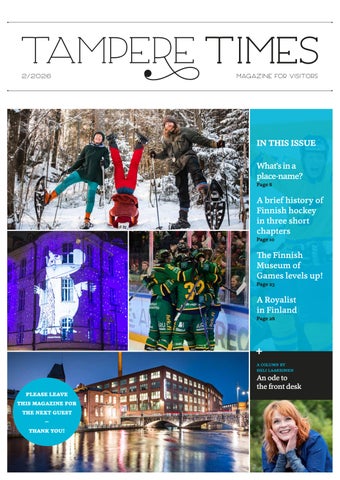
IN THIS ISSUE What’s in a place-name? Page 8
A brief history of Finnish hockey in three short chapters Page 10
The Finnish Museum of Games levels up! Page 23
A Royalist in Finland Page 28
A column by Heli Laaksonen
please leave this magazine for the next guest – thank you!
An ode to the front desk
Welcome to Tampere, Finland’s most loved city Set between two beautiful lakes, Tampere blends urban culture with outdoor experiences in a way that feels effortless. You can move f rom a lakeside sauna to a lively restaurant, f rom forest trails to cultural landmarks, all at your own pace. There is a certain ease to life in Tampere. You see it in cafés buzzing with conversation, and in f riends meeting for a sauna after work, taking a swim before dinner. Here, everything is closer than you think: a morning stroll along the scenic Pyynikki Ridge, lunch in the historic Market Hall, a day exploring museums and local flavours, a lakeside sauna at sunset and a live gig to end the day. In most places, you’d have to choose. In Tampere, it all f its into one unforgettable day. Welcoming and ref reshingly unpretentious, Tampere invites you to experience more, without ever feeling rushed.
Share your favourites on social media by tagging and with #VisitTampere @visittampereoff icial @visittampere Visit Tampere
Check out our tips at visittampere.com
Give feedback on your visit to the City of Tampere and Visit Tampere Ltd.
World’s Sauna Capital
Step into the world’s Sauna Capital and let nature, relaxation and Finnish happiness come together. From historic public saunas and traditional smoke saunas to modern architectural landmarks and peaceful lakeside retreats, Tampere offers unforgettable experiences shaped by warmth, water and wellbeing. Pair the gentle steam with a ref reshing lake swim, embrace local traditions, and experience a way of life that has brought people together for generations. Ready to f ind your perfect sauna? Find your favourite at saunacapital.com
Photos: Laura Vanzo/ Visit Tampere
Great food, genuine people, no fuss
In Tampere, culture is part of the city’s fabric. Its industrial heritage lives on in red-brick districts that have found new life as centres of culture. Museums, theatres, live music and events bring the city to life throughout the year. Explore the dynamic Museum Centre Vapriikki, wander through the historic Finlayson district, or take in panoramic views f rom the iconic Näsinneula Tower. Tampere is also home to the world’s only Moomin Museum, where visitors of all ages can step into the beloved stories and illustrations of Tove Jansson and discover one of Finland’s most cherished cultural treasures.
Whether you’re enjoying street food at the marketplace, discovering local delicacies in the historic Market Hall or indulging in award-winning f ine dining, Tampere offers a culinary experience for every taste. From cosy cafés and creative bistros to acclaimed restaurants, the city’s food scene celebrates seasonal ingredients, culinary creativity and a welcoming atmosphere. Here, even f ine dining is ref reshingly relaxed. Great food, genuine people, no fuss: come as you are and enjoy the best of Finnish flavours.
World’s only Moomin Museum
CONTENTS Enjoy warm experiences in Tampere 6 What’s in a place-name? 8 A brief history of Finnish hockey in three short chapters 10 Gone with the stars 14 Tampere in a nutshell 16 Map of Tampere 18 Hotels providing Tampere Times 20 The Finnish Museum of Games levels up! 23 A Royalist in Finland 28 Captain Finland: How to make it in Finland, Part 4 32 An ode to the front desk – Column by Heli Laaksonen 34
Tampere Times Magazine for Visitors Issue 2/2026 Autumn-Winter-Spring www.tamperetimes.fi ISSN 2343-3817 (print) ISSN 2669-8293 (online)
Editor in chief Roope Lipasti
Graphic design & layout Petteri Mero Mainostoimisto Knok Oy
Sales manager Kari Kettunen kari.kettunen@aikalehdet.fi Tel. +358 40 481 9445
Sales manager Raimo Kurki raimo.kurki@aikalehdet.fi Tel. +358 45 656 7216
8
10
14
23
Published by Mobile-Kustannus Oy Betaniankatu 3 lh FI-20810 Turku, Finland Member of Finnish Magazine Media Association (Aikakausmedia) Publisher Teemu Jaakonkoski Printed by Newprint Oy
Cover photos Snowshoeing. Photo: Laura Vanzo / Visit Tampere Moomin lights installation. Photo: Laura Vanzo / Visit Tampere Ilves ice hockey team. Photo: Anssi Takala / Visit Tampere Tampere by night. Photo: Laura Vanzo / Visit Tampere Heli Laaksonen. Photo: Suvi Elo
Digital edition of Tampere Times: www.tamperetimes.fi The magazine is available in hotel rooms in the city of Tampere (see page 20). Next issue will be out in April 2027. 4
The largest covered shopping street in Tampere Located in the heart of Tampere, Tullintori brings together a vibrant mix of the city’s best restaurants, local cafés, specialty shops and wellness services. You’ll also find everyday essentials, including grocery stores, a pharmacy and ATMs, all under one roof. With entertainment and activities for all ages, Tullintori offers something for everyone. Whether you’re a local or visiting Tampere for the first time, there’s always a reason to stay a little longer – every visit is an experience. Opening hours Mon–Fri 7 am – 9 pm Sat 9 am – 9 pm Sun 12 pm – 9 pm Tullikatu 6 | tullintori.fi Please note that some shops are closed on Sundays.
photos: Laura Vanzo / Visit Tampere
Enjoy warm experiences in Tampere Hello traveler! A warm welcome to Tampere, the most loved city in the happiest country in the world. Autumn and winter bring a special atmosphere to Tampere. With over 70 public saunas in the region, Tampere is the Sauna Capital of the World. That’s something we are very proud of. As the temperature drops, experiencing sauna gets a whole new twist with a dip in the cold lake. It’s a Finnish tradition that might sound extreme at first, but I recommend giving it a try. You may be surprised by how good it feels! The public saunas are also some of the best places to meet locals and experience an important part of Finnish everyday life. Another great place to meet locals is the Nokia Arena. Tampere is a city that loves sports. Especially ice hockey has a special place in local culture. I recommend catching a game while you’re here. The atmosphere in the stands is an experience in itself and offers a great glimpse into Tampere’s passion for sports. The cooler seasons are also a perfect time to discover Tampere’s rich cultural scene. Visit the world’s only Moomin Museum, explore our many other museums and galleries, or enjoy a concert, theatre performance or one of the many events taking place around the city. And when it’s time to warm up, Tampere’s cafés and restaurants offer plenty of great places to stop and stay a little longer. But don’t let the cooler weather keep you indoors. Autumn colours and crisp winter days offer a wonderful reason to explore Tampere on foot. Nature is always close here, even in the heart of the city. Take a walk along the shores of Tammerkoski rapids, wander through the city centre and admire the red-brick industrial landscape. When the snow arrives, familiar places take on a completely new character. One of my favourite places to show my guests is the Finnish Labour Museum Werstas, located in the historic Finlayson area. It’s a great place to discover the industrial story that shaped our city.
Make sure to see the impressive steam engine that once powered the Finlayson cotton mill. Still in its original location, with a flywheel over eight metres in diameter, it gives you a real sense of the scale of Tampere’s industrial past.
As the temperature drops,
experiencing sauna gets a whole new twist with a dip in the cold lake.
While you are in the Finlayson area, I also recommend visiting the Spy Museum. At the museum, you can learn about real spies, their stories and the tools they used. You can also test your own skills and find out if you would make a good secret agent. In Tampere I appreciate how easy it is to combine different experiences. You can spend the morning outdoors, discover a museum in the afternoon, enjoy good food and then end your day at a sauna, a concert or an ice hockey game. Everything is close, so there is no need to rush. I hope you enjoy your time in Tampere, discover something unexpected and find your own favourite places along the way. Whether this is your first visit or you already know the city, I hope Tampere gives you plenty of reasons to come back. Enjoy your stay in Tampere and make yourself at home. Jari Ahjoharju ceo, visit tampere 6
STEAK HOUSE S I N C E
1 9 8 6
THE
BEST
IN
TOWN
ST EAK S since 1986
When you want to feast QUICKLY AND REASONABLY Koskikeskus Shopping center, 3rd floor. www.manhattansteakhouse.fi
What’s in a place-name?
Finland is full of vulgar and just plain strange place-names.
A
Written by Roope Lipasti Translated by Christina Saarinen
strange fact about Finland: It has almost 3,000 place-names that contain the word paska, meaning “shit.” The most common is Paskalampi, “Shit Pond.” And that’s not all! Our country also has hundreds of places called Pillulampi, “Pussy Pond.” The latter usually comes from the shape of the pond, while the former refers to the darkness of the water: shallow and murky, with muddy bottoms – or as we say in Finnish, “shitty” places. Of course, it could also be that the names tell us something not only about the physical landscape, but also about the mental landscape of Finns... To some extent, the abundance of vulgar or obscene place-names is due to changes in the language: what sounds outrageous to modern ears may originally have been relatively innocent. For example, numerous place-names ending in perse, meaning “ass,” such as Hevonperse, Koiranperse, or Sianperse (“Horse’s Ass,” “Dog’s Ass,” and “Pig’s Ass,” respectively) often refer to a landform like a blind valley or a narrow cove. They’re places at the “back end.” One particularly famous and unique place-name is found in Turku: Pallivaha, or “Testicle Wax.” But in the Turku dialect, palli means “ball,” as in the shape, not “balls,” and vaha means “stone.” The name refers to a large round stone – it stands over ten meters high. Only later did palli acquire its other meaning. The village of Pöljä, located on Lake Siilinjärvi, is a somewhat similar case. Today, pöljä means “stupid,” but in the past, it meant a log or block of wood.
What sounds outrageous to
modern ears may originally have been relatively innocent.
8
Sometimes, place-names are purely nonsensical and sound like they were invented to torment tourists and sign-makers
ÄTERITSIPUTERITSIPUOLIL AUTATSIJÄNK Ä King of Titty Hill
Most of Finland’s vulgar place-names were discovered and preserved in the twentieth century, when researchers and mapmakers Terskanperä, “Penis Back,” in Siikalatva is a name that might make traveled the country interviewing local residents. Their respondents you choke on your morning coffee, but originally, terska was simply reported the names by which forests, ponds, and islands had always the name of a house and a word for difficult terrain. been called, not putting a shine on them. Other classics include Pillujoki, “Pussy River,” in Lapland; The mapmakers, in turn, faithfully wrote down the names and put Horonpohja, “Slut End,” in Joutsa; and Mulkkusaaret, “Dick Islands,” them on the map. Today, of course, new place-names follow modern in Sulkava, among many other places. All of these can be traced to sensibilities. Offensive or vulgar names are not accepted. descriptions of geographical features. Sometimes, however, residents do want to change a name they There are also many Hells in Finland. And we may not have any find problematic. In Pöljä, for example, changing the name has been mountains, but there are multiple places named “Titty Hill” and proposed several times with little success. These days, the people of one “Pussy Ridge.” Pöljä bear the name proudly, and it’s practically a brand. A few years ago, in a poll by Kotiliesi magazine, Finns voted The people of Horonpohja have also been interested in a change, Suolikulli, “Bowel-cock,” in Urjala as Finland’s most awful place-name. but it hasn’t gone through because horo once meant “sparse,” “spacious,” Velhonvittu, “Sorcerer’s Cunt,” in Lavia took a strong second place. or “crack.” Strangely, Pierupapinlähde, “Fart Priest’s Spring,” in Orimattila only Nonetheless, sometimes money talks: Kusipää, “Dickhead Fell,” in came in tenth. Inari was renamed as Kaunispää, “Beautiful Fell,” when the area was Sometimes, place-names are purely nonsensical and sound developed into a tourist ski resort. The thought was that the new name like they were invented to torment tourists and sign-makers: For sounded more like the kind of place tourists would like to visit. But example, Savukoski is home to the longest place name in Finland, if you did want to go to Kusipää, you can still find one in Sodankylä. Äteritsiputeritsipuolilautatsijänkä, which is partly in a Sámi language In some cases, a Paskalampi has also been changed to the more or some corrupted version of Sámi, and doesn’t really mean anything. Instagram-friendly Joutsenlampi, “Swan Pond,” or Mustalampi, “Black Perhaps it was meant to annoy the authorities when the property Pond,” if properties were developed along the shore and the existing register was created. name threatened the image of the area. Of course, it’s purely a matter of taste whether you’d prefer to live by Joutsenlampi or perhaps along the shore of Perseensilmälampi, Take a holiday in Dickhead “Asshole Pond.” The latter, if you’re interested, can be found in Ranua. s Because even lewd names are names and can therefore tell us something about history, they aren’t often changed. In Finland, the National Land Survey is responsible for the names of places. (Their website provided the examples for this article – what a great way to relive schoolboy humor!) As a rule, if a name has been used by locals and officially recorded, it’s retained on the map. Place-names are considered historical documentation of how people have described their environment. Usually, the obscenest place-names are also located off the beaten track, and don’t really bother anyone. Places in the vicinity of one’s own village were given more pleasant names.
SHIT POND
9
Sweden's Mats Sundin celebrates 5–6 goal against Finland during the quarterfinal ice hockey World Championships match in Helsinki 2003.
A brief history of Finnish hockey in three short chapters Written by Matti Mäkelä Translated by Christina Saarinen
Chapter one: The Book of Job
two-goal lead over Sweden. In 1975, one measly extra goal in either match against Sweden would have been enough. The team couldn’t make any of these happen. The most bitter Job moments occur in 1974, when Finland’s medal was snatched away due to goaltender Stig Wetzell’s doping scandal, and 1976, when an Olympic medal is lost to Germany by a goal ratio difference of 0.04. Then come the 1986 and 1991 Sweden matches, the outcomes of which would make even God and Satan, who conspired against Job, proud. Both times, Finland leads by two goals with a minute to go, and both times Sweden equalizes, denying Finland a medal in 1986, and a place in the playoff round five years later. The trials and tribulations seem to be over in 1995, when Finland finally wins the World Championship. That sigh of relief is premature, however, and over the next 20 years, Finland will play in the World Championship final seven times and leave the rink defeated in six of them. With Finland hosting the World Championship in 2003, a disaster comparable to floods, plague, boils, and locusts strikes: in the quarterfinal, Finland leads Sweden 5–1 in the second period, but ultimately loses 5–6.
Fans of the Red Sox baseball team, the pride of Boston, have been known to sport merch with the slogan “Job was the first Red Sox fan.” The unjust trials endured by the pious, God-fearing, upright Job of the Old Testament would suggest that in years past, he was also a fan of the Finnish national ice hockey team. Like the Red Sox, who languished without a championship for 86 years, the Finns participated in the Ice Hockey World Championship for 56 years before securing their first win. What makes Finland’s pain almost biblical is that the team came so close so many times. In 1970, Canada withdraws from the World Championship for seven years in protest of the ban on sending professional players to the games. Finland sees its chance, not for the championship but for the bronze: the Soviet Union and Czechoslovakia are too strong, but Sweden might be beatable. Again and again, the coveted bronze medal is nearly within reach, but always painfully lost at the last moment: In 1970, Finland needed to beat East Germany, which was at risk of being relegated to Pool B, or hold a 10
Chapter two: Fear and Loathing in the Hockey Rink
Chapter three: The Metamorphosis But then, all of a sudden, the Finnish hockey player awakes from restless dreams and finds himself transformed into a winner. Of the seven World Championships that have been held in the past eight years, Finland has won three. The last two were even in overtime, which had previously been almost as terrifying for Finns as a penalty shootout for the English national football team. Two Olympics have been held in that same period, with Finland taking home a gold and a bronze. For their part, Sweden – that old nemesis – has finally underperformed, resulting in two fourth places at the Olympics and two bronze medals at the World Championships. The change is being driven by a new generation of players, raised in the happiest country in the world, for whom believing in themselves and their team’s potential is a given. It’s a generation that – to paraphrase Muhammad Ali – is so good that it’s hard or even impossible to be humble. A generation for whom the idea of Finns as poor country cousins is incomprehensible. This new, brave world revealed itself for the first time in the final of the World Junior Championship in Helsinki in 2016. Finland scored and took the lead against Russia a couple of minutes before the end, but Russia got lucky and tied it up with just 6.9 seconds to go. In the bad old days, this would have been completely devastating for the Finnish team, but this time was different. Forward Kasper Björkqvist summed up the changed attitude in a short TV interview before the start of overtime: “This is hockey at its best. They managed to tie it up, but we’ll score the next goal.” And that’s what happened. Now that Finland’s winter of losses has turned into a glorious summer of victories, it’s perhaps good to return – to see how far we have come – to the darkest moment in Finnish ice hockey history, the 1960 Olympics in Squaw Valley, where Finland loses to Germany and drops to the consolation round, facing Japan and Australia as opponents. Turning the knife in the wound, the Finnish media compounds the shame by saying that Finland was now playing ice hockey in the Pacific series. s
How did things turn out this way? The topic has been discussed endlessly in Finland, and the explanations can be roughly divided into the psychological and the magical. The former is based on the idea that Finnish players simply couldn’t handle high-pressure situations: with victory in sight, the possibility of defeat created fear, which led to overly cautious playing and easy mistakes. According to the firm beliefs of kitchen psychologists, the Sweden games turned into perfect storms when this fear was combined with Finns’ weak self-esteem, little-brother complex, and envy of their richer and larger western neighbor. On the magical explanation side, it might be claimed that Finns are afflicted with bad luck in general, while Swedes’ luck never seems to run out. This luck is not limited to hockey alone, but can be seen, for example, in the fact that Sweden does not have a land border with Russia (which, of course, applies to most countries in the world), and that the Swede Thomas Wassberg beat the Finn Juha Mieto in the 15-kilometer cross-country skiing event at the Lake Placid Olympics by one hundredth of a second. Taking it even further, this toxic concoction can be given a dash of the Finnish national character, which some believe is prone to misery and melancholy and flourishes only in moments of defeat and sadness. Of course, Finnish sarcastic humor helps ease the pain. Consider how the outcome of World War II was described in Väinö Linna’s classic novel The Unknown Soldier: “The Union of Soviet Socialist Republics won, but plucky little Finland took a strong second place.”
The trials and tribulations seem to be over in 1995, when Finland finally wins the World Championship.
World Championship celebrations in 1995.
Photos: Ilkka Laitinen / Vapriikki photo archives
11
jens lö öke 29
l ukas jase k 9
O N D REJ KO S 15
October
sat 3.10. 17:00 fri 9.10. 18:30 sat 17.10. 17:00 tue 20.10. 18:30 sat 31.10. 17:00
Home games 2026-27
k-espoo lukko jokerit jukurit kalpa
See the full schedule and game start times at ilves.com
wed 11.11. 18:30 sun 15.11. 15:00 fri 20.11. 19:30 tue 24.11. 18:30 sat 28.11. 17:00
December
wed 2.12. 18:30 tue 15.12. 18:30 thu 17.12. 18:30
pelicans saipa tappara ässät hifk kärpät hpk kookoo
Photo: Tuomas Uusheimo
buy tickets: ILVES.LIPPU.FI
November
January
sat 2.1. 17:00 tue 5.1. 18:30 sat 9.1. 17:00 tue 12.1. 18:30 sat 16.1. 17:00 tue 19.1. 18:30 sat 23.1. 17:00 tue 26.1. 18:30 fri 29.1. 18:30
tps lukko hifk jyp tappara ässät sport k-espoo jokerit
February
tue 2.2. 18:30 sun 7.2. 15:00 tue 23.2. 18:30 sat 27.2. 17:00
March
tue 2.3. 18:30 sat 6.3. 17:00 tue 9.3. 18:30
kärpät kalpa hpk jyp pelicans saipa sport
Experience the Timeless Charm of Kangasala The city of Kangasala combines stunning national landscapes, peaceful lakes, rich cultural heritage and nature experiences throughout the seasons. Easy to reach, hard to forget.
visitkangasala.fi
Welcome to the House of Concerts, Theatre, Cinema and Arts! All under one roof – just 20 minutes from Tampere. Plan your visit:
kangasala-talo.fi
For the Car Lovers Welcome to Mobilia, Finland’s national responsibility museum for road and motor transport. Explore several exhibitions, including the popular Rally Museum. Fun for the whole family! Open year-round, including Mondays.
mobilia.fi
Gone with the stars In Finland’s winter sky, you can see the northern lights and a whole lot more.
T
Written by Roope Lipasti Translated by Christina Saarinen
Northern lights all over
urku-based amateur stargazer and astronomy evangelist Eeva-Kaisa Ahlamo has been interested in the topic since the age of four. As a first grader, she gave a presentation about stars to her entire school, one grade at a time: “The teacher was my assistant and helped with the slides. Later, she teased me about breaking off my lecture at some point and asking very seriously for her to return to the previous slide because I had forgotten to say that ‘Pluto’s orbit is backwards’ – whatever my precocious 7-year-old self might have meant by that.” Since then, the hobby has even taken Ahlamo to live in New Zealand for a couple of years to admire the stars of the southern hemisphere. Yet she has one personal characteristic that doesn’t lend itself to the hobby: “For a stargazer, I’m not much of a night owl. I have to decide already during the day if I’m going to stay up the following night. But because of the stars, I always take my summer vacation in September, for example, because at that time of year, it starts getting dark enough earlier.” It is dark quite a lot of the time in Finland, which is perfect for stargazing enthusiasts. The downside is that it is often also cloudy, especially in winter, which hinders one’s opportunities. And of course it’s too bright in the summer. Luckily, that still leaves several months to admire the sky.
Of course, one thing you can see at night in Finland is the northern lights. And not just in Lapland, but all over the country, though they are most concentrated in Lapland, and often more spectacular there. “Contrary to popular belief, the northern lights occur all year round and at all times of day. In the summer and during the day, the sky is just too bright to make them out. The northern lights are so visible in winter precisely because there is so much darkness. Personally, I’ve seen the best lights in August, but you have to stay up late so the sky is properly dark and gives the best contrast with the lights.” Ahlamo explains that the northern lights are related to the activity of the sun. The activity of our nearest star fluctuates in 11-year cycles, and we are currently moving toward quieter times. However, there will still be very good chances of seeing spectacular northern lights in the next couple of years, as long as the sky is clear and dark enough and a suitable solar storm tickles Earth’s atmosphere. The best places to spot the northern lights are anywhere it’s dark. City centers are bad because there’s too much light, but if you make your way to an even slightly darker place, where street lamps don’t shine directly in your face, the northern lights may appear: “Typically, they’ll look like a featureless grayish arc that hovers about a palm’s width above the northern horizon. Many people would mistake it for a cloud, if they even bothered to look in that direction. The biggest problem with spotting the northern lights is that people don’t really look up at the light-polluted sky,” Ahlamo says. Though people often imagine that freezing weather and the northern lights are related, she explains that isn’t the case: “The sun doesn’t ask whether it’s freezing on Earth! But when it’s cold, the sky is often cloudless, and in the cold season, it’s also dark.”
photo: Eeva-Kaisa Ahlamo
Start with wonder Ahlamo is not a professional astronomer – she works in communications. But she has been a northern lights safari guide in Lapland and led astronomy events in Finland and New Zealand. So perhaps it’s no surprise that she has her own telescope. But even though she usually has it along, it doesn’t always get used. “Often, I’ll end up looking at familiar objects with my naked eye or spotting satellites or things like that, and then I’ll realize I haven’t used the telescope at all. Stargazing isn’t actually a hobby that depends on equipment – unless you want it to. The greatest experiences can be had without it, when you look up at the sky and feel a connection with the universe. Your own problems seem pretty small if you look at them from beyond the orbit of Neptune!” Ahlamo advises beginners to start with wonder: “Just look up at the sky and wonder what all that stuff is, where does it come from, how does it work. That kind of wonder is innate to humans. Of course, as a hobby, the more you learn about things, the more you get out of it.”
Observing familiar planets When the weather is clear, it’s worth looking at the sky for more than just the northern lights. This winter, for example, there is quite the planetary cavalcade on offer, Ahlamo says: “The ringed planet Saturn will be hanging at due south at nightfall in early winter. It’s slightly yellowish, but not super bright. To see the rings, you’ll need a small telescope. As winter goes on, the planets Jupiter and Mars will also rise in the east during the evening. This winter, they’ll be next to each other in the constellation Leo. Jupiter is easy to recognize: it’s that really bright star low in the eastern sky. Mars, which is reddish, will be to its left, slightly lower.” And then, of course, are the constellations: 14
Elon Musk overhead
The starry sky is interesting and beautiful
The starry sky isn’t motionless, quite the contrary. For one thing, there are heaps of satellites up there: “They’re especially visible soon after sunset. The sun is still shining in Earth’s orbit then, and it illuminates the satellites with its light. Their solar panels are good reflectors.” How can you identify a satellite? “A good rule of thumb is that if it flashes, it’s an airplane. If it looks like a moving star and you can see it long enough to point it out to a friend, it’s a satellite. If you only have time to say ‘whoa!’ before it disappears, it was a shooting star,” Ahlamo says, adding: “Satellites usually move individually, but nowadays even in Finland you can see chains of multiple satellites, where they follow one another like a string of pearls. Those are Elon Musk’s famous Starlink satellites. The Finnish sky also has many polar orbit satellites, whose orbit passes over the poles. They’re often Earth observation satellites, used for research or even surveillance. The satellites are very close, less than 1,000 kilometers above Earth’s surface. From time to time, you can also see the International Space Station on the southern horizon as it travels around our planet.”
and inspires deep thoughts.
“The most famous constellation in the winter sky is Orion. It’s easy to recognize from Orion’s Belt, a tight row of three stars that is visible low in the southern sky in the winter. Orion itself is shaped like an hourglass, with the belt in the middle. In classical mythology, Orion was a hunter.” The North Star is a constant Orion is also a tool that can help novice stargazers find other stars, Ahlamo says. If you trace along the sky in the direction indicated by Orion’s Belt, down and to the left, you will soon find the brightest star in the sky, Sirius. Sirius is very close to the horizon and usually twinkles quite a bit because the star’s light has to pass through a lot of atmosphere before it reaches our eyes. “Harry Potter fans will know the character Sirius Black, who was named after this star. The upper right star in Orion’s hourglass is called Bellatrix. If you follow Orion’s Belt in the other direction, to the right and upwards, you will soon encounter the constellation Taurus, with a small star cluster riding on its back. That cluster is Pleiades, or the Seven Sisters. Those who have read Lucinda Riley’s books will be able to list the names of the stars in the cluster.” If you lose your sense of direction (and who wouldn’t), you can determine north using the Big Dipper: “The Big Dipper is a large group of stars resembling a scoop, which belongs to the constellation Ursa Major. In winter, the Big Dipper stands upright on its handle in the northeastern sky. If you find the two stars of the front edge of the bowl, you can use them to draw a line upwards relative to the open top of the bowl. The first brighter star you come across on this line is the North Star,” Ahlamo says. It’s located directly above the North Pole, so that direction is north. The North Star never moves from its position, while the rest of the starry sky appears to rotate around it counterclockwise.
A world-class time machine The starry sky is interesting and beautiful and inspires deep thoughts. In her star shows, Ahlamo likes to remind audiences that the sky is actually a huge time machine: “By looking into space, we look into the past. The speed of light is the fastest known speed in the universe, approximately 300,000 kilometers per second. When we hear how far away a star is in light-years, we also know how long the light we see now has been traveling through space. So that’s how far we’re looking into the past. For example, the Andromeda Galaxy is 2.5 million light-years away, so we’re seeing what it looked like 2.5 million years ago. But it’s good to remember that it also works the other way around: if there’s someone in Andromeda looking at us right now with a big telescope, they’ll see the first great apes learning to use tools. That’s when you start to understand the truths of the universe.” s
Eeva-Kaisa Ahlamo.
photo: Eeva-Kaisa Ahlamo
Eeva-Kaisa Ahlamo’s tips: How to photograph the northern lights The human eye has a hard time distinguishing colors in the dark, which is why the beauty captured in photographs never looks quite the same in real life. On the other hand, photographs can’t reproduce the movement that northern lights paint in the sky. You can photograph the northern lights with a mobile phone, but depending on the phone, you might need night mode, or a long exposure and a steady hand. The idea is to take an exposure of a few seconds, during which the camera shouldn’t move. Different phones have different options for how long of an exposure they can take. With interchangeable-lens cameras, photographers should choose the largest aperture and widest angle possible. Depending on the brightness and activity of the northern lights, you can then adjust the exposure and ISO accordingly. The faster the northern lights move, the shorter the exposure and the higher the ISO. And set the focus to infinity! 15
Tampere
1820
in a nutshell
A Scotsman called James Finlayson set up a cotton factory near the Tampere Rapids. It was the first but not last major factory in the remarkable industrial history of Tampere. Finlayson still is a brand every Finn knows. Also from that time on, the use of waterpower from Tampere Rapids became important.
1840
Written by Roope Lipasti Translated by Owen F. Witesman
From the 1840’s Tampere became the most industrialised city in Finland. Soon there were factories that made iron, paper, machinery, clothes, shoes and many other things. Even to this day Tampere is sometimes called “Manse”, which comes from the saying that Tampere is the Manchester of Finland.
8000 BC The connection to ocean from the Tampere region was cut when the ice age was finally over. As the ice melted, the land rose up and the lakes were born – also Näsijärvi and Pyhäjärvi, and little later the Tampere Rapids. A must see attraction from the ice age is Pyynikki, a 90 hectare ridge area, which is almost in the centre of the city. From here there are marvellous views to lake Pyhäjärvi. It is also a beautiful place for other outdoor activities.
1901 Tampere is also a vibrant theatre city. The first one, Tampereen Työväen Teatteri – The Tampere Workers Theatre – was established 1901. In 2020 there are over 10 professional theatres in the area.
1918
600 Tampere was an ideal place to build a village, because there were good waterways to both north and south. The first signs of permanent living in the area are from the 7th century.
In 1918 Finland was torn by a civil war with two sides: the “reds” and the “whites”. As a working class city, Tampere sided with the reds (who lost). Tampere saw severe battles, thousands died in war efforts and even more in prison camps.
1200
1939–1945
By the 13th century Tampere region had grown, and it was an important market place. It was inhabited by the Pirkka tribe and even today the Tampere province is called Pirkanmaa, “The land of the Pirkka”.
Finland was in war against Russia, and Tampere was an important centre of war industry. For example Tampella made mortars and cannons. Tampere was also bombed, but luckily there was little damage.
1638
1971
Tampere was not yet an actual city, but in 1638 Finland’s governor Per Brahe ordered two yearly fairs to be held at the the Tampere Rapids. That’s why Turku – the then capital of Finland – and Tampere have got a special connections of fates, for when the whole city of Turku burned in 1827, the damage was so severe partly because all the men from Turku happened to be at the Tampere fair.
Näsinneula, the high tower that Tampere is famous for, was built. Few years later The Särkänniemi Amusement Park opened its doors.
1990 During the 90’s the heavy industry of Tampere was in trouble. One reason was the collapse of Soviet Union, but all and all the world was changing. The chimneys were no longer active, and the factories shut down. Nowadays they are renovated for apartments, museums and such. Industry in today’s Tampere in mostly high tech.
1779 The King Gustav III of Sweden finally granted Tampere the full township status. And no wonder, because Tampere was huge: 3.2 square kilometres with population of no less than 200!
2026 Tampere is the third biggest city in Finland, with 264,000 inhabitants in the city. It has four universities and a very vivid cultural life. Tampere is also a city of vision and courage: the brand new tramway is a good example of that! s
1824
photo: Mikko Vares / Visit Tampere
The beautiful old church of Tampere was built. The architect was Charles Bassi.
16
A FAMILY BAKERY SINCE 1954 We l c o m e t o P y y m ä e n – a F i n n i s h f a m i l y - ow n e d b a ke r y wh e re t ra d i t i o n m e e t s m o d e r n c a f é c u l t u re . N ow i n i t s fo u r t h g e n e ra t i o n , o u r f a m i l y c o n t i n u e s t o b a ke , c re a t e a n d s e r ve w i t h t h e s a m e p a s s i o n t h a t s t a r t e d i t a l l i n 1 9 5 4 . B re a k f a s t , a r t e s a n c a ke s a n d m a c a ro n s , l u n c h m e n u , w i n e s , e s p re s s o , f re s h b a ke d b re a d a n d p a s t r y f ro m ow n b a ke r y. C o m e i n , t a ke a s e a t a n d e n j oy a l i t t l e t a s t e o f o u r f a m i l y t ra d i t i on . Discover our cafes in Tampere: Pyymäen Aira, Hämeenkatu 14 Pyymäen Oma, Tuomiokirkonkatu 32
Entertainment for all ages
www.pyymaen.fi @pyymaen
ARCADE Games
Bar tampere@zbase.fi
+358 50 345 2810
FINLAYSON AREA - NORTH SIDE OF KESKUSTORI
zbase.fi
YOU ARE HERE! Hotels providing Tampere Times are marked on the map with numbered blue dots. The list of hotels can be found on page 20.
Tampere
Digital magazine
Tampere Times digitally
www.tamperetimes.fi
Finland Norway
Sweden Estonia Latvia
Denmark
Germany
Lithuania Poland
Tram lines nysse.fi/en
10
12
18
0
500
18
© Tampereen kaupunki 2026
6
3
3
19
9
11
16 15
13 4 8 17
7
2
1
14
5
PLEASE LEAVE THIS MAGAZINE FOR THE NEXT GUEST – THANK YOU! 19
Tampere Times is available in these high standard hotels and hostels
01 Courtyard by Marriott Tampere City Hotel
08 Original Sokos Hotel Villa
14 Scandic Tampere Hämeenpuisto
Sumeliuksenkatu 14, 33100, Tampere +358 20 123 4633 www.sokoshotels.fi
Hämeenpuisto 47, 33200 Tampere Tel. +358 3 4108 1628 www.scandichotels.fi
02 Dream Hostel Tampere
09 Radisson Blu Grand Hotel Tammer
15 Scandic Tampere Koskipuisto
Åkerlundinkatu 2, 33100 Tampere Tel. +358 45 236 0517 www.dreamhostel.fi
Satakunnankatu 13, 33100 Tampere Tel. +358 20 123 4632 www.radissonblu.com
03 Hotel Kauppi
10 Scandic Eden Nokia
Kalevan puistotie 2, 33500 Tampere Tel. +358 3 253 5353 www.hotelli-kauppi.fi
Paratiisikatu 2, 37120 Nokia Tel. +358 3 4108 1627 www.scandichotels.fi
04 Lapland Hotel Tampere
11 Scandic Postitalo
Yliopistonkatu 44, 33100 Tampere Tel. + 358 3 383 0000 www.laplandhotels.com
Rautatienkatu 21, 33100 Tampere Tel. +358 3 0030 8486 www.scandichotels.fi
05 Lillan Boutique Hotel
12 Scandic Rosendahl
18 Spa Hotel Holiday Club Tampereen Kylpylä
Kurjentaival 35, 33100 Tampere Tel. +358 10 200 7305 www.lillan.fi
Pyynikintie 13, 33230 Tampere Tel +358 3 244 1111 www.scandichotels.fi
Lapinniemenranta 12, 33180 Tampere Tel. +358 30 687 0000 www.holidayclub.fi
06 Norlandia Tampere Hotel
13 Scandic Tampere City
19 Uumen Tampere Finlayson
Biokatu 14, 33520 Tampere Tel +358 50 3844400 www.norlandiahotel.fi
Hämeenkatu 1, 33100 Tampere Tel. + 358 3 244 6111 www.scandichotels.fi
Finlaysoninkatu 5, 33210 Tampere Tel. +358 10 579 2730 www.uumenhotels.fi
Yliopistonkatu 57, 33100 Tampere Tel. +358 29 357 5700 www.marriott.com
07 Original Sokos Hotel Ilves
photo: Tampere Taivaalta / Visit Tampere
Hatanpään valtatie 1, 33100 Tampere Tel. +358 20 123 4631 www.sokoshotels.fi
20
Koskikatu 5, 33100 Tampere Tel. +358 3 4108 1626 www.scandichotels.fi
16 Scandic Tampere Station Ratapihankatu 37, 33100 Tampere Tel +358 3 339 8000 www.scandichotels.fi
17 Solo Sokos Hotel Torni Tampere Ratapihankatu 43, 33100, Tampere Tel. +358 20 123 4634 www.sokoshotels.fi
CONTEMPORARY DANCE WITH A TURN
HÄLLÄ-NÄYTTÄMÖ, HÄMEENKATU 25 TA N S S I T E AT T E R I M D . F I
YOUR LOCAL TAXI SERVICE Tampere • Pirkkala • Kangasala • Lempäälä • Nokia • Ylöjärvi
CALL
+358 100 4131 (2,84 €/call + 0,55 €/min + local network / cellphone charge)
taksitampere.fi
facebook.com/taksitampere instagram.com/taksitampere
Discover
the Tampere region with Nysse Plan your trip with Nysse journey planner
Nysse buses and trams offer a smooth journey to sights and events in the Tampere region. Tickets can be purchased easily using the Nysse Mobiili app or contactless payment.
Find the best routes, schedules and real-time travel information. reittiopas.tampere.fi/en
Tampere regional transport | nysse.fi/en
ANISH KAPOOR –4.4.2027
Anish Kapoor, Ancestor, 2026. ©Anish Kapoor. All rights reserved, DACS/Kuvasto 2026.
FAR-OUT ART WITH A HISTORIC HEART Open 1 Sep–31 May Tue–Sun 11–18 | 1 Jun–31 Aug daily 10–18 Public sauna days at the Art Sauna every Tuesday | Restaurant Gösta open on museum opening days | Train & Taxi service on Tuesdays and Saturdays | Buy tickets and services > shop.serlachius.fi
photo: Heikki Kuittinen, Vapriikki Photo Archives
A cosy gaming corner where the new Amiga 500 with Kickstart 1.2 and the game ‘Winter Games’ are about to start, 1988.
The Finnish Museum of Games levels up! Text: The Finnish Museum of games / Outi Penninkangas
Do you play card games, solve Sudoku puzzles, or paint miniature soldiers? Or perhaps you teach your grandchild to play chess?
T
Games are played all over the world, but at the Finnish Museum of
Games you can explore the unique story of Finnish gaming culture.
he Finnish Museum of Games has been part of the Museum Centre Vapriikki for almost ten years. Since its opening in 2017, the museum has enjoyed strong public support as the first museum dedicated to Finnish gaming culture. In autumn 2026, the museum underwent an extensive renovation, giving games an even larger presence within the museum centre.
The Finnish Museum of Games showcases not only digital games but also board games, role-playing games, and traditional games. Through more than one hundred exhibits, visitors can explore a cross-section of the history of the Finnish game industry and gain insight into the creative work of independent game developers. Some of the games are internationally renowned success stories, such as Angry Birds and Clash of Clans, while others were never commercially released.
23
photo: Saarni Säilynoja, Vapriikki Photo Archives
The Finnish Museum of Games showcases
not only digital games but also board games, role-playing games, and traditional games.
Exhibits at the Finnish Museum of Games.
Games such as the fishing simulator Pro Pilkki and the car-building simulator My Summer Car reflect distinctly Finnish themes and experiences. Almost every Finn has, at some point, played either the board game Afrikan Tähti (The Star of Africa) or the mobile classic Matopeli (Snake). Whenever possible, the games on display are playable. The gaming stations invite visitors to try games such as Lord, a text adventure game released in 1981, which is among the earliest computer games inspired by The Lord of the Rings. Visitors may also be surprised to encounter Hugo, the game controlled using an old push-button telephone. Originally based on a Danish concept, Hugo became a household name in Finland through the interactive television game show of the 1990s, and especially through its charismatic host Taru Valkeapää, who captivated an entire generation of players. Elsewhere in the exhibition, visitors can safely experience the thrill of demolition derby racing by taking the wheel in Wreckfest. Developed by Bugbear, best known for the FlatOut series, the game is acclaimed for its realistic physics and extensive vehicle customisation. One of the museum's most popular attractions is the arcade hall, which features around fifteen freely playable machines. Almost all of them belong to the extensive collection of Pelikonepeijoonit, a group of dedicated collectors and long-standing partners of the museum. Thematic period rooms take you on a journey through time Many cherished gaming memories are closely linked to places at home and elsewhere where games were played. The museum features six thematic period rooms, each representing a different year and featuring a typical game of its era, playable on its original hardware. Although staged, these rooms offer a nostalgic journey through Finnish interiors from the 1980s to the 2010s. In the living room set in
1980, visitors can try a "brand-new" Pong console. Nearby, a group of friends gathers around a Commodore 64, while the next room invites visitors to play Super Mario Bros. on the Nintendo Entertainment System (NES). The museum also recreates two environments that have played a distinctive role in Finnish gaming culture: the petrol station and the summer cottage.
The first commercially published board
games appeared in Finland during the 1860s The long history of games Long before the advent of digital games, Finns spent their leisure time playing many kinds of games. Traditional examples include kyykkä and the Sámi game päskksiõrr. Card games, meanwhile, have long been an international pastime. In Finland, the French-suited deck, consisting of spades, diamonds, hearts, and clubs, became the standard. The first commercially published board games appeared in Finland during the 1860s. One of the earliest was Lustfärd till Avasaksa – Huvimatka Aavasaksaan, designed by artist Hilda Olson and published in 1862. The game introduced players to the popular Finnish tourist attractions of the day. Board games, family games, and card games have remained popular for generations. One of the newest games featured in the museum is Agemonia, a cooperative board game whose publication was supported by a crowdfunding campaign that raised more than €200,000 from around 2,000 backers. Its success demonstrates that players remain eager to support innovative game projects and patiently await their release.
24
photo: Kalle Lindgrén, Vapriikki Photo Archives.
The Finnish Museum of Games
A group of card players in the early 20th century.
The realm of games
photo: Saarni Säilynoja, Vapriikki Photo Archives
In one way or another, games and gaming are part of nearly every Finn's life. Video games, card games, board games, role-playing games, bingo, solitaire – these are all games! Games serve as many purposes as there are players. Some games help you relax, while others can teach you things or let you compete against others. Games also bring people together, fostering communities and relationships through shared experiences. The Player Barometer 2024 (Pelaajabarometri), published by the Centre of Excellence in Game Culture Studies at Tampere University, highlights the diversity of gaming in Finland. According to the survey, almost all Finns aged 10 to 75 (97.7%) play some form of game. Non-digital games are played at least occasionally by 96.6% of Finns, while 81.8% play digital games. The survey also found that board games and parlour games have grown in popularity in recent years. (Source: Pelaajabarometri, 2024) As a result, the Finnish Museum of Games has a vast and fascinating field to explore. The museum collects, studies, preserves, and presents gaming culture, the history of game development, and a wide range of materials that are significant to players. Collaboration with communities is a defining feature of the museum's work. s
Located within Museum Centre Vapriikki, the Finnish Museum of Games is a unique museum dedicated to Finnish gaming culture. It presents the long history of games in Finland and explores their significance to players and society. The oldest games in the exhibition date back to the mid-nineteenth century, while the most recent was released in early 2026. In autumn 2026, the museum underwent a major renovation. Exhibition technology, playable hardware, and surface materials were extensively renewed. The aim was to preserve the original concept and character of the acclaimed, award-winning exhibition while updating it with the latest games and technologies. The renewed exhibition now features 110 games. Before the renovation, the museum conducted several surveys among different visitor groups. Many respondents emphasised the importance of retaining the museum's extensive playability. Thanks to significant technological upgrades, these wishes have been fulfilled. Accessibility at the gaming stations has also been improved, and the facilities supporting the essential behind-the-scenes maintenance work have been enhanced, allowing staff to respond more quickly to technical issues.
Pelaaja – The Challenger explores game journalism The Finnish Museum of Games also features a gallery space for temporary mini-exhibitions exploring a wide range of gaming-related topics. The new mini-exhibition, Pelaaja – The Challenger, displays the history of Finnish games journalism through one of the country's most influential gaming publications. Interviews with former editors-in-chief and a range of borrowed objects offer a fascinating insight into the development of Finnish games journalism during the 2000s. The exhibition has been curated by veteran games journalist Jukka O. Kauppinen.
MUSEUM CENTRE VAPRIIKKI Vapriikki is a versatile museum centre located on the banks of the Tammerkoski rapids, offering something to see and experience for the whole family. Visitors can explore over ten exhibitions, including The Finnish Museum of Games, all with single admission ticket. As the Finnish Museum of Games features a wide variety of playable games, age recommendations are provided as a guide to their content. Our visitors are also served by a museum restaurant and a museum shop. The Finnish Museum of Games Museum Centre Vapriikki Alaverstaanraitti 5, 33100 Tampere Opening Tue–Sun 10–18, Mon closed. www.vapriikki.fi on map (page 19) 25
Spy Museum presents the ways and means of espionage
The world’s first spy museum in the city center introduces you to the world of real life James Bonds where a single device can change the world more than governments. World of eavesdropping, hidden cameras and microphones, secret weapons, hacking, code breaking, picking locks...
TA M P E R E
Say the code
“We met at the hotel” to get free Agent Test for the kids!!
Translation books in 12 languages!
VAKOILUMUSEO
Museum is open Monday-Sunday 12-18 Admission ‘26: 11€ / 6€ Agent Test 5€
www.vakoilumuseo.fi Satakunnankatu 18, Finlayson
FREE ENTRAN
CE
OPEN Tue−Fri 10 −16, Sat 12−17
LAULAVAT
SADEPISARAT SINGIN’ IN THE RAIN
Musikaalin ensi-ilta / premiere
9.9.2026
Enjoy the good food and Greek atmosphere Open: Tuesday–Saturday 13.00–22.00
POPULAR AND AWARD-WINNING MEDITERRANEAN RESTAURANT Kyttälänkatu 7, Tampere www.onnileo.fi
Tel 03 2141 282
www.antika.fi
Väinölänkatu 1,33100 TAMPERE
FIRST WISH:
Discovering the best deals in town
FOR FREE!
App Store
Download the app now
Google Play
While in Tampere, make sure to install the Tampere.Finland app on your phone. In it, you’ll find the Tampere Pass – your pass to all the best deals in town. Get discounts and deals for shopping, dining & wining, and cultural events in downtown Tampere.
photo: Harri Hinkka
Satu Jaatinen.
Photo: Jonne Räsänen/ Otava
Written by Roope Lipasti Translated by Christina Saarinen
W
A Royalist in Finland
hen they need to know what’s happening in the world’s royal families, Finnish journalists usually call nonfiction writer Satu Jaatinen to ask what to think about events and how to interpret them: “For example, when I saw the news that Harry and Meghan were moving back to England, I knew that the next morning the phone would be ringing non-stop,” Jaatinen says with a laugh. It all started when Jaatinen had been following royals as a hobby for a long time and noticed that journalists make a lot of mistakes, even with basic terminology. So she wrote the book Rojalistin käsikirja (“The Royalist Handbook”) to explain everything. Since then, she has also published a book about the queens of Finland, and most recently, a work titled Kuolla kuin kuningas (“To Die Like a King”). As a result, Jaatinen has become, almost by accident, the Official Royalist of Finland. She certainly isn’t alone: royals always seem to manage to keep the interest of Finns, regardless of our own status as a boring parliamentary democracy. Or maybe that’s precisely why.
28
Longing for sparkle
Jaatinen believes Finns’ interest in the sparkle of royalty is precisely a result of the typically unassuming Finnish culture: “Though that unassumingness is also a bit contradictory because at the same time, we have official state orders that hand out a slew of medals every year on Independence Day.” The Independence Day celebrations – which have a practically royal flair, in Finnish terms – are also full of gowns that often described as fit for a queen. Another example of Finns’ interest in royals: Currently, the Turku Cathedral, where the actual queen Kaarina Maununtytär is buried, is undergoing restoration. As part of the church renovation, her coffin was opened for a little look at how her corpse was doing, arousing huge interest – all the papers were full of stories about the Finnish queen! It came as no surprise to Jaatinen, considering Finland’s scanty contact with royals: “The kings of Sweden sometimes came to Finland, but actually, the Russian czars visited more often. Finland was a safe country
The kings of Sweden sometimes came
to Finland, but actually, the Russian czars visited more often.
close to St. Petersburg, and they didn’t have to worry about being assassinated here. But the clearest traces of monarchy that still remain in Finland are mostly in the names of city neighborhoods and streets, and in a few castles,” Jaatinen says. A glass sarcophagus with elephants for legs Royals are also a guilty pleasure. Many people roll their eyes and claim not to be interested, but deep down they might think differently: “Often, if I go on television, the host will say beforehand that they’re not interested in that sort of thing, but then afterwards, they might reveal who their favorite monarch is.” And how about Jaatinen, does she have a favorite? “Of the royals living today, Margrethe II of Denmark. She succeeded in running things like a professional, but still kept working hours. On Mondays, she had a day off, and that’s when she painted. She illustrated children’s books and put on art exhibitions. A fun curiosity is the glass sarcophagus she ordered for herself, which has elephants for legs and includes all sorts of symbols related to Denmark and herself. It’s like something out of Sleeping Beauty! I think that if you have the chance and the toys, you should go ahead and play with them. It’s good for royals to have a little fun!” The king of Finland Finland almost did have a monarch of its own. After Finland gained independence in 1918, there were efforts to form a kingdom, and the German prince Frederick Charles of Hesse was elected king of Finland. However, he never accepted the scut job, which was a shame because many arrangements had already been made: where he would set sail from to arrive in Finland, where he would land, what kind of guard of honor he would walk through, and so on. Uniforms had been ordered for his staff, and much more – Finns were fully on board with the idea of a king. What might life have been like as a kingdom? “From the king’s perspective, it would have probably been even more boring than the current president’s job. Perhaps it would have been similar to Sweden, where the ruler goes around shaking hands, accepting items and handing them out. It doesn’t actually have anything to do with power,” Jaatinen reflects. But it would be so grand! The royal palace would undoubtedly be in Helsinki. The original idea was that the king would initially reside in the current presidential palace. The main building of the Kaisaniemi Botanic Garden could have also served as a starter palace.
How do kings die, nonfiction writer Satu Jaatinen? “If royals themselves have the final word, the expression is ‘died peacefully in his sleep.’ But in fact, it’s only recently that kings have died like ordinary people. In the past, they either died on the battlefield or, quite often, were killed by a relative. In the early twentieth century, there was a significant spike in royals dying in car accidents. Partly it was because there weren’t many other people who could afford a car. “To this day, it’s very rare to die in a hospital, and hospitals are avoided until the last possible moment. It’s probably a fear of losing privacy and that images would get out of the king in a weak state – the underlying idea being that a weak ruler, sick in bed, is the same as a weak kingdom. “There’s also a lot of coded language around death. When it was said that people were ‘worried’ about Elizabeth II, it signaled she had maybe a day left. Of course, preparations had been made for her death. Elizabeth’s coffin had been ready for thirty years, and the death itself happened in the palace, with everything under control. The goal of monarchs is to be a bit like the Phantom, with the transition of power as smooth as possible: the old one simply disappears and a new one takes their place. “One of my favorite absurd kingly deaths is that of Charles II of England in the seventeenth century. He suffered from various lifestyle diseases – he had pretty much every possible venereal disease, and gout on top of that. Eventually, he suffered a stroke. Medical science being what it was, he had his blood let and was given various enemas, in addition to which he took ‘medicines’ that were intended specifically for him. The king had a laboratory where a concoction called ‘King’s Drops’ was prepared for him. It contained a lot of alcohol and powdered human skulls – from young men, who were full of vital energy. For some reason, the King’s Drops didn’t help, so other medications were tried, fifty-eight different remedies in all. “Throughout the treatments, the king was conscious and the room was full of all different kinds of people, from bishops to mistresses and bastard children. Charles finally died when they decided to drain several deciliters of blood from him.” Satu Jaatinen: Kuolla kuin kuningas (“To Die Like a King”), Otava 2026.
“A crown was even made sometime later – just for fun, since the drawings existed anyway. It was made of gold from Lapland and Finnish gemstones, mainly freshwater pearls. A throne was ready, too; it had belonged to the czar. He had several of them around the empire, including one in Finland. These days, it’s in the National Museum.” Look, it’s simply more comfortable to travel when you have your own chair waiting for you! s
29
ALEX LIFESTYLE Discover carefully selected fashion, timeless pieces and inspiring details at Alex Lifestyle.
ARE YOU HIDING YOUR BRAND? We create functional identities and unforgettable brands. So stop hiding and let’s level up your image!
Aleksis Kiven katu 30, Tampere Mon–Fri 11 AM–6 PM Sat 11 AM–3 PM Shop online: alexlifestyle.fi Instagram: @alexlifestyle.fi Visit, get inspired & find your style
The Most Beautiful Knitwear For This Season KUNINKAANKATU 30 TAMPERE
www.knok.fi K A U P PA .W I L H E L M I I N A . N E T
Jyväskylä Times | Lapland Times | Metropolitan Times Saimaa Times | Tampere Times | Turku Times
TIMES-LEHDET TAVOITTAVAT KOLME MILJOONAA
HOTELLIYÖPYJÄÄ VUODESSA Varmista näkyvyytesi: Puh. 045 656 7216 | Puh. 040 481 9445 | www.aikalehdet.fi
zarillo.fi/english
N O O L A S R U O O T WELCOME ks and Tex Mex dishes in real Burgers, Stea reasonable price Western style at a
Zarillo Tex Mex & Western Tampere
Otavalankatu 9 | Puutarhakatu 8 | Hervanta | Tesoma | Pirkkala
The most charming bistro in central Tampere
A cellar restaurant for food lovers in the heart of Tampere
Satamakatu 7, Tampere www.henriks.fi
Kauppakatu 10, Tampere www.tiiliholvi.fi
e it o mak how t rt 4 and, pa l n i f in
BY ROOPE & ANTON LIPASTI FINNISH ARCHITECTURE TOURISM COLLAPSES. IS WORLD-RENOWNED. LOOK, WE HAVE CONCRETE!
FINLAND: THE COUNTRY OF HOPE AND GLORY WONDERFUL YOU FINNISH EAT FOOD! THIS?
I WANNA GO HOME.
THE GOVERNMENT IS IN TROUBLE: WHAT HAVE WE DONE WRONG? WE HAVE A TALKKUNA NOTHING IS MUSEUM GOOD ENOUGH AND EVERYFOR THOSE THING! FOREIGNERS!
IF THE CITY DOESN'T DO IT FOR THE TOURISTS... WE'LL TAKE THEM TO THE WOODS! LEAVE IT TO ME! OOH, CAPTAIN FINLAND!
...IT USED TO BE EVERYMAN'S RIGHT BUT NOWADAYS ALSO WOMEN MAY GO TO THE WOODS.
HOW OPEN-MINDED! CAPTAIN FINLAND TEACHES SURVIVAL SKILLS. HAVE SOME EW, COWBERRIES TART! BUT FREE!
SO YOU CAN GET YOUR FOOD FROM HERE! AH, WHAT A RELIEF
YOU CAN CAMP IN THE FORESTAND SAVE ON HOUSING!
FASCINATING, MR TRAMP, SMILE!
HOW LIBERAL! AND IN THE WINTER? THEN YOU CAN EAT TREE BARK.
IN FINLAND, ANYONE'S FREE TO PICK WHAT GROWS IN THE FOREST. IT'S CALLED EVERYBODY'S RIGHT...
THE DIVERSITY OF FINNISH NATURE IS WONDERFUL. NOW THIS IS THE LIFE!
CAPTAIN FINLAND, YOUR COUNTRY IS GREAT AFTER ALL! BUT CAN WE GO NOW?
YET ANOTHER COUPLE OF HAPPY CUSTOMERS!
TEHNED 32
WORLDWIDE WHISKY PRODUCER OF THE YEAR 2020
BEERS AND WHISKIES FROM OWN BREWERY AND DISTILLERY ay! d y r e v e n e Op
R A B E K O KARA B U L C T H G NI Tampere
Teerenpeli Tampere Hämeenkatu 25 www.teerenpeli.com @teerenpelitampere
Just around the corner fr om Nokia Arena!
and
in
Food, Beer Sports! The Friendliest British Pub in Town! Open every day until 5 a.m. • Hämeenkatu 23 • Tampere
Sumeliuksenkatu 18 • Tampere • oldmates.fi
photo: Envato
TAMPERE TIMES
COLUMN
An ode to the front desk
don’t start until nine). Would you happen to have a couple of safety pins? (Yes.) Could I get a paper clip? (Sure, what color would you like?) I realize I’ve forgotten my phone charger at home. I go ask for help at reception. In a flash, a heaping bicycle-basketful of chargers left behind by previous guests appears before my eyes. I get my choice of charger to borrow.
As a traveling poet, I’m on the road a lot. If I’m going to be in the same hotel room for more than two nights, I decorate. (Is this normal? Do other people decorate their rooms?) I’ll buy a small plant or a yellow potted pansy from the market square for the windowsill. Anything unromantic, like the room phone and information binders, get hidden on the chair under the desk. I always have books along, and I arrange them carefully on the desk. On several occasions, I have washed the room’s window. I once fixed a wobbly shower arm mount. (I don’t remember why I had a Phillips screwdriver along, but I did, and it did the job.) The clarity of a hotel room gives you space to think. Small, friendly notepads invite you to take measure of your life. If daylight is coming through the window, I draw. Some of my book illustrations were born at a desk in a hotel room. The lynx – a real challenge to draw, with its small, angled head and large, soft paws – succeeded on the ninth try. And so what if there’s a hotel chain logo at the top of the page? s
A hotel is a strange combination of home and away, office and resort. What a relief to be able to slam the door behind you in the middle of a day of travel, to escape the prattling ads, the hustle and bustle of traffic, and the noise of coffee machines! What makes it feel most like home is that I alone hold the key, and I alone get to decide who enters. (Go ahead and try the same thing in a restroom at the mall!) And it feels homey when someone nods at you from behind the front desk with a look of recognition: you belong here! The hotel receptionist is some kind of a cross between a mother, a social worker bound by confidentiality, a traffic cop and a city tour guide. If you don’t know where to turn, ask at reception! Have you seen a scarf? (Here it is!) Is it possible that someone – meaning me – left a jacket here yesterday? (Yes! Here you go!) Where is the closest free parking? (Leave your car out front, the meter maids 34
Writer and illustrator Heli Laaksonen’s literary nonfiction book Valos! will be published in the fall of 2026. An English edition based on Laaksonen’s earlier books in the same series, The Nature of Finnish Nature (Otava 2024), describes Finnish organisms and natural phenomena.
Photo: Suvi Elo
I had received a small literary award and a large bouquet of flowers. I glided through the Helsinki November night toward the hotel room that had been reserved for me. If medium black had a trade name, it could be Helsinki November, but my mind was like the flowers: lily of the valley, freesia, lily and Indian grass. I burst into the hotel lobby, waving my arms and yelling as soon as I came in through the revolving door, in an utterly un-Finnish manner: I won a prize! The young man at the front desk stood up and exclaimed in shared delight: Why, congratulations! This calls for a fancier room! He tapped away at his computer for a moment and said: I upgraded you a little. I thanked him and was handed a key card belonging to one of the top rooms, up on the ninth floor, with a view of the sea. In truth, the view was of black seawater, black silhouettes of buildings, and behind, a black sky – but that gesture, that consideration! (And besides, when day broke, I did get to see the soft gray open sea and, set off against it, a snowball-white gull who had forgotten to migrate). I’m sure it didn’t put a huge financial strain on a big hotel that instead of a regular room, they put me up for one night in a fancy penthouse suite, where I pawed around in slippers, stretched out in a bed the size of a van, and luxuriated in the large bathtub, helping myself to a little bottle of lotion and a shower cap as souvenirs. But for me, it was an unforgettable experience. The night desk clerk had thrown me an after-party! Customer service workers with situational awareness are a godsend for travelers and the tourism industry.
Written by Heli Laaksonen Translated by Christina Saarinen
restaurant
Telakka
TAPS BEERHOUSE
Best Beer
Restaurant
Tullikamarin aukio 3 www.telakka.eu
in Tampere
2023-2025
Sweet and savoury waffles
Craft beer for the people!
IN THE SMALLEST STONEHOUSE IN TAMPERE SINCE 1992
THE ORIGINAL
TAMPEREEN VERKATEHTAANKATU 5, TAMPERE
VOHVELIKAHVILA Ojakatu 2. Phone no. (+358) 50 421 0682 www.vohvelikahvila.com
MORE THAN A BISTRO
BOOK A TABLE BURGERS. WINE. STEAKS. COCKTAILS.
HELSINKI'S BEST BURGER
H S L N E IN T ERE www.burgersandwine.fi
Voted Helsinki’s Best Independent Restaurant 2024. Pepsi & Burger Lovers Awards 2024 — over 20,000 votes.
ONE TICKET. OVER TEN EXHIBITIONS.
Scan to see current exhibitions
The Tampere Philharmonic Orchestra’s symphony concerts are held on Fridays, and a monthly chamber music series on Sunday afternoons at the Tampere Hall. You’re invited. Concerts, tickets, offers and news at
tamperefilharmonia.fi
Photo: Aleks Talve
MUSEUM CENTRE VAPRIIKKI | ALAVERSTAANRAITTI 5, TAMPERE TEL. +358 3 5656 6966 | 16/8€ | OPEN TUE–SUN 10–18 VAPRIIKKI.FI/EN
Kuva: Patrik Rastenberger
31.10.2026–10.1.2027 Kutomosali Finlaysoninkuja 9 33210 Tampere
26.9.2026–5.1.2028 TAMPERE HALL YLIOPISTONKATU 55
muumimuseo.fi