prairiegrains.com
Issue 213 September 2026
Connecting Agriculture in the Northern Great Plains
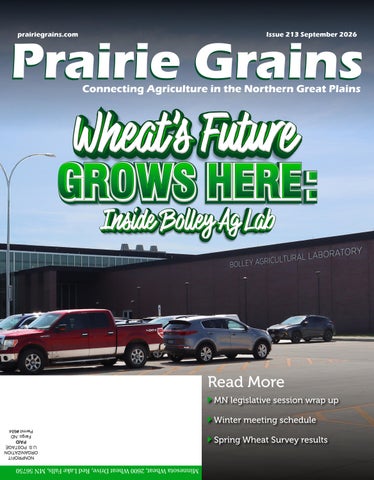
Wheat’s Future
GROWS HERE : Inside Bolley Ag Lab
Read More MN legislative session wrap up Winter meeting schedule Spring Wheat Survey results Minnesota Wheat, 2600 Wheat Drive, Red Lake Falls, MN 56750 5675056750
Minnesota Association of Wheat Growers
Watch visions come to fruition with the Minnesota Association of Wheat Growers. While farmers farm, MAWG is in St. Paul and Washington, D.C., protecting producers from harmful policies and advocating for farm-friendly legislation. Because checkoff dollars cannot be used for advocacy, MAWG depends on our members’ support to ensure that Minnesota wheat growers have a voice at the legislative table. Join the wheat family today – become a MAWG member!
Prairie Grains September 2026 | Issue 213
1 2 3 4 5
05
Taming the Bulls & Bears: Another year to get it right
08
Table talks: MAWG president, directors visit with Senate Ag Committee members
10
Active participants: MAWG intervenes in three environmental lawsuits
12
The next season of leadership: Minnesota’s wheat growers have spoken
20
Wheat’s welcoming arms: Mark Jossund hosts trade teams from Nigeria/Japan
Cover Story North Dakota State University’s state-of-the-art Bolley Agricultural Laboratory is ready to grow discoveries. With its ribbon cutting ceremony held Aug. 10, the new facility will be home to a variety of agricultural research programs including plant pathology, plant breeding, weed science, agronomy, soil science and horticulture. Turn to page 16-18 to learn more about one of the largest capitol construction projects in NDSU history and how it will strengthen the agriculture industry. PUBLISHER AND CIRCULATION
Minnesota Association of Wheat Growers 2600 Wheat Drive • Red Lake Falls, MN 56750 218.253.4311 • Email: mnwheat@mnwheat.com Web: www.mnwheat.org
ART DIRECTOR
Alex Troska Ag Management Solutions Ph: 952.334.2539 Email: atroska@agmgmtsolutions.com
EDITORIAL
ADVERTISING SALES
CONTENT EDITORS
ABOUT PRAIRIE GRAINS
Sydney Harris, Managing Editor Ag Management Solutions Ph: 218.689.5091 Email: sharris@agmgmtsolutions.com
Drew Lyon, News Editor Ag Management Solutions Ph: 507.388.1635 Email: dlyon@agmgmtsolutions.com Katelyn Engquist Ag Management Solutions Ph: 507.508.1540 Email: kengquist@agmgmtsolutions.com
OUR COLLABORATORS Minnesota Association of Wheat Growers 2600 Wheat Drive • Red Lake Falls, MN 56750 218.253.4311 • Email: mnwheat@mnwheat.com Web: www.mnwheat.org
Jill Thibert LHM & Co Ph: 218.280.2821 Email: jill@lhmandco.com
Prairie Grains magazine is published six times annually and delivered free of charge to members of these grower associations, and agriculture producers in Minnesota, North Dakota, South Dakota and Montana. To subscribe or change address, please write or call our circulation department.
North Dakota Grain Growers Association 2401 46th Ave SE , Suite 204 • Mandan, ND 58554 701.222.2216 • Email: danw@ndgga.com Web: www.ndgga.com
September 2026
|
Prairie Grains
|
Page 3
Set for success Wasn’t it just yesterday that tractors were rolling across the horizon, planting the 2026 spring wheat crop? I never cease to be amazed by how quickly the growing season flies by, and this year has been no different, especially since I began my term as secretary-treasurer on the U.S. Wheat Associates officer team, adding another variable to the bustle. We grow premium-quality wheat in the U.S. and USW’s role in marketing that product worldwide is critical to producers in Minnesota and across the nation. Without them, I’m convinced that we wouldn’t sell the amount of wheat that we do. Operating in over 100 countries around the world, USW is instrumental in enhancing U.S. wheat’s profitability by promoting its reliability, quality and consistency. I look forward to contributing valuable insights and being a resource to our overseas customers and U.S. farmers. A key aspect of building relationships with our customers includes inviting them to our farms here in the U.S. This summer, I welcomed a trade team from Nigeria and another from Japan to my farm in Clay County. I had the pleasure of showing them the dedicated work that goes into growing the premium quality wheat they value. During trade team visits, it’s always fascinating to see how captivated our customers are when they look out at sprawling fields as far
Page 4
|
Prairie Grains
|
September 2026
as the eye can see. farms. In this issue of Amid the hustle of Prairie Grains, you’ll find our growing season, the results of the Spring it’s a good reminder Wheat Survey, which is of how fortunate we sent to producers every are to wake up every year. The survey gives Jim morning and get to Anderson insight into what do what we love. varieties are being grown As the end of and why they’re being the 2026 growing chosen, helping guide the Mark Jossund season closes in on breeding program and Secretary-Treasurer, us, numbers will be target varieties that should U.S. Wheat Associates crunched, ledger be replaced. Turn to page 15 books will be scrutinized and heads to view the results. may shake. You may notice the two-cent One thing that wheat checkoff dollars checkoff that is deducted from every cannot be used for is advocating in bushel of wheat you sell and wonder St. Paul and Washington, D.C. That how those two cents are used. I can being said, we have a great working assure you, wheat checkoff dollars don’t relationship with the Minnesota disappear into the ether. They are wisely Association of Wheat Growers, which invested toward research that improves uses membership and fundraising farmer profitability, expanding export dollars to fight for farm-friendly policy. market opportunities and education. While we work separately, at the end of Those investments are guided by the day, we have the same goal, which the Minnesota Wheat Research & is to raise a great quality crop and sell it Promotion Council and the nine farmer- for a good value. leaders from across the state who As the growing season comes to a comprise its board of directors. close, I hope everyone experiences a A shining example of your checkoff safe and successful harvest. Success dollars at work is the University of looks different from year to year, and Minnesota’s wheat breeding program, the economic outlook may be bleak spearheaded by Jim Anderson. at times, but farmers are nothing Supporting this program has kept if not optimistic. We’ll get through Minnesota wheat farmers competitive this growing season, and we’ll do it by curating a roster of varieties that all again next year with a renewed producers want and need for their sense of hope.
Betsy Jensen is a Farm Business Management Instructor at Northland Community and Technical College. Follow her on X at @jensenbetsyr.
Another year to get it right Every crop year starts with a fresh start. And every harvest starts with all new bushels to sell. Even with some preharvest sales, soon the bins will be full and looking at you asking, “What now?” How long can and should you store the crop? Should it be stored unpriced? If you price it, should you do futures, basis or both? So many decisions. Do you have a plan? Your business revolves around your plan. Your ability to pay bills, plan for income taxes and make capital purchases revolves around your marketing plan. I know shooting from the hip can work, but life can be a little easier with a plan. We were fortunate in 2026 to have some good rallies in the spring and summer. Since I write this article several weeks before you read it, I hope harvest prices are through the roof, and sale decisions are easy to make. Beans in the teens? Run them to the elevator and don’t look back. There is no perfect marketing plan. There is no plan that will ever guarantee you top price on all your bushels. The best we can do is to minimize mistakes, minimize risk and lock in some profits. Let’s look at some red flags that indicate
your marketing plan is not working. The first red flag is storage costs. How much do you budget for elevator storage costs? I know it should be zero, but honestly it is okay to spend a little on elevator storage. Elevator storage may be less expensive than putting up a bin, especially if you have a short-term issue like you planted more corn than expected or have bigger yields than planned. When thinking about storage, convert the expense from per bushel to per acre. It was only 30 cents per bushel for wheat, but at 60-bushel wheat that is $18 per acre. One thousand acres of wheat is $18,000. It doesn’t take long for 30 cents a bushel to add up quickly. When it comes to storage, look at the big picture and not just a few cents a bushel. In my farm records, I do track storage, drying and protein and quality premiums and discounts. Sometimes I need a slap of reality and tracking that information reminds me I can do better. Another red flag is interest expense. The prime rate has dropped 1.75 percent from the high in 2023, but it is still 3.25 percent higher than our bottom in 2020. In farm business management we do
break down interest into short term, intermediate and long term and we want to minimize that short term interest. That cannot happen if the bins are full, or we are paying storage to the elevator. We need that cash today to pay down the line of credit. My final red flag is a personal choice and that is the number of sales. I love lots of smaller sales instead of a few large ones. Now if beans are in the teens at harvest, sell the beans and walk away smiling. I think of durum farmers in 2007 when it was $20. One big sale is perfectly acceptable in that scenario. I like smaller sales because I like my security blanket bushels. I might be nearly sold out, but I still have that bin bottom in case something crazy happens. I still have bushels to sell at that record high price. It might not be many bushels, but at least I am still in the game. My wish for you is record yields and record prices for 2026. I also wish you loved crop marketing as much as me instead of being frustrated by it. I love that I don’t have to be perfect and make all the right decisions all the time. The challenge is to make little mistakes and do the big things well. September 2026 |
Prairie Grains
|
Page 5
Field
By Drew Lyon
Legislative sessions often don’t feature grand slams, home runs or even run-scoring doubles that bring home winning legislation. Most times, advocacy groups hope to win by hitting singles, moving batters around the bases and playing strong defense. Such was the case in the 2026 legislative session. Groups like the Minnesota Association of Wheat Growers (MAWG) surveyed the field at play — split government, a governor who declined to run for a third term and a huge election coming in November — and knew the second year of the biennium likely wasn’t one to swing for the fences. “The session didn’t have a whole lot of substance happen of interest to the Wheat Growers because it was a non-budget year, and the tie in the House and the pending election made the path for anything controversial forward really difficult,” said Bruce Kleven, MAWG’s longtime lobbyist. “But we had an engaged president (Austen Germolus) who help lead MAWG in an effective fashion.” Despite an environment that wasn’t exactly conducive to legislative movement, MAWG did manage to secure several wins: As part of a bonding bill agreement, lawmakers approved a one-year reduction on vehicle tab fees, which
Page 6
|
Prairie Grains
|
September 2026
will save taxpayers an estimated $254 million but also won’t affect infrastructure funding. “That’s going to stay in Minnesota taxpayers’ pocketbooks,” said Senate Minority Leader Mark Johnson, who lives in East Grand Forks and represents Minnesota’s First District. “It’s a win-win situation.” The $1.2 billion bonding bill also includes $72 million for local bridge and road improvements and $2 million in Greater Minnesota Business Development Public Infrastructure grants. “We passed the bills, so now the hard work comes into play to actually putting (legislation) into effect,” Sen. Johnson said. MAWG also secured a win in the tax bill, which included a removal of the $4 million cap on the Beginning Farmer Tax Credit for one year. This legislature ensures that all eligible applications can be funded, rather than being waitlisted when demand exceeds available dollars, which became an issue when the credit was expanded in 2023. A one-time homestead tax credit increase of nearly 15% was also included. However, there were roadblocks to legislative progress. For
Focused MAWG makes its play during legislative session the first time in recent memory, lawmakers couldn’t reach an agreement on an omnibus agriculture bill, which stalled due to largely partisan debates over banning the herbicide paraquat (Nearly all Democrats favored a ban; almost all Republican members opposed). Paraquat became a sticking point for committee members throughout the session. MAWG strongly opposes restrictions on ag chemicals. “There was a pretty strong push to get paraquat banned. It’s a chemical we don’t use as wheat farmers, but a lot of farms do use, and we’ve discussed that with legislators,” MAWG President Austen Germolus said. “If you start pulling one thing away, where does it end? So that was our standpoint: We need to protect our crop inputs.” Had it passed, the ag omnibus bill was set to include updates to Minnesota Department of Agriculture programs; extending the Farmer Lender Mediation Program (which expires in 2027), funding increases to food shelves, wolf depredation assistance and resources for the farmer down payment assistance program. Sen. Aric Putnam said many of those policy discussions, along with strengthening the Beginning Farmer Tax Credit, will be some of his top priorities when the Legislature reconvenes Jan. 12, 2027.
“I hope to stay (on the Ag Committee), because it’s too important and I have too many friends in that space,” said Putnam, who has chaired the Senate Ag Committee since 2023. “The entire ag budget is only a quarter of a percent of the entire state’s budget, even though we’re a quarter of the state’s GDP. ... We can all do a better job in St. Paul of promoting Minnesota agriculture.” MAWG also successfully defended against additional restrictions on neonicotinoid insecticides and seed treatments. Under a proposed bill, farmers would require MDA approval to use treated seeds by proving a need. With the Nov. 3 election quickly approaching, MAWG advocates are visiting with legislative candidates and promoting the policy priorities of the state’s wheat farmers. A pivotal election awaits: All 134 seats in the Minnesota Legislature are up for election, and dozens of state legislators are either retiring or running for higher office. Meanwhile, both parties are vying to replace Gov. Tim Walz. “In the broad sense, we’re just kind of on hold until the election,” Kleven said. “Then after the November election, we can start making some plans on how we’re going to approach the 2027 session.”
MEMBERSHIP MATTERS The Minnesota Association of Wheat Growers depends on its members to support and fund its advocacy mission in St. Paul and Washington, D.C. A one-year membership starts at $100 and a multi-person membership costs just $260 for three members. 27% of membership dues are tax-deductible. Growers can also purchase MAWG apparel, including a quarter-zip pullover, fleece lined jacket and an insulated hooded work jacket.
September 2026 |
Prairie Grains
|
Page 7
By Drew Lyon
Table talks Austen Germolus marked two big milestones during his first nine months as president of the Minnesota Association of Wheat Growers (MAWG). First, in March 2026, Germolus delivered a Minnesota Wheat update to the Minnesota Senate Ag Committee, his first time testifying in front of lawmakers at the state Capitol. During his nearly 15-minute exchange with committee members, Germolus emphasized that although the state’s wheat farmers produced record yields in 2025, the industry continues to be bogged down by low prices, high input costs, increasing health care fees and stagnant demand. “Producers are seeing negative margins ... which is hard to swallow,” he said. Four months later, Germolus continued the conversation with a bipartisan group of Senate Ag Committee lawmakers, including Senate Ag Chair Aric Putnam and Sen. Rob Kupec, along with Sen. Minority Leader Mark Johnson, when he hosted lawmakers for two hours on a hazy summer’s day at his fifth-generation Borup crop and livestock farm, where Page 8
|
Prairie Grains
|
September 2026
MAWG president, directors visit with Senate Ag Committee members
he raises spring wheat, corn, soybeans, alfalfa and beef cattle. “I’ve never had (legislators) out to the farm before, so it was a lot of prep work getting things cleaned up and looking decent,” Germolus said. “It was hot, too, so that was kind of uncomfortable, but we made it work.” Sen. Putnam credited Germolus with making an impression by extending an invitation back in March during MAWG’s annual St. Paul bus trip to visit his farm. “He said, ‘I’ll make it happen,’ and he did,” said Sen. Putnam, who has visited nearly 120 Minnesota farms since becoming Senate Ag Committee chair in 2023. “This was Austen’s imperative. That’s how the visit came about. … He’s clearly a very dedicated man, not just to his family, but to farming and wheat growing in general.” While Germolus repeated his economic concerns from March to lawmakers this summer, he’s encouraged by the lawmakers’ goodfaith efforts in listening and their eagerness to work toward state-level solutions in 2027 and beyond. “It was good to have members of
both parties here to show we can work together,” Germolus said. “We talked about how some of the policies that are being proposed aren’t based on rational thinking. Fortunately, Sen. Putnam seems to have a pretty good handle on it.” The visit was part of an ongoing statewide listening tour in which Senate Ag Committee members meet with leaders of Minnesota farm groups. Sen. Kupec, who represents District 4, said while it’s important that farm groups make the trek to the Capitol in St. Paul to advocate for their priorities, meeting farmer leaders on their operation has its own value. “Ag groups bring a wealth of information when they come to St. Paul, but you learn a little bit more and it’s good to be on the ground where things are happening,” he said. “These farm visits are crucial to informing the work that the committee does and how farming impacts all of our lives.”
Wheat runs deep During the wide-ranging roundtable conversation, Germolus was joined by several wheat industry colleagues,
including MAWG Executive Director Brian Sorenson, Vice President Tate Petry, Director Kevin Leiser, Director Mike Gunderson and MAWG lobbyist Bruce Kleven. “Wheat means something to America; it’s immediate food,” Putnam said. “It means something to the farmers who produce it, which was really cool to hear.” Northern Crops Institute Director David Boehm and University of Minnesota Small Grains Specialist Jochum Wiersma also attended to spotlight the importance of state support for agriculture research to grow domestic and international markets and boost quality. The group also looked at Germolus’ wheat field to examine for head scab and other production issues. “It’s important to show what a wheat field looks like while talking about profitability and baking quality,” Germolus said. “And we need help on the research side to keep things going, and a lot of that money comes from the state.” Sen. Kupec said he’s quick to remind his legislative colleagues that although NCI is based at North Dakota State University, the state of Minnesota also enjoys myriad benefits from NCI: opening markets, food processing and training future professionals. “In the past, we’ve given NCI legislative appropriations, and they had to apply for a grant this year, and they got me, and it was less funding (than normal),” he said. “As a Legislature in Minnesota, we need to do something about it. They don’t understand the value it brings to the Red River Valley.” For Kupec, a former meteorologist who has served on the Senate Ag Committee since 2023, the visit to Germolus’ farm was another reminder of the broad impact Minnesota’s wheat industry has on the state’s economy and way of life. “(Wheat growers) take a lot of pride in being the breadbasket of Minnesota and the world,” Kupec said. “It’s a crop that runs really deep in this area; there’s a lot of affinity for it in a lot of families, because in the Red River Valley, wheat was the first thing they grew up here. I think the history of it here, a lot of people feel a deep connection.” Whether testifying or hosting, Germolus said meetings with legislators, both at the Capitol and on the farm, help lawmakers better understand how legislation affects farming operations and Minnesota’s economy. “When we’re discussing some of the policies that get made, we want someone that can reach out and talk to us about it,” Germolus said.
MAWG President Austen Germolus (front) and Sen. Mark Johnson discuss the ag economy during a roundtable at Germolus’ farm in July 2026.
September 2026 |
Prairie Grains
|
Page 9
By Bruce Kleven, MAWG legal counsel
Active participants MAWG intervenes in three environmental lawsuits Environmental activist groups have opened up a new front in their ongoing war against conventional agriculture: They have now turned to the court system to push their agenda. In 2025, three lawsuits were filed involving agricultural production practices — two by an environmental activist group and one by a pair of commodity groups. The first lawsuit was filed on January 28, 2025, by the Minnesota Center for Environmental Advocacy (MCEA) along with two other groups. The MCEA is a well-funded, highly litigious, St. Paul-based environmental activist law firm. In this case, the MCEA sued the Minnesota Department of Agriculture (MDA) and the Minnesota Pollution Control Agency (MPCA) essentially arguing that neither agency is “doing enough” to keep nitrates out of surface and groundwater. The MCEA asked a Ramsey Court judge to 1) order that each agency look at its existing rules to see if they are adequate, and 2) if their rules are not adequate, then order each agency to change its rules to further restrict the application of commercial fertilizer (which is governed by the MDA) and the application of manure (which is governed by the MPCA). The second lawsuit was filed on August 4, 2025. Again, it was the MCEA, along with the Natural Resources Defense Council (NRDC), that sued the MDA, this time alleging that the MDA is not “doing enough” to protect the environment from the
Page 10
|
Prairie Grains
|
September 2026
use of treated seeds. For the past 10 years, the NRDC has tried, and repeatedly failed, to convince the Minnesota Legislature to enact a treated seed regulatory program at the MDA. The NRDC and the MCEA asked a Ramsey County judge to find that the MDA’s existing rules are not adequate to protect the environment from the routine use of treated seeds. They did not go so far as to ask for action other than a determination that the rules are inadequate. This could be because the NRDC and the MCEA know that the MDA lacks authority to regulate the use of treated seeds, and even if they did, they know the agency does not have the financial resources to create and implement a new regulatory program. The third lawsuit involves the regulation of agricultural drainage. On August 28, 2025, the MCEA and several other groups filed a formal Petition for Rulemaking asking the MPCA to adopt a new agency rule requiring stormwater permits for new and improved agricultural drainage systems. The MPCA denied to take the requested action, explaining that the agency lacks authority to issue ag drainage permits, and even if they did, the agency does not have the financial resources to create and implement a new permitting program. Believing the petition was simply a prelude to yet another lawsuit, the Minnesota Corn Growers Association and Minnesota Soybean Growers Association went on offense
and preemptively filed a third lawsuit on December 19, 2025, beating the environmental groups to the courthouse door. The two ag groups filed their case in Faribault County, rather than in Ramsey County. Their suit asked for something called a “declaratory judgment” from the court. A declaratory judgment is a decision by a court regarding what the status of the law is, in other words offering clarity in situations where disputes — in this case, whether the MPCA has the authority to start requiring drainage permits — could arise in the future. The two ag groups asked the judge to affirmatively rule that the MPCA does not have authority to require permits for agricultural drainage. Due to the very real threats posed to Minnesota Association of Wheat Growers (MAWG) members in each of the above lawsuits, the MAWG board of directors decided to join other agricultural groups and became an “intervening party” in each of the three lawsuits. An intervening party is not an original party to the lawsuit but joins the suit claiming an interest in the disputed subject matter in order to protect its rights. Becoming an intervening party means that MAWG will be in a position to provide additional information, which it thinks will help to persuade the court, but more importantly, the intervenors’ permission is needed to sign off on any settlement proposals. As each of these cases wind their way through the court system, MAWG will remain an active participant on behalf of our members.
Thank you for supporting the 2026 MAWG Shootout The annual MN Wheat Sporting Clay Shoot Out had 37 novice and advanced shooters participate. Growers and ag professionals enjoyed a beautiful day of shooting at the Northwest Sporting Clay course in Thief River Falls, MN.
THANK YOU SPONSORS
September 2026 |
Prairie Grains
|
Page 11
By Sydney Harris
The Next Season of Leadership Minnesota’s wheat growers have spoken The ballots are in and three spring wheat producers have been reelected to the Minnesota Wheat Research & Promotion Council (MWRPC) board of directors. Mikayla Tabert of Red Lake Falls was reelected to represent Area 1, Moorhead’s Mark Jossund will continue to represent Area 2 and Scott Lee, who farms near Benson, will serve another term representing Area 3. “The farmer leaders guiding MWRPC investments are second-tonone,” MWRPC Executive Director Brian Sorenson said. “They’re a great group who take their roles seriously, giving it the time and attention needed to ensure sound decisions are made for the benefit of producers across the state.” Wisely directing the investments of Minnesota wheat checkoff dollars, MWRPC works to improve the profitability and viability for Minnesota wheat producers across the state. MWRPC is guided by nine farmerleaders who are elected by their fellow farmers and must be wheat producers who share in the profit and risk of loss from producing wheat in the current or preceding marketing year. “Serving on the board is a great opportunity to help the wheat industry have a voice,” said Jossund, who is serving his seventh term on the MWRPC board. “We do a really good job of evaluating research projects to try to make a difference in wheat production and we’re part of U.S. Wheat Associates (USW) to promote wheat both domestically and overseas.” Directors are elected to serve three-year terms, with the board meeting approximately six times throughout the year. “I’m looking forward to hearing the different perspectives of our newer board members and seeing what investment areas are important to Page 12
|
Prairie Grains
|
September 2026
Peter Hvidsten (front right), wife Kristin (front left) and three daughers
them,” Tabert said. “I really respect the people who’ve been on the board for a long time, and they did a really nice job, but I look forward to seeing how the dynamic shifts.”
New chairman takes seat After the election results were tallied, the MWRPC board met for its summer meeting during which the 2026-27 officer team was appointed with Peter Hvidsten, who farms near Stephen, elected chairman. “I want to do a good job,” Hvidsten said. “I want to serve the wheat growers from Minnesota well.” While it might be Hvidsten’s first rodeo serving as MWRPC chair, it isn’t his first rodeo as an MWRPC officer. Not long after being elected to the MWRPC board, he stepped into the secretary role before assuming the vice chair role where he presided for two years while Mark Jossund served as chair. “I think it would be kind of foolish to start out at the top,” Hvidsten said. “As you move through the positions on the board, the more involved you’re required to be and the more you see of what’s going on behind the scenes.” His involvement on the MWRPC board has gone beyond the state’s borders. Hvidsten represents Minnesota on the USW board, along with Mark Jossund, who currently serves as USW secretary-treasurer. “My greatest privilege and the most learning that I’ve done since I’ve sat on the Council has been participating in the USW meetings and seeing what other organizations are doing with their checkoff dollars to increase exports across the world,” Hvidsten said.
Supporting USW’s mission to develop, maintain and expand international markets to enhance wheat’s profitability for U.S. wheat producers and its value for their customers, MWRPC invests checkoff dollars in USW to promote the reliability, quality and value of U.S. wheat. “USW has a solid group of growers from across the country,” Hvidsten said. “What I like best is meeting the people, both the staff and the other growers, and seeing the like-mindedness of this industry. Our goal is to promote the high-quality wheat that we grow in our country, and USW creates a sense of pride in what we grow and how we grow it.” Tabert, who served as MWRPC treasurer for six years, has had a front row seat to Hvidsten’s leadership growth. “I really respect Peter,” Tabert said. “He’s not afraid to say what needs to be said and he does it with tact, which is a great strength. I’m looking forward to seeing how he’ll lead the organization.” Tabert will be supporting Hvidsten as MWRPC vice chair. “Because I was treasurer, I probably have a better feel on what the financial end looks like and why we’re making the decisions that we are,” Tabert said. “I think having that history will be really helpful in making decisions.” Alongside Hvidsten and Tabert, East Grand Forks’ Jeff Larson, who represents Area 1, was appointed secretary and Sydney Balstad, who farms near Fosston and also represents Area 1, will assume the treasurer role. “I’m curiously optimistic for the next year,” Hvidsten said.
HARVEST WITH THE
POWER OF BRENT® grain carts With more than five decades of experience building grain handling products, Brent has earned a reputation for innovation and quality. From the dual-auger Avalanche ® with pivoting unloading auger to the singleauger V-Series grain carts with superior unloading visibility and more, we push the limits of technology to create products you can depend upon each and every harvest.
V-SERIES SINGLE-AUGER GRAIN CART
AVALANCHE
FROM 1,500- TO 800-BUSHEL CAPACITIES
SCAN TO LEARN MORE.
DUAL-AUGER GRAIN CART FROM 2,500- TO 1,100BUSHEL CAPACITIES
Unverferth Manufacturing Co., Inc. P.O. Box 357 • Kalida, OH 45853 • Unverferth.com
VISIT BRENTEQUIP.COM OR SEE YOUR NEAREST DEALER FOR MORE INFORMATION.
September 2026 |
Prairie Grains
|
Page 13
By Deanna Kanne
A Grain of Knowledge
On-farm research network
The Minnesota Wheat Research & Promotion Council is partnering with North Dakota State University to establish an on-farm research network to provide more information on the value of hard red spring wheat, beyond just the grain, to farmers. “Wheat acres are going down year after year, but other than economical benefits you get from wheat, there’s a lot of agronomic benefits you get from it as well,” said Carlos Pires, assistant professor in soil health at NDSU. According to the USDA National Agricultural Statistic Service (NASS), total wheat acreage is projected to be down 6% from 2025. Hard red spring wheat (HRSW) is projected to be at 8.75 million acres. Wheat, with its early harvest time, makes it easier to incorporate cover crops into a crop rotation. A lot of farmers even use volunteer wheat that regrows after harvest as a cover crop. Pires’ study aims to put some numbers to this practice. “We want to see the real effect of volunteer wheat as a cover crop,” Pires said. “Can it be considered a cover crop? Does it provide services that cover crops usually provide like breaking up compaction, protecting the soil from erosion, suppressing weeds and so on?” This on-farm research project aims to show just how many agronomic benefits farmers can see if they include HRSW and regenerative practices in their crop rotation. Pires and his team will provide all the analysis, including chemical, physical and biological soil health indicators. “Farmers always have questions about these practices because many of them are already implementing soil Page 14
|
Prairie Grains
|
September 2026
health strategies, but they often lack the tools to determine whether those practices are actually improving soil health,” Pires said. “For example, one farmer was concerned about soil compaction. We’re now developing a research project with him to evaluate whether cover crops can help alleviate compaction under his specific farming system.” Farmers are required to commit to a four-year period of research, with samples taken every two years. This first year, starting in September, will begin with baseline samples, followed by implementation of some of these regenerative practices. “One of the good things about this project is that we meet farmers. We talk to them and we decide on what the regenerative ag practice would be together,” Pires said. “We’re using these sites to showcase these practices for farmers that are in the late adopter’s group, so the ones that are not very confident in adopting cover crops or to have more crop rotation or to adopt minimum tillage or even no tillage.” From the last U.S. Census of Agriculture, performed in 2022, cover crops increased by 17%, but were only planted on 4.7% of total cropland. That practice is much more common in the eastern United States than the Midwest. For other regenerative agriculture practices, no-till acreage increased by about 1%, while conservation or reduced tillage decreased by about 8%. “The goal is to work with these farmers to implement regenerative agricultural practices and monitor that over time to see if we are improving soil health or if we are sustaining soil health or even degrading soil health,” said Pires.
Minnesota Wheat Open Golf Scramble Thief River Golf Club Thank you to all of the sponsors:
And the winners are .....
PLATINUM SPONSORS
GOLD SPONSORS
SILVER SPONSORS
• American Federal Bank
• A&S Ag Sales
• CHS
• Corteva AgriScience • MIAX • Old National Bank • TCG Wheat • Unity Bank
A&S Ag Sales
Jesse Sundby, Joel Osowski, Nic Thompson & Aaron Anderson
The Minnesota Wheat Open Golf event is a way to say thank you to members and supporters of the Minnesota Association of Wheat Growers. Membership dues and event sponsorships help raise the funds necessary to continue our work in St. Paul and Washington D.C. We are proud of our past successes and we continually work on issues important to wheat growers in Minnesota.
WIN BIG
THIS SEASON.
You’re holding all the cards. Success isn’t luck, it’s strategy. With CoAXium wheat varieties and the power of Aggressor®AX herbicide, you’re holding a winning hand that beats grassy weeds. Cash in on superior yields this season — go all in with CoAXium.
Don’t gamble with grassy weeds. Visit FindCoAXium.com
Driven by Aggressor® Herbicides and Aggressor® are trademarks of Albaugh, LLC. Refer to the Aggressor® AX product label for complete directions and instructions. Aggressor® AX EPA Reg. No. 45002-51 AD120222N
September 2026 |
Prairie Grains
|
Page 15
By Sydney Harris
N O I T A V O N N I G N I Z I S A H P M E ard
forw ing ag
ov
ab is m L y e l l rt Bo
a
of-the e t a t s DSU’s
N
The “Thundering Herd” is charging toward agricultural innovation like never before. North Dakota State University’s new, state-of-the-art Bolley Agricultural Laboratory, which will be home to a variety of agricultural research programs including plant pathology, plant breeding, weed science, agronomy, soil science and horticulture, is ready to grow discoveries, with its ribbon cutting ceremony held on Aug. 10. “The investment in Bolley Lab is really critical to help continue to move agriculture forward in the state of North Dakota,” said Greg Lardy, dean of NDSU’s College of Agriculture, Food Systems, and Natural Resources. “It’s really about getting our agronomic scientists into a much more modern lab space.”
Page 16
|
Prairie Grains
|
September 2026
Named after Henry L. Bolley, one of the first faculty members at North Dakota Agricultural College, founder and coach of the university’s football team and the first plant pathologist at the North Dakota Agricultural Experiment Station, Bolley Lab construction broke ground in June 2024, marking the beginning of one of the largest capital construction projects in NDSU history. “The greatest amount of excitement is that we have a new lab space that matches all the excellence that we’re doing in the field,” said Andrew Friskop, cereal crop Extension plant pathologist at NDSU. “It gives us an opportunity to continue what we’re doing and doesn’t put a ceiling on our potential. We’re able to continue to create new research projects, and we’re able to start diving into other arenas that will supplement some of the information we provide to the growers in the state.” Friskop’s research includes fungicide efficacy, fungicide timing and assessing integrated management strategies in the field, making Bolley Lab’s state-of-the-art technology sure to accelerate his research-driven solutions that will benefit farmers. “When we work with diseases, we have to know how the pathogen works and be able to test the pathogen in the field,” Friskop said. “With Bolley Lab, we have infrastructure in place to create inoculum for our research trial needs.” Along with inoculum creation, Friskop’s research can now expand into post-harvest analysis.
“For small grains, specifically, we have the opportunity to look at more post-harvest assessments,” Friskop said. “For example, we’re going to be able to process ergot in wheat, which will help expand our research program drastically on the post-harvest side.” NDSU’s spring wheat breeding program is another discipline that will soar to new levels with Bolley’s amenities. Out of the many advantages of the new facility, NDSU Spring Wheat Breeder Andrew Green says he’s highly anticipating uniformity that the updated equipment and lab space will give his research. “Consistency is a big thing with any research, but especially in the breeding program,” Green said. “It’s really important to be able to go to a piece of equipment and know that it’s going to work in the same way time and time again.” When building the updated facilities, implementing critical safety measures were top of mind. When researchers can work safely, they can work effectively. “One of the nicest attributes of this new facility is the emphasis on worker safety, like air handling and dust collection,” Green said. “It’s a big deal because when you get a bunch of threshers and cleaners going in the same room, it can make some pretty hazardous dust. So, to be able to do our work in a clean and effective way that keeps everybody healthy and happy is going to really improve both the morale and the results.” Continued on page 18
September 2026 |
Prairie Grains
|
Page 17
Many disciplines, one roof NDSU and its faculty know that collaboration is the catalyst for breakthroughs that will impact the industry for years to come. “We’re all in the same facility, so in a lot of cases, we’re building on the efficiency of common use areas,” Green said. “Before this, we were spread out across so many different buildings and it was easier to operate in a silo, not really knowing what other folks were doing. Having a shared roof over our heads and working together to maximize the use of some of those shared facilities will enhance collaboration, which is a good thing.” Though we live in a digital era, there still isn’t anything that holds a candle to the camaraderie built from spontaneous water cooler talks that spark big ideas. “It makes it easier for somebody to just walk down the hall and ask a question,
instead of having to go over the river and through the woods,” Green said. Friskop echoed Green’s sentiment. “Anytime you get enough disciplines under one roof, you remove the social interaction barrier,” Friskop said. “We work really closely with the breeding program and while we can do that from our offices, having our research specialists mingle improves those relationships. It increases the collaborative think tanks where we try to come up with new projects and we aren’t stuck in the silo of our own specific discipline but trying to address more all-around productionrelated issues in the state.” Future investments Located on the western edge of NDSU’s campus, construction on the building began in June 2024 with the North Dakota Seed Commission donating the initial gift of public fundraising. In total,
the North Dakota Legislature allocated $87 million for the facility, and private donors raised over $3 million. “Bolley Lab is a $90 million project that’s really an investment in the future of crop production in North Dakota,” Lardy said. “During the 2023 legislative session, we received state authorization and funding and then we went out and did some additional fundraising as well.” Between the public and private funding raised to erect Bolley Lab, there’s no doubt that North Dakota’s agriculture industry is a powerhouse and the agronomic research that happens on NDSU’s campus is critical to the state. “The confidence and the faith that the state has shown in our programs by making an investment this substantial is something that we’re proud for people to see,” Green said. “Our stakeholders believe in us, and I think that’s the most exciting part.”
Capture the value of today’s best genetics
PLANT NORTH DAKOTA CERTIFIED SEED Call your local ND Certified Seed dealer to put the best seed to work on your farm.
www.ndseed.com
More than 240 varieties of 20 crops Known Varietal Identity
Page 18
|
Prairie Grains
|
Field Inspected
September 2026
Lab Tested
Proven Quality
Superior Performance
Greater Profitability
MARK YOUR CALENDARS! Winter meeting season is right around the corner. Check out the list of meetings on the books and pencil them in before your schedule fills up!
15-17
Big Iron, Red River Valley Fairgrounds Fargo, ND
17-18
Canola/Wheat Outlook & International Durum Forum, Minot, N.D.
09-10
Prairie Grains Conference Grand Forks, N.D.
06-07
Lake Region Extension Roundup Devils Lake, N.D.
12-15 Jan. 2027
Small Grains Update Meetings Northwest Minn.
27-28
KMOT Ag Expo Minot, N.D.
04
Best of the Best in Wheat & Soybean Research Grand Forks, N.D.
05
Best of the Best in Wheat & Soybean Research, Moorhead, Minn.
16
Best of the Best in Wheat & Soybean Research, Minot, N.D.
Sept. 2026
Nov. 2026
Dec. 2026 Jan. 2027
Jan. 2027
Feb. 2027
Feb. 2027
Feb. 2027
September 2026 |
Prairie Grains
|
Page 19
By Mark Askelson
Wheat’s Welcoming Arms Mark Jossund hosts trade teams from Nigeria, Japan On any busy farmyard, it’s common to see people coming and going throughout the day, but on the Mark Jossund farm it’s more than just seed dealers, agronomists and farmhands running back and forth from the field. Also making regular appearances are international trade teams eager to get a better perspective and understanding of the high-quality wheat they’re purchasing and the farms that are growing it. Jossund’s involvement in agriculture via the Minnesota Wheat Research & Promotion Council (MWRPC), U.S. Wheat Associates (USW), Agricultural Fertilizer Research and Education Council and more, plus his location, size and style of of farm have made him a go-to anytime trade teams are in the region. “What makes Mark and his farm a great destination is his dedication to education and promoting the hard red spring wheat we produce,” said MWRPC Executive Director Brian Sorenson. “His farm is a good representation of the average family farm in Minnesota, he uses a lot of the new technologies and precision tools that are available and he does a very good job explaining to those trade teams how he uses those tools to produce a consistent and high-quality wheat crop.”
Page 20
|
Prairie Grains
|
September 2026
In 2026, Mark has already welcomed two teams of international guests, including the Sub-Saharan African trade team from Nigeria in June and another from Japan in July, both of which were organized through USW. The small group from Nigeria consisted of wheat millers and purchasers. During the visit, the delegation toured one of Jossund’s wheat fields and took a closer look at his farm and equipment. “They were really interested in the equipment we were using. There’s a different piece of equipment to plant corn and another for wheat, and they were very interested in that,” said Jossund, past MWRPC chair. “Then we headed out to a wheat field where I showed them a field with the variety MN-Torgy. They seemed very intrigued with everything.” Following their visit at the Jossund Farm, the trade team then headed to the University of MinnesotaCrookston to tour the Hard Red Spring Wheat research plots and then visited the farms of fellow MWRPC Directors Rhonda K. Larson and Jeff Larson near East Grand Forks. They also toured the Valley United Co-op in Halstad and North Dakota State Mill in Grand Forks.
Paying dividends Nigeria is a developing market with a very robust milling industry, typically buying lower priced wheat from around the world, with occasional purchases of higher protein wheat from Canada and the U.S., Sorenson said. The country’s trade team visit was apparently impactful, as it triggered a 100,000 metric tons purchase, or about two shipping vessels worth, of U.S. HRS wheat within a few weeks of their return to Nigeria. “We talk about the importance of these trade teams to build relationships and plant a seed for future purchases, so to have them go back to their companies and almost immediately make a purchase is wonderful!” Sorenson said. “I wish it was always that quick, but it was certainly a pleasant surprise.” Just under a month later, Jossund hosted his second trade team of the year, when a small group of mid-level management representatives from Japan arrived at his farm. During the visit, the team was most intrigued about learning about herbicide and other treatments applied during the HRS wheat growing cycle. “Their market is very concerned about quality and food safety, so we explained that everything we use, even Roundup, which we don’t use on our farm, is safe to use as long as you follow the label,” Jossund said. “So, we went through our fertilization practices, our herbicide practices and fungicides with them.” Sorenson adds that Japan, whose milling and baking industry is very mature and has long been a top buyer of U.S. wheat, has always been focused on quality. However, sales of HRS wheat have slumped in recent years. “They’re a high-quality buyer, but they also buy winter wheat as well and a lot of soft white out of the PNW,” Sorenson said. “Their hard red spring wheat sales are strong, but have decreased in recent years due to pricing issues versus Canadian Western Red Spring Wheat.”
The Japanese team also visited the Alton Grain Terminal near Hillsboro, N.D., to learn more about the transportation of commodities and toured the North Dakota State University Wheat Quality labs in Fargo during their time in the region. Jossund notes that these trade visits are very important because of the connections they can make as farmers with the people who are buying their wheat. “Especially with these two groups, they really like to see where their product is coming from. They like to meet you and they like to see your operation,” said Jossund. “And I think it’s important that we do a good job of raising a quality crop for them and that they get to see that.” While Jossund has hosted trade teams from several different countries over the years, all with their own unique cultures, languages and interests, he notes that there is one trait they all have in common. “They’re all very amazed by our vast, flat landscape here in the Red River Valley,” Jossund said. “It’s a 35 minute drive to our farm from Fargo, and there’s not a single hill in sight, and crops as far as their eye can see.”
September 2026 |
Prairie Grains
|
Page 21
By Mark Askelson
Diversity in Dakota NDGGA highlights agricultural diversity to EPA in annual E-tour For more than three decades, the North Dakota Grain Growers Association (NDGGA) has been showcasing the diversity, innovation and economic impact of North Dakota’s agricultural and related industries. The E-tour, which is in its 33rd year, brings along officials from the U.S. Environmental Protection Agency (EPA) for firsthand experiences at farms, agribusinesses, research facilities and energy operations. “The E-tour is a vehicle to encourage dialogue between the people at EPA that are working with chemical registrations and approving different chemicals and the producers out here in North Dakota who make use of those chemicals and have to follow all the rules of those chemicals,” said Nick Sinner, NDGGA executive director.
“The label is the law, and as producers we want the folks at EPA to know that we are using them in a safe and responsible manner.” This year’s E-tour was based out of the Minot and northcentral regions of North Dakota, where they toured farms in Berthold, Bottineau, Newburg and Hazen. Agriculturally, this region, known as the “Prairie Pothole Region,” is very diverse. Along with growing wheat and barley, producers have multiple other options to add to their rotation, including corn, soybeans, durum, canola, peas, flax and dry beans. “A lot of these farms will have eight or nine different crops that are produced in that region, so really a great variety to show those folks coming up from Washington, D.C., and Denver,” Sinner said. “They’re all impressed by the variety because I think they see a lot of the other production areas, for example if you’re Iowa, Indiana, Illinois, where you only get to see corn and soybeans.” Show and tell NDGGA Vice President Dean Knell hosted the group as they made their first series of farm visits throughout the Beulah and Hazen area. During those visits, EPA officials had a chance to get up close and personal with the various small grains grown in the area and get a good look at the large equipment used around the farm such as combines, air seeders and sprayers.
Page 22
|
Prairie Grains
|
September 2026
“It’s nice to show them exactly what we’re doing out here in North Dakota, because a lot of them come from D.C., Philadelphia, Cincinnati and one even from Puerto Rico, and show them what the landscape is and the challenges we have out here,” Knell said. “I had them raise their hands to see who had ever been to North Dakota before, and only one did, but that was when they were seven years old and were driving through it on their way somewhere else.” One of the most unique moments from the trip was the tour of the Freedom Mine just outside Hazen, an environmental success story of how both energy and agriculture can work together. The Freedom Mine is not only known for being the largest lignite coal mine in the United States, but also for its award-winning land reclamation process that takes once mined land and puts it back into agricultural production. “It was a great demonstration to see land that had been pretty severely disturbed, then reclaimed and able to produce a pretty nice wheat crop,” said Knell, who farms near Hazen. “From an EPA perspective, even though they didn’t work in the oil and gas division, to see land that went from giant clumps of dirt to productive farmland in 20 years is a pretty cool story to tell.” Eye in the sky Other highlights from the E-tour included an aerial tour, which provided a bird’s eye perspective of the state’s topography and agricultural landscape, drone demonstrations, an opportunity for the EPA officials to test drive some of the equipment and a stop at the North Dakota State University’s North Central Research Extension Center in Minot where they learned about weed control issues and the latest research. “Their weed specialist really dug deep into their research and showed them some of results from what they’re doing as they
gain insight on this issue of resistance that the farmers are facing,” Sinner said. “The number of chemicals that they have to be effective against certain weeds is really decreasing and that was really evident in that discussion.” Perhaps the greatest value to the E-tour goes beyond the farm visits and facility tours, but where the rubber really meets the road is the dialogue and discussions that happen between producers and the EPA participants. Sinner says through these tours both parties are able to form good working relationships and understandings that will benefit everyone moving forward. “We enjoy having them out here because this is a real give and take from both sides, not just us showing them,” Sinner said. “It’s us being able to talk to them and learn what they’re working on and what we need to be aware of. It’s a great exchange of information.” The North Dakota Corn Utilization Council and North Dakota Soybean Council also joined NDGGA on this year’s E-Tour.
The 33rd annual E-Tour included visits to grain and seed facilities, equipment and aerial application demonstrations, tours of the Freedom Mine, Great Plains Synfuels Plant and NDSU's North Central Research Extension Center.
September 2026 |
Prairie Grains
|
Page 23
MAWQCP-enrolled farmers see seven straight years of higher profits Year after year, farmers enrolled in the Minnesota Agricultural Water Quality Certification Program (MAWQCP) continue to show stronger and more reliable profitability than noncertified farms, according to data released in summer 2026 from the Minnesota State Agricultural Centers of Excellence. The findings reinforce a clear, long term trend: For the seventh consecutive year, MAWQCP certified farms reported higher gross cash farm income and higher net farm income than comparable non certified operations. The 2026 Influence of Intensified Environmental Practices on Farm Profitability study analyzed financial and production data from farms participating in the Minnesota State Farm Business Management program. The results show that efficient input use, diversified cropping systems and conservation practices that reduce risk and improve long term productivity all contribute to stronger financial performance. These approaches help stabilize yields, build resilience, and support more consistent profitability over time.
Page 24 | Prairie Grains | September 2026
In 2025, certified farms earned an average net income of just more than $197,500, compared to $129,400 for noncertified farms. Median net income followed the same pattern, demonstrating that the financial advantage holds across farm sizes and sectors. “Seven years of data make one thing unmistakably clear: Conservation is a long term profitability strategy. Certified farms aren’t just seeing better results in good years — they’re holding strong in the tough ones, too,” said MDA Commissioner Thom Petersen. “That kind of steady, repeatable return is invaluable in today’s farm economy. I strongly encourage Minnesota farmers to explore certification and see how this program can strengthen both their operation and the natural resources we all depend on.” Keith Olander, executive director of AgCentric and Agricultural Partnerships, noted the resilience of certified farms during a challenging year. “Row crop producers faced real financial pressure in 2025, yet water-quality certified farms continued to come out ahead,” Olander said. “Livestock operations in particular saw notable gains. The management approach required for certification continues to translate into stronger financial performance year after year.” The study can be viewed at agcentric.org. With support from farm groups across Minnesota, including the Minnesota Association of Wheat Growers, MAWQCP began as a Minnesota Department of Agriculture (MDA) initiative to protect water quality statewide. Since launching statewide in 2016 with Clean Water Fund support, the program has enrolled more than 1.25 million acres across 1,800-plus certified farms. Those farms have implemented conservation practices that prevent more than 1.25 million pounds of nitrogen, 60,500 tons of sediment and 78,000 pounds of phosphorus from entering Minnesota waters each year. Certification starts with a one on one, field by field review conducted by local conservation experts who walk the operation with the farmer to identify potential water quality risks. Together, they develop a customized conservation plan that fits the farm’s goals and addresses those risks with practical, effective solutions. Farmers receive priority access to technical and financial assistance to complete any needed improvements. Once all risks are resolved, the farm is certified and granted 10 years of regulatory certainty, recognizing it as fully in compliance with Minnesota’s water quality laws. Farmers and landowners interested in learning more about MAWQCP or enrolling in the program can contact their local Soil and Water Conservation District or visit MyLandMyLegacy.com.
IT’S NOT JUST YOUR LAND. IT’S YOUR LEGACY. The Minnesota Agricultural Water Quality Certification Program rewards farmers like you for what you do best, taking care of your land and its natural resources. To get started and learn more, contact your local soil and water conservation district or go to:
MyLandMyLegacy.com
September | PrairieBusiness Grains | - Page JANUARY - FEBRUARY - 20242026 - Soybean 25 25
Survey Findings: • MN-Rothsay was the most popular variety statewide, with 27% of the acreage planted in 2026. • Second most popular was WB9590 with 16% of the state's acreage. • Third on the list was MN-Torgy at 11%, followed by TCG-Zelda at 9% and AP Elevate at 7%. • In the northern growing region of the state, MN-Rothsay was the most popular variety with 26%. • MN-Rothsay again took the lead and was the most popular variety in the central growing region, with 34% of the acres planted. • In the southern region, MN-Torgy was first on the list at 41% acres planted.
This survey is conducted from the check-off funds collected by the Minnesota Wheat Research & Promotion Council.
Total Acres Surveyed: 41,733
The results of the survey depict what varieties are most important to Minnesota’s wheat growers.
Total Acres Surveyed: 2,745
Thank you to all Minnesota wheat producers who responded to the wheat variety survey. The results of this survey help guide the UMN spring wheat breeder, Dr. Jim Anderson, in developing suitable varieties for production in Minnesota.
Total Acres Surveyed: 210,234
Total Acres Surveyed: 254,712
2026 MN Spring Wheat
Varieties by Planted Acres * Chart sorted by Statewide totals Statewide Totals
MN-Rothsay WB9590 MN-Torgy TCG-Zelda AP Elevate SY Valda Misc Varieties WB9479 ND Stampede AP Murdock TCG-Wildcat Linkert LCS Trigger AP Smith AP Iconic TW Olympic SY 611 CL2 LCS Cannon PFS Rolls Enhance-SD Virtue Andina LCS Buster TCG-Arsenal Driver LCS Hammer AX PFS Muffins Ascent-SD MS Charger TW Trailfire ND Horizon ND Thresher Virtue Himalaya FG Heiner CP3915 Shelly 2026 Total Acres
Statewide %
Northern Totals
69,951 27.46% 55,594 39,632 15.56% 35,256 27,256 10.70% 18,210 23,930 9.39% 20,562 17,566 6.90% 16,494 14,397 5.65% 12,717 10,444 4.10% 8,467 7,204 2.83% 6,644 7,116 2.79% 6,021 5,136 2.02% 4,810 5,036 1.98% 2,871 4,243 1.67% 2,985 3,900 1.53% 3,000 3,133 1.23% 2,833 2,888 1.13% 2,729 2,670 1.05% 2,090 2,044 0.80% 2,044 1,474 0.58% 1,397 1,230 0.48% 1,230 855 0.34% 555 789 0.31% 689 500 0.20% 500 460 0.18% 460 372 0.15% 372 340 0.13% 340 320 0.13% 320 309 0.12% 89 277 0.11% 0 250 0.10% 200 230 0.09% 230 220 0.09% 220 155 0.06% 155 150 0.06% 150 143 0.06% 0 92 0.04% 0 254,712 100.00% 210,234
Northern %
26.44% 16.77% 8.66% 9.78% 7.85% 6.05% 4.03% 3.16% 2.86% 2.29% 1.37% 1.42% 1.43% 1.35% 1.30% 0.99% 0.97% 0.66% 0.59% 0.26% 0.33% 0.24% 0.22% 0.18% 0.16% 0.15% 0.04% 0.00% 0.10% 0.11% 0.10% 0.07% 0.07% 0.00% 0.00%
Central Totals
14,066 4,266 7,909 3,368 1,072 1,365 1,977 560 1,070 326 2,165 1,238 900 0 159 530 0 77 0 300 100 0 0 0 0 0 0 0 50 0 0 0 0 143 92 41,733
Central %
33.70% 10.22% 18.95% 8.07% 2.57% 3.27% 4.74% 1.34% 2.56% 0.78% 5.19% 2.97% 2.16% 0.00% 0.38% 1.27% 0.00% 0.18% 0.00% 0.72% 0.24% 0.00% 0.00% 0.00% 0.00% 0.00% 0.00% 0.00% 0.12% 0.00% 0.00% 0.00% 0.00% 0.34% 0.22%
Southern Totals
291 110 1,137 0 0 315 0 0 25 0 0 20 0 300 0 50 0 0 0 0 0 0 0 0 0 0 220 277 0 0 0 0 0 0 0 2,745
Southern %
10.60% 4.01% 41.42% 0.00% 0.00% 11.48% 0.00% 0.00% 0.91% 0.00% 0.00% 0.73% 0.00% 10.93% 0.00% 1.82% 0.00% 0.00% 0.00% 0.00% 0.00% 0.00% 0.00% 0.00% 0.00% 0.00% 8.01% 10.09% 0.00% 0.00% 0.00% 0.00% 0.00% 0.00% 0.00%
The information contained in this chart is the property of the Minnesota Wheat Research & Promotion Council (MWRPC). It may not be published, reproduced, or used in any manner without the prior permission of MWRPC. For questions or permission requests, please contact MWRPC at mnwheat@mnwheat.com.
By Sydney Harris
EXP RTING EXCELLENCE U.S. Wheat Associates marks decades-long presence in Taiwan, Japan
Trade makes the world go ’round. In April, the U.S. Wheat Associates (USW) celebrated significant trade milestones with Taiwan and Japan, each a critical export market destination for U.S. wheat. USW’s Taipei office reached 60 years of promoting the reliability, quality and value of U.S. wheat while the USW Tokyo office marked 70 years. “USW has worked hard to maintain a great relationship with the buyers, millers and bakers throughout Japan and Taiwan to promote U.S. wheat as the highest quality wheat,” said USW Secretary-Treasurer Mark Jossund, who farms near Moorhead, Minn. “We have excellent staff in those locations, who do a great job of building relationships
Page 28
|
Prairie Grains
|
September 2026
and promoting our product.” To commemorate the anniversaries, USW hosted events in both locations to honor the people who make the storied partnerships possible. Jossund, along with Minnesota Wheat Executive Director Brian Sorenson, were part of the delegation who attended, along with 11 other U.S. wheat farmers and five state wheat associations representatives. “U.S. wheat producers rely on vital export markets like Taiwan and Japan,” Sorenson said. “Relationships are essential to building and maintaining these markets, so it was great to participate in these anniversary celebrations to meet with our customers to let them know how much we appreciate their wheat purchases,
and that we value the relationships that we have with them. It was also important that we personally thanked the staff at the Taipei and Tokyo offices of U.S. Wheat Associates for all their efforts to promote Minnesota Hard Red Spring Wheat.” With more than 23 million people, Taiwan purchases about 1 million metric tons of wheat annually, giving U.S. wheat a more than 80 percent market share of Taiwan’s wheat milling imports over the last decade. During the celebration in Taiwan, USW’s Taiwan Director Yi-I Huang presented awards and made a few comments. “We must work to preserve what has been built for us, do what we can to make it even better,” Huang said.
“We are grateful for our partners in the Taiwan food and milling businesses. We are also grateful for the U.S. wheat farmers who attended the anniversary, and those back in the U.S. preparing to harvest or plant their crops. It’s the most important part of the U.S. wheat supply chain.”
Tokyo times After Taiwan, the USW delegation headed to Tokyo. Purchasing approximately 2.5-3 million metric tons of U.S. wheat each year, Japan is a vital export market for wheat producers, claiming 10 percent of all U.S. wheat exports. Nobuhiro Iijima, chairman of the Japan Baking Industry Association and president of Yamazaki Baking Co. offered comments during the anniversary celebration. “Over these 70 years, U.S. Wheat has not only ensured a stable supply of wheat, which is indispensable for the production of a wide variety of flour-based products, but also has worked closely with the Japanese milling and flour user industries,” Iijima said. “Through technical exchanges, crop tours and many other initiatives, U.S. Wheat contributed significantly to the
development of Japan’s bread, noodle and confectionery industries, as well as to the enrichment of our diverse food culture.” Along with commemorating the anniversary, the group met with the U.S. embassy, learning more about the breadth of its work. “In Tokyo, we went to the U.S. Embassy and met with the U.S. Ambassador and his staff where they told us about the work they do in Japan with the commodity groups to make sure our products are purchased in Japan,” Jossund said. “It was really enlightening. They work with everybody to promote the U.S. over there in Japan. It’s amazing what the Embassy does for us.” With offices in more than 100 countries around the world, USW serves as boots-on-the-ground support for wheat industry stakeholders. The expert staff are vital to the longevity of USW’s mission and nourishing the relationships between U.S. wheat trading partners. “Our USW staff will meet with millers and bakers and help with any problems,” Jossund said. “If there’s a problem with the logistics of a shipment or if there’s a problem milling the wheat, USW staff is
there to troubleshoot with them, and our office will help mitigate whatever issue they’re having.” It’s been said many times, and it’s still as true today as it was yesterday, that relationships are essential to strong wheat exports. While in Taiwan and Japan, Jossund and the rest of the USW delegation built camaraderie with their international stakeholders. “They’re so appreciative to meet the farmer, and they want to know where the wheat they’re buying comes from,” Jossund said. “It’s really great to get to know the people buying our wheat and thank them for purchasing U.S. wheat.” At the end of the day, without wheat farmers, these trade partnerships wouldn’t be possible. “The U.S. farmer does a great job of picking good varieties and watching the fertility so that we produce a good quality wheat,” Jossund said. “There is an entire chain of events to get to this point and requires everyone working together. We need the breeders and we need the farmers, but we also need our retailers for inputs like fertilizer and their expertise.”
September 2026 |
Prairie Grains
|
Page 29
ACROSS THE PRAIRIE By Prairie Grains Magazine staff
NAWG hires policy manager Ross Bodine joined the National Association of Wheat Growers (NAWG) as policy manager. In this role, Bodine will support NAWG’s advocacy efforts on Capitol Hill and with federal agencies, working to advance federal policy priorities on behalf of U.S. wheat growers. “I’m excited to join NAWG and advocate on behalf of wheat growers across the country,” Bodine said. “Growing up around agriculture, I’ve seen firsthand how deeply these policies affect farm families and rural communities. At a time when agriculture is central to major policy conversations in Washington, I look forward to working alongside the NAWG team to ensure wheat growers’ voices are heard and their priorities remain front and center.” Prior to joining NAWG, Bodine served as a government relations intern with CropLife America, where he supported federal and state advocacy initiatives and helped coordinate the D.C. Agriculture Intern Network. He also brings hands-on research experience from his time as an undergraduate research assistant under Dr. Dean Riechers at the University of Illinois, as well as industry experience through internships with Corteva Agriscience and KWS Wheat. Ross earned his Bachelor of Science in plant biotechnology from the University of Illinois Urbana-Champaign. “Ross brings a great combination of technical knowledge and policy proficiency to our team,” said NAWG CEO Sam Kieffer. “His energy, familiarity with hands-on agriculture research and early D.C. policy experiences will complement the NAWG team as we continue to advance policies that support wheat growers and rural communities.” ND senator working to boost exports for farmers by linking NDSU ARPC and REC North Dakota Sen. John Hoeven is spearheading an initiative to link the North Dakota State University Agricultural Risk Policy Center (ARPC) and the National Page 30
|
Prairie Grains
|
September 2026
Rural Export Center (REC). Hoeven outlined how the cooperative agreement, which he is advancing as chairman of the Senate Agriculture Appropriations Committee, will leverage the expertise of the ARPC to supercharge the research engine of the National REC, empowering greater export opportunities for agriculture producers and rural businesses on a nationwide basis. “We have two incredible institutions in Fargo supporting our farmers, ranchers and rural businesses —NDSU’s Ag Policy Research Center and the National Rural Export Center,” Hoeven said. “On their own, these initiatives have been great resources for strengthening farm and rural economies. Now, we’re working to supercharge the research engine of the National REC. We’re working to create a new cooperative agreement that will link the expertise of the policy center with the National REC, helping our farmers and rural businesses across the country to identify and seize more opportunities in foreign markets.”
Wheat Foods Council names new executive director The Wheat Foods Council (WFC) is thrilled to announce the hiring of Sheri Glazier as executive director. Glazier is a wheat farmer and registered dietician from Loyal, Oklahoma. She holds a bachelor’s degree in human environmental science and a master’s degree in nutritional science, both from Oklahoma State University. She is also the founder of Dirt Road Dietitian, a multifaceted program focused on connecting nutrition science and agriculture. Through this work, Glazier has established herself as a trusted voice translating real-world farming practices into credible, science-based messaging for consumers. Her work includes the development of immersive, hands-on programs merging common sense nutrition and production agriculture education for consumers of all backgrounds. “Sheri’s ability to speak confidently about wheat production and nutrition from personal knowledge and experience, her online presence and her ability to communicate and connect effectively with consumers, is going to be an enormous benefit to the organization,” said Britany Hurst Marchant, WFC chairwoman. “After a year of evaluation and reconstruction of the
organization, I am confident in Sheri’s ability to take this opportunity by the reins and guide WFC into a productive future.” Glazier and her husband operate a fifth-generation wheat, hay and cattle operation, which includes a direct-to-consumer protein business. Her authentic and practical messaging is based on firsthand knowledge and experience, which resonates with industry and consumer audiences. Her background also helped her launch GROWN, a recurring and novel platform for strategic crossindustry education and relationship building between agriculture, nutrition experts and consumers. WFC is the only grower-led marketing organization in the U.S. focused on increasing domestic demand. “Domestic demand for wheat has remained stagnant for the past several decades, and wheat continually gets villainized by diet culture. Sheri’s expertise and skills will set WFC on course to change the narrative, not only around the health and nutrition of wheat foods, but also the safety of wheat production,” said Ron Suppes, a wheat farmer from Kansas and longtime WFC board member. Glazier assumed the executive director role on Aug. 18, 2026.
September 2026 |
Prairie Grains
|
Page 31
Farming doesn’t wait. And now, neither will you. Minnesota Wheat, including Prairie Grains magazine, is increasing its digital communications by delivering digital issues and pertinent updates straight to your inbox. Scan to QR code to sign up to receive time-sensitive, important industry updates.
Minnesota Association of Wheat Growers Page 32 | Prairie Grains prairiegrains.com
|
September 2026