Watch visions come to fruition with the Minnesota Association of Wheat Growers.
While farmers farm, MAWG is in St. Paul and Washington, D.C., protecting producers from harmful policies and advocating for farm-friendly legislation.
Because checko dollars cannot be used for advocacy, MAWG depends on our members’ support to ensure that Minnesota wheat growers have a voice at the legislative table.
Join the wheat family today – become a MAWG member!
Prairie Grains Prairie Grains
Cover Story
2 1 3 4 5 05 06 12 20 26
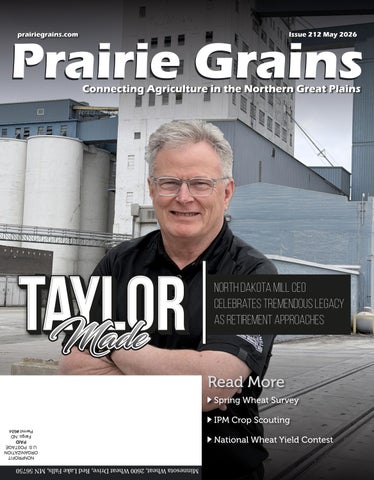
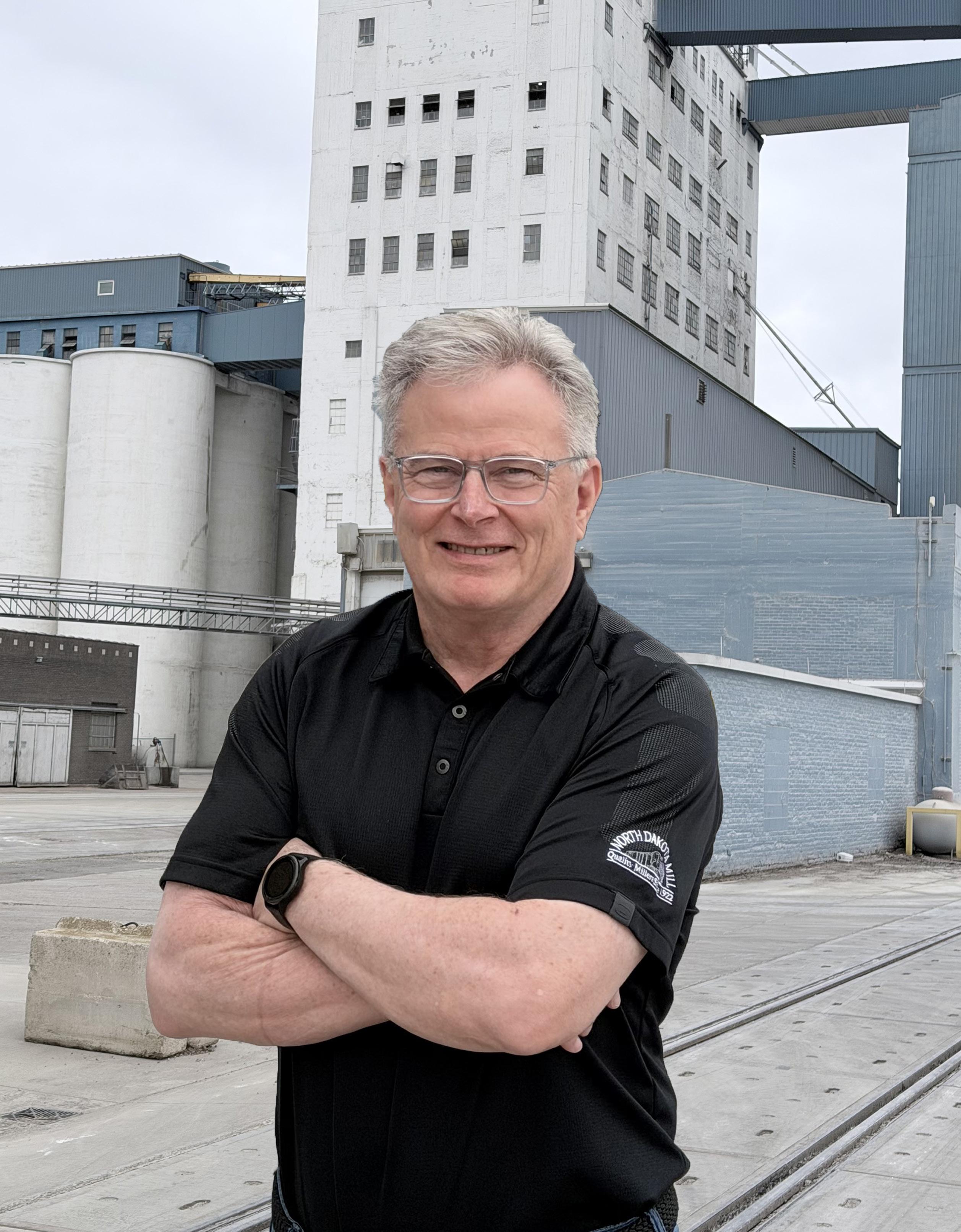
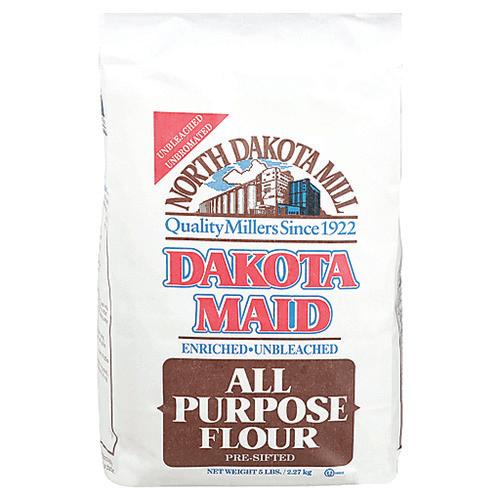
After 26 years as North Dakota Mill’s president and CEO, Vance Taylor is retiring on July 3 as the Mill’s longest-standing leader. Under his guidance, Taylor oversaw several capital projects that increased the capacity and efficiency of the Mill, allowing for exponential growth. Head to pages 16-17 to read more about his impressive tenure with the 104-year-old milling facility.
PUBLISHER AND CIRCULATION
Minnesota Association of Wheat Growers
2600 Wheat Drive • Red Lake Falls, MN 56750 218.253.4311 • Email: mnwheat@mnwheat.com Web: www.mnwheat.org
EDITORIAL
Sydney Harris, Managing Editor
Ag Management Solutions
Ph: 218.689.5091
Email: sharris@agmgmtsolutions.com
CONTENT EDITORS
Drew Lyon, News Editor
Ag Management Solutions
Ph: 507.388.1635
Email: dlyon@agmgmtsolutions.com
Katelyn Engquist
Ag Management Solutions
Ph: 507.508.1540
Email: kengquist@agmgmtsolutions.com
ART DIRECTOR
Alex Troska
Ag Management Solutions Ph: 952.334.2539
Email: atroska@agmgmtsolutions.com
ADVERTISING SALES
Jill Thibert
LHM & Co
Ph: 218.280.2821
Email: jill@lhmandco.com
ABOUT PRAIRIE GRAINS
Prairie Grains magazine is published six times annually and delivered free of charge to members of these grower associations, and agriculture producers in Minnesota, North Dakota, South Dakota and Montana. To subscribe or change address, please write or call our circulation department.
Taming the Bulls & Bears: New perspectives
On the record: Wheat growers share their story in St. Paul
Bridging the gap in mental health support: Vital resources available to producers
‘Once in a lifetime’: Outgoing USW chair aims to showcase home state during Summer Board Meeting
Rural ballots: North Dakota farmers elect Commissioners to North Dakota Wheat Commission
OUR COLLABORATORS
Minnesota Association of Wheat Growers 2600 Wheat Drive • Red Lake Falls, MN 56750 218.253.4311 • Email: mnwheat@mnwheat.com Web: www.mnwheat.org
North Dakota Grain Growers Association 2401 46th Ave SE , Suite 204 • Mandan, ND 58554 701.222.2216 • Email: danw@ndgga.com Web: www.ndgga.com
South Dakota Wheat Growers Association 116 N. Euclid, Box 667 • Pierre, SD 58501 605.224.4418 • Email: wheatinc@midco.net
Montana Grain Growers Association P.O. Box 1165 • Great Falls, MT 59403 • 406.761.4596 Email: erobinson@mgga.org • Web: www.mgga.org
A season of change and challenge for wheat growers
From winter to spring in a matter of a few weeks. Mother Nature is amazing and so much of what we do as farmers relies on her schedule. At our farm near Ada, Minnesota, we went from over 16 inches of wet snow to start April and now at the end of the month fertilizer is being applied and farmers are starting to seed their fields. As we begin the 2026 growing season, I would like to wish the best to all, and I hope everyone has a safe and successful year. This growing season is going to have its challenges. This has already been apparent with the conflict in the Middle East, which has caused fuel and fertilizer markets to soar. Rising input costs, along with an already depressed grain market, will make profitability bleak in 2026, but as years are long and things change rapidly, I remain optimistic that the farm economy will rebound. We are a resilient bunch, and like farmers have done in the past generations, we will find a way to muddle through all of this to a brighter future. I would like to thank all the past, future and present wheat growers for sowing the seed that keeps bread on the counter and pasta in the pantry of homes across the world. Our spring wheat growers are the best in the world. The Minnesota Legislature is winding down for the year as farmers get in the field, but our duties to our growers continue as we push for logical policies that work for farmers. This legislative session has been fairly quiet on the agricultural front, and we don’t expect much for policy that will affect the farm adversely. As Minnesota’s 2026
legislative session nears its end, we still have much work to do federally. There is still a need to get a new farm bill passed through the House and the Senate; this is the most important priority. Even though we, as producers, can’t be in Washington, D.C., we have a great organization standing with us. As members of MAWG, we carry additional membership with the National Association of Wheat Growers (NAWG), which has a great team of lobbyists. This team pulls the weight for all wheat growers by providing information to the legislative body and fighting for what we as producers deem important. The same is true for our state lobbyist, Bruce Kleven, and the work he does for our state wheat growers when we can’t be present at the legislative table.
I would like to remind farmers that as we get rolling in the fields there will be two important surveys that we would kindly ask you to respond to: the IPM Survey and the Spring Wheat Survey. The IPM survey is administered by the University of Minnesota and allows researchers to gauge disease and pest pressure in our fields. This is important as it allows tracking of disease and pest pressures which helps our colleagues to provide timely and beneficial recommendations to combat these issues. The Spring Wheat Survey allows U of M researchers to track popular varieties of wheat. This will give breeders insight into what characteristics farmers are looking for in wheat varieties.
I should like to point out to all MAWG members that we have scheduled our annual MN Wheat Open golf tournament for Thursday, July 16. You can find additional information on our website. This is a great opportunity to take a break away from the farm and join other growers and industry professionals.
In closing, I ask that if you are a current or past wheat producer, or industry professional that relies on wheat growers, that you consider becoming a member or continuing your membership with MAWG. Membership dollars allow MAWG to advocate on behalf of the wheat growers in our state, and at our nation’s capital. Additionally, those dollars allow the organization to administer many informative programs throughout the year. The fight to protect our livelihoods never stops, and that is why your membership is so important.
New Perspectives
Our small-town Lutheran church had a minor crisis and celebration this winter. Our pastor had a baby! Yay! But what would happen while the pastor was on leave? Who would we find? Did we need to resort to online videos for our weekly service? It was a celebration and a crisis rolled into one.
Our church survived, and I think we thrived. We had congregation members step up and cover the service. Our high school kids did a service and we had guest clergy who offered new perspectives and small twists to our service.
We didn’t do anything crazy like sit in different pews, but for a stubborn small-town church we embraced the change. We discovered new talents among our members, and we welcomed the visiting clergy with a weak cup of Lutheran coffee. Sometimes we just need that nudge to break out of the routine.
I am asking you to break out of your routine this summer and find some new perspectives and ideas, and maybe some hidden talents. I get into a rut with the same old newsletters, podcasts, newspapers, and radio and TV programs. I am certain most of you know the exact time the farm network comes across the radio, or when the morning ag shows are on TV. Nudge
Betsy Jensen is a Farm Business Management Instructor at Northland Community and Technical College. Follow her on X at @jensenbetsyr.
yourself to try something new.
This spring the crop condition reports are important, but global events are a strong headline. The market had strong reactions to the war in Iran, and those global issues will stay with us. It is hard to see diesel prices posted at gas stations, and fertilizer prices are something we cannot avoid.
I know you are probably devoted to a specific farm news source but nudge yourself to try something new. There are plenty of financial sources available such as the Wall Street Journal, Bloomberg, Forbes, Kiplinger, The Economist, The Financial Times, CNBC, the list gets longer and longer. Buy a subscription, listen to a podcast or watch on TV. There is no shortage of media available. I promise nearly all of them have covered fuel, fertilizer and food prices this spring. Get a perspective from someone outside of agriculture.
You probably have a favorite marketing newsletter, but try a new one. I do argue we are somewhat limited in the Northern Plains because I want someone who talks spring wheat, and not just corn and soybeans. I do not have a favorite marketing newsletter. Maybe that’s a surprise, but I want to hear different perspectives. I want someone who looks
at technical indicators and gives me a larger view than just USDA reports and weather forecasts.
It is OK if you pledge to stop reading this article. I am a broken record of crop marketing. Use GTC orders, spread out sales and stop waiting for the high to make a sale. Focus on your average price received and not just the single good or bad sale. Those are good guidelines but also very boring. Find someone more exciting than me.
If you need a book recommendation, my favorite farm relevant books are “The Alchemy of Air” by Thomas Hager and “The Worst Hard Time” by Timothy Egan. Nonfiction books can bring a new perspective, and I was shocked by the history of fertilizer. If you finish those, wait until you hear about Rudolf Diesel. We all need nudges to try something new, and I am not asking you to do anything crazy. Find a new podcast for your tractor time. Ask a neighbor for a marketing newsletter recommendation. Attend a field day that you’ve never visited. Maybe next winter you can attend a new conference or farm show. You are too young to be boring and stale. Let this be your nudge to try something new. If a church of stubborn Lutherans can do it, so can you.
By Mark Askelson
On the record
Wheat growers share their story in St. Paul
A delegation of wheat farmers made their annual visit to the Minnesota State Capitol in early March to share their stories and voice their concerns during the Minnesota Association of Wheat Growers’ (MAWG) annual Wheat Day on the Hill. MAWG board members visited with legislators about proposed treated seed restrictions, protecting crop inputs and opportunities to improve a struggling farm economy.
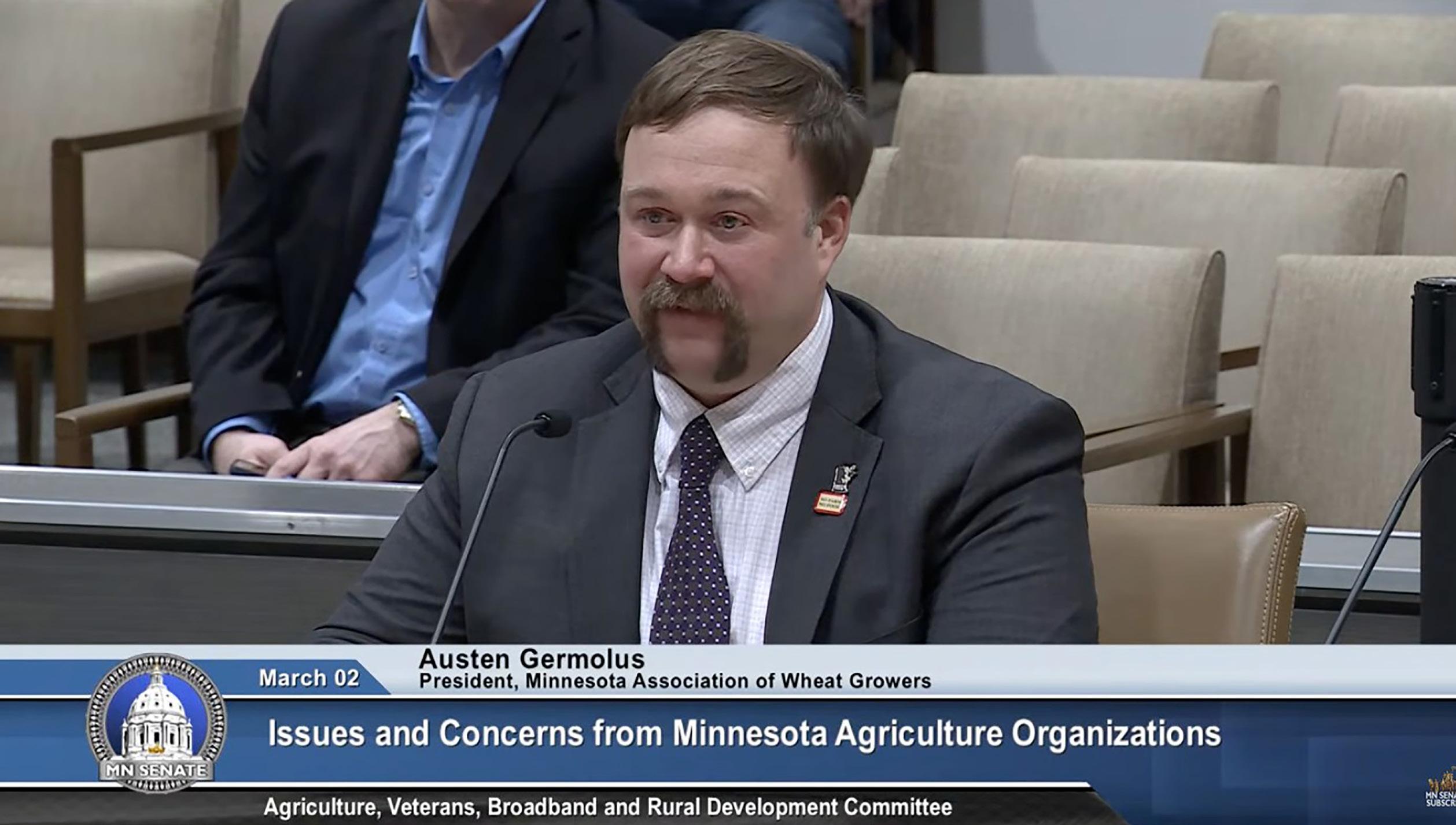
A unique aspect of this year’s trip to St. Paul was that MAWG was invited alongside several other ag groups to testify in front of the Senate Ag Committee. As MAWG president, Austen Germolus was given the distinct honor of sharing his testimony.
“I appreciated the opportunity to share a wheat grower’s perspective on the state of the farm economy,” said Germolus, a fifth-generation farmer from Borup. “The committee hearing went well and was well received by the committee.”
Germolus spoke to Senate Ag Committee Chair Aric Putnam and the rest of the committee on the
current challenges in the ag economy, including the rising input costs and straining markets, as well as a need to protect crop inputs and the use of treated seeds.
“The current economic climate for wheat producers can be characterized as one of high input costs and low prices, and even with record state yields in recent years, producers are seeing negative returns of $100 to $200 an acre, which is hard to swallow,” Germolus said in his testimony. “Fertilizer costs have increased substantially over the past few years, reaching record high levels.”
In addition to the challenging economic times for wheat producers, Germolus also testified on some of the other logistical challenges of operating a family farm, including the cost of health insurance and workforce hurdles. One of those workforce hurdles is the Paid Family Medical Leave Act, which was signed into law in 2024. Germolus says that MAWG has supported bills that would exempt small employers from being mandated
to participate in that program, especially farms that rely on part-time, seasonal workers.
“The act imposes annual tax increases on small business and will make it nearly impossible to find replacement workers during this challenging job market and workforce shortage,” Germolus said. “There are no farm exemptions, and the unique and seasonal nature of the farm industry makes record keeping compliance with this law challenging to family farms.”
Face to face
As significant as it was for MAWG to be invited to testify in front of the Senate Agriculture Committee, equally as important during their visit to the Capitol were the one-on-one visits with legislators that occurred the following day. During his visits, past MAWG President Kevin Leiser made sure to speak with lawmakers about a proposed bill that would ban paraquat herbicide and add constraints to neonicotinoid insecticides and seed
treatments. Under the proposed bill, farmers would have to apply to MDA to use treated seeds and show that there is a need.
“If you believe in vaccines you should believe in treated seed, because we’re just protecting the seed,” said Leiser. “We treat our seeds right before we plant them, usually with insecticide and fungicide to protect the seed from cold/wet soils and soil borne insects which allows the seed to stay viable and healthy until it emerges.”
Given the challenges to the ag industry and specifically wheat growers, MAWG board members emphasized to legislators the importance of protecting their tools and not bringing further difficulties to life on the farm.
“Most of the time we’re asking them to not pass legislation that is going to make our job harder or by taking away a tool in our toolbox,” Leiser said. “So, a big part of that is educating them on
what we do and that we have the best interest of the land in mind because we rely on that land to produce. If you don’t treat your soil right, it won’t treat you right.”
Overall, Leiser said, the visits were productive and provided MAWG members with the opportunity to speak with both Democratic and Republican legislators on the visits. Leiser said it appeared that lawmakers were attentive to what the wheat growers had to say and were often taking notes.
“I really liked that some of the legislators who weren’t as informed on some of our concerns were actually taking notes, which shows that they care enough to revisit it later,” he said.
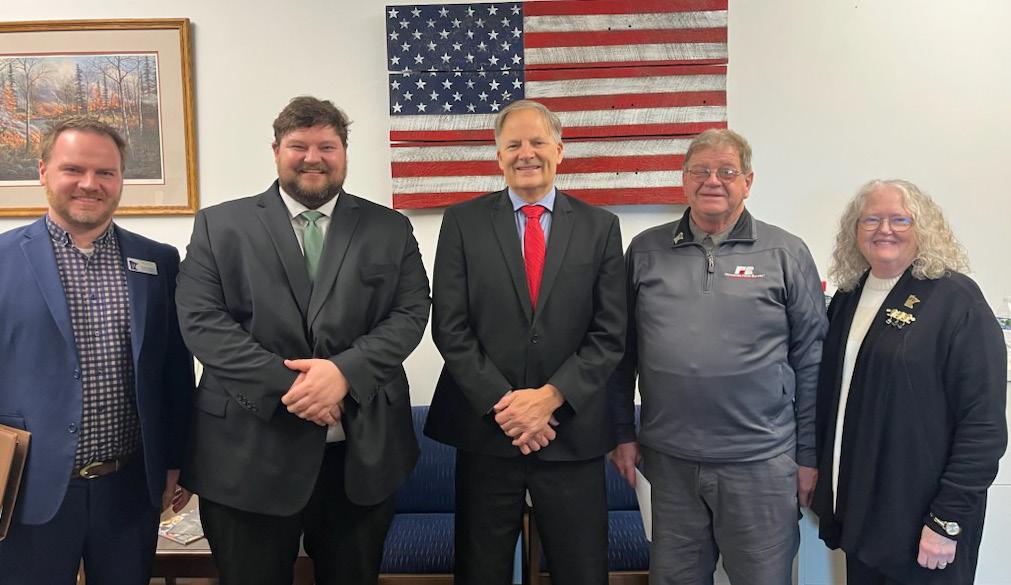
Following his testimony in front of the Senate Ag Committee, Germolus and MAWG colleagues had the chance to visit again with Sen. Putnam, but this time as a sit-down conversation in his office to talk more in-depth about MAWG priorities and follow up on parts
of their conversation from the previous day in committee.
“Senator Putman has been friendly to agriculture and willing to hear all sides, I think it’s good to meet with him personally and talk about our priorities and to get his perspective,” Germolus said. “It was a good conversation; he was very receptive and he was appreciative of what we’re doing.”
MAWG invites any of its members to participate in their annual Wheat Day on the Hill and advocate for their fellow wheat producers. Germolus says it’s important that farmers stand up for themselves, share their stories and make their voices heard to lawmakers.
“It’s a great experience. Taking the time to make a trip to the Capitol leaves an impression and has a profound impact on those we meet with,” he said. “It’s very important to make those connections, reach out and make sure your concerns are heard.”
MAWG President Austen Germolus testifies at the Capitol in front of the House Agriculture Committee.
By Sydney Harris
High priority
Spring Wheat Survey provides researchers insight into variety selection
What variety to plant and what variety not to plant.
It’s the age-old question for Minnesota wheat producers.
With a plethora of options available, boasting a range of traits, the varieties that farmers select each year allow wheat breeders to take the pulse of what traits producers seek.
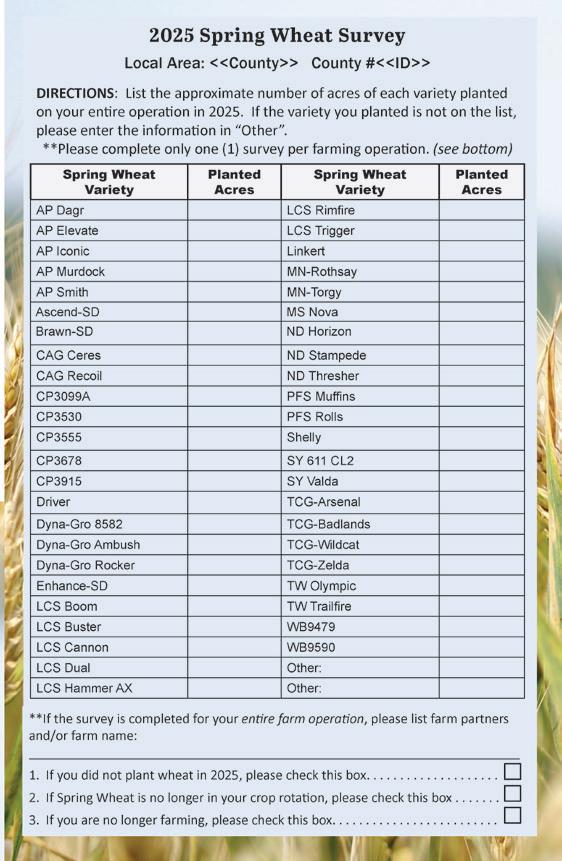
The Spring Wheat Survey, distributed yearly by the Minnesota Wheat Research & Promotion Council and supported by Minnesota wheat checkoff dollars, is the guidebook that the University of Minnesota wheat breeding program relies on.
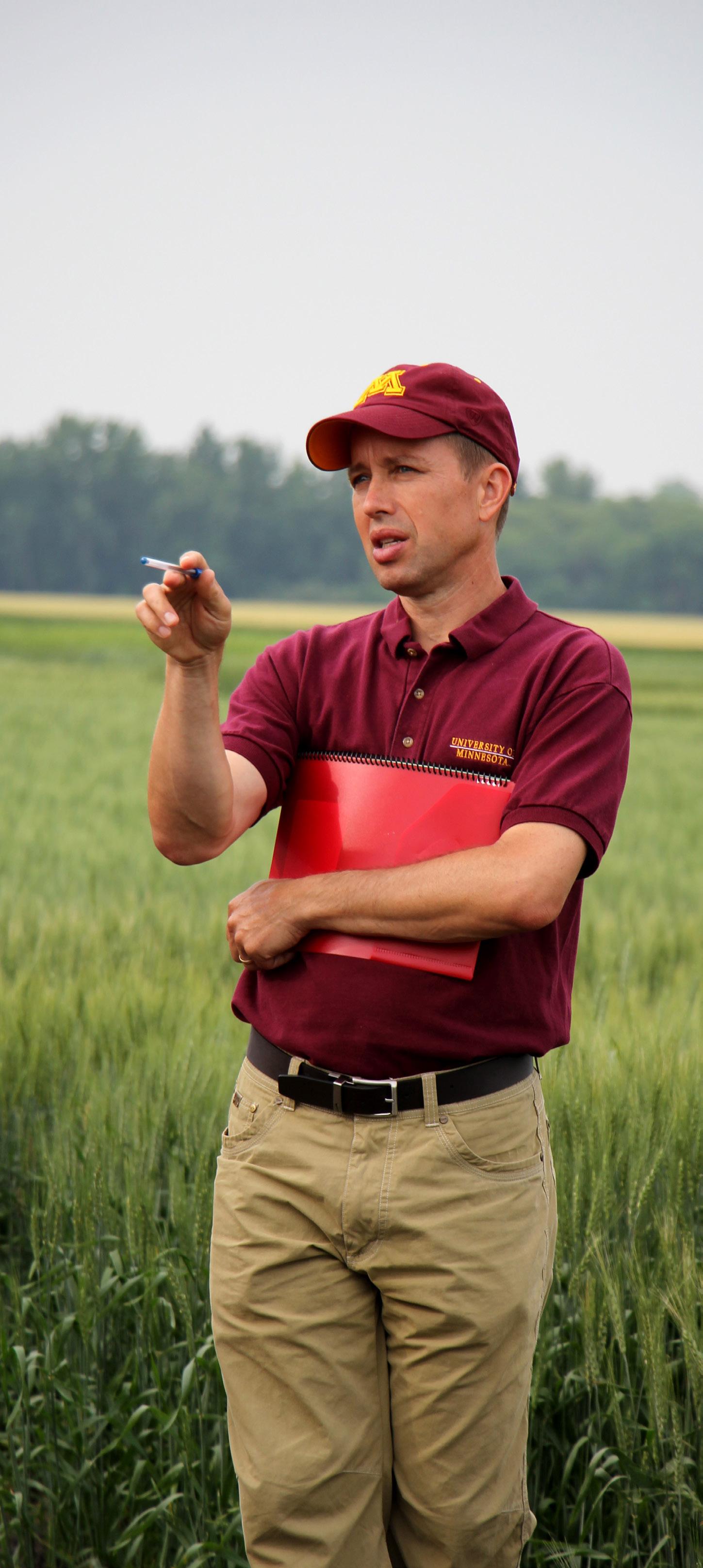
“We ask wheat growers what spring wheat varieties they’re planting for this coming season to get a profile of what varieties are being grown,” said Jim Anderson, University of Minnesota wheat breeder. “It helps give breeders like me insight into what varieties are being grown and why they’re being grown, which we can know because of the varietal traits.”
Since the early 2000s, the Spring Wheat Survey has helped curate a variety roster that producers want, with emphasis placed on traits like yield, protein, quality characteristics and disease resistance.
“It helps orient the breeding program as to which traits are being selected most heavily by growers when they’re making their variety choices,” Anderson said. “As a breeder, it helps us target varieties that we think should be replaced. They’re getting older, they’re vulnerable to diseases. So, it helps us kind of recalibrate the breeding program on a periodic basis.”
Usually, there aren’t many variety bracket “upsets” and Anderson’s predictions for the 2026 growing season don’t vary drastically from 2025.
“The rankings don’t change much from
one year to another,” Anderson said. “MN Rothsay was number one last year and I believe it will be again this year. One variety that I expect to go up in acreage a lot is a recent release, ND Stampede. It’s done well yield-wise and has just enough protein that most growers wouldn’t get a discount, so the yields make it a very attractive variety.”
But what happens when a popular variety does move up the ranks?
“What becomes interesting is looking at which variety or varieties it replaced,” Anderson said. “If a variety all of the sudden goes from five percent of the state’s acreage to 15 percent, that means that other varieties lost acreage. Based on that, we can infer which traits have the highest priority in the minds of growers.”
‘Valuable data’
Before MWR&PC took the helm, the U.S. Department of Agriculture distributed the survey, but high costs caused Anderson to explore other avenues, leading to his proposal to MWR&PC.
“It’s such valuable information, so we’re doing a lowcost version now,” Anderson said. “The data is still good as long as there’s good response from growers, which there always has been.”
Toward the end of May, the survey will be mailed and emailed to growers and the results will be used to create a report that shows each variety as a percent of all wheat acres in the state and regions of the state.
“The University of Minnesota wheat breeding program is vital to growers in our state,” said MWR&PC Chair Mark Jossund, who farms near Moorhead. “The data from the Spring Wheat Survey helps guide their research, which in turn benefits us at the farm-gate. When you see it in your mailbox or in your email inbox, please fill it out. It doesn’t take long.”
Because of the survey’s continuity, the data that can be gleaned is beneficial to stakeholders across the industry, from growers to end-users.
“We’ve had this data for more than 20 years and so it’s really nice to see the trends throughout those years,” Anderson said. “It’s really valuable data for not only the breeders but also the industry that’s using those varieties.”
Completing the Spring Wheat Survey isn’t an arduous or cumbersome process. It’s quick, it’s simple and it’s important.
“I encourage all growers to fill it out when they have a few minutes,” Anderson said. “It’s really helpful.”
The 2026
SPRING WHEAT SURVEY
This survey is conducted for the benefit of the University of Minnesota Spring Wheat Breeding Program.
Your cooperation is greatly appreciated!
will be out in May!
Each year the Minnesota Wheat Research & Promotion Council conducts a Spring Wheat Survey. The information gathered from the survey will help Dr. Jim Anderson, UMN Spring Wheat Breeder, with his selection of new varieties that meet the needs of you, the grower.
In late May, after planting is complete, the Spring Wheat Survey will be emailed and mailed out to wheat growers in Minnesota. Please take the time to complete the survey. It will only take a few minutes.
Whether you received a survey in the mail, email, or received the information from another source, if you live in Minnesota and planted spring wheat, we welcome you to complete a survey.
The link to the survey will be available on mnwheat.org in May.
The combined results of the surveys will be put into a report that shows each variety as a percent of all wheat acreas in the state and regions of the state. Results will be published in the Prairie Grains magazine in the fall.
Thank you, Minnesota Wheat Research & Promotion Council
Covering ground: Beach Family Farms enrolls in MAWQCP
When it comes to protecting soil health and promoting water quality, Beach Family Farms is leading from the front
Speaking from his Isanti County farm just prior to planting his spring crop, Beach recalled his family’s strip tilling practices being met with initial skepticism from nearby farms. Little by little, Beach Family Farms is winning ‘em over.
Seeing is believing.
“(One farmer) came up to us last fall and said, ‘Those crops looked the best in the area all summer long and through the fall,’” said Chris Beach, who farms with his family in Stanchfield. “He could see the change in what we were trying to do. Folks are starting to come around, that maybe there is a different way we can look at this.”
Beach was aware of the Minnesota Agricultural Water Quality Certification Program (MAWQCP) and started pursuing enrollment last fall through the farm’s close affiliation with Centra Sota Cooperative, a key MAWQCP stakeholder.
“We’re a true family operation and have worked with Centra Sota getting involved with carbon programs and expanding strip till and cover crops,” Beach said. “They said, ‘Hey, we think you guys are doing a lot of the things to get certified.’ We thought it would help further the cause within the state.”
Beach Family Farms rotate soybeans and corn; in addition, they plant rye as a cover crop and are involved in a camelina project with Cargill. They’ve experimented with strip till practices, variable rating and split applications to reduce nitrogen runoff over the last 20 years and have since incorporated into their entire farming operation.
“This last year was the first year we covered every acre that we could with cover crops,” Beach said. “That felt really good, to be able to prove that concept, and then we strip tilled every acre we could this fall, and that was a big milestone to pass.”
The Beach family worked with Centra Sota over the course of several months to become certified. The farm became one of the
largest operations to enroll in MAWQCP.
“We haven’t had to make a huge shift in what we’re doing,” Beach said, “but it feels good to get that acknowledgement and help tell that story, that even with a larger number of acres, you can do these things. It doesn’t require you to have to sacrifice your organization.”
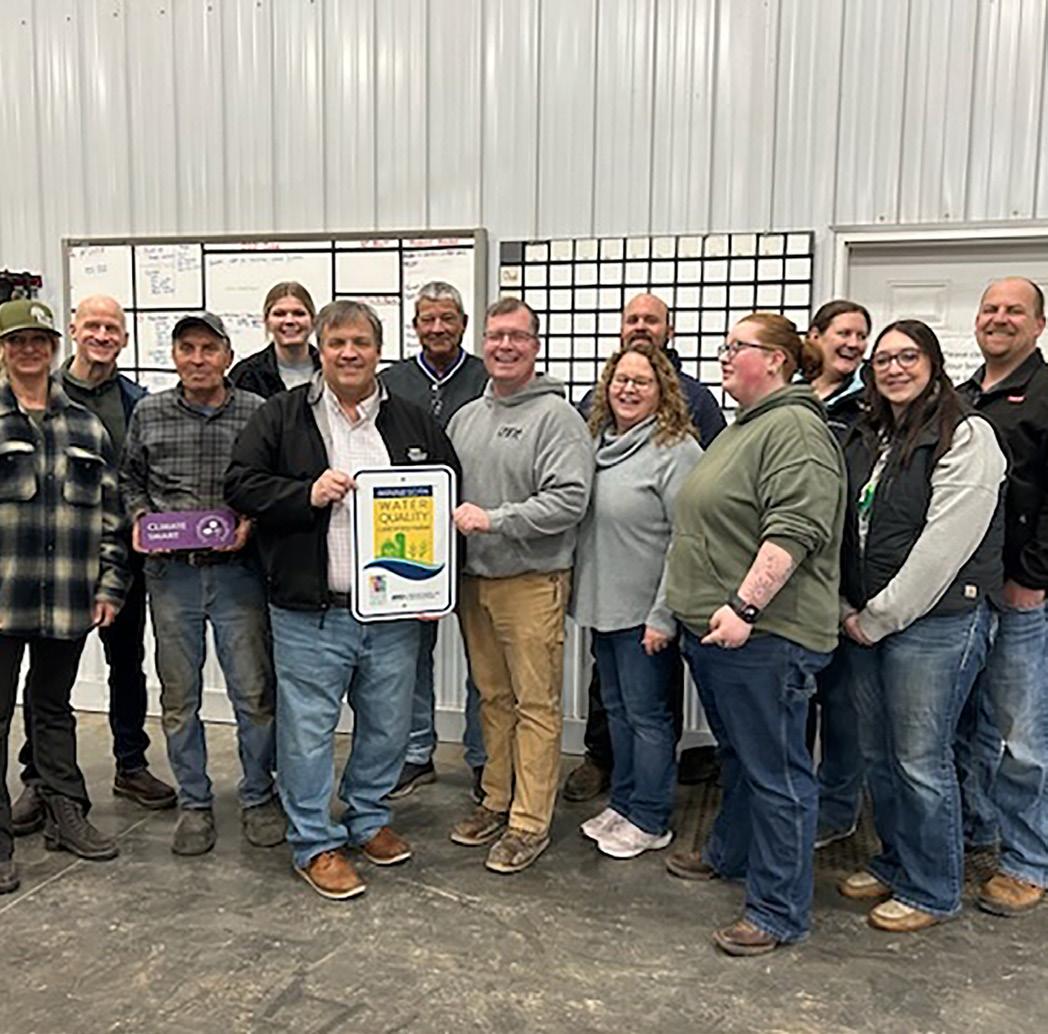
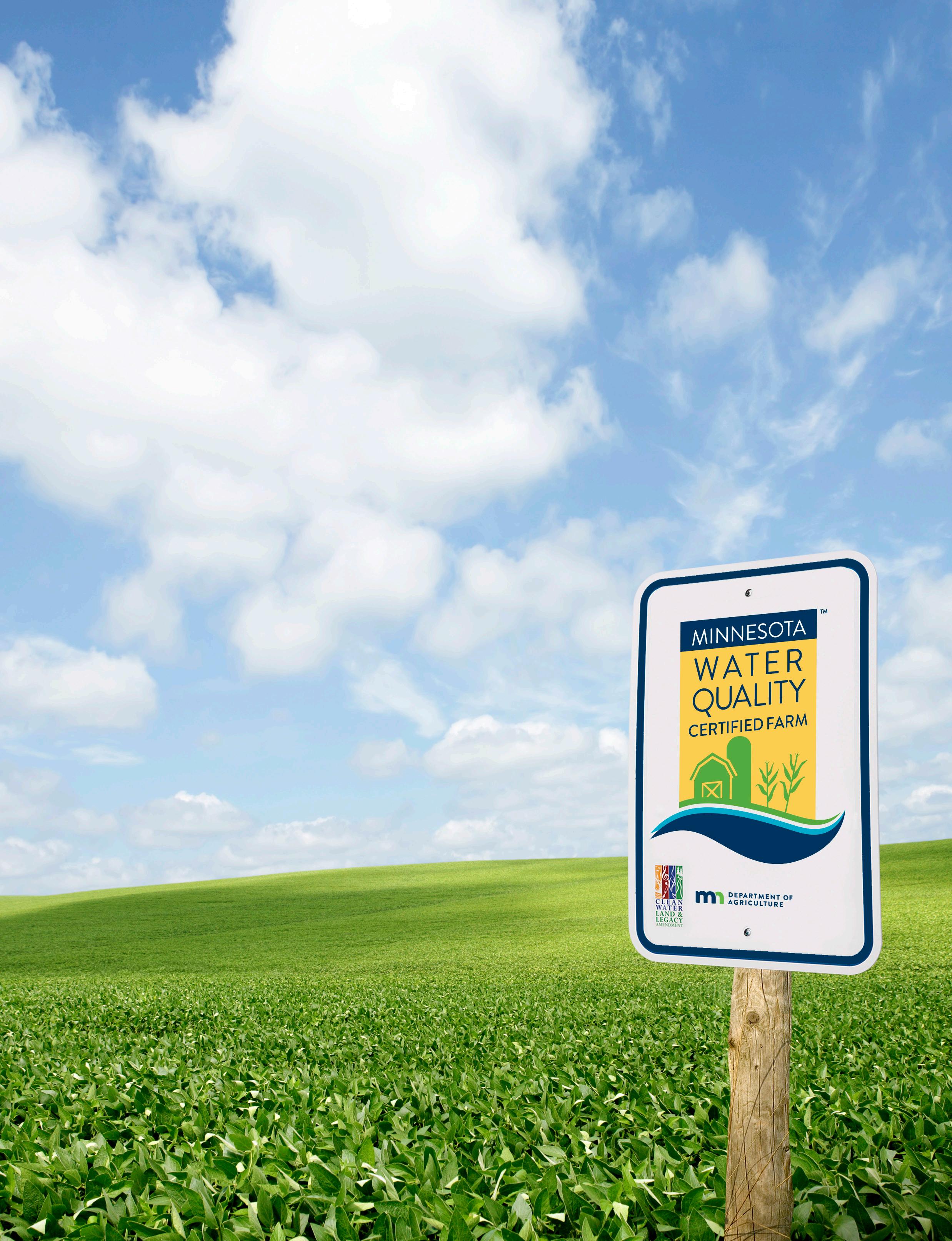
The voluntary enrollment process was capped by a visit from MAWQCP Program Manager Brad Jordahl Redlin and Ag Commissioner Thom Petersen, who presented the Beach family with the coveted MAWQCP plaque, which all enrollees receive, along with other benefits, including financial assistance programs.
“It was such a treat to meet the Commissioner, and he actually lives not too far from us and knows our area,” Beach said. “It was nice to visit with him and give a little perspective of what we’re seeing and provide him some feedback and be able to toot our horn a little bit.”
Since the program became available statewide in 2015, over 1,800 farms totaling over 1.72 million acres have been certified across Minnesota. Farms have added over nearly 8,200 new conservation practices. Those new practices have kept nearly 60,000 tons of sediment out of Minnesota rivers while saving 167,000 tons of soil and 77,000 pounds of phosphorous on farms each year. The conservation practices have also reduced nitrogen loss by nearly 50%.
MAWQCP connects farmers with local conservation district experts to identify and mitigate any risks their farm poses to water quality on a field-by-field basis. Once certified, each farm is considered in compliance with new water quality laws and regulations for 10 years.
“This is a way to be a good ambassador for agriculture,” said Beach, whose family began farming in northwest Hennepin County. “There are a lot of people who don’t understand what we do as farmers, and I see this certification as a way to demonstrate that we are doing the right things and trying to be proactive. The voluntary part of it gives us the opportunity to provide input and help develop recommendations.”
Farmers and landowners interested in joining Beach Family Farms in becoming water quality certified are encouraged to contact their local Soil & Water Conservation District or visit MyLandMyLegacy.com to enroll.
“It’s definitely something we’re proud of to put out there so people know what we’re doing and we can tell our story,” Chris Beach said.
MDA Commissioner Thom Petersen presents Beach Family Farms with the MAWQCP plaque.
By Sydney Harris
Bridging the gap in mental health support: Vital resources available to producers
Minnesota farmers are natural optimists. Between unpredictable weather, high input costs and low commodity prices, they have to be to plant their fields each year, trust that the crops will grow and that profit margins will be enough to get them through to the next year when they’ll do it all again.
But, sometimes, the rose-colored glasses come off, and the realities of the tumultuous agriculture economy is blinding.
May marks National Mental Health Awareness Month and as the 2026 growing season kicks off, it’s important to remind producers of the resources available to them.
“Mental health is the foundation of how we think, feel and live,” said Brian Sorenson, executive director of the Minnesota Association of Wheat Growers. “It isn’t to be taken lightly, and Minnesota farmers are fortunate to have resources available to them to help them walk through difficult times.”
For Minnesota producers experiencing stress, anxiety or depression due to business and financial challenges, the Minnesota Department of Agriculture has resources readily available to help, such as the Minnesota Farm and Rural Helpline. Calls are answered 24/7 by trained counselors who can lend a listening ear or connect you with help for business, financial or legal problems. Call 833-600-2670 or text “FARMSTRESS” to 898211 to get started. MAWG, in collaboration with fellow farm groups, advocated for these free resources at the Minnesota Legislature.
This first-of-its-kind program also supports Monica McConkey, Jennifer Vaughn and Tracie Rutherford-Self, who are experienced, ag-focused mental health providers. Funded through an appropriation from the Minnesota Legislature to the Region Five Development Commission, these individuals offer free, confidential counseling to farmers, farm family members, employees, agricultural workers and advisors across Minnesota. Sessions can take place in person, on Zoom or over the phone and insurance is not needed. They have helped hundreds of Minnesota farmers and farm family members over the years.
“Farmers are tough, but it’s not an easy profession,” said Agriculture Commissioner Thom Petersen. “From unpredictable weather to rising input costs, farmers
face an enormous amount of stress. Sometimes, just a few conversations with someone who understands can really help.”
In addition, the University of Minnesota Extension offers farm safety and farmer mental wellness programs, news and resources, including online workshops at extension.umn.edu/rural-stress.
“You’re not alone, even if it feels like you are,” Sorenson said. “These resources are confidential and free to use so if there is a weight on your shoulders that you need help carrying, please look into the options available.”
North Dakota producers also have a plethora of resources available to them in times of stress, including the North Dakota Mediation Service and Credit Counseling. Established in 1984, the North Dakota Mediation Service is a program of the North Dakota Department of Agriculture to help financially distressed farmers and ranchers through assistance with credit and financial matters and resolving disputes. Visit www.ndda. nd.gov for more information.
Additional resources are available through North Dakota State University Extension to help growers manage stress, whether that be adverse weather, disease, regulations, volatile commodity prices, family dynamics, financial worries or a combination of factors. For more information visit www.ndsu.edu/agriculture/extension.
Producers can also tap into the North Dakota Farm Management Program, which is designed to provide education to farm owners and operators or persons interested in farming. Topics covered include business and family goal setting, improving record keeping systems, increasing financial management skills and improving efficiency and organization. More information can be found at www.ndfarmmanagement.com.
HOW MUCH IS THE COSTING YOU?
HERBICIDE TAX
BY MATT THOMPSON
As weeds become harder to kill with GLYPHOSATE AND EVEN HPPD CHEMISTRIES, many farmers are looking at additional herbicide options. With more chemistry getting put into the tank, what effect does that have on your corn yield?
THINK ABOUT HOW A CORN PLANT DEVELOPS.
The first three leaves of the corn plant are already inside the corn seed when you put it in the ground. From V3 to V6, that plant will determine all the rest of its leaves for the year and begin to expand them out as the growing point moves above the ground at V6. By V5, the plant has already determined how many rows around its ear will be.
THE REASON I BRING ALL THIS UP IS THIS — WHEN DO YOU TYPICALLY MAKE A HERBICIDE APPLICATION IN CORN?
FROM V2-V6. That means the plant is conducting some of its most critical functions in determining yield for the season all while it’s trying to process and metabolize herbicide.
I’ve referred to the stress following herbicide applications and its effect on yield as the Herbicide Tax. When you spray a foliar product like glyphosate on crop, the plant has to decide if that toxin is something it can process and metabolize or if that toxin is going to kill the plant itself. Regardless of trait tolerance, this takes a tremendous amount of energy away from critical functions like foliar leaf development, root development, and even beginning stages of yield determination.
THE ENERGY A PLANT USES TO PROCESS APPLIED HERBICIDES IS A TAX IT HAS TO PAY IN ORDER TO SURVIVE – THE HERBICIDE TAX.
One of the most consistent products in the Hefty Naturals portfolio is one that works to diminish this Herbicide Tax — MEGAGRO. MegaGro is patented as a glyphosate safener because it functions by overloading the plant with auxins to speed up how the plant metabolizes glyphosate chemistry; and in the past 13 years of research, we’ve seen an average yield increase of more than 6.5 bushels per acre in corn.
In some of our 2025 trials, we also looked at different timings and products, including some that fall into the dicamba category. When comparing applications made at V2 and V8, we saw some pretty striking results. Spraying Clarity herbicide late at V8 rather than on time at V2 resulted in an 11.6-bushel yield reduction! What implications does this mean for growers who make revenge sprays later in the season? We saw similar results in other products. An application of DiFlexx at V8 showed a 7.8-bushel reduction in yield versus spraying at V2. Further, at the V2 timings, we added MegaGro to the tank with Clarity and DiFlexx. In both occasions, we showed higher yields with MegaGro being included in the tank (+7.87 bushels with Clarity and +4.10 bushels with DiFlexx).
WHAT WAS
MOST INTERESTING
WAS
THE
COMPARISON BETWEEN V2 CLARITY HERBICIDE, AND V2 DIFLEXX PLUS MEGAGRO: MORE THAN A 10.16-BUSHEL DIFFERENCE!
This represents an ROI of more than 2.7 using a corn price of $4.25. I think that this presents a compelling argument for running DiFlexx with MegaGro versus just Clarity herbicide in the post pass at V2. This directly relates back to how much the Herbicide Tax costs the plant to process and metabolize these chemistries. Either way, if you are running a dicamba product with your post applications in corn, MegaGro should be included in the tank.
No matter what chemistry you spray, the Herbicide Tax comes into play because the plant has to spend energy to ensure it stays alive, even if the chemistry itself won’t kill the corn crop. How you minimize negative effects will determine how many bushels you can harvest at the end of the season.
As we’ve seen year in and year out for more than a decade, adding a product like MegaGro to the tank is an excellent way to minimize that tax.
By Deanna Kanne
its small grain insect and disease field survey in western Minnesota, and they need your help!
“It’s harder to find wheat fields (in Minnesota),” said Anthony Hanson, UMN Extension educator in field crops integrated pest management. “We don’t know where all the acres are but want to make sure we’re getting this service to as many growers as we can in western Minnesota. That’s where we definitely need help with people volunteering fields.”
This survey is done in partnership with North Dakota State University and has been funded by the Minnesota Wheat Research and Promotion Council since 2011.
“This is a checkoff-funded program, so it’s already paid for scouting for those growers that want to volunteer fields,” Hanson said. “This is especially helpful so growers can get a heads up on what might be showing up in their field, whether it be diseases or insects.”
Scouts are based in three different areas of Minnesota:
discouraged if your field is outside those specific cities. Scouting begins in late May or early June and will be done on a weekly basis. If selected, farmers are able to receive weekly updates about what scouts are finding in the fields, and if there is a treatment recommendation.
“It’s definitely a good early warning system,” Hanson said. Hanson and the rest of the field survey team use this information to make larger-scale maps that show disease spread and pest locations. In 2025, armyworm infestations were found by scouts, and new locations were found for cereal leaf beetle in 2024.
To volunteer your field, scan the QR code or contact Anthony Hanson at hans4022@umn.edu. The latitude and longitude will need to be provided, which is easily found on Google Maps. Preferred fields are those easily accessible from a roadside. Include your email in the submission to receive weekly scouting updates.
Hanson is looking for Minnesota farmers to volunteer their fields to be scouted during the growing season. Scan the QR code to register your field. For farmers in North Dakota, contact Patrick Beauzay at Patrick.beauzay@ndsu.edu for additional information.
Scan the QR code to sign up for scouting in Minnesota:
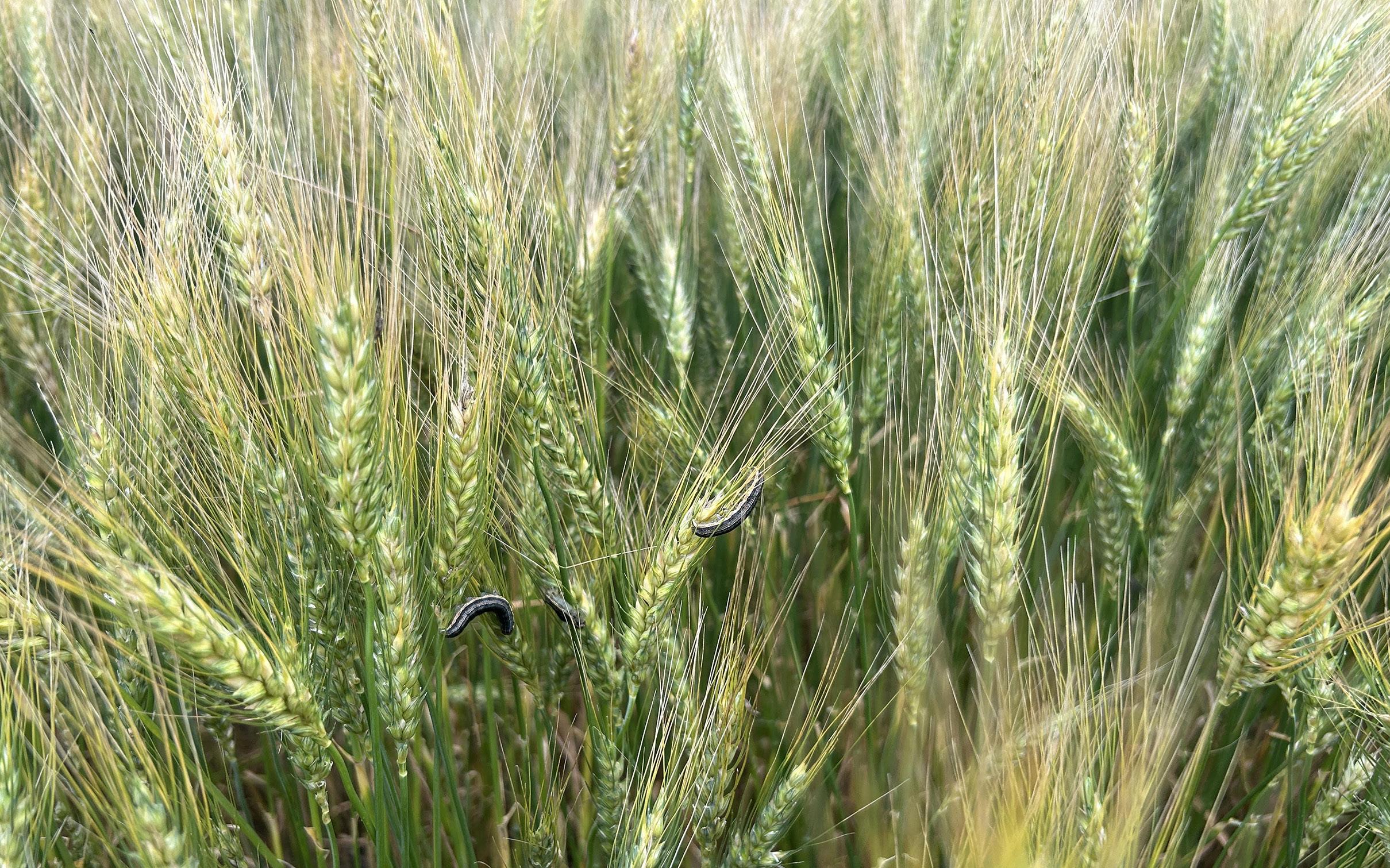
Severe and widespread true armyworm infestations were found by scouts during late July in 2025 that resulted in yield loss due to defoliation or head clipping just prior to harvest.
Photo: Jordan Hunnicutt, 2025 IPM scout.
By Sydney Harris
A new day
Following 26 years of serving as North Dakota Mill’s president and CEO, Vance Taylor’s last hurrah with the 104-year-old milling facility is right around the corner on July 3.
For Taylor, the country’s 250th Independence Day will be one to remember as his first day with a new kind of independence.
“It feels great,” Taylor said. “My wife and I are excited to spend more time with the grandkids and do some traveling.”
While he’s looking forward to the next chapter, there’s no denying that July 3 will be a bittersweet day.
“I’m going to miss the job,” Taylor said. “I’m going to miss the people here at the mill and the connections with the state and local government, who have both given a lot of great support over the years.”
Before he landed in North Dakota, Taylor worked in various roles for ConAgra Flour Milling, which later merged with Horizon Milling to form Ardent Mills. He grew up in Manhattan, Kan., and attended Kansas State University where he earned a degree in milling science.
“I didn’t grow up on a farm, but both of my parents had farm backgrounds,
and I had uncles who farmed nearby,” Taylor said. “I had always been interested in agriculture.”
Grind and shine
Launching operations in 1922, the North Dakota Mill and Elevator Association was born to ease the financial burden on North Dakota wheat producers. At the time, Minneapolis was the primary market for North Dakota-grown wheat, but because of freight costs, farmers received a lower price for their wheat.
The North Dakota Mill, which is the only state-owned milling facility in the U.S., solved that problem.
“We exist to provide additional returns to farmers, and we do that by creating demand for more grain,” Taylor said. “This year, we’ll grind over 40 million bushels of spring wheat and durum.”
Throughout his storied career at the North Dakota Mill, Taylor worked together with the North Dakota Wheat Commission to enhance the value of North Dakota-grown wheat.
“Our region’s hard red spring wheat and durum have very unique and high value quality traits,” said Erica Olson, director of marketing
and research at the North Dakota Wheat Commission. “The Mill has been integral in marketing the flour made from that wheat to high value markets across the country, providing opportunities to get our growers’ wheat in the hands of the right customers, bringing significant value to the region’s wheat crop.”
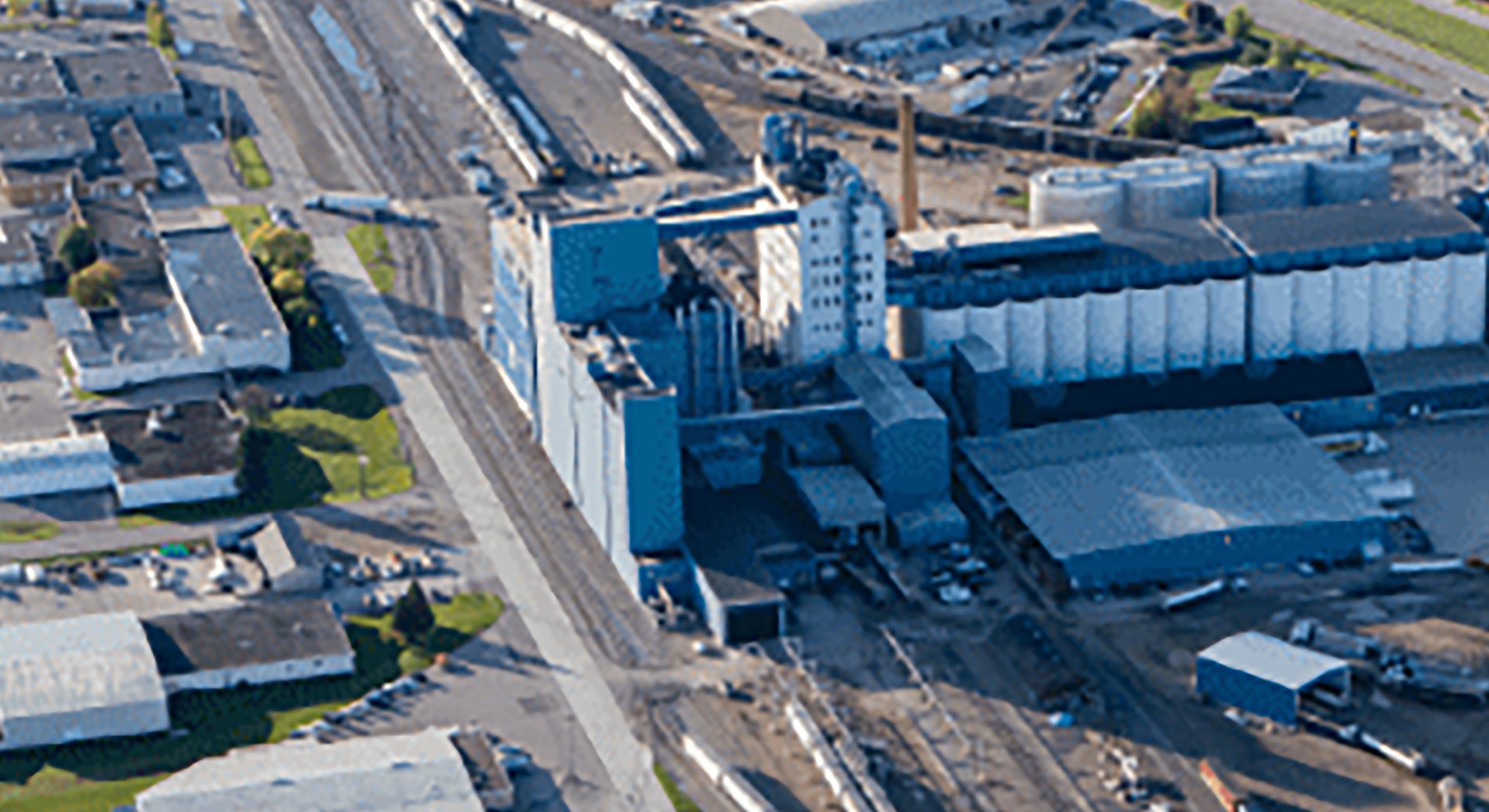
Today, the North Dakota Mill is home to ten milling units, a terminal elevator and a packing warehouse. It produces and ships 60,500 hundredweights of milled products daily and processes and mills over 130,000 bushels of wheat per day. Every year, the Mill adds value to 40 million bushels of spring and durum wheat.
“When I started working at the mill in 2000, our capacity was about 27,500 hundredweights, so 2.75 million pounds per day,” Taylor said. “Now we produce over 6 million pounds per day and have an expansion project in progress right now that will take us to 6.5 million pounds per day.”
Throughout his tenure, Taylor oversaw several capital projects that increased the capacity and efficiency of the Mill, allowing for exponential growth.
“We completed the 5,000 cwt per
Upon retiring, Vance Taylor’s Fourth of July holiday will be a bittersweet affair
day C Mill project back in 2006 and expanded the K Mill through three different renovation projects around 2010,” Taylor said. “In 2017, we completed the G Mill project which was 11,000 cwt per day. The H and I Mills were added in 2023, and those projects added another additional 11,000 cwt capacity.”
Because of its ability to process and store more wheat, the Mill has had to adjust its receiving process to accommodate the growth. With the terminal elevator’s storage capacity at 5.3 million bushels of wheat, the Mill receives 80 percent of its grain from elevators and 20 percent directly off the farm.
“One of the hurdles we’ve had to find a solution for was long waiting times in the wheat delivery lines,” Taylor said. “We’ve sped up our unloading process to unloading over 200 trucks in 8 hours or less when it used to take 12 to 16 hours to unload 80 to 100 trucks.”
Those improvements translated to rail, too.
“It makes us more efficient on the rail side as well,” Taylor said. “Those projects also give us capability to unload shuttle trains when we need to pull wheat from further out west.”
A people person
People make a place and Taylor’s time at North Dakota Mill proved no different.
“It’s a great group of people that we have here at the Mill,” Taylor said. “Everybody works really well together as a team to reach common goals.”
Taylor’s connections go beyond the Mill’s gates.
“It’s a very close-knit industry,” Taylor said. “So, I enjoy the people on the supply side working with farmers and elevators, as well as our customers in the baking industry.”
With 80 percent of the Mill’s flour and semolina shipped on bulk rail cars and trucks and 20 percent of finished products packaged in bags ranging from 5 to 50 pounds for shipment via boxcars and trucks, Taylor has worked closely and built strong connections with the transportation industry.
“Because we’re located in North Dakota and most of our customers are located on the east coast, transportation is a large part of our business,” Taylor said.
Additionally, Taylor didn’t hesitate to welcome others to the Mill, offering his expertise and knowledge of the industry.
“Vance was always open to assist with customer education and the number of trade teams and industry groups that toured the Mill over the years is impossible to keep track of,” Olson said. “There have been summers that the Commission was there on a consistent basis because Vance and his team was always willing to showcase the Mill, providing tours and education on the region’s wheat crop and milling attributes.”
Outside of leading the North Dakota Mill, Taylor stayed engaged with the industry through participation in organizations, such as the Wheat Foods Council.
“He knew the importance of industry involvement in national organizations and was a key supporter of the Wheat Foods Council,” Olson said. “I worked with him a lot through the Council and he always took the time to be at the meetings and provide input on domestic promotion efforts as he valued the importance of that work.”
After 26 years, there’s no doubt that Taylor will be reminiscing on the connections he’s made with the people surrounding him for years to come as the North Dakota Mill welcomes its next leader, and he turns the page.
“I’ve really enjoyed working at the North Dakota Mill,” Taylor said.
By Deanna Kanne
A Grain of Knowledge
Success in a difficult season
While farmers are financially conscious every year, in a year like 2026, it’s even more important. Input prices are up, trade is down and the combination makes margins razor thin.
According to the USDA prospective planting report, wheat acreage is projected to drop 3% this year. If realized, this would represent the lowest wheat planted area since records began in 1919.
In Minnesota, wheat acreage is projected to be down 10% compared to 2025, as more farmers in the state favor corn and soybeans.
“It’s going to be a rough ride this summer,” said Jochum Wiersma, small grains specialist at the Northwest Research and Outreach Center in Crookston.
Yet there are ways farmers can set themselves up for financial success in a tough financial year.
For farmers who haven’t planted, consider how important seed treatments are in your area. Past crop history is important to consider and can potentially save a few bucks.
“There are a couple of instances where the seed treatment is more or less automatic, and that would be if you had Fusarium head blight in that seed lot last year, or if you know you have, Blue Smut, in the seed lot last year, when you harvested it,” Wiersma said. “Those are two automatics where you would use a seed treatment, or if you have a history of Fusarium crown rot or common root rot and are planting wheat on wheat.”
After planting, there are also a couple of areas where producers can watch their finances. For example: During herbicide applications, is it necessary to apply fungicide as well?
“Oftentimes, and probably most of the time, there actually isn’t any disease present yet,” said Wiersma. “So, it’s a couple of dollars an acre that doesn’t need to be spent.”
Jochum Wiersma is a small grains specialist stationed at the Northwest Research & Outreach Center in Crookston. On the Extension side, his mission is to develop educational programs, organize grower and industry meetings and handle inquiries and requests from the public. His research mission is to develop the knowledge and solutions that meet grower’s small grain production and management needs so that small grain production remains profitable and sustainable.
The same holds true for adding insecticides to the tank when spraying for diseases, even if the insect threshold hasn’t been met.
“There’s the odd luck that you would actually take out, say, army worm and you’re saving yourself a pass, but otherwise, you, in a way, are throwing away money,” said Wiersma. “It’s a combination of integrated cash management and watching your expenditures.”
By Sydney Harris
‘ONCE IN A LIFETIME’
Outgoing USW chair aims to showcase home state during Summer Board Meeting
The U.S. Wheat Associates (USW) is going “North to Dakota” June 2326 for its Summer Board Meeting, commemorating Jim Pellman’s year as chair of the organization.
“Representing wheat around the world has been one of my favorite parts (of serving),” Pellman said. “It’s gone very fast. It’s a four-year commitment and though this will only be year three out of four for me because I will be past chair for a year, the year as chairman went really fast.”
Growing wheat, barley, canola, corn and soybeans near McClusky, Pellman is serving his second fouryear term on the North Dakota Wheat Commission and has served as the county representative for Sheridan
County since 2014.
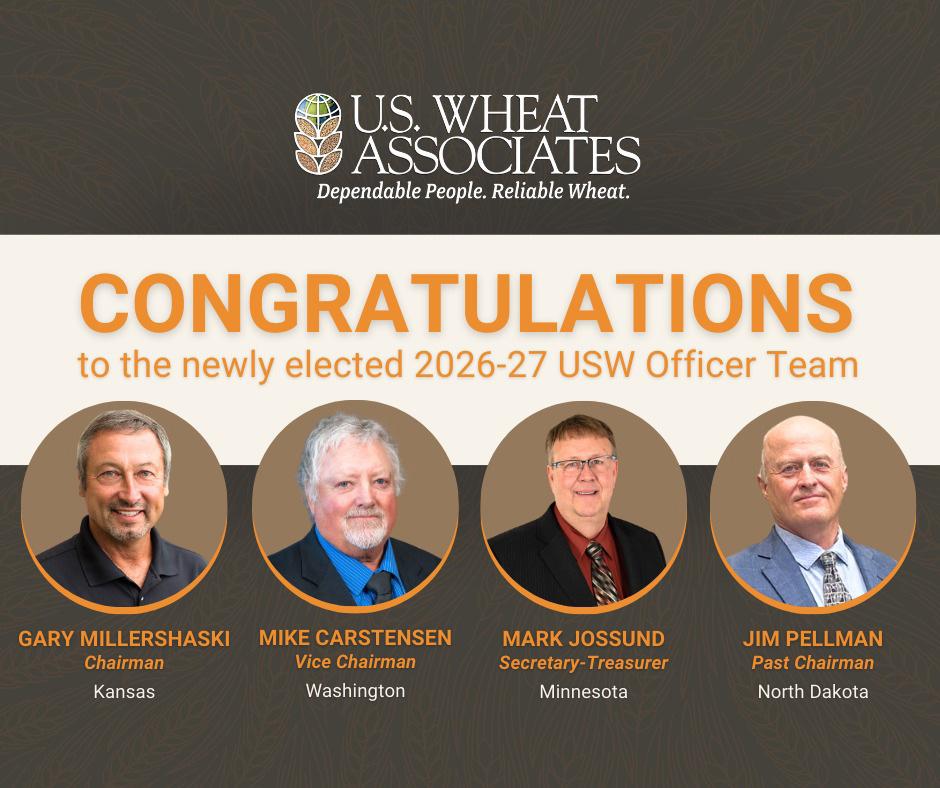
During the USW meeting in Fargo, Pellman will pass the gavel to Gary Millershaski of Kansas, who will serve as the 2026-27 chairman. Millershaski was elected to the USW officer team in 2024 and has served in various leadership roles, including as a director of the Kansas Association of Wheat Growers from 2007 to 2017 and becoming a Kansas Wheat Commissioner in 2016.
“Our farmer leaders are the backbone of everything we do at USW, keeping our strategies grounded in realities of production agriculture while meeting the demands of the global marketplace,” said USW President and CEO Mike Spier.
To round out the 2026-27 USW officer team, Washington’s Mike Carstensen will assume the role of vice chairman and Mark Jossund of Minnesota will step into the secretary-treasurer position.
“I’ve been involved with USW for many years, and it’s a great organization,” said Jossund, who farms near Hendrum. “I want to help guide the future of U.S. wheat exports, and I hope I can fill the shoes of the people that have gone before me.”
A legendary state
USW better count on having some fun while in North Dakota.
In addition to their board meeting, the group will tour North Dakota Mill
in Grand Forks, the only state-owned milling facility in the U.S., which supports the local economy with a payroll of $16 million annually. The facility includes ten milling units, a terminal elevator and a packing warehouse, shipping 60,500 hundredweights of milled products and milling over 130,000 bushels of top-quality North Dakota wheat daily. The group will also tour the Case IH factory in Fargo, which produces Case IH Steiger series four-wheel drive wheeled and Quadtrac tractors. Beyond tractors, the Fargo plant also produces Case G
Series wheel loaders.
“We’re more than a frozen tundra, which I’m excited to demonstrate to our peers across the country,” Pellman said. “I want to emphasize that North Dakota is an agriculture state and is consistently a top producer of wheat and the top producing state of the durum and hard red spring wheat classes.”
Of course, it won’t be all play and no work. The meeting will feature updates from industry stakeholders, as well as reports from various USW committees. Because the meeting will be in Fargo, all the NDWC Commissioners will be
invited, along with the NDWC staff, to celebrate Pellman’s year of guiding the organization.
“It’s been an honor to represent North Dakota wheat and it’s a once in a lifetime opportunity,” Pellman said. “I’m fortunate that my family is home taking care of business and working to get ready for planting while I’m representing wheat around the world. I wouldn’t be able to do it without them.”
After the Summer Board Meeting, USW will hold its Fall Joint Conference with the National Association of Wheat Growers in November in Albuquerque, N.M.
From our Fields to your Feed!
Follow Us!
Minnesota Association of Wheat Growers
Compete, learn and improve: The value of the National Wheat Yield Contest
The National Wheat Yield Contest has been challenging wheat farmers for a decade. The first contest was held in 2016 and included seven partners and 128 entries. Since then, the contest has grown to more than 30 partners and nearly 500 entries.
The objectives of the contest are to:
• Improve the overall productivity, quality and marketability of the U.S. wheat crop.
• Educate and communicate to all segments of the wheat industry the importance of yield, end-use quality and profitability.
• Develop and share best management practices that lead to higher yields, improved quality and increased profit.
Wheat farmers who routinely enter the contest often report a yield increase across their entire farm because of practices they learned and implemented through participation.
Winners are determined in the following categories: winter dryland, winter irrigated, winter dryland percent increase over county average, spring dryland, spring irrigated and spring percent increase over county average. A new pilot category, Digital Yield, is available to dryland growers in several states across the northern and central Plains. There are 28 national winners, and a state list is published showing the top three yields in each state.
National winners receive a trip to the Commodity Classic, where a winners’ reception is held for them and their guests. Top Quality Awards of $250 cash are presented to the highest-quality samples.
The data shared by contestants is critically important for understanding the practices that enhance yield, quality and profitability. One change for the 2026 contest is that biological products are reported separately from crop
protection products and fertilizer. In addition, proof of purchase for newly purchased seed is now required and must be uploaded with each entry.
The quality component of the contest demonstrates to stakeholders that high-yielding wheat can also be high quality.
The entire contest is administered through the contest website at www.wheatcontest.org. Winter wheat entries are due by May 15, and spring wheat entries are due by July 31.
Since the contest began in 2016, special thanks go to WestBred, BASF, John Deere and Croplan who have been partners every year.
Other 2026 partners include:
AgriMaxx, Agrigro, AgXplore, American Bankers Association, Anheuser-Busch, Ardent Mills, BNSF, Bushel, Climate FieldView, Corteva, DTN/Progressive Farmer (official publication of the contest), DynaGro, Eastman, GPAL, Grain Craft, Limagrain, Mennel, Miller Milling, Nachurs Alpine Solutions, Northern Crops Institute, Siemer Milling, The McGregor Companies, UPL, U.S. Wheat Associates.
States supporting the contest include:
Idaho Wheat, Kansas Wheat, Kentucky Small Grain Growers Association, Michigan Wheat, Minnesota Association of Wheat Growers, Montana Grain Growers Association, Nebraska Wheat, North Carolina Small Grain Growers Association, Ohio Corn & Wheat, Oklahoma Wheat, PlainsGold (Colorado Wheat), Texas Wheat.
All wheat growers are encouraged to participate in the contest. Whether you’re competing against others or benchmarking your own performance, the experience is engaging, rewarding and fun. For more information, visit www.wheatcontest.org or contact Anne Osborne, executive director of the National Wheat Foundation, at aosborne@wheatworld.org.
THE NATIONAL WHEAT YIELD CONTEST
The National Wheat Yield Contest documents wheat growers’ achievements, compares production practices, and helps advance understanding of what is possible in wheat production.
WHY PARTICIPATE
•Share practical knowledge across regions
•Highlight successful management strategies
•Support research and education
•Recognize outstanding grower performance
OPEN TO WHEAT PRODUCERS NATIONWIDE
National winners are selected in the following categories:
Winter Wheat Dryland • Winter Wheat Dryland (% increase over county) • Winter Wheat Irrigated • Spring Wheat Dryland • Spring Wheat Dryland (% increase over county) • Spring Wheat Irrigated
NEW PILOT CATEGORY – DIGITAL YIELD
Available in MT, ND, MN, SD, WY, NE, KS, CO, OK, TX
LEARN MORE OR ENTER
All entries are submitted online. Winter Wheat deadline – May 15 | Spring Wheat deadline –July 31
Entry fees may be paid using partner vouchers. Participants must be members in good standing of NAWG or an affiliated state wheat grower association.
National Wheat Yield Contest Website: www.wheatcontest.org
THANK YOU PARTNERS
BASF, Dyna-Gro, John Deere, WestBred, AgXplore, Croplan, Limagrain, Corteva, McGregor Companies, U.S.
FieldView, Anheuser-Busch, Mennel, Bushel Farm, American Bankers Association, GPAL, Miller Milling, Nachurs Alpine Solutions, Grain Craft, Northern Crops Institute, Idaho Wheat, Kansas Wheat, Kentucky Small Grain Growers Association, Michigan Wheat, Minnesota Wheat Growers Association, Montana Grain Growers Association, Nebraska Wheat, North Carolina Small Grain Growers Association, Ohio Corn & Wheat, Oklahoma
Wheat, Plains Gold, Texas Wheat
Rural ballots
North Dakota farmers elect Commissioners to North Dakota Wheat Commission
The results are in from District elections to elect Commissioners to the North Dakota Wheat Commission (NDWC) board, and we are pleased to announce the leadership that will continue to guide our efforts across North Dakota and the region.
In District 3, NDWC is proud to share that Jim Pellman of McClusky has been reelected. Pellman’s continued dedication to the organization’s mission and his deep understanding of the challenges facing local producers make him an invaluable asset to the board. At the national level, Pellman is currently chairman of U.S. Wheat Associates.
“As a wheat producer, we need to promote and support the grain we produce,” Pellman said. “For two-cents per bushel we promote and offer technical support around the world as well as support the research so we can continue to have quality wheat that not only sells but sells at a premium.”
Similarly, in District 6, Aaron Kjelland of Park River has also been reelected. Kjelland’s commitment to sustainable growth and innovation remains a cornerstone of the Commission’s strategic vision moving forward.
“It is so important to raise your hand and serve on these
commodity boards to keep our state’s wheat industry competitive,” Kjelland said. “The Commission’s work in research and market development is more critical than ever, and I am eager to build on our progress to ensure a profitable future for North Dakota farmers.”
In District 2, NDWC has a new face and is excited about the fresh perspective and insight Parker Gates of Mohall will bring to the board.
“I am incredibly grateful for the opportunity to serve on the Board of Commissioners and protect the hard work of our producers at home and abroad,” Gates said. “I look forward to diving into our research and domestic initiatives to ensure the unique needs of our local producers are voiced as we look to the future.”
NDWC extends its sincere appreciation to Nate Brandt for his time and dedication to the board. The organization truly appreciates his willingness to step in and serve his district over the past several months.
Finally, NDWC thanks every representative who took the time to cast a ballot. Their participation is what keeps the organization strong and accountable.
Parker Gates, Mohall
Jim Pellman, McClusky
Aaron Kjelland, Park River
NDWC
County Representatives elected in 2026:
Incumbents are noted with an asterisk.
District 3:
Burleigh - *Dean Goetz, Bismarck
Eddy - *Brady Richter, New Rockford
Emmons - *Tom Bernhardt, Linton
Foster - *Lee Greger, Carrington
Kidder - *Tim DeKrey, Steele
Logan - *Bill Becker, Wishek
McIntosh – Vacant
McLean - *Brian Fransen, Underwood
Sheridan - *Jim Pellman, McClusky
Stutsman – Vacant
Wells – Mitchel Mason, Fessenden
District 6:
Cavalier – Jakob Iverson, Langdon
Grand Forks – Vacant
Nelson - *John Steffan, Michigan
Pembina - *Kelly O’Toole, Crystal
Walsh - *Aaron Kjelland, Park River
‘Full confidence’
MGGA announces leadership transition
The Montana Grain Growers Association (MGGA) in April announced the resignation of Executive Vice President Alison Vergeront. Her decision to step down came after several years of dedicated service, during which she made significant contributions to the organization and the agricultural community at large.
Vergeront has been a pivotal figure at MGGA since her appointment in 2020, championing the interests of grain growers across Montana. Under her guidance, the Association has seen remarkable growth in membership, enhanced educational programs and increased visibility on critical issues affecting the grain industry.
Her commitment to the grain growers of Montana has left a lasting impact on not just the organization, but the broader agricultural community. MGGA is incredibly grateful for her contributions and wishes her the best in her future endeavors.
Shawna Severson, the current office manager and event coordinator, has been appointed MGGA’s interim executive vice president.
Severson steps into the role with years of experience serving MGGA members and a strong understanding of the organization’s priorities and mission. Her deep familiarity with MGGA’s programs, policy efforts and day-today operations positions her well to guide the Association during this transitional period.
“Shawna’s knowledge and dedication to our mission will be invaluable as we navigate this change,” said MGGA President Steve Sheffels. “We have full confidence in her ability to lead MGGA during this interim period. Her commitment
Alison Vergeront (left) and Shawna Severson visit during MGGA’s 2025 Annual Convention. In April 2026, Severson was tapped to replace Vergeront as MGGA’s interim executive vice president.
to Montana’s grain growers and to the strength of our organization is clear, and we are grateful for her willingness to step into this role.”
In her new capacity, Severson will oversee MGGA’s advocacy efforts, member services, communications and events, working closely with the board of directors, staff and industry partners. She will help ensure a smooth leadership transition by maintaining continuity in MGGA’s programs and strategic initiatives.
MGGA remains firmly committed to advocating for its members and promoting the interests of grain producers throughout the state. The organization will continue to focus on advancing sound agricultural policy, enhancing farmer resources and educational opportunities, promoting sustainable and innovative farming practices and ensuring that the voices of Montana grain growers are heard at the state and federal levels.
For more information, visit mgga.org
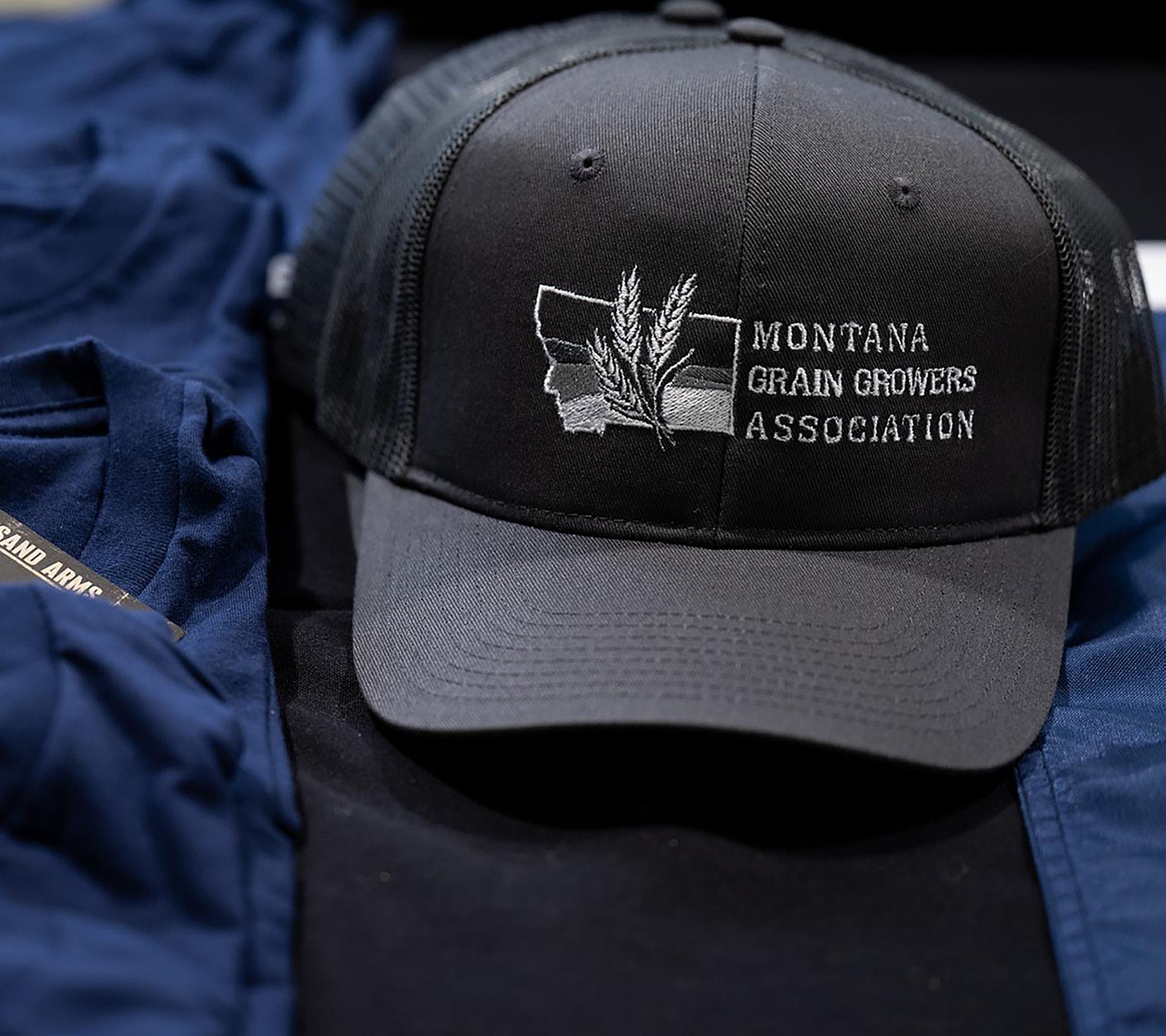
Visit mgga.org to wave the flag (literally) by purchasing Montana Grain Growers Association swag, including hats, hoodies, pullovers and lapel pins.
ACROSS THE PRAIRIE
By Prairie Grains Magazine staff
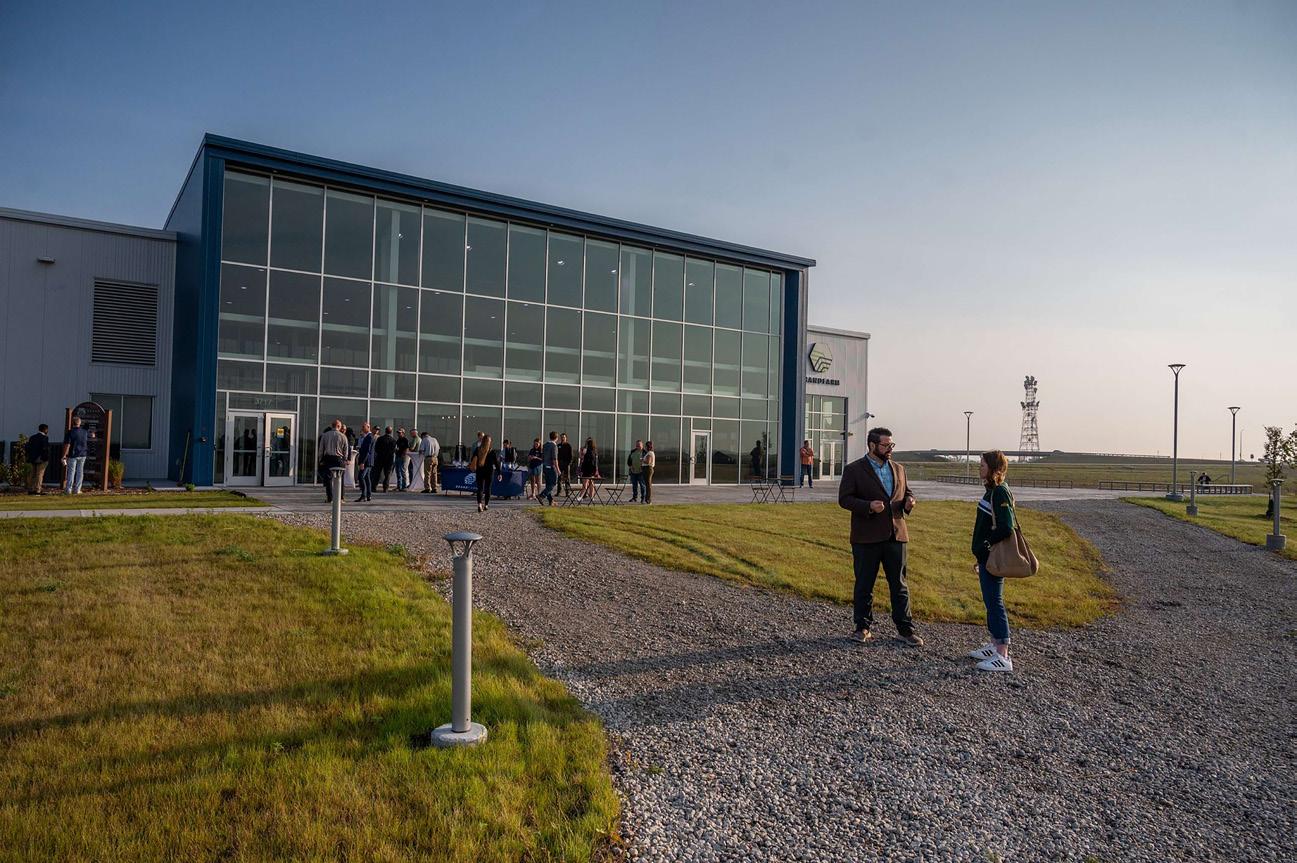
USDA announces the creation of the USDA National Proving Grounds Network, North Dakota’s Grand Farm to serve as National Program Manager
USDA’s Research, Education, and Economics Under Secretary Dr. Scott Hutchins announced the launch of the USDA National Proving Grounds Network for AgTech (NPG-Ag), a nationwide initiative designed to rigorously evaluate agricultural technologies under real-world U.S. farming and ranching conditions. Grand Farm, a North Dakota-headquartered AgTech ecosystem and innovation testbed, will serve as the USDA’s National Program Manager, alongside land-grant universities across the country that will serve as primary research and testing partners.
“Agricultural research in the United States has long supported the development of practical solutions that improve farm and ranch productivity while strengthening rural economies; indeed, innovation has been our competitive edge and ensured food security since the nation’s founding 250 years ago,” Hutchins said. “By establishing a coordinated national research network to objectively validate new and emerging technologies,
especially digital and AI-driven technologies, we are helping ensure row crop, specialty crop and livestock producers all have access to reliable performance data for their investment decisions with a goal to accelerate adoption of AgTech innovations. Moreover, we fully expect that NPG-Ag will expand and facilitate the development and application of emerging technologies across the public and private sector to uniquely benefit U.S. agriculture.”
The initiative has been designed to thoroughly test and validate both existing and emerging tools under real-world production conditions, ultimately providing farmers and ranchers with trusted, practical insights that they can rely upon when making technology-investment decisions.
The NPG-Ag is designed to accelerate the U.S. farmer’s confidence to adopt innovations that improve profitability and strengthen the long-term resilience and competitiveness of American agriculture. It will also provide farmers with trusted, data-driven information on technology performance and economic return, helping reduce investment risk and support more informed decisions. Moreover, the network will support the collaborative development of emerging technologies so that U.S. farmers and ranchers are the first to benefit.
U.S. Wheat Associates attends MOU signing with Philippines
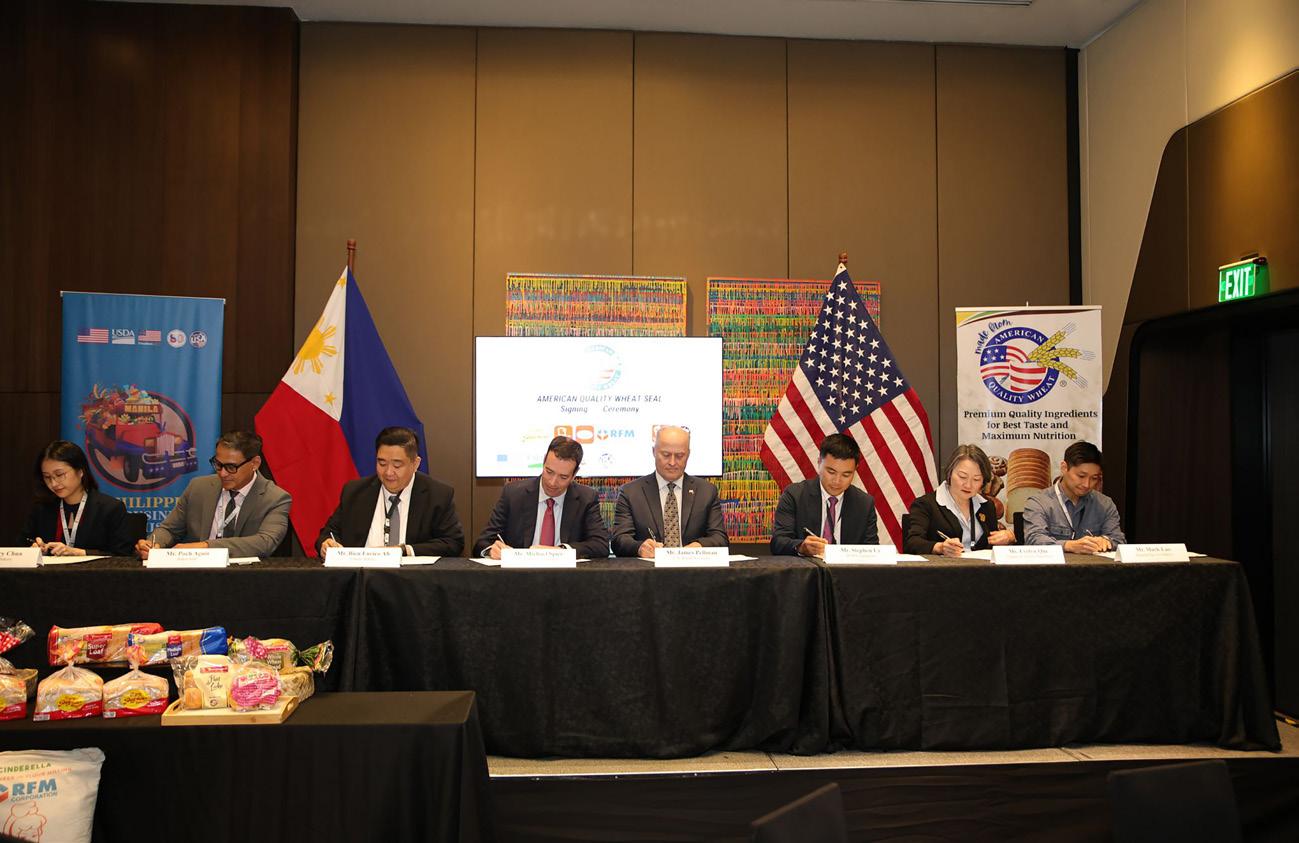
A key milestone in agricultural cooperation between the U.S. and Philippines was achieved when the American Wheat Quality Seal signing ceremony was successfully held during the 2026 U.S. – Philippines Agri-Business Trade Mission Week. The event brought together leading Philippine millers and bakers to reaffirm and strengthen collaboration with U.S. wheat producers. The milestone ceremony featured the
Pictured middle left, USW President & CEO Mike Spier and middle right USW Chairman Jim Pellman
signing of a Memorandum of Understanding (MOU) by leading baking and milling companies, formalizing their commitment to adopt the American Quality Wheat Seal in their products. The signing was witnessed by USDA Trade and Foreign Agricultural Affairs Deputy Under Secretary Michelle Bekkering and Charge d’Affaires a.i. Y. Robert Ewing, with U.S. Wheat Associates Chairman and North Dakota farmer Jim Pellman and President and CEO Mike Spier.
Following the MOU signing, a second group of Philippine bakers further demonstrated strong industry interest by signing a Memorandum of Intent to adopt the American Quality Wheat Seal, signaling growing participation and momentum with the baking sector.
As a key highlight of the ATM week, the successful signing ceremony, reinforced industry confidence in the quality, consistency and performance of U.S. wheat. The strong turnout and commitments marked a meaningful step forward in deepening trade ties and advancing shared goals of quality and innovation across the Philippine baking and milling industry.
South Dakota Governor’s Ag Summit set for June 25-26
South Dakota Governor Larry Rhoden is inviting farmers, ranchers and agriculture leaders from across South Dakota to join him in Pierre on June 25-26 for the 2026 Governor’s Ag Summit. The annual event provides an opportunity for South Dakota’s agricultural community to come together, learn from one another and celebrate the state’s number one industry.
“Agriculture is the backbone of South Dakota’s
economy and way of life,” said Gov. Rhoden. “Our farmers, ranchers and ag businesses keep us strong and drive opportunity across our state. As a lifelong West River rancher, I look forward to welcoming the ag community to Pierre for this year’s Ag Summit.”
This year’s keynote address will be delivered by Grey Zabel, Seattle Seahawks rookie offensive guard and 2026 Super Bowl LX champion. A Pierre native, Zabel will share how growing up in South Dakota and the lessons learned working on his family’s farm, helped build the character and work ethic that carried him to success in the NFL. He will also discuss his plans to continue his family’s farming tradition in years ahead.
The two-day event includes a full day of presentations on June 25 and industry tours on June 26. The event is free, and attendance is open to the public; however, preregistration is required.