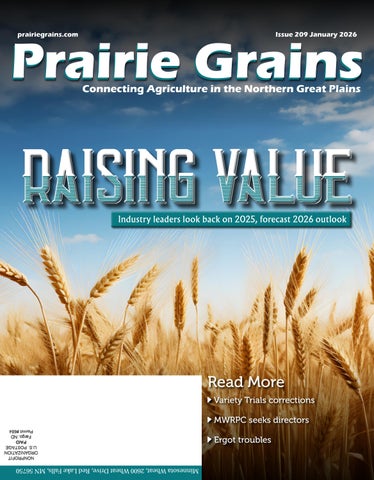
prairiegrains.com
Issue 209 January 2026
Connecting Agriculture in the Northern Great Plains
Industry leaders look back on 2025, forecast 2026 outlook
Read More Variety Trials corrections MWRPC seeks directors Ergot troubles
Minnesota Wheat, 2600 Wheat Drive, Red Lake Falls, MN 56750
Minnesota Association of Wheat Growers
Watch visions come to fruition with the Minnesota Association of Wheat Growers. While farmers farm, MAWG is in St. Paul and Washington, D.C., protecting producers from harmful policies and advocating for farm-friendly legislation. Because checkoff dollars cannot be used for advocacy, MAWG depends on our members’ support to ensure that Minnesota wheat growers have a voice at the legislative table. Join the wheat family today – become a MAWG member!
Prairie Grains January 2026 | Issue 209
04
1 2 3 4 5
Against the Grain: Best laid plans
10
Best in their class: North Dakota Wheat Commission seeks election candidates
12
Back on the Hill: MAWG aims to keep ‘status quo’ during 2026 legislative session
24
Stronger resources, better decisions: Policymakers rely on NDSU’s Agricultural Risk Policy Center
28
Wheat to the world: U.S. Wheat Associates spread the word during Crop Quality Seminar
Cover Story Despite a winter storm blowing in just in time for the 2025 Prairie Grains Conference, growers weren’t deterred from making their way to the Alerus Center in Grand Forks to take in the marquee event. Head to page 16 to catch the highlights and read more about the conference.
PUBLISHER AND CIRCULATION
Minnesota Association of Wheat Growers 2600 Wheat Drive • Red Lake Falls, MN 56750 218.253.4311 • Email: mnwheat@mnwheat.com Web: www.mnwheat.org
EDITORIAL
Sydney Harris, Managing Editor Ag Management Solutions Ph: 218.689.5091 Email: sharris@agmgmtsolutions.com
CONTENT EDITORS
Drew Lyon, News Editor Ag Management Solutions Ph: 507.388.1635 Email: dlyon@agmgmtsolutions.com Katelyn Engquist Ag Management Solutions Ph: 507.508.1540 Email: kengquist@agmgmtsolutions.com
ART DIRECTOR
Alex Troska Ag Management Solutions Ph: 952.334.2539 Email: atroska@agmgmtsolutions.com
OUR COLLABORATORS Minnesota Association of Wheat Growers 2600 Wheat Drive • Red Lake Falls, MN 56750 218.253.4311 • Email: mnwheat@mnwheat.com Web: www.mnwheat.org
ADVERTISING SALES Jill Thibert LHM & Co Ph: 218.280.2821 Email: jill@lhmandco.com
North Dakota Grain Growers Association 2401 46th Ave SE , Suite 204 • Mandan, ND 58554 701.222.2216 • Email: danw@ndgga.com Web: www.ndgga.com
ABOUT PRAIRIE GRAINS
South Dakota Wheat Growers Association 116 N. Euclid, Box 667 • Pierre, SD 58501 605.224.4418 • Email: wheatinc@midco.net
Prairie Grains magazine is published six times annually and delivered free of charge to members of these grower associations, and agriculture producers in Minnesota, North Dakota, South Dakota and Montana. To subscribe or change address, please write or call our circulation department.
Montana Grain Growers Association P.O. Box 1165 • Great Falls, MT 59403 • 406.761.4596 Email: erobinson@mgga.org • Web: www.mgga.org
January 2026 |
Prairie Grains
|
Page 3
Best laid plans If you want to make God laugh, so the adage goes, tell him about your plans. When you’re leading a proactive advocacy team like the Minnesota Association of Wheat Growers (MAWG), with all the variables facing our industry, it’s best to keep your head on a swivel and your eyes on the road – even when you’re planning ahead. My colleague and MAWG presidential successor, Austen Germolus, and I had to stay especially aware as we drove through a December snowstorm from the Twin Cities, where we attended planning committee meetings with the National Association of Wheat Growers (NAWG), to Grand Forks, N.D., in time for the 2025 Prairie Grains Conference. Before Mother Nature threw a wrench in our plans, we had a chance to connect with new NAWG CEO Sam Kieffer, a veteran advocate who’s primed to work with the NAWG board in Washington, D.C., to move farmfriendly policies forward. Kudos to NAWG’s hiring team – they found a good one! While I pass the MAWG presidential baton in January to Austen – who, I assure you, is ready to take the reins – I’m proud to continue representing Minnesota on NAWG and look forward to attending our Hill Visit and Annual Meeting this month in Washington, D.C. We have plenty of policies to promote, including
Page 4
|
Prairie Grains
|
January 2026
developing new markets both at home and internationally, supporting research funding, improving our infrastructure and (finally) seeing a new Farm Bill to completion. While some factors are beyond our control – mainly this year’s midterm election – we have big plans to make a policy impact that delivers for our producers. The Prairie Grains Conference was another success, despite some industry professionals having to alter their plans after a snowstorm blanketed our region. But we’re a hearty bunch up here, and we are grateful to everyone who braved the elements to attend this year’s conference. Our farmers were able to engage and network, hear from new U.S. Wheat Associates President Mike Spier, walk the trade show floor and receive research updates. During MAWG’s Annual Meeting, we finalized our policy resolutions and met with our lobbyist, Bruce Kleven, to discuss policy opportunities and challenges ahead of the 2026 legislative session. The Prairie Grains Conference was also a chance for me to connect with friends I’ve made not just in my two years as president, but throughout
my farming career. Our business is relationshipbased, but it goes deeper than that: In farming, family and friends are truly what matter most. This community bonds us, and I’m humbled by the support of our board, staff and members during my tenure as MAWG president. Together, despite many obstacles, ranging from market challenges to high input costs to a stark urban-rural divide in the Minnesota Legislature, we’ve helped defend and promote our region’s storied wheat industry, which helped build the Northern Plains’ economy. Because being part of MAWG is a cause greater than myself, I’d like to close with a plea to my fellow farmers: Please support your fellow farmers and industry by joining MAWG. Your membership dollars go a long way toward showing legislative leaders that the wheat industry is united and dedicated to creating a stronger farm economy for today and tomorrow. Plans can always change, but MAWG’s mission has remained the same for 50 years. We’re working for wheat farmers. Make your plans to become a member by visiting mnwheat.org/growers today.
My Copilot Friend I fell down an AI rabbit hole this fall. And I mean artificial intelligence, not the livestock version. Our college requires us to use Copilot, so I asked for a soybean marketing plan, and the information it gave me was creepy. It listed major buyers, talked about pre and post harvest plans, asked about cost of production, and even said Marshall County, Minnesota typically has “volatile basis and unpredictable weather.” I asked two short questions and got significantly more information than I expected. But then I asked about price targets, and it recommended I sell around $13 to $14. I agree! I should sell my soybeans between $13 and $14. That will cover my cost of production and make everyone on the farm happy. I am not sure how long I can store my beans to wait for beans in the teens, and I don’t think my banker will understand that my AI marketing plan told me to wait. The soybean marketing plan sounded amazing until I asked the price target question. I always recommend farmers create their own marketing plans and not use the generic ones you might hear from me at meetings, or listed on a university
Betsy Jensen is a Farm Business Management Instructor at Northland Community and Technical College. Follow her on X at @jensenbetsyr.
website, and now I can say do not use the one generated by AI. Your marketing plan should reflect your cost of production, your storage capacity and your need for cash flow. As a special case for 2025, your marketing plan should also reflect your birthday bushels. This summer as I updated balance sheets, many of you still own 2024 crop. Your grain will celebrate a birthday on your farm. I once held barley for three years, so I will not judge but make sure to consider your total bushel ownership. I know AI can make my life easier, somehow, but I will continue to create my own marketing plans. Partly because I am a control maniac, and partly because I do not trust someone that tells me to sell beans in the teens when our current cash price is $9. My hope for this winter is that I can use AI to convince you guys to make better decisions. I plugged a sample cash flow into Copilot and asked if the farm should spend $100,000 on a tractor, and it told me it was a high risk move and then explained why. It even discussed financial ratios. And it took less than ten seconds for
it to answer my question. It took me longer to upload the cash flow and type the question. When farmers ask me about buying a tractor, I’ll create the cash flow, help you interpret it, tell you it’s a high-risk move, and then you buy it anyway. Maybe if AI and I tell you the same thing, you’ll be more receptive. Maybe AI can more clearly state the risks and rewards. I have not found the magic solution to creating grain marketing plans and using AI to make business decisions isn’t quite there yet. There are just too many factors for me to plug into AI. Sometimes the gut feeling is one of the best determining factors and AI can’t help with that gut feeling. Farming rarely has clear, black and white decisions, and the best thing we can do is understand the risks. You and I are not replaceable, yet. Perhaps Copilot can provide another opinion, but ultimately, I am in charge of marketing the bushels and making the decisions. I guess that’s why it is called Copilot and not Autopilot. You are still needed in the cockpit at the controls. January 2026 |
Prairie Grains
|
Page 5
By Sydney Harris
Playing wheat’s long game MWRPC election puts producers in position for checkoff success
Page 6
|
Prairie Grains
|
January 2026
It’s a beautiful day to run for the Minnesota Wheat Research & Promotion Council (MWRPC) board of directors. Wisely directing the investments of Minnesota wheat checkoff dollars, MWRPC works to improve the profitability and viability for Minnesota wheat producers across the state. MWRPC is guided by nine farmer-leaders who are elected by their fellow farmers and must be wheat producers who share in the profit and risk loss from producing wheat in the current or preceding marketing year. “It’s critical that wheat checkoff investments are made by farmers who are actually out in their fields growing wheat – they’re the experts,” MWRPC Executive Director Brian Sorenson said. “By volunteering their time, our board members play a key role in ensuring that checkoff dollars help growers at the farm gate.” Administered by the Minnesota Department of Agriculture, there are three MWRPC board seats up for election this year: one seat each in Area 1, Area 2 and Area 3. While the current directors representing those areas are running for reelection, other farmers interested in serving as a board member are encouraged to submit their name by Jan. 16, 2026, to be placed on the ballot. Mark Jossund, who currently serves as chair of the MWRPC board and represents Area 2, is seeking his seventh term of guiding checkoff investments. “I like being a part of looking at different research options that we can invest in and different ways that we can promote wheat in the world,” said Jossund, who farms near Hendrum. “I enjoy being part of the group and making decisions that make the wheat industry better.”
Minnesota Wheat Research & Prom otion Council Board Representation Area Map
Roseau
Lake of the Woods
Area 1
Cook Clearwater
Norman
om
en
rd ba
Area 2
Wilkin
Otter Tail
Grant Douglas
e
Swift ui
Pa
rl
Chippewa
e
Lyon
Sherburne
Renville
Redwood
Scott
Sibley
Nicollet Brown
st on Pi pe
Rock
Murray
Cotton- Watonwood wan
Nobles Jackson
Anoka
Hennepin
McLeod Carver
Area 3
Martin
Pine
Ramsey
Meeker
Dakota
Goodhue Le Sueur Rice Wabasha
e
Li nc ol n
Yellow Medicine
Be n to n
Wright
hi iyo
Q
Carlton
Mille Lacs
Morrison
Stearns nd Ka
La c
s en Pope ev
Aitkin
gton ago Washin Chis ti an Is
t Big Stone S
Cass
Crow Wing
Todd s er av Tr
St. Louis
Itasca
Becker
Clay
Lake
Ka na be c
M ah n
Blue Earth
te el e
Polk
S
Red Lake
ub
Nomination forms can be mailed to: MN Wheat 2600 Wheat Drive Red Lake Falls, MN 56750
Pennington
H
To obtain a MWRPC board member nomination form, email mnwheat@mnwheat.com. Nomination forms must be received by Jan. 16, 2026, to appear on the ballot, which MDA will mail to Minnesota wheat producers across the state in early March.
Beltrami
Wa den a
MWRPC WANTS YOU!
Koochiching
Marshall
W as ec a
Kittson
Faribault Freeborn
e
D
g od
Olmsted Winona
Mower
Fillmore
Houston
As of 02/27/2025
MWRPC Treasurer Mikayla Tabert, who currently represents Area 1, and Scott Lee, who represents Area 3, are also seeking reelection. “My family does conservation farming, which is the reason I decided to become a MWRPC director,” said Tabert, who farms near Red Lake Falls. “I’d like to see more environmentally sustainable practices be adopted, but they obviously have to be economical and researched. So, I wanted to be a voice on that side, advocating for more research on environmentally friendly and economically sustainable practices.” Directors are elected to serve three-year terms, and the board meets approximately six times throughout the year. To obtain a nomination form, please email mnwheat@mnwheat.com. Nomination forms must be received by Jan. 16, 2026, to appear on the ballot and can be mailed to MN Wheat, 2600 Wheat Drive, Red Lake Falls, MN 56750. “Being on the Council has given me an inside look at how the wheat checkoff works on behalf of growers across the state,” said Lee, who farms near Benson. “I enjoy being able to offer input and have a say about what investments are made. It’s been a great experience, and I hope to continue guiding our state’s wheat industry.” All wheat checkoff investments are made with
research and promotion at top of mind, with the ultimate goal of increasing profitability for Minnesota wheat farmers. “We do a really good job of evaluating research projects to try to make a difference in wheat production,” Jossund said. “And we’re a part of U.S. Wheat Associates (USW) to promote wheat both domestically and overseas.” Though the price is less than ideal, MWRPC continues to work hard to market the quality of the wheat grown in Minnesota and fund research that will help growers economically. “It’s no secret that wheat struggles to compete with other commodity crops,” Tabert said. “The importance of the Council is to fund ways to make wheat be more profitable, as far as overseas marketing and the importance of wheat in the crop rotation.” MWRPC is playing the long game for Minnesota wheat producers, and the upcoming director election is a chance for growers to give back to their industry by running for a board position. “It’s just a great experience,” said Jossund, who, along with Vice Chair Peter Hvidsten, represents MWRPC on on the US Wheat Associates board.. “It is time consuming, but it isn’t too bad. It’s a great opportunity to help the wheat industry have a voice.”
January 2026 |
Prairie Grains
|
Page 7
By Deanna Kanne
A Grain of Knowledge
Ergot in wheat
It has often been said that researchers are experts in their field, but in Andrew Friskop’s case, he is literally the only one in his field. Friskop works on a variety of wheat diseases at North Dakota State University but is currently the only person in the nation conducting research on ergot in spring wheat. “It’s kind of a niche market that we have,” Friskop said. “It’s been severely understudied.”
Background Ergot is a fungus that affects grasses during the flowering stage. The primary sign of the pathogen is a hardened black to purple sclerotia that replaces the kernel of a grass host (Figure 1). It can survive dormant in the soil until ideal conditions, such as a wet season, allow it to take hold in grassy crops. Once it takes hold, the fungus primarily causes quality and yield deficiencies leading to possible health issues in both humans and livestock. Ergot and its effect on humans is very well known when it comes to rye – scientists believe infected rye was a large factor in the Salem witch trials in 1692 – but also affects numerous other grassy grain crops. Wheat is one of these other grains. While the human effects have been studied, there is little known about how to manage the disease in the wheat field. “We know it has a very large host range, including grassy weeds,” Friskop said. “We’re trying to get some of that information out there on why the pathogen survives so Page 8
|
Prairie Grains
|
January 2026
well in the U.S.” The disease often takes hold on grassy weeds on the outskirts of a field, then spreads inward in a small grain crop (Figure 2). Current recommendations include mowing field edges prior to grass heading, which could lead to more pest problems, including grasshoppers; or a harvest strategy once ergot is noticed, which requires harvesting and separating the infected grain. In 2018, ergot levels throughout North Dakota were higher than expected, which led to dockage and rejection at elevators across the state. The ergot threshold in wheat is 0.05%, which can be as little as 10 ergot bodies in two pounds of wheat seed. At the time, there was no set management practice for ergot, which prompted Friskop’s research.
Research The basis of Friskop’s studies involves prevention and management of ergot. One study determined whether certain spring wheat varieties are more susceptible to ergot than others. For the experiment, the susceptible check was the variety ‘Waldron,’ which was taken off the market in the 1970’s due to ergot susceptibility. The goal of the experiment was to see if current spring wheat varieties varied in ergot susceptibility and were better than Waldron (Figure 3). “Working closely with the NDSU Spring Wheat Breeding Program, we determined that all the varieties tested were
figure 1
figure 3
figure 2
better than Waldron, but there’s nothing immune,” Friskop said. “We don’t have a variety that is going to solve our ergot problems, but there are some that are better than others.” Another study was based around fungicide applications and disease suppression. While fungicide is a common treatment for the head disease Fusarium head blight, their effects on ergot are less known. “If you’re looking for ergot control with a fungicide, we don’t have a silver bullet,” said Friskop. “We have one that works a little bit better compared to others on the market.” Of the fungicides they’ve tested, consistent, multiyear results with Miravis Ace have been observed. “We’re feeling pretty confident on our recommendation of what you can expect with a fungicide application,” said Friskop. “Your fungicide timing target should focus on Fusarium head blight, and our data suggests you will get some ergot suppression with Miravis Ace.” For 2026, Friskop plans to continue with the fungicide trials, focus more on screening spring wheat for ergot resistance and continue to communicate information through Extension events. “The greatest value of the wheat checkoff is it gives the growers and the boards an opportunity to make sure we’re hitting their needs but also moving forward with trying to find those solutions,” said Friskop. “The overall goal is trying to help make a healthy wheat crop for everyone.” January 2026 |
Prairie Grains
|
Page 9
By Sydney Harris
Best in their class
North Dakota Wheat Commission seeks election candidates Farmer-led organizations make the world go round. Led by seven producer board members, the North Dakota Wheat Commission (NDWC) is a grassroots organization that works to promote the high-quality wheat grown by North Dakota farmers, who grow the most spring wheat and durum in the nation. Without the farmer-volunteers that guide NDWC, the organization wouldn’t be the powerhouse that it is, creating worldwide market opportunities and funding research that benefits producers. And it all starts at the county level. “The Commission is focused on the production side of things because farmers are focused on bushels, but it’s also focused on cultivating the quality side,” said Glendon Slaubaugh, who represents District 4 on the NDWC Board of Commissioners. “It bridges that gap and is very valuable in funding research that benefits farmers and marketing our wheat worldwide.” Six of the board members are elected by their fellow producers; the seventh is appointed by the governor, and the election process begins in counties across the state. Producers are elected to represent their county, and those county representatives meet at the district level to elect a member to the state board. “It’s very important to have farmers involved,” Slaubaugh said. “The Commission is very producer oriented, and we want to do what is best for our constituents.” Producer involvement at the county level is critical to ensure that NDWC’s checkoff funded programs and priorities align with producer wishes. In 2026, elections will be held in District 3 and District 6. All active wheat producers in the county, who have not requested a refund in the past 12 months, are eligible to participate in their Page 10
|
Prairie Grains
|
January 2026
GRASSROOTS EFFORT Election dates and locations for counties will be updated on the website as they are scheduled. If you have any questions about the county representative position or Commission board position, please contact NDWC at 701-328-5111. You may also contact your local Extension agent for more information on election times.
county’s election. District 3 includes counties Burleigh, Eddy, Emmons, Foster, Kidder, Logan, McIntosh, McLean, Sheridan, Stutsman and Wells. District 6 encompasses Cavalier, Grand Forks, Nelson, Pembina and Walsh counties. “It’s been a great experience for me,” said Brian Fransen, who represents McLean County. “I’ve gotten to meet farmers from all over the state and see what’s going on in their backyard. It doesn’t take much time at all and it’s important to have voices from across the state giving input to the Commission.” Typically, county representatives meet once per year at an annual meeting. They serve a vital role in ensuring local issues are included in statewide discussions and being a resource in helping to establish priorities for investment of the wheat checkoff. “The Commission is a producer-funded and led organization,” NDWC Commissioner Jim Peterson said. “We depend on board members to direct Commission programs and budgets and view our county representatives as integral to this process. We very much appreciate our current and former board members for their contributions to the Commission. The time they devote to the organization is significant and reflects a meaningful commitment not only from them, but also from their families and support networks, especially as board service often requires time away from their farming operations.” January 2026 |
Prairie Grains
|
Page 11
By Mark Askelson
Back on the Hill
MAWG aims to keep ‘status quo’ during 2026 legislative session
With the painstaking process of passing a biennial budget in 2025 – albeit via a special session – now in the rearview mirror, there’s a lot less at stake when the Minnesota Legislature reconvenes in February. However, there’s still plenty of work to be done and plenty of reasons for the Minnesota Association of Wheat Growers (MAWG) members to not let their guard down and play strong defense against any bills that may hurt farmers.
“We’d like to keep things status quo if at all possible. No new regulations are always a good thing,” said Austen Germolus, who became MAWG president in January. “There’s been some water things that have come up in the past, like the drainage portal, and some fertilizer discussion, but I don’t expect them to be pushing those items too hard with it being an election year.”
MAWG lobbyist Bruce Kleven gives a policy update at the 2025 Prairie Grains Conference, providing legislative insights during MAWG’s Annual Meeting.
Page 12
|
Prairie Grains
|
January 2026
The 2026 legislative session, which starts Feb. 17, is considered a bonding session. During those sessions, which typically take place on the even-numbered years, lawmakers focus on passing a capital investment bill to finance large public infrastructure projects, such as roads and bridges, water and wastewater infrastructure and asset preservation and maintenance needs, across the state. Bonding bills also require a supermajority, or three-fifths approval, of both the House and Senate to pass. However, the long-term outlook of the latest state budget forecast, which projects a $2.47 billion surplus for this biennium but a nearly $3 billion budget deficit in the 2028-29 biennium, may make some legislators hesitant on spending. “The budget surplus that is projected for this biennium may tempt folks to want to use some of that, but when they’re facing a structural deficit of $3 billion in the next biennium, they may want to push that for the next two years,” said Bruce Kleven, MAWG’s longtime lobbyist. “The dynamic will be very different this year because there are no budget bills that have to pass.” The other prevailing dynamic of the upcoming session is the November election. All of Minnesota’s 134 House seats and all 67 Senate seats are on the ballot; in addition, Gov. Tim Walz is vying to become the first governor to serve three terms, while Minnesota House Speaker Lisa Demuth has announced her candidacy to unseat Walz. With so many races on the ballot, combined with a tied House and a one-seat DFL majority, contentious bills may be introduced, but they’re unlikely to pass this session. “Ultimately, controversial bills will never get out of the Capitol, but that doesn’t mean either side won’t try for the purpose of getting things on record and trying to make a point,” Kleven said. “For our wheat growers, you could see maybe something come up on changing of the licensure for mixers, handlers and loaders of restricted use pesticides. That issue was brought up last year and is still hanging there.”
Real people, real stories While MAWG approved its policy resolutions at its annual meeting at Prairie Grains Conference, grower leaders are still finalizing its legislative priorities ahead of the 2026 session. Top of mind for many farmers and small businesses in greater Minnesota is the Paid Family Leave law, which was passed in 2023 and officially took effect on Jan. 1, 2026. MAWG and other organizations have fought for exemptions for small farms that rely on seasonal help over the past few years and will continue to do so. “As it stands, there are no exemptions for anyone, which is going to hurt farmers and small businesses, especially those in rural Minnesota,” said Germolus, who farms in the rural Borup community. “It’s already difficult to find
employees, but now you could have an employee that’s on paid leave for three months and it’s on you and your dime to find someone to replace them.” Germolus and MAWG will head to the Capitol for its annual Wheat Day on the Hill March 2-3, where they’ll meet face-to-face with legislators from both sides of the aisle to discuss the issues concerning wheat growers. Farmer leaders find a welcome audience with rural legislators but are seeking stronger engagement with metro-area lawmakers. “We’d really like to be able to have some conversations with some of the legislators from the more urban districts, but that’s been quite the challenge the past few years,” Germolus said. “It doesn’t matter what side of the aisle they’re on, it’s just good to have those relationships and the opportunity to tell your story.” And while Kleven, a veteran lobbyist with over a quartercentury of experience will be hard at it in St. Paul working on behalf of MAWG throughout the session, he notes that when the farmers are at the Capitol, people listen. “They hear from me all the time,” he said, “but when members of their district come in it means more, because they’re real people with real faces and real stories from a real farm.” Membership in MAWG helps support industry efforts in both St. Paul and Washington, D.C. To learn more or to become a member, visit mnwheat.org/growers.
REALTY & LAND CO.
January 2026 |
Prairie Grains
|
Page 13
Leader of the pack: Rep. Steve Jacob talks MAWQCP reenrollment Few farmers have more experience in the Minnesota Agricultural Water Quality Certification Program (MAWQCP) than Steve Jacob. “Any way I can be involved to help do the right thing with the environment and keep regulations off farmers, that’s what I’m trying to accomplish,” Jacob said. When MAWQCP launched a pilot program in 2014 in Winona County, Jacob found himself in the right place at the right time. He’d been a member of his local Soil & Water Conservation Board and served as a county commissioner when he learned about MAWQCP through meetings with Program Manager Brad Jordahl Redlin. Jacob admitted he was initially reluctant to enroll. But the more he learned about MAWQCP’s voluntary enrollment and its regulatory certainty, he found the initiative aligned with his passion for conservation. “As I saw the true intent of MAWQCP and how it gives recognition to the good work the farmers do, I saw that it could be beneficial for farmers to engage with the process,” said Jacob, who in 2022 was elected to represent southeast Minnesota’s District 20B in the Minnesota House of the Representatives. “Willing participation is what we’re after.” Jacob farms 300 acres of soybeans and corn in picturesque Altura and became just the sixth Minnesotan to enroll in MAWQCP. Since then, more than 1,700 Minnesota farmers have followed Jacob’s lead. “I really didn’t have to do very much because I was already implementing all the practices needed to become Ag Water
Rep. Steve Jacob (left) was an early enrollee in MAWQCP. He’s now part of a class of farmers who are re-certifying after 10 years in the program.
Page 14
|
Prairie Grains
|
January 2026
Quality Certified,” he said. The Jacob family, which has been farming the same land for nearly 150 years, has a storied history of supporting conservation and soil health in an area vulnerable to flooding: In 1951, Steve’s dad and uncle were named Minnesota’s Soil Saver of the Year. “We’re one of the first farms in the area to put in contour strips, erosion control structures, paddock pasturing,” Jacob said. “All the best management practices, we’ve been implementing as far back as these practices became available.” Since becoming certified, he’s transitioned to 100% no-till. After a decade, it was a no-brainer for Jacob to re-enroll his family farming operation in MAWQCP. “Our farm remains fertile and profitable when other farms had too much erosion and were not profitable,” said Jacob, who is transitioning the farm to his son, Trent, in 2026. In his role on the agriculture and environmental committees, Rep. Jacob continues to promote MAWQCP. In 2024, he introduced legislation creating a $5 per acre tax credit for MAWQCP-enrolled farmers in eight counties in southeast Minnesota. He plans to reintroduce the bill in 2026, with longterm hopes of making the credit available statewide. MAWQCP connects farmers with local conservation district experts to identify and mitigate any risks their farm poses to water quality on a field-by-field basis. Producers going through the certification process retain priority access to financial assistance. After being certified, each farm is considered in compliance with new water quality laws and regulations for 10 years. Certified farmers also receive a MAWQCP sign to display on their farm, along with other benefits. “The sign is a stamp of approval to society that this farmer is not abusing the environment and implementing all the best management practices,” Jacob said. “We’re using the farm to take care of the environment.” Farmers and landowners interested in joining Rep. Jacob in becoming water quality certified can contact their local Soil and Water Conservation District or visit MyLandMyLegacy.com to enroll and learn more about financial assistance programs.
Visit with the MAWQCP team at the Soil Management Summit Jan. 14-15 in Fargo, N.D.!
IT’S NOT JUST YOUR LAND. IT’S YOUR LEGACY. The Minnesota Agricultural Water Quality Certification Program rewards farmers like you for what you do best, taking care of your land and its natural resources. To get started and learn more, contact your local soil and water conservation district or go to:
MyLandMyLegacy.com
JANUARY - FEBRUARY - 20242026 - Soybean 15 15 January | PrairieBusiness Grains | - Page
2025
Prairie Grains
conference
Host it, and farmers will come. Despite a winter storm blowing in just in time for the 2025 Prairie Grains Conference, growers weren’t deterred from making their way to Grand Forks to listen to industry updates, learn about the latest research and network with their peers. Boasting over 80 trade show exhibitors and welcoming more than 600 attendees, the marquee event didn’t disappoint. “No matter the weather outside, the Prairie Grains Conference is a good place to be,” Minnesota Association of Wheat Growers (MAWG) President Kevin Leiser said. “Attendees walk away from the conference with knowledge they can use to improve their operation.” Hosted by MAWG, the North Dakota Grain Growers Association and the Minnesota Soybean Research & Promotion Council, the Prairie Grains Conference’s robust agenda never fails to draw a crowd. This year, U.S. Wheat Associates (USW) President and CEO Mike Spier delivered a keynote speech highlighting the ways USW promotes hard red spring wheat across the globe, differentiating its quality and delivering value to producers. Al Kluis, managing director of Kluis Commodity Advisors, followed by reviewing his 2025 marketing plan and laying out a game plan for 2026. Rounding out the keynote speaker lineup was Daryl Ritchison, director of the North Dakota Agricultural Weather Network, who discussed the weather changes he foresees for the next growing season. “We take great pride in being a valuable source of information every year,” MAWG Executive Director Brian Sorenson said. “This year, our keynote speakers were dynamic and relayed important industry insights, and our exhibitors, which totaled 81, were instrumental in the success of the conference. It’s been a challenging year, so the knowledge offered by the conference agenda is invaluable to growers.” Attendees also fed their appetites for knowledge during several breakout sessions. “The educational sessions had something for everyone,” Sorenson said. “Whether you wanted to learn about the latest research, new crop protection products, stress management tips or marketing strategies, there was a wide range of topics to choose from.” Above all, the Prairie Grains Conference offers warm smiles and great company. “It’s about meeting people and talking about how their year went and what they may have done that could work on your farm,” Leiser said. “It’s a great way to get together with old friends that you haven’t seen in a while and catch up.” Page 16
|
Prairie Grains
|
January 2026
Outgoing MAWG President Kevin Leiser leads the organization’s annual meeting.
This year’s Prairie Grain Conference featured more than 80 exhibitors and over 600 attendees.
A winter storm didn’t stop attendees from heading to the Alerus Center in Grand Forks.
MAWG Vice President Austen Germolus (left) and Executive Director Brian Sorenson gameplay during the conference.
January 2026 |
Prairie Grains
|
Page 17
By Bailey Grubish
The 2025 Prairie Grains Conference gathered a grand collection of growers, researchers and industry professionals for the Northern Plains’ premier indoor ag trade show. In his first visit to the Prairie Grains Conference since becoming president and CEO of U.S. Wheat Associates (USW), Mike Spier shared his insights and expertise during his keynote presentation, “Driving global demand: How USW promotes U.S. hard red spring wheat and delivers value to producers.” USW, chaired by North Dakota’s Jim Pellman, is the export market development organization for the U.S. wheat industry promoting the reliability, quality and value of all six U.S. wheat classes to wheat buyers, millers, bakers, food processors and government officials around the world.
Value behind HRS Hard red spring wheat, the wheat class behind “designer” wheat foods like artisan hearth breads, is enduring market challenges while attracting new importers. “I know prices are down this year compared to last year, but the U.S. wheat activities that we’re doing overseas are still so important because we’re differentiating U.S. wheat compared to the competition,” Spier said. “And I think it’s important to continue to do so.” Canada is a major competitor for HRS in terms of high protein, high quality and milling. HRS and the Canadian western spring wheat are the Page 18
|
Prairie Grains
|
January 2026
top two high protein quality wheats. The Philippines is the top export market for HRS, with sales down slightly from the previous year, though mills are still buying HRS because of its quality, its stronger gluten strength and high-water absorption. With the tariff talks over the past year, Spier said they didn’t see any regulatory tariffs on U.S. wheat. In fact, two markets, Indonesia, the second largest buyer of wheat in the world, and Bangladesh, another top 10 importer of wheat in the world, approached USW to improve their trade balance with the U.S and to increase their import of U.S. wheat. Indonesia has already imported over 800,000 metric tons for this year, and commercial sales to Bangladesh are over 460,000 metric tons compared to the same time last year where the U.S. didn’t have any sales on the books to Bangladesh. Spier said both these situations came out positive in generating more sales opportunities for U.S. wheat.
Hype behind HRS The more reasons to use HRS and import U.S. wheat, the better for U.S. wheat growers and that’s just what’s happening. Spier shared that in Southeast Asia, an increase in industrial sized bakeries is encouraging for U.S. wheat growers. “This trend is positive, I think, for our hard red spring wheat and U.S. wheat, because when you make this switch to the more industrialized, you need strong wheat, strong gluten wheats, good mixing time,” Spier said. “Both
quality attributes that HRS has.” Another trend changing the wheat industry in Southeast Asia is the increase in wheat-based products: bread, pasta, cake, cookies and pizza, as consumers diversify beyond rice. Vietnam is a large market seeing this growth in the wheat market due to the addition of U.S. based fast food restaurants arriving to the country. Frozen dough is another new trend that calls for a strong gluten wheat class like HRS, and for extended shelf life. With the shift to bread products, Spier said that surveys are finding a demand for more premium wheat and overall product from the millers. Flour mills reported in the same survey there is less need for bread or flour improvers, which allows for lower production cost. Along with cost savings, there is a rising demand for clean label products, according to Spier. Clean label products means adding fewer chemical ingredients or improvers in the flour. The biggest challenge in exporting HRS is price, with the price of Canadian western red spring wheat a cheaper option this year.
Activities to address challenges To prove to trading partners that HRS and U.S. wheat is worth the additional price, USW created activities and demonstrations. The South America office in Santiago, Chile, executed 54 activities this year and other partnerships with baking schools. USW has a strong relationship
New USW president, CEO talks wheat quality, challenges at PG Conference with a UFM baking and cooking school in Bangkok, Thailand. UFM is the largest flour mill in the country and has been one of the largest importers of U.S. wheat for the school. “You can talk in presentations about the quality of wheat, but when they really get in there and they’re able to work with the dough and do the baking themselves, they can see firsthand; that’s very powerful,” Spier said. “They can see for themselves the difference that U.S. hard red spring wheat and other wheat classes, the quality of those wheats make on their end products...” Along with activities in the Philippines, there is the American Wheat Quality Seal. This program requires mills to use a minimum of 80 percent U.S. wheat and to comply with quality standards. Bakeries buying and using this flour can then add the seal to their products. “I think that’s where U.S. Wheat Associates is bringing value to producers, is by working and differentiating the quality that you’re producing compared to our competitors,” Spier said. Heading into 2026, USW continues to lead the wheat industry to provide service before and after sales and build relationships with export markets. “It’s tough times now with the prices where they’re at and where input costs are, but rest assured, we have a team out there that is just as passionate as every one of you are about what you’re doing,” Spier said. “They’re out representing you and promoting U.S. wheat.”
Mike Spier has promoted U.S. agriculture in over 50 countries during his 30-plus year career.
January 2026 |
Prairie Grains
|
Page 19
By Mark Askelson
Page 20
|
Prairie Grains
|
January 2026
The grains markets are always changing and evolving, making it important to stay on top of trends and have a strategy for success to stay profitable. That was the message from Al Kluis, managing director of Kluis Commodity Advisors, shared with farmers during the 2025 Prairie Grains Conference in Grand Forks, N.D. “The markets are a lot different than 20 years ago,” said Kluis. “What we’re seeing is that commodities have become tradeable on Wall Street and we’re seeing a lot of other factors affect crop prices other than supply and demand.” Kluis notes that large institutional funds are one of those factors now playing a significant role in the markets. These funds often take long or short positions based on market momentum, and their trading strategies can cause extreme price moves. “Funds are momentum traders,” Kluis said. “They buy on strength and sell on weakness, which can lead to sharp fluctuations in commodity prices.” With the U.S. no longer being the sole dominant player in the global grain market, the weather in other parts of the world, mainly Brazil and Argentina, has become crucial to global supply forecasts as well, along with U.S. crop conditions.
Currency impact Another key factor that affects U.S. agricultural exports is the strength of the U.S. dollar. A stronger dollar can make U.S. crops more expensive for foreign buyers, thus reducing demand. Kluis emphasized the importance of currency movements in the global trade of commodities, citing the Canadian dollar and Brazilian real as examples of currencies that have significant effects on their respective countries’ competitiveness in the global grain market. When the dollar rises, it becomes harder for U.S. farmers to compete with lower-cost exporters like Brazil and Canada.
“The Brazilian real has crashed, making Brazilian exports more competitive,” Kluis said. “A weaker dollar is generally positive for U.S. exports, but a strong dollar can create challenges, especially in the wheat market, where we face competition from Canada.” While the dollar’s fluctuations can complicate matters, Kluis remains optimistic about the long-term demand for U.S. agricultural products. As China’s middle class grows and more consumers switch to protein-rich diets, there will be an increasing demand for both U.S. and Brazilian soybeans. “When Chinese consumers are doing well,” he said, “U.S. soybean prices tend to follow.”
Understanding market cycles Understanding market cycles and knowing when to make sales using historical data should be an important part of any producer’s marketing plan, according to Kluis. While it’s not feasible to sell everything at a market high, farmers can take advantage of certain key periods to avoid selling at low points. He encourages producers to avoid selling crops in August through October and holding out hope for a rally, which rarely comes during that time period before harvest. Keeping charts of what you sold, how much you sold, and why you sold, can also provide some historical context and data for making future decisions. “Charts can be a roadmap of what to expect and as one of my mentors once told me, time is more important than price,” said Kluis. “There’s key months and key weeks that you need to be selling.” Kluis also emphasized the importance of making incremental sales and setting price targets. His approach involves selling a portion of the crop when prices are favorable and then setting a series of orders above the market to capture any upward price movement.
“It’s about spreading out the risk,” he said. “You don’t have to sell everything at once. You can scale into the market and still come out with a good average price.” When it comes to making a marketing plan for 2026, Kluis encourages producers to review their 2025 plan and what you sold. Then, write out a price and time plan for this year and make note of the key time periods to watch based on previous year’s highs.
Utilizing AI Looking to the future, Kluis also discussed the potential for artificial intelligence (AI) to assist in grain marketing. While AI is still in its early stages of application in the agricultural sector, it holds significant promise. For example, AI can analyze historical market data to determine the most optimal dates for making sales. “AI can look at past data and predict which days were historically the best for selling corn or soybeans,” Kluis said. “This can be incredibly valuable when developing a marketing strategy.” Although AI is not yet a staple in most farms’ marketing strategies, Kluis believes it will play an increasing role in helping farmers make more informed decisions. Bottom line Ultimately, Kluis’s message to farmers is clear: In today’s complex and rapidly changing commodity markets, it’s essential to have a well-thoughtout marketing plan and stick to it. Whether it’s understanding the impact of global economic factors, leveraging technology like AI, or simply knowing when to make a sale, success in grain marketing requires careful attention to both the big picture and the details. In the end, it’s about making smarter, more strategic decisions. “You can’t just hope for higher prices,” Kluis said. “You have to make the right choices when the market gives you the opportunity.”
January 2026 |
Prairie Grains
|
Page 21
By Bailey Grubish
WHAT’S
WHAT
Preparing for the future can be daunting, but with the right tools it can be simplified. David Piper, shareholder attorney, and Tiffany Findlay, associate attorney, with Ohnstad Twichell, P.C., shared legal tips and tools for succession planning during the 2025 Prairie Grains Conference. “Our purpose of the presentation is to give you some opinions on ideas that you could maybe implement in your farming practices or whatever you do to make the farming world more efficient, to make real property transitions in particular work for everyone that’s involved,” Findlay said. The first step is to understand the type of ownership. “Real property ownership is something that is very important in the farming world,” Findlay said. “If you own your property outright, you want to make sure you know how you own it. There are a lot of different types and forms of ownership, and in particular, when you start adding multiple people to your ownership...There are different types of ownership levels and tools that you can use to make sure that that ownership is working for you and for your farm.” Piper and Findlay spoke on ownership interest and the type of common deeds to transfer ownership of the real property, or land, and the permanent attachments.
Ownership interest: how you own the property The two most common types of joint ownership interest are tenants in common and joint tenants. Tenants in common, the presumed method of joint ownership in North Dakota, occurs when there are two or more people on the deed to the real property, and each person owns an undivided interest in that property, it can be an unequal split of the land unless the deed specifies otherwise. If a co-owner dies, their portion of the interest is then added to their estate and must go through probate. Joint tenants have the rights of survivorship, meaning when a joint tenant passes away, the surviving joint tenant becomes the owner of the deceased tenant’s share in the property. Additionally, each joint tenant’s interest in the real property is equal, both owners in a joint tenancy have the right to use all the property, and no probate is necessary. “It’s important that you understand exactly what the deed language says,” Findlay said. Deeds: how the property is transferred There are two simplified common types of deeds: The life estate deed and the transfer on death deed. Both can help avoid probate. Page 22
|
Prairie Grains
|
January 2026
Real property legal tools
A life estate deed allows the owner to transfer property to a grantee, while reserving an interest during their lifetime. Once the owner who holds the life estate passes away, the grantee fully owns the property. This also means that once another person is added as a remainder beneficiary, they now have an equitable right in that property. If the owner decides to mortgage or sell the property, the grantee has a say in that decision and receives a portion of the proceeds. The other simple option discussed at the Prairie Grains Conference is a transfer on death deed. This allows the owner to retain full ownership during their lifetime and conveys their full interest to the grantee upon their death. During their lifetime, the grantee has no interest in the property. “There are pros and cons to both types of deeds, but they act in very similar manners depending on what you’re attempting to do with your real property,” Findlay said. This session, which took place on day two of the 2025 Prairie Grains Conference, shared tools and offered insight into succession planning. Those looking to start the conversation should work with their own attorney for advice and further information.
Grow in 2026 with Skilled H-2A Labor New to H-2A? Overwhelmed by the process? We can help.
Lean on a true partner with 22+ years of experience Get both your labor certification and choose from 3,000+ verified workers Find skilled farm labor for both your peak and off-seasons Experts dedicated to Harvesters, Housing, Visas, and more
Ready for a hassle-free H-2A experience with a 99.9% approval rate?
Get your free consultation.
usafarmlabor.com 828-246-0659
By Mark Askelson
Fighting farm stress Sleep, acceptance can ease worried minds Newsflash! Farming is a stressful occupation. Learning to understand what causes that stress, being able to recognize it in others and being able to manage stress in a healthy manner are all keys to being able to being able to reduce risks and improve on-farm performance without letting it strain one’s personal life. This was addressed during a breakout session at the 2025 Prairie Grains Conference. “When we are stressed, we release a hormone called cortisol, which has long-term and short-term effects that can be pretty negative for our body and for our mental health,” said Jennifer Vaughn, Minnesota agricultural mental health specialist with Acquire Mental Health. “When our stress response turns on, essentially your brain goes into flight, fight, freeze, fib or fawn mode.” When it comes to what causes stress on the farm, there are many factors that are unique to the farming occupation. Some of those include financial pressures, unpredictable weather, trade disruptions, lack of insurance and benefits, heavy work loads and long hours, agronomic issues such as weeds and disease, labor shortages, loss of land and the dayto-day grind of farming. Both the body and mind respond to stress in their own way. Some of the ways the body may respond include headaches, stomach problems, weakened immune system, high blood pressure or blood sugar, weight gain, hair loss and fatigue. Your mind may respond to stress by increased depression, sleep problems, irritability, lack of motivation and focus, memory problems, anger, sadness, substance use and isolation. “When you look at things such as headaches and stomach problems, it has to do with your body being primed for what it thinks is danger,” Vaughn said. “If you’re about to be attacked by a bear, your body stops focusing on digesting foods or other functions that aren’t important to keep you from being eaten by the bear. It’s the same with chronic stress.”
Vaughn says there are some things you can do to reduce your stress levels. One of those ways is through radical acceptance – to completely acknowledge and embrace reality as it is, without judgement, fighting or wishing circumstances were different. “Acceptance doesn’t mean you have to like it, it’s more ‘it is what it is’ and making the best decisions based on the facts at the time,” Vaughn said. Getting more sleep, eating healthy meals, exercise and bonding with other people are also simple, but important, ways to reduce cortisol in your body and relieve stress. “I always say start with sleep, because lack of sleep can wreak havoc on your stress levels, and then next is diet and meditation, which can help with sleep and slowing your thoughts down.” When the stress has become too much for one to treat on their own, there are a number of resources available specifically for farmers. Through the Minnesota Department of Agriculture (MDA), Minnesota supports licensed providers throughout the state that can meet one-on-one with farmers, farm families and employees either at their location or one of their offices. There is no insurance required, no paperwork and no charge for the visits. Also, for more than four decades, there have been Minnesota Farm Advocates in place who are problem solvers who can help navigate solutions to difficult problems that are unique to agriculture. North Dakota also has a number of services for farm and ranch stress assistance, including mental health resources, farm management, credit counseling and mediation. For farmers or anyone considering taking their own life, the suicide helpline is available nationwide, 24 hours a day, 7 days a week by dialing 9-8-8.
Resources Minnesota Farm & Rural Helpline Website: www.mnfarmstress.com Phone: 833-600-2670 Text: FARMSTRESS to 898211
Minnesota Agricultural Mental Health Specialists Monica (northern MN): 218-280-7785 Jennifer: 218-820-6626 Tracie: 507-514-7057
North Dakota Farm & Stress Assistance Website: www.ndda.nd.gov/frsa
Mobile Crisis Teams Available in every Minnesota county, mobile crisis team counselors can respond quickly and provide in-person, short-term counseling or mental health services during a crisis or emergency. Calls are answered immediately 24 hours/day. Responders travel in private vehicles and generally arrive within two hours.
January 2026 |
Prairie Grains
|
Page 23
By Sydney Harris
STRONGER RESOURCES, BETTER DECISIONS POLICYMAKERS RELY ON NDSU’S AGRICULTURAL RISK POLICY CENTER Farming is risky business. An inherent part of farming, risk keeps growers on their toes, constantly balancing playing it safe with taking a chance. The more information and resources they have at their fingertips to make decisions, the better. “Farmers contend with several factors that can make or break their operations,” said Brian Sorenson, executive director of the Minnesota Association of Wheat Growers. “Having an effective selection of tools in their toolboxes to mitigate that risk is important.” Producers across the Upper Midwest have a new powerhouse backing their interests during critical farm policy conversations: the Agricultural Risk Policy Center (ARPC) at North Dakota State University. Using data-driven research and policy evaluation, ARPC delivers evidence-based insights that inform agricultural policy and support
Page 24
|
Prairie Grains
|
January 2026
producers, policymakers, and industry leaders in managing economic risk, thereby building a stronger, more resilient rural economy. “We serve as a resource to inform national discussion when it comes to new farm policies or changing existing ones,” ARPC Director Sandro Steinbach said. “Our work is driven by the needs of stakeholders, not only in Washington, D.C., but across the region. Many of the questions we take on originate directly from producers, commodity groups and state-level partners. That regional perspective ensures our analysis remains grounded in the realities that matter most to Midwest agriculture.” Complementing the work being done at the Food and Agricultural Policy Research Institute at the University of Missouri and the Agriculture and Food Policy Center at Texas A&M, ARPC highlights North Dakota’s and
the Upper Midwest’s agricultural economics expertise. “Agriculture in the Upper Midwest is very different compared to agriculture in other regions, and we’re thinking about ways to make sure that the voice of farmers in the Midwest gets a bit more bandwidth in Washington, D.C.,” Steinbach said. “North Dakota alone grows more than 50 different commodities. That level of diversity creates a much more complex production environment than in states with monoculture-dominated production systems. Having a policy resource located in the Upper Midwest, one that understands that complexity and can respond with region-specific expertise, brings real value to producers.” North Dakota U.S. Senator John Hoeven, chairman of the Senate Agriculture Appropriations Committee, has been a strong proponent of
ARPC and has helped secure nearly $6.5 million in funding since FY24, including an additional $2.5 million in the FY26 agriculture funding bill. “NDSU’s Ag Risk Policy Center is just over a year old, but it has already proven to be a key tool for policymakers and is shaping our nation’s ag policy to the benefit of farmers and ranchers as we speak,” said Hoeven in a November 2025 statement. “North Dakota has long been a powerhouse in agriculture, but with these latest initiatives in agriculture policy, we are truly taking our leadership to the next level.” Proven itself, it has. When it was established in the fall of 2024, ARPC hit the ground running and hasn’t slowed down since. “We did a lot of the background work and policy evaluation for the programs that are in the OBBB (One Big Beautiful Bill),” Steinbach said. “When you think about changing farm policy, you need to be confident that the proposed adjustments will truly benefit the
producers who depend on them. Our job is to evaluate the implications, identify potential distributional effects and ensure the outcomes are fair across the agricultural system.” No matter what policy ARPC is analyzing, it remains independent and nonpartisan. The organization provides objective, evidence-based research that helps decision-makers understand the economic implications of different policy options. “The impartiality of ARPC is crucial for growers across the Prairie Grains region,” Sorenson said. “When making decisions, our legislators and industry stakeholders need unbiased information to guide them. They can trust that the research from ARPC is objective and equitable.” And those impartial answers are found and relayed promptly. “We invested in the data infrastructure and human resources to make sure that we are the go-to platform that can provide reliable economic and policy insights in
a timely fashion,” Steinbach said. “Producers and policymakers don’t have the luxury of waiting months for answers. Timely analysis, whether it comes within a few weeks or even the next day, can be decisive when it comes to risk management and farm policy.” At the center of everything ARPC does are farmers and rural economies. By providing informed policy solutions and strengthening market stability, ARPC’s work provides tangible results for producers in the Midwest. “I think that’s what I dreamed about when coming to North Dakota; that the work that I do has a positive impact on the livelihood of farmers and ranchers,” said Steinbach, who grew up on a farm southeast of Berlin, Germany. “The ability to deliver timely, objective policy analysis helps producers in the Upper Midwest make more informed decisions, and that ultimately strengthens the economic foundation of rural communities across the region. That impact means a great deal to me.”
Capture the value of today’s best genetics
PLANT NORTH DAKOTA CERTIFIED SEED Call your local ND Certified Seed dealer to put the best seed to work on your farm.
www.ndseed.com
More than 240 varieties of 20 crops Known Varietal Identity
Field Inspected
Lab Tested
Proven Quality
Superior Performance
Greater Profitability
January 2026 |
Prairie Grains
|
Page 25
December 2025 Variety Trial corrections In the Dec. 2025 Variety Trials issue of Prairie Grains Magazine, there were errors in two of the tables published. The two tables have been updated below to correctly reflect the trials. We apologize for our error. Table 6. Relative grain yield of hard red spring in Minnesota in single-year (2025) Table 6. Relative grain yield of wheat hardvarieties red spring wheat varieties in Minnesota and multiple-year comparisons (2023-2025). in single-year (2025) and multiple-year comparisons (2023-2025).
State Entry
2025 2 Yr
AP Dagr
103
AP Elevate
North
South
3 Yr
2025
2 Yr
3 Yr
2025 2 Yr
–
–
101
–
–
106
–
3 Yr –
99
101
–
99
101
–
99
101
–
AP Iconic
102
–
–
101
–
–
106
–
–
AP Murdock
100
101
98
99
100
98
102
105
100
AP Smith
99
100
99
97
99
98
102
101
101
Ascend-SD
106
105
104
107
103
102
106
108
108
Brawn-SD
102
102
103
102
101
101
101
103
106
CAG Ceres
97
99
–
98
98
–
95
100
–
CAG Recoil
98
98
98
94
96
96
105
102
101
CP3099A
104
96
103
106
100
104
100
90
100
CP3530
102
–
–
103
–
–
101
–
–
CP3555
103
–
–
104
–
–
103
–
–
CP3678
99
–
–
98
–
–
100
–
–
CP3915
97
97
97
98
97
97
95
97
98 95
Driver
98
98
98
101
100
99
94
94
Dyna-Gro 8582
103
104
–
100
100
–
109
110
–
Dyna-Gro Ambush
100
100
100
99
99
99
100
102
101
Dyna-Gro Ballistic
103
105
106
103
103
105
105
107
108
Dyna-Gro Commander
101
104
103
99
101
101
105
108
105
Dyna-Gro Rocker
101
94
–
104
98
–
95
86
–
Enhance-SD
101
101
–
98
99
–
105
106
–
LCS Ascent
103
105
104
104
105
104
101
105
104
LCS Boom
94
98
97
94
97
96
94
100
99
LCS Buster
110
108
109
114
111
111
102
101
104
LCS Cannon
96
98
97
95
97
97
97
101
98
LCS Dual
100
97
98
100
98
98
100
97
98
LCS Hammer AX
94
92
–
93
92
–
97
92
–
LCS Rimfire
101
–
–
102
–
–
99
–
–
LCS Trigger
111
110
110
111
109
109
111
113
112
Linkert
89
89
89
89
89
89
88
89
89
MN-Rothsay
102
102
102
104
104
103
100
98
99
MN-Torgy
96
99
100
98
99
100
94
98
100
MS Charger
107
108
107
109
108
107
103
106
105
MS Cobra
94
96
97
94
97
97
94
95
97
MS Nova
97
–
–
97
–
–
96
–
–
ND Horizon
104
–
–
104
–
–
104
–
–
ND Stampede
111
110
110
110
109
109
114
113
112
ND Thresher
95
96
–
96
95
–
93
97
–
PFS Muffins
104
–
–
104
–
–
104
–
–
PFS Rolls
101
101
–
102
101
–
101
100
–
Shelly
103
102
102
102
103
103
104
101
102
SY 611 CL2
98
101
100
97
101
100
99
100
100
SY Valda
101
104
103
102
103
103
100
105
103
TCG-Arsenal
104
–
–
107
–
–
100
–
–
TCG-Badlands
100
99
–
100
98
–
99
99
–
TCG-Wildcat
98
98
99
98
99
99
98
95
98
TCG-Zelda
102
103
–
100
102
–
105
104
–
TW Olympic
104
103
–
104
102
–
104
104
–
TW Trailfire
98
99
–
101
100
–
92
98
–
WB9479
95
96
95
94
96
96
97
96
94
WB9590
97
99
99
95
97
98
101
102
99
Mean (Bu/Acre) LSD (0.10) No. Environments
91.6 3.7 14
87.8 3.2 26
87.4 2.7 39
104.5 4.1 8
100.5 3.6 15
98.8 3.1 22
74.2 6.9 6
70.6 6.0 11
72.7 6.6 17
Page 26
|
Prairie Grains
|
January 2026
Updated University of Minnesota Table 6, found on page 42 of the December issue.
Table 7. Grain yield (bushels per acre) of hard red spring wheat varieties grown under conventional and intensive management. Table 7. Grain yield (bushels per acre) of hard red spring wheat varieties grown under conventional and intensive management. North South1 State 1 2025 2-year 3-year 2025 2-year 2025 Entry Conv Int Conv Int Conv Int Conv Int Conv Int Conv Int AP Dagr
101.2
–
–
AP Elevate
93.1
94.3
91.5
99.9
–
–
65.5
78.0
60.3
69.0
83.9
88.9
81.1
89.6
96.9
92.8
–
–
–
–
70.6
84.6
–
–
88.1
90.0
82.8
89.5 87.6
93.4
–
–
84.8
92.0
93.7
–
91.0
–
66.2
92.4
73.4
88.5
–
–
83.4
89.5
99.0
2-year Conv Int
AP Iconic AP Murdock
104.3
68.7
75.3
86.8
84.3
84.3
AP Smith
88.4
89.2
88.3
96.1
90.9
95.0
66.7
76.4
56.7
66.3
81.1
84.9
77.8
Ascend-SD
110.2
109.2
102.8
108.8
100.3
103.3
75.6
84.6
71.1
74.8
98.7
101.0
92.3
97.5
Brawn-SD
93.9
102.9
91.9
105.6
91.9
103.7
67.8
86.0
62.0
73.5
85.2
97.2
82.0
94.9
CAG Ceres
91.7
92.7
88.3
100.2
94.0
98.7
72.6
76.4
67.4
69.9
85.3
87.2
81.3
90.1
86.2
CAG Recoil
90.1
97.2
91.7
99.6
92.4
98.8
83.4
60.7
69.9
82.8
92.6
81.4
89.7
CP3099A
101.9
113.6
90.1
115.5
94.4
112.2
67.9
72.0
52.7
63.1
90.6
99.7
77.6
98.0
CP3530
92.4
92.7
–
–
–
–
68.6
74.8
–
–
84.5
86.7
–
–
CP3555
98.9
96.6
–
–
–
–
69.4
84.1
–
–
89.1
92.4
–
–
CP3678
91.9
108.1
–
–
–
–
74.0
74.8
–
–
85.9
97.0
–
–
68.2
CP3915
96.1
99.6
89.2
102.9
91.8
98.6
69.5
79.5
58.9
64.4
87.2
92.9
79.1
90.1
Driver
98.7
101.3
95.2
101.4
94.6
97.6
67.4
73.5
57.1
62.0
88.3
92.0
82.5
88.3 91.8
Dyna-Gro 8582
70.7
71.2
85.7
89.6
85.3
Dyna-Gro Ambush
94.7
91.0
91.7
98.0
92.6
98.5
63.8
82.7
63.4
72.4
84.4
88.2
82.2
Dyna-Gro Ballistic
98.1
93.1
111.9
96.2
96.5
92.7
110.0
102.1
100.1
–
108.6
–
66.3
70.8
84.1
76.5
61.5
70.5
87.5
102.6
84.8
96.8
Dyna-Gro Commander
97.8
98.5
95.2
105.4
98.4
102.7
67.9
83.0
65.8
72.8
87.8
93.3
85.4
94.5
Dyna-Gro Rocker
100.8
102.1
86.9
99.2
–
–
72.6
77.9
49.6
56.9
91.4
94.0
74.4
85.1
89.5
Enhance-SD
89.3
97.4
88.9
102.0
–
–
70.7
81.5
62.7
70.8
83.1
92.1
80.2
91.6
LCS Ascent
99.5
99.5
97.5
102.8
98.2
100.8
72.6
75.6
70.4
73.2
90.6
91.5
88.5
92.9
LCS Boom
87.5
83.2
89.7
93.5
87.2
89.5
73.7
76.2
69.8
70.0
82.9
80.8
83.1
85.7
LCS Buster
115.3
111.8
109.9
113.4
110.6
110.8
78.0
76.9
68.5
68.4
102.9
100.2
96.1
98.4
LCS Cannon
89.8
93.8
89.1
99.5
90.2
95.7
68.4
74.3
66.1
69.6
82.7
87.3
81.4
89.5
LCS Dual
95.6
92.5
91.7
96.7
92.2
95.2
70.7
78.2
61.9
66.0
87.3
87.7
81.8
86.5
LCS Hammer AX
86.7
90.1
81.0
94.1
–
–
67.1
77.7
55.8
63.9
80.2
85.9
72.6
84.1
LCS Rimfire
92.1
96.8
–
–
–
–
67.3
76.5
–
–
83.8
90.0
–
–
LCS Trigger
110.3
104.9
107.9
110.0
107.1
108.4
69.5
89.1
70.8
80.5
96.7
99.6
95.5
100.2
Linkert
86.4
91.8
82.3
91.3
82.2
88.5
69.8
68.1
60.1
57.5
80.9
83.9
74.9
80.0
MN-Rothsay
103.8
102.2
99.6
105.5
101.4
103.6
70.6
76.2
60.3
63.8
92.8
93.5
86.5
91.6
MN-Torgy
88.9
90.5
90.5
94.7
91.4
93.0
69.4
77.5
63.4
71.1
82.4
86.1
81.5
86.8
MS Charger
99.7
99.5
98.1
106.7
100.1
104.2
71.7
84.3
71.3
76.6
90.4
94.4
89.2
96.7
MS Cobra
84.5
92.8
86.4
98.5
87.7
96.5
75.5
73.8
63.5
63.4
81.5
86.5
78.8
86.8
MS Nova
94.9
95.0
–
–
–
–
74.8
76.3
–
–
88.2
88.8
–
ND Horizon
92.3
88.7
–
–
–
–
73.8
79.1
–
–
86.2
85.5
–
–
ND Stampede
104.4
99.6
100.7
108.7
101.1
106.5
79.0
84.2
70.4
78.4
95.9
94.4
90.6
98.6
ND Thresher
89.0
98.3
86.8
98.0
–
–
72.0
73.0
62.8
62.3
83.4
89.8
78.8
86.1
PFS Muffins
95.7
104.4
–
–
–
73.7
84.5
–
–
88.4
97.8
–
–
PFS Rolls
92.5
97.7
90.8
101.1
–
–
71.7
82.6
60.8
65.1
85.6
92.6
80.8
89.1
Shelly
98.4
102.4
95.0
104.8
95.4
102.6
73.4
78.7
61.6
65.3
90.1
94.5
83.9
91.6
SY 611 CL2
92.4
–
75.9
–
90.5
95.4
98.7
96.1
97.1
73.0
66.2
66.6
86.9
84.6
85.7
88.0
SY Valda
96.9
99.7
97.8
104.8
97.3
102.6
67.5
76.2
64.8
69.2
87.1
91.8
86.8
92.9
TCG-Arsenal
105.9
102.5
–
–
–
–
69.7
82.6
–
–
93.8
95.8
–
–
TCG-Badlands
93.2
92.5
87.6
95.8
–
–
77.3
78.9
61.9
65.0
87.9
88.0
79.0
85.6
TCG-Wildcat
93.8
94.8
89.5
98.9
91.5
98.0
70.3
83.7
54.9
63.6
85.9
91.1
77.9
87.2
TCG-Zelda
95.1
95.8
93.2
102.4
–
–
71.3
75.4
59.2
64.9
87.1
89.0
81.9
89.9
TW Olympic
102.5
96.7
96.5
101.9
–
–
80.0
81.3
69.5
70.4
95.0
91.5
87.5
91.4
TW Trailfire
94.5
91.1
90.7
95.9
–
–
62.2
71.6
65.5
69.8
83.7
84.6
82.3
87.2
WB9479
89.5
95.1
87.3
97.4
90.0
96.3
73.5
74.7
64.6
66.1
84.1
88.3
79.7
86.9
WB9590
89.8
90.8
91.0
94.6
93.6
94.7
72.5
79.9
65.7
70.2
84.1
87.1
82.6
86.4
Mean (Bu/Acre) LSD (0.10) No. Environments
95.3 8.8 2
96.6 19.3 2
92.6 7.9 4
100.6 6.8 4
94.0 6.3 5
98.7 5.6 5
70.7 16.1 1
77.4 13.8 1
63.0 19.4 2
67.4 14.0 2
87.1 8.0 3
90.2 13.3 3
82.8 7.5 6
89.5 6.4 6
1
Updated University of Minnesota Table 7, found on page 43 of the December issue.
There were no intensive trials in southern locations in 2023.
LCS Conventional Spring Wheat Yield Performance
Variety
2025 Avg. Yield
Crooktosn, Glyndon, MN MN
Berthold, ND
Carrington, ND
LCS Ascent
87.52
92.8
85.7
60.3
87.7
111.1
14.4%
LCS Boom
82.48
99.2
83.7
58.6
76.2
94.7
15.0%
LCS Hammer AX
80.66
75.8
86.3
54.2
94.9
92.1
14.5%
LCS Rimfire
89.62
101.4
94.7
59
91.1
101.9
15.0%
LCS Trigger
96.1
101.7
88.4
65.1
100.9
124.4
12.8%
AP Murdock
84.9
91.5
81.5
58.4
101
92.1
15.1%
MN Rothsay
91.26
102.3
88.3
50.7
88.1
126.9
14.6%
ND Stampede
95.9
108.6
100.5
63.3
85.1
122
15.3%
MS Charger
80.58
82.2
85.5
72.7
86.8
75.7
13.4%
SY Valda
81.58
75
79.6
60.2
90.8
102.3
14.6%
WB9590
86.3
91
88.2
60.5
86.9
104.9
15.4%
Hoople, ND Protein Avg.
Updated Limagrain Cereal Seeds table found on page 71 of the December issue.
January 2026 |
Prairie Grains
|
Page 27
By Sydney Harris
Wheat to the world U.S. Wheat Associates spread the word during Crop Quality Seminar
Quality isn’t an accident. Wheat producers across the U.S. grow the highest quality wheat not because they drew a lucky straw, but because of their diligence as stewards of the land. That diligence is highlighted each year when the U.S. Wheat Associates (USW) embarks on its Crop Quality Seminar tours across the world, disseminating important data to millers and bakers about the year’s wheat crop. In November 2025, North Dakota Wheat Commission (NDWC) Chairman Mark Birdsall participated in the North Asia portion of the tour, visiting Taiwan, South Korea, China and Japan, relaying the care U.S. farmers take in their operations. “When half of what we grow goes overseas, we have to maintain those relationships,” Birdsall said. “We need to make sure they understand that we’re working hard to provide them with what they need, but we also have to hear from them what they need and if there are any issues or problems.” Along with Birdsall, USW Vice President and Director of the West Coast Office Steve Wirsching joined the delegation, delivering a world supply and demand outlook during the seminars. Royce Schaneman, Nebraska Wheat Board executive director, gave a hard red winter quality Page 28
|
Prairie Grains
|
January 2026
report while Jon Kleinjan, South Dakota Wheat Commission executive director, covered the hard red spring quality report. Cereal Chemist Sean Finnie also partook, presenting the soft white and white club quality report while also highlighting the various wheat quality labs in the U.S. “Our customers really appreciate the transparency that we provide them,” Birdsall said. “We tell them the good and the bad and they really appreciate the honesty and the integrity of USW. We’re very transparent about what’s out there.” Though Birdsall’s role wasn’t as technical, it was just as important to building and maintaining relationships. “My job as a grower was to present the grower story,” said Birdsall, who farms in Ward and Mountrail counties. “I showed how we farm, such as the
machinery we farm with, and that we farm as a multi-generational family farm. We aren’t a food factory. We’re just a family farm and we’re interested in providing the best quality and quantity of product that we can.” North Dakota is quite a different world from North Asia, so walking through the ins and outs of a U.S. farm operation and detailing the resources needed to grow quality wheat goes a long way toward building rapport. “I spent a lot of time talking about new technology on our farms and how we’re trying to get the best product possible, making sure that it’s a quality that they’re looking for,” Birdsall said. “I went through storage procedures and spent a lot of time talking about sitespecific farming and zone application of crop protection, fertility and seed. All those things resonated with them.”
USW across the globe Focused on developing, maintaining and expanding international markets to enhance wheat’s profitability for U.S. wheat producers and its value for its customers, USW has 13 international office locations, including locations in Taipei, Seoul, Beijing and Tokyo. “A big takeaway for me as a grower was seeing firsthand how hard and how well the USW offices work in each one of these countries,” Birdsall said. “It was just amazing to see.”
2025 HRS production across the Prairie Grains region: North Dakota – 7.5 MMT Minnesota – 2.1 MMT South Dakota – 0.9 MMT Montana – 1.5 MMT
An abundant crop Variety selection is another factor that plays a critical role in quality U.S. wheat. To help farmers select varieties that bring them the most “bang for their buck,” NDWC publishes a yearly guide that summarizes how varieties rate for kernel, milling and baking quality, as well as for key end-use quality parameters. This brochure, which Birdsall highlighted during the seminars, helps producers balance their agronomic needs with the quality desired by purchasers. “They were interested in how we pick the varieties that we grow, so I talked about the preferred variety list that NDWC provides to farmers, helping them pick varieties that are not only good economically but good quality, too,” Birdsall said. While demand for high-quality U.S. wheat is never-ending, the supply outlook often sings a different song. But in 2025, U.S. wheat farmers produced the most crop since 2016, with total hard red spring wheat production reaching 12.5 million metric tons. Throughout their time in North Asia, the USW delegation spotlighted this year’s abundant supply. “The message was, ‘The quality is
good, the quantity is great and the price is low,’” Birdsall said. North Dakota wheat farmers can’t do it all alone, which makes NDWC’s partnership with USW crucial to securing vital export opportunities. “The wheat grown in North Dakota, hard red spring and durum, competes on quality, not price,” said Erica Olson, NDWC market development and research manager. “Partnering with USW gives us the ability to relay the quality information on the current year’s crop, which is important to help market our wheat and provide timely updates on other issues to customers.” The quality of U.S. wheat isn’t an accident, and neither are the relationships USW has cultivated with international customers through their international offices and Crop Quality Seminars. “It really boils down to a relationship,” Birdsall said. “They see how their food is being produced, they see that our families are out there working in the fields and that we make sure that everything is healthy and clean. I think that really means a lot to them, just that we take the time as producers to visit them. They really respect that.”
Customers are giving U.S. wheat the thumbs up. January 2026 |
Prairie Grains
|
Page 29
Best of the Best in Wheat and Soybean Research Wednesday, February 4, 2026 - Alerus Center, Grand Forks Thursday, February 5, 2026 - Courtyard by Marriott, Moorhead University of Minnesota Extension, and the North Dakota State University along with Minnesota and North Dakota wheat and soybean commodity groups have joined together to present producers with current research extension information. Join us!
Meetings are free. Registration is requested. Register online at www.mnwheat.org
PROGRAM 8:00 a.m.
Registration
11:45 a.m. - 2:00 p.m. Hands on Demonstrations:
8:20 a.m.
Welcome!
• Early-Season Establishment of Yield Potential in Wheat - Dr. Jay Goos, NDSU
8:30 a.m. Finding Good Value in Spring Wheat Variety Selection - Clair Keene, Small Grains Specialist, NDSU Extension 9:00 a.m. Progress, Promise, and Practical Realities of Building Better Soybeans at NDSU- Carrie Dottey, Soybean Breeder, NDSU 9:30 a.m. Spray Early, Spray Often? - Jochum Wiersma, Small Grains Specialist, U of MN Extension 10:00 a.m. Break 10:30 a.m. Compaction: What You Can’t See Can Hurt Your Crops - Jodi DeJong-Hughes, Water Quality Educator, U of MN Extension 11:00 a.m. Drainage, Biologicals & P Fertilizer: What Pays in Soybean & Wheat Rotations? - Lindsay Pease, Nutrient & Water Mgmt Specialist, U of MN Extension 11:45 a.m.-2:00 p.m. Lunch and Hands on Demos Soybean Agronomy to Maximize ROI - Seth Naeve, Soybean Agronomist, U of MN Extension
Page 30
|
Prairie Grains
|
January 2026
• Spray Nozzle and Carrier Volume Effects on Pesticide Deposition Patterns - Navjot Singh, U of MN • Interactive Insect Identification and Mgmt Considerations - Claire LaCanne, U of MN • Weed Seedling ID: Know Your Weeds Early - Eric Yu, U of MN
2:00 p.m. 2025 Growing Season Recap and Forecast for 2026 - Daryl Ritchison, NDAWN Director and North Dakota Climatologist, NDSU 2:30 p.m. Farm Program and Tax Update - Ron Haugen, Farm Management Specialist, NDSU Extension 3:15 p.m. Adjourn Sponsored by: Minnesota Association of Wheat Growers
3 Effective Active Ingredients
Overlapping Control of Foliar and Head Diseases
Lowers DON and Protects Grain Quality
BAYER
11 Bu./A Yield Advantage vs. Untreated in High Disease Pressure Trials* *20 2019 Trials: IN (1), KS (1), KY (1), MI (1), MN (4), ND (8), OH (1), PA (2), WI (1)
Flexible Application Window for Fusarium Head Scab
The future of plant health
starts here.
When it comes to healthy fields and higher yield potential, Prosaro® PRO 400 SC fungicide delivers. Visit ProsaroPRO.com to learn more. ALWAYS READ AND FOLLOW PESTICIDE LABEL DIRECTIONS. Performance may vary, from location to location and from year to year, as local growing, soil, and weather conditions may vary. Growers should evaluate data from multiple locations and years whenever possible and should consider the impacts of these conditions on their fields. Not all products are registered in all states and may be subject to use restrictions. The distribution, sale, or use of an unregistered pesticide is a violation of federal and/or state law and is strictly prohibited. Check with your local dealer or representative for the product registration status in your state. Bayer, Bayer Cross, and Prosaro® are registered trademarks of Bayer Group. All other trademarks are the property of their respective owners. For additional product information, call toll-free 1-866-99-BAYER (1-866-992-2937) or visit our website at www.BayerCropScience.us. Bayer CropScience LP, 800 North Lindbergh Boulevard, St. Louis, MO 63167. ©2022 Bayer Group. All rights reserved.
January 2026 |
Prairie Grains
|
Page 31
ACROSS THE PRAIRIE By Prairie Grains Magazine staff
USDA announces $12 billion farmer bridge payments On Dec. 8, USDA announced $12 billion in one-time bridge payments to American farmers in response to temporary trade market disruptions and increased production costs. The payments are intended in part to aid farmers until historic investments from the One Big Beautiful Bill Act, including reference prices which are set to increase between 10 and 21 percent for major covered commodities such as soybeans, corn and wheat, will reach eligible farmers on Oct. 1, 2026. Of the $12 billion provided, up to $11 billion will be used for the Farmer Bridge Assistance (FBA) Program, which provides broad relief to U.S. row crop farmers who produce wheat, barley, soybeans and sunflowers, along with several other commodities. FBA will help address market disruptions, elevated input costs, persistent inflation and market losses from foreign competitors engaging in unfair trade practices that impede exports. The FBA Program applies simple, proportional support to producers using a uniform formula to cover a portion of modeled losses during the 2025 crop year. This national loss average is based on FSA reported planted acres, Economic Research Service cost of production estimates, World Agricultural Supply and Demand Estimates yields and prices and economic modeling. Farmers who qualify for the FBA Program can expect payments to be released by Feb. 28, 2026. Crop insurance linkage will not be required for the FBA Program; however, USDA strongly urges producers to take advantage of the new OBBBA risk management tools to best protect against price risk and volatility in the future. The remaining $1 billion in bridge payments will be reserved for commodities not covered in the FBA Program such as specialty crops and sugar. Details including timelines for those payments are still under development and require additional understanding of market impacts and economic needs.
Page 32
|
Prairie Grains
|
January 2026
Montana Grain Growers Association identifies 202526 leadership team The curtains have closed on the Montana Grain Growers Association’s 70th Annual Convention and Trade show, which was held in Great Falls at the Pacific Steel & Recycling Arena. With over 110 exhibitors and 900 attendees, the convention explored several topics including market outlooks, geopolitical perspectives, 1031 exchanges and mental health. During the convention, MGGA members passed more than 20 resolutions, discussing issues such as base acres, undesirable plants, disaster assistance programs, transportation and taxes. Additionally, the farmervolunteer board approved the 2025-26 leadership team. Steve Sheffels, who served as 2025 Convention chair, was appointed president while Dale Flikkema was selected as vice president. Paul Bradley will serve as treasurer, Trevor Schock as secretary and Klayton Lohr as past president. USW excited for American First Trade Promotion Program opportunity U.S. Wheat Associates (USW) welcomed the announcement of the American First Trade Promotion Program (AFTPP) by the USDA. Details of the program were announced by Michelle Bekkering, USDA deputy undersecretary for trade and foreign agricultural affairs, at a meeting of the U.S. Ag Export Development Council. The program will include $285 million in funding for organizations like USW that work to develop and maintain overseas markets for U.S. agricultural producers. “USW is excited about the opportunity to pursue additional funding through the America First Trade Promotion Program and thanks the Trump Administration for their continued focus on expanding U.S. ag exports,” said Mike Spier, USW president and CEO. “U.S. wheat farmers are the world’s best at producing high quality wheat that global customers
need, and the USDA’s support for our work to connect U.S. wheat farmers with customers around the world is absolutely vital.” According to details, AFTPP is designed to complement existing market development programs, including the Market Access Program and the Foreign Market Development program. USDA encouraged traditional USDA market development program recipients to propose new and innovative activities in non-traditional markets to generate increased export sales for U.S. farmers, ranchers and producers. Applications are due Jan. 23, 2026.
and strengthening the farm safety net to ensure the future viability of American agriculture,” Rollins said. “Across the Trump administration, we are removing burdensome regulations that were strangling small businesses. For every new regulation, President Trump has eliminated a remarkable 48 – lifting a weighted blanket from the American economy. With this new rule, we are delivering real, meaningful relief by modernizing the system, expanding access to crop insurance and making it easier, not harder, for farmers and ranchers to protect their operations and keep doing the work that keeps America fueled and fed.” To read more about EARP, scan the QR code.
USDA expanding crop insurance access In early December, USDA Secretary Brooke Rollins announced major updates to federal crop insurance, reducing red tape for farmers, modernizing longstanding policies and expanding access to critical risk protection beginning with the 2026 crop year. The Expanding Access to Risk Protection (EARP) Final Rule streamlines requirements across multiple crops, responds to producer feedback and strengthens USDA’s commitment to putting America’s farmers first. “President Trump is cutting burdensome regulations
New Varieties ND Stampede Hard Red Spring Wheat
ND Williams Oat
ND Miller Oat
For seed contact:
Agronomy Seed Farm, Casselton: 701-347-4743 Carrington REC: 701-652-2951 Langdon REC: 701-256-2582 North Central REC, Minot: 701-857-7677 Williston REC: 701-774-4315
Spring Wheat • Soybean • Durum • Barley Dry Bean • Oat • Winter Rye • Flax Winter Wheat • Field Pea • Lentil • Chickpea
ND Foundation Seedstocks
701-231-8140 • www.ag.ndsu.edu/fss
brian.otteson@ndsu.edu joyana.baumann@ndsu.edu • toni.muffenbier@ndsu.edu NDSU is an EEO/AA-M/F/Vet/Disability Employer.
January 2026 |
Prairie Grains
|
Page 33
Best of the Best in Wheat and Soybean Research Wednesday, January 28, 2026 Grand Hotel 1505 N Broadway, Minot, ND
Agenda 8:30 AM Welcome - Paige Brummund, Ward County Extension Agent Remarks from commodity groups (NDWC, NDSC, NDGGA) 8:40 AM Dissecting the Management Plan for Wheat Diseases in 2026 - Andrew Friskop, NDSU Extension 9:00 AM 2026 Weed Control Update - Brian Jenks, NDSU Extension 9:40 AM Spring Wheat, Durum, and Oat Variety Selection for Western ND - Clair Keene (via Zoom) 10:00 AM Break 10:20 AM Fine-tuning Soybean Plant Population - Ana Carcedo, NDSU Extension 10:40 AM Soybean Inoculation in Western ND - Victor Gomes, NDSU Extension 11:00 AM Interest Rates and Operating Loans - Bryon Parman, NDSU Agribusiness & Applied Economics 11:40 AM Saline Soil Management - Naeem Kalwar, NDSU Extension 12:00 PM Lunch 12:55 PM Concurrent Breakout Sessions 1.Weed Identification - Brian Jenks 2.Improving The Effectiveness of Fungicide Applications Targeting White Mold In Dry Beans and Soybeans - Michael Wunsch 3. Biotic vs Abiotic Stress In Wheat - Victor Gomes 1:55 PM Break 2:10 PM Positioning For 2026: Grain Markets & Producer Strategy - Allison Thompson, The Money Farm 3:00 PM Program Ends Ward County Ag Improvement Association will hold their annual meeting following the BoB program. Commodity Elections will be held at 3:00 PM
An NDSU Extension Service Workshop Sponsored by:
Page 34
|
Prairie Grains
|
January 2026
ALWAYS READ AND FOLLOW PESTICIDE LABEL DIRECTIONS. Not all products are registered for use in all states and may be subject to use restrictions. The distribution, sale, or use of an unregistered pesticide is a violation of federal and/or state law and is strictly prohibited. Check with your local dealer or representative for the product registration status in your state. Bayer, Bayer Cross are Huskie FX registered trademarks of Bayer Group. For additional product information call toll-free 1-866-99-BAYER (1-866-992-2937) or visit our website at www.BayerCropScience.us. Bayer CropScience LP, 800 North Lindbergh Boulevard, St. Louis, MO 63167. ©2025 Bayer Group. All rights reserved. ®
January 2026 |
Prairie Grains
|
Page 35