prairiegrains.com
Issue 208 December 2025
Connecting Agriculture in the Northern Great Plains
Read More 2025 Prairie Grains Conference preview USW publishes 2025 Crop Quality Report Wheat Yield winners revealed Minnesota Wheat, 2600 Wheat Drive, Red Lake Falls, MN 56750
WB9641 • WB9642 • WB9590
AVERAGE WON’T CUT IT HERE. YOU NEED SEED THAT YIELDS. Wheat grows under pressure in the Northern Region. And so do wheat growers. That’s why WestBred® Wheat delivers regionally proven varieties with the characteristics you need to meet your field’s conditions — from excellent yield potential and standability to very good test weight. Top yield potential for wheat growers who prioritize top performance. We’re ’Bred Differently. Just like you. Seize the Season at WestBred.com
Bayer, Bayer Cross, WestBred and Design® and WestBred® are registered trademarks of Bayer Group. ©2025 Bayer Group. All Rights Reserved.
Page 2
|
Prairie Grains
| December 2025
Prairie Grains December 2025 | Issue 208
1 2 3 4 5
04
Against the Grain: USW chair, ND farmer reflects on value of wheat checkoff
06
Industry involvement: MAWG’s halfcentury of advocacy makes impact across generations
10
A Grain of Knowledge: From quiet to quality, researchers pleased with 2025 growing season
22
Blood type A(griculture): Jim Peterson steps up as NDWC administrator
26
Insurance essentials: Crop safety nets have protected producers for nearly 100 years
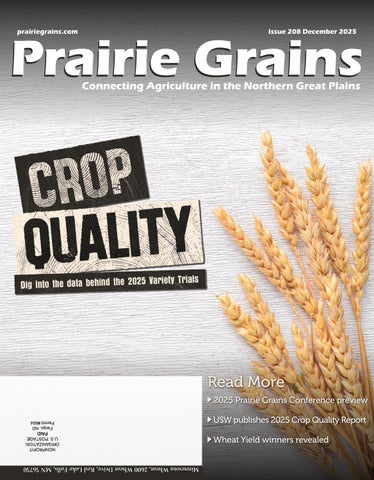
Cover Story It’s time for farmers across the Prairie Grains region to go shopping – small grain variety shopping. Dive into the 2025 variety trial data from public universities and private enterprises, published yearly in this special issue. Starting on page 34, the Dec. 2025 issue of Prairie Grains Magazine has all the information needed to make informed purchasing decisions.
PUBLISHER AND CIRCULATION
Minnesota Association of Wheat Growers 2600 Wheat Drive • Red Lake Falls, MN 56750 218.253.4311 • Email: mnwheat@mnwheat.com Web: www.mnwheat.org
EDITORIAL
Sydney Harris, Managing Editor Ag Management Solutions Ph: 218.689.5091 Email: sharris@agmgmtsolutions.com
CONTENT EDITORS
Drew Lyon, News Editor Ag Management Solutions Ph: 507.388.1635 Email: dlyon@agmgmtsolutions.com Katelyn Engquist Ag Management Solutions Ph: 507.508.1540 Email: kengquist@agmgmtsolutions.com
ART DIRECTOR
Alex Troska Ag Management Solutions Ph: 952.334.2539 Email: atroska@agmgmtsolutions.com
OUR COLLABORATORS Minnesota Association of Wheat Growers 2600 Wheat Drive • Red Lake Falls, MN 56750 218.253.4311 • Email: mnwheat@mnwheat.com Web: www.mnwheat.org
ADVERTISING SALES Jill Thibert LHM & Co Ph: 218.280.2821 Email: jill@lhmandco.com
North Dakota Grain Growers Association 2401 46th Ave SE , Suite 204 • Mandan, ND 58554 701.222.2216 • Email: danw@ndgga.com Web: www.ndgga.com
ABOUT PRAIRIE GRAINS
South Dakota Wheat Growers Association 116 N. Euclid, Box 667 • Pierre, SD 58501 605.224.4418 • Email: wheatinc@midco.net
Prairie Grains magazine is published six times annually and delivered free of charge to members of these grower associations, and agriculture producers in Minnesota, North Dakota, South Dakota and Montana. To subscribe or change address, please write or call our circulation department.
Montana Grain Growers Association P.O. Box 1165 • Great Falls, MT 59403 • 406.761.4596 Email: erobinson@mgga.org • Web: www.mgga.org
December 2025 |
Prairie Grains
|
Page 3
We’re growing: USW chair, ND farmer reflects on value of wheat checkoff Well, folks, another wheat growing season has come and gone – and what a season it was. Every year, farmers across the Prairie Grains region face new, and recurring, challenges. This year proved to be no different. Now, more than ever, export market development is proving critical for wheat producers. As the organization that promotes the reliability, quality and value of all six U.S. wheat classes to industry stakeholders in more than 100 countries around the world, U.S. Wheat Associates employs sales and technical experts in 13 overseas offices who nurture and develop relationships with our customers. They are our eyes and ears, continually looking for opportunities to sell U.S. wheat and providing technical expertise as needed. As USW chair, I am fortunate to witness the impact this organization has on markets across the world. The inroads made by USW wouldn’t be possible without exemplary leaders manning the ship. In July, we bid farewell to Vince Peterson, who led USW as president and CEO for eight years, when he retired, and welcomed Mike Spier to the helm. Previously, Spier served as USW’s vice president of overseas operations, making him an excellent candidate for the role. We’re excited to see the direction the organization takes under his leadership and have no doubt that U.S. wheat producers will benefit. On the home front, the North Dakota Wheat Commission has also undergone a significant staff change. After 27 years of working on behalf of North Dakota wheat producers as NDWC’s administrator, Neal Fisher earned a well-deserved retirement.
Page 4
|
Prairie Grains
| December 2025
While we’re sad to producer of wheat and see him go, we’re the top producing state happy that now of the durum and hard he has more time red spring wheat classes, for fishing with but it’s also the nation’s his grandkids and leading producer of riding horseback. sunflowers, edible beans, Succeeding Neal oats, flax, rye, honey as administrator and canola. Our state’s is a familiar face. diverse agriculture Jim Peterson landscape doesn’t end has worked in there: North Dakota is various roles at also a major producer of NDWC since soybeans, corn, barley, Jim Pellman 1991, most recently serving as deputy peas, lentils, sugar beets and potatoes. administrator. A North Dakota farm We may be known for freezing boy, Jim’s transition to administrator temperatures and blizzards, but I want has been seamless, and the to emphasize that North Dakota is an Commission is in good hands. agriculture state. In fact, according to the Speaking of the Commission, North Dakota Department of Agriculture, NDWC works on behalf of North nearly 90 percent of North Dakota land Dakota farmers, using their checkoff area is farms and ranches, and agriculture investments to market and promote is responsible for almost one-fourth of wheat domestically and worldwide, the state’s employment, making it the invest in research to give producers largest segment of the state’s economy. the best varieties and ensure wheat We’re more than a frozen tundra, which producers have an effective voice on I’m excited to demonstrate to our peers domestic and trade policy issues. These across the country. dollars are farmer dollars, which is why As we gear up for 2026, it may be it’s so significant that investments are easy to focus on the obstacles, but I directed by producers. Because the encourage you to also take a moment seven farmer-leaders that comprise to remember the opportunities in our the board of commissioners volunteer industry, which will be highlighted countless hours and engage in robust during the Prairie Grains Conference conversations to determine the best use Dec. 10-11 in Grand Forks. The wheat of checkoff funds, the Commission is a industry’s advancements also shine powerhouse for growers in our state. when you look at the vast amount of And next summer, industry variety research, which you can study stakeholders from across the country in this issue of Prairie Grains Magazine. will have the opportunity to see Together, we will make the most firsthand North Dakota’s significant out of 2026. Until then, have a great role in the U.S. agriculture industry holiday season! when we host the USW summer board Jim Pellman farms near McClusky, meeting June 23-25 in Fargo. Not only N.D., and serves as chair of U.S. is North Dakota consistently a top Wheat Associates.
Betsy Jensen is a Farm Business Management Instructor at Northland Community and Technical College. Follow her on X at @jensenbetsyr.
Big dreams I love a good post-harvest rally. That price for which I have been waiting for all harvest has finally arrived. This is the price of my harvest dreams. And then I change my mind and wait for another dime or quarter. Does that sound familiar? How often do our dreams come true, only to discover the dream has changed? Maybe you are dreaming of your kids coming home to farm, but now all four want to farm. How is that going to work? Now you are dreaming that a few change their minds and work off the farm. Or maybe it is a piece of land that you have wanted to own, but you also need a new shop. It’s okay that dreams and plans can change. Before you change your dream price targets, step back and think about how far that market has moved. I am begging you not to change your price targets. You can change your bushels, but not the target. If you wanted $6 wheat and we hit $6 wheat, you need to sell something. Your dream price should be the final price target, and I call this the “Lightning Strike Me Dead” price. You
will be struck by lightning if you hold a crop past that price. Make sure it is a long shot price, like beans in the teens or double-digit wheat. If we hit that price, load the trucks, collect the check and don’t look back. There are so many unusual triggers in our economy, such as tariffs and government shutdowns. We always have ups and downs in crop marketing, but we are being hit by some unusual external factors. We missed some USDA reports this fall, the statisticians aren’t working and it will be interesting to see what reports indicate later this winter. This year seems to have more risk than prior years. Your price targets and goals should be adaptable, and unfortunately that might mean lowering the price targets. Nearly everyone I have worked with this year has plans to add storage. That is a profitable idea when we have a full carry in the market. It is not a good idea when you plan to hold what I call “Birthday Crop.” Use caution when your crops celebrate a birthday on your farm. That can be a very expensive decision. You can build bins because
you are growing more corn, or you need storage closer to fields, but bins for Birthday Crops should be reconsidered. As I write this article, there is an eighty cent carrying charge in spring wheat. December 2026 futures are eighty cents higher than December 2025. That is a huge carrying charge. We do not often get that much of a premium for storing wheat or planning ahead for sales. Your dream price might be out there, but only if you plan ahead and make sales in advance. As a farm management instructor, I love hearing the goals and dreams of farmers. There are a few common goals but also unique goals such as changing crops, changing tillage systems or unique transition plans. Please think about your dreams and goals and make sure to write them down. The top goal should be to remain profitable and live to farm another year. That is where a marketing plan can help you remain rational when the markets are irrational. That post harvest rally has been hoped for all year and it has finally arrived. Use your marketing plan to keep the farming dream alive. December 2025 |
Prairie Grains
|
Page 5
by Sydney Harris
Industry involvement MAWG’s half-century of advocacy makes impact across generations Minnesota wheat farmers need a voice at the legislative table. The Minnesota Association of Wheat Growers (MAWG) was established in 1975 to do just that – represent Minnesota wheat producers in St. Paul and Washington, D.C. And, since its inception, MAWG’s backbone has been its farmer-leaders, who are elected to represent the best interests of growers throughout their region. “Farmers can really advocate for what we need in a way that industry doesn’t have the same ability,” MAWG Treasurer Tate Petry said. “When farmers go to St. Paul and Washington, D.C., legislators really seem to stop, listen and try to understand the things that we’re saying. We’re the boots on the ground.” There’s no doubt that farmers’ voices resonate within the walls of legislative buildings, making MAWG membership a critical tool toward improving profits for Minnesota wheat producers. Under the guidance of its board of directors, MAWG plays a key role in ensuring that important projects and policies become reality, while at the same time, playing legislative defense. “As a MAWG board member, instead of sitting around having coffee and
complaining about it, we can talk directly to somebody that might be able to do something about it,” MAWG President Kevin Leiser said.
Family traditions Elected by their fellow farmers, MAWG directors carve out precious time to advocate for the state’s wheat industry. Meeting six times a year, the MAWG board comprises seven members. Two represent District 1, two represent District 2 and three are at-large, serving the entire state. With three-year terms, there is only one seat up for election this MAWG director election season – an at-large position currently held by Petry – which will be voted on during the Prairie Grains Conference Dec. 10-11, 2025. Running for reelection, Petry was first elected to the board in 2020. Today, he serves as MAWG treasurer and sits on the National Association of Wheat Growers (NAWG) budget committee. “Initially, I got involved because of an invitation from Torgy (Dave Torgenson), the executive director at the time, to participate in Ag Peer Group, which has now evolved into Ag Leadership Network,” said Petry, who farms near Ada. “That was my
initial step into the organization and understanding what they did. And following that program, I ran for the open at-large position.” But the apple doesn’t fall far from the tree and Petry’s exposure to the organization began several years prior when his mom, Melissa, served as a MAWG director. In fact, Petry’s first MN Wheat Day on the Hill experience occurred when he was in high school. “Growing up, I was pretty familiar with the organization because Mom was on the board,” Petry said. “I went on a few legislative trips in high school because she thought it was a good opportunity to get a feel for how the legislature works.” Those experiences left an impression, considering Petry is now seeking his third term on the MAWG board. “Since being a MAWG director, the thing that sticks out is just how important it is to be in front of legislators when they’re making policy and sharing our opinions,” Petry said. “Because what I’ve found is that the people in both Washington, D.C., and St. Paul do carry a great deal of respect, and they care a lot about making sure that rural America and farming can continue.”
MAWG WANTS YOU! To become a candidate and place your name on the ballot, call the MN Wheat office at 218-253-5002 or scan the QR code.
on ti ia oc s ss er A w ta ro so t G ne ea in h M fW o
Page 6
|
Prairie Grains
| December 2025
Building relationships is at the heart of MAWG’s mission – even with those who might not see eye-to-eye with MAWG’s resolutions. “Even when we’re meeting with people that we perceive as not in favor of agriculture, oftentimes, they’re more sympathetic and openminded about things than we give them credit for,” Petry said. “So, it’s been a really good opportunity to see how important it is to make personal connections with those people and tell them what we’re doing and what we need to ensure that agriculture can continue to contribute to the economy in a productive way.”
Growing knowledge While Petry is seeking reelection, other growers are also welcome to run for the board seat. If you or someone you know is interested in putting their hat in the ring, please fill out a nomination form by Dec. 10.
MAWG directors are encouraged to attend and participate in MAWG’s Annual Meeting in December during the Prairie Grains Conference, as well as NAWG meetings. While there are other meetings that board members can attend, the time commitment outside of regular board meetings is up to individual board members. However, there have been instances when pressing issues arise, and board directors are encouraged to be flexible and active. “The most rewarding part of being on the board is seeing the impact that we can have to continue to grow the wheat industry in Minnesota,” Petry said. “It’s a really good experience for anybody. It forces me to have a deeper understanding of a lot of the programs and tools that we use every day on the farm and how those programs can be affected by legislation. It grows your connections, which grows your knowledge and understanding of ag programs and how to best use
them on your farm.” Several MAWG directors state that being on the board has helped them in their farming operations, such as meeting people with new ideas, expanding their knowledge and generally helping them have a larger view of the industry. Board members are not paid for their involvement; however, their travel-related expenses are covered and directors receive a stipend for each meeting to cover other costs associated with being a board member. “Being a MAWG board member has been really worthwhile,” said Leiser, who farms near Fertile. “Before I joined the board, I’d never been to Washington, D.C., and the first time was kind of fun because you see a whole different side of the world. And then, you actually talk to somebody that could maybe make a difference and the reality sinks in that you can really make an impact.”
RRFN
December 2025 |
Prairie Grains
|
Page 7
2026
Small Grains Update Meetings Wheat, Soybean & Corn
JANUARY 13-16th, 2026 Visit mnwheat.org for more details.
Meetings are free - registration is not necessary
Dr. Jochum Wiersma Small Grains Specialist University of MN
Bruce Kleven Legislative Strategist for MN Wheat
Adam Birr Executive Director Minnesota Corn
The Good, The Bad, and The Ugly
2026 Minnesota Legislative Session Update
Minnesota Corn Checkoff 35 Years of Delivering Markets, Research and Outreach
Sergio Cabello-Leiva Research Director MN Soybean Research & Promotion Council
Betsy Jensen Farm Business Management Northland Community & Technical College
Turning Research into Profit for Minnesota Soybean Growers
Make Marketing Plans, Not Excuses. We’ll Create One Today
MN Association of Wheat Growers and the MN Wheat Research & Promotion Council Update
County Soybean and/or Corn Grower Association Annual Meetings will take place in: Halstad, Crookston and Lancaster Sponsored in part by:
LOCATIONS DILWORTH Tuesday, January 13th 12:00 p.m. TAK Music Venue 1710 Center Ave (Lunch served) HALSTAD Wednesday, January 14th 8:00 a.m. Halstad Legion Rec Center 580 2nd Ave W (Lunch served) (Mtg in conjunction with Norman County Ag Day) CROOKSTON Wednesday, January 14th 12:00 p.m. Ag Research Center UMN - Crookston Campus (Lunch served) (Mtg in conjunction with West Polk County Crop Improvement) LANCASTER Thursday, January 15th 8:30 a.m. Community Center (Lunch served) (Mtg in conjunction with Kittson County Crop Show) ROSEAU Thursday, January 15th 12:00 p.m. Gene’s Bar & Grill (Lunch served) ST. HILAIRE Friday, January 16th 8:30 a.m. Community Center (Lunch served) _ _ _ _ _ _ _ _ _ OTHER AREA MEETINGS: MORRIS Monday, January 19th 12:00 - 3:00 p.m. WCROC (Lunch served)
Page 8
|
Prairie Grains
| December 2025
BE IN THE RESEARCH LOOP When it comes to soybean checkoff-funded research, the Minnesota Soybean Research & Promotion Council doesn’t back down. Join us on Dec. 11 at the Prairie Grains Conference in Grand Forks, N.D., to hear the latest research updates and learn how checkoff investments continue to strengthen Minnesota soybean farms. 7:00 a.m. Minnesota Soybeans 2025 Production Dynamics, Pathogen Issues, and Waterhemp Pressure – Sergio Cabello Leiva, Director of Research, Minnesota Soybean Research & Promotion Council 7:20 a.m. No News is Good News: 2025 Western Minnesota IPM Survey – Dr. Angie Peltier, Extension Educator – Crops, University of Minnesota 7:40 a.m. Study of the Efficacy of Two Nematicides on SDS and SCN in Greenhouse Pot Assay – Fariba Heydari Soreshjan, Postdoctoral Associate, UMN 8:00 a.m. Advancing IPM for Soybean Gall Midge and Soybean Aphid – Robert Koch, Professor and Extension Specialist, UMN 8:20 a.m. Managing Fertilizer for Soybean Production – Daniel Kaiser, Professor, UMN
Find us on the trade show floor in booth #78! Register for the Prairie Grains Conference at mnwheat.org
December 2025 -| NOVEMBER
by Sydney Harris
A Grain of Knowledge
From quiet to quality, researchers pleased with 2025 growing season
The dust has settled. Like clockwork, another wheat growing season is in the books and producers around the Prairie Grains region are regrouping, taking a close look at what went well and what didn’t, before gearing up for next year. “I figured it to be a very solid crop and was surprised that we ended up with a new state record,” said University of Minnesota Small Grains Specialist Jochum Wiersma. “Even though we had a shorter growing season, yields were very good in most areas but, especially in the northern end of the Red River Valley, the lack of timely rains curbed the yields.”
Slow and steady wins the race When the birds start chirping, farmers tend to get antsy. This spring, Minnesota wheat growers were raring to go, but field and weather conditions had other plans. According to USDA’s National Agricultural Statistics Service (NASS), as of April 27, Minnesota’s spring wheat planting progress was at 14 percent, which was three percentage points behind the five-year average. But slow and steady wins the race and by May 19, planting had jumped to 93 percent complete, and May 27 marked spring wheat at 97 percent complete with 80 percent emergence. “We caught up very, very quickly,” Wiersma said. “That’s the amazing part when it comes to the Red River Valley; the amount of capacity that’s here to make things happen is just phenomenal. There are very few parts in the world where that many acres get seeded that quickly – they’re planting hundreds of acres a day.” Page 10
|
Prairie Grains
| December 2025
North Dakota’s spring wheat planting progress had a slightly different cadence. As of April 27, planting was ahead of the five-year average by seven percentage points at 19 percent. On May 12, planting was over halfway complete at 58 percent, well ahead of the 35 percent average. By the time harvest rolled around, the USDA rated 64 percent of North Dakota’s spring wheat as good or excellent. “Going into harvest, we were expecting yields to be pretty good,” said Clair Keene, North Dakota State University Extension agronomist specializing in cereal crops. “The vast majority of the state, except for the northeast corner and up around Langdon, had good rainfall in May and June. We haven’t been able to say that many years over the past five years or so.”
Danger zone Planting may go swimmingly, and harvest may be a breeze, but it’s the in between that can make or break a harvest’s quality. For instance, several Minnesota producers wish they could mentally block out the falling numbers scandal of the 2024 growing season. Though the risk of Fusarium head blight (FHB) haunts growers every year, in 2025, Minnesota wheat producers walked away virtually unscathed. “We’re in much better shape than last year; I haven’t heard of anybody getting rejected right off the bat at the elevator,” Wiersma said. “The crop headed relatively early and we kept trending above average temperatures, increasing the risk of FHB and putting us at moderate to high risk for spring wheat.” As they fired up their combines for harvest, North Dakota growers were also crossing their fingers, hoping that they had
HOME-GROWN WHEAT. HOME-RUN RESULTS. NEW
MUFFINS
ROLLS
57
DAYS TO HEADING
60
DAYS TO HEADING
• Proven high yield performance in multi-year data
• Top-yielding performer in multiyear trials--leads the pack in potential
• Strong fit for northern and western environments with broad adaptability
• Strong protein and test weight while delivering standout yields
• Above-average protein and strong test weight
• Earlier heading than BUNS and ROLLS
• Good lodging resistance
• Great standability
• Performs alongside BUNS under similar management
The earlier-heading wheat you’ve been looking for.
We test where you farm—so
The yield you want and the protein the market demands.
wheat performs where it matters most.
No need to take our word for it: Check out the U of M and NDSU trial data to see how we stacked up. •
Scan the QR code to see yield results and learn more about Peterson’s wheat varieties.
Seed Smarter. Grow Stronger. • www.peterson.ag/products/wheat
good falling numbers. “We were a little nervous, not knowing what the DON situation would be like come harvest,” Keene said. “But it’s certainly good news on that front, it really has not been a bad year. There have been a couple scattered reports, but no widespread areas of the crop were affected.” If it’s not one thing, it’s another. In late July, another pest – true armyworm – came marching along, causing headaches for Minnesota wheat growers, especially those along the beach ridge of the Red River Valley. Unfortunately, some farmers had infestations that reached damaging levels. “Armyworms did show up, and they showed up relatively late,” Wiersma said. “They’re always kind of here but it’s about how big the flights are – it’s the numbers that matter. If they’re smaller flights, most don’t even notice.” Overall, the 2025 growing season didn’t bring a lot of unwanted excitement. “It was a very quiet year,” Wiersma said. “Last year, every single disease that we could think of showed up. This year, as a pathologist, overall, it was boring.” When it’s all said and done, farmers are probably alright with a little bit of “boring.”
The results Recognized globally for the quality crop grown, the Prairie Grains region continually produces an exceptional product. 2025 was no different. In Minnesota, another record was broken when the USDA NASS Small Grains 2025 Summary reported an average
spring wheat yield of 69 bushels per acre, up 0.5 bushels from last year’s record. Noth Dakota saw an average of 55 bushels per acre, down from last year’s average of 59. Across the U.S., all wheat production totaled 1.98 billion bushels with an average yield of 53.3 bushels per acre. “I can’t tell these guys what to do, they’re too good,” Wiersma said. “Other than price, I think everyone should be relatively happy with how the crop turned out.” Not only were yields strong, but according to the U.S. Wheat Associates 2025 Crop Quality Report, the excellent quality solidified the 2025 crop as a good one. The report found that Minnesota’s spring wheat crop graded as Number 1 Northern Spring with a test weight of 61.8 pounds per bushel, 59 percent vitreous kernels, 13.9 percent protein, 0.4 parts per million DON and a Hagberg falling number of 411. North Dakota’s spring wheat came in with a test weight of 62.1 pounds per bushel, 57 percent vitreous kernels, 14.2 percent protein, 0.2 parts per million DON and a Hagberg falling number of 409. “North Dakota and Minnesota spring wheat farmers have done a good job with variety selection, paying attention to yield, of course, but also the quality of their crop and protein levels,” Keene said. “I applaud farmers that pay attention to both yield and protein on those quality metrics, along with disease resistance, when selecting varieties.” Before wheat producers know it, the 2026 growing season will be here. Until then, they can look back on the 2025 season, take notes and prepare as best as they can for the year ahead. December 2025 |
Prairie Grains
|
Page 11
December 10-11, 2025 Alerus Center, Grand Forks, ND
Thursday Keynote Speakers
MIKE SPIER
Page 12
|
ALAN KLUIS
DARYL RITCHISON
President U. S. Wheat Associates
Managing Director Kluis Commodity Advisors
Director of NDAWN & ND State Climatologist North Dakota State University
9:15 a.m.
10:00 a.m.
1:30 p.m.
Prairie Grains
| December 2025
Thank you Sponsors & Exhibitors! Platinum Sponsors
Gold Sponsors
December 2025 |
Prairie Grains
|
Page 13
Thank you Sponsors & Exhibitors! Silver Sponsors FULLTEC
Bronze Sponsors
Exhibitors: A&S Ag Sales Ag Central Radio / Ag News 890 Agassiz Seed & Supply AgCountry Farm Credit Services Agricultural Utilization Research Institute AgriPro/Syngenta Anchor Ingredients Anheuser-Busch BASF Bayer CropScience Cargill Inc CHS CHS Sunflower Corteva Agriscience Dakota Peat & Equipment Duluth Seaway Port Authority EcoCredit Marketing Ellingson Farm Bureau Financial Services Frontier Precision Agriculture GK Technology Inc. Gowan USA, LLC Helena Agri-Enterprises Page 14
|
Prairie Grains
| December 2025
Landmark Companies LHM & Co Limagrain Cereal Seeds Litzau Farm Drainage Meridian Seeds LLC Minnesota Ag Water Quality Certification Program Minnesota Ag Weather Network Minnesota Agricuture in the Classroom Minnesota Crop Improvement Assn Minnesota Department of Agriculture Minnesota Farm Bureau Minnesota Farmers Union Minnesota Soybean Research & Promotion Council MN Ag Rural Leadership National Wheat Foundation NCTC Farm Business Management ND Crop Improvement & Seed Assn North Dakota Ag Mitigation Northern Crops Institute Ohnstad Twichell, PC Old National Bank Pioneer Hi-Bred International
Plant Power Agriculture ProSeed Purple Wave Auction QA Farmer R&J Broadcasting Red River Farm Network Red River Watershed Mgmt Board Rinke Noonan Rivard’s Turf & Forage Inc. Spray Advantage Spraytec Fertilizers Stine Seed Company Sunflower Hearts Inc Syngenta Crop Protection TCG Wheat The Arthur Companies University of Minnesota Extension US Commodities USDA Farm Service Agency Valley Grain Milling, Inc Virtue Seeds WestBred Widmer Roel Wilbur-Ellis Agribusiness
Wednesday, December 10th Morning Sessions 9:00 a.m. - 12:00 p.m.
ND Crop Improvement Meeting - Eastern Regional
9:00 a.m. - 12:00 p.m.
Board Leadership Training Program
9:30 a.m. - 12:00 p.m.
North Dakota Barley Council County Representatives Meeting
10:00 a.m. - 12:30 p.m.
Red River Basin Flood Damage Reduction Work Group (FDRWG)
10:00 a.m. - 3:00 p.m.
Minnesota Wheat Research Committee
12:00 p.m. Lunch
Registration by November 25, 2025 is required for all meal ticket guarantees. Don’t delay!
MN & ND Malting Barley Program 1:30 - 4:00 p.m. 1:30 p.m. Welcome - Nathan Boll, ND Barley, Chris Englestad and Ryan Hough, Minnesota 1:35 p.m. Barley Research Update
• Optimizing Nitrogen Inputs to Reduce Scope 3 Emissions in Barley Production in Idaho, Montana, and North Dakota - Dr. Brady Goettl, NDSU Ext Soils Specialist • Preventing Sprout in Malt Barley Prior to Harvest - Dr. Michael Ostlie, ND Ag Experiment Station, Carrington, ND • Malting Barley Variety Development - Dr. Max Fraser, AB-InBev • Barley Pathology Update - Dr. Thomas Baldwin, Assistant Professor, NDSU
3:00 p.m. Challenges & Opportunities in Malting & Brewing Industry - Mark Black, Owner, 49th Parallel, LLC
Afternoon Sessions 2:00 - 3:00 p.m.
MAWG Resolutions Committee Meeting
3:00 – 4:00 p.m.
Minnesota Soybean Growers County Association Meeting
4:00 p.m.
TCG Wheat Meeting
4:00 - 5:00 p.m.
North Dakota Grain Growers Annual Meeting
4:00 - 5:00 p.m.
Minnesota Association of Wheat Growers Annual Business Meeting
Social, Banquet, and Live Auction Hospitality hosted by:
5:15 p.m.
Social – Hors d’oeuvres & Refreshments
6:15 p.m.
Welcome and Banquet
7:15 p.m.
Recognition and Awards
7:30 p.m.
Concluding Remarks, Hospitality and Auction December 2025 |
Prairie Grains
|
Page 15
Thursday, December 11th 6:30 a.m. 7:00 a.m. 8:00 a.m. 8:50 a.m.
Registration & Breakfast Wheat & Soybean Research Reporting Sessions - see next page Trade Show opens Break in Trade Show area
8:55 a.m. 9:00 a.m.
Welcome Thom Petersen, Commissioner, MN Department of Agriculture
9:15 a.m.
Driving Global Demand: How USW Promotes U.S. Hard Red Spring Wheat and Delivers Value to Producers Mike Spier President, U. S. Wheat Associates
GENERAL SESSION
An overview of how U.S. Wheat Associates promotes U.S. hard red spring wheat overseas, differentiates its quality, delivers measurable value to producers, and adapts to recent USDA funding changes.
10:00 a.m.
Strategies for Success in 2026 Alan Kluis Managing Director, Kluis Commodity Advisors Al Kluis will review his marketing plan from last year and lay out a game plan for marketing your soybeans, corn, and wheat in 2026.
10:45 a.m. 11:30 a.m. 12:15 p.m. 1:00 p.m.
Break in Trade Show area Breakout Sessions - see next page Lunch in Arena / Refreshments in Trade Show area Visit Trade Show
GENERAL SESSION 1:30 p.m.
Expected 2026 Weather Conditions Daryl Ritchison Director of the ND Agricultural Weather Network (NDAWN) and ND State Climatologist, NDSU After several years in its cold phase, the equatorial Pacific may be finally shifting to an El Nino pattern. What if any impacts will this have on agriculture in the United States? Daryl will discuss what type of changes he foresees for the next growing season. In addition, he will fill us in on the latest news on NDAWN’s expansion into Minnesota in cooperation with the Minnesota Department of Agriculture.
2:15 p.m. 2:30 p.m. 3:00 p.m. 4:00 p.m.
Page 16
|
Prairie Grains
Break in Trade Show area Breakout Sessions - see next page Social in Trade Show area Conference Closes
| December 2025
CEU Credits will be available for most sessions on Thursday, December 11.
Thursday, December 11th Wheat Reporting Session
11:30 a.m. - 12:15 p.m. Breakout Sessions Concurrent Sessions - Choose ONE
7:00 a.m. 2025 Update on Variety Development and Breeding for Disease Resistance – Dr. Karl Glover, Professor and HRSW Breeder, SDSU 7:20 a.m. Managing True Armyworm Outbreaks in Small Grains – Dr. Anthony Hanson, Regional Extension Educator & Assistant Extension Professor-Field Crops Integrated Pest Management, U of MN 7:40 a.m. Breeding to Boost Seed-Filling and Increase Minnesota Wheat Yields – Dr. Walid Sadok, Associate Professor, Crop Physiology, U of MN 8:00 a.m. Split Application of Nitrogen and Sulfur in Spring Wheat - Szilvia Yuja, Soils Research Specialist, NDSU Carrington Research Extension Center
A Review of the 2025 Variety Trials – Dr. Jim Anderson, Spring Wheat Breeder, U of MN A New White Mold Solution in Soybeans and Canola from BASF – Albre Brown, PhD, Senior Technical Marketing Manager for Row Crop Fungicides & Insecticides and Ken Deibert, Technical Service Representative, Eastern North Dakota/Western Minnesota, BASF What are the Financial Trends Telling Us? A Look at the 2024 Minnesota FINBIN Farm Financial and Production Highlights - Greg Dvergsten, Ron Dvergsten and Brett Fellbaum, Farm Business Management Instructors, Northland Community & Technical College The War Against Waterhemp – Dr. Joe Ikley, Associate Professor and Extension Weed Specialist, NDSU
8:20 a.m. Bacterial Leaf Streak in Wheat: Current Research, Key Challenges, and Future Directions – Dr. Rebecca Curland, Researcher 6, Department of Plant Pathology, U of MN
Strategies for Managing Crop Yields with High Fertilizer Prices - Steven McKechnie, AgrIntelligence Agronomist, Helena and Robbie Holthusen, Product Manager, Helena
Concluding Remarks
Drainage in Compliance – Kale Van Bruggen, Attorney, Rinke Noonan
Soybean Reporting Session 7:00 a.m. Minnesota Soybeans 2025 Production Dynamics, Pathogen Issues, and Waterhemp Pressure – Sergio Cabello-Leiva Director of Research, Minnesota Soybean Research & Promotion Council 7:20 a.m. No News is Good News: 2025 Western Minnesota IPM Survey – Dr. Angie Peltier, Extension Educator - Crops, U of MN 7:40 a.m. Study of the Efficacy of Two Nematicides on SDS and SCN in Greenhouse Pot Assay - Fariba Heydari Soreshjan, Postdoctoral Associate, U of MN 8:00 a.m. Advancing IPM for Soybean Gall Midge and Soybean Aphid – Robert Koch, Professor and Extension Specialist, U of MN 8:20 a.m. Managing Fertilizer for Soybean Production – Daniel Kaiser, Professor, U of MN Concluding Remarks
Real Property Legal Tools – David Piper, Shareholder Attorney, and Tiffany Findlay, Associate Attorney, Ohnstad Twichell, P.C.
2:30 - 3:15 p.m. Breakout Sessions Concurrent Sessions - Choose ONE
Making More (or Losing Less) with Soybeans in 2026 – Seth Naeve, Extension Soybean Agronomist, U of MN and Ana Carcedo, Broadleaf Agronomist, NDSU Involvement in Agricultural Land Protection in the Red River Basin of Minnesota – Rob Sip, RRWMA Executive Director The Hidden Costs of Marketing – Betsy Jensen & Josh Tjosaas, Farm Business Management Instructor, Northland Community & Technical College Yours, Mine, and Ours: Managing Farm Stress to Reduce Risk and Improve Performance – Jennifer Vaughn, MN Agricultural Mental Health Specialist, Acquire Mental Health, Monica McConkey, MN Agricultural Mental Health Specialist, Eyes on the Horizon and Meg Moynihan, Senior Advisor, Strategy & Partnerships, Minnesota Department of Agriculture
December 2025 |
Prairie Grains
|
Page 17
Prairie Grains Conference Registration
Join us for the 2025 Prairie Grains Conference! From weather and marketing to research and business management, you will be sure to walk away with some new and valuable information. The wide variety of speakers are sure to answer the questions you may have. Registration is open through the day of the conference - walk-ins are welcome. Meals only guaranteed if registered by Nov 25, 2025. Meal tickets for those registering after the deadline will be available on a first-come, first-served basis. Registration for both days of programming and meals are FREE for: Minnesota Association of Wheat Growers members Minnesota Soybean Check-off contributors North Dakota Grain Growers Association members REGISTRATION FEES
- Wednesday program & lunch - $35 ($40 after Nov 25) - Wednesday banquet tickets - $40 ($45 after Nov 25) - Thursday conference program & lunch - $35 ($40 after Nov 25)
Register online at mnwheat.org or scan the QR code ON-SITE HOTEL
Canad Inn, 701-772-8404, $109.00/night, Block #909068, ask for Prairie Grains Conference Hotel cutoff 11/10/2025 (based on availability after this date)
Page 18
|
Prairie Grains
| December 2025
TRUSTED SOLUTIONS FOR DRAINAGE & EXCAVATION At Litzau Farm Drainage, we bring experience, skill, and advanced equipment to every project. From precision drainage and trenching to grading and excavation, our team is dedicated to doing the job right the first time. Whether it’s farm tiling, site prep, or excavation for construction, you can count on us to deliver reliable solutions that keep your land and projects moving forward.
Contact us today to see how Litzau Farm Drainage & Directional Boring can work for you! Scott Litzau: 320-905-1857 Matt Casper: 320-463-8135 Mike Litzau: 320-905-8645 www.litzaufarmdrainage.com
December 2025 |
Prairie Grains
|
Page 19
Page 20
|
Prairie Grains
| December 2025
Unique operations need unique solutions. Whether you need agriculture focused lending solutions or a crop insurance policy to mitigate risk, we have the knowledge and tools for you. • Real Estate Loans & Leases • Operating Loans • Equipment Financing • Crop Insurance Get customized options that fit any size farm, ranch, or agribusiness by contacting your local AgCountry office. AgCountry.com
Visit us at booth #41 at the 2025 Prairie Grains Conference
December 10-11, 2025 | Alerus Center, Grand Forks, ND
December 2025 |
Prairie Grains
AgCountry is an equal opportunity employer, an equal credit opportunity lender, and an equal housing lender.
|
Page 21
by Sydney Harris
Blood type A(griculture)
A
griculture is in Jim Peterson’s blood. Raised on a small grains and livestock operation near Makoti, N.D., Peterson has always known that agriculture would play a pivotal role in his life. Along with working on the family farm, he was active in 4-H during high school. As an agricultural economics student at North Dakota State University, he was a member of Farmhouse Fraternity and the livestock judging team. And it was at NDSU that his advisor, Dr. Bill Wilson, sparked his interest in global markets, which set the stage for his career. “I was fortunate to have him as my advisor,” Peterson said. “His knowledge on grain trade in relation to the global situation and market risk is unparalleled. It helped get me enthused about that sector of the industry.” Nearly 40 years later, the agriculture-based foundation that shaped Peterson’s life from the get-go culminated in him being named administrator of the North Dakota Wheat Commission (NDWC). After graduating college in 1988, Peterson worked for Archer Daniels Midland as a merchandiser, in time winding up in Velva, N.D., at its canola crushing plant. In 1991, he began his career with NDWC as a marketing specialist, eventually earning the title of marketing director. Most recently, Peterson served as deputy administrator, before stepping into the administrator role on July 1, 2025, when Neal Fisher, who had held the position since 1998, retired. “Neal’s time with the Commission speaks for itself,” Peterson said. “He led the organization through a lot of good times but also challenging times. We can’t thank him enough for all he’s done for not only North Dakota wheat producers but all wheat producers.” A far cry from a stranger to North Dakota’s wheat industry, Peterson was a natural choice for the administrator position. “Jim’s got a long history with the North Dakota Wheat Commission,” said NDWC Chair Mark Birdsall, who farms in Ward and Mountrail counties. “He’s been here for over 30 years and has done a great job as the policy and marketing director. He’s very well respected throughout North Dakota, he knows North Dakota wheat and he knows people.” With a storied career at NDWC, Peterson spent countless days promoting the top-quality hard red spring and durum wheat grown across the state. “The bulk of my work has been working with international and domestic customers, as well as the wheat research Page 22
|
Prairie Grains
| December 2025
Jim Peterson steps up as NDWC administrator community” Peterson said. “In North Dakota, we focus heavily on the functional qualities that distinguish our wheat from other origins.” Those high-class qualities that set North Dakota wheat apart come at a premium price in the world market, so promotion efforts need to focus on the added value it brings customers. And, when Mother Nature throws a wrench at producers, degrading their wheat’s quality and causing market penalties to add up, it’s natural that some years wheat marketing can bring added frustration to growers, as they compete at the top of the world quality spectrum. Privy to an inside look at the complete life cycle of wheat, from the time it’s planted to when it’s a baking ingredient for domestic and international customers, Peterson has had the unique opportunity to balance the needs of growers, millers, pasta makers and bakers. “I think I’ve been able to bridge that gap and relay to end users who are demanding high-quality wheat that we need a premium to produce it because it takes more management and more crop inputs to maintain, and added harvest risk,” Peterson said. “I’ve enjoyed that aspect of my job – working with the Wheat Quality Council and customers on quality aspects, but then also relaying why those higher standards are in place to producers back here.” While some of his responsibilities will shift as administrator, Peterson still plans to remain engaged in the market development and transportation issues that affect producers.
“My challenge is to continue to push the envelope and make sure we’re at the table on a lot of the current issues, providing input and guidance and helping develop the future of wheat production in North Dakota,” Peterson said. “I’m going to have to learn to give up some of the other jobs that I love doing but I’m fortunate to have a good staff that I can depend on.” Working for producers and led by a board of seven farmer-leaders, NDWC invests wheat checkoff dollars to market and promote wheat domestically and worldwide, fund research to keep wheat competitive with other crops and ensure wheat producers have an effective voice on domestic and trade policy issues. “We have a bright future ahead,” Birdsall said. “We’ve got some great people that make it a great organization to be involved with. They do a fantastic job of representing North Dakota wheat and our wheat producers.” Since 1959, NDWC has strived to expand the use of wheat grown by North Dakota farmers. As the organization steps into its next chapter, there’s no doubt that it will remain steadfast in its commitment to the wheat industry. “We have a strong history to lean on at the NDWC,” Peterson said. “There are a lot of things out of a farmer’s control. But with NDWC, growers ensure that they’re investing in themselves, collectively, as wheat producers. The collective investment of growers means they’re addressing and tackling issues as an industry.”
Checkoff Dollars at Work NDWC’s efforts are funded by wheat producers through a checkoff of two cents on each bushel of wheat sold, ensuring continuous support of its programs. · Developing and maintaining market opportunities · Reinforcing grain food consumption · Funding research · Influencing trade policies · Addressing policies that impact producers
December 2025 |
Prairie Grains
|
Page 23
MAWQCP ‘leans into’ financial assistance for enrolled producers Mike Young’s first steps toward improving his soil health began two decades ago with no clear road map or end goal. “It didn’t start as a ‘soil health journey,’” Young told an assembled group of farmers and industry leaders in September 2025 at his Waverly farm. “For me it started as, ‘There’s got to be a better way.’” There were no smartphones or easy access for Young to find his way toward adopting strip-till on his soybean and corn operation. Instead, he combed through magazines and talked with his crop adviser, who set out a plan and promptly told Young he was better off selling his land, rather than strip-tilling. Young declined the recommendation and instead sought out matching-funds grants to purchase equipment through his local Soil and Water Conservation District representative, who also responded to Young’s idea to purchase strip-till equipment with skepticism before promising to do further research. “Sure enough, he called me back three weeks later and said, ‘Hey that strip-tilling thing, they’re doing it in other places! We’ll match that funding,” Young said. “That’s what allowed me to purchase this equipment, was a 50 percent matching grant.” Young welcomed stakeholders at his farm alongside the Minnesota Department of Agriculture and Minnesota Pollution Control Agency to promote the state’s $200 million to cut climate pollution from food systems through the Climate Smart Food Systems Initiative. The Minnesota Agricultural Water Quality Certification Program
Waverly farmer Mike Young found a better way to improve his soil health by adopting new conservation practices
Page 24
|
Prairie Grains
| December 2025
(MAWQCP) received $10 million of the funding via its Soil Health Financial Assistance Program grants and developing markets for continuous living cover crops and cropping systems. “This is particularly exciting to offer this grant opportunity and work with retailers to buy down the cost of things like nitrogen that farmers buy,” said Brad Redlin, MAWQCP program manager. “Farmers have to take on that expense and, obviously, it’s challenging, especially in these times. We’re happy to lean right into it.” Young has proven to be a farmer ahead of his time, employing practices before MAWQCP launched. While adopting strip-tilling tested his patience, from costly labor and machinery to time invested, Young said he’s learned valuable lessons along the way. Today, he’s evolved from strip-tilling every spring and fall to every two years, saving equipment costs in the long run. “We’ve seen great benefits,” he said. MAWQCP connects farmers with local conservation district experts to identify and mitigate any risks their farm poses to water quality on a field-by-field basis. Producers going through the certification process retain priority access to financial assistance. After being certified, each farm is considered in compliance with new water quality laws and regulations for 10 years. Since MAWQCP’s statewide launch,1.22 million acres have enrolled in the first-of-its-kind program. The 1,600-plus certified farms have added over 7,872 new conservation practices that protect Minnesota’s waters. These new practices are keeping 68,800 tons of sediment out of Minnesota rivers while saving over 89,800 pounds of phosphorous on farms each year. The conservation practices have also reduced nitrogen loss by up to 45%. “For me, the return on investment has been unbelievable,” said Young, who enrolled in MAWQCP about six years ago. Farmers and landowners interested in becoming water quality certified can contact their local Soil and Water Conservation District or visit MyLandMyLegacy.com to enroll and learn more about financial assistance programs. MDA Commissioner Thom Petersen, who visited with colleagues from across the country while Minnesota hosted the 2025 Farm Aid, said MAWQCP continues to be a model program nationwide. “We had people from all over the country come here and look at our grant program and MAWQCP, and they all said, ‘We’d love to do something like that in our state,’” Petersen said.
IT’S NOT JUST YOUR LAND. IT’S YOUR LEGACY. The Minnesota Agricultural Water Quality Certification Program rewards farmers like you for what you do best, taking care of your land and its natural resources. To get started and learn more, contact your local soil and water conservation district or go to:
MyLandMyLegacy.com
December 2025 |
Prairie Grains
|
Page 25
JANUARY - FEBRUARY - 2024 - Soybean Business--25 25 NOVEMBER - DECEMBER - 2025 - SOYBEAN BUSINESS
INSURANCE Crop safety nets have protected producers for nearly 100 years What do Prairie Grains farmers have in common with Tina Turner? Like Tina Turner, farmers insure their assets. Unlike Tina Turner, farmers don’t insure their legs; they insure the crops they grow. Between Mother Nature’s curveballs and unpredictable market fluctuations, farmers face an abundance of uncertainty and risk. Author Amor Towles wrote that farming, “was a way of life in which the difference between abundance and ruin could be measured by a few inches of rain or a few nights of frost.” That’s why crop insurance is critical. “Crop insurance has been part of the evolution of our
Page 26
|
Prairie Grains
| December 2025
agricultural support system in the United States,” said Kyle Jore, head of crop insurance development for Watts and Associates, a firm that develops and demonstrates data-driven risk management strategies for agricultural leaders. “It ensures that we have resilience in agriculture, which largely funds our rural economies.” While the first crop insurance agency can be traced back to a group of tobacco farmers protecting against hail damage in the 1880s, federal crop insurance began as an experiment in the 1930s to help agriculture recover from the Great Depression and the Dust Bowl. Today, with more than 90 percent of insurable farmland in the U.S. protected by the federal crop insurance program, it has developed into a complex system that aims to alleviate a grower’s financial burden when elements out of their control enter the picture. “With how expensive farming is now, from machinery to land to everything else, farmers are using a lot of money to grow crops,” said Chris Engelstad, past president of the National Barley Growers Association (NBGA). “And then, with all the volatile weather, cost of inputs and commodity prices, it’s tough to handle all that year to year. Crop insurance is the backbone that allows us to take risks every year.” Like agriculture, crop insurance has evolved over time, adapting to the needs of producers. In 1980, the Federal Crop Insurance Act of 1980 was passed, expanding the crop insurance program through a cost-share with farmers that could deliver assistance in a timely manner. This endeavor enabled policymakers to shift away from the direct payment system that had previously been a mainstay for disaster assistance. In 2024, Minnesota farmers paid $332.6 million dollars to protect 18.1 million acres, and in North Dakota, producers paid $409.3 million to insure 26.5 million acres. “It’s structured so that producers have to have skin in the game, in their own risk management,” said Jore, who farms near Thief River Falls, Minn. “They have to pay something and choose how much risk management they want, and what they want. As a result, producers have a tremendous number of tools that they can use and tailor to their business.”
ESSENTIALS Today, that toolbox is chock-full of insurance plans spanning across 136 different crops and offering 36 different plan options for producers. Multiple peril crop insurance (MPCI) policies protect farmers from a myriad of losses, such as natural causes like drought and disease, with newer coverage options including yield and price protection which shields growers from loss in revenue. Overseen by the USDA’s Risk Management Agency, MPCI must be purchased before planting, and private companies must sell to any eligible farmer interested and retain a large portion of the risk. Farmers also have the option to purchase crop-hail policies, which aren’t part of the Federal Crop Insurance Program, and can be purchased at any time during the growing season. “Crop insurance doesn’t make you whole, but it gives you peace of mind,” said Engelstad, who farms near Fertile, Minn. “It makes sure that we have stability on our farm and can keep going from year to year. Otherwise, the risks can get you really fast and take you from a profitable year to being completely upside down in an hour.”
insurance companies cannot proceed without checks and balances. Championed by Tim Watts, founder of Watts and Associates, section 508(h) of the Federal Crop Insurance Act allows private parties to develop products that are in the best interests of producers, follow sound insurance principles and are actuarially appropriate. “Private entities can build a new crop insurance program and propose it to the board for a rigorous review process,” Jore said. “The FCIC Board, through guidance from college professors and actuaries, will look through it, make sure it’s sound and that there are no major underwriting flaws that they can tell. If it goes through this rather rigorous process, it can be implemented as a new crop insurance product.” continued on page 28
Working together A crucial aspect of crop insurance is the symbiotic relationship between the public and private sector. While government programs are notorious for being slow to deliver assistance, private companies can help growers in a much timelier manner, often within 30 days. An adeptness that makes a significant difference when farmers are trying to stay afloat, this partnership brings together the efficiencies of a private-sector delivery system with the regulatory and financial support of the federal government. “Private companies compete on service, which means that the farmer wins,” said Jore, who participated in the Ag Leadership Network, a joint program between the Minnesota Association of Wheat Growers (MAWG) and Minnesota Farm Bureau. “One agent might answer the phone right away or get ahold of the adjuster and gets them out there as soon as possible. Maybe a certain agent understands all the different types of programs and the different options well and can communicate to the farmer in a way that they appreciate.” To protect the integrity of the system, private crop
December 2025 |
Prairie Grains
|
Page 27
Voices carry Membership groups, like MAWG and NBGA, are instrumental in retaining and enhancing the crop insurance program. Because so many factors impacting crop insurance are set by federal policy, it’s imperative that farmers have a voice at the table. “Joining and being active in producer groups really helps individual farmers because they can group together with peers and advocate for things that will help them on their own farms,” Engelstad said. “They keep their fingers on the pulse of everything that’s going on that is affecting farms, including crop insurance. They’re there to help right away when they need to be either proactive, like creating new crop insurance tools, or even when something unforeseen pops up.” And, sometimes, it’s just as important to defend what’s working, protecting the policies against opinions that don’t understand the intricacies of the crop insurance program. “Producer groups want legislators to know that they like crop insurance and that it’s working for them,” Jore said. “Other people might say, ‘Hey, look this thing costs a lot of money,’ and might try to make changes to the program, so they bring it up because they want to preserve the way that it’s already working really well.” When advocacy groups meet with legislators to stress the importance of a strong crop insurance program, they aren’t just shouting into the wind. Their efforts go a long way and often lead to real change. “A big win for barley was when they added the malt barley endorsement to crop insurance,” Engelstad said. “There’s a big price difference between feed barley and malt barley, and there are really specific specifications to make malt quality. If you don’t make the quality, you drop down almost half the price making it almost unprofitable to grow barley. The malt barley endorsement helps bridge the gap.” Each year, farmers buy more than 2.4 million crop insurance policies, protecting more than $200 billion worth of crops and livestock. It’s an essential component to the agriculture industry, with many nuances affecting its efficacy, and grassroots membership organizations play a pivotal role in ensuring that it remains effectual. “Crop insurance allows farmers to take on the risks that come every year,” Engelstad said. “In turn, that helps make a robust supply of crops for all people, for affordable food and quality food. And it helps stabilize markets and gets food and supplies to all people that are in and outside of agriculture because farmers comprise a very small percentage of the U.S. population.”
Page 28
|
Prairie Grains
| December 2025
See how far your soybeans can go. At CHS, we don’t just believe in taking what grows in your fields and connecting it to markets across America. We deliver. Contact CHS or a local grain originator to learn more about delivery options to our Mankato facility, Fairmont facility and other nearby locations. Learn more at chsag.com/soybeans.
IT TAKES A CO-OP. ™ December 2025 |
© 2025 CHS Inc.
Prairie Grains
|
Page 29
by Sydney Harris
CHART-TOPPERS:
PRAIRIE GRAINS REGION RANKS HIGH IN CROP QUALITY REPORT Quality matters. In 2025, hard red spring wheat producers across the Prairie Grains region delivered quality, which was epitomized in the U.S. Wheat Associates (USW) 2025 U.S. Crop Quality Report. The report, which has been published since 1979, provides essential, objective information to help global wheat buyers make informed purchasing decisions. “We are happy to share the 2025 U.S. Crop Quality Report, a detailed look at the high-quality wheat grown by U.S. wheat farmers and used by millers and bakers around the world,” said USW President and CEO Mike
Spier. “This USW report reflects not only the quality of the 2025 crop, but also the hard work and commitment of U.S. wheat farmers. We’re proud to share the results of their efforts with our global partners.” Along with the overarching report, USW publishes regional quality reports focusing on each of the six classes of wheat grown in the U.S. The hard red spring wheat report relayed that ninety-seven percent of the survey samples graded as No. 1, which is an “exceptionally high” percentage. The statistics below give just a glimpse into the quality of 2025’s HRS crop.
st weight:
Protein: Production:
Test weight: Moisture:
nesota – 61.8 lbs/bu
Minnesota – 13.9% • Minnesota – 76 •million bushels
• Minnesota – 61.8 lbs/bu • Minnesota – 12.9%
h Dakota – 62.1 lbs/bu
North Dakota – 14.2% • North Dakota – •277 million bushels
• North Dakota – 62.1 lbs/bu • North Dakota – 12.5%
h Dakota – 60.2 lbs/bu
South Dakota – 14.1% • South Dakota – •33 million bushels
• South Dakota – 60.2 lbs/bu • South Dakota – 12.7%
tana – 60.9 lbs/bu
• Montana – 14.9% • Montana – 57 million bushels
• Montana – 60.9 lbs/bu • Montana – 11.0%
ht:
Protein: Production:
Test weight: Moisture:
bs/bu
• Minnesota – 13.9% • Minnesota – 76 million bushels
• Minnesota – 61.8 lbs/bu • Minnesota – 12.9%
.1 lbs/bu
• North–Dakota – 14.2% • North Dakota 277 million bushels
• North Dakota – 62.1 lbs/bu • North Dakota – 12.5%
.2 lbs/bu
• South–Dakota – 14.1% • South Dakota 33 million bushels
• South Dakota – 60.2 lbs/bu • South Dakota – 12.7%
s/bu
• Montana – 14.9% • Montana – 57 million bushels
• Montana – 60.9 lbs/bu • Montana – 11.0%
Interested in reading the entire 2025 U.S. Hard Red Spring Wheat Regional Quality Report? Scan this QR code! Page 30
|
Prairie Grains
| December 2025
SEEKING BETTER WILD OAT CONTROL IN 2026? Plan now and incorporate a residual with alternate mode of action into your herbicide program. Talk with with your your local local agronomist agronomist or or reach reach out out to to your your local local Gowan Gowan sales sales rep rep today! today! Talk
G OWA N C O . C O M
QUICK, QUIET,
CONVENIENT the grain train ® high-capacity wagons The Brent ® 57-Series Grain Train wagons deliver the ultimate in grain transport efficiency and convenience. Quickly and quietly. And there’s a size for every need — 750, 650 or 550 bushels. Towed singly or in tandem, the Brent 57-Series Grain Train wagons provide the quickest, quietest and most convenient grain transport possible. Plus, they have the most standard features to keep you rolling easily through your busiest time of the year. See your nearest Brent dealer today.
MODEL 657
MODEL 757 Unverferth Manufacturing Co., Inc. P.O. Box 357 • Kalida, OH 45853 • Unverferth.com
SCAN TO LEARN MORE.
VISIT BRENTEQUIP.COM OR SEE YOUR NEAREST DEALER FOR MORE INFORMATION.
December 2025 |
Prairie Grains
|
Page 31
It’s time for a new solution to white mold. The best way to control yield-limiting diseases in your soybeans, like white mold and frogeye leaf spot, is to prevent them from taking hold in the first place. Zorina® fungicide provides dual modes of action for proven white mold control and extended foliar disease protection. And it can be just the thing to help protect your yield potential.
*Subject to credit approval, terms and conditions. For full details, see BASF Grower Finance Program and Terms and Conditions. Always read and follow label directions. Always read and follow label directions. Zorina is a registered trademark of BASF. ©2025 BASF Agricultural Solutions US LLC. All Rights Reserved. Page 32
|
Prairie Grains
| December 2025
University of Minnesota 2025 Wheat, Barley, and Oats Variety Performance in Minnesota Preliminary Report Dr. James Anderson, Wheat Breeder, Department of Agronomy & Plant Genetics, St. Paul Dr. Kevin Smith, Barley Breeder, Department of Agronomy & Plant Genetics, St. Paul Dr. Ruth Dill-Macky, Plant Pathologist, Department of Plant Pathology, St. Paul Dr. Brian Steffenson, Plant Pathologist, Department of Plant Pathology, St. Paul Dr. Pablo D. Olivera Firpo, USDA-ARS, Cereal Disease Laboratory, St. Paul Karen Beaubien, Matt Bickell, Danielle Fiebelkorn-Wrucke, Dave Grafstrom, Tom Hoverstad, Michael Leiseth, Nicholas Metz, Rafael Moreira, Susan Reynolds, Edward Schiefelbein, Nathan Stuart, Donn Vellekson, and Travis Vollmer supervised fieldwork at the various sites. Special thanks are also due to all cooperating producers.
Preface Jochum Wiersma The 2025 growing season will likely not be remembered for the new state record for spring wheat but rather for the low commodity prices and a historical widening of the basis for wheat and other commodities in eastern North Dakota and northwest Minnesota. Adjusted for inflation, the current cash bids for spring wheat in the region are the lowest in nearly a quarter century. Spring seeding started slightly later than the 5-year average and well behind last year’s pace in the last week of April. Above normal temperatures and little precipitation in the first half of May allowed for great progress to be made and by May 12 growers had caught up to last year’s pace and were more than 20% ahead of the 5-year average with two thirds of the spring wheat crop seeded. A few days later seeding was all but completed. The warmer and drier than normal weather also allowed aphids to migrate north and arrive earlier than most years. By the end of May, they could be found in low numbers across much of the state. The early arrival resulted in not just the typical yellowing of leaves but also in the stunting on individual plants. Aphid numbers, however, remained relatively low and economic thresholds were reached only here and there. Tan spot was found in a few fields by crop scouts in the first week of June but both incidence and severity were very low. Those same scouts never found stripe or leaf rust this growing season. By mid-June, oat crown rust was first found in SE Minnesota, and producers were encouraged to use fungicides to limit economic losses. Bacterial leaf streak (BLS) was the only disease that could readily be found in individual fields across much of the state. The risk of FHB was low across the state until June 7. Starting along the Wisconsin border the risk steadily increased from east to west and from moderate to high. Only the counties in the extreme SW and NW of Minnesota remained at low risk as precipitation remained elusive for those two parts of the state. In hindsight, the risk models may have overestimated the risk for individual fields as the rain events that allowed models to trend higher were highly variable and on a much smaller scale than most years. There were just as many fields that didn’t receive any rain as there were those that did receive rain. Ultimately the incidence and severity of FHB were much lower than in 2024. USDA-NASS reported Minnesota’s average spring wheat to be 69 bu/acre, equal to the June 1 forecast and a 0.5 bu/acre year-over-year increase in their Small Grains 2025 Summary. The state’s average barley yield increased 5 bu/acre to 75 bu/ acre, while the state’s average oat yield dropped 1 bu/acre year-over-year to 87 bu/acre. Spring wheat remained at 1.2 million acres, while oat acreage increased 5% to 215,000 acres. U.S. Wheat Associates’ Hard Red Spring Wheat Quality Report reported that Minnesota’s spring wheat crop graded as #1 Northern Spring with an average test weight of 61.8 lbs/bu, 59% vitreous kernels, 13.9% grain protein, 0.4 ppm DON, and a Hagberg falling number of 411, confirming that the 2025 growing season was indeed a good one. Introduction Successful small grain production begins with selection of the best varieties for a particular farm or field. For that reason, varieties are compared in trial plots on the Minnesota Agricultural Experiment Station (MAES) sites at St. Paul, Becker, Waseca, Lamberton, Grand Rapids and Crookston. In addition to these six MAES locations, trials are also planted at the Magnusson Research Farm near Roseau and with nine farmer cooperators. The trials are handled so factors affecting yield and performance are as close to uniform for all entries at each location as possible. The MAES 2025 Wheat, Barley, and Oat Variety Performance in Minnesota Preliminary Report 24 is presented under authority granted by the Hatch Act of 1887 to the Minnesota Agricultural Experiment Station to conduct performance trials on December 2025 |
Prairie Grains
|
Page 33
farm crops and interpret data for the public. The MAES and the College of Food, Agricultural and Natural Resource Sciences (CFANS) grants permission to reproduce, print, and distribute the data in this publication - via the tables - only in their entirety, without rearrangement, manipulation, or reinterpretation. Permission is also granted to reproduce a maturity group sub-table provided the complete table headings and table notes are included. Use and reproduction of any material from this publication must credit the MAES and the CFANS as its source. Variety classifications Varieties are listed in the tables alphabetically. Seed of tested varieties can be eligible for certification, and use of certified seed is encouraged. However, certification does not imply a recommendation. The intellectual property rights of the breeders or owners of the variety are listed as either PVP, PVP (pending), PVP (94), patent or none. Registered and certified seed is available from seed dealers or from growers listed in the ‘Minnesota Crop Improvement Association 2025 Directory’, available through the Minnesota Crop Improvement Association office in St. Paul or online at www.mncia.org. Interpretation of the data The presented data are the preliminary variety trial information for single (2025) and multiple year (2023-2025) comparisons in Minnesota. The yields are reported as a percentage of the location mean, with the overall mean (bu/acre) listed below. Two-year and especially one-year data are less reliable and should be interpreted with caution. In contrast, averages across multiple environments, whether they are different years and/or locations, provide a more reliable estimate of mean performance and are more predictive of what you may expect from the variety the next growing season. The least significant difference or LSD is a statistical method to determine whether the observed yield difference between any two varieties is due to true, genetic differences between the varieties or due to experimental error. If the difference in yield between two varieties equals or exceeds the LSD value, the higher yielding one was indeed superior in yield. If the difference is less, the yield difference may have been due to chance rather than genetic differences, and we are unable to differentiate the two varieties. The 5% or 10% unit indicates that, with either 95% or 90% confidence, the observed difference is indeed a true difference in performance. Lowering this confidence level will allow more varieties to appear different from each other but also increases the chances that false conclusions are drawn.
DOES YOUR WHEAT VARIETY CHECK ALL THE BOXES? MN-Rothsay
MN-Torgy High Yield Strong Straw Good Protein Disease Resistance
VARIETIES THAT COMBINE YIELD, QUALITY AND PERFORMANCE
For varietal trial information visit: varietytrials.umn.edu The University of Minnesota is an equal opportunity educator and employer.
Page 34
|
Prairie Grains
| December 2025
SPRING WHEAT James Anderson, Jochum Wiersma, Susan Reynolds, Nathan Stuart, Danielle Fiebelkorn-Wrucke, Fernando Alberto, Rafael Moreira, Ruth Dill-Macky, and Pablo D. Olivera Firpo.
MN-Rothsay jumped to first place with 28% of the acreage. WB9590 dropped to second place with 19 % of acres. MN-Torgy held on to its third place and combined MN-Torgy and MN-Rothsay count for nearly 40% of the state’s spring wheat acreage. SY Valda also maintained its 4th place with 7% of the acres. Newcomer TCG Zelda reached fifth place with just under 5% of the acreage, most of which is grown in northwest Minnesota. Nine HRSW varieties were tested in the 2025 trials for the first time. This included AP Dagr, AP Iconic, CP3555, CP3678, LCS Rimfire, MS Nova, ND Horizon, PFS Muffins, and TCG-Arsenal. CP3530 was re-entered after a one-year hiatus. Enhance-SD was entered under number for the first time in 2024 and results are now reported for the first time. Testing of AP Gunsmoke CL2, CAG Justify, CAG Reckless, CP 3055, CP3188, CP3322, CP3360AX, ND Heron, PFS Buns, TCG-Teddy, and TW Starlite were discontinued. WestBred did not enter any HRSW varieties in the University of Minnesota variety trial system. WB9479, WB9590, however, were included in the testing in 2025 as each occupied more than 5% of the acreage in 2024. The results of the variety performance evaluations for spring wheat are summarized in Tables 1 through 6. The varietal characteristics are presented in Tables 1 through 3. Tables 4, 5, and 6 present the relative grain yield of tested varieties in 1, 2, and 3-year comparisons. The average yield across the five southern testing locations was 74 bu/acre in 2025. This average compares to a southern average of 66 bu/acre in 2024 and a three-year average of 73 bu/acre. The eight northern locations averaged 105 bu/acre in 2025 with the three-year average jumping 6 bushels to 99 bu/acre. It is the first time ever that the average across the northern location surpassed the 100 bu/acre mark. Varieties with a lodging score of 2 or 3 are considered exceptionally good and will only lodge in extreme cases, while varieties with a rating of 4 or 5 have adequate straw strength most years. Increasing seeding rates generally increases the risk of lodging for all but the strongest and shortest semi-dwarf HRSW varieties. Conversely, lower seeding rates will lower the risk of lodging but commonly results in lower grain yield potential. Linkert continues to be rated superior for straw strength with a rating of 2 while MN-Rothsay is the only other public release with a lodging rating of 3. Private releases that have a rating of 3 for lodging include AP Smith, Dyna-Gro 8582, LCS Dual, LCS Hammer AX, TCG-Wildcat, WB9479, and WB9590. The University of Minnesota spring wheat breeding program has had a controlled environment screening method in place for preharvest sprouting for more than two decades. A rating of 1 or 2 is still considered the best way to avoid preharvest sprouting (PHS) in most instances. Starting harvest at a higher moisture content than the ideal 13.5% grain moisture further reduces the risk of PHS . Spring wheat can be harvested at 18% grain moisture and stored safely for about a month when the grain’s temperature in the bin is brought down to 70oF with aeration. That time nearly doubles and triples when the temperature of the grain is brought down to 60oF and 50oF, respectively. Varieties with disease ratings of 4 or lower are considered the best defense against a particular disease. Varieties that are rated 7 or higher are likely to suffer significant economic losses under even moderate disease pressure. The differences in yield between the trials managed with and without fungicide that are reported in Table 7 are illustrative for this reason and informative in next year’s variety selection. The foliar disease rating represents the total complex of leaf diseases other than the rusts and includes the Septoria complex and tan spot. Although varieties may differ from their response to each of those diseases, the rating does not differentiate among them. Therefore, the rating should be used as a general indication and only for varietal selection in areas where these diseases historically have been a problem or if the previous crop is wheat or barley. Control of leaf diseases with fungicides may be warranted, even for those varieties with an above average rating. Bacterial leaf streak (BLS) cannot be controlled with fungicides. Selection of more resistant varieties is the only recommended practice at this time if you have a history of problems with this disease. CAG Recoil, CP3678, CP3915, and LCS Trigger provide the highest level of resistance to this disease, while LCS Trigger, Ascend-SD, LCS Boom, LCS Buster, and SY 611 CL2 provide the highest level of resistance to FHB.
December 2025 |
Prairie Grains
|
Page 35
2025 Minnesota Hard Red Spring Wheat Table 1. Origin and agronomic characteristics of hard red spring wheat varieties in Minnesota in single-year (2025) and multiple-year comparisons.
Table 1. Origin and agronomic characteristics of hard red spring wheat varieties in Minnesota in single year (2025) and multiple-year comparisons. 1
Entry
Origin
AP Dagr
2025 AgriPro/Syngenta
Legal Status PVP (94) (pending)
Desired Stand
Days to
Height
Straw
2
Heading
3
Inches
Strength
30.1
5
(Plants/Acre) 1.3
62.2
AP Elevate
2024 AgriPro/Syngenta
PVP (94)
1.3
62.3
31.0
4
AP Iconic
2025 AgriPro/Syngenta
PVP (94) (pending)
1.3
61.6
33.1
4
AP Murdock
2020 AgriPro/Syngenta
PVP (94)
1.3
59.9
30.6
5
AP Smith
2021 AgriPro/Syngenta
PVP (94)
1.3
62.7
29.7
3
Ascend-SD
2021 SDSU
PVP (94)
1.3
62.6
34.6
5
Brawn-SD
2022 SDSU
PVP (94)
1.3
60.9
33.0
5
CAG Ceres
2024 Champions Alliance Group Inc
PVP (94) (pending)
1.3
59.1
32.5
4
CAG Recoil
2022 Champions Alliance Group Inc
PVP (94)
1.5
65.5
31.1
4
CP3099A
2020 CROPLAN
PVP (94) (pending)
1.3
65.8
34.8
4
CP3530
2022 CROPLAN
PVP (94) (pending)
1.3
62.5
34.0
5
CP3555
2024 CROPLAN
PVP (94) (pending)
1.3
61.0
31.5
5
CP3678
2024 CROPLAN
PVP (94) (pending)
1.3
63.8
31.7
4–5
CP3915
2019 CROPLAN
PVP (94) (pending)
1.3
61.6
31.8
4
Driver
2019 SDSU
PVP (94)
1.3
62.5
33.0
4
Dyna-Gro 8582
2024 Nutrien Ag Solutions
PVP (94) (pending)
1.5
57.8
30.9
3
Dyna-Gro Ambush
2017 Nutrien Ag Solutions
PVP (94) (pending)
1.5
58.6
32.0
5
Dyna-Gro Ballistic
2018 Nutrien Ag Solutions
PVP (94) (pending)
1.5
61.7
33.7
5
Dyna-Gro Commander
2019 Nutrien Ag Solutions
PVP (94) (pending)
1.5
58.6
32.1
4
Dyna-Gro Rocker
2023 Nutrien Ag Solutions
PVP (94)
1.5
64.1
33.2
6
Enhance-SD
2024 SDSU
PVP (94) (pending)
1.3
58.8
33.5
4
LCS Ascent
2022 Limagrain Cereal Seeds
PVP (94)
1.3
58.5
31.0
5
LCS Boom
2023 Limagrain Cereal Seeds
PVP (94)
1.3
58.1
30.8
4
LCS Buster
2020 Limagrain Cereal Seeds
PVP (94)
1.3
65.0
33.7
5
LCS Cannon
2018 Limagrain Cereal Seeds
PVP (94)
1.3
57.3
30.8
4
2021 Limagrain Cereal Seeds
PVP (94)
1.3
60.7
32.3
3
2022 Limagrain Cereal Seeds
PVP (94)
1.3
60.5
30.2
3
2025 Limagrain Cereal Seeds
PVP (94) (pending)
1.3
59.1
29.3
5–6
LCS Dual LCS Hammer AX
5
LCS Rimfire LCS Trigger
2016 Limagrain Cereal Seeds
PVP (94)
1.3
65.8
32.9
5
Linkert
2013 MN
PVP (94)
1.3
61.0
30.8
2
MN-Rothsay
2022 MN
PVP (94)
1.3
64.5
29.8
3
MN-Torgy
2020 MN
PVP (94)
1.3
60.8
31.9
4
MS Charger
2023 Meridian Seeds, LLC
PVP (94)
1.3
60.5
30.5
5
MS Cobra
2022 Meridian Seeds, LLC
PVP (94)
1.3
60.4
30.2
5
MS Nova
2023 Meridian Seeds, LLC
PVP (94) (pending)
1.3
58.4
30.7
4
ND Horizon
2025 NDSU
PVP (94) (pending)
1.3
61.1
31.1
4
ND Stampede
2024 NDSU
PVP (94) (pending)
1.3
60.7
32.1
4
ND Thresher
2023 NDSU
PVP (94) (pending)
1.3
64.1
31.5
5
PFS Muffins
2026 Peterson Farms Seed
PVP (94) (pending)
1.3
61.7
30.7
4
PFS Rolls
2025 Peterson Farms Seed
PVP (94) (pending)
1.3
61.7
32.8
4
Shelly
2016 MN
PVP (94)
1.3
63.1
30.9
5
SY 611 CL26
2019 AgriPro/Syngenta
PVP (94)
1.3
60.7
29.5
4
SY Valda
2015 AgriPro/Syngenta
PVP (94)
1.3
61.1
31.5
5 3–4
TCG-Arsenal
2024 21st Century Genetics
Patent pending
1.3
64.7
31.5
TCG-Badlands
2023 21st Century Genetics
Patent pending
1.3
60.5
30.3
4
TCG-Wildcat
2020 21st Century Genetics
Patented, PVP (94)
1.3
61.9
32.1
3
TCG-Zelda
2023 21st Century Genetics
Patent pending
1.3
60.2
30.2
4
TW Olympic
2022 Thunder Seed
PVP (94)
1.3
62.0
31.9
5
TW Trailfire
2024 Thunder Seed
PVP (94)
1.3
58.2
31.7
6
WB9479
2017 WestBred
Patented, PVP (94)
1.3
58.6
29.7
3
WB9590
2017 WestBred
Patented, PVP (94)
1.3
58.3
28.6
3
61.2
31.5
Mean 1
Abbreviations: MN = Minnesota Agricultural Experiment Station; NDSU = North Dakota State University Research Foundation; SDSU = South Dakota Agricultural Experiment Station 2
Our standard seeding rate is designed to achieve a desired stand of 1.3 million plants/acre, assuming a 10% stand loss and adjusting for the germination percentage and seed weight of each variety.
Page 36
|
Prairie Grains
| December 2025
4
Table 2. Grain quality of hard red spring wheat varieties in Minnesota in single-year (2025) and multiple-year Table 2. Grain quality of hard red spring wheat varieties in Minnesota in single year (2025) and multiple-year comparisons. comparisons. Test Weight (lb/Bu)
Protein (%)1 2 yr
Baking Quality2
Pre-Harvest Sprouting3
13.7
–
–
2
14.5
14.3
–
3
–
14.1
–
–
2
58.7
58.3
14.3
14.0
5
2
AP Smith
59.2
58.7
14.6
14.5
3
3
Ascend-SD
59.5
59.2
14.6
14.5
5
6
Brawn-SD
60.0
59.8
13.7
13.5
–
1
CAG Ceres
58.8
58.6
14.2
13.8
–
2
CAG Recoil
57.6
57.2
14.5
14.4
–
1
CP3099A
56.3
53.7
12.2
11.4
6
1
CP3530
58.9
–
14.7
–
–
1
CP3555
58.6
–
14.0
–
–
1
CP3678
58.7
–
15.0
–
–
1
CP3915
59.3
58.5
14.6
14.3
4
1
Driver
59.9
59.2
14.2
14.1
6
2
Dyna-Gro 8582
59.2
58.9
14.3
14.1
–
4
Dyna-Gro Ambush
60.2
59.7
14.8
14.6
2
3
Dyna-Gro Ballistic
58.3
57.8
13.8
13.7
5
4
Dyna-Gro Commander
59.2
58.8
14.2
14.1
6
1
Dyna-Gro Rocker
57.8
56.6
14.6
14.3
–
2
Enhance-SD
58.5
58.4
14.9
14.6
–
4
LCS Ascent
59.1
58.8
13.8
13.4
–
4
LCS Boom
60.0
59.8
14.7
14.4
–
3
LCS Buster
56.5
56.3
12.4
12.3
7
5
LCS Cannon
60.4
59.8
14.5
14.3
4
4
LCS Dual
59.7
59.1
13.8
13.7
–
2
LCS Hammer AX
58.0
57.0
14.3
14.0
–
2
LCS Rimfire
58.4
–
14.5
–
–
3
LCS Trigger
59.2
58.9
12.1
12.1
7
1
Linkert
58.8
58.5
15.1
15.0
1
1
MN-Rothsay
58.8
58.5
14.4
14.2
5
2
MN-Torgy
59.2
59.1
14.7
14.5
4
1
MS Charger
58.8
58.2
12.8
12.8
–
1
MS Cobra
59.2
58.7
14.3
14.2
3
4
MS Nova
59.3
–
14.7
–
–
2
ND Horizon
59.4
–
14.7
–
–
3
ND Stampede
59.4
58.5
14.6
14.2
–
6
ND Thresher
57.9
57.1
14.9
14.7
–
2
PFS Muffins
58.6
–
14.2
–
–
4
PFS Rolls
58.1
57.4
14.2
14.0
–
4
Shelly
58.9
58.5
13.9
13.6
5
1
SY 611 CL2
59.4
59.4
14.5
14.3
6
2
SY Valda
59.4
58.9
14.0
13.8
6
2
TCG-Arsenal
58.5
–
13.6
–
–
3
TCG-Badlands
58.9
58.3
14.0
13.8
–
4
TCG-Wildcat
59.1
58.6
14.9
14.5
4
1
TCG-Zelda
59.2
58.6
14.5
14.3
–
3
TW Olympic
59.4
59.1
14.3
14.2
–
3
TW Trailfire
58.4
58.0
14.6
14.4
–
3
WB9479
59.2
58.4
15.2
15.1
1
2
WB9590
58.6
58.0
15.0
14.6
4
2
Mean
58.9
58.4
14.3
14.0
No. Environments 1 12% moisture basis.
14
24
14
25
Entry
2025
2 yr
2025
AP Dagr AP Elevate
57.7
–
59.0
58.7
AP Iconic
59.0
AP Murdock
2
2014-2022 crop years, where applicable.
3
1-9 scale in which 1 is best and 9 is worst. Values of 1-2 should be considered as resistant.
December 2025 |
Prairie Grains
|
Page 37
2025 Minnesota Hard Red Spring Wheat Table 3. Disease reactions comparisons.
1
of hard red spring wheat varieties in Minnesota in multiple-year
Table 3. Disease reactions 1 of hard red spring wheat varieties in Minnesota in multiple-year comparisons. Leaf Rust
Stripe 2 Rust
Stem 3 Rust
Bacterial Leaf 4 Streak
Other Leaf 5 Diseases
Scab
AP Dagr
2
–
–
2–3
7
4–5
AP Elevate
3
1
–
4
5
4
AP Iconic
3
–
–
3
6–7
4
AP Murdock
4
1
1
4
6
7
AP Smith
6
2
2
4
4
6
Ascend-SD
3
2
1
3
7
3
Brawn-SD
1
2
2
3
6
5
CAG Ceres
6
1
–
3
5
7
CAG Recoil
2
1
1
2
4
6
CP3099A
7
2
8
6
4
7
CP3530
6
–
–
3–4
5–6
4
CP3555
2
–
–
3
5
7
CP3678
2
–
–
2
5
4
CP3915
1
2
1
2
4
4
Driver
2
1
1
4
4
4
Dyna-Gro 8582
8
2
–
4
5
4
Dyna-Gro Ambush
4
2
1
4
5
5
Dyna-Gro Ballistic
5
2
3
3
5
5
Dyna-Gro Commander
6
1
1
4
7
5
Dyna-Gro Rocker
7
2
–
5
5
6
Enhance-SD
3
2
–
4
6
4
LCS Ascent
4
1
1
5
6
5
LCS Boom
4
1
1
3
6
3
LCS Buster
3
2
2
3
3
3
LCS Cannon
6
1
1
5
7
4
LCS Dual
3
2
2
5
4
5
LCS Hammer AX
7
3
–
8
7
8
LCS Rimfire
7
–
–
6
5–6
7
LCS Trigger
1
3
1
2
3
3
Linkert
4
1
1
4
5
5
MN-Rothsay
4
2
1
4
3
4
MN-Torgy
3
1
1
3
4
4
MS Charger
2
4
2
4
6
5
MS Cobra
2
1
1
4
5
5
MS Nova
2
–
–
4
5
4
ND Horizon
2
–
–
2–3
5
4–5
ND Stampede
3
7
2
4
5
5
ND Thresher
2
2
–
4
5
4
PFS Muffins
4
–
–
2–3
5
4–5
PFS Rolls
3
3
–
6
4
5
Shelly
5
1
1
5
4
4
SY 611 CL2
4
1
5
3
4
3
SY Valda
4
3
1
4
5
4
TCG-Arsenal
6
–
–
3
3–4
4–5
TCG-Badlands
3
1
–
3–4
5
5
TCG-Wildcat
3
2
3
4
6
7
TCG-Zelda
3
2
–
6
6
4
TW Olympic
4
2
–
3
3
4
TW Trailfire
6
1
–
4
5
4
WB9479
6
3
1
6
5
7
WB9590
7
2
2
6
6
7
Entry
1-9 scale where 1=most resistant, 9=most susceptible. Based on natural infections in 2024 at Becker. 1 CP3099A is the only variety that had where significant damage due 9=most to stem rust in 2024. Ratings of other varieties is based on inoculated trials. 1-9 scale 1=most resistant, susceptible. 4 2 Bacterial leaf streak symptoms areon highly variable from environment Based natural infections in one 2024 at Becker. to the next. The rating of entries may change as more data is collected. 5 Combined rating of tan spot, septoria and powdery mildew. 3 1
2 3
CP3099A is the only variety that had significant damage due to stem rust in 2024. Ratings of other
Page 38
|
varieties is based on 2025 inoculated trials. Prairie Grains | December
4 Bacterial leaf streak symptoms are highly variable from one environment to the next. The rating of entries may change as more data is collected. 5
Table 4.Table Relative graingrain yield of hard red wheat varieties in northern Minnesota locations in(2025) single4. Relative yield of hard redspring spring wheat varieties in northern Minnesota locations in single-year and multiple-yea year (2025) and multiple-year comparisons (2023-2025). 1
Entry
Crookston 2025 2 Yr 3 Yr
Fergus Falls 2025 2 Yr
AP Dagr
107
–
–
104
–
97
–
–
AP Elevate
97
96
–
101
–
97
99
–
AP Iconic
105
–
–
105
–
99
–
–
93
–
–
99
–
AP Murdock
98
101
97
111
104
96
96
96
104
102
99
102
100
2025
Hallock 2 Yr 3 Yr
Oklee 2 Yr
3 Yr
2025
108
–
–
106
–
98
100
–
101
102
2025
Perley 2 Yr
AP Smith
93
95
97
93
98
101
102
100
102
103
100
94
96
Ascend-SD
123
117
108
113
108
105
102
102
98
99
100
109
103
Brawn-SD
99
98
96
101
104
105
103
101
105
100
99
109
108
CAG Ceres
99
96
–
97
–
97
100
–
104
98
–
99
93
CAG Recoil
93
97
97
96
98
98
96
96
94
99
97
90
94
CP3099A
106
88
96
93
104
117
113
109
113
88
98
107
104
CP3530
98
–
–
110
–
104
–
–
105
–
–
100
–
CP3555
106
–
–
100
–
107
–
–
107
–
–
99
–
CP3678
97
–
–
101
–
99
–
–
102
–
–
103
–
CP3915
104
100
101
90
94
93
97
98
106
104
99
102
99
Driver
103
102
99
95
98
105
100
103
104
104
101
99
99
Dyna-Gro 8582
97
103
–
109
–
95
95
–
106
107
–
97
100
Dyna-Gro Ambush
99
101
100
100
101
101
98
97
101
99
98
95
98
Dyna-Gro Ballistic
98
104
108
112
114
105
105
108
103
107
105
107
106
Dyna-Gro Commander
107
107
109
104
101
91
97
97
100
106
103
102
103
Dyna-Gro Rocker
106
89
–
93
–
110
107
–
108
93
–
103
99
Enhance-SD
91
97
–
106
–
96
99
–
94
95
–
102
101
LCS Ascent
109
110
107
110
109
103
105
103
109
107
103
102
104
LCS Boom
91
99
92
99
98
96
95
97
95
99
100
89
89
LCS Buster
120
119
117
94
101
117
111
112
117
112
112
117
113
LCS Cannon
94
97
96
95
96
96
94
96
92
99
99
102
96
LCS Dual
97
96
96
98
99
99
99
96
99
95
96
103
103
LCS Hammer AX
88
83
–
94
–
94
99
–
87
86
–
91
86
LCS Rimfire
95
–
–
97
–
105
–
–
109
–
–
98
–
LCS Trigger
109
114
111
104
107
118
108
109
103
111
113
110
106
Linkert
92
93
89
89
88
89
89
90
87
87
89
90
91
MN-Rothsay
111
107
108
97
100
101
100
102
104
105
99
96
101
MN-Torgy
90
98
97
102
104
97
99
100
93
98
98
100
104
MS Charger
103
104
106
110
108
111
105
106
111
114
110
115
115
MS Cobra
78
84
87
98
97
99
99
99
97
97
98
95
97
MS Nova
100
–
–
93
–
101
–
–
92
–
–
97
–
ND Horizon
86
–
–
111
–
101
–
–
109
–
–
103
–
ND Stampede
109
110
108
116
112
104
105
106
114
107
106
104
104
ND Thresher
95
94
–
102
–
101
96
–
93
95
–
102
101
PFS Muffins
96
–
–
104
–
103
–
–
112
–
–
108
–
PFS Rolls
103
101
–
95
–
107
105
–
104
103
–
100
99
Shelly
107
107
103
99
103
103
104
106
104
104
101
100
101
SY 611 CL2
98
107
104
99
97
94
97
99
103
104
103
95
99
SY Valda
99
107
103
105
103
93
95
99
106
108
108
106
108
TCG-Arsenal
116
–
–
100
–
117
–
–
101
–
–
108
–
TCG-Badlands
101
95
–
91
–
102
99
–
107
101
–
105
101
TCG-Wildcat
98
95
97
97
96
96
100
99
104
99
100
100
97
TCG-Zelda
101
100
–
104
–
100
102
–
95
97
–
103
104
TW Olympic
108
102
–
107
–
104
105
–
97
99
–
106
102
TW Trailfire
96
97
–
93
–
107
102
–
106
103
–
95
96
WB9479
93
94
97
97
93
87
95
95
97
97
99
97
96
WB9590
98
104
104
95
93
94
98
100
96
96
97
100
97
103.0 10.5
93.5 14.0
93.5 11.5
94.2 8.8
84.5 10.9
108.5 9.4
113.3 7.7
113.1 6.9
103.7 15.8
105.7 13.4
105.6 10.6
107.4 10.8
96.9 7.5
Mean (Bu/Acre) LSD (0.10) 1
2024 Fergus Falls was abandoned due to hail. 2 year data is 2023 and 2025. 2024 Fergus Falls was abandoned due to hail. 2 yr data is 2023 & 2025. 2023 Roseau was abandoned due to hail.
1
2
2
2023 Roseau was abandoned due to hail.
December 2025 |
Prairie Grains
|
Page 39
2025 Minnesota Hard Red Spring Wheat (2025) and multiple-year comparisons (2023-2025).
Table 4 (continued). Relative grain yield of hard red spring wheat varieties in northern Minnesota locations in single-year (2025) and multiple-year comparisons (2023-2025). 2
Perley 2 Yr
3 Yr
106
–
–
105
–
94
–
–
92
–
–
101
102
–
99
102
101
100
–
102
106
–
3 Yr
2025
– –
Roseau 2025 2 Yr
2025
Stephen 2 Yr 3 Yr
Strathcona 2025 2 Yr 3 Yr
–
99
–
–
97
–
104
–
–
102
–
–
99
102
100
100
97
97
92
98
95
95
99
97
100
94
96
95
92
96
101
102
100
100
100
99
100
109
103
104
107
105
101
97
98
100
95
97
99
109
108
108
98
100
104
99
99
96
96
98
–
99
93
–
93
94
98
100
–
101
103
–
97
90
94
94
97
101
95
95
95
91
92
90
98
107
104
111
108
106
101
99
107
102
99
105
–
100
–
–
96
–
105
–
–
106
–
–
–
99
–
–
101
–
104
–
–
105
–
–
–
103
–
–
96
–
104
–
–
86
–
–
99
102
99
95
97
92
98
98
98
94
95
95
101
99
99
96
105
103
99
97
96
98
96
99
–
97
100
–
98
97
95
98
–
101
100
–
98
95
98
98
100
97
98
97
100
100
102
103
105
107
106
104
108
104
99
99
104
94
95
99
103
102
103
99
98
98
95
100
99
98
98
103
–
103
99
–
105
98
105
104
–
101
100
–
–
102
101
–
96
95
94
98
–
107
102
–
103
102
104
104
99
100
103
105
105
101
101
101
100
89
89
92
93
95
94
97
95
97
101
103
112
117
113
114
122
119
114
107
109
107
104
106
99
102
96
95
94
95
91
94
95
98
102
103
96
103
103
104
104
102
99
98
99
100
93
98
–
91
86
–
94
92
99
101
–
96
94
–
–
98
–
–
98
–
109
–
–
103
–
–
113
110
106
107
123
119
111
103
104
110
105
107
89
90
91
90
89
85
89
89
90
91
91
92
99
96
101
101
106
108
110
105
107
106
106
104
98
100
104
102
97
98
100
97
97
100
102
102
110
115
115
110
106
107
113
108
109
104
102
105
98
95
97
96
101
103
89
95
98
94
100
102
–
97
–
–
99
–
99
–
–
98
–
–
–
103
–
–
109
–
102
–
–
112
–
–
106
104
104
106
110
107
107
109
111
113
117
113
–
102
101
–
92
94
92
93
–
95
91
–
–
108
–
–
105
–
106
–
–
99
–
–
–
100
99
–
90
95
105
103
–
105
100
–
101
100
101
100
99
99
105
106
106
98
99
99
103
95
99
100
96
99
91
99
98
98
101
99
108
106
108
107
105
105
103
104
104
98
95
96
–
108
–
–
105
–
103
–
–
103
–
–
–
105
101
–
94
94
100
102
–
101
100
–
100
100
97
98
99
98
97
105
101
97
102
103
–
103
104
–
98
101
94
103
–
104
106
–
–
106
102
–
107
106
104
104
–
104
96
–
–
95
96
–
103
99
102
100
–
103
106
–
99
97
96
94
95
94
88
94
93
97
100
98
97
100
97
97
89
93
89
95
98
99
99
101
105.6 10.6
107.4 10.8
96.9 7.5
99.3 6.6
87.7 13.8
91.8 6.5
116.6 12.8
108.9 9.8
104.9 8.7
115.3 6.8
96.6 8.9
90.4 8.2
Page 40
|
Prairie Grains
| December 2025
Table 5. Relative grain yield of hard red spring wheat varieties in southern Minnesota locations in singleyear (2025) comparisons (2023-2025). Table 5. Relative grainand yield ofmultiple-year hard red spring wheat varieties in southern Minnesota locations in single-year (2025) and multiple-year comparisons (2023-2025). Becker 2 Yr
3 Yr
2025
112
–
–
104
100
–
112
–
Entry
2025
AP Dagr AP Elevate AP Iconic
Benson 2 Yr
3 Yr
Lamberton 2025 2 Yr 3 Yr
102
–
–
94
–
–
111
–
–
96
101
–
93
96
–
104
108
–
–
108
–
–
100
–
–
111
–
–
2025
Le Center 2 Yr 3 Yr
Waseca1 2025 2 Yr
St. Paul 2 Yr
3 Yr
114
–
–
107
–
94
96
–
105
–
97
–
–
108
2025
–
AP Murdock
103
103
96
101
103
99
104
109
106
107
110
106
88
98
94
107
94
AP Smith
107
104
104
98
100
99
94
90
93
106
108
105
108
107
104
95
99
Ascend-SD
113
107
107
98
104
102
107
113
111
96
101
108
103
111
109
129
115
Brawn-SD
105
106
108
99
104
103
96
98
100
99
105
108
92
93
104
120
117
CAG Ceres
98
103
–
92
94
–
103
107
–
91
100
–
92
98
–
98
–
CAG Recoil
107
104
103
103
99
99
96
96
99
104
103
102
106
104
99
114
107
CP3099A
121
109
109
106
101
104
96
84
97
102
88
98
81
63
77
95
118
CP3530
102
–
–
101
–
–
97
–
–
103
–
–
101
–
–
103
–
CP3555
113
–
–
101
–
–
98
–
–
113
–
–
96
–
–
93
CP3678
112
–
–
96
–
–
105
–
–
94
–
–
102
–
–
96
–
CP3915
91
97
97
104
106
103
98
94
97
99
96
95
86
93
101
88
91
Driver
98
98
97
88
89
93
95
91
85
92
91
96
96
101
103
97
101
Dyna-Gro 8582
114
106
–
109
106
–
100
112
–
109
109
–
117
120
–
105
–
Dyna-Gro Ambush
110
103
105
97
98
97
90
101
101
100
104
101
105
103
104
104
97
–
Dyna-Gro Ballistic
123
119
119
104
108
108
94
98
98
105
110
108
103
103
109
103
110
Dyna-Gro Commander
124
115
112
110
108
104
96
104
102
102
111
107
103
106
105
98
101
Dyna-Gro Rocker
117
110
–
86
82
–
103
79
–
92
79
–
89
79
–
95
–
Enhance-SD
101
106
–
106
105
–
100
99
–
102
104
–
114
116
–
106
–
LCS Ascent
107
106
106
109
111
107
103
112
104
101
105
102
92
94
102
93
98
87
100
LCS Boom
88
97
99
99
97
104
111
105
99
100
99
104
86
84
LCS Buster
100
96
101
100
108
107
110
109
108
108
99
100
89
92
98
104
114
LCS Cannon
101
104
103
102
101
99
97
105
94
99
101
98
86
98
96
97
95
LCS Dual
119
104
102
93
95
96
100
98
98
92
94
99
106
93
96
97
97
LCS Hammer AX
98
97
–
99
90
–
95
89
–
102
97
–
91
89
–
93
–
LCS Rimfire
114
–
–
100
–
–
95
–
–
97
–
–
94
–
–
97
–
LCS Trigger
112
107
102
110
115
111
98
112
115
113
111
108
116
119
118
115
118
98
Linkert
82
83
88
87
88
90
99
95
93
83
87
88
86
90
90
88
87
MN-Rothsay
86
86
90
101
102
102
100
96
94
98
95
98
107
108
105
103
102
MN-Torgy
99
96
101
100
101
98
95
99
102
99
94
98
MS Charger
90
94
99
111
112
111
101
113
107
109
111
109
86
95
95
113
107
MS Cobra
100
90
98
96
99
96
96
99
107
98
101
98
88
92
94
76
86
89
95
95
97
97
MS Nova
93
–
–
97
–
–
106
–
–
96
–
–
93
–
–
87
–
ND Horizon
109
–
–
105
–
–
104
–
–
99
–
–
106
–
–
104
–
ND Stampede
122
109
111
112
111
108
112
112
113
113
114
113
127
126
123
98
104
ND Thresher
90
91
–
98
104
–
102
100
–
95
97
–
84
93
–
86
–
PFS Muffins
109
–
–
104
–
–
104
–
–
106
–
–
102
–
–
100
–
PFS Rolls
107
104
–
95
97
–
101
97
–
107
103
–
94
100
–
105
–
Shelly
89
89
94
101
101
101
104
98
96
109
105
104
109
106
106
109
110
SY 611 CL2
109
107
103
97
98
100
107
105
106
95
100
98
89
91
91
104
100
SY Valda
97
96
97
101
106
105
96
103
103
102
109
105
100
109
103
107
102
TCG-Arsenal
93
–
–
94
–
–
99
–
–
101
–
–
103
–
–
114
–
TCG-Badlands
107
105
–
96
98
–
109
98
–
95
97
–
94
99
–
97
–
TCG-Wildcat
99
95
100
88
91
93
99
87
99
91
89
92
110
112
110
106
101
TCG-Zelda
119
119
–
102
100
–
101
94
–
102
104
–
109
108
–
101
–
TW Olympic
111
106
–
97
101
–
113
110
–
101
103
–
100
105
–
104
–
TW Trailfire
105
102
–
94
94
–
88
104
–
94
102
–
77
92
–
97
–
WB9479
100
97
94
96
93
91
104
102
100
94
97
95
104
96
96
87
84
WB9590
101
101
101
106
104
100
103
104
101
99
105
100
99
96
99
101
94
Mean (Bu/Acre) LSD (0.10)
58.7 17.0
58.7 13.5
59.3 10.6
97.8 5.2
92.4 8.3
94.1 6.4
70.7 16.1
63.0 19.5
67.2 14.5
91.2 10.2
78.1 12.5
81.6 10.5
70.4 13.2
67.9 15.8
63.9 16.3
56.6 16.5
68.8 16.3
December 2025 |
Prairie Grains
|
Page 41
2025 Minnesota Hard Red Spring Wheat Table 6. Relative grain yield of hard red spring wheat varieties in Minnesota in single-year (2025) and multiple-year comparisons (2023-2025).
Table 6. Relative grain yield of hard red spring wheat varieties in Minnesota in single-year (2025) and multiple-year comparisons (2023-2025). State Entry
2025
2 Yr
North 3 Yr
2025
2 Yr
South 3 Yr
2025
2 Yr
3 Yr –
AP Dagr
103
–
–
101
–
–
106
–
AP Elevate
99
101
–
99
101
–
99
101
–
AP Iconic
102
–
–
101
–
–
106
–
–
AP Murdock
100
101
98
99
100
98
102
105
100
AP Smith
99
100
99
97
99
98
102
101
101
Ascend-SD
106
105
104
107
103
102
106
108
108 106
Brawn-SD
102
102
103
102
101
101
101
103
CAG Ceres
97
99
–
98
98
–
95
100
–
CAG Recoil
98
98
98
94
96
96
105
102
101 100
CP3099A
104
96
103
106
100
104
100
90
CP3530
102
–
–
103
–
–
101
–
–
CP3555
103
–
–
104
–
–
103
–
–
CP3678
99
–
–
98
–
–
100
–
–
CP3915
97
97
97
98
97
97
95
97
98
Driver
98
98
98
101
100
99
94
94
95
Dyna-Gro 8582
103
104
–
100
100
–
109
110
–
Dyna-Gro Ambush
100
100
100
99
99
99
100
102
101
Dyna-Gro Ballistic
103
105
106
103
103
105
105
107
108
Dyna-Gro Commander
101
104
103
99
101
101
105
108
105
Dyna-Gro Rocker
101
94
–
104
98
–
95
86
–
Enhance-SD
101
101
–
98
99
–
105
106
–
LCS Ascent
103
105
104
104
105
104
101
105
104
LCS Boom
94
98
97
94
97
96
94
100
99
LCS Buster
110
108
109
114
111
111
102
101
104
LCS Cannon
96
98
97
95
97
97
97
101
98
LCS Dual
100
97
98
100
98
98
100
97
98
LCS Hammer AX
94
92
–
93
92
–
97
92
–
LCS Rimfire
101
–
–
102
–
–
99
–
–
LCS Trigger
111
110
110
111
109
109
111
113
112
Linkert
89
89
89
89
89
89
88
89
89
MN-Rothsay
102
102
102
104
104
103
100
98
99
MN-Torgy
96
99
100
98
99
100
94
98
100
MS Charger
107
108
107
109
108
107
103
106
105
MS Cobra
94
96
97
94
97
97
94
95
97
MS Nova
97
–
–
97
–
–
96
–
–
ND Horizon
104
–
–
104
–
–
104
–
– 112
ND Stampede
111
110
110
110
109
109
114
113
ND Thresher
95
96
–
96
95
–
93
97
–
PFS Muffins
104
–
–
104
–
–
104
–
–
PFS Rolls
101
101
–
102
101
–
101
100
–
Shelly
103
102
102
102
103
103
104
101
102
SY 611 CL2
98
101
100
97
101
100
99
100
100
SY Valda
101
104
103
102
103
103
100
105
103
TCG-Arsenal
104
–
–
107
–
–
100
–
–
Page 42
|
Prairie Grains
| December 2025
Table 7. Grain yield (bushels per acre) of hard red spring wheat varieties grown under conventional and intensive management. Table 7. Grain yield (bushels per acre) of hard red spring wheat varieties grown under conventional and intensive management. South1 North 2025 2-year 3-year 2025 2-year Entry Conv Int Conv Int Conv Int Conv Int Conv Int
State1 2025 Conv Int
2-year Conv Int
AP Dagr
101.2
104.3
–
–
–
–
66.2
88.5
–
–
89.5
99.0
–
–
AP Elevate
93.1
94.3
91.5
99.9
–
–
65.5
78.0
60.3
69.0
83.9
88.9
81.1
89.6
AP Iconic
96.9
92.8
–
–
–
–
70.6
84.6
–
–
88.1
90.0
82.8
89.5
AP Murdock
93.4
84.8
92.0
93.7
91.0
92.4
73.4
83.4
68.7
75.3
86.8
84.3
84.3
87.6
AP Smith
88.4
89.2
88.3
96.1
90.9
95.0
66.7
76.4
56.7
66.3
81.1
84.9
77.8
86.2
Ascend-SD
110.2
109.2
102.8
108.8
100.3
103.3
75.6
84.6
71.1
74.8
98.7
101.0
92.3
97.5
Brawn-SD
93.9
102.9
91.9
105.6
91.9
103.7
67.8
86.0
62.0
73.5
85.2
97.2
82.0
94.9
CAG Ceres
91.7
92.7
88.3
100.2
94.0
98.7
72.6
76.4
67.4
69.9
85.3
87.2
81.3
90.1
CAG Recoil
90.1
97.2
91.7
99.6
92.4
98.8
68.2
83.4
60.7
69.9
82.8
92.6
81.4
89.7
CP3099A
101.9
113.6
90.1
115.5
94.4
112.2
67.9
72.0
52.7
63.1
90.6
99.7
77.6
98.0
CP3530
92.4
92.7
–
–
–
–
68.6
74.8
–
–
84.5
86.7
–
–
CP3555
98.9
96.6
–
–
–
–
69.4
84.1
–
–
89.1
92.4
–
–
CP3678
91.9
108.1
–
–
–
–
74.0
74.8
–
–
85.9
97.0
–
–
CP3915
96.1
99.6
89.2
102.9
91.8
98.6
69.5
79.5
58.9
64.4
87.2
92.9
79.1
90.1
Driver
98.7
101.3
95.2
101.4
94.6
97.6
67.4
73.5
57.1
62.0
88.3
92.0
82.5
88.3
Dyna-Gro 8582
93.1
96.2
92.7
102.1
–
–
70.8
76.5
70.7
71.2
85.7
89.6
85.3
91.8 89.5
Dyna-Gro Ambush
94.7
91.0
91.7
98.0
92.6
98.5
63.8
82.7
63.4
72.4
84.4
88.2
82.2
Dyna-Gro Ballistic
98.1
111.9
96.5
110.0
100.1
108.6
66.3
84.1
61.5
70.5
87.5
102.6
84.8
96.8
Dyna-Gro Commander
97.8
98.5
95.2
105.4
98.4
102.7
67.9
83.0
65.8
72.8
87.8
93.3
85.4
94.5
Dyna-Gro Rocker
100.8
102.1
86.9
99.2
–
–
72.6
77.9
49.6
56.9
91.4
94.0
74.4
85.1
Enhance-SD
89.3
97.4
88.9
102.0
–
–
70.7
81.5
62.7
70.8
83.1
92.1
80.2
91.6
LCS Ascent
99.5
99.5
97.5
102.8
98.2
100.8
72.6
75.6
70.4
73.2
90.6
91.5
88.5
92.9
LCS Boom
87.5
83.2
89.7
93.5
87.2
89.5
73.7
76.2
69.8
70.0
82.9
80.8
83.1
85.7
LCS Buster
115.3
111.8
109.9
113.4
110.6
110.8
78.0
76.9
68.5
68.4
102.9
100.2
96.1
98.4
LCS Cannon
89.8
93.8
89.1
99.5
90.2
95.7
68.4
74.3
66.1
69.6
82.7
87.3
81.4
89.5
LCS Dual
95.6
92.5
91.7
96.7
92.2
95.2
70.7
78.2
61.9
66.0
87.3
87.7
81.8
86.5
LCS Hammer AX
86.7
90.1
81.0
94.1
–
–
67.1
77.7
55.8
63.9
80.2
85.9
72.6
84.1
LCS Rimfire
92.1
96.8
–
–
–
–
67.3
76.5
–
–
83.8
90.0
–
–
LCS Trigger
110.3
104.9
107.9
110.0
107.1
108.4
69.5
89.1
70.8
80.5
96.7
99.6
95.5
100.2
Linkert
86.4
91.8
82.3
91.3
82.2
88.5
69.8
68.1
60.1
57.5
80.9
83.9
74.9
80.0
MN-Rothsay
103.8
102.2
99.6
105.5
101.4
103.6
70.6
76.2
60.3
63.8
92.8
93.5
86.5
91.6
MN-Torgy
88.9
90.5
90.5
94.7
91.4
93.0
69.4
77.5
63.4
71.1
82.4
86.1
81.5
86.8
MS Charger
99.7
99.5
98.1
106.7
100.1
104.2
71.7
84.3
71.3
76.6
90.4
94.4
89.2
96.7 86.8
MS Cobra
84.5
92.8
86.4
98.5
87.7
96.5
75.5
73.8
63.5
63.4
81.5
86.5
78.8
MS Nova
94.9
95.0
–
–
–
–
74.8
76.3
–
–
88.2
88.8
–
–
ND Horizon
92.3
88.7
–
–
–
–
73.8
79.1
–
–
86.2
85.5
–
–
ND Stampede
104.4
99.6
100.7
108.7
101.1
106.5
79.0
84.2
70.4
78.4
95.9
94.4
90.6
98.6
ND Thresher
89.0
98.3
86.8
98.0
–
–
72.0
73.0
62.8
62.3
83.4
89.8
78.8
86.1
PFS Muffins
95.7
104.4
–
–
–
–
73.7
84.5
–
–
88.4
97.8
–
–
PFS Rolls
92.5
97.7
90.8
101.1
–
–
71.7
82.6
60.8
65.1
85.6
92.6
80.8
89.1
Shelly
98.4
102.4
95.0
104.8
95.4
102.6
73.4
78.7
61.6
65.3
90.1
94.5
83.9
91.6
SY 611 CL2
92.4
90.5
95.4
98.7
96.1
97.1
75.9
73.0
66.2
66.6
86.9
84.6
85.7
88.0 92.9
SY Valda
96.9
99.7
97.8
104.8
97.3
102.6
67.5
76.2
64.8
69.2
87.1
91.8
86.8
TCG-Arsenal
105.9
102.5
–
–
–
–
69.7
82.6
–
–
93.8
95.8
–
–
TCG-Badlands
93.2
92.5
87.6
95.8
–
–
77.3
78.9
61.9
65.0
87.9
88.0
79.0
85.6
TCG-Wildcat
93.8
94.8
89.5
98.9
91.5
98.0
70.3
83.7
54.9
63.6
85.9
91.1
77.9
87.2
TCG-Zelda
95.1
95.8
93.2
102.4
–
–
71.3
75.4
59.2
64.9
87.1
89.0
81.9
89.9
TW Olympic
102.5
96.7
96.5
101.9
–
–
80.0
81.3
69.5
70.4
95.0
91.5
87.5
91.4
December 2025 |
Prairie Grains
|
Page 43
WHEAT
HARD RED SPRING VARIETIES WITH PROVEN RESULTS
Varieties That Combine Yield, Quality and Performance
MN-ROTHSAY
MN-TORGY
Excellent yields Very good straw strength Above average protein Good pre-harvest sprout rating
High yielding Very good protein Good scab and BLS resistance Well adapted to MN, ND and SD
Other University of Minnesota Developed Varieties
BOLLES
LINKERT
Superior protein
Very Strong Straw High Protein
High baking quality
Visit the Minnesota Agricultural Experiment Station at www.maes.umn.edu or check your state or local variety trials. For a list of seed producers, visit the Minnesota Crop Improvement Association at www.mncia.org or call 1-800-510-6242. Page 44 | Prairie Grains is | December 2025 The University of Minnesota an equal opportunity educator and employer.
BARLEY Kevin Smith, Ruth Dill-Macky, Ed Schiefelbein, Brian Steffenson, Karen Beaubien and Jochum Wiersma
The results of the variety performance evaluations for spring barley are summarized in Tables 8 through 12. The varietal characteristics and disease reactions are presented in Tables 8 and 9. Tables 10 through 12 present the relative grain yield of the tested varieties in single and multiple year comparisons. The varieties were tested in 13 locations, however, St. Paul was lost to severe lodging. The average yield across the 12 testing locations was 102 bu/acre in 2025 which was the same as in 2024 (Table 12). The highest yields this year were recorded in Hallock with 205 bu/acre (Table 10) while the lowest grain yields were recorded in Lamberton with 73 bu/acre (Table 11). ND Treasure was the highest yielding six-row variety and AAC Synergy was the highest yielding two-row varieties based on the 2025 state average (Table 12). ND Genesis and Tradition had the lowest stem breakage while ND Treasure had the lowest lodging (Table 8). On average, two-row varieties head about four days later than six-rows. ND Treasure is a recent six-row entry from NDSU that is intended for the pet food market. Table 9 describes the reaction of this year’s entries to the major diseases in the region. Disease reaction is based on data from at least two experiments and scored from 0–9; where 0 is most resistant and 9 is most susceptible. Net blotch can be an important disease and most but not all varieties tested have good resistance with scores of 3 or lower. The six rows, with the exception of Quest, are generally more susceptible to Fusarium head blight expressed as higher concentrations of vomitoxin or DON. All listed varieties carry stem rust resistance to the predominant Puccinia graminis f. sp. tritici race (MCCF). Most varieties possess pre-heading resistance to stem rust; thus, they will not likely incur much damage unless the disease epidemic is severe. Bacterial Leaf Streak (BLS) cannot be controlled by fungicides and there are some modest differences (ratings from 3-5) in resistance among the tested two row varieties. Table 8. Agronomic characteristics of malting barley varieties, 2023-2025. Table 8. Agronomic characteristics of malting barley varieties, 2023-2025. Year of Release
PVP status
Heading (DAP)
Height (inches)
Lodging (0-9)2
Stem Breakage (0-9)2
Test Weight (lb/bu)
Protein (%)
Variety Origin1 2-row AAC Connect AAFC 2017 Yes 60 33 5 2 12.7 46.9 AAC Synergy AAFC 2012 Yes 60 34 5 3 12.6 47.3 ABI Cardinal ABI 2021 Yes 60 32 5 2 13.0 46.8 Explorer AS 2020 59 29 3 2 12.4 46.7 ND Genesis ND 2015 Yes 58 34 5 1 11.9 47.0 6-row Lacey MN 2000 Expired 56 34 3 3 13.4 47.6 ND Treasure ND 2023 Yes 56 31 2 2 12.5 45.6 Quest MN 2010 Yes 56 36 6 6 13.4 46.9 Rasmusson MN 2008 Yes 56 32 3 2 12.9 46.8 Robust MN 1984 Expired 56 35 3 4 13.5 47.4 Tradition ABI 2003 Expired 56 34 3 1 13.2 46.6 No. of Trials 11 8 12 5 23 17 1 Agriculture and Agri-Food Canada (AAFC), Agrii Secobra (AS), Anheuser-Busch InBev (ABI), North Dakota State University (ND), University of 1 Agriculture and Agri-Food Canada (AAFC), Agrii Secobra (AS), Anheuser-Busch InBev (ABI), North Dakota State University (ND), Minnesota (MN). of Minnesota (MN). 2University 2 Scored on a 0-9 scale where 0 = none and 9 = severe. Scored on a 0-9 scale where 0=none and 9=severe. Table 9. Disease reactions of barley varieties in multiple year comparisons. Net Bacterial Spot Powdery DON1, 2,3 Variety Blotch1 Leaf Streak 1 Blotch1,4 Mildew1,5 2-row AAC Connect 3 2 4 4 4 AAC Synergy 5 2 3 4 4 ABI Cardinal 5 4 4 6 2 Explorer 4 5 5 9 0 ND Genesis 3 4 4 5 5 6-row Lacey 5 3 5 3 6
December 2025 |
Prairie Grains
|
Page 45
Lacey MN 2000 Expired 56 34 3 3 13.4 47.6 ND Treasure ND 2023 Yes 56 31 2 2 12.5 45.6 Quest MN 2010 Yes 56 36 6 6 13.4 46.9 Rasmusson MN 2008 Yes 56 32 3 2 12.9 46.8 Robust MN 1984 Expired 56 35 3 4 13.5 47.4 Tradition ABI 2003 Expired 56 34 3 1 13.2 46.6 No. of Trials 11 8 12 5 23 17 1 Agriculture and Agri-Food Canada (AAFC), Agrii Secobra (AS), Anheuser-Busch InBev (ABI), North Dakota State University (ND), University of Minnesota (MN). 2 Scored on a 0-9 scale where 0 = none and 9 = severe.
2025 Minnesota Barley
Table 9. Disease reactions of barley varieties in multiple year comparisons. Table 9. Disease reactions of barley varieties in multiple year comparisons. Net Bacterial Spot Powdery The Minnesota corn DON1, 2,3 Variety Blotch1 Leaf Streak 1 Blotch1,4 Mildew1,5 checkoff delivers: 2-row Markets AAC Connect 3 2 4 4 4 New uses AAC Synergy 5 2 3 4 4 Economic opportunity ABI Cardinal 5 4 4 6 2 Explorer 4 5 5 9 0 ND Genesis 3 4 4 5 5 6-row Lacey 5 3 5 3 6 ND Treasure 6 2 5 3 6 Quest 2 3 4 5 6 Rasmusson 5 2 6 4 6 Robust 7 2 5 4 6 Tradition 4 3 5 3 5 No. of Trials 4 3 3 1 2 1 Trait measured on a scale from 0-9 where 0=resistant and 9=susceptible. 1 measured on a scale 0-9 whereproduced 0=resistant andFusarium 9=susceptible. 2 Trait Deoxynivalenol (DON) is from the mycotoxin by the head blight pathogen. 2 (DON) is the mycotoxin produced by the Fusarium head 3 Deoxynivalenol Data is for 2023 and 2024. Learn more at checkoffdelivers.org blight pathogen. 34 Data is from 2025 only. Data is for 2023 and 2024. 45 Dataisfrom trials with natural Powdery Mildew infection in 2024 only. Data fromtwo 2025 only. 5
Data from two trials with natural Powdery Mildew infection in 2024 only.
Table 10. Relative grain yield (percent of the mean of the trial) of barley varieties in northern Minnesota
Table 10. Relative grain yield (percent the mean of the year trial) of barley varieties(2023-2025). in northern Minnesota locations in single-year (2025) and locations in single-year (2025)ofand multiple comparisons multiple year comparisons (2023-2025). Crookston Hallock Oklee Perley Roseau Stephen Strathcona Variety 2025 3 yr 2025 3 yr 2025 3 yr 2025 3 yr 2025 2 yr1 2025 3 yr 2025 3 yr 2-row -----------------------------------------------------------------(% of mean)-----------------------------------------------------------------------------AAC Connect 96 101 97 99 98 100 108 111 98 98 98 100 98 95 AAC Synergy 98 101 99 101 94 96 104 105 117 105 105 103 98 94 ABI Cardinal 88 100 103 100 106 105 102 106 113 100 99 102 92 88 Explorer 90 97 99 97 100 101 106 99 96 98 98 100 106 96 ND Genesis 96 95 97 101 107 101 108 105 109 105 103 102 89 100 6-row Lacey 103 102 100 102 105 107 90 99 87 95 99 97 107 107 ND Treasure 115 115 103 107 115 109 101 100 101 109 109 107 125 111 Quest 101 93 96 91 92 88 97 85 103 100 100 99 103 114 Rasmusson 101 103 108 105 106 104 90 97 105 105 101 102 102 103 Robust 100 93 98 96 86 92 91 92 78 88 87 92 88 93 Tradition 110 100 101 102 91 96 104 101 94 97 100 97 93 99 Mean (bu/acre) 123 125 205 172 123 122 118 111 104 123 161 141 146 124 LSD(0.1) 13.6 5.0 8.2 3.2 25.7 6.1 15.2 6.1 22.5 5.8 8.8 3.4 24.2 4.1 1 Trial data for Roseau is from 2024 and 2025. 1 Trial data for Roseau is from 2024 and 2025. Table 11. Relative grain yield (percent of the mean of the trial) of barley varieties in southern Minnesota locations in single-year (2025) and multiple year comparisons (2023-2025). Page 46 | Prairie Grains | December 2025 Becker Fergus Falls Lamberton Le Center Rochester St. Paul Variety 2025 3 yr 2025 2 yr1 2025 3 yr 2025 3 yr 2025 2yr2 2 yr3
1
LSD(0.1) 13.6 5.0 8.2 3.2 Trial data for Roseau is from 2024 and 2025.
25.7
6.1
15.2
6.1
22.5
5.8
8.8
3.4
24.2
4.1
Table 11. Relative grain yield (percent of the mean of the trial) of barley varieties in southern Minnesota Table 11. Relative grain yield(2025) (percent of the mean ofyear the trial) of barley varieties in southern Minnesota locations in single-year (2025) an locations in single-year and multiple comparisons (2023-2025). multiple year comparisons (2023-2025). Becker Fergus Falls Lamberton Le Center Rochester St. Paul Variety 2025 3 yr 2025 2 yr1 2025 3 yr 2025 3 yr 2025 2yr2 2 yr3 2-row -----------------------------------------------------------------(% of mean)------------------------------------------------------------AAC Connect 95 98 101 102 88 95 93 97 101 100 96 AAC Synergy 107 101 104 105 107 101 91 96 99 106 102 ABI Cardinal 100 101 89 100 78 83 93 103 105 89 102 Explorer 105 100 77 86 87 92 91 92 103 97 84 ND Genesis 93 93 101 104 92 94 104 107 83 87 117 6-row Lacey 100 106 103 99 105 106 109 109 117 108 110 ND Treasure 107 110 118 109 117 115 113 108 115 117 95 Quest 97 95 105 98 97 109 102 93 108 94 84 Rasmusson 102 108 103 102 120 110 111 109 116 118 111 Robust 92 91 96 93 97 97 89 93 102 107 86 Tradition 102 97 103 101 111 98 103 93 113 105 97 Mean (bu/acre) 119 85 116 112 73 63 116 103 86 73 65 LSD(0.1) 13.4 6.8 22.9 6.0 26.8 8.9 19.7 5.2 26.3 11.0 18.9 1 Trial data for Fergus Falls is from 2023 & 2025; 2024 trial was lost to hail. 1 Trial data for Fergus Falls is from 2023 and 2025; 2024 was lost to hail. 22 Trialdata data Rochester is from 2024 2025. Trial forfor Rochester is from 2024 andand 2025. 33 Trial forfor St.St. Paul is for 2023 andand 2024; 20252025 was trial lost to hail. Trialdata data Paul is for 2023 2024; was lost to hail.
Table 12. Relative grain yield (percent of the mean of the trial) of barley varieties in single-year (2025) and year comparisons (2023-2025). Tablemultiple 12. Relative grain yield (percent of the mean of the trial) of barley varieties in a single-year (2025) and multiple year comparisons ( 2025). State North South Variety 2025 2 yr 3 yr 2025 2 yr 3 yr 2025 2 yr 3 yr 2-row ------------------------------------(% of mean)------------------------------------AAC Connect 96 99 99 99 101 100 92 95 96 AAC Synergy 101 100 101 102 100 101 100 99 100 ABI Cardinal 97 98 99 100 100 100 90 94 97 Explorer 96 97 97 99 99 98 90 92 96 ND Genesis 99 100 100 101 102 101 97 95 98 6-row Lacey 102 103 103 99 101 102 106 108 106 ND Treasure 111 112 109 110 111 108 114 115 109 Quest 100 94 95 99 94 95 102 97 96 Rasmusson 105 105 105 102 102 103 109 111 109 Robust 92 93 93 90 91 93 94 96 94 Tradition 101 98 99 99 99 99 106 98 98 Mean 124 113 111 140 134 132 102 84 84 (bu/acre) LSD (0.1) 5.3 2.6 1.5 6.4 3.1 1.7 9.6 4.7 3.2 No. of Trials 12 24 35 7 14 20 5 10 15
Table 13. Origin and agronomic characteristics of oat varieties in Minnesota in multiple-year comparisons (2023-2025). Year of Legal Seed Days to Plant Straw Test Variety Origin1 Release Status Color Heading Height Strength5 Weight (days) (inches) (0-9) (lbs/bu) Antigo WI 2017 PVP Yellow 56 37 4 39.2 2 CDC Endure Sask 2022 PVP Yellow 64 44 3 35.5 Page 47 | Prairie Grains | December 2025 December 2025 | Prairie Grains | Page 47 CS Camden LS 2013 PVP White 62 39 4 34.6 Deon MN 2014 PVP Yellow 62 42 4 37.3 Esker 2020 WI 2020 PVP Yellow 59 38 4 35.0
Gr Pro ( 1 1 1 1 1
North Dakota Hard Red Spring Wheat Variety Trial Results for 2025 and Selection Guide Clair Keene, Andrew Green, Shahidul Islam, Andrew Friskop, Tim Friesen, Zhaohui Liu, Upinder Gill, Michael Leng (NDSU Main Station); Yue Jin (USDAARS St. Paul, MN); John Rickertsen (Hettinger Research Extension Center); Leandro Bortolon, Austin Kraklau, Jayden Hansen, and Alexius Holter (North Central Research Extension Center, Minot); Rutendo Nyamusamba and Lawrence Henry (Langdon Research Extension Center); Glenn Martin (Dickinson Research Extension Center); Gautam Pradhan (Williston Research Extension Center); and Kristin Simons (Carrington Research Extension Center)
Hard red spring (HRS) wheat was planted on 5.1 million acres in 2025, down from 5.4 million acres in 2024. The average yield of HRS wheat was 55 bushels/acre (bu/a) across the state, down slightly from the record-high 59 bu/a recorded in 2024. The 2025 growing season was overall favorable for good HRS wheat yields with abundant rainfall in May and June across much of the state. Unusually, the only area of the state that was consistently dry throughout the growing season was the northeast. Many farmers were able to start seeding early relative to recent years with many starting to plant in mid to lateApril and continuing more or less uninterrupted through mid-May. In the middle two weeks of May, much of the state, and especially the central region, recorded well above average rainfall with some locations receiving 5-7 inches of precipitation. Fields that were not seeded prior to this stretch of rainy weather were planted late as farmers had to wait for fields to dry. This had the effect of staggering the maturity of the HRS wheat crop with early-planted fields ready for harvest by mid-August and later-planted fields not ready until September. WB9590 was again the most popular HRS wheat variety in North Dakota in 2025, reportedly planted on 15.9% of acres, followed by SY Valda (9.0%), AP Murdock (8.2%), MN Torgy (7.7%), and AP Smith (3.2%) as the top five varieties. WB9590 is a WestBred/Monsanto release and SY Valda, AP Murdock and AP Smith are Syngenta/AgriPro varieties. MN Torgy is a
Capture the value of today’s best genetics
PLANT NORTH DAKOTA CERTIFIED SEED Call your local ND Certified Seed dealer to put the best seed to work on your farm.
www.ndseed.com
More than 240 varieties of 20 crops Known Varietal Identity
Page 48
|
Prairie Grains
Field Inspected
| December 2025
Lab Tested
Proven Quality
Superior Performance
Greater Profitability
University of Minnesota release. NDSU varieties Elgin ND, Faller, and Glenn were reported on 2.2%, 1.5%, and 1.1% of acres, respectively. Glenn is considered a very high-quality HRS wheat and is still contracted on a few acres by the North Dakota Mill to ensure high-quality flour demanded by discerning buyers. As of early fall, the 2025 HRS wheat crop is showing average to above-average protein levels with few quality issues reported. Cool overnight temperatures and rainy weather in August reduced falling numbers in portions of the affected crop. Locally heavy rains in early August in the central portion of the state reduced quality in early-planted fields that were ready to harvest when the rain fell. The August rains did not appear to harm later-planted fields. Successful HRS wheat production depends on numerous factors, including selecting the right variety. The information included in this publication is meant to aid in selecting a variety or group of varieties. Characteristics to consider in selecting a variety include yield potential, protein content when grown with proper fertility, straw strength, plant height, response to problematic pests (diseases, insects, etc.) and maturity. Every growing season differs; therefore, when selecting a variety, we recommend using data that summarize several years and locations. Choose the variety that, on average, performs the best at multiple locations near your farm over several years. Selecting varieties with good milling and baking quality is important to maintain market class recognition and avoid discounts. HRS wheat from the northern Great Plains is known around the world for its excellent end-use quality. It is recommended that producers balance their variety selection by taking into consideration not only yield, but also the quality rankings presented on Table 6 in this publication. Millers and bakers consider many factors in determining the quality and value of wheat they purchase. Several key parameters are high test weight (for optimum milling yield and flour color), high falling number (greater than 300 seconds indicates minimal sprout damage), high protein content (the majority of HRS wheat export markets want at least 14% protein) and excellent protein quality (superior bread-making quality is indicated by strong gluten proteins, high baking absorption and large bread loaf volume). These data are presented in Tables 6 and 7. Gluten strength and milling and baking quality ratings are provided for individual varieties based on the results from the NDSU field trials conducted across multiple locations in 2024 (Table 7). The wheat protein data often are higher than obtained in actual production fields but can be used to compare relative differences among varieties.
New Varieties ND Stampede Hard Red Spring Wheat
ND Williams Oat
ND Miller Oat
For seed contact:
Agronomy Seed Farm, Casselton: 701-347-4743 Carrington REC: 701-652-2951 Langdon REC: 701-256-2582 North Central REC, Minot: 701-857-7677 Williston REC: 701-774-4315
Spring Wheat • Soybean • Durum • Barley Dry Bean • Oat • Winter Rye • Flax Winter Wheat • Field Pea • Lentil • Chickpea
ND Foundation Seedstocks
701-231-8140 • www.ag.ndsu.edu/fss
brian.otteson@ndsu.edu joyana.baumann@ndsu.edu • toni.muffenbier@ndsu.edu NDSU is an EEO/AA-M/F/Vet/Disability Employer.
December 2025 |
Prairie Grains
|
Page 49
The agronomic data presented in this publication are from replicated research trials using experimental designs that enable the use of statistical analysis. These analyses enable the reader to determine, at a predetermined level of confidence, if the differences observed among varieties are reliable or if they might be due to error inherent in the experimental process. The LSD (least significant difference) values beneath the columns in the tables are derived from these statistical analyses and apply only to the numbers in the column in which they appear. If the difference between two varieties exceeds the LSD value shown at the bottom of the table, it means that with 90% confidence (LSD probability 0.10), the higher-yielding variety has a significant and real yield advantage. When the difference between two varieties is less than the LSD value, no significant difference was found between those two varieties under the growing conditions. Ideally, aim to select varieties that are high-yielding, preferably across locations and years, for your region of the state, along with those varieties that appear in the top half of the Wheat Quality Index ratings (Tables 6 and 7). NS is used to indicate no significant difference for that trait among any of the varieties tested at the 90% level of confidence. CV stands for coefficient of variation and is expressed as a percentage. The CV is a measure of variability in the trial. Large CVs (CV > 10%) indicate a large amount of variation could not be attributed to differences among the varieties. Yield is reported on a 13.5% moisture basis, while protein content is reported at 12% moisture content, per industry standards. Presentation of data for the entries tested does not imply approval or endorsement by the authors or agencies conducting the test. North Dakota State University approves the reproduction of any table in the publication only if no portion is deleted or altered, appropriate footnotes are given, and the order of the data is not rearranged. Additional data from county sites are available from each NDSU Research Extension Center and at https://www. ag.ndsu.edu/varietytrials/variety-trial-results. Overall, the 2025 HRS wheat crop experienced lower disease pressure relative to 2024. However, moderate temperatures and high humidity and/or rain resulted in some localized areas of Fusarium Head Blight (scab). Multiple rounds of strong thunderstorms impacted the crop in the central and southeast parts of the state in mid-summer which contributed to pockets of bacterial leaf streak (BLS) within fields. The disease observations below provide a brief summary of issues that likely impacted yields at selected locations. Page 50
|
Prairie Grains
| December 2025
When it comes to financing, farmers and ranchers trust Farm Credit.
Supporting agriculture and rural communities Farm Credit Services of Mandan
AgCountry.com FarmCreditMandan.com AgCountry and FCS Mandan are equal opportunity employers, equal credit opportunity lenders, and equal housing lenders.
Location 2025 Disease and damage observations of note Casselton Moderate to high levels of FHB which reduced yield of many varieties. Severe lodging occurred after a period of intense rain and wind and the trial was harvested after a prolonged period of rain. Forman
Moderate bacterial leaf streak (BLS), trace levels of late-season leaf rust, and high levels of FHB. Grain was harvested late after multiple rain events delayed harvest and caused sprout damage.
Prosper
Moderate levels of FHB, which reduced yield of many varieties. Strong winds caused a fair amount of lodging in the trial.
Thompson Moderate levels of FHB, which reduced yield of many varieties. Some lodging occurred due to late- summer thunderstorms. Williston
A late July hailstorm reduced small grain yields by 30%-40% across the research station.
List of Tables Table 1. North Dakota hard red spring wheat variety descriptions, agronomic traits, 2025. Table 2. Yield of hard red spring wheat varieties grown at six locations in eastern North Dakota, 2023-2025. Table 3. Yield of hard red spring wheat varieties grown at five locations in western North Dakota, 2023-2025. Table 4. Protein at 12% moisture of hard red spring wheat grown at eleven locations in North Dakota, 2025. Table 5. Test weight of hard red spring wheat varieties grown at eleven locations in North Dakota, 2025. Table 6. Quality data from 2022-2024. Table 7. Quality data from 2024 from four locations across North Dakota. Table 8. Yield, test weight, and protein data from the 2025 variety by fungicide trials at Prosper and Thompson.
December 2025 |
Prairie Grains
|
Page 51
2025 North Dakota Hard Red Spring Wheat Table 1. North Dakota hard red spring wheat variety descriptions, agronomic traits, 2025. Reaction to Disease5 Agent or
Year
Height
Straw
Days to
Stem
Leaf
Tan
Bact. Leaf
Head
Stripe
DRI
Variety
Origin1
Released
(inches)2
Strength3
Head4
Rust6
Rust
Spot
Streak
Scab
Rust
Value8
AAC Hockley
Evolution Genetics
2022
31
4
57
2
2
3
7
4
NA
49
AAC Hodge
Evolution Genetics
2022
35
4
57
2
4
4
6
4
NA
49
AP Dagr
Syngenta/AgriPro
2024
29
5
60
2
2
3
6
5
NA
51
AP Elevate
Syngenta/AgriPro
2024
29
4
59
2
4
3
5
5
3
50
AP Gunsmoke CL2
Syngenta/AgriPro
2021
30
6
58
2
3
6
8
5
4
62
AP Iconic
Syngenta/AgriPro
2024
31
4
59
2
3
6
5
5
NA
53
AP Murdock
Syngenta/AgriPro
2019
30
4
58
2
6
3
6
5
3
54
AP Smith
Syngenta/AgriPro
2021
29
3
60
1
4
5
5
6
4
58
Ascend-SD
SD
2022
35
5
60
2
3
6
4
5
3
51
Brawn-SD
SD
2022
33
5
58
2
2
5
5
6
6
57
CP3678
Croplan
2025
31
4
60
2
6
6
5
6
NA
61
Dagmar
MT
2019
32
4
57
1
8
7
7
8
NA
80
Driver
SD
2019
33
3
60
2
2
6
6
5
2
56
Enhance-SD
SD
2025
33
4
56
2
3
3
6
6
NA
58
Faller
ND
2007
34
7
59
2
8
3
5
5
8
53
LCS Ascent
Limagrain
2022
31
5
56
2
7
5
6
5
2
58
LCS Cannon
Limagrain
2018
30
4
55
2
6
6
7
5
4
61
LCS Rimfire
Limagrain
2024
28
4
57
2
8
2
7
5
NA
57
MN-Lang
MN
2017
32
4
60
2
2
7
4
6
NA
57
MN- Rothsay
MN
2022
29
3
61
2
7
5
6
5
6
58
MN-Torgy
MN
2020
31
4
58
1
2
4
6
4
3
47
Mott7
ND
2009
36
4
57
2
8
7
5
5
NA
58
MS Charger
Meridian Seeds
2022
30
7
58
1
4
5
7
5
8
58
MS Cobra
Meridian Seeds
2022
30
4
58
1
2
6
7
6
3
63
MS Nova
Meridian Seeds
2024
31
4
57
1
4
6
7
5
3
59
MT Carlson
MT
2023
30
7
58
2
7
4
7
8
4
76
ND Frohberg
ND
2020
34
4
58
2
4
7
4
5
3
53
ND Heron
ND
2021
32
5
55
1
6
4
7
4
6
52
ND Horizon
ND
2025
31
3
58
2
5
4
5
5
NA
52
ND Roughrider
ND
2025
32
6
60
2
4
3
6
6
NA
58
Reaction to Disease
Page 52
|
Prairie Grains
| December 2025
5
Table 1. North Dakota hard red spring wheat variety descriptions, agronomic traits, 2025. Agent or
Year
Height
Variety
Origin
Released
(inches)
ND Stampede
ND
2024
32
ND Thresher
ND
2023
PFS Muffins
Peterson Farm Seeds
2025
PFS Rolls
Peterson Farm Seeds
PG Predator
Premier Genetics
1
Straw
Days to
Stem
Leaf
Tan
Bact. Leaf
Head
Stripe
DRI
Head
Rust
Rust
Spot
Streak
Scab
Rust
Value8
4
58
1
2
5
7
5
9
56
30
4
59
2
5
4
4
4
6
44
29
4
58
2
2
3
6
7
NA
63
2023
32
4
60
2
5
4
5
7
6
63
2025
29
4
60
2
3
4
5
6
NA
56
2
Strength
3
4
6
Shelly
MN
2016
30
4
60
1
6
6
7
5
4
60
SY 611CL2
Syngenta/AgriPro
2019
29
3
58
2
6
4
6
4
4
50
SY Ingmar
Syngenta/AgriPro
2014
30
4
59
1
4
4
6
5
4
53
SY Valda
Syngenta/AgriPro
2015
30
5
59
1
3
4
7
5
8
56
TCG-Badlands
21st Century Genetics
2024
32
4
58
1
6
4
6
7
3
66
TCG-Wildcat
21st Century Genetics
2020
31
4
59
1
7
6
6
7
6
69
TCG-Zelda
21st Century Genetics
2024
29
4
57
1
2
6
7
7
8
69
TW Olympic
Thunder Seed
2021
32
4
58
2
8
7
6
5
NA
61
TW Trailfire
Thunder Seed
2022
31
8
56
2
7
6
6
6
NA
65
WB9590
WestBred
2017
27
3
57
2
3
6
8
8
8
78
Refers to agent or developer: MN = Univ of Minnesota; MT = Montana State Univ; ND = North Dakota State Univ; SD = South Dakota State Univ Varieties in bold text are a recent release or first year entry in NDSU trials with limited data available and the potential for future ratings to change.
1
Height data averaged from 9 locations in 2025.
2
Straw Strength = 1 to 9 scale, with 1 the strongest and 9 the weakest. These values are based on recent data and may change as more data become available.
3
Days to Head = the number of days from planting to head emergence from the boot, averaged based on data from 7 locations in 2025.
4 5
Disease reaction scores from 1 to 9, with 1 = resistant and 9 = very susceptible, NA = not available. Stem rust scores determined from field severity ratings and Puccinia graminis f. sp. tritici race QFCQ
6
Solid stem or semi-solid stem for increased resistance to wheat stem sawfly.
7
8 Disease Risk Index Value = Value to assess overall disease risk associated with a variety. The higher the value indicates higher disease risk. Value created using a weighted formula based on ranked importance of wheat diseases. Value does not include stripe rust (incomplete data due to minimal stripe rust occurrence in 2025).
December 2025 |
Prairie Grains
|
Page 53
2025 North Dakota Hard Red Spring Wheat Table 2. Yield of hard red spring wheat varieties at six locations in eastern North Dakota 2023-2025. Carrington Variety
2025
Casselton 3 Yr.
2025
Forman 3 Yr.
2025
Langdon 3 Yr.
2025
Prosper 3 Yr.
2025
Thompson 3 Yr.
Average
2025
2 Yr.
2025
3 Yr.
------------------------------------------------------------- (bu/a) --------------------------------------------------------------------AAC Hockley
66.4
--
77.3
--
62.0
--
80.5
--
85.8
--
65.7
--
72.9
--
AAC Hodge
72.7
--
86.7
--
71.8
--
87.3
--
91.6
--
72.0
--
80.4
--
AP Dagr
81.7
--
87.7
--
72.0
--
87.4
--
93.0
--
77.0
--
83.1
--
AP Elevate
78.7
--
92.9
--
68.4
--
90.4
--
99.5
--
79.6
92.7
84.9
--
AP Gunsmoke CL2
76.9
68.6
89.9
86.1
70.2
68.4
81.7
78.6
89.1
89.6
80.1
87.2
81.3
79.7
AP Iconic
76.2
--
89.5
--
66.0
--
89.6
--
99.0
--
80.1
--
83.4
--
AP Murdock
84.2
76.0
92.1
91.3
67.1
68.7
93.6
84.0
99.9
93.5
81.3
93.5
86.4
84.5
AP Smith
75.1
72.2
85.9
86.4
62.7
65.6
83.8
81.7
87.5
88.4
74.4
88.2
78.2
80.4
Ascend-SD
79.8
79.7
95.6
92.3
73.6
67.0
96.4
85.9
94.0
99.3
79.0
92.2
86.4
86.1
Brawn-SD
85.3
76.5
89.2
90.5
67.9
67.1
89.7
85.9
104.9
101.6
76.0
94.3
85.5
86.0
CP3678
71.8
--
94.4
--
68.4
--
88.5
--
89.9
--
64.4
--
79.6
--
Dagmar
81.3
--
91.0
--
60.2
--
86.2
--
96.9
--
80.0
--
82.6
--
Driver
70.9
72.4
93.5
89.7
74.7
68.1
90.7
85.6
93.4
92.7
72.5
85.9
82.6
82.4
Enhance-SD
87.5
--
90.6
--
75.0
--
92.4
--
103.4
--
78.5
94.9
87.9
--
Faller
86.4
78.7
95.4
--
77.7
--
98.2
89.4
100.0
--
81.3
92.2
89.8
86.8
LCS Ascent
77.9
71.9
80.4
89.7
68.9
67.4
92.1
86.6
100.2
--
80.0
94.4
83.2
82.0
LCS Cannon
72.2
70.4
83.5
87.2
74.3
69.4
87.3
84.9
96.8
93.9
82.3
92.3
82.7
83.0
LCS Rimfire
82.0
--
85.9
--
65.8
--
89.6
--
97.7
88.4
70.3
--
81.9
88.4
MN-Lang
70.5
--
83.7
--
69.7
--
86.9
--
83.0
--
73.5
--
77.9
--
MN- Rothsay
79.2
74.1
93.2
88.1
75.9
69.1
89.1
85.6
93.7
93.0
78.4
91.1
84.9
83.5
MN-Torgy
79.5
70.1
86.6
85.5
73.4
69.4
94.9
83.9
92.6
94.6
70.2
83.9
82.9
81.2
Mott
--
--
87.9
--
68.8
--
.
.
91.9
--
67.7
--
79.0
--
MS Charger
81.0
77.2
92.2
92.4
71.1
70.5
92.5
88.3
92.7
97.3
79.2
97.8
84.8
87.2
MS Cobra
75.9
70.7
81.4
87.3
61.9
63.7
91.0
84.1
93.5
90.0
70.3
89.3
79.0
80.9
MS Nova
69.3
--
79.1
--
68.4
--
84.2
--
92.9
--
76.7
87.1
78.4
87.1
MT Carlson
75.3
--
87.4
--
51.5
--
74.7
--
97.5
--
64.7
81.5
75.2
81.5
Page 54
|
Prairie Grains
| December 2025
Table 2. Yield of hard red spring wheat varieties at six locations in eastern North Dakota 2023-2025. Carrington Variety
2025
Casselton 3 Yr.
2025
Forman 3 Yr.
2025
Langdon 3 Yr.
2025
Prosper 3 Yr.
2025
Thompson 3 Yr.
Average
2025
2 Yr.
2025
3 Yr.
------------------------------------------------------------- (bu/a) --------------------------------------------------------------------ND Frohberg
69.9
69.0
80.1
82.7
62.9
59.0
80.9
77.2
92.2
90.6
68.6
84.7
75.8
77.2
ND Heron
69.9
64.9
78.9
79.1
70.1
64.6
85.1
80.0
90.8
88.9
71.5
79.7
77.7
76.2
ND Horizon
80.7
75.1
93.5
96.3
74.1
71.3
89.4
85.1
101.0
98.6
90.4
93.2
88.2
86.6
ND Roughrider
83.5
86.8
96.3
93.2
69.7
73.6
88.1
87.7
99.5
104.3
85.8
102.6
87.1
91.4
ND Stampede
81.6
79.0
90.8
86.9
73.2
71.2
85.6
85.5
98.5
97.0
84.5
103.3
85.7
87.2
ND Thresher
75.4
71.0
91.8
86.6
65.8
63.3
96.1
81.6
93.3
92.3
72.1
90.5
82.4
80.9
PFS Muffins
82.1
--
83.3
--
64.8
--
95.8
--
93.6
--
81.1
--
83.4
--
PFS Rolls
75.7
--
86.5
--
58.6
--
85.7
--
100.8
--
75.3
86.5
80.4
86.5
PG Predator
73.1
--
89.6
--
69.1
--
88.3
--
95.3
--
79.5
--
82.5
--
Shelly
71.7
68.8
80.5
83.5
74.3
70.7
88.2
88.3
98.3
95.5
76.4
--
81.6
81.3
SY 611CL2
79.1
75.1
84.6
86.7
70.9
67.1
87.3
85.3
92.5
93.7
75.8
91.6
81.7
83.2
SY Ingmar
71.2
69.1
86.0
85.4
62.7
63.2
84.9
76.8
90.1
89.3
72.7
86.2
77.9
78.3
SY Valda
77.1
75.6
89.3
92.0
67.9
71.2
89.0
85.0
90.8
97.4
86.4
96.5
83.4
86.3
TCG-Badlands
79.8
--
87.8
--
61.8
--
82.5
--
93.5
--
69.6
89.6
79.2
89.6
TCG-Wildcat
78.7
77.5
88.4
89.6
60.4
59.8
85.5
82.9
97.5
98.2
85.7
94.8
82.7
83.8
TCG-Zelda
82.5
--
87.8
--
68.4
--
90.3
--
102.9
--
78.6
96.5
85.1
96.5
TW Olympic
75.2
--
93.0
--
73.0
--
96.3
--
99.6
--
75.0
--
85.3
--
TW Trailfire
72.3
--
84.4
--
66.6
--
81.9
--
84.5
--
74.1
--
77.3
--
WB9590
66.5
67.7
80.4
82.3
68.6
63.7
84.7
82.5
99.9
97.3
76.0
89.1
79.3
80.4
Mean
76.9
73.5
87.7
87.9
68.0
67.2
89.0
84.1
95.0
94.5
76.3
91.1
82.0
84.1
CV%
5.4
--
3.6
--
4.2
--
4.2
--
6.4
--
6.5
--
5.0
--
LSD 0.10
4.8
--
4.2
--
3.9
--
4.0
--
6.4
--
8.6
--
4.0
--
REALTY & LAND CO.
December 2025 |
Prairie Grains
|
Page 55
2025 North Dakota Hard Red Spring Wheat Table 3. Yield of hard red spring wheat varieties grown at five locations in western North Dakota 2023-2025. Dickinson Variety
2025
Hettinger
3 Yr.
2025
Mandan 3 Yr.
2025
Minot 3 Yr.
2025
Williston1 3 Yr.
2025
Average
3 Yr.
2025
3 Yr.
------------------------------------------------------------------ (bu/a) ---------------------------------------------------------------------AAC Hockley
--
--
64.3
--
55.6
--
58.8
--
42.0
--
55.2
--
AAC Hodge
--
--
69.6
--
56.5
--
66.5
--
43.5
--
59.0
--
AP Dagr
80.4
--
64.5
--
58.7
--
65.3
--
38.4
--
61.5
--
AP Elevate
80.7
--
67.8
--
59.8
--
67.2
--
32.5
--
61.6
--
AP Gunsmoke CL2
83.2
67.7
65.2
70.5
50.0
53.9
64.1
61.0
42.2
51.4
60.9
60.9
AP Iconic
79.2
--
70.6
--
56.0
--
66.4
--
39.3
--
62.3
--
AP Murdock
74.2
61.7
63.2
65.0
54.6
58.6
60.5
63.9
32.1
43.2
56.9
58.5
AP Smith
77.2
62.6
64.8
66.7
52.6
54.2
62.3
60.6
34.9
41.6
58.4
57.1
Ascend-SD
86.7
67.2
68.8
70.8
57.3
62.7
72.1
66.0
38.8
45.3
64.7
62.4
Brawn-SD
86.6
67.8
71.8
75.0
65.1
61.0
75.4
70.5
41.9
45.5
68.2
63.9
CP3678
88.9
--
69.0
--
54.6
--
67.6
--
45.0
--
65.0
--
Dagmar
82.3
--
67.9
--
52.9
--
71.3
--
46.0
--
64.1
--
Driver
84.0
66.1
66.9
71.8
62.3
62.2
66.2
57.8
44.6
51.3
64.8
61.9
Enhance-SD
76.5
--
70.1
--
57.7
--
65.0
--
36.2
--
61.1
--
Faller
85.6
68.7
71.2
--
57.1
--
78.0
--
38.8
--
66.1
68.7
LCS Ascent
94.1
73.8
70.9
69.6
55.0
56.6
77.1
70.2
39.1
52.1
67.2
64.5
LCS Cannon
76.1
67.0
68.3
67.2
56.6
56.0
67.3
60.6
42.6
46.9
62.2
59.5
LCS Rimfire
83.2
--
67.4
--
56.9
--
71.9
--
43.8
--
64.6
--
MN-Lang
79.7
--
64.4
--
53.6
--
64.0
--
35.3
--
59.4
--
MN- Rothsay
88.0
67.5
68.9
69.8
58.0
59.7
67.6
65.6
38.5
43.8
64.2
61.3
MN-Torgy
83.5
67.7
68.8
71.4
62.3
64.8
68.5
66.6
43.3
49.0
65.3
63.9
Mott
--
--
--
--
--
--
--
--
--
--
--
--
MS Charger
91.4
67.7
67.8
72.0
57.3
56.1
78.7
63.8
43.2
51.3
67.7
62.2
MS Cobra
84.4
67.1
63.8
66.9
55.7
58.5
70.8
66.3
35.9
44.6
62.1
60.7
MS Nova
86.3
--
67.4
--
56.8
--
68.1
--
47.1
--
65.2
--
MT Carlson
80.4
--
66.4
--
50.8
--
72.1
--
37.2
--
61.4
--
Williston site damaged by a hailstorm which was estimated to reduce small grain yields by 40%. Assuming 40% loss, trial average yield potential was 55.3 bu/ ac.
1
Page 56
|
Prairie Grains
| December 2025
Table 3. Yield of hard red spring wheat varieties grown at five locations in western North Dakota 2023-2025. Dickinson
Hettinger
Variety
2025
3 Yr.
ND Frohberg
79.2
64.8
2025
Mandan 3 Yr.
2025
Minot 3 Yr.
2025
Williston1 3 Yr.
2025
Average
3 Yr.
2025
3 Yr. 57.9
------------------------------------------------------------------ (bu/a) ---------------------------------------------------------------------63.7
66.1
58.2
55.5
66.2
60.2
34.2
42.7
60.3
ND Heron
75.9
62.1
65.8
65.3
55.0
54.0
66.7
58.6
43.8
48.9
61.4
57.8
ND Horizon
82.0
64.1
64.9
69.5
61.6
62.3
81.0
65.4
43.5
--
66.6
65.3
ND Roughrider
92.7
69.2
75.7
76.2
68.4
68.1
81.0
71.4
41.6
--
71.9
71.2
ND Stampede
86.1
65.6
67.2
70.3
61.5
59.4
78.5
68.3
35.6
--
65.8
65.9
ND Thresher
77.8
60.7
61.4
67.2
45.1
52.3
64.2
56.7
36.9
39.2
57.1
55.2
PFS Muffins
91.9
--
68.4
--
58.5
--
79.8
--
38.7
--
67.5
--
PFS Rolls
91.7
--
70.1
--
54.3
--
74.3
--
33.8
--
64.8
--
PG Predator
82.0
--
67.6
--
58.8
--
71.1
--
33.8
--
62.7
--
Shelly
88.8
69.0
65.0
69.9
57.9
59.1
78.0
68.9
40.2
44.5
66.0
62.3
SY 611CL2
80.7
66.6
68.0
69.2
56.0
61.0
68.4
61.4
42.2
49.9
63.1
61.6
SY Ingmar
77.5
64.1
63.9
62.9
52.0
55.2
64.8
58.4
38.0
--
59.2
60.1
SY Valda
85.5
68.1
66.2
69.7
58.0
61.5
69.5
61.3
42.7
--
64.4
65.1
TCG-Badlands
87.5
--
66.4
--
57.6
--
73.7
--
30.1
--
63.1
--
TCG-Wildcat
83.0
67.5
66.2
67.4
58.8
59.9
63.0
66.2
33.9
45.1
61.0
61.2
TCG-Zelda
89.1
--
69.6
--
61.5
--
72.3
--
43.6
--
67.2
--
TW Olympic
88.7
--
70.3
--
59.1
--
68.0
--
36.6
--
64.5
--
TW Trailfire
76.0
--
59.8
--
44.7
--
71.1
--
45.3
--
59.4
--
WB9590
79.0
64.5
69.7
68.5
56.2
55.4
71.1
65.7
35.8
--
62.4
63.5
Mean
83.9
66.4
67.6
69.5
56.0
58.5
70.4
--
39.5
46.5
63.1
62.1
CV%
6.2
--
4.5
--
8.2
--
7.2
--
6.7
--
5.9
--
LSD 0.10
4.8
--
2.8
--
4.2
--
6.8
--
6.2
--
3.9
--
Williston site damaged by a hailstorm which was estimated to reduce small grain yields by 40%. Assuming 40% loss, trial average yield potential was 55.3 bu/ ac.
1
REASON CENTRAL BOILER # 0017 OUTDOOR FURNACE TO HEAT WITH A
Outside burning beats inside. Every time. There’s a reason we build campfires outside and not in our living rooms. There’s a much safer, cleaner and more comfortable option. When it comes to wood-burning heat...we say take it outside. Need another reason to choose Central Boiler? We’ve got more than 50. CB50REASONS.COM
50 REASONS
©2025 Central Boiler | ad8042
December 2025 |
Prairie Grains
|
Page 57
2025 North Dakota Hard Red Spring Wheat Table 4. Protein at 12% moisture of hard red spring wheat varieties across 11 locations in North Dakota, 2025. Variety
Carrington
Casselton
Forman
Langdon
Prosper
Thompson
AAC Hockley
15.6
15.0
15.6
14.1
13.7
13.9
AAC Hodge
15.4
14.5
15.9
15.2
14.5
AP Dagr
14.0
13.4
14.3
13.4
13.2
AP Elevate
14.8
14.3
15.2
14.4
AP Gunsmoke CL2
15.5
14.8
15.5
14.7
AP Iconic
14.2
13.8
14.6
AP Murdock
14.5
14.3
15.3
AP Smith
15.1
14.4
Ascend-SD
15.1
14.7
Brawn-SD
13.7
CP3678 Dagmar
Dickinson
Hettinger
Mandan
Minot
Williston
State Avg.
--------------------------------------------------------------(%)---------------------------------------------------------------
12.4
13.9
14.1
17.8
14.6
14.1
--
13.3
14.7
14.4
17.3
14.9
12.6
13.8
11.4
13.0
12.5
16.6
13.5
13.6
13.0
14.4
13.1
14.3
15.0
16.8
14.4
14.9
14.9
14.3
11.8
13.5
15.0
17.3
14.7
14.0
13.4
12.8
14.3
12.5
14.0
13.1
16.2
13.9
14.0
13.6
12.8
14.0
12.3
13.7
15.0
16.3
14.1
15.2
14.7
13.7
13.7
14.5
13.3
14.5
14.3
16.1
14.5
15.6
15.2
14.1
14.4
14.3
12.5
13.2
14.7
16.3
14.6
14.3
14.6
13.3
13.0
12.7
13.1
12.0
12.4
14.2
15.2
13.5
15.1
14.9
16.1
14.5
14.4
14.5
14.7
12.7
14.1
15.1
16.4
14.8
14.7
15.3
16.4
15.2
14.1
14.5
15.0
12.4
14.4
16.0
16.7
15.0
Driver
14.4
14.6
15.4
14.1
13.9
13.7
13.9
13.1
13.5
15.3
15.2
14.3
Enhance-SD
15.1
14.8
16.0
15.0
13.7
14.1
14.0
13.2
13.7
14.8
16.4
14.6
Faller
13.5
14.1
15.4
13.7
13.2
13.1
13.6
12.3
13.5
14.2
14.7
13.8
LCS Ascent
13.4
13.9
15.1
14.1
12.7
12.1
13.3
11.8
12.9
13.8
15.9
13.5
LCS Cannon
14.6
14.9
15.5
14.0
12.8
12.8
14.0
12.7
12.9
14.8
15.8
14.1
LCS Rimfire
13.9
14.7
15.7
14.6
13.2
13.5
14.0
12.5
13.9
15.3
15.1
14.2
MN-Lang
14.9
15.0
16.4
15.2
14.4
14.6
14.6
13.2
15.1
15.7
15.7
15.0
MN- Rothsay
14.9
14.2
15.4
14.4
13.4
13.4
13.8
13.2
13.7
15.0
16.2
14.3
MN-Torgy
14.9
14.5
16.1
14.5
14.1
14.5
14.1
12.5
14.2
15.1
16.4
14.6
Mott
--
14.4
15.9
--
13.5
13.6
--
--
--
--
--
14.3
MS Charger
13.4
13.0
14.0
12.6
12.2
11.9
12.6
11.5
12.5
13.2
14.3
12.8
MS Cobra
14.8
14.5
16.0
14.8
13.7
13.5
14.0
12.7
13.9
15.3
15.7
14.4
Page 58
|
Prairie Grains
| December 2025
Table 4. Protein at 12% moisture of hard red spring wheat varieties across 11 locations in North Dakota, 2025. Variety
Carrington
Casselton
Forman
Langdon
Prosper
Thompson
Dickinson
Hettinger
Mandan
Minot
Williston
State Avg.
--------------------------------------------------------------(%)-------------------------------------------------------------MS Nova
15.0
14.7
15.8
14.5
13.7
13.3
13.8
12.7
13.5
14.5
16.2
14.3
MT Carlson
14.1
14.4
15.5
14.1
13.0
12.8
13.5
12.1
13.3
13.8
15.0
13.8
ND Frohberg
15.4
14.4
15.4
14.5
13.4
13.3
14.8
12.5
14.3
15.3
16.1
14.5
ND Heron
15.0
15.1
16.0
15.0
14.2
13.8
14.5
13.2
14.0
14.6
17.0
14.8
ND Horizon
15.5
15.0
15.9
15.6
14.1
13.7
14.6
13.0
13.8
14.9
16.5
14.8
ND Roughrider
14.5
14.1
14.8
14.4
14.3
13.9
13.3
11.9
13.7
14.0
16.9
14.2
ND Stampede
14.4
15.1
15.8
15.2
13.8
14.0
14.3
12.4
13.8
16.1
17.2
14.7
ND Thresher
14.5
14.7
15.6
14.8
13.8
14.1
14.3
12.9
15.6
15.4
16.0
14.7
PFS Muffins
14.0
14.4
15.4
14.3
13.7
13.2
13.7
11.9
13.6
15.2
15.8
14.1
PFS Rolls
15.0
14.3
15.7
14.6
13.3
13.2
13.5
12.2
13.6
14.0
15.7
14.1
PG Predator
14.6
14.3
15.3
14.7
13.7
13.1
14.5
13.0
14.4
14.6
16.3
14.4
Shelly
14.7
14.1
15.9
14.5
13.3
13.5
13.6
11.7
13.5
14.6
14.3
14.0
SY 611CL2
14.6
14.5
15.5
14.7
14.0
13.7
14.6
12.2
14.0
14.6
16.3
14.4
SY Ingmar
15.3
14.6
15.1
14.8
14.0
13.9
14.7
13.0
14.8
15.0
16.7
14.7
SY Valda
14.9
14.0
14.8
14.2
13.6
13.2
13.8
12.1
13.1
14.5
15.9
14.0
TCG-Badlands
14.5
14.3
15.1
14.3
13.2
13.3
13.9
12.2
13.4
14.5
16.2
14.1
TCG-Wildcat
14.3
15.0
15.6
15.1
13.9
13.9
14.3
13.1
14.1
15.4
17.0
14.7
TCG-Zelda
14.3
14.8
15.1
14.2
13.6
13.8
14.0
12.6
13.6
14.8
16.4
14.3
TW Olympic
14.1
14.8
15.7
14.2
14.2
13.8
13.7
12.5
13.7
15.4
16.0
14.4
TW Trailfire
14.5
15.3
16.0
14.8
13.0
13.2
14.3
12.4
13.4
15.3
16.1
14.4
WB9590
15.5
15.3
15.9
14.7
13.9
13.8
14.7
13.0
13.9
14.5
17.1
14.8
Mean
14.5
14.5
15.5
14.3
13.7
13.5
14.1
12.5
13.7
14.5
16.1
14.3
CV%
3.8
1.2
0.3
2.2
4.1
1.9
2.9
4.1
2.6
4.8
3.1
2.8
LSD 0.10
0.6
0.3
0.3
0.4
0.4
0.4
0.4
0.5
0.3
0.9
1.2
0.3
December 2025 |
Prairie Grains
|
Page 59
2025 North Dakota Hard Red Spring Wheat Table 5. Test weight of hard red spring wheat varieties grown at 11 locations in North Dakota, 2025. Variety
Carrington
Casselton
Forman
Langdon
Prosper
Thompson
AAC Hockley
63.9
61.7
60.3
59.8
60.8
59.6
AAC Hodge
63.6
61.4
59.7
58.6
60.3
AP Dagr
61.0
59.8
56.7
58.0
56.9
AP Elevate
61.5
61.1
58.9
58.4
AP Gunsmoke CL2
62.1
60.3
59.3
58.1
AP Iconic
62.8
61.3
58.6
AP Murdock
61.7
60.5
58.3
AP Smith
62.1
60.9
Ascend-SD
63.4
61.2
Brawn-SD
64.0
CP3678 Dagmar
Dickinson
Hettinger
Mandan
Minot
Williston
State Avg.
---------------------------------------------------------------- (lb/bu) -----------------------------------------------------------------
61.7
58.2
64.0
55.2
60.5
59.6
--
61.5
57.7
63.8
55.0
60.1
55.3
60.2
59.3
56.6
62.5
53.1
58.1
58.9
58.3
61.4
60.5
57.1
63.0
54.6
59.4
58.2
58.9
61.1
59.9
56.9
63.1
54.5
59.3
58.9
58.8
58.0
61.1
60.4
56.8
63.7
54.8
59.6
56.2
59.3
59.1
60.6
60.4
56.7
62.3
54.0
59.0
58.6
58.8
58.6
57.4
61.5
60.9
56.5
63.6
54.7
59.4
59.8
55.3
59.9
59.6
61.8
61.4
58.2
63.3
54.5
59.9
62.1
58.9
61.6
61.5
60.2
62.8
61.9
58.9
64.8
56.8
61.2
62.3
60.9
58.0
58.4
59.4
57.2
61.4
61.0
56.4
63.3
55.9
59.5
63.0
60.6
57.7
59.0
59.7
58.7
60.9
61.1
56.9
62.9
54.8
59.6
Driver
63.4
61.8
59.1
60.5
60.5
59.7
62.1
61.9
58.9
64.2
56.6
60.8
Enhance-SD
62.7
60.3
57.5
57.8
59.7
58.5
60.8
60.9
57.0
62.7
55.1
59.4
Faller
62.9
60.7
58.0
59.6
58.6
58.9
61.0
60.3
56.8
63.2
54.3
59.5
LCS Ascent
63.0
60.9
59.7
54.9
60.2
59.5
62.0
61.5
57.5
63.5
55.8
59.9
LCS Cannon
63.8
61.8
60.2
60.2
60.9
60.1
62.8
61.4
58.9
64.1
56.4
61.0
LCS Rimfire
62.7
60.4
57.4
55.7
59.0
57.6
61.1
60.5
56.9
62.6
55.1
59.0
MN-Lang
63.5
61.4
60.5
60.5
61.2
60.5
62.2
61.6
57.7
63.4
55.2
60.7
Page 60
|
Prairie Grains
| December 2025
Table 5. Test weight of hard red spring wheat varieties grown at 11 locations in North Dakota, 2025. Variety
Carrington
Casselton
Forman
Langdon
Prosper
Thompson
Dickinson
Hettinger
Mandan
Minot
Williston
State Avg.
---------------------------------------------------------------- (lb/bu) ---------------------------------------------------------------MN- Rothsay
63.0
61.3
58.5
57.9
59.8
58.7
61.7
61.2
57.0
63.2
56.2
59.8
MN-Torgy
63.1
61.1
60.5
58.6
60.4
59.3
61.6
61.7
58.3
63.1
55.6
60.3
Mott
--
61.0
58.1
--
60.0
59.4
--
--
--
--
--
59.6
MS Charger
62.4
60.5
58.4
59.3
58.1
57.6
60.7
60.1
57.3
62.8
56.2
59.4
MS Cobra
62.8
61.1
57.2
57.8
59.9
59.1
61.4
60.7
57.7
62.7
56.7
59.7
MS Nova
62.4
61.0
57.9
58.2
59.4
58.9
61.6
60.8
57.8
63.2
54.8
59.6
MT Carlson
62.0
60.2
53.3
52.3
59.5
56.8
60.8
59.7
56.6
62.9
54.8
58.1
ND Frohberg
63.5
61.4
56.8
59.2
60.0
58.8
62.2
61.2
58.3
63.6
55.6
60.1
ND Heron
64.0
61.4
60.2
59.5
61.0
59.6
62.4
61.3
58.7
63.2
55.7
60.6
ND Horizon
62.9
61.8
58.8
56.9
59.1
60.2
61.1
58.0
57.3
63.4
55.2
59.5
ND Roughrider
61.7
60.2
56.3
57.8
58.1
57.9
60.7
59.7
56.9
63.0
52.2
58.6
ND Stampede
62.6
61.1
58.2
60.5
58.9
58.4
61.4
59.9
56.8
63.0
54.0
59.5
ND Thresher
61.6
60.3
58.4
55.7
59.1
58.1
60.1
59.1
55.2
62.3
53.3
58.5
PFS Muffins
62.2
60.8
56.8
56.3
58.1
57.3
61.0
59.9
56.7
62.9
54.7
58.8
PFS Rolls
62.3
60.9
56.8
56.4
60.0
58.4
60.8
60.4
56.0
63.2
55.0
59.1
PG Predator
61.6
60.5
59.4
58.2
58.2
57.8
61.3
60.2
56.7
62.7
55.7
59.3
Shelly
62.7
61.1
58.5
58.2
60.0
53.1
61.9
60.7
57.8
63.5
57.0
59.5
SY 611CL2
62.9
61.6
59.3
58.6
59.4
58.6
62.6
60.8
58.1
63.1
55.5
60.0
SY Ingmar
63.1
61.7
59.5
59.3
58.9
58.8
62.0
61.1
57.5
63.6
56.0
60.1
SY Valda
63.1
61.4
60.0
60.5
59.0
59.3
61.6
60.8
57.6
63.4
55.6
60.2
TCG-Badlands
62.5
60.5
56.0
55.3
59.6
58.2
61.1
60.6
55.9
62.6
55.1
58.9
TCG-Wildcat
63.5
61.1
55.5
59.0
59.3
59.9
62.3
60.5
57.9
63.8
55.4
59.8
TCG-Zelda
62.9
61.3
58.2
57.5
59.0
58.0
61.3
60.4
56.3
63.2
55.4
59.4
TW Olympic
63.1
61.3
59.4
60.3
58.9
58.8
62.2
61.2
58.5
63.3
56.2
60.3
TW Trailfire
62.8
60.7
58.9
56.9
59.1
57.5
60.8
60.1
57.2
62.6
54.9
59.2
WB9590
62.5
60.8
57.0
56.8
59.7
57.9
61.0
60.6
56.8
63.3
53.8
59.1
Mean
62.6
61.0
58.3
58.0
59.4
58.5
61.4
60.6
57.2
63.2
55.1
59.6
CV%
0.7
0.4
1.0
0.5
3.4
3.6
0.6
0.9
1.3
0.5
1.2
1.7
LSD 0.10
0.5
0.3
0.8
0.8
0.7
0.7
0.3
0.5
0.7
0.4
1.5
0.7
December 2025 |
Prairie Grains
|
Page 61
2025 North Dakota Quality Data: 2022-2024 Table 6. Quality data from 2022-2024. The Wheat Quality Index (WQI) is a weighted average developed to summarize the relative milling and baking quality of lines in the trial. Data from across years are from 2022-2024 for all varieties which were tested in a minimum of two years (and four locations per year) across North Dakota. Test Weight1
Vitreous Kernels2
Wheat Protein3
Farinograph Absorption4
Flour Extraction5
Farinograph Stability6
Loaf Volume7
lb/bu
%
12% m.b.
%
%
min
cm3
ND Frohberg
61.6
69.1
14.3
67.7
67.3
13.7
982.1
1
MS Cobra
61.1
79.9
14.5
67.1
68.0
11.0
1052.4
2
ND Thresher
59.6
68.5
14.8
66.3
68.9
11.9
999.7
3
ND Horizon
61.1
73.7
14.6
68.0
67.6
9.5
995.3
4
ND Stampede
60.7
71.8
14.3
68.0
66.5
12.4
975.4
5
SY Ingmar
61.3
73.4
14.8
64.7
67.9
12.5
990.5
6
AP Smith
60.5
71.8
14.5
64.6
67.1
14.9
952.2
7
Ascend-SD
61.3
83.4
14.4
66.5
67.2
10.8
952.2
8
WB9590
61.0
72.1
14.5
65.3
66.8
14.0
940.2
9
SY 611CL2
61.6
68.8
14.4
69.7
66.3
10.2
958.8
10
Faller
60.5
65.3
13.9
65.5
69.4
11.2
965.4
11
LCS Cannon
62.4
53.7
14.3
65.2
69.2
12.5
943.9
12
ND Heron
62.0
68.1
15.1
73.4
65.6
8.7
970.9
13
MN Rothsay
60.7
58.7
14.2
63.0
68.5
15.4
935.5
14
LCS Ascent
61.7
40.5
13.7
65.0
67.6
15.6
930.7
15
TCG-Wildcat
61.5
71.7
14.6
65.5
67.5
10.8
925.0
16
AP Murdock
60.1
59.9
14.0
65.4
67.3
13.2
927.1
17
Brawn-SD
62.3
62.2
13.5
63.7
67.8
16.1
899.0
18
Shelly
61.2
60.7
13.7
62.6
69.1
14.5
902.1
19
MN Torgy
61.2
65.2
14.5
63.8
67.0
11.8
911.8
20
ND Roughrider
59.6
72.5
13.7
66.6
67.2
9.4
909.6
21
SY Valda
60.7
71.8
14.1
64.7
67.9
8.9
919.3
22
AP Gunsmoke CL2
60.3
66.4
14.8
63.0
66.6
13.4
890.2
23
MS Charger
60.7
53.6
12.8
65.7
67.7
10.7
896.8
24
Driver
61.3
61.8
14.1
61.9
68.0
12.3
891.6
25
Mean
60.8
68.3
14.2
65.4
67.6
12.8
943.4
Variety
WQI Rank8
Test weight - Expressed in pounds (lbs) per bushel. A high test weight is desirable. A 58 lb test weight is required for a grade of US No. 1.
1
Vitreous kernels - Percentage seeds having a vitreous-colored endosperm, a high percentage is desirable. US No. 1 DNS requires > 75% vitreous kernels. 2
Wheat Protein - Measured by NIR at a 12% moisture basis. A high protein is desirable for baking quality.
3
Farinograph Absorption - Measured by NIR at a 14% moisture basis. A measure of dough water absorption, expressed as percent. A high absorption is desirable.
4
5 Flour Extraction - Percentage of milled flour recovered from cleaned and tempered wheat. A high flour extraction percentage is desirable.
Farinograph Stability - A measure of dough strength expressed in minutes above the 500 Brabender unit line during mixing. A high stability is desirable.
6
Loaf Volume - The volume of the pup loaf of bread, expressed in cubic centimeters. A high volume is desirable.
7
Standardized means were used to calculate the Wheat Quality Index (WQI). The WQI is a weighted index calculated as: Test Weight (5%); Vitreous kernel (5%); Wheat Protein (10%); Flour Extraction (10%); Farinograph Absorption (23.3%); Farinograph Stability (23.3%) and Loaf Volume (23.3%). Adjusted means across locations were calculated for each trait using a mixed model. These means were standardized (mean=0 and standard deviation=1) to remove the effect of scale, which varies between traits. Page 62 | Prairie Grains | December 2025 8
2025 North Dakota Quality Data: 2024 Table 7. Quality Data from 2024 from four locations across North Dakota. The Wheat Quality Index (WQI) is a weighted average developed to summarize relative milling and baking quality of the varieties tested. Data below are from varieties tested in 2024 at Hettinger, Williston, Minot, and Thompson (Grand Forks Co.) ND. These data are always presented from the previous year due to the amount of time it takes to test the samples. Test Weight1
Vitreous Kernels2
Wheat Protein3
Farinograph Absorption4
Flour Extraction5
Farinograph Stability6
Loaf Volume7
lb/bu
%
12% m.b.
%
%
min
cm3
ND Frohberg
61.6
69.1
14.3
67.7
67.3
13.7
982.1
1
MS Cobra
61.1
79.9
14.5
67.1
68.0
11.0
1052.4
2
ND Thresher
59.6
68.5
14.8
66.3
68.9
11.9
999.7
3
ND Horizon
61.1
73.7
14.6
68.0
67.6
9.5
995.3
4
ND Stampede
60.7
71.8
14.3
68.0
66.5
12.4
975.4
5
SY Ingmar
61.3
73.4
14.8
64.7
67.9
12.5
990.5
6
AP Smith
60.5
71.8
14.5
64.6
67.1
14.9
952.2
7
Ascend-SD
61.3
83.4
14.4
66.5
67.2
10.8
952.2
8
WB9590
61.0
72.1
14.5
65.3
66.8
14.0
940.2
9
SY 611CL2
61.6
68.8
14.4
69.7
66.3
10.2
958.8
10
Faller
60.5
65.3
13.9
65.5
69.4
11.2
965.4
11
LCS Cannon
62.4
53.7
14.3
65.2
69.2
12.5
943.9
12
ND Heron
62.0
68.1
15.1
73.4
65.6
8.7
970.9
13
MN Rothsay
60.7
58.7
14.2
63.0
68.5
15.4
935.5
14
LCS Ascent
61.7
40.5
13.7
65.0
67.6
15.6
930.7
15
TCG-Wildcat
61.5
71.7
14.6
65.5
67.5
10.8
925.0
16
AP Murdock
60.1
59.9
14.0
65.4
67.3
13.2
927.1
17
Brawn-SD
62.3
62.2
13.5
63.7
67.8
16.1
899.0
18
Shelly
61.2
60.7
13.7
62.6
69.1
14.5
902.1
19
MN Torgy
61.2
65.2
14.5
63.8
67.0
11.8
911.8
20
ND Roughrider
59.6
72.5
13.7
66.6
67.2
9.4
909.6
21
SY Valda
60.7
71.8
14.1
64.7
67.9
8.9
919.3
22
AP Gunsmoke CL2
60.3
66.4
14.8
63.0
66.6
13.4
890.2
23
MS Charger
60.7
53.6
12.8
65.7
67.7
10.7
896.8
24
Driver
61.3
61.8
14.1
61.9
68.0
12.3
891.6
25
Mean
60.8
68.3
14.2
65.4
67.6
12.8
943.4
Variety
WQI Rank8
Test weight - Expressed in pounds (lbs) per bushel. A high test weight is desirable. A 58 lb test weight is required for a grade of US No. 1.
1
Vitreous kernels - Percentage seeds having a vitreous-colored endosperm, a high percentage is desirable. US No. 1 DNS requires > 75% vitreous kernels. 2
Wheat Protein - Measured by NIR at a 12% moisture basis. A high protein is desirable for baking quality.
3
Farinograph Absorption - Measured by NIR at a 14% moisture basis. A measure of dough water absorption, expressed as percent. A high absorption is desirable.
4
5 Flour Extraction - Percentage of milled flour recovered from cleaned and tempered wheat. A high flour extraction percentage is desirable.
Farinograph Stability - A measure of dough strength expressed in minutes above the 500 Brabender unit line during mixing. A high stability is desirable.
6
Loaf Volume - The volume of the pup loaf of bread, expressed in cubic centimeters. A high volume is desirable.
7
Standardized means were used to calculate the Wheat Quality Index (WQI). The WQI is a weighted index calculated as: Test Weight (5%); Vitreous kernel (5%); Wheat Protein (10%); Flour Extraction (10%); Farinograph Absorption (23.3%); Farinograph Stability (23.3%) and Loaf Volume (23.3%). Adjusted means across locations were calculated for each trait using a mixed model. These means were standardized (mean=0 and standard deviation=1) to remove the effect of scale, which varies between traits. December 2025 | Prairie Grains | Page 63 8
2025 South Dakota Spring Wheat Variety Trial Results Regional Summaries David Karki | SDSU Extension Agronomist Karl Glover | SDSU Spring Wheat Breeder Christopher Graham | SDSU Extension Agronomist Madalyn Shires | SDSU Extension Plant Pathologist Gazala Ameen | SDSU Small Grains Plant Pathologist Dalitso Yabwalo | SDSU Research Associate Kevin Kirby | Agricultural Research Manager Shawn Hawks | Agricultural Research Manager Christopher Nelson | Agricultural Research Assistant Travis Iverson | Assistant Farm Manager
Eastern trial locations: Brookings, Claire City, Frankfurt, South Shore Central trial locations: Agar, Miller, Mina, Selby Western trial locations: Sturgis, Wall (both abandoned) Individual trial location results can be accessed online at: extension.sdstate.edu/spring-wheat-variety-trial-results SDSU Extension is an equal opportunity provider and employer in accordance with the nondiscrimination policies of South Dakota State University, the South Dakota Board of Regents and the United States Department of Agriculture. Learn more at extension.sdstate.edu. S-0002-2025-02-SW-Regional-Summaries Page 64
|
Prairie Grains
| December 2025
© 2025, South Dakota Board of Regents
2025 South Dakota Spring Wheat Variety Trial Results Variety List Table 1. List of spring wheat varieties tested in 2025 along with origin, agronomic, and grain quality characteristics. Testing and Origin Variety
Years tested in SD Trials
Origin† Year
AP DAGR AP ELEVATE AP ICONIC ASCEND-SD BRAWN-SD CP3055 CP3119A CP3188 CP3555 DRIVER Enhance-SD LCS ASCENT LCS BOOM LCS BUSTER LCS CANNON LCS DUAL LCS Hammer AX LCS TRIGGER MN-Rothsay MN-Torgy MS CHARGER MS COBRA MS NOVA ND Horizon ND Roughrider ND STAMPEDE SURPASS SY VALDA WB9590 Trial Average#
new new new 5+ 5+ 2 new 4 new 5+ 3+ 4 4 5+ 5+ 4 4 5+ 4 3 4 5 2 new new 2 5+ 5+ 5+ -
AP-25 AP-25 AP-25 SD-21 SD-22 WF-24 WF-25 WF-20 WF-25 SD-19 SD-25 LCS-21 LCS-23 LCS-20 LCS-18 LCS-21 LCS-22 LCS-15 MN-21 MN-20 MS-22 MS-22 MS-24 ND-25 ND-25 ND-24 SD-15 AP-15 WB-17 -
Agronomic Characteristics Relative Lodging Heading‡ Height (in.) Score§ (days) 4 31 2 4 30 2 3 33 2 3 35 2 2 32 2 9 33 1 8 33 1 3 32 3 3 31 2 4 33 1 0 33 2 0 31 2 0 30 2 5 33 2 0 31 2 1 32 2 1 31 2 7 32 2 5 29 2 2 31 2 1 31 2 2 30 2 1 30 2 3 31 2 2 32 2 0 32 2 0 31 2 2 30 2 0 29 2 32 1.8
Grain Quality¶ Test Wt. (lb/bu)
Protein (%)
57.5 58.4 57.3 59.6 59.5 54.3 53.8 57.1 57.3 59.2 58.8 59.1 60.0 57.5 60.3 58.4 57.5 59.6 57.8 59.4 57.7 58.3 58.6 58.4 58.2 58.5 57.8 59.1 58.0 58.2
13.5 14.4 14.2 15.1 14.5 13.8 13.5 14.1 14.4 14.6 15.2 14.3 14.9 13.3 14.6 14.4 15.0 13.1 14.7 14.9 13.4 14.9 14.9 14.8 14.8 15.3 15.4 14.6 15.5 14.5
† AP, AgriPro; CAG, Champion Alliance Group; LCS, Limagrain Cereal Seeds; MN, Minnesota; MS, Meridian Seeds; ND, North Dakota; PFS, Peterson Farms Seed; SD,South Dakota, WI, Winfield; WB, WestBred; and – (Year of Release). ‡ Difference in days to heading compared to Surpass (eastern location average) § Lodging score: 1, perfectly standing; to 5, completely flat (2025 eastern and central locations). ¶ Test weight and protein are statewide averages.
December 2025 |
Prairie Grains
|
Page 65
SDSU Extension is an equal opportunity provider and employer in accordance with the non discrimination policies of South Dakota State University, South Dakota Board of Regents and United States Department of Agriculture. © 2025
2025 South Dakota Spring Wheat Variety Trial Results Disease Rating Table 2. Spring wheat variety disease ratings. Disease Ratings† Variety
2024 Stem Rust
2023 Leaf Rust
2025 Tan Spot
MR MR MS MR R R R R R R MR R MR R R MR R MR
2 3 4 2 4 6 7 5 3 6 2 5 3 5 4 4 3 3
4 5 6 4 5 5 5 9 6 7 6 7 7 5 8 7 8 2 5 4 6 5 5 3 4 5 3 6 7
AP DAGR AP ELEVATE AP ICONIC ASCEND-SD BRAWN-SD CP3055 CP3119A CP3188 CP3555 DRIVER ENHANCE-SD LCS ASCENT LCS BOOM LCS BUSTER LCS CANNON LCS DUAL LCS HAMMER AX LCS TRIGGER MN-ROTHSAY MN-TORGY MS CHARGER MS COBRA MS NOVA ND Horizon ND Roughrider ND STAMPEDE SURPASS SY VALDA WB9590
2023-2025 Bacterial Leaf Streak 3 3 5 3 4 5 5 5 5 4 7 2 4 3 5 4 4 3 4 5 6
2023-2025 Fusarium Head Blight 3 4 6 4 4 4 4 5 5 6 7 3 4 3 5 6 5 3 4 5 7
† Disease ratings: R, resistant; MR, moderately resistant; MS, moderately susceptible; S, susceptible; or 1, most resistant to 9, most susceptible. Note: SDSU does not perform nursery screenings for all listed pathogens in each growing season. ‡ A dash (-) signifies no rating provided/available. § Parenthesis denote estimated ratings/rankings (X) based on externally-provided information.
Page 66
|
Prairie Grains
| December 2025
SDSU Extension is an equal opportunity provider and employer in accordance with the non discrimination policies of South Dakota State University, South
2025 South Dakota Winter Wheat Variety Trial Results Eastern Summary Table 3. 2025 spring wheat variety performance trial results for testing sites in eastern South Dakota. Varieties yielding in the top 1/3 of the trial are bold and shaded light blue. Variety LCS TRIGGER ASCEND-SD Enhance-SD MN-Torgy SY VALDA LCS BUSTER MS CHARGER BRAWN-SD LCS ASCENT LCS BOOM DRIVER LCS CANNON MN-Rothsay SURPASS MS COBRA WB9590 CP3188 LCS DUAL LCS Hammer AX CP3055 MS NOVA ND STAMPEDE AP DAGR AP ELEVATE AP ICONIC CP3119A CP3555 ND Horizon ND Roughrider Trial Average# LSD (0.05)† C.V. %‡
2023 Yield (bu/a) 58.1 52.4 52.9 57.1 56.3 57.8 54.0 54.5 52.3 53.0 53.3 51.7 51.7 49.0 50.0 49.0 49.4 55.0 51.1 52.3 3 8.4
2024 Yield (bu/a) 59.8 62.3 56.1 54.3 56.5 50.2 54.3 58.6 51.8 51 49.2 47.1 48.6 53.9 50.3 48.3 49.8 39.8 38.9 46.4 48.2 49.7 3.9 7.9
2025 2-year 3-year Yield Test Wt Protein Yield Test Wt Protein Yield Test Wt Protein (bu/a) (lbs) % (bu/a) (lbs) % (bu/a) (lbs) % 65.4 59.0 13.1 62.6 59.4 13.1 61.4 58.0 13.4 65.5 59.0 15.5 63.9 60.6 15.1 59.6 58.0 15.2 63.5 57.7 15.7 59.8 56.9 15.1 57.8 57.3 15.6 59.7 58.6 15.2 57.0 56.4 15.2 57.6 58.2 15.4 59.0 58.6 14.9 57.8 57.6 14.9 57.5 57.7 14.9 59.1 56.3 13.2 54.6 53.2 13.3 56.8 55.7 13.5 59.0 56.6 13.9 56.6 55.5 13.9 56.1 56.5 14.0 55.6 58.2 14.8 57.1 58.4 14.5 55.9 58.4 14.5 58.3 58.2 14.4 55.0 55.0 14.3 54.6 57.7 14.7 58.0 59.6 15.0 54.5 55.3 15.0 54.6 59.0 15.5 56.5 58.3 14.9 52.8 53.7 14.7 53.7 57.4 14.9 58.6 59.8 14.9 52.8 53.5 15.0 53.5 59.0 15.3 57.7 56.5 14.8 53.2 52.6 14.5 53.5 56.5 14.9 54.3 56.7 15.6 54.1 55.3 14.9 52.2 57.0 15.7 54.3 57.3 15.1 52.3 53.8 14.9 51.8 56.5 15.4 56.0 56.6 16.0 52.2 52.4 15.3 51.7 56.1 16.1 52.9 55.7 14.4 51.3 52.7 14.0 50.9 55.3 14.2 51.9 57.2 14.8 45.8 48.5 14.6 50.7 56.4 14.8 53.4 55.3 15.5 46.2 47.1 14.9 49.6 54.9 15.2 51.0 53.1 14.3 48.7 49.8 14.0 54.3 57.4 15.2 51.2 52.8 15.0 50.0 50.8 14.0 56.0 54.5 15.0 53.0 55.7 13.8 54.7 52.0 14.7 55.6 55.2 14.1 46.9 52.9 14.5 56.3 56.1 14.6 63.7 57.4 15.1 62.1 57.2 15.4 58.3 57.5 14.9 55.5 55.5 14.8 54.3 56.9 15.0 7.2 2.0 0.6 8.2 2.5 0.8 7.1 1.9 0.7 6.2 2.0 3.1 6.5 2.1 2.9 7.3 1.8 3.0
# Trial averages may include values from experimental lines that are not reported. † Value required (≥LSD) to determine if varieties are significantly different from one another. ‡ C.V. is a measure of variability or experimental error, 15% or less is considered acceptable.
December 2025 |
Prairie Grains
|
Page 67
SDSU Extension is an equal opportunity provider and employer in accordance with the non discrimination policies of South Dakota State University, South
2025 South Dakota Winter Wheat Variety Trial Results Central Summary Table 4. 2025 spring wheat variety performance trial results for testing sites in central South Dakota. Varieties yielding in the top 1/3 of the trial are bold and shaded light blue. Variety LCS TRIGGER BRAWN-SD SY VALDA MN-Torgy ASCEND-SD MS CHARGER DRIVER LCS BUSTER Enhance-SD LCS ASCENT CP3188 MN-Rothsay LCS CANNON LCS DUAL LCS BOOM MS COBRA LCS Hammer AX WB9590 SURPASS CP3055 MS NOVA ND STAMPEDE AP Dagr AP Elevate AP Iconic CP3119A CP3555 ND Horizon ND Roughrider Trial Average# LSD (0.05)† C.V. %‡
2023 Yield (bu/a) 73.7 67.6 69.2 70.8 67.5 66.7 69.1 72.4 64.9 64.8 67.3 68.2 62.7 65.6 60.5 64.5 64.8 61.0 60.0 65.3 3.0 6.6
2024 Yield (bu/a) 55.4 58.5 58.2 56.3 58.9 56.1 54.1 49.0 54.4 51.6 49.7 50.3 49.8 48.8 52.9 50.0 45.8 47.4 56.1 43.4 50.6 54.2 50.1 2.9 8.3
2025 2-year 3-year Yield Test Wt Protein Yield Test Wt Protein Yield Test Wt Protein (bu/a) (lbs) % (bu/a) (lbs) % (bu/a) (lbs) % 69.6 60.2 13.1 62.5 58.1 13.1 66.2 58.7 13.0 67.3 60.8 14.1 62.9 59.0 14.1 64.5 59.4 14.1 64.4 59.6 14.3 61.3 58.0 14.3 64.0 58.2 14.4 64.5 60.2 14.6 60.4 58.6 14.8 63.9 58.8 14.7 65.3 60.2 14.8 62.1 58.8 14.8 63.9 58.9 14.9 65.8 58.7 12.9 61.0 57.0 13.0 62.9 57.5 13.2 65.2 60.0 14.3 59.7 58.0 14.4 62.8 58.4 14.5 66.8 58.8 13.4 57.9 56.1 13.5 62.7 56.5 13.3 66.3 59.9 14.8 60.3 58.0 14.9 61.8 58.2 15.1 66.6 60.1 14.1 59.1 58.0 14.2 61.0 58.3 14.4 64.1 58.5 13.9 56.9 55.8 13.8 60.4 56.4 13.7 60.9 59.1 14.6 55.6 57.2 14.8 59.8 57.8 14.8 66.2 60.8 14.3 58.0 58.9 14.7 59.6 59.3 14.9 64.2 59.6 13.9 56.5 57.3 14.2 59.4 57.9 14.3 62.8 60.5 14.7 57.9 59.2 14.9 58.7 59.4 15.1 60.8 59.3 14.6 55.4 57.1 14.8 58.5 57.6 14.8 64.6 59.6 14.4 55.2 56.3 14.6 58.4 56.9 14.7 65.2 59.4 15.0 56.3 56.8 15.3 57.8 57.2 15.7 56.0 58.8 15.1 56.1 57.4 15.0 57.4 57.7 15.2 64.1 55.4 13.3 53.8 52.4 13.8 56.5 52.9 13.8 62.5 59.7 14.7 56.6 58.0 14.9 59.3 58.4 15.0 69.6 59.2 14.8 61.9 57.3 14.7 57.8 14.6 63.7 68.4 59.3 13.9 66.7 59.5 14.3 68.3 59.7 14.2 62.6 54.7 12.8 58.4 14.2 62.7 59.4 14.5 67.6 59.1 14.1 70.7 64.7 59.6 14.4 60.2 57.0 14.7 60.1 57.7 14.6 5.7 0.9 0.6 6.1 1.2 0.6 5.7 1.1 0.6 7.4 1.2 4.4 7.6 1.5 3.3 7.4 1.3 4.1
# Trial averages may include values from experimental lines that are not reported. † Value required (≥LSD) to determine if varieties are significantly different from one another. ‡ C.V. is a measure of variability or experimental error, 15% or less is considered acceptable.
Page 68
|
Prairie Grains
| December 2025
SDSU Extension is an equal opportunity provider and employer in accordance with the non discrimination policies of South Dakota State University, South
2025 South Dakota Winter Wheat Variety Trial Results Western Summary Table 5. 2025 spring wheat variety performance trial results for testing sites in western South Dakota.Varieties yielding in the top 1/3 of the trial are bold and shaded light blue. Variety LCS BOOM BRAWN-SD MS CHARGER ASCEND-SD MN-TORGY MS COBRA LCS BUSTER MN-ROTHSAY SY VALDA WB9590 LCS ASCENT CP3188 DRIVER SURPASS LCS CANNON LCS TRIGGER LCS HAMMER AX LCS DUAL CP3055 MS NOVA ND STAMPEDE Trial Average# LSD (0.05)† C.V. %‡
2023 Yield (bu/a) 65.4 61.3 64.6 61.6 64.3 62.3 65.0 64.8 60.5 58.2 57.0 53.9 58.9 57.3 56.6 61.2 54.4 50.5 57.1 5.3 9.6
2024 Yield (bu/a) 39.0 39.5 36.1 38.9 35.4 36.2 33.4 33.1 37.3 36.6 37.3 39.8 34.6 36.0 36.6 31.9 37.4 33.6 33.7 36.4 40.4 35.9 2.8 8.0
2025 2-year 3-year Yield Test Wt Protein Yield Test Wt Protein Yield Test Wt Protein (bu/a) (lbs) % (bu/a) (lbs) % (bu/a) (lbs) % data not available 52.2 58.6 15.6 date not available 50.4 58.2 15.6 50.4 57.1 15.0 50.2 57.4 15.9 49.9 56.6 15.7 49.3 57.2 16.0 49.2 53.5 14.9 48.9 56.7 15.6 48.9 56.5 15.8 47.4 57.1 15.7 47.2 57.7 15.3 46.9 55.2 15.1 46.8 56.2 15.3 46.6 56.6 15.9 46.6 58.4 15.6 46.5 55.3 15.3 45.9 56.1 15.3 42.0 56.7 15.2 46.8 56.4 15.7 2.9 0.8 0.5 8.9 -
# Trial averages may include values from experimental lines that are not reported. † Value required (≥LSD) to determine if varieties are significantly different from one another. ‡ C.V. is a measure of variability or experimental error, 15% or less is considered acceptable. § Due to weather conditions western locations were abandoned in 2025; 2-year data presented here is the average of years 2023 and 2024.
December 2025 |
Prairie Grains
|
Page 69
Limagrain Cereal Seeds 2025 Spring Wheat Data and Portfolio Review Zach Thibault- LCS Regional Commercial Manager
LCS Ascent: This variety isn’t just about good looks – thought it does stand tall with striking color and impressive wheat heads. LCS Ascent brings high-end yield along ith stable protein without needing to pour in the extra inputs. Combined with a solid disease package, LCS Ascent provides both visual appeal and excellent results come harvest time. LCS Boom: For those eager to kick off harvest early, LCS Boom is the perfect choice. Building off the success of LCS Cannon, this variety is designed for early maturity. LCS Boom takes it a step further, offering increased protein, heavy test weight, enhanced tolerance to BLS and desirable end-use quality, making it a superior option for your operation. LCS Hammer AX: If you’re looking for a spring wheat variety that carries an extra punch, LCS Hammer AX is it. Carrying the CoAXium trait, LCS Hammer AX provides farmers with an extra tool in their pocket. Combined with great yield across multiple growing regions, LCS Hammer AX allows farmers to keep their grassy weeds under control, without sacrificing too much on the performance front. LCS Rimfire: LCS Rimfire is a new hard red spring wheat from LCS. It delivered high protein and consistent top yield results. Demonstrating high test weights and strong straw strength, this variety is ready for action across the Northern Plains. Dial in on your yield goals and nail your target with LCS Rimfire. LCS Trigger: LCS Trigger a powerhouse with a history of blockbuster yields. With a robust disease package and great adaptability, it remains a reliable option year after year for those chasing top-end yield across their farm.
PLAY BY THE RULES.
Don’t risk a flag on your field. Ignoring the rules can cost you big. Stewardship isn’t just good practice — it’s the game plan to protect your yields and preserve the power of CoAXium for seasons to come. Chasing short-term gains is a losing strategy. Follow the CoAXium rules to stay in the game: Plant certified seed Spray only with labeled rates of Aggressor AX Rotate crops and herbicide modes of action Cut down the weed seed bank. Prevent resistance. Protect the CoAXium system.
When you break the rules, we all lose. Visit ProtectCoAXium.com
Driven by Aggressor® Herbicides and Aggressor® are trademarks of Albaugh, LLC. Refer to the Aggressor® AX product label for complete directions and instructions. Aggressor® AX EPA Reg. No. 45002-51 AD120222N
Conventional Spring Wheat Yield Performance
Variety
2025 Avg. Yield
Crooktosn, Glyndon, MN MN
Berthold, ND
Carrington, ND
LCS Ascent
87.52
92.8
85.7
60.3
87.7
111.1
14.4%
LCS Boom
82.48
99.2
83.7
58.6
76.2
94.7
15.0%
LCS Hammer AX
80.66
75.8
86.3
54.2
94.9
92.1
14.5%
LCS Rimfire
89.62
101.4
94.7
59
91.1
101.9
15.0%
LCS Trigger
96.1
101.7
88.4
65.1
100.9
124.4
12.8%
AP Murdock
84.9
91.5
81.5
58.4
101
92.1
15.1%
MN Rothsay
91.26
102.3
88.3
50.7
88.1
126.9
14.6%
ND Stampede
95.9
108.6
100.5
63.3
85.1
122
15.3%
MS Charger
80.58
82.2
85.5
72.7
86.8
75.7
13.4%
SY Valda
81.58
75
79.6
60.2
90.8
102.3
14.6%
WB9590
86.3
91
88.2
60.5
86.9
104.9
15.4%
Driver
61.3
61.8
14.1
61.9
68.0
12.3
891.6
Mean
60.8
68.3
14.2
65.4
67.6
12.8
943.4
Hoople, ND Protein Avg.
December 2025 |
Prairie Grains
|
Page 71
Get more from your wheat acres
HRSW
LCS Boom
HRSW
LCS Cannon
HRSW
LCS Rimfire
Very early
Superior
Yield-protein
maturity
disease package
balance
National Wheat Yield Contest
Strong straw
Very early
and test weight
maturity with quick emergence
Top Yielder
Very Strong
High protein
in LCS internal trials multiple years
straw
with top-end yield
winner
Reserve your seed today LimagrainCerealSeeds.com
Page 72
|
Prairie Grains
| December 2025
406.404.4911
Become a MAWG member today! Minnesota Association of Wheat Growers
Watch visions come to fruition with the Minnesota Association of Wheat Growers. While farmers farm, MAWG is in St. Paul and Washington, D.C., protecting producers from harmful policies and advocating for farm-friendly legislation. Because checkoff dollars cannot be used for advocacy, MAWG depends on our members’ support to ensure that Minnesota wheat growers have a voice at the legislative table. Join the wheat family today – become a MAWG member!
December 2025 |
Prairie Grains
|
Page 73
21st Century Genetics (TCG) Hard Red Spring Wheat (HRS) trials in 2025 2025 was another very good year for many producers. Yields were excellent in many areas and protein was mostly adequate and often carried a protein premium. For TCG growers in 2025, the Minneapolis price per bushel has been more of a challenge than Varietal Performance. Tight margins make varietal selection all that much more important. The tables we’ve included focus on our top 2 varieties, TCG-Wildcat and TCG-Zelda. The data is yield and protein from all the public and private trials we have participated in from 2022-2025. The comparisons are with the top 3 varieties by acreage in North Dakota and Minnesota. Our performance across many environments is strong. When you factor in other characteristics like lodging, BLS tolerance, Falling Number scores, Dry down, etc. these 2 varieties have a fit on all productive acres in ND and MN. We have three other varieties available that are also described below. These varieties have their own niche in producers planting plans. Our recommendation is to work with us and our Associates on placing these varieties with unique strengths on your appropriate acres. TCG-Wildcat continued to perform well, and was a top yielder for many of our customers. It is also our highest protein variety which has more recently earned a premium. A cross between Mayville and Linkert, the variety combines many of the strengths of both. While the parents were mostly successful in Northeastern ND and Northwest MN, TCG-Wildcat has performed into Western ND and Central MN. Growers also love the standability and easy harvestability. TCG-Wildcat has proven to be a great option in any farms lineup. TCG-Zelda continued to deliver in virtually every environment. For the second year we heard many reports of growers seeing the highest yields they could remember in their TCG-Zelda production. The variety performs well in trials, but really shines in commercial production. We attribute this to high yield potential with great standability. The high yield does not come at the price of low protein, as the variety tends to run around 14%. For 2026 planning, TCG-Zelda can be confidently placed on your highest yielding fields, and pairs great with TCG-Wildcat. TCG-Badlands had another great year in 2026. We’ve placed it, as the name suggests, on your weaker ground. One of the only “defensive” wheat varieties on the market, we mean defensive in terms of tolerating alkali and poorly drained soils. It is a suitable replacement for Barley and grows where many other wheat varieties won’t. For a good rule of thumb, if your soybeans have IDC issues in a field, TCG-Badlands is a great candidate to put into the rotation. TCG-Teddy is our shortest and strongest standing wheat. In 2025 we observed 2 locations where TCG-Teddy was the only variety standing. Probably more of a niche variety, TCG-Teddy fits into cropping systems where straw structure and residue management are important for no-till production strategies. TCG-Arsenal is our newest variety, and is an outstanding performer in the later maturing wheat class. It has the highest yield potential in our lineup, when Mother Nature favors late maturity. The protein averages 1% less than TCG-Zelda, so that is a limitation for TCG-Arsenal. New data in 2025 is indicating the variety will be better suited for SW North Dakota moving into South Dakota. Limited supply is available in 2026. We definitely feel we have options for any field going into 2026. We also have a great network of Associates, the most professional in the industry. We hope you reach out to them, and us, as we can provide more information, data, and support before making your 2026 planting decisions.
Page 74
|
Prairie Grains
| December 2025
TCG-Zelda compared to top 3 Varieties grown in Minnesota 2023-2025
TCG-Wildcat compared to top 3 Varieties grown in Minnesota 2022-2025
Avg Bu/Acre
Avg Protein
Avg Bu/Acre
Avg Protein
32 loc
27 loc
46 loc
27 loc
TCG-Zelda
90.9
14.3
MN-Rothsay
90.6
14.4
MN-Rothsay
90.8
14.4
SY Valda
89.5
13.9
SY Valda
89.7
13.9
WB9590
88.6
14.5
WB9590
89.1
14.5
TCG-Wildcat
88.4
14.7
TCG-Zelda compared to top 3 Varieties grown in North Dakota 2023-2025
TCG-Wildcat compared to top 3 Varieties grown in North Dakota 2023-2025
Avg Bu/Acre
Avg Protein
Avg Bu/Acre
Avg Protein
26 loc
27 loc
41 loc
27 loc
SY Valda
73.8
13.9
73.2
14.7
TCG-Wildcat
TCG-Zelda
72.2
14.3
SY Valda
72.7
13.9
AP Murdock
71.7
14.2
AP Murdock
70.2
14.2
WB9590
70.8
14.5
WB9590
69.5
14.5
HARD RED SPRING WHEAT VARIETIES TCG-WILDCAT
TCG-ZELDA
TCG-BADLANDS
WIDELY ADAPTED YIELDER
THE BIN BUSTER
BIG YIELD ON BAD GROUND
TCG-Wildcat is a widely adapted, easy threshing, medium height, medium early maturing variety, with a great combination of yield, standability, high protein, and test weight. TCG-Wildcat has good tolerance to preharvest sprouting, preserving high falling numbers, and a good coping reaction to BLS.
TCG-Zelda is a short, early maturing variety with top end yield potential. Protein and TW are good. Standability is excellent. It has done especially well in high yielding environments. If you are looking for a high yielding, high protein variety, you need tolook at TCG-Zelda.
TCG-Badlands is a medium tall, medium maturing variety. It comes with good standability, drydown, and good yield potential on your difficult fields such as water impacted alkali ground. It also excels on your productive acres, and higher yield environments as well. Protein and TW are medium.
CSO
CSO
CSO
US Patent; PVPA 1994
Patent Application Pending
Patent Application Pending
TCG-TEDDY
TCG-HEARTLAND
TOP END YIELDER IN LATER MATURITY CLASS
OUTSTANDING STANDABILITY
EARLY WITH TOP QUALITY
TCG– Arsenal is our newest release to the lineup. It offers exceptional top end yield in its later maturity class, along with good standabilty, adequate protein, and quicker dry down. When it comes to a high yielding, later season wheat class TCG– Arsenal is sure to perform on your acres.
TCG-Teddy is a short, medium maturity variety with exceptional standability, excellent yield potential, and high protein and average TW. Teddy is tolerant to preharvest sprouting, preserving high falling numbers. It also has good tolerance to BLS. Performs best at higher planting populations.
TCG-Heartland is an early maturing short variety with excellent standability, excellent yield potential, and very high protein and high TW. Performs best on medium textured well drained soils. It is tolerant to preharvest sprouting (PHS), preserving falling numbers.
CSO
CSO
CSO
Patent Application Pending
Patent Application Pending
Patent Application Pending
NEW: TCG-ARSENAL
CERTIFIED SEED ONLY (CSO) Varieties are patented and grain produced from certified seed and cannot be saved and replanted.
Visit our website TCGWHEAT.COM
GET IN TOUCH
Follow us @tcgwheat
December 2025 |
Prairie Grains
|
Page 75
ACROSS THE PRAIRIE By Prairie Grains Magazine staff
MN Wheat mourns loss of former board president In September, the Minnesota Wheat family mourned the loss of a tremendous leader, friend and farmer. Gary Anderson, of Grygla, served as president of the Minnesota Association of Wheat Growers from 20202021 and was an active board member for six years. A staunch advocate for not only the wheat industry, but the entirety of agriculture, Anderson led the organization with a steady hand, earning the respect of his peers. Anderson’s generous commitment to serving his community extended beyond agriculture. He served on the Grygla school board for 18 years and the Minnesota School Board Association for five years. Active in Jaycees/ Lions, he was also a member of the Farmers Union Oil Company board for 18 years. In 1984, Anderson was honored as Minnesota’s Outstanding Young Farmer and named Marshall County King Agassiz for 1984-1985. Anderson earned a bachelor’s degree in chemistry at Bemidji Statue University before pursuing his master’s degree in plant physiology from the University of Illinois at Champaign-Urbana. He began his post-education
Past MAWG President Gary Anderson died Sept. 21, 2025, at the age of 73.
Page 76
|
Prairie Grains
| December 2025
career in agronomy labs at the University of Illinois and North Dakota State University before returning to the farm where he dedicated 47 years. During his MAWG presidency Anderson helped secure several legislative successes, including emergency relief for producers and infrastructure investments. In late 2020, under his guidance, MAWG helped successfully advocate for Section 179 Conformity, which brought Minnesota farmers and businesses up to $200 million in tax relief. “I was proud that I made it work,” Anderson told Prairie Grains in 2022 of his tenure as MAWG president. “It was an experience I’ll never forget.” The agriculture industry – especially Minnesota’s wheat industry – is stronger with people like Gary Anderson in its corner. His smiling face and genial personality will be deeply missed. NAWG appoints its next CEO The National Association of Wheat Growers selected Sam Kieffer as its next chief executive officer. Kieffer, who started his position Nov. 1, brings more than 20 years of experience in agricultural leadership and farm policy to the role. “I’m honored to join NAWG at such a pivotal time for wheat growers across the country,” Kieffer said. “Having grown up on a farm, it has been a privilege to dedicate my career to serving farmers and I’m proud to champion their cause in this new role. I look forward to working alongside NAWG’s dedicated members, board and staff to tackle challenges and ensure a bright future for farm families and rural America.” Kieffer most recently served as vice president of public policy at the American Farm Bureau Federation, where he led policy advocacy and economic analysis for the nation’s largest general farm organization. In that role, he oversaw strategic advocacy initiatives impacting federal legislation and regulatory frameworks across the agriculture sector. Prior to that, he held several key leadership positions at the Pennsylvania Farm Bureau, working with farmers at the state and local level. A Pennsylvania native, Kieffer grew up on his family’s
grain and beef cattle farm and proudly served as an officer in the United States Army and Pennsylvania Army National Guard. He holds a bachelor’s degree in political science from Dickinson College, a master’s degree in public administration from Widener University and an MBA from Delaware Valley University. “Sam brings a wealth of experience and a deep understanding of both the policy landscape and the needs of wheat growers,” NAWG President Pat Clements said. “We’re excited to welcome him as CEO and are confident farmers will be well served by his thoughtful leadership and strong voice in Washington, D.C., and beyond. We’re grateful to Eric Steiner for his service as our interim CEO.” ND 2025 grain storage & facility rebuilder program application deadline approaching On July 1, 2025, North Dakota Governor Kelly Armstrong announced a program to help agricultural producers quickly replace infrastructure, such as grain storage, lost in severe storms that occurred on June 20-21 and spawned over a dozen tornadoes and intense straight-line winds. The program provides two options: temporary storage support and facility repair and replacement assistance. The program application period closes on Dec. 31, 2025.
Program 1: Temporary Grain Storage Support: Financing is available for temporary storage solutions and related supplies for the 2025 crop. Examples of eligible storage solutions include but are not limited to: • Baggers and extractors • Hopper bins • Rental grain facilities Program 2: Ag Facility Repair & Replacement: Financing is available for the repair or reconstruction of grain storage systems and other critical agricultural structures. Examples of eligible facilities include but are not limited to: • Flat bottom bins, hopper bins, grain legs, augers, grain dryers • Hoop barns, calving barns, feed barns, milk parlors • Machine shops, storage sheds • Irrigation pivots For more information, visit https://bnd.nd.gov/gsfr/.
December 2025 |
Prairie Grains
|
Page 77
by Sydney Harris
A strong foundation
Prairie Grains region well represented in annual Yield Contest Wheat producers across the U.S. are second to none. The National Wheat Yield Contest, hosted by the National Wheat Foundation (NWF), emphasizes the innovative techniques growers implement to improve wheat productivity on their farms. The winners of the 2025 National Wheat Yield Contest were announced during NWF’s annual meeting Nov. 5 in Austin, Texas. Celebrating the 10-year anniversary of the contest with 465 entries, the contest aims to improve the productivity, quality and marketability of the U.S.
Winter Wheat – Dryland Bin Buster – Steve Vangrunsven, Ore. 1st – Jerry and Daniel Mullen, Ore. 2nd – Garrett Warren, Wash. 3rd – Erik Olson, Idaho 4th – Steve Wilkens, Wis. 5th – Blake Anthis, Ind.
Spring Wheat – Dryland Bin Buster – Nick Pfaff, N.D. 1st – Brent Philipp, Minn. 2nd – Karissa Berg, N.D. 3rd – Robert Holzwarth, S.D.
Page 78
|
Prairie Grains
| December 2025
wheat crop while fostering education and collaboration across all segments of the industry. “We are pleased to see winners from new states such as Wisconsin and Indiana as well as the traditional large wheat states like my home state – Montana,” NWF Chairman Gary Broyles said. “Congratulations to everyone who entered and completed the contest. It takes extra work and time, but it pays off in what is learned and then applied to raise productivity on our entire farm’s wheat acres.”
Winter Wheat – Irrigated
Bin Buster – Rylee Reynolds, I.D. 1st – Oree Reynolds, I.D. 2nd – Nick Suwyn, Mich.
Spring Wheat – Irrigated Bin Buster – Derek Friehe, Wash. 1st – Dallin Wilcox, Idaho 2nd – Jess Blatchford, Ore.
ALWAYS READ AND FOLLOW PESTICIDE LABEL DIRECTIONS. Not all products are registered for use in all states and may be subject to use restrictions. The distribution, sale, or use of an unregistered pesticide is a violation of federal and/or state law and is strictly prohibited. Check with your local dealer or representative for the product registration status in your state. Bayer, Bayer Cross are Huskie FX registered trademarks of Bayer Group. For additional product information call toll-free 1-866-99-BAYER (1-866-992-2937) or visit our website at www.BayerCropScience.us. Bayer CropScience LP, 800 North Lindbergh Boulevard, St. Louis, MO 63167. ©2025 Bayer Group. All rights reserved. ®
December 2025 |
Prairie Grains
|
Page 79
New for 2026 HARD RED SPRING WHEAT VARIETIES For more than 40 years, the AgriPro® brand has been delivering the wheat genetics you need to be successful from field-to-field and year-over-year.
AP Iconic
Next-Gen Yield Leader
AP Dagr
Top-End Yield Potential Syngenta trial data is available at AgriProWheat.com
Call your local AgriPro Associate today. A list of AgriPro Associates is available at AgriProWheat.com.
©2025 Syngenta. All photos are either the property of Syngenta or are used with permission. Some or all of the varieties may be protected under one or more of the following: Plant Variety Protection, United States Plant Patents and/or Utility Patents and may not be propagated or reproduced without authorization. AgriPro®, the Alliance Frame, the Purpose Icon and the Syngenta logo are trademarks of a Syngenta Group Company. 11-25
Page 80
|
Prairie Grains
| December 2025