Investing
Investing
Investing



Prairie Grains Prairie Grains
Cover Story
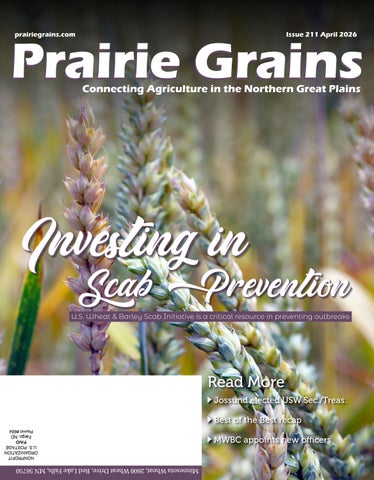
Fusarium head blight (FHB) is what wheat farmers’ nightmares are made of – and rightfully so. Commonly known as scab, FHB costs growers hundreds of millions of dollars annually; losses in North Dakota from the 1990s epidemic estimated scab was a $7 billion disease. Thankfully, those numbers have decreased, and, in 2025, North Dakota scab losses totaled between $2.5-3.5 million. The U.S. Wheat & Barley Scab Initiative has played a critical role in developing effective control measures that minimize the threat of scab for producers, processors and consumers. Learn more about USWBSI on page 12-13! 2 1 3 4 5 06 14 22 20 30
PUBLISHER AND CIRCULATION
Minnesota Association of Wheat Growers 2600 Wheat Drive • Red Lake Falls, MN 56750 218.253.4311 • Email: mnwheat@mnwheat.com Web: www.mnwheat.org
EDITORIAL
Sydney Harris, Managing Editor
Ag Management Solutions
Ph: 218.689.5091
Email: sharris@agmgmtsolutions.com
CONTENT EDITORS
Drew Lyon, News Editor
Ag Management Solutions
Ph: 507.388.1635
Email: dlyon@agmgmtsolutions.com
Katelyn Engquist
Ag Management Solutions
Ph: 507.508.1540
Email: kengquist@agmgmtsolutions.com
ART DIRECTOR
Alex Troska
Ag Management Solutions
Ph: 952.334.2539
Email: atroska@agmgmtsolutions.com
ADVERTISING SALES
Jill Thibert
LHM & Co
Ph: 218.280.2821
Email: jill@lhmandco.com
ABOUT PRAIRIE GRAINS
Prairie Grains magazine is published six times annually and delivered free of charge to members of these grower associations, and agriculture producers in Minnesota, North Dakota, South Dakota and Montana. To subscribe or change address, please write or call our circulation department.
Hard at work: hard red wheat growers deliver policy priorities during D.C. meetings, Hill Visits
A Grain of Knowledge: Pilot sampling program screens for herbicide resistance in Minnesota weeds
Resources, research, results: NDWC proud to promote the next generation of wheat
The quality keeper: Dave Green reflects on four decades of crop quality
Meaningful policies, bipartisan solutions: Legislative leaders honored by NAWG
OUR COLLABORATORS

Minnesota Association of Wheat Growers 2600 Wheat Drive • Red Lake Falls, MN 56750 218.253.4311 • Email: mnwheat@mnwheat.com Web: www.mnwheat.org
North Dakota Grain Growers Association 2401 46th Ave SE , Suite 204 • Mandan, ND 58554 701.222.2216 • Email: danw@ndgga.com Web: www.ndgga.com
South Dakota Wheat Growers Association 116 N. Euclid, Box 667 • Pierre, SD 58501 605.224.4418 • Email: sdwga@midco.net

Montana Grain Growers Association P.O. Box 1165 • Great Falls, MT 59403 • 406.761.4596 Email: erobinson@mgga.org • Web: www.mgga.org
Working Together for Common Ground
The sun is setting on another North Dakota winter, but the sun never sets on the North Dakota Grain Growers Association’s (NDGGA) advocacy in Bismarck and Washington, D.C. Since 1967, NDGGA has been the premier voice for the state’s wheat and barley producers, remaining committed to serving its members with education, leadership, proactive advocacy and representation.
As NDGGA president, I have the privilege of working closely with our members and staff to ensure that our organization’s initiatives increase profitability and value-added opportunities for producers. And though field work has slowed down in the last few months, we haven’t lost momentum, remaining vigilant of the happenings that impact our members.
In December, NDGGA representatives participated in the Midwest Council on Agriculture’s annual meeting and Hill visits in Washington, D.C., strengthening relationships with our federal leaders. We’ll continue building upon those connections in March when we return to our nation’s capital for appointments with legislators and agencies. NDGGA also had representation at this year’s Commodity Classic in San Antonio, connecting with agriculture industry stakeholders from around the country,
which is crucial to the work we do, especially at the federal level.
On the home front, things have been quiet in Bismarck while we await the 2027 legislative session. Nevertheless, NDGGA has been on the road, meeting with other state agriculture groups and discussing issues that are bound to arise in the 2027 session. Often, issues that affect wheat and barley also affect other commodities grown across our state. With North Dakota producers growing over 40 different crops, it’s vital that we communicate with our peers about the challenges they are facing and strategize together how we can advocate for North Dakota’s agriculture industry.
We’ve also been busy planning our 32nd annual E-Tour, which is one of the most impactful things that we do as a board. The summer tour is an opportunity for us to showcase to EPA personnel the crucial role crop protection plays on our farms and the diligent care producers have when handling and applying pesticides. Often, the participants on the E-Tour didn’t grow up on a farm, or around the agriculture industry at all, and this is a chance for them to see how an actual farm works. Usually, they even get to take a tractor for a spin.
It’s no secret that the ag economy

Ryan Ellis, Williston, ND
looks bleak right now. While we haven’t encountered a genie in a bottle to grant us our wish for high commodity prices and low input costs, at some point the markets will come back. They always do. Until then, keep your eye on your “why.” Before we know it, we will be back in our cabs, preparing for the 2026 growing season. While you’re in your fields, growing high-quality grain that is highly sought after around the world, NDGGA will have your back at the political table, ensuring your voice is heard.
Ryan Ellis farms near Williston, N.D., and serves as president of the North Dakota Grain Growers Association.

Reset and Restart
The calendar turned a few weeks ago, but farmers prefer the crop calendar. We are still in the old crop year. We are focused on old crop and cleaning out bins, reviewing the financials from last year and slowly making plans for the new crop year.
There is no official start date for the new crop year. It depends on the year. We need a few warm days, hints of black in the fields, and maybe that first load of seed delivered. Then we are all in on new crop and making money in 2026.
New Year’s Resolutions are all the talk in January, but as farmers, we still have time to make New Crop Year’s Resolutions. How are we going to do better for the 2026 crop year? Time for a reset and restart.
One area I am emphasizing with my farmers is the cost of marketing, specifically storage and deferred pricing costs. If you have not reviewed those costs, spend an hour paging through your 2025 settlements. While you are looking at the settlements, also look at the basis if you are someone who likes to roll the basis contract once, twice or until the elevator says you can no longer roll. Many farmers carried 2024 crop
Betsy Jensen is a Farm Business Management Instructor at Northland Community and Technical College. Follow her on X at @jensenbetsyr.
into 2025, then harvested a large crop and ran out of storage. Bushels were delivered when prices were low, no one wanted to sell and storage costs started accumulating. Deferred pricing seems like a minimal cost at a few pennies a month, but there is usually an upfront cost too.
Paying storage and deferred payment costs can make you money if the market rallies, but few farmers calculate the cost. You need to understand the costs if you want to pay for the possibility of rallying prices.
Most elevator websites or apps make it easy to download your 2025 settlements. You can see the prices received for your sales in 2025. Look at your sales and create a marketing plan to beat the prices you got in 2025.
When we create our marketing plans, my mind still recalls the beans in the teens, $10 wheat and $6 corn. There is nothing exciting about contracting crops at today’s mediocre prices. I am still going to recommend contracting at mediocre prices. We can contract at mediocre prices for our first sale or two and then keep selling as the market rallies. Do not aim for a home run at the first sale. Get
something priced, especially if you want or need to deliver at harvest.
When I review the 2025 year with farmers, we look at the profitability of each crop. We will publish our 2025 data in March, and you can find out overall which crops were the most profitable. We can adjust our cropping plans based on projected profitability, but that is just a projection. In my area, corn did very well in 2025, but we had incredible yields. If we plug more typical yields into 2026 projections, there are no stand outs in the cash flow.
If you are going to make changes to your crop rotation, make sure you are using typical yields, and not what happened last year. We have many crop options in the Northern Plains, and I do not want one year’s experience to cause major changes to the plan.
We can make money in 2026, but it might require a few small changes to how we market our crops. We need to take advantage of pricing opportunities. I hope my first sales are my worst sales. I would love an extra buck or two a bushel at harvest. And I hope my biggest problem next fall is tax planning with all my extra income.
By Mark Askelson
Hard at work
Hard red spring wheat growers deliver policy priorities during D.C. meeting, hill visits
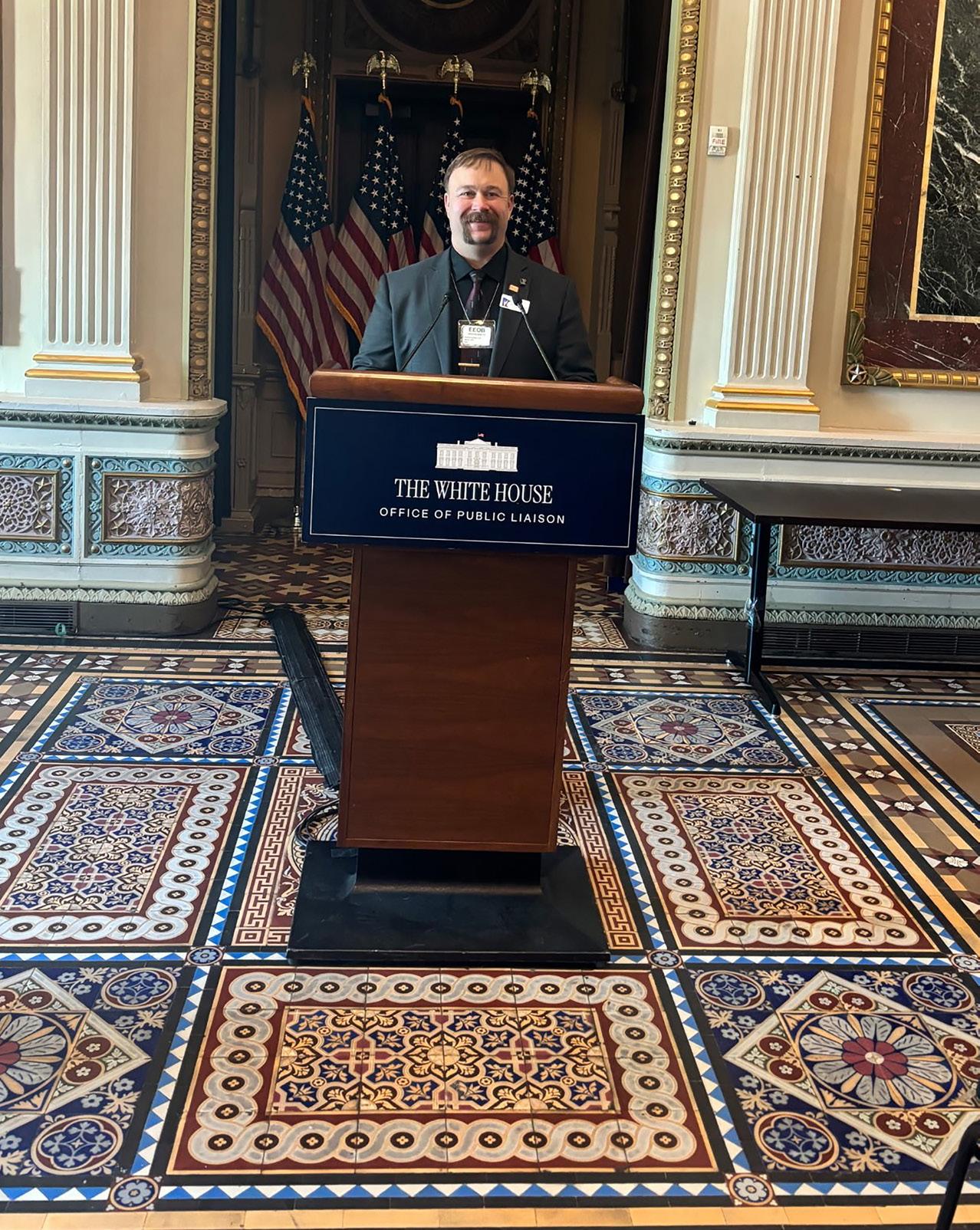
Neither snow nor ice could keep wheat growers from across the northern plains from traveling in January to Washington, D.C., for the National Association of Wheat Growers’ (NAWG) winter conference. During their visit to the nation’s capital, farmer leaders and staff from throughout NAWG-affiliated states met with members of Congress and their staff to share their stories, express their concerns and discuss their priorities.
This year’s meetings brought its own set of unique challenges. The streets were barely passable due to recent winter snow storms, which made getting around difficult. Although Congress wasn’t in session, the MAWG delegation had impactful conversations with ag legislative staff.
While in D.C., farmer-leaders had the unique opportunity to meet with
key administrative staff at the White House this year, including staff from the USDA, National Security Council, United State Trade Representative and the Environment Protection Agency.
“It was a full room with representation from both NAWG and the U.S. Wheat Associates and we had about two hours of nonstop discussion and we got to ask a lot of questions,” said Minnesota Association of Wheat Growers President Austen Germolus. “It was great insight. We went through a lot of different topics, and I feel it was well received. I’m glad we had the opportunity.”
Included in that room was Calley Means, the top adviser to Health Secretary Robert F. Kennedy, Jr. and a key part of the Make America Healthy Again (MAHA) platform. Germolus says that wheat is a staple part of people’s diets and out of the big three
commodities, it’s the only one that is capable of being readily consumed.
“We need to make sure we don’t lose ground in the MAHA movement and that people know that wheat is a safe and healthy food item,” said Germolus.
NAWG Treasurer and Montana Grain Growers Past President Nathan Keane, who has double digit visits to D.C. over the years, says any time you can get into the White House and have in-depth conversations on topics such as nutrition, trade and regulation with senior officials at the table, you know your voice is being heard.
“It was pretty impactful to me to get those people who are higher ups in their respective departments and hear information about the things we’ve been talking to them about for a while and to know they’ve been working on it,” said Keane, who farms near Lome,
Montana. “It makes you feel pretty good that maybe you are making an impact, and you’re not just there saying words. They’re there working for us.”
A full agenda
Back on a very snowy Capitol Hill, wheat growers visited with the House and Senate offices on a number of issues important to them, including trade and crop protection, but perhaps most pressing was the need for a new Farm Bill.
“We really want to see a Farm Bill get passed because it’s been too long and there’s just too much uncertainty in agriculture without one,” Germolus said. “They’re just kicking the can down the road every year, and it gets to be frustrating.”
A growing concern amongst farmers is that the temporary, one-year extensions of the program will become the new normal if they can’t work together to put together a new Farm Bill.
“The feeling is that if we don’t keep pushing this Farm Bill, will we ever end up having one again or are we going to continue having to do it through these continued resolutions?” Keane said. “We just really want a permanent, long-term safety net in place.”
For the South Dakota Wheat Growers Association (SDWGA) contingency in D.C., who had the opportunity of speak with the office of Senate Majority Leader John Thune, they urged the importance of the continuing funding for the USDA NIFA’s Wheat CAP grant program, which is its final year of funding but has been hung up from some of President Trump’s recent executive orders.
“There are about 20 different states that are part of that grant, including South Dakota, and it’s distributed to those different universities for the purpose of wheat research,” said Jessica Sharpe, executive director of SDWGA. “That program has been critical to the wheat research that happens at SDSU.”
The NAWG annual meeting was a first-time experience for Sharpe, who joined the staff at SDWGA this past October. One of her takeaways from the experience was how supportive the legislative offices from South Dakota were toward agriculture and how much they enjoyed hearing first-hand from the farmers.
“I think they were very receptive to hearing from us, and I think they appreciate hearing from growers directly,” Sharpe said. “I do think the Trump administration does want to hear from growers and their concerns specifically also.”
When
Despite the current challenges facing wheat growers and agriculture, Keane left Washington, D.C., with a sense of optimism and that things will improve if growers continue to advocate for themselves and make themselves heard.
“Ag is in a bit of a hurt right now, but I’m pretty optimistic with everything I’m hearing,” he said. “If we can get through this year, there is optimism that things could turn around.”
By Sydney Harris
BRIDGING DIVIDE THE
NDGGA’s annual E-Tour connects farmers with EPA officials
Now, perhaps more than ever before, the disconnect between agriculture and consumers is a gaping chasm. But the North Dakota Grain Growers Association (NDGGA) is resolute in its efforts to build bridges that cross that chasm and cultivate connections. The NDGGA E-Tour is one of those bridges.
Hosted by NDGGA for over 30 years, the E-Tour invites individuals from the Environmental Protection Agency (EPA) to experience North Dakota’s agriculture industry, taking in the state’s agricultural practices and environmental stewardship for themselves.
“The purpose of the E-Tour is to help educate people within the EPA ranks as to what exactly goes on in production agriculture,” NDGGA Executive Director Nick Sinner said. Imaginations are powerful – especially when there’s a
lack of tangible knowledge to call upon to form accurate depictions. For many of the E-Tour participants, the only exposure to farming that they’ve had is what the media has fed them. The E-Tour aims to remedy that.
“They know the chemical but many of them have never stepped foot on a farm,” Sinner said. “They’re involved in approving different chemicals and the labels that go on those chemicals, but we want to get them on farms.”
This year’s E-Tour takes place June 22-26, based out of Minot and focused around north-central North Dakota.
“Personally, I think the E-Tour is one of the most impactful things we do as a board,” said NDGGA President Ryan Ellis, who farms near Williston. “It’s a way to show them how an actual farm operates and the role that pesticides play in those farms.”
Following the label
As stewards of their land, North Dakota farmers take their part in ensuring that the land is productive for years to come seriously, adopting sound production practices that benefit them and the land.
“It’s second nature to them,” Sinner said. “Our farmers are adopting new technology, and they don’t go out and work the fields unless it’s absolutely necessary. So, when we’re on the farms, we want them to see some of the production techniques — the minimum tillage, the reduced use of chemicals — to help them understand that farmers are not out there just spraying chemicals around their fields whenever and wherever they can. There has to be a legitimate reason.”
Applying crop protection is also costly, which plays a significant role in on-farm decision making. Unnecessary crop protection application not only increases the total cost farmers spend on product but also increases fuel costs and adds wear and tear to machinery and equipment, risking costly breakdowns. And it takes time, which is a hot commodity.
“We want to showcase all the decisions that go into raising a crop, which includes the use of chemicals that are safe to do the job that they’re supposed to do,” Sinner said.
While visiting farms, the EPA participants will watch both ground and aerial spray demonstrations that showcase the care used when growers apply product.
“We’ll highlight that the label is always followed and that it isn’t a free-for-all when farmers spray,” Sinner said.
Understanding through education Farms won’t be the only destination during the tour. Stops will also be made at local cooperatives and elevators, where crop protection products are stored and farmers make their purchases.
“We want to give the EPA folks a better understanding of the safety measures that they undertake and just how careful they are when they’re handling product,” Sinner said. “Not only do these companies handle the chemical and fertilizer, oftentimes, they’re also applying the product for farmers.”
Additionally, E-Tour participants will visit the North Central Research Extension Center in Minot.
“We want to give them an understanding of the research that goes on and what information is trying to be collected,” Sinner said.
Based on past years, some of the most valuable conversations will happen going to and from the various locations along the tour.
“The time on the bus in between stops is very beneficial because a lot of good discussion happens,” Sinner said. “The folks from EPA can ask as many questions as they want, and the farmers from our group are more than happy to answer the questions.”
A highlight every year, the NDGGA E-Tour never fails to build connections and bridge gaps.
“The education is invaluable,” Sinner said. “The feedback that we get every year is that it was an eye-opening experience. They never fully understood how their work connects with the product being applied on the farm. So, this gives them that experience and exposes them to exactly how their work in Washington, D.C., comes out and benefits the producers here in North Dakota.”
PLANT NORTH DAKOTA CERTIFIED


By Mark Askelson
Research at its ‘Best’
High turnout at conference, as growers seek ROI
The Best of the Best in Wheat and Soybean Research returned to the Red River Valley with a heavy focus on how producers can earn their best return on investments and which practices will be effective in helping them break even, or perhaps lose the least amount of money, during a time when markets are slumping.
Best of the Best, which made stops in early February to Grand Forks, N.D., and in Moorhead, Minn., is supported by the Minnesota Wheat Research & Promotion Council, Minnesota Association of Wheat Growers, Minnesota Soybean Research & Promotion Council, North Dakota Soybean Council, North Dakota Grain Growers Association and the North Dakota Wheat Commission.
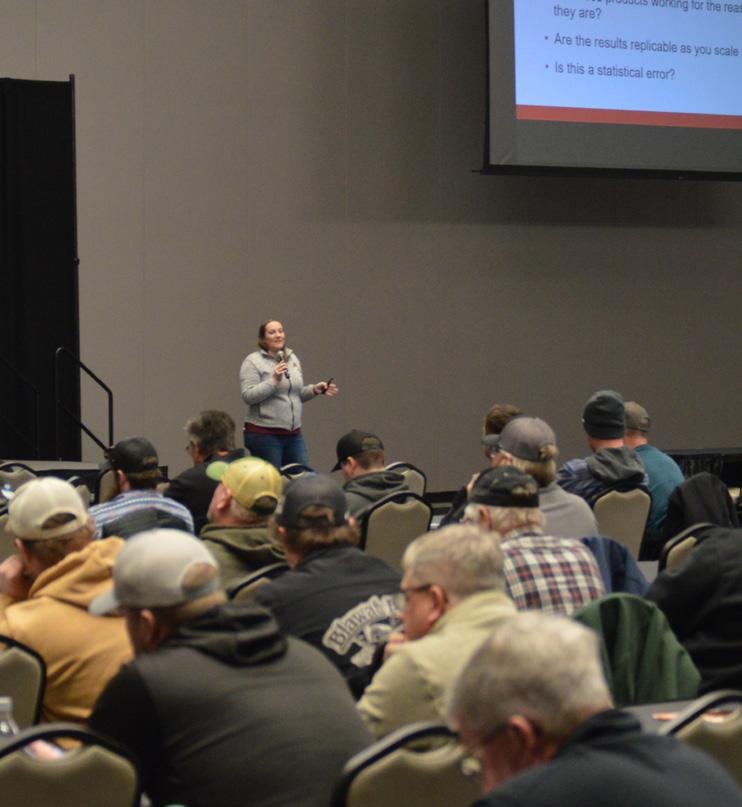
“I think Best of the Best is unique because it focuses on the newest research, and we have excellent presenters who are the ones conducting the research,” said Brian Sorenson, MWRPC executive director. “It’s not just lectures – the breakout sessions are excellent, too, with their hands-on demonstrations.”
Especially on topics related to wheat, Sorenson noted that the agenda for Best of the Best this year had a heavy emphasis on when and where producers are best suited to spend their money and which practices would be the best for their bottom line.
“You know talking about being more selective or critical on your inputs, and perhaps maybe thinking twice on some of the pesticides and herbicides you put down,” Sorenson said. “Just trying to scrutinize how you manage your crop, which this year was really important to producers.”
Dr. Jochum Wiersma, University of Minnesota Extension small grains specialist, had two presentations focused on how wheat growers can get the best bang for their buck. One presentation pertained to nitrogen and the other
Lindsay Pease with the University of Minnesota Extension briefs Best of the Best crowd on nutrient and water management practices.
focused on fungicide application. For nitrogen applications, producers should not be skipping out, but the ultimate goal is to get to 14% protein with the least amount of nitrogen. The best way to do that is with a highyielding variety, even though they tend to be lower protein.
“Bushels are more important than discounts, and the cost of nitrogen is less influential on your cost-per-acre than your other inputs,” Wiersma said. “High yielding varieties benefit more from additional inputs than lower yielding varieties. In the case of this year, you will need to spend more to lose less.”
When applying fungicide for diseases such as Fusarium head blight and leaf rust, the old saying has been to “spray early and spray often,” but Wiersma says producers can also look at being more intentional with their spraying depending on conditions.
“Diseases need leaf wetness to be prevalent, so we don’t see as much disease pressure in dry years,” he said. “And it happens to be we’re in a bit of dry cycle.”
Wiersma’s research indicated that intensive fungicide applications added an average of about 6-8 bushels over conventional applications in northwest Minnesota, which is statistically significant. However, producers may want to consider if that 6-8 bushels is cost-prohibitive.
“If we look at the yearly data, it’s only 8 out of the 20 years that the prevented yield loss was equal or greater in Crookston and 11 out of the 20 years in Roseau, so it’s not great odds,” Wiersma said. “So, the answer to if we should always spray early and often and continue with the same program is probably no.”
Producers should also pay attention to disease ratings for the variety they are growing. The average yield loss for the varieties with the best ratings for a particular disease varied between 4.8% and 6.6% and rise from there.
“However, the decision to spray should never be based on the risk assessment for a single disease,” Wiersma said, “but luckily for growers, all the fungicides are very broad spectrum.”
Wheat growers should also capitalize on available tools and resources, such as the North Dakota Agricultural Weather Network (NDAWN), which has risk assessment indicators for the various diseases and scout for their presence before making an application.
“If they’re not there,” Wiersma said, “there’s no reason to spray for them.”
Compaction yield losses
University of Minnesota Extension soil health specialist Jodi DeJongHughes shared with growers at Best of the Best how compaction issues in fields can result in yield loss and what to do to reduce their impact.
Compaction, most commonly caused by heavy equipment, can result in yield losses of 15-30% in the affected areas and can take several years of freeze/ thaw cycles to be alleviated.
Some of the root causes of compaction include working the soil when it’s too wet, a lack of soil structure from too much tillage, overly inflated tires, unchecked travel patterns and heavy axle loads from large grain carts, combines and sprayers.
“The weight of the equipment is what drives the compaction down, and your tire pressure is what drives the intensity of that weight,” DeJong-Hughes said. “About every 10 tons per axle can drive compaction down 12 inches into the soil.”
Farmers can reduce compaction by improving soil structure through practices such as reduced tillage, cover crops or changing tillage practices.
“Points, shanks and sweeps are better for not tearing up soil structure and are an easier option than changing everything over to strip-till,” DeJongHughes said. “Disks, however, are very destructive to your soil.”
Zone tillage, a very aggressive tillage operation that cuts through deep compaction between 15-20 inches, is another option for compaction issues. However, it requires 30-50hp per shank to operate, but has shown to increase wheat yields by 15% over time in compacted soils.
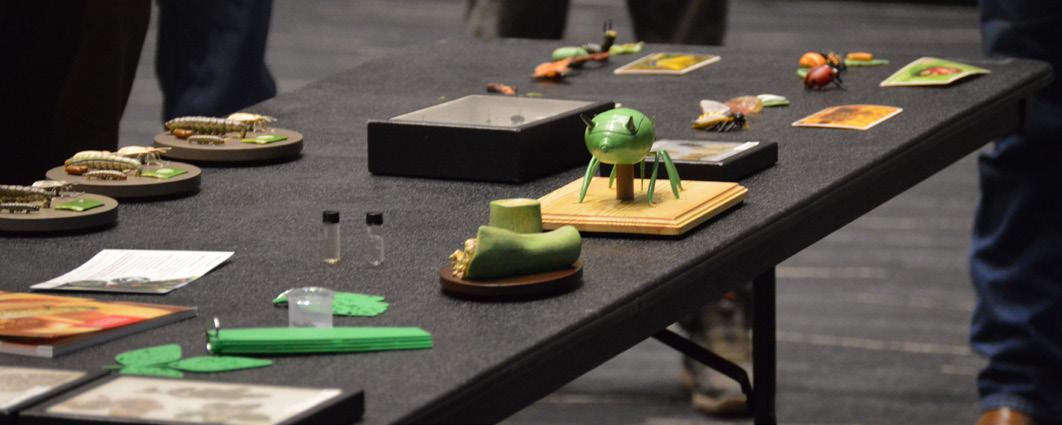
Farmers got up close and personal learning how to identify insects and management considerations during a demonstration from Claire LaCanne of the University of Minnesota at Best of the Best
By Deanna Kanne
Fighting the Fusarium head blight fight U.S. Wheat & Barley Scab Initiative
Ask a wheat farmer to name the worst wheat disease, and chances are high that they’ll come back with Fusarium head blight (FHB). FHB, commonly known as “scab,” is one of the most economically important diseases known to wheat farmers. Losses from this disease are estimated to run in the hundreds of millions of dollars annually.
“In 1993 we had a scab outbreak in the upper plains that decimated the wheat crop,” said Richard Magnusson, who farms near Roseau. “Up until that point, research wasn’t really being done on scab. It became a national and
international problem.”
Enter the U.S. Wheat & Barley Scab Initiative (USWBSI). Founded in the late 1990s after the scab epidemic, the goal of this research consortium is to develop effective control measures that minimize the threat of scab for producers, processors and consumers.
Economic impact
Funding for USWBSI comes from the USDA; however, over the past year, USWBSI has had to make considerable efforts to receive its typical funding from USDA.
“Some of our challenges this past
year were defined by process and staffing changes, along with delayed approvals at USDA. Fortunately, all came together for FY25, and funds were released just in time to be able to continue the research, thanks to the strong advocacy efforts by our stakeholder partners,” said Andrew Friskop, co-chair of the executive committee. Friskop is the USWBSI Research co-chair, while Magnusson is the Grower co-chair.
Through this funding, USWBSI is able to support research projects at land grant universities in multiple states, along with several USDA-ARS PIs at area offices, including those in the Prairie Grains readership area.
“We have funding in place for over 30 U.S. states,” Friskop said. “We’re funding projects led by over 85 lead researchers and are training over 125 future ag leaders.”
Projects range from plant breeding to fungicide trials, and across all crops that are susceptible to scab. Currently, there are 125 projects in progress between both universities and USDA scientists.
“We have some very strong outputs,” Friskop said. “Our collaborations in germplasm screening, germplasm development, makes sure that we’re pushing some of the best varieties that have strong FHB resistance but carry all the quality with them, too.”
In fiscal year 2024, USWBSI released 33 new varieties, the majority of which are classified as “moderately resistant.”
“We’ve been making a lot of great efforts,” Friskop said, “but we can’t get rid of this disease.”
Magnusson agreed.
“The challenge with this pathogen is that there’s no absolute resistance,” he said. “It still takes management with fungicides.”
Not only does scab cause yield losses, but sometimes quality loss can be substantially higher.
“You can get point of sale impact, where growers are being docked based off vomitoxin levels,” Friskop said.
Vomitoxin is a toxin produced by FHB. While they are related,
having FHB in the field does not automatically mean vomitoxin is present, and vice versa. The FDA highly regulates vomitoxin levels, as high levels in livestock feed could impact animal health, and elevators dock prices and may even reject loads if levels are too high.
In North Dakota, 2025 was considered a low scab year. After the economic analysis was run, scab losses still totaled somewhere between $2.53.5 million. In the epidemics of the 1990s, scab was estimated to be a $7 billion disease.
The decrease in scab’s financial damages underscores why USWBSI is important. For every $1 invested in FHB research by the USWBSI, $71 in benefits are generated.
Looking to the future
The success of USWBSI revolves around the cooperation of industry,
university, grower and government, and the number of resources this provides.
“It’s been one of the most important efforts locally, but also nationally, addressing the most significant small grain disease we have in wheat and barley,” Friskop said.
Through the efforts of USWBSI, a forecasting system was developed to assess the likelihood of scab occurrence. This tool is available across 35 states and is used to plan fungicide applications and grain purchasing decisions. The system is currently expanding to areas where scab has become more of a concern.
“The Scab Initiative has been instrumental in helping wheat growers in protecting their crops for the past 28 years,” Magnusson said.
Visit the USWBSI website at scabusa. org for more information and to learn more about the initiative’s current research.
Research pays off
The decrease in scab’s financial damages underscores why USWBSI is important. For every $1 invested in FHB research by the USWBSI, $71 in benefits are generated.
By Deanna Kanne
A Grain of Knowledge
Pilot sampling program screens for herbicide resistance in Minnesota weeds

The National Agricultural Genotyping Center (NAGC), located on the NDSU campus in Fargo, N.D., aims to improve diagnostic services in the agricultural community.
“There is a testing gap when it comes to diagnostics in agriculture compared to human diagnostics and even livestock,” said Zack Bateson, Ph.D., research director of the NAGC. “NAGC is trying to close that gap by helping to diagnose pests and identifying traits within crops as well as honeybees.”
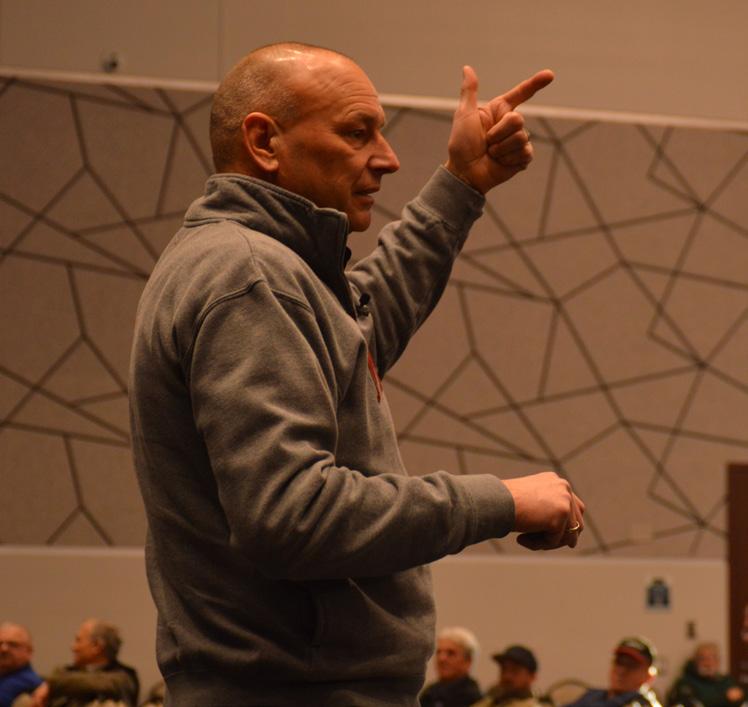
New this year, the Minnesota Wheat Research & Promotion Council is working with the NAGC on an herbicide resistant weed survey.
While the survey itself is not new, this is the first time Minnesota is participating.
“Around 2019 is when our weed diagnostics started,” Bateson said. “We were approached from the North Dakota State Seed Department about the inability to identify amaranth species by seed size and shape.”
There are many varieties of amaranth, including commercially grown edible varieties, but Palmer amaranth is one of the most economically damaging weeds for farmers. This invasive weed competes aggressively with row crops and spreads exponentially. Each plant can produce more than 250,000 seeds. It can also be resistant to multiple herbicides, including glyphosate.
“It was Palmer amaranth that drove our interest into weed diagnostics,” said Bateson. “We developed a genetic
test to confirm amaranth species during seed lab purity tests, which is sensitive enough to detect a single Palmer amaranth seed among a pool of 200 amaranth seeds.”
Fast forward to 2023, and interest grew in testing for herbicide resistant weeds. The NAGC jumped on the opportunity and began growing their own weeds in the greenhouse from field seeds.
“There’s a lot of genetic markers associated with herbicide resistance in multiple weed species,” said Bateson. “We’re able to use this genetic test to have folks send us leaf samples and test for these markers associated with herbicide resistance so they can use that information in-season for a different herbicide approach or different weed management approaches.”
The program currently tests for resistances to herbicide groups 2, 9 and 14, which covers ALS inhibitors, EPSPS

inhibitors (glyphosate) and PPO inhibitors.
“When it comes to herbicide resistance, there are two flavors,” Bateson said. “There are non-target site mechanisms, where the weed can isolate or metabolize the herbicide before it becomes active and inhibits the plant. The second is target site mechanisms – the genetics. We can look for these point mutations in the genome that allow the plant to escape herbicide action.”
The NAGC has reached the point where they know the exact gene mutation that leads to that herbicide resistance, specifically for pigweeds like Palmer amaranth and waterhemp. It does get more complicated, and there can be several point mutations that can lead to resistance, but they are currently focusing on one per herbicide group.
Grower participation
With support from North Dakota commodity groups, and now MWRPC, the NAGC has created collection kits that farmers can request to send in their weed samples for testing. Each kit comes with a prepaid business envelope that contains four coin envelopes, a submission form and a collection guideline. Three of these envelopes are for one variety of pigweed, whether that be waterhemp, Palmer amaranth or kochia, and the fourth is for grassy weeds.
“We’re looking for wild oat and green
foxtail to develop new tests,” Bateson said.
After receiving the samples and testing for resistance, Bateson and the NAGC team aggregate that information into county-level weed maps.
“Even if farmers don’t participate in the survey, they’ll be able to see if their county or a neighboring one contains weeds with herbicide resistance,” Bateson said.
Interested participants can contact NAGC at genotypingcenter.com for more details, with collection kit pickup locations to be announced later this spring.