
Skydio ‘first responder’ drone contract fails in Minneapolis City Council after weeks of resident opposition
By Izzy Canizares
Contributing Writer
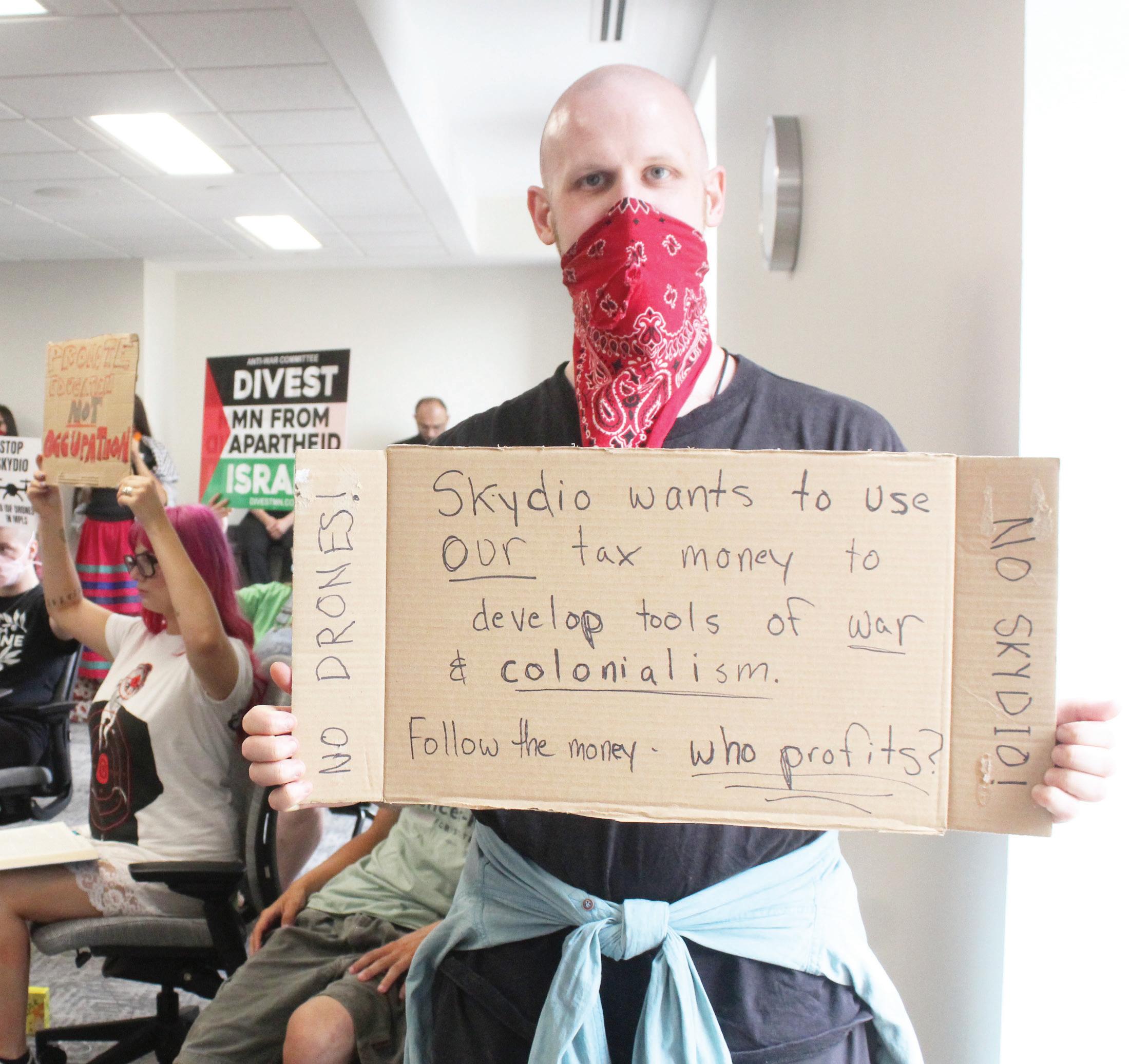
espite poor air quality from wildfires, residents gathered outside Minneapolis City Hall on Wednesday, July 15, protesting a potential contract with drone company Skydio. They packed the council chamber the following morning ahead of the contract's vote, which ultimately failed.
“Nothing is free. This costs the trust of our residents. This costs us people's sense of freedom.”
A protest was organized at the Federal Building Plaza in Minneapolis on Wednesday, the day before the contract was voted on. Members from local organizations came out despite a citywide heat advisory and poor air quality warnings.
"I think the thing that we learn from watching them explode their own argument and make no sense in front of the city council is that they don't
The contract would have been a 75-day free trial with the U.S.-based drone company, which has come under scrutiny for supplying surveillance drones to the Israeli military since 2023 and for its recent federal contracts with ICE. If passed, the drones would have been used in Ward 4 as "first responder" tools, dispatched as soon as a 911 call is made to provide surveillance from the scene. The company has advertised the drones for uses ranging from responding to illegal dumping complaints to finding missing people. Residents see this as an example of the program having no clear purpose.
actually know what they want to use these drones for," said Sarah Heller, a Ward 4 constituent. "North Minneapolis is not made safer when we are made a testing ground for Minneapolis cops with military toys."
The demonstration came after more than 40 residents attended a public comment hearing on the contract at the previous week's Public Health, Safety and Equity Committee meeting. Council members present voted to move the contract forward with no recommendation. The idea of technology as a safety tool can sound promising but can be easily misused, said Maamoun Slayhi of the Free Palestine Coalition.
"I can see why they think it is a good idea, because, yes, it will reduce time for response. But it all comes at a cost," Slayhi said. "They see the thing that could be used for good, but the problem is
■ See SKYDIO on page 5
Ramsey County sues federal government over stonewalled Thao investigation

By Jasmine McBride Editor
amsey County
Attorney John Choi and Ramsey County Sheriff
Bob Fletcher filed a federal lawsuit July 15 against the U.S. Department of Homeland Security, accusing the agency of illegally withholding evidence needed to investigate the detention of a St. Paul man during Operation Metro Surge.
"As
District Court
of Minnesota,
Thao, a 56-year-old U.S. citizen with no criminal history. Masked and armed individuals believed to be federal agents broke into Thao's St. Paul home that afternoon, handcuffed him without a warrant and drove him around for about an hour before returning him, according to the complaint. Thao was wearing only shorts, Crocs and a baby blanket in 10-degree weather at the time.
"As plaintiffs, we seek de-
a July 15 press conference announcing the suit. "All that we wish is to simply do a proper investigation under Minnesota law to seek the truth, determine if any state laws were violated and uphold the rule of law without fear or favor."
The lawsuit marks an escalation in a monthslong effort by county officials to obtain basic information about the incident. According to the complaint, the sheriff's office first requested information from ICE Field Office Director Sam Olson on Feb. 24. An investigator met in person with ICE Section Chief Howard Weisman on March 5, but Weisman said he was not authorized to share the information and would not say who was.
By Clint Combs Contributing Writer
hree years after Minnesota Democrats used their newly won trifecta to legalize recreational marijuana, the state agency tasked with clearing old felony cannabis convictions says it's ready to bring its work directly to the communities most affected by it.
The Cannabis Expungement Board was created by the 2023 Adult-Use Cannabis Act, part of a broader package of criminal justice reforms that Democratic-FarmerLabor lawmakers pushed through after flipping the legislature that year. Alongside legalization, the DFL trifecta delivered automatic "Clean Slate" expungement for lower-level cannabis misdemeanors, changes to the state's pardon law and the board itself, which reviews felony-level cases that don't qualify for automatic clearing.
The board hosted an expungement relief clinic at the Urban League in North Minneapolis on July 15, in partnership with Roots Wellness Center. Executive Director Jim Rowader said the agency spent its first year and a half largely out of public view, building the systems needed to handle a massive volume of records.
"We've done a lot of work over the last year and a half to get it built up and to build a lot of behind-the-scenes functionality," Rowader said.
"Data management is a big deal in terms of 10s of 1000s of records that we're trying to review, and we didn't want to get out into the community and talk about the work when we weren't prepared to really have some immediate impact."
claratory and injunctive relief to set aside Defendants' unlawful noncooperation and their refusal to comply with lawful and legitimate investigative demands," Choi said at
On March 20, the county attorney's office submitted a formal Touhy demand, the legal mechanism for compelling federal agencies to produce ■ See LAWSUIT on page 5
The event let attendees fill out intake applications on site, with CEB staff and partner attorneys pulling up individual criminal records on the spot to flag cases for review.
Heather Faulkner, the board's chief communications and external engagement officer, said Minnesota's approach to felony cannabis convictions is unique. "As far as we're aware, we are the only state in the country approaching cannabis expungement in this way, particularly on a felony level," Faulkner said. "Rather than someone having to hire an attorney, go to court, go through a process, our attorneys and paralegals will literally look at every cannabis case and see if it's eligible."
The board pulls its cases from a Bureau of Criminal Apprehension database of ■ See EXPUNGEMENT on page 5
That foundation is now in place, he said, and the agency wants Minnesotans to understand what it offers, and that it isn't something they need a lawyer to access. "We're tasked with identifying the cases, working them up and getting them in front of the actual board so that relief can be granted," Rowader said.

Photo courtesy of Izzy Canizares/MSR
ChongLy “Scott” Thao, a U.S. citizen that was escorted out of his St. Paul home by federal agents, Jan 18. Louansee Moua
Metro
Good Trouble’s State of the Youth calls on young people to lead, communities to listen
By Lizzy Nyoike Contributing Writer
Generations of civil rights leaders have challenged future generations to leave the world better than they found it. At the Good Trouble State of the Youth event, organizers said that responsibility now belongs to today’s generation, while reminding adults in the room that meaningful change requires more than asking for youth opinions. It requires making room for young people to lead.
Honored and grounded in the legacy of Congressman John Lewis, the event brought together students, organizers, educators and community members for an evening focused on civic engagement, youth leadership and collective action. Through a panel discussion and a new student feedback field guide, organizers encouraged attendees to transform conversation into action.
Opening the program, Jose Perez, executive director of Good Trouble, challenged attendees to think about America’s 250-year history as an unfinished democratic project that each generation has a responsibility to continue.
“We celebrate America because generations after generations of those who were excluded from that promise have fought to make it more real and more honest,” Perez said. “We all have gifts. If we choose to be, we can be a part of the solution, a part of what’s right with America.”

Perez said the strategies used by leaders like Lewis and Ella Baker must evolve alongside modern technology, schools and institutions while remaining rooted in courage, sacrifice and love. “We honor him by practicing the courage, strategy, sacrifice and the love that it required for him to do his work,” Perez said. “The generation before us did the best they could with what they had. Now the opportunity is for us to do the best we can with what we have.”
The event featured a panel of young leaders discussing what it means to organize in today’s political and social climate. Rather than describing youth as the leaders of tomorrow, panelists emphasized that they are already leading businesses, organizing cam-
paigns, advocating for policy changes and creating space for others.
Haley Taylor Schlitz, one of the panelists, said one of the biggest barriers facing young people is believing they have to wait until everything is figured out before taking action. “You don’t find your path, you make it,” she said, explaining that many young people stay comfortable because they fear making the wrong decision. She encouraged attendees to rely on mentors, saying courage often comes after taking the first step rather than before it.
Aaliyah Demry, another panelist, pointed to the unique pressures Gen Z is facing, saying constant exposure to violence, breaking news and injustice can feel overwhelming and eventually
desensitizing. Still, she said she remains hopeful because young people continue showing up, volunteering and creating spaces where difficult conversations can happen.
“If we choose to be, we can be a part of the solution, a part of what’s right with America.”
Charlie St. Dennis challenged the framing of whether schools should partner with young people, arguing the question should no longer be if it should happen, but when. He said schools have an opportunity to become stronger communities when students
are treated as partners in finding solutions rather than being recipients of a decision that didn’t involve them.
St. Dennis pointed to his experience at Highland Park
Senior High in St. Paul during heightened concerns surrounding federal immigration enforcement earlier this year.
Located just minutes from the federal building that houses U.S. Immigration and Customs Enforcement, he said many students feared family members could be detained while traveling to or from school.
Rather than solely waiting for administrators to solve the problem, students, teachers and school leaders worked together to respond. St. Dennis said the conversations were uncomfortable at times but led to meaningful action. Stu-
Voting is a responsibility
strong as the knowledge of its citizens.
By James Trice
"In every government on earth is some trace of human weakness, some germ of corruption and degeneracy, which cunning will discover, and wickedness insensibly open, cultivate, and improve. Every government degenerates when trusted to the rulers of the people alone." — Thomas Jefferson, Notes on the State of Virginia, 1781-1782
Thomas Jefferson, a "founding father," third president of the United States, and the chief architect of the Declaration of Independence, was also a stark proponent of democracy. However, he was also an enigma in that while he owned more than 600 slaves, this quote is one of Jefferson's strongest statements in favor of active civic participation, an informed citizenry, and checks on governmental power.
Jefferson believed that every government has weaknesses that dishonest people can exploit. Corruption grows gradually when citizens are not paying attention. A free government remains healthy only when the people actively watch, question and hold their leaders accountable.
Jefferson argued that the ultimate safeguard of liberty is an informed and engaged citizenry, not blind trust in those who hold office.
The ideas espoused by Jefferson were:
• A democracy is only as
• Government works for the people, not the other way around. Government exists to serve the people.
• Even good governments could become corrupt if citizens became passive. Citizens should hold their elected offi
cials accountable.
• If people don't participate, they leave decisions to others. Voting is a responsibility.
• Democracy starts in your own community.
• Free press was essential because citizens need information to make good decisions.
When we consider our present political climate, the reversal of major civil rights protections in housing, lending, employment, education and health care, along with the attacks on freedom of press and free speech, and book bans, not to mention cutting of the Voting Rights Act and attempts to limit citizenship, Jefferson's words seem prescient.

In other words, more people stayed home than voted for either candidate.
“Elections determine who makes decisions about your rights, your community and public resources.”
Jefferson's emphasis on an informed and engaged citizenry is especially relevant to the 2024 election: more than 89 million eligible voters did not cast a ballot. Vice President Harris received just over 75 million votes, while Trump received more than 77 million.
To be clear, Jefferson wrote these words and the Declaration of Independence at a time when Black people were enslaved, denied citizenship, treated as property and excluded from the right to vote. Yet his warning remains as true in 2026 as it was in 1781, whether he fully intended its broader meaning or spoke a truth larger than himself. However, Jefferson's words, written 245 years ago, underscore the importance of voting and civic participation and the power it engenders to change our current realities. Historically disenfran-
chised, oppressed and marginalized communities have taken Jefferson's ideals seriously, fighting fiercely to claim them since the 14th Amendment made us citizens in 1868, the 15th Amendment guaranteed voting rights in 1870, and the Voting Rights Act of 1965 strengthened those protections.
November 3, 2026, marks the midterm elections, which are poised to be the most consequential election of my lifetime. As a lifelong voter since 1984, I've participated in every election, local, state and national, and this midterm election stands out as the most significant election I've ever been a part of. As mentioned above, with only two years in office, this current administration has taken several actions to eliminate or tremendously limit our basic human and civil rights.
It is crucial for every eligible Black, Brown and Indig-
dent organizations, including the Black Student Union and Unión Latina, partnered with staff to organize food drives for affected families, educate classmates about what to do if immigration officers appeared near campus and develop plans to help students feel informed and supported.
“It was a really uncomfortable conversation. There was a lot of ‘this is not normally how we do this.’ But we really had to listen to both sides,” St. Dennis said.
He said the experience demonstrated what can happen when schools move beyond simply hearing students and instead work alongside them to address challenges facing their communities.
The conversation concluded with panelists reflecting on the gifts they hope to use in service of their communities. Several identified communication, writing and organizing as the tools that allow them to build connections across generations and inspire others to act.
The event closed with a call for continued civic engagement, encouraging attendees to apply the principles of nonviolent organizing and youth leadership within their own schools, organizations and communities.
Lizzy Nyoike is a Hubbard School of Journalism & Mass Communication student and contributing writer for the Minnesota Spokesman-Recorder. She welcomes reader responses at lnyoike@spokesman-recorder.com.
enous voter to participate in this midterm election. Voting is more than a right; it is a responsibility. It is the collective ability of the masses to get out and make their voices heard.
Why voting matters
Elections determine who makes decisions about your rights, your community and public resources. Your vote is your voice and your opportunity to advocate for yourself, your family and your community.
Vote based on the issues
When evaluating candidates, ask:
• Do they protect your rights?
• Will they work to bring resources to your community?
• Do their policies support opportunity, safety, education, healthcare, jobs and economic growth?
• Have they demonstrated a commitment to serving the public, not just making promises?
Don't vote based on personality alone
Elections are not popularity contests. Charisma and name recognition should not outweigh a candidate's record and policies. Focus on who is prepared to represent your interests and uphold the constitutional ideals of life, liberty and the pursuit of happiness. Sometimes voters face difficult choices between imperfect candidates. Learn the differences and make an informed decision.
Do your research
Before voting:
• Learn who is on your ballot.
• Read each candidate's platform.
• Compare their records, priorities and proposals.
• Ask whether their plans are realistic and achievable.
Voting is only the beginning
Casting your ballot is an important first step, but it is not the final step. Participate in every election, local, state and federal.
After the election:
• Stay informed.
• Attend public meetings.
• Contact your elected officials.
• Hold them accountable for the promises they made.
Democracy works best when citizens stay engaged before and after Election Day.
Be patient Change does not happen overnight. New laws and policies often take months, or even years, to produce results. Stay engaged and continue advocating for your community.
Part 2 of this series covers key dates for Minnesota's 2026 primary and general elections, as well as what's at stake in the fight for control of Congress.
If you have any questions, please reach out to James Trice,
First of two parts
Gen Z event panelists, from left, Aaliyah Demry, Joseph “Brother Ra” Cole, Khya Charlisle, Charlie St. Dennis and Haley Taylor Schlitz Lizzy Nyoike/MSR
Edmond Dantes
Health
Medicaid disruptions are affecting healthcare providers and will disproportionately impact Black Minnesotans
By Izzy Canizares Contributing Writer
Medicaid changes are hitting Minnesota, and providers have begun feeling their impact. Some have been disenrolled after a recent state evaluation, while others report billing issues due to internal login changes. As these disruptions occur, hundreds of patients will remain vulnerable without the services they need, severely impacting Black and brown Medicaid users.
A June press release from the Department of Human Services shared that more than 5,500 providers were re-evaluated by the state after fraud allegations. Providers were required to complete a five-month review to show they met heightened legal and eligibility standards required to serve vulnerable people. While around 2,000 of these providers will continue to provide care uninterrupted, 3,411 providers were notified they would be disenrolled by the end of May, with most disenrollments due to incomplete paperwork.
The state is working to help inform residents whose coverage may be disrupted, including through the creation of a website with more information. However, active providers are also reporting recent billing issues due to a new internal switch with DHS, Anna Cazban, executive director of Southside Community Health Services, said.
“DHS moved to a new pro-

gram, but they didn't update the clearing house where all the claims are processed,” Cazban said. “For the past two DHS payments we've seen a disruption in payments because of that change. When we got our payments and it was close to zero, we said, 'Oh, what's going on here?' Something's wrong because we didn't have anything indicating on our end that there was a problem.”
Providers used to be able to view their claim information from DHS through its interface, MN-ITS. However, on June 13, DHS began requiring providers to access their accounts through LoginMN, described as “a widescale, allMinnesota state agency effort to improve security,” through a new webpage. This change, Cazban said, did not automatically roll over all the active accounts, leading to a gap in
payment for providers.
“MN-ITS remains the Minnesota Department of Human Services' secure billing and claims system. The recent update changed how providers sign in, by moving authentication to LoginMN,” Emily Zimmer, Strategic & External Communications Manager for Minnesota IT services said.
“LoginMN gives individuals and businesses a single account to access participating state services while protecting their information with multi-factor authentication and enhanced identity fraud detection.”
The issue has since been resolved, and Cazban expects DHS billing to return to normal by its next payment cycle.
“As to be expected with any large technology implementation, a small number of providers experienced account migration or access issues during the transition,” Zimmer
said. “Minnesota IT Services (MNIT) worked closely with the Minnesota Department of Human Services to identify and resolve those issues as quickly as possible and minimize disruptions for providers.
While residents across Minneapolis were not impacted by the brief login switch, some may be impacted both by the state's re-evaluation and recent federal changes to Medicaid eligibility. The first changes will begin this October, altering eligibility for certain undocumented residents. Next year will introduce a six-month renewal process, as well as stricter work requirements.
“It's just going to be much more burdensome, and then the fact that it has to be done every six months. I mean, Hennepin County is already overwhelmed by eligibility requests and there's a delay. It would double the workload for the counties, and I don't know how DHS is going to approach it,” Cazban said. “I don't know exactly how that's going to play out when the time comes. People have lives to live, and they're busy trying to work and take care of their families, and this is just one more thing that people have to worry about.”
Minnesota's Medicaid and MinnesotaCare programs served 1.2 million residents in 2024 alone, recent data shows, with 42% of those enrolled being children. While the majority of those on Medicaid are White Minnesotans, the disruptions will have a
larger impact on Black or Indigenous residents.
“Individuals with low incomes and those whose eligibility must be periodically renewed are generally the most vulnerable to disruptions in coverage if paperwork is delayed, eligibility requirements change, or they are unaware that action is needed to maintain their benefits,” Jane Lieberman from Hennepin Healthcare's public relations office said. “As Minnesota's largest safety-net health system, we continue providing medically necessary care while helping patients reconnect with available coverage and financial assistance.”
Healthcare continue to serve residents despite billing issues.
“Patients' healthcare needs do not stop when insurance coverage changes or lapses,” Lieberman said. “Our teams work closely with patients to help them understand a range of public assistance programs, assisting with Medicaid applications and renewals when appropriate. We also partner with Hennepin County Human Services staff who assist residents in navigating Medicaid and other public support programs.”
Southside Clinic, now located at 1000 East Lake Street, has made it its mission to serve Black and brown Minneapolis residents who may not have access to health services since its founding in 1971. The clinic also offers a sliding fee discount program, which allows patients to pay what they can if they are uninsured.
Black Minnesotans make up 20% of those enrolled in Medicaid statewide, but in Hennepin County, they represent the largest share of monthly enrollees, making up 38.1% of all residents enrolled in 2024.
2019 data from the University of Minnesota's State Health Access Data Assistance Center showed that around 44% of Black Minnesotans under age 65 rely on Medicaid, and that 64% of Black Minnesota children depend on Medicaid for health care.
For those experiencing coverage issues, clinics like Southside and Hennepin
Health care workers demand binding protections ahead of Allina-Sutter merger
By Clint Combs Contributing Writer
Nurses and doctors at Allina Health, represented by the Minnesota Nurses Association, Doctors Council SEIU and SEIU Healthcare Minnesota & Iowa, called for legally binding guarantees to protect workers and patients before Sutter Health completes its proposed acquisition of Allina Health.
A half dozen SEIU-United Healthcare Workers West members traveled from California to meet with more than 200 unionized health care workers who packed a community forum at Gustavus Adolphus Lutheran Church on July 13, warning them of what could be in store.
Minnesota Deputy Attorney General John Keller, Assistant Attorney General of Minnesota’s Antitrust Division
Elizabeth Odette and state health economist Stefan Gildemeister moderated a forum where Allina CEO Lisa Shannon and Sutter CEO Warner L. Thomas made their pitch to health care workers.
that Sutter Health make legally binding commitments to honor union contracts, pensions and other key workforce protections through a letter of understanding,” Nelson said. “I have the LOU right here in my hand tonight. You can sign it tonight.”
Shannon and Thomas did not sign the agreement. Shannon told the room collective bargaining agreements “will be honored” and said Allina’s “nonprofit mission and commitment to the community is not changing.”
Sarah Pineda, a Sutter Health worker from California, described understaffing she said is already routine inside Sutter facilities.
“I’ve got CNAs that work for years that have 25 patients,” Pineda said. “Sometimes there’s only two CNAs that take one and put one in a room to sit. So I’ve got one CNA for my whole floor.”
Pineda said Sutter managers push workers to send colleagues home on paid time off when patient volume dips, a practice she called “flexing,”
“I came in to work one day to find a new memo that
MNA board secretary Becky Nelson brought a signed letter of understanding to the microphone, modeled on the agreement North Memorial secured when it was acquired by Sanford Health in May. She said nurses want the same protection in writing.
“Nurses are demanding
rather than maintaining staffing.
“If we’re really putting patients first, we’d staff accordingly instead of canceling and flexing people on the front end because we want to meet this bonus quota at the very end of the year,” Pineda said. She warned that Allina’s existing union contracts could
lapse once the merger closes, leaving Sutter free to walk away from them.
“If this merger happens, their contract expires,” Pineda said. “He doesn’t have to renegotiate a contract if he takes over. If he decides to move the union out, which he can do, then these people are going to suffer.”
Victoria Halvorsen works
ment.
“We’re having meetings all the time about all these cuts and there’s no money to give raises, or to buy new equipment, or to pay for overtime or extra staffing,” she said, “and yet we can drop $2 billion into another company when we have to ship our mental health patients to other facilities, and we don’t have that.”
testimony landed alongside a running account of Allina’s own record in Minnesota. Dr. Matthew Hoffman, a family physician and Doctors Council union leader, said Allina had closed four rural birth centers, five primary care clinics and an entire pediatric unit at Mercy Hospital over six years, while Shannon’s pay rose from $1.8 million in 2020 to more than
“That's what we were founded for. That's why we exist,” Cazban said. “I think we focus a lot on insurance, which of course is better, but we just know that there are some people who fall through the cracks, and we need to be there as a safety net provider to make sure that people are getting at least their basic healthcare needs covered and taken care of.”
Izzy Canizares is a contributing writer for the Minnesota Spokesman-Recorder. He welcomes reader responses at isabellacani0102@gmail.com.
munity benefits agreement signed prior to this merger moving forward,” Schweiger said.
Jessica Rogge, a local nurse and organizer with MNA, said Sutter’s scale, a $25 billion company against Allina’s roughly $5 billion valuation, would tilt bargaining power sharply away from workers.
“They have a lot more money to lock us out,” Rogge said, “and I hear from the Sutter nurses that Sutter does like to lock their nurses out.” Thomas told the forum Sutter had added more than 2,000

at Sutter Lakeside Hospital in Lakeport, one of eight Northern California facilities where SEIU-UHW members voted 96% last fall to authorize a strike over what the union called bad-faith bargaining.
“I came in to work one day to find a new memo that said that we were going to join with Alina Hospitals,” Halvorsen said.
She questioned how Sutter could commit roughly $2 billion to the Allina deal while workers were told there was no money for raises or equip-
Halvorsen said Sutter workers were given no advance notice of the deal.
“We were told nothing either,” Halvorsen said. “So where is the transparency in explaining where we sat on that shelf as well?”
She said Sutter had declined to engage with employees’ concerns.
“You have not been willing to come and talk and discuss any of those concerns, which shows that there’s something sketchy,” Halvorsen said.
The California workers’
$4 million in 2024.
“Lisa Shannon doesn’t have to worry about how she is going to get her family medical care,” Hoffman said. “Should we trust Lisa Shannon and Warner Thomas to make a deal for what health care will look like in Minnesota without our community being involved?”
Cambridge pediatrician Dr. Lisa Schweiger said her hospital lost inpatient pediatrics, labor and delivery, and inpatient psychiatry even as it remained profitable. “We need a com-
physicians in Northern California over three years and cut wait times. “We believe health care is local,” he said.
No community benefits agreement was signed at the forum, and no timeline has been set for the Minnesota Attorney General’s Office to complete its review of the deal.
Clint Combs is a contributing writer for the Minnesota Spokesman-Recorder. He welcomes reader responses at combs0284@gmail.com.
RDNE Stock project

By Lizzy Nyoike Contributing Writer
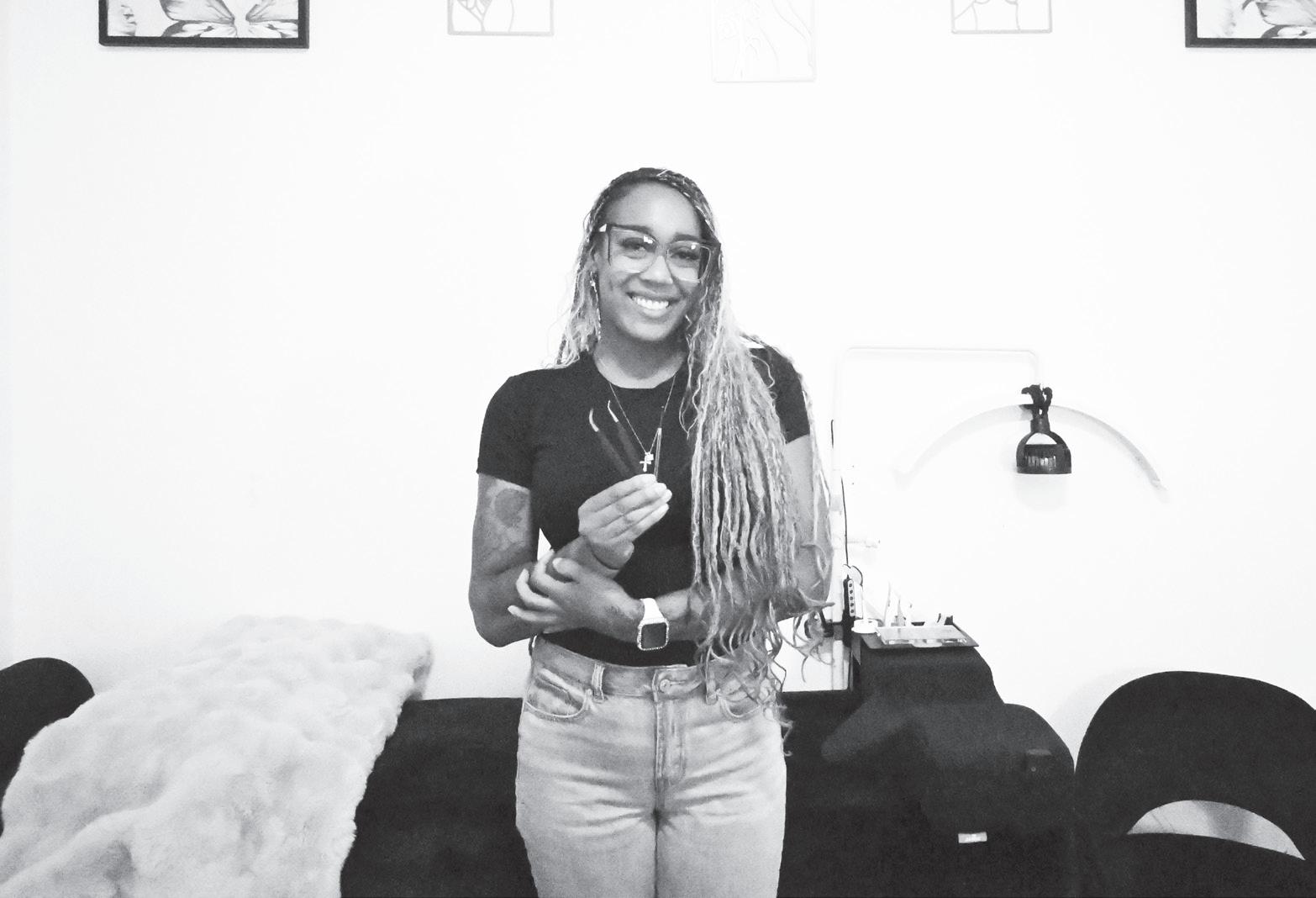
For Shareez Foreman, becoming a lash artist started off by being curious, having a creative mindset and the confidence to teach herself a skill that would grow into a business.
Today, Foreman is the owner of Certified Lash Lover, where she has spent the past three years helping clients enhance their natural beauty through eyelash extensions.
What began as a homebased business has grown into a professional salon suite, marking another milestone in her entrepreneurial journey.
“I’ve been lashing for three years, I taught myself,” she said.
Before opening her salon suite, Foreman worked from home for about a year and a half, spending hours practicing and refining her craft.
While many lash artists begin with formal training, Foreman first leaned on her passion and natural abilities.
“It’s just something that I’ve been passionate about for a very long time,” Foreman said. “I’m very crafty, creative and steady with my hands.”
That passion eventually led her to enroll in cosmetology school to become licensed.
While she already knew the craft, Foreman said she wanted to make her business official. Her instructors quickly noticed the level of skill she had already developed.
“I taught myself, but I just wanted to make it official.”
“When I went to school, my instructors were, ‘oh my gosh, like you. Have you been doing this?’” Foreman said. “I taught myself, but I just wanted to make it official.”
Like many small business owners, Foreman balances her business with another career.
She has worked at the airport for 17 years and currently runs her lash business part-time.
Rather than seeing that as a limitation, she views it as an opportunity to build something that belongs to her while continuing to grow her clientele at her own pace.
“This is something that I wanted to do for myself because this is something that I’ve been wanting to do for a long time,” she said.
Foreman says growing her
business has come with challenges. However, she says she’s remained resilient. Foreman said one of the biggest hurdles has been making her work visible in an increasingly competitive beauty industry. She has focused on creating content that showcases her work and introduces potential clients to her services.
“I’ve really been pushing myself to create the content to get myself out there. To have people see the work that
I do and it’s been pretty positive so far,” Foreman said.
Lash extensions continue to gain popularity, and Foreman believes the service offers clients a simple way to feel confident without spending extra time getting ready each morning.
Foreman says she rarely wears much makeup herself, making lash extensions a practical part of her own beauty routine.
“A lot of females are kind
Cashless payment systems
By Amy Kang
Silently guard your small shop’s revenue with an understated cashless payment system. Don’t let that cardand-phone sale miss your counter. If you want to grow your Black-owned business, a clean sales record matters more than any flashy storefront feature.
Customer habits are changing. Federal Reserve research found that Americans averaged 48 payments a month in 2024 and used cash for only seven of them, leaving credit and debit cards far ahead. Most shoppers who still carry cash would rather use a card if given the option.
If your business only takes cash, you’re losing sales to customers who would rather shop somewhere easier. That doesn’t mean you need to buy every new device or turn away cash entirely. What it means is having a system that lets you tap a card or phone and automatically log the sale.
Done right, this gives you a clean record of every transaction. Cashless payment systems aren’t glamorous, but they recover sales that might otherwise be lost, document cash flow and build the records Black businesses need to grow. A modern setup turns each sale into a dated, searchable entry rather than just reading a card. That visibility, more than anything, is
the actual product: a connected system can accept cards, taps and phone wallets at the counter; log each sale with a time, date and amount; track which items move and which sit; and flag refunds, voids and tips on its own. These features reduce the friction that chases buyers away and keep the checkout line moving.
Going cash-only feels safe, but it narrows your pool of shoppers and can send them to other retailers. At the same time, dropping cash entirely can be costly, since some customers rely on it exclusively. FDIC data shows that two-thirds of unbanked households rely entirely on cash, and Black households are more than five times as likely to be unbanked as white households. The smartest move is to accept both forms of payment. That balance has helped modernize Blackowned businesses without leaving any buyer out. Cards also let shoppers leave a deposit for a service, add a tip on the screen, or order ahead for pickup.
Cash-only businesses also have a harder time getting loans. Cashless payment systems let lenders verify a business’s sales history, which can factor into whether they approve or reject a loan request.
A Federal Reserve analysis found that credit availability is a challenge for more than a quarter of small busi-

nesses, and lenders lean on documented, steady revenue when making those decisions. Steady digital records help an owner do more than borrow: they build a credit profile lenders trust, help spot best sellers and slow weeks, prove income for leases and suppliers, and support cleaner, faster taxes each year. None of that is possible when your earnings live in a cash box. These same records can also help a

of fading away from makeup,” she said. “Lashes are an enhancement.”
That convenience, she believes, is one reason the lash industry continues to grow as more clients look for lowmaintenance beauty services that fit into busy lifestyles.
As Foreman continues to expand her business, she will soon be moving into a new salon that reflects her values: a Black woman-owned, faithbased suite salon.
Looking ahead, Foreman hopes to continue expanding her clientele while providing a space where clients leave feeling more confident than when they arrived.
For those interested in booking an appointment, clients can schedule online through Booksy at www.booksy.com/ en-us/1483970_certified-lashlover_brows-lashes_134619_ minneapolis#ba_s=sr_1 or connect with Certified Lash Lover on Instagram.
Lizzy Nyoike is a Hubbard School of Journalism & Mass Communication student and contributing writer for the Minnesota Spokesman-Recorder. She welcomes reader responses at lnyoike@spokesman-recorder.com.
business qualify for grants, relief programs or a lease.
Choosing the right payment hardware means matching the tool to your foot traffic, counter space and budget.
A few questions cut through the noise: Does it take cards, taps and phone wallets? Are the fees flat and easy to predict? Will it keep working if the internet drops? Can it grow with a second register? Answering these keeps you from
paying for features your shop will never use. The right tools keep checkout quick and the data clean, and a system you can run without a manual will make the whole process easier.
Modern systems encrypt card data and flag odd transactions before they clear, which lowers a shop’s exposure to chargebacks and theft, though owners should still use strong passwords and keep their software updated. Most reputable providers build in protections that a manual cash process simply can’t match.
Setup is typically quick.
Many card readers connect in an afternoon, especially plug-and-play models made for small counters, and usually just require linking a bank account, downloading an app and running a test sale. Pointof-sale systems with full inventory tools take longer, but rarely more than a few days.
Spotty internet doesn’t have to be a dealbreaker, either. Many systems store sales offline and sync once the connection returns, so a short outage won’t stop checkout. That matters most for pop-ups, outdoor markets and shops in areas with weak service, and it’s worth confirming a system’s offline mode before buying if your location loses signal often.
This is the part of running a business that rarely gets talked about. The reward of using a cashless payment system is quiet and slow, but its reliability can take a Black-owned business to the next level. An enterprise that captures every customer and documents every dollar holds a stronger case for a loan or a second location than one that doesn’t. This unglamorous choice, made early, is often what makes the next move possible.
This article appeared first in Black Press USA. It has been edited for style. For the original, visit https://blackpressusa.com/ cashless-payment-systems-arethe-boring-move-every-blackshop-needs/.
Amy Kang is a contributing writer for Black Press USA.
Cost varies by provider, but most charge a small percentage of each sale, often around two to three percent, plus the price of the reader. Flat, predictable pricing is easier to budget than tiered plans with hidden add-ons, and many shop owners find that the sales recovered from cardpaying customers outweigh the fees. Customers also tend to spend a bit more when paying by card, since they aren’t limited to the cash in their pocket, and card or phone checkout can make impulse add-ons easier to ring up. The effect varies by shop, but few owners report card payers spending less.

Shareez Foreman at her business suite in Edina, MN.
Lizzy Nyoikes/MSR
Viktoria Slowikowska
it never stays for good. ... We can invest in things that are much better for our community than more policing and more surveillance."
Minneapolis would not have been the first Minnesota city to partner with Skydio; Minnetonka has had its own contract for more than a year, providing a public "flight log" that tracks drone flights and the calls they respond to, though no other identifying information is shared.
"The Fourth Precinct has also been very well known to be discriminatory in their behavior," Slayhi said. "So now all of a sudden Ward 4 turns into a testing ground, and then it turns into surveillance automatically. Every person becomes a suspect all of a sudden."
Skydio representatives told the City Council at the prior committee meeting that the company deletes non-evidentiary video footage after seven days and that its drones would avoid identifying landmarks, homes or people while in the air. However, a Wired investigation published July 13 found that Skydio had left hours of San Francisco police drone footage exposed on the open internet, a security gap discovered by outside researchers in mid-June, reveal-
ing unblurred footage from SFPD-led drone flights.
Council Member LaTrisha Vetaw of Ward 4, who spearheaded the project, said the contract deserved consideration in her ward despite the concerns, calling it the safety tool her constituents have been asking for in emergencies. "In emergencies, minutes matter. If this program saves one life, this is worth trying," Vetaw said. "At times it feels like this body is searching for reasons to say no, instead of


looking for reasons to give this a chance."
Despite support from the measure's author, the contract failed in a 6-6 vote Thursday, July 16, to the relief of many residents who attended the meeting. The sticking points for opposed council members were the lack of reliable privacy safeguards from Skydio and its continued work with ICE, which took action against
Minneapolis residents during Operation Metro Surge six months earlier.
"This action is morally bankrupt. It's an abysmal mistake," said Council Member Aurin Chowdhury. "Nothing is free. This costs the trust of our residents. ... I keep on hearing that this is going to solve all our public safety issues and problems. There is no silver bullet."
Residents who packed both
the council meeting room and the overflow room rejoiced at the decision. Emil, a member of Students for a Democratic Society at the University of Minnesota, said the vote was a win for all residents regardless of political alignment. "I think just the fact that council members voted it down showed that they are keeping in mind the fact that residents do not want to be surveilled," Emil said. "The fact that this company is propped up through its contracts with ICE and through its contracts with the IDF, and the fact that we voted it down for one of those reasons, is good. ... Many people on the council outright said, 'If this trial were to begin, it would never end.'”
Izzy Canizares is a contributing writer for the Minnesota Spokesman-Recorder. He welcomes reader responses at isabellacani0102@gmail.com.
records or testimony for state investigations. ICE Senior Counsel Ryan Stubbs asked for extensions on April 28 and again on May 15, saying only that the agency was "still in the process of evaluating" the request. The county granted both. The final deadline, May 29, passed without further response.
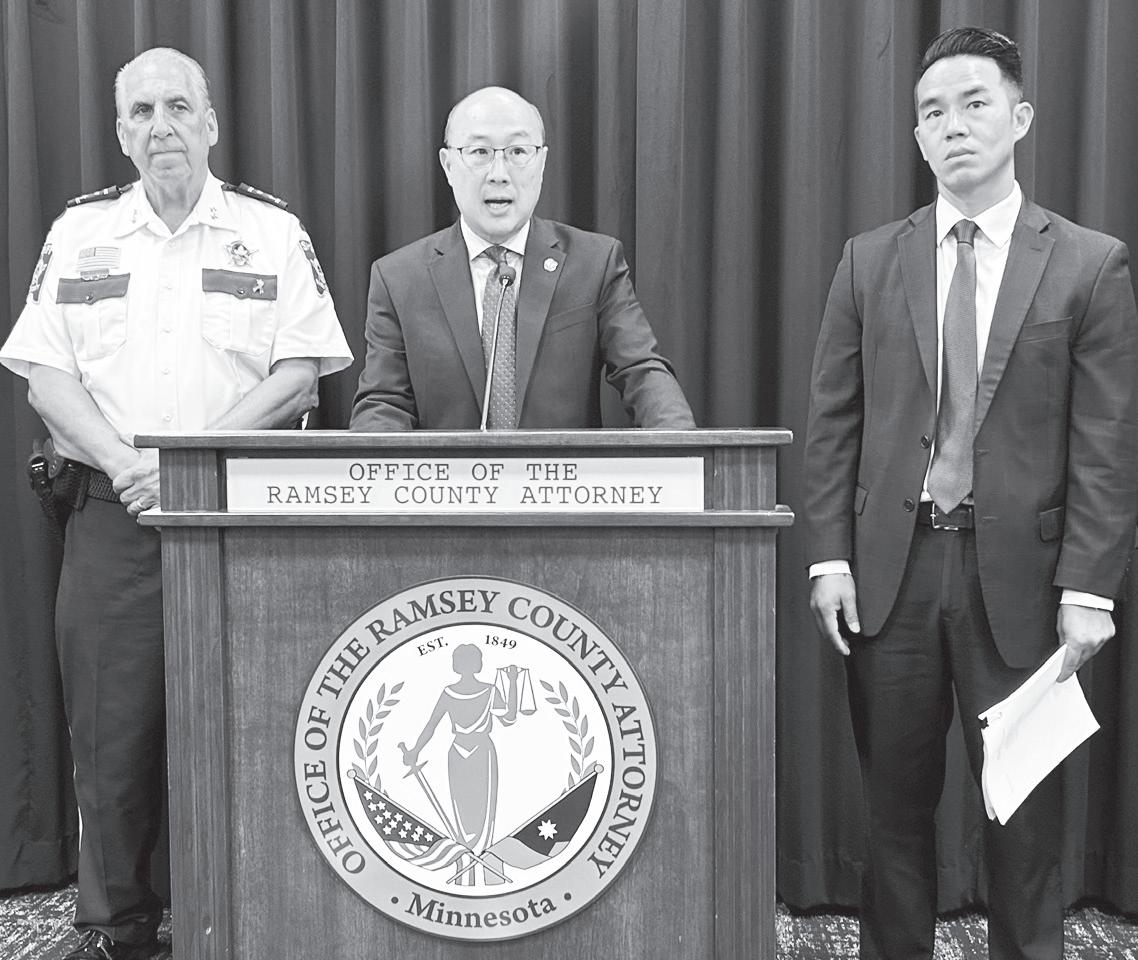
"We don't have a statement from the federal officer," said Hao Nguyen, director of the Ramsey County Attorney's Office Trials Division, who is leading the case. "If they produced a document or report that indicated they thought A, B and C, that would defend and condemn, you know, clear their name. Great, send it to us. But we don't have it, and so not having it doesn't allow us to clear them either."
Investigators have not
been able to identify the individuals involved. Fletcher said his office has photographs of agents from the scene and social media, along with license plate information gathered through the Flock camera system, but the plates were later found swapped onto other vehicles. "There has to be some accountability," Fletcher said. "Dragging someone out of their house that's not wanted, doesn't have any warrants, hasn't committed a crime, in the winter, throwing them in a squad car and driving them around isn't the America we want to live in."
The complaint argues that DHS's silence amounts to final agency action under the federal Administrative Procedure Act and violates the Tenth Amendment, which reserves police powers to the states. It also cites a history of routine cooperation between federal and state law enforcement in Minnesota, including
joint investigations after the 2025 shooting deaths of state lawmakers Melissa and Mark Hortman and the mass shooting at the Church of the Annunciation, arguing DHS's refusal to cooperate here breaks from that precedent.
The lawsuit follows a similar path taken by Hennepin County and the Minnesota Attorney General's Office, which sued DHS and the U.S. Department of Justice earlier this year over the fatal shootings of Renee Good and Alex
Pretti and the wounding of Julio Cesar Sosa-Celis during the same federal operation. That case led federal officials to begin releasing information to the Minnesota Bureau of Criminal Apprehension this week, Fletcher said. "I actually think there's some motion and some movement," he said. "All we really need is the reports written by their officers. The reports will elucidate exactly what happened and why it happened." Nguyen said the county has been in contact with Thao's attorneys and believes he is "in good spirits," though the incident has taken a toll. "When they suffer an intrusion like this, an invasion into someone's home, a public embarrassment of being dragged out, guns drawn, all those things, then being taken away into a vehicle by masked and armed men, I can't imagine what that must feel like," Nguyen said.
Reached for comment, a
DHS spokesperson pushed back on the allegations. "This lawsuit is nothing but a political stunt to demonize ICE law enforcement officers who are facing a 1,300% increase in assaults against them as they arrest the worst of the worst," the spokesperson said, adding that agents were executing a warrant based on surveillance tying "sexual predator targets" to the property, and that Thao "refused to be fingerprinted or facially identified," which the agency said justified holding everyone at the scene under standard protocol.
The county attorney's office is asking anyone who witnessed or experienced potential crimes by federal agents in Ramsey County to contact 911 or the non-emergency line for the relevant local law enforcement agency.
Jasmine McBride welcomes reader responses at jmcbride@ spokesman-recorder.com.
98,000 cases, reviewing each one for eligibility before it goes to a five-member board for a final decision. "Recipients don't have to do anything," Faulkner said. "That will just happen on their behalf."
The board consists of Susan Segal, chair and Supreme Court designee, who also serves as chief judge of the Minnesota Court of Appeals; David Genrich, the attorney general's designee; Safia Khan, the Department of Corrections' designee; Amanda Brodhag, an assistant public defender in Hennepin County; and Rebecca St. George, assistant commissioner for the Child Safety and Permanency Administration at the Minnesota Department of Children, Youth and Families.
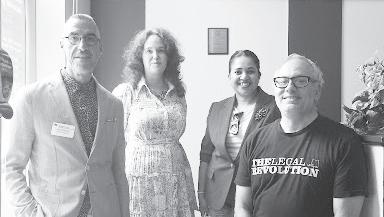
From left: Jim Rowader, executive director of the Cannabis Expungement Board
Heather Faulkner,
nications and external engagement officer at the CEB; Nilushi S. Ranaweera, deputy director and chief legal officer; and Jon Geffen, executive director at The Legal Revolution, providing expungement relief services at Roots Wellness Center in North Minneapolis on July 15. Clint Combs/MSR
Malcolm Wells of the New Justice Project said the stakes are especially high for Black Minnesotans, who bore the brunt of cannabis criminalization long before legalization. He said the board's outreach clinics represent "an opportunity for people to get back either into the workplace, find housing without having to deal with any kind of prejudice, but also getting people on a pathway to ... the type of life that they want to live."
The disparity Wells pointed
to is well documented. A 2020 ACLU report examining marijuana possession arrest data from 2010 to 2018 found that, nationally, Black people were arrested for marijuana possession at three times the rate of white people, despite comparable usage rates between the two groups. Minnesota's disparity was substantially worse than the national average: Black Minnesotans were arrested at five times the rate of white Minnesotans in 2018, one of the widest racial gaps
of any state that year. The board holds public meetings monthly at the Department of Corrections, 1450 Energy Park Drive in St. Paul, open to the public and livestreamed. Its next scheduled meeting is Aug. 12 at 10 a.m.
Clint Combs is a contributing writer for the Minnesota Spokesman-Recorder. He welcomes reader responses at combs0284@gmail.com.
“As far as we're aware, we are the only state in the country approaching cannabis expungement in this way.”
The board's authority extends beyond sealing records; it can also vacate and dismiss a past marijuana felony conviction outright, a distinction Faulkner called more powerful than expungement alone. "Once this is delivered by the court and it is off their record, they now can say when they're applying for housing, no, I don't have a felony," she said. "No, I don't have this conviction anymore because it's gone."
Jon Geffen, executive director at The Legal Revolution, provides free legal help on old criminal records. He said 2023 marked a turning point for record-clearing generally in Minnesota, not just for cannabis. "It created a clean slate, automatic expungement and automatic cannabis expungement. Then the cannabis expungement board for more serious cannabis-related offenses changed our pardon law," Geffen said. He estimated roughly 2 million Minnesota records are eligible for some form of relief statewide, far more than existing advocates and attorneys
can handle. Geffen also cautioned that legalization alone hasn't erased the risk of lingering consequences. "Even with the legalization of cannabis, people with cannabisrelated offenses should still be tracking what's going on to ensure they're not continually punished for something that is not legal," he said. "Truthfully, it is making people a lot of money now, because nothing's happening faster automatically for most people."
Minnesotans can search their own criminal history through Minnesota Court Records Online to see whether a case has already been expunged, or reach out to the board directly if unsure whether they qualify. Closing that awareness gap is the point of events like the one at the Urban League, Faulkner said: "People are aware that we exist, and they come to us, and we get their case moved up in the queue."
Photos courtesy of Izzy Canizares/MSR
From left: Ramsey County Sheriff Bob Fletcher, Ramsey County Attorney John Choi and Hao Nguyen, director of the Ramsey County Attorney's Office Trials Division, at a July 15 press conference. Jasmine McBride/MSR
(CEB);
chief commu-
Arts & Culture
Historian revisits a pivotal moment in city history
By Alaysia Lane Contributing Writer
More than 50 years after Minneapolis teachers walked off the job in an illegal strike that reshaped labor relations in Minnesota, historian William D. Green believes that event remains widely misunderstood.
While the 20-day walkout in April 1970 is often remembered as a labor dispute over pay and working conditions, Green argues it also expressed deeper tensions over race, class, and political power that challenged Minneapolis’ carefully cultivated image as a progressive city.
“The teachers strike brought in so many other issues that the city wasn’t prepared to talk about at all,” Green said in a recent interview. “And that is race. That is class.”
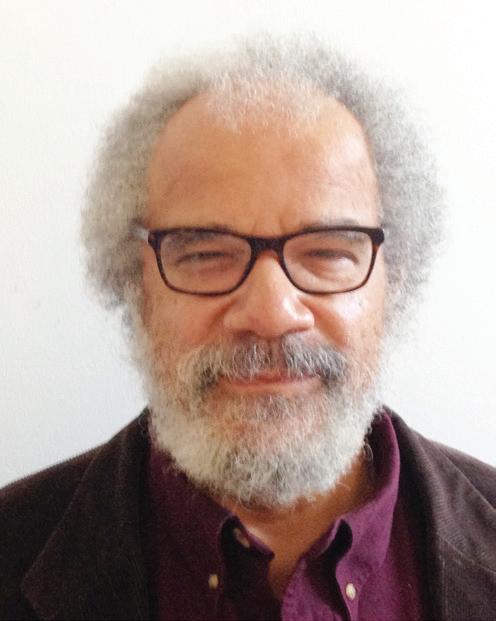
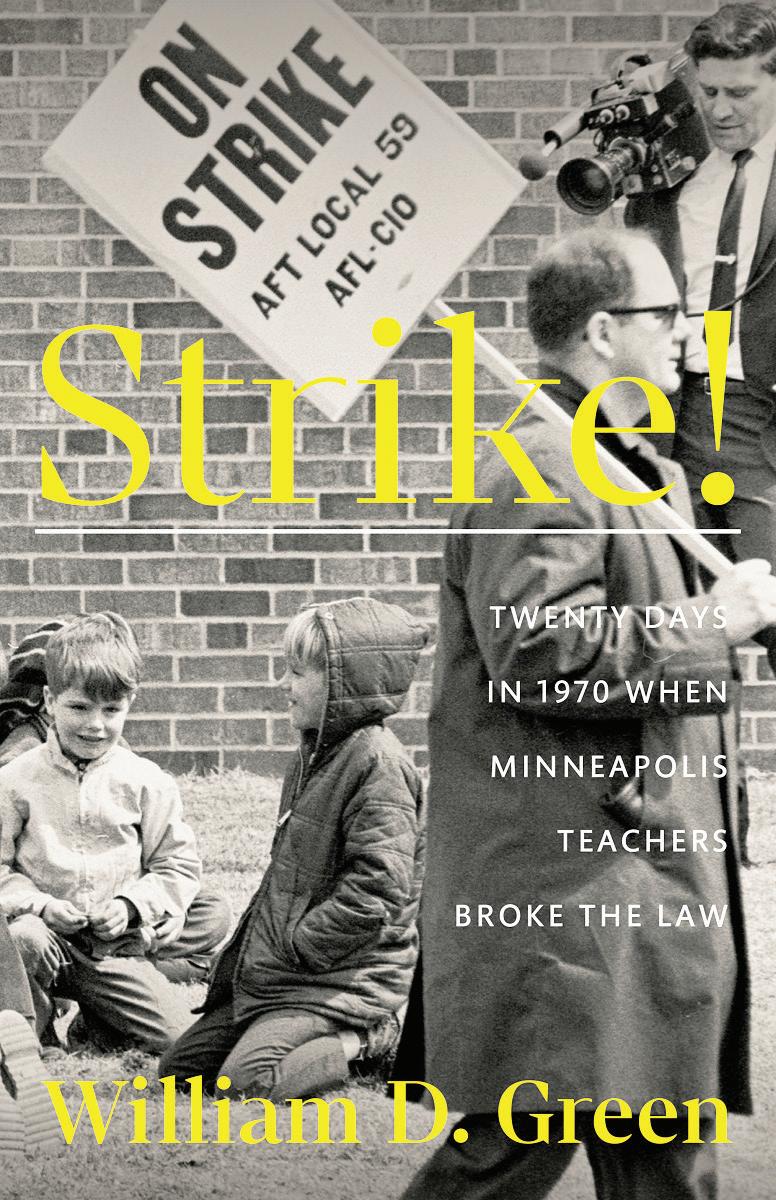
Green, a professor emeritus at Augsburg University and former superintendent of Minneapolis Public Schools, explores those themes in his new book, “Strike! Twenty Days in 1970 When Minneapolis Teachers Broke the Law.”
The book examines a pivotal moment in Minnesota history when public school teachers defied state law and launched a strike that helped transform public-sector labor relations across the state.
At the time, strikes by public employees were illegal in Minnesota. Teachers who joined the walkout risked losing their jobs, pensions, and professional standing. The strike lasted 20 days and became a turning point in the
ers did not feel proud of the decisions that they made in order to survive through that period.”
The strike unfolded during a turbulent period in American history marked by labor unrest, anti-war protests and growing social movements.
Yet, Green said many Minneapolis residents were shocked to see teachers, normally viewed as selfless public servants, engage in militant labor action.
“People were surprised that teachers could be militant,” he said.
along lines of race.”
Although Minneapolis schools remained overwhelmingly white in 1970, Black and Native American students were concentrated in certain schools, a pattern that would later become central to debates over school desegregation.
Green said those issues are part of a larger story he plans to explore in future research on Minneapolis school desegregation during the 1970s.
movement for collective bargaining rights for public employees. It also helped lay the groundwork for the Public Employment Labor Relations Act, or PELRA, which later granted public workers collective rights and limited strike protections.
For Green, the story began with conversations he had years later with teachers who participated in the strike.
“I always found it interesting that they would refer to the strike almost as if they had been to war,” he said. “I could still see the wounds in their eyes.”
Those memories led Green to investigate why the experience remained so emotionally charged decades later.
Part of the answer, he said, involved fractured relationships and difficult choices.
Teachers found themselves divided not only from administrators and elected officials, but sometimes from colleagues and friends.
“It was a question of survival,” Green said. “Some teach-
That reaction, Green argues, reflected broader assumptions about both teachers and Minneapolis itself.
For decades, Minneapolis enjoyed a national reputation for political moderation and tolerance. The debut of “The Mary Tyler Moore Show” in 1970 helped reinforce an image of the city as friendly, optimistic and largely free of the turmoil affecting other urban centers.
But Green said that image often obscured ongoing struggles over race and inequality.
The strike occurred just a few years after unrest on Plymouth Avenue in north Minneapolis highlighted racial tensions that many residents had preferred to ignore. At the same time, Minneapolis schools faced increasing scrutiny over racial segregation patterns and educational inequities.
“The strike wasn’t really a race issue,” Green said. “But it did kind of lance the boil of tension that was growing
The book also examines the changing role of women in education. Teaching was a profession dominated by women, yet many educators were expected to embrace sacrifice rather than advocate for higher wages or improved working conditions.
“You don’t demand things for yourself,” Green said, describing the expectations many women educators faced at the time.
As more teachers challenged those assumptions, tensions emerged within schools and communities about professional identity, labor rights and gender roles.
Many of the concerns raised during the 1970 strike continue to resonate today, Green said. Issues such as classroom resources, teacher workload, preparation time and student support services remain common topics in education debates.
When Minneapolis teachers staged their first strike in more than 50 years in 2022, many of the concerns sounded familiar to those who remembered 1970. Green said
that continuity reflects a broader challenge facing public education.
“Teachers have felt ignored and abandoned by the community,” he said.
He hopes readers will view the strike not simply as a historical event but as a reminder of society’s ongoing responsibility to public schools.
“Education has to be more front and center,” Green said.
“It has receded into the closet of our public consciousness.”
Green also emphasized the importance of historical records that documented perspectives often overlooked by mainstream institutions. He credited Black newspapers, including the Minnesota Spokesman-Recorder, with preserving stories about race and community life that might
otherwise have been lost.
More than five decades after teachers first carried picket signs into streets of Minneapolis, Green believes the strike still offers lessons about education, democracy and the stories communities tell about themselves.
“History,” he said, “is often about the things people choose not to remember.”
For more information on William D. Green’s new book, Strike! Twenty Days in 1970 When Minneapolis Teachers Broke the Law, visit www.upress.umn. edu/9781517912956/strike/.
Alaysia Lane is a contributing writer for the Minnesota Spokesman-Recorder. She welcomes reader responses at aal7008@nyu.edu.
After Operation Metro Surge, Mixed Blood Theatre turns to storytelling to heal
By Ella Stern Contributing Writer
During the peak of Operation Metro Surge, while Minnesotans turned out to support their neighbors, Mixed Blood Theatre considered how to sustain that energy in whatever would come next.
“At some point, hopefully, this moment will end, and we’ll need to be prepared to support what happens then,” said Tolu Ekisola, Mixed
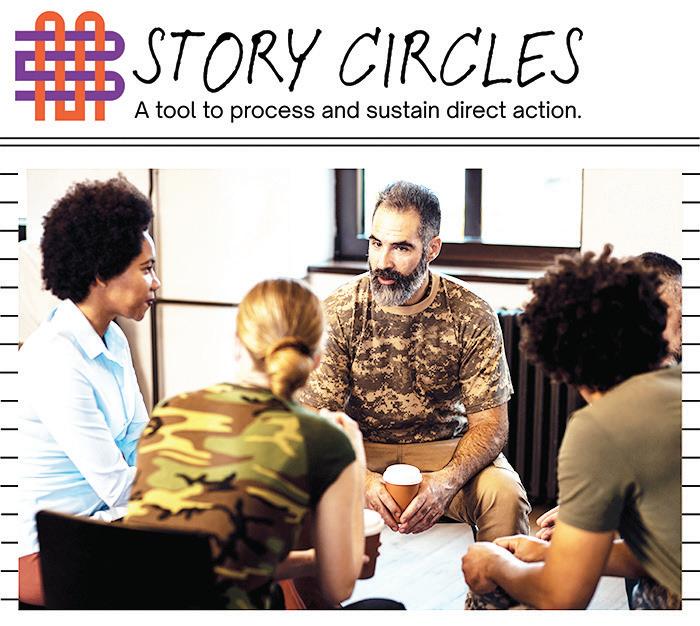
Blood’s manager of community organizing and engagement. The theatre’s team landed on story circles, community events that invite participants to share a personal experience in response to a prompt. Each storyteller gets a set amount of time to speak without interruption. Afterward, participants discuss the stories they heard and their experiences telling them.
“The end goal of story circles is community building,

listening to each other, hearing each other’s stories and feeling less alone in our struggles and in our concerns about the future,” Ekisola said.
Mixed Blood staff held several story circle training sessions in early June. Around Juneteenth, Ekisola and the facilitators she trained hosted story circles across the Twin Cities and surrounding suburbs to help communities heal from Operation Metro Surge and move forward together.
Libin Hashi attended the story circle event at Mixed Blood because she was looking for community and an exchange of stories.
“[I wanted] to give my experience to people that might not have the same lived experience as I did so that they know how ICE has impacted our communities, whether that’s mentally, physically or even socially,” Hashi said.
She also hoped to bring the stories she heard at the event back to her community. Telling them, for example, about allies fighting for immigration and human rights.
Hashi said that now that it is summer, she and other Somali people are trying to heal from Operation Metro Surge. For her, the story circle was part of that process.


“Healing requires storytelling and humor,” Hashi said. “Being a Somali, one of our core things that we turn to during dark times is humor. Storytelling can have so many ways of sharing humor, which
sometimes brings light. It allows you to step away from the sad parts. You joke and you connect through just laughing. Laughter is an act of resilience and resistance in itself because you’re not allowing oppressive regimes to take down your happiness or your joy.”
cally taxing for a lot of people,” Ekisola said. “I want those groups to come back together with a sense of healing and a sense of community care [and] community building.”
“The end goal of story circles is community building, listening to each other, hearing each other’s stories.”
To Ekisola, the role of story circles in the aftermath of this winter is helping people recommit to community. Since the peak of Operation Metro Surge, “it’s been hard to pull people back in and pull the groups back together, especially because ... it was emotionally and physi-
Story circles are not unique to Mixed Blood; they have a long history in Indigenous practices. Mixed Blood’s model comes from the Free Southern Theatre, the theatrical arm of the Civil Rights Movement’s Student Nonviolent Coordinating Committee, or SNCC. When SNCC members returned from direct actions, they would sit in a circle and share stories in response to a prompt.
“It was found to be a very helpful tool, not only for processing, but for mapping out what’s next,” Ekisola said.
Story circles are also grounded in a human need to share stories.
“Outside of the political sphere, we are human beings, and we have this long history of storytelling,” Ekisola said. “We would sit around the fire and tell stories, and that was a practice that made us human.” Although recent local story circle events have focused on Operation Metro Surge, the gatherings aren’t limited to urgent, heavy matters. People could gather to share stories about their happiest childhood memories, Ekisola said.
“That’s the day that I look forward to: when we’re engaging in story circles regularly, formal and informal, communing as a group of individuals from a variety of backgrounds, and coming together specifically just to get to know one another,” Ekisola said. “That’s the community care that I look for: continuing to show up.”
Ekisola said she hopes to host another story circle day later this summer or in the fall. For more information on story circle training sessions, visit https://mixedblood.com/
Courtesy
William D. Green
Photos courtesy of University of Minnesota Press
Education
Catalyst for Systems Change celebrates a year of youth-driven policy wins
By Anya Armentrout
Contributing Writer
At Catalyst for Systems Change, the goal isn’t to invest in youth. It’s to invest through youth.
The organization believes young people don’t need to be given a voice. They already have one. What they need is for adults to listen.
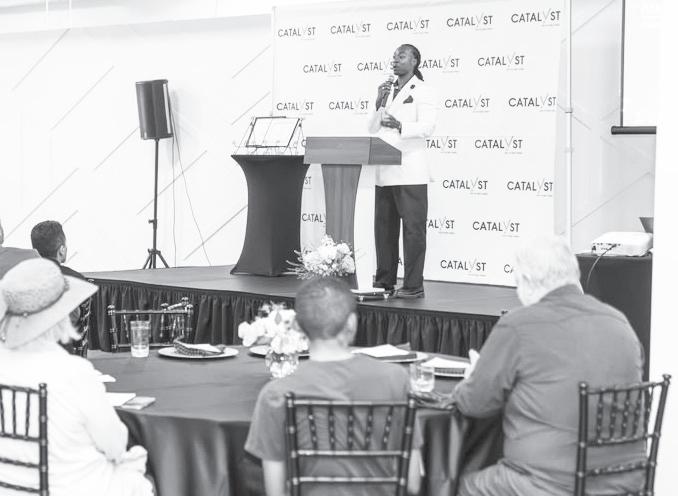
On the evening of July 9, leaders from Catalyst for Systems Change joined local legislators and youth advocates to celebrate the organization’s public policy successes over the past year.
Among the group’s biggest accomplishments was helping secure a legislative study of Minnesota’s Postsecondary Enrollment Options (PSEO) program.
PSEO allows high school students to take college courses and earn both high school and college credit at no cost. Since the program began in 1985, participation has grown dramatically. Today, some Minnesota high schools have a majority of their juniors and seniors enrolled in PSEO courses, with some students attending college full time.
PSEO was identified as the top legislative priority during Minnesota’s 2026 session.
When Catalyst students, many of them PSEO participants themselves, studied the program, they found that two out of three Minnesota high schools were not fully complying with state PSEO implementation requirements. As a result, school websites often contain incomplete or inaccurate information, making it difficult for students to understand or access the program.

Schools also face challenges with PSEO. Because students enrolled full time in PSEO are not counted in the same way for per-pupil funding, districts can lose state revenue. Enrollment numbers are often uncertain while school budgets are being developed, leaving districts vulnerable to unexpected funding shortfalls.
Some educators have also raised concerns about course quality and communication.
PSEO courses may be offered in person, online or in hybrid formats. Differences between college and K-12 privacy laws can make it difficult for schools and parents to monitor students’ progress throughout the semester. In some cases, families may not learn that a student has failed a required course until final grades are released.
For students, however, the benefits can be significant.
PSEO offers the opportunity to earn college credits, or even complete an associate degree, without paying tuition, reducing one of the biggest financial barriers to higher education. Even students who do not complete a full degree
can enter college with credits already earned, potentially graduating earlier and with less debt.
Beyond the financial benefits, students say the program gives them greater ownership over their education.
State Sen. Clare Verbeten, DFL-St. Cloud, participated in PSEO as a student herself.
One course in particular has stayed with her: “In the Heart of the Beat: The Poetry of Rap.”
“We in Minnesota are far ahead of the curve in empowering young people."
“It was about studying rap and the music, the culture, the artists, what they mean to our community, how they’ve, you know, pushed for change,” Verbeten said. “It was just really exciting to me. As a music lover and rap lover, I was like, ‘Wait, I can take a class about this?’ That’s something you get the opportunity to do in
college.”
For Verbeten, youth leadership is essential.
“We as legislators should get out of the way and let them lead,” she said.
Catalyst also celebrated its role in helping pass HF 2023, which requires overdose prevention education in Minnesota schools.
Rep. Nolan West, R-Blaine, the bill’s chief author, emphasized that the legislation was driven by young people. While he introduced the bill, he said youth advocates were “the ones who truly moved the bill through the process.”
He encouraged students in attendance to “never wait your turn.”
“It will never be ‘your time,’” West said. “Just go and do it.”
Another milestone was the organization’s 2026 Capitol Advocacy Days. Several participating students later testified before members of Congress. The group also advocated for more than $320 million in housing investments.
Rep. Duane Quam, R-Byron, said it is essential that young people “take a seat at the table” and actively partici-
pate in democracy. Throughout the evening, the spotlight remained on the students.
Many speakers reflected that, only a year earlier, public speaking had been one of their greatest fears. Today, they are testifying before lawmakers, meeting with elected officials and helping shape public policy.
Student speaker Samia Mohamud described traveling to Washington, D.C., to speak before members of Congress about the impacts of Operation Metro Surge. She was the only Minnesotan there.
sota House Pat Murphy has long been involved with youth leadership programs. As he entered the event, several student speakers rushed over to greet him. He’s known many since they were children.
Murphy said he wants every young person to know “they belong, we want them there, and we want to hear what they have to say.”
When he meets with international visitors, he often asks what their countries are doing to develop the next generation of leaders.
“From what I’ve seen,” Murphy said, “we in Minnesota are
“When you fail to quit,” Mohamud said, “that’s when you will rise.”
Many students reflected on how much they had learned about the legislative process or about their own ability to influence it. Several said they never imagined they would stand on the Senate floor or advocate for legislation without the encouragement they found through Catalyst.
Chief Clerk of the Minne-
far ahead of the curve in empowering young people.”
For more information on Catalyst for Systems Change, visit www.catalystforsystemschange.org/.
Anya Armentrout is a freelance journalist, a student at Macalester College, and a contributing writer for the Minnesota Spokesman-Recorder. She welcomes reader responses at anyaarmentrout@gmail.com.
Parent Power: After families show up
By Khulia F. Pringle Columnist
I have spent years encouraging parents to do the one thing adults love to say other people aren’t doing. Show up. Show up to the meeting. Fill out the survey. Use your public comment. Join an advisory council. Build a relationship with your child’s school.
If families aren’t sitting at the table, how can we expect our voices to impact the decisions made about our children?
Then Minneapolis Public Schools announced it would begin the Transformation process. Like many parents and community leaders, I attended meetings. Listened to presentations. Read district updates. And talked with families across Minneapolis trying to learn as much as I could about what Transformation could mean for our kids.
Somewhere in the process, I realized I had been focusing on the wrong question.
For years I asked: “Did families have an opportunity to participate?”
Now I ask: “How will families know their voices matter after they show up?”
I can’t shake that question because I think it really forces us to consider what community engagement is meant to achieve.
On paper, Minneapolis Public Schools has been very

clear about why Transformation is necessary. Declining enrollment. Financial uncertainty. Aging buildings. And lack of access to quality programs and courses have contributed to district leaders believing that the current system is unsustainable. The School Board has directed the superintendent to present three program change options this fall. Decision making doesn’t get much bigger than this. What schools look like. Which schools remain open. Where students can attend school. All of these decisions will impact students, families and Minneapolis communities. Which is why engagement matters. Minneapolis Public Schools has invested time and resources into engaging the
Anna Shvets
public. Some families attended community meetings, provided feedback on surveys, attended listening sessions, reviewed presentations and shared their thoughts throughout the process.
I attended a Transformation meeting with several engaged parent leaders from STAND Up Minnesota Parents United, and at the end of the meeting
I asked what felt like a simple question.
“If your kid sister called you tonight and asked you to explain Transformation, what would you tell them?”
The responses struck me.
These parents cared. They showed up. They listened. They participated. But as I asked the question, no one could articulate exactly what Transformation would look like. They didn’t know what decisions had been made or
what was still left to be decided. They didn’t know how the work they were doing in their classrooms and communities would influence the recommendations made by district leaders.
It wasn’t that they hadn’t been engaged. Quite the contrary. Information is not the same as understanding. Information tells. Understanding allows people to believe in what happens next. Throughout the Transformation process, I kept noticing how the district and families were having two very different conversations.
recommendations were adopted into the plan while others weren’t.
At the heart of my wondering, I have a few questions:
Who are the students and families who will be most impacted by these decisions?
Were those families engaged?
Did families who participated reflect the diversity of Minneapolis?
“We have the opportunity to transform our relationship with the families who’ve committed to public education.”
The district was communicating: “How did we engage the community?”
Families were wondering: “How did our engagement impact the decisions?”
That isn’t the same question. As a parent advocate, I’m not asking districts to implement every change families recommend. In fact, asking that much of public leaders isn’t realistic. But I do expect the district to share how decisions are made. I do expect families to know their voices were heard. I do expect families to understand what they influenced and why certain
How were the voices of Black families, multilingual families, Native families, families of students with disabilities and other families who have been historically left behind by Minneapolis Public Schools reflected in these recommendations?
What changed because people spoke up?
And once decisions have been made, how will families remain engaged partners in the work to come?
These aren’t questions trying to prevent change. As hard as decision making can be, delaying these conversations does more harm to students. These are questions that build public trust.
I’ve learned over the past few years that any time you make a major public deci-
sion, you’re really testing something much larger than a school district strategic plan. You test relationships. You test whether or not your public institutions view communities as partners in creating the future.
That’s why I believe Minneapolis has the opportunity to do more than transform schools.
We have the opportunity to transform our relationship with the families who’ve committed to public education.
Because when communities see how decisions are made. When they recognize their voices in the changes adopted. And remain partners long after the meetings and presentations have ended, transformations create more than school district change. They create trust.
Trust in our public institutions. And ultimately trust in public education. After years of working beside families, I’ve learned we’re not simply asking for a seat at the table.
We want to know that after we leave the table, something changed because we sat there.
Khulia F. Pringle, M.A., is founder and executive director of S.T.A.N.D. Up Minnesota Parents United, commissioner on the Saint Paul Recovery Act Commission on Reparations, and co-chair of the Minnesota Literacy Coalition. You can reach her directly at khuliapringle@standupmpu.org.
Catalyst for Systems Change Changemakers at 2026 Legislative Recap & Changemakers Program Celebration. Photos courtesy of Catalyst for Systems Change
Khalique Rogers, executive director of Catalyst for Systems Change, at 2026 Legislative Recap & Changemakers Program Celebration.
By R. Lynn Pingol
Congress is considering a bill that would quietly dismantle one of the most important economic ladders available to women-owned businesses in America. It’s called S.4390, a bill to repeal Section 8(m) of the Small Business Act relating to the Women-Owned Small Business Program. If it passes, it will eliminate the Women-Owned Small Business (WOSB) program and the federal authority that allows agencies to create contracting opportunities for womenowned firms. Without that authority, women-owned businesses lose the only statutory protection they have in federal procurement.
Let’s be clear: This is not a procedural tweak. It is a structural extraction of contracting power from women-owned firms, especially Black women-owned firms, who already face the steepest barriers to capital, bonding and privatesector procurement.
According to the U.S. Small Business Administration, women-owned businesses generate $2.7 trillion in annual revenue and employ 12.2 million workers. A conservative 20% contraction, the level economists expect when federal access collapses, places $540 billion in annual revenue and 2.44 million jobs at risk. Those losses will not
be evenly distributed. Black women-owned firms, along with Latina-owned, Asian American women-owned, and Native and Indigenous women-owned firms, rely more heavily on federal contracting because private markets have never treated them fairly.
Federal data from the U.S. Census Annual Business Survey and the Wells Fargo 2024 Women-Owned Business Report show that Black womenowned firms alone generate roughly $250 billion in annual revenue and support 1.2 million jobs nationwide. A 20% contraction translates into $50 billion in lost revenue and 240,000 jobs erased. These are not abstract figures. They represent real storefronts, real families and real workers.
20,000 local jobs erased.
Eliminating WOSB authority doesn’t create neutrality. It creates consolidation, handing more federal dollars to the same billion-dollar primes that already dominate the marketplace. The timing could not be worse: federal equity infrastructure is already under attack, from the OMB’s Merit-Based Contracting Rule restricting DEI-informed procurement tools to a DOT rollback of transportation equity protections and a slowdown in the SBA’s 8(a) program. S.4390 is the fourth strike, the one that completes the collapse.
The harm doesn’t stop at the business level. When women-owned firms lose revenue, corridors decline, storefronts go dark and cities
By Sharon M. Holder, PhD, MPhil, MSc, MSW
There are moments in a nation’s life when a single ruling forces us to stop and ask: What is happening to the country we thought we knew?
The Supreme Court’s June 25 decision affirming the federal government’s broad authority to end Temporary Protected Status was one of those moments for me. With that decision, the administration now has the power to strip protections from hundreds of thousands of migrants from Haiti, Syria and beyond. The ruling landed not as a legal technicality, but as a moral shockwave, a reminder that the rights we assume are secure can be undone with the stroke of a pen. It forces us to confront the most chilling question of all: If they can do this to them, who is next?
I found myself sitting with a deep unease: voting rights chipped away, DEI initiatives dismantled, human rights protections eroding. Black people and people of color have always carried the weight of this nation’s contradictions, building families, communities and movements even while enslaved, segregated and excluded, refusing to surrender their dignity.
The late John Lewis understood this better than anyone. He reminded us, “Freedom is not a state; it is an act.” He also said, “We all came here in
different ships, but now we’re all in the same boat.” That line feels urgent today: if we are in the same boat, the holes being drilled into the hull, attacks on rights, on truth, on democratic norms, will eventually sink us all. Yet it doesn’t feel like we’re rowing together. The American Dream, once imperfect but at least aspirational, feels like it’s narrowing into a gated ideal reserved for a select few.
me your tired, your poor, your huddled masses yearning to breathe free.”
Here in Minnesota, the stakes are just as clear. Minneapolis women-owned firms generate $6.5 to $7.5 billion annually, and Saint Paul women-owned firms generate $4.5 to $5.5 billion. A 20% contraction means Minneapolis loses $1.3 to $1.5 billion and Saint Paul loses $900 million to $1.1 billion, together more than $2.2 billion ripped out of the Twin Cities’ small-business economy and more than

submissions@spokesman-recorder.com submissions@spokesman-recorder.com
ads@spokesman-recorder.com
submissions@spokesman-recorder.com.
lose sales, payroll and property tax revenue, weakening the schools, transit and infrastructure that revenue supports. This is how a bill passed in Washington becomes a vacancy on Lake Street or a shuttered childcare center elsewhere. This is how economic mobility disappears.
Federal contracting has long been one of the most reliable ladders into the middle class for Black women entrepreneurs, one of the few places where performance can outweigh pedigree. S.4390 kicks that ladder away. It tells every woman-owned business in America that their participation is optional and their economic contribution is negotiable. It is not.
Women-owned businesses are not peripheral. They are foundational, the backbone of corridor vitality, municipal stability and national competitiveness. Eliminating their federal contracting authority is not just bad policy, it is economic malpractice.
Congress must reject S.4390. Cities, states and business communities must oppose it. This is a $540 billion extraction, a 2.44 million job loss event, and for Minneapolis and Saint Paul, a $2.2 billion blow to the very firms that keep our corridors alive. And it is happening in plain sight.
R. Lynn Pingol is the CEO of MaKee Company. She welcomes reader responses at rlynnp@makeecompany.com.
By Deidre Johnson
My father, who was an entrepreneur, taught me confidence, self-efficacy and determination. He believed that if you wanted something, you had to assert yourself. Ask for the moon, he said, and if the answer was no, work your way down. Never start low and expect to work your way up. It proved to be good advice.
Grateful as I am for his wisdom, my career trajectory might have been very different if an experienced colleague had spotted my potential and nurtured it. Right now, perhaps more than at any time in recent history, Black women need the steady guidance, insight and wise counsel a mentor can provide.
Disturbing trends
Across the country, diversity programs are under attack, commitment to women’s advancement is declining, and companies are scaling back anti-bias training. For the first time in more than a decade, Lean In’s Women in the Workplace 2025 report found that women are significantly less likely than men to want a promotion at work.
The message is clear: We can’t rely on government programs or corporate enlightenment to see us. If women, and Black women in particular, hope to preserve the gains we’ve made, it’s up to us to help one another.
I may never have had a mentor in any official sense, but I’ve benefitted from others’ advice, like the friend I met regularly for breakfast, or
And still, I refuse to believe the story ends here. History teaches us that every time America has drifted toward injustice, ordinary people have pulled it back. Abolitionists, suffragists, civil rights leaders and labor organizers understood that progress is fragile and never guaranteed, and that silence is complicity.
The Supreme Court ruling on protected status is not just about immigration. It is about the soul of the nation: Who do we value? Who do we protect? Who do we see as fully human? Haitian and Syrian migrants are not abstractions, they are families, workers, students, neighbors fleeing violence in search of safety. To treat their presence as a political inconvenience is to betray the values etched at the base of the Statue of Liberty: “Give
As we continue from the 250th anniversary of the United States, we should be reflecting on the full truth of our history, the triumphs and the atrocities, expanding rights rather than restricting them, strengthening democracy rather than weakening it. But reflection alone is not enough. As John Lewis taught us, freedom is an act. It is something we do, something we defend, something we pass on.
We are at a crossroads. One path leads toward fear, exclusion and concentrated power. The other leads toward justice, dignity and a renewed commitment to protecting all people, regardless of race, origin or status.
The question is not whether the moment is dark. It is. The question is whether we will allow the darkness to define us. Because at 250 years, America’s fate depends on whether we still believe in the work of freedom, and the promise of this nation survives only when we defend it, together.
Dr. Sharon M. Holder is a behavioral health researcher with more than 25 years of experience in academia and healthcare.
the leadership coach who recognized I was always racing to a finish line. That urgency works, sometimes. But my coach advised that personal development is an ongoing journey; a finish-line mindset leads you to underestimate yourself. It took someone from the outside to help me see that, and to see my career from the balcony, where it’s easier to spot the patterns that hold us back.
ing they know anything about the person they’re helping. Instead, they listen, ask their mentees what they believe the solutions are, and only then offer advice.
It’s also important for mentors to let go of any preconceptions or stereotypes they might carry. Some people still tell me that I’m “so articulate,” or “so well spoken.” It’s as insulting now as it was when I was a child, and reveals more about the speaker than they realize.
Expectations vs. hope
I tell young women they must be open to seeking and receiving guidance. Don’t make it hard for people to help you. Invite honest feedback, but also be self-reflective: figure out who you are when nobody’s looking, and focus on what you need to flourish. Many of us are capable and brilliant, but it’s easy to be in our own way.
Helping other women advance
Being a mentor doesn’t take special talent or a massive time commitment, just a desire to be of service. In our patriarchal society, women don’t have a great track record of helping one another, which is why we must be deliberate about it. The best mentors don’t enter a relationship assum-
We all need help to get to where we want to be, expanding our vision for what is possible for ourselves, our families and our communities. Some of us are comfortable asking for assistance; others are lucky to have someone spot their potential. We all need to be mentoring when the time and opportunity allow.
My father said one other thing that has stayed with me: “White children are born with expectations, and Black children are born with hope. I raised you and your sister with expectations.” Whatever I do, he added, I should always work to turn hope into expectation for those I encounter.
I’m committed to helping women grow and prosper as leaders, especially young Black women. It makes a difference.
This op-ed appeared first in Word in Black. It has been cut for length. For the original, visit www.wordinblack. com/2026/07/black-womensbreakthrough-starts-with-oneanother/.
Employment & Legals
LOST TITLE APPLICATION.: 2706427 18 June, 2026
SOE
Continued from page 10
if you love it and you feel like you can continue to contribute and be an asset and not a hinder, continue to do it,” she said proudly.
“Continue to do what you love and give it your all.”
“My son Talon, 34 years old now, he’s grown up in this.
Just loves that I continue to play for my grandchildren.
Just showing that there is no limit,” she surmised.
Both Minnesota and Pittsburgh have similar 7-1 records, and one of them will notch its eighth win and a championship on Saturday, 2 p.m. on ESPN2 at Canton Hall of Fame Stadium.
Winning the WFA ti-
tle “means a lot because it shows the resilience of women in this sport that is so dominantly and supposed to be for men,” concluded Bryant. “If you’re a true sportsman and you love football, then you want to see football any chance you can get, anywhere, anyhow. Especially when it’s good football, and we play good football. We’re not trying to outdo or be men, or outdo the NFL.”
“We’re playing as best as we can as women with what our talents are, and we have every right to show those talents,” she reaffirmed.
Charles Hallman welcomes reader responses at challman@ spokesman-recorder.com.
Copyright © Charles Hallman
THIRD
Continued from page 10
predominantly white.
Biles said in a 2023 interview that despite the historic success she and other Black gymnasts have demonstrated, “I feel like every Black athlete ... could say that they have experienced (racism) through their career.”
MSR asked Blakely whether she had experienced racism during her career.
“Starting with just being a younger Black gymnast
look like yourself can be difficult.
“I thankfully had my sister alongside me at that moment growing up, but it definitely came with challenges. Challenges of people talking about your hair and how your hair should look, and how you’re expected to wear your hair because it looks different from other gymnasts.”
“But I have learned to embrace my natural hair and the clothes that I have. I’d say in my gymnastics career I have been thankful to not have experienced any really harsh racism in this sport,” Blakely
OFFICE OF TITLES
NOTICE PURSUANT TO SECTION 82 OF THE REGISTRATION OF TITLES ACT (RTA)
WHEREAS the applicant(s) in the above stated application has/ have declared that the following duplicate Certificate of Title has been lost, I HEREBY GIVE NOTICE that I intend to cancel the said Certificate of Title and issue a new one in duplicate fourteen days after the last publication of this advertisement.
Volume: 1310
Folio: 641
Place: Catherine Hall Pen called Rose Heights
Lot: 96
Parish: St. James
Registered proprietor(s): Chelda Smith Kondo
S. Maclean Registrar of Titles
Minnesota Spokesman-Recorder, July 16, 23, 2026
ing at every level. “I’d say it’s been really cool to grow in the sport and to see more athletes who look like myself and to be surrounded by them. Even being at the University of Florida, there’s a lot of other athletes on our team who do look like me. It’s also really cool to see how diverse our team is.”
Black Student Athletes Summit for the first time in May was a rewarding experience.
“It was my first time going to the summit,” Blakely said, “and I went with four of my other teammates here at the University of Florida. I had a great time.”

for Girls in the Game.
we talked to veteran broad caster Cindy Brunson for her analysis.

“There’s a lot of diversity, and I think it’s really cool to have representation in sports, so young gymnasts can see themselves in a sport that they love and be inspired and know that it is possible, and that they can overcome any prejudice or microaggressions that they face and become who they
“There was so much to take away from it. I was inspired. I learned a lot. I was pushed and encouraged in my career, which is the health field, and it was honestly an experience that I would want to go through several times again. I really enjoyed myself,” she concluded.
Charles Hallman welcomes reader responses at challman@ spokesman-recorder.com.
Copyright © Charles Hallman


Reeve “has the trust in the
tive playing at home for the first time in her pro career: “We knew her capability. She system,” said Brunson of the veteran forward. “That con fidence piece has just un
for player, there is talent in every corner of the league, and it is so exciting,” de clared Brunson. “Every game is a battle. It doesn’t mat ter where you are in the standings. Anybody can get anybody else, and that also raises the excitement level as well.”

second-year Golden State off last season, as a play off contender. “The biggest surprise for me, and I think

Among the surprises, Minnesota ranks right up there, says Brunson. “There were just so many question marks, and my goodness gracious, it’s just been a masterclass by Reeve on how to put the pieces together.” This includes the signings of Nia

Coffey and Howard as free agents, replacing two of last year’s starters who left as free agents, and of course the drafting of Miles at No. 2. Miles, a first-time AllStar rookie starter, is known among other nicknames as “The Spectacle.” “I love that nickname,” continued Brunson. “She’s putting up numbers that we don’t normally see from guards coming into the league,” she added of Miles, who leads all W rookies in virtually every statistical category. But more importantly, as the broadcaster pointed out,

Golden State,” stressed Brunson. “Are they the sexi est games to watch? Not fact that they are exactly what (Head Coach) Natalie Nakase wants them to be, and that’s defense first, and they’ve all bought in.”
Toronto’s Marina Mabrey is having such a breakout year that Brunson easily said, “Let’s just go ahead and hand Most Improved Player to her. She is literally shooting the leather off the basketball. Oh, my goodness gracious! Forty percent from three, she was just at 27% from three last year. She reminds me so much of Diana Taurasi.”

Copyright © Charles Hallman VIEW Continued from
Among this season’s disappointments has to be Phoenix, last season’s runner-up, surmises Brunson. “There’s signs that they might compete, and then the Mercury just fell on their face over and over again. That’s a head scratcher for sure.”
Next week: Brunson shares her second-half prognostications along with our WASG recap from Chicago.
Charles Hallman welcomes reader responses at challman@ spokesman-recorder.com.




he Lynx went into the All-Star break with a WNBA-best 20-6 record, including a five-game winning streak. They are led by Olivia Miles (19.1 ppg), Kayla McBride (17.6), Natasha Howard (16.5), Courtney Williams (15.6) and Nia Coffey (7.9).
Miles, a rookie point guard, and veteran forward Howard were named All-Star starters, while Williams was voted in as a reserve, giving the Lynx three All-Stars this season.
Dr. Mitchell Palmer McDonald welcomes reader responses at mcdeezy05@gmail.com.
Sports
Lynx are at the top of WNBA



he Minnesota Vixen plays the Pittsburgh Passion in Canton, Ohio, July 25 for the Women’s Football Alliance (WFA) Pro Division championship.
If successful, the Vixen, which started in 1999, joins the Minnesota Lynx (4), Minnesota Frost (2) and the defunct Minnesota Whitecaps (2) who have brought home a championship trophy in this century, a far cry compared to their Twin Cities male pro counterparts.
The Vixen is the longest continuously operating women’s professional tackle football team in America. But mainstream print media, with very few exceptions, treats women’s football like most women’s sports, second behind men.
Local author and teacher
Dan Whenesota recently filed an online report of the Vixen’s last-second field goal that clinched their 23-20 victory over Salt Lake City: “A Minnesota professional football team made a game-winning field goal in a conference championship game,” he reported.
Minneapolis native Cynthia “Red” Bryant is one of three original Vixen players still on the team since it started in 1999. The 52-year-old mother and grandmother is by far the
Let’s go Red
oldest active football player, older even than George Blanda, who played 26 seasons in the NFL and AFL and retired at age 48 back in the mid1970s.
“Continue to do what you love and give it your all."
“I want to say thank you to my son Talon for just being there and supporting, and my grandbabies (Payton and Karmarianna), and my dad ... and all other supporters who
have had my back through thick and thin,” said Bryant last week in an MSR phone interview.
Women’s football is no joke, and Bryant is no lightweight. She is a nine-time team captain, 2019 Team MVP, twotime Defensive Player of the Year (2014, 2015) and eighttime All-Star.
“It’s still under the radar,” reiterated Bryant on her Vixen.
“And for us to continue as long as we have since (the) beginning 27 years ago,” she pointed out, “and to see how far it is going and it’s still being under the radar. (But) we have
one of the biggest fan bases and it’s growing.”
One Vixen fan was seen at the July 13 Minnesota LynxLos Angeles Sparks WNBA contest: “You have Cheryl Reeve wearing our jersey during the game,” said Bryant of the Minnesota head coach.
“We believe in ourselves and we believe in what we’re doing as women in the sport.”
Bryant has been around long enough to say this year’s Vixen (7-1) might be the best ever. “In my opinion, it is the team camaraderie,” she stressed. “We’re actually playing for each other. It’s actually got that team vibe, whereas in past years you had half [a] team vibe but you didn’t have that togetherness.”
“This year, it just feels like that. It feels like [a] true family. And truthfully, just the coaches and the way we talk and how we talk, and how they listen to the players. Some of our coaches have been players before on the Vixen team, and so they know they’ve been involved.”
Asked what keeps her going, Bryant credited her late father.
“My father, he passed away four years ago, but he always instilled in me that if you love what you do, no matter at work, no matter what you do,
■ See SOE on
By Charles Hallman Sports columnist
wo-time world champion Skye Blakely last weekend made her first elite competition since the 2025 World Championships in Jakarta, Indonesia. Blakely won bars (14.100) and beam (14.250) in apparatus competition at last Saturday’s USA Gymnastics U.S. Classic in Hartford, Connecticut.
he proverbial first half of the WNBA regular season has wrapped up as WNBA All-Star 2026, “a week of leadership, innovation and community impact,” takes place in Chicago for the second time since 2022. This time, however, two marquee events will be held at the newly opened Obama Presidential Center: an invitation-only All-Star Media and Innovation Summit (July 23) and All-Star Media Day and Practice (July 24).
The W is the first U.S. pro sports league to host events at the Obama Center, built to permanently honor the country’s first Black president and first lady, Barack and Michelle Obama, and their family. The
former president also honored league champions and other women’s team champions during his eight-year run. The WNBA All-Star Game (WASG) on Saturday will be only the fifth time a WNBA game has been played at the United Center, home of the NBA’s Bulls. The host Chicago Sky played two home games there last season, played one this year on June 28 and are scheduled to play another on Aug. 8.
The annual All-Star event, which, in my opinion, is the best among major league allstar games for its competitiveness, will have a new initiative this year, as the two teams will compete for a $100,000 prize pool to benefit two Chicagobased organizations dedicated to girls involved in sports: $70,000 to the winners and $30,000 to the runners-up. W legends Cynthia Cooper
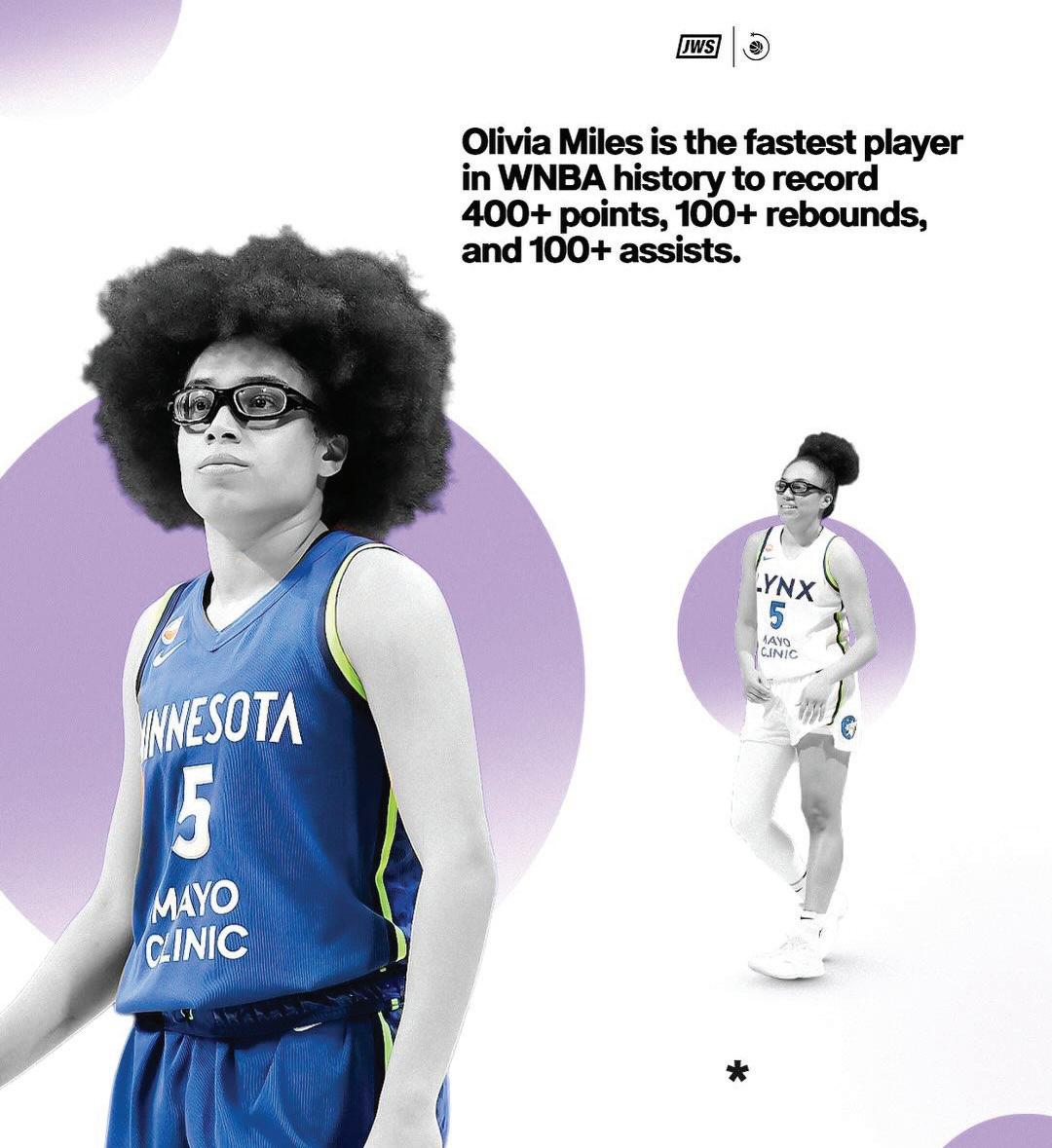

Before the event, she spoke to reporters, including MSR, on a July 13 Zoom call.
Black female gymnasts over the years have shown they can compete successfully on both the domestic and international stage, among them Simone Biles, Gabby Douglas, Jordan Chiles and Dominique Dawes, in a sport that has traditionally been
“I’m hoping to go out there and just kind of be a week to dig my toes back into competing elite again,” said the Frisco, Texas, native, “and an opportunity to compete my elite in front of a crowd and really just do my best and to enjoy the opportunity.” Blakely has been in gymnastics since 2008, competing alongside older sister Sloane. She has medaled multiple times; gold at the 2022 and 2023 World Championships, silver at the 2022 Pan American Championships and bronze at the 2019 Junior World Championships. She most recently helped the University of Florida to a third-place finish at the 2026 NCAA Women’s Gymnastics Championships.

(Coop) and Teresa Weatherspoon (Spoon) served as special GMs and drafted the
players. Team Coop, which features Lynx forward Natasha Howard, will play for An-
gels Athletics. Team Spoon, coached by Minnesota’s Cheryl Reeve and her staff and fea-
turing guards Olivia Miles and Courtney Williams, will play
Kayla McBride Natasha Howard Courtney Williams (L-R) Nia Coffey and Olivia Miles
Photos by Dr. Mitchell Palmer McDonald.
Cynthia “Red” Bryant
Minnesota Vixen
Skye Blakely