n July 3, 2025, President Trump announced that he would increase fees for international visitors to certain national parks. Over a year later, the policy is still raising questions.
For an American family of four, entrance to the parks by vehicle would cost $35, total. For non-citizens, it would cost $435 because of a $100-perperson surcharge. Those fees also increase the price of a year-long America the Beautiful pass from $80 to $250.
This fee more than triples the price of visiting these parks, and how the policy will be enforced remains unclear.
“How implementation should be happening has not been very transparent,” said Emily Thompson, director of the Coalition to Protect America’s National Parks. “So what does this look like on the ground, and especially as we’re talking about parks who are certainly struggling with staffing already? It seems that this is an added burden to already overworked park staff.”
Some park rangers have been instructed to ask visitors for proof of residence. For parks plagued by long lines and understaffing, that could be a difficult process. ■ See PARKS on page 5
The increase applies to some of the nation’s most popular spots: Acadia, Bryce Canyon, Everglades, Glacier, Grand Canyon, Grand Teton, Rocky Mountain, Sequoia and Kings Canyon, Yellowstone, Yosemite and Zion.
Community pushes back on Minneapolis drone pilot program
By Ella Stern Contributing Writer
ommunity members fervently objected to what they described as surveillance, complicity with Israel and ineffective policing at the July 8 Public Health, Safety and Equity (PHSE) Committee meeting, where members weighed a “Drones as First Responders” (DFR) pilot program. Under the plan, the Minneapolis Police Department (MPD) would use two Skydio drones, launching them to sites of 911 calls in Ward 4. Skydio is the largest drone manufacturer in the United States and has provided drones to the Israel Defense Forces (IDF). Ward 4 Council Member LaTrisha Vetaw wrote a legislative directive last spring proposing the DFR program.
squad car, and improve other city services, according to Office of Community Safety (OCS) Chief of Staff Andy Skoogman.
“Minneapolis, like many cities across the country, continues to face [police] staffing challenges,” Skoogman said. “If technology can help us improve efficiency, enhance safety and provide better service to residents, we believe it’s worth exploring.”
The two drones would be stationed at Minneapolis Fire Department’s Station 14 in North Minneapolis and launched only after the 911 director’s approval, according to Fire Department Public Information Officer Brian Feintech. Drones would stream live video to dispatch, which would relay it to officers on the ground; if footage shows no further police presence is
National parks charge foreign visitors more, and history gets a harder look Community reckons with Patriot Front march
By Jasmine McBride Editor
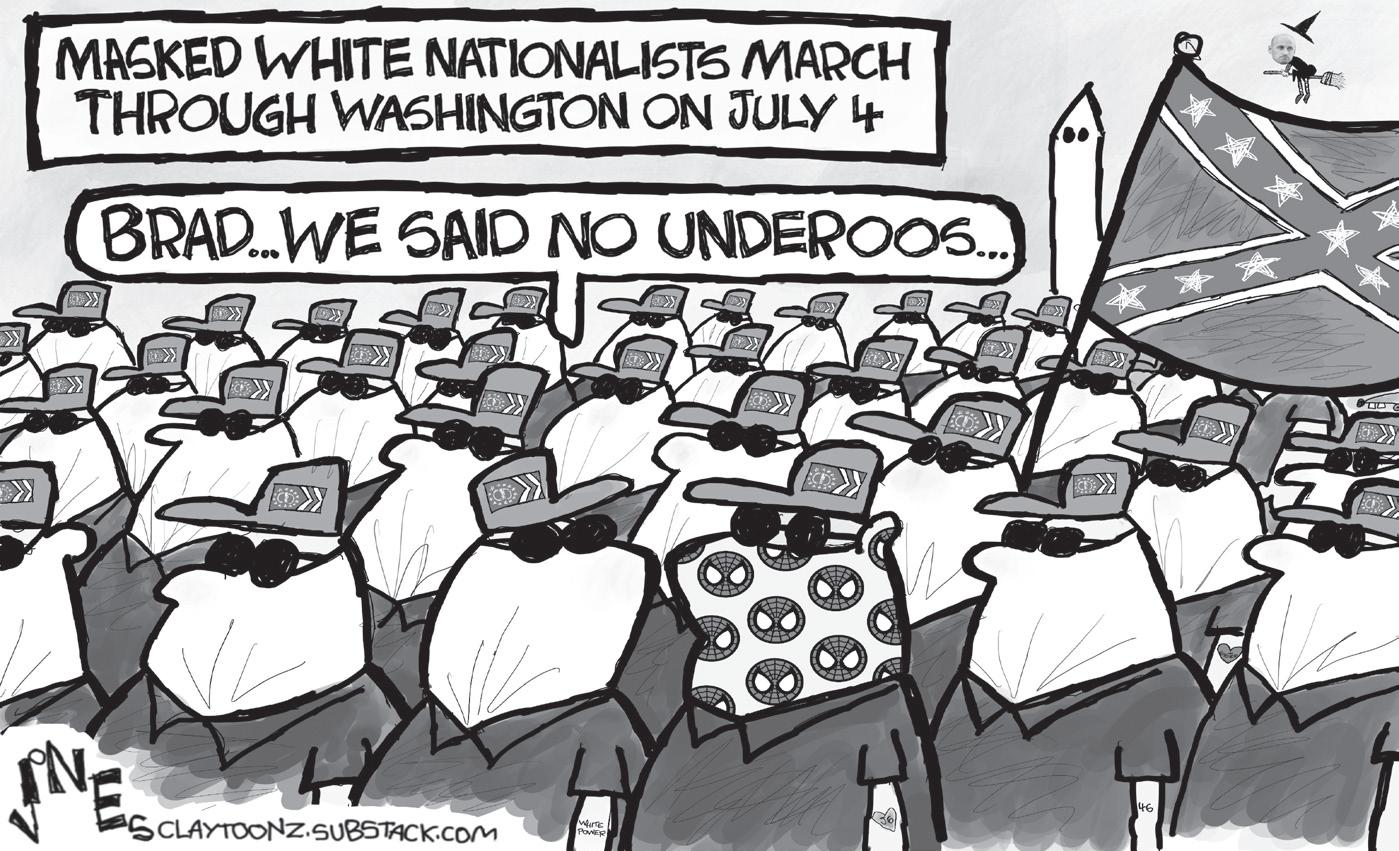
he masked column that marched through Washington, D.C. on July 4 did not walk through Minneapolis or St. Paul. But for many in Minnesota’s Black community, the images traveled here anyway, landing in a body already carrying generations of the same story.
“That is a reminder that these things are constant and consistent,” said Dr. Resmaa Menakem, therapist and author of “My Grandmother’s Hands,” of the images of white nationalists marching in formation. “It is only when something is so egregious, because we’ve been overriding for so long, that we go, wait a minute, that just happened. But it’s always happening.”
Menakem said the danger isn’t only in the visible, “feral” moments, the marches, the viral images, but in what he
calls the “seductive” pieces of white body supremacy: the daily conditioning that teaches Black people to scan a room for exits, to keep their hands visible in a store, to survive by overriding rather than processing. Left untended, he said, that weathering shows up in the body for generations. He traced his own understanding of it back to his grandmother’s hands, thick and calloused from a childhood picking cotton, a story she carried silently for decades before ever telling him why.
“This is how this stuff gets transferred down,” Menakem said. “We don’t tend to it, so we just override it and get through it, and then it shows up in these ways.”
That through line, from enslavement to the present, is also what retired Judge LaJune Thomas Lange points to in a written statement on the march. Lange noted that
"A drone will do nothing to solve this problem." How four Black women bosses define
By Tiffany Johnson Contributing Writer
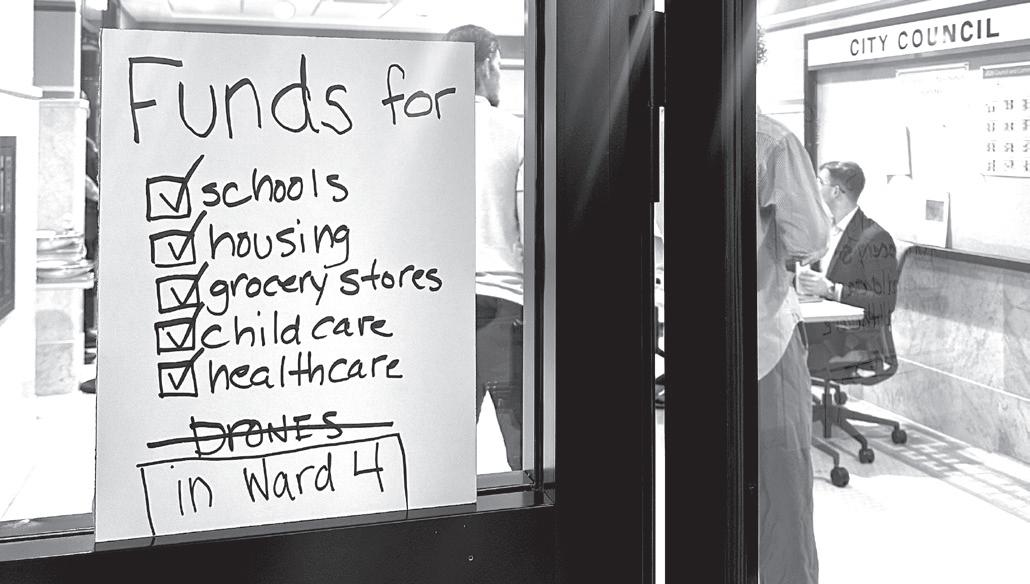
put up at City
During public comment, 40 community members asserted that the program is not how they want to be kept safe, and no one spoke in favor of the drones. PHSE decided unanimously to send the pilot program to a vote of the full City Council on July 16.
If the program passes, Minneapolis would enter a 75-day free trial with Skydio to determine whether the drones reduce MPD’s response time, clear low-level calls without a
needed, responding officers could be freed for other calls.
“Drones are not a replacement for police officers, for firefighters, for EMS personnel or other first responders,” Skoogman said. “They’re simply a tool that helps ensure the right resources are sent to the right call at the right time.” The Fourth
hen you hear the word wellness, what comes to mind?
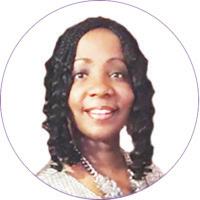
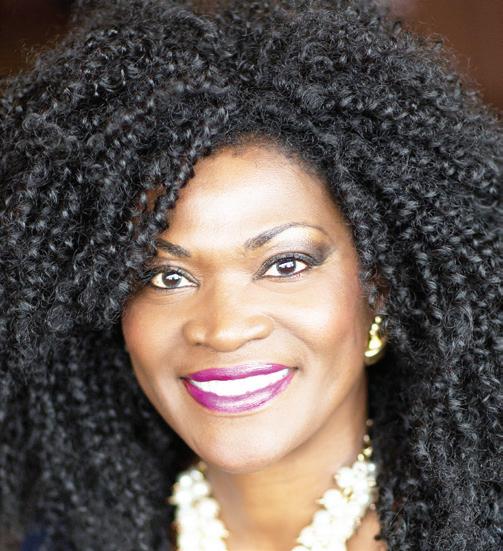
I posed that question to four Black women leaders across sectors in Minnesota: Reverend Joan Austin, founder
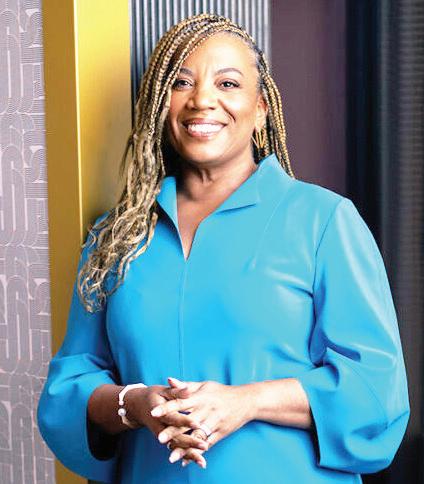
of Endure Women’s Ministries, a nonprofit supporting women in ministry; Kelsey Joson, founder and CEO of InControl, a wellness hub for adults with disabilities; Dr. Ayanna Rakhu, founder and CEO of Sankofa Swim International, promoting healing for Black and brown bodies through water; and Serena Wright, arts leader and
former director in the University of Minnesota’s Office of the Vice Provost for Faculty and Academic Affairs.
I invited each of them to share her perspective on what wellness means and how it shapes different areas of life. What emerged was a reservoir of wisdom, revealing the many ways wellness takes root, and the many ways
these women have built their own leadership around it.
Reverend Austin has served as an ordained minister for more than 25 years, and for the past decade she’s run her own nonprofit. “To me, wellness means being wellrounded spiritually, emotionally, mentally and physically.
The new “America the Beautiful” pass, which grants U.S. residents access to national parks, now features a portrait of President Trump alongside George Washington. NPR
Chris F
Precinct sent Skydio its 2025 calls for service. Skydio determined its drones could have responded
See DRONES on page 5
Sign
Council by advocates against “Drones as First Responders” (DFR) pilot program. Ella Stern/MSR
Reverend Joan Austin Endure Women's Ministries Kelsey Joson (right) InControl
Dr. Ayanna Rakhu (right) with her daughter and mother Sankofa Swim International Serena Wright Courtesy
Opportunity Crossing opens on site of Wells Fargo branch burned in 2020 uprising
By Clint Combs Contributing Writer
A new apartment complex is now leasing in South Minneapolis on the site of the former Wells Fargo branch at 3030 Nicollet Ave., which burned down during the civil uprising following the murder of George Floyd.
A ribbon cutting was held Thursday, July 9, for the grand opening of Opportunity Crossing. The 13,700-square-foot complex will feature 110 units, ranging from studios to fourbedroom apartments, including 12 affordable homes set aside for adults exiting homelessness. The development is available to prospective residents who make no more than 50% of the Minneapolis area median income.
Karla Henderson, president and CEO of Project Pride in Living, said the project carries added weight for a neighborhood still processing the killings of Alex Pretti and Renee Good just blocks away.
“What we saw with our PR firm is that ICE would gather in the parking lot at the post office, and then the residents would come out with their whistles, and then the media would show up,” Henderson said. “There would be our brand new building on TV, empty.”
“So what emerged is not simply a new development, but a reflection of what is possible when community voice, public leadership, philanthropy
and private sector investment come together around a shared purpose,” Henderson said.
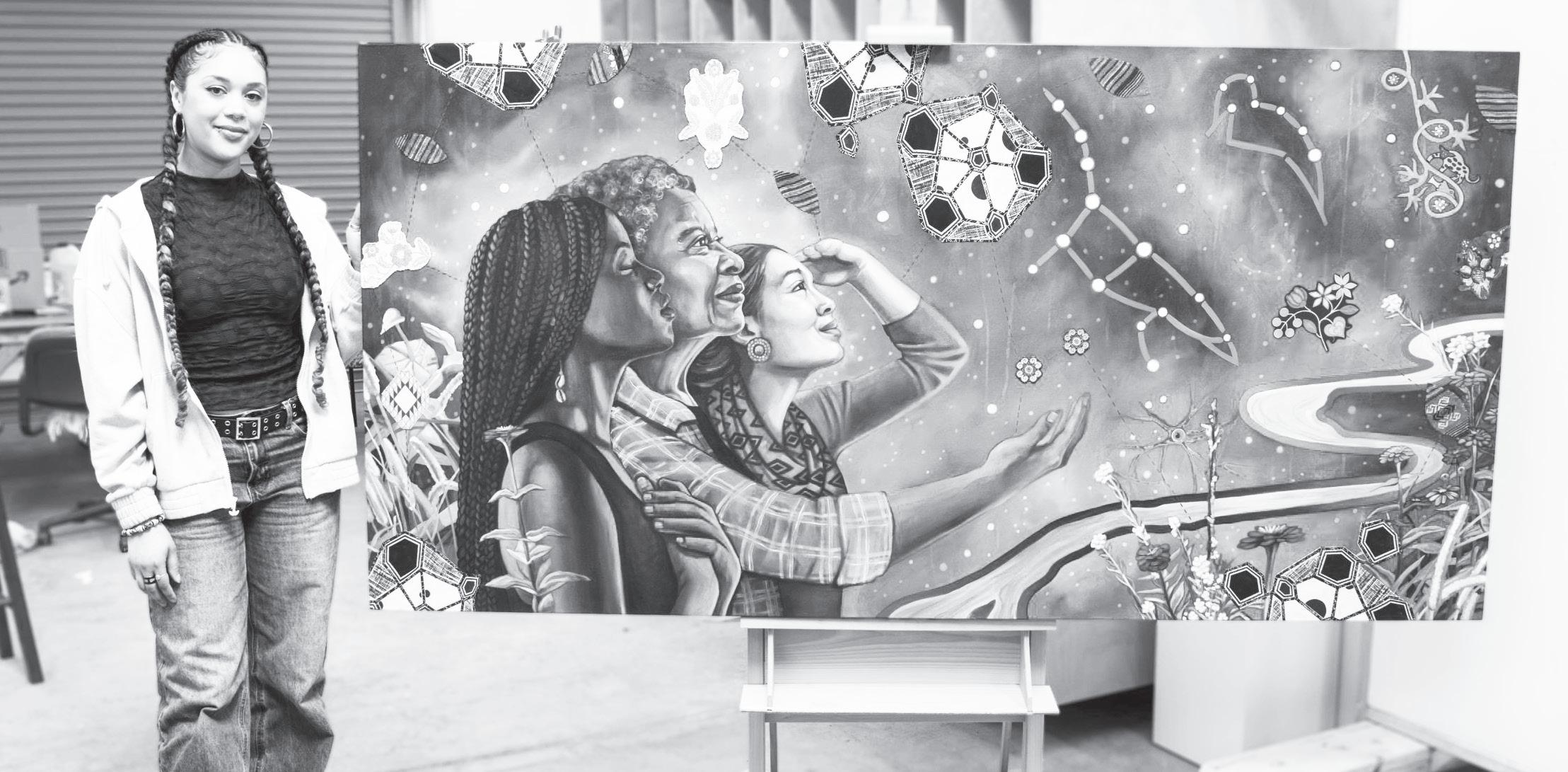
Dr. Nettrice Gast’s multistory mural towers above a ground-level patio and courtyard. The Afrofuturist artwork depicts an overlapping, diverse group of community members looking upward and forward.
Damaris Melo-Gyasi, owner and principal architect at Design by Melo, said the project was shaped less by a typical schedule, budget and materials list and more by active civic engagement.
“This building carries more than function. It carries trust, it carries dignity, and it carries the strong sense of belonging you hear about when you talk to residents here,” MeloGyasi said. “It’s proof of what happens when you listen first and design second, when you design with communities instead of for them, and when you treat lived experience as expertise, too.”
“This blend
of
we’ve worked toward through our entire administration.”
Rep. Ilhan Omar said Opportunity Crossing serves as a model that goes beyond a basic public works project.
“We don’t just see the kind of infrastructure and the kind of communities that used to exist being rebuilt. What we see is communities transformed,” Omar said. “What we see is hearts changed, and what we see is a thoughtfulness to the kind of environments we are building for the future.”
Hennepin County’s Affordable Housing Development Accelerator program contributed nearly $7 million to the project.
community-rooted commercial ownership and affordable housing is the kind of equitable development that residents have been calling for.”
Minneapolis Mayor Jacob Frey credited Henderson as a “galvanizing force,” crediting her leadership with bringing together the local, state and federal partnerships needed to get Opportunity Crossing built.
“She brought together partners in the state, like our incredible Lieutenant Governor Peggy Flanagan, our Commissioner Marion Greene, our Congresswoman Ilhan Omar,” Frey said. “You need partners like this to make these projects come to fruition. I saw our former council member and council president Andrea Jenkins, who’s also in the audience.”
Frey emphasized that the city’s $34 million investment in the project also allowed
BIPOC entrepreneurs to own property rather than be priced out by rising rents.
“They could have stopped there, but they didn’t,” Frey said. “To have commercial spaces open not to tenants, but to owners, gives business owners the ability to run with a great idea, become an entrepreneur, and reap the benefit of the work they put in, in equity. Not just equity in the social justice sense.”
Ameriprise Financial invested $4 million in the project five years ago to help anchor the affordable housing development. Aaron Kalosis, vice president and chief operations officer at Ameriprise Financial, said flexible, long-term capital helped make Opportunity
Crossing, and its 110 units of affordable housing, possible.
Minnesota Lieutenant Governor Peggy Flanagan touted the state’s $40 million investment in the Family Homeless Prevention and Assistance Program, part of an effort that has helped 100,000 Minnesotans obtain emergency housing assistance and expanded homeownership opportunities for tens of thousands of firsttime buyers through partnerships with tribal nations.
“I’m more happy to be here as a kid who grew up on the merchants, as a kid who needed that Section 8 housing voucher to pay the rent. That is what is deeply meaningful to me,” Flanagan said. “Opportunity Crossing reflects what
Commissioner Marion Greene called the investment a premier example of resilient, community-driven development.
“This blend of communityrooted commercial ownership and affordable housing is the kind of equitable development that residents have been calling for,” Greene said. “This is pandemic-era funding focused on rebuilding a more resilient and affordable housing ecosystem by investing heavily in areas impacted by civil unrest and in projects led by BIPOC teams.”
For more information, visit www.ppl-inc.org/opportunitycrossing.
Clint Combs is a contributing writer for the Minnesota Spokesman-Recorder. He welcomes reader responses at combs0284@gmail.com.
For this foundation CEO, leadership starts with “clarity is kind”
By Destiny Kromah
Contributing Writer
After years of leading some of Minnesota’s most influential nonprofit organizations, including serving as CEO of Pillsbury United Communities, chief impact officer at the Minneapolis Foundation, and now as president and CEO of the Saint Paul & Minnesota Foundation, Baker is turning inward to share the lessons that shaped her. Through her new content series, “Power of Possible: Leadership Edition,” she invites audiences into conversations about what leadership looks like beyond the resume.
Released June 17, the series has already published eight episodes exploring not just how leaders reach positions of influence, but what it takes to remain grounded once they get there. For Baker, the timing could not be more important.
“It is a difficult time to be a leader,” she said.
As organizations and communities continue to navigate uncertainty, Baker believes leadership conversations have become too focused on accomplishments and outcomes while overlooking the realities behind them. Success, she says, often hides the difficult decisions, doubts, and personal growth that make meaningful leadership possible. That perspective is especially important within Black leadership.
Baker says stories of Black leaders have always inspired her, particularly as more people step into spaces where
they are the first person who looks like them. Having carried that responsibility herself throughout much of her career, she believes those experiences deserve to be discussed more openly.
“Leadership is not positional. Leadership can get you to a position.”
The word “possible” in the series’ title reflects more than optimism. For Baker, it represents action. She describes hope as something that requires intention rather than passive belief.
“It is absolutely not passive,” she said.
To move with intention, Baker continually returns to the questions that keep her moving forward: How do I hold hope? How do I center on what is in my control? How do I break through this moment? She acknowledges the struggles many communities face today while resisting the temptation to accept those realities as permanent.
Throughout the series, Baker also shares pieces of herself that audiences may not have seen before. Rather than presenting another executive biography, she reflects on childhood experiences, personal challenges, and the moments that quietly shaped her leadership philosophy.
“It is a gift to have the opportunity to share,” she said. “I
don’t take that lightly.”
That openness mirrors the approach Baker has taken throughout her career. Of all the accomplishments on her resume, she says one of the things she is most proud of is her willingness to evolve.
“I always reserve the right to change my mind,” she said.
As her responsibilities have grown, so have her priorities. Today, Baker says creating spaciousness has become essential to how she leads. She encourages leaders to embrace reflection and radical rest as daily practices rather than occasional rewards. After experiencing burnout herself, she realized that while stress is an inevitable part of leadership, letting it become toxic is not.
“Spaciousness, reflection, and rest should be a daily practice,” she said.
That philosophy extends to every role she holds. For Baker, leadership should never require sacrificing empathy.
“I always lead with empathy,” she said. Though she recognizes that leadership often requires making choices that affect people’s lives, her guiding reminder is simple: “Clarity is kind.”
Through her series, Baker also hopes young people will rethink what leadership means.
“Leadership is not positional. Leadership can get you to a position,” she said.
Instead of chasing titles, she encourages emerging leaders to focus on becoming the strongest version of themselves wherever they are. Po-
sitions, she believes, are often the result of leadership, not the goal.
As the first season introduces both Baker and her vision for the Saint Paul & Minnesota Foundation, she hopes future episodes will expand into conversations with other leaders willing to tell the stories behind their own journeys.
For Baker, those stories matter because leadership is rarely defined by a single accomplishment. It is built in quiet moments of growth, difficult conversations, moments of rest, and the decision to keep showing up with purpose.
“My life is my testimony,” she said.
It is a quote that has guided Baker throughout her career, and one she now hopes will help others discover what leadership can look like when it is rooted not just in achievement, but in possibility.
For more information on the series, visit https://spmcf. org/pop/leadership.
Destiny Kromah is a Macalester college student and contributing writer for the Minnesota Spokesman-Recorder. She welcomes reader responses at dkromah@macalester.edu.
Chanda Baker Saint Paul & Minnesota Foundation
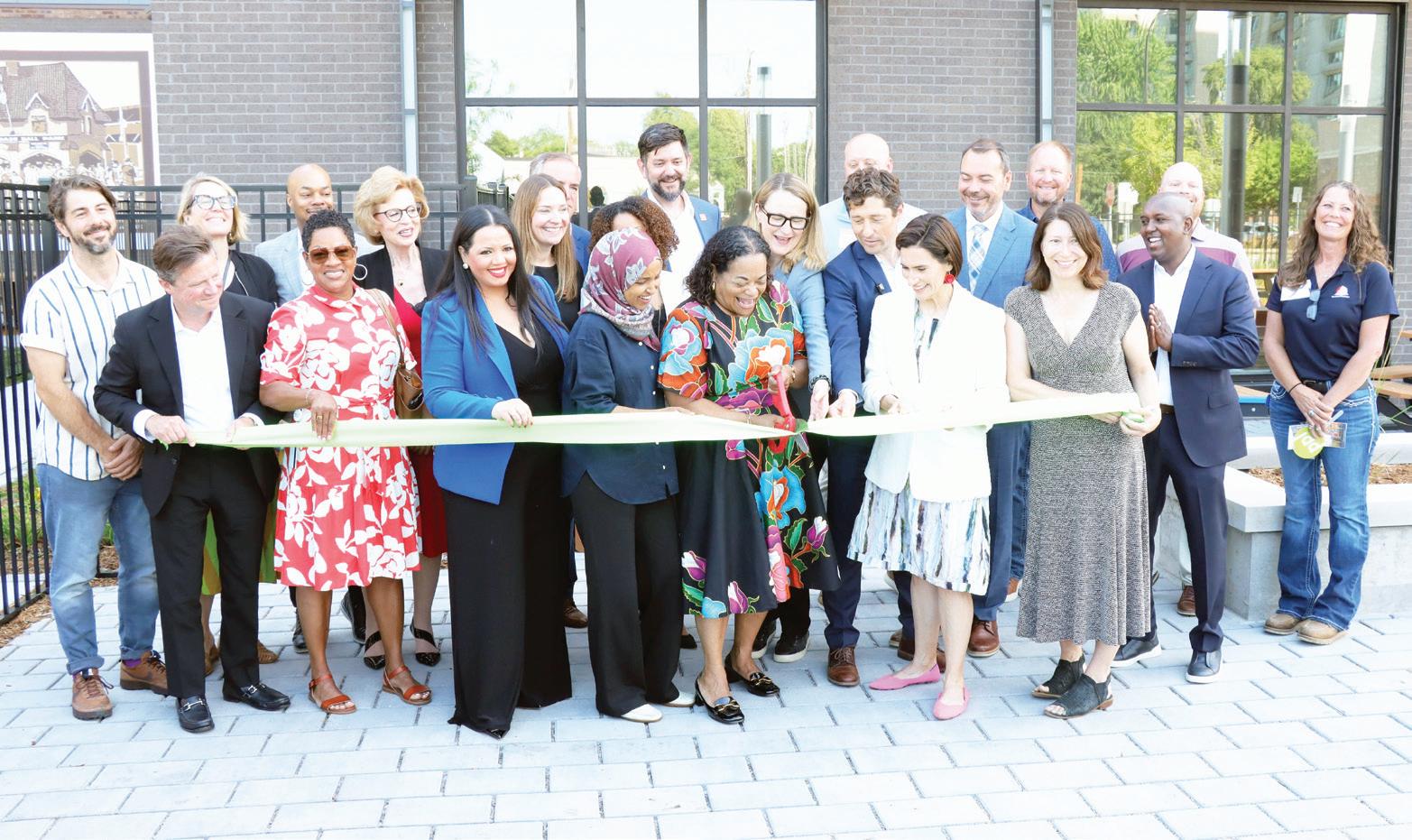
Project for Pride in Living President and CEO Karla Henderson cuts the ribbon during the July 9 grand opening of Opportunity Crossing at 3030 Nicollet Ave., joined by U.S. Rep. Ilhan Omar, left, Lt. Gov. Peggy Flanagan, right, and community members and project partners. Clint Combs/MSR
Tribe Federal Credit Union
Black Business SPOTLIGHT
By Fela Jamal Contributing Writer
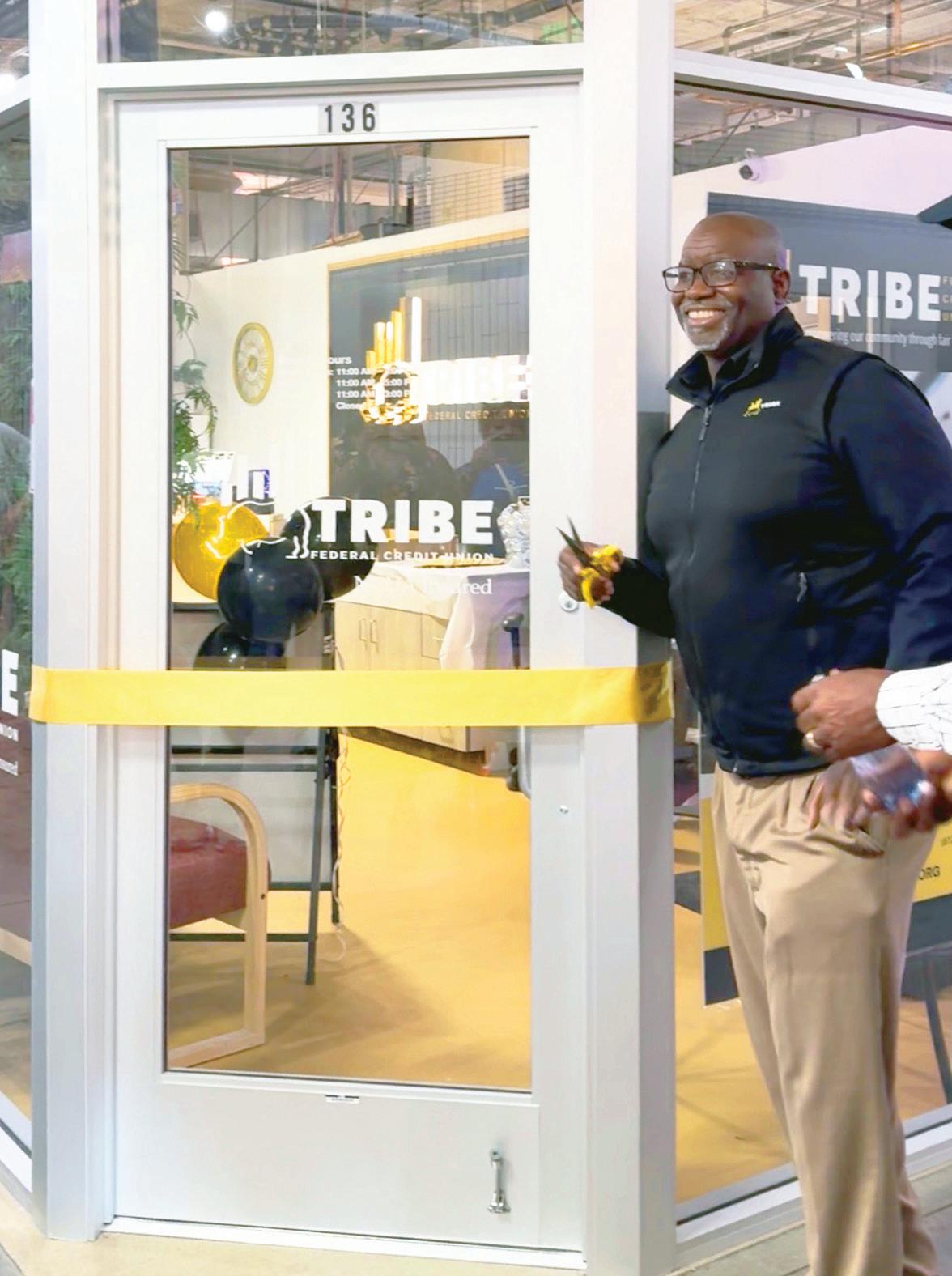
A new credit union on a mission to expand the economic power of diverse, multicultural communities in Minneapolis has opened its doors at Midtown Global Market. On June 19, Tribe Federal Credit Union celebrated its grand opening with a community celebration, offering cake and inviting neighbors to open accounts.
“The event was a great success and we were pleased to see so many community members support the newest credit union in the Minneapolis area,” said Chairman and co-founder Jose Williamson.
Tribe Federal Credit Union, known as TFCU, holds the distinction of being Minnesota’s and the nation’s first provisionally chartered credit union. A provisional charter means the institution was legally recognized and insured by the National Credit Union Administration before raising the startup funds required to become fully operational. For TFCU, that process included building a governance structure, completing all regulatory steps, and raising $600,000 in required startup funds. A milestone the organization reached in September 2025.
Jose Williamson described
the provisional charter as “an important step in Tribe Federal Credit Union’s development,” one that gave the institution the time and structure needed to get everything in order before opening its doors to the public.
Bringing community-rooted banking to Midtown
resources back into the community, the model was a natural fit for the founding members’ vision. The process demanded community support and organizing, fundraising, board development, and constant regulatory review. It required, as Jose put it, “a great deal of persistence.”
What began as a family initiative focused on financial literacy, one that, according to Williamson, saved relatives
“We want Tribe to become a long-term community asset that strengthens families, small businesses, and neighborhoods over time.”
The road to opening was years in the making. Headley Williamson, TFCU’s current CEO and the primary driving force behind the chartering effort, spent years helping family and community members navigate financial challenges like car loans, emergency expenses, credit issues, high-interest debt, and situations “where people did not feel [like] they had a trusted financial partner.”
Over time, Headley came to a conclusion: one individual was not enough. The community needed an institution. That realization led to the decision to pursue a federal credit union charter. Because credit unions are memberowned, regulated, missiondriven, and built to recycle
“hundreds of thousands of dollars in interest while building essential financial knowledge,” grew into a full-fledged financial institution aimed at serving the broader community. The choice to open in Midtown Global Market was intentional. Tribe wanted to be, in Jose’s words, “in a multicultural space that reflects the community we are trying to serve. Midtown is surrounded by small businesses, immigrant communities, working families, and everyday community life.” He was clear that while TFCU is Black-led, it is not exclusively for Black members. “It is intended to be multicultural, communityrooted, and accessible.”
TFCU also sees itself as
part of a larger movement. With Arise Community Credit Union already serving North Minneapolis, Tribe aims to extend that same mission-driven financial access into South Minneapolis from what Jose describes as “a different geographic and cultural hub.”
The work has not been carried by the Williamsons alone. A volunteer board, community members, advisors, and partners have all played a role. Established credit unions, including Affinity and Blaze, have served as mentor institutions along the way. “Their support has been valuable,” Jose said, “because starting a credit union is not only about vision. It requires governance, compliance, operations, systems, and disciplined execution.”
TFCU is now fully chartered and open for business with no provisional charter limitations. Qualifying members can open accounts, access checking and debit cards, and apply for loans. The credit union is also accepting direct deposits.
Community support remains essential to TFCU’s ability to grow. “At this stage, the most important way the community can help is by becoming members and actively using the institution,” Jose said. “That means opening accounts, moving deposits, using Tribe debit cards, setting up direct deposit, applying for responsible loans, referring others, and helping the credit union grow into a strong and sustainable community institution.”
TFCU’s broader vision centers on three pillars: promoting financial literacy, providing affordable financial services, and fostering homeownership. Jose summarized the institution’s origin and purpose simply: “Tribe grew out of the belief that communities should not only talk about financial empowerment, they should build the institutions that make it possible. We want Tribe to become a longterm community asset that
strengthens families, small businesses, and neighborhoods over time.”
Tribe Federal Credit Union is located at Midtown Global Market, 920 E. Lake St., Suite 136, in South Minneapolis. For more information or to become a member, visit tribefcu.org.
Fela Jamal is a contributing writer for the Minnesota Spokesman-Recorder. He welcomes reader responses at jamal.denman@gmail.com.
On University Avenue, barbershops and salons are building more than businesses
University Avenue has always been known for its restaurants, international markets, and family-owned shops. Increasingly, it’s also become a destination for beauty and grooming, home to barbershops, braiding studios, and salons that draw clients from across the Twin Cities.
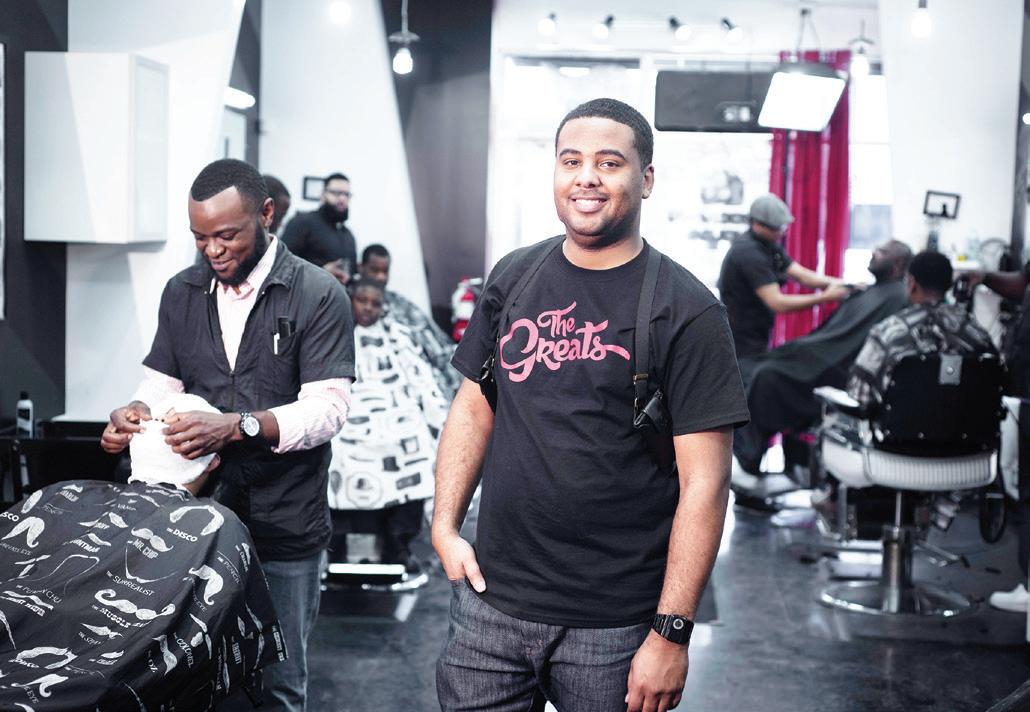
Near Victoria Station, CJ African Hair and Privilege Barber Lounge represent the range of expertise available along the corridor, from precision barbering to natural hair care to braiding styles rooted in tradition. These are businesses built by owners who know their clients aren’t just customers, but neighbors.
A few stops east at Dale Station, the density of beauty businesses tells its own story. Grooming House Barber Shop, Anh’s Hairstylists, Glamour New York Cuts, Reliance Salon, U Haircut, TT Salon, TJ Nails, and Collective Salon Studios all sit within a few blocks of each other, giving clients options without ever having to leave the neighborhood.
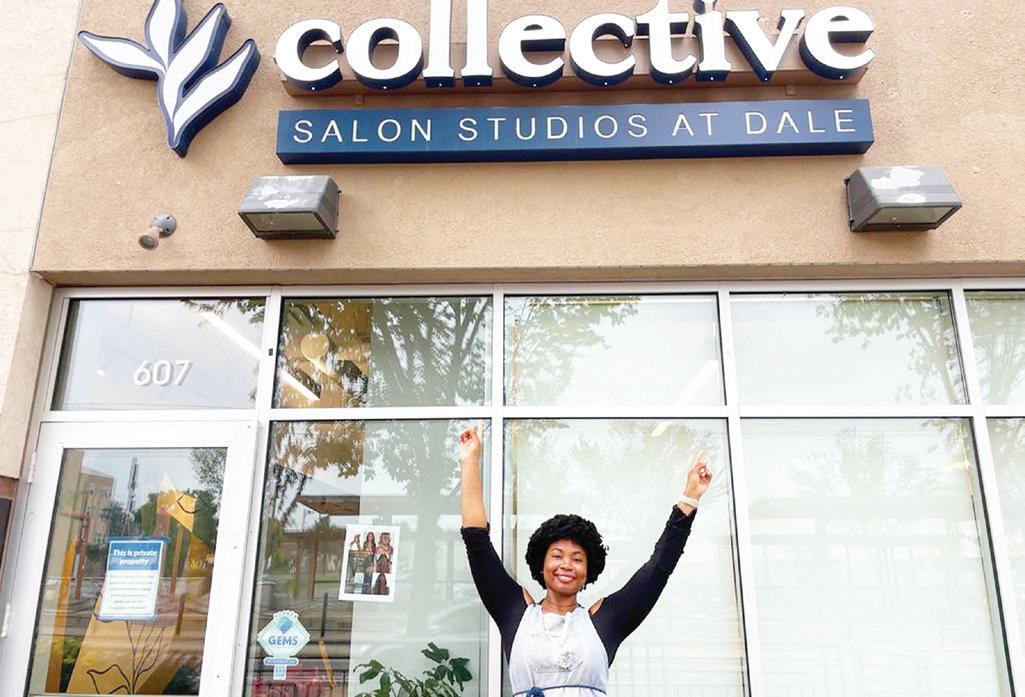
At Collective Salon Studios, independent stylists rent space to run their own businesses under one roof, a model that gives owners a path to running their own shop without the overhead of a standalone storefront.
Angela Walker, owner of Crown Garden, is one of them. Walker grew up in the neighborhood she now serves.
“Serving my clients in the heart of Frogtown has me feeling empowered,” Walker said. “I am honored to work within a community of thriving businesses. The convenience, diversity, and professionalism of the neighborhood motivate me to be my best self and continuously elevate my business at Collective Salon Studios.”
Just down the block, Damen Johnson is carrying on a family legacy at Grooming House Barber Shop, located on Dale near Collective Salon Studios. For Johnson, the shop isn’t just his first venture
on the avenue, it’s a continuation of a story his grandmother started decades ago. “I love owning a business on University Avenue in such a great community, following in the footsteps of my grandmother Shirley who owned Ebony Lady and served our community for years before me,” Johnson said.
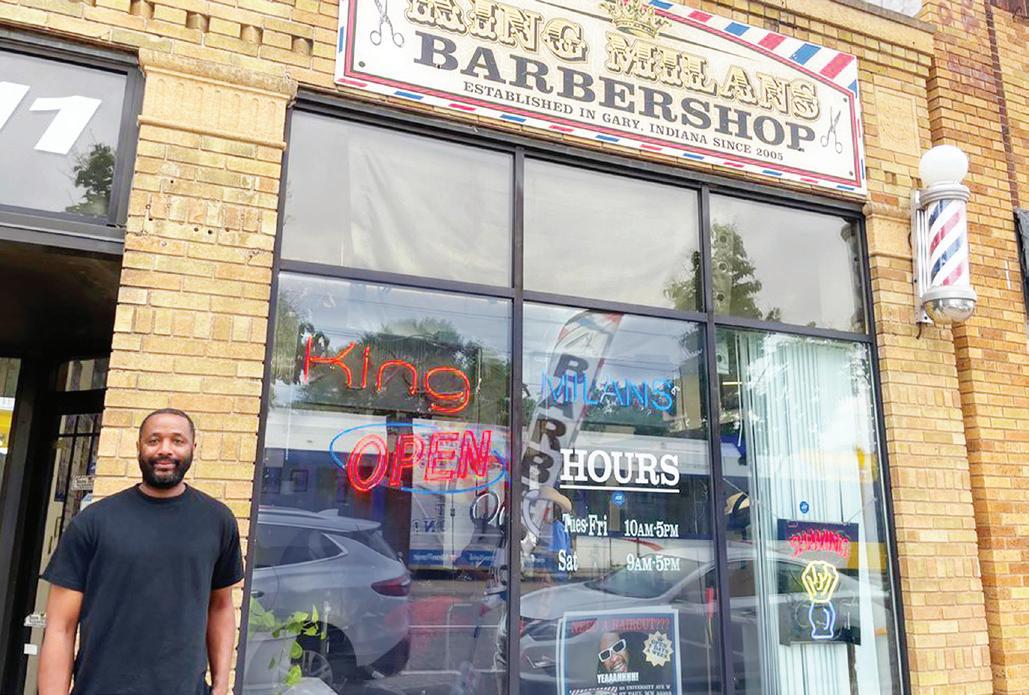
Closer to Western Station, Blendz Barber Shop and King Milan’s Barber Shop show what it looks like when a barbershop becomes a cornerstone of the block. For Milan Dennie, owner of King Milan’s, the shop was never just about the cut.
philosophy further by partnering with the nonprofit It’s Our Neighborhood (ION) to launch Minnesota’s first youth barber training program, creating a direct pipeline for young people to build career skills, confidence, and a path toward owning their own shop one day.
These businesses are just a sample of the salons, barbershops, and beauty entrepreneurs who’ve made University Avenue home. Owners like Walker, Johnson, and Dennie describe their shops as places built on more than transactions, spaces for mentorship, connection, and pride in the
“Owning a business on University Avenue means much more to me than operating a barbershop,” Dennie said. “My shop has become a place where people come not only for haircuts, but for mentorship, encouragement, and connection.” Dennie has taken that
neighborhoods they come from. Their success is a reminder of what local ownership can mean for a corridor like University Avenue.
To explore the full list of businesses participating in the Hidden GEMS on University Avenue campaign, including restaurants, retailers, beauty businesses, and service providers throughout the district, visit www.ndc-mn.org/gems. Business owners along University Avenue interested in learning more about the campaign or getting involved can reach Neighborhood Development Center at communications@ndc-mn.org.
That story is now getting wider recognition through University Avenue’s Hidden GEMS campaign, an initiative led by Neighborhood Development Center (NDC) with support from the City of Saint Paul’s Commercial Corridor Program. This summer, the campaign is spotlighting businesses between Lexington Parkway and Rice Street through window clings, billboards, local influencers, and digital storytelling.
Tribe Federal Credit Union CEO Headley Williamson cuts the ribbon at the credit union’s grand opening at Midtown Global Market in Minneapolis, June 19. Courtesy
Angela Walker, owner of Crown Garden at Collective Salon Studios. NDC
Damen Johnson, owner of The Grooming House barbershop. NDC
Milan Dennie, owner of King Milan’s Barbershop. NDC
Sponsored by
Don’t let fraud and scams ground your summer vacation
Sponsored by
As you make your summer travel plans this year, or perhaps you’ve already hit the road or you’re on your way to the airport, one thing to keep in mind, without putting too much of a damper on your trip, is to stay financially vigilant when finalizing your vacation plans.
The travel and events sector is especially susceptible for fraud and scams as people are looking for deals in locations that might be unfamiliar, with bad actors savvier than ever when it comes to separating travelers from their money. Once travelers figure out their plans, they’re ready to hand over the funds to make their dream vacations happen, and scammers are more than happy to take it.
Antonio Carmona-Elias, Chase community manager in Minneapolis-St. Paul, offers these tips to help you avoid the latest and most common travel scams so you can relax and enjoy your trip.
Vacation rental scams
So you’ve found a great house on a vacation rental website and email the property through the website. You might have received a call back from the “owner,” who asked you to send your deposit through Zelle or another peer-to-peer app. The “owner”
will often pressure you into sending a deposit to hold the property, saying there’s a lot of demand for the location, and may ask to move the conversation from the official website to a private messaging app. As your trip gets closer, you might reach out to confirm the details or assume all is well and travel to the property at the start of your trip. That’s when you discover the location is already booked, not available to rent or doesn’t exist at all.
"Watch out for automated calls or texts offering free vacations or ‘vacation
The listing you saw could have been fake, or a fake phone number was posted to a real listing, and the true owner has no idea about your reservation. Either way, you’re stuck without lodging and your payment, with little chance of getting your money back.
Most major property rental sites offer fraud guarantees, but only if you pay and communicate with the owners through the site. To avoid lodging scams, try to see properties in person if possible, read reviews from other travelers, and pay through the
official platform. Sending deposits through wire transfers or P2P apps is like sending cash. Once you send it you may not be able to get it back.
“Free” trips
Unless you’ve won a legitimate contest or sweepstakes, and even those should be examined, there’s no such thing as a free vacation. If you get a call, text, email or other notification that you’ve won a free vacation, it may be a scam, especially if you don’t remember entering a contest.
Watch out for automated calls or texts offering free vacations or “vacation deals.”
There may not be a vacation package available at all, or you’ll be asked to pay processing fees, taxes and other costs to claim your “free” trip, which might include substandard accommodations.
If you did enter a contest and are told you’re the winner, you won’t be asked to send money to claim your prize. The Federal Trade Commission is a good resource for information on recognizing legitimate versus fraudulent contests.
Flight scams
If you hear about a charter flight or other private flight deal to a destination, sometimes including a tour or hotel stay, be extra careful. Too many would-be travelers find out after paying their money that the flight, and sometimes the entire trip, is nonexistent.
The U.S. Department of Transportation maintains updated lists of approved charter flights so you can make sure the company you’re considering is legitimate.
Concert/event ticket scams
The event ticket industry is ripe for scammers. You might find an amazing deal for a sold-out show on social media, send money to the seller and never hear from them again. Not only do you not have concert tickets, there’s also no way to get your money back. While some social media sellers might be legitimate, the best sources for ticket deals are verified resale sites that handle transactions and guarantee authenticity. If something goes wrong, there’s a digital “paper trail” that can help you get your money back.
Reminders
While even the most prepared consumers can fall victim to a well-executed scam, remember these tips to protect your vacation plans.
• Zelle and other P2P payment apps should be reserved for family, friends and businesses you know and trust. Treat your transactions like cash. Once scammers get the money, you may not get it back.
• Scammers are advertising on social media and social marketplaces. Whenever possible, shop through official websites and be cautious of deals that seem too good to be true before sending any money.
• Scammers can make caller ID, emails and texts display as messages from your bank or other businesses. If you are
How people are fighting back from unexpected expenses
ever unsure, end the conversation and reach out to the company directly through their official website or call the number on the back of your card.
For more financial health tips, visit chase.com/security.
For informational/educational purposes only: Views and strategies described in this article or provided via links may not be appropriate for everyone and are not intended as specific advice/recommendation for any business. Information has been obtained from sources believed to be reliable, but JPMorgan Chase & Co. or its affiliates and/ or subsidiaries do not warrant its completeness or accuracy. The material is not intended to provide legal, tax, or financial advice or to indicate the availability or suitability of any JPMorgan Chase Bank, N.A. product or service. You should carefully consider your needs and objectives before making any decisions and consult the appropriate professional(s). Outlooks and past performance are not guarantees of future results.
JPMorgan Chase & Co. and its affiliates are not responsible for, and do not provide or endorse third party products, services, or other content.
People are fighting back against unexpected expenses by building flexible buffers instead of rigid budgets, shifting to side hustles for extra income, shopping around for better rates on essentials, and treating financial literacy as a priority.
More households are asking the same questions. How do you recover when one unexpected cost triggers a chain reaction across the rest of your spending? What helps keep one bad month from turning into long-term financial strain?
If a surprise bill has ever wrecked your entire month, you are not alone. A survey by Qualtrics for Intuit Credit Karma found that nearly half of U.S. respondents, 49%, said their finances took a turn for the worse in 2025. Most pointed to unexpected expenses as the main reason their budgets slipped.
Financial resilience is not about avoiding problems. It is about being able to absorb them without everything spiraling at once, and building it starts with knowing where the danger lies. Common risks include medical emergencies such as urgent care, prescriptions or dental issues; vehicle repairs or tire replacements; home repairs or appliance replacements; and family emergencies or support.
From there, the next step is setting emergency fund goals. Experts often suggest saving three to six months of
living expenses. That might sound like a huge amount, but it does not have to happen overnight. Even $20 a month into a separate account builds a buffer over time. Consistency matters more than the size of any single deposit. Setting up automatic transfers, so a small, steady portion of each paycheck moves into savings, takes the decision out of your hands. Putting windfalls such as tax refunds or work bonuses straight into that account, rather than spending them, speeds things along. The money should stay out of a primary checking account, where it is too easy to spend on groceries or entertainment instead. Tightening expenses is another piece of the puzzle. Paying close attention to where money is going makes it easier to stay on top of fixed costs,
prioritize what matters most, and adjust spending where it makes sense. That can mean switching providers or dropping a higher-tier plan that is not really needed. Going through subscriptions and memberships and canceling what is no longer used frees up money that can go toward savings or everyday essentials instead.
Debt deserves the same focused approach. Rather than trying to clear everything at once, tackling the highestinterest balance first reduces stress and frees up cash flow faster than spreading payments thin across every account.
Building skills matters as much as building savings. In 2025, nearly three-quarters of Americans said they either already had a side hustle or
were seriously considering starting one. Side income does not have to mean a second full-time job. Basic admin work, tutoring, repairs, digital tasks, driving or delivery, and handmade crafts or products are all common starting points. Taking classes or earning certifications, and keeping a resume up to date, rounds out the picture. Insurance is the first line of defense, but only if the coverage matches the real risk. If coverage is too low or does not apply to the type of risk faced, most of the cost still lands on the policyholder. Nobody needs every type of insurance at the highest level, but covering the biggest risks first, health insurance, car insurance, home or renter’s insurance, and income protection or disability coverage,
keeps unexpected expenses from turning into long-term financial problems. Reviewing policies once a year is worth the time.
Financial literacy, including basic skills such as budgeting, understanding debt, knowing how interest works and making informed choices about saving and spending, is often discussed alongside broader economic conditions, including income and wealth inequality in the United States. It matters, but it does not operate in isolation. An Annuity.org report highlights that many Black Americans continue to face lower levels of wealth, credit challenges and lower retirement savings, factors that can make it harder to build financial stability over time.
“Staying on track financially is not a one-time task.”
Doom spending, or making purchases in response to economic anxiety rather than as a planned decision, is one of the more common ways financial resilience breaks down. Recognizing the emotional trigger behind a purchase, rather than just the price tag, is often the first step toward breaking that cycle.
Staying on track financially is not a one-time task. Set-
ting aside time each week or month to review accounts and spending, and looking for patterns instead of fixating on every transaction, makes it easier to catch problems early. Keeping essentials, savings and everyday spending separate makes it easier to see where money is actually going, and anyone who feels overwhelmed should not hesitate to seek professional financial planning advice. A workable budget does not have to be complicated, but it has to match real life rather than ideal spending. Starting with actual income, listing fixed costs such as rent, transportation, utilities and basic debt payments, and then splitting the remainder into categories like food, personal spending and savings gives every dollar a job before the month even starts.
Unexpected expenses are part of life. Nobody can prevent every flat tire or every leak, but building an emergency fund and staying on top of debt changes how those events affect a household. The next bill will come. The goal is to already be ready for it.
This article appeared first in Black Press USA. It has been edited for style and length. For the original, visit https://
PARKS
Continued from page 1
“These are park employees who are collecting fees at entrance gates,” Thompson said. “Park employees shouldn’t be in a position of having to validate or confirm citizenship in any way, shape or form.”
Rangers have reportedly been instructed to ask either “Is everybody in the car a U.S. citizen?” or “Is there anybody in the vehicle that is a foreign national?” Some full tour buses have had to disembark so passengers can show ID, while other cars have driven through without any questions or identification checks. Some rangers have expressed confusion and dismay about the policy change.
DRONES
Continued from page 1
within two minutes to 4,643 of the precinct’s 33,402 Priority 0 and 1 calls that year, over 17% by the company’s count, according to Skoogman’s presentation.
The actual number is 13.9%.
Priority 0 and 1 calls are MPD’s highest priority, including auto thefts in progress, weapons calls, ShotSpotter alerts, shootings and suspicious persons.
Vetaw said she introduced the pilot as a possible response to low-priority calls in her district, including illegal dumping.
“I have been told that the reason that I should support this program by my council person is that it will do something about illegal dumping and chop shops in North [Minneapolis],” Ward 4 resident
Sarah Heller said. “A drone will do nothing to solve this problem. ... They want drones
PARTIOT
Continued from page 1
the Ku Klux Klan was founded in December 1865 by Confederate veterans under Nathan Bedford Forrest with the explicit goal of preserving white supremacy, and that Independence Day itself has been “exploited by White Supremacist groups for more than 100 years.”
Lange connected the march directly to present-day politics, arriving “only weeks before the midterms” alongside new voter ID and redistricting efforts she described as a continuation of the Klan’s historical playbook of voter suppression. She also pointed to unresolved local history, including the lynching
BOSSES
Continued from page 1
It’s about nurturing each of those aspects of ourselves as we navigate the different experiences and challenges of life,” she said.
“I was at a point where I wanted to give up in ministry, and during prayer, the Lord told me not to give up. He said ‘He needed me to endure,’ and that’s where the name came from.” The name is also an acronym: Equipped, Nurtured, Devoted, United, Renewed and Empowered.
Joson, founder of InControl, has built her career around others’ wellness. “When I hear wellness, what comes to mind is how someone takes care of their body, and not just physically. Wellness was never meant to be one dimensional.
It is everything that goes into
Thompson said the Coalition supports entrance fees, and even supports increasing them, but if these dramatic changes drive visitors away, that’s a threat to the park system. It’s also a threat to “gateway communities,” towns directly outside of national parks that rely on park tourism for much of their revenue.
Supporters of the policy argue that foreign visitors should contribute more to maintaining the public lands they enjoy, and that U.S. taxpayers already support the parks through federal taxes. They suggest that for international travelers, the additional fee is minor compared to the total trip cost, including airfare and lodging.
Opponents contend that reduced tourism could offset
first, and they’ll figure out what they’re going to do with them later. That concerns me deeply, as someone who has lived in a part of town that has suffered a lot of police abuse.”
Opposition went beyond questioning whether the program would meet its stated purpose. Many raised privacy concerns about the footage and data the drones would collect, heightened by their communities’ experiences during Operation Metro Surge.
“This could be used as a tool to expand state-sanctioned violence, surveil protests and dissent, and bring in huge amounts of visual data on Black and brown communities,” said Maddie, a Ward 7 resident.
“I wonder how this [would] affect community rapid response systems as we rely on community members to respond to ICE. And I’d like to know: how many of your immigrant constituents would feel safer with this expanded surveillance?”
of three Black circus workers in Duluth and a case of a young Black man found hanging from a tree there in more recent years, as evidence that the reckoning has never fully happened.
“We must learn about the predictive nature of history,” Lange wrote, tracing a line “from Dred and Harriet Scott to the present.”
Carla Hill, vice president of research and investigations at the ADL’s Center on Extremism, said Patriot Front’s July 4 demonstration appeared to be its largest on record. The Texas-based group, responsible for the majority of white supremacist flash demonstrations nationally since 2019, relies on speed and secrecy, marching a short route and
being a whole human being, the mental piece, the emotional piece, the spiritual piece, all working together to create a firm foundation,” she said.
“InControl is devoted to solving the quality of life crisis for adults with intellectual and developmental disabilities across Minnesota. We provide in-home coaching focused on physical health, nutrition and social emotional wellbeing, meeting clients exactly where they are and helping them build real agency and independence in their own lives.”
Dr. Rakhu leads Sankofa Swim International and serves on the board of V3 Sports, a wellness hub in North Minneapolis, teaching communities from Minnesota to Grenada.
“When I hear the word wellness, I picture a set of scales,” she said. “Sometimes one side is heavier than the other, and sometimes they’re perfectly aligned. But the scales are al-
much of the additional fee revenue while creating new burdens for park employees, and staff worry about alienating international visitors.
In 2024, the National Park Service reported that 332 million park visitors spent an estimated $29 billion in local gateway regions. Minnesota saw 1.1 million park visitors spend around $69.4 million.
No Minnesota national parks were included in the $100 surcharge, but the America the Beautiful pass includes admission to Voyageurs National Park.
The fee changes arrived alongside other shifts to how the parks operate. The administration also removed Martin Luther King Jr. Day and Juneteenth from the list of feefree days, replacing them with
Trump’s birthday and Constitution Day.
The America the Beautiful pass itself has also drawn scrutiny. Since 2004, the pass has featured a winning image from an annual public lands photo contest. For 2026, that contest was won by a photo of Glacier National Park, but NPR reported that the image was moved to the pass sold to nonresidents, while the pass sold to U.S. residents instead features a portrait of Trump alongside George Washington. The National Park Service confirmed that if that portrait is covered with a sticker, the card will be invalidated, a policy that has drawn its own backlash and at least one lawsuit.
The Trump administration has also attempted to restrict signage and educational material. In March 2025, Trump
Skoogman said drone operations would follow Minnesota Statute 626.19, barring drones from randomly surveilling or carrying facial recognition or weapons. “By no means are we using these drones for any type of surveillance,” he said. The statute also regulates when drones can be operated. However, pilots can request permission to fly drones for situations outside of the statute, including monitoring public events that
disappearing before law enforcement or counter-protesters can respond, she said.
“The goal is a clean, intimidating visual spectacle, one built for social media, not for dialogue,” Hill said. She noted the group deliberately packages its ideology in “patriotic” red, white and blue branding, with slogans like “Reclaim America” alongside more explicit rhetoric like “American Spirit, European Blood.” Hill said ADL has documented Patriot Front propaganda distributions in Minnesota and urged journalists to report not just what happened, but who the group is and what it believes.
State Rep. Esther Agbaje said the march lands amid a broader rollback she’s tracking closely, from the Supreme
ways adjusting. That’s how I think about wellness.”
It’s no coincidence that Rakhu’s specialty exists in the world of water, where balance is essential for survival. She’s passionate about restoring healing in the Black community around its historic relationship with water, challenging stereotypes about Black people and swimming while acknowledging the historical trauma of the transatlantic slave trade and the African diaspora.
“I describe my work as liberation work because I believe healing our relationship with water is liberating,” she said. “The communities I serve are Black people and people of African descent. I’m especially concerned about that relationship. That’s where my work lies.”
Wright, a leader in Minnesota’s arts and education community, finds sanctuary in nature. “Nature has always
signed an executive order directing parks staff to remove signs “disparaging Americans past or living” in order to “Restore truth and sanity to American History.
National Park Service crews removed a slavery exhibit at Philadelphia’s Independence National Historical Park following the executive order. Additional signs referencing climate change, women’s rights and Indigenous history have also been removed from park sites nationwide, according to AP News.
The Equal Justice Initiative reported that Interior Secretary Doug Burgum ordered NPS staff to post QR code signs at NPS properties asking visitors to identify “any signs or other information that are negative about either past or living
Jamison Whiting said about monitoring public events.
Ward 4 resident Kaitlyn Metzel questioned the longterm use of collected data:
“My main concern with this pilot program is what happens after the pilot. ... Who will [data] be shared with? And how can we guarantee it won’t quickly be handed over to invading parties?”
pose a heightened risk to participants and bystanders, conducting threat assessments in anticipation of certain events, and non-law enforcement purposes for which a government agency has filed a specific written request. Several community members worried that the drones would surveil protests using these carve-outs.
“If it is not surveilling, what is the reason for the deployment of the drone in that situation?” Council Member
Court’s May ruling on the Voting Rights Act to reports that the U.S. Department of Justice wants to send observers to state primary polls, including Minnesota’s in August. She pointed to a Trump administration social media post targeting an image of immigrant kindergartners as part of the same pattern.
“The goal is a clean, intimidating visual spectacle, one built for social media, not for dialogue.”
“We continue to see this attack on communities of color, especially Black communities, especially Black immigrant communities,” Agbaje said.
been a part of who I am. I literally take the time to look at a leaf, because that brings me to life.” Her connection to nature feels fitting given her recent recognition at Flowers Now!: A Celebration of Black Elders of the Arts Community, presented by the Givens Collection of African American Literature in May 2026.
“Wellness is a body, mind and spirit connection,” Wright said. “It’s checking in with myself first, being willing to ask questions, seeking honest feedback and pushing through discomfort. I don’t want to be paralyzed by fear, because that’s how I continue to grow.”
Americans or that fail to emphasize the beauty, grandeur, and abundance of landscapes and other natural features.”
An analysis by the Center for Western Priorities found less than 1% of 35,700 comments submitted used the form as intended. Most either disparaged the policy itself, were advocacy letters from coordinated campaigns or were requests for more inclusive history. For more information on National Park Service updates, visit www.nps.gov/planyourvisit/passes.htm.
Anya Armentrout is a freelance journalist, a student at Macalester College and a contributing writer for the Minnesota Spokesman-Recorder. She welcomes reader responses at anyaarmentrout@gmail.com.
Gaza, saying drones identified his home as a target before the IDF raided it and attack dogs mauled him to death.
Skoogman said drone cameras will point toward the horizon en route to incidents but activate once drones reach the scene. Data will upload to evidence.com; non-evidentiary data will be deleted within a week, while evidentiary data will be retained indefinitely.
Other community members objected to partnering with Skydio given the IDF’s use of its drones in Gaza. Sana Wazwaz, chapter lead of American Muslims for Palestine Minnesota, showed council members a photo of Mohammed Bhar, a Palestinian man from
“But our communities are resilient. We find safety and power within each other.”
Agbaje said the state continues to monitor Minneapolis’s police reform agreement with the Minnesota Department of Human Rights and to invest in housing, healthcare and education as underpinnings of safety. But she was direct about the limits of state power when federal institutions stay silent. “We kind of do the most that we can to backfill the federal government,” she said. “At the end of the day, we just have a federal government that is on a very different trajectory than where most Minnesotans are.”
For Menakem, the work ahead isn’t remedy, it’s tending. “So often we look for rem-
Though Wright recently retired from her longstanding role at the University of Minnesota, she doesn’t see it as an ending, but as “a reset,” continuing part-time at the university while staying deeply engaged in the arts community.
These four women, different in practice, revealed real overlap in how they approach wellness, and leadership.
On community: “You don’t need people tearing you down. You need people who will tell you the truth with love,” Wright said.
On showing up over perfection: “I protect my mornings as time for myself first, before I give my attention to anything else,” Joson said.
On movement: “I really love to roller skate. It reminds me of my capability, reminds me of my joy,” Rakhu said. “Wellness doesn’t have to look like a gym. Movement can be the smallest things we do every day,” Wright added.
On where to start: “Start with prayer, because I know God will lead, guide and direct,” Austin said. Rakhu suggested something simpler: “Make a list. It gets things
“This isn’t about rhetoric, this is about human life,” Wazwaz said. “Minneapolis, when you choose to contract with Skydio, you are deciding to be complicit in Mohammed’s death, complicit in the genocide of Gaza. In your pursuit of stopping crime, you are committing an even greater crime.”
The Skydio drones would add to MPD’s existing program: 12 exterior and 17 interior drones, 12 licensed pilots and over 640 missions since fall 2022. Skydio partners with five agencies in Minnesota: St. Paul, Duluth, Rochester, Minnetonka and Brooklyn Park, among 236 nationwide.
Ella Stern is a Macalester student and contributing writer for the Minnesota Spokesman-Recorder. She welcomes reader responses at erstern10@gmail.com.
edy. Remedy is not our job,” he said. “Our role is to create the conditions.” That means practicing the small, repetitive acts of noticing: orienting to a room, breathing, touching the places in the body that carry tension, not to fix the harm, but to keep from carrying it silently, the way his grandmother once did.
“I think my work is becoming more and more important for this time,” Menakem said. “We know the patterns of white body supremacy. What we have to begin to do is examine and tend to what it is that we already know, as opposed to acting like we don’t know.”
Jasmine McBride welcomes reader responses at jmcbride@ spokesman-recorder.com.
out of your head and into this world of manifestation.” Wright summed it up: “Wellness isn’t about taking one big step. It’s about the little things you do every day.” Wellness looks different for everyone, but these women point to one universal truth: caring for ourselves allows us to better care for others. By investing in their own physical, emotional, mental and spiritual health, they’ve become stronger leaders, building lasting impact in the communities they serve.
To learn more, visit Endure Women’s Ministries at endurewomensministries.org, InControl at incontrolmn.com, or Sankofa Swim International at sankofaswim.com.
Tiffany Johnson is a contributing writer for the Minnesota Spokesman-Recorder. She welcomes reader responses at tjohnson@spokesman-recorder.com.
Sign put up at City Council by advocates against "Drones as First Responders" (DFR) pilot program. Ella Stern/MSR
Arts & Culture
New Minneapolis mural imagines Black and Indigenous futures among the stars
By Callisto Martinez
Growing up, visual artist
Leslie Barlow wanted to be an astronaut. Now, her mural Belonging to the Entire Universe, titled in reference to a quote from astronaut Mae Jemison, the first Black woman to travel into space, brings Barlow’s vision of a future universe to downtown Minneapolis.
Unveiled on June 12, the 66-by-33-foot installation faces the U.S. Bank Stadium and is displayed on the Minneapolis headquarters of the McKnight Foundation, a Minnesotabased foundation dedicated to advancing climate solutions, combatting housing instability and confronting other issues impacting Minnesotans.
“This mural is both a reflection and a call.”
“What I would love people to take away from it is this reminder of our relationship to the land, to each other, to our ancestors’ lineage, and then, of course, as the title says, to the entire universe,” said Barlow, a 2025 McKnight Visual Artist Fellow.
Barlow has long admired Jemison, enough to dress up as her for Halloween a few years ago, but the piece was not titled after Jemison until it was already finished. Barlow’s initial inspiration for the piece came directly from McKnight’s mission to “advance a more just, creative, and abundant future where people and [the] planet thrive.”
“With the words ‘just,’ ‘creative,’ and ‘abundant,’ I was thinking of something that
showed a large amount of space, something that was really colorful and vibrant, definitely something that had plant life and spoke to the environment and the planet, so that’s where the cosmic imagery came in,”
Barlow said. “I wanted it to feel like it flowed between different images to encompass people and [the] planet.”
Barlow’s piece began with digital sketches that she presented to a committee of McKnight staff and board members, who gave feedback on the design and unanimously selected her from a pool of applicants.
Barlow began rendering her drafts into a 7-foot-wide and 3.5-foot-tall oil painting in February, when Operation Metro Surge was in full force.
“It was actually very difficult for me to start painting because of the way that we were pulled toward mutual aid and on-the-ground efforts,”
Barlow said. “It was a very dark time where so many of us were grieving and a lot of people were scared, rightly so, and still are. But at that time, I was also wanting to create an image that felt really hope-
ful and felt like another world was possible.”
Barlow describes the painting as an “artistic roadmap” that considers “if these aren’t just moments that our communities come together, but we are continually caring for each other and supporting each other, what society could look like.”
Constellations, textiles, na-
tive plants and the cosmic reconstruction of the Mississippi River function as “visual moments that could allude to multiple narratives, deeper meanings,” according to Barlow. Much of the mural’s plant life was photographed outside the McKnight headquarters. The floral details grew out of McKnight’s photo library, inspired by the founda-
tion’s work with local farmers of color.
Similarly, the textiles embedded within the mural “allude to a quilting of ideas, or histories, or stories” together, Barlow explained. Their designs primarily draw from Barlow’s personal collection, which she has grown since she began working with textiles in 2016.
“The textile that’s the biggest, which looks almost like DNA, which I really love, is both organic and geometric in shape,” Barlow said. “Those pieces, I actually purchased from Tanzania on my very first trip to the African continent. ... That trip was very meaningful for me as a Black person, and so I wanted that one to be central in the space.”
While grounded in the local landscape, the symbols also draw from Afrofuturism and Indigenous futurisms.
Barlow sees Afrofuturism and Black and Indigenous solidarity as parts of herself that she brought to the piece, given
Shannon Gibney breaks taboo with new children’s book on infant loss
By Ella Stern Contributing Writer
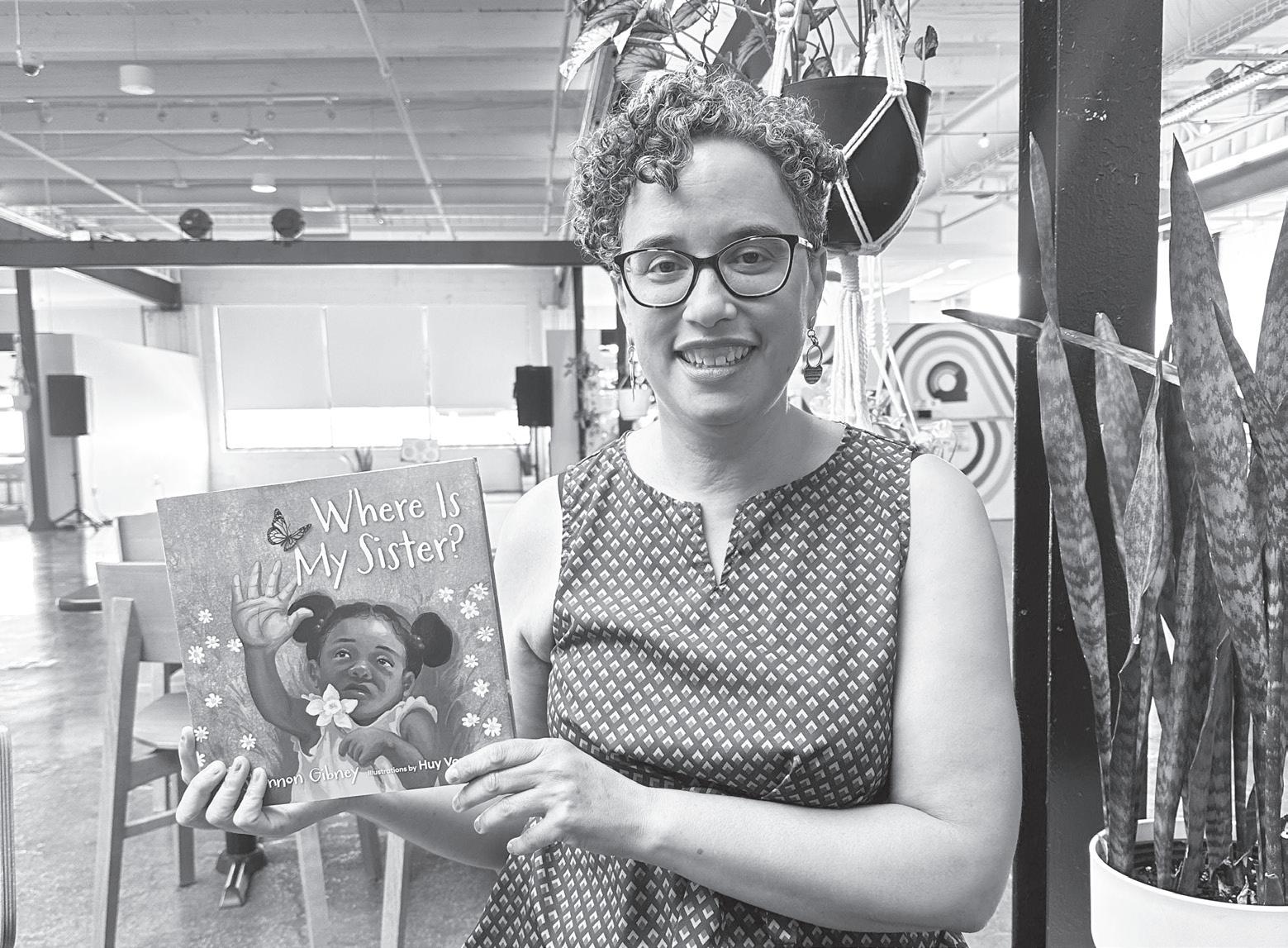
In her newest work, out last month, local multigenre author Shannon Gibney set out to tackle an issue that is taboo in children’s literature. Her book, “Where Is My Sister?,” is an emotional and thoughtout exploration of how families, especially young children, navigate infant loss.
“Where Is My Sister?” follows Salome, a young girl whose mother suffered a stillbirth. Having expected to be an older sister, Salome struggles to understand why the younger sister she had expected did not come home from the hospital with her mother. While undergoing their own grief, Salome’s mother, father and older brother, Gerald, use their distinct approaches to spirituality to help Salome comprehend the loss of her sister, Toni. Salome considers that Toni might be in the spaces between her and Gerald, in her mother’s tears, by her favorite tree. While Gibney does not purport to offer one single solution to this deep loss, Salome concludes that her sister is everywhere.
Gibney wrote “Where Is My Sister?” eight years ago, five years after she herself experienced a stillbirth. While grieving what she described as the worst
moment of her life, she watched her kids attempt to process the loss. She found no media representation of what her children were going through.
“As somebody who is always looking at the existing literature and [trying] to find shards of our experiences in books, I really wasn’t coming across anything that adequately conveyed what my children were trying to navigate,” Gibney said.
“For that, this book came to me.” Children understand and interpret experiences on a
different level than adults do, and they have received less socialization around what questions they can ask, Gibney said. In “Where Is My Sister?,” Salome’s mother attempts to explain her grief, and Salome asks questions that her parents don’t always expect. Gibney hopes that Salome’s experience gives kids permission to ask questions that they feel scared to ask or don’t know how to voice, and that it can guide them toward possible answers.
“I hope that kids can see themselves in the book,” Gibney continued. “I hope it gives them some language to work with, so that they feel less alone if they are going through this.”
To Gibney, having the words to comprehend and discuss grief is crucial. That can be difficult in a world where people shy away from talking about death and where there are unspoken rules against writing kids’ books about infant loss.
“If people don’t have tools,
their significance in her work outside visual art. In 2023, she founded ConFluence, a twoday sci-fi convention in Northeast Minneapolis that centers Black people, Indigenous people and people of color.
Though the symbolism is personal for Barlow, she encourages viewers to form their own interpretations and connections to their own lives. The central image of three women from different generations standing together, each wearing a matching turquoise motif in a different way, was also created with this hope in mind.
“I wanted people to be able to see themselves in these people,” Barlow explained. “They are painted as individuals, but they are also kind of symbols.”
For Tonya Allen, president of the McKnight Foundation, each viewer’s personal connection with Belonging to the Entire Universe also encourages connection with others.
“This mural is both a reflection and a call,” Allen said.
“Rooted in the history, cultures, and landscapes that shape Minnesota, Leslie’s work honors what has shaped us while inviting us to imagine what’s possible. It reminds us that a more just and hopeful future is something we must create together.”
Belonging to the Entire Universe is the inaugural installation in McKnight’s public art series, which will feature a different piece every three years. It is displayed at the McKnight Foundation’s Minneapolis headquarters, located at 921 Washington Ave. S.
For more information, visit https://www.mcknight.org/ news-ideas/mcknight-unveils-new-public-mural-byleslie-barlow-launching-rotating-public-art-series/.
Callisto Martinez is a Macalester student and contributing writer for the Minnesota Spokesman-Recorder. They welcome reader responses at cmarti17@macalester.edu.
language [or] context to process those things, it becomes actually a secondary or tertiary trauma,” Gibney said. “There’s the first layer of trauma, which would be the stillbirth, losing the baby. And then the secondary or tertiary trauma is not seeing your experience represented anywhere in the popular culture, and then you start to feel like a freak.”
Gibney also contributed to “What God is Honored Here?,” the first anthology of writing about miscarriage and infant loss by and for women of color. The 2019 anthology is for an adult audience, but has the same goal as “Where Is My Sister?:” giving people words to help them as they grieve. One woman said that the anthology was the only thing that helped her with her infant loss because it showed her that other women of color had not only experienced something similar, but were moving through it.
The representation that “Where Is My Sister?” provides comes as Black infants see a mortality rate 95% higher than that of infants nationwide, according to 2023 data from the U.S. Department of Health and Human Services.
“I think in the past five years or so, there’s been a lot more awareness about this disparity, which is good,” Gibney said.
“As far as I know, a lot of the numbers have not changed, which is depressing, but really not surprising, given how entrenched racism and sexism are in so many of our systems.” 2022 research by Caleb Jang and Henry Lee reflects this, finding that Black/white infant mortality disparities have remained even as overall infant mortality has declined in recent decades.
“I
hope
that
kids can see themselves in the book.”
As “Where Is My Sister?” goes out into the world, Gibney hopes to see more books, especially secular ones, reflecting experiences of infant loss. She also wants to see writing “really just being honest about [the topic],” Gibney said.
“Which is never easy, and it’s messy, and multifaceted, and, a lot of times, painful. But as I tell my students: if we’re not telling the truth in our work, why do it?”
To purchase “Where Is My Sister?” visit https://www.upress. umn.edu/9781517911454/ where-is-my-sister/. For more information on author Shannon Gibney, visit www.shannongibney.com/.
Ella Stern is a contributing writer for the Minnesota Spokesman-Recorder. She welcomes reader responses at erstern10@gmail.com.
Shannon Gibney holds a copy of her new children’s book, “Where Is My Sister?,” published by University of Minnesota Press and illustrated by Huy Voun Lee. Ella Stern/MSR
Leslie Barlow in her studio with the painting “Belonging to the Entire Universe,” which was scanned and printed on vinyl for the mural. The title is inspired by a quote from Mae Jemison, the first Black woman to travel to space. Photos courtesy of McKnight Foundation
“Belonging to the Entire Universe” is displayed on the south-facing exterior of the McKnight Foundation headquarters, 921 Washington Ave. S., Minneapolis.
By Fela Jamal
Contributing Writer
After a fight for a permit, Veritas Academy is still standing
By any measure, Susie Brooks did not have a typical childhood. Growing up in Nairobi, Kenya, she reflects on being raised by a mother who had survived a traumatic experience at the hands of a minister connected to a missionary organization. “My mother was raped, and that’s how I came to be,” Brooks says. “I was a product of rape, so I don’t have a father.”
She shared that her mother died when Brooks was six, leading to being placed with a family she describes as unkind. At 17, she struck out on her own, facing years of hardship without money or family support. But she held on to a sense of hope she credits to her mother, a Christian woman who believed things would get better even when others told Brooks she would amount to nothing.
where she landed a job and later moved to Minnesota to follow a relationship that did not last. She decided to stay in the state anyway, working first in the coffee industry before landing at a Christian
She quickly realized she was not suited to working inside someone else’s system. “If you are a visionary, it’s very hard to go and work under someone else’s vision,” she says, “because you want to fix things, you want to make some changes.”
to Brooks, making comments that suggested the objection was personal rather than legal. She recalls hearing that some in the community had moved to the area specifically to get away from “those” people. After 15 months of delays, Fox News covered the dispute, and the permit was approved within minutes. By then, Veritas had lost prospective families and teachers who had moved on.
Veritas opened in July 2015 with three students, two Kenyan American and one American. It began hosting international students in 2017 and joined an exchange visitor program in 2019, though Brooks pulled back from placing students with host families after overhearing families express regret over taking a child in. That experience led Veritas to acquire a former hospital in Chisago City in 2020 to house international students directly.
students who need a different environment, whether they are struggling academically or dealing with outside pressures. Students can board Sunday through Friday and return home on weekends.
Veritas folds extracurricular activities, including basketball and soccer, directly into its core curriculum, and Brooks is planning an agricultural program in partnership with Michael Chaney and Project Sweetie Pie to grow food for students and for sale.
Now in its 11th year, Veritas has sent graduates on to college and hopes to enroll around 50 students this year, with continued growth in its residential program as a goal. For more information about Veritas Academy, and the enrollment process, visit www.veritasclassical.org/.
Fela Jamal is a contributing writer for the Minnesota Spokesman-Recorder. He welcomes reader responses at jamal.denman@gmail.com.
Years later, at 19, Brooks reconnected with a family from the same church as the man who had inflicted harm on her mother. The relationship grew close enough that they helped fund her college education in the Netherlands, her first opportunity to leave Kenya. She thrived there as an international business student, and an exchange program brought her to the University of Akron in Ohio in 1997. An internship eventually took her to Alaska,
university, where she finished a master’s degree and discovered a passion for education. Working across three universities, Brooks noticed the same pattern: students arriving unprepared for collegelevel work, forcing schools to spend money on remedial classes for material she believed should have been mastered in K-12. The disconnect pushed her to leave higher education in 2012 and focus on younger students instead.
Around the time her son entered kindergarten, Brooks discovered classical education and became convinced it offered the most complete path to preparing students for leadership. That conviction led her to found Veritas Academy, a classical Christian school built around international student and residential programs.
Brooks started Veritas with three students and no money, relying on private donors to get off the ground. Finding a home for the school proved difficult. After a two-year search, she and her team purchased a building in North Branch, only to have the township deny their permit, citing zoning while, according
The school has grown steadily since, adding a mental health-focused curriculum in 2023, three years ahead of what Brooks says public schools are rolling out this year. Veritas served 61 international students from about 12 countries in the 2024-25 school year, but new visa restrictions have since kept many admitted students from enrolling.
Brooks and her team are now recruiting both international and local students, including from Twin Cities communities, for a residential program open to American
Susie Brooks, left, with Veritas Academy graduate. Photos courtesy of Veritas Academy.
Veritas Academy graduates.
Opinion
DevSecOps Engineer: Plymouth, MN
IT Company seeks DevSecOps Engineer to integrate security practices into DevOps workflows, automate security checks, and ensure the safety of cloud infrastructure. Work closely with development and security teams to enhance the security posture of applications and systems. Build and Configure delivery environments by using CD/CI, Agile delivery methodologies. Create and assist in performing various types of tests. Perform troubleshooting. Generate customized reports. Offered Salary: $116,480.00 to $116,500.00/yr. Send resumes to: HRD, VITS Consulting Corp., 14264 23rd Ave N, Plymouth, MN 55447. Minnesota Spokesman-Recorder July 10, 2025
By Joseph Williams
The most revealing image of America’s 250th birthday was not fireworks over the National Mall or military flyovers above Washington, D.C. It was a Reuters photo of a lone Black woman on public transportation.
By Andrew G. White IV, PhD
American education is built on a promise of equal opportunity, yet its outcomes re-
main deeply unequal. Formal barriers to access have largely been removed, but structural inequality persists across schools, districts, and institutions. Access still depends heavily on where students live, what resources they have, and which pathways they can afford to pursue. The system is open in principle, but uneven in practice.
This distinction between formal equality and structural inequality is central to understanding why disparities persist. Legal access alone does not ensure equitable outcomes. Funding levels, institutional quality, social supports, and financial constraints shape what opportunity actually looks like. Brown v. Board of Education (1954) dismantled legal segregation, but not the racial segregation that persists in fact. As Elizabeth Anderson observes, Americans still inhabit a profoundly segregated society whose de facto segregation continues to impede opportunity for disadvantaged groups (Anderson, 2010).
Funding remains one of the most visible drivers of inequality. Because public education is tied to local property wealth, schools in more affluent communities tend to have greater resources, more stable staffing, and broader curricular offerings. Other schools operate with fewer supports and more constraints. These
differences accumulate over time, shaping preparation and outcomes well before students reach higher education.
The pattern carries a racial signature: Black students take on more debt than white peers for the same credentials (Marcus, 2018).
information, weigh competing claims, and take part in collective decision-making. When access to education is uneven, the capacity for democratic participation is uneven too.
Riding the Metro, the unidentified woman in a green Tshirt sat in a train car crowded with nearly a dozen identically dressed white men wearing khakis, navy shirts, baseball caps, sunglasses, and face masks. With members of the white supremacist group Patriot Front filling the car around her, she stared ahead, her expression frozen somewhere between practiced indifference, quiet calculation, anger, and fear.
&
sion of organized white intimidation. The uniforms change. The slogans evolve. But the underlying message, delivered plainly by white men, remains consistent: We belong here.
You are merely tolerated.
PLEASE CONTACT ACCOU N T I NG DEPT @ BILLI NG@SPOKESM A N-R ECOR DER .COM EMPLOYMENT DISPLAY
Patriot Front wraps itself in the language of patriotism while promoting a white nationalist vision of America.
Members marched through Washington carrying American and Confederate imagery beneath chants of “Reclaim America,” presenting themselves as defenders of the nation’s founding ideals, even as their movement traces its roots to the aftermath of the fatal 2017 Charlottesville rally.
The men who signed the Declaration of Independence pledged their lives, their fortunes, and their sacred honor. They publicly attached their names to beliefs they considered worth dying for. Patriot Front members invoke the founders while refusing to identify themselves. If they believe their cause is righteous, why the masks?
Because they know that openly embracing white supremacy carries consequences. So they hide behind the symbolism of public strength without accepting the personal cost of public conviction.
Higher education adds further layers of stratification.
Tuition, admissions practices, institutional hierarchy, and uneven transfer pathways mean students are not choosing among equivalent options; they are navigating structured inequality. Financial constraints influence where students enroll, whether they persist, and what risks they assume in doing so. Access is only the threshold. Whether students persist also depends on inclusion, and on whether an institution’s climate and curriculum reflect them. A question critical race scholarship has long examined (Ledesma & Calderón, 2015). The consequences extend beyond individual outcomes.
Robert Dahl argued that democratic systems depend on inclusive participation and informed citizens (Dahl, 1989). Education builds that capacity, equipping people to interpret
Educational inequality is therefore not only a social or economic issue. It is a democratic one. A system that produces unequal educational outcomes also produces unequal civic capacity, shaping who participates and whose voices carry weight in public life. As Cicero observed, the welfare of the people must be the supreme law, and a democracy that educates its citizens unequally cannot honestly claim to uphold that principle.
This persistence is not simply the result of isolated policy failures. It is embedded in how the system is organized. Students with greater resources accumulate advantages at every stage, benefiting from stronger early schooling, more stable environments, and greater access to guidance and enrichment. Others encounter barriers that compound over time. What begins as unequal access becomes an unequal outcome, often mistaken for a reflection of merit rather than structure.
Pierre Bourdieu’s concept of reproduction helps explain this pattern. Educational institutions reward forms of cultural and social capital that are unevenly distributed, allowing inequality to be sustained while appearing neutral. Success gets framed as individual achievement even when it reflects structural advantage. A dynamic that makes inequality harder to challenge because it is normalized within the system itself.
Addressing this requires more than incremental reform. More equitable funding, reduced financial barriers, and stronger institutional accountability are all necessary, but they must be understood as structural changes, not supplemental ones. Without altering how opportunity is distributed, reform efforts will have limited impact. Educational inequality is not a peripheral concern; it sits at the center of democratic legitimacy. A system that promises opportunity but delivers it unevenly teaches a lesson that extends far beyond the classroom: that formal equality can coexist with structural exclusion. If that lesson persists, it will shape not only educational outcomes, but public trust itself.
Andrew G. White IV, PhD, is the dean of Enrollment Management at NYADI: College of Transportation Technology.
The image raced around social media because millions of Americans instantly understood what they were looking at: a hate group in public, retelling an old American story about Black trauma in modern costume.
For Black Americans, the photograph was painfully familiar. It echoed images of Elizabeth Eckford, a Black teenager hounded by an angry white mob in Little Rock, and Ruby Bridges, a Black child walking past screaming segregationists into a New Orleans elementary school. Now, a Black woman sat juxtaposed against looming masked white nationalists, as if a century of American racial history had folded in on itself.
From the Ku Klux Klan to the White Citizens Council to the Proud Boys, every generation has produced its own ver-
Yet the most striking detail was not what they carried or chanted. It was what they hid.
The Klan understood more than a century ago that anonymity is its own weapon. White robes and pointed hoods protected identities, denied victims the ability to identify attackers, and insulated participants from legal and social accountability. In the 1920s, tens of thousands of robed Klansmen marched openly through Washington, demonstrating that white supremacy was not confined to Southern back roads but was comfortably at home in the nation’s capital.
A century later, the wardrobe has changed from white robes to tactical khakis. The strategy has not.
The woman at the center of that photograph did not choose to become a symbol. She simply wanted to get somewhere on the subway. But the photo compresses centuries of Black experience into a single subway car.
America’s original patriots signed their names. Patriot Front hides behind masks. For all its talk of reclaiming America, its members seem unwilling to claim their own beliefs.
This op-ed appeared first in Word in Black. It has been cut for length. For the original, visit https://wordinblack. com/2026/07/a-metro-carphoto-portrait-of-trumpsamerica/.
Joseph Williams is a contributing writer for Word in Black.
By Frances “Toni” Draper
It is a fair question.
For generations, Black Americans have been asked to celebrate a nation that did not always recognize our humanity, protect our rights or honor our contributions.
Enslavement was not a minor flaw in the American experiment. It was a centuries-long atrocity imposed on an entire race of people who were brought to this country against their will, stripped of their names, families, languages and freedoms, and forced to build wealth they could never claim as their own.
The question is not whether America is perfect. No nation is.
The question is whether America can honestly commemorate 250 years of history while minimizing the reality that for much of those 250 years, millions of Black people were denied the very freedoms being celebrated.
As federal policies reshape museums, educational priorities and workplace diversity initiatives, the AFRO remains committed to its longstanding mission of documenting the full African-American experience. We celebrate our achievements and progress, but we refuse to whitewash or sanitize the pain, injustice and sacrifice that are also part of
our nation’s history.
Now more than ever, preserving a complete and honest record of the African-American experience is essential. That includes the remarkable achievements of African Americans as well as the realities of enslavement, segregation, disenfranchisement and discrimination.
Many of us have good reasons to remain skeptical. Racism remains a reality in far too many places. Voting rights, won through sacrifice, bloodshed and relentless struggle, are once again under assault. These concerns are not relics of the past. They remind us that the pursuit of equality remains unfinished.
History does not always make us feel good. Nor should it. Honest history forces us to confront uncomfortable truths, challenge convenient myths and better understand both ourselves and the nation we hope to leave to future generations.
The path forward is not amnesia but honesty. This nation embodies both its highest ideals and its deepest contradictions. It includes the founders and the enslaved, the promises of liberty and the struggle to make those promises real.
The question is not whether America has something to celebrate after 250 years.
The question is whether America 250 will honor the full American story or a sanitized version of it. This op-ed appeared first in The AFRO. For the original, visit https://afro.com/america-250black-experience/. Frances “Toni” Draper is the CEO and Publisher of
Yet the story of African Americans is not solely one of oppression. It is also a story of resilience, achievement and contribution. Our ancestors helped build this nation. Our soldiers fought in every American war. Our churches nurtured hope when laws denied justice. Our journalists documented the truth when others ignored it. Our voters expanded democracy not only for ourselves but for the nation as a whole.
DIVISION
Employment & Legals
LOST TITLE APPLICATION.: 2706427 18 June, 2026
OFFICE OF TITLES
NOTICE PURSUANT TO SECTION 82 OF THE REGISTRATION OF TITLES ACT (RTA)
WHEREAS the applicant(s) in the above stated application has/ have declared that the following duplicate Certificate of Title has been lost, I HEREBY GIVE NOTICE that I intend to cancel the said Certificate of Title and issue a new one in duplicate fourteen days after the last publication of this advertisement.
Volume: 1310
Folio: 641
Place: Catherine Hall Pen called Rose Heights
Lot: 96
Parish: St. James
Registered proprietor(s): Chelda Smith Kondo
S. Maclean Registrar of Titles
Minnesota Spokesman-Recorder, July 16, 23, 2026
Even GOP lawmakers in Washington have gotten into this: ESPN last week reported a group of Republican U.S. Congress members wrote and sent a letter to WNBA Commissioner Cathy Engelbert, demanding that the league must protect the Fever star. So instead of passing bills on protecting voting rights or strengthening gun control, they are more concerned with whether or not Clark is fouled during games.
It’s the WNBA, not the ACC (always Caitlin Clark).
The pro game is physical, and up to this point Clark hasn’t yet adjusted to it, Richardson pointed out.
“I was watching that game (on June 24 between Indiana and Phoenix),” she said of the contest in which Phoenix’s Thomas got tangled up with Clark. League officials reviewed the play, calling a flagrant foul and suspending Thomas for one game. “Alyssa Thomas is a very physical player. I won’t say (Thomas) did it purposely, but I have seen
Continued from page 10
“I’ve enjoyed it,” added Brown. “I’m lucky that Val (Ackerman, founding president) 20 years ago invited me. I’ve enjoyed the journey.”
Fast forward to today, Brown serves as an advisor in the sports industry, specializing in game operations, leadership dynamics and fostering high-performing, inclusive environments for athletes, staff and fans.
But as I reminded her that Saturday evening in Knoxville, Brown can run but can’t hide from the fact that she has a definitive place in the W’s 30-year history.
“Nothing surprised me,” she said when asked whether America’s longest women’s pro basketball league would make it three decades. “Because the (late NBA) commissioner David Stern, when I was talking with him, told me this day was going to come.
(Clark) flinging her body, trying to sell a foul. She’s arguing with her coaches … and you’re trying to tell the refs how to do their job when you haven’t improved at your game.”
Richardson agrees that the WNBA took too long to effectively call out the socalled Clark fans who have shown their racist colors in spewing their hate on social media against Black W players. Thomas and her family have received death threats after the incident. Other Black players have said it is often uncomfortable to play at Indiana due to some fans’ racist behavior toward them.
“Cathy Engelbert has done a terrible job at taking care of this,” said Richardson. Back to the first truth: this year’s All-Star Game in Chicago later this month will feature six Black starters, including Minnesota’s Olivia Miles and Natasha Howard, and eight Blacks among the reserves, including Lynx guard Courtney Williams. WNBA Legends Cooper and Teresa Weatherspoon are serving as honorary general managers and will draft the two All-Star rosters.
“I love Olivia Miles,” declared Richardson of the
lifted this league up, but it would be nothing without these talented players, and the players make this league.”
There are no Black female head coaches in the WNBA this season.
“My biggest concern is that Black women need to get more opportunity to coach in this league,” reaffirmed Brown before we hugged again. “To see that there are no Black women in this league, it should not be like that.
“I think the league should somehow create a program that would help train some of the players,” surmised Brown.
“We have great players with great basketball minds who should be head coaches in this league.”
Val Ackerman looks back on the WNBA’s diversity push
Val Ackerman, the Big East commissioner since 2013, is retiring at the end of August.
2 Columns x 4.25” High
INVITATION TO BID
Sealed bids will be received by the Public Housing Agency of the City of Saint Paul at 91 Arch St, St. Paul, MN 55130 for LED LIGHTING UPGRADES AT SEAL HI-RISE, Contract No. 27-069, until 3:00 PM, Local Time, on WEDNESDAY, AUGUST 5, 2026 at which time they will be publicly opened and read aloud via the Teams App. Bids may be submitted electronically, in a pdf format, to Alpha Graphics, www.agplanroom.com, or may be sealed and delivered to the address above.
A Pre-Bid Conference will be held on WEDNESDAY, JULY 22, 2026, at 11:00 AM, local time, at 825 SEAL STREET, SAINT PAUL, MN 55114.
A complete set of bid documents is available by contacting Alpha Graphics at 612-446-3777 or www.agplanroom.com, under public projects, LED LIGHTING UPGRADES AT SEAL HIRISE, Contract No. 27-069. Digital downloads are no charge. Contact Alpha Graphics for hard copy pricing.
Bids must be accompanied by a 5% bid guarantee, non-collusive affidavit, EEO form and Minnesota Responsible Contractor Compliance Affidavit. The successful bidder will be required to furnish both a satisfactory performance bond and a separate payment bond.
The PHA reserves the right to reject any or all bids or to waive any informalities in the bidding.
AN EQUAL OPPORTUNITY AGENCY
KA YANG PROJECT LEADER (651) 292-6089
KA.YANG@STPHA.ORG
Minnesota Spokesman-Recorder, July 16, 2026
All-Star rookie starter. However, she and other players’ performances thus far this season “once again (is) being overshadowed by this Caitlin Clark fallacy that she’s the best on the planet, she’s not,” reiterated the Coppin State professor. “And Caitlin is not the savior. They got to stop this narrative.”
Wolves wrap up Summer League play in Vegas
The Minnesota Timberwolves at press time have completed their scheduled four NBA Summer League games in Las Vegas (July 9, 11, 13, 15). If the Wolves don’t advance to the four-team playoffs, they will play a fifth game on either July 17, 18 or 19.
2 Columns x 6” High
INVITATION TO BID
Sealed bids will be received by the Public Housing Agency of the City of Saint Paul at the Maintenance Contracts Office, 200 Arch St, St. Paul, Minnesota 55130 for BULK REFUSE TRANSFER SERVICE until 2:00 PM, Local Time, on August 5, 2026, at which time they will be publicly opened and read aloud via the Microsoft Teams App. Bids may be submitted electronically in a pdf format to AlphaGraphics, www.agplanroom.com, or may be delivered to Mt. Airy Community Center at 91 Arch St, Saint Paul, MN 55130.
A complete set of bid documents are available by contacting AlphaGraphics Plan Room at www.agplanroom.com, under public plan room, BULK REFUSE TRANSFER SERVICE, Contract No. 27-068, or call 612-446-3777. Digital downloads are available at no charge, contact AlphaGraphics for hard copy pricing.
Bids must be accompanied by a Bid Bond, Non-Collusive Affidavit, a MN Responsible Contractor Compliance Affidavit, and EEO1 submittals.
PRE-BID CONFERENCE WILL BE HELD ON July 21, 2026, at 11:00 AM in room 109 at the Mt. Airy Community Center, 91 Arch St, St. Paul, MN 55130. All questions arising from this pre-bid conference will be addressed by addendum if necessary.
The PHA reserves the right to reject any or all bids or to waive any informalities in the bidding.
AN EQUAL OPPORTUNITY AGENCY
A Lor Project Technician (612) 475-4628
Minnesota Spokesman-Recorder, July 16, 2026
PREP
Continued from page 10
during her entire four-year collegiate career.
Jennifer Jacobs
ty, has been director of team security for the Minnesota Timberwolves since 2020.
While at North, Adams led them to back-to-back runner-up finishes in the Class AA state tournament in 1984 and 1985.
While a police officer in Minneapolis, he started assisting with security at Timberwolves games in 1996.
Joseph Mitchell Mitchell, an outstanding boys basketball player for Cretin Derham Hall the past three seasons, will be playing at the University of St. Thomas.
“I just want to prove myself,” 6-foot-7 forward Devin McGlockton told MSR after a practice before the team left for Vegas. He is one of nine rookies on the Wolves’ summer squad. “My greatest strength is just my effort. I give 100% to my rebounding. I’m relentless on the glass.”
The former St. Paul Central student athlete, who excelled in volleyball, went on to star at Minnesota State University-Mankato, and had coaching stops at St. Paul Harding High School, Augsburg University and Augustana University (South Dakota), was recently named an associate director with the Minnesota State High School League (MSHSL).
Graduating from Central in 2000, Jacobs was one of the metro area’s top volleyball players.
Charles Hallman welcomes reader responses at challman@ spokesman-recorder.com.
The former Minneapolis North boys basketball standout, who went on to play at Alcorn State University and North Dakota State Universi-
The 6-foot-2 guard was a three-time All-Conference selection and played a key role on a Raiders team that finished as runner-up in Class 4A competition in 2025. Mitchell completed his outstanding prep career eclipsing the 1,000-point mark this past winter.
Dr. Mitchell Palmer McDonald welcomes reader responses at mcdeezy05@gmail.com.
“So, I honor him and the work that he did for us,” continued Brown. “What has happened from Val Ackerman to Adam Silver, Mark Tatum to the current commissioner Cathy (Engelbert), I’m gonna give all credit. They’ve
She was the WNBA founding president and served the league’s first eight seasons, then chaired USA Basketball in 2005. She also served two terms as U.S. representative for men’s and women’s basketball in FIBA.
Ackerman and I spoke about diversity issues during her time with the W, and
she took my question about it during a media call in April.
“Charles, I continue to believe, and my presidents have heard me loud and clear on this,” she responded, “that diversity is critically important in the sports business. We’ve got people of all genders, gender diversity, racial diversity, ethnic diversity across the board in sports leagues and outlets across the country.
“I’m proud of the Big East because I really feel like we have been a leader in pushing these themes,” said Ackerman before answering our question about the W.
“It was the dream when we started the league that it would get to that point where the players would be making significant salaries, and that the fan support would be at a high level,” Ackerman pointed out. “I’m thrilled to see that it happened” on the league’s new seven-year CBA. “It fulfills the dream that we had at the beginning, and I’m sure it will be even brighter than it is today.”
Charles Hallman welcomes reader responses at challman@ spokesman-recorder.com.
he WNBA couldn’t and wouldn’t have survived for 30 years if it wasn’t for Black players, and thirdyear Indiana guard Caitlin Clark isn’t the league’s savior. Like the old axiom, these two points can be true. The first truth is indisputable: ever since the ceremonial jump ball before Game No.
Sports
Don’t erase the Black players who built the W
1 between Los Angeles and New York in 1997, the likes of Lisa Leslie, Sheryl Swoopes, Cynthia Cooper, Tina Thompson, Tamika Catchings, Maya Moore, Seimone Augustus, Candace Parker and many, many other Sistahs over the course of three decades have carried the W. But this truth too often has been overlooked or undervalued, especially since the arrival of Clark two summers ago.
Coppin State Sport Management Associate Professor
F. Michelle Richardson has followed America’s longestrunning women’s pro league
since day one.
“I was at the first WNBA game, I was a Nike intern in 1997 with the Los Angeles Sparks,” she proudly said in an MSR phone interview last week. Later, “I was the first Nike intern for the Washington Mystics in their first season (1998).” Dr. Richardson is both a longtime fan and studies race and sport. She co-authored book chapters on Black women’s sports experiences at HBCUs, Black female hockey fans and their experiences, and Black females’ experiences beyond sport.
"Cathy Engelbert has done a terrible job at taking care of this.”
Expectedly, the latest controversy involving Clark and Phoenix’s Alyssa Thomas hasn’t escaped Richardson either. “I don’t think people hate Caitlin Clark,” continued the professor. “We have the bad actors who are trying to use her for an agenda.” The oft-popular notion, or falsehood, that Clark is some Superwoman who swooped in to save the W, and Black females somehow are her Kryp-
Renee Brown’s WNBA legacy runs deeper than she’ll admit
hether she likes it or not, Renee Brown’s WNBA legacy is forever cemented. She was with the league from the start and rose to one of pro sports’ high-ranking Black female executives during her nearly decade-plus tenure.
“It has been a privilege serving all of you.”
“Charles, you know I’m not going to talk about myself,” reiterated Brown when we ran into each other at the Women’s Basketball Hall of Fame ceremony in Knoxville, Tenn., the last weekend of June. We hadn’t seen each other since she left the league in 2016, but it was always the same with Brown, doing her best to
avoid talking about her contributions and achievements, mainly because I was probably one of the few reporters who clearly knew what she did.
This is what I wrote shortly after Brown announced she was leaving the W after 20 years in my Sports Odds and Ends column, Nov. 3, 2016: Renee Brown was an inte-
gral part of the WNBA since its drawing-board days. She signed the league’s first players. She has been involved with all on-court basketball operations and player-related programs. She has represented the league at USA Basketball since 1996, including as selection committee chair for the U.S. women’s basketball
team, which won six Olympic gold medals during her stints.
“It has been a privilege serving all of you,” said Brown in a released statement.
Former prep stars making their mark
League President Lisa Borders told the MSR, “I’ve known Renee for 10-plus years. But I had not had the privilege of working so intimately with her.” re Holloman
Black players carry the Twins system into the All-Star break
By Charles Hallman Sports columnist
e enjoy watching baseball, especially seeing and speaking with Black baseball players before or after games.
Strike one: Kaelen Culpepper was named to the MLB All-Star Futures Game for the second straight year. However, the No. 2 Minnesota Twins prospect and No. 35 overall couldn’t play in last Sunday’s contest in Philadelphia because he was placed on the injured list (IL) July 7 due to a left hip strain.
Before he was placed on the IL, “It’s an accomplishment, it’s an honor that you get acknowledged for putting up some good numbers halfway through the season,” said Culpepper, the St. Paul Saints starting shortstop, on his second consecutive selection. The 22-year-old Culpepper,
but they saw me as one of the (players),” surmised Culpepper.
“I’m doing something right, that’s for sure.”
Strike two:
We haven’t talked since he was traded to Toronto from Minnesota in late June. Pitcher Simeon Woods Richardson spoke after his July 4 start against St. Paul made him the 20th different pitcher to start this season for the Buffalo Braves, the Blue Jays’ AAA affiliate.
in his first year at St. Paul, is hitting .272 with 14 homers, 43 RBI, 54 runs and 15 stolen bases, and is tied for first in baseball in leadoff home run games (6).
“I was really excited last year,” he recalled, “and I was excited again this year. Being a twotime Futures Game (participant), I feel like I earned that because (it) definitely wasn’t given.
“I don’t know if I was playing good enough to earn that,
“Getting back to the starter routine is always fun,” said the right-hander. Before the trade, the Twins had sent him down to the bullpen, and he was later outrighted to Toronto. “I realize it’s a business. I love being in Minnesota, but I realize at the end of the day, it’s a business,” stressed Woods Richardson, who played for the Twins for almost four seasons (2022-2025).
The former big league Black hurler continued, “I liked all
the guys in the clubhouse. I love going to war with all those guys. But it could be anybody. It was me, but I’m over here now with the Blue Jays (organization) and trying to get back on the right track.”
Woods Richardson is working to not only get his pitching form back, but also to get back to the majors.
“Just getting mechanics back right, getting my legs underneath me again,” he surmised. “That’s why we’re here at AAA.”
The former Minneapolis North and Cretin Derham Hall boys basketball star, who went on to play collegiately at Michigan State University and North Carolina State University, recently joined the Orlando Magic’s NBA Summer League roster.
The 6-foot-2 point guard averaged close to 10 points per game last season for NC State.
He completed his prep career as CDH’s all-time leading scorer in 2022.
Strike three: Charles McAdoo was one of three Black players on the Buffalo AAA club. He was on a tear during his team’s recent road trip. He smacked his 11th home run of the season in the Braves’ 8-3 win at St. Paul on July 5, the series finale between the two clubs. The second baseman also lined a double and scored two runs.
Charles McAdoo
“(I’m) just making sure that I’m not missing the pitches I’m looking for,” McAdoo told MSR afterwards. “I know I can control the zone.”
Ball four: Taj Bradley, the Minnesota Twins’ only Black pitcher, went into this week’s All-Star break
Nia Coffey
One of the WNBA’s top players, who starred at Hopkins High School and Northwestern University, has helped the Minnesota Lynx currently become one of the top teams in the WNBA.
The 6-foot-1 small forward led Hopkins to Class 4A state championships in 2014, 2015 and 2016.
While in college, Coffey became one of the few players to make First Team All-Big Ten
Taj Bradley
after two impressive outings last week.
Bradley earned his teamleading ninth win of the season Sunday with a 4-2 win over the Los Angeles Angels, his second consecutive seven-inning outing, his 18th start of the season.
“It ain’t anything I’m not used to. I pitched in Tampa Bay last year,” said the pitcher of pitching in 90-plus-degree heat. “I’m putting up quality starts and giving the team a chance to win. Keep it as simple as possible.” Sunday’s performance followed Bradley’s 7-inning, 10-strikeout victory on July 7 when the Twins defeated Cleveland 3-1. It was the second consecutive start with double-digit strikeouts
See
■ See SOE on page 9
SportS ColumniSt
Sports Columnist
tonite. Too many believe that:
1) Black players are jealous of the White player, and 2) Clark is a de facto victim. None of which is true.
Photo from WNBA 1st season in 1997. Threads
F. Michelle Richardson Courtesy
Threads
Kaelen Culpepper All photos courtesy of Charles Hallman/MSR
Simeon Woods Richardson
Tre Holloman Packinsider.com
Renee Brown Charles Hallman/MSR
Ceremonial jump ball tossed by Val Ackerman in 1997. Threads