

The Karmelo Anthony case and the families left behind
By Jasmine McBride Editor
n June 9, 2026, a Collin County, Texas jury sentenced 19-year-old Karmelo Anthony to 35 years in prison for the murder of 17-yearold Austin Metcalf, a white student fatally stabbed during a high school track meet in Frisco in April 2025. The verdict, reached in less than three hours by a jury that was not adequately diverse, sent shockwaves through communities already questioning whether equal justice exists for Black Americans.
Anthony, who was 17 at the time, maintained he acted in self-defense after Metcalf repeatedly confronted and physically pushed him. The jury rejected both a self-
defense claim and a “sudden passion” finding that could have reduced the sentence.
His mother, Kayla Hayes, was the sole witness during sen-
tencing, pleading for mercy.
The day after, both parents broke their silence.
“My son is no murderer,” Hayes said. “My son didn’t in-
tend to hurt anyone. My son was defending himself. And that’s what hurt so bad.”
His father, Andrew Anthony, said the verdict felt prede-
Metro surge’s toll:
$700 million and three lives
By Clint Combs Contributing Writer
aniel Hernandez arrived in the United States at 16 chasing the American Dream. Twenty-four years later, he opened a third
Colonial Market in South Minneapolis with 25 workers, $3 million invested and a vision for serving the Latino community along the Lake Street corridor. Eighteen months after opening day, he is closing the doors. His story is one of thousands detailed in a sweeping new report estimating that Operation Metro Surge inflicted nearly $700 million in economic damage on Minneapolis. A figure city officials say is likely an undercount, with the true toll closer to $1 billion.

The 50-page report, released Wednesday, found that businesses lost an estimated $445 million in revenue and workers lost more than $152 million in wages over four months. Nearly 40% of residents avoided urgent care or hospital visits out of fear. Minneapolis Public Schools served roughly 441,000 fewer meals over three months as student attendance collapsed.
Three people died. Federal agents killed Renee Good and Alex Pretti in Minneapolis. Victor Manuel Diaz died in a Texas detention facility after
being arrested in the city. A 2-year-old child was transported to Texas despite a court order.
Rachel Sayre, who spent a decade leading humanitarian responses for USAID in Yemen, Syria and Ukraine, said what she witnessed in Minneapolis was unlike anything she expected to see at home.
“People with masks, without any sort of seeming chain of command or rule of law… The way they were taking our residents out of the street, shipping them away without any sort of due process. Those are all conditions that you see in conflict zones that I’ve worked in,” Sayre said.
For Hernandez, the collapse was swift and unrelenting. Within weeks of Trump taking office, sales were cut in half. By
Georgia Fort honored for courage in journalism
By Alaysia Lane Contributing Writer
ndependent
journalist
Georgia Fort has been named a recipient of the 2026 Courage in Journalism Award by the International Women’s Media Foundation, known as the IWMF, an honor recognizing women journalists who report under risk and pressure around the world.
Based in Minneapolis and the founder of BLCK Press, Fort is among this year’s recipients, which also include journalists from Iran, Myanmar and the Philippines. The award is dedicated to recognizing women who persist in their reporting despite facing legal threats, imprisonment, violence and censorship.
Fort said she was notified while traveling back to Minnesota.
“I was actually at the airport
on my way back to Minnesota when I found out,” she said.
“Just really moved and touched to have an international institution recognize my work and dedication to journalism. It’s just really humbling.”
Fort is currently facing federal felony charges related to her coverage of a Jan. 30 protest in St. Paul. She has pleaded not guilty and is awaiting trial.
While the legal proceedings have drawn national attention, IWMF officials said the award recognizes Fort’s broader career in journalism.
“The IWMF selected Fort because she has demonstrated courage throughout her long career,” said Elisa Lees Muñoz, president of the organization. “This award recognizes journalists for their longstanding dedication to the industry and to supporting issues that are fraught in their communities.”
Muñoz said Fort’s nearly two-decade career across radio, television and independent media reflects the organization’s intent to honor
sustained commitment, not a single moment.
Still, she said the timing of the recognition also reflects

termined. “He was convicted when he walked out of the jail. It was not innocent until proven guilty… he was already guilty.” Both parents described ongoing death threats and called the trial fundamentally flawed. They plan to appeal.
The racial dimensions are impossible to ignore. None of the 12 jurors were Black. The state struck three potential Black jurors during selection, citing their profession as educators. The defense objected; the judge allowed the strikes.
Critics have raised Batson challenge concerns, pointing to the Supreme Court’s ruling that lawyers cannot use peremptory challenges solely based on race.
The case has drawn pointed comparisons to that of Caysen Allison, a white Texas teenager who fatally stabbed
a Hispanic teen and received a 10-year sentence after a jury rejected the murder charge and convicted him of criminally negligent homicide instead.
The contrast has become a flashpoint for advocates arguing race continues to shape how juries evaluate self-defense claims and culpability.
Ten years ago, another family was thrust into the center of a national reckoning over race and justice in Minnesota, and Diamond Reynolds is still living with the weight of it. Reynolds was in the car on July 6, 2016, when St. Anthony police officer Jeronimo Yanez shot and killed her boyfriend, Philando Castile, during a traffic stop in Falcon Heights. She livestreamed the aftermath, her young daughter in the back seat. Yanez was ■ See STOLEN on page 5
By Anya Armentrout Contributing Writer
7% of Black youth say they are on social media
“almost constantly,” and 47% say they frequently encounter racist comments on those platforms.
This is just one of the aggressive tactics that pushed

Minnesota is no exception to these statistics, taken from a 2024 survey by Common Sense Media.
“Social media companies have designed their products to be harmful and addictive, especially to children,” Minnesota state Sen. Erin K. Maye Quade said. “They know the harm that they’re causing, and they’ve decided to double down on the tactics that bring about that harm.”
Maye Quade to author HF 4138, also known as the Stop the Harms from Addictive Social Media Act. The bipartisan act, signed into law in May, requires age verification and parental consent for children under 15 to access social media, limits addictive design features, requires account settings to default to maximum privacy and limits targeted advertising to minors.
But if the federal Kids Internet and Digital Safety Act, known as the KIDS Act, passes, state legislators like
When Instagram, owned by Meta, identifies that a teenage girl has posted a selfie and then deleted it, the algorithm is trained to push beauty products, disordered eating content and ads for GLP-1 weight loss drugs onto her feed. The company produces insecurity, and then profits off of it.
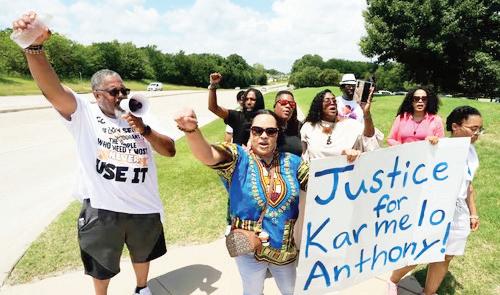
Supporters for Karmelo Anthony demonstrate in front of the Collin County courthouse, June 11, in McKinney, Texas. AP Photo/Tony Gutierrez
Interior of Colonial Market on Lake Street. Photo courtesy of Clint Combs/MSR
cottonbro studio Georgia Fort
A message from our publisher
Juneteenth is a day of joy, and a day of reckoning.
On June 19, 1865, enslaved people in Galveston, Texas learned what had been true for two and a half years: that they were free. The Emancipation Proclamation had been signed in January 1863, but freedom, as Black Americans have always known, is not simply declared. It must be delivered. And too often, it has been delayed. That gap, between the promise and the reality, is what Juneteenth asks us to sit with. Not to dampen the celebration, but to deepen it. Because when we understand what our ancestors endured, and what they built in spite of it, the joy becomes something more: it becomes testimony.
This year, that testimony feels especially urgent. We are living through a political moment that is testing the durability of hard-won freedoms in our schools, in our courts, in our communities. Across the country, the tools of democracy are being challenged. The stories of Black Americans are being erased from curricula. The very language of equity is under assault. In Minnesota and beyond, our people are being asked to fight battles we thought we had already won. And yet, we are still here. Still building. Still pushing.
That is the spirit of Juneteenth. And it is the spirit of this newspaper.
For more than 88 years, the M innesota Spokesman-Recorder has stood as a witness to Black life in the Twin Cities, in all of its complexity, its grief and its glory. We have covered the movements and the milestones, the injustices and the breakthroughs. We have told the stories that others overlooked, amplified voices that deserved to be heard, and held the powerful accountable when no one else would.
That mission has never been more important than it is right now.
Black excellence is not a response to oppression. It is its own declaration. It exists not to prove anything to anyone, but because our people have always possessed gifts worth sharing and dreams worth pursuing. We see that excellence every week in the pages of this paper: in our students, our entrepreneurs, our artists, our elders, our athletes, and our advocates. We see it in the work of every community member who refuses to let this moment define what is possible.
As we celebrate Juneteenth, I want to thank you, our readers, for your continued trust in the MSR. You are the reason this paper exists. You are the community we serve, the stories we tell, and the future we are fighting for. Freedom is not a finished project. But it is ours to carry forward.
Happy Juneteenth.
Tracey Williams-Dillard Publisher & CEO
Minnesota Spokesman-Recorder
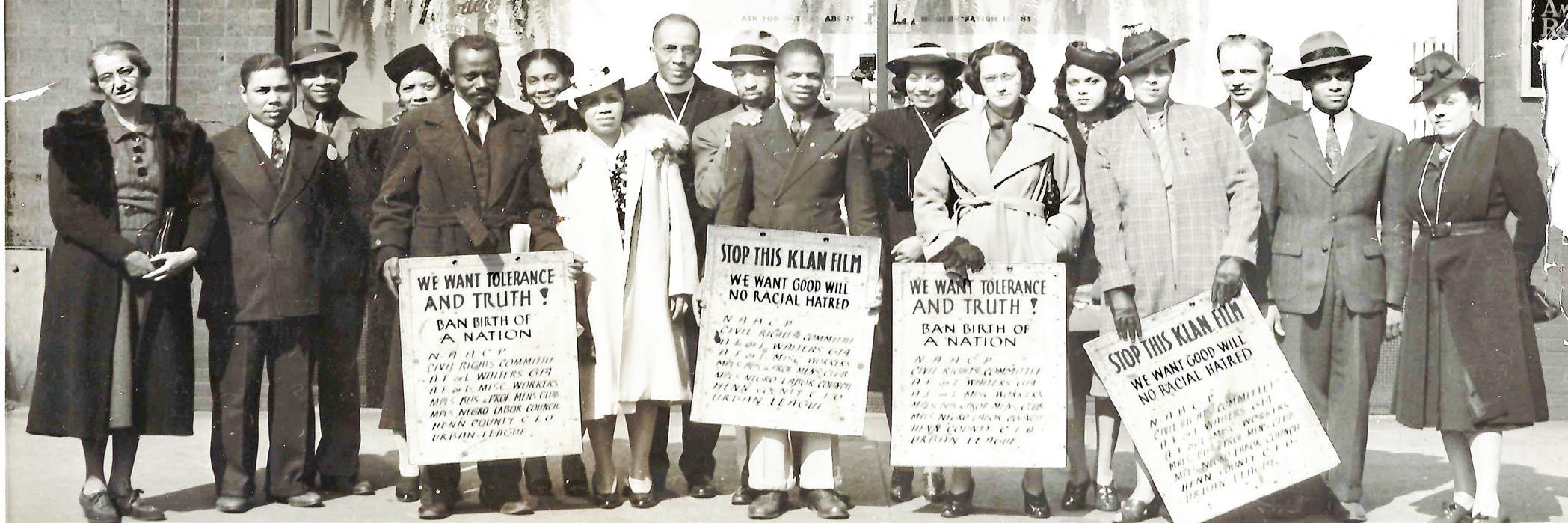



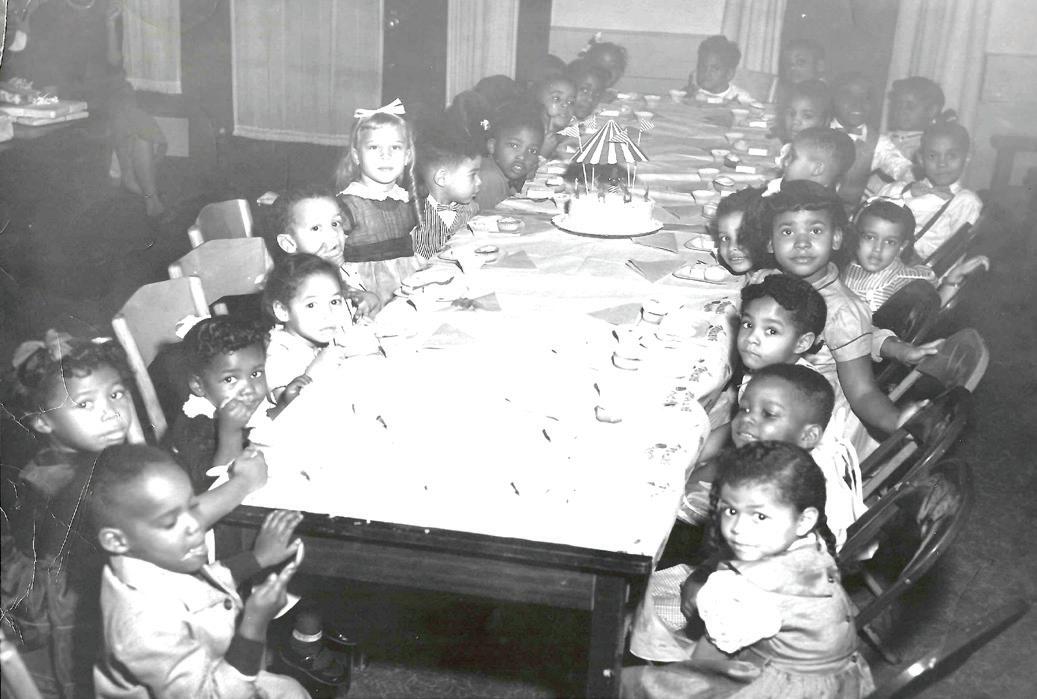




Photos courtesy of MSR Archives
Metro
By the time he is fourteen
By De’Vonna Pittman
Last week, I took my grandsons to a local water park. Like most grandmothers, I spent the afternoon doing what grandparents do: watching, smiling and making memories. The boys were laughing, splashing and enjoying a carefree summer day. What they didn’t realize was that while they were playing, I was watching something else.
I was watching the world watch them.
At one point, I noticed two teenage boys interacting with my grandson, Bentley. One of them repeatedly elbowed him. Bentley didn’t complain. He didn’t run to tell an adult. He simply absorbed it and kept playing.
He didn’t know I had seen it.
I walked over immediately.
I asked the teenager how old he was. “Fourteen,” he replied.
I looked him directly in the eye and said, “Bentley is 9 years old. Don’t you ever do that to him again. Did he give you permission to play with him like that? Then don’t.”
The young man looked surprised. Perhaps he thought no one noticed. Perhaps he thought it was harmless. Maybe it was.
But what struck me was not that single moment. It was what that moment represented.
Because Black boys spend much of their childhood navigating experiences that others often dismiss as insignificant.
The shove.
The joke.
The exclusion.
The assumption.
The teacher who expects less.
The store employee who watches a little too closely.
The adult who sees a threat instead of a child.
Each experience by itself may seem minor.
But a thousand small cuts still bleed.
By the time many Black boys reach 14 years old, they have already learned lessons no child should have to learn. They learn that they may be judged before they speak. They learn that they may be seen as older than they are. They learn that they may be viewed with suspicion before they have done anything wrong.
They learn that in America, their Blackness can become a burden long before they understand why.
Research has shown that Black children, particularly Black boys, are often perceived as older and less innocent than their white peers. They are disciplined more harshly in schools. They

“Black boys spend much of their childhood navigating experiences that others often dismiss as insignificant.”
are more likely to encounter systems that punish rather than nurture. Too often, they are denied the grace and protection routinely extended to other children.
Imagine receiving those messages year after year.
Imagine being told directly and indirectly that you do not measure up.
Imagine being feared before you are understood.
Imagine carrying those experiences into adolescence and adulthood.
Then imagine being asked why you are angry.
As a society, we often focus on the moment a young Black man reacts. We dissect his decisions. We debate his behavior. We question his character.
But we rarely ask what happened before that moment.
What happened when he was 9?
What happened when he was 10?
What happened when he was 14?
What insults did he swallow?
What humiliations did he endure?
One easy $0 premium plan
What assumptions were made about him?
What wounds were never acknowledged?
Too often, America meets Black boys with suspicion and Black men with punishment.
We wait until they are in trouble to pay attention.
We discuss them when they are arrested.
We debate them when they are incarcerated. We mourn them when they are killed.
But we rarely ask what it would look like to truly protect them while they are still children.
As a Black grandmother, I find myself doing something many grandparents never have to do.
I am not simply watching my grandsons grow.
I am watching the world respond to them.
I celebrate their laughter, their intelligence, their curiosity and their dreams. Yet I am constantly aware that there are people who will see their skin before they see their humanity.
That reality is exhausting.
Not because my grandsons are broken, but because too often the systems and perceptions around them are.
I want a world where Bentley can run through a water park and simply be a 9-year-old boy.
A world where he is not viewed as older than he is.
A world where he is not expected to absorb disrespect without complaint.
A world where he is not forced to learn survival skills before he has fully experienced childhood.
Black boys should not have to spend their formative years proving they belong, proving they matter, or proving they are safe.
They are children.
And if we truly want healthier Black men, stronger families, safer communities and a more just society, then we must start by protecting Black boys.
Not when they become headlines.
Not when they enter courtrooms.
Not when they fill prison cells.
Now.
While they are still children.
While they are still becoming.
While there is still time for them to grow up knowing they are valued, protected and loved.
Because every Black man was once a little Black boy.
And how we treat that little boy matters.
The future of our communities depends on it.
De’Vonna Pittman is a contributing writer for the Minnesota Spokesman-Recorder.
HealthPartners ® Minnesota Senior Health Options (MSHO) (HMO SNP) bundles Medicare, Medical Assistance and prescription drug coverage into a simple $0 premium plan. It saves you money. And it comes with valuable perks and support.
Plan highlights
• A dedicated care coordinator helps you navigate your health
• Rides to appointments
• Extras like tablets with well-being tools and lifelike support pets*
• Up to $450 in rewards for health screenings

Easy, guided enrollment Call 855-394-8845 (TTY: 711) to find out if you’re eligible.
Oct. 1 to March 31: 8 a.m. to 8 p.m. CT, seven days a week April 1 to Sept. 30: 8 a.m. to 8 p.m. CT, Monday through Friday
HealthPartners is a health plan that contracts with both Medicare and the Minnesota Medical Assistance (Medicaid) program to provide benefits of both programs to enrollees. Enrollment in HealthPartners depends on contract renewal. *The benefits mentioned are a part of special supplemental benefits for members with certain chronic conditions such as: heart failure, dementia, diabetes, cancer, or a disabling mental health condition. Not all members will qualify, and all applicable eligibility requirements must be met. For details and a complete list of eligible conditions, please contact us. Discrimination is against the law. HealthPartners does not discriminate because of race, color, national origin, creed, religion, sexual orientation, public assistance status, marital status, age, disability or sex. H2422_004969_M Accepted 8/30/25 25-3491751-3628086 (9/25) © 2025 HealthPartners

cottonbro studio
HCMC secures $205
By Izzy Canizares Contributing Writer
While many of the bills fought for this past legislative session did not pass, Governor Walz did sign a sweeping health and human services bill that would guarantee continued funding for Hennepin Healthcare Medical Center, which had been at risk of closure. With the promise of funds on the way, leadership at HCMC still needs to work to ensure a crisis like this doesn’t happen again, especially when so many marginalized Minnesotans depend on the Center for healthcare.
“Our immediate priorities are to stabilize our team and invest in patient care while carefully stewarding the funds allocated to us,” the Director of Communications of HCMC, Alisa Harris, said. “We have essential needs that are part of our budget but have been deferred because of financial challenges. For example, staffing and equipment that supports patient care. Our first priority is to make sure we have the resources and team members to deliver excellent patient care.”
HCMC is a pillar for many Minnesota residents, with 2025 data showing the medical center has treated around 1 in 50 Minnesotans, including 26,800 cases from counties outside the metro area. Despite this wide reach, HCMC

was at risk of closure just over a month ago, having reported steady operational losses over the past eight years that had finally caught up with the hospital. The county has already cut more than 100 jobs at HCMC.
“We are facing the critical and increasing shortage of family physicians, particularly in rural communities, because of all the financial and security problems that are happening at the hospital level,” Dr. Kathy Guthrie said at a town hall held by Attorney General Keith Ellison before funds were secured for HCMC. “Hennepin is at risk of losing one of the more genius young researchers in community health care because of this
current instability. This kind of instability can’t wait for the next budget year.”
Thankfully for HCMC, a health and human services bill was passed by the state before the legislative session ended, which included $205 million in direct stabilization funding for HCMC, as well as a reserve account of up to $500 million that HCMC, and possibly other hospitals struggling financially, can draw from until 2031.
“We are grateful for onetime funding that lets us stabilize our immediate operations, fund essential expenses, weather unexpected crises, and plan for the longterm,” Harris said. “We still need a durable, long-term
funding stream to respond to structural challenges like the rising costs of uncompensated care, and we are committed to advocating for that solution in the coming legislative session.”
Besides the funds, the bill also adds language regarding oversight of HCMC, including the creation of a new board.
The bill would establish a new board that consists of between 11 and 15 directors, with 70% of members having the professional training and expertise needed to govern a health system and safety net hospital, to ensure a crisis like this does not happen again, especially when so many hospitals outside of the immediate metro area also rely on its
services.
“HCMC is vital for my patients and my community all the way up in Saint Louis County, because I, at a level one trauma center also have some issues referred to HCMC, because they offer treatments, they have special skills, and services they are able to provide that my hospital cannot,” Chris Rubesch, R.N., a cardiac nurse at Essentia Twin Ports in Duluth, said. He is also the president of the Minnesota Nurses Association. “They really are crucial for the entire state of Minnesota, and my patients’ care, my patients’ outcomes depend on HCMC staying open.”
“They really are crucial for the entire state of Minnesota.”
While a majority of the state depends on HCMC, the impact the hospital has is even greater for those who are uninsured and may not be able to find healthcare anywhere else, especially for people of color, where the risk of being uninsured is greater.

About 75% of HCMC patients are uninsured or have public insurance, and in 2023, Black Minnesotans’ uninsured rate was 6.3%, double the state average, while the Latino community had the highest rate at 11.4%.
“Hennepin Healthcare is proud to serve patients from racial and ethnic minority groups, patients on public programs, and many patients with social and medical complexities such as chronic health conditions, unstable housing, transportation, food insecurity, and language barriers,” Harris said. “We are grateful that the state of Minnesota showed support for our essential safety net mission. Over the coming months, the Governor-appointed task force will make recommendations to sustain our long-term stability, and we will support and contribute to that important conversation.”
“Hennepin Healthcare has cared for me and my household for 20 years and has saved my life about a million times. That place does not close its doors to anybody,” said Dulce De La Rosa, a health care coordinator for COPAL (Comunidades Organizando el Poder y la Acción Latina). “This is why this hospital cannot close. In addition to being a sanctuary for our health, it’s a sanctuary for our souls. My community needs that health care center.”
Izzy Canizares is a freelance journalist and contributing journalist for the Minnesota Spokesman-Recorder.

CONTROL. STI TESTING. PRIMARY CARE. GENDER AFFIRMING CARE. VASECTOMY. CARE. MENTAL HEALTH TREATMENT. MENOPAUSE CARE. CANCER SCREENINGS. CARE. HPV VACCINES. PEP & PREP. BREAST & CHEST EXAMS. BIRTH CONTROL. PRIMARY CARE. GENDER AFFIRMING CARE. VASECTOMY. FERTILITY CARE. TREATMENT. MENOPAUSE CARE. CANCER SCREENINGS. ABORTION CARE. & PREP. BREAST & CHEST EXAMS. BIRTH CONTROL. STI TESTING. PRIMARY GENDER AFFIRMING CARE. VASECTOMY. FERTILITY CARE. MENTAL HEALTH MENOPAUSE CARE. CANCER SCREENINGS. ABORTION CARE. HPV VACCINES. BREAST & CHEST EXAMS. BIRTH CONTROL. STI TESTING. PRIMARY CARE. GENDER CARE. VASECTOMY. FERTILITY CARE. MENTAL HEALTH TREATMENT. MENOPAUSE SCREENINGS. ABORTION CARE. HPV VACCINES. PEP & PREP. BREAST BIRTH CONTROL. STI TESTING. PRIMARY CARE. GENDER AFFIRMING CARE. FERTILITY CARE. MENTAL HEALTH TREATMENT. MENOPAUSE CARE. CANCER ABORTION CARE. HPV VACCINES. PEP & PREP. BREAST & CHEST EXAMS. TESTING. PRIMARY CARE. GENDER AFFIRMING CARE. VASECTOMY. FERTILITY HEALTH TREATMENT. MENOPAUSE CARE. CANCER SCREENINGS. ABORTION VACCINES. PEP & PREP. BREAST & CHEST EXAMS. BIRTH CONTROL. STI TESTING. GENDER AFFIRMING CARE. VASECTOMY. FERTILITY CARE. MENTAL MENOPAUSE CARE. CANCER SCREENINGS. ABORTION CARE. HPV VACCINES. BREAST & CHEST EXAMS. BIRTH CONTROL. STI TESTING. PRIMARY CARE. GENDER CARE. VASECTOMY. FERTILITY CARE. MENTAL HEALTH TREATMENT. MENOPAUSE SCREENINGS. ABORTION CARE. HPV VACCINES. PEP & PREP. BREAST BIRTH CONTROL. STI TESTING. PRIMARY CARE. GENDER AFFIRMING CARE. FERTILITY CARE. MENTAL HEALTH TREATMENT. MENOPAUSE CARE. CANCER ABORTION CARE. HPV VACCINES. PEP & PREP. BREAST & CHEST EXAMS. TESTING. PRIMARY CARE. GENDER AFFIRMING CARE. VASECTOMY. FERTILITY HEALTH TREATMENT. MENOPAUSE CARE. CANCER SCREENINGS. ABORTION VACCINES. PEP & PREP. BREAST & CHEST EXAMS. BIRTH CONTROL. STI TESTING. GENDER AFFIRMING CARE. VASECTOMY. FERTILITY CARE. MENTAL MENOPAUSE CARE. CANCER SCREENINGS. ABORTION CARE. HPV VACCINES. BREAST & CHEST EXAMS. BIRTH CONTROL. STI TESTING. PRIMARY CARE. GENDER CARE. VASECTOMY. FERTILITY CARE. MENTAL HEALTH TREATMENT. MENOPAUSE SCREENINGS. ABORTION CARE. HPV VACCINES. PEP & PREP.
Laura James
acquitted of all charges.
A decade later, Reynolds says the system has never acknowledged what it put her and her daughter through.
“Me and my daughter, as if our lives didn’t matter from being in that car,” Reynolds said. “Had I not recorded what happened and put my life on the line, we would have died in that car. And the fact that
METRO
Continued from page 1
fall, as masked federal agents patrolled East Lake Street, sales fell to 30% of normal. At the height of the surge, 90% of what little revenue remained came from deliveries.
The layoffs came in waves: three employees in the summer, two more in the fall, half the staff by January.
KIDS
Continued from page 1
Maye Quade won’t be able to impose those state-level protections.
“What the KIDS Act is intending to do is try to say, ‘Oh, don’t worry, the federal government will do something,’ but what it would actually do is override much stronger state-level protections that have been implemented with mealy-mouthed nothing,”
Maye Quade said. “Big tech companies know that they’re harming kids and they know that people are concerned about it. This is their attempt to try and both get what they want, which is no regulation, and make it seem like there is going to be safety.”
Minnesota Attorney General Keith Ellison also opposes the bill.
COURAGE
Continued from page 1
broader concerns about press freedom.
“Georgia is being targeted by the U.S. government,” Muñoz said. “That is actually not an unusual situation right now in the United States, and we wanted to make sure to raise a red flag and to highlight her case.”
The IWMF, which has long focused on journalists working under repressive governments or in conflict zones,
That is precisely the gap the Marvina Haynes Act is designed to fill.
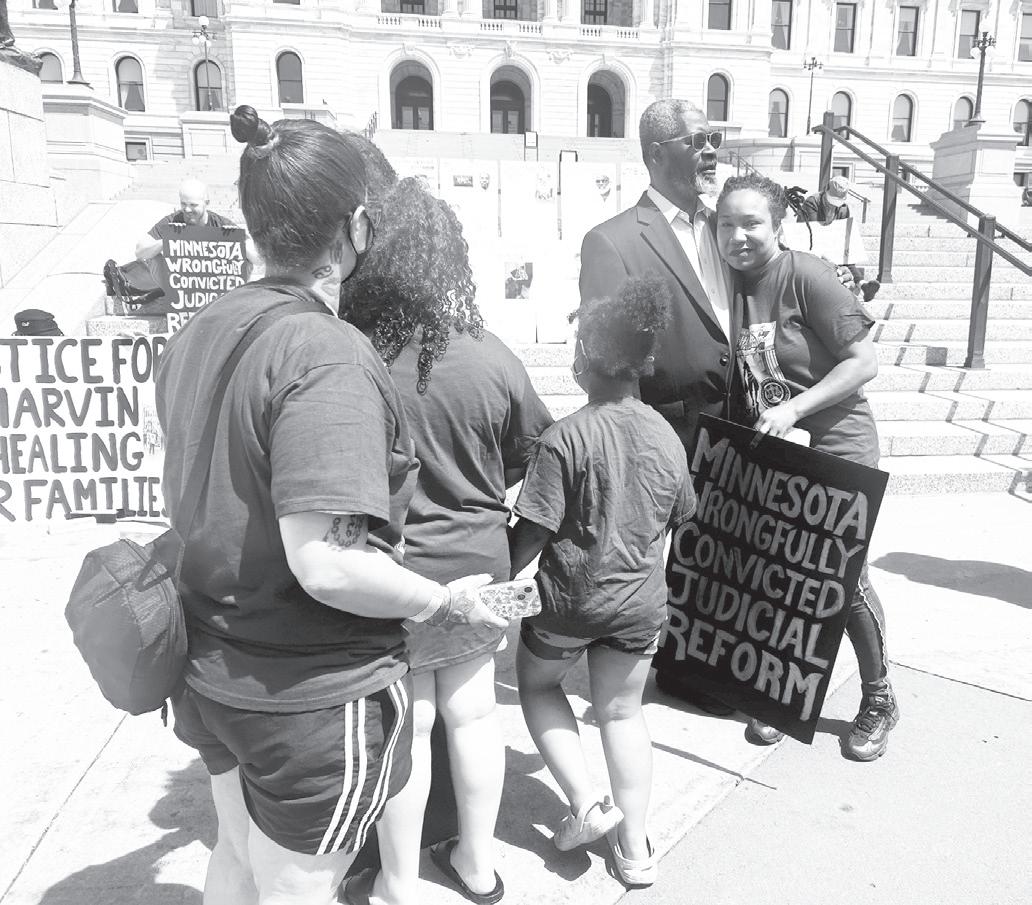
A week before Anthony’s sentencing, families impacted by the justice system gathered at the Minnesota State Capitol in support of the Marvina Haynes Act with claims of false incarceration, unfair law practices, and inadequate rehabilitative support.
Minnesota absolutely does not care about our lives… we’re still here, still trying to fight from a storyline that was placed on me that I had absolutely no control over,” she shared, referring to the impact that occurrence had on her life till present day, including on employment and her and her child’s sense of safety due to continued death threats. Her words land alongside the Anthony family’s with painful familiarity. Both cases involve a Black life, a justice system many believe failed them, and a family left to carry trauma the system never accounted for.
Marvina Haynes, founder of Minnesota Grown Fully Convicted, shared she slept in her car for six months fighting for her brother’s freedom. When he was finally exonerated and received a $4.5 million settlement. She says there was no support system in place for him or his family.
“People celebrate the outcome, but they forget the decades of sacrifice that got us there,” Haynes said. “They forget the mother who cried themselves to sleep. They forget the children who grew up without their father.”
The proposed Minnesota bill would provide trauma support, mental health resources, housing assistance and advocacy services for families of

the wrongfully convicted. It has not yet been placed on the legislative docket. Haynes is calling on state lawmakers to carry it forward.
“When systems cause harm, they have a responsibility to invest in the repair.”
“When systems cause harm, they have a responsibility to invest in the repair,” said Danielle Matthias of the Minnesota Freedom Fund. “A wrongful conviction doesn’t just steal years from the person incarcerated. It steals time from

the jobs are not that great right now, especially with so many businesses suffering.”
Minneapolis Mayor Jacob Frey said Trump’s hardline immigration crackdown forced many customers indoors.
“I don’t even think we’ve begun to see the real economic fallout.”
“Right now we have two people,” Hernandez said. “The families who were dependent on this store, this business, no longer have a job. Many of them are still looking, because
“The deck is stacked against young people online,” Ellison said in a statement. “Some of the world’s most gifted designers are building apps, programs, and websites to addict young people, and those young people need our help.”
Proponents of the KIDS Act argue that one federal framework would create consistent safety standards nationwide. However, federal preemption means the act limits states’ ability to enact separate requirements, and any less-lenient laws addressing online harms to children would be overwritten. A letter opposing the act was signed by 44 attorneys general and sent to Congressional leaders. Ebony Eromobor, a therapist and owner of Village Support, a mental health practice that specializes in culturally responsive therapy, sees social media magnify what young people already
said Fort’s inclusion signals growing concern about press freedom globally, including in the United States.
“There were millions of dollars that were invested to make this business a reality,” Frey said. “By the way, it was a business that was very much
experience.
“For youth who are struggling with, let’s say, selfesteem, belonging, or other mental health concerns, it can often intensify those challenges due to what they’re exposed to because there aren’t guardrails on social media,” Eromobor said.
For young people of color, that can mean encountering racist vitriol and threats online. According to the same Common Sense Media survey, 48% of Black youth say they have taken breaks from social media due to harassment.
Malicious adults can use social media to access and harass young people. Hateful language attracts engagement, positive and negative, which spreads the content further.
“The algorithms of social media are designed to keep us online as long as possible, and what keeps people on social media is outrage, anger and
community of their peers and organizations who are ready to support them.”
“An attack on the press is not simply an attack on a journalist. It is also an attack on the public’s right to know.”
“We wanted to send the exact opposite message that the government is sending,” Muñoz said. “Rather than silencing journalists with their actions, we want journalists to know that there is a broad
Before launching BLCK Press, Fort worked in broadcast journalism and later created the independently produced “Here’s the Truth,” which received multiple regional Emmy nominations and awards. Her reporting
needed in the community, because people need groceries.
Daniel Hernandez, who’s a great business owner, couldn’t hack it. Why? Because when you lose 80% of your foot traffic for multiple months on end, yeah, there’s a lasting impact.”
Even as his business bled, Hernandez turned outward. He helped sign up roughly 6,000 children for DOPA, Delegation of Parental Authority documents ensuring children have a legal guardian if a parent is detained, and set up a service connecting neighbors with nurses and doctors who would visit their homes.
fear,” Maye Quade said. “One way that social media impacts youth of color is that it drives content about Black and brown communities to make people angry, and that endangers their lives.”
Eromobor sees growing rates of ADHD and behavioral issues that she connects to the “super stimuli” in social media that overwhelm kids’ brains.
“Think about youth and their developing brains,” she said.
“And they’re not only consuming it throughout the day, they’re consuming it at night.”
Interruptions to sleep prevent the brain from growing and healing, which is specially critical for young people, for whom sleep is integral to growth and development.
49% of young people already say they can’t control their use of social media, and 46% say they feel it has impacted their attention span.
Operation Metro Surge
has focused on social justice, community issues and stories she says are often underrepresented in mainstream media. She pointed to coverage of Black pilots, community programs and local leaders as examples of the stories she prioritizes.
Fort said she hopes the recognition highlights her extensive body of work, which goes well beyond recent events.
“To be seen for my body of work and not just one day and one story means a lot,” Fort said.
Fort said her approach to journalism was shaped by
parents and children, drains families of financial resources, and creates trauma that ripples for generations.”
The families who gathered to support the act came with names, faces and years of pain.
Natasha Bennett is fighting for Glen Acon, whom she says was wrongfully convicted under aiding and abetting laws that don’t apply. Crystal Bond has spent over $60,000, draining her 401(k), fighting for her daughter Camille, who she says is serving 15 years for a crime she did not commit. The mother of DeAndray Easley, who is serving 29 and a half years at Rush City Correctional
“I had the option to either cry about my business and all the money I was losing, or begin helping the community one way or another,” he said.
Jennifer Jackson King, owner of Prima Restaurant on Lyndale Avenue, said the operation was more damaging than the COVID-19 pandemic.
“Not knowing how long it would go on, who would be taken next… everything that you read about or heard was actually 10 times worse,” King said.
“I don’t even think we’ve begun to see the real economic fallout.”
The city has approved $3.8 million in emergency rental as-
showed this impact in real time, with an outsized effect on Minnesotan youth, particularly youth of color. The federal assault on the Twin Cities was heavily broadcast on social media, where news was distributed constantly via users’ feeds.
“Think
and their developing brains.”
“I know a lot of youth who were struggling with not being able to focus on anything because of constant anxiety and the constant updates,”
Eromobor said. “They felt they had to stay glued to their phone and glued to social media to stay up to date.”
Social media allowed information to spread easily, but had no fact-checking or censoring of violent imagery.
“There have been very public
how communities like hers were depicted in the media, often inaccurately or misrepresented in television and newspapers.
“As a journalist, as a storyteller, it has been my commitment to make sure that our stories are told and that our history is not erased,” Fort said.
Muñoz said the award comes amid growing global pressure on journalists.
“It is more dangerous today to be a journalist almost everywhere than it ever has been,” she said. Fort said she views the
Facility, underwent a heart transplant from the stress. “I just been praying that I stay alive long enough to see my son be released,” she said. There were over 10 bulletins of incarcerated individual’s faces across the Capitol steps with their names, sentences, and why they are believed to be falsely imprisoned.
Diamond Reynolds emphasized that she put her life on the line to make Minnesota see what happened to Philando Castile and is still dealing with what she deems retaliation. The families behind the Marvina Haynes Act are asking Minnesota to finally see the similarities in their stories, too.
Karmelo Anthony’s parents are appealing. Glen Acon’s family is still waiting. DeAndray Easley’s mother is still praying. Camille Dennis-Bond is earning her paralegal certificate from inside a prison cell. And Marvina Haynes is still fighting for all of them.
For more information on the Marvina Haynes Act or to contact your representatives in support, visit www.mnwcjr.org.
Jasmine McBride welcomes reader responses at jmcbride@ spokesman-recorder.com.
sistance and a $7 million small business resiliency fund. But Council Member Jason Chavez said those figures fall far short.
“In order to implement longterm recovery at the scale that is required, and I will repeat, at the scale that it is required… there is a need for sustained investment, coordinated cross-sector action, and long-term community-centered strategies,” Chavez said. Colonial Market’s other location remains open at 3120 N. Penn Ave.
Clint Combs welcomes reader responses at combs0284@ gmail.com.
murders that have been livestreamed, and people can see them just by being online, even if they’re not searching it out,” Maye Quade said. Ellison supports the Kids Online Safety Act, known as KOSA, as an alternative. It includes a duty-of-care provision that requires online platforms to act in the best interests of minors and allows states to enforce their own, stricter legislation.
Maye Quade thinks regulating youth technology is straightforward. “We have consumer protections for cribs and mattresses and car seats. Those are absolutely regulations we can apply to tech companies: it has to be safe for a child to be on it.”
Anya Armentrout is a freelance journalist, a student at Macalester College and a contributing writer for the Minnesota Spokesman-Recorder.
award as recognition of journalism’s broader role in society.
“An attack on the press is not simply an attack on a journalist,” she said. “It is also an attack on the public’s right to know.”
The 2026 Courage in Journalism Awards will be presented in New York City and Los Angeles in November.
For more information, visit www.iwmf.org/awards/courage-in-journalism-awards/.
Alaysia Lane is a multimedia journalist and commerce writer based in Minneapolis.
Boards of individuals advocates claim are falsely incarcerated. Photos by Jasmine McBride/MSR
Daniel Hernandez speaks to reporters after announcing the closure of Colonial Market on Lake Street.
Photo courtesy of Clint Combs/MSR
about youth
Marvina Haynes (far right) hugs bill supporters at State Capitol, June 1.
Orange barrels, empty tables: East 7th St. businesses fight to survive
By Jasmine McBride Editor
For the small business owners along East Seventh Street, spring 2025 was supposed to be the season of recovery. Instead, it brought orange barrels.
A major MnDOT Highway 61 reconstruction project launched April 1 and runs through Oct. 31, seven months cutting through the heart of St. Paul’s East Side commercial corridor. For the dozens of immigrant- and minority-owned businesses lining the street, it is not just an inconvenience. It is an existential threat.
“There is no survival otherwise,” said Paris Dunning, executive director of the East Side Area Business Association (ESABA). “If we don’t get businesses the traffic they need, with their regular customers and new customers, there will be no survival.”
The construction follows a brutal winter. The federal immigration enforcement surge that swept the metro from November through February

destabilized businesses right at the holiday season, one of two peak revenue windows for small retailers and restaurants. State legislators considered a mitigation fund similar to COVID-era relief, but it did not materialize. Henry Garnica, owner of CentroMex Supermercado on East 7th St, said the impact has been relentless. “All businesses are affected. Sales are

Trump’s
By Armani Durham
On Feb. 20, the U.S. Supreme Court ruled 6-3 in Learning Resources Inc. v. Trump that President Donald Trump was not authorized to impose sweeping tariffs under the International Emergency Economic Powers Act (IEEPA).
IEEPA, created in 1977, authorizes the president to act during a national emergency to regulate commerce, freeze assets or impose economic sanctions. Trump used the law, declaring national emergencies to bypass Congress and impose tariffs, sanction foreign entities and threaten economic action.
“The decision to move very quickly to both impose tariffs and then increase those tariffs has injected new lines of uncertainty and a lack of predictability to markets that doesn’t serve the United States economy or those market participants as well,” said Eric Morrissette, a senior fellow at the Joint Center for Political and Economic Studies.
The ruling carries national significance, as it not only reshapes consumer prices and business costs but also redefines the limits of presidential authority over trade and signals a broader shift in United States economic and global policy.
On Feb. 24, Trump signed a proclamation under Section 122 of the Trade Act of 1974 to address “fundamental international payment problems,” imposing a 10% global import surcharge for 150 days as a replacement for the invalidated IEEPA tariffs. Tariffs imposed under Section 122 require congressional approval to continue beyond 150 days and are
going down. The traffic for customers is very slow, every single day,” he said. Construction crews have parked personal vehicles in the few customer spots out front. The street has been closed without warning. On some days, workers are nowhere to be seen. “I have to reduce my purchases, but I am losing money every week. It’s a tricky time right now.”
Garnica keeps his employees on the payroll out of loyalty, staffers who have been with him for years and have families to support. Some days there is little for them to do. “No customers, they’re cleaning, they’re trying to find something to do,” he said. He pays them anyway. But he is watching the math get harder by the week, and he is not alone. He said his neighbors, the cafe, the barbershop, the taqueria across the street, are all in the same position. In July, construction shifts to the opposite side of the street, meaning the disruption will intensify before it ends.
Mimi Muhammad, owner of Sota Soul on Arcade Street, the only Black-owned soul food restaurant in the area, lived through last year’s MnDOT project and is still recovering. The road in front of her business closed in mid-March 2025 and did not reopen until nearly mid-November, sometimes barricaded even when no work was happening. Third-party delivery drivers dropped orders rather than navigate the detours. Mitigation money, around $3,000, arrived months too late for most.
Minnesota has no standing mitigation fund for businesses impacted by road construction. Advocates won an unprecedented fund for Arcade Street last year, but only after the project went off-script, with lanes closed for months where no work was active. They did not win the same for East 7th St. Instead, ESABA redirected $90,000 in city HRA corridor funds into grants for the most vulnerable businesses. $5,000 each for 30 of the 51 affected storefronts.
“Five thousand dollars will cover rent and utilities for one

“By the time businesses got the $3,000, it was probably October, and by now you’re drowning,” Muhammad said. Some businesses on Arcade never came back. Sota Soul survived partly because of a sympathetic landlord. “We were almost down for a year. Second year in business… you can’t be down.”

set to expire July 24, 2026. However, the Section 122 tariffs have since faced their own legal challenge. On May 7, the Court of International Trade ruled 2-1 that the 10% surcharge is also unlawful — though unlike the IEEPA ruling, that decision granted relief only to the plaintiffs involved in the case, not to all importers broadly.
struck down, companies became eligible to seek refunds totaling an estimated $130 billion to $175 billion. On March 4, in Atmus Filtration v. U.S., the Court of International Trade ordered CBP to refund unlawful IEEPA tariffs. CBP subsequently launched its Consolidated Administration and Processing of Entries system, known as CAPE, on April 20, 2026, establishing a formal pathway for importers to submit refund claims through the Automated Commercial Environment portal.
The refund process, however, remains contested. On May 29, CBP reversed its earlier position and asserted for the first time that it lacks legal authority to issue IEEPA refunds on finally liquidated entries, those 180 days or more past liquidation, without an importer-specific court judgment. The government filed an appeal of the CIT’s nationwide refund order on June 2. A hearing is scheduled for June 9, where the court directed CBP Commissioner Rodney S. Scott to appear in person to address the anticipated timeline for compliance. A successful appeal could result in a stay of the refund process and significantly delay payments for many importers.

month,” Dunning said. “We’re talking about a seven-month impact. But it is something, and it is absolutely necessary.”
Distributing those grants falls to the East Side Neighborhood Development Company (ESNDC), rooted in the East Side since 1979. Executive Director Lisa Xiong said the partnership works be-
Trump’s tariffs, including those imposed under IEEPA before it was invalidated, have impacted businesses across the country, including Blackowned businesses.
Black-owned businesses are less able to absorb rising costs and economic uncertainty because of their smaller size, limited financial resources and concentration in import-dependent and customer-facing industries. According to the Center on Budget and Policy Priorities, tariffs increased input costs, leading Black-owned businesses to raise prices, cut staff or both.
Higher input costs disproportionately affect Black small businesses, as they often operate on narrower profit margins and have less access to capital than white-owned businesses. Approximately 52% of Black-owned businesses experienced a decline in sales due to tariffs.
cause ESABA has the community relationships and ESNDC has the staff capacity to collect documentation and cut checks. Something ESABA, a one-person operation, cannot do on its own. “Our goal is being as proactive as we can to pivot and bring resources to meet the needs of our community in real time,” Xiong said. Beyond the construction grants, ESNDC offers capital improvement loans, facade funding, technical assistance, and a character-based lending program for businesses that don’t qualify through traditional credit. Businesses can apply for the mitigation grant through ESNDC’s website.
The practical message from advocates is simple: East 7th St. is driveable. Both lanes remain open. A coalition campaign, Keep It Open on East Seventh, has a website listing all affected businesses, many offering deals to draw traffic. Businesses include Sweet Olle Cafe, Manana Pupuseria, El Guanaco, CentroMex Supermercado, Tacaria Los Bassanos, and dozens more.
“Small businesses are the backbone of the neighborhoods,” Muhammad said. “If the small businesses are dying, you have a dying neighborhood.”
“Remember what’s on 7th St.,” Dunning said. “And then go there.”
To find participating businesses and available deals, visit www.keepitopenoneast7th.com. Businesses seeking grant applications can apply through ESNDC at esndc.org.
Jasmine McBride welcomes reader responses at jmcbride@ spokesman-recorder.com.
“The prices have changed. They’re going up,” said the manager of JC Lofton Tailors, who goes by Shoemaker to customers. “Then you have to go up on your customers, and you don’t want to lose them.” Trump’s tariffs affected everyday people, with some populations being more vulnerable, such as the Black community.
“There are real people on the other side of this, who have both their life and their livelihoods tied into the decisions that are being made,” Morrissette said. “I think they all deserve the respect and the honor of being considered before a rush of action, which seems to have been the case.”
Armani Durham is a reporter for HUNewsService.com. This article has been updated by the editor to the most recent updates surrounding Tariffs.
Approximately 90% of tariff costs were paid by businesses and consumers in the United States, not in foreign countries. Businesses that rely on imports saw input costs rise.
“At the end of the day, we all receive the repercussions behind their actions,” said Tony Barnes, co-owner of Oohh’s & Aahh’s. After the IEEPA tariffs were
As of May 26, CBP reported receiving approximately 157,400 CAPE declarations, with roughly $85 billion in accepted refund claims and approximately $20.6 billion already processed. Refunds are issued electronically via Automated Clearing House and are primarily available to importers of record registered in the ACE system.
Construction barricades line East 7th St. in front of the G.W. Carver Cultural Center for Innovation.
Building

By Jasmine McBride Editor
For many people in underrepresented communities, the barrier to financial wellness isn’t just a lack of money. It’s a lack of trust, confidence, and access.
On West Broadway in North Minneapolis, a U. S. Bank partnership is working to change that, one client at a time.
Operation HOPE, a national nonprofit dedicated to financial empowerment, operates a coaching office inside the U. S. Bank branch on West Broadway. One of a small number of locations nationwide with a dedicated brick-and-mortar space. The office was made possible by a U. S. Bank donation following the rebuilding of the branch after the civil unrest of 2020. Today, it serves as a hub for free, one-on-one financial coaching for individuals and small business owners across the Twin Cities.
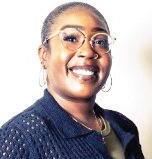
points to trust and judgment as two of the biggest barriers she sees in her community: people don’t ask questions because they fear being turned away or looked down on.
“A lot of people don’t ask questions because they don’t want to be judged,” she said. “They don’t know what to ask, let alone fear being judged for asking.”
months hesitant to follow her advice on improving her personal credit. When she finally committed to the process, her credit score jumped 76 points in just 45 days. With that financial stress lifted, she poured her energy back into her business, and was nominated for and received a best small business award in Minneapolis earlier this year.
Leading that work locally is Achante Brown, a financial well-being coach who brings nearly a decade of banking experience back to the community that raised her. Born and raised in North Minneapolis, she spent almost 10 years at U. S. Bank, working her way from personal banker to Banker III across multiple Twin Cities locations. Now, through Operation HOPE, she works with clients at no cost. Helping them build credit, develop budgets, grow savings, and find the confidence to pursue their financial goals.
Since joining Operation HOPE, Brown has worked with more than 230 clients and conducted over 139 oneon-one coaching sessions.
Across those conversations, three themes rise to the surface every time: credit, confidence, and access.
“Taking that stress off of yourself, believing in yourself, and pouring it back into what you love… number one game changer,” Brown said.
By April D. Lee
A paycheck can feel smaller the moment bills, groceries, gas, subscriptions, and everyday purchases start pulling from it. Many households are careful with their money. The problem is that they are simply trying to manage too many costs without a clear monthly system.
A strong budget brings order to that pressure. It gives every major expense a place, every goal a timeline, and every spending decision a reason. A budget is not about cutting out everything enjoyable. It is about knowing what your money can handle before the month gets away from you. A practical plan can help you pay bills on time, build savings, prepare for emergencies, and spend with more confidence.
Start with what you actually take home
The first step in building a workable budget is starting with your real take-home pay, not your gross income. Net income is the money available after taxes, insurance, retirement deductions, and other payroll items are removed. A budget based on gross pay can look better on paper than it feels in real life. Take-home pay gives the clearest picture of what you can actually use for monthly expenses, savings, debt payments, and daily needs.
A simple starting process includes listing all the income you can count on, writing down every fixed bill, estimating flexible costs like food and gas, setting savings and debt goals, and checking whether your spending is higher than your income. If it is, that gap needs a plan, not avoidance.
Use a framework as a start-
“A lot of my clients come from the same places,” Brown said. “I know what it looks like where they are and how to get where they want to be.” That lived connection is central to her approach. She
“People, especially small business clients, want to build something real, but they don’t know where to go,” she said. “First, the confidence to even ask the question… the confidence to say, ‘Hey, I need help.’”
The results speak for themselves. Brown shared that one client, a young woman building a beverage business in Minneapolis, spent three
U. S. Bank’s Greg Cunningham, chief community impact and inclusion officer, said the partnership reflects the bank’s broader commitment to the communities it serves.
“Our partnership with Operation HOPE and its dedicated coaches like Achante Brown in Minneapolis truly makes a difference for communities,” Cunningham said. “By offering guidance, Operation HOPE coaches help to simplify financial terms, work to improve credit scores and help make connections to access capital. Together, we are committed to connecting individuals and business owners in our communities with the knowledge and resources they need to succeed and thrive financially.”
For those still on the fence about seeking financial sup-

port, Brown’s message is direct.
“Ask questions, ask questions, ask questions,” she said.
“If you don’t know what to ask, or if you’re not confident in asking, no one can help. The help is out there, and community is here.”
Because of the U. S. Bank donation, Brown is able to offer coaching sessions and community workshops entirely free of charge, right in the neighborhood where she grew up.
“Being able to bring back my
knowledge at no cost, I really do appreciate that,” she said.
“I can do a lot of my coaching, a lot of my workshops, right here in the community that raised me.”
Everyone deserves financial confidence, she says. And for those who don’t have it yet, she’s ready to meet them where they are.
To connect with Operation HOPE’s financial coaching services at U. S. Bank’s North Minneapolis branch, visit operationhope.org.
ing point
One of the most practical tools for budgeting is the 50/30/20 method. In that model, 50% of take-home pay goes toward needs, 30% goes toward wants, and 20% goes toward savings or debt repayment. The numbers can shift based on income, family size, housing costs, and financial goals, but the framework gives you a starting point when everything feels overwhelming.
Needs typically include housing, utilities, groceries, transportation, insurance, minimum debt payments, and childcare. Wants may include dining out, entertainment, hobbies, travel, and subscriptions. Savings can include an emergency fund, retirement contributions, future car repairs, school costs, or a home down payment.
The goal is not perfection. The goal is clarity: knowing where your money is going before it disappears.

savings, flexible spending, and any extra debt payoff. What remains after necessities is what you actually have to work with, and knowing that number changes how you make decisions throughout the month.
For people with irregular income, the process looks slightly different. A separate holding account can help, where all income goes in first, and you draw from it based on a consistent monthly budget. Use past income to estimate a conservative monthly average, and plan around the lower end to avoid shortfalls.
Track it and revisit it
Build from the bottom up
A budget should be built around your real life, not an ideal month. Many budgets fail because they are too strict, too vague, or built on assumptions that don’t hold up past the first week.
Begin with the basics. Cover housing, utilities, groceries, transportation, insurance, and minimum debt payments first. After those costs are accounted for, assign money to
A budget that lives only in your head will not hold. Writing it down, whether in a notebook, a spreadsheet, or a budgeting app, makes it real. A simple spreadsheet with columns for planned spending, actual spending, and the difference between the two is often enough.
Categories can include income, housing, utilities, food, transportation, debt, savings, insurance, medical costs, per-
sonal care, and entertainment. The value of tracking is not
make smarter decisions next month. Variable bills like groceries, gas, and utilities need flexible categories. Review past statements and use an average. Add a small buffer when possible so that higher months do not throw off the entire plan. A separate sinking fund like a small account set aside for seasonal costs, annual fees, school expenses, or holiday spending can also absorb those irregular hits before they become emergencies.
When the budget isn’t working
If your budget keeps failing, it may be too strict, too vague, or based on the wrong income number. Rather than starting over completely, review actual spending first. Identify one or two problem categories and make targeted adjustments. Add weekly check-ins to catch small problems be-
Better results often come from small, consistent changes repeated every month, not from an overhaul that is impossible to sustain.
Every dollar deserves a job Learning to budget is one of the most practical financial skills available to anyone, regardless of income level. A strong budget starts with honest numbers, realistic categories, and regular review. It turns monthly income into a plan for bills, savings, debt, and daily spending. And it gives you the confidence to make financial decisions with intention rather than anxiety. Start where you are. Adjust as you go. The most important budget is the one you will actually use.
This column was first published in Black Press USA. For more information, visit www. blackpressusa.com.





Macalester breaks ground on $88 million housing and sustainability project
By Alaysia Lane Contributing Writer
Macalester College’s new residence hall and welcome center is designed to do more than add student housing.
College officials say the $88 million project will reshape how prospective students experience the campus, how current students connect with it, and how the institution pursues its long-term climate goals.
The project, currently under construction at the corner of Grand Avenue and Macalester Street in St. Paul, is intended to expand housing for upper-year students, advance the college’s climate goals and create a more visible, welcoming entrance to campus. Together, those goals represent a broader effort to transform the student experience from a prospective student’s first visit through graduation.
Expected to open in 2027, the five-story building will include 224 beds, a new welcome center, admissions offices, community gathering spaces, a campus store and a public cafe. The building also features a geothermal heating and cooling system that college leaders hope will eventually serve additional campus buildings.
According to Nathan Lief, Macalester’s associate vice president of facilities, the project grew out of several needs the college was trying to address simultaneously.
“The project has several specific goals that we were trying

to solve for the campus,” Lief said, pointing to housing, sustainability and campus visibility among the primary drivers.
While the residence hall will provide new housing, college officials say the project is equally about how people experience Macalester itself.
One of the most visible changes will be the creation of what administrators describe as a new “front door” to the college. The campus currently lacks a central arrival point for visitors, prospective students and families. Macalester plans to redesign the intersection of Grand Avenue and Macalester Street, creating a more welcoming and recognizable entry point to campus.
The project also addresses increasing demand for oncampus housing. Macalester recently implemented a threeyear residency requirement, but existing residence halls have not provided enough capacity to house most students
beyond their second year. The new building is expected to help close that gap while offering upper-year students a living environment that more closely resembles apartmentstyle housing.
Students’ rooms will be organized into pod-style units with shared kitchens, lounges and private-stall bathrooms.
College officials say the design was influenced by feedback gathered during campus planning discussions and is intended to provide greater independence while keeping students connected to campus life.
Lief said housing availability is particularly important for Macalester’s international students, who may face additional challenges securing offcampus housing.
“I think there’s just more of a bond to your college if you live on campus for more years,” he said. “You’re around your friends. You’re around your
professors. You’re around the campus activities.”
College leaders view those housing investments as part of a broader effort to strengthen the student experience, from recruitment through graduation.
carbon emissions.
Lief said the geothermal infrastructure is being designed for future expansion beyond the residence hall itself.
“We’re hoping this is the first step,” he said. “The goal is that over time we can connect additional buildings and continue moving away from our natural gas system.”
Megan Butler, Macalester’s sustainability director, said the project reflects a larger shift occurring across higher education.
“There’s been this shift toward less carbon neutrality and more decarbonization,” Butler said. “What can we actually do on these campuses to reduce how we’re emitting right here, right now?”
“The goal is that over time we can connect additional buildings and continue moving away from our natural gas system.”
The project also represents one of the college’s most significant sustainability investments. The residence hall will be heated and cooled using a geothermal system that utilizes underground wells and heat pumps instead of relying primarily on natural gas. The building will also include rooftop solar panels, native landscaping, energy-efficient systems and construction materials chosen to minimize
Rather than relying primarily on carbon offsets, Butler said colleges are increasingly investing in projects that directly reduce emissions by changing infrastructure and energy systems.
The sustainability features extend beyond energy production. Plans call for a green roof terrace, native plants and landscaping designed to manage stormwater while creating outdoor gathering spaces for students and visitors.
The project also aims to enhance Macalester’s connection with the surrounding
community. In addition to housing and admissions functions, the building will include a public cafe and gathering spaces open to visitors. College leaders say those features were intentionally included to create a more active presence along Grand Avenue and encourage interaction between campus and neighborhood residents.
The development replaces a long-vacant lot and parking area that previously housed a dry-cleaning business. Macalester collaborated with state agencies to address contamination at the site before construction began.
The project is financed through a mix of private contributions and institutional loans. During the 2026 legislative session, the college requested $2.57 million in state funding to support geothermal and sustainability initiatives, but the request was not granted. College officials say they are exploring other funding avenues, including grants, philanthropic efforts and energy-related programs.
“I would hope that people feel welcome,” Butler said. “That they can see themselves here, and that they belong here.”
For more information, visit www.macalester.edu/ news/2026/05/macalestercollege-senior-leadershipdedicates-new-residencehall-and-welcome-center/.
Alaysia Lane is a multimedia journalist and commerce writer based in Minneapolis.
Your Voice Matters to Us!
We’re committed to covering the topics that reflect our community’s passions, challenges, and victories. But we need your help. Take our quick survey and let us know what kind of news excites, inspires, and informs you the most—from culture and entertainment to business and wellness. Your feedback will guide the future of our news coverage!
1. Are you interested in weekend events for the black community?
Yes No
If yes, what do you like that the MSR What’s Hot This Weekend series has covered?
Food and Wine Events
Music Events
Yoga / Wellness Events
Arts & Crafts Events
Markets / Shopping / Thrifting
If yes, which type of weekend events would you like to see that we aren’t currently covering? Comedy Shows
Afrofuturism & Comic Meetups
Independent Film Screenings
Black Tech & Gaming Tournaments
Themed Brunches & Day Parties
Secret Dining Experiences
Other:
2. How would you rate the overall quality of the content we publish?
/ Satisfactory
3. What would you prefer to be different?
4. Rank the topics we currently cover in order of your interest (1 being the highest - 9 being the lowest)
Rights & Social Justice
& Voting
& Prison Reform Black Business Spotlight
Literacy Academic Achievement Health & Wellness Sports
& Culture
5. Please share your feedback regarding MSR’s community coverage. It is excellent and covers diverse local stories. It is good but needs more focus on grassroots events. It is average and
How often do you find yourself recommending our articles/issues to friends or colleagues?
/ Seldom
What is your favorite format for consuming news/digesting content?

Construction of new residence hall expected to open in 2027. Courtesy of Macalester College
Opinion
DevSecOps Engineer: Plymouth,
By Sharon M. Holder, PhD., MPhil., MSc., MSW
June is not just another month on the calendar, it is a national reckoning. It is National Post-Traumatic Stress Disorder Awareness Month and Men’s Health Awareness Month, a moment when we are asked to confront a truth we have avoided far too long: men are suffering, and too many are suffering in silence. The crisis is real, it is growing, and it is claiming lives quietly, in the shadows where stigma thrives and vulnerability is punished.
vention, men die by suicide nearly four times more often than women. Black men, in particular, have seen some of the fastest-rising suicide rates in the country over the past decade. PTSD, often assumed to be a condition limited to veterans, affects millions of men who have never stepped foot on a battlefield.
Trauma lives in neighborhoods shaped by systemic racism, in encounters with law enforcement, in unstable housing, in generational poverty, in the quiet fear of being misunderstood or misjudged. As Bryan Stevenson reminds us, “the
disloyal to the unwritten rules of masculinity. In many communities, emotional restraint is framed as survival: You man-up. You don’t cry. You don’t break.
But this stoicism, while protective in the moment, becomes suffocating over time. It traps pain inside the body until it erupts as anger, withdrawal, substance use, or despair.
PTSD in Black men and men of color often goes undiagnosed not because the symptoms are absent, but because they are normalized.
Nightmares become “just stress.” Hypervigilance becomes “just being careful.” Emotional numbness becomes “just how life is.”
By Jacqueline Patterson
I am a survivor of intimate partner violence.
I don’t remember the hitting, likely due to a protective habit of leaving a blank space in my memory where trauma occurred. I do, however, remember the physical and emotional pain. I remember being very afraid and feeling helpless. I remember the sensation of walking on eggshells and being confident that it wasn’t my fault. That the abuse wasn’t, as too many believe, a sign of their intense love for me.
What I remember most is the shame.
It was deep, isolating, soul-wrenching. It convinced me not to tell a living soul. It made me believe people would question my judgment. It told me I would be derided for letting myself fall into this situation. So I confided in no one. Not family. Not friends. Not a counselor. No one.
Haunted by ‘what-ifs’
I was not alone. Approximately four in 10 Black women have experienced intimate partner violence in their lifetimes. Black women are more than twice as likely as white women to be murdered by their partner.
the horrific murder of eight young children in Louisiana. It includes Nancy Metayer, vice mayor of Coral Springs, Fla., and an environmental scientist, found shot to death inside her home. Her husband has been charged with killing her.
Four years ago, the same year she was married, I interviewed Nancy for a role with The Chisholm Legacy Project. She was our top candidate. Since her murder on April 1, I’ve been haunted by the what-ifs. If Nancy had joined us, would I have seen something in her eyes?
Please
Heard something in her voice?
Would I have recognized my younger self in her?
Am I missing the signs in someone else right now?
tic violence shelter and once harbored a friend fleeing her own abuser. Yet I led a solitary, shadow existence of shame and fear. I never said to a close friend, “Here’s what’s going on with me. Can I talk to you?” I never asked a trusted relative, “Will you help me plan my escape?” Tell someone. Get help. Get out. Your partner will not change. It will not get better. To the friends, family members and colleagues of victims: If you see something, say something. If you sense something, say something. Chances are, they are not okay, even if they insist that they are. Do it even if it means angering that person. It is far better than the alternative.
Taking care of Black women
The Black Femicide Prevention Coalition warns that Black women “are dying at rates that should alarm anyone claiming to care about Black women, the Black family or the Black community.”
When we look closely, one truth becomes impossible to ignore: Black men and other men of color are carrying a disproportionate share of this burden. Their pain is often unseen, their trauma unacknowledged, and their healing unsupported.
As a behavioral health researcher, I have seen this crisis unfold not only in data but in lived experience. According to the American Psychological Association and the American Foundation for Suicide Pre-
opposite of poverty is justice,” and for many Black men, the absence of justice becomes a daily psychological burden. That constant vigilance, bracing against the world, takes a toll on the mind, the body, and the spirit.
For many men, especially Black men and men of color, the expectation to be strong is not just cultural, it is inherited. Strength becomes synonymous with silence. Vulnerability becomes a liability. Asking for help feels dangerous, even
The trauma is real, but the language to name it is often missing. And when men do seek help, they encounter systems not built for them. Systems that lack cultural competence, that have historically caused harm, that too often pathologize Blackness instead of understanding it.
Yet healing is possible. It begins with telling the truth about what men carry. It begins with creating spaces where Black men and men of color can speak without judgment, where their pain is not minimized and their trauma
The past 30 days have laid bare that statistic: Dr. Cerina Fairfax, Davonta Curtis, Pastor Tammy McCollum, Qualeshia “Sidditty” Barnes. It includes
Shame and silence
I was 19 when I first experienced intimate partner violence. It wasn’t the last time. Each time, I dealt with it alone. And I escaped it alone.
I must join the intrepid force of those who share their stories publicly. I want to tell someone in the cruel, stifling grip of IPV shame: don’t be like me.
Even as I write, I weep for the terrified young woman I was. I worked in a domes-
The Black women I know and work with take care of family, community, organizations, movement, democracy and the Earth. We must ensure that we can also take care of ourselves, and that the people and institutions around us know how to take care of Black women, too.
This op-ed was originally published by Word in Black. For more information, visit www. wordinblack.com.
By Andrew G. White IV, PhD
Education reform in the United States is constant, yet its results are strikingly limited. New standards, new
assessments, and new accountability systems appear with each political cycle. But reform continues without resolving a more fundamental question: what is educa-

tion for? Until policymakers agree on whether schools are primarily economic engines, civic institutions, or both, reform will remain directionless. Changing mechanisms without changing outcomes.
Education has never served a single purpose. It prepares individuals for the labor market, supports intellectual development, and cultivates the capacities necessary for civic life. These functions are not mutually exclusive, but they do compete for attention within policy frameworks. In recent decades, one function has come to dominate: economic productivity.
Human capital theory has played a central role in shaping this orientation. By framing education as an investment in labor-market outcomes, it provides a clear rationale for public and private spending (Schultz, 1960). Earnings, employment rates, and productivity gains offer measurable indicators of success, attractive to policymakers because they are quantifiable and comparable. But they capture only part of what education does.
Democratic societies require more than a skilled workforce. Robert Dahl argued that
democracy depends on broad and effective participation, which requires citizens capable of understanding public issues, evaluating alternatives, and engaging in collective decision-making (Dahl, 1989).
Education develops not only knowledge, but judgment, the ability to interpret information, assess claims, and participate meaningfully in public life. But broad participation has a precondition: that the system actually includes those it claims to serve. America has long omitted groups by race, gender, and origin from the full bonds of its founding commitments, and an education that reproduces that omission cannot sustain a democracy projected to be majority-minority by 2060 (Chappell, 2015).
When policy emphasizes economic outcomes above all else, civic functions become secondary. Skills such as critical thinking, deliberation, ethical reasoning, and media literacy are more difficult to measure and therefore receive less institutional attention. What cannot be easily quantified is often treated as less essential, even when it is foundational to democratic stability.
The result is a system car-
rying conflicting expectations.
Schools and universities are expected to produce both skilled workers and engaged citizens, yet policy frameworks primarily support the former. This creates tension within institutions and inconsistency across the system, and leads to a narrowing of educational experience, as measurable outcomes crowd out less quantifiable forms of learning.
why policy cycles feel repetitive: each reform responds to a perceived deficiency, yet the system itself remains conceptually unsettled.
Reform efforts rarely address this tension directly. Instead, they focus on mechanisms like raising standards, revising assessments, restructuring accountability systems. These changes can alter institutional behavior, but they do not resolve the underlying question of purpose. Without a shared understanding of what education is meant to accomplish, reforms accumulate without producing coherence. This helps explain
A coherent system requires a coherent purpose. If education is both an economic and civic institution, and it must be both, policy must reflect those dual roles. This would require broader definitions of success, more stable expectations, and greater support for forms of learning that resist easy measurement. It would also require acknowledging that education’s value extends beyond immediate economic return. A system designed only to produce workers cannot sustain the civic foundations on which its economy depends. Until policymakers define education’s purpose clearly and honestly, reform will continue to move without direction by changing tools, but not outcomes. The question is not whether education should prepare students for work. It is whether that goal alone is sufficient for a democratic society.
Andrew G. White IV, PhD, is the dean of Enrollment Management at NYADI: College of Transportation Technology.
SOE
Continued from page 12
“I’m really still in the league,” she told me after a recent practice.
McCowan in her rookie year in Indiana finished second in rebounding and 10th in blocks and made the 2019 All-Rookie Team. Her second season, the post player put up five doubledoubles, and career highs in boards and blocks, to finish third in rebounding and fifth in blocks in her third campaign.
Then Indiana traded McCowan to Dallas in March 2022, where she earned her first career Western Conference Player of the Month for August that season and shot .602 from the floor, second best in the league. Her second season in Dal-
las, McCowan had one of her 13 double-doubles against Minnesota, season-high 18 rebounds, and later finished the year fifth in rebounding and fourth in field goal accuracy, a starter in 29 out of 30 games.
In 2024, McCowan played in 39 games (38 starts), but the following season, which turned out to be her last in Dallas, she saw action in only 17 games before being waived late in 2025.
Looking back, McCowan admitted she didn’t see herself playing basketball at all, let alone later in college and the pros.
“I didn’t really start playing basketball until eighth grade, and that’s pretty late compared to the basketball world,” she pointed out. “I just wanted to hang with my friends at first, and then I actually got good. I found my calling.”
While at Mississippi State (2015-19), the only school that seemed to really want her in recruiting, McCowan said it wasn’t until her sophomore or junior year that she could see herself moving on to the pro level.
One ESPN mock draft had McCowan going No. 1 in the 2019 draft, but a later draft prospectus put her third, which is where Indiana did select her.
Being a third overall draft pick put McCowan in elite company withMichael Jordan, James Harden, Carmelo Anthony, Pau Gasol and Grant Hill among successful NBAers taken third overall.
Skylar Diggins, Candace Wiggins and Tamika Catchings were also WNBA third overall picks in their respective drafts.
“I didn’t think I was going three, but I was super shocked,” remembered Mc-
Cowan. “I looked at my mom and my aunt, I was like, three is crazy. Then I just got up and I hugged them.”
Now with Minnesota, McCowan says she understands why the Lynx have been perennially successful: “Now I know why they play so hard and why they’re so successful in the game because of the practices that I’ve had,” she surmised after the workout.
Finally, whenever she does hang up her sneakers for good, McCowan said she plans to go into business for herself, perhaps clothing.
“I plan on having a couple of businesses,” she said. “I’m currently working on something right now.”
Charles Hallman welcomes reader responses at challman@ spokesman-recorder.com.
Copyright © Charles Hallman
Sports Act, known as the SAFE Act, and the SCORE Act.
U.S. Sen. Cory Booker calls the SCORE Act “harmful,” even after a group of HBCU commissioners from the CIAA, MEAC, SIAC and SWAC sent a letter to the Congressional Black Caucus in May urging the Black legislators to push for it, because they see it as “best suited to address our core concerns … [a] currently unsustainable state of collegiate sports.”
On the other hand, the SAFE Act, according to
bill co-sponsor Sen. Maria Cantwell, would “help smaller schools compete” and give every school “a fair shake.”
I’m not a Matlock or Perry Mason, although I once took a mandatory journalism law class in college, nor am I a politician, but I do know what a holy mess looks like. “College sports are worth fighting for. It’s probably going to take Congress … if Congress can somehow get involved so that the NCAA can make rules without the constant threat of litigation, that would go a long way,” stated soon-to-retire Big East Commissioner Val Ackerman a couple of months ago to reporters, including the MSR. Sadly, there are people, in-
Finally, Bell has hit safely in 14 of his last 17 games dating back to May 28. The first baseman-DH is hitting .295 with five doubles, two home runs, a walk, 11 RBI and nine runs scored in that stretch.
cluding the president, members of Congress, fans and million-dollar-making coaches, who are against college players getting their fair share, hoping to roll back any gains they have received from the House v. NCAA $2.8 billion settlement, which created the College Sports Commission (CSC) in 2025.
The CSC was created by the then-Power Five conferences, Big Ten, Big 12, ACC, SEC and the former Pac-12 to oversee and enforce compliance with the institutional revenue-sharing model with student-athletes, who can be paid up to $20.5 million per participating school in the 2025-26 academic year. This amount is scheduled to
is something that’s really important, not only for our young players but for our organization,” Shelton said.
increase each year and is expected to reach nearly $33 million by 2035.
The group is also charged with overseeing NIL compliance through NIL Go, which would require all third-party NIL deals exceeding $600 to be submitted for review, and oversee institutional compliance with new sport-specific roster limits.
So, the players are finally getting paid, right?
As they say in Ghostbusters, who you gonna call? Seemingly, it isn’t that simple in the wild, wild west, eh, NIL.
Charles Hallman welcomes reader responses at challman@ spokesman-recorder.com.
Copyright © Charles Hallman
Service. The five Twins joined Whittier students on the playground for recess.
Minnesota Spokesman-Recorder, June 18, 25, 2026
PREP
Continued from page 12 of the season. “We have to remember with Taj that he doesn’t have a ton of major league experience,” Shelton said of Bradley, who has only two years of MLB service. Bradley told reporters, including the MSR, “I was more elated … attacking hitters early. I was happy.”
“I don’t think there’s enough superlatives or good things you can say about Josh Bell as a person, as a leader, as a teammate in our clubhouse. I think what he brings on a daily basis in terms of professionalism
Twins take recess Bell, Twins bullpen Coach LaTroy Hawkins, Coach Toby Gardenhire and teammates Pablo Lopez and Anthony Banda took part in “Play Day” at Whittier Elementary School in Minneapolis on June 1 as part of the team’s fifth annual Minnesota Twins Week of
“Oh, yeah, it was cool,” said Bell. “Just hung out and had recess for three or four different grades, played kickball and fetched some balls off the tee.”
Charles Hallman welcomes reader responses at challman@ spokesman-recorder.com.
Copyright © Charles Hallman
He dominated the sprints at the Minneapolis City Conference Track and Field Championships, winning the 100-meter and 200-meter runs.
He went on to capture the 200-meter title at the Class AA State Track and Field Championships with a record-breaking time of 21.38, while finishing runner-up in the 100.
Khapriece Venzant Venzant turned in quite the dominant performance at the St. Paul City Conference Track and Field Championships last month.
The St. Paul Harding senior placed first in the long jump and triple jump. He leaped 20 feet, 9 inches in the long jump and 44 feet, 5 inches in the triple jump.
Amira Cogshell Cogshell turned in one of the most dominant performances as a sprinter this spring. In leading St. Paul Highland Park to the City Conference Track and Field Championships title, she captured top honors in the 100-meter, 200-meter, and 400-meter runs.
Dr. Mitchell Palmer McDonald welcomes reader responses at mcdeezy05@gmail.com.




Employment & Legals
SUMMONS (CITACION JUDICIAL)
NOTICE TO DEFENDANT:
(AV(SO AL DEMANDADO):
Christine Moua
YOU ARE BEING SUED BY PLAINTIFF:
(LO ESTA DEMANDANDO EL DEMANDANTE):
Dean Moua, Tou Moua
FOR COURT USE ONLY
(SOLO PARA USO CELA CORTE)
ELECTRONICALLY FILED
SUPERIOR COURT OF CALIFORNIA
County of Tehama Kevin Harrigan, Clerk of the Court By _____________________, Deputy EFILED
Gregoria Guardado
NOTICE! You have been sued. The court may decide against you without your being heard unless you respond within 30 days. Read the information below.
You have 30 CALENDAR DAYS after this summons and legal papers are served on you to file a written response at this court and have a copy served on the plaintiff. A letter or phone call will not protect you. Your written response must be in proper legal form if you want the court to hear your case. There may be a court form that you can use for your response. You can find these court forms and more information at the California Courts Online Self-Help Center (www.courts.ca.gov/selfhelp), your county law library, or the courthouse nearest you. If you cannot pay the filing fee, ask the court clerk for a fee waiver form. If you do not file your response on time, you may lose the case by default, and your wages, money, and property may be taken without further warning from the court.
There are other legal requirements. You may want to call an attorney right away. If you do not know an attorney, you may want to call an attorney referral service. If you cannot afford an attorney, you may be eligible for free legal services from a nonprofit legal services program. You can locate these nonprofit groups at the California Legal Services Website (www.lawhelpcalifornia.org), the California Courts Online Self-Help Center (www.courts.ca.gov/selfhelp), or by contacting your local court or county bar association. NOTE: The court has a statutory lien for waived fees and costs on any settlement or arbitration award of $10,000 or more in a civil case. The court’s lien must be paid before the court will dismiss the case.
¡AVISO! Lo han demandado. Si no responde dentro de 30 días, la corte puede decidir en su contra sin escuchar su versión. Lea la información a continuación.
Tiene 30 DÍAS DE CALENDARIO después de que le entreguen esta citación y papeles legales para presentar una respuesta por escrito en esta corte y hacer que se entregue una copia al demandante. Una carta o una llamada telefónica no lo protegen. Su respuesta por escrito tiene que estar en formato legal correcto si desea que procesen su caso en la corte. Es posible que haya un formulario que usted pueda usar para su respuesta. Puede encontrar estos formularios de la corte y más información en el Centro de Ayuda de las Cortes de California (www.sucorte.ca.gov), en la biblioteca de leyes de su condado o en la corte que le quede más cerca. Si no puede pagar la cuota de presentación, pida al secretario de la corte que le dé un formulario de exención de pago de cuotas. Si no presenta su respuesta a tiempo, puede perder el caso por incumplimiento y la corte le podrá quitar su sueldo, dinero y bienes sin más advertencia. Hay otros requisitos legales. Es recomendable que llame a un abogado inmediatamente. Si no conoce a un abogado, puede llamar a un servicio de remisión a abogados. Si no puede pagar a un abogado, es posible que cumpla con los requisitos para obtener servicios legales gratuitos de un programa de servicios legales sin fines de lucro. Puede encontrar estos grupos sin fines de lucro en el sitio web de California Legal Services, (www.lawhelpcalifornia.org), en el Centro de Ayuda de las Cortes de California, (www.sucorte.ca.gov) o poniéndose en contacto con la corte o el colegio de abogados locales. AVISO: Por ley, la corte tiene derecho a reclamar las cuotas y los costos exentos por imponer un gravamen sobre cualquier recuperación de $10,000 ó más de valor recib 1 ida mediante un acuerdo o u 2 na concesión de arbitraje en un caso de derecho civil. Tiene que pagar el gravamen de la corte antes de que la corte pueda desechar el caso.
The name and address of the court is: (El nombre y dirección de la corte es): Superior Court County of Tehama 1740 Walnut Street, Red Bluff, CA 96080
CASE NUMBER (Número del Caso): 25CI-000033
The name, address, and telephone number of plaintiff’s attorney, or plaintiff without an attorney, is: (El nombre, la dirección y el número de teléfono del abogado del demandante, o del demandante que no tiene abogado, es): Natalie R. Ludwig, 2150 Main Street, Suite 116, Red Bluff, CA 96080 (530) 690-2711
DATE: (Fecha)
Sr Industrial Engineer Covidien LP (a Medtronic Company)
Plymouth, MN. Req. Master’s deg. in Mechanical, Industrial, Biomedical or Electronics Engineering or rel. engr. d. & 2 yrs. exp. as an industrial engr. or rel. occupation in mfg. or quality engr., or Bachelor’s deg. & 5 yrs. exp. Salary: $131,000 to $148,800 per year. Apply for more details, see https:/medtronic.wd1.myworkdayjobs.com/ MedtronicCareers, Req. #R66813. No agencies or phone calls. Covidien/Medtronic are equal opportunity employers. All individuals are encouraged to apply.
Architect (Multi. Pos.)
The Alliance, Inc. d/b/a Alliiance, Minneapolis, MN
The Alliance, Inc. d/b/a Alliiance seeks Architect (Multi. Pos.), Minneapolis, MN; req MS in Architecture from NAAB accred univ prog + 3 yrs exp as architect or rel. pos in aviation arch design; Req. 3 yrs w/each: Autodesk; Adobe; SketchUp; Rhino; Enscape; Lumion; Bluebeam Revu; Constr admin. Incl. site visits, coord w/ contractors & consultants, submittal & RFI logs, & issuing constr directives; Work w/ mech. and elec. engrs; Work in airport, w/ fed. Bldg. reqs. MN Arch Lic req. $85,093/yr; Portfolio req. Resume to careers@alliiance.com.
State
Certificate of Assumed Name Minnesota Statutes, Chapter 333
ASSUMED NAME: Eikenridge Advisory
PRINCIPAL PLACE OF BUSINESS: 601 Carlson Pkwy Ste 300
APPLICANT(S): JED Enterprises LLC 601 Carlson Pkwy Ste 300
Minnetonka MN 55305 USA
If you submit an attachment, it will be incorporated into this document. If the attachment conflicts with the information specifically set forth in this document, this document supersedes the data referenced in the attachment.
By typing my name, I, the undersigned, certify that I am signing this document as the person whose signature is required, or as agent of the person(s) whose signature would be required who has authorized me to sign this document on his/her behalf, or in both capacities. I further certify that I have completed all required fields, and that the information in this document is true and correct and in compliance with the applicable chapter of Minnesota Statutes. I understand that by signing this document I am subject to the penalties of perjury as set forth in Section 609.48 as if I had signed this document under oath.
Clerk, by (Secretario)
Deputy (Adjunto) 2/14/2025 9:12 AM
(For proof of service of this summons, use Proof of Service of Summons (form POS-010).) (Para prueba de entrega de esta citación use el formulario Proof of Service of Summons, (POS-010)).

[ ] on behalf of (specify): under: [ ] CCP 416.10 (corporation) [ ] CCP 416.60 (minor)
[ ] CCP 416.20 (defunct corporation) [ ] CCP 416.70 (conservatee) [ ] CCP 416.40 (association or partnership)
Minnesota Spokesman-Recorder, June 18, 25, July 2, 9, 2026
Binta Kanteh
Alaysia
SIGNED BY: Alexander C. Roverud
MAILING ADDRESS: None Provided EMAIL FOR OFFICIAL NOTICES: Jorgen.dahl@nm.com
Minnesota Spokesman-Recorder, June 18, 25, 2026
Office of the Minnesota Secretary of State Certificate of Assumed Name Minnesota Statutes, Chapter 333

The filing of an assumed name does not provide a user with exclusive rights to that name. The filing is required for consumer protection in order to enable customers to be able to identify the true owner of a business.
ASSUMED NAME: NEON
PRINCIPAL PLACE OF BUSINESS: 1007 W BROADWAY AVE MINNEAPOLIS MN 55411 USA
APPLICANT(S): Northside Economic Opportunity Network 1007 W BROADWAY AVE MINNEAPOLIS MN 55411 USA
If you submit an attachment, it will be incorporated into this document. If the attachment conflicts with the information specifically set forth in this document, this document supersedes the data referenced in the attachment.
By typing my name, I, the undersigned, certify that I am signing this document as the person whose signature is required,or as agent of the person(s) whose signature would be required who has authorized me to sign this document on his/her behalf, or in both capacities. I further certify that I have completed all required fields, and that the information in this document is true and correct and in compliance with the applicable chapter of Minnesota Statutes. I understand that by signing this document I am subject to the penalties of perjury as set forth in Section 609.48 as if I had signed this document under oath.
SIGNED BY: Larry E. Posey
MAILING ADDRESS: None Provided EMAIL FOR OFFICIAL NOTICES: larry@neon-mn.org
McCowan: Still in the league
eaira McCowan a couple of months ago saw herself taking a “gap year” in her pro basketball career. The 6-foot-8 post player had completed a successful season overseas, playing for Turkish powerhouse club Fenerbahçe.
But back stateside, McCowan hadn’t gotten any calls from a WNBA club as the 2026 training camp heated up. She had been available since being waived by Dallas last August.
“When I was overseas,” recalled McCowan, “I kind of wasn’t in the best position to get myself back out there” as a free agent, she pointed out. “So, I was like, okay, I’ll take the year off.”
"I
didn't think I was going three, but I was super shocked."
It would have been her first extended time off since being drafted by Indiana in the 2019 WNBA Draft (first round, third overall) after a college career at Mississippi State. It has been virtually nonstop from season to offseason overseas to back to the W ever since.
“This technically was actually my first off-season,” said
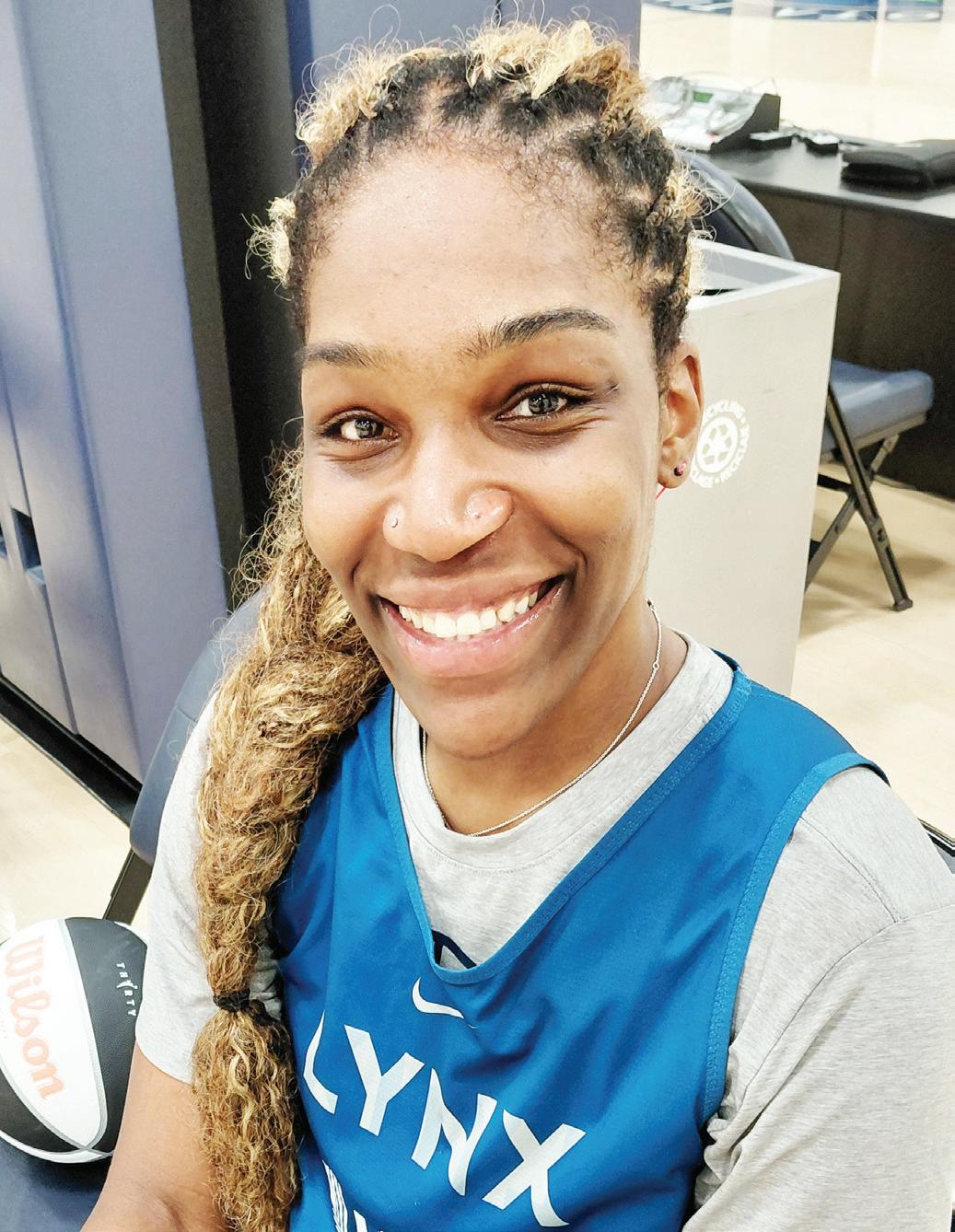
McCowan, the Texas native, “when I wasn’t signed (by a WNBA club). The first off-season I’ve had since I’ve been a pro.”
But as soon as she realized it wasn’t going to be an eighth season in the W, things quickly ramped up in May. “Five minutes later, Cheryl (Reeve) hit me, and I was like that is crazy because it happened so fast,” recalled McCowan.
Five who made their mark Hughes Jr., Moses, Minibah Jr., Venzant, Cogshell excel

ere are five student athletes who made their mark this spring.
Juriad Hughes Jr. Hughes Jr. has had a spring to remember.
The former Irondale High School football and track and field standout, now a sophomore phenom for the University of Arkansas, helped the Razorbacks capture the NCAA Division I Track and Field Championship by plac-
ing second in the long jump.
Hughes was the 2024 Gatorade Track and Field Performer of the Year as a senior.
Laila Moses Moses, one of the state’s top student athletes, seemed to pick up where she left off last year.
The junior from DeLaSalle High School was outstanding while competing in the Class AA state track and field meet earlier this month.
Not only did she successfully defend her 100-meter hurdles title, she also took first place in the shot put.
She also plays forward for the girls basketball team.
Saye Minibah Jr. Minibah closed his track and field career at Minneapolis North with an unforgettable spring.

Cost of college sports
The

e strongly suggest that every Division I college athlete from now on send a thank-you card to Ed O’Bannon. If the former UCLA star hadn’t seen his likeness on a college basketball video game without his permission and successfully sued the NCAA, a ruling the U.S. Supreme Court eventually confirmed, today’s NIL (name, image and likeness) era might not exist.

After years of battling against them, Minnesota signed McCowan as an unrestricted free agent to a one-year contract on May 28, about two weeks after the 2026 season began.
She’s now a Lynx. Reeve, the team’s head coach and basketball operations head, needed another big and McCowan fit the need.
However, neither O’Bannon nor anyone else for that matter imagined what’s going on in today’s college sports landscape.
Law professor Michael McCann last September said in Sportico that “college sports has morphed into a unique and still evolving creature for legal study” because of O’Bannon’s historic win over the NCAA.
Several legal defeats later, the big bad NCAA is now looking to the White House and Congress for help. Instead of working on bills that help eliminate income and health disparities in this country, we have a president and lawmakers worried more about players finally getting paid, even though they will never make as much as the coaches and the schools they play for. There are currently two proposed bills in Congress, plus an executive order, all intended to put the brakes on the so-called NIL runaway train: the Protect College
By Charles Hallman
Sports columnist
With Simeon Woods Richardson traded to Toronto earlier this month, the Minnesota Twins now have four Black players: Josh Bell, Byron Buxton, Royce Lewis and Taj Bradley. All four played in last Sunday’s win over St. Louis.
Manager Derek Shelton spoke with reporters before the game, including the MSR, in his clubhouse office, touching briefly on each of the four.
“I’m enjoying playing baseball in the big leagues. Everything’s going
Royce Lewis is back with the parent club after a 15-day stint in St. Paul working on his batting swing and fielding skills. Since being recalled on June 6, the infielder has hit .379 with two doubles, three home runs, three walks, five RBI and four runs scored. He
left town on the team’s sixgame, seven-day road trip riding an eight-game on-base streak.
“I think there’s been times in the past where we’ve seen Royce get really hot, and it’s good to see,” said Shelton. “He’s got some energy … that
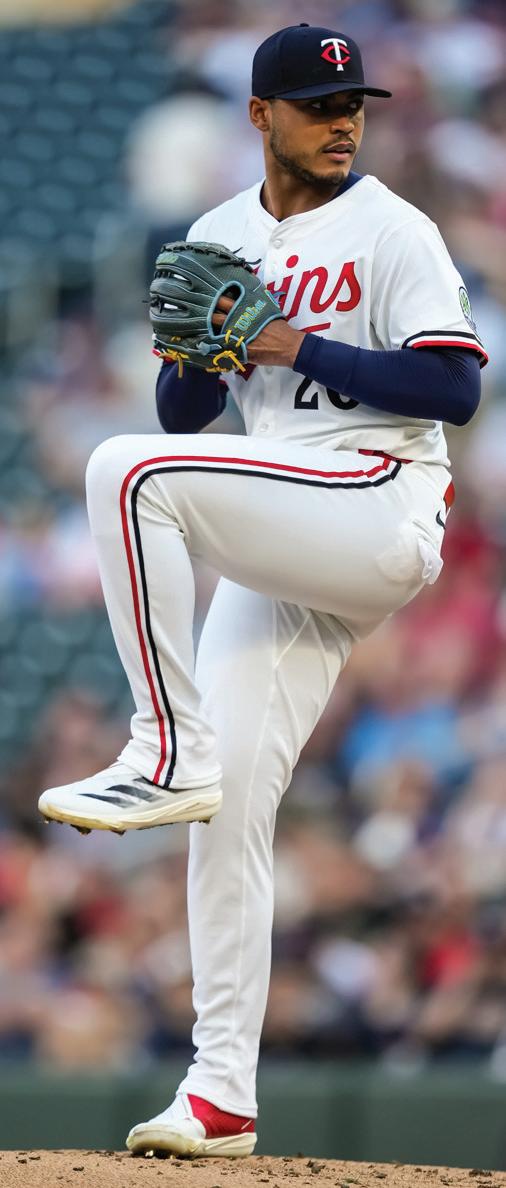
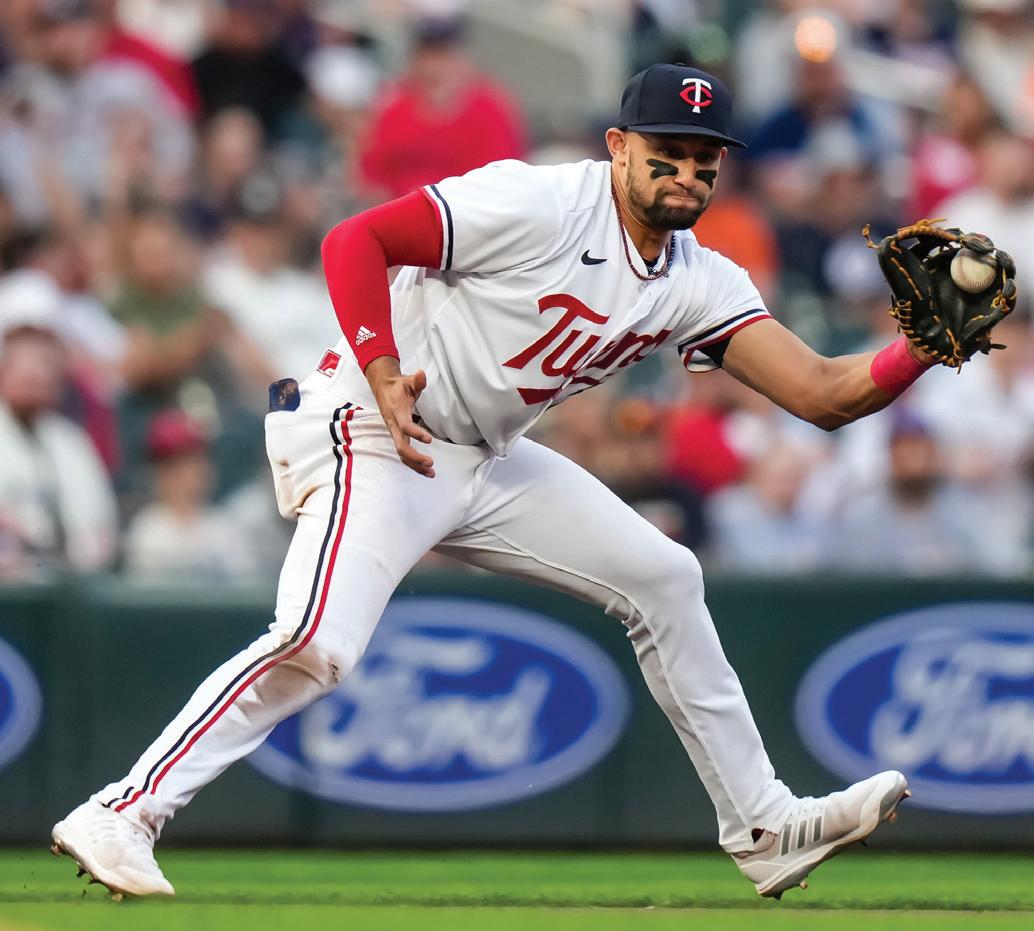
energy is great for us.” Shelton added, “I love the fact that he took the demotion so professionally. A lot of kids that have had success at the major league level will go down and not work and pout. He did not do that. He went down there and forced his

way back to the big leagues by how hard he worked, and I think it’s a credit to him.”
After infield practice, Lewis, who is now playing first base, told the MSR, “I’m enjoying playing baseball in the big leagues. Everything’s going well.”

Dating back to April 25, Buxton has 17 home runs, a .715 slugging percentage and 103 total bases entering Sunday’s contest. “What he’s doing on the field this year has been really fun to watch,” said Shelton of Buxton, the team’s longest-tenured player. “Just seeing him grow into the man he is, the husband he is, the father he is, the person he is… it’s gratifying.”
Bradley is the Twins’ only Black pitcher. Although he didn’t factor into Sunday’s decision, he had seven strikeouts in 6.2 innings in his 13th start
First of two parts
Ed O'Bannon
Courtesy of X
Juriad Hughes Jr. University of Arkansas Athletics
Taj Bradley Minnesota Twins
Josh Bell Charles Hallman/MSR
Royce Lewis Charles Hallman/MSR
Byron Buxton Minnesota Twins Royce Lewis Minnesota Twins
Josh Bell Minnesota Twins
Teaira McCowan
Charles Hallman/MSR