Health Advocates push back on HERC pollution standards
By Alaysia Lane Contributor
A renewed debate over the future of Hennepin County’s waste incinerator is growing as environmental advocates question federal pollution standards, raise concerns about toxic chemical emissions, and accuse officials of downplaying health risks for nearby communities.
The Hennepin Energy Recovery Center, or HERC, is a downtown Minneapolis wasteto-energy facility that burns about 365,000 tons of trash each year while producing electricity. The plant sits near North Minneapolis and the city’s industrial core, where it has long been a point of conflict over pollution, environmental justice, and waste policy.
The debate has escalated alongside a federal lawsuit filed by youth plaintiffs and environmental groups against the U.S. Environmental Protection Agency. The case challenges recent rollbacks of federal emissions protections and argues that weaker standards violate constitutional rights by increasing exposure to climate and toxic pollution. Plaintiffs also say the changes could lead to higher greenhouse gas emissions.
The lawsuit is part of a larger set of legal challenges to federal environmental policy. Advocates say these challenges matter for facilities like HERC, where residents already worry about com-
bined pollution from multiple sources and whether current air pollution rules fully protect nearby communities.
A separate analysis commissioned by the Zero Burn Coalition adds to those concerns, arguing that PFAS emissions, long-lasting synthetic chemicals known as “forever chemicals,” may not be properly monitored or regulated at the facility level. PFAS are linked to cancer, immune system impacts, and developmental harm, and they can remain in the environment for decades. Hennepin County acknowledges PFAS are not included in HERC’s air permit, but officials say industry and waste-recovery studies suggest high-temperature combustion destroys most PFAS compounds.
Still, critics say the science is not settled.
“The permits that they are relying on were improperly set,” said Doug Gurian-Sherman, a former EPA risk assessor who contributed to the Zero Burn Coalition analysis. “They are not based on a full assessment of long-term health risks from residual pollution.”
Gurian-Sherman pointed to a federal court ruling and Clean Air Act requirements, which he said require a second-stage “residual risk” review after initial controls are in place. He said that review has never been fully completed for municipal waste incinerators.
The Minnesota Pollution Control Agency said it could not provide an interview and referred inquiries to existing agency documentation on
emissions and permitting.
County officials say HERC meets all federal and state permit requirements and that emissions stay well below limits.
“HERC is in full compliance with our current permits from both the EPA and the Minnesota Pollution Control Agency,” said Dave McNary, assistant director of Hennepin County’s Environment and Energy Department. “Air emissions from HERC are significantly below those permit levels.”
McNary said the facility uses continuous emissions monitoring systems that track pollution in real time and share data with regulators. He also said county data show mercury and nitrogen oxide emissions remain far below permitted levels.
But environmental advo-
cates say compliance does not always mean safety.
Nazir Khan, an organizer with the Zero Burn Coalition, said the issue is about longterm exposure in already burdened neighborhoods.
“We’re talking about communities that have experienced decades of environmental racism and cumulative harm,” Khan said. “People living near HERC are dealing with multiple pollution sources at once.”
Khan said residents are questioning why they should continue carrying what he called unequal environmental burdens.
Stephani Booker, another coalition organizer who lives about a mile from the facility, said PFAS concerns have added urgency to long-standing worries.
“People hear ‘forever chemicals,’ and they understand that these compounds don’t just disappear,” Booker said. “Residents want accountability and transparency about what’s being released into the air.”
“To conclude that emissions are safe is scientifically unjustified.”
Booker called the new research “a reckoning” for local officials and said concerns near HERC go back decades.
Gurian-Sherman said studies suggesting modern pollution controls can significantly reduce PFAS emissions from waste burning are limited, focusing on a small number of chemicals and short testing periods.
“To conclude that emissions are safe is scientifically unjustified,” he said.
Environmental justice concerns remain central to the debate. Advocates cite state risk assessments suggesting higher pollution exposure in neighborhoods closest to HERC, many of which include lower-income residents and communities of color.
County officials have said most air pollution in Hennepin County comes from cars and trucks rather than industrial facilities and that there is no clear disparity in health risk across communities.
Gurian-Sherman disputed that, pointing to county modeling he said shows higher exposure near the facility.
“The people closest to HERC are exposed to two-tofour times greater risks,” he said.
The county says it plans to eventually close HERC as part of its Zero Waste Plan, but warns that shutting down too quickly could increase landfill use and create other environmental problems. The facility is expected to operate into the late 2020s or as late as the 2040s, depending on waste system changes.
Meanwhile, federal litigation and new scientific research continue to intensify a longrunning debate over waste incineration in urban areas.
“This is bigger than one incinerator,” Khan said. “The question is whether communities should continue being asked to accept pollution that newer science increasingly shows may not be safe.”
Alaysia Lane is a multimedia journalist and commerce writer based in Minneapolis.
Outside the Hennepin Energy Recovery Center
H Jiahong Pan/MSR
PREP
Continued from page 12
The most memorable part of his remarks centered on how proud he was of his sons — Marcus Fitzgerald, a 2004 Holy Angels graduate who went on to play wide receiver at Marshall University, and Larry Fitzgerald Jr., a 2000 Holy Angels alum and 17-year NFL veteran
THIRD
Continued from page 12
just like nitpicking… you call it my way one time, then you call it against me the next time, and it’s the same exact play. It’s always unfair to bigs, and I feel like nobody ever really notices that. Personally, it’s difficult for me because I feel like they always call against me.”
New CBA adds developmental player spots
The new WNBA collective bargaining agreement (CBA) added two developmental player spots to each roster. Each team, if it chooses, can carry up to two developmental players. Players must have three or fewer years in the league, though those with four or five years can qualify if they played limited
wide receiver who will be inducted into the Pro Football Hall of Fame in August. It was a great moment and a deserved honor for one of the pioneers for Black journalists across the country. More importantly, Larry Fitzgerald Sr. got his flowers. Thank goodness I was there to see it.
Dr. Mitchell Palmer McDonald welcomes reader responses at mcdeezy05@gmail.com.
minutes the previous season. Developmental players receive a $750 weekly stipend and, if activated for a game, can earn a prorated game bonus of roughly $6,000.
“It’s an opportunity for a young player on the cusp to ease their transition into the league,” Jordan Robinson said in her WNBA30 feature in The
SOE
Continued from page 12
FINALLY…
I had those types of players around me: Lindsay, Rebekkah Brunson, Seimone Augustus, Sylvia Fowles, Maya Moore. Those players helped me grow as a player but also as a person.” “I’m glad to be back,” she added.
Olivia Miles was named WNBA Rookie of the Month last week for games played May 8-31. The first-year point guard leads all rookies in scoring, assists, steals and efficiency.
Charles Hallman welcomes reader responses at challman@ spokesman-recorder.com.
Copyright © Charles Hallman
Guardian. “The developmental spots are mutually beneficial. Coaches won’t need to pull in a random, outside player to quickly learn the plays.”
Chicago guard Rachel Banham, a Minnesota native, said the developmental spots may be among the least-talked-about features of the seven-year CBA.
“There’s just so much more opportunity for the younger players to get an opportunity,” Banham said.
Washington’s Darianna Littlepage-Buggs became the first developmental player signed in WNBA history. Minnesota has since signed forward Liatu King and guard Eliska Hamzova to its two developmental spots.
Charles Hallman welcomes reader responses at challman@ spokesman-recorder.com.
Copyright © Charles Hallman
"Interesting," Banham added.
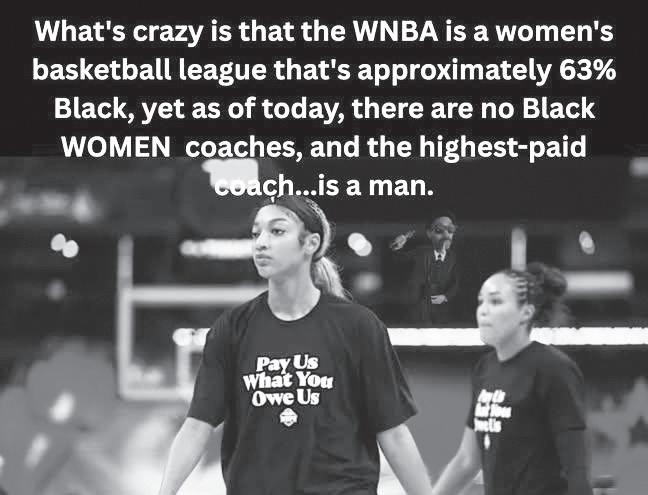
Coach Marsh acknowledged he was also unaware. "I'm extremely proud of that," he said. "I think the more representation we can have as players, as staff, as front office, coaching-wise… the better."
On what it means to be a Black coach in the league, Marsh added: "I think there's a ton of talented African American players and coaches that don't always have the opportunity, and so it's part of the reason why I approach this job in a way that it's not just a job, it's a responsibility. It's a responsibility that I try to uphold each day for my players. It's what keeps me going. I know what I rep-
resent and who I represent and why I work and live for."
On his all-Black coaching staff, Marsh said: "I think our staff feels the same, and I appreciate you bringing that up because it does mean a lot."
FINALLY…
Each PWHL club can protect three players in the league's first phase of the Expansion Roster Distribution
The
Charles Hallman welcomes reader responses at challman@ spokesman-recorder.com.
Copyright © Charles Hallman
Olivia Miles Photo courtesy of X
Process. Vancouver's Sophie Jaques and Sarah Nurse, two of the league's three Black players, made the first phase.
third Black player, Mikyla Grant-Mentis, did not make Seattle's protected list.
Rachel Banham Photo courtesy of Charles Hallman/MSR
Courtesy of threads