

Civil rights groups fight back as Trump policies target Black voters, Muslim communities
By Clint Combs Contributing Writer
wo of the country’s leading civil rights organizations are litigating legal challenges against Trump administration policies they say dilute Black voting rights and systematically target Muslims.
CAIR-Minnesota hosted So-
mali American Solidarity Day at the Minnesota State Capitol May 12, drawing speakers who argued that President Donald Trump’s policies have made Muslim and immigrant communities daily targets of suspicion and state power. The rally came as CAIR-MN announced it is representing a Minnesota labor organizer whose phone and books were seized by federal agents upon her return from Europe.
Janette Corcelius, a community organizer with OPEIU Local 12, arrived at Minneapolis-St. Paul International Airport on April 30 after a twoweek trip abroad, where she had been promoting a Minneapolis City Council resolution
urging European banks to cut ties with companies that contract with Immigration and Customs Enforcement. After opting out of a facial recognition scan, she was stopped by Department of Homeland Security agents, who seized her phone and dozens of books she had collected overseas.
“If the violation of my First and Fourth Amendment rights in retaliation for my political beliefs, organizing, and identity was meant to inflict fear and suffering, then it has failed,” Corcelius said. “I am unabated and undeterred.”
Alec Shaw, a civil rights attorney at CAIR-MN, saw the seizure as part of a broader crackdown on political dissent. “American Muslims are being targeted for the healthy criticism of their government, the most democratic action a citizen can take,” Shaw said. “We stand with Minnesotans and we stand with Ms. Corcelius today.”
Speakers at the solidarity rally drew on history and current events to argue that the
■ See NAACP on page 5

Leaders condemn George Floyd joke on Netflix Special

Chris Juhn/MSR
By Jasmine McBride Editor
early six years af-
ter George Floyd was murdered by a Minneapolis police officer, a Netflix comedy special reopened wounds that community members say have never fully healed.
During “The Roast of Kevin Hart,” comedian Tony Hinchcliffe made a joke referencing Floyd’s final moments, saying Floyd was “looking up” at the audience and “can’t breathe,” a reference to Floyd’s last words as officer Derek Chauvin knelt on his neck for nine minutes and 29 seconds on May 25, 2020.
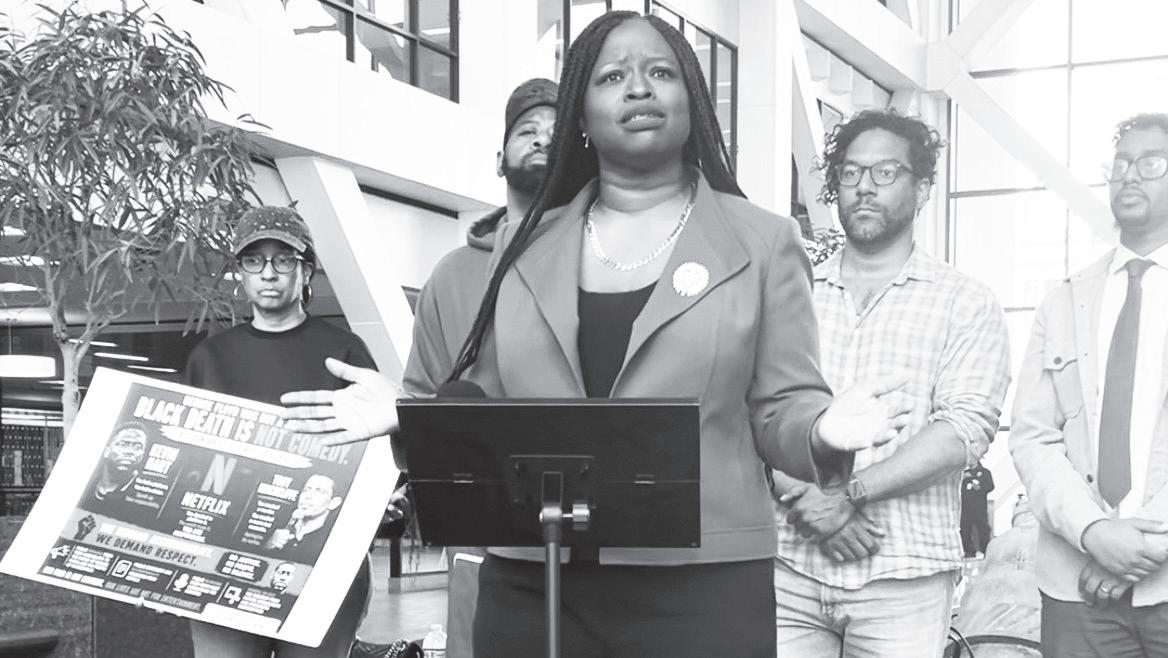
On May 13, Minneapolis community leaders, civil rights advocates and residents gathered at the Hennepin County Government Center to condemn the remarks and demand accountability from Hinchcliffe, Hart and Netflix.
“When I saw the clip online, it made me sick to my stomach,” said Nekima Levy Armstrong, civil rights attorney and founder of the Racial Justice Network, who opened the press conference. “George Floyd was a member of our community. He was a father, he was an uncle, and he was a man who should still be alive. Here we are about to memorialize George Floyd for year six, and instead of allowing our community to
grieve in peace, we have Netflix comedians making light of his killing. It is unacceptable and it is unconscionable.”
Brandon Williams, Floyd’s nephew, spoke to the Spokesman-Recorder by phone from Texas. He said he did not watch the special but learned about the joke through calls and texts.
“Kevin Hart was at the service after George was killed. He spoke to us privately, saw the pain that we went through,” Williams said. “It was shocking for him not to at least say something.”
Experts weigh in on hantavirus risk
By Damenica Ellis Staff Writer
antavirus, a virus carried by rodents most recently contracted by two cruise passengers, has raised concerns as questions of person-to-person spread linger in the wake of the COVID-19 pandemic. Claudia MunozZanzi, a University of Minnesota infectious disease expert, emphasizes that the risk of a widespread outbreak remains low. A frontline nurse shares concerns in her field, and the Cultural Wellness Center director stresses the importance of cultural preparedness.
“I think the concern nurses have right now is, just like COVID, we were under the impression it wouldn’t impact us,” said Lynnetta Muehlhauser, a pre- and post-operation nurse with the Minnesota Nurses

Association. “What we’ve found is that communicable diseases aren’t the same as they used to be and the infor-
mation that we get is also very limited or kind of varies.” Munoz-Zanzi, an associate professor at the University of
Minnesota School of Public Health who studies rodentborne infections, says there is minimal risk concerning the hantavirus and Andes virus. The hantavirus is a family of viruses with many strains. The Andes virus is one strain now drawing attention as it spreads from human to human.
“This disease has been around … there are cases that occur on a regular basis in South America and even here in the U.S. Sporadic cases we can see regularly over the years,” Munoz-Zanzi said.
There have been two hantavirus cases “likely acquired” in Minnesota since 1999, and another Minnesota resident who acquired a hantavirus infection in the western U.S., according to the Minnesota Department of Health.
Transmission from one person to another is low, she said.
The pathogen behaves differently from other viruses, making a larger outbreak unlikely.
“Clusters tend to be very defined and haven’t gone beyond very close contacts, and then the cluster at some point is gonna die out.”
“We definitely operate from a place of suspicion.”
The slow spread also allows for more in-depth contact tracing and time to prepare for a worst-case scenario. “I was surprised that it has been in the news so much because again the risk is so low,” Munoz-Zanzi said.
Muehlhauser, who has 30 years of experience at the bedside including working
Speakers pointed to what they called a clear double standard. Jokes about Melania Trump were reportedly pulled from the special before broadcast, while remarks targeting Black women, including Cheryl Underwood and Lizzo, were allowed to air.
“You can’t disrespect white women, but you can disrespect Black women,” said Trahern Crews, co-founder of Black Lives Matter Minnesota.
“Kevin Hart was the producer of the show. This is about
Williams said the family is on a healing journey. “We try not to open up old wounds for our own mental health,” he said. “We see the bigger picture… what can we do to create meaningful change that will prevent another George Floyd.”
■ See GEORGE on page 5
on the front lines of the COVID-19 pandemic in the Twin Cities, said inconsistent information causes confusion and fear. She noted uncertainty about whether the virus spreads only through rodent feces and contaminated food, or through people as well.
“It’s the unknown, that’s scary,” Muehlhauser said.
“This is what happened with COVID; they’re like ‘this has been around a long time.’” She also noted that as 2020 moved further behind people, many stopped testing or worrying about disease altogether. “Some people still believe coronavirus wasn’t really a big deal, then there’s other people who lost family members and there’s still people to this day that I work with that test positive every three months and still get pretty significant symptoms,” she said.
Muehlhauser, who is involved in the Commission on Nursing Practice and Education,
■ See HANTA on page 5
Mikael Blomkvist
Minnesota’s growing diverse activists movement showed up to the capitol rotunda to stand in solidarity with the country’s largest Somali community. Clint Combs/MSR
Minnesota gets $59M in opioid funds, but gaps persist
By Alaysia Lane
Contributing Writer
Minnesota will receive an additional $59 million in opioid settlement funding as part of a nationwide $7.4 billion settlement with Purdue Pharma and the Sackler family, bringing the state’s total recovery to approximately $633 million.
Attorney General Keith Ellison announced the settlement on May 1, stating, “No amount of money can ever make up for the death, devastation, and destruction opioid companies caused in every corner of Minnesota. Nevertheless, it’s been critically important to hold them accountable, and no company more so than Purdue Pharma and the Sackler family members that controlled it.”
Under a 2022 Minnesota law, all settlement funds must be used for opioid treatment, prevention and recovery. By a 2021 agreement initiated by Ellison’s office, 75% of the funding goes to cities and counties, while 25% goes to the state.
Jeremy Drucker, director of Minnesota’s Office of Addiction and Recovery, said most settlement decisions are made locally, with counties and cities determining spending through grant processes.
“The spirit of the agreement is that local communities know best,” Drucker said.
Drucker said Minnesota receives funds over multiple years rather than all at once, with the projected total exceeding $600 million over roughly 18 years. He said spending focuses on the “continuum of care,” including prevention, treatment, harm reduction and long-term recovery services.
Still, providers and community organizations say questions remain about whether funds are reaching communities most impacted.
Despite increased funding, Minnesota has seen a 68% drop in residential treatment providers since 2017, and 24 counties still lack a provider.
For organizations like African American Survivor Services, the crisis is tied to homelessness, incarceration, trauma and longstanding racial disparities in care.
“We are a Black-led, survivor-led organization,” said Ivan Nelson, who works in peer recovery support and community outreach. “Everyone employed by us has a history of those types of traumas or disorders.”
Founded in 2020, African American Survivor Services provides peer support, education and referrals for people facing substance use disorders, mental health challenges, domestic violence and reentry after incarceration. It serves Minneapolis, St. Paul and

surrounding counties, often working with unhoused residents and people navigating multiple crises at once.
Nelson said the drug supply has continued shifting.
“First it was heroin and prescription pain medication, then fentanyl, then xylazine,” he said. “Now, it’s nitazenes.”
He said the rise of synthetic opioids and their low cost has made treatment and prevention harder for alreadystrained organizations.
Nelson said major barriers remain, especially in Black communities and among people leaving incarceration.
“One of the greatest barriers is lack of health insurance,” he said, especially for people exiting jail or experiencing homelessness.
Nelson said many Black Minnesotans still struggle to find culturally responsive treatment.
State data emphasizes these disparities: American
Indians in Minnesota were seven times more likely to die from a drug overdose in 2024 than white residents, while African Americans were three times more likely.
Drucker said overdose deaths declined statewide in 2024, including among disproportionately impacted populations, but disparities remain.
Nelson acknowledged support from Hennepin County and the Minnesota Department of Health’s Office of African American Health, saying those partnerships helped expand outreach and naloxone distribution efforts into underserved communities. Yet sustainability remains a concern.
“We’re trusted messengers in the community,” Nelson said. “But if funding stalls, resources dry up.”
African American Survivor Services currently partners with Hennepin County on outreach and overdose prevention. Nelson said such programs
have helped reduce deaths, but state investment still falls short of community needs.
“When you invest in us, you invest in the community,” he said.
Julie Bauch, Hennepin County’s senior strategist for opioid response, said the county has not yet received funding from the newly announced Purdue Pharma and Sackler family settlement.
Instead, the county has been receiving opioid settlement dollars since 2022 through earlier litigation against pharmaceutical manufacturers, distributors and retailers. Bauch said the county is expected to receive about $70 million over 18 years and has received about $27 million so far.
She said funding decisions are guided by overdose and demographic data.
Hennepin County awarded funding to 39 community organizations through its 2024 to 2025 opioid response framework, supporting harm reduction, outreach, treatment access, naloxone distribution and recovery support. Contracts ranged from about $25,000 to more than $700,000.
African American Survivor Services received a $100,000 contract for outreach, education and referrals to treatment services in African American communities.
The county currently manages 31 contracts focused on prevention, treatment, recovery and overdose response. Bauch said organizations are selected based on both services and community ties.
“We rely heavily on trusted messengers, specifically those that are community-based organizations,” she said. “Community knows them, not necessarily as a government worker, but as a community worker.”
Bauch said overdose deaths in Hennepin County declined slightly in 2024 after years of increases fueled largely by fentanyl, though it is unclear if the trend will continue.
She said long-term success depends not only on reducing deaths, but expanding access to medications for opioid use disorder and reducing stigma around addiction.
“The number one reason people don’t seek treatment is because of shame,” Bauch said. “People should not have to suffer alone.”
Nelson said recovery work ultimately depends on treating people with dignity rather than judgment.
“I would love to see the public see them as human beings,” Nelson said. “People deserving of respect, patience, and compassion.”
Alaysia Lane is a multimedia freelance journalist and commerce writer based in Minne-
Judge orders unredacted documents in case against 39
By Clint Combs Contributing Writer
Magistrate Judge Doug Micko ordered prosecutors on behalf of the Trump administration to turn over unredacted discovery documents in their case against the 39 by May 22.
Three defendants: Thomas Teir, Monique Cullars-Doty and Trahern Crews, and their attorneys, stood outside the federal courthouse in St. Paul on May 14, five months after protesters challenged Cities Church Pastor David Easterwood’s role as acting field director for Immigration and Customs Enforcement in St. Paul.
to the witnesses who actually saw what happened, because their fear is that those witnesses will tell the truth that this was a peaceful protest.”
Defense attorneys say they will return to court and seek sanctions, which could range from penalties against government counsel to restraints on the prosecution’s case, if the Trump administration fails to comply.
Two days before the Cities Church protest, U.S. District Judge Katherine Menendez issued a scathing 63-page ruling in a case brought by Susan Tincher, Abdikadir Noor and four others in Tincher v. Noem.
The plaintiffs argue that ICE agents pepper-sprayed and
at ICE officers.”
The judge flatly rejected that account, saying video evidence showed the 43-yearold Somali-American from Fridley “backing away from the car” and using his arms to signal other protesters away from agents.
Easterwood also claimed that Northside resident Tincher “attempted to push the ICE officer out of the way.” The pastor’s testimony was contradicted by eyewitnesses including Katherine Rollins and Nik Sorensen. Court documents show Rollins said Tincher did not “physically resist the agents in any way” and “did not taunt or threaten the agents.”
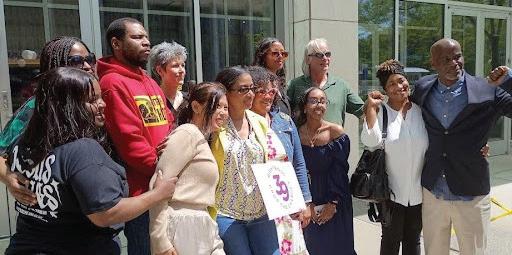
Defense attorneys argued the government had handed over roughly 9,000 pages of pretrial disclosures with nearly every name of St. Paul police officers, witnesses and federal immigration agents redacted. The omissions made it functionally impossible to mount a legal defense, Crews’ attorney said.
“Every name of law enforcement officers, every name of witnesses who were present at the church on Jan. 18, every witness from other agencies, deleted from the reports,” said Robert Richmond. “In the government’s view, only the government should have access
intimidated peaceful protesters and observers at the height of the Trump administration’s militarized immigration crackdown.
Judge Menendez found that video evidence contradicted Easterwood’s sworn declarations and that the pastor’s claims carried significantly less weight than sworn testimony from plaintiffs and witnesses.
Easterwood claimed that Noor was “leading some of the protesters” by “threatening to interfere, acting aggressively, pushing up into ICE officers’ faces, shouting obscenities and throwing rocks
The court found it was likely that ICE agents had violated the First and Fourth Amendment rights of peaceful protesters, temporarily barring agents from arresting or pepper-spraying people engaged in peaceful protest, or stopping vehicles, without probable cause.
Bruce Nestor, attorney representing Cullars-Doty, argued there is a direct link between Easterwood’s sworn court declarations and the protests that landed 38 activists and journalists in federal court.
“The events on Jan. 18 were about holding a high public
official accountable for his official actions,” Nestor said.
“David Easterwood had submitted affidavits that were not credible in light of the video evidence that showed a pattern and practice of federal agents retaliating against, intimidating, threatening, falsely arresting, using chemical munitions and using less-lethal munitions as part of their political operation to sow terror in the community.”
Cullars-Doty accused federal prosecutors of prioritizing a political stunt over legal preparation. During the first round of arrests, federal agents misidentified Satara Strong-Allen, wife of defendant and St. Paul School Board Member Chauntyll Allen, in a hotel hallway, knocking her head against the wall before realizing she was not Nekima Levy Armstrong. Strong-Allen was released and arrested nearly a month later.
“The government put the cart before the horse,” Cul-

lars-Doty said. “They moved so fast because they wanted the good PR to say that they were coming after our local activists.”
“The events on Jan. 18 were about holding a high public official accountable for his official actions.”
Levy Armstrong alleged a key witness in the government’s case made fabricated claims. “There was a so-called victim who fabricated an entire story about being harmed during the protest,” Armstrong said, “and it came forward that that individual was not even present at Cities Church on Jan. 18.”
Nestor questioned who is actually driving the case against the protesters. Cities Church Lead Pastor Jonathan
Parnell called St. Paul police that Sunday. No arrests were made.
“Their qualifications tend to be that they are associated with extreme right-wing legal organizations that are antiabortion, that are anti-immigration, that have a history of litigating positions from the extreme right of the culture wars,” Nestor said. “And they’re now taking over the Civil Rights Division and weaponizing it against their political opponents.”
The Justice Department’s Civil Rights Division had roughly 380 attorneys before Trump began his second term, with half having left within the first week. Assistant U.S. Attorney Rob Keenan was unable to produce an arrest warrant at Judge Micko’s request, forcing an unprecedented court recess.
Clint Combs welcomes reader responses at combs0284@ gmail.com.
Activists gather outside the Federal Courthouse in St. Paul on May 14. Clint Combs/MSR
Tima Miroshnichenko
By Izzy Canizares Contributing Writer
Hennepin County Medical Center, central to health care for Minnesotans, went from facing closure by the end of the month to securing a promised $205 million in state funding starting in July, according to a legislative deal introduced by Gov. Tim Walz. For the funding to be finalized, the supplemental budget must still pass a legislative vote before the session ends. The agreement was made possible in part by residents who defended HCMC and shared the medical center’s importance in their lives, including during a public forum May 13.
Before a legislative deal was reportedly reached that night, Attorney General Keith Ellison hosted a public forum at University Lutheran Church of Hope to gather public opinion on why saving HCMC was vital and the best way to do so.
HCMC serves many Minnesota residents, with 2025 data showing the medical
Health
Residents rally for HCMC as State funding deal nears

a retired nurse practitioner who spoke during the public forum. She formerly worked at NorthPoint Health and Wellness Center, which, according to Novak, sends 60% to 70% of patients to HCMC. “Hennepin County Medical Center is essential to the lifeblood of
“It is our collective responsibility to strengthen health care within different organizations, and certainly for our friends and neighbors at Hennepin Healthcare,” said Lisa Shannon, CEO of Allina Health, during the forum. “If we do not collectively think
future within our emergency programs.”
For many Minneapolis residents, HCMC’s closure feels personal. Despite financial woes, the hospital has been recognized for its quality care, training of medical professionals across the state and
health, it’s a sanctuary for our souls. My community needs that health care center.”
About 75% of HCMC patients are uninsured or have public insurance. The hospital’s closure would leave thousands, especially uninsured residents of color, without care. In 2023, Black Minnesotans’ uninsured rate was 6.3%, double the state average, while the Latino community had the highest rate at 11.4%.
“Since I’ve lived in Minneapolis, I’ve gone to Hennepin Healthcare. They’ve saved my life multiple times, and it’s where my children were born,” De La Rosa said. “I have thought the worst if HCMC closes and predict there will be a lot of lives lost, because this place attends to people without insurance and has many resources. People will not know where to go. I won’t know where to go.”
The fact that HCMC is located in the heart of downtown and serving a primarily uninsured patient population, at risk of closure, has left residents frustrated and unheard.
been provided by Walz’s office about the legislative deal, but MinnPost reports that HCMC would receive $205 million in state funding for the fiscal year starting in July.
“At a time of real uncertainty, we are protecting Minnesota’s strong financial position while delivering a historic, bipartisan investment in HCMC, a cornerstone of our health care system and a critical safety net for Minnesotans across the region,” Walz said. “This agreement strengthens Minnesota’s long-term stability, supports the broader health care ecosystem, and reflects the discipline of living within our means while preparing for the challenges ahead.”
“People will not know where to go. I won’t know where to go."
Ellison encouraged attendees to contact their lawmakers and share their own stories about HCMC with representatives before the legislative session ends.
“The people too often pushed to the margins are the poor, the uninsured, the struggling worker, the elderly, the person with nowhere else to go,” said one Minneapolis resident at the forum. “When working people cannot afford private care in their county, and nobody else answers the call, Hennepin
“Everything matters. But some things have to be made to matter more than others, and that can be achieved by making a bunch of calls to whoever represents you and leads you,” Ellison said.

Izzy Canizares is a freelance journalist and contributing writer for the Minnesota Spokes-

CONTROL. STI TESTING. PRIMARY CARE. GENDER AFFIRMING CARE. VASECTOMY. CARE. MENTAL HEALTH TREATMENT. MENOPAUSE CARE. CANCER SCREENINGS. CARE. HPV VACCINES. PEP & PREP. BREAST & CHEST EXAMS. BIRTH CONTROL. PRIMARY CARE. GENDER AFFIRMING CARE. VASECTOMY. FERTILITY CARE. TREATMENT. MENOPAUSE CARE. CANCER SCREENINGS. ABORTION CARE. & PREP. BREAST & CHEST EXAMS. BIRTH CONTROL. STI TESTING. PRIMARY GENDER AFFIRMING CARE. VASECTOMY. FERTILITY CARE. MENTAL HEALTH MENOPAUSE CARE. CANCER SCREENINGS. ABORTION CARE. HPV VACCINES. BREAST & CHEST EXAMS. BIRTH CONTROL. STI TESTING. PRIMARY CARE. GENDER CARE. VASECTOMY. FERTILITY CARE. MENTAL HEALTH TREATMENT. MENOPAUSE SCREENINGS. ABORTION CARE. HPV VACCINES. PEP & PREP. BREAST BIRTH CONTROL. STI TESTING. PRIMARY CARE. GENDER AFFIRMING CARE. FERTILITY CARE. MENTAL HEALTH TREATMENT. MENOPAUSE CARE. CANCER ABORTION CARE. HPV VACCINES. PEP & PREP. BREAST & CHEST EXAMS. TESTING. PRIMARY CARE. GENDER AFFIRMING CARE. VASECTOMY. FERTILITY HEALTH TREATMENT. MENOPAUSE CARE. CANCER SCREENINGS. ABORTION VACCINES. PEP & PREP. BREAST & CHEST EXAMS. BIRTH CONTROL. STI TESTING. GENDER AFFIRMING CARE. VASECTOMY. FERTILITY CARE. MENTAL MENOPAUSE CARE. CANCER SCREENINGS. ABORTION CARE. HPV VACCINES. BREAST & CHEST EXAMS. BIRTH CONTROL. STI TESTING. PRIMARY CARE. GENDER CARE. VASECTOMY. FERTILITY CARE. MENTAL HEALTH TREATMENT. MENOPAUSE SCREENINGS. ABORTION CARE. HPV VACCINES. PEP & PREP. BREAST BIRTH CONTROL. STI TESTING. PRIMARY CARE. GENDER AFFIRMING CARE. FERTILITY CARE. MENTAL HEALTH TREATMENT. MENOPAUSE CARE. CANCER ABORTION CARE. HPV VACCINES. PEP & PREP. BREAST & CHEST EXAMS. TESTING. PRIMARY CARE. GENDER AFFIRMING CARE. VASECTOMY. FERTILITY HEALTH TREATMENT. MENOPAUSE CARE. CANCER SCREENINGS. ABORTION VACCINES. PEP & PREP. BREAST & CHEST EXAMS. BIRTH CONTROL. STI TESTING. GENDER AFFIRMING CARE. VASECTOMY. FERTILITY CARE. MENTAL MENOPAUSE CARE. CANCER SCREENINGS. ABORTION CARE. HPV VACCINES. BREAST & CHEST EXAMS. BIRTH CONTROL. STI TESTING. PRIMARY CARE. GENDER CARE. VASECTOMY. FERTILITY CARE. MENTAL HEALTH TREATMENT. MENOPAUSE SCREENINGS. ABORTION CARE. HPV VACCINES. PEP & PREP. BREAST BIRTH CONTROL. STI TESTING. PRIMARY CARE. GENDER AFFIRMING CARE. FERTILITY CARE. MENTAL HEALTH TREATMENT. MENOPAUSE CARE. CANCER ABORTION CARE. HPV VACCINES. PEP & PREP. BREAST & CHEST EXAMS. TESTING. PRIMARY CARE. GENDER AFFIRMING CARE. VASECTOMY. FERTILITY Which type of birth control is best for me? We’re experts on the full range of birth control methods. Free shipping on pills, Specializing in you. PPNCS.org
Attorney General Keith Ellison speaks at University Lutheran Church of Hope in support of HCMC, May 13. Izzy Canizares/MSR
Business

Black Business SPOTLIGHT Arise Community Credit Union Black-led Arise Community Credit Union works to
By Lizzy Nyoike Contributing Writer
In the years following the murder of George Floyd, conversations across Minneapolis have centered on healing, rebuilding and addressing longtime inequalities within Black communities. For leaders at Arise Community Credit Union, one of those inequalities was financial access.
Founded through the efforts of the Association for Black Economic Power, also known as ABEP, Arise Community Credit Union was created to serve residents who have historically felt excluded from traditional banking systems.
“The groundswell movement to create a specific credit union for the needs of the underserved in Minneapolis actually came about as a result of what occurred several years ago with George Floyd,” said Francis Odhiambo, interim CEO of Arise Community Credit Union.
According to Odhiambo, ABEP conducted surveys throughout the community following Floyd’s murder. One message appeared repeatedly: residents wanting a financial institution that understood and reflected the needs of the community itself.

“One of the overwhelming responses that we got from the community is that the community would love to have a financial institution that would cater to what the needs of the community would be,” Odhiambo said. That feedback became the foundation for Arise Community Credit Union. ABEP worked alongside the Minnesota Credit Union Network to charter the credit union, with a goal of building a community-rooted alternative to traditional banks. Arise was officially chartered in March 2024 before opening its doors

in June 2025. Today, membership is open to anyone who lives, works or worships in Hennepin or Ramsey counties. Beyond opening member accounts, leaders say the mission is centered on rebuilding trust in communities where banking relationships have historically been strained.
“What often gets blurred is there’s what we would term in the industry as the unbanked, then you also have the underbanked,” Odhiambo said.
According to the Federal Deposit Insurance Corporation’s 2023 executive summary, 4.2% of U.S. households, representing about 5.6 million households, were unbanked in 2023, meaning no one in the household had a checking or savings account at a bank or credit union.
While underbanked households may have accounts, some rely on alternative financial services such as pay-
day loans or check-cashing services.
Odhiambo said many residents lose trust in financial institutions after repeated loan denials or negative banking experiences.
According to the same FDIC executive summary, the most cited reason for unbanked households to not have a bank account was not having enough money to meet minimum balance requirements, at 40.6%. The second most cited reason, at 39.7%, was a lack of trust in banks.
Rather than offering what Odhiambo described as “cookie cutter” financial products, Arise says it is working to create programs specifically designed around the realities many community members face.
One of those programs is the Phoenix Loan, aimed at helping people rebuild damaged credit histories and eventually work toward longterm goals such as homeownership.
The program operates in partnership with ABEP’s Financial Empowerment Center, which provides financial literacy education and coaching alongside lending support.
For Arise, education is just as important as access to capital. Odhiambo said many people are never formally taught
how credit systems or banking structures work.
“Someone has to take the lead and walk people through how things formally happen in businesses,” he said.
The credit union also emphasizes accessibility. Odhiambo said Arise works to maintain low barriers to entry through lower account minimums, reduced fees and remote access options that allow residents to open accounts online through their phones.
Odhiambo believes trust grows when people feel heard and seen. Unlike traditional banks, credit unions operate as member-owned institutions rather than shareholderdriven corporations. Odhiambo said that distinction allows Arise to prioritize sustainability and community impact over maximizing profits.
As Arise Community Credit Union continues to grow, leaders say the long-term vision remains rooted in expanding access, strengthening financial literacy and building a financial institution designed with the community in mind.
Lizzy Nyoike is a Hubbard School of Journalism & Mass Communication student and contributing writer for the Minnesota Spokesman-Recorder.










Francis Odhiambo Courtesy
Arise Credit Union in Minneapolis Lizzy Nyoike/MSR
NAACP
Continued from page 1
targeting of Somali Americans reflects a long American tradition of scapegoating immigrant communities.
“We are tired of being treated like suspects. We’re tired of political scapegoating. We are tired of entire communities carrying blame for headlines, and for elections and for talking points,” said Suleiman Adan, deputy director of CAIR-MN.
Adan invoked Malcolm X to draw a line from the civil rights era to the present. “Malcolm X once said that if you’re not careful, the newspapers will
Continued from page 1
Black entertainers bending and bowing to white supremacy for better business.”
Toussaint Morrison, an activist and independent journalist, noted that Netflix had previously edited out jokes about the late Paul Walker out of respect for his family. “They edited those out, but they let these in about George Floyd,” Morrison said. “Why is it okay to joke about dead Black people and expect everybody to laugh?”
John Thompson, a friend of Philando Castile and former state legislator, said Floyd’s final moments should never have become entertainment.
“It wasn’t a joke. It wasn’t a punchline. It was a human being on the ground, crying for his mama, in front of the entire world,” Thompson said.
“When human suffering becomes content for ratings and
HANTA
Continued from page 1
said she is not seeing any education in hospitals about what the spread of the virus means. “I feel like until we actually had a case show up in our doors… would they have a response and would we respond appropriately?
Yes, but it would be more of a reactive versus a proactive approach.”
Not involving nurses in policy decisions is a problem now and was a problem during COVID, she said. “If they’re talking about it at the higher levels, they’re not distributing any information, to my knowledge, to the bedside workers right now about the hantavirus. The people that were making policies were the people that were isolating at home and safe. It wasn’t the people actually in the field doing the work.”
Funding cuts to the De-
have you hating the people who are being oppressed and loving the people who are doing the oppressing,” Adan said.
“Today the only thing that has changed is instead of a print newspaper, we have platforms like X. Instead of an editor in chief we have folks like Elon Musk.”
Eva Ngono, civic engagement advocacy manager for Ayada Leads, described the compounding pressures Black Muslim women face in the current political climate. “We peel back expectations put onto us as women, sisters, mothers and as daughters, as Black and African women, as Muslim women, as immigrants and first generation Americans,” Ngono said. “The
weight that is carried by holding all those identities at once is heavy in our United States of America.”
“We are tired of being treated like suspects. We’re tired of political scapegoating.”
“Today is so important because young Somali girls are watching right now,” Ngono added. “They are watching how adults respond when their community is under pressure.
They are watching whether people stay silent. They are watching who shows up.”
The Afghan Cultural Society’s Nasreen Sajady highlighted how her community leaned on Somali Americans when resettling in Minnesota. “When searching for a location for our community center, we ultimately chose the Cedar Riverside neighborhood, in large part because of the Somali community’s solidarity with us,” Sajady said.
Hundreds of miles to the southeast, the NAACP is fighting on a different front.
Tennessee Gov. Bill Lee signed a new congressional map into law that carves up the state’s only majority-Black district, splitting Memphis
profits, we have a moral problem in this country.”
Leslie E. Redmond, executive director of Wind Back, said the joke felt intentional. “When this man says ‘George Floyd is looking up at you…’ when you say somebody is looking up, are you insinuating he is in hell?” Redmond said. “We have to be very
partment of Government Efficiency, known as DOGE, and the Centers for Disease Control and Prevention (CDC) are also concerns. “Each area is doing their own little thing and there’s no consistency,”
Muehlhauser said. “If you have cuts to those organizations, where are we getting our data from then?”
Following the COVID pandemic, some improvements have been made: command centers now distribute information faster, and hospitals are better stocked with personal protective equipment (PPE).
The organization she works for monitors trends from the CDC and Minnesota Department of Health, resulting in mandatory masking periods when cases rise.
Muehlhauser also noted the health care field lost two generations of workers: baby boomers working beyond retirement age and Gen Xers who were able to retire early.
“I don’t feel like we ever really
intentional and listen to the words these people are saying as they try to rewrite history.”
Suleiman Adan, deputy executive director of CAIR-MN, said the community should not have to defend Floyd’s humanity. “You shouldn’t have to stand here and say that he was a human being,” Adan said. “Why do we have to add orna-

ments to Black men’s lives to make them more human?”
Michelle Gross, president of Communities United Against Police Brutality, directed part of her remarks at white community members. “It should not be on people of color to check white folks,” Gross said. “It should be white folks checking white folks. These things

rebounded fully,” she said.
The Cultural Wellness Center was on the front lines of the COVID pandemic in neighborhoods of color. Atum Azzahir, founder and executive director of the center, said they implemented practices to sustain people under the circumstances. The center uses information from the Minnesota Department of Health to educate its community on symptoms and next steps in language free of medical jargon.
“We have a pattern of reach-
ing people who usually are suspicious of the system, who do not believe that there is a cure or they don’t trust science. So those are many of the people we work with, teach and share,” Azzahir said.
Azzahir said she witnessed firsthand during COVID the deep distrust some communities have in the medical system, including people who refused vaccines, masks and social distancing.
“We definitely operate from a place of suspicion … as Black

across three separate districts, in a special session called at Trump’s request. The Tennessee Legislature’s Republican supermajority passed the map days after the U.S. Supreme Court weakened a key section of the Voting Rights Act. The NAACP filed an emergency lawsuit arguing Tennessee Republicans violated their own state laws and constitutional limits in their push to redraw the map, noting the state had explicitly prohibited congressional redistricting between census cycles for more than five decades before Republicans repealed that prohibition. The suit remains pending.
“It is a direct attack on our democracy and our Constitution to dismantle
start as a joke, then jokes become statements, and statements become dangerous actions.”
Monique Cullars-Doty, cofounder of Black Lives Matter Minnesota, connected the incident to a broader pattern. “This is what happens because America has continued to coddle white supremacy,” she said. “It’s all connected, and it all goes back to a history where America has never held white supremacy accountable.”
majority-Black districts. A democracy without Black representation is not a democracy,” said NAACP General Counsel Kristen Clarke.
Tennessee House Speaker Cameron Sexton subsequently removed Democratic lawmakers from all House committees after they protested the gerrymander, stripping every Black elected official in the Tennessee legislature of their committee assignments.
Back in Minnesota, Adan closed with a message of belonging to his community.
“You are not an outsider in this state,” he said.
Clint Combs welcomes reader responses at combs0284@ gmail.com.
response from Hart condemning the remarks, and removal or editing of the segment from future broadcasts. Levy Armstrong closed with a call to action. “Netflix is not the ambassador for free speech, they are focused on profits over people,” she said.
“At a minimum, do not stream this particular comedy special until this joke is removed.”
The press conference was co-hosted by Black Lives Matter Minnesota and the Racial
“Kevin Hart was at the service after George was killed. He spoke to us privately, saw the pain that we went through.”
Community leaders are demanding a direct public apology from Hinchcliffe to Floyd’s family and the people of Minneapolis, a public statement and accountability measures from Netflix, a public

people, we have had a reason to believe that things might be purposely targeting us. So what we want to do then is reverse that and say, as often as we can in many classes ‘let us assume that that’s true. What do we do together?’” Azzahir said.
Cultural preparedness begins with open communication and self-care, and monitoring family members rather than dismissing or hiding struggles and symptoms, Azzahir said. The hantavirus and Andes virus come from wild rodents,
Justice Network. The sixth anniversary of Floyd’s death is May 25.
Jasmine McBride welcomes reader responses at jmcbride@ spokesman-recorder.com.
not the rats or mice commonly seen in cities and homes, Munoz-Zanzi said. Her tips are especially for people opening up cabins or sheds after winter in rural areas.
Avoid sweeping right away, as this kicks contaminated rodent dust into the air where it can be inhaled. Instead, vacuum or apply a bleach solution to wet down the area before cleaning. If visiting an area where wild rodents may live, wear a proper respirator mask that fits tightly over your face. Seal any entry holes around the building and store all food securely to avoid attracting pests. Because the Andes virus is so rare, Munoz-Zanzi hopes its recent media attention will bring focus to the need for more research and funding. For more information on the hantavirus, visit www. health.state.mn.us/diseases/ hantavirus/index.html.
Damenica Ellis welcomes reader responses at dellis@ spokesman-recorder.com.
GEORGE
From left, Monique Cullars-Doty, John Thompson, Nekima Levy Armstrong at the podium, Toussaint Morrison, and Suleiman Adan, May 13. Jasmine McBride/MSR
TLynnetta Muehlhauser Courtesy Claudia Munoz-Zanzi Courtesy Atum Azzahir Courtesy

Depending on where you are in your homeownership journey, refinancing your mortgage can be an effective strategy to help you meet your financial goals. Refinancing may help you save money over time or add money back to your monthly budget if you score a lower interest rate.
And depending on the type of refinance you choose, you could also borrow against your home’s equity to pay down debt or make a major purchase.
Understanding when and why a refinance might make sense is the first step toward getting the most from this financial tool. There are also different types of refinances to consider, and one might work better for your goals than another.
What is refinancing?
Refinancing replaces your current mortgage with a new one—usually with a new rate and/or terms. It can often also come with a new set of closing costs. It may also come with a new lender.
So when does it make sense to refinance? You might want to consider a refinance if you want to:
• Change the loan length or lower your monthly payments
• Secure a better or lower interest rate to save on monthly payments
• Switch from an adjustable-rate mortgage to a fixedrate one.
• Change the loan type to remove mortgage insurance costs
• Access your home equity to fund home improvements, buying another property, or consolidate debt.
How does refinancing work?
Much like your original mortgage, the refinancing process involves a thorough review of your current financial status to determine if you qualify. Here’s an example of what a lender may review:
• Credit score and history: Score requirements vary by lender and loan type; 620 is a general minimum for conventional mortgages. Lenders want to see responsible credit use, such as a positive payment history on your debt.

mal issues.
• Debt-to-income (DTI) ratio: This metric shows how much debt you have in relation to your income. To calculate your DTI, add up your monthly debt payments and divide by your gross monthly income. Then multiply by 100 to get a percentage. A low DTI lets lenders know you’ll likely be able to manage your monthly payments with mini-
• Property value and equity: Many homeowners have built equity over time, and the real estate market can cause property values to appreciate as well. When refinancing, your current loan balance and market value of the property will help the lender calculate a loan-to-value (LTV) ratio. Refinancing qualifications usually prefer lower LTVs.
What are my refinancing options and how do I choose the right one?
Let’s break down a few commonly offered types of refinancing:
• Rate-and-term refinance:
This option allows you to replace your current loan with a new one with a different interest rate, different term or both. The primary aim is to secure terms that better suit your current financial situation, while the principal balance remains the same.
• Cash-out refinance: A cash-out refinance allows you to replace your existing mortgage with a new loan for more than you currently owe, leveraging equity you’ve built up in your home. This type of mortgage refinance might be more suited for those who need funds for significant expenses, such as home renovations or debt consolidation.
• No closing cost refinance: A no closing cost refinance allows borrowers to refinance without paying the upfront fees usually required.
The lender may charge a slightly higher interest rate or fold the closing costs into the total loan amount.
Understanding your current financial goals and needs can help you decide which option works best.
The bottom line
Refinancing can be a smart financial move for many people. You may be able to save money in the long term, and you also have options to take cash out if that’s what would
support your goals. A qualified mortgage professional or home lending advisor can help clarify whether a mortgage refinance makes sense for you and ensure you’re on the right path to achieving your financial goals.
For more information, visit chase.com/afford.
For informational/educational purposes only: Views and strategies described in this article or provided via links may not be appropriate for everyone and are not intended as specific advice/recommendation for any business. Information has been obtained from sources believed to be reliable, but JPMorgan Chase & Co. or its affiliates and/ or subsidiaries do not warrant its completeness or accuracy. The material is not intended to provide legal, tax, or financial advice or to indicate the availability or suitability of any JPMorgan Chase Bank, N.A. product or service. You should carefully consider your needs and objectives before making any decisions and consult the appropriate professional(s). Outlooks and past performance are not guarantees of future results. JPMorgan Chase & Co. and its affiliates are not responsible for, and do not provide or endorse third party products, services, or







2026 MSR grads!


In celebration of these mighty young women who contribute to the MSR and embark on a new milestone, MSR says congratulations. Their stories reflect the dedication, resilience and excellence that define this community and inspire the next generation. — Jasmine McBride, Editor
Leticia Alvarez
Bachelor of Science, Special Education, Mankato University
eticia Alvarez didn’t take a straight road to her degree. She took the one that made sense for her life, and she arrived with honors.
A first-generation college student, Alvarez began at Normandale Community College in 2009, navigating course requirements without a roadmap and without family who had done it before her. When she became a mother at 21, school paused. Life didn’t.
“When you want something, you go for it.”
Over the years, she worked in schools, listened to mentors describe what the education system was doing to Black and brown boys in Minnesota, and raised two Black and Mexican sons of her own. What she heard in classrooms and what she feared for her children merged into a single question: what could she do to change it? The answer pointed her back to school.
“I wanted this for my kids, but in order to want this for them, I had to do it first,” Alvarez said. “I can’t tell them to do something I haven’t done.”
She earned her Bachelor of Science in Special Education with a focus on academic


behavior strategy, while working, parenting and pouring into others. Her self-care toolkit included deep breaths, a wide circle of family and colleagues, boundaries she wasn’t afraid to enforce and yes, the GoldRoom.
Alvarez is the daughter of MSR CEO and Publisher Tracey Williams-Dillard. In roughly a decade, she plans to carry the SpokesmanRecorder’s 91-year legacy forward as the next generation of leadership.
“When it’s my turn to take on the paper, I’m going to do it with honor,” she said. “When you want something, you go for it… I wanted a degree, I wanted to say I was a college graduate, and I did that. With honors.”
More than a diploma, Alvarez says she found herself in this process. “I actually met Leticia,” she said. “I’ve been rebranding who I am, what I am, and what my purpose is here on earth. That’s been the most liberating thing.”
Lizzy Nyoike Associate of Arts (2), Normandale Community College | Currently: University of Minnesota Hubbard School of Journalism and Mass Communication
izzy Nyoike graduated high school in 2024 and walked away with two associate degrees before most of her peers had finished their first semester elsewhere. She did it debt-free, on her own terms, and with a clear vision of where she was going.
As a PSEO student, Nyoike was already two semesters from finishing two associate degrees when she faced a choice: leave for an out-of-state school with credits that might not transfer, or stay and finish what she started. She stayed.
“Having something tangible that I could hold onto, even pursue a job while still completing my education, was what inspired my choice,” Nyoike said.
“Celebrate every success.”
Balancing a full-time seasonal job and a full course load her freshman year was demanding, but Nyoike learned early that selfcare wasn’t optional. Weekend trips, quiet Sundays at home, intentional silence… These became her reset.
“There’s so much chaos and noise going on


around us,” she said. “It’s very important that we create a safe haven for ourselves to just allow our minds to think and process.”
She completed both degrees at 19 without paying a dollar out of pocket, funded entirely through scholarships she applied for and earned. She is now a journalism major with a political science minor at the University of Minnesota’s Hubbard School of Journalism and Mass Communication, on track to graduate in less than a year.
At MSR, Nyoike contributes the Black Business Spotlight and What’s Hot series, along with freelance reporting. She plans to continue her education beyond her undergraduate degree.
“Celebrate every success,” she said. “Even graduating from a community college, there is someone who wishes they were walking that stage. The small things can be great successes, too.”
amenica Ellis always had questions, and she always needed to share what she found out. Her mother’s favorite memory of her is a girl who would learn something new and immediately turn to whoever was nearby and ask: “Did you know?”
That curiosity found its form in her junior year of high school, when a teacher connected her with a TPT program that introduced BIPOC students to media literacy and storytelling. There, Ellis discovered journalism. A field that matched her love of reading and writing with something she hadn’t expected: the interview.
“I
She took that discovery to Howard University, one of the nation’s most storied historically Black universities, where she earned her Bachelor of Arts in Media, Journalism and Film. Balancing school, work and social life was a learning curve. A late-closing job nearly swallowed her college experience whole until she figured out what her schedule actually needed to look like.
“I just remembered that I was where I was for school and nothing else,” she said. Her friends


adapted with her, finding time between classes and homework, going out when they could. Sundays became sacred… A standing mental break of new restaurants, museum visits and long walks, no schoolwork allowed.
“I needed time to rest my brain and reward myself with a meal I didn’t cook,” Ellis said. Going to school away from home, managing her own logistics each year with family in another state, securing housing, holding multiple jobs and building a community from scratch, Ellis came out the other side knowing something important about herself.
“I can not only survive but thrive wherever life may take me,” she said.
Ellis has served as a staff writer at the Minnesota Spokesman-Recorder for several months, covering stories that center communities of color. She also hosts MSR’s On the Radar series. This summer, she heads to an internship at the Business Journal.
“Graduating from college allowed me to live my career dream of providing important, trustworthy information, especially for people of color,” Ellis said. “I am looking forward to continuing to tell the stories that others miss.”
Tiffany Johnson
Master of Business Administration, Carlson School of Management, University of Minnesota
iffany Johnson has always known where her heart was: culture, community and the arts. Her path to an MBA was not about chasing a title. It was about becoming the leader her organization needed her to be.
Johnson earned her bachelor’s degree in English literature with a minor in African American studies from the University of Minnesota’s College of Liberal Arts in 2016. After about three years in media sales with the Star Tribune and Greenspring, she wanted to contribute more directly to community and culture. That desire led her to Penumbra Theatre, where she joined as marketing manager. She has also contributed to the Minnesota Spokesman-Recorder, writing with an arts and culture emphasis.
“I learned that I’m much more capable than I thought.”
Johnson saw where the organization was headed and made a decision.
“I figured my background currently wasn’t going to be enough for me to be an asset to the future of this company,” she said. “I really


wanted to get my MBA to increase my business acumen and to learn more about what it means to be a leader in a growing organization.”
Four years later, she has done exactly that.
Johnson completed her MBA at the Carlson School of Management while working full time at Penumbra and remaining deeply active in her church, Evangelist Crusaders Church in South Minneapolis.
“I had nights where I cried over my schoolwork,” she said. “Some classes I didn’t know if I was going to pass them. But it was really a matter of not giving up… just keep going.”
Her anchor throughout was her faith. “I just give all the glory to God,” she said. “To look back over all of it, four years, and go, wow. God, you did that. I’m just amazed.”
Penumbra is celebrating its 50th anniversary season, and she is focused on bringing everything she learned: strategy, brand management, leadership and discipline, to this milestone moment for the organization.
A study abroad experience in São Paulo, Brazil, during her program offered one final revelation. Living for months in a country where few spoke English, Johnson returned home with a clearer sense of herself.
“I learned that I’m much more capable than I thought,” she said.
Damenica Ellis Bachelor of Arts, Media, Journalism and Film, Howard University
Courtesy photos
Courtesy photos
Lizzy Nyoike's custom grad cap made herself, @madebyshikoo on instagram.
Tiffany (center) with her parents Larry (left) and Yvonne (right) Trawick.
Arts & Culture
From Maya Angelou to the Emmy stage, the interdisciplinary life of PaviElle French

By Damenica Ellis
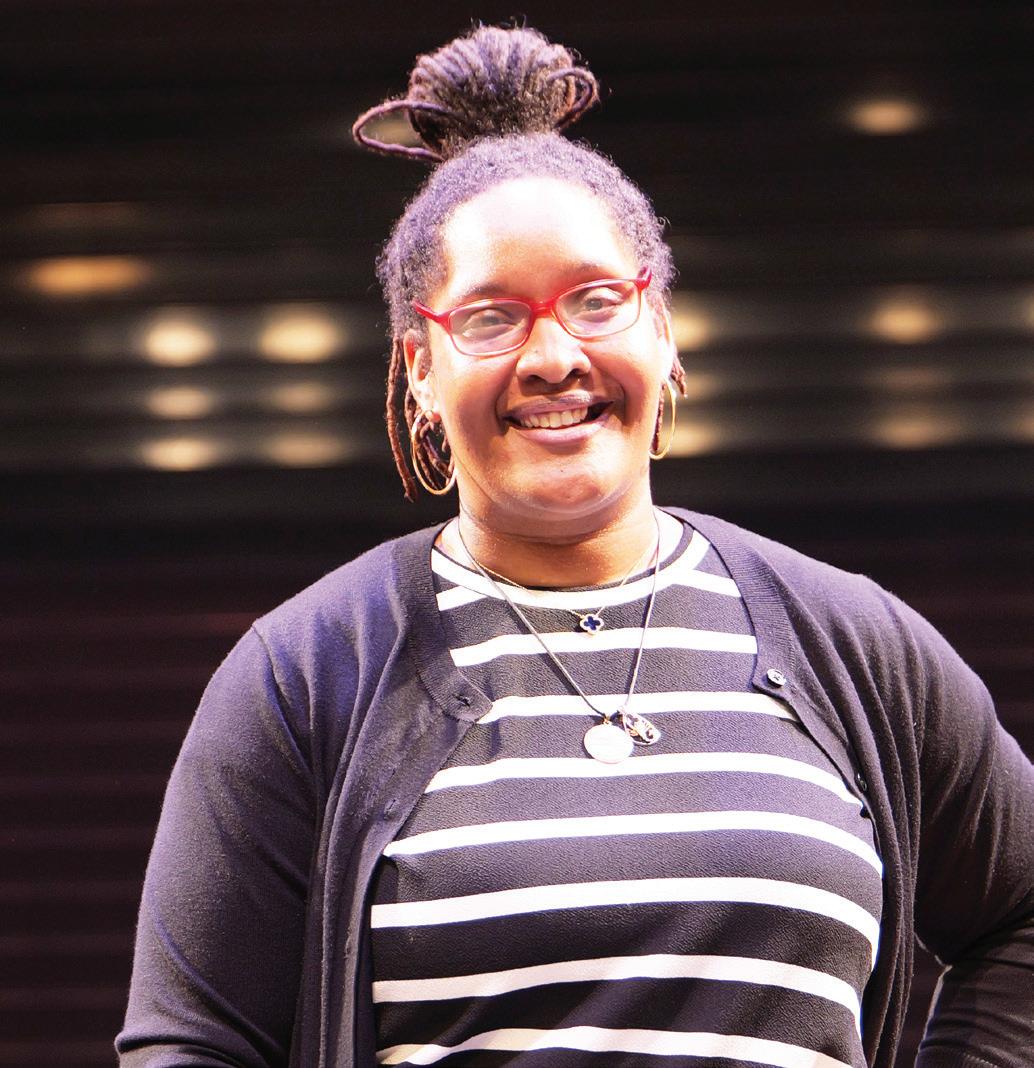
PaviElle French started singing at age 5 in 1989 under the direction of a teacher at Maxfield Elementary School, who also served as musical director at Pilgrim Baptist Church. The Rondo native received vocal and piano lessons at Walker West Music Academy and sang under Robert Robinson with City Songs. Around age 10, City Songs had the opportunity to perform as the choir at the Dr. Martin Luther King Jr. celebration at St. Mary’s Basilica, where Maya Angelou headlined. After performing alongside Angelou, French recalls the esteemed poet turning around and blowing her a kiss.
“Watching her perform and watching her piece that she wrote for Dr. Martin Luther King Jr. really sealed the deal for me,” French said.
French attended Mississippi Creative Arts School, where she received training in dance, acting and musical theater. She later trained at Penumbra Theater and Stepping Stone Theatre.
“I’ve been a child actor, performer, singer, dancer, all of that, all into my older age here,” she said. “I’ve never stopped.”
French comes from a family of artists. Her uncle played saxophone in the band Haze, led by Sonny Knight. A second cousin was a foundational company member of Penumbra and wrote music for an August Wilson show.
“I always had the representation and people always showed me that I could do this… that I could live my life in my imagination and carry that through into my adulthood and allow me to make a living off of it,” French said. “It
was always something that I could see that I could do.”
“Art is always gonna be the No. 1 point of my life.”
French released her first album, “Fear Not,” in 2014, in honor of her late mother and father. Music, she said,
helps process grief. In 2021, she released “SOVEREIGN,” a response to the murder of George Floyd.
“I don’t make music for other people to like me,” French said. “I make music to speak the truth and to talk about
the things that are happening in community.”
As an interdisciplinary artist, French has performed at many theaters, winning a Sage Cowles Award for Dance and Choreography and an Emmy Award for a documentary about her life and career.
She is now working with the Capri Theater in North Minneapolis.
“I make music to speak the truth and to talk about the things that are happening in community.”
“I have always loved the north side as somebody from Rondo,” she said. “I always feel like we’re twins… being two Black neighborhoods that have fostered so much love and connectedness and culture over the years and we’re always going back and forth with each other.”
French wants to continue fostering community work through her music and mentorship of youth. She recently completed a 100-page curriculum based on her work with the American Composers Forum, Schubert Club, TruArtSpeaks, Walker West, Purple Playground and the Saint Paul Chamber Orchestra.
The curriculum grew from work she did in response to the murder of Floyd and the subsequent racial reckoning. She worked with three music educators to develop the project. She plans to pilot the curriculum with young people and adults to help them process trauma through art.
Work she hopes will one day become a school.
To learn more or contact PaviElle French, visit paviellefrench.com or follow her on Instagram @pavielle_music and on Facebook at pavielle.french.
Damenica Ellis welcomes reader responses at dellis@ spokesman-recorder.com.



By Robin James Columnist
“You Must Believe in Spring” is an album by the late jazz pianist Bill Evans, recorded in August 1977. It comes to mind now as spring brings a wealth of jazz news worth celebrating.
Robert M. Pallitto and John A. Melendez, traces his life from a Texas sharecropping family to becoming a key figure in bebop. Dorham was an underrated talent deserving of this kind of historic remembrance. Pair it with his 1961 album of the same name. Vocalist Stacey Kent has a
“Dorham was an underrated talent deserving of this kind of historic remembrance.”
Record Store Day, which took place April 19, brought a doubly special release: late trumpeter Roy Hargrove’s “Bern” (Live at the Bern Jazz Festival 2000), out now from Time Traveler Recordings. Restored from original tapes and remastered for audiophile fidelity, the album features Hargrove’s quintet: Larry Willis, Sherman Irby, Gerald Cannon and Willie Jones III, at their finest.
The performance is a vital document of soul, swing, Latin-inflected grooves, bebop tradition and beautiful ballads. Liner notes are by Nate Chinen, with rare photos and testimonials from the band included in the limited-edition 180g 1-LP pressing. The track list: Side A, “Stranded,” “Depth;” Side B,“Never Let Me Go,” “Caryisms,” “Circus.” If you’ve been lucky enough to experience Hargrove live, you know how important this album is.
Another long-overdue release is the first biography of jazz trumpeter Kenny Dorham. “Whistle Stop: Kenny Dorham, Jazz and the Journey of a Texas Family” (University Press of Mississippi, 2026), by
new album out, “A Time for Love,” from Token Productions. The record is a mix of English and French vocals, featuring Art Hirahara on piano and Jim Tomlinson on tenor saxophone, also Kent’s
New releases and celebrations make for a Jazz-filled spring
husband. She covers standouts including “Lucky to Be Me,” “The Shadow of Your Smile” and “As.” Kent is a versatile singer who knows how to make audiences appreciate well-written lyrics. The last time I saw her perform live was at the Dakota.
Also out now is “The Oscar Peterson Trio at Baker’s Keyboard Lounge: The Complete Recordings” from Verve Records, 27 songs running 2 hours and 19 minutes across a 3-LP/digital set. Peterson, bassist Ray Brown and drummer Ed Thigpen were at the peak of their powers during this Detroit outing, capturing over five sets on a Friday night in early August 1960.
The tapes were found decades later in a mislabeled box in the Verve vaults. Highlights include “Whisper Not,” “I Remember Clifford,” “My Funny Valentine” and my personal favorite, “Softly as in a Morning Sunrise.” The trio’s interplay is everything one hopes for in a live recording. It’s also a fitting way to celebrate the 100th anniversary of Peterson’s birth, Aug. 15, 1925.

Congratulations are in order for saxophonist and bandleader James Brandon Lewis, who announced on X that he is a 2026 Guggenheim Fellow in music composition.
“I am beyond words,” he wrote.
“I never got into music for
awards. I am deeply honored by this acknowledgement.” Lewis and the Lutoslawski Quartet also have a new album out, “These Are Soulful Days (Live at Jazztopad, Wroclaw 2021),” from TAO Forms, available on vinyl.
Now go ahead and enjoy some live music, whether on a recording or in person. Believe in spring.
Robin James welcomes reader responses at jamesonjazz@ spokesman-recorder.com.



PaviElle French Emmanuel Duncan/MSR

Joy of educating Black boys
come into my office and say “you were right about how I emotionally reacted to that situation,” or “thank you for supporting me throughout the years.” Or when they see you in the community and share the positive things they are doing, such as going to school, working and serving in the community.

By Richard D. Terrell Columnist
Before diving into this column, I want to be clear: This is not a critique of any one school, district, or institution. This is a broader reflection on a blend of research, observation, and personal experience on the current state of education for Black boys in America. Many conversations about Black boys in schools and in the community sometimes focus on the struggle. We hear statistics, discipline data, academic gaps, and negative narratives. While those realities cannot be pushed to the side, they should not become the only story we tell about our Black boys. There is another side that deserves equal attention: the joy of educating Black boys.
There is joy in watching a young Black boy discover awareness about himself. There is joy in seeing him
There is joy in seeing him raise his hand after once being afraid to speak. There is joy in hearing him read fluently after struggling with words. There is joy in seeing him walk across a graduation stage after others doubted his future. Educating Black boys is not just difficult or challenging work, it is meaningful and rewarding work that can shape generations.

“Black boys are not problems to fix. They are gifts to nurture and pour into.”
Many Black boys enter schools already carrying labels: “too loud,” “too difficult,” “too far behind,” or “unmotivated.”
Educators who take the time to learn about them see beyond behavior and start recognizing gifts, leadership, creativity and brilliance. Sometimes the boy who asks too many questions is really a future leader. Sometimes the boy with endless energy simply needs purpose and direction.
I would honestly say that relationships are at the cen-
ter of this joy. We must take the time to build and cultivate those relationships. Black boys thrive when they know someone genuinely cares about them. Some examples include greeting them in the hallway, attending their game, checking on them after a difficult day, encouraging them during a failed moment, teaching them how to play chess, seeing how their weekend went, just to name a few.
The truth of the matter is, and what I learned as an educator, many Black boys are not looking for perfection. They are looking for consistency, care, and belief.
The joy also comes from cultural affirmation. Black boys deserve to learn in environments where they see themselves reflected positively in books, leadership, conversations and curriculum. They have to know their history matters, their voice matters, and their identity is not something that needs to be erased to succeed.
When I ran my boys group and worked with Black boys, I realized that I needed to show them brilliance in the way I act, what I read and listened to, along with bringing in speakers who shared their experiences and provided them with resources for growth.
Transformation is another powerful source of joy. There are a few examples that I have witnessed:
• Watching a student evolve over time.

• The quiet student becomes confident.
• The angry student begins healing emotionally.
• The disengaged student becomes a leader.
These moments do not happen overnight. They happen through patience, accountability, structure, mentorship and love.
Joy is also found in community and brotherhood. Black boys flourish when schools intentionally create spaces for mentorship, leadership and positive peer relationships. They need environments where they are encouraged to celebrate each other’s success instead of competing against one another. Brotherhood builds confidence, accountability and belonging.
How can schools and communities create an environment where Black boys can experience joy?
• Mentorship programs and leadership groups.
• Culturally relevant curriculum and books.
• Creating spaces for creativity and innovation.
• Building strong school and family partnerships.
• Creating opportunities for Black boys to lead inside and outside the classroom. Black boys are not problems to fix. They are gifts to nurture and pour into. They bring creativity, humor, resilience, leadership and brilliance into classrooms every day. When schools focus only on correction and discipline,
they miss the opportunity to experience the beauty of helping young men grow into purpose and focus on their calling in life.
Parents, educators, mentors, pastors, coaches and community leaders all have a role to play:
• Celebrate Black boys openly.
• Encourage their dreams.
• Speak life into them.
• Correct them with tough love.
• Give them an opportunity.
• Remind them constantly that they are capable of greatness.
Think about this:
1. Do our schools create joyful learning experiences for Black boys?
2. How do Black boys feel seen, valued and affirmed in our schools?
3. What are you doing to impact a Black boy?
Let’s Rise Together, Richard D. Terrell
Richard D. Terrell is a native of Minneapolis, MN. He is the father of three; Zyree, Raymond and Vivian. Richard has a passion for community, education, and youth development. He has served as the senior pastor of God’s Revelation MBC in south Minneapolis, and for the last 20 years, he has served at various schools working with and supporting students, families, and teachers. He currently serves as an Assistant Principal with Saint Paul Public Schools. For more information on Richard D. Terrell or to purchase his book “Letters to my Young Brothers: There is Hope!” visit his website at https://mrrichardterrell.com.
Preventing summer reading loss at home
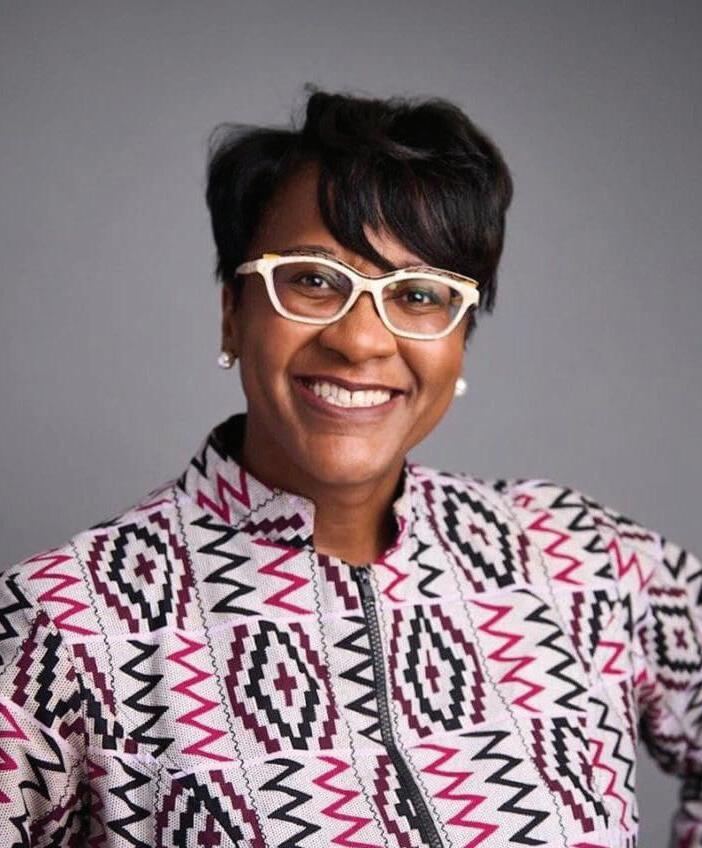
By Dr. Artika R. Tyner Columnist
Children look forward to summertime. They can enjoy great weather and time away from school. Most children do not want to do any schoolwork during this period. Vacations to theme parks, video games, visits to or by close cousins, non-stop playground action and many more exciting activities abound. Studying and learning can feel like a distraction from enjoying fun and entertainment. Research, however, shows that during this period when academic work is on hold, children tend to lose the progress made in their educational journey if they completely put learning on hold. The average loss over the summer is 25% to 30% of school learning. There are, however, ways to address this challenge and turn summer learning losses into tangible gains for academic success.
As a “first educator,” you can help promote summer learning gains by promoting reading. “First educator” refers to the fundamental primary role that parents and caregivers play in a person’s early development and education. They instill essential life skills, morals and behaviors. Reading is an essential building block of education. Yet during summertime, non-
academic activities take center stage. Many children will go several weeks without reading a single book. The benefits of reading include expanding one’s vocabulary, improving cognitive functioning and developing critical thinking skills. Like any sport or activity, the lack of practice is a missed opportunity for growth and development. The improvements made throughout the school year suffer a summer slump when learning is not a daily practice. During the next school year, time is lost getting children to the levels they were at prior to the summer break due to the loss of momentum.
To manage summer slide, the tendency of children losing acquired knowledge or ability during the summer break, parents would have to make reading a part of their children’s daily routine. Although not as intense as during school days, children should be encouraged to engage in reading and fun literary exercises. It could be as easy as reading inscriptions on cereal boxes or pronouncing words on billboards. Reading consistently in a relaxed environment is beneficial; a routine such as bedtime storytelling will contribute to fostering the habit of reading. Literacy cannot be achieved only through reading academic books or novels.
The following are some of the methods first educators can employ to keep learning ongoing in their homes during the summer:
• Putting on closed captions while watching TV shows together. Children will read the captions they see on the screen. This could also serve as a teaching opportunity, as children may

see words for the first time and seek clarification. It also fosters summertime bonding between the child and first educators.
• Get children to help create grocery lists. The excitement of writing the grocery needs of a household will be coupled with the opportunity to spell these words, and even to know the total cost involved, which improves the child’s math abilities.
• Writing letters to friends, favorite books or comic characters. This activity helps improve children’s literary skills as they express themselves with new vocabulary picked up during the school year. Calling family is easier these days, and parents should encourage their children to also adopt letter writing as a form of communication.
• Menu reading. When eating out, children should be able to pick out their own meals from the menu. They can also be made to point out meals chosen by other people at their table. This practice helps children identify words easily.
• Summer Word Jar. Another innovative way of pre-
venting summer reading loss is to fill a jar with new vocabulary. Children are tasked to draw a word a day and then challenged to use these words in conversation throughout
the day. Successful children could be rewarded with extra screen time or a cookie of their choice.
• Children should be encouraged to read signs and labels they come across. They should share these words with their family and, if possible, explain. Children who engage in this game should be rewarded to serve as motivation.
• Children will imitate what they see. If a first educator reads in the presence of their children, the probability of the children developing an interest in reading would be high. This is also more effective than forcing children to adopt habits they do not see adults around them indulge in.
“First educators” should not shirk their responsibilities toward their children’s education with the excuse that it’s summertime. Training children
to love reading will invariably become a good habit. This will aid in eliminating summer slide. Valuable time is saved, which is used to teach children new things when they return to school in September.
Dr. Artika Tyner is committed to creating a world of inclusive leaders who will meet the pressing needs of today and work towards a better future where racial justice and economic justice reign supreme. As a motivational speaker, author and educator, Dr. Tyner helps people of all ages connect with their gifts and develop tangible tools for bringing forth sustainable, durable change in the family, workplace, community or school. By building and leveraging the tools in The Inclusive Leader she has inspired thousands of people to lead with their own gifts and plant a seed of social change.



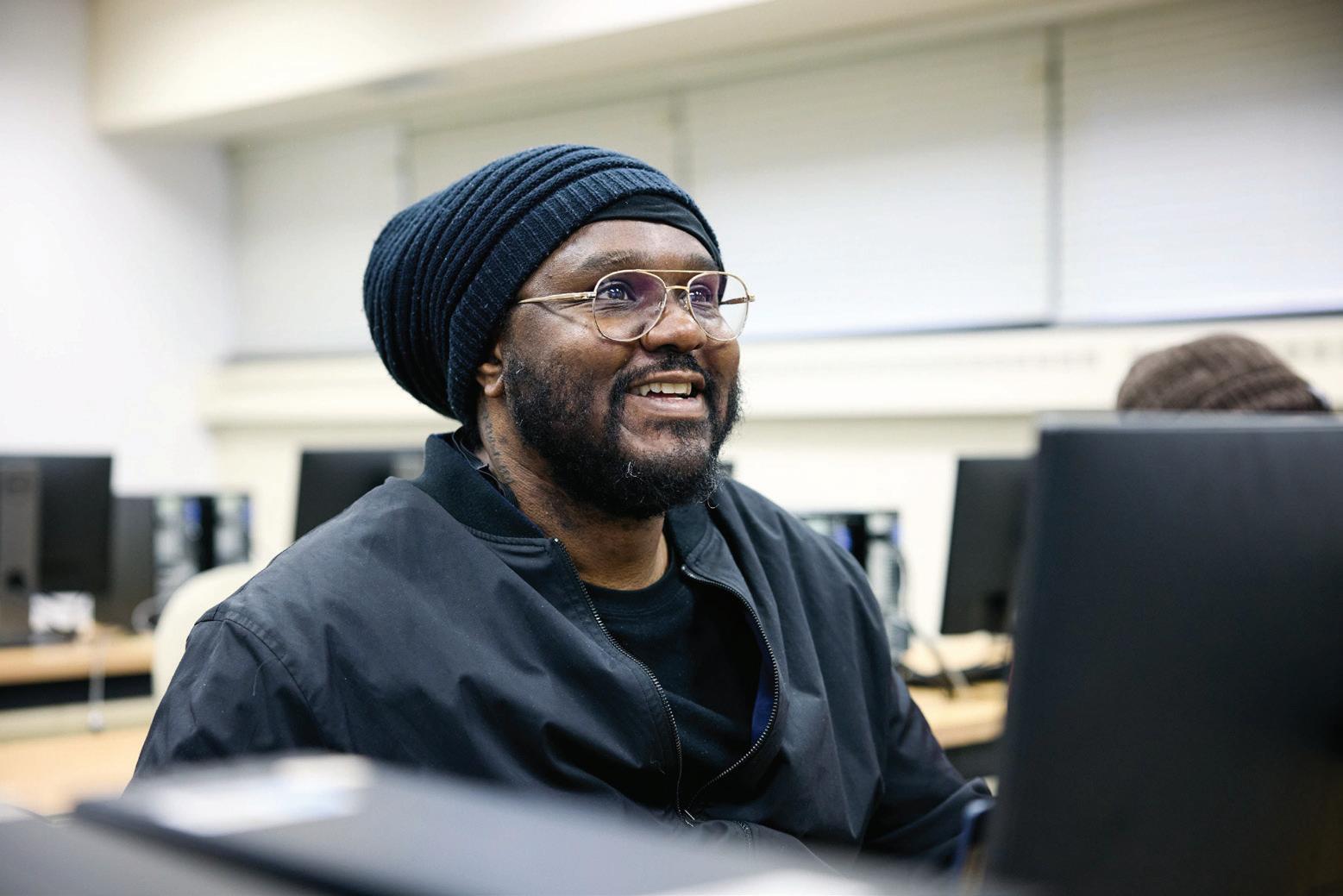
Marta Wave
Opinion
DevSecOps Engineer: Plymouth,
By Julienne Louis-Anderson
On April 29, the Supreme Court struck down Louisiana’s congressional map in a decision that dismantled the largest Black voting district in the state, suppressing the votes of thousands of Black Louisianans, including mine. The NAACP and the ACLU have already filed lawsuits challenging the ruling.
Louisiana, where I still live and work. I’ve seen how decisions made in Baton Rouge don’t stay in government buildings. They show up in courtrooms, classrooms and everyday life.
Just days later, the Louisiana legislature eliminated the position held by Calvin Duncan, a formerly incarcerated Black man elected clerk of the local criminal district court. Framed as structural efficiency, the move effectively fired an elected official whose job was to advance reform and accountability. With the support of the ACLU, Duncan sued and won in federal court, restoring his position.
But what’s happening in Louisiana isn’t just policy, it’s a blueprint.
I don’t write about this as a distant observer. I am a Black woman, born and raised in
Since 2023, under Gov. Jeff Landry, the state has sought to restructure political systems and limit access to power. One of his early actions was reversing a key component of the “Raise the Age” law, lowering the age at which young people can be tried as adults to 17 — exposing more children to the adult criminal legal system. The effect is not evenly distributed. It lands hardest on Black and poor children. Weeks after the vote, I watched a former student sitting behind bars for breaking into a car during the 2025 Louisiana snowstorm, seeking shelter when the entire state had shut down.
This is how erosion works, not through one sweeping decision, but through policy shifts that reshape outcomes over time.
Louisiana residents have

MN
IT Company seeks DevSecOps Engineer to integrate security practices into DevOps workflows, automate security checks, and ensure the safety of cloud infrastructure. Work closely with development and security teams to enhance the security posture of applications and systems. Build and Configure delivery environments by using CD/CI, Agile delivery methodologies. Create and assist in performing various types of tests. Perform troubleshooting. Generate customized reports. Offered Salary: $116,480.00 to $116,500.00/yr. Send resumes to: HRD, VITS Consulting Corp., 14264 23rd Ave N, Plymouth, MN 55447. Minnesota Spokesman-Recorder July 10, 2025
By Keith Hapana Crow
The current criminal justice system at Rush City prison is in need of major prison reform. With the aftermath of Minnesota legislative decision to close the century-old Stillwater prison in 2025 legislation has drastically impacted prisoners at Rush City.
The Restorative Justice perspective would encourage the administration to allow recreation. Why doesn’t the administration encourage recreation and exercise, even for those who are working?
In essence saying prisoners who want a positive program with jobs, staying out of trouble are being penalized. Why?
duced to the minimum are frequent -- yet allegedly 9 new employees were hired in Spring 2026. There is always some illegitimate reason to lock in half of the kitchen unit as a punitive measure deepening the oppressive environment.
When prisoners are experiencing mental health concerns stemming from being treated like a dog, and forced to act like a Wolf, who is at fault?
2026, Disney corporation has cancelled Minnesota Dept of Correction contacts as for 10 plus years Minnesota Dept of Corrections has been misleading Disney with inflated wages paid to prisoners. Where are ICE agents to investigate this fraud in Minnesota?
Why is the Minnesota Dept of Corrections actively doing to curve the uptick in violence at Rush City?
not been passive. In 2025, voters rejected all four proposed constitutional amendments that would have expanded legislative control over courts and altered the criminal legal system. On May 16, voters face another slate of amendments that could reshape schools, courts and communities. Another effort to shift power away from residents and toward politicians, a central feature of Project 2025.
Southern states including Alabama, Tennessee, South Carolina, Georgia and Florida are advancing similar policies. Coordinated strategies, like the “trigger laws” that activated abortion bans across 13 states including Louisiana, show how what begins here does not stay here.
Across the South, communities are fighting back. In Florida, grassroots organizing helped flip Jacksonville’s mayoral seat. Georgia now has its most diverse legislature. Virginia and Alabama have driven voting rights victories, forcing courts to redraw congressional maps for fair representation.
The erosion of fair courts, representative districts and accountable leadership isn’t partisan, it’s structural. Louisiana is where these policies are tested before they spread nationally. Du Bois’ warning still holds. Other states would be wise to look here, and prepare.
This op-ed appeared first in Word in Black. For the original, visit www.wordinblack. com/2026/05/theyre-testingdemocracys-collapse-in-louisiana-first/.
Furthermore why does the sex offender unit get paid to attend gym (50 cents an hour 5 days a week)? What would the lawmakers think of this conundrum?
Withholding of recreation for the prisoners is pushing many prisoners beyond the Rubicon, creating mental health issues. Further disconnection family and loved ones.
It is proven that human beings require physical exercise. At Rush City prisoners are allowed access to pull up bar, dip bars in the unit’s courtyards. However, what would the Fire Marshal think?
Modified lock downs, where out of cell time is re-
Prisoners are encouraged to write Mental health for help, yet many requests go unreplied. Prisoners’ families are the ones who suffer more. Less contact with family, less time out of cells, including after segregation placements where people need mental health support. What are the Administration’s objectives? Treat the prisoners like animals with oppressive measures that correlates with more hazard pay for forced overtime for staff?
Perhaps the administration could revert to the opening of the rural prison. Allow all prisoners out of cell full time. No job availability, where is the accountability?
Possible solutions, remote telephone jobs, reintroduce the dog training program, add mentor and other support jobs in all units, or paid restorative justice mentors. Simply offer recreation or switch in for an hour, and either offer prisoners to purchase a tablet that once was available, and in the meantime add more phones in the unit.
The United Nations has deemed long term isolation over 7 days is cruel and unusual punishment, “ Mandela Rule.” For the sake of anyone struggling with mental health issues, please make a complaint on our behalf.
Mr. Paul Schnell Minnesota Dept of Corrections 651-361-7226 or 651361-7200
Keith Hapana Crow is a current inmate at Rush City prison.

By Stacy M. Brown
Republican lawmakers in several states are redrawing congressional maps mid-decade, a move critics say is part of a broader effort to reshape the balance of political power ahead of the 2026 midterms and beyond.
The redistricting push is underway in Texas, North Carolina, Ohio, South Carolina and Louisiana. Voting rights advocates, Democratic lawmakers and constitutional scholars argue the effort goes beyond gaining House seats, warning it could be a step toward building enough congressional dominance to pursue constitutional amendments.
“You need a two-thirds majority to change the Constitution,” one widely circulated social media commentator said. “That’s why they’re pushing so hard for this… penny-pinching every single seat they can possibly get.”
CNN anchor Jake Tapper described the national situation as a redistricting “arms race,” noting that former President Donald Trump urged Texas Republicans to redraw maps mid-decade, which prompted retaliation from Democratic-controlled states. Tapper said the resulting landscape could yield a one- to 11-seat Republican advantage from redistricting alone.
Republicans have defended
the efforts as a legal political strategy, pointing to Democratic-controlled states like California, Illinois and New York, which have also redrawn maps for partisan advantage.
The current wave follows the Supreme Court’s 2013 decision in Shelby County v. Holder, which eliminated the federal preclearance requirement that had forced states with histories of racial discrimination to obtain federal approval before changing election laws. Critics say the ruling opened the door to aggressive gerrymandering.
More recently, the court’s ruling in Louisiana v. Callais further weakened Section 2 of the Voting Rights Act, which voting rights advocates say allowed southern legislatures to quickly dismantle Blackmajority districts.
Sen. Elissa Slotkin said the maps could effectively eliminate minority representation.
Rep. Joe Morelle accused Trump of openly politicizing the process.
“Donald Trump said we should redo the Texas congressional lines middecade, not because it helps democracy, not because it’s good for the American people, but because it’s good for the Republican Party,” Morelle said.
The Brennan Center for Justice has also raised concerns about Project 2025, a conservative governing blueprint organized by The Heritage Foundation, warning it proposes changes that would “significantly expand executive power” and poses “an unambiguous threat to American democracy.”
Critics argue that when redistricting is combined with weakened federal voting protections and expanded executive authority, the effect could entrench one-party control regardless of shifts in public opinion, not just through the 2026 cycle, but potentially for generations.
Stacy M. Brown is a senior writer for The Washington Informer and the senior national correspondent for the Black Press of America.
“You could see real redrawing of the maps, particularly in southern states, in ways that essentially get rid of any African American leadership and representation,” she said. “It’s just another way the president and his team are trying to make a permanent Republican majority.”
due to the new seven-year collective bargaining agreement that kicked in this season. “A lot of people are starting to reap those benefits,” she said. “It’s really cool to see the full circle of how far the league has come, this is my 10th year from when I first started. I’m very blessed that I get to see it, too.”
Coffey is in Minnesota’s regular rotation, she has started thus far, and recorded her eighth career double-double (13 points, 10 rebounds) last week in a win at Phoenix.
She’s not a rebounding machine like her dad was in his day, but joining the Lynx means she gets to work with Assistant Coach Rebekkah Brunson, a legendary board master and the only player in W history to win five championship rings.
“Now with Coach Brunson, getting to work with her, I get to learn from one of the
THIRD
“Almost 68% to 70% of our youth leaders are students of color,” said Executive Director Shauna McDonald. “Also, about 22% are English language learners as well.”
“It’s the opportunity to really get involved in leadership at an early age,” added Travis Evans, a Playworks Minnesota trainer for nearly six years. “And leadership can look like a
best of the best,” Coffey said. “What does she think I need to add to my game? What does she think are my strong suits? There’s always something to work on.”
The St. Paul native is a seasoned veteran on a club that is 71% new this season.
“I do see myself as a vet,” she said. “I have so much experience that I can share with others and just learn from my mistakes.”
“I want to pour into others the things I wish I had when I was younger. I didn’t have any vets to help me when I was younger. I will always speak up; I’m always here for questions.”
Coffey said it also helps to have excellent role models, including her father and her mother Sheba, a local realtor and success coach, and her brother Amir, a former Gopher and current NBA player, among her support system.
“One thing I will say that helped me so much,” Coffey said, “I had an amazing foundation with people who sup-
lot of different things.”
“The program allows them to take that step in their leadership … learn small skills that sustain them over the course of a lifetime,” he continued. “This is one of those things where we’re trying to be intentional about how we can build strong children through leadership.”
McDonald stressed that fourth and fifth graders, 10 and 11 years old, are at the right age to learn and adapt leadership skills.
“There’s not a lot of leadership programs for kids in

ported me. I love basketball.”
…
FINALLY
Former Gopher Janey Sanders, who played a season as a graduate student in
elementary school, they typically start in maybe middle and high school,” she said.
“These are all fourth and fifth graders, and developmentally that’s a really critical time. It’s when they’re really getting a sense of self. They start to connect with other kids that have shared interests, and to put them in a leadership role at their age, I think that helps set them on a trajectory of understanding their own abilities… their own agency, to control not only themselves in that leadership role but the
2023-24, is a member of the Charlotte Crown of the new four-team UpStart League, which started play this month. Two siblings ruled track and field last week: Yolan-
situation around them.”
McDonald added that the school playground during recess is the perfect setting.
“We think about school community, right?” she said. “And recess is a critical time of day for kids. It’s where they build community with each other.”
“I was just on an international webinar that said recess is critical for our democracy because recess is a time of community for kids,” McDonald continued. “It’s where they learn to get along, work out differenc-

da Nabwe took the Summit League heptathlon title with a personal-best 5,308 points for North Dakota State. Meanwhile, her older sister Anthonett won the Big
es, solve problems, engage with each other and build a sense of identity together in their school. We increase academic engagement and reduce chronic absenteeism because kids want to come to school, and these student leaders want to come and lead in their school.”
Evans said many of the children who attended the May 5 event were likely experiencing a professional baseball park for the first time. He hopes it leaves a lasting impression.
“If you’re able at a young
age to be exposed, whether it’s to the stadium, whether it’s to the sport of baseball … it’s a beautiful thing to see,” Evans said. “Plant seeds, watch them grow.” McDonald thanked the Saints and other partners for hosting the youth event and supporting the children’s leaders. “We want to let them know that they’re important. They’re leaders,” she said.
Charles Hallman welcomes reader responses at challman@ spokesman-recorder.com.
was at Hamline for 13 seasons, the last 10 as head coach, and also served as the Pipers’ special teams coordinator. He has been in coaching since the mid-2000s. “I’m excited to be part of a winning championship program,” said Taylor, a Willingboro, N.J., native. Lehigh is a private research university in Pennsylvania and a twotime Patriot League champion (2024, 2025).
A difficult year
The Minnesota tennis team’s 2026 season ended last month on a high note.
The Gophers won their final matches on Senior Day, defeating Nebraska 4-2.
Seniors Sofia Pinto, Arina Valitova and Aiva Schmitz each won their final singles matches, and Schmitz’s set clinched the win for Minnesota. Head Coach Lois Arterberry said afterward, “All three seniors stepped up in singles and clinched the match for us.”
The victory brought a brief bright spot to an otherwise difficult year for the Gophers, who finished the regular sea-

Lois Arterberry
Charles Hallman/MSR
son 11-16.
Arterberry spoke with us shortly after the season concluded. “I think we went
into the season really promising based off of how we competed in the fall, and we were really excited to see … basically having the exact same team again,” she said.
“And we started off really well with a good win against Iowa State,” recalled Minnesota’s only Black head coach. But things took a difficult turn. “We had a couple of injuries start off the year unexpectedly. One of our top players was out basically for the entire season, and I think that just kind of changed things.”
“We had to change around doubles, and not having her for singles was definitely
tough. We ended not the way that I would have liked,” said Arterberry, whose third season in Dinkytown was perhaps her most frustrating since being hired in 2023 after two seasons as St. Thomas head coach.
“I’m not gonna lie,” she continued, “it was a difficult year for me. I have not had a season like this in maybe my entire career.” The Grenada native has more than a decade of head coaching experience, including coaching both men’s and women’s tennis at Jackson State.
“It was difficult balancing, dealing with the injuries …
it impacted us quite a bit. It took a bit of a toll on players. We weren’t expecting it.” A season like this one also forces self-analysis, Arterberry said. “You’re questioning yourself as a coach… am I doing the right things? Am I following the right path? You begin to ask yourself these questions.”
Now it’s back to work as Arterberry and her staff prepare for the upcoming season.
“I’m expecting that it’s going to be pretty busy here,” she said.
Charles Hallman welcomes reader responses at challman@ spokesman-recorder.com.

Ten hammer throw title. Her fourth conference title.
Charles Hallman welcomes reader responses at challman@ spokesman-recorder.com.
Yoland Nabwe Courtesy of X
Anthonett Nabwe
Courtesy of X
Sports
Lynx veteran Nia Coffey is her father’s daughter
ia Coffey is her father's daughter. She has the same tenacity as her dad Richard Coffey, whom I covered as a Gopher, during his one-year stint with the Minnesota Timberwolves and his post-athletic nonprofit work over the years.
Accordingly, I’ve followed Nia’s hoopin’ journey since she graduated from Hopkins as a high school McDonald All-American, then as an allBig Ten player at Northwestern, and then her nearly a decade in the WNBA. Yet it was only after a recent Minnesota Lynx practice that we formally sat down and chatted.
“I appreciate every season,”
said the 6-foot-1 small forward, “because I’ve been able to add to my repertoire and just got better and just more resilient in my journey with basketball.”
“I picked up a few different skills,” she said, since San Antonio, now Las Vegas, selected Coffey at No. 5 in the 2017 WNBA Draft. Her impeccable credentials, Big Ten All-Freshman team, led Northwestern in scoring and rebounding all four years. The school’s first player to earn all-conference honors all four seasons would only get her in the door. Coffey expectedly had to adjust to the next level of play in order to stick around the W.
“When I got to the pros,” she continued, “I was like, how much more could I give and how much did I need to improve to stay in the league. I was really fortunate to have a successful career in college, but that wasn’t cutting it.”
“I want to pour into others the things I wish I had when I was younger.”
“So I realized, season by season, just continue to get better and be open to whatever
THIRD STORY:
By Charles Hallman Sports Columnist
ecess during school time can be more than just play or blowing off steam for young children.
According to Playworks Minnesota, a local affiliate of a national organization that for 30 years has promoted the social, emotional and physical benefits of play at elementary schools.
Schools partnered with Playworks report a 40% reduction in behavior incidents, and teachers recover roughly two weeks of instructional time per year, according to
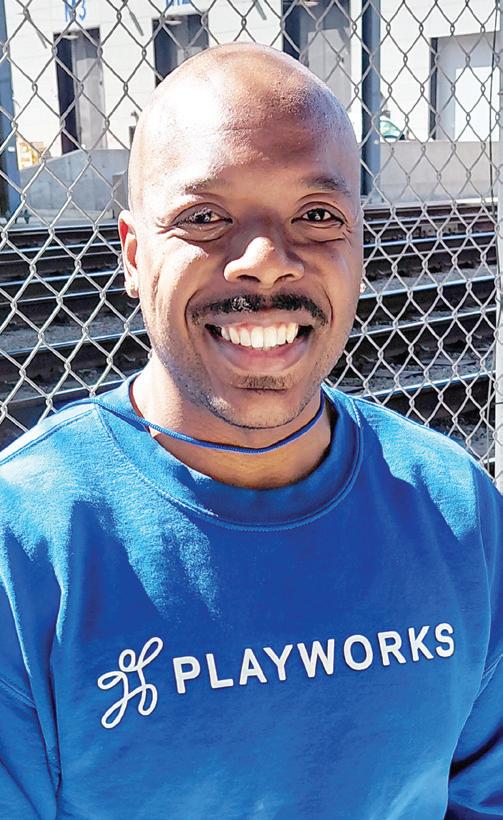
the organization, which cites independent research from Mathematica, Stanford University and RAND. On the morning of May 5, a regular school day, nearly 1,000 Twin Cities and Great
er Minnesota elementary school students gathered at the home of the St. Paul Saints, for an end-of-year recognition that included a parade on the outfield warning track. Almost a quarter of the fourth and fifth graders in attendance were children of color.
“It’s the opportunity to really get involved in leadership at an early age."
the grade schoolers participated in the Playworks Minnesota Youth Leadership Program, which serves more than 25,000 students.


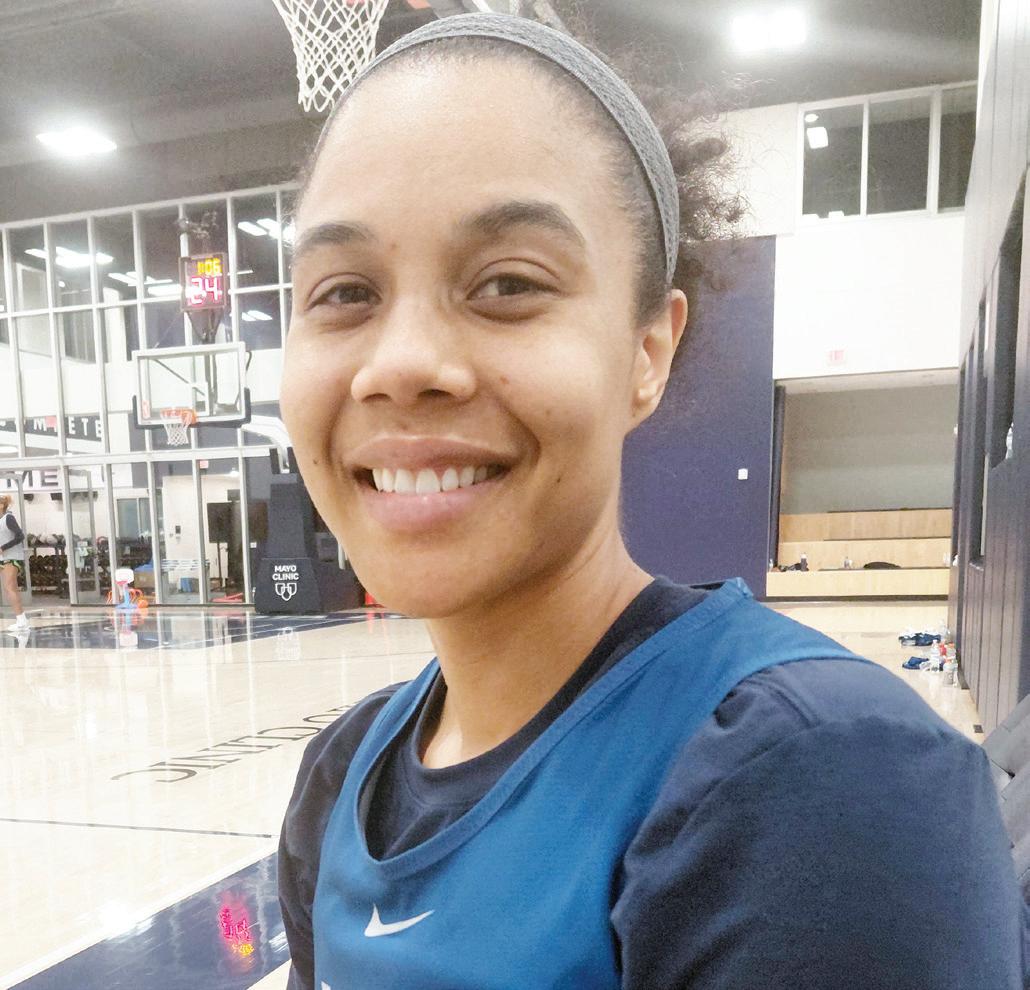
basketball brought me… and honestly, really blessed that it brought me home,” said Coffey, who signed with Minnesota as a free agent after two seasons in Atlanta. This is her seventh pro club and ninth season in the W. She also played overseas during the offseasons.
“I would say the first time I went overseas, I didn’t know what to expect,” recalled Coffey. “The things that people tell you to watch out for when you’re younger, like don’t get in a car with strangers.”
Like all players, veterans and rookies alike, Coffey saw a significant bump in her pay
Gopher running backs

oach Mo
Mohamed Ibrahim was a star running back at Minnesota from 2017 to 2022, set numerous school records and left the Baltimore native with a business and marketing education degree as one of the most productive backs in Big Ten history.
Now, the two-time AllAmerican and 2020 Big Ten Running Back of the Year is back in Dinkytown. On the sidelines as Coach Mo., Ibrahim was hired as running backs coach in January, and this fall will be his first on the sideline in that capacity.
“Yeah, it’s been new to me,” said Ibrahim, sitting at his Bierman office desk. He moved into coaching after a brief NFL career was derailed by injury, first as a volunteer coach with the Gophers in
2024, then at Kent State as running backs coach in 2025.
“When I came here two years ago, I had some people on the team that I actually played with. It wasn’t natural for them just to call me
Coach Mo yet,” he recalled. “Now coming back two years later, none of these guys I played with are here, so now naturally, it’s been unique just being in the building and just having a different role.”
Fall camp will be upon us in a couple of months, and Ibrahim said he can’t wait for the entire squad, including first-year players, to be in tow.
“Behind the scenes, everything has a purpose behind it.”
“I want to make sure that I meet everybody’s needs come summertime, just to make sure that they’re all at an equal spot … that they’ve all mastered the playbook. Just to see what do they know? What can they keep getting better at? Who do they need help with? Stuff like that,” he said.
With his playing days behind him, Ibrahim believes that experience greatly helps him now as a coach. “As a
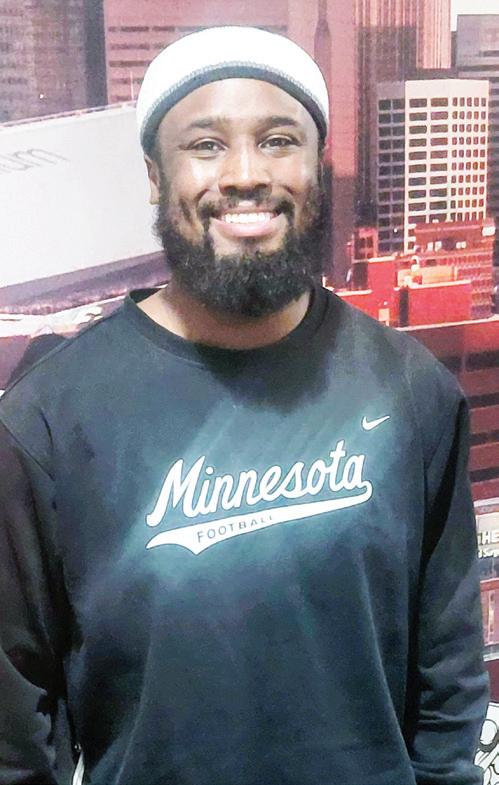
coach, you want your players to know everything, right? Then you come to realize that you have to teach them the basics first,” he said. “Technique is important, and that’s up to them, and that’s the maturity level of a college athlete.”
Being a coach has also fully opened his eyes. “I didn’t know how much coaches cross their t’s and dot their i’s,” Ibrahim said. “Behind the scenes, everything has a purpose behind it. I’m making the most of my opportunity right now.”
FURTHERMORE …
Former Hamline coach
Chip Taylor, the school’s first Black head football coach, was hired in April as Lehigh’s special teams coordinator and safeties coach. Taylor

Coaching While Black By Charles Hallman
This occasional series highlights Black coaches at all levels of sport.
Nia Coffey
Mo Ibhamin
Hallman/MSR
Dave Winfield (New York Yankees) Ebay Dave Winfield (University of Minnesota) The Daily Gopher