

Clock ticks as MN gun bill stalls in House
By Izzy Canizares Contributing Writer
sweeping gun reform bill that would ban the sale of semiautomatic assault-style weapons and high-capacity magazines passed the Minnesota Senate on a narrow 34-33 vote May 4, but its future is uncertain in the House, where Republicans remain opposed and the legislative session ends in two weeks.
The bill also includes $20 million in school safety aid for every school in Minnesota, $2.7 million in school-linked behavioral health grants for early intervention, funding for mental health and public safety, and an anonymous reporting system. It is among the most ambitious gun legislation the state has considered.
The bill comes after a series of deadly shootings in Minnesota in the past year, including the Annunciation school shooting, the murders of state Rep. Melissa Hortman and her husband Mark Hortman, and the killings of Renee Good and Alex Pretti. Parents of Annunciation victims advocated for the legislation.
“Today, the Senate stood up and voted to protect the lives of Minnesotans and to help prevent the unthinkable tragedies that have taken too many of our children, af-

fected too many of our families, and shattered the peace of too many of our schools and churches,” Senate Majority Leader Erin Murphy said.
“We know that gun violence is complex, and this bill is a layered approach to dealing with it. It protects our schools and children, invests in mental
health intervention and prevention, and keeps the most dangerous weapons off our streets.”
Every Senate Republican voted against the measure, and opponents say the same dynamic is likely to play out in the House.
“Minnesotans have been
Minnesota schools breaking law on free college program

By Jasmine McBride
families nearly $60 million annually and state taxpayers ■ See PSEO on page 5
asking their elected leaders to pass gun violence prevention legislation, and that is exactly what we are doing with a comprehensive package that will save lives,” said Sen. Ron Latz. “These are reasonable measures that would help prevent mass shootings, injuries, and deaths in our
communities. I urge my colleagues in the House to find common ground and join us in keeping Minnesotans safe.”
Sen. Zaynab Mohamed, the bill’s co-author, said the legislation does not force a tradeoff between gun restrictions and school investment.
“This legislation is com-
Golden Thyme
By Jasmine McBride Editor
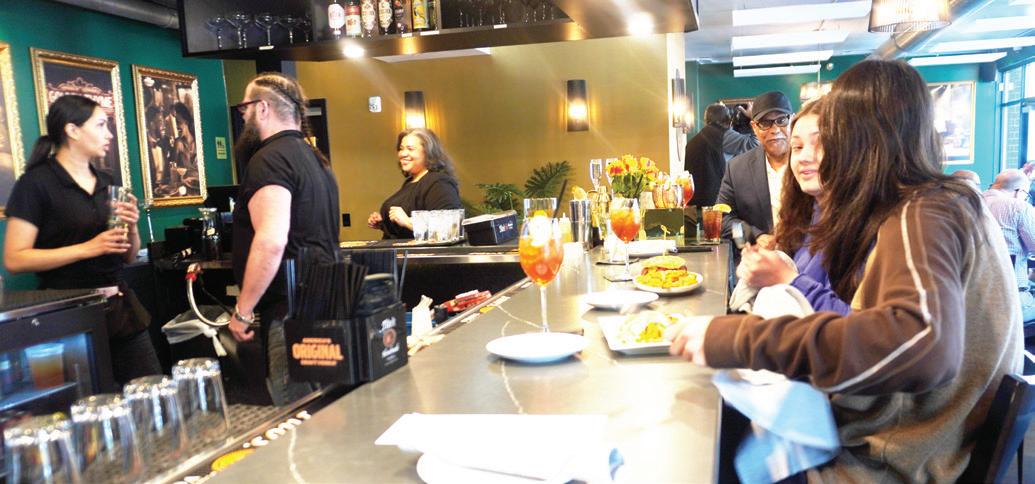
n a sunny afternoon along Selby Avenue, the smell of wings and po’ boys drifted through Golden Thyme Restaurant and Bar as neighbors, founders, and community members filled the space to mark a milestone: one year since the beloved Rondo gathering place reopened under new leadership.
The celebration on May 7 drew generations of Rondo residents together for food, music, and reflection. A reunion in the truest sense, said Heather Raibon, who helped shape the restaurant’s menu and atmosphere during its reopening.
“It is truly like a family reunion every time you come in here,” Raibon said. “Somebody from someone knows
prehensive, and doesn’t compromise on our values,” Mohamed said. “Students and parents do not want us to choose between banning weapons of war and investing in schools. They demand we do both. Any one of these provisions would make our
■ See GUN on page 5
somebody, and tables just continue… ‘Oh, I didn’t know you were going to be here.’
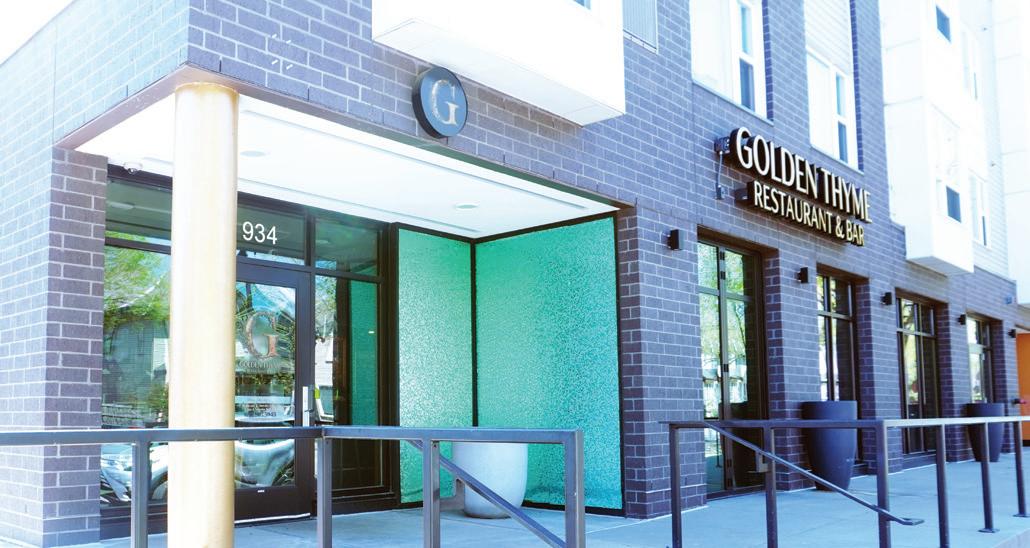
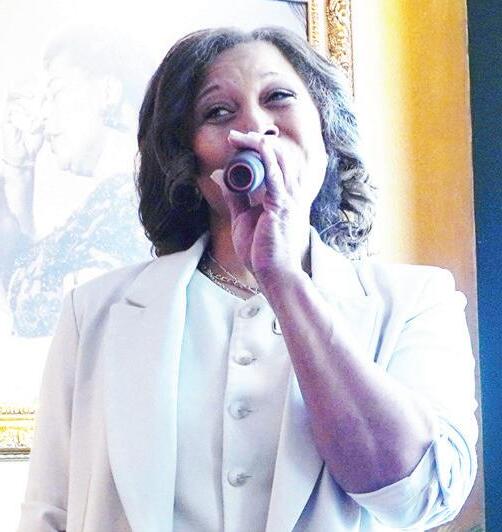
Golden Thyme Restaurant and Bar marked their one-year anniversary, May 7. All photos courtesy of Jasmine McBride/MSR Mikeya Griffin, president and CEO of Rondo Community Land Trust.
It makes me feel warm and fuzzy, because it’s like being part of their families too.” Golden Thyme, which operated for decades as Golden Thyme Coffee and Cafe under founders Mychael and Stephanie Wright, was taken over in 2024 by Rondo Community Land Trust, a three-decade institution in the neighborhood. The transition came when the Wrights were ready to retire and approached the Land Trust about preserving their legacy.
“We asked them to give us a chance,” said Mikeya Griffin,
■ See GOLDEN THYME on page 5
Tima Miroshnichenko
From left, Henry Brick, Ella Palm, Samia Mohamud, Beatrice Handlin, Khalique Rogers. Dante’s Craft
An Uptown YWCA is being reborn as a job training center for workers of color
By Clint Combs Contributing Writer
Go past Lake and Hennepin and you’ll notice that Uptown Minneapolis is in a funk. Like many metropolitan areas, vacant buildings line a once-bustling retail hub. Now, grant money from the state and city hopes to transform an outdated YWCA into a job training center.
Construction at the Rise Up Center on 2808 Hennepin in Uptown Minneapolis has already started. Unidos MN’s Emilia Gonzalez called this part phase one.
“We hope that in the next 18 months, we’ll have phase one completed on some of the principal organizations moving in,” said Gonzalez. “We also have a larger vision where we still have to develop and fundraise for phase two, because we have an ambitious vision.”
That vision includes a fourpart cooperative community space designed to turn lowwage earners in BIPOC communities into middle-class wage earners working union jobs. The 70,000-square-foot center is designed to be geographically accessible, culturally competent, and economically sustainable, anchored in the Lake Street corridor that has faced decades of economic disinvestment, com-
pounded by the pandemic and the civil unrest of 2020.
“Here we are in the vanguard of clean energy, of decarbonization, of electrification, and that requires more time,” said Gonzalez. “Phase two will be more clear as the months come.”
Unidos MN, The New Justice Project, Unite Here Local 17, SEIU Local 26, and Minnesota Training Partnership are among the coalition organizations that want to transform the former YWCA’s outdated basketball courts into a onestop retraining hub.
“We’ve seen our communities locked out of the economy for too long.”
The New Justice Project and Unidos MN have proposed a Green Training Pre-apprenticeship Program, which would give workers from BIPOC and immigrant communities the foundational skills needed to pursue careers in environmentally sustainable construction, an onramp into the skilled trades for those who have historically been locked out.
“We’ve seen our communities locked out of the econo-
my for too long, and the Rise Up Center opens up doors to push back those systemic barriers, to build new partnerships and strengthen old ones with our labor partners, with philanthropy, and with the public sector,” said Rod Adams, Executive Director of The New Justice Project.
The New Justice Project is a Black-led nonprofit that has advocated for a $25 minimum wage, just-cause eviction protections, a municipal wealth tax, and community-owned grocery stores.
“This building is going to train over 3,000 people a year, meaning that economic mobility is no longer a dream, but a reality… meaning that working two or three jobs no longer has to be a reality for the folks who come here, get apprenticeship training, and move on to careers in the trades,” said Adams.
SEIU Local 26 represents 8,000 unionized workers, with 4,000 members working as commercial janitors. Brahim Kone hopes that renovating the former YWCA, originally a West High School gym, into a job training center will give his members a place to call home.
“The idea of having a center where members can call home, a place where they can come and get trained was pretty much a big, big deal,” said Kone. “It’s like a dream,
something that they never thought of.”
Rena Wong is President of the United Food and Commercial Workers (UFCW) Local 663, representing retail workers at Cub Foods, Lunds & Byerlys, Kowalski’s Markets, and various food co-ops throughout the Twin Cities. Wong sees the center as a practical solution for part-time workers who need scheduling flexibility and childcare access to pursue job training.
“They need a place to come for workforce development that understands their needs…
that they might need childcare, that they might need language support, so that they have a path to those full-time meat cutter jobs,” said Wong.
The nearest meat-cutting apprenticeship program is nearly two hours northwest of Minneapolis at Central Lakes College’s Staples Campus. The Rise Up Center, by contrast, is located steps from the Metro E Line station, putting workforce training within reach for transit-dependent workers across the city. Wong added that the center will also offer ESL and citizenship classes for workers in Minnesota’s meat-
packing plants.
Minneapolis Mayor Jacob Frey noted the broader significance of a job-training center aimed at uplifting communities of color. “This is going to be something really special to the whole city, and also specifically this corridor,” Frey said. “Those 3,000 workers who come through here aren’t just getting training for a new job, they’re creating opportunities they’ll be able to pursue throughout their lives.”
Clint Combs welcomes reader responses at combs0284@ gmail.com.
As food insecurity grows in North Minneapolis, neighbors turn to technology and community farming for solutions
By Zacharus E. Turner and Jasmine McBride
Fourteen advocates, students and community organizers boarded a bus bound for Duluth last month with one thing on their minds: food justice.
The group traveled north on Interstate 35, headed for a three-day Metro Food Justice Network summit focused on the latest developments in micro-growing, farm-to-table initiatives and seed stewardship. The ride gave attendees a chance to connect before the work began.
As the bus rolled north, passengers introduced themselves one by one. Some were students representing the University of Minnesota, St. Catherine University and Hamline University. Others worked with nonprofits like Project Sweetie Pie and Renewing the Countryside, alongside several members of the Metro Food Justice Network. The conversation flowed easily as Duluth came closer on the horizon.
The group arrived midmorning and made their first stop at the Whole Foods Coop Hilltop location, where General Manager Sarah Hannigan briefed them on local food programs and shared the store’s history of organic practices spanning more than 20 years. The group then toured the hills of Duluth, taking in a sweeping view of Lake Superior from 1,400 feet above sea level before making their way to the DECC Arena, where the summit was being held.
The Food Justice Summit was hosted by J. DeVon Nolen and drew roughly 300 attendees. The event opened with a video tribute to Melvin Giles, known as Mr. Bubbles, a beloved community leader
and head of the Urban Farm and Gardening Alliance who recently passed away. Giles, who lived and worked in the Frogtown neighborhood of St. Paul, was celebrated by colleagues for his decades of activism on behalf of peace, diversity and education in metro communities. He believed that being seen is the first call to action, followed by finding your purpose and remembering where you came from.
Panel discussions throughout the weekend centered on the challenges facing underrepresented urban farmers, including the lack of systemic support for growers of color. Speakers also addressed seed stewardship and the responsibilities that come with planting, growing and harvesting, including the importance of passing that knowledge on to the next generation.
The role of micro-farmers in the broader food supply chain was another key topic.
County extension workers from across Minnesota voiced concerns about healthy food access and highlighted opportunities for small growers to help fill gaps in the system, including supplying fresh pro-
duce to school cafeterias.
Two speakers drew particular attention.
Brownson J. Arebojie traced his path from a career as an IT engineer to the University of Minnesota’s Master Gardener Program, where he became a lead coordinator at several local farm plots, including Karma Farms and the U of M Arboretum, where he worked as a botanist. For the past four years, Arebojie has worked with youth as an educator, sharing his passion for beekeeping, canning and growing from seed to finished product.
“We want to have easy access, local control…”
Keynote speaker Patrice Bailey, assistant commissioner at the Minnesota Department of Agriculture, offered a personal and wide-ranging account of his journey from growing up in Harlem, New York, to Prairie View A&M University, where he studied
agriculture and human sciences and graduated in 1995, and then to Iowa State University, where he earned a degree in agricultural education in 2005.
Bailey is the first Black person to hold his position in the department’s 141-year history and is one of four commissioners serving the state. His story, from a young man in Harlem to a trailblazing leader in Minnesota agriculture, was by many accounts the highlight of the summit.
Bringing food justice home to North Minneapolis
The conversations in Duluth resonate far beyond the summit floor. Back in the Twin Cities, organizations are turning those same principles into on-the-ground action, and technology is playing a growing role.
Asian Media Access has partnered with Project Sweetie Pie since 2012. Now the two organizations are collaborating on Sankofa Power, a digital platform in development for North Minneapolis designed to connect neighbors and address food insecurity at the block level.
“We want to have easy ac-
cess, local control… a digital platform that links a database to a map so members can easily identify where resources are and how far those resources are from them,” said Ange Hwang, executive director of Asian Media Access.
The platform would also allow neighbors to post realtime updates, alerting others when a garden harvest yields more than one household can use, or facilitating skill exchanges such as lawn mowing in exchange for a homecooked meal.
“We want neighbors to connect at the local level,” Hwang said. “Project Sweetie Pie is providing a lot of the information and concept. Asian Media Access is providing the technology and AI knowledge to co-create this platform.”
The urgency behind Sankofa Power has only grown in 2026. Hwang cited cuts to SNAP funding and the ripple effects of Operation Metro Surge as compounding pressures on North Side residents already struggling with food access.
“A lot of our members are not only worried about their safety, a lot of them are not
going out to buy food or work,” Hwang said. “We totally missed the winter farming because of that, and a lot of food shelves had nobody coming in and limited delivery options. Members are really suffering.” A hyperlocal platform, Hwang said, could change that calculus.
“If we could have a database like Sankofa Power, people could walk a couple of blocks and connect with a neighbor to share excessive food or household tasks,” she said.
“Really support the neighborhood at the block-by-block level.”
Throughout the weekend in Duluth, the theme of stewardship ran through nearly every session: stewardship of seeds, of land, of community and of opportunity. Attendees left with a renewed sense of purpose and a clearer picture of the work still ahead in the fight for food justice across Minnesota. Work that, for many, begins right in their own neighborhoods.
Zacharus Turner is a volunteer with Project Sweetie Pie. For more information, visit proj
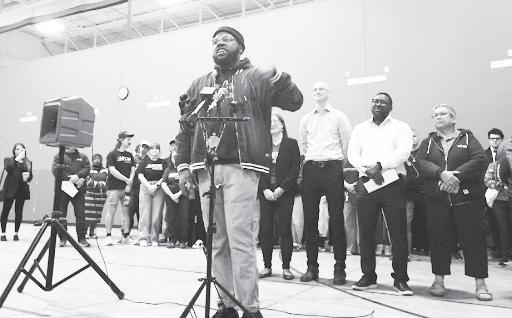
Rod Adams, Executive Director of the New Justice Project speaks at a ceremony announcing Phase 1 of turning the old YWCA on Hennepin into the Rise Up Center. Clint Combs/MSR
ectsweetiepie.org.
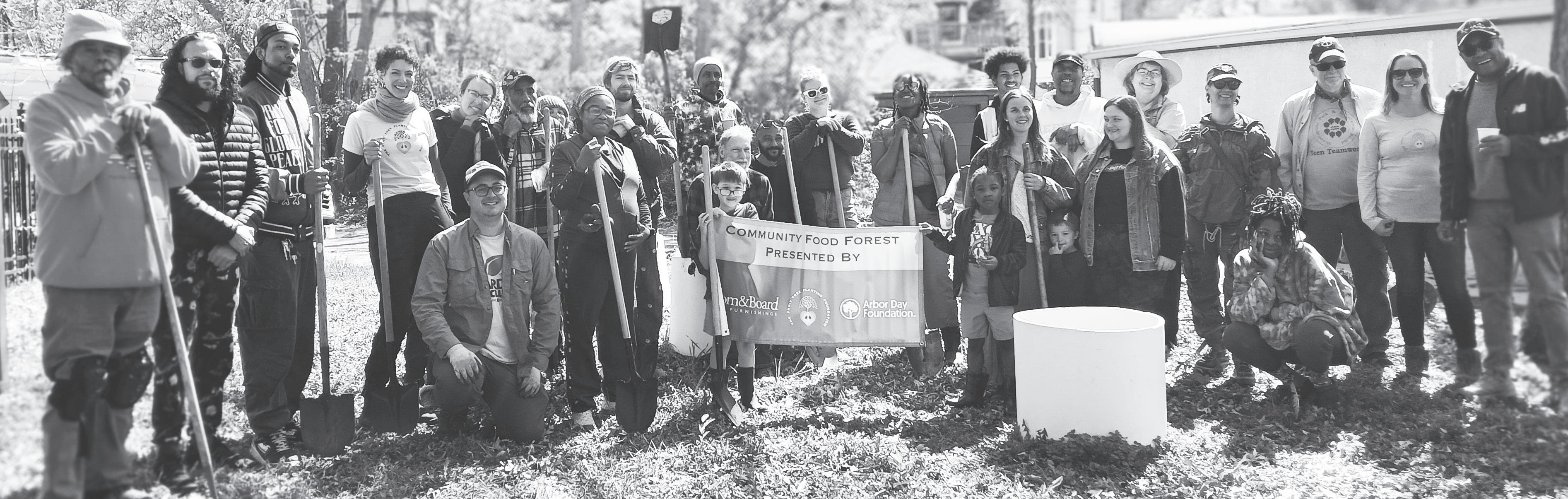
Volunteers and community members representing Project Sweetie Pie's "People's Garden," including the Arbor Day Foundation, Zintkala, Northside Roaring Lions, The Rotary Club, the Loppet Foundation, the Minnesota Horticultural Society, Black Visions, Renewing the Countryside, and Hennepin First Methodist Church, gather to plant trees in celebration of Arbor Day alongside North Minneapolis residents.
Courtesy of Project Sweetie Pie
By Clint Combs Contributing Writer
Dr. Walt Galicich had good reasons to feel optimistic.
The neurosurgeon working at one of the state’s five levelone trauma centers had just finished operating on 12-yearold Sophia Forchas, who was shot in the head during the Annunciation Church shooting in the summer of 2025.
“She was bilaterally fixed and dilated, which means that her pressure in her brain was very high,” Galicich said. “If you had told me at this juncture, 10 days later, that we’d be standing here with any ray of hope, I would have said it would take a miracle.”
Forchas survived.
In August 2007, the I-35W bridge collapsed, leaving Julie Graves with a broken back and a shattered ankle. Disoriented and in pain, she had one urgent instruction for her ambulance driver, who didn’t have a GPS and wasn’t familiar with the area.
“Take me to HCMC. Only take me to HCMC,” Graves said.
Those two words, and the level of care behind them, are now at the center of a fight over whether Hennepin County Medical Center will survive.
County Commissioners
have warned that HCMC could start closing in June if lawmakers fail to reach a funding deal before the legislative session ends on May 18th.
Last month, County Administrator Jodi Wentland told lawmakers HCMC had entered a financial crisis late last year, prompting Hennepin County to step in with stabilization measures. Since January, the county has cut more than 100 jobs, shuttered five programs, and reduced inpatient capacity by 100 beds. Wentland warned that the lower bed count could strain the hospital when summer volumes peak.
Two bills are now on the table. In the House, Rep. Esther Agbaje (DFL-Minneapolis) and Rep. Danny Nadeau (RRogers) are pushing HF4841, which would raise the ballpark sales tax from 0.15% to 0.75%, generating roughly $250 million annually for HCMC and North Memorial. The bill is still in committee.
“One-time funding could help address immediate cashflow pressures for a hospital system that operates with significantly fewer days cash on hand than other metro and safety-net hospitals,” Hennepin County’s Joshua Yetman told MSR. “However, Hennepin Healthcare’s challenges are structural and growing over time.”
shockwaves through Minnesota’s hospital system. “It would be catastrophic. HCMC is essentially a pillar of our hospital system,” she said. “If that were to go down, many other hospitals would soon be facing serious constraints.”
The financial pressure extends well beyond the current legislative session. HCMC racked up $104 million in unpaid medical care in 2024, up from $40 million in 2020. The hospital now projects losing $1.7 billion over the next decade, a figure driven in large part by the $900 billion in Medicaid cuts signed by President Donald Trump, which will hit hardest at hospitals like HCMC that serve a disproportionately low-income patient population.
The hospital has posted operating losses in seven of the last eight years. In August 2025, the Hennepin County Board of Commissioners voted 6-1 to dissolve HCMC’s independent community board and retake direct oversight amid a financial crisis driven by unpaid medical bills. The hospital has burned through three leaders in roughly a year, and the county has extended a line of credit so HCMC can make its $33 million biweekly payroll without overdrafting.
Reps. Agbaje and Katie Jones (DFL-St. Louis Park) remain optimistic that a funding bill will pass within two weeks.
“I do think that we will be doing something… when we unveil what that is, it will probably be at the 11th hour, once everyone can get everything in a row and on a spreadsheet,” Agbaje said.
“I’m encouraged that we have a bipartisan commitment to get this done,” said Jones. “Republican House Speaker Lisa Demuth has also publicly stated that she’s willing to help. We need a sustainable solution.”
The Senate has passed its own two-prong approach.
Senate HHS Committee Chair
Melissa Wiklund (DFL-Bloomington) is pushing a $150 million funding bill (SF4612) covering two years. Sen. Ann Rest (DFL-New Hope) proposed raising the ballpark tax to 0.25%, estimated to generate $84 million a year in SF4985. Both Senate bills passed along party-line votes.
“I think the biggest thing that has been a little bit hard for people to deal with is the
size of the tax that has been asked for by Hennepin County,” said Agbaje.
Rep. Mike Freiberg said it was unfair for Hennepin County taxpayers to shoulder the full cost of safety-net services that treat patients from across the state.
“I don’t know that it’s fair to ask Hennepin County taxpayers to bear the full cost,” Freiberg said. “Funding for these safety nets is a critical need.”
Agbaje warned that an abrupt closure would send

By Andrew Marshall
When most of us think about nurses, we picture hospital hallways, clinics, and exam rooms. That image is real, and nurses working in
those settings deserve enormous respect for working on the front lines of health care.
But here is something many people do not realize.
Some of the most important nursing work happens outside hospital walls. These nurses play a critical role in helping people stay healthier, avoid unnecessary complications, and reduce avoidable health care costs.
We see this every day.
It is a situation nurses encounter often: a member leaves the hospital with a discharge plan that looks fine on paper but does not reflect the reality of recovering at home.
A nurse steps in to review medications, arrange in-home services, and shift follow-up visits to virtual care when travel is not realistic. The

result is that recovery stays on track, care is not missed, and a hospital readmission is avoided.
That is a nursing story, even
though it does not happen at the bedside.
Nursing across the health system
and guide members through complex decisions. They work behind the scenes in care management, utilization review, quality oversight, and provider partnerships helping ensure care is appropriate, evidence-based, and coordinated.
While this work may not always be visible, its impact is very real.
As one nurse leader at Medica shared, nurses are trained to look at “the whole picture including clinical needs, safety, and what is realistic for a person’s life.” When care aligns with that reality, outcomes improve and unnecessary costs are avoided.
Why this matters for households and affordability
The consumer nonprofit Public Citizen analyzed hospitals nationwide with high shares of low-income patients and negative profit margins, finding 446 at heightened risk of closing, cutting services, or laying off workers due to federal Medicaid cuts. Seven Minnesota hospitals made the list, including HCMC. Public Citizen found that communities served by those at-risk hospitals have larger shares of Black and Hispanic residents.
Clint Combs welcomes reader responses at combs0284@ gmail.com.
Nurses help prevent those breakdowns. By connecting the dots early after discharge, between appointments, or during major decisions, they help people avoid larger health crises later. That is better for your health, and it is essential for affordability.
A Nurses Week reflection
During National Nurses Week, we rightfully recognize nurses where we most often see them in hospitals and clinics. But it is also important to widen the lens.
The nurses many people do not see are the ones working behind the scenes, on the phone, and through digital tools that help connect services, clarify care plans, support safe recovery, and advocate for what is medically appropriate. Their work may be less visible, but it is no less essential.




Nursing remains one of the most trusted professions because nurses combine clinical expertise with practical judgment and compassion, especially when people feel overwhelmed or uncertain.
At Medica, nurses serve in roles many consumers never see. They help coordinate care, review clinical information, partner with providers,
When people talk about health care costs, they often think about premiums or prices. But the costs families feel most sharply often come from breakdowns in care:
• missed follow-ups that turn into emergencies
• medication confusion that leads to complications
• poor coordination that results in repeated hospital visits
These nurses are not only supporting individuals; they are helping the health care system function better for everyone.
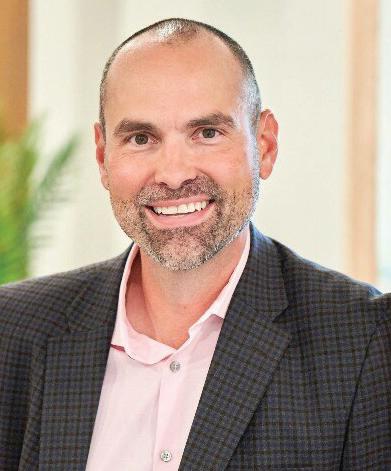
Andrew Marshall is Medica’s Market President for Minnesota and the Dakotas, where he leads with a focus on affordability and access and is a strong advocate for making health care more connected, more compassionate, and easier for the members and communities we serve.

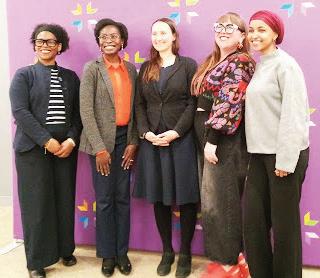
From left, Hennepin County District 4 Commissioner Angela Conley; state Reps. Esther Agbaje (59B) and Katie Jones (61A); Julie Graves, senior director of youth and future focus at Pillsbury United; and U.S. Rep. Ilhan Omar called on the Minnesota Legislature to pass funding to keep Hennepin County Medical Center open. Clint Combs/MSR
Stock project

By Lizzy Nyoike

or 20 people through the whole week. No new customers at all. The streets were completely empty,” Wilson said.
Wilson said many longtime customers from Minneapolis and surrounding areas and nearby metros stopped making regular trips because construction and road closures made travel difficult. At times, he said customers would tell him they planned to return once things settled down.
Still, Wilson never walked away from the business. Instead, he focused on the values that helped Urban Lights grow: consistency and community connection.
“We’re all about the culture,” Wilson said. “The culture of music, the culture of the neighborhood, just the things that make this area tick.”
Wilson believes small businesses play an important role
in neighborhoods because they create spaces where people know one another personally. Unlike larger chain stores, he said independent
businesses often become part of people’s everyday lives.
“You also have your neighborhood stores where you know people, kind of know everyone,” Wilson said. “I know everyone’s name, I know the family, things like that. That’s important, just to build community, camaraderie.”
That sense of familiarity has stretched across generations. Wilson said some customers who first visited the store as children now return as adults with careers and families of their own.
“I have customers who used to come with their parents,” Wilson said. “They were kids at the time, went on to college, graduated from college, came back, and came in to say hey.”
In recent years, vinyl records have seen a surge in demand nationally, especially among younger listeners looking for physical media collections and a personal connection to music. Stores like Urban Lights have benefited from renewed
interest in vinyl culture, but Wilson said running an independent business still requires patience and focus.
He said surviving 32 years in business taught him resilience through every setback the store has faced. Even with ongoing challenges, Wilson remains optimistic about the future.
“Because of the trials and tribulations, it makes you stronger and more focused,” Wilson said.
After more than three decades, the store has become part of the history and culture of the neighborhood itself. A place where music, memories and community continue to play on.
For more information o n Urban Lights Music, visit www. theurbanlightsmusic.com/.
Lizzy Nyoike is a Hubbard School of Journalism & Mass Communication student and contributing writer for the Minnesota Spokesman-Recorder.




Contributing Writer Lights still remains. Over the years, Wilson has
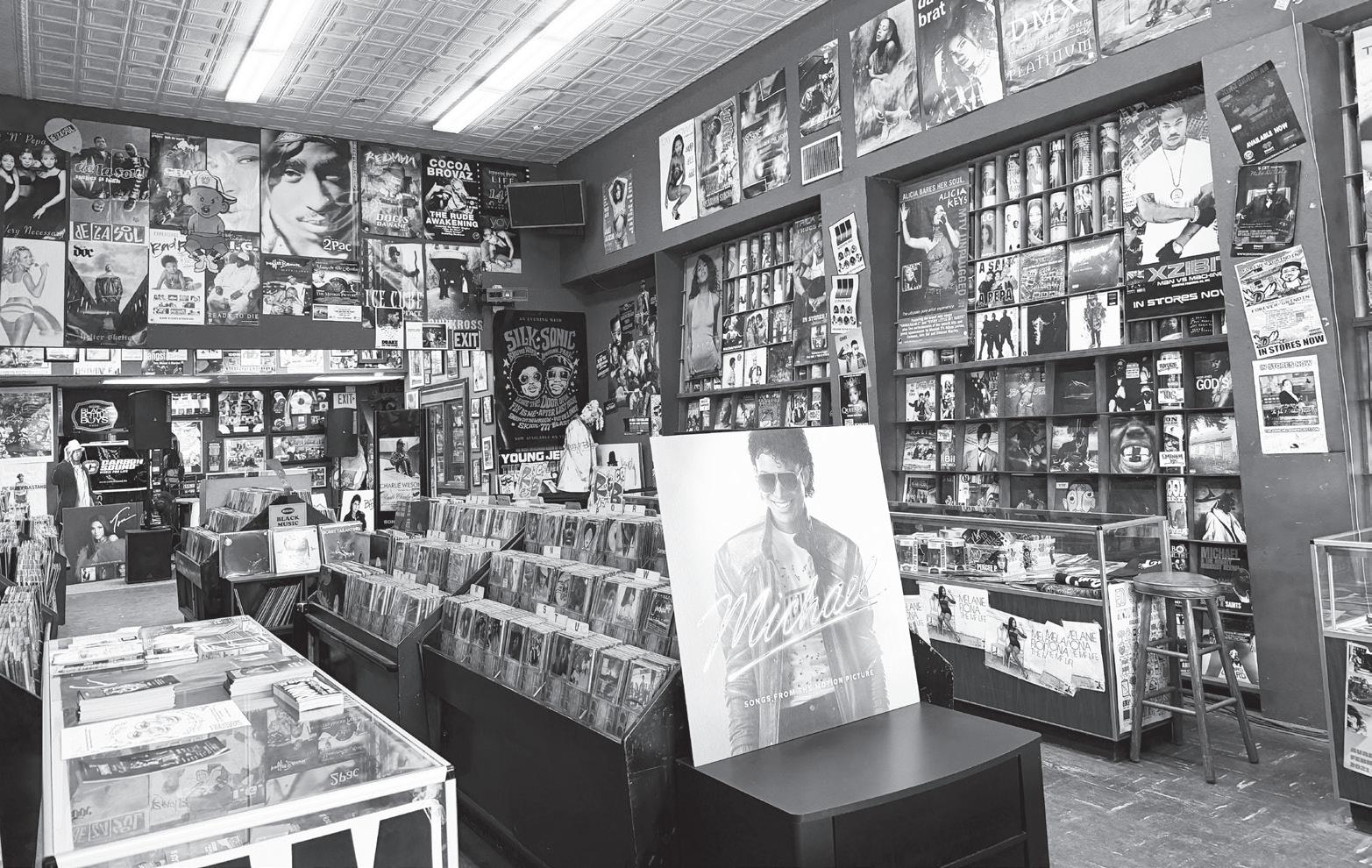
Inside Urban Lights Music in St. Paul off University Avenue.
Lizzy Nyoike/MSR
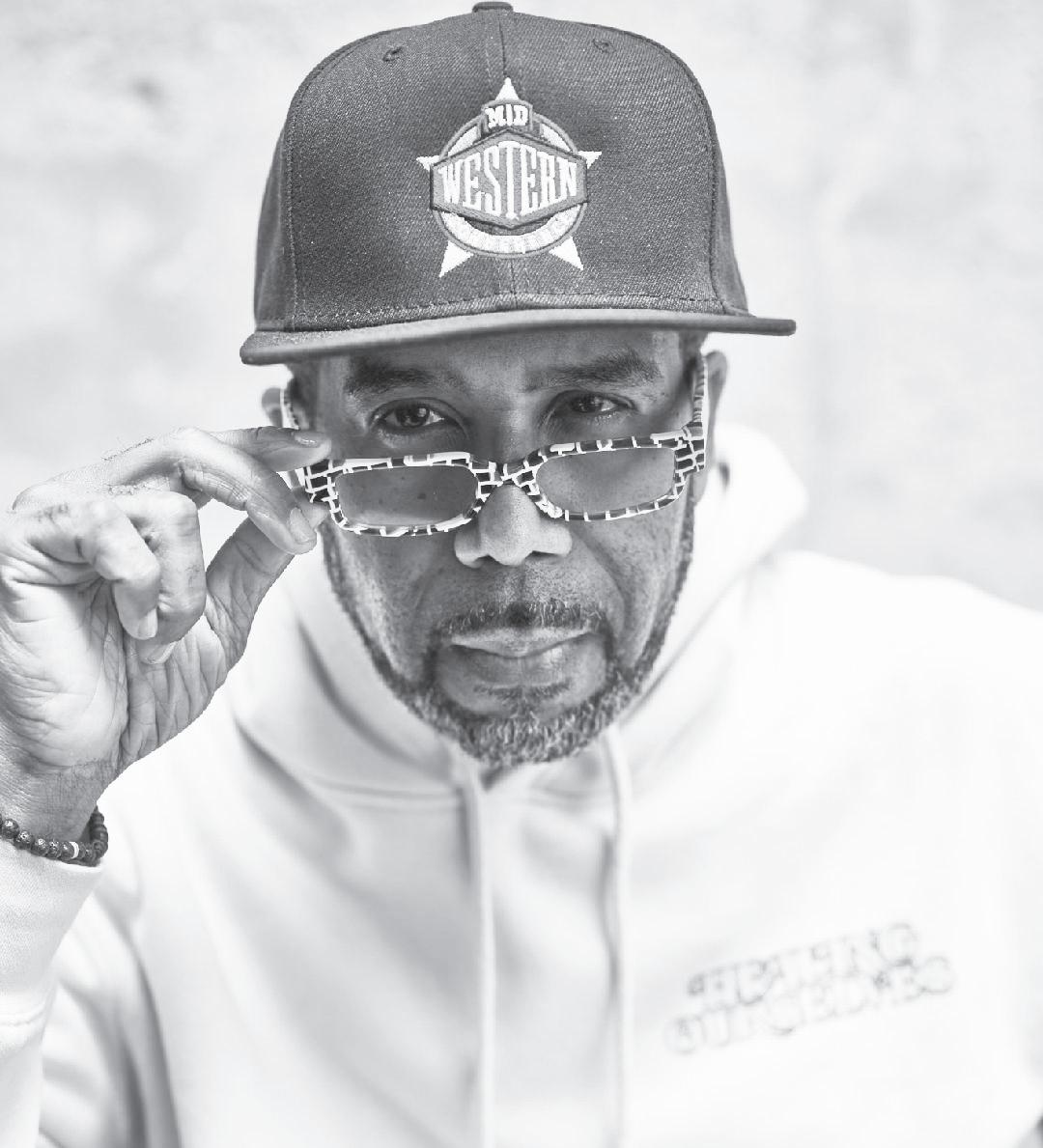
Timothy Wilson Courtesy
GUN
Continued from page 1
schools safer immediately. All of them together will make our schools safer forever.”
Bryan Strawser, chair of the Minnesota Gun Owners Caucus Support, said the bill’s gun control provisions are a nonstarter, arguing the semi-automatic ban would not have prevented the Annunciation shooting and will have little effect on gun violence broadly.
“We are opposed to the
gun control provisions in this bill that would infringe upon the Second Amendment rights of peaceable Minnesotans,” Strawser said. “None of these steps would have prevented the awful tragedy at Annunciation and will have little to no impact on violence involving firearms in Minnesota. Instead, the DFL is essentially blocking funding and programs that would markedly improve school safety and access to mental health resources by mandating that it must be connected to the passage of gun control.”
Strawser said his organi-
PSEO
Continued from page 1
about $15 million per year.
For students at under-resourced schools, the information gap can be decisive.
“I go to a school that’s majority low income, and a lot of the students I’ve talked to are scared to go to college. Not because of the education or the workload, but mainly because of the disparity in income and how expensive tuition is,” said Samia Mohamud, a full-time PSEO student and school board representative. “PSEO provides an opportunity to take two years off your college experience as a high school student. That’s valuable.”
The report found that many school websites fail to inform students that transportation funds are available for lowincome families, that school computers can be used for online courses, that students can continue participating in extracurricular activities while enrolled in PSEO, and that 10th graders are eligible for both academic and career and technical courses after their first semester.
Researchers and student
advocates say the gaps are not uniform, they fall hardest on students in rural and lower-income districts.
“My public school does a really good job of making sure students have access to PSEO information, maybe because we’re the fourth-largest school district and have the resources,” Mohamud said. “But when we look at rural schools or schools without the same income level, there is a disparity. Students don’t have access to links… they’re either dead or they just route to the MDE website.”
“Minnesotans have been asking their elected leaders to pass gun violence prevention legislation, and that is exactly what we are doing.”
zation supports the school safety and mental health investments in the bill, but not at the cost of what he called constitutional rights.
“We reject the false choice that Minnesotans must give up constitutional rights in order to improve public safety,”
Strawser said. “The problem
is that DFL leadership chose to package those investments together with policies that infringe on the constitutional rights of law-abiding Minnesotans, including bans on commonly owned firearms and magazines that are in lawful use by millions of Americans.”
There has been no update on a House vote. Families impacted by gun violence expressed frustration with Republicans who opposed the bill, including Mike Moyski, whose 10-year-old daughter Harper was killed in the Annunciation shooting.
“It’s also a God-given right
for a nine-year-old and a 10-year-old to live beyond that age, right?” Moyski said, in response to Republicans who argued the gun provisions would infringe on their “God-given rights,” according to MPR. “So let’s get serious when we’re talking about God-given rights, especially on this topic.”
For more information on the bill, visit www.revisor. mn.gov/bills/94/2025/0/ SF/1596/versions/latest/.
Izzy Canizares is a freelance journalist and contributing journalist for the Minnesota Spokesman-Recorder.
formation, it makes it hard for students to access PSEO, which builds college readiness skills like time management that are really important for all students to have,” she said.
Henry Brick, PSEO team lead for Catalyst for Systems Change, pointed to a deeper structural issue: a long-running funding dispute between high schools and colleges over which institution receives money when a student enrolls in PSEO. He said that instability has rippled into inconsistent information
“A student’s future should never depend on whether their school decided to fully inform them about their opportunities.”
Ella Palm, a student advocate with Catalyst for Systems Change, said the consequences extend beyond college savings. “When districts aren’t providing accurate and up-to-date in-
across the state.
“Students do what students are told, especially in a field they don’t know much about,” Brick said. “Consistency is one of the biggest factors we can improve on. Students
from rural to urban should get the same information, because it’s the same program no matter where you go.”
The funding conflict has created other barriers as well. Students who remain at their high school receive free lunch, but those who travel to a college campus for PSEO courses do not. For low-income students, that tradeoff can be a deciding factor.
“Young people throughout the state have said there’s a disincentive to take advantage of the program because they have to choose between eating lunch and going to college,” said Khalique Rogers, executive director of Catalyst for Systems Change. “That should never be a choice a young person has to face, especially as they’re taking a positive risk into their future.”
Brick added that transportation costs compound the problem for rural students.
“A lot of students from rural areas aren’t in close proximity to institutions that offer PSEO. They’ve been discouraged because they don’t want to spend $40 or $50 in gas every three days to take a college class,” he said.
People for PSEO and Catalyst for Systems Change are
calling on legislators to direct the Office of the Legislative Auditor to conduct a comprehensive study of the program. The organizations say a formal audit could examine the funding formula, identify barriers to participation, and produce recommendations that bring all parties across high schools, colleges, and the state to the table.
“Right now it’s just a lot of telephone going back and forth around the issues,” Rogers said. “This gives everyone an opportunity to be at the table and design a way to strengthen and protect PSEO.”
Beatrice Handlin, board president of People for PSEO and a former PSEO student herself, said the program changed the trajectory of her life. “It saves so much money, and I think it’s so important that every student knows about this opportunity and has access to it,” she said.
“For students to not know about these opportunities is directly taking away their chances to succeed and learn their capabilities.”
On funding, the organizations said they are not opposed to changes to the formula but want balance. “We don’t want to see colleges
lose funding, and we don’t want to see districts suffer,” Handlin said. “We want to see a good balance so we don’t have to constantly see attempts to hurt the program.”
A small legislative victory came Friday, when the OLA study recommendation advanced to a wider legislative survey. The organizations are now urging constituents to contact legislators on the OLA subcommittee before a vote on which topics to prioritize. Students interested in enrolling in PSEO for the fall semester have until May 30 to submit a notice of student registration. The deadline for spring semester enrollment is Oct. 30.
“A student’s future should never depend on whether their school decided to fully inform them about their opportunities,” Rogers said. For the report and more information on People For PSEO, visit www.peopleforpseo.org/research. For more information on Catalyst for Systems Change, visit www. catalystforsystemschange. org/.
Jasmine McBride welcomes reader responses at jmcbride@ spokesman-recorder.com.
president and CEO of Rondo Community Land Trust. “They weren’t just going to let their legacy go to anybody. So just being able to say, ‘please trust us, and thank you for trusting us with some of the visions and things that you wanted to see happen.’”
For Griffin, who grew up in Rondo, the stewardship is deeply personal. She described the original Golden Thyme as a place she visited for coffee but later understood as something far more significant. A space where community decisions were made, relationships were built, and people felt at home.
“I get so emotional around this, because I’m also a Rondo baby,” Griffin said. “They didn’t know they [referring to Mychael, Stephanie, and other Rondo elders] were my mentors. All the hard work and legacy over the past 38 years… Golden Thyme is more than a restaurant. It’s been a cultural anchor, a gathering place, and a source of pride along Selby Avenue.”
Stephanie Wright, who attended Saturday’s celebration alongside her husband, said
she is proud of what Golden Thyme has become.
“I love what they did and how they’re keeping it going,” Stephanie Wright said. “It’s still in the neighborhood, and it’s still surviving.”
at home,” she said. “It brought the community back together, and it opened Selby back up.”
Mychael Wright reflected on what he and his wife built, and what they handed off.
“The wife and I created a
“Golden Thyme is more than a restaurant. It’s been a cultural anchor.”
She said the original vision was simple: a place where the community could slow down and feel at home. “We needed a place to slow the pace and bring back our community and have everybody come in and feel like they’re
vehicle with Golden Thyme Coffee and Cafe, but the community drives,” he said. “What they’ve done to transform it into this restaurant bar is quite superb. I’m happy for them, and it’s good for our community.”

He described the original Golden Thyme as a place where people could be fully themselves: loud, joyful, and unguarded. “We like to laugh loud. We like to joke loud. Golden Thyme allowed our community to do that,” he said. He added that meetings held at the cafe quietly shaped the neighborhood. “People said they got more done here than in our office, and it’s all hinged on bettering Rondo, bettering our people, bettering our kids.”
That sense of purpose extends to the bar staff. Todd, a bartender who grew up in Duluth and has worked at Golden Thyme since the reopening, said the job has changed how he thinks about going to work.
“My whole life, I’ve never had
a job where I can wake up and say I get to go to work today and feel good about it,” he said.
“I would work here for free. It’s the people, the owners, the community, the camaraderie… the family that we have.”
Rondo’s history looms large over the celebration. The neighborhood, once a thriving hub of Black life in St. Paul, was bisected by the construction of Interstate 94 in the 1960s, displacing hundreds of families and businesses. Griffin said the work of Rondo Community Land Trust, and places like Golden Thyme, is part of an ongoing effort to restore what was lost.
The anniversary also marked the launch of a new season of programming at Golden Thyme, including monthly R&B nights, Sunday suppers, game nights, and open mic nights. Rondo CLT also announced that Golden Thyme Cafe, a separate location down the block, will anchor a new small business incubator along the Selby corridor.
Proceeds from a featured event cocktail, the Rondo 93, will support Rondo CLT’s efforts to expand housing opportunities and move families off its waitlist and into stable homes.
“Golden Thyme reflects the heart of Rondo CLT’s commercial work,” Griffin said. “To preserve culturally significant spaces, support local businesses, and ensure community assets remain rooted in the neighborhood for generations to come. We’re excited about what’s next.”
For more information, visit www.goldenthymeco.com/ for the restaurant, and www. rondoclt.org/ for the Land Trust.
Jasmine McBride welcomes reader responses at jmcbride@ spokesman-recorder.com.
“It’s bringing back that sense that Black people are here, that they’ve been here, and we’re not going anywhere,” Griffin said. “I grew up in the embrace and the love of not just my family, but my community. And we’ve lost a little bit of that. We’re trying to bring it back.”
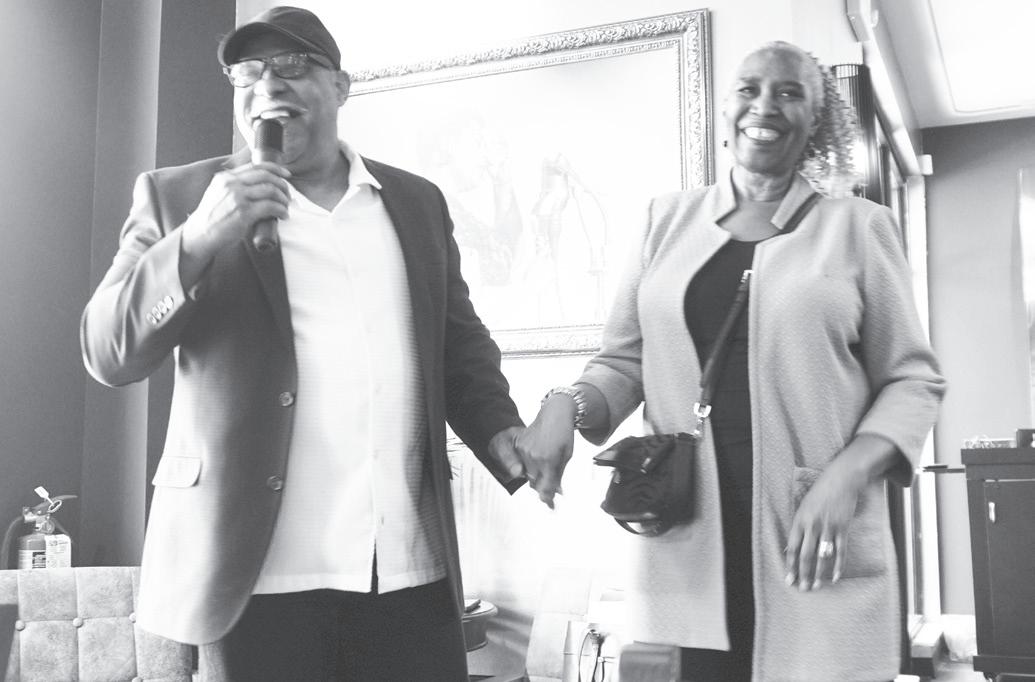
Former Golden Thyme Cafe owners, Mychael (left) and Stephanie Wright.
Featured cocktail, the “Rondo 93,” with proceeds going toward housing opportunities.
Chase opens community branch in Minneapolis’ Longfellow neighborhood
By Jasmine McBride Editor
Chase opened a new Com-
munity Center branch in Minneapolis’ Longfellow neighborhood Wednesday, bringing financial education resources and expanded banking access to one of South Minneapolis’ most established communities.
The branch, located at 2903 26th Ave. S., is one of 19 Community Center locations nationwide and marks Chase’s latest expansion in the Twin Cities since the bank first entered the Minnesota market in 2019. It is the first Community Center branch in Minnesota.
“Longfellow is a resilient neighborhood with deep roots and a real spirit of looking out for one another,” said Jamie Dimon, chairman and CEO of JPMorgan Chase. “Opening this Community Center is about matching that spirit with a lasting investment that helps families build stronger futures, supports local businesses, and contributes to a thriving, inclusive economy in the Twin Cities.”
The location is staffed with
ers through certification, targeted procurement and capital access. The bank also made an $8.1 million historic tax credit equity investment toward the adaptive reuse of the historic Duffey Paper Company Block in Minneapolis, including the rehabilitation of the Minneapolis Iron Store and Lindsay Warehouse buildings.
local financial health experts and features a modern design alongside the latest banking
technology. A large multipurpose room will be used for community events, financial health workshops, skills training and small business popups. Branch Manager Trevor Beckman said the space is designed to meet people wherever they are in their financial journey.
“We do a lot of listening to make sure our services, resources, and programs truly support the Longfellow community,” Beckman said. “Ev-
eryone is welcome here, and our goal is for you to leave with more confidence to embark on the next step in your financial journey.”
The Community Center model was first introduced in Harlem in 2019 with the goal of reaching residents who might not otherwise have access to financial services. Since then, Chase has expanded the concept to 19 locations across the country. In 2025 alone, Community Center managers hosted about 14,000 financial health workshops nationally, reaching 240,000 attendees.
In Minnesota specifically, Chase has hosted nearly 200 financial health events since

2021, reaching more than 2,000 attendees with practical money skills. Workshops cover topics including budgeting, saving, building credit and fraud prevention, and are free to attend whether or not participants are Chase customers.
more than 885,000 consumers and over 50,000 small business customers across Minnesota through 45 branches and more than 100 ATMs. The bank’s ongoing expansion is expected to create more than 300 new jobs in the

“When a community has the right financial tools and support, incredible things happen,” said Diedra Porché, head of community and business development. “This branch is here to support every single Minnesotan who walks through the door, no matter where they’re starting from, and help them go further than they thought possible.”
Chase currently serves
Minneapolis-St. Paul region.
JPMorgan Chase has also deepened its philanthropic footprint in the Twin Cities, investing more than $20 million in local nonprofits since 2019. That includes a $5 million commitment to the Center for Economic Inclusion’s Project Vanguard, a multi-sector initiative aimed at expanding wealth-building opportunities for underserved business own-
About Chase Chase is the U.S. consumer and commercial banking business of JPMorgan Chase & Co. (NYSE: JPM), a leading financial services firm based in the United States of America with operations worldwide, assets of $4.9 trillion and $364 billion in stockholders’ equity as of March 31, 2026. Chase serves nearly 87 million consumers and 7.5 million small businesses with a broad range of financial services, including personal banking, credit cards, mortgages, auto financing, investment advice, small business loans and payment processing. Customers can choose how and where they want to bank: more than 5,000 branches in 48 states and the District of Columbia, nearly 15,000 ATMs, mobile, online and by phone. For more information, go to chase.com.
Jasmine McBride welcomes reader responses at jmcbride@ spokesman-recorder.com.
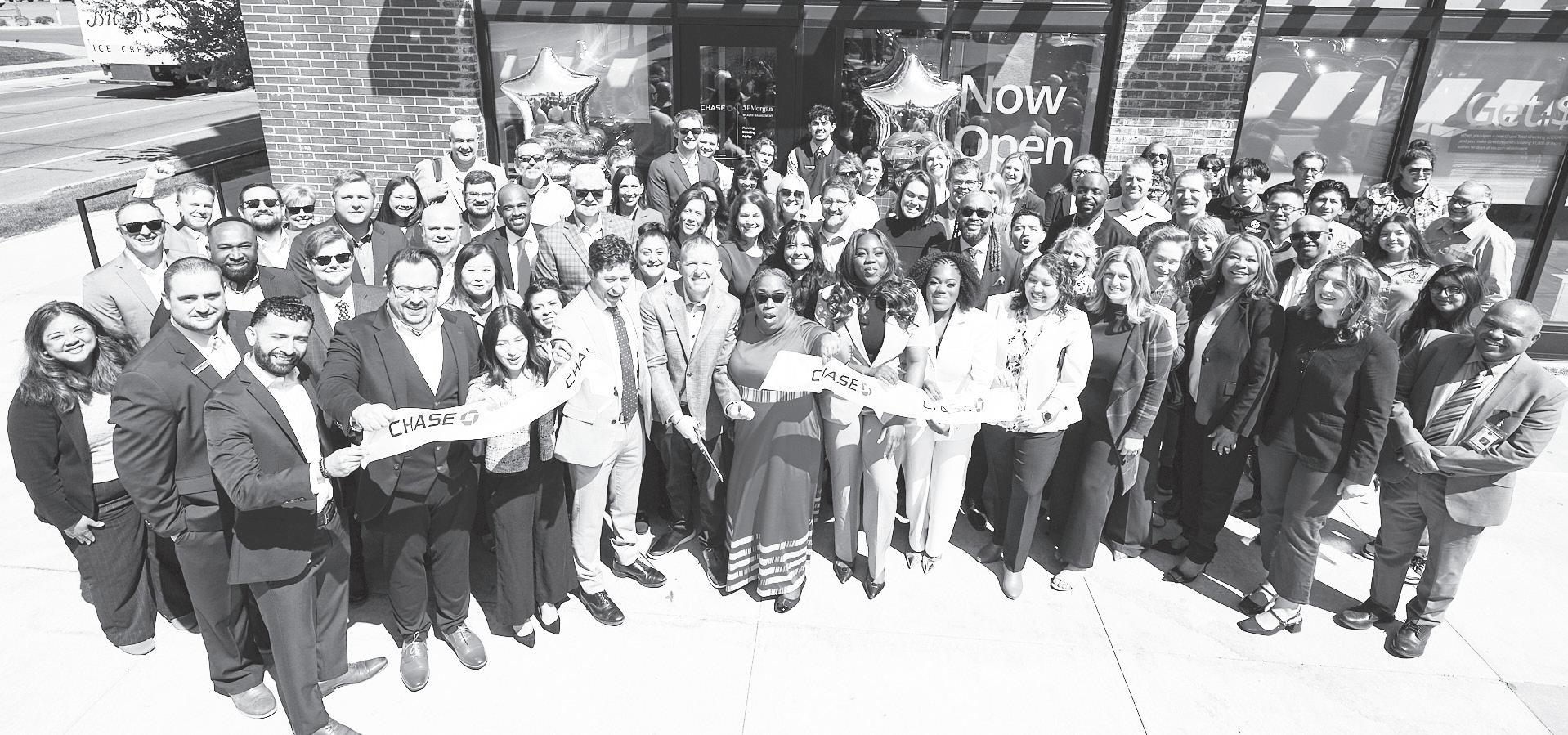
Chase branch manager Trevor Beckman (center, with scissors), alongside Minneapolis Mayor Jacob Frey, cuts the ribbon
new Community Center branch in the Minneapolis Longfellow neighborhood. All photos courtesy of JPMorganChase
“When a community has the right financial tools and support, incredible things happen,”
Chase Head of Community Business Development Strategy and Growth Michele Lawrence (left) speaks with sisters Peace (center) and Praise Olowokere about their business, The Purposed Parent, at a ribbon cutting ceremony for a new Community Center branch in the Minneapolis Longfellow neighborhood.
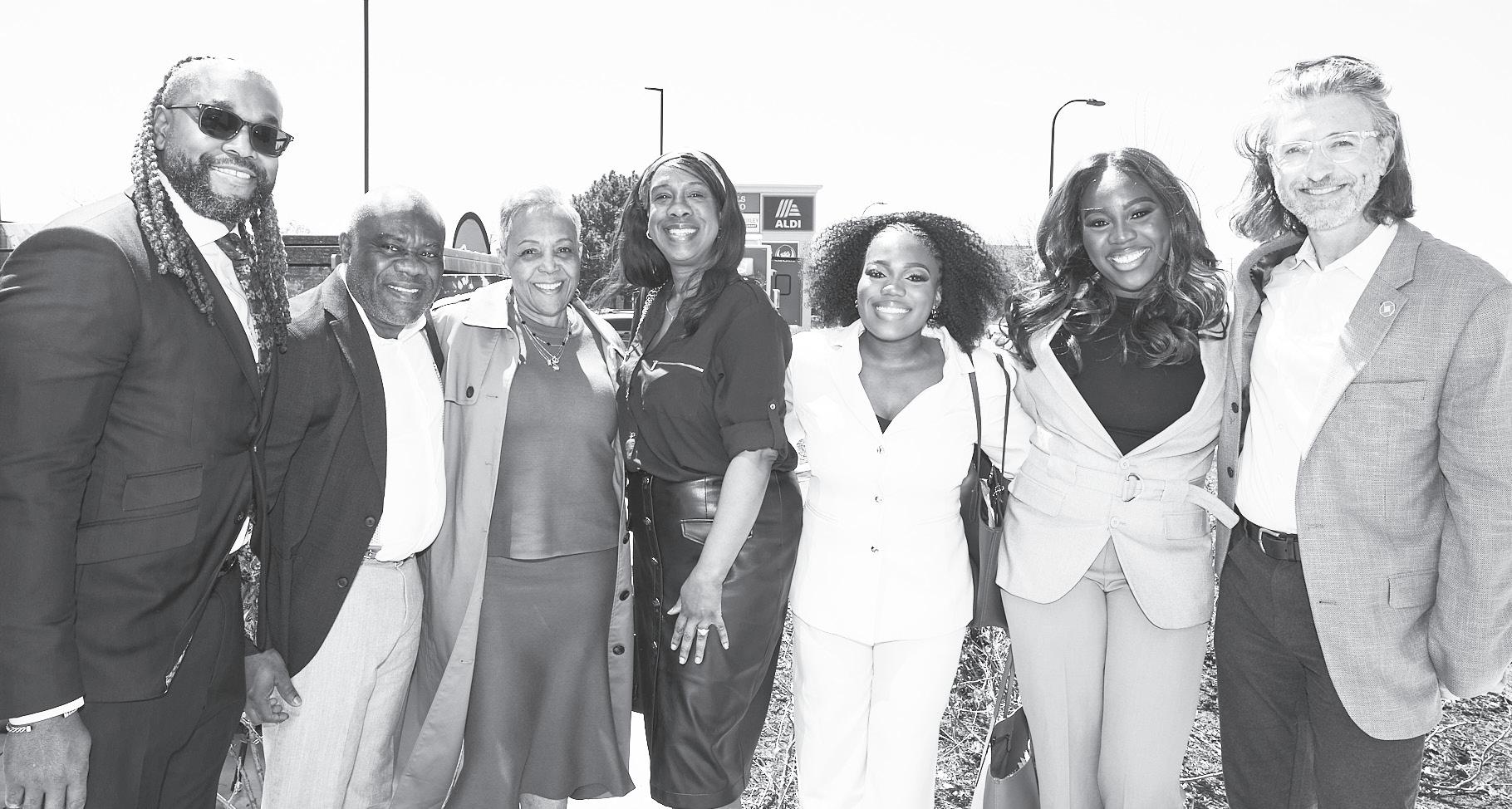
Pictured from left: Jeremy Luke, senior lending manager, Chase; Pastor Emmanuel Olowokere; Tracey Williams-Dillard, publisher and CEO of the Minnesota Spokesman-Recorder; Peace Olowokere, co-founder, The Purposed Parent; Praise Olowokere, co-founder, The Purposed Parent; and Brian Hanover, head of U.S. regional communications, JPMorgan Chase.
Arts & Culture
The art of intentional dining: Jametta Raspberry’s House of Gristle

By Damenica Ellis Staff Writer
Jametta Raspberry uses her creativity in the kitchen designing experiences, building plates and crafting flavors.
Chef Raspberry didn’t take a traditional road to the kitchen.
She hadn’t worked in a restaurant before being classically trained in French cuisine at culinary school in 2004, but she knew the corporate lifestyle wasn’t for her. That realization, along with a childhood immersed in music, solidified her desire for an artistic career.
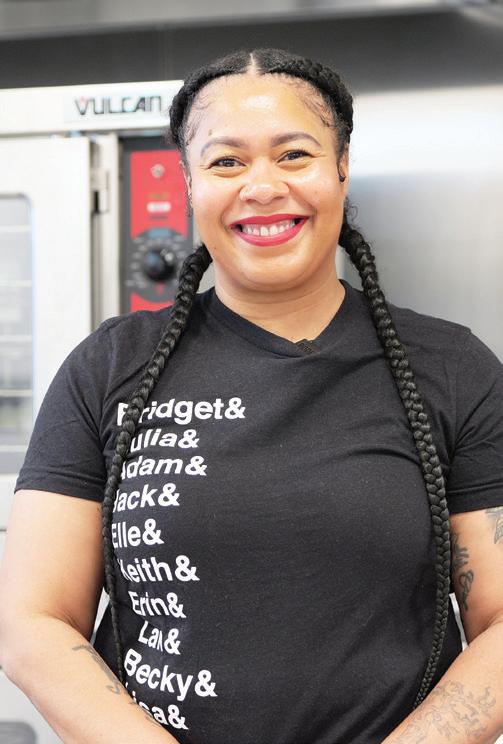
chase trends. We set the tone.”
Raspberry worked in fine dining after her time at Le Cordon Bleu College of Culinary Arts in Mendota Heights. Her experience with different restaurant concepts around the Twin Cities helped her build a vast repertoire of cuisines, cooking styles and service approaches, she said.
“I have a passion for the art of hospitality,” Raspberry said.
to feel free, find Black joy and enjoy some delicious food.”
Some of Raspberry’s art and inspiration comes from travel. Moving through different parts of the world, she hones in on an emotion and the feeling a place brings her.
“I start from there and I create the vibe around it,” she said.
excitement, to be able to create special experiences and memories that can last forever.”
House of Gristle is based at the NEON Collective Kitchen, part of the Northside Economic Opportunity Network, on Broadway Avenue in North Minneapolis. The incubator space provides affordable, secure space for food entrepreneurs.
Raspberry founded House of Gristle, a culinary design studio, in 2019, “known for intentional dining experiences that blend bold flavors with lush aesthetics, and cultural confidence with deep hospitality,” according to its website.
“I believe and know that Black people really empowered hospitality. It’s in our DNA, it’s in our history, our ancestors and our ancestry... I would like to bring that back to the forefront and create an ownership environment where we can establish hospitality for our community.”
House of Gristle means house of connection, she said.
“I believe it’s not just about the food, it’s about the environment, the people around the table, colors, smells, feeling. That really brings me a lot of
The placement excites Raspberry, as it allows her to both support the neighborhood and be supported by it.
“We don’t just feed people. We design energy. We don’t
“What we do is we bring people together around food and create a welcoming and safe environment for Black people

The future of fashion: Howard and U of M experts decode 2026 trends
By Damenica Ellis
Elka Marie Stevens, professor and Fashion Design Program coordinator at Howard University’s College of Fine Arts, and Lucienne Kandler, professor at the University of Minnesota’s College of Design, identified some of the clothing trends of 2026.
The circular nature of style
Fashion is famously cyclical. Some of the styles that have returned from past decades include bold graphic prints and mixing prints, according to Stevens, reminiscent of the late ‘60s and early ‘70s.
“Last year I was seeing a lot of retro ‘80s with neon colors and leg warmers and oversized sweaters and oversized cardigans … pleated skirts, plaids, stuff like that, but we’re moving into a little bit different of dressing.”
She also highlighted “jellies,” a translucent plastic footwear, along with kitten heels, which are making a comeback. Though she was happy to see jellies leave the scene, Stevens acknowledged they are back and reinvented to be more elevated, pointing to jelly stilettos as an example. Kandler is seeing interest in ‘90s and early 2000s aesthetics. She described a popular new silhouette for women and female-identifying people that is boxy and loose fitting.
“The jeans aesthetic is primarily still a wide aesthetic or a barrel leg, versus for men it’s actually going the opposite way, which is really interesting,” she said. “I think we haven’t seen this in modern times for men. We’re seeing more of a boot cut or even a skinny leg or a flare.”
“This is one of the first times in modern history that men and women can find any and all styles of pants,” she said.
Sustainability
“We’re seeing sustainability as a trend and I’m hoping that it actually moves beyond a trend and actually just is more incorporated into our way of life on a regular basis,” Stevens said.
She defined clothing sustainability as an intentional effort to maintain ecological, political and economic systems to protect lifestyle
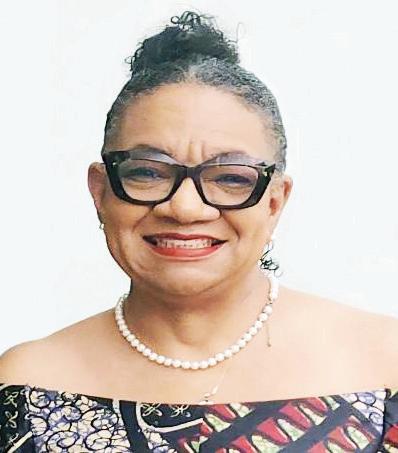
and resources for future generations, including consumers repurposing items and being mindful of discarding them.
People are also making their own clothing, which Stevens finds especially exciting as someone who teaches fashion.
“I love the idea of people making clothing,” she said. “I think pre-industrial revolution, everything was made by hand.
You did not have that luxury of just being able to run to a store… if you wanted something, you made it.”
Stevens has seen this firsthand on Howard’s campus, where students make unique pieces for occasions such as Homecoming, painting the Howard logo, crocheting and knitting paraphernalia centered around their school.

sociates it with the current global climate.
“The world in which we live is very hostile,” she said. “I think that as our political environment changes and becomes more strict and it’s still as if our rights are being taken away, I think that may be the doorway to invite this utility style dressing.”
“Messy girl”
Kandler credits the “messy girl” trend to the rising popularity of Rama Duwaji, the first lady of New York City.
“This ‘art girl’ aesthetic is taking over,” Kandler said. “So anything that had to do with ‘clean girl’ aesthetic is out.”
Clean girl looks favor simple jewelry, sleek hair, basic clothing pieces and neutral

Athleisure and workwear Elevated athleisure is in, Stevens said, and not in the traditional sense of performance wear for athletes.
“We have this athleisure that is becoming just part of our everyday wear. We’ve seen this developing post-COVID and through COVID.” Athleisure is now becoming more refined and is appearing on runways.
Workwear is another trend Stevens identified through social media, including cargo pants, garments with visible name badges and materials that mimic uniforms. She as-
colors. Messy girl, by contrast, embraces layering, thrifted patterns, statement pieces and mismatched textures.
How trends spread Now, trends spread at the speed of light due to technological developments including the internet and social media.
“You have more than one group who is identifying trends,” Stevens said. “It used to be there were only seemingly one or two people who were setting the standard and we were waiting for that article to come out in Women’s
Wear Daily to tell us what the trends were going to be.”
Kandler noticed the effects of this connectedness in her travels over the past year. Style, she said, looks pretty much the same all over the world, especially among college students. However, she noted some unique influences in Minnesota.
“We definitely have an influence with different cultures
here with Somali culture and Hmong culture,” she said. “I think that plays a part in what people are gravitating towards in terms of style.”
Fashion forecast
Clothing cycles are moving rapidly, Kandler said, causing an overlap of trends and bursts of inspiration within subcategories.
“We’re able to serve that community directly by being here,” she said. “I look forward to weaving into the fabric of how the Northside is developing and expanding, and being at the center of it, with Black voices being a part of that process.” House of Gristle offers private dinner experiences, elevated grazing tables and “Bites + Vibes,” a curated cocktail-style event designed for mingling. This summer, Raspberry is working toward hosting events that bring the Black community to Black-owned farms and launching a monthly supper club experience to further strengthen community gatherings. To learn more or book a service, visit houseofgristle.com and follow @houseofgristle and @chefraspberry on Instagram. If you’d like to nominate someone to be featured the Minnesota SpokesmanRecorder’s “On the Radar,” visit spokesman-recorder.com/ on-the-radar-nominations.
Damenica Ellis welcomes reader responses at dellis@ spokesman-recorder.com.
“I think we might see more individualism becoming really important, especially as people move offline and more towards in person and analog, and we’re going to see more of people personalizing their clothing.”
She sees knitting, crocheting and hand tailoring holding high value as ways to show a personalized aesthetic.
Stevens, meanwhile, said she hopes the way clothing is designed, manufactured, distributed and consumed improves in the wake of the United Nations sustainability goals.
“We’re moving into a little bit different of dressing,” and by the sound of it, a more intentional one.
Damenica Ellis welcomes reader responses at dellis@ spokesman-recorder.com.

Jametta Raspberry Photos courtesy of Emmanuel Duncan/MSR
Elka Marie Stevens Courtesy Lucienne Kandler Courtesy
ABEP brings free financial literacy to underrepresented communities
By Jasmine McBride Editor
Money is a tool. That is the foundational belief driving the Association for Black Economic Power (ABEP), a Twin Cities-based nonprofit working to close the wealth gap one conversation at a time. Founded in 2017, ABEP has built a reputation for making financial literacy accessible, culturally relevant, and, perhaps most importantly, free.
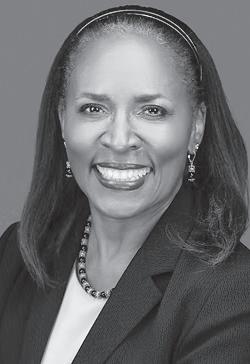
“Learning how to manage your money as a tool to benefit you is extremely critical in a capitalist society,” says Debra Hurston, ABEP’s executive director and chair of the board for Arise Community Credit Union. “Money is designed to move around. Either you dictate where it’s going, or someone else will.”
Hurston joined ABEP in 2020, bringing with her a career spanning national and statewide nonprofit leadership. But her drive to demystify money runs much deeper than her resume. She grew up on the South Side of Chicago in a single-parent household, where conversations about investing or building wealth simply were not part of daily life.
“My mother was a solid rock,” Hurston says, “but we didn’t have conversations about investing or the value of money. I went to a predominantly white college, and I could see the difference… They’re going to England during spring break, and I’m working three jobs to pay for college. That difference was amazingly clear, and I knew I needed to understand why.”
That question, “why,” still fuels her work today. And she is quick to point out that the absence of financial education in Black communities is not accidental. “Why don’t they teach financial literacy in school? Why don’t they teach civics?” she asks. “Those are powerful tools. If you understand how the system works, then you can work the system to your advantage. They don’t want to teach you that.”
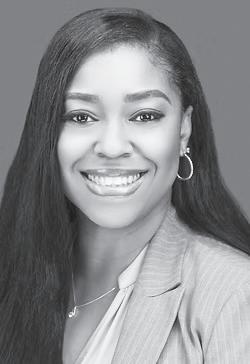
On the program side, Aquilla Robinson, ABEP’s program and outreach manager, is the engine behind the organization’s day-to-day community engagement. A three-year veteran

of the organization, first as a board member, now in a staff role, Robinson credits ABEP itself with transforming her own relationship with money.
“I didn’t have the language of financial literacy growing up,” she says. “My mother did the best she could, but she didn’t know exactly the steps of how to save, and what to do with your income. Her language went as far as: start to save. But then it was like, okay, now what?”
The answer, Robinson found, came through ABEP’s programming. The organization operates under a tagline that doubles as a mission statement: “Educating to achieve bold economic power.” Its core offerings include Beyond Table Talks, a monthly live broadcast,
also recorded for later use, covering topics from homeownership and taxes to side hustles and building generational wealth; one-on-one financial coaching, offered free of charge in up to six sessions lasting 30 to 45 minutes each; and Smart Money Moves, a culturally responsive curriculum with more than 10 chapters that ABEP brings directly to schools, businesses, churches, and community organizations.
“We make financial literacy fun, and we make it so everyone can understand what we’re talking about,” Robinson says. “We come to you. We’re going into schools, businesses, anywhere you are.”
The curriculum is designed to reach people from middle school through adulthood. ABEP has partnered with organizations like NorthSide Achievement Zone (NAZ) and Ujamaa Place to bring programming directly into classrooms, and maintains a task force of financial experts, realtors, financial advisors, and bankers who lend their knowledge to the community at no cost.
For both Hurston and Robinson, ABEP’s work is about more than balance sheets and budgeting. It is about identity, dignity, and reclaiming power in a system designed to keep it out of reach.
“We have more power than we imagine. We just don’t use it,” Hurston says. “And it has been intentional that we don’t know how to use it. Every choice you make is either a play toward your power or a play toward theirs [referring to the systems that uphold economic disparities].”
She is equally candid about the social pressures, particularly on young people, that make financial wellness harder to prioritize. Social media, she says, has amplified the long-standing pressure in Black communities to project
prosperity, whether or not that image reflects reality. Her message to young people is direct: “Find out what’s important to you and stand in that. Society has never, until of late, seen us as valuable. We have to stop letting them define for us what’s valuable.”
Robinson echoes that sentiment, pointing to a key barrier ABEP works to dismantle: the feeling among community members that financial institutions and advisors simply won’t relate to them. “There’s a stigma of maybe they won’t identify with me, or be relatable,” she says. “So people just don’t know where to go, who to turn to, who to trust.”
“Imagine if all people considered marginalized understood that money is a tool.”
That is precisely the gap ABEP is built to fill. And for Hurston, the stakes couldn’t be higher. “Imagine if all people considered marginalized understood that money is a tool,” she says. “The trajectory of those who are challenged would change. We have the power. We just have to use it.”
For more information on ABEP’s programs, including free one-on-one financial coaching and upcoming Beyond Table Talks sessions, visit www.abepmpls.org.
Jasmine McBride welcomes reader responses at jmcbride@spokesman-recorder.com.

Tima Miroshnichenko
Debra Hurston Courtesy
Aquilla Robinson Courtesy
Opinion
DevSecOps Engineer: Plymouth, MN

IT Company seeks DevSecOps Engineer to integrate security practices into DevOps workflows, automate security checks, and ensure the safety of cloud infrastructure. Work closely with development and security teams to enhance the security posture of applications and systems. Build and Configure delivery environments by using CD/CI, Agile delivery methodologies. Create and assist in performing various types of tests. Perform troubleshooting. Generate customized reports. Offered Salary: $116,480.00 to $116,500.00/yr. Send resumes to: HRD, VITS Consulting Corp., 14264 23rd Ave N, Plymouth, MN 55447. Minnesota Spokesman-Recorder July 10, 2025
By Mariah Cooley
Eusther Toussaint in North Carolina. Barbara Deer in Illinois. Nancy Metayer, vice mayor of Coral Springs, Florida. Dr. Cerina Wanzer Fairfax, a Virginia dentist. And most recently, eight children were killed, and two women were critically wounded in Louisiana.
Over the span of one month, we’ve seen at least five stories of Black women and children killed or wounded in gun-related domestic violence incidents. Make no mistake: these are not isolated tragedies. They are a pattern and a direct reflection of what happens when misogynoir, hatred of Black women, becomes enmeshed with bad gun policies.
proportionately harms Black American women. Compared to all ethnicities, we have the second-highest prevalence rates and experience the highest homicide rates in which an intimate partner was the perpetrator. Although about 19 women are shot and killed in a domestic violence homicide each month, very few reports specify how many of those women were Black. And with the Trump Administration having slashed more than a billion dollars set aside for gun violence research and prevention, it could take years before we get a clear national picture.
if their story makes the local news. It’s a harsh reflection of our country’s unspoken hierarchy of grief. But grief is not a limited resource, and ending gun violence does not require choosing which shootings are worth our attention.
Black women have been doing gun violence prevention work in communities for generations. We organize vigils. We lobby elected representatives. We beg the system to listen. But the movement cannot succeed if it continues to require Black women to save ourselves. It must center Black women.
By Sharon M. Holder, PhD., MPhil., MSc., MSW
In many communities of color, certain emotions are treated like inheritances passed down quietly, long before we ever learn the words to describe them. Some families hand down recipes, heirlooms, or stories; others pass down the unspoken. We learn to stay silent, to smile through pain, to work through exhaustion, to pray through trauma. But in that silence, stigma grows. Not because our communities lack strength, but because we’ve been taught that survival leaves no room for struggle.
Mental Health Month is a reminder that survival is not the same as healing. The weight of silence and the unspoken trauma beneath it is often compounded by discrimination, generational traumas, and a healthcare system that has not always welcomed us with dignity. The result is a cycle: pain becomes shame, shame becomes silence, and silence becomes stigma.
Stigma thrives in secrecy. When we hide our struggles, we unintentionally reinforce the belief that they should be hidden, that they signal weakness or failure instead of
reflecting the simple truth of being human. Those struggles are real and familiar: the panic attack that leaves us shaking, the depressive episode that makes the world feel unbearably heavy, the intrusive thoughts we don’t dare name. Stigma is shaped by history: by medical systems that dismissed our symptoms, by workplaces that punished vulnerability, by the fear that asking for help will confirm someone else’s stereotype about us. Yet the truth is simple: mental health challenges are not a personal failure. They are a human experience. Communities of color carry layers of trauma too often overlooked… the trauma of racism, of economic inequity, of being told to “push through” because our ancestors endured worse. But trauma doesn’t disappear because we refuse to name it. It settles into our bodies, our relationships, our parenting, and our sense of self, becoming the quiet inheritance passed
from one generation to the next. Science now confirms what our elders always understood: trauma leaves imprints on generations yet unborn.
When a Black mother teaches her child to be twice as careful, twice as good, twice as invisible, she passes down both protection and pain.
Yet our mental health system remains largely blind to these realities. Traditional therapy models, built through a Western lens, often fail to recognize how mental health manifests across cultures.
America’s man-made epidemic of gun violence is fueling a horrific outbreak of femicide against Black women, and still, our country refuses to confront this crisis. We talk about mass shootings and community violence, but when Black women are shot and killed by intimate partners or other family members, the silence is profound.
Gun violence is gendered.
Growing up as a young Black woman in Illinois, I saw firsthand how gun violence in Black communities is flattened to street beefs and gang shootings, leaving little room to discuss intimate partner violence. As a result, the stories of Black women shot and killed by someone they knew go unheard.
That means funding anti-violence organizations we lead. It means elevating domestic violence from a secondary category to an ongoing crisis. It means making space for difficult conversations about misogynoir and how it has infected policy and government.
“It settles into our bodies, our relationships, our parenting, and our sense of self.”
Cultural mistrust is labeled as paranoia, and generational trauma is reduced to a checklist of symptoms. In many communities, resources are extremely limited, insurance is hard to access, therapy is expensive, and waiting lists stretch for months.
According to data from Everytown for Gun Safety, hundreds of women are shot and killed by an intimate partner every year. Nearly 6 million women reported that an intimate partner had attacked them with a gun. But the story doesn’t end there.
Domestic violence dis-
The gun violence prevention movement continues to ignore a long-overlooked fact: gun violence in America cannot end if we refuse to fully see Black women. White women killed by their intimate partners often become national headlines, while their Black counterparts are lucky
Eusther, Barbara, Nancy, Cerina, and the women and children in Louisiana deserve no less.
This op-ed first appeared in Word in Black. It has been edited for length. For the original piece, visit www.wordinblack. com/2026/04/misogynoirgun-violence-and-a-crisis-werefuse-to-name/.
submissions@spokesman-recorder.com

submissions@spokesman-recorder.com
ads@spokesman-recorder.com
submissions@spokesman-recorder.com.
The path forward requires more than awareness. It demands witness. We need workplaces that recognize the mental health toll of discrimination. Schools that understand how trauma shows up in children’s behavior. Faith communities that make room for both prayer and therapy.
Healthcare providers who listen without bias. And we need each other to normalize vulnerability and remind one another that healing is not a luxury but a right.
Mental Health Month is not just a campaign; it is an invitation to tell a friend you’re having a hard day, to ask someone how they’re really doing, to name your emotions instead of burying them. Silence once kept us safe, but today, our safety lies in speaking.
This Mental Health Month, may we confront the stigma we carry by breaking the silence, because mental health is a shared human experience.
Dr. Sharon M. Holder is a South Carolina–based scholar with more than 25 years of experience in academia and healthcare. Her work focuses on health disparities, behavioral health, mental health stigma, and advancing equity for rural and underserved communities.
By Demetria McCain
Days after the Supreme Court allowed Texas’ 2025 racially discriminatory redistricting plan to stand, I suspected the “Callais” decision might follow shortly thereafter. The clock struck 10 AM on April 29, and within moments, the Supreme Court’s “Callais” decision was published on its website for all the world to see.
By now we all know the voting rights for which so many fought, bled, and died were gutted by last week’s “Callais” decision. Although the majority claims Section 2 of the Voting Rights Act still stands, in operation it now doesn’t. If the majority thinks we believe racism is a thing of the past, if the majority thinks we believe it’s easy to prove intentional discrimination in the age of high tech and procedural tactics that keep evil doers’ motivations hidden, if the majority believes we think this Louisiana case was about the state’s partisan politics and not race, think again. What has remained constant since Reconstruction until now are nefarious changes to voting that disempower Black voters. So, no, district lines should not be drawn in ways that block Black voters from electing candidates of their choice simply because a state claims its decision is based on
partisan politics. It has been and presently is all about race.
The ruling was not a surprise to many of us. The demise of rights for Black and Brown communities has been playing out in real time before our eyes with unchecked killings by federal agents, federal civil rights offices turning blind eyes to discrimination complaints, and federal and private industry jobs held by Black people being cut left and right.
It is time for us to take up the mantle like Frederick Douglass, Sojourner Truth, Ida B. Wells, Pauli Murray, Fannie Lou Hamer, John Lewis, Bayard Rustin, Thurgood Marshall, and Constance Baker Motley as we envision an even more inclusive democracy than we have had these last 61 years and advocate on all fronts (federal, state and local) as if our lives depend on it… because they do. We may not live to see the fruit of our labor. But Generation Beta, those born between 2025 through 2039, or their offspring may. And I say, just like the foot soldiers of the 1960s did, they are worth it.
— Demetria McCain, Director of Policy at the Legal Defense Fund
This op-ed first appeared in The Root. For the
But this is our time. We must register people to vote, ensure our voter registrations remain valid and are not purged, vote early and spread the word, volunteer at the polls through LDF or become a poll worker, hold all elected officials accountable, support the federal John R. Lewis Voting Rights Advancement Act, engage in state redistricting hearings and voice opinions on the record, advocate for the introduction and passage of State Voting Rights Acts like the one recently enacted in Maryland, be open to conversations about alternative voting methods like those used since the 1980s by LDF as remedies for racial discrimination, and teach Black history like that included in LDF’s Thurgood Marshall Institute’s archives.
STATE OF MINNESOTA
Employment & Legals
COUNTY OF HENNEPIN FOURTH JUDICIAL
State of Minnesota, by its Commissioner of Transportation, Petitioner, vs. Unknown successors in interest to Northwestern Lumber and Wrecking Company, et al. Respondents. IN THE MATTER OF THE CONDEMNATION OF CERTAIN LANDS FOR TRUNK HIGHWAY PURPOSES NOTICE
To the Respondents hereinabove named:
You, and each of you, are hereby notified that on June 10, 2026, at 10:00 a.m., or as soon thereafter as counsel can be heard, before Judge Bruce D. Manning, in the Courthouse at Minneapolis, Hennepin County, Minnesota, via remote hearing, the Petitioner will present a Petition now on file herein for the condemnation of certain lands for trunk highway purposes. This hearing will not be in person at the Courthouse. Instructions for attending the remote hearing may be obtained from Hennepin Court Administration. The remote hearing may be accessed by video at https://Zoomgov.com/join, or by phone at 833-568-8864. For either method, the Meeting ID is 161 943 1155 and the Meeting Password is 377203. YOU, AND EACH OF YOU, ARE FURTHER NOTIFIED, that Petitioner will also move the court for an order transferring title and possession to Petitioner of the parcels described in the Petition in accordance with Minn. Stat. §117.042, as of July 5, 2026. YOU, AND EACH OF YOU, ARE FURTHER NOTIFIED, that all persons occupying the property described in the petition must VACATE THE AREA BEING ACQUIRED AND MOVE ALL OF YOUR PERSONAL PROPERTY FROM THE AREA BEING ACQUIRED ON OR BEFORE JULY 5, 2026. All advertising signs or devices located in the area being acquired must be removed by July 5, 2026.
YOU, AND EACH OF YOU, ARE FURTHER NOTIFIED, that (1) a party wishing to challenge the public use or public purpose, necessity, or authority for a taking must appear at the court hearing and state the objection or must appeal within 60 days of a court order; and (2) a court order approving the public use or public purpose, necessity, and authority for the taking is final unless an appeal is brought within 60 days after service of the order on the party.
Dated: March 5, 2026
ATTORNEY FOR PETITIONER
KEITH ELLISON, Attorney General State of Minnesota
/s/Mathew Ferche
MATHEW FERCHE, Assistant Attorney General Atty. Reg. No. 0391282
445 Minnesota Street, Suite 600, St. Paul, MN 55101-2125
(651) 757-1457 (Voice) (651) 282-2525(TTY)
ATTORNEY FOR PETITIONER
STATE OF MINNESOTA
COUNTY OF HENNEPIN
State of Minnesota, by its Commissioner of Transportation, Petitioner, vs. Unknown successors in interest to Northwestern Lumber and Wrecking Company, County of Hennepin, Unknown heirs of Erick W Anderson, deceased, Unknown heirs of Bernice Anderson, deceased, Unknown heirs of Minna Smith, deceased, also all other persons unknown claiming any right, title, estate, interest or lien in the real estate described in the Petition herein, Respondents. IN THE MATTER OF THE CONDEMNATION OF CERTAIN LANDS FOR TRUNK HIGHWAY PURPOSES PETITION
To the District Court above named the State of Minnesota brings this Petition and respectfully states and alleges: I.
That Trunk Highway Legislative Route numbered 104, which has been renumbered 55, and which has been located according to law and passes over the lands herein described. That it is duly covered by Width Order numbered 99418 and Center Line Order numbered 40838. II.
That the Commissioner of Transportation deems it necessary that the State of Minnesota for trunk highway purposes obtain the lands herein described in fee simple absolute.
Petitioner hereby moves the court for an order authorizing the Court Administrator to accept and deposit payments from the Petitioner to the court pursuant to Minn. Stat. § 117.042. Petitioner hereby moves the court for an order transferring title and possession of the parcels herein described, after the filing of an award by the court appointed commissioners, pursuant to Minn. Stat. §117.042.
Further, Petitioner hereby moves the court for an order requiring the parties to exchange any appraisals at least 14 days prior to a commissioners’ hearing, pursuant to Minn. Stat. § 117.036. The Petitioner reserves its right to recover costs of clean up and testing and all other damages arising from the presence of pollutants, contaminants, or hazardous materials on the property described herein, from all potential responsible parties, including respondents herein where appropriate, in a separate legal action to the extent permitted by law III.
That the following described lands in these proceedings taken are situated in Hennepin County, Minnesota; that the names of all persons appearing of record or known to your Petitioner to be the owners of said lands or interested therein, including all whom your Petitioner has been able by investigation and inquiry to discover, together with the nature of the ownership of each, as nearly as can be ascertained, are as follows:
FEE ACQUISITION
Parcel 262 C.S. 2724 (55=116) 901
S.P. 9910-02
All of Tract A described below:
Tract A. Lots 9 through 12, inclusive, GILBERT’S RE-ARRANGEMENT OF LOTS 1, 2, 3, 4, 5, 6 AND 19, BLOCK 2, OF FOSTER’S ADDITION TO MINNEAPOLIS, MINN., and Lots 1 through 5, inclusive, Block 3, FOSTER’S ADDITION TO MINNEAPOLIS, together with that part of vacated Franklin Avenue accruing thereto by reason of the vacation thereof; according to the plats thereof on file and of record in the office of the County Recorder in and for Hennepin County, Minnesota.
Names of parties interested in the above-described land and nature of interest: Unknown successors in interest to Northwestern Lumber and Wrecking Company Fee County of Hennepin Taxes and Special Assessments
FEE ACQUISITION
Parcel 263 C.S. 2724 (55=116) 901
S.P. 9910-02
All of Tract A described below:
Tract A. Lot 13, GILBERT’S RE-ARRANGEMENT OF LOTS 1, 2, 3, 4, 5, 6 AND 19, BLOCK 2, OF FOSTER’S ADDITION TO MINNEAPOLIS, MINN., according to the plat thereof on file and of record in the office of the County Recorder in and for Hennepin County, Minnesota.
Names of parties interested in the above-described land and nature of interest: Unknown heirs of Erick W Anderson, deceased Fee Unknown heirs of Bernice Anderson, deceased Fee County of Hennepin Taxes
FEE ACQUISITION
Parcel 272 C.S. 2724 (55=116) 901 S.P. 9910-02
All of Tract A described below:
Tract A. Lot 18 and the North Half of Lot 17, Block 2, FOSTER’S ADDITION TO MINNEAPOLIS, according to the plat thereof on file and of record in the office of the County Recorder in and for Hennepin County, Minnesota.
Names of parties interested in the above-described land and nature of interest: Unknown heirs of Minna Smith, deceased Fee County of Hennepin Taxes
WHEREFORE, Your Petitioner prays that the Court grant this petition, that commissioners be appointed to appraise the damages which may be occasioned by such taking, and that such proceedings may be had herein as are provided by law.
Dated: February 20, 2026 KEITH ELLISON, Attorney General, State of Minnesota /s/Mathew Ferche
MATHEW FERCHE, Assistant Attorney General, Atty. Reg. No. 0391282
445 Minnesota Street, Suite 600, St. Paul, Minnesota 55101-2125
(651) 757-1457 (Voice) (651) 297-4077 (Fax)
mathew.ferche@ag.state.mn.us, ATTORNEY FOR PETITIONER 101031
MINN. STAT. § 549.211 ACKNOWLEDGMENT
The party or parties on whose behalf the attached document is served acknowledge through their undersigned counsel that sanctions may be imposed pursuant to Minn. Stat. § 549.211.
Dated: February 20, 2026 KEITH ELLISON, Attorney General, State of Minnesota
/s/Mathew Ferche
MATHEW FERCHE, Assistant Attorney General Atty. Reg. No. 0391282
445 Minnesota Street, Suite 600, St. Paul, Minnesota 55101-2125
(651) 757-1457 (Voice) (651) 297-4077 (Fax)
mathew.ferche@ag.state.mn.us
ATTORNEY FOR PETITIONER Minnesota Spokesman-Recorder
Employment & Legals
1.000 fielding percentage.
The 5-foot-7 Wichman, from Norfolk, Neb., played in 47 games primarily as a pinch runner, scoring 22 runs and stealing two bases in three attempts. “The key to being successful, I found, is just to trust myself and not think about it too much,” she said of her base running. “Just trust your instincts.”
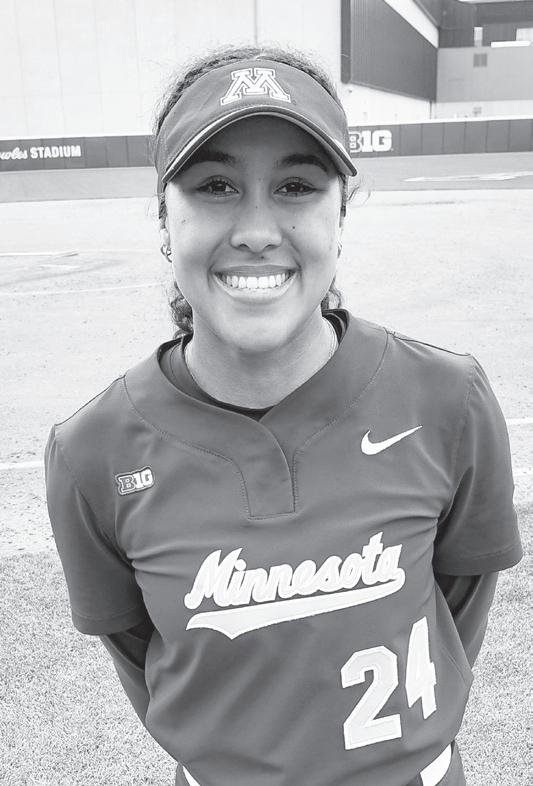
Both Trotter and Wichman earned spots on the 2024-25 Summit League Honor Roll. Sample’s father, Victor Sample, watched his daughter play in person last week and said softball runs in the family.
“My dad played, I played, and her granddad on her mother’s side played, so she loved the game,” Victor said. “It’s natural.”
He added that one of his daughter’s biggest strengths is “her energy and how she encourages her teammates to play.”
Minnesota also ended its season last week, losing 4-2 to Washington in the Big Ten Tournament opening round at Maryland. The Gophers finished 16-36.
Jae
Cosgriff Charles Hallman/MSR
Sophomore Jae Cosgriff of Livermore, Calif., one of two Black players on the team, wrapped up her second season as a starter in center field: .945 fielding percentage, 24 hits, 12 RBI, three home runs and a perfect 2-for-2 in stolen base attempts.
“One of my goals was just to be more confident … see the ball well and just hit better,” Cosgriff said. She said she regularly calls her father when she hits a rough patch at the plate. “He was helping me with my timing, get that front foot down early.”
Cosgriff was moved from left field to center field this
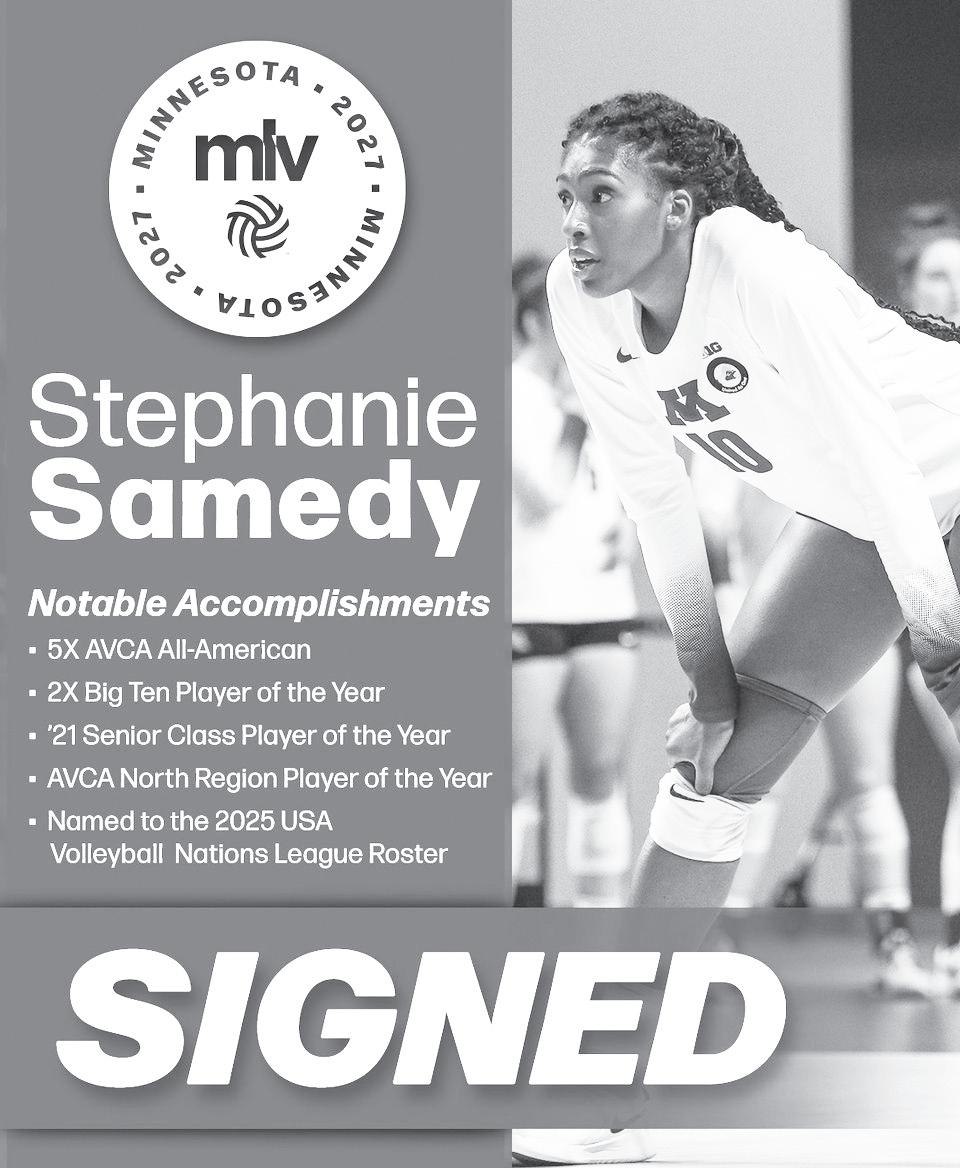
season. “It was definitely different, but I played center all growing up, so it wasn’t that big of a jump,” she said. “I love it. It’s my favorite position.”
FINALLY …
MLV Minnesota, the new pro volleyball team expected to begin play in 2027, last week signed its first player: former Minnesota Gopher and East Ridge High School
standout Stephanie Samedy. The 6-foot-2 Samedy has played professionally in Japan for the past two seasons. She starred at Minnesota from 2017-21, earning Big Ten Player of the Year honors twice and All-American recognition five times.
Charles Hallman welcomes reader responses at challman@ spokesman-recorder.com.
online school. So I enrolled at the local junior college close to the county where I live.”
“Once I started, the first year was really tough,” he recalled, “just the discipline it takes to study and all that good stuff. But once you get into it and understand your purpose, it didn’t get easier, but my time management got better.”
Hawkins earned a sociology degree from Southern New Hampshire University in May 2022.
Although he retired as an active player, Hawkins has never strayed far from the game. Now in his first season as the Twins’ bullpen coach, hired by first-year Manager Derek Shelton, the Gary, Ind., native is the team’s first Black pitching coach since Garvin Alston in 2018 and the first Black bullpen coach in franchise history. He is the only coach of color on this year’s staff.
Continued from page 12
for their support.
“We cannot thank them enough,” Horton said. “This event is showing that barri ers are being broken.”
The May 2 game was a

Asked to assess his role so far, Hawkins was candid.
“That’s a really interesting question,” he said. “I’ve done some coaching over the years since I retired, at USA Baseball and MLB Development. I’m having to learn something different, and it’s a lot of information, a lot of homework. Hopefully I’ll grow to love it.”
Hawkins first pitched for the Twins in 1995 and stuck with the big league club for good in 1997. Minnesota moved him from the rotation to the bullpen in 2000, first as a closer in 2001, a role he struggled in, before finding success as a setup man and playing a key role in the Twins’ 2002 and 2003 playoff runs. He also has the distinction of recording at least one save against all 30 MLB teams during his career.
Later, Hawkins was hired by Minnesota after the 2016 season as a special assistant, contributing across the organization in areas including pitching philosophy, amateur scouting and trade deadline preparation. He also pro-

vided occasional analysis on Twins broadcasts, offering perspective as a former player.
“I’m trying my best,” Hawkins said of his role as a teacher. He also has a head start in familiarity with several Twins pitchers, particularly the team’s two Black starters, Simeon Woods Richardson and Taj Bradley.
“I’ve known both of these
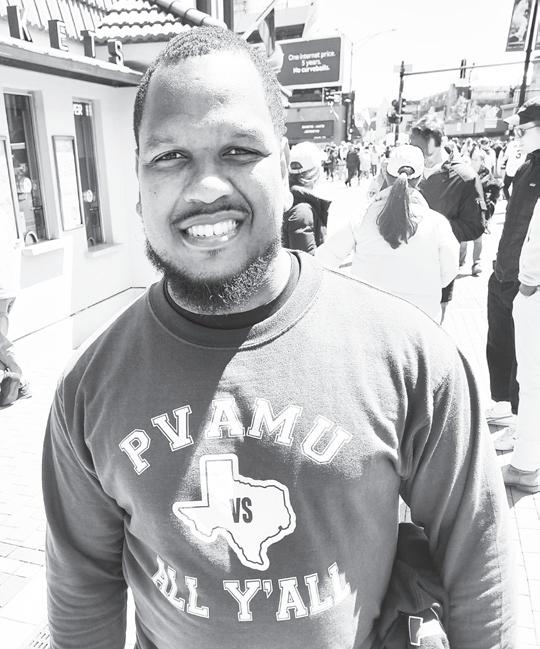
Cubs-Arizona contest and his school’s historic baseball appearance at the ballpark.
a universal historic meaning to them, and Wrigley is one of them,” Lattin-Sims said. “Just being able to see HBCU baseball highlighted here, and see these players get the experience they’re getting, and really getting exposure to baseball in the community a little bit more. My son also plays baseball. He’s a catcher.”
guys since age 16,” at MLB Development, Hawkins said. “Further back than being here as the bullpen coach. I was around them a lot, and I think that helps with our relationship.”
Both pitchers said having Hawkins around is significant on multiple levels. He is the first Black pitching coach either has had in their respective professional careers,
whether in the minors or the majors. Woods Richardson and Bradley said they appreciate seeing someone they can relate to and learn from.
“They both have really good pitches, both smart kids, both athletic,” Hawkins said of the Twins’ only two Black pitchers. Hawkins also made clear there are only two people who could have persuaded him to get into coaching.
“I always said there are two people I would work for: Torii Hunter and Derek Shelton, because I’m looking for that type of loyalty,” he said. “I met Derek Shelton in 2011. He was the hitting coach for an all-star team MLB took to Taiwan, and we were together for about 17 days. We didn’t know each other before, but we connected
right away and always kept in touch. I know he’s going to allow me to grow in my position.”
Shelton spoke highly of his bullpen coach.
“He’s a guy that’s been there, done that,” Shelton said. “He doesn’t need to do this. But his commitment to the organization and his desire to help young players, that’s really special for a guy who’s had his career. LaTroy Hawkins is one of those people who can relate to everyone, and I think that’s really important. We’re very fortunate to have him.”
“I get a chance to grow as a coach on this team,” Hawkins said.
Charles Hallman welcomes reader responses at challman@ spokesman-recorder.com.
two-for-one for Jamian Lattin-Sims of Houston, who spoke with MSR outside the ticket office. A Prairie View alum, he made a quick trip to Chicago to catch both the
“I came here for the Prairie View game but also the Cubs game,” he said. He and his 14-year-old son watched the games together. “He’s a big Cubs fan… he’s been to Wrigley about 12 times,” said Lattin-Sims, for whom it was his first visit. “So being able to have my first time at Wrigley with him, that’s going to be a great experience.”
“There are certain places that are special, that have
Horton’s broader mission, according to his organization’s annual report, is to expand Black Baseball Media’s national footprint and market reach beyond Chicago, with the Wrigley game as one launching point. He said the May 2 event can serve as a model for hosting future HBCU games in other MLB cities, including Minneapolis.
“Hey, man, Minnesota, get ready,” Horton said. “We’ve got something special for you in 2027.”
Charles Hallman welcomes reader responses at challman@ spokesman-recorder.com.
Courtesy of X
LaTroy Hawkins (Left) and Taj Bradley Minnesota Twins
BCSR
Earnest Horton
Jamian Lattin-Sims
Sports


Fab Five photos: Timberwolves even series with Spurs at 2-2
his week's Fantastic Five photos features images from Game 3 of the NBA Western Conference semifinal playoff game between the Minnesota Timberwolves and San Antonio Spurs held Friday evening May 8 at the Target Center.
Center Victor Wembanyama's 39 points and 15 rebounds led the Spurs to a 115-108 victory to take a 2-1 best-of-seven series lead. Point guard Stephon Castle added 13 points and 12 assists. Guard Anthony Edwards led
the Timberwolves with 32 points, 14 rebounds and six assists. Naz Reid added 18, Jaden McDaniels had 17, Rudy Gobert chipped in 13, Julius Randle 12 and Ayo Dosunmu 11. The Timberwolves answered May 10 in Game 4, defeating
the Spurs 114-109 at Target Center to even the series at 2-2. Wembanyama was ejected early in the second quarter after drawing a Flagrant 2 foul for elbowing Reid. Edwards scored 36 points, including 16 in the fourth quarter, to carry
Minnesota. Game 5 is May 12 in San Antonio, with Game 6 scheduled to return to Target Center on May 15.
Dr. Mitchell Palmer McDonald welcomes reader comments to mcdeezy05@gmail.com.
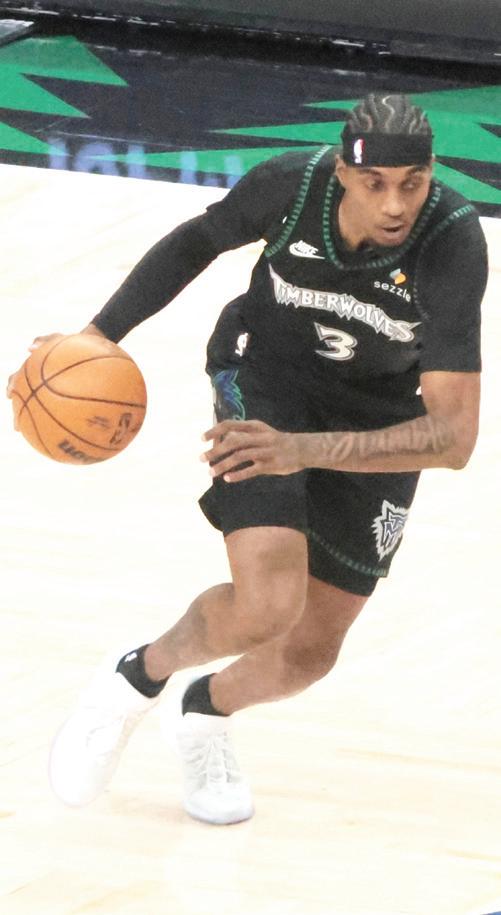

Softball in color
Black players shine at Summit League Softball Championship
he 2026 college softball season is rapidly reaching its conclusion.
Jane Sage Cowles Stadium on the University of Minnesota campus hosted the 2026 Summit League Softball Championship for the first time last week, May 6-9.
Top-seeded Omaha played second-seeded St. Thomas in an elimination game Thursday after both squads dropped their opening games in the double-elimination format.
The Mavericks defeated the Tommies, 12-2, in five innings in a contest that featured the only Black players in the tournament.
“We definitely came out with a lot of energy and intensity wanting to win.”
Omaha senior Bailey Sample was among the winners’ top three hitters, a group that went a combined 9-for-11 with six runs scored and nine RBI. The 5-foot-5 outfielder from Benicia, Calif., went 3-for-3 with one RBI and two runs scored. She is the team’s only Black player.
It was not her first perfect night at the plate. “I’ve actually had one earlier this year, and I had one that was 4-for4,” Sample told MSR.
Sample had a double in four trips to the plate in Omaha’s 1-0 opening-game loss to
South Dakota earlier that day. She said the defeat served as a wake-up call heading into the win-or-go-home matchup against St. Thomas, which faced the same fate after losing, 7-6, to South Dakota State.
“We definitely came out with a lot of energy and intensity wanting to win,” she said, “knowing that we are the best team out here, and we just got to prove it and show up, and take it one pitch at a time.”
Sample’s Mavericks nonetheless fell short of a fourth consecutive Summit League title, losing 2-1 to South Dakota in Saturday’s championship game. She stole a base and scored her team’s only run in the final. Earlier that day she went 1-for-4 in a 10-1

victory over South Dakota.
Sample led both Omaha and the league in batting average (.407) and hits (65), ranked second in on-base percentage (.522), fourth in on-base-plusslugging percentage (1.186), and tied for second in assists (53) across 50 games. She was successful in all three stolen base attempts.
The No. 2-seeded Tommies ended their season at 34-19. St. Thomas sophomores Zoe Trotter and Miley Wichman, the team’s only two Black players, both scored in the second inning to give their team a 2-1 lead. Trotter later hit her fourth home run of the season, a solo shot, in the loss.
“If we see our pitch, we’re gonna swing hard. That’s what I did, and the love coming back into the dugout after that is just unmatched,” Trotter said afterward. “We’re all there for each other through the highs and the lows. That was just a great moment.”
The 5-foot-5 Trotter, from Saint Joseph, Mo., started 46 of 53 games this season, finishing with 30 hits, 23 runs, four home runs, 18 RBI, a .390 slugging percentage and five stolen bases in seven attempts. She was also one of eight Tommies to finish with a

aTroy Hawkins a few years ago finally kept his word and promise to his mother and became a college graduate.
“I always tell people I didn’t go to college right out of high school, I went to play baseball.”
After 1,042 regular season games pitched, 10th most in MLB history, plus 22 more in the postseason during his 21year major league career with 12 clubs, including Minnesota, which drafted him out of high school in the seventh round in 1991, Hawkins now has a well-earned diploma to go along with his many accom plishments.
to college,” Hawkins fondly recalled during a conversation before a Twins home game. “I always tell people I didn’t go to college right out of high school, I went to play baseball.”
The 2020 worldwide pandemic, which shut down sports, unexpectedly offered Hawkins a golden opportunity nearly five years after he retired from playing.
“I got some time. We all had time, right?” he said. “That was the one thing that was open,
“Never thought I would go
BY CHARLES HALLMAN
HICAGO — Historic Wrigley Field, built in 1914 and renamed from Cubs Park in 1926, is the second-oldest active Major League Baseball stadium, located on the city’s North Side.
Two weekends ago, Wrigley became the first-ever site of an HBCU baseball game when Prairie View A&M and Alabama A&M faced off in the three-game Chicago HBCU Baseball Classic, May

1-3. The middle game was sandwiched between contests played at other parks in the area, but the famed ballpark was the crown jewel of the event for both SWAC teams, Black baseball fans, alumni from both schools, and for this reporter, attending Wrigley for the first time as the only Minnesota media in attendance.
“To be able to bring HBCU culture and baseball to the city, I think is massive, and I’m just excited to be a part of it,” Prairie View Coach Daniel Dulin told MSR before the game. His Panthers went 2-1 that weekend but lost to Alabama A&M, 10-7, on Saturday night in Chicago. Dulin was hired in 2025
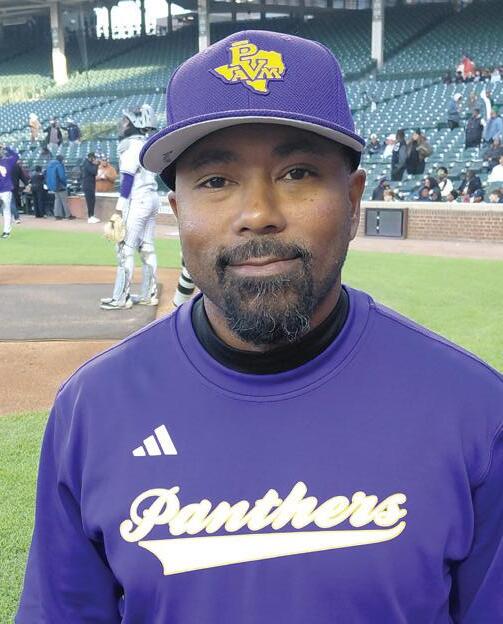
after two seasons as an assistant coach at the University of Illinois Chicago (2023-25).
Prairie View A&M is his first Division I head coaching position; he previously served as head coach at Highland Community College (2016-20) and

in assistant roles at Murray State, Hutchinson (Kan.) Community College, Coffeyville (Kan.) Community College, and Lawrence (Kan.) High School since 2008.
“I’ve lived here for the last two years, and the diverse community this city has, that was one thing I always loved about it,” Dulin said.
Senior outfielder Michael Burroughs of San Antonio said it was his first time at Wrigley and spoke to the significance
of a national spotlight on Black college baseball being shown there. “We’re getting a lot of attention now. We have the same talent on all levels. The SWAC is going up,” he said.
Wrigley Field is the only MLB stadium still standing where Jackie Robinson played during his major league career with the Brooklyn Dodgers. Now it is also the place where HBCU baseball has been played. That was precisely what Black Baseball Media CEO Earnest Horton wanted when he organized the Chicago HBCU Baseball Classic. He thanked the Ricketts family, owners of the Chicago Cubs,
(L-R) Anthony Edwards (Minnesota Timberwolves) guarded by Stephon Castle (San Antonio Spurs).
Julius Randle (Minnesota Timberwolves)
Jaden McDaniels (Minnesota Timberwolves)
Rudy Gobert (Minnesota Timberwolves)
Victor Wembanyama (San Antonio Spurs)
Bailey Sample Charles Hallman/MSR
(l-r) Zoe Trotter, Miley Wichman Charles Hallman/MSR ■ See SOE on page 11
LaTroy Hawkins Charles Hallman/MSR
Wrigley Field
Daniel Dulin
Michael Burroughs