

Air and water disparities, and the fight to shut down HERC
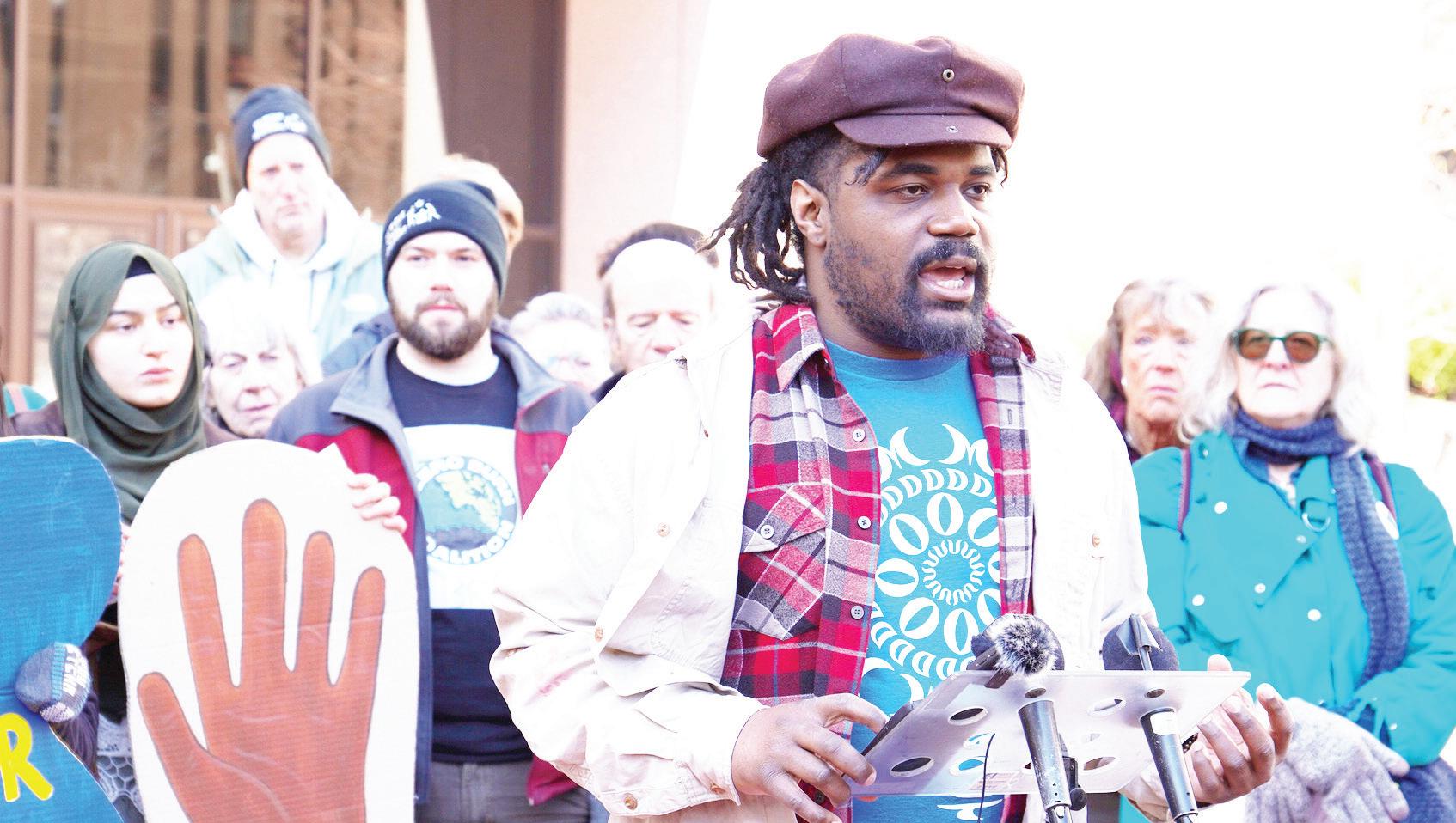
By Damenica Ellis Staff Writer
North Loop resi-
dent submitted a video to the Zero Burn Coalition letting others hear how loud the Hennepin Energy Recovery Center (HERC) trash incinerator is. HERC, located between Downtown and
North Minneapolis, has operated since 1989.
“It sounds like you’re living on the tarmac of the airport,” said Natasha Villanueva, who is currently on a hunger strike with the coalition.
Others have complained of respiratory illnesses and mold growing on food in their apartment within 30 minutes of setting it out. These are tes-
timonies the Zero Burn Coalition is trying to amplify, Villanueva said.
“We choose to believe those people,” she said. Some Hennepin County leaders have credited these problems to highways, she continued, but Villanueva believes both are impacting residents harshly.
“We need to do something about the one that we have
A new poll tax? How the SAVE Act impacts Black, unhoused and female voters
By Damenica Ellis Staff Writer
he SAVE America
Act, introduced in January by U.S. Rep.
Chip Roy, R-Texas, as an updated and expanded version of the 2025 SAVE Act, is believed to make the voting process difficult for many eligible voters across the country. Some say the bill will especially impact Black elders.
The act would require proof of U.S. citizenship to be presented in person to register to
vote. A similar law passed at the state level in Kansas prevented 31,000 eligible people from voting before a federal judge struck it down. The bill would also require states to provide private personal data records on all registered voters, Minnesota Secretary of State Steve Simon said. More than 21 million voting-age citizens lack the documents that would be required, including many elders of African heritage born during Jim Crow, because of well-documented barriers to obtaining
birth records, according to the Council for Minnesotans of African Heritage.
The council, which advises the Minnesota government on the needs of African American, African immigrant, Black American and Black immigrant communities, said more than 140 million Americans lack passports, and 69 million women have names that do not match their birth certificates, creating additional hurdles.
“The SAVE Act… it’s defi-
within our control, which is shutting down HERC.”
HERC sits in a densely populated, majority-Black community, burning trash sent from across Hennepin County and surrounding suburbs, the coalition said in a FAQ document.
“That concentration of harm is not accidental. It reflects deliberate decisions about
Fitness
where pollution is allowed to exist and whose health is treated as expendable. The trash burner was built with a 20-year design life. It should have been retired by 2009. Instead, the county has extended its operation year after year while the surrounding community continues to absorb the pollution. Clean air should not depend on your zip code. This is urgent because people are getting sick, the county has the authority to act, and every year of delay is another year of preventable harm.”
Fifty-three percent of lowincome neighborhoods have air pollution-related risks above health guidelines, and 78% of communities of color in Minnesota face the same, according to the Minnesota Pollution Control Agency.
“In addition, the social, economic and health inequities that these populations face can make them more vulnerable to the effects of air pollution,” the MPCA said on its website.
Joshua Lewis, a veteran labor, climate justice and utility organizer who is also on hunger strike, named some of those social, economic and health inequities.
Neighborhoods face food deserts, lack access to healthy food and have seen freeways destroy businesses and homes, he said.
“And, ‘hey, we’re going to throw this trash burner in the community as well.’” Lewis described these environmental disparities as a form of “slow genocide” and eugenics, arguing that the actions of the capitalist and ecoimperialist classes mirror the destructive patterns of global colonialism.
Villanueva lives in the 55411 ZIP code, which has the highest asthma and allergy rates in the state, she said.
HERC also requires water to operate, she said.
“A bunch of diesel trucks come to HERC all the time to dump there, and then water is used to create steam, and then that turns turbines, not to produce energy. So it’s a very indirect way it sullies that water, and we could just be replacing it with five wind turbines instead.”
Emissions also pollute the air.
“Every day, residents near the trash burner, and communities downwind in South Minneapolis, breathe its toxic
Jasmine McBride Editor
s temperatures climb and daylight stretches longer, fitness communities of color across the Twin Cities are hitting their stride, gathering on riverbanks, neighborhood trails and community spaces to move, heal and connect.
A ride for Faith
On April 18, dozens of cyclists gathered at Harriet Island Regional Park in St. Paul for a 19-mile breast cancer awareness ride hosted by the EZ Bike Club, a community cycling group rooted in the
Twin Cities’ Black and Latino streetwear scene. The ride was held in honor of Faith Moss, a club co-founder who was recently diagnosed with breast cancer and completed surgery three weeks before the event.
“It’s a lot of moving pieces that was able to put this together today,” said Alexander Iverson, co-founder of EZ Bike Club, addressing the crowd before the ride. “Originally it started as two wheels that brought us all together, but also was the one spirit of ourselves, and brought all these like-minded individuals together to create something like this.” Before riders set out, the gathering took on the feel
of a community celebration. Chopped and Served provided acai bowls and protein balls made fresh that morning. Savory Bake House out of South Minneapolis andEasy Day Cafe contributed food and refreshments. Schorbahn Family Law sponsored custom shirts. A post-ride meal was provided by Soul Lao, who also supplied snacks at the halfway point. Moss, visibly moved, addressed the crowd before the ride.
“My mom was the first person to buy a ticket for today,” she said. “Three weeks ago, I had surgery to remove my tumor, and after surgery, she
Joshua Lewis Photo courtesy of Zero Burn Coalition
communities of color kick off the season
Jasmine McBride/MSR
Edmond Dantès
St. Paul residents hope Midway development brings needed resources back to neighborhoods
By Damenica Ellis Staff Writer
Misty Aoudia, 51, remembers when the Midway was the place to be: Dots, Rainbow Foods, Golden Gate, Payless, a bowling alley and a laundromat all within reach.
“It was just such a staple in the community,” she said. “The businesses were accessible and affordable.”
Since 2014, many of those stores have closed. The Metro Green Line, which opened that year connecting downtown St. Paul to downtown Minneapolis, marked a turning point for the neighborhood, Aoudia said.
“It was already downhill when I was raising my kids, with being economically depressed, but once the light rail came, you really started seeing it being downhill with a lot more drug usage and more people that were homeless and panhandling.”
In 2020, unrest and rioting struck the Midway following the murder of George
Floyd less than 10 miles away. Aoudia moved from the area in 2012 but visits her 20-yearold daughter there regularly.
“I think I’ve noticed that you have a lot of have-nots and haves that separate the area,” she said.
A neighborhood in transition On University Avenue, two superblocks between Hamline Avenue and Snelling Avenue are undergoing significant changes. The area, which once held shopping centers filled with stores, local businesses and entertainment venues, looks little like it used to.
One block is now home to Allianz Field, a loon statue, a playground and the long-anticipated United Village development, where construction cranes are now visible along the skyline. The adjacent block has seen the recent closure of a major grocery store and sits largely vacant.
Private landowner RK Midway acquired the first block,

a 34.5-acre site, 10 acres of which are owned by Metropolitan Council/Metro Transit.
Allianz Field, home to Major League Soccer’s Minnesota United FC, was completed in 2018 at a cost of $250 million in private funding. The city of St. Paul invested in pedestrian facilities, roads and stormwater systems on the site.
Bill McGuire, lead investor in Minnesota United and the driving force behind United Village, is now spending ap-

proximately $170 million to build two restaurants, an office building and a hotel near the intersection of Snelling and University avenues. All four buildings are under construction by Golden Valley-based Mortenson. Two restaurants, the Midway Diner and an Italian pizzeria, are expected to open this summer. A 160-room boutique hotel is targeted to open in early 2027.
Daniela Lorenz, a project manager for United Village with St. Paul’s Department of Planning and Economic Development, said feedback on the stadium and development has been mostly positive, with beneficial effects on surrounding businesses and transit.
Not everyone agrees.
Samantha Burnett, 32, a Minnesota resident who studied social justice at Hamline University, said she believes the development prioritizes aesthetics over community investment.
“When you update or upgrade in the area, it drives up the value, which means home
costs might go up, business rent might go up,” she said. “If you’re not making that money, you can’t stay there anymore.”
Anne Draghine, 55, a former Midway resident, was blunter.
“They put it there in hopes of attracting business, that isn’t the business you needed to attract,” she said. “You need to take care of the people in your neighborhood.”
What’s coming, and what isn’t
For residents hoping a grocery store would eventually return to United Village, McGuire has provided a clear answer: it won’t. He has said a grocery store already exists in the Midway and therefore isn’t part of the United Village plan.
An office building with a bakery on its ground floor is expected to open by late summer, and phase two ideas currently include a music and entertainment venue and possibly housing for neighborhood elders.
Greg Ellis, who has lived in St. Paul since 1992, acknowledged the activity but questioned what was lost in the process.
“All those options are gone and not in the neighborhood and haven’t been replaced,” he said.
Draghine said an office building and hotel do little for longtime residents. She called for the return of a bank, medical space and shopping, amenities people can actually use.
The neighboring block remains a concern
The eastern block, once
home to Walmart, Cub Foods, Dollar Tree, Herberger’s and TJ Maxx, has seen most of its tenants close. No clear redevelopment plan has been announced for the site.
Lorenz said city officials are engaged, with Ward 1 Council Member Anika Bowie convening decision-makers to explore options. Lorenz said the short-term priority is filling the buildings with amenities residents relied on.
“I think it would be great to get a grocery store back in there because that was a huge loss for the area,” she said.
“There’s none of the things that used to make Midway great there anymore.”
For residents who depend on public transportation, the closures have meant traveling farther for basic necessities.
“It’s a food desert. It’s a shopping desert,” Draghine said. “There’s none of the things that used to make Midway great there anymore.”
Lorenz said the city welcomes the scrutiny from residents.
“They’re watching and they are very interested in what’s happening on the block and want to make sure that it is an asset to the community.”
Damenica Ellis welcomes reader responses at dellis@ spokesman-recorder.com.
20 years of answering the call
Frequently throughout 2026, space in these pages will be given to organizations working to end racial injustice across the state. We hope that these reflections spark policy changes for a more equitable Minnesota. This week’s guest contributor is The Power of People Leadership Institute.
By Dr. Verna Cornelia Price
If you want to know what is really going on in a community, you must get to know it… and then listen to it. You cannot believe most media, as they typically share only small parts of the fabric of a community, and the stories represent only a tiny percentage of the people living there. The most important aspect of every community is the people who live in it. Why? They know the heartbeat, the
highs, the lows, the gifts, the resources, the challenges, the pain and the trauma. In other words, they know what they have and what they need. People often ask how my husband, Brother Shane, and I started The Power of People Leadership Institute, and what inspired us. The answer: our community called, and we answered. In 2005, I received a call from North High School asking me to come and “talk” to the girls because of an increase in fights, girl

gangs, and a decrease in academic engagement. Of course, I said yes. I wanted to honor my community and be part of the solution by listening and offering my gifts, talents and resources. What I didn’t know was that when I saw the faces of our North High girls and felt their heartbeat, I would have to respond with more than one talk. I saw so much potential, but I also saw so much pain. I walked out of that auditorium knowing in my spirit that I had to do more. I had to provide a solution. The result was the launch of Girls in Action.
Not long after, my husband received a different kind of call involving another part of our community: men serving time at Faribault Correctional Facility who were caught in the vicious revolving door of incarceration. The commu nity wanted Brother Shane to “talk” to the men so they would change their lives, re turn to their families, rebuild and never again see the walls of a prison cell. Like me, he thought he was giving one talk, but when the men asked him to come back, he knew he had to be part of the solution. We launched the RePlanting Program to stop that revolv ing door and reduce recidivism among the men coming home.
Now we had two programs: Girls in Action, a weekly inschool mentoring and em powerment program for girls in grades 6-12 that was grow ing like wildfire across Minne apolis Public Schools; and the RePlanting Program, a prerelease, 10-week personal
“I
walked out of that auditorium knowing in my spirit that I had to do more.
I
had to provide a solution.”
development and leadership training that attracted hundreds of men. But the community was not finished calling us. People began asking, “What about the boys?” We responded by launching Boys of Hope,
discussed all the work we were doing, it became clear that we needed to formally start a nonprofit. In 2003, I had released my first book, “The Power of People: Four Kinds of People Who Can Change Your Life,” and I used its core tenets to write the curriculum for Girls in Action and Boys of Hope. Brother Shane used those same tenets to build the core training for the RePlanting Program. That day, we decided to name our organization The Power of People Leadership Institute, because
20th year and the impact we have had reaching more than 7,000 girls, 1,500 boys and 6,000 formerly incarcerated community members. We have a saying at our institute: “We are the help we have been waiting for. Nobody else is coming.” We are proud to have a legacy of love for our community, of answering the call and providing the leadership to be the help our community needed, and still needs.
Dr. Verna Cornelia Price is





Construction of structure at United Village
HUNS/Damenica Ellis
Dr. Verna Cornelia Price and Brother Shane Courtesy
Aerial view of Midway neighborhood in 2025.
Google Maps
Hunger strikers say Hennepin County commissioners won’t meet with them Health
By Clint Combs Contributing Writer
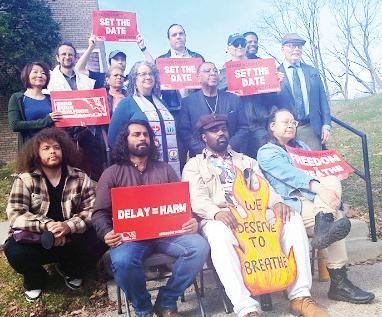
Six days into a hunger strike, members of the Zero Burn Coalition say Hennepin County commissioners have refused to meet with them to discuss forcing a vote to close the Hennepin Energy Recovery Center trash incinerator.
Coalition members Nazir Khan, Natasha Villanueva and Joshua Lewis made the announcement April 15 outside Zion Baptist Church in North Minneapolis. The three are demanding a vote to close the incinerator, known as HERC, by December 2027. Environmental activists say Hennepin County is the only governing body with the authority to force the closure.
The standoff comes after the county board passed a resolution in October 2023 committing to eventually close the facility, sometime between 2028 and 2040, without setting a firm timeline.
The following day, clinicians, scientists and coalition members gathered at the Minneapolis American Indian Center to make their case for why that timeline isn’t fast enough. Speakers argued that HERC’s emissions pose an ongoing public health threat to surrounding North Minneapolis neighborhoods, and that the science used to permit the facility is dangerously out of date.
County officials have defended the facility, saying










HERC’s air emissions over a 10-year period from 2016 to 2025 were on average 80 percent below permitted levels from the Minnesota Pollution Control Agency. David McNary, assistant director of Hennepin County Environment and Energy, called the facility “highly regulated” and operating “well below” permit levels.
But Doug Gurian-Sherman, a risk assessment scientist and former EPA official, challenged that framing directly.
“The permit that the county touts as being so protective of us is like 30 years old from old, outdated science, and it was never based on protecting the public,” he said. “The Clean Air Act provision used for those permits was just based on what pollution control equipment is out there and available.”
Gurian-Sherman said that under pollution limits proposed by the EPA during the Biden administration, which would have cut 14,000 tons of toxic emissions annually, the HERC would have exceeded safe levels for hydrogen chloride. He added that nitrogen oxides, linked to asthma and heart disease, would be emitted at levels nearly double what the proposal would have allowed. The EPA under President Donald Trump ultimately finalized a weaker version of the rule, limiting standards to only 3,269 tons of pollution per year and giving waste incinerators significantly more operating room.



The health consequences of living near the facility are visible in the data. The 55411 zip code in Minneapolis has recorded some of the highest asthma hospitalization rates in the seven-county metro area, with asthma-related emergency room visits reaching up to 43 per 10,000 residents, nearly six times the state average. Former state Rep. Hunter Cantrell, who works at a Northside clinic less than two miles from HERC, said he sees the impact firsthand.
“We see significant rates of asthma exacerbations among particularly children, but we also see asthma and COPD exacerbations among our elderly patients as well,” Cantrell said. “The vast majority of the children I see in clinic with asthma


exacerbations who live in the surrounding areas are children who are people of color. This is fundamentally a racial justice issue because there’s a reason why the HERC isn’t in the most affluent or least diverse communities in Hennepin County.”
University of Minnesota School of Public Health professor Peter Raynor has said HERC’s emissions are a valid concern, though he characterizes them as a contributing factor rather than a sole cause.
“The concentrations we see are unlikely to, by themselves, cause asthma or cause cancer, but it could worsen other conditions, like underlying cardiovascular disease or respiratory problems,” Raynor told MN Daily in 2024.
Back at the April 15 press


conference, the coalition described a wall of silence from elected officials. “Commissioner Fernando has not responded despite multiple requests,” Khan said. “Members of government have reached out to her. It’s been total silence, which, as chair of the board, is extremely disappointing.”
Villanueva, who lives in the Jordan neighborhood near the facility, said the breakdown played out in real time at the Hennepin County Government Center. “When we began the hunger strike on Monday, on Tuesday we were told that Chair Fernando was not in the office,” she said.
“And then shortly thereafter, a county staff person arrived and said, ‘I have a meeting with the chair.’ And then we saw them go around the back.”
She said repeated emails sent before and during the strike have gone unanswered, and that basic access to commissioners remains out of reach. “I’m feeling exhausted on day six,” Villanueva said.
“What’s sustaining me is the community, the support of my fellow hunger strikers, the cause. We’re doing this for folks who can’t go on a hunger strike… people who already have cancer, people who already have respiratory illnesses.”
Khan described his only direct interaction with a commissioner as tense. He said Commissioner Kevin Anderson, encountered leaving the


EVERY CENT ADDS UP TO A BETTER MINNESOTA











24.3 cents of each dollar spent on the Minnesota Lottery helps fund projects and resources that benefit us all, such as projects to preserve our unique environmental landscapes, general funds spread all across the state, resources for responsible gambling and more. When you play your part, it all makes cents.























county offices, accused the coalition of being tied to landfill companies. “It just speaks to the desperation of the county to throw false accusations and question the integrity of our movement,” Khan said. There has been limited progress with at least one other commissioner. A coalition member was able to reach Commissioner Angela Conley, who tentatively agreed to meet with the group.
University of Minnesota professor Nick Estes framed the issue as a broader failure of political responsibility. “What covenant does Hennepin County have when it knowingly keeps open a deadly trash incinerator that’s polluting everyone’s air, everyone’s water and the land we all live on?” Estes said. “This isn’t just an Indigenous problem. This is everyone’s problem.”
Organizers say pressure will continue to build. An Earth Day rally is scheduled for Saturday, April 18 at the HERC facility, with protesters gathering at Target Field Bus Station at 1 p.m. before marching to the site. On Tuesday, April 21, environmental justice activists plan to pack the Hennepin County Board meeting at the Government Center, beginning at 1 p.m. Coalition members are asking supporters to arrive at the Government Service Center by 12:30 p.m. Note that the public comment period is not publicly broadcast.
Six days in, the demand remains unchanged: a meeting and a vote.
Clint Combs welcomes reader responses at combs0284@ spokesman-recorder.com.




















Seated in the front row from left to right are hunger strikers: Nazir Khan, Joshua Lewis and Natasha Villanueva. Clint Combs/MSR

By Jasmine McBride Editor
It started with a simple question from a child: Mom, how can I make some money?
Ashley Bolden gave her son a choice, mow lawns or sell lemonade. He chose lemonade. What followed was a journey that would transform a backyard hustle into Lynnmonade, a beverage brand rooted in holistic wellness, mental health and the kind of quiet determination that defines Black entrepreneurship in the Twin Cities.
Bolden has called Minnesota home for 21 years. In the spring of 2020, just as the world was shutting down, she began selling lemonade with her son. When COVID hit and her son stepped back, Bolden kept going. She started thinking differently about what she was making and why.
“There has to be a more healthy option,” she recalled thinking. That instinct led her to expand the menu beyond lemonade, incorporating herbal teas and fresh juices designed to detox and refresh
the body. “A lot of our illnesses come from what we consume,” she said. “These teas and fresh juices can help the body be at its best performance.”
But Lynnmonade was never just about the drink.
Every Lynnmonade product carries an affirmation, a mantra or a reflection question, intentional prompts designed to pull people out of the autopilot of daily life and into something more intentional.
Questions like “If you knew you would succeed, what would you attempt to do?” or prompts like “I am capable of...” are printed alongside the beverages, turning every sip into a moment of pause.
“I really wanted to create something where people can have a chance to unplug from the day-to-day and actually think about what they are trying to strive for in life,” Bolden said.
The mission is personal. As someone who has navigated her own mental health struggles, Bolden said she has seen firsthand what happens when people are invited to slow down and reflect.
“I see a spark in people’s
eyes when you take them out of that mode of what they got to do next,” she said. “Positive things happen. Mindset is everything.”
Building the business has not been without its challenges. Without early mentorship or guidance, Bolden described the process of formalizing Lynnmonade as “touch and go,” working through administrative missteps and learning as she went. She credits the West Broadway Coalition with helping her find her footing.

After meeting coalition representative Donna Sanders at a community event, Bolden was invited to the office, where she met staff members Colleen Klungseth and Kristel Porter. They listened to her pitch, offered feedback and connected her with resources that matched where she was



in her business journey. The coalition has since helped her review grant applications and linked her to people who could support her growth, and
also awarded Bolden as 2026 New Business of the Year.
“I think it would have been a lot easier if I would have had that support from the begin-
ning,” she said. “Connecting me with people who can help me at the stage that I am at has been really beneficial.”
Today, Lynnmonade operates primarily through catering, with individual tea boxes also available. Bolden has shown up at community events including Open Streets, building her brand one conversation and one cup at a time. Her ambitions for the future are clear: she wants to take Lynnmonade on the road, bring greater awareness to non-alcoholic beverages in corporate and business settings, and eventually land on store shelves.
And her son? After watching his mother build something real, he’s ready to come back.
“He wants to be involved now,” Bolden said with a laugh.
“After witnessing the proof, he’s like, ‘Well, how can I help?’” For orders and more information, visit lynnmonade. com or follow the brand on social media at @lynnmonadejuice on all platforms. Popup events are in the works for summer 2026, check the page for updates.
Jasmine McBride welcomes reader responses at jmcbride@ spokesman-recorder.com.



Ashley Bolden
Courtesy photo
from page 1
emissions: fine particulate matter (PM2.5), nitrogen oxides, hydrochloric acid, lead, dioxins, mercury and other hazardous air pollutants.
These are linked to asthma, heart disease, stroke, cancer and premature death,” the coalition reports.
“All of this puts pressure on other parts of our society that are already suffering, like HCMC (Hennepin County Medical Center), because we end up going to emergency rooms to deal with this type of tragedy.”
Villanueva added that millions in taxpayer funds are being used to maintain the aging HERC facility. She argues the public is stuck in a costly loop,
Continued from page 1
nitely a voter suppression bill, plain and simple,” said Jasmine Russell, chief narrative and data justice officer at the African American Leadership Forum.
“This is another way for them to weed out voters and to suppress the rights that all citizens should have, being able to show up to a poll in Minnesota and have their vote count. And also to register with ease.”
The name and stated purpose of the bill may be misleading, some say.
Nieeta Presley, president of the NAACP St. Paul Roy Wilkins Memorial Branch, said the SAVE Act sounds like supporters want to protect people’s votes, when that is not the case.
“In reality, they’re creating unnecessary layers of barriers and challenges to voting, especially for the most marginalized or vulnerable people like our seniors, like the unhoused, like our ex-offenders who have finished their parole and probation and are eligible to vote now.”
Secretary Simon, who opposes the bill, said he understands why someone who heard the bill requires proof of citizenship might think that sounds reasonable.
“Except, in my view, the more you look, the less you like,” Simon said. “When you really think about how this would be implemented on a day-to-day level, it’s going to be a lot of challenges for a lot of eligible folks, people who have been voting for years or
Continued from page 1
took time off of work, slept in my living room on an air mattress and cared for me around the clock for 48 hours.”
Moss thanked a web of supporters, friends, cousins and fellow club members, who showed up on what she called a “super cold Minnesota day.”
“Life is so precious. We weren’t created to do this life alone,” she said. “And as I look around, I’m so overwhelmed.”
A scripture printed on the back of the event shirts framed her message: For I walk by faith, not by sight.
— 2 Corinthians 5:7.
“Regardless of what happens, I’m trusting and believing that I will come out on the other side
either paying for expensive upgrades to keep a dangerous facility running or risking even greater safety hazards by letting it deteriorate. The only viable solution, she said, is a total shutdown to make way for zero-waste alternatives.
Mary’s Place, a homeless shelter, sits across the street from HERC. Villanueva recently spoke to someone who stayed there whose child developed asthma during the stay.
“These are some of the most vulnerable people in our communities, which we should be protecting the most fiercely. Instead, they’re right next to this giant polluter,” she said.
This is one example of why shutting down HERC is so urgent, she said.
Transitioning to sustain future generations The Minnesota Environmental
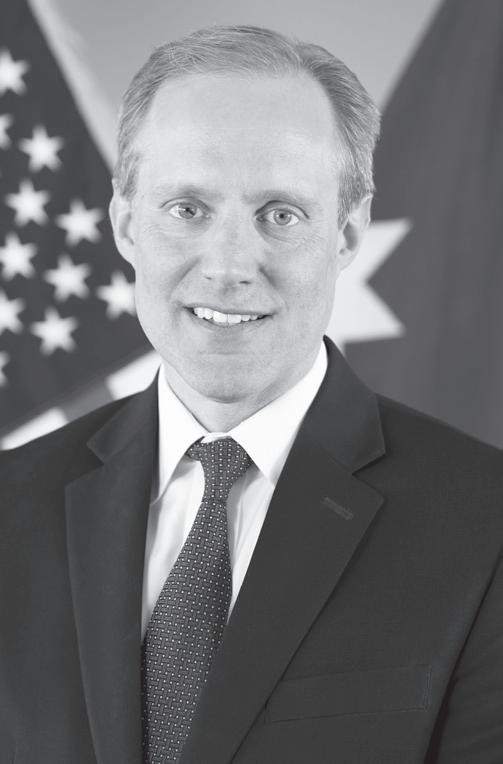
decades. And that is something that I think needs to be considered, and why I have serious concerns.”
An example he gave is the complications it would create for married women. There are 69 million women in America who have a different last name than the one they were born with, Simon said. That is a problem for those among them who don’t have passports.
“They’d have to produce both a birth certificate and a marriage record of some kind, and that’s if they’ve been married once,” Simon said. “If they’ve been married more than once and changed their name more than once, then they’d have to have a third document. ... A lot of people will be able to come up with those documents, but a lot of people will not.”
The problem the bill claims to address is noncitizens voting. From 2014 through 2023, three out of 13.4 million people who cast a ballot were not citizens, Simon said.
Though that is three too many, Simon said, the voting system is clean.
“Is it worth shutting out
stronger,” Moss said.
EZ Bike Club was founded by Randy Mendez and Iverson, both of whom came up through the Twin Cities sneaker community.
The club’s name comes from El Zapatero, Spanish for “the shoe man.” What started as weekend rides among friends has grown into a multicultural, multigenerational community open to all skill levels. Iverson, who grew up spending most of his time outdoors, has said the club is about more than physical fitness.
“It’ll be great for the community to see people of color riding through the Twin Cities together as a group, smiling, and all different shapes and sizes,” Iverson has said.
Running together
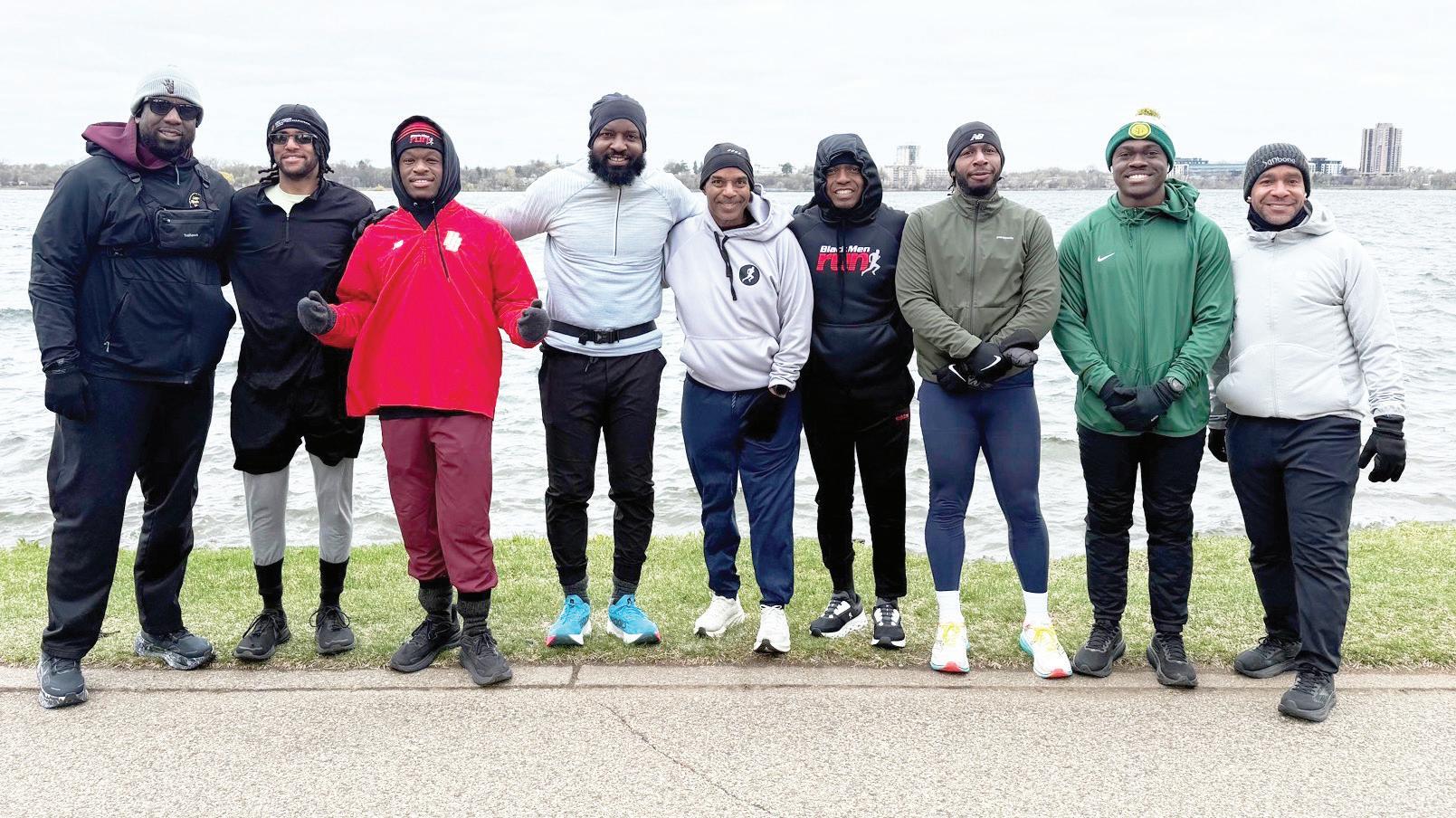
That same Saturday, across the metro, Black Men Run Twin Cities was also out on the roads. The group runs
Justice Table, Zero Burn Coalition and Zero Waste Coalition do policy work and are pushing a landfill standards bill to raise accountability requirements for landfills and better protect surrounding communities from leaching into soil and water.
Drawing from examples in other cities, Villanueva said they know that when trash incinerators are shut down, cities have had to use temporary landfills while zero-waste infrastructure is built, resulting in large increases in composting and recycling.
According to the coalition, metro area landfills have the capacity to receive what currently goes to the trash burner, so no new landfills will be needed.
Lewis said policy that interfaces with and empowers communities of color is needed.
potentially tens of thousands of eligible voters to catch a handful of people?” he asked.
“I say the answer to that is ‘no.’ I think that’s lopsided. It’s not a fair balance.”
The Council for Minnesotans of African Heritage agrees the problem the bill targets is virtually nonexistent, as noncitizen voting in federal elections is already illegal under the 1996 Illegal Immigration Reform and Immigrant Responsibility Act. Existing systems, including HAVA identity verification, federal database checks and felony penalties, already safeguard election integrity, the council said in a statement to the Minnesota Spokesman-Recorder.
Attorney General Keith Ellison also opposes the act. His office said in a statement that it would reverse three decades of progress made under the National Voter Registration Act, which was designed to remove barriers to voter registration and promote greater participation in the democratic process.
Presley, the council and Russell said the act will especially impact Minnesota’s Black community.
“For African heritage communities, the SAVE Act echoes the logic and impact of poll taxes and other Jim Crow-era barriers: it imposes costs, paperwork, travel and bureaucratic obstacles that fall hardest on those historically excluded from political power. Civil rights and human rights organizations warn that the act would suppress turnout, erode civic participation and weaken the democratic infrastructure that Black communities have built over generations,” the council said.
every first and third Saturday of the month and has built a loyal following among Black men looking for both a workout and a sense of belonging.
RZ Shahid, a regular participant, said the group has become one of his favorite finds in the city.

“Right now, a large issue is a lack of power by the people,” he said. “We need policy that is dictated by the people, for the people.”
Part of that ask, Villanueva said, is for the community to be involved in deciding what replaces HERC. Lewis also believes eco-
nomic empowerment, educational empowerment, voter literacy and system literacy are needed.
“What’s going to improve things for future generations is not just policy, but policy can be a part of it. We need improved processes, and this means the accessibility of our elected officials, the accessibility of the law and information.” Community infrastructure, he said, is most important.
“As long as we are fitting into a socioeconomic culture that prioritizes individualism and every man for themselves, we are going to be susceptible to the same sorts of booby traps that keep us from being found, coherent and growing in capacity.”
Damenica Ellis welcomes reader responses at dellis@ spokesman-recorder.com.

“The SAVE Act does not strengthen democracy, it restricts it. Protecting the freedom to vote requires strengthening, not dismantling, the civil rights safeguards that ensure every eligible citizen can participate fully and equally in our democracy.”
Presley echoed this, explaining that for many decades there was no formal recording of the existence or births of Black residents.
“So that really puts our elders at risk of being able to vote, because they no longer have the necessary documentation, yet have been voting for decades.”
“The SAVE Act echoes the logic and impact of poll taxes and other Jim Crow-era barriers.”
She continued that a high population of Black people are also part of the unhoused population she mentioned earlier.
do races, and it’s just a dope and supportive community. I appreciate being around my people and watching everyone progress in their journey.”
Running roots
Not far from those same trails, another community is
“I started Tierra Rec Club just to find more like-minded women who want to be outside.”
“It’s a nice feeling to be a part of a group of Black folks all running together, when a lot of times it’s usually you’re one of the few out in a sea of whiteness,” Shahid said. “It’s great energy. I’ve been pushed to go further, encouraged to
lacing up. Tierra Rec Club, founded by Lariza Estrada, is now in its third year of bringing women of color outdoors, and this spring, the club’s run club component is back on its biweekly Saturday schedule. “I started Tierra Rec Club just
The St. Paul NAACP registered 200 residents to vote last year by visiting senior buildings and shelters. The SAVE Act would impact that voter engagement, she said.
Russell said the SAVE Act would unwind much of Minnesota’s strong voting infrastructure.
“Black Minnesotans disproportionately rely on same-day registration, at community voter drives, mail-in registration, and this bill would effectively eliminate all of that. It also criminalizes election workers who might just be trying to help someone who needs to register,” she said.
Minnesota has had sameday registration since 1973, something the state is very proud of, Simon said.
“It would definitely complicate things,” he said. “It would make the process slower in the polling place, because now instead of someone registering at the polling place with, say, a driver’s license, or a neighbor vouching for them, or some other standard identification like a passport… now you have individual cases involving a particular birth certificate or marriage record. I’m imagining that’s going to take more time and might slow things down for some of the election judges.”
Other concerns Simon has include a lack of funding and time to implement the changes and train poll workers.
The state’s 30,000 poll workers would need to be trained to spot fake birth certificates and marriage records from across the country. In the past 30 years, election laws from Congress have come with time and money to implement changes.
to find more like-minded women who want to be outside,” said Estrada. “The first year [of Tierra Rec Club], it was kayaking and hiking. The second year, I incorporated running.”
After signing up for her first race, and describing herself as someone who becomes “very obsessed with new things,” Estrada built running deeper into Tierra’s programming. The club now meets every two weeks on Saturdays at 9 a.m., with a Halloween race each fall that draws a costumed team for a group run.
Tierra was born from Estrada’s frustration with the lack of cultural representation she found in outdoor spaces. Growing up in an inner-city neighborhood in Minneapolis, she loved the outdoors but rarely saw people who looked like her on the trails or at the campgrounds.
“This one comes with no money, and even worse, for me, is it becomes effective the day the president signs the law,” Simon said.
The council is calling on policymakers to reject restrictive voting mandates in favor of a modernized electoral framework that prioritizes access over bureaucracy, including protecting early voting and mail voting options, increasing language and disability access, and funding community-based civic engagement efforts led by trusted Black institutions.
The council also recommends increasing polling locations in Black, immigrant and rural communities to reduce wait times, strengthening vote-by-mail access through prepaid postage, secure drop boxes and ballot-tracking tools, and waiving fees for documents required for voter registration, among other measures.
The bill appears to be stalled in the U.S. Senate, Simon said.
“It looks right now like there are no votes to pass this bill as it is. However, we’re keeping a close eye on things and talking with our congressional representatives, because there’s always the possibility that the boosters of the bill could take pieces of it and attach it to other legislation that is moving. We think that’s less likely, but we’re still watching.”
The African American Leadership Forum has created an action center where people can register to vote now, visit www.aalftc.quorum.us/ for more information.
Damenica Ellis welcomes reader responses at dellis@ spokesman-recorder.com.
“My parents, they love cycling. They would make me go on these really long bike rides when I was like 10 years old, it was the worst! But I finally came around to it as I got older.” Tierra offers hiking, kayaking and running, and centers women of color in the Twin Cities metro area. For more information, follow @tierra. recclub on Instagram.
Jasmine McBride welcomes reader responses jmcbride@ spokesman-recorder.com.
“I don’t see enough Black or brown people on the trails,” she said. “I don’t see a lot of bikers, or when we go camping, the same people that you want to feel in community with.” Estrada, who immigrated from Mexico at age 3, also credits her parents with instilling a love of the outdoors, even when that love came with some resistance.
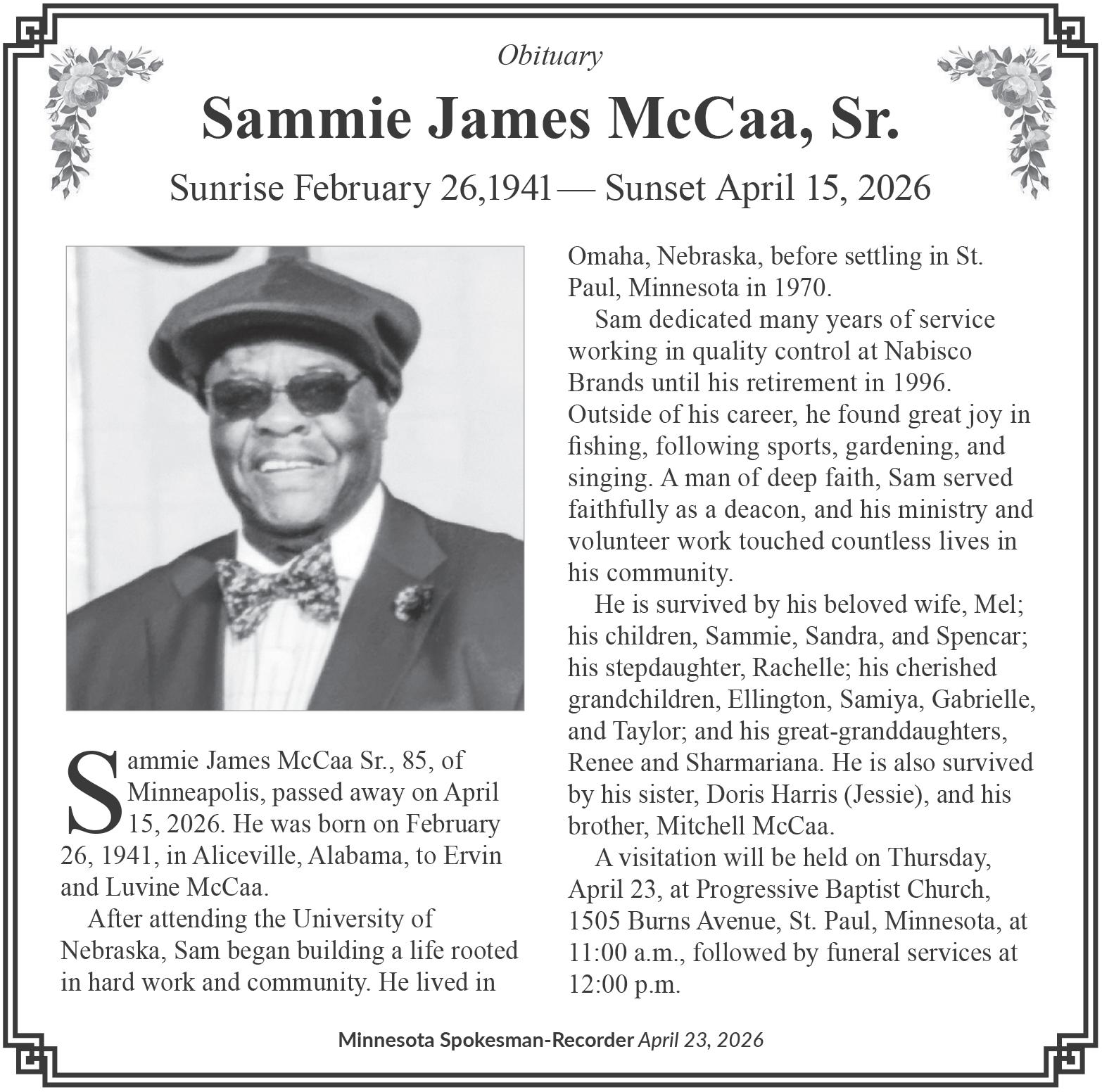
Secretary Steve Simon Courtesy
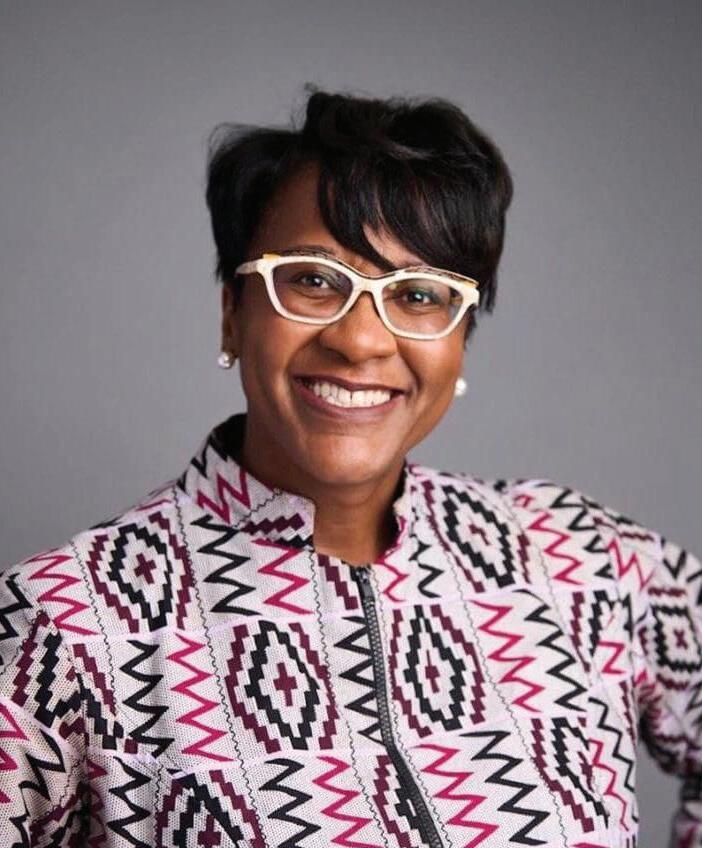
Jasmine Russell Courtesy
Natasha Villanueva
Photo courtesy of Zero Burn Coalition
Arts & Culture
Minneapolis to host massive Prince sing-along block party this June
By Jasmine McBride Editor
Minneapolis is planning to send 10,000 to 15,000 voices skyward this summer in honor of the city’s “most iconic son,” and if you’re showing up, you’d better bring your best purple.
Mayor Jacob Frey joined representatives from Paisley Park, the Minneapolis Downtown Council and the city’s arts office April 16 at the Prince mural at 101 N. 9th St. to announce a free community sing-along as part of the 2026 Prince Celebration Block Party on June 6. The event is part of a larger five-day Prince Celebration running June 3-7, billed as a “10th Anniversary Celebration of Life” marking a decade since Prince’s death in April 2016. He would have turned 68 this June.
“Prince belongs to Minneapolis,” Frey said. “We lend him out to the rest of the world. But wherever he went, he made very sure to tell everyone exactly where his roots are from, right here in this great city.”
Frey recalled the organic outpouring that flooded Minneapolis streets in the days after Prince died, when tens of thousands gathered outside First Avenue to mourn and celebrate together. “There was this organic outpouring of love and music and dance,” he said. “We shut down the streets, and next thing you
know, we had about 10,000 people out singing and dancing. That is so beautifully Prince and so beautifully Minneapolis.” That spontaneous moment is the spirit organizers are hoping to recreate this June, and this time with intention, infrastructure and a 100-person choir behind it.
"We hope to have 15,000 people singing in the streets of Minneapolis, and we hope that the ground shakes,"
The sing-along, free and open to all ages, will be led by musical director Sanford Moore alongside a 100-person choir of Minneapolis vocalists. Thomasina Petrus will serve as emcee, and the set list will span Prince’s entire career. Frey was clear that attendees should come ready to participate, not just watch. “Raspberry Beret is coming down the pike. Rain or shine, we’re coming out,” he said. As for attire, the mayor had equally firm guidance: “I expect a whole lot of purple, head to toe sequins, and courage. If Prince taught us anything, it’s that subtlety is overrated.”
L. Londell McMillan,

Prince’s former attorney, manager and longtime friend, said the city’s partnership has been essential to preserving the legacy properly. “Although Prince in the physical is past, he lives,” McMillan said.

“Prince lives today. He remains with us. You hear it everywhere you go.” He added that honoring an artist of Prince’s stature demands genuine collaboration. “In order for someone to preserve a magnificent legacy, you need true partners and you need a team. We’re so grateful to have this wonderful team of people in Minneapolis supporting our dear friend.”
Ben Johnson, the city’s director of Arts and Cultural Affairs, called the event “a love
letter to Prince, a love letter to his fans and a love letter to the city of Minneapolis.” Johnson said it was partly inspired by Estonia’s Song Fields, a tradition where more than a million people gather to sing in unison. “We hope to have 15,000 people singing in the streets of Minneapolis, and we hope that the ground shakes,” he said. He also noted that two major national music conferences, Chorus America and the National Independent Venue Association, will be in
the city that same weekend, giving Minneapolis a chance to show the country what it can do.
Adam Duininck, president and CEO of the Minneapolis Downtown Council and Downtown Improvement District, said the event fits into a broader push to energize downtown. “Everybody has a Prince story,” he said. “Whether you work in one of these high rises or you’re just coming downtown, Prince spoke to you.” The celebration weekend also includes a Princethemed night with the Minnesota Twins, Prince-related activities with the Minnesota Lynx, and programming at theaters and venues across the city.
Ward 7 Council Member
Elizabeth Schaefer captured the spirit of the day simply. “We are going to gather in mass, lift our voices in unison and stand together, bringing song and hope and joy to the streets of Minneapolis,” she said. “And maybe one other thing, we’re gonna party like it’s 1999 in 2026.”
For Frey, the event carries meaning beyond a single afternoon of music. Minneapolis has weathered a turbulent decade, and the mayor said Prince offers a through line that connects all of it. “What Prince showed is that there’s a through line of persistence and grit and perseverance,” Frey said. “He showed that there’s a through line of caring about each other. And that is something that, once you experience Minneapolis, you realize it is so specifically this place, and it’s also Prince.”
The June 6 block party is free and open to the public and will run approximately two hours. The full Prince Celebration weekend runs June 3-7, 2026. For more information, visit paisleypark.com.
Jasmine McBride welcomes reader responses at jmcbride@ spokesman-recorder.com.

Prince mural located at 101 N 9th St in Minneapolis.
Jasmine McBride/MSR
Education
Sustaining the future through community care
FIRST EDUCATOR
By Dr. Artika R. Tyner
When we talk about sustainability, our minds are often drawn to green technology, renewable energy and environmental justice. These topics are undeniably central to sustainability; however, a key component that is often overlooked is community care. What is community care?
How do we practice collective responsibility? Community care refers to individuals and groups investing in the wellbeing of their community, and it should not be mistaken for charity. Human beings need each other; our interdependence is key to sustaining the future we desire as a collective.
Community development expert Felix Larbi Appiah sheds light on community care and offers practical advice on how First Educators can teach these principles to children.
Q: What is the concept of community care?
A: Community care is understood by some as self-care, though it extends beyond the mental, physical and emotional well-being of individuals.
Community care answers two questions: Who needs support in my community? And what can we do to ensure no member of the community is left behind?
Mutual aid and peer support have existed among indigenous populations and cultures since the beginning of time, serving as a means of sustaining oneself despite systemic neglect. This practice is also deeply rooted in proverbs:
“Sticks in a bundle are unbreakable.” — Kenyan proverb
“If you want to go quickly, go alone. If you want to go far, go together.” — African proverb
Community care has historically been viewed as a survival mechanism for the marginalized and vulnerable, but that framing is limiting. For sustainable development to take place, all societies should adopt community care as a means of building a just and resilient future.
Q: What is the importance of community care today?
A: Today, we face a wide range of crises: rising mental health challenges, economic instability, cost-of-living pressures, displacement and migration, and public health threats. In such times, individual solutions fall short. As community development professor Peter Westoby notes, “all social problems are not individual problems. They are public-shared social problems,” and must be tackled collectively.
Individual solutions cannot protect a person from the effects of a broken community. Community care addresses challenges at their root by strengthening connections, easing the isolation of the marginalized and building shared resilience before crises escalate.
Q: How do you put community care into practice?
A: Communities around the world demonstrate the power

of community care in action, most visibly during times of crisis. During the COVID-19 pandemic, for example, community members organized food drives and financial support networks to reduce the burden on those most vulnerable. Community development organizations work continuously to bridge the gap between the wealthy and the poor, offering the disenfranchised a measure of dignified living.
Community health workers implement programs serving populations such as the homeless, improving health outcomes in ways clinical interventions alone cannot. These efforts are backed by evidence: studies confirm a positive link between strong, close-knit communities with mutual support networks and better outcomes during economic crises, public health emergencies and natural disasters.
Q: What strategies connect community care, sustainability and justice?
A: Marginalized communities, including low-income and Black, Indigenous and people of color communities are historically disadvantaged, often denied access to clean water, energy, housing and quality health care. Community care does not exist in isolation; it is tied directly to justice and health equity.
For sustainability to be truly achieved, the disparities between community care, justice and access must be addressed. Investing in community care is, in essence, investing in justice. Every person, regardless of their status, deserves support when the need arises. A community that supports its most vulnerable members in turn motivates them to advocate for themselves, deepen their participation in community development and contribute
The reader who became a revolutionary: Kwame Nkrumah
By Alex Mason
Before he became the face of a nation’s independence, Kwame Nkrumah was a young reader who discovered that ideas could be as powerful as armies.
Born in 1909 in the Gold Coast, a British colony that would later become Ghana, Dr. Kwame Nkrumah grew up in a world that offered little room for concepts like freedom and self-determination. His early education came through missionary schools, but his imagination outgrew the walls of colonial classrooms. He wanted his life to amount to more than survival. He wanted dignity, self-rule, and a future that was not contingent upon European approval.
He found that future in books. Nkrumah read voraciously from philosophy, politics, history, to economics. He read Marcus Garvey, W.E.B. Du Bois, Lenin, Gandhi. Through those pages he encountered bold and dangerous ideas: that African people must own their own destiny, that a small but well-coordinated group of people holds the power to overthrow systems far larger than themselves. Literacy was not merely personal growth. It was his connection to something larger than himself.
When he left for the United States in 1935, he worked menial jobs while studying at Lincoln University and later the University of Pennsylvania. He
lived frugally, studied obsessively and debated endlessly. He organized African students, wrote articles and attended political meetings, learning along the way about the nature of power and its strengths and its vulnerabilities.
Nkrumah saw words as a weapon, as a vehicle for change. By the time he returned to the Gold Coast in 1947, he was not just a scholar.
He was a communicator. He knew how to speak in classrooms and in marketplaces. He knew how to speak dangerously. He could move professors and farmers with the same fire, because he understood that liberation had to be spoken in a language people recognized as their own. His political rise was swift because his message was unambiguous: self-government.
to the common good.
Q: How can First Educators teach children the principles of community care?
(Note: “First Educator” refers to the primary role parents and caregivers play in a child’s early development, instilling essential life skills, values and behaviors.)
A: Children are part of the community and should not be left out. The most fundamental lesson First Educators can pass on is simple: we need each other. Parents can model this by introducing children to a lifestyle that encourages looking out for one another and participating in efforts that contribute to a thriving community.
These principles are best introduced early:
Reciprocity: Children should learn that care is not a one-way street. Developing the habit of giving builds a profound sense of responsibility and belonging.
Contribution: Every child has something to offer. Encourage children to identify community needs and take action whether by volunteering, sharing a skill, or lending a hand.
Inclusion: Adults should guide children in recognizing those who are marginalized and teach them how to make everyone feel welcome.
Collective responsibility: Children should understand that while adults and community leaders may facilitate community care, young people have an important role too: caring for shared spaces, respecting community resources, helping at home, speaking up and being a reliable friend.
A child does not need to wait to grow up to become
a change agent. When community care principles are instilled consistently and early, they will help build a community we can all be proud of.
“The responsibility does not rest solely with governments and organizations, it begins in our homes.”
Conclusion
Sustaining the future requires an all-hands-on-deck approach. The responsibility does not rest solely with governments and organizations, it begins in our homes and extends into our neighborhoods, schools, churches and community centers. Community care is a reminder that no person is an island. We are mutually dependent, and our futures are deeply intertwined. Caring for our communities builds a solid foundation for a sustainable, just and healthy society, and a better world for all.
Dr. Artika Tyner is committed to creating a world of inclusive leaders who will meet the pressing needs of today and work towards a better future where racial justice and economic justice reign supreme. As a motivational speaker, author and educator, Dr. Tyner helps people of all ages connect with their gifts and develop tangible tools for bringing forth sustainable, durable change in the family, workplace, community or school. By building and leveraging the tools in The Inclusive Leader she has inspired thousands of people to lead with their own gifts and plant a seed of social change.
Now. Not someday. Not when Britain felt comfortable. Now. He founded the Convention People’s Party, organized strikes and boycotts, and mobilized everyday citizens who had never been told their voices mattered. When colonial authorities jailed him, his popularity only grew. In 1951, he was elected Prime Minister from a prison cell. Six years later, the Gold Coast became Ghana, the first sub-Saharan African nation to win independence from colonial rule.
Nkrumah became its first
Prime Minister, then President. But his vision extended far beyond Ghana’s borders. He was a towering advocate of the Pan-Africanist movement and believed that political independence without economic sovereignty was hollow. He warned that neocolonialism was simply colonialism dressed in friendlier language. Many of those warnings proved painfully accurate.
In 1966, while he was abroad, a military coup removed him from power. He never returned to Ghana as its leader, spending his final years in exile writing, teaching and thinking about Africa’s future. He died in 1972, but his ideas did not die with him. Today, Nkrumah’s legacy lives in
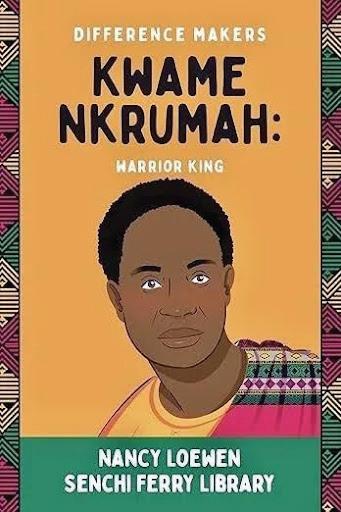
every African nation that governs itself, in every Pan-African movement that insists Black history does not begin with slavery, and in every young reader who learns that leadership can come from anywhere. Dr. Kwame Nkrumah did not just help free a nation. He helped redefine what Black leadership could look like when it refuses to shrink itself for the comfort of the West. Ready to learn more about Kwame Nkrumah? Read Planting People Growing Justice’s book “Kwame Nkrumah: Warrior King” by Nancy Loewen.
Alex Mason is a Minneapolisbased writer and editor. He has written for nonprofits for nearly a decade.

Felix Appiah engaging children in community care in an elementary school. Courtesy
Opinion
DevSecOps Engineer: Plymouth, MN

IT Company seeks DevSecOps Engineer to integrate security practices into DevOps workflows, automate security checks, and ensure the safety of cloud infrastructure. Work closely with development and security teams to enhance the security posture of applications and systems. Build and Configure delivery environments by using CD/CI, Agile delivery methodologies. Create and assist in performing various types of tests. Perform troubleshooting. Generate customized reports. Offered Salary: $116,480.00 to $116,500.00/yr. Send resumes to: HRD, VITS Consulting Corp., 14264 23rd Ave N, Plymouth, MN 55447. Minnesota Spokesman-Recorder July 10, 2025
Anonymous
The MRRA Act is now established law. Yet the Minnesota Department of Corrections and its MRRA Team have created a policy so insufficient that the law is not being meaningfully implemented, and thousands of incarcerated people are paying the price.
A large percentage of inmates have programming and treatment requirements they must complete before they can earn time off their sentences. The problem is that prisons like Faribault are openly admitting that no changes will be made to programming and treatment wait lists, while falsely claiming that the MRRA does not determine how a person gets into programming or treatment.
our earliest possible release dates, the response was that the MRRA Team does not determine who gets into treatment, that I needed to follow established protocol, and that I should write to treatment about the long wait list. When I wrote to the treatment supervisor directly, she said that offers to participate in treatment are not based on any potential earned incentive release dates and that I am simply on the current wait list.
That response reveals the catch-22 in plain language. The facility admits inmates can earn early release under the MRRA, while simultaneously refusing to adjust wait lists to make that possible. That contradiction is precisely what puts Faribault and the DOC in violation of the law.
By Stephani Booker
Dear Commissioner Conley,
I am an African American woman who has lived about a mile away from the HERC trash burner since 1999. I breathe its pollution every day. I am writing because I believed you were going to change that.
You made history in 2019 when you were elected as Hennepin County’s first Black commissioner. You spearheaded a resolution declaring racism a “public health crisis.”
You ran in 2018 on an environmental justice platform that included phasing out the trash burner. Your campaign website read: “community voices matter.”
For months, the Zero Burn Coalition worked with you and Commissioner Lunde on a resolution to close the trash burner. The county’s largest single polluter and a decadeslong source of environmental racism, poisoning frontline communities in North Minneapolis and in your own district. When a fourth vote was secured in 2023, closure was within reach. Instead of seizing that moment, you shut community members out of the resolution drafting process, a direct violation of environmental justice principles and your own promises. In
2021, you co-authored a resolution to include impacted community members in decisions about the trash burner. You abandoned that commitment the moment it mattered. The resolution that passed proved it. It called for a “closure plan” between 2028 and 2040. You publicly called it “unacceptable,” demanded “bold action,” and said you wanted closure by 2028, calling the trash burner’s continued operation an “emergency.” I was there when you said this. Then, when we asked to be part of the closure planning itself, we were ignored. The resulting plan does not require the trash burner to close, ever. It states on page 35 that a new resolution is necessary to do that. The gap between your public statements and your actions is impossible to ignore.
nity-rooted leader. Instead, I found a politician protecting her position with incinerator industry talking points. I left the meeting in tears because your words contradicted everything you said you stood for.
Every time we addressed one of your stated concerns, you moved to a new excuse without ever acknowledging you had held the previous one.
When we presented landfill capacity data, a Minnesota Center for Environmental Advocacy analysis showing landfills have capacity through 2054, you called it misinformation. Kirk Koudelka of the Minnesota Pollution Control Agency had confirmed just moments before that trash going to the burner could be redirected to existing landfills. You chose to ignore that.
On April 10, four commu-
This creates a clear and obvious catch-22: inmates are required to complete programming to earn earlier release, but the DOC and Faribault prison are not facilitating access to that programming in a way that is consistent with the law. The MRRA entitles eligible inmates to earn up to 50% off their sentence. In practice, eligible prisoners are likely to be denied that early release through no fault of their own.
I have experienced this firsthand. When I inquired about how the MRRA Team planned to get me and others into treatment before
When I asked my lead case manager about getting into a required recidivism reduction program, I was told the MRRA does not mean I get to jump the line. When I filed a formal grievance, the grievance administrator dismissed it, stating that the MRRA does not alter how individuals are prioritized for programming and does not change how wait lists operate or how programming is delivered. He then acknowledged that the MRRA’s purpose is to outline how a person may earn credits toward an earlier release.
Commissioner Paul Schnell and the MRRA Team have a lawful duty and the ability to create a policy that allows incarcerated people to complete required treatment and programming before their earliest possible release date. They have not done so. Instead, they are ignoring what the law requires, deliberately misrepresenting its intent, and making inaccurate statements about its scope. The result is a system where the law exists on paper but offers no real relief to the people it was designed to help.
That is why I am issuing a call to action. Please contact the Department of Corrections, Faribault prison, Commissioner Schnell and your state legislators. Demand answers. Demand accountability. With public pressure, we can get relief for thousands of incarcerated people who are patiently waiting for a law that was already passed on their behalf to actually be enforced.
This opinion piece was written by an incarcerated person at Faribault Prison.
In December 2024, we had a virtual meeting with you to present an analysis showing the trash burner was not profitable, it had put the county millions of dollars in debt. I had come to talk to a commu-

nity members began a hunger strike. They are refusing food until you and Hennepin County commit to closing the trash burner. People do not stop eating because they have other options. They are doing this because you have left us no other options.
Commissioner Conley, when you call documented facts misinformation to avoid taking action, you are not protecting my community. You are protecting the trash burner.
It has been nearly eight years since you were elected on a platform that included closing the incinerator. Children are sick. People have died. The emergency you named is still burning.
You said the trash burner is an emergency. I live in that emergency every day.
It’s not too late to do the right thing. Commissioner Conley, work with us to negotiate a resolution that will close the trash burner and open the way to a future of equity for all.
Sincerely,
Stephani Maari Booker
Stephani Maari Booker is a Minneapolis-based writer and environmental advocate.
By Daniel Hernandez
I came to the United States as a teenager with a clear goal: build something meaningful through hard work. I put in long days in construction, restaurants and landscaping; doing whatever it took to learn, save and eventually start my own business.
Over time, I built and ran several successful ventures, including an event photography company, a magazine, a tax and accounting firm, and now grocery stores serving neighborhoods across the Twin Cities where other retailers chose not to invest. I’ve created jobs, supported families and committed to communities that deserve stability and opportunity.
That’s why I’m speaking out now.
Small business owners in Minneapolis, and the communities we serve, are recovering from serious disruptions, including the impacts of Operation Metro Surge. That event hit immigrant communities especially hard. In my own case, I lost nearly half of my 60 employees and saw revenue drop by about 85%. While I worked to provide competitive wages, health benefits and paid time off, the real hardship fell on the people who lost their jobs and income.
Even as we rebuild, small businesses are facing another
challenge. The Minnesota Legislature is considering letting an important tax policy expire: the Pass-Through Entity tax option.
Here’s what that means in plain terms.
Many small businesses, including mine, are passthrough businesses. That means the business itself doesn’t pay income tax. Instead, the owners report the income on their personal tax returns. But under current federal rules, there’s a limit on how much state tax we can deduct. That often leads to higher federal tax bills.
The Pass-Through Entity option fixes that. It allows the business to pay the state tax directly, which means the business can fully deduct those taxes on its federal return and lower the total amount of income taxed federally. The result is straightforward: small business owners pay less in federal taxes, without reducing what the state collects.
In a state where the cost of doing business is already high, it’s hard to understand why we wouldn’t offer the same basic tax treatment as states like California and Illinois. Small businesses have carried a heavy load in recent years, through a pandemic, rising costs and public safety disruptions. We’ve adapted, reinvested and stayed committed to our communities. What we need now are practical policies that support that work, not make it harder. If the Minnesota House does not act soon, many businesses will face significantly higher federal tax bills. That’s money that could otherwise be used to hire workers, raise wages or reinvest in local neighborhoods.
I urge Gov. Tim Walz and members of the House Tax Committee to pass House File 3127 and extend the PassThrough Entity election.
Small businesses are the backbone of our communities. We’ve proven our resilience. Now we need our state leaders to show the same commitment to us.
This policy is not new or controversial. Thirty-six states already offer it. It doesn’t cost Minnesota anything, it’s revenue neutral. And it benefits more than 66,000 businesses across the state.
Daniel Hernandez is the owner of Colonial Market located at 2100 E. Lake St.
Employment & Legals
NOTICE OF INFORMAL PROBATE OF WILL AND APPOINTMENT OF PERSONAL REPRESENTATIVE AND NOTICE TO CREDITORS In Re: Estate of
Phyllis Ann Owens, FILE NO. 27-PA-PR-26-39 Deceased
FOR BILLING INQUIRIES & TEARSHEETS PLEASE CONTACT ACCOUNTING DEPT BILLING@SPOKESMAN-RECORDER. COM
ASSUMED NAME
TO ALL INTERESTED PERSONS AND CREDITORS:
FLAT RATE: $215 2 WEEK RUN
Notice is hereby given, that an application for informal probate of the above named decedent’s last will dated May 10, 2028 has been filed with the Registrar herein, and the application has been granted informally probating such will. Any objections may be filed in the above, and the same will be heard by the Court upon notice of hearing fixed for such purpose.
Please proof, respond with email comfirmation to ads@spokesman-recorder.com
Notice is hereby further given that informal appointment of Elizabeth Perkins, whose address is 6520 Brooklyn Blvd, Brooklyn Center, MN 55429, as personla representative of the estate of the above-named decedent, has been made. Any heir, devisee or other interested person may be entitled to appointment as personal representative or may object to the appointment of the personal represenative and the personal representative are empowered to fully administer the estate including, after 30 days from the date of issuance of letters, the power to sell, encumber, lease or distribute real estate, unless objections thereto are filed with the Court (pursuant to Section 524.3-607) and the Court otherwise orders.
The MSR handles billing digitally. This means you will get e-tears and emailed invoices unless you specifically request a hard copy.
Notice is further given that ALL CREDITORS having claims against said estate are required to present the same to said personal representative or to the Probate Court Administrator within four months and after the date of this notice or said lclaims will be barred.
Dated: April 7, 2026
Lindy
Scanlon Regristrar
NOTICE FLAT RATE: $215 2 WEEK RUN
Please proof, respond with email tion to ads@spokesman-recorder.com The MSR handles billing
was a high school state champion in the shot put and discus, a three-sport athlete and a National Honor Society member.
“I expect myself to do well because I know I can,” she said. “Every time I get in the ring, I expect to be consistent. It doesn’t have to be a record, but every single time, being consistent and bringing a good throw every time.”
Nabwe is often the only
SEASON 30
Continued from page 10
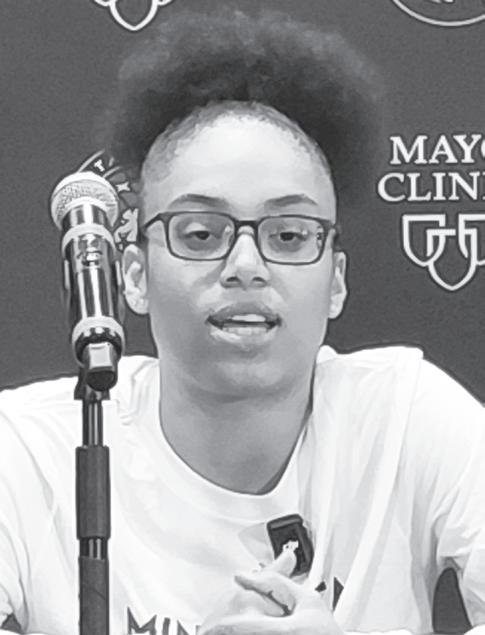
2026 Minnesota Lynx top pick Olivia Miles was asked how she sees herself fitting in with an organization that has been a standard-bearer for social and racial justice both locally and nationally.
“I’m excited to join a franchise and a culture that aligns with me and my beliefs and
Black competitor in her field events. “Most of my competitors are white,” she said, “But there are some that are also Black, it’s just not a lot.” She and Illinois’ Phethisang Makhethe are considered the top Big Ten throwers. The two Black women competed against each other in the weight throw at the 2026 Big Ten Indoor Championships in late February. Makhethe’s teammate Oluwatomilayo Akintunde is also a fellow Black thrower in the conference. Off the track, Nabwe is majoring in kinesiology and is on track to graduate this spring,
with plans to walk in the commencement ceremony before beginning graduate school in the fall.
“I’m going to take the exercise science graduate program and then PT school,” she said.
Her athletic ambitions extend well beyond the Big Ten.
“The goal is still the Olympics in 2028,” she said. “I am trying to make worlds first, which is next year. There’s a big track meet this summer and I need 75 meters or a ranking to make it there.”
Two former Gophers headed
gives me a platform to spread whatever message I want to spread,” responded the 5-10 guard, a three-time All-American and multiple National Player of the Year honoree. Miles led the nation in tripledoubles (6) and became the first NCAA player to average at least 19 points, seven rebounds, six assists and 1.5 steals per game.
“I can’t wait to meet the people in the communities who will actually be impact-
to WNBA training camps
Two former Minnesota Gophers are in WNBA training camps, which opened Sunday. Amaya Battle signed a training camp contract with the Minnesota Lynx. Rachel Banham re-signed with the Chicago Sky, who acquired the 10-year veteran guard at last season’s trade deadline. Banham set career highs last season in blocks, steals, rebounds, field goals made and free throws made.
Charles Hallman welcomes reader responses at challman@ spokesman-recorder.com.
ed by me and my presence here,” added Miles, the second overall pick in the April 13 WNBA Draft. “This platform only allows me to emphasize that message and get it across to a lot of different audiences.”
Whalen said she is looking forward to working with the rookie.
“It’s gonna be a lot of fun to just work with her, get to know her, and to have somebody with that type of

passion, it is going to be a lot of fun to have her on the team.”
Finally: Timberwolves face Denver with questions unanswered
The Minnesota-Denver first-round playoff series got underway last weekend in Denver, with Game 3 set for Minneapolis on Thursday.
ESPN NBA analyst Danny Green previewed the series April 17 on a media confer-
ence call. When asked which matchup to watch, Green zeroed in on the Wolves.
“Everybody is talking about the Minnesota-Denver series,” Green said. “To me, Minnesota hasn’t played really good basketball as a group. They seem like they’re not hitting their stride at the right time.”
Charles Hallman welcomes reader responses at challman@ spokesman-recorder.com.
am… very athletic, that’s why I’m pretty good at this game.
I can hit. I can run. I can do all the intangibles, so I feel like I don’t really have one that stands above the others.”
Culpepper said he knew early on that he had something special.
“When I got to high school, I feel like I was on a different level than other kids around me. I had always been the best player on the field. Once I got to high school, I started training harder, gaining more confidence, and I wanted to go D1. I always wanted to get to that big league level just so I can make enough money to provide for my family. That’s always been the goal.”
Culpepper was named the Twins’ Minor League Player of the Year in 2025 after hitting 20 home runs, driving in 64 runs and stealing
25 bases in 113 games split between AA Wichita and A+ Cedar Rapids. He raised his batting average 47 points and his OPS 120 points from his first season in the minors.
He was the lone Saints player to make his Triple-A debut on Opening Day in March. His St. Paul debut was a three-hit game, and his first Triple-A home run came the following night. Now in his second full season in the minors, Culpepper said he is quickly learning what life in professional baseball really demands.
“They always tell you about the grind, but they don’t tell you how many games you have to play and how important it is to stay healthy through all of them, and having to do it every day. That’s a big thing. You’ve got to be mentally stable because it’s hard.”
Culpepper entered last week’s series against Le-
(20), runs scored (10) and total bases (33) and has started every game this season. His sights remain fixed on a big league call-up.
“Things have been going my way,” he said. “I just got to keep my head down, keep running, keep that chip on my back, keep pushing.”
Woldeslassie joins Northern Iowa staff
Former Macalester College men’s head basketball coach Abe Woldeslassie, who served as an assistant at the University of Denver this past season, has joined Kyle Green’s staff at the University of Northern Iowa as assistant coach and general manager.
“I’m grateful to join Coach Kyle Green at Northern Iowa,” Woldeslassie said. “There is a great tradition of winning here, and the Missouri Valley is a great basketball conference.”
Charles Hallman welcomes reader responses at challman@ spokesman-recorder.com.
Amaya Battle
Courtesy of X
Olivia Miles
Charles Hallman/MSR
Record-breaker Nabwe has her sights set on the Olympics

There are approximately 100 African American and other student-athletes of color this school year at the University of Minnesota. In an occasional series throughout the 2025-26 academic and sports year, the MSR will highlight many of these players. This week: Track & Field Athlete Anthonett Nabwe.
nthonett Nabwe is an introvert who enjoys singing and listening to music. But as a member of the Gophers’ track and field team, she lets her performances speak loudly and clearly.
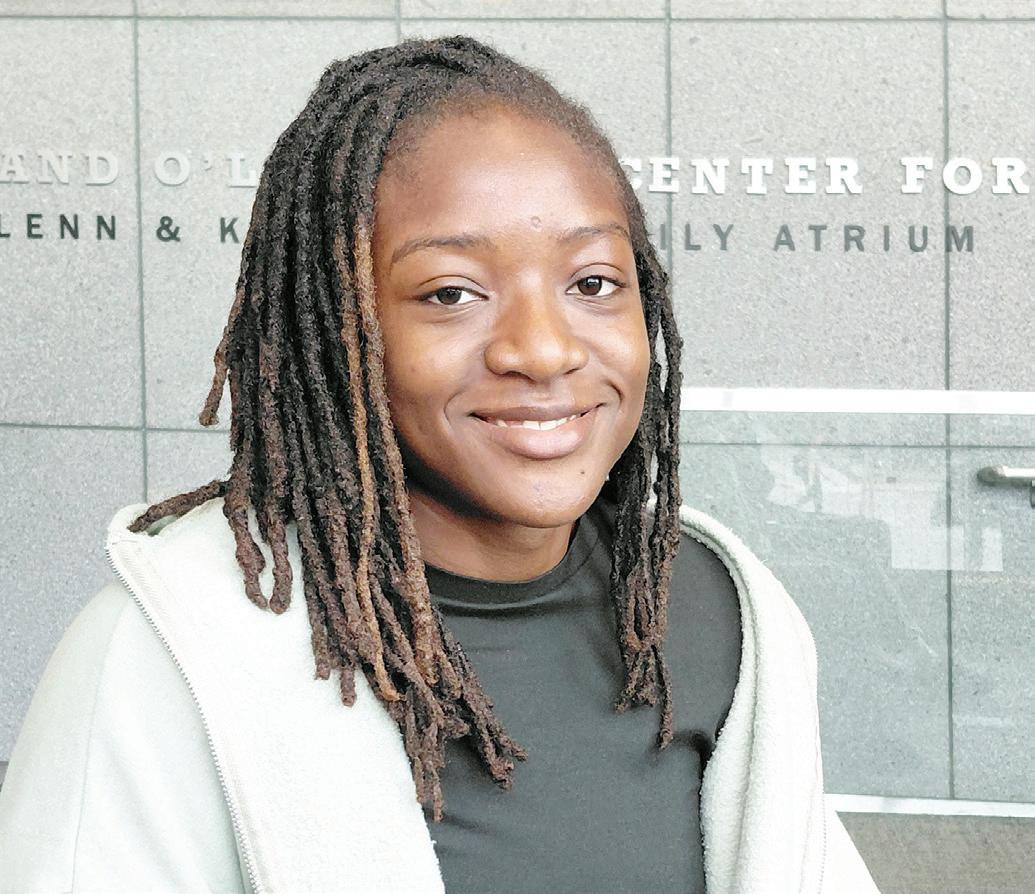
Dakota to attend high school now sits atop the Big Ten in both the hammer throw and the discus, and ranks No. 2 nationally in the hammer and No. 4 in the discus.
When the Spokesman-Recorder caught up with Nabwe last week in the Athletes Village lobby, she was asked where she keeps the numerous awards she has collected since joining the Gophers in 2024 as a redshirt freshman.
“I got stuff in the box,” she said softly, referring to storage in her apartment.
Earlier this month, Nabwe won the Big Ten Field Athlete of the Week for the fourth time this season, her 10th such honor of her career, as she helped lead the Gophers to several standout performances at LSU’s Battle on the Bayou.
After winning the 2026 NCAA indoor weight throw title, Nabwe opened her outdoor season by winning the hammer throw at 71.22 meters (233-8) at the Battle on the Bayou, a mark that put her at the No. 1 spot all-time in Big Ten history. She also set a personal best in the
discus at 59.58 meters (1955), finishing runner-up in that event while moving to No. 2 in school history. Her hammer throw also broke her own Minnesota record, which she had set in 2025.
Nabwe’s Big Ten hammer record gives her two conference records this season. The Monrovia, Liberia native who moved to Jamestown, North
Season 30: WNBA’s new CBA ushers in a new era
By Charles Hallman Sports Columnist
ow with a new collective bargaining agreement in place, the WNBA is set to tip off its 30th season on schedule Friday, May 8. Training camps, considered the shortest preparation period in professional sports, opened Sunday.
“It’s gonna go quick, each day, work to get better, and that’s what we got to do,” Minnesota Lynx Assistant Coach Lindsay Whalen told the SpokesmanRecorder last week.
The new seven-year CBA, which runs from the 2026 season through 2032, is being hailed as one of the most transformational labor agreements in major professional
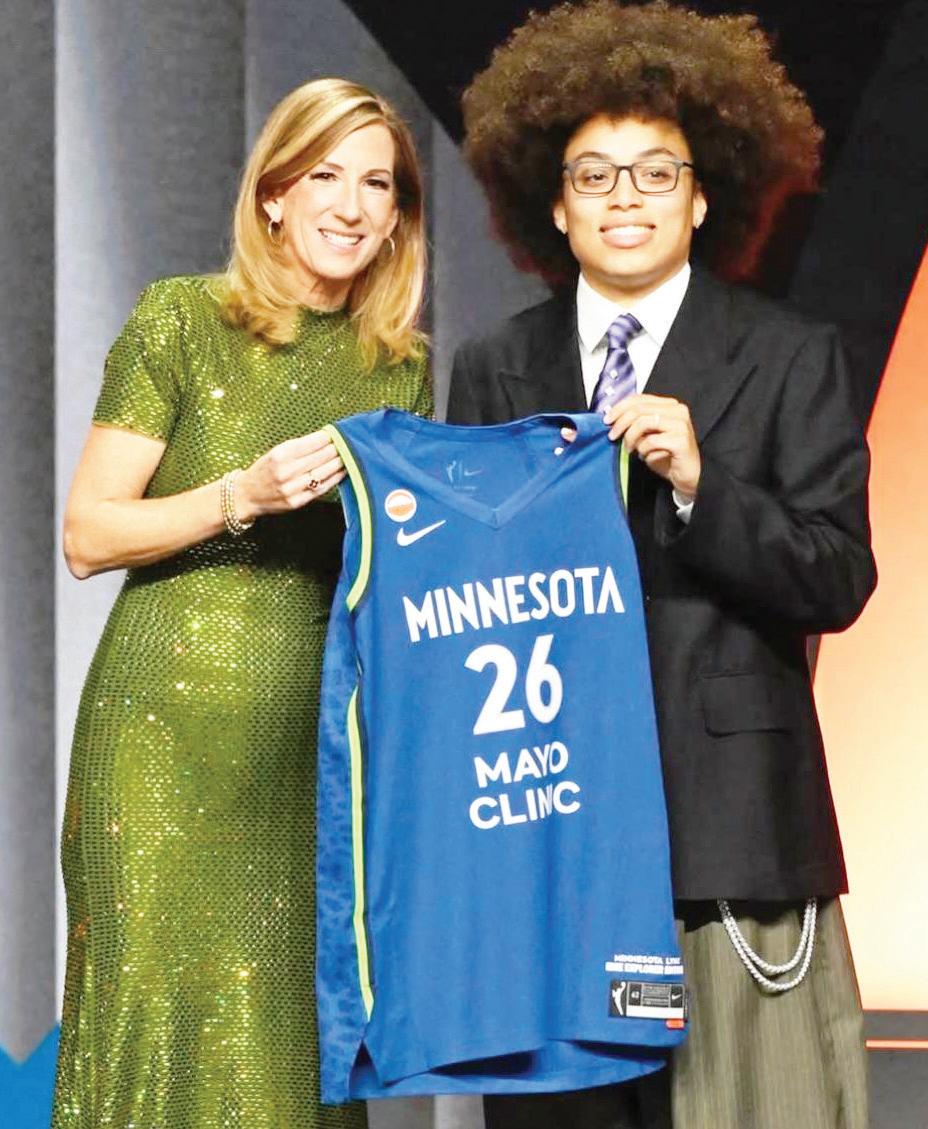
sports history. The WNBPA negotiating committee was led by two Black women, Executive Director Terri Carmichael Jackson and Union President Nneka Ogwumike.
“This is the best team in my opinion in the history of this university.”
Among the provisions secured: two development player roster spots, increased mental health benefits, new minimum and supermax salaries, and a 20% share of gross revenue. The agreement also includes a one-time recognition payment for WNBA veterans and retired players based on years of service: $100,000 for retirees with 12 or more years of service, $50,000 for those with eight to 11 years, and $30,000 for those with five to seven years.
Whalen, who played 14 seasons (2004-2018) with Connecticut and Minnesota, qualifies for the one-time payment.
“It was definitely transformational,” she said. “I really appreciate Phee (Napheesa Collier, a WNBPA vice president), Nneka, Alysha Clark and everybody on the committee for being able to give back a little bit to some of the


“I expect myself to do well because I know I can.”
The technical demands of her events are considerable. The shot put is essentially a push from the neck, while the hammer throw relies on maximizing release velocity through rotational acceleration within a throwing circle. Both require
older ones. Definitely grateful for them and just really excited for this group of players to have the resources and financial stability moving forward.”
An unprecedented six-day free agency period began April 6, with signings commencing April 11. For the first time in league history, free agents commanded sixfigure salaries and star players signed million-dollar contracts, all made possible by the new CBA. Every player, from rookies to longtime veterans, will see a significant pay increase.
Two expansion teams, Toronto and Portland, also enter the league this season.
“Season 30 arrives at what I think is the perfect moment,” WNBA Commissioner Cathy Engelbert told reporters during her April 13 pre-draft press conference in New York City. “The past 30 years have been about building the foundation. The next 30 are about scaling the game, unlocking what’s possible for the entirety of women’s basketball and women’s sports.”
This season also marks this columnist’s 30th year covering America’s longest-running women’s professional sports league, and his 27th year covering the Lynx as the area’s longest-tenured beat writer.
Lynx rookie Miles ready to make her mark on and off the court
At her introductory press conference last Wednesday,

balance and the management of centripetal force.
“I don’t know how to explain it, but the rotation is different in both,” Nabwe said. “The shot has two or three parts, and then the hammer… you have to spin. You’re turning about four times, very heel-
■ See SEASON 30 on page 9 Twins’

he Minnesota Twins have the most U.S.born Black players, five, in the majors so far this season.
The team’s Triple-A farm club, the St. Paul Saints, has just one Black player, and he is eager to join the parent club soon.
“My name is Kaelen Culpepper. I’m just ready to show who I am. Ready to get to the big stage and really take off, elevate the game,” the 23-year-old, 5-10 infielder said as he introduced himself to the Spokesman-Recorder and its readers. The Memphis native is in his first full season in Triple-A.
Culpepper was drafted by the Twins in the first round in 2024, 21st overall. After signing with Minnesota, he was assigned to the minors and debuted with the Fort Myers (A) club, then was promoted to Cedar Rapids (A+) and represented the Twins in the 2025 All-Star Futures Game.
He plays shortstop just like his older brother, who played the
to-toe, and you have to go in a straight line and release the ball at the fourth turn.”
Both the women’s shot put and hammer throw weigh 4
lograms (8.82 lbs.).
“It’s just the technique that’s different,” continued Nabwe,
same position.
“I wanted to be like him growing up,” Culpepper said.
“I was just a shadow, following his footsteps at shortstop. I was trying to do the same thing as him. I got good at it.”
Culpepper was a two-sport athlete in high school but chose baseball over basketball. He earned first-team All-State honors as a senior and played college ball at Kansas State for three seasons, where he was switched from third base to shortstop and became an MLB top draft prospect.
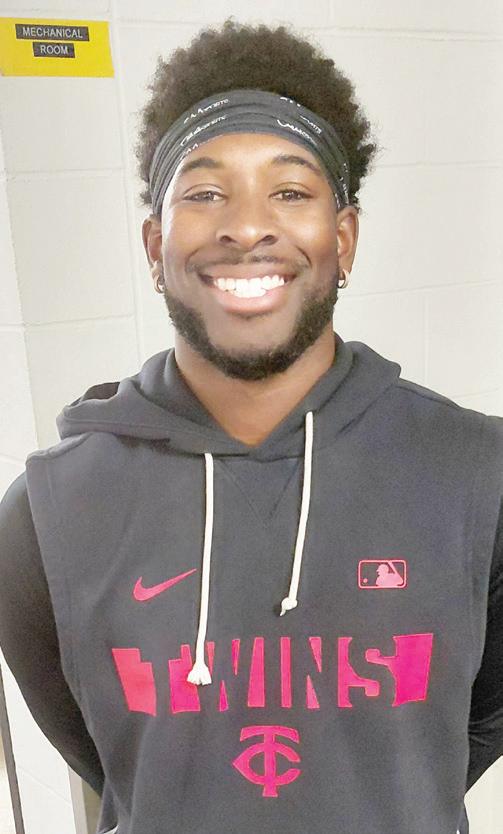
“I feel like all my tools are on an even level,” he said. “I would say speed, how quick I
week’s
ing Class 4A state champions, placed second in the 2026


last


his
Fab Five photo gives one more shoutout to girls basketball players from Hopkins High School. The Royals, the defend-
state tournament
month.
aliyah Diggs, Inarah Nesbitt, Ava Cupito, Lanaia Durant, and Erma Walker led
Hopkins. Led by head coach Tara Starks, the Royals finished with
Photos by Dr. Mitchell Palm-
McDonald.
Hopkins guard Ava Cupito Hopkins forward Erma Walker
Hopkins guard Lanaia Durant Hopkins guard Jaliyah Digg
Hopkins guard Inarah Nesbitt
Anthonett Nabwe
Charles Hallman/MSR
Anthonett Nabwe
Minnesota Athletics
Olivia Miles with WNBA Commissioner Cathy Engelbert Courtesy of X
Kaelen Culpepper
Charles Hallman/MSR