

Judge dismisses charges against activist arrested outside Cities Church on Easter
By Clint Combs Contributing Writer
mily Phillips, 33, spent Easter Sunday behind bars after being arrested across the street from Cities Church, only to have Ramsey County Judge Maria Mitchell dismiss all charges the following morning after finding no probable cause.
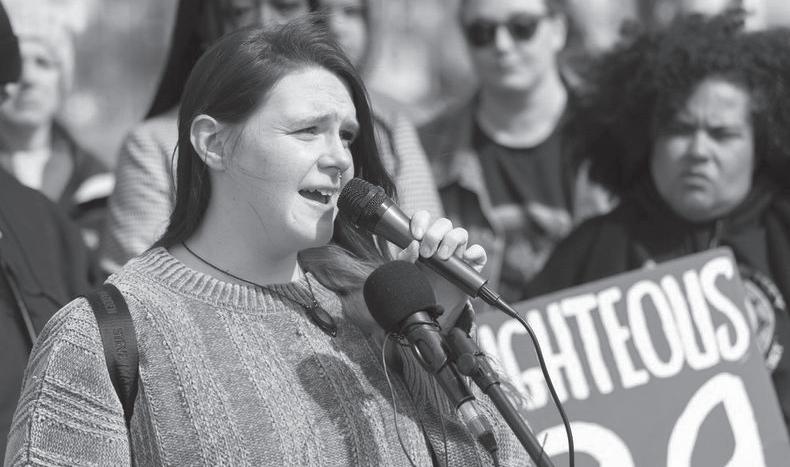
Phillips was charged with committing offensive, obscene or noisy behavior and interrupting a religious service. During the protest, Phillips could be heard shouting slogans such as “Love thy neighbor… require paperwork for Jesus.”
The first protest at Cities Church on Jan. 18 resulted in nearly 40 arrests after activists learned that St. Paul ICE Field Director David Easterwood served as a pastor there. Federal prosecutors under President Donald Trump have since charged those protesters, dubbed the Righteous 39 and led by ordained ministers Nekima Levy-Armstrong and Monique Cullars-Doty, under the Freedom of Access to Clinic Entrances Act. LevyArmstrong is also a co-founder of Black Lives Matter Minneapolis.
Phillips stood outside the Ramsey County Courthouse and described the escalating verbal standoff she had with St. Paul officers.
“There’s an officer who just really was unhappy about the protest, and he was kind of the officer in charge,” Phillips said. “At one point he told me, ‘I would have already arrested you if it was up to me.’”
"At one point he told me, 'I would have already arrested you if it was up to me.'"
St. Paul Police Department spokesperson Alyssa Arcand told the Minnesota Spokesman-Recorder that officers responded to a noise complaint at 8:35 a.m.
“The protesters were using a bullhorn and yelling loudly, disrupting the church services,” Arcand said. “The protesters were given numerous announcements by officers to stop, or they would be cited and possibly arrested.”
Phillips said the officer was texting back and forth with his sergeant over questions of
noise levels, ultimately telling protesters they would be arrested if they could be heard from 50 feet away or from inside Cities Church.
“And I was like, well, what’s the decibel level? And he was like, well, there is no decibel level. It’s just what is reasonable,” Phillips said. Someone in the protest group then looked up the city’s actual noise stan-
Minnesota's Missing and Murdered Black Women and Girls Office
By Jasmine McBride Editor
hen Maia Yang's niece Amarie
Alowonle was shot at Sanborn Park in Robbinsdale in May 2025, the family was thrust into a grief they had never prepared for. Amarie was 19 years old. She died a week later from her injuries. Nearly a year later, no one has been arrested. In the aftermath, Yang did what many families in crisis do, she searched. She Googled resources, advocates, anyone who could help her
steps into the light
sister Tatiana Kilgore navigate the impossible weight of losing a child to violence. That search led her to the Office of Missing and Murdered Black Women and Girls.
"I reached out to them," Yang said. "Amarie, she was Black, Native, I was like, wow, this would be perfect for them to step in and know about her story."
The office, established by the Minnesota Legislature, is one of the few of its kind in the country. Led by Director Kaleena Burkes and a sixperson team, it was created to address a crisis that has long existed in the shadows:

the disproportionate rates at which Black women and girls go missing, are harmed and are killed, and the systemic failures that have allowed those cases to go unresolved and underreported.
On April 13, the office hosted its 2026 Missing and Murdered Black Women and Girls Day on the Hill. A day of action, remembrance, and truth-telling at the Minnesota State Capitol. Tatiana Kilgore, Amarie's mother, was among those who spoke. So was Lt. Governor Peggy Flanagan, who helped champion the office's creation and addressed the crowd as an Anishinaabe woman, a survivor of domestic violence and a mother.
"This work was not created in a vacuum," Flanagan said. "It was born out of love and out of a movement. It was built through the courage of community members who refused to stay silent."
For Burkes, the day represented both a milestone and a call to action.
"This year's Day on the Hill is focused on awareness, visibility and truth-telling," Burkes said. "We are working to elevate the reality of the violence Black women and
dard. “They’re 65 by the way, by a city board,” Phillips said.
Rather than push back, Phillips said she tried to comply with every directive St. Paul police issued. She walked across the street to a grassy median and turned off her megaphone, relying only on her natural voice.
“I brought the speaker with me off, and he was like, ‘You
brought the speaker?’” Phillips said. “I was like, ‘It’s not on. It’s my property.’ But he was really upset about that, and he was texting about how I had brought my speaker to the side, even though it was off, and telling me how he already had cause to arrest me.”
“The majority of the group complied,” Arcand said. “One person, an adult female, did not comply and was arrested by officers for interference with religious observance.” Phillips has had numerous run-ins with federal agents, sheriffs and local police. She said Department of Homeland Security agents know her by name. Three months ago, The Young Turks posted a video of Phillips confronting an ICE ■ See EMILY on page 5
The quiet revolt against hustle culture
By Damenica Ellis Staff Writer
ernique Esther’s father died early this year due to complications from heart disease and lung cancer, something she said metastasized because he was not connected to his community.
Though estranged, Esther could turn on the TV and see her father with news correspondents speaking on current events as a geopolitical leader in the Republic of Benin. Even with his multiple degrees, books written and other accolades, at the end, Esther found out that there was work he was doing that he never finished.
“The achievements and the accolades, there’s always a temptation to get another one,” she said. “But I don’t think that we value what it does to our bodies and to those around us when we forsake everything for those aims. It’s literally never worth it.”
This lesson was key to Esther’s own journey in stepping away from hustle culture this year. She has limits on her week, with work banned completely on Sundays. She goes outside and has taken up skating while still getting tasks
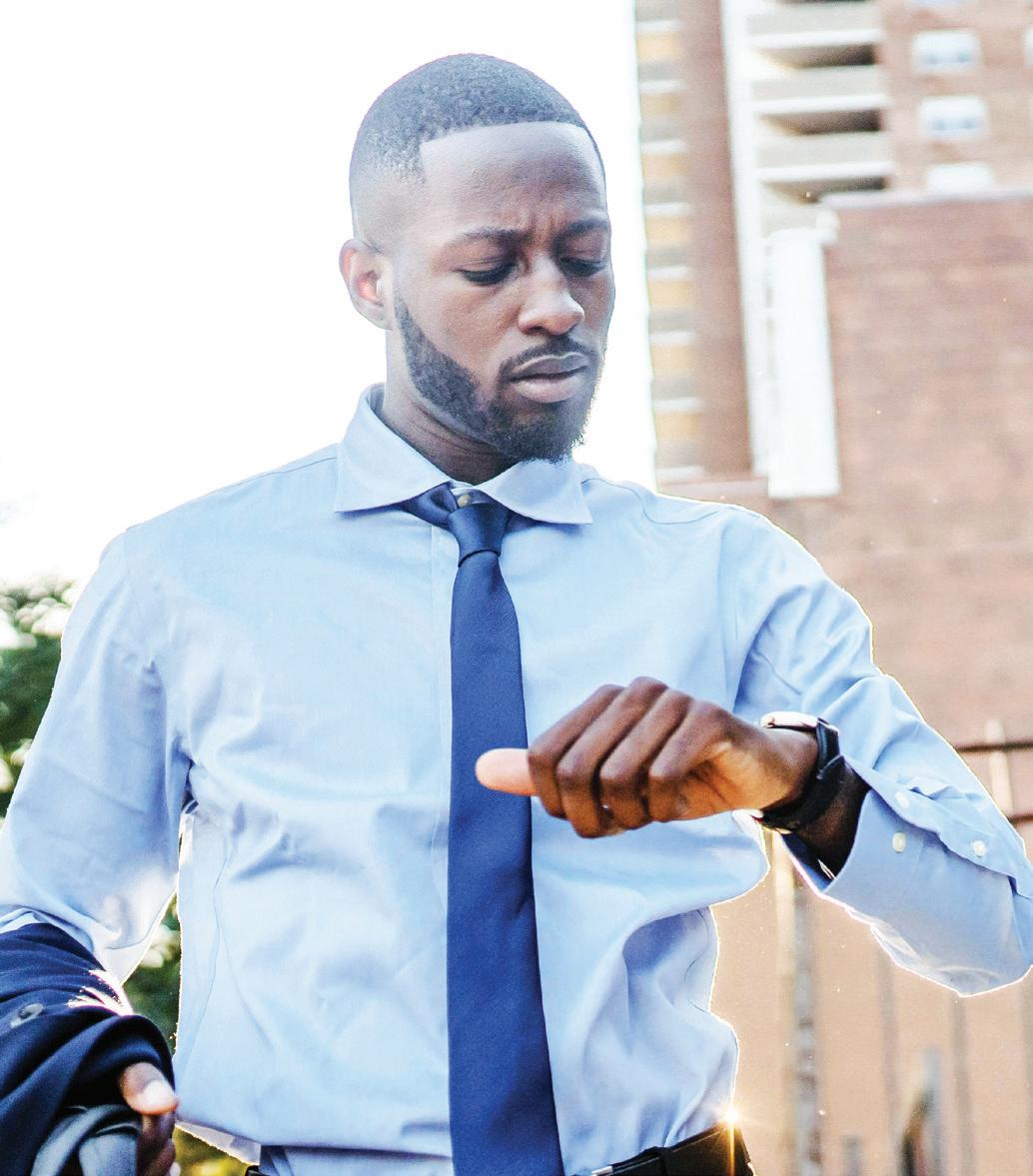
done professionally.
“Being able to find ways to move my body and honor my commitments to myself have been huge for me,” she said.
“I’m still a high achiever … but I think I do it differently. Now, I slow down when I need to. I take breaks when I need to. I push the gas when I need to, but always being mindful that this is not something that I’m trying to sustain indefinitely.”
Her life feels more honest, she said.
“I’ve learned what actually matters, to strip away the fat and to not just do things because it’s there and available, to not just work a job because of the financial aspect. But what else matters to me? Is it lifestyle? Is it flexibility?”
More people are stepping away from hustle culture, redefining what success looks like outside of a workplace. The subtle lifestyle changes are shaping wellness and
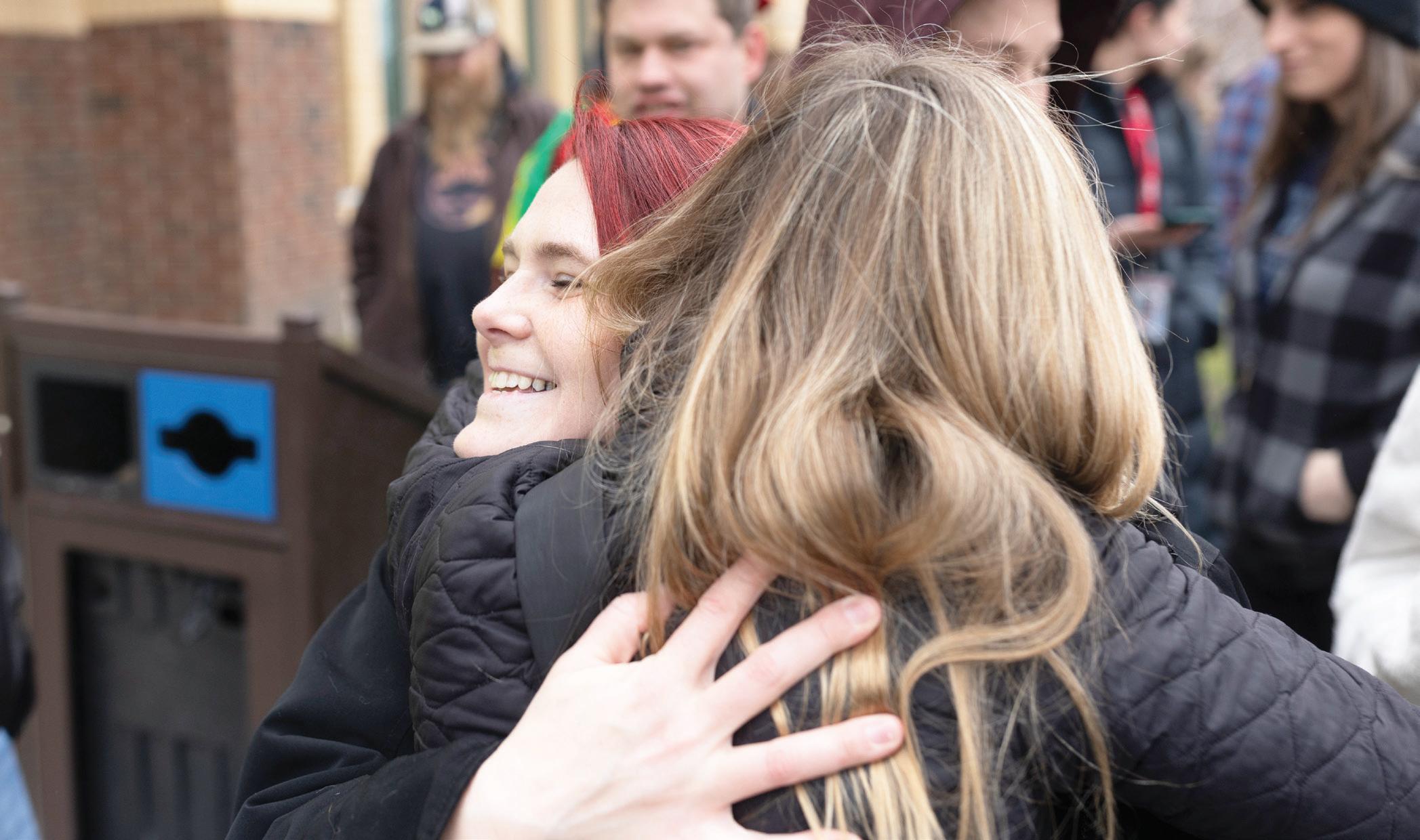
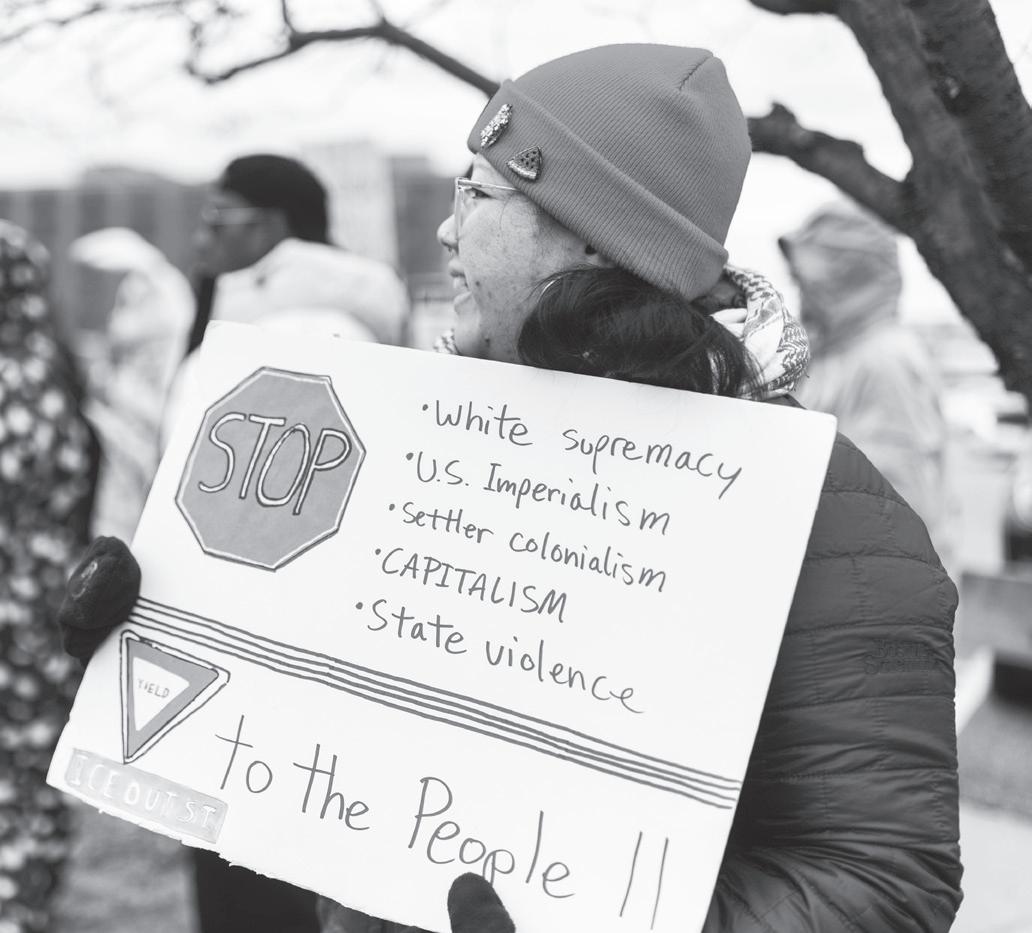
Emily Phillips is embraced by supporters outside the Ramsey County jail following her release March 6, one day after her Easter Sunday arrest outside Cities Church in St. Paul.
Chris Juhn/MSR
(L-R) Amarie Alowonle and her mother Tatiana Gilmore Courtesy
Mizuno K
Activists allege Cities Church denied Black man entry to worship service
By Clint Combs Contributing Writer
Cities Church, led by pastor
and St. Paul ICE Field Director
David Easterwood, allegedly denied a Black man entry to worship services sometime after a Jan. 18 protest, two civil rights activists said at a news conference outside the Western District Police Station in St. Paul on Monday.
Target Boycott co-founders
Nekima Levy-Armstrong and Monique Cullars-Doty made several allegations describing what they considered a pattern of discriminatory and retaliatory treatment after the Justice Department charged multiple journalists and protesters, dubbed the Righteous 39, under the Freedom of Access to Clinic Entrances Act.
The allegations came one day after Ramsey County Judge Maria Mitchell said she did not find probable cause to keep Emily Phillips in jail and dismissed charges related to a noise complaint across the street from Cities Church on Easter Sunday.
Alyssa Arcand, a spokesperson for the St. Paul Police Department, said the dismissal was due to a “procedural error” and that St. Paul police may press additional charges against Phillips at a later date.
“We’re aware that the case was currently dismissed because of a procedural error that was made where the ‘probable cause’ notes were not included on the citation.
A police report detailing the facts of the case was written,” Arcand said. “Our investigators are continuing to work on the case with the City Attorney’s Office. It is not uncommon for cases to be charged out of custody.”
Levy-Armstrong said her office was contacted by a man who initially attended Cities Church without incident but was stopped when he returned a second time.
“We were contacted by a Black man who went to Cities Church, not knowing what had happened there,” she said.
“And then the second time that he went, he was questioned, asked if he knew me.”
According to Levy-Armstrong, the man had not been in contact with her since at least 2020. Still, she said,
church staff made the connection and denied him access to the sanctuary.
“He was told he looks like one of us, and was not allowed into the sanctuary to worship with other people at Cities Church,” Levy-Armstrong said.
“That’s unacceptable. This man was looking for a church home, yet he wasn’t even allowed to go into the sanctuary the second time that he showed up to participate in the worship service simply because he is a Black man. That is not okay.”
Cullars-Doty provided additional detail about how the congregation apparently asked for identification before denying access to Sunday service.
“When he went, they wanted his driver’s license. They wanted to know who he was, and they were asking all
Tenant union
By Izzy Canizares Contributing Writer
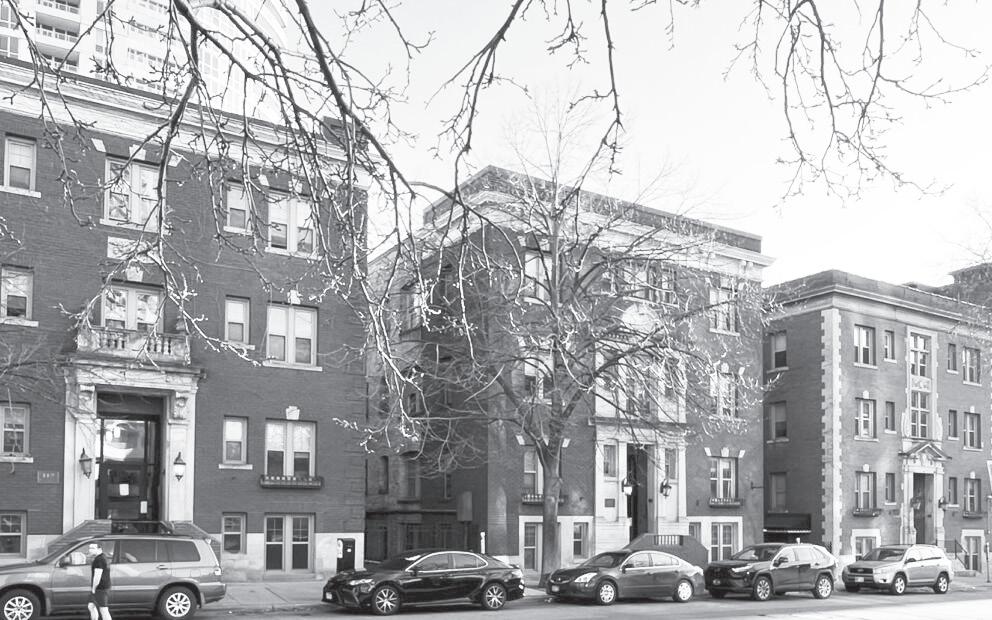
Members of the Brentwood Tenants Union will be awarded more than $49,500 in court fines from Quadrel Realty after the landlord allegedly failed to appear in court proceedings concerning housing conditions. While the ruling marks one of the largest wins for a tenant union in Hennepin County, Brentwood tenants are still fighting to receive the original settlement agreed upon.
After a January 2025 ruling allowed renters to organize to improve living conditions, tenants at Brentwood Apartments formed their own union to seek emergency relief following extended heating outages during the 2024-25 winter season.
“That winter, a number of tenants in the building had severe heat outages,” said Legal Aid Attorney Julia Zwak.
“The boilers connected to the three buildings went out, so there was heat loss for basically everyone in the building. It sounded terrible. There were some families that even
had young children and had to bundle them up.”
A settlement was reached in fall 2025 requiring Quadrel Realty to fix the heating issues and any other pending repairs, and to issue a 50% rent abatement for the two months tenants went without heat.
However, according to Zwak, Quadrel Realty continued to ignore tenants and their counsel in subsequent court proceedings, and many tenants affected by the heat loss had still not received the promised payments.
knowledge, this is the largest fine ever awarded to a tenants union in Hennepin County Housing Court.”
Quadrel Realty owns properties in Minneapolis and other major cities including Miami and Chicago. Tenant complaints appear to be a recurring issue across locations, with Yelp reviews from renters in both cities citing poor living conditions. Complaints range from employees allegedly verbally assaulting tenants to mold found on walls.
As of April 2025, only
kinds of questions,” CullarsDoty said. “He said he doesn’t watch the news. He didn’t know what had happened.”
Levy-Armstrong also raised a second allegation, claiming that someone affiliated with Cities Church contacted at least one Black congregation on Minneapolis’ North Side in an effort to spur public opposition against the Righteous 39.
called around to at least one predominantly Black church in North Minneapolis asking them to speak out against the Righteous 39,” she said. “That is absolutely ridiculous.”
The Minnesota Spokesman-Recorder contacted Pastor Parnell for comment, and he referred questions to his attorney, Greg Scott, who denied the allegations.
“The version of events described in your email is wildly inaccurate. It’s obvious that this is another attempt to intimidate the church,” Scott wrote. “Cities Church is a place where people come to find the peace of Christ and they should be able to do so without fear.”
Cullars-Doty pushed back on claims that church members felt threatened by protesters.
saw some people chanting.” Phillips also described how federal immigration agents targeted her in Richfield on Dec. 7. Phillips said she approached a stop sign when an unmarked vehicle drove the wrong way down a one-way street, forcing her to reverse until she was boxed in by multiple agents.
“At least eight agents in full tactical gear got out and pointed a rifle directly at the driver,” Phillips said. “And I have it on video. I have proof of it, and yet I was not even allowed to file a police report.”
Phillips said Richfield police declined to let her file a police report, prompting her to raise the issue directly with Minnesota Attorney General Keith Ellison.
“Quadrel and its lawyer largely lost touch with our office and our clients,” Zwak said. “We took them to court in December to enforce our agreement. They showed up an hour late. In January, when they again failed to meet the terms of the agreement, we filed an affidavit of noncompliance. At our request, the court imposed fines. To our
seven tenants have received the amount agreed upon in the settlement, according to union President Emery Bush.
“There are around 18 tenants who deserve a credit and have not received it. This is based on data we have collected through door knocking and connecting with tenants who have provided us their contact information,” Bush said.

“He was told he looks like one of us, and was not allowed into the sanctuary to worship with other people at Cities Church,”
“The thing I want to call out regarding [Pastor] Jonathan Parnell is the fact that we know that you have called around, or someone from your church has
“Stop acting like you’re the victim. Stop acting like it’s necessary for you to have a Saint Paul Police officer sitting in your congregation on Sunday, nobody was violent towards you,” she said. “If you think that you were in danger, that is your own insecurity, that is your own white fragility, because you saw some Black people in the church, and you
“The Attorney General Keith Ellison told me that the police are not used to having to do anything against federal officials, federal employees, federal agents, and that we, the people, needed to apply pressure,” Phillips said. “That is not an acceptable response from the person who has control over the police in our state, and just saying that they’re not used to policing federal agents isn’t good enough when they’re pointing guns in our faces.”
The Minnesota Attorney General’s Office did not respond to a request for comment as of press time.
Clint Combs welcomes reader responses at combs0284@ gmail.com.
building landlord
“Quadrel has our membership list, and they know exactly who was living here during the winter of 2024-25. They could very easily give us a list of who has and has not received a credit, but has failed to do so.”
Tenants continue to report safety and sanitary issues at the Brentwood. During the most recent winter, sporadic heating outages persisted, though they were resolved more quickly than before. Tenants also report unhoused individuals frequently taking shelter in the building’s stairwells due to a lack of security.
“Neighbors are experiencing intermittent heating issues
across all three buildings. The joint mail room, which serves all three buildings, has had a persistent and serious leak since October 2025,” Bush said. “They only began construction on it recently. The first day construction started, the ceiling was torn out and wires were left hanging into the room. It was left in that state for about a month, with mail still being delivered and the leak still ongoing.”
Bush also noted there are only three working washers and dryers for all three buildings, which together house 102 units.
“The biggest issue here is lack of communication,” Bush
said. “All of these maintenance concerns, as well as previous ones, have been clearly communicated to management, and yet it takes weeks or months to make any progress. Oftentimes, tenants never hear back, or have maintenance requests cancelled.”
“It does seem like the landlord is trying to do as little as possible to get by,” Zwak said.
“There was a point in time, before we were involved, where the court ordered them to take some steps and they expressed to the court that they thought the order was optional. Their understanding of how the legal system works and their obligations just seems very skewed.”
In March, a court ordered Quadrel Realty to pay $49,500 in fines by March 20, payable to the Brentwood Tenants Union. Per the court order, additional fines of $750 per day will continue to accrue until the landlord fulfills its obligations.
Izzy Canizares is a freelance journalist and contributing journalist for the Minnesota Spokesman-Recorder
Emily Phillips
Photos Chris Juhn/MSR
By Dr. Ashwak Hassan
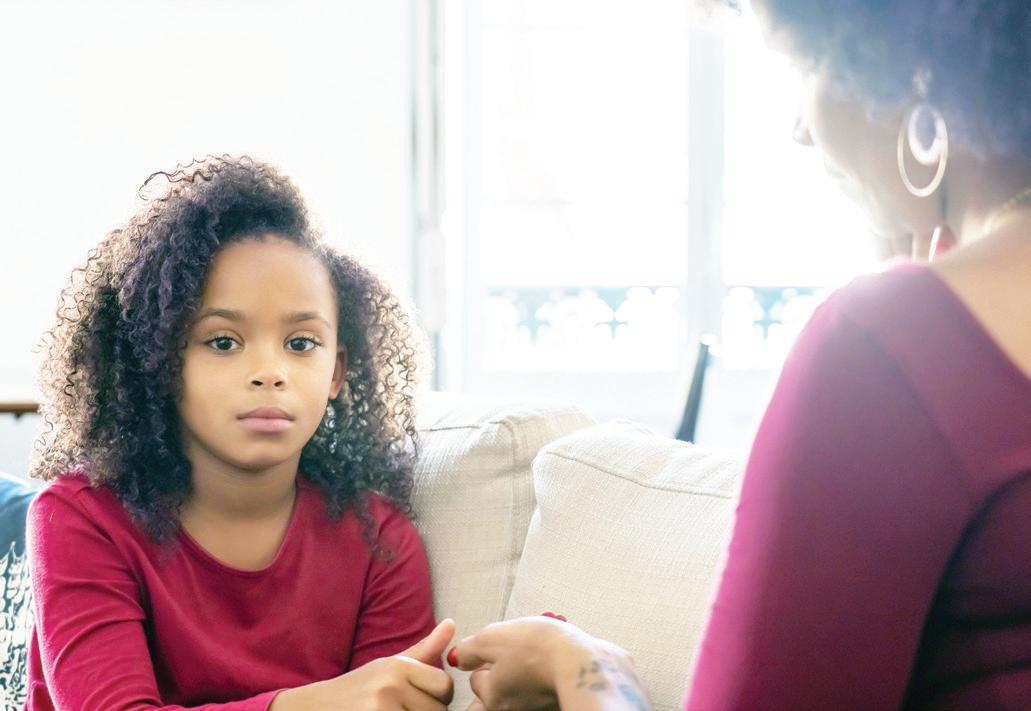
In communities across Minneapolis and St. Paul, children are carrying fears that no child should have to bear. They are not afraid of monsters or the dark. They are afraid that their parents will not come home. They are afraid their families will be torn apart. They are afraid that they do not belong in the country they call home. These are not abstract anxieties, they are the lived experiences of immigrant and refugee children in Minnesota, and they are symptoms of a deepening public health crisis driven by the current anti-immigration climate.
As a Somali therapist working directly with immigrant and refugee families in the Twin Cities, I observe this crisis unfolding in real time. Children present in my practice with increased anxiety, sleep disturbances, irritability, and social withdrawal. Their parents arrive overwhelmed, managing their own fears while straining to protect their children from a reality that grows harder to conceal. What is happening in these families is not a private struggle. It is
a community-wide emergency that demands a communitywide response.
One of the most significant and underappreciated dynamics of this crisis is how fear spreads even when families are not directly targeted by immigration enforcement. Children absorb what they hear in school hallways, see in the news, and encounter on social media. They are far more perceptive than adults often acknowledge, and they internalize the threats they cannot control or fully understand. The ambient fear generated by anti-immigration rhetoric is itself a source of chronic stress, one that does not require a direct encounter with enforcement to cause real psychological harm.
Fear, and the mental health impact of the anti-immigration climate on children
language, and identity. Black immigrant families, including Somali families, face the intersecting weight of anti-Blackness, anti-Islam sentiment, and anti-immigrant hostility simultaneously. This layered experience creates a distinct and compounded psychological burden that mainstream conversations rarely address with the seriousness it deserves. To speak about immigrant mental health without naming these intersecting forces is to tell only part of the story.
any failure of love or devotion, but because the psychological weight they carry is immense. When parenting is strained, the entire family system feels the effects. Children depend on caregivers for their sense of safety, and when caregivers are themselves destabilized, that sense of safety erodes.
For children, chronic stress of this nature is not a passing phase. Research consistently demonstrates that prolonged exposure to fear and instability during childhood shapes neurological development, affects academic performance, strains peer relationships, and increases long-term vulner-
require active, sustained attention and care.
Yet access to that care remains deeply unequal. Mental health stigma persists across many immigrant communities.
Language barriers, shortage of culturally responsive providers, and systemic mistrust further restrict access to services.
Many families are left to navigate these experiences without adequate support. This is a failure not of individual families but of the systems meant to serve them.
Addressing this crisis requires us to reject the false separation between policy and human impact. Immigra-
damentally alters a child’s relationship to safety, belonging, and possibility.
The resilience present in immigrant and refugee communities is real and profound. Families continue to support one another. Parents create stability under extraordinary pressure. Community members build networks of care and connection. Yet resilience alone is not a sufficient response to systemic harm.
For many families, this fear does not exist in isolation. It is compounded by race, religion,
The impact on parenting is equally significant and equally overlooked. Parents who are living under chronic fear and uncertainty operate in a state of prolonged survival response. This affects their capacity for emotional availability, consistency, and stability, not due to
Pay $0 for all benefits
ability to anxiety, depression, and trauma-related conditions. The psychological wounds inflicted by this climate will not simply disappear when the political moment shifts. They
tion rhetoric and enforcement do not exist in a vacuum, they shape the psychological environments in which children develop. When fear becomes a feature of daily life, it fun-
Genuine solutions require expanding access to culturally responsive mental health services, equipping schools to address the psychological needs of students, and investing meaningfully in communitybased support systems.
Above all, we must affirm what is at stake. Children deserve to grow up in environments that nurture their development, not compromise it. They deserve safety, stability, and the freedom to simply be children. When we fail to protect that, when we allow the political climate to become a source of childhood trauma, we are not only harming individual children. We are shaping the future of our entire community.
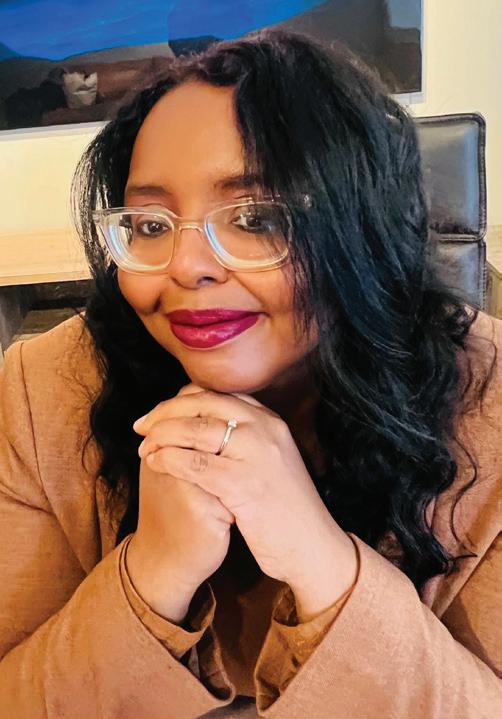
Dr. Ashwak Hassan is a therapist, educator, and community advocate in the Twin Cities, providing culturally responsive mental health care to immigrant families.
HealthPartners® Minnesota Senior Health Options (MSHO) (HMO SNP) Enjoy coverage for medical, prescription drugs and dental. Plus, many extra benefits like: Up to $300 annual over-the-counter allowance to buy eligible health, dental and well-being items
Get Medicare + Medical Assistance (Medicaid) in one plan. Call 877-778-7898 (TTY 711) to find out if you’re eligible. Oct. 1 to March 31: 8 a.m. to 8 p.m. CT, seven days a week; April 1 to Sept. 30: 8 a.m. to 8 p.m. CT, Monday through Friday.


Dr. Ashwak Hassan Courtesy
Kampus Production

Amuure Holistic
Black Business SPOTLIGHT
Jasmine McBride Editor
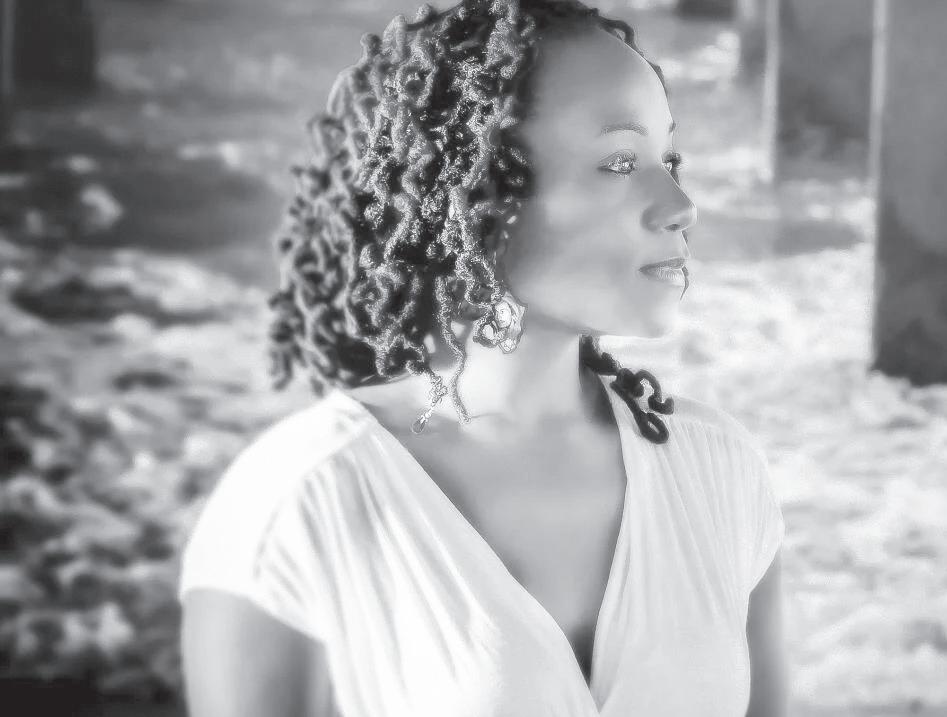
Kenisha Ama’anii didn’t grow up knowing what massage therapy was. Raised in the mountains of Jamaica in what she describes as a sheltered childhood, bodywork was, in her words, “a foreign language.” Today, she is the founder of Amuure Holistic Health, a thriving wellness practice in Minneapolis with nearly two decades of experience behind her, and a calling she said she didn’t see coming. “Spirit, I guess, puts you where you need to be,”
Ama’anii said.
Her path into the industry began after moving to New York to live with her parents. She and her mother would work out together at a local gym, where the manager noticed something in the way she moved and suggested she became a personal trainer. She studied for and passed the ACE certification exam, and he hired her as promised. It was at that gym, stretching
clients and working with her hands at the end of sessions, that something unexpected began to emerge.
“Each client would be like, ‘Oh my God, you have such an amazing touch. You should become a massage therapist,’” she recalled. “I had to Google what that was, because I had no idea.”
What she found drew her in. After visiting a school in New York several times, and being invited by a front desk worker to sit in on a class, she was hooked within minutes.
“When I tell you, within a few minutes, I was like, ‘Oh my God, I love this. I am home.’” She applied that week, was accepted, and went on to earn an Associate Degree in Occupational Therapy with a Massage Therapy focus from the Swedish Institute, College of Health and Sciences in New York City. She has been in the health and wellness industry for over 19 years, with 10 of those as a licensed massage therapist. Amuure Holistic Health has been in its cur-
One founder’s journey from the mountains of Jamaica to a Minnesota healing space
rent Minneapolis location since September 2020, and Ama’anii took over the lease for the space in May 2023.
Walking into Amuure, the first thing many clients notice is the smell, lemongrass and cedarwood, a deliberate choice.
“When you step through those doors, I want you to forget that you just parked in the parking lot of a strip mall,” Ama’anii said. “I want you to feel so welcome and relaxed just by stepping in.”
The practice offers a variety of bodywork modalities, including deep tissue massage,
myofascial release and ashiatsu, a technique where the therapist uses overhead bars and their feet to apply pressure. Ama’anii also specializes in mat skeletal muscular alignment, an active release technique she uses primarily with athletes and those recovering from injuries. She additionally provides oncology massage for clients navigating cancer treatment.
“I have clients who are beating cancer’s ass, but they need a little support in the meantime,” she said.
At the core of everything Ama’anii does is a trauma-cen-
tered approach, one shaped in part by her own lived experience.
“Recognizing that your body is your temple, you get to say what it is that you want out of your session,” she said. “Even though I am the professional, I never get to dictate what that looks like for you.”
She said the body holds trauma in ways people often don’t recognize, and massage can surface it. She’s had clients burst into tears on the table, others into uncontrollable laughter, and many who walked in carrying what felt like 1,000 pounds and left smiling.
“I’ve had clients that came in going through some really intense things, and I can feel it coming off of them,” she said. “Mid session, they’re like, ‘I’m going through a divorce.’ And I’m like, that’s what I felt.”
Ama’anii is also candid about why she believes her community in particular needs this kind of care. Black people, she said, often carry chronic stress in their bodies without realizing it.
“We walk around with our shoulders up to our ears because we have to fight the
The secondhand shift: Stretching dollars instead of creating more trash
From The Black Market Mpls. to Goodwill, thrifting is now a point of pride… but experts warn that even secondhand habits can lead to overconsumption.
By Damenica Ellis Staff Writer
Connie Harrell describes thrift shopping as a form of personal therapy. Pushing a cart down the aisles of a Goodwill, she explained that she and her friend love to dig through racks and handle the clothes, searching for good deals. Harrell visits secondhand shops across town, and on this chilly shopping day, her outfit proves it. From hoodie to pants, everything she wore was bought at a thrift store.
For Harrell, thrifting is a financially responsible choice and something she hasn’t been ashamed of in a long time.
She is one of many adults who intentionally buy preloved clothes, furniture and other household items. Experts say the trend carries important environmental and financial significance as both landscapes shift. Consumers have also redefined secondhand shopping, once seen as lowly, into something cool and a way to stand out.
Lucy Dunne, a professor in apparel design at the University of Minnesota College of Design, said her interest in the secondhand economy grew out of a study examining how people use the clothes in their closets. Researchers found that the people studied were wearing just 7% of their clothing. The finding led Dunne to dig further, she found that fewer than 10% of clothing produced ever makes it into someone’s closet and gets worn.
That fact deeply troubles her as someone who trains
clothing designers.
“Obviously we’re not doing our job very well if we’re mostly making trash.”
Clothes that don’t find a home are often destroyed, and most are shipped to the secondhand clothing market, primarily in other countries.
“I think people are really surprised to learn how little of our secondhand clothing stays in the U.S.,” Dunne said. “It’s a very, very small fraction that ever makes it back into someone else’s closet near you … And now we’ve just shipped our trash to another country that has worse infrastructure for dealing with trash.”
“We don’t really need anymore,” she said. “We just need to get the clothing that exists to the right people and we need to maintain it and refurbish it and do whatever we need to do to keep that clothing in circulation.”
people are able to buy multiple things at once.”
Thrifting allows Harrell to maintain a higher standard of living than she could if she were buying only new items.
“[Secondhand stores] have quality stuff that you couldn’t afford to get brand new somewhere,” Harrell said. “They always got something, a lid, a pot, or you can get lucky and find them together.”
Dunne said she has noticed many people trying to make more intentional choices about what they buy and bring into the world.
“I think as people have become more and more aware of the crisis that we’re in, in terms of sustainability, that becomes a really easy option,” Dunne said. “Like if you still need to consume, you might as well consume in a way that’s doing the least damage.”
Sheppheard added that
“Obviously we’re not doing our job very well if we’re mostly making trash.”
Seanie Sheppheard is the founder and owner of The Black Market Mpls., a collective that hosts events and provides space for Black-owned businesses. Vendors at the marketplace, held every second Saturday, rotate monthly. Several are consistent sellers of secondhand and vintage clothing, shoes, accessories, household items and books.
Sheppheard said it’s important to include vendors like these because of the environmental benefits of reusing items. Price is another factor.
“It is something where people are able to make their dollars stretch,” Sheppheard said. “A lot of the vintage and thrifted or secondhand items are priced at a point where
buying secondhand has become a way to find one-ofa-kind pieces and honor the past, while acquiring products of better quality.
“I think that the narrative changed, it shifted a lot recently, and I see the young people really leading that charge,” she said. “They just speak about vintage items with more regard, and they see the value in something that was original … and the vintage stuff is like something you can take pride in because this is something that has a historical meaning to it as well.”
What has also changed is the shift from people historically shopping secondhand out of necessity to people now choosing it. There was once a
stigma, now there’s pride.
Harrell experienced this shift firsthand. When she was a child, shopping at thrift stores felt shameful. Now as an adult, she understands the value. For Sheppheard, it’s something she wants to feel completely normal for her child.
“Now it’s just something that is… it’s almost like a treasure hunt, something like I
look forward to hanging out with my mom on a weekend, grabbing lunch and going out and seeing what we can find.”
Dunne believes everyone should be shopping secondhand, and that greater demand will drive the market to evolve with developments like virtual clothing try-ons making the experience easier. But the growth of secondhand
world, and we don’t realize that our cortisol levels are off the charts,” she said. “Massage helps to combat that. It lowers blood pressure. People need to recognize that massage is not just a luxury thing, it’s really health care. It’s mental health care.” She also addressed the guilt that can keep people, especially parents and caregivers, from prioritizing rest and self-care.
“Sometimes, if you take care of yourself, then you’re now able to take care of others better,” she said. “You have the tools to take care of someone else versus running on empty, which we do a lot.”
For Ama’anii, every session is a reminder of why she does this work.
“I can’t imagine my life without doing this,” she said. “I am happiest when I’m in a session with a client.”
Amuure Holistic Health is located in Bloomington. For more information or to book a session, visit www.amuureholistichealing.com/.
Jasmine McBride welcomes reader responses at jmcbride@ spokesman-recorder.com.
shopping isn’t without complications.
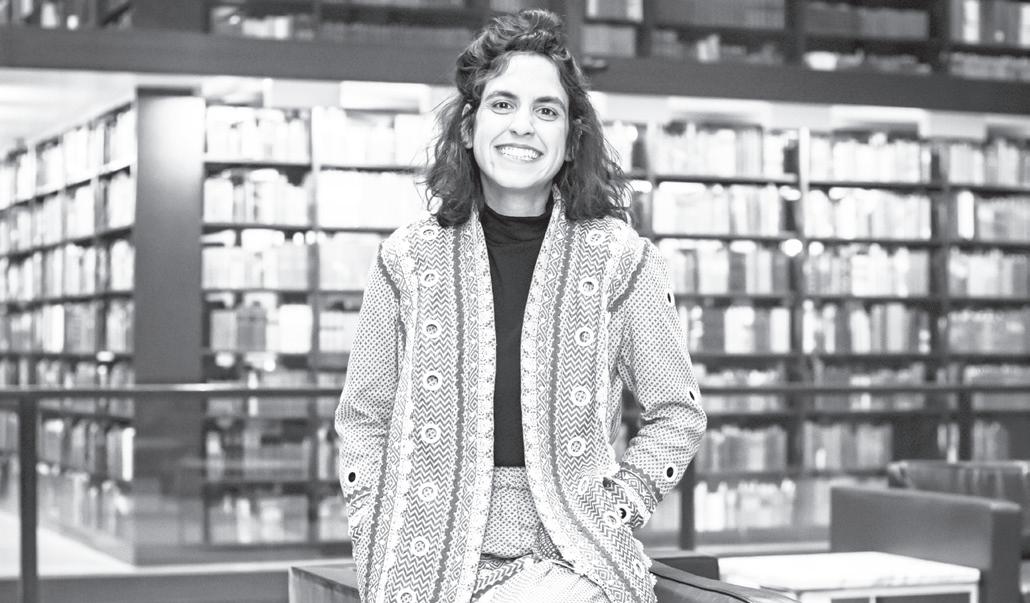
Meital Peleg Mizrachi, a postdoctoral fellow at Yale University and professor at the University of Connecticut, said people who thrift tend to overconsume. Her research spans sustainable fashion, consumer behavior and secondhand markets, and she found that people often buy more when items are cheaper, and keep them for shorter periods.
“They end up generating more textile waste than consumers only buying the primary market,” she said. “It’s a good thing as long as it doesn’t make us overconsume.”
Her advice: before buying another garment, ask yourself a few questions.
• Can you wear it for the next five to 10 years?
• Are you going to wear it more than 30 times?
• Can you wear it to more than just one place?
Damenica Ellis welcomes reader responses at dellis@ spokesman-recorder.com.
to



Kenisha Ama’anii
Courtesy
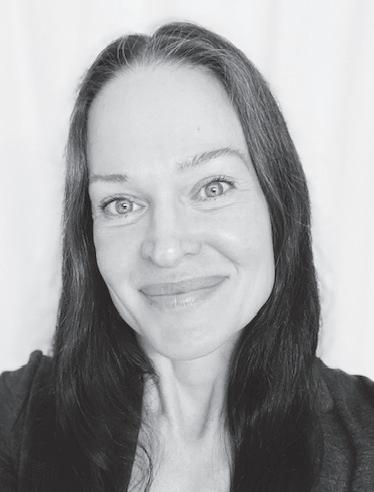
Meital Peleg Mizrachi Courtesy
agent outside a Target store on East Lake Street.
Phillips also said a federal agent drew a weapon on her after she was forced to drive in reverse down a one-way street in Richfield. She was also present when a Homeland Security Investigations agent rushed out to retrieve a car after Minneapolis City Council Member Jason Chavez had it towed.
Her arrest outside Cities Church came during a momentary lull in the demonstration.
“Eventually they came over and they were just like, ‘All right, we’re arresting you.’ And I was like, wait, I wasn’t even yelling at that point. It was ridiculous. Yeah, it was a very confusing arrest,” Phillips said.
The confusion apparently extended to jail staff during
MISSING
Continued from page 1
girls are navigating, while centering the voices of impacted families."
Since opening, the office has faced significant challenges. Among them is simply making people aware it exists, and that the epidemic it was created to address is real.
"There is still a gap in understanding the realities Black women and girls face," Burkes said. "And as a six-person team, we are balancing community outreach, training, collaboration and direct family support, all without a national blueprint to follow."
A second barrier is data. The office does not yet have direct access to law enforcement systems and missing persons data, making it difficult to fully map the scope of the crisis. And then there is the media.
HUSTLE
Continued from page 1
social spaces, including more communal healing events.
Eighty percent of millennials say hustle culture leads to burnout and/or health issues. Across every other demographic measured, more than half of each generation agreed, according to a September 2024 survey by Monster.
Esther, a licensed clinical social worker, therapist, mental health influencer and founder of Soleil Therapy and Wellness in Atlanta, believes it’s important to understand where work practices came from to understand their effect on people, especially those of color.
Hustle culture is embedded in American work culture and is highly connected to the Protestant work ethic, which is foundational to Western Christianity, she said.
An example she gave is that in the Protestant work ethic, how hard you work and the outcomes of that work are correlated to your closeness to God.
“While that seems super random, that has also been infiltrated throughout the foundations of American culture and even down to why we have a five-day work week instead of a four-day work week,” Esther said. “When we translate that to people of color, especially
her intake at Ramsey County jail.
“The officers that received me at the county looked at the charges, and they were like, ‘I’ve never seen any of these before,’” Phillips said.
“And even when they were searching them, because I was listening to them search my charges, they weren’t coming up as anything. So they had to choose what to put them as, because they weren’t coming up in the database as anything. So the people literally don’t get brought in on these charges. This guy just wanted to do a resume.”
Activist William Kelly, who was charged in connection with the Jan. 18 protests, said the arrest was more about a power trip than enforcing city law.
“What we have is a case of an officer being butt hurt.
She did not commit a crime.
She was practicing her First Amendment right to peace
"'Missing White Woman Syndrome' is real," Burkes said. "Many people can name a missing white woman from recent years, but far fewer can name a missing Black woman or girl. That disparity impacts urgency, resources and outcomes."
Flanagan echoed that urgency, warning against a mindset that pits communities against one another in competition for attention and resources.
"We cannot fall into the trap of scarcity… that colonial mindset that tells us there is not enough care, not enough justice, not enough attention for all of our communities," she said. "That mindset divides us and weakens us."
For Amarie's family, the disparity in media coverage has been painfully personal. Kilgore said that as other high-profile cases captured public attention in the months after Amarie's death, their efforts to keep her name visible became even harder.
Black people in this country who have always been seen as a work product, we internalize it in even more ways and in more insidious ways.”
For white Americans, hustle culture can look like working all day, oftentimes on the backs of other laborers, with social capital through marriage and generational wealth, along with familial styles and supports that allow them to stay home longer or work longer, and access to self-care and insurance. By comparison, Black residents may carry generational trauma and ideas that work is connected to survival, not just passion.
The expectations placed on Black people through ideas such as Black excellence, which connotes that Black people are only excellent when they are hyperachieving, push the group to continue pressing toward hustle culture, Esther said.
Opting out of this culture is scary but necessary, she said.
fully assemble on a public Minnesota street,” Kelly said.
“The officer was mad that she questioned his authority, so he knew there would be no charges. He knew that there would be no case, but he arrested her anyway, because the process is the punishment.”
Levy-Armstrong, also a civil rights attorney, took issue with Police Chief Axel Henry and city leadership following the arrest.
“I saw the videos of them lined up, not trying to be aggressive, trying to act like an extension of the Trump administration,” Levy-Armstrong said. “Shame on St. Paul Police and Mayor Her. We need an apology.”
Phillips’ attorney, Trisha Pohland, said her firm would represent other protesters at no cost should they be arrested going forward.
“We are representing not only Emily, but any of the
"It just kind of took away from Amarie's case," Kilgore said.
The family has had to do much of the legwork themselves: writing letters, contacting representatives, organizing a vigil, pushing for a reward. The office helped support the vigil and contributed to the reward fund, and staff attended Monday's event alongside the family.
"There's no other nonprofit group that even supported us the way they have," Yang said. "They are doing a really good job."
But both women are clear that more is needed, not just from the office, but from the broader community and from law enforcement. Robbinsdale Police, they said, are a small department unaccustomed to homicide investigations. In the first two months after Amarie's death, Kilgore said, no witnesses were questioned.
"They didn't even question nobody in the first two
“The system that was built on our backs is not willing to give anything back to us for the ways that we have labored.”
Christine Harris, an autistic and ADHD therapist who works exclusively with other neurodivergent people, defines hustle culture as a value system that prioritizes constant productivity, output and achievement; often at the expense of well-being, self-care, rest and health sustainability.
“It encourages people to override our own physiological limits in order to keep up with these external demands that are really in the long run unrealistic,” she said.
The problem, not only for neurodivergent people, but for everyone, is that their nervous systems are not designed to function that way, Harris said.
“We are not built for this continuous efficiency, urgency, increasing productivity and all of this stress without time
protesters that get arrested, we are representing them for free,” Pohland said.
Phillips said she has no regrets for speaking her mind, even when bluntly, about law enforcement’s actions.
“When David Easterwood is still the pastor there, they
months," Kilgore said. "That was very disappointing."
Kilgore also called for more community resources like programs, mental health support and pathways for families who have no road map for what they are going through.
"Nobody wakes up like, 'I don't think my kid's gonna get murdered today,'" Kilgore said.
"You don't have a road map to that. But what are some things and precautions and procedures for people that experience this?"
Flanagan spoke directly to those families from the Capitol steps, pushing back against any framing that reduces victims to data points.
"You are not statistics," she said. "You are daughters, you are sisters, you are mothers, you are aunties, you are cousins. You are children of God."
Director Burkes stressed that the office is working to build an advisory board rooted in lived experience, made up of community members, survivors and victims' families,
to recover from it.”
Burnout can affect those with autism to the point of skill regression, Harris said.
“I think that’s just a really extreme version of showing how much this burns people out.”
Harris said she is seeing more people, especially those who are neurodivergent, experiencing exhaustion, and those who can are opting out entirely.
“I think just the fact that it’s so widespread is not showing that it’s like any kind of personal failure or lack of resilience,” she said. “It’s just people reaching the limits of what their bodies and their minds can actually tolerate.”
More than half of each generation views hustle culture as an outdated approach to working, the Monster survey shows. Factors that affect whether someone can opt out, and to what degree, include economic demands and caregiving needs.
“You might not have the option to opt out of this, you might be forced to just continue pushing yourself on and on and on, no matter how badly it affects you, because this is just what you need to do to survive in this society,” Harris said. “It is very, very much a systemic issue.”
Esther believes the results of the 2024 presidential election fueled people’s recent change in values and lifestyles. Many Black women realized they cannot be good enough for a capitalistic society that only sees them as a work
Chris Juhn/MSR
don’t just get to scare people away by putting charges on people. That’s not how free speech and a free society is supposed to work,” Phillips said. “If they are truly Christians who love thy neighbor, they should demand that he no longer be a pastor there.
to shape its direction going forward.
"What we've learned, time and time again, is that women and girls have been telling their stories for decades," Burkes said. "The difference now is that someone is finally listening, and that must continue."
“There’s no other nonprofit group that even supported us the way they have.”
As the Walz-Flanagan administration enters its final year, Flanagan was clear that the work must outlast any administration.
"This work did not begin in government. It began as a movement, and it will continue as a movement because of you," she said. "My occupa-
product, she said.
“We saw ourselves in Kamala [Harris], to have been the most qualified presidential candidate and still be seen as not good enough.”
This, along with Donald Trump’s presidency, has led people to take more breaks, take more time off and invest in their families and hobbies, Esther said.
In her practice, working primarily with high-achieving women, Esther helps deconstruct ideologies that keep them in those work cycles.
One method she created is called “trauma languages,” which helps people identify burnout. A lot of the time, Black people feel disconnected from their existence and from their bodies, she said, causing them not to realize when they are overworked until it’s too late.
“I work really hard to help [clients] reframe work and themselves, and for them to see themselves more clearly outside of what they do, and give them language and methodologies to detangle with them and for themselves.”
As success moves away from being defined by how much someone works, it moves toward how people feel once they clock out.
“I think the work used to be enough for itself, or we told ourselves it was the title, the money, whatever social status comes with it, but I think more and more of us are realizing that ‘if my life is lacking,
And as far as I’m concerned, all of the administration of that church is complicit.”
Cities Church Lead Pastor Jonathan Parnell expressed disappointment at Judge Mitchell’s decision, telling the Star Tribune that protesters “held signs with obscenities and yelled harassing comments at families and individual worshippers.”
“I did all of the things that they told me to because I did not want to get arrested,” Phillips said. “It is unsurprising that I was arrested at Cities Church. I knew going into this that no matter how minimal I thought my actions were, they were going to make a big deal of it because they’re already pressing charges against 39 people for peacefully protesting beforehand.”
Clint Combs welcomes reader responses at combs0284@ gmail.com.
tion might change, but my vocation is the same: to ensure that people are seen."
She closed with a direct message to Burkes and the office's future.
"I look forward to the day, Director Burkes, when you close this office because it's no longer a problem," Flanagan said. "Take up space. Continue to speak your truth, because this movement belongs to all of us."
Yang and Kilgore said they are hoping Amarie's story reaches someone who knows something.
"Keep putting her name out there so that she's not forgotten," Yang said. "She's not a statistic. She's not swept under a rug. We want justice." Anyone with information about Amarie Alowonle's death is urged to contact the Robbinsdale Police Department at (763) 531-1220.
Jasmine McBride welcomes reader responses at jmcbride@ spokesman-recorder.com.
then the work means nothing,’” Esther said.
Now, the question is who people are and what they are doing when they’re not working, and whether it’s worth the work, she said.
“For a lot of women that come through my practice, they’re realizing it’s not.”
As people rework how their lives look, social spaces that prioritize communal health, from restorative yoga classes to curated community dinners, are increasing.
This is something Esther said she is working toward doing more of creating more communal opportunities to slow down, not just for her clients.
“I think putting ourselves in our community first is so important,” Esther said. “I want to highlight the community aspect because communal healing is so much more important than we realize … We need each other now more than ever and I think that we have to invest in our own local and hyper-local and global communities in order to survive, resist and excel.”
Harris said she is encouraged to see more people opting out of hustle culture.
“I see it as more of a corrective response to a system that is really very destructive to people in general. This is not sustainable, so I think more and more people are realizing that.”
Damenica Ellis welcomes reader responses at dellis@ spokesman-recorder.com.
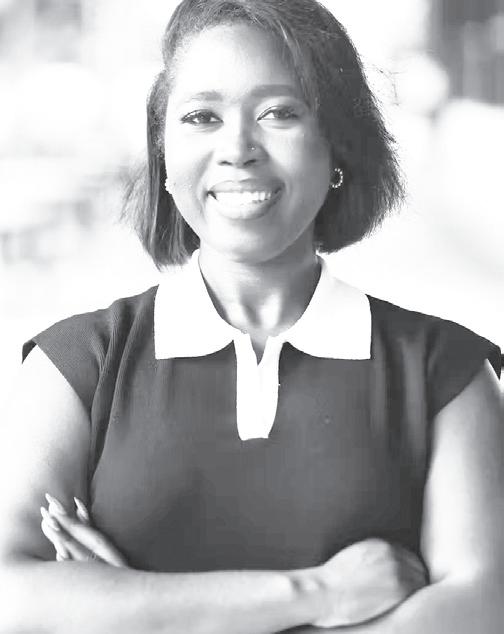
Christine Harris Courtesy
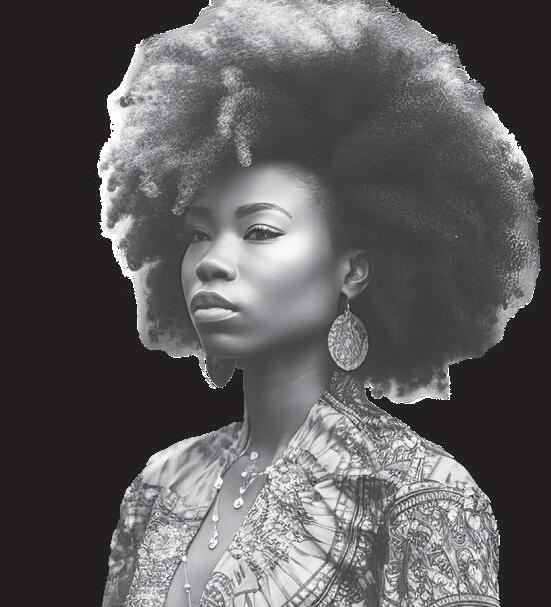
Vernique Esther Courtesy
Arts & Culture
Where diasporic silos are being conquered: Meet BOMJA
By Jasmine McBride Editor
The word hits differently when you know what it means. BOMJA, pronounced BOHMjah, is born from two languages and two corners of the African diaspora: “Nkabom,” the Twi word from Ghana meaning unity, and “Pamoja,” the Swahili word from East Africa meaning together. Blended into one, the name carries a mission: bring people together through rhythm, culture and shared space.
That mission came to life on Jan. 30 at the Cabooze in Minneapolis, when BOMJA held its first event. Less than three months later, on April 10, the collective returned to the same stage, and the room made clear that something real is being built here.
Walking into the Cabooze that Friday night felt like stepping into a living, breathing mosaic of Black culture. Durags and snapbacks moved alongside fur coats and leopard print. Box braids and locs filled the dance floor. Afrobeats, amapiano and hip-hop poured from a rotating lineup of DJs: DJ McShellen, DJ Guy, DJ MKZ, DJ D-Waynne and DJ MWAHHH, each one feeding the energy of a crowd that didn’t need much convincing to move. The night was hosted by up-and-coming Afrobeats artist OC Mack and KP, who kept the vibe grounded and celebratory all at once. Dance circles formed and dissolved and formed again. Nobody was

a stranger for long. This is exactly what Kojo Frimpong, CEO and founder of BOMJA, set out to create, not by accident, but by design.
“It’s a reminder that we have more in common than we think.”
“Growing up and being in different spaces, I noticed how people from similar backgrounds could still feel disconnected, whether it was because of culture, music, or just not feeling like they fully belonged,” Frimpong said. “Even in social scenes, things felt divided, like certain spaces were
for certain groups.”
Frimpong said he also saw the antidote to that division playing out in real time, in the power of music and shared environments to dissolve walls that words alone couldn’t touch.
“When the right song plays or the right energy is created, people drop their guard and connect naturally,” he said. “That stuck with me.”
So BOMJA was built to intentionally recreate that feeling, a space, Frimpong said, “where culture isn’t separated or compared, but experienced together.” For young people across the diaspora who have grown up code-switching between worlds, straddling identities and sometimes feeling like they don’t fully belong anywhere, that kind of space isn’t just fun. It’s necessary.
Frimpong is clear-eyed about the deeper tensions BOMJA is working against. Divisions within the diaspora, between African and Caribbean communities, between first-generation immigrants and American-born Black people, between those who grew up with Afrobeats and those raised on hip-hop, are real, he said. And they didn’t appear out of thin air.
“A lot of it was taught, reinforced, and passed down over time,” he said. “So it makes sense that people still feel that separation.”
But Frimpong believes proximity is a powerful teacher. BOMJA doesn’t claim to fix generational fractures overnight. What it does is put people in the same room, dancing to the same music, breathing the same air, sharing the same
energy, and letting that do the work of transcending the barriers.
“It’s a reminder that we have more in common than we think. BOMJA is the physical experience of unity. Not just talking about it, but actually living it.”
That distinction, between performing unity and actually practicing it, is what sets BOMJA apart from a simple night out. In an era where diaspora identity is increasingly visible in fashion, music and social media, there is no shortage of spaces that celebrate Blackness in the abstract. BOMJA asks what it looks like to live it together, in person, across differences.
For Frimpong, the work is
personal, and he isn’t stopping anytime soon. When asked what keeps him going, he didn’t hesitate.
“You can’t fail unless you quit,” he said, “and quitting is for losers. I am far from a loser.”
But it is also collective work. He emphasizes the collaboration of his team that helps enhance the vision of BOMJA, like Chief Operating Officer Manasseh Williams.
With two larger events into the new year, and a few intimate ones in between, BOMJA is just getting started as a movement in the making. If you’d like to experience it yourself, their next event kicks off in collaboration with another culture organizer, ARUSA, on June 12, at the Cabooze. For more information, visit BOMJA’s instagram at @ bomja.hq.
Jasmine McBride welcomes reader responses at jmcbride@ spokesman-recorder.com.
Building without waiting: Amara Anieke
By Jasmine McBride Editor
Amara Anieke doesn’t wait for the right moment. At 27, the Nigerian-born, Minneapolis-based entrepreneur and executive producer is simultaneously building across five industries: prestige television, documentary film, water infrastructure technology, conflict intelligence and brand strategy. Not sequentially. Not someday. Right now.
“The moment is now,” Anieke said. “You can’t say I’m gonna do this tomorrow, I’m gonna do this next week. What’s gonna be the difference between today and next week? The sun is still gonna rise and the sun is still gonna set. So if you can do it today, why not do it today?”
Anieke grew up in Nigeria watching his parents run multiple businesses at once, a blueprint that stuck with him long before he had a name for it. After earning a bachelor’s degree in material science and metallurgical engineering, he worked in oil and gas before moving to the United States to pursue a master’s degree in manufacturing at a Minnesota university. There, he joined a fellowship called New Product Tech Venture, which helped entrepreneurs scale ideas into business concepts. The engineering precision he had built over years in the field didn’t disappear, it became the foundation for everything else.
“The system-thinking applies everywhere,” he said. “Once you understand that, there is really no reason to limit yourself to one thing.” His entry into film came even earlier. In his second year of college in Nigeria, he joined a theater group that staged a state production. Film industry professionals attended, noticed his work and offered him and his team mentorship in film production. The seeds of a creative life were planted alongside his engineering career, and both have been
growing ever since.
Today, Anieke is in preproduction on “Two Minutes,” a prestige limited series he writes and produces, telling the true story of a girl from Alabama from age three through her teenage years. A short film version is being prepared for submission to the Sundance Film Festival. He is also developing “STILL,” a documentary series that follows subjects through a full day, camera in tow, before weaving in interviews about their past, their turning points and their inte-
rior lives.
“We’re telling the story from what people do not see,” he said. “Their innermost self. The interior part of a person, what’s beyond them waking up in the morning and having breakfast and going to the gym. How do those little things really shape our life in the long run?”
His reach extends well beyond the screen. AquaGuard, one of his most personal ventures, is an IoT water quality monitoring system designed for Nigeria and other regions in West Africa, where wa-
terborne disease remains a persistent public health crisis. The device installs into a home’s water supply and allows residents to monitor pH levels, turbidity and temperature, in real time from their phones. A prototype is currently being tested in a Nigerian household, with a longer-term vision of building a national data infrastructure for water quality, something the country currently lacks.
“The World Health Organization tracks water surveys every three to five years just by asking human surveyors,” Anieke explained. “What we’re creating is a system that gives you real-time data of water quality in different areas in Nigeria.”
“I’ve never been a looker. I’ve never been a watcher. I act.”
Then there is Persecuted Nigeria, a conflict and persecution intelligence platform built for policy researchers. Inspired by the gap between what is actually happening in Nigeria’s most volatile regions and what gets reported, or suppressed, the platform aims to provide an interactive, real-time map of violence, displacement and persecution verified by people living through it.
“Our government suppress-
es the press,” he said. “There’s no transparency. What Persecuted Nigeria is doing is helping create a verified, real-time conflict intelligence platform.”
Across all of it, Anieke is also co-executive producing “Thanks For Coming,” a YouTube podcast series hosted by Grandprince Ita and filmed in Nigeria, featuring guests including acclaimed actress Omotola Jalade-Ekeinde. He also serves as brand strategist for Everyday Bread, a faith-informed apparel brand based in South Africa preparing for a May launch.
All of this, while working full time as a quality manager at a Minnesota engineering firm. Anieke is clear that none of it is built alone. When asked what kind of leader he is, he doesn’t hesitate.
“I’m a team leader. I don’t know how to be a lone wolf,” he said. “The one major thing I look for in anybody I’m associated with is passion, because
I’m a very passionate person, and I want to be surrounded with passionate people.”
What ties everything together, he said, is a single instinct: he sees gaps, and he moves toward them.
“I’ve never been a looker. I’ve never been a watcher,” Anieke said. “I act.”
To learn more about Amara Anieke and his work, visit amaraanieke.com.
Jasmine McBride welcomes reader responses at jmcbride@ spokesman-recorder.com.
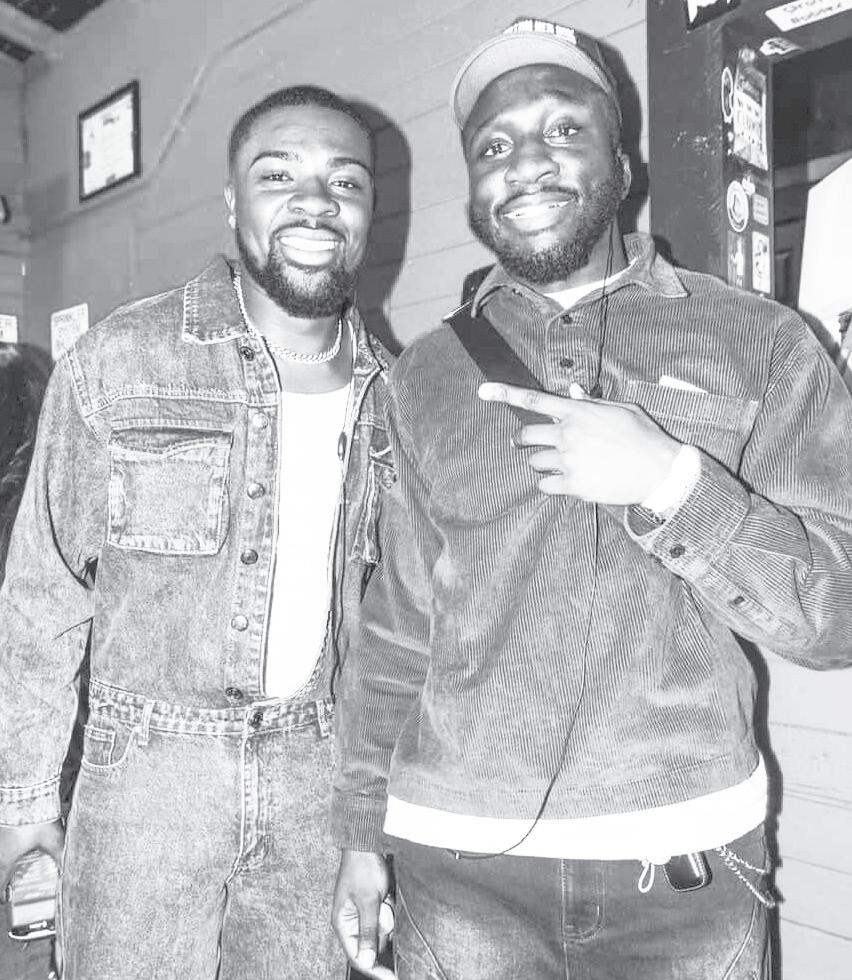
(L-R) Manasseh Williams and Kojo Frimpong Courtesy
Hundreds gather at the Cabooze for BOMJA’s “Pon de Replay” event, April 10. Jasmine McBride/MSR
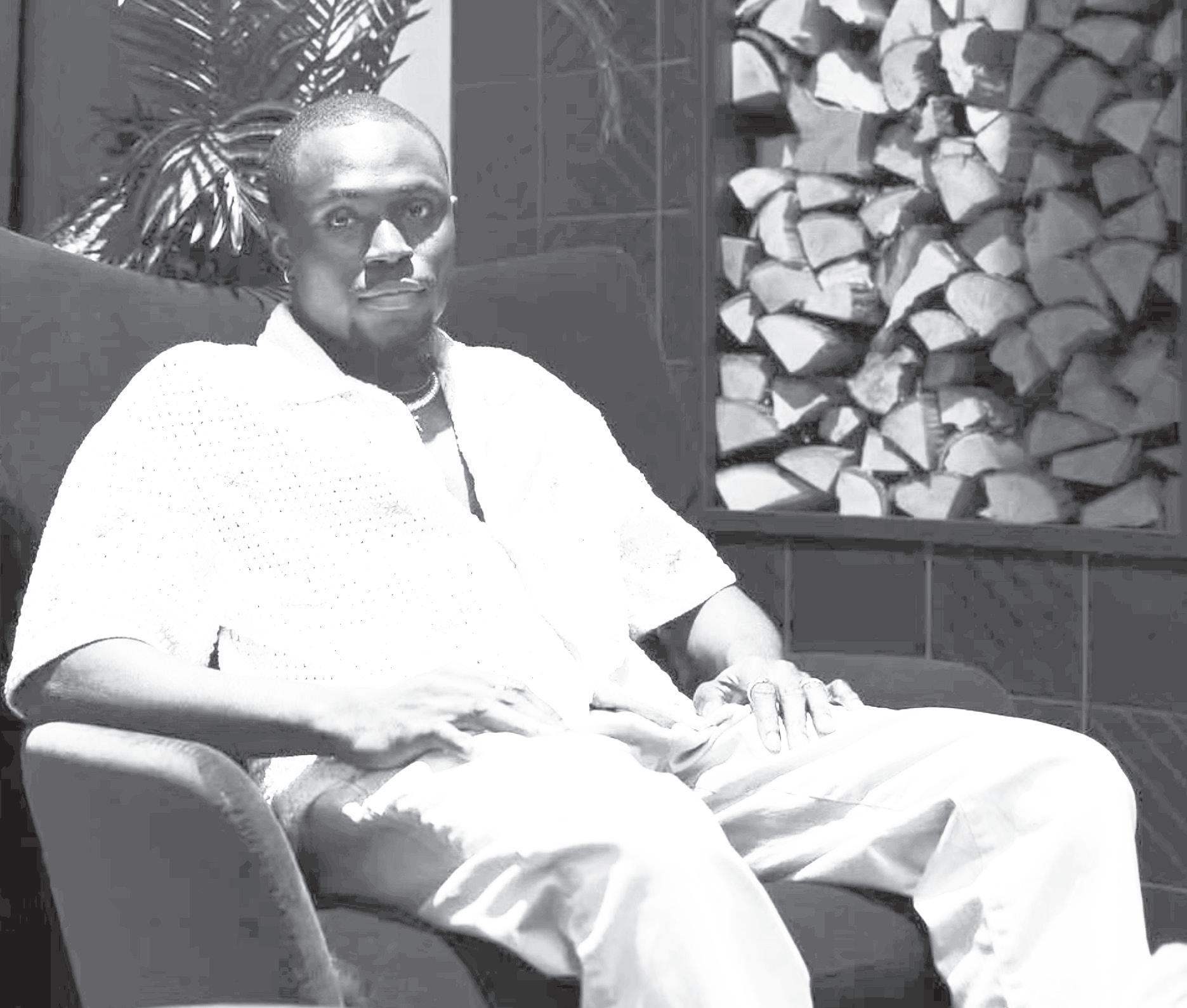
Amara Anieke Courtesy
Education
Dr. Brittany Lewis challenges institutions to build a new table in debut book
By Destiny Kromah Contributing Writer
As a Minnesota native, Dr. Brittany Lewis admits she is deeply invested in the innovative change the Twin Cities represent and in the numerous possibilities the cities offer. However, the cities, and the state itself, struggle with performative action from activist organizations and powerful institutions. These actors don’t serve the communities they intend to help, and as Dr. Lewis explains in the introductory chapter of her book, the disconnection is harmful. Living inside this contradiction, Dr. Lewis writes about ways to address and alter the traditional research process and how to close the gap between communities and researchers.
The phrase “building a new table” represents the reconstruction of who gets a seat at the table and who has been historically left out. Dr. Lewis mentioned Shirley Chisholm, the first Black congresswoman, who famously coined the phrase, “If they don’t give you a seat at the table, bring a folding chair.” At the time, it was revolutionary for a Black woman to assert that kind of agency. However, Dr. Lewis suggests
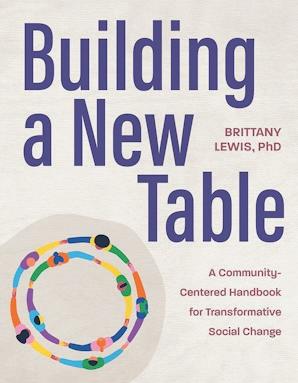
that it is now important to encourage communities to operate by their own systems. “We don’t want to bring a folding chair to someone else’s table, we want to build a whole new table,” she states. “We aren’t coming to your table.”
Dr. Lewis states in her book the importance of failing well and recovering during the journey to shifting research models. The throughline of her book is that the change people seek is centered around the development of self-awareness. “Failing well is making a commitment to lean into discomfort,” she writes.
“Knowing when to show up for change, and when to step back and when to step forward.” She encourages readers to analyze what is apparent in their bodies during difficult
conversations and to examine their interpersonal growth as active community members. Dr. Lewis explains how these considerations are crucial to becoming a reliable part of the reconstruction process.
To Dr. Lewis, failing well means existing in a supportive ecosystem where mistakes are allowed. A system that lives far beyond strategic outcomes and policy and starts with people and their capacity to grow. She hones in on the importance of constructive feedback rather than shame, noting that it is rare in professional spaces for people to discuss the difference. “What does it mean to be part of an ecosystem that will hold you, not shame you?” is a question Dr. Lewis recommends readers ask themselves.
One of the main themes of Dr. Lewis’ book is how institutions can shift from performative action to genuine leadership. Something she argues cannot be achieved without understanding the value of sharing power. “How do you relinquish power, and still be an important part of that ecosystem?” Institutions and organizations must ask themselves this question and reevaluate their strategies with the understanding that those they want to serve
"What does it mean to be part of an ecosystem that will hold you, not shame you?"
may have solutions that differ from their original plans. She believes this work must come before engaging with communities, as many institutions act without their guidance, making communities passive actors in their own betterment. Breaking down this paternalistic mindset, she argues, is step one. While Minnesota is known for its wellmeaning humanitarian politics, Dr. Lewis encourages readers and policymakers to think beyond good intentions. “What can I do with ‘well-meaning’?” she asks. Within the book, institutional and personal accountability is a central concept, and readers should expect to selfreflect and ask how they, too, might be part of the problem.
Dr. Lewis explains that one of the hardest parts of shift-
ing from traditional research models is rejecting “objectivity.” She argues that the notion of what is objective, academically factual and efficient has been historically defined by white cisgender men, scholars who tend to position themselves as neutral without recognizing the power dynamics they have created. Not only is the normalization of this narrative rejected in her book, but throughout her life’s work. Creating space specifically for queer Black women to redefine objectivity is one of Dr. Lewis’ driving motivations.
Dr. Lewis’ Equity in Action model challenges the existing framework for executing social change. She explains how the model is constrained by capitalism and, to combat this, she
Macalester professor traces Jesse Jackson’s civil rights legacy at Hamline Symposium
By Anya Armentrout Contributing Writer
Hamline University’s Social Justice Symposium Week opened April 7 with a keynote address from Walter Greason, a civil rights scholar and professor at Macalester College. His talk, titled “Prophetic Rhetoric, Direct Action,” examined the Rev. Jesse Jackson’s role in carrying forward the civil rights movement.
Greason argued that Jackson’s most revolutionary contribution was affirming the value of not only Black life, but of all human life. “Jesse Jackson is one of the first people to operationalize the idea that people from all backgrounds all have value, that our fundamental human dignity must be respected at all places at all times,” he said.
For attendees like Khadijah Sookhanan, that message felt especially relevant. She said today’s activists can learn from Jackson to “stand ground in themselves and what they do, and also be outspoken against all injustices.” She also emphasized the importance of sustaining that work even when it feels exhausting.
Kareem Watts, Hamline’s director of the Hedgeman Center for Student Diversity Programs and Initiatives and one of the event’s organizers, said Jackson’s focus on universal human rights was a key reason he wanted the symposium to center on the activist.
Environmental justice was the symposium’s other focus.
Jackson’s emphasis on dignity influenced Watts’ own leadership philosophy. “Certain folks… the rich, wealthy, leaders with major titles and corporations will say that only these people that are in this class have value, but he saw all people with dignity and value,” Watts said. “I try to also lead by that example, recognizing everyone, even a small gesture of saying ‘Hi’
and a smile, not just to staff and faculty and students, but to custodians and the workers in the cafeteria.”
Greason traced the concept of universal human dignity to the African Methodist Episcopal Church. He described the AME Church as having built, 80 years before the Civil War, “a free society within a society that is dedicated to segregation and enslavement.”
Beyond worship, AME communities established schools, businesses, libraries and literacy programs, even without the right to vote.
Greason argued that work laid the foundation for American freedom, and that neither the Civil War nor the Rev. Martin Luther King Jr.’s movement would have been possible without it. “The only way we get here is because of the previous 130 years of struggle,” Greason said. “All on this vision, on this belief that we should be able to come together no matter where we’re from, no matter what our background is, no matter what religion or what language we speak.”
That is the tradition Jackson inherited as he worked to actualize King’s dream.
Drawing from earlier leaders, Jackson made their ideals tangible through both rhetoric and direct action. His signature phrases, “I am somebody,” “Keep hope alive!” and “Yes, we can!” resonated with attendees, who connected them to today’s rallying cries of “Black Lives Matter” and “No Kings.”
“Reverend Jackson was an architect,” Greason said. “He built the structure in ways that were not possible for his parents or his grandparents. He took the infrastructure that existed before him and said, this can be for everyone. This is the open door for anyone, anywhere in the world.
The idea of democracy is for everybody, that our self rule, our human dignity, our ability to vote, must never be threatened or taken away. … He redesigned corporations, he redesigned laws, he redesigned our basic assumptions about who we are and what we can accomplish.”
Watts said he hopes that message stays with attendees long after the symposium. “I would [hope] they leave the symposium with a new focus to really take action, to do something, whether that’s protesting or writing a letter to Congress or to the mayor or the governor, just taking more direct action,” he said.
Greason also noted how far society has come, pointing out that a gathering like the keynote would once have been illegal. That reflection resonated with Sookhanan.
“We’ve come a very long way,” she said. “To be in a space like this where we’re not feeling unsafe and at risk of our lives, it really resonates.”
Both speakers and attendees acknowledged, however, that the work is far from finished. Greason closed with a reflection on the ongoing Artemis II lunar mission: “I think
I just heard somebody circle the moon saying something about human dignity and the
love that we should carry for each other into the future.
“asks the person with the biggest pocketbook to leave the table.” She makes clear that this book is not written for impacted community members, who have already lived the experience. It is intended for investors, funders and those in positions of power who are exerting that power through institutional action and “missing the dial.” “This is for the well-meaning person who claims they want to do better but keeps missing the dial,” she says. Dr. Lewis hopes readers finish the book understanding that there are many paths to success. “People will try to tell you there is only one way… don’t believe them. I will show you ten.”
Dr. Lewis has risen through the ranks and achieved success across many different corners of her life. As a former college professor, Minneapolis Federal Reserve Bank scholarin-residence and founder and CEO of Research in Action, she has become a decorated, sought-after leader. Her book echoes the importance of transparency, accountability and the discarding of ego in order to create authentic social change in community spaces. For more information, visit https://www.upress.umn. edu/9781517919450/building-a-new-table/.
Destiny Kromah is a Macalester college student and contributing writer for the Minnesota Spokesman-Recorder
It’s one of the most powerful messages we can ever participate in.”
Anya Armentrout is a freelance journalist, a student at Macalester College and a contributing writer for the Minnesota Spokesman-Recorder.
Dr. Brittany Lewis Photos courtesy of University of Minnesota Press
Walter Greason Anya Armentrout/MSR
Opinion
DevSecOps Engineer: Plymouth, MN
IT Company seeks DevSecOps Engineer to integrate security practices into DevOps workflows, automate security checks, and ensure the safety of cloud infrastructure. Work closely with development and security teams to enhance the security posture of applications and systems. Build and Configure delivery environments by using CD/CI, Agile delivery methodologies. Create and assist in performing various types of tests. Perform troubleshooting. Generate customized reports. Offered Salary: $116,480.00 to $116,500.00/yr. Send resumes to: HRD, VITS Consulting Corp., 14264 23rd Ave N, Plymouth, MN 55447.
By Dr. Frances “Toni” Draper
The pushback against diversity, equity and inclusion is not new. For years, these efforts have been questioned, criticized and quietly rolled back. But what we are witnessing now is different. What was once rhetoric is now enforcement.
By June Jordan
Used to be a time when most of us were field niggers.
Back then hardly any of us stayed up in the Big House, watching de Massa do his thing, throwing salt or arsenic in the soup. But now every last one of us is a house nigger, for a fact. From Brooklyn to Los Angeles, we all stay in the Big House and, what’s more, we pays de Massa taxes for our troubles!
This Big House belongs to me and you. The fields beyond belong to the Vietnamese, the Black peoples of Southern Africa, the Palestinians of Northern Africa, and the Brown and Black peoples of Nicaragua, our victim cousins making their way to freedom. And whether they speak Spanish or Xhosa or Arabic, these new field niggers expect the rest of us here in the Big House to watch de Massa and take appropriate care of de Massa’s soup!
Why don’t we do that?
We can’t say we’re too few or too weak or too ignorant!
How many of our victim cousins own a pair of jeans? How many of them own a radio or have the choice between meat and brown rice? Over here we eat so much
we have to jog around the block. We walk away from public libraries that can tell us of the life of Fannie Lou Hamer and how to build a nuclear bomb. We have telephones and 35 million other house niggers we can call. Yet, how can we hope to keep our jobs, our books, our music, our base of safety from the avaricious Massa, unless we make this Big House safe for the needy from Soweto to Beirut to Managua to Detroit?
Who will we become if we remain the silent partners to this white arrogance?
where to subjugate any First World peoples resistant to Israeli/South African/American rule. Can you imagine Detroit with an extra 6.8 million dollars a day pouring into it?
Granted de Massa and his friends have no business assuming God created the fields of the earth for a white man’s paradise plantation. But we have no excuse letting them take our piece-a money to carry out their fantasies.
In a federal lawsuit filed this year, the Equal Employment Opportunity Commission sued Coca-Cola Beverages Northeast over a women’s networking retreat. The case stems from a complaint filed by a male employee and centers on a 2024 womenfocused professional development event for which attendees were paid and excused from work. The EEOC now argues that excluding men from that opportunity constituted unlawful sex discrimination under Title VII of the Civil Rights Act of 1964.
ing agencies and contractors to eliminate DEI-related programs in hiring, contracting, and operations, the pattern becomes unmistakable. On one hand, the federal government has removed the expectation that institutions pursue equity. On the other, it is signaling that even voluntary efforts to support underrepresented people may now carry legal risk. Together, the message is clear: Do not prioritize diversity. Do not pursue equity. Do not create inclusion. And if you do, you may be challenged.
women’s unemployment now exceeding 7 percent. This is what researchers call an economic crisis.
And yet, Black women are not standing still. Organizations like Win With Black Women have mobilized thousands and helped shape leadership at the highest levels of this country. But at the very moment that collective power is growing, the pathways that made that progress possible are being narrowed. That is not accidental. That is reaction.
The language has changed, but the pattern has not. When efforts to expand opportunity are dismantled, and the burden shifts back onto those historically excluded to justify their presence once again, we are not witnessing neutrality. We are witnessing a system of control.
Everyday de Massa spends your and my piece-a money on nuclear blippety-do and general killer equipment. He delivers more than 6.8 million dollars a day to Israel, a country that has fewer people in it than the city of Detroit! Our money flies to Israel in the form of planes and tanks that do de Massa’s dirty work: Israel sells the stuff straight to South Africa or peddles it else-

submissions@spokesman-recorder.com
submissions@spokesman-recorder.com
ads@spokesman-recorder.com
submissions@spokesman-recorder.com.
This year, Representative Ronald V. Dellums (D. Calif.) is a leading plaintiff in an extraordinary lawsuit (Sanchez v. Reagan) against the President and the Secretary of State, among others. He charges the President with violating the Constitution and the War Powers Act by conducting a war without congressional approval (in 1981, Reagan approved 19 million dollars for the CIA’s efforts to “destabilize” Nicaragua’s revolutionary government).
Is this man crazy?
Well, no. He understands that the heart that hates niggers in the Big House is the same one hatting niggers in the field. He knows that if the house niggers and the field niggers ever got together, Massa would be paying overdue!
Inside the Big House our mothers and grandmothers worked down on their knees so that we could stand up. They kept their eyes on a house ahead of them, a house full of family come to freedom. Now we sleep inside the Big House. Will we let ourselves and our family in the fields just grovel down and die, domesticated by de Massa? Or will we join our cousins in the field, and clean it up?
This piece, “Black Folks and Foreign Policy,” originally produced by June Jordan, in Essence, June 1983, is being republished from the Black Agenda Report. For more information, visit https://www. blackagendareport.com/essayblack-folks-and-foreign-policyjune-jordan-1983.
But what makes this moment more striking is the posture of the agency itself. Under the leadership of Andrea Lucas, recently elevated to EEOC Chair, the agency has taken a more aggressive stance publicly encouraging men, especially White men, to come forward with claims tied to diversity initiatives. That shift is more than unusual. It is revealing. And it is disturbing.
Placed alongside the most recent presidential executive order rescinding prior federal DEI directives and instruct-
This is not about one retreat. This is about dismantling the infrastructure of access. And the consequences are already visible. According to the Institute for Women’s Policy Research, more than 113,000 Black women lost jobs in 2025 alone, with over 250,000 losses in just the first eight months. Black women, only 14 percent of the female workforce, accounted for more than half of all women’s job losses. Data from the National Women’s Law Center shows Black
History repeats itself not always in form, but in function. And the danger is not just in what is being done. It is in how quietly it is being accepted.
So we cannot afford to be silent. We must name it, challenge it, and stand clearly, collectively, and unapologetically for the access, equity, and opportunity that are already ours.
This opinion piece appeared first in Afro News. It has been cut for length. For the original version, visit www.afro.com/blackwomen-are-losing-ground-nowinclusion-is-on-trial/.
By Gail Christopher
If you consume a steady diet of daily news and political commentary, you might believe our nation is hopelessly fractured by race. Yet when we look past the noise and examine how people actually live their lives, a completely different reality emerges.
New research shows Americans are rejecting explicit racial bias and building meaningful, lasting relationships across racial lines. The Brookings Institution's "Interracial Cooperation in the United States" report and the National Collaborative for Health Equity's 3rd Annual Heart of America Survey show we are finding common ground, and that our capacity for connection is far stronger than the forces pulling us apart.
Rejecting the hierarchy
The Brookings report shows Americans reject the deeply flawed belief that some groups of people matter more than others. Nearly 9 in 10 respondents say race is not a factor in their business decisions, and 83% say the same when selecting friends. In hypothetical hiring scenarios, 85% of respondents demonstrated entirely race-neutral preferences, with qualifications and performance carrying the day.
The normalization of diverse lives Today, 83% of Americans
work alongside colleagues of different races, and nearly half have supervisors of a different race. These everyday interactions dissolve lingering stereotypes and reduce prejudice through shared experience.
We see this most clearly in our friendships. The study found that 72% of adults have at least one friend of another race, and more than half have a close friend of a different race. Among adults aged 30 and under, 35% are in interracial relationships, compared with 14% among those 70 and over. For younger generations, racial boundaries are becoming irrelevant in matters of the heart.
three-quarters of Americans agree that immigrants, regardless of legal status, deserve due process, and 77% believe immigrants enrich American society. More than 8 in 10 believe educating children on the true history of race and racism is important for reconciliation, a view shared by 90% of Democrats and 78% of Republicans.
Acknowledging the work ahead
Optimism does not require ignoring reality. Residential segregation and occupational clustering continue to limit interracial contact for many. But the data suggest our capacity for overcoming these barriers is strong. A decisive 86% of respondents said they would support a leader who actively works to unite the country, even if they disagree with that leader on specific policies.
A deep yearning for unity
The Heart of America Survey captures the nation's emotional pulse. More than three-quarters of respondents believe we can overcome our current challenges through shared understanding. Nearly 90% say they want to belong and trust one another. The consensus extends to issues often portrayed as hopelessly divisive. Nearly
The path forward lies not in digging deeper trenches, but in leveraging the massive reservoir of goodwill that already defines much of American life. The data are clear: we are a nation evolving, healing and yearning for unity.
This opinion piece appeared first in Word in Black. It has been edited for length.
Employment & Legals
Spanish Teacher (HS), Minneapolis Public Schools
Minneapolis, MN
Req. Bach’s degree in Educ, Teaching or related. MN teaching license in K-12 Spanish or K-12 Edu with ACTFL assmt of Spanish prof/ pending licensure. Fluency in written & spoken Spanish. $78,301/yr. Apply at https://jobs.mpls.k12.mn.us/job-invite/104120/. No agencies or phone calls.
Spanish Immersion Tchr (Elem)– Las Estrellas, Minneapolis Public Schools Minneapolis, MN
Req. Bach’s deg in Educ, Teaching or related field. MN Teaching License in Elem Educ & Spanish or Elem Educ with ACTFL assmt of Spanish prof/pending licensure. Fluency in written & spoken Spanish. $60,420/yr, Apply at https://jobs.mpls.k12.mn.us/job-invite/104122/. No agencies or phone calls.
SOE
Continued from page 10
young women, just like everybody else in this tournament," said Grace, who Howard hired in 2015. "As soon as I stepped foot on campus in 2015, I wanted to set the standard. And I think we've done a great job."
Howard's 26-win campaign was the most by any Howard basketball team, men's or women's, in school history, earning them a No. 14 seed in this year's NCAA Tournament, the highest in program history. Last week, Howard made the final Women's Mid-Major Top 25 poll for the 11th time this season.
The Prairie View men's
THIRD
Continued from page 10
when I tell them that I was at ESPN before Stephen A. (Smith),” Gray said proudly. “I’m glad I got in when I did.” Also reached for comment was another longtime Black sports radio voice, Kevin Stanfield, based in Washington, D.C. Some things haven’t changed, he noted.
team's historic season, however, ended with a lopsided loss to top-seeded Florida in the NCAAs. But the Panthers (19-18) also recorded their first ever First Four victory over Lehigh to advance to the Round of 64 for the first time.
Smith, in his 11th season at PVAM, has now won two SWAC regular-season titles (2018-19, 2019-20) and two tournament titles (2019, 2026).
"This is my 11th year here," Smith said after his team's first-round exit. "This is the best team in my opinion in the history of this university. So very proud of these guys for a remarkable year. I think brighter days are coming for Prairie View men's basketball."
"Anytime that we recruit
Office Manager, Sr Leadership Team, Minneapolis Public Schools Minneapolis, MN
From Ads Department/MN Spokesman-Recorder
Req. Bach’s Deg in Buss or Public Admin, or related field & 4 years exp as Education Administrator. Position will oversee administrative and operational functions. Salary: $99,006/yr. Apply at https://jobs.mpls.k12. mn.us/job-invite/104119/. No agencies or phone calls. From Ads Department/MN Spokesman-Recorder
Phone: 612-827-4021
FOR BILLING INQUIRIES & TEARSHEETS PLEASE CONTACT
ACCOUNTING DEPT
BILLING@SPOKESMAN-RECORDER. COM
Phone: 612-827-4021 FOR BILLING INQUIRIES & TEARSHEETS PLEASE CONTACT ACCOUNTING DEPT BILLING@SPOKESMAN-RECORDER. COM
VIEW Continued from page 10
remains predominately male (almost 70%).
From my press box seat, I constantly look for Black fans, young and old, in the stands. Too often it’s a rare sight as present generations rather watch basketball and football.
Dr. Josie Johnson is one of 12 Legacy Community Champions the Twins are recognizing this year, each honored on the field prior to Saturday home games this season and featured on the team’s Community Champions Wall inside the ballpark.
The “First Lady of Civil Rights” for her fierce advocacy for voting rights, housing and education, Johnson graciously spoke on what both the Twins and MLB could do to attract more Black fans, especially Black youth.
“Many of our people have experienced isolation for so long that you have to create an environment in which make us feel comfortable to
Elem SpEd Teacher, Minneapolis Public Schools Minneapolis, MN
EMPLOYMENT DISPLAY
From Ads Department/MN Spokesman-Recorder
Phone: 612-827-4021
SIZE 2 COL X 2 INCH RATE: $44.60 PCI
TOTAL: $178.40
Req. Bach’s deg in Educ, Teaching or related field. MN Teaching License: LD, EBD or ABS/pending approved license/ MN Elementary Teaching license & Out of Field Permission for EBD or ABS. Fluency in written & spoken Spanish. $80,899/ yr. Apply at https://jobs.mpls.k12.mn.us/job-invite/104121/. No agencies or phone calls.
a player," Grace said, "I'm recruiting them as young women first, and I want them to come into this program and know that we're going to take care of them, that they're going to have an opportunity to get a great degree from Howard University, and they're going to have an opportunity to win."
The other ACE MBB Honor Roll coaches: Kelvin Sampson (Houston), Antoine Pettway (Kennesaw State), Shaheen Holloway (Seton Hall), Eric Strothers (Tougaloo College), Jai Lucas (Miami), Rod Strickland (Long Island University), Kenny Blakeney (Howard), Craig "Speedy" Claxton (Hofstra), Larry Dixon (Morehouse College) and Devin Hoehn (Fayetteville State).
The ACE WBB Honor Roll coaches: Dawn Staley (South
From Ads Department/MN Spokesman-Recorder
Phone: 612-827-4021
“I was working at a Contemporary Christian station, I did the overnights and a buddy of mine did the evenings,” he recalled. “They called him in the office and said, ‘We’ve got a complaint that you were sounding too Black.’ That’s a legitimate
fear of White programmers and station owners. They don’t want to lose their audience.”
Today’s divisive climate
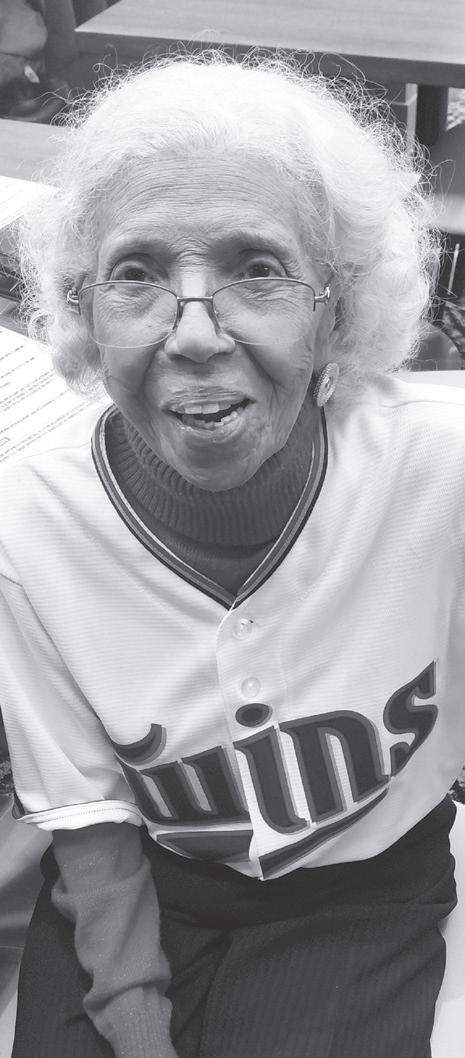
come to the games … and I think to recognize that, to talk about what’s going on in the community,” she said. Matt Hodson, the Twins’ business communications director, and I have had many conversations on this subject over the years.
“That is the hope of us,” Hodson said. “We’ve all done a very good job of increasing
youth participation in the sport.”
This includes several youth-designed initiatives, such as Learning Through Baseball, which started in 2012 to provide educational experiences both in the classroom and in the ballpark. The focus is on connecting baseball with math and science, environment, sustainability, stadium architecture, social studies and the language of baseball.
“T.C.’s Strike Out Plan” is for Twin Cities elementary grades K-6 with emphasis on mental health, and Reading Is Powerful offers young people baseball-themed books.
“We’re always looking at different ways,” Hodson continued.
Finally, Johnson stressed that it is not solely up to the Twins and/or MLB to get more Blacks watching baseball on television or attending games in person, but upon all of us.
“We must return our young people to scholarship,” she concluded. “That’s where we came from, and they don’t really know it, so we have
Please proof, respond with email comfirmation to ads@spokesman-recorder.com
FOR BILLING INQUIRIES & TEARSHEETS PLEASE CONTACT ACCOUNTING DEPT
BILLING@SPOKESMAN-RECORDER. COM
EMPLOYMENT DISPLAY
The MSR handles billing digitally. This means you will get e-tears and emailed invoices unless you specifically request a hard copy.
SIZE 2 COL X 2 INCH
RATE: $44.60 PCI TOTAL: $178.40
FOR BILLING INQUIRIES & TEARSHEETS PLEASE CONTACT ACCOUNTING DEPT
BILLING@SPOKESMAN-RECORDER. COM EMPLOYMENT
Please proof, respond with email comfirmation to ads@spokesman-recorder.com
Carolina), Kara Lawson (Duke), Amaka Agugua-Hamilton (Virginia), Dawn Thornton (Alabama A&M), Special Jennings (Jacksonville), Felisha Legette-Jack (Syracuse), Carlos Funchess (Southern), Pete Asmond (Miles College), Niele Ivey (Notre Dame) and Vanessa Blair-Lewis (George Mason).
The MSR handles billing digitally. This means you will get e-tears and emailed invoices unless you specifically request a hard copy.
Sadly, Agugua-Hamilton made the list before she was fired at Virginia on April 4 after four seasons and after guiding her squad to the school's first Sweet 16 appearance since 2000. It was reported that she was the subject of an internal investigation over staff mistreatment allegations.
Charles Hallman welcomes reader responses at challman@ spokesman-recorder.com.
makes it even harder to find diversity on sports radio, Stanfield continued. “As we see through society, people have hidden prejudices, and some of the prejudices aren’t hidden anymore. They feel emboldened now.”
“As we see through society, people have hidden prejudices, and some of the prejudices aren’t hidden anymore.”
Khan, Gray, Stanfield and this reporter all agree that Black voices in sports radio, both
nationally and locally, are still needed today more than ever.
“We do have a voice,” Stanfield said. “We can have our own voice if it takes a little work, and we just got to stick with it and do what it takes to get established in that line.”
“We’re just doing it on different platforms. I’m kind of waiting to see what the next iteration with AI and all that kind of stuff brings. I think there are new opportunities waiting for Black people with so much access to become their own channel,” Gray said. “I think we gotta take advantage of it.”
to tell them, bring them up… and people like you, writing and identifying and introducing scholars to our children so they make a connection. Because we have to do that.”
Please proof, respond with email tion to ads@spokesman-recorder.com
The MSR handles billing digitally. This means you will get e-tears and invoices unless you specifically request copy.
FINALLY … Legendary Black radio personality Bob Law joined the ancestors on March 30 at age 86. Law hosted the first national Black talk show, “Night Talk,” in 1981 on the now-defunct National Black Network, which launched in 1972 and closed in 1995. He also produced a 2010 documentary on the rise and fall of Black radio, “Saying It Loud,” which can be viewed on YouTube.
Charles Hallman welcomes reader responses at challman@ spokesman-recorder.com.
Charles Hallman welcomes reader responses at challman@ spokesman-recorder.com.
Kevin Stanfield
Photos courtesy of X
Dr. Josie Johnson Charles Hallman/MSR
chieving Coaching Excellence (ACE) recently announced its annual Black head college basketball coaching honor roll. Started after the 2019-20 season, ACE introduced the Honor Roll, which annually "recognizes leaders in women's and men's college basketball that demonstrate tenets of coaching excellence," according to April 2 and 3 press releases.
Sports
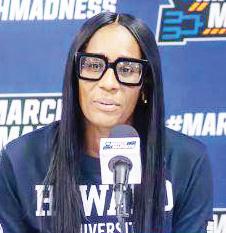
This year's Head of the Class is Tierra Terry of Winston-Salem State (WBB) and Nolan Smith of Tennessee State (MBB).
Terry led WSSU to a 28-4 record, a 21-win improvement from a season ago, won the 2026 CIAA Tournament championship and earned the program's first appearance in the NCAA Division II Sweet 16, and won her conference's
Coach of the Year award. All in her first season at the helm.
Smith led Tennessee State in his first season to a share of the Ohio Valley Conference regular-season title and the school's first No. 1 seed in the league tournament in 30 years. Smith also was OVC co-
Coach of the Year and recorded 15 conference wins, the highest in the Division I era.
Howard's Ty Grace (WBB) and Byron Smith of Prairie View A&M (MBB) both made their respective 12-member Black coaches honor rolls.
By Charles Hallman
o borrow from a 1972 Earth, Wind & Fire cover song, “Where Have All the Flowers Gone?,” where have all the Black voices on national sports radio gone? Yussef Khan’s First and Pen brought this up in his March 31 piece on former ESPN host and reporter Clinton Yates after he was let go four days earlier.
“What’s happening to the Black national sports radio host?” asked Khan. “At one time, prominent Black sports voices could be heard on airwaves across the country. Listening to mainstream sports talk radio and podcasts, you hear similar voices, practices and styles.
“And when it comes to discussions around coaching, these same voices frustratingly circulate the same names.”
In other words, the same old White voices speaking mainly on White coaches. And

ackie Robinson Day is Wednesday, April 15. All 30 MLB teams: players, coaches and managers, will wear Robinson’s No. 42, which in 2004 was permanently retired by MLB.
April 15, 1947, was the day the 26-year-old Robinson broke the majors’ color barrier with the Brooklyn Dodgers as the first Black player to play in the big leagues in the 20th century.
“I think he was the right person for the job,” said Minnesota pitcher Simeon Woods Richardson of Robinson (1919-1972). “He was UCLA educated, multi-sport athlete, military background, very smart and very capable of handling what was going on at that time, and all the obstacles he was handling with.”
some of these same old voices, and young ones for that matter, seem unbashful to bash Black athletes and coaches when given the chance.
This subject isn’t newsbreaking. We wrote back in 2017: “Sports radio, whether locally or nationally, remains the last holdout in media diversity … programmed by Whites, seemingly only for White listeners. If by chance a Black host is heard, typically that person was a former pro athlete as opposed to someone who’s Black and trained as a broadcaster.”
Of course, there were exceptions such as 2 Live Stews, the brothers Stewart, and Fred Hickman, among others, who had a national platform as Black sports talkers, as Khan briefly mentioned.
After reading his piece, we immediately reached out to Mark Gray, another Black trailblazer in sports radio.
Gray was the first Black host on ESPN Radio during its early days and the network’s first late-night weekend host.
He later hosted the first originally produced weeknight sports show on then-XM Satellite Radio, and was its first weekend host on the MLB channel, MLB Live.
Gray has more than 25 years of experience in multimedia communications across print, broadcast radio and TV as a play-by-play announcer for HBCU sports, on the web, and as an adjunct journalism college professor.
“I’m still doing my thing,” said Gray, who hosts a nighttime show on Sports Rap Radio, a reconstituted all-Black sports channel in Detroit. Sports Rap Radio first came
Both head coaches won their conference tournaments and NCAA automatic bids.
on the air on a White-owned AM sports station in 2024 but went off the air less than 90 days later. It is now heard on Detroit’s WGPR-FM HD2, a longtime Black-owned radio station, and online.
His current time slot once again gives him a national platform, Gray said. “That’s why I took the 9-11 slot at Sports Rap,” he said, “so I could get back to my West Coast audience because I realized that I connect with people on the west side of the Mississippi better than the average East Coast person.
“It blows people’s minds

memory and historic feat?
Minnesota, which has the most Blacks (5) on one team, this week hosts Boston, which was the last major league club to integrate, 12 years after Robinson joined the Dodgers, and this season the Red Sox have zero Blacks on their roster.
Along with Woods Richardson, Byron Buxton, Josh Bell, Royce Lewis and Taj Bradley are with the Twins this season. Woods Richardson and Bradley are two of 11 Black pitchers, and there is only one Black catcher: Atlanta’s Drake Baldwin.
“You say we have the most Black people on the team,” Woods Richardson said proudly. “It’s really cool and refreshing to see someone that looks like you in the same clubhouse.”
Grace's Howard Bison won their first MEAC championship since 2022 in a season that began with a trip to Portugal last summer and ended with an NCAA first-round loss to Ohio State in late March,
Fab Five
ere are some Fab Five moments!
Ellis-Milan resigns After leading East Ridge to the Class 4A state girls basketball tournament for the first time in school history, head coach Ashley Ellis-Milan resigned a position she has held since the 2020-21 season.
The former St. Paul Central and University of Minnesota star led the Raptors to a 23-7 record before losing to Maple Grove in the quarterfinals.
finishing 26-8. The team also recorded its first ever Power 4 win over Cincinnati, a win over Fairfield, which at the time was ranked second among the nation's mid-majors and an 11-0 undefeated home record.
"We go out to compete as
Moments
columnist Charles Hallman, a longtime assistant coach for the Minneapolis South boys basketball team, contributed to the Tigers’ run in the consolation bracket of the Class 3A state tournament last month. Son C.J. Hallman was on the sidelines as an assistant during Apple Valley’s surprising journey to a runner-up finish in Class 4A competition.
Central was first It was 50 years ago when St. Paul Central won the first girls state basketball tournament at the Class AA level, the highest level at the time, with a 49-47 victory over Benilde-St. Margaret’s. The Minutemen were led by sophomores Rita Burch and Lisa Lissimore, junior Linda Roberts, and seniors Debbie Krengel and Teresa Tierney. McMillan recognized Richfield boys basketball
It took nearly two decades later before MLB was fully integrated. However, for most of this century, the number of U.S.-born Black players in the majors has hovered around 7%.
What would Jackie see today, almost 80 years after his MLB debut, on the day that since 2009 is dedicated to his
MLB Opening Day 2026, approximately 52 U.S.-born Black players were on team rosters. 28 in the National League and 24 in the American League. It’s been more than a minute that Blacks make between 6-7% of the total number of MLB players.
This is my 26th year of covering both the Twins and the minor league St. Paul Saints. I’ve lost count how long I’ve been a baseball fan, beginning in my formative days growing up in Detroit. But according to Statista, the average baseball fan is around 57 years old and
Starks leads Hopkins Hopkins, under the leadership of head coach and former Minneapolis North standout Tara Starks, made yet another Class 4A girls state tournament appearance, finishing runner-up to Rosemount after a 63-62 nailbiter. Behind the outstanding play of Erma Walker, Jaliyah Diggs, Ava Cupito, Marianna Davis, Ava Smith, Lanaia Durant and Inarah Nesbitt, the Royals finished with a 27-3 record.
Father-son connection Hall of Fame MSR sports
coach Omar McMillan was recently honored with the 2026 John R. Wooden Award for Minnesota after leading the Spartans to a thirdplace Class 3A state tournament finish. Dre Collins, Tyrece Hagler, Gideon Horne, Waleed Muhammad, Adin Inda and Nathaniel Clifford led Richfield to one of the most memorable seasons. The Spartans finished with a 29-3 record.
Mitchell Palmer McDonald welcomes reader responses at mcdeezy05@gmail.com.
Sports columnist
Dr.
Former East Ridge coach Ashley Ellis-Milan Photo by Dr. Mitchell Palmer McDonald
Nolan Smith Courtesy of X Tierra Terry Courtesy of X Byron Smith Charles Hallman/MSR Ty Grace Howard Athletics
Kevin Stanfield Photos courtesy of X
Blacks and baseball 1, First in a series
Simeon Woods Richardson Minnesota Twins