tors, journalists and public employees are facing harassment after far-right influencers circulated their personal information online following the killing of conservative activist Charlie Kirk, according to social-media posts and interviews.
Chaya Raichik, creator of the Libs of TikTok account, launched the campaign with a post reading “THIS IS WAR” shortly after Kirk’s death. Former President Donald Trump issued a statement blaming “radical left political violence,” while making no mention of the recent assassination of former Minnesota House Speaker Melissa Hortman and her husband Mark.
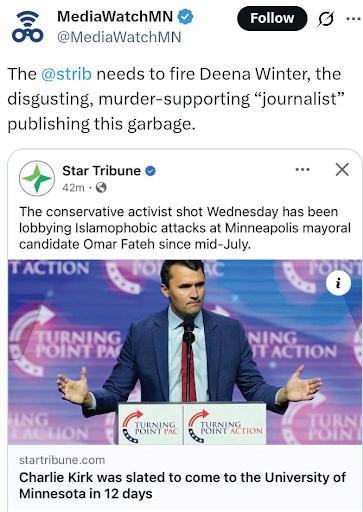
Among those amplifying the posts are Liz Collin, a reporter with the conservative outlet Alpha News and wife of former Minneapolis police union head Bob Kroll; the account @MediaWatchMN; and commentator Dustin Grage. The group reposted workplace details and personal information about local journalists and public employees, including Star Tribune reporter Deena Winter, and demanded she be fired for allegedly “celebrating murder,” a claim not supported by anything Winter has written. “So. Gross,” Collin wrote on X. “The @strib needs to fire Deena Winter, the disgusting, murder-supporting ‘journalist’ publishing this garbage,” @ MediaWatchMN added. Neither the Star Tribune nor Winter responded to requests for comment.
MediaWatchMN’s post calling for Deena Winter to be fired
Kirk’s controversial legacy Before his death, Kirk was widely criticized for inflammatory remarks about Muslims and Black leaders. He once accused Minneapolis State Sen. Omar Fateh, who is Muslim, of participating in an “Islamic takeover of America,” and
■ See KIRK on page 5
City nominates Spokesman-Recorder for national historic recognition
Phyllis Wheatley Center, Harry Davis home also nominated
By Jasmine McBride Associate Editor
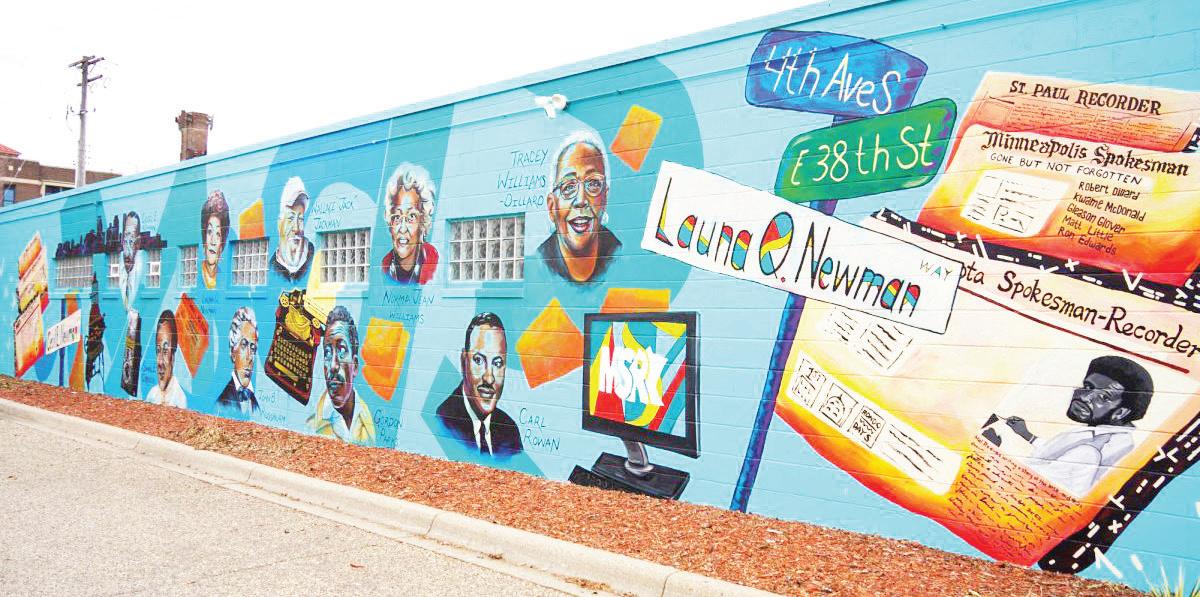
fter a year-long study, the City of Minneapolis is preparing to nominate three key sites in the African American community to the National Register of Historic Places, including the Minnesota Spokesman-Recorder (MSR), the state’s oldest Blackowned newspaper. The nominations are part of a broader effort to preserve the legacy of influential people and places in the City of Lakes. The sites being nominated are the Minnesota Spokesman-Recorder, one of the longest continuously operated family-owned Black newspapers in the U.S.; the Phyllis
Wheatley Community Center,
a 101-year-old North Minneapolis hub offering programs and services that empower residents; and the former home of Harry Davis, Sr., civil rights advocate, community leader, and the first Black candidate for mayor of Minneapolis.
“These sites don’t just tell the story of Minneapolis, they are the story,” said Mayor Jacob Frey. “From the pages of the Spokesman-Recorder to the halls of Phyllis Wheatley, to the home of Harry Davis Sr., these places helped shape our city. Preserving their legacies is long overdue, and I’m grateful to the community members who’ve worked so hard to get us to this moment.”
Hennepin County expands ‘Red Flag’ orders to prevent crises
A listing on the National Register recognizes a site’s historical significance and can open opportunities for state and federal preservation grants and tax credits. The City will hire third-party consultants to complete the nominations, including research, interviews with knowledge keepers, and drafting a Multiple Property Documentation Form (MPDF) to guide future nominations.
Funding comes from an Underrepresented Communities Grant from the National Park Service and a Minnesota Arts and Cultural Heritage Fund grant.
Tracey Williams-Dillard, CEO and publisher of the MSR,
■ See HISTORIC on page 5
By Clint Combs
Contributing Writer
xtreme Risk Protection
Orders, also known as ‘Red Flag’ orders, remove guns from people in crisis while the county pursues early mental health interventions. Hennepin County officials are highlighting a growing use of such orders (ERPOs) and expanded mental health access in an effort to prevent gun violence and intervene in crises before they escalate.
Hennepin currently leads Minnesota in ERPO implementation, with 50 petitions filed in 2025, nearly double the 29 filed in all of 2024. Officials report an average of five to six filings per month.
“Everytown USA reached out to me and said, ‘Would you like some help in implementing your red flag law?’” said Hennepin County Attor-
ney Mary Moriarty, recalling early discussions with gun violence prevention activists.
“At that point, we realized we were in over our heads. It was brand new to law enforcement, and to our office.”
Moriarty assembled a specialized ERPO team to help families and law enforcement navigate the process. Rena Alexander focuses on law enforcement cases, while Bridget Liverca handles cases filed by private individuals, including domestic violence survivors.
“You do not have to be law enforcement to ask for an ERPO,” Moriarty said. “You can be a family or household member, and I know that they’re going to talk to you.”
Only seven family-filed petitions have been submitted so far this year.
Alexander, a longtime advocate for domestic violence survivors, said ERPOs are
“not about punishing wrongdoing. Rather, they come from a place of care and concern for individuals who are behaving in a way that is frightening either to themselves or others.”
How ERPOs work Minnesota law allows two types of ERPOs. Emergency ERPOs can be issued without notice when there is immediate danger, lasting up to 14 days unless a hearing occurs
sooner. Full ERPOs require notifying the respondent and holding a hearing, and can last up to a year. The Minnesota Department of Health reported 530 gun deaths in 2023, 70% of which were suicides and 27% homicides, underscoring the importance of early intervention.
Mental health investments
The conversation at the forum also focused on mental health. Hennepin County District 4 Commissioner Angela Conley highlighted county investments in behavioral health programs.
Julia Hillel, assistant county attorney and manager of the Adult Services Division, detailed civil commitment, a legal process that orders treatment for individuals at risk of
harming themselves or others due to mental illness, chemical dependency, or developmental disabilities.
“Commitments usually last six months, but many individuals receive the help they need sooner and are discharged with case managers to support them,” Hillel said. “Our goal is early intervention, to get people help before a crisis escalates to the point where commitment is necessary.”
Hillel explained that community petitions allow families or concerned individuals to seek help for loved ones reluctant to engage in treatment. She emphasized the importance of collaboration among families, police, hospitals, and community partners, as well as accessible crisis resources such as the HOPE line, family response stabilization services, and behavioral crisis teams.
“We work closely with all system partners to provide a cohesive response,” Hillel said. “Our ultimate goal is to intervene early, educate the community, and connect vulnerable individuals to support effectively.”
For help filing an ERPO, call the Domestic Abuse Service Center at 612-348-5073;
Photo courtesy Eleanor King
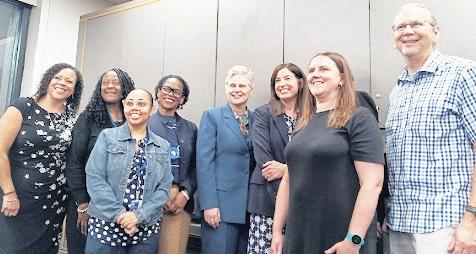
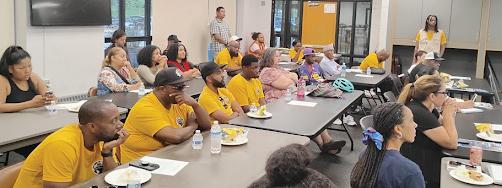
Hennepin County Commissioner Angela Conley (fourth from left) and County Attorney Mary Moriarty (fifth from left) with caseworkers from 1800 Chicago at a community forum on Minnesota’s Red Flag law and mental health access Photos courtesy of Clint Combs/MSR
By Francina Carter
Ujamaa Place supports young African American men, primarily ages 18 to 30, who are economically disadvantaged and have faced repeated cycles of hardship. Its mission is to address participants’ fundamental needs: personal, family, economic, social and spiritual, through a comprehensive, integrated program.
The foundation of Ujamaa Place’s work is its Theory of Transformation, a culturally grounded model that guides participants toward five key outcomes: stable housing, educational advancement, gainful employment, positive family and child relationships, and no involvement with the criminal justice system.
tailored one-on-one coaching that encourages personal growth, education, and access to more than 37 supportive services. Coaches, many of whom are credible messengers who have overcome similar life challenges, provide guidance and mentorship to help participants navigate their journeys.
Recognizing the impact of trauma and systemic inequities, Ujamaa Place prioritizes wellness and mental health. Holistic wellness, encompassing physical, mental, emotional, and social health, is integral to achieving the goals outlined in the Theory of Transformation. Mental health is more than the absence of illness; it is essential to personal growth, resilience, and overall well-being. Upon entry, participants undergo a mental and chemical health assessment by a li-
Ujamaa Place helps Black men achieve holistic wellness
censed wellness therapist. Early screening allows for timely interventions and informs each participant’s Individual Transformation Plan, including referrals to community-based partners and ongoing care.
Ujamaa Place offers a range of wellness services, including:
• Individual counseling for substance use and mental
health concerns
• Psychoeducational groups on meditation, yoga, nutrition and fitness
• Trauma-informed, genderspecific process groups on cognitive restructuring, co-occurring disorders, coping skills, and cultural pain
• Case management and connections to community-
New McKnight headquarters reflects foundation’s mission
By Jasmine McBride Associate Editor
The McKnight Foundation’s new Minneapolis headquarters is more than just a workplace. It is a tangible reflection of the foundation’s mission to advance equity, community and sustainability.
From the heating and cooling system to staff gathering spaces, every detail was approached with the question of how to align people and planet. The building’s recent LEED Gold certification, awarded by the U.S. Green Building Council, underscores the foundation’s commitment to environmentally responsible design.
“One of the goals of the building was to weave climate and sustainability through every aspect,” said Ben Passer, program director of McKnight’s Midwest Energy and Climate team. “The biggest step was actually just utilizing the space that was already here, rather than doing all of the carbon-intensive work of building new.
“We have the fortune to work with a lot of grantee organizations doing building work, and what we hear from them is that the most important thing you can do for sustainability is to utilize existing space.”
That approach set the tone for the entire project. Nichol Higdon, vice president of finance and operations, oversaw the move and renovation.
For her, sustainability was inseparable from the founda-
was very important for us to continue to stay connected to Minneapolis…
“We had been in our prior location for about 20 years, and then we also wanted to make sure that we were able
took us some time to actually find.”
Higdon emphasized that holistic sustainability also meant considering employees. “We took into account our employee needs, from
based health services
Therapists are available for scheduled, drop-in, or crisis sessions, and all participants receive nutrition education and access to personal fitness training, recognizing the profound impact of nutrition and physical activity on health.
Ujama coaches, having overcome their own life challenges, help participants navigate their journeys.
Program participants attending Ujamaa Place activities receive nutritious breakfast and lunch Monday through Thursday, while residents at Ujamaa Place properties receive dinner daily. Partnerships, such as with the St. Paul YMCA, further expand access to fitness resources.
A unique component of Ujamaa Place’s wellness approach is its digital music program, developed in partnership with Walker West Music. Music creation helps reduce symptoms
ice in them, and the heat that comes off the ice as it melts is used to warm the building, and the cooling is recaptured as well. In a place like Minnesota with such extreme weather, to be able to say we can do this is pretty remarkable.”
Such systems remain rare due to cost, climate and complexity. Partners like Trane and Griner helped make it possible, alongside a $1.5 million federal tax credit through the Inflation Reduc-
tion’s values.
“We first started off with determining what we were trying to accomplish with the move, period,” Higdon said. “It
to live out our mission as part of the process. Being able to partner with a landlord that was supportive of sustainability was very critical, and that
a wellness center and yoga studio to a prayer room with a foot-washing station. All of those things culminated into what the budget needed to support.”
The board’s full support enabled bold decisions. “Ben helped us work through three different scenarios of how we could approach sustainability, and our board said, ‘No, we’re just going to go all in, because we are all in on mission,’” Higdon said.
One of the building’s most innovative features is its icebased thermal energy system, which replaces fossil fuels for heating and cooling. “Sometimes the technology is even over my head,” Passer admitted with a laugh, “but it really demonstrates what’s possible.
“We’re using tanks that have
of anxiety and depression, supports emotional expression, and fosters social connection. Group sessions provide a safe space for participants to explore feelings, process experiences, and build community, contributing to emotional and psychological growth.
At Ujamaa Place, wellness is both an individual and community endeavor. Participants are responsible for their choices and behaviors, yet the program recognizes that wellness is shaped by physical, social and cultural environments. Through culturally responsive programming, mentorship, and access to holistic services, Ujamaa Place equips young men to cultivate resilience, personal growth, and a positive sense of self, paving the way for sustained individual and community wellness.
Francina Carter is the advancement associate at Ujamaa Place. For more information, visit www.ujamaaplace.org.
Community Voices is a series created to amplify the voices of local organizations committed to dismantling disparities in Minnesota.
night’s Arts & Culture program, which has supported local artists for 50 years.
The office is not just environmentally forward; it is also a hub for connection. In the first four months since opening, McKnight has welcomed 2,000 grantee partners, community leaders, and changemakers working on initiatives ranging from green jobs and clean energy to wealth-building and arts support.
“For us, sustainability is not just about the environment… It’s about sustaining community, sustaining culture, and sustaining relationships,” Passer said. The headquarters also honors the land’s history.
Both McKnight’s current and former offices sit on the ancestral and present-day lands of the Dakota people, including Owámniyomni, or St. Anthony Falls, a sacred site. McKnight supported the local organization Owámniyomni Okhódayapi in initiating restoration efforts, connecting the foundation’s work to broader goals of healing, justice, and community engagement.
Tonya Allen, president of McKnight Foundation, described the new space as a “hub for changemakers.”
“We’re showing how building owners and tenants alike can express their values and live out their missions through the built environment,” Allen said.
tion Act, one of Minnesota’s first tenant-led clean energy deals. Sustainable construction practices diverted more than 75% of landfill waste and avoided over a ton of fossilfuel-derived plastics.
“For
The McKnight Foundation’s headquarters is, in many ways, a living demonstration project: proof that missiondriven organizations can align operations with values in both visible and invisible ways. Through sustainability, inno-
us, sustainability is not just about the environment. It’s about sustaining community, culture and relationships.”
In addition to energy efficiency, the building promotes wellness, equity and creativity. It features electric vehicle chargers, ample natural light, all-gender restrooms, and an in-house creative studio. A highly visible exterior mural wall, facing U.S. Bank Stadium, will showcase Minnesota artists and
vation, and community connection, McKnight hopes not only to inspire its grantees but to influence a broader shift toward responsible, equitable, and human-centered design in Minnesota and beyond.
Jasmine McBride welcomes reader responses at jmcbride@ spokesman-recorder.com.
Frequently throughout 2025, space in these pages will be given to organizations working to end racial injustice across the state. We hope that these reflections spark policy changes for a more equitable Minnesota. This week’s guest contributor is Francina Carter, advancement associate at Ujamaa Place.
Ujamaa Place supports young African American men, primarily ages 18 to 30, who are economically disadvantaged and have faced repeated cycles of hardship.
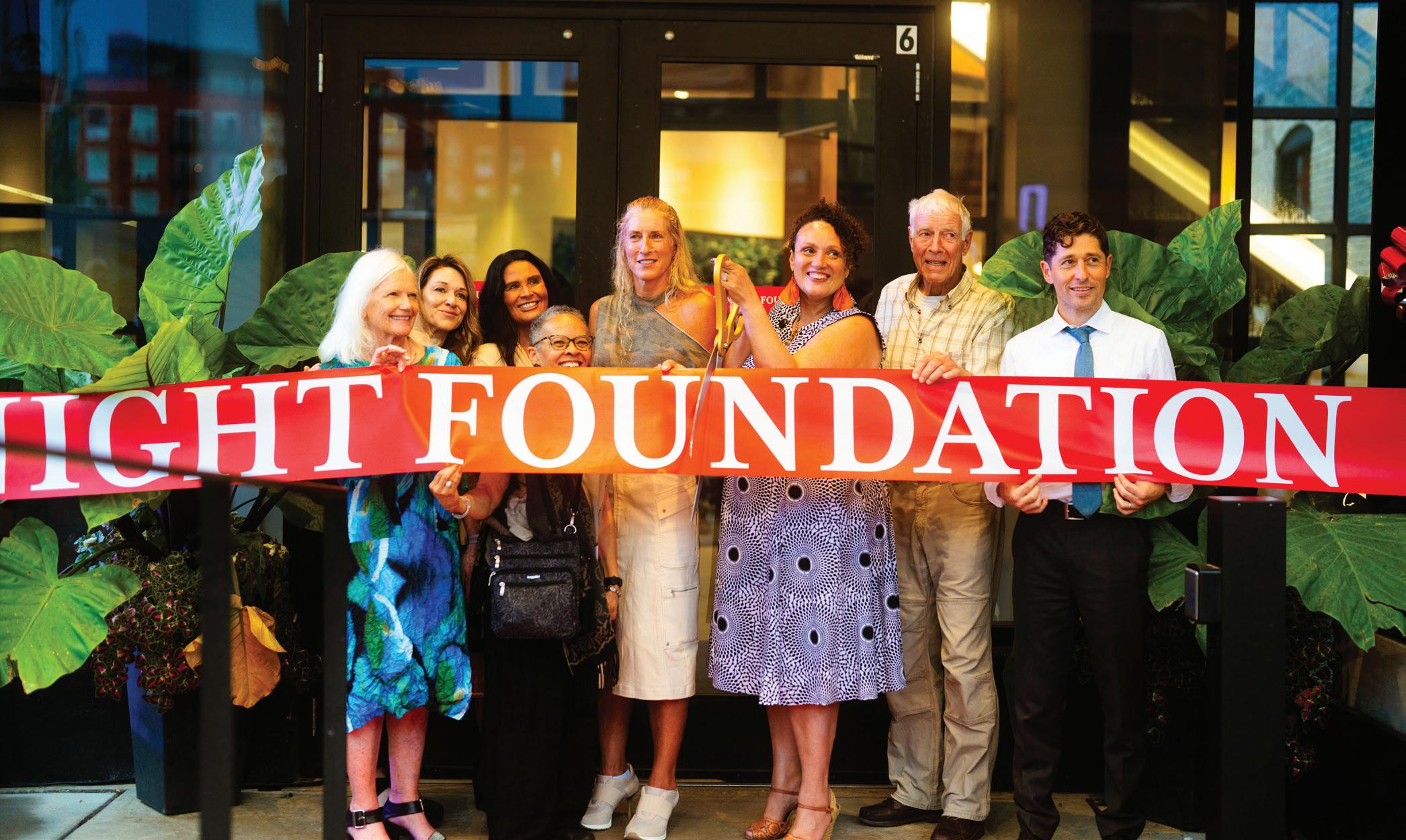
(l-r) Peg Birk, Perry Moriearty, Shelley Buck, Phyllis Goff, Erika Binger, Tonya Allen, James (Mac) Binger and Mayor Jacob Frey, at McKnight Foundation’s new building ribbon cutting, Sept. 18. Raww Files Media
PUSH triathlon gets Black people outside and active
By Binta Kanteh Contributing Writer
While participation in triathlons across the United States is generally low, the number of non-white athletes is even smaller. Some data over the past few years suggests that less than 1% of triathletes are Black.
Several factors contribute to this lack of diversity, including historical exclusion from public biking, swimming and running spaces, the costs of training in the three disciplines, and a lack of belonging.
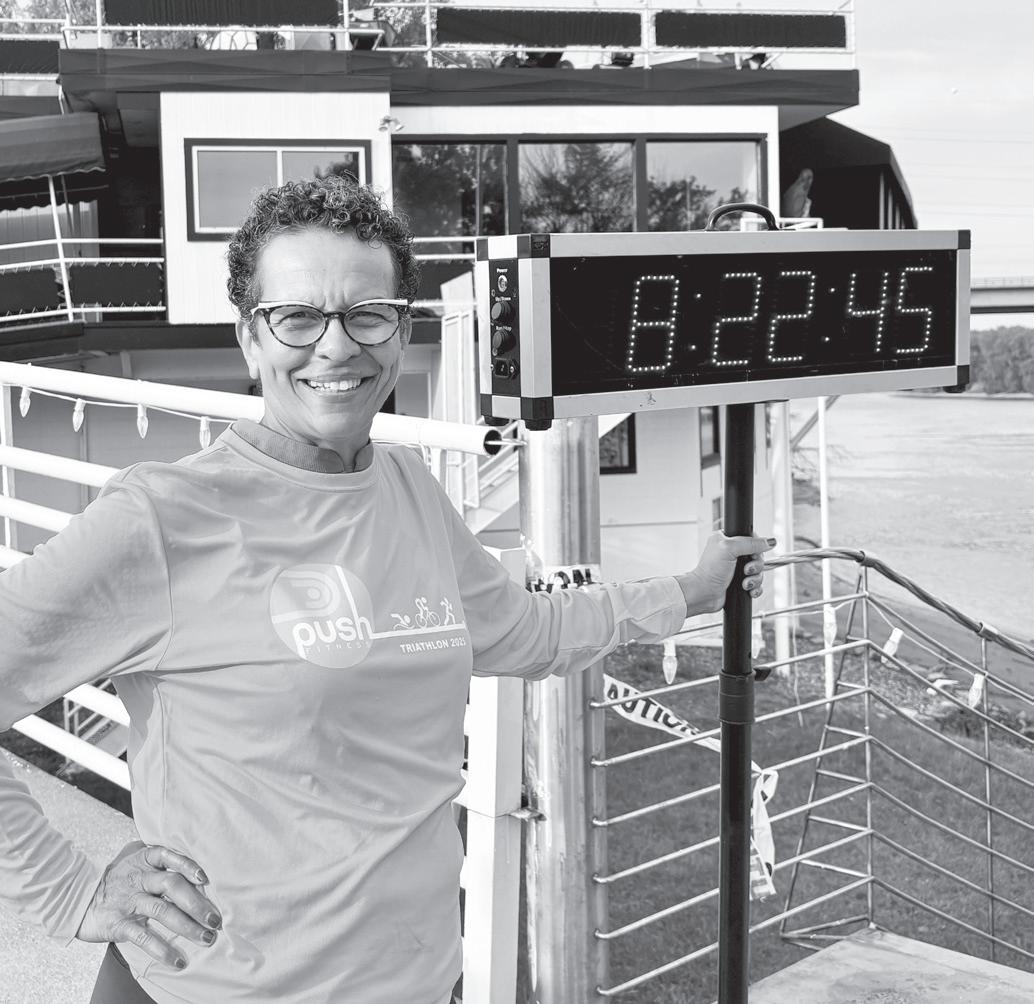
Connie Sheehan, owner of PUSH Fitness in St. Paul, launched her triathlon six years ago and has since seen a steady increase in participants and sponsors for the annual gathering at Lilydale Pool & Yacht Club.
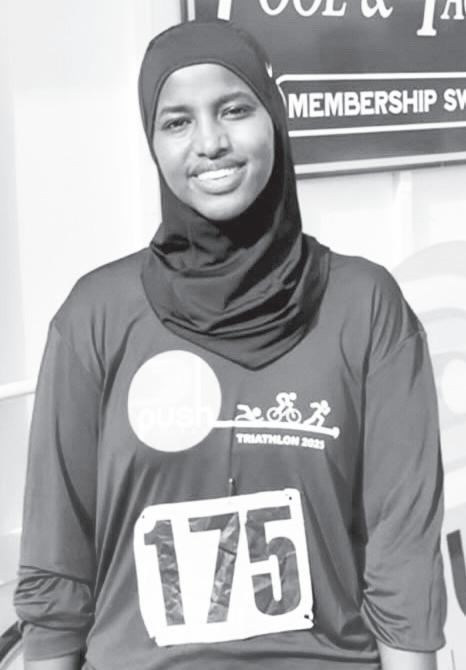
her fitness in community with others committed to health. “What drew me to the triathlon was the opportunity to challenge myself, commit to disciplined training, and push past my limits,” Sahal said.
“As an athlete who loves a variety of sports and getting involved with groups like Melanin in Motion and their slow roll bike rides, I saw the triathlon as a chance for personal growth and connecting with community. Hearing stories of local advocates like Connie Sheehan and being part of community celebrations inspired me to take on what once felt impossible and turn it into an achievement,” said Sahal.
and
“I am still doing this because I am trying to create a safe place for people of color to know they can move their bodies,” Sheehan said. “It is so rare to find a place where they are welcomed and they can just come in and do their thing. That’s why I still do it, because I know that the incidence of high blood pressure… it’s killing us. I believe one of the ways to get past that is to move our bodies in any way that feels good to you.”
A value pillar of the PUSH Fitness triathlon is physical accessibility. “[There are] brand new swimmers who hadn’t been swimming before. One person needs assistance walking, but she can swim, right? I want them to know there are things that we can do to move our body to stay healthy,” Sheehan said. Most participants compete in relay teams, with each of the three members taking on
swimming, biking, or running.
Shortly after the 6 a.m. start, as the sun rose, Natasha Pugh of Minneapolis’ Bryn Mawr neighborhood waited for her teammate to finish the 600-yard swim. Pugh explained what brought her to the event.
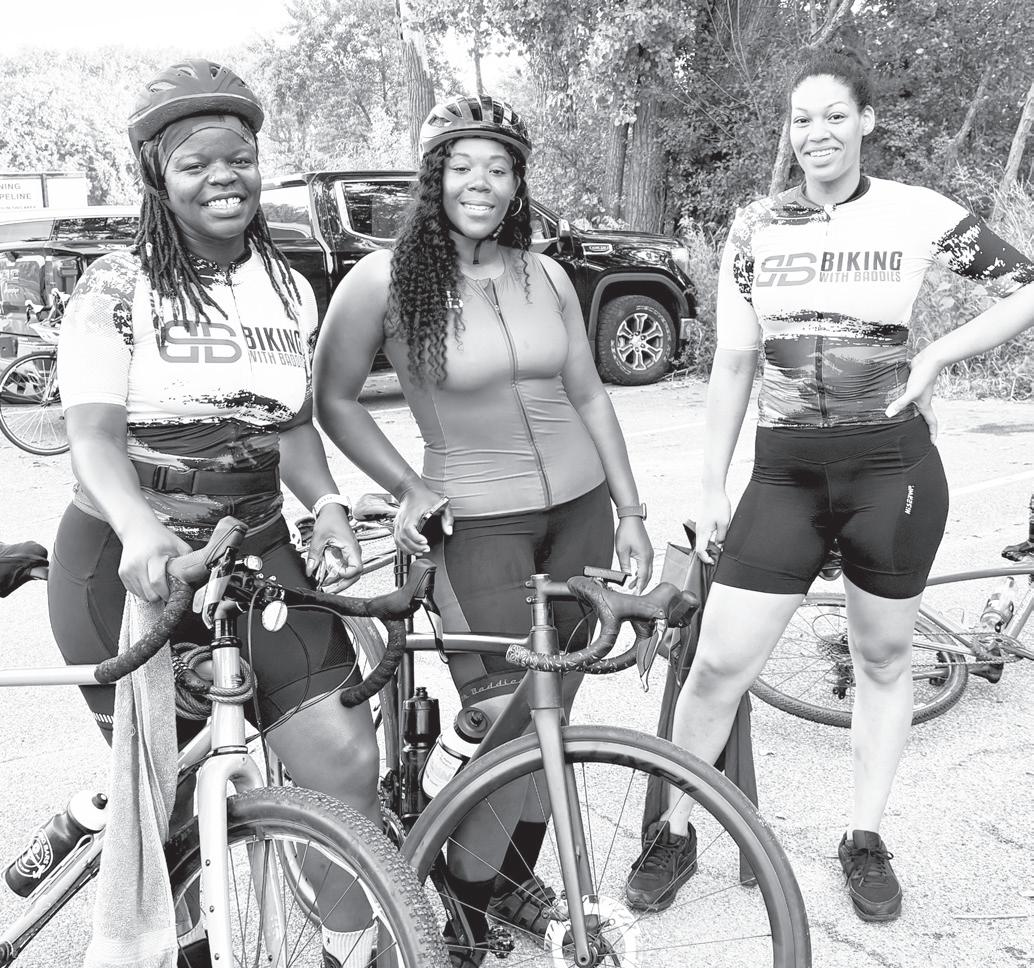
“I found out about this through Biking with Baddies, which is an organization that I biked with recreationally,” she said. “I knew that I could bike a little bit, but I wanted to challenge myself. This felt like a good intro to triathlons. There’s varying abilities here, and I felt like this is a really great way for me to get into it.”
This year’s triathlon had 11 sponsors, including the Healing Justice Foundation, which helped nearly 100 participants of color join, including Pugh.
“I’ve been looking forward
to this day,” Pugh said. “I didn’t really sleep last night. I’m excited to get on my bike, see how fast I can go, and see how I finish the race. I’ve been training for the last couple of months.”
Families also joined the event. Jasmine Boudah of North Minneapolis brought her daughter to watch as she prepared to run.
“Her observing us practice for months and train our bodies, eat well, and think about the mindfulness of the practice, bringing her to observe it has been a humbling experience and a grateful opportunity,” Boudah said.
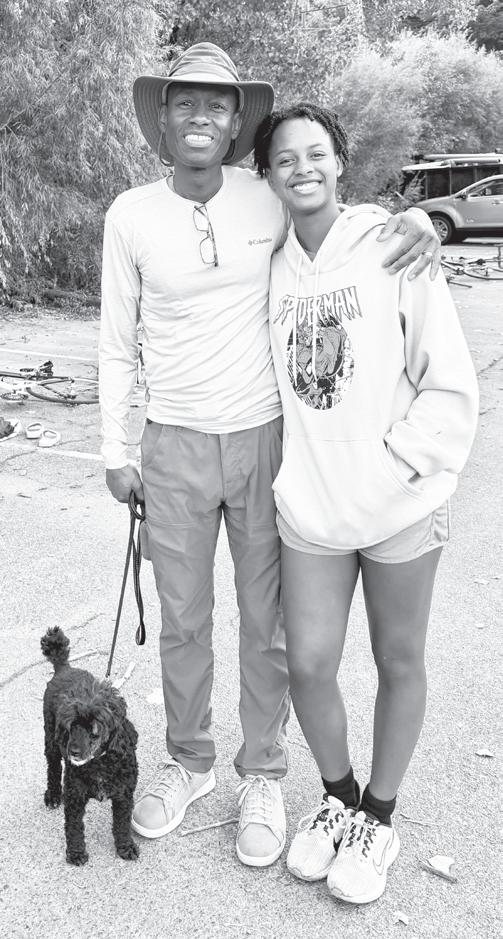
The Bailey family of Fargo, North Dakota, participated as a relay team, joined by their family puppy. “We are here to support and participate in the PUSH triathlon as a relay team,” said David Bailey, who cheered on his wife, sister, and 16-year-old daughter Simone.
people of color to be out here and be active and prioritize their well being,” Templeton said. “This is self care. That’s why I’m here.”
Lead volunteer Njia Lawrence-Porter reported that participants ranged in age from 17 to 70, many completing their first triathlon.
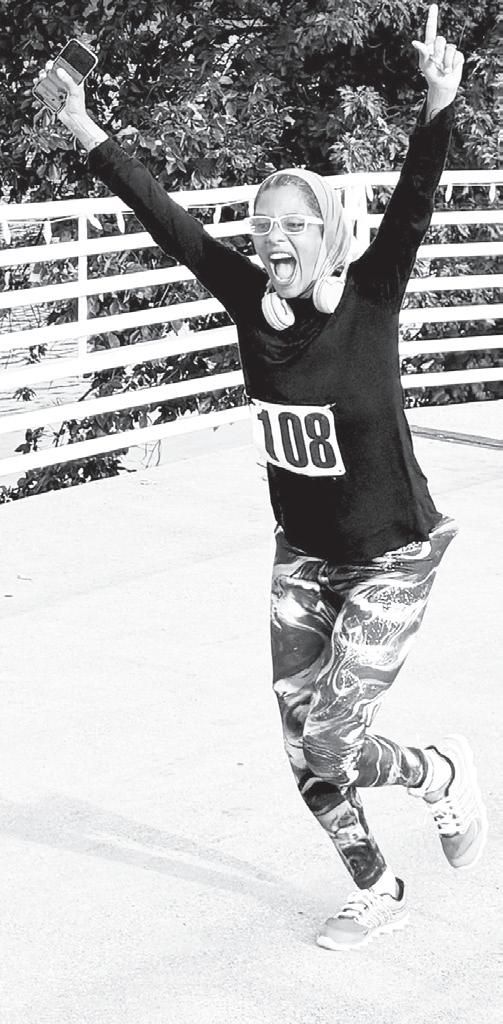
After finishing her race, Sahal reflected on the morning’s challenge. “The triathlon was both challenging and rewarding,” she said.
“During tough moments, I kept pushing through. The incredible feeling of accomplishment after crossing the finish line showed me that I’m capable of more than I thought, and left me motivated to keep taking on new challenges. I
“The incredible feeling of accomplishment after crossing the finish line showed me that I’m capable of more than I thought.”
Simone, competing for the third year and running for the first time, said the event carries special meaning. “It shows that Black women and Black people can be outside and do activities just like this whenever they want,” she said.
Ebony Templeton, who lives near Bde Maka Ska, echoed the sentiment. “This event is important to me because it’s really important for
don’t know the results yet, but after finishing, I just feel proud to have participated and showed up for myself.”
To learn more about PUSH Fitness and its annual triathlon, visit their website: https://pushfitnessforyou.com/triathlon/.
Binta Kanteh welcomes reader responses at bkanteh@ spokesman-recorder.com.
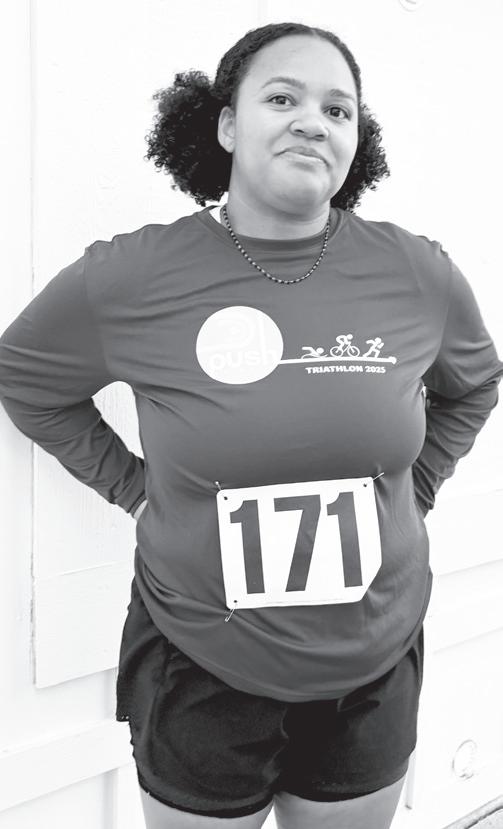
Sainab Sahal of Golden Valley, a returning participant, arrived before dawn to test
Connie Sheehan, owner of PUSH Fitness
Participant Natasha Pugh
Biking With Baddies group
Sainab Sahal
Participant Jasmine Boudah
David
Simone Bailey
By Jasmine McBride Associate Editor
The McKnight Foundation, in collaboration with the Saint Paul & Minnesota Foundation and other philanthropic partners, announced a $1.35 million statewide investment in Minnesota nonprofits through the newly launched MN Forward Pooled Fund. The initiative is designed to strengthen small and mid-sized organizations addressing urgent and long-term community needs across the state.
The fund’s first round awarded $50,000 grants to each of 27 organizations, including the New Justice Project, a Black-led organization dedicated to creating job opportunities, advocating for housing justice, and reimagining community safety. Other recipients serve Native communities, Greater Minnesota, and the Twin Cities metro area, reflecting the fund’s commitment to equity and impact statewide.
“This fund emerged from conversations with our peer foundations about how to respond to both immediate and long-term needs in our communities,” said Tsega Tamene, associate vice president of community impact at Saint Paul & Minnesota Foundation.
“We knew we wanted to pool resources collaboratively so we could move quickly and strategically to support community builders doing critical work on the ground.”
Tamene, who leads a team focused on resourcing changemakers and community builders across Minnesota,
Business Funders pool resources to address urgent needs
explained that the idea for the MN Forward Pooled Fund began in late 2024. Following federal policy shifts and a perceived shift in community resources, the foundation convened peer funders to assess what needs might emerge and how philanthropic organizations could respond collectively.
“It started with conversations about what we might expect in our communities and how we could continue to invest despite challenges,” Tamene said. “We realized that pooling resources in a collaborative way could have a real-time impact while also supporting longer-term community-building efforts.”
By mid-2025 the collaborative fund was established, attracting contributions from 10 foundations and several individual donors and raising over $1.5 million to support community-centered initiatives. Tamene described the
effort as “miraculous,” noting how quickly the fund was assembled and grants distributed. Program finalists were notified by the end of June, with denied applicants informed at the same time.
Rod Adams, founder of the New Justice Project and a 2024 Bush Fellow, said the grant will allow the organization to advance two new initiatives: United We Build, which hosts community forums and roundtables throughout the year to foster political engagement and connection between residents and elected officials; and United We Heal, a culturally rooted program focused on joy, healing, restoration, and relationship-building.
“This support allows us to take the next step in building community power and creating spaces for connection and restoration,” Adams said. “It elevates the work we’ve been developing and helps us progress
initiatives that address both immediate needs and long-term community wellness.”
The MN Forward Pooled Fund intentionally targeted organizations with operating budgets under $3 million, focusing on smaller groups that often lack resources but have deep community impact. Eligible organizations ranged from emerging groups without formal nonprofit status to tribal government programs, demonstrating inclusivity in both structure and mission.
Tamene emphasized that while this fund provides critical support, it is not intended to replace government funding, which in some areas has been diminishing or at risk.
“The goal here isn’t to supplant other resources but to
respond in the moment and support those already doing the work in their communities,” she said. “At the same time, our sector continues to advocate for the state and federal resources our communities deserve.”
While the MN Forward Pooled Fund is a new initiative, foundations involved hope to continue the collaborative model in the future. “We’re still convening and thinking about how best to coordinate resources so our partners and communities feel supported,” Tamene said.
By investing in organizations like the New Justice Project, the MN Forward Pooled Fund exemplifies how foundations can work together to amplify impact, address ineq-
uities, and support community-driven solutions at both the local and statewide level. For smaller, grassroots nonprofits, these funds provide not only financial resources but also recognition and momentum to expand programming and strengthen their impact in Minnesota communities.
As Adams noted, “With this support, we’re able to dream bigger, act faster, and create opportunities for residents to connect, heal, and take part in shaping the community they want to see.”
“With this support, we’re able to dream bigger, act faster, and create opportunities for residents to connect, heal, and take part in shaping the community they want to see.”
For more information on the MN Forward Pooled Fund, visit www.spmcf.org/nonprofits/ grants-for-nonprofits/mn-forward-grants. For more information on the New Justice Project MN, visit www.newjusticeprojectmn.org.
Jasmine McBride welcomes reader responses at jmcbride@ spokesman-recorder.com.
Call For Contractors
Community Action Partnership of Ramsey and Washington Counties, specifically the Energy Conservation Department, is soliciting a Call for Contractors. We are seeking Commercial and Residential Contractors in the following areas to partner with us to weatherize the homes of income-eligible clients in Ramsey, Washington, and Anoka counties: Appliance Sales, Delivery, and Install; Asbestos Abatement; Wiring/Electrical; Lighting Design and Installation; General Structure/Building Shell; Cleaning/Janitorial/Clutter Removal and Support; Mechanical/HVAC; Mold and Moisture Remediation; Pest/Animal Control; Plumbing; Roofing.
Contractors must be fully licensed and insured. CAPRW encourages all minority, veteran, and women-owned business enterprises to apply. The Call for Contractors will remain open to the public so long as work is needed.
For more details and a list of onboarding requirements, email Seth Johnson at sjohnson@caprw.org.
Tsega Tamene Courtesy of the Saint Paul & Minnesota Foundation Rod Adams Courtesy of the New Justice Project
falsely claimed that “Muslims are commanded to take over the government in the land they live.”
Minneapolis Mayor Jacob Frey defended Fateh, calling the comments “dangerous and inflammatory.” Both Frey and Fateh condemned Kirk’s killing as unacceptable political violence.
Kirk also attacked Black leaders, referring to U.S. Supreme Court Justice Ketanji Brown Jackson as “a diversity hire” and falsely claiming George Floyd died of an overdose despite autopsy findings and court rulings to the contrary.
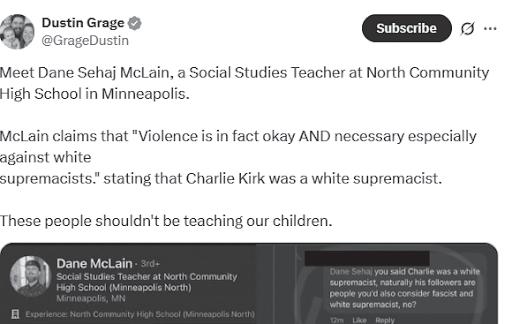
Educators and journalists targeted Dane Sehaj McLain, a social studies teacher at Minneapolis North High School, became a focus of the campaign after Grage reposted a screenshot of a Facebook comment he had made during a heated political debate. The post, since deleted,
HISTORIC
Continued from page 1
spoke about what the nomination means for the paper and the community it has served for nearly 90 years. “I’m honored that the paper my grandfather built is being considered for national recognition. This would shine a long overdue light on the decades of work the MSR has done to uplift African American voices and secure its place on the national stage,” Williams-Dillard said.
“I’m honored that the paper my grandfather built is being considered for national recognition.”
Founded in 1934, the MSR has documented civil rights struggles, local activism, and
read: “Violence is in fact ok AND necessary… to confront hateful violent fascists.”
“Hi @MPS_News, [is] this your teacher?? Any comment?” Libs of TikTok wrote on X. McLain told the MSR that his words were taken out of context and that he was “shocked and appalled by the news of Charlie Kirk’s assassination.” He said, “I don’t believe anyone
community achievements across Minneapolis. The nomination underscores the paper’s role in chronicling African American history and ensuring future generations understand its contributions.
“This recognition will provide a platform to continue telling our stories and highlight the work that continues today,” Williams-Dillard added.
“It’s a proud moment for the paper, for the community, and for all those who have contributed to its mission over the years.”
The nominations follow a year-long effort by 15 cityappointed members of the African American Heritage Work Group, who advised on the “African American Historic and Cultural Context Study,” drafted by the 106 Group. The study highlights African American history in Minneapolis from the 1800s to the present, recognizing influential people,
should face violence, intimidation or threats when they are speaking their minds.”
He described a barrage of harassment: “Relentless calls at my job. Calls on my phone. Emails. Threatening social media posts. Disgusting comments calling me a psychopath and a fascist.”
Minneapolis Public Schools did not respond to requests for comment.
McLain said those calling for his firing are defending Kirk, who “advocated for public executions brought to you by Coke” and “dehumanized my Muslim, Latino, and Black students.”
Other targets include Christina Moran, an administrative assistant for Hennepin County, and Minneapolis resident Antonio Reynero, whose
social-media post questioning Kirk’s legacy was shared by @ MediaWatchMN.
Experts warn of real-world harm
Dr. Cynthia Miller-Idriss, founding director of the Polarization and Extremism Research and Innovation Lab at American University, said doxxing campaigns often lead to dangerous consequences, especially when family members or bystanders are drawn in.
“We’ve seen cases where the wrong person gets harassed, an old address, someone’s child, a family member,” MillerIdriss said. “These campaigns fuel hate attacks, threats and violence, sometimes against people who had nothing to do with the original post.”
McLain said even his sister has received harassing calls.
“They even got my sister’s number,” he said. “This is the kind of mob effect that leads to real-world harm.”
Miller-Idriss warned that escalating rhetoric on both the left and right risks pushing the country toward a “tinderbox moment” in the wake of
Kirk’s death.
Congressional fallout
National tensions spilled into Congress as Reps. Nancy Mace (R-S.C.) and Buddy Carter (R-Ga.) introduced a resolution to remove Rep. Ilhan Omar (D-Minn.) from the House Budget and Education and Workforce committees. They accused Omar of making hateful remarks about Kirk’s death after she reposted a video calling Kirk a “stochastic terrorist,” even though she condemned the killing and expressed sympathy for Kirk’s family.
The House voted 214-213 to table the resolution, with four Republicans joining Democrats to block the effort.
As online harassment continues, local educators and journalists say the threats highlight a growing danger. “I’m proud to teach my students to think critically,” McLain said. “But nobody should have to fear for their life or their family’s safety for speaking their mind.”
Clint Combs welcomes reader responses at ccombs0284@ gmail.com.
places and events.
“There are so many remarkable stories in this study,” said Erin Que, senior city planner.
“These stories talk about finding and making a home here in Minneapolis, discuss faith traditions and important commu-
nity resources. They also uplift the ways African Americans have added vibrancy to the city and consistently fought for civil rights.”
The study and nominations are designed to preserve the city’s rich African American
history, honoring the voices, struggles and achievements that shaped Minneapolis.
For more information on the African American Historic and Cultural Context Study or to sign up for project updates, visit
the City of Minneapolis website, at www.minneapolismn.gov/ news/2025/september/national-register.
Jasmine McBride welcomes reader responses at jmcbride@ spokesman-recorder.com.
Screenshots of posts from Libs of TikTok and Dustin Grage targeting North Community High School educator Dane McLain
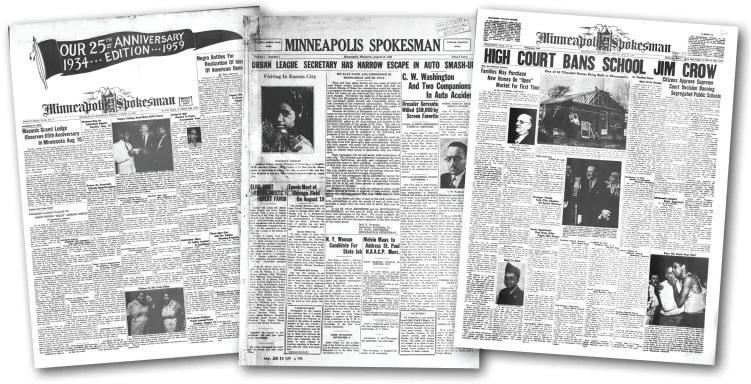
Front page of the “Minneapolis Spokesman,” Aug. 10, 1934, May 21, 1954 and Aug. 14, 1959
Minnesota Historical Society
Arts & Culture
NextStep Runway brings New York fashion energy to Minnesota
By Jasmine McBride Associate Editor
NextStep Runway made a bold Minneapolis debut Sept. 19–21 with a three-day fashion camp and runway show that brought together emerging models, designers, and industry professionals for a weekend of training, creativity, and celebration of Minnesota’s growing fashion scene.
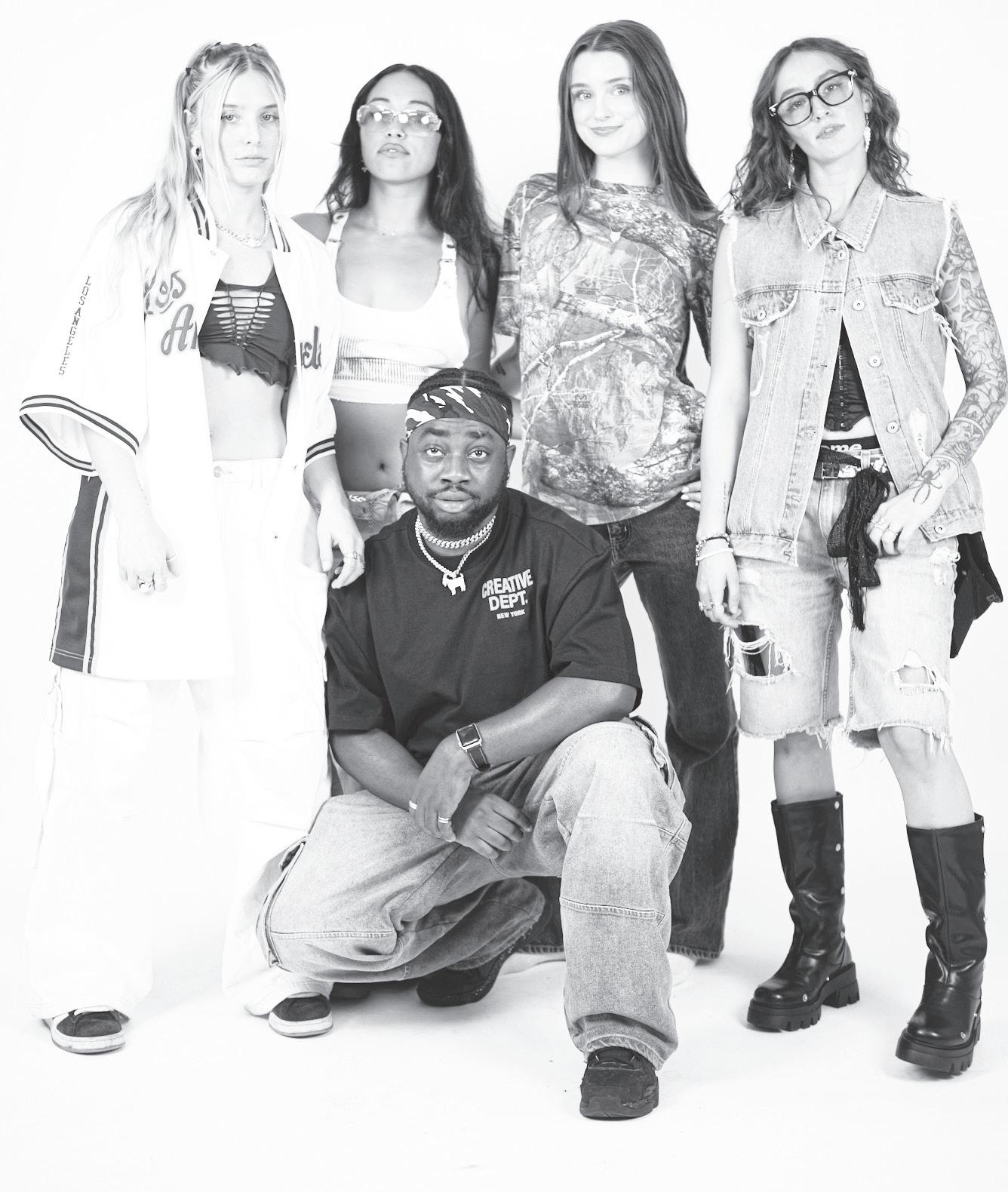
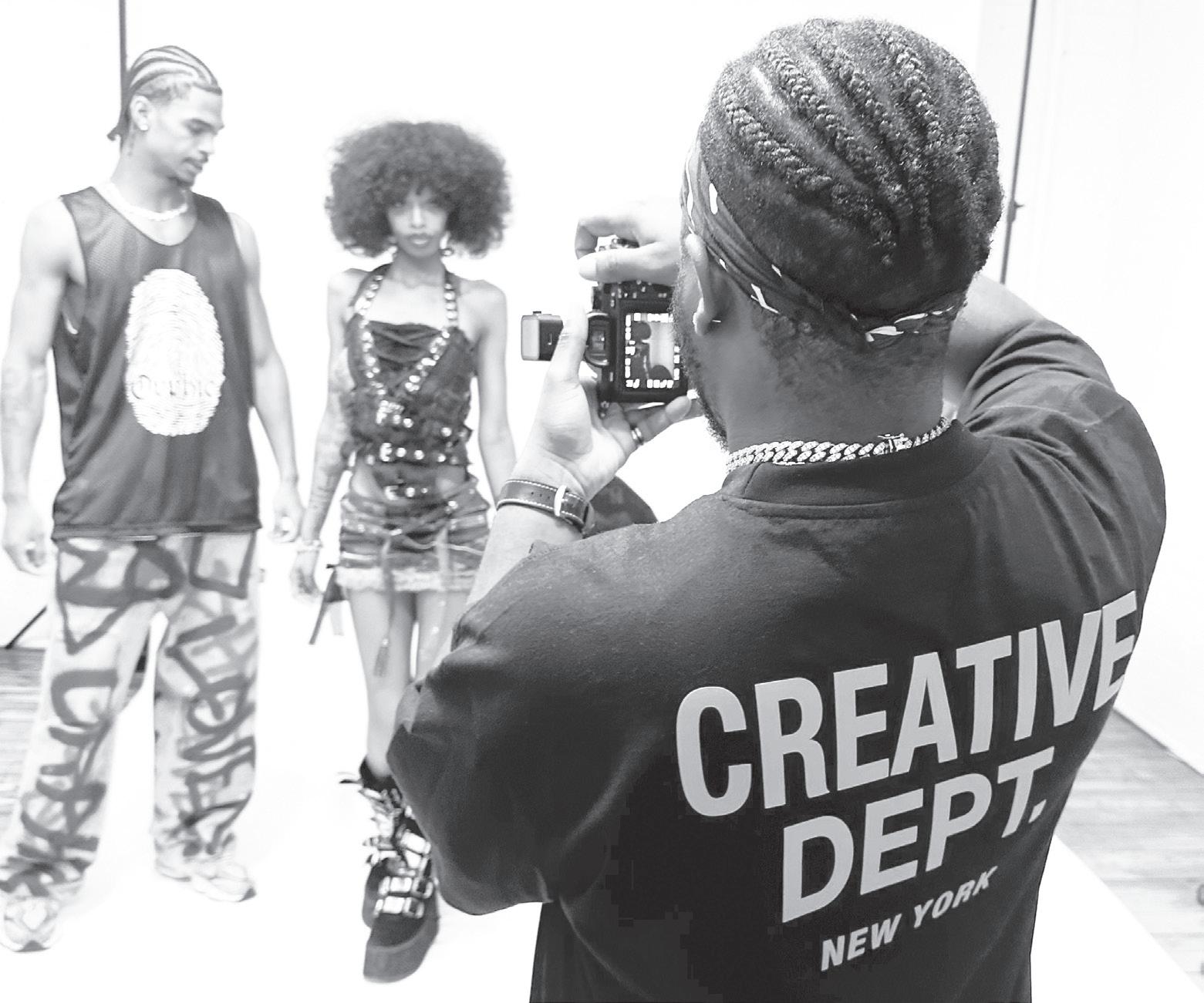
The inaugural event, founded and produced by creative director and fashion photographer Charles Jah, drew more than 20 local models and four designers to a downtown venue transformed into a fashion hub. Over the course of the weekend, attendees sharpened their skills, built their networks, and stepped into a professional environment that felt more like New York Fashion Week than a first-year event in the Midwest.
The experience began with a two-day fashion development camp that set the tone for the showcase to come. Models participated in intensive runway coaching sessions, learning everything from posture and walk to facial expressions and tim-
ing. Styling tutorials and panel discussions gave participants a deeper understanding of the industry, including how to prepare for casting calls, collaborate with photographers, and market themselves in a competitive field. The camp also featured a portfolio-building photo shoot Jah dubbed “The Muse Session,” which paired models with photographers for high-quality images they could use in future auditions and brand pitches.
“It was like a crash course in the business of fashion,” said one participating model, who described the weekend as both nerve-racking and empowering. “We were treated like professionals from the moment we walked in the door. By the time we hit the
runway, we felt ready.”
Sunday’s runway show brought the training to life in front of a packed audience of family, friends, and local fashion enthusiasts. Twenty-two models of varying skill levels, ranging from first-time walkers to agency-signed professionals, took their turns on the catwalk, wearing collections from four Minnesota designers. Each designer styled four to six models, unveiling looks that spanned cutting-edge streetwear, gender-fluid designs, and sleek ready-to-wear pieces. The result was a vibrant, high-energy showcase
“There’s no reason the Midwest can’t be a fashion destination too.”
that demonstrated both the range and sophistication of Twin Cities fashion.
“This was about creating access and opportunity,” said Jah, 27, who has spent years photographing fashion and
portraiture in New York and Minnesota. “I wanted to bring a New York Fashion Week–level experience to Minnesota, but with a community-driven approach. There’s so much untapped talent here, and they deserve a platform to show what they can do.”
Jah’s path to launching NextStep Runway reflects the collaborative spirit of the event. A self-taught creative, he began experimenting with photography as a teenager using only a phone camera. His early passion earned him a scholarship to New York University, where he immersed himself in film, photography, and multimedia projects. After graduating, he returned to Minnesota determined to help local creatives sharpen their skills and gain exposure. Much of his work has involved organizing free or low-cost photo sessions, often on a Time For Print basis, where neither model nor photographer is paid in order to give participants professional-quality images for their portfolios.
That emphasis on mentorship and accessibility carried through every part of the weekend. Workshops featured hands-on guidance from modeling coaches, stylists, and hair and makeup professionals. Panelists offered real-world advice on how to navigate castings, negotiate contracts, and use social media to build a personal brand. Jah said he wanted attendees
to leave not just with polished runway skills, but also with the confidence and practical knowledge needed to sustain a creative career.
“It’s not just about looking good in front of a camera,” Jah said. “It’s about understanding the ecosystem, how to network, how to collaborate, how to show up professionally. Those are the skills that take you from hobbyist to working creative.”
For the designers, the event provided a rare opportunity to debut collections in a professional setting without leaving the state. Several expressed excitement about the chance to connect directly with models, photographers, and potential clients in their own backyard. “Minnesota has incredible talent, but we don’t always have spaces to show it,” said one participating designer. “NextStep gave us that stage.”
While this was the first official event under the NextStep Runway banner, Jah views it as the start of something bigger. His long-term goal is to develop the platform into a year-round hub for creatives, photographers, designers, stylists, and other fashion professionals; offering workshops, mentorship, and ongoing showcases. “If we keep building on what we started this weekend, there’s no reason Minnesota can’t become a fashion destination,” he said.
For Jah, the success of the debut event was measured less in ticket sales than in the growth he saw among participants. “Seeing models walk out of here with new skills, new photos, and new confidence, that’s the real payoff,” he said. “This is about giving people their next step, whether that’s their first professional booking or simply believing they belong in this industry.”
As the lights dimmed on the final runway walk, the weekend left an impression that extended beyond fashion. NextStep Runway’s debut proved that Minnesota’s creative community is ready to command the spotlight, and that with the right support, its next step could be even bigger.
For more information on the NextStep Runway visit the instagram page, @nextsteprunway. Those interested in partnerships, sponsorships, or future model opportunities are encouraged to reach out via the page as well.
Jasmine McBride welcomes reader responses at jmcbride@ spokesman-recorder.com.
Funding remains a key challenge. Much of the weekend was financed out of pocket or through modest model fees, and Jah is calling on sponsors and supporters to help sustain the momentum. “With more investment, we can take this to an even higher level,” he said. “Imagine a Minnesota Fashion Week that draws people from across the country. That’s the vision.”
NextStep founder Charles Jah (middle) with participating models
All photos courtesy of NextStep Runway
By Jasmine McBride Associate Editor
Children’s bookstore inspires early love for reading
In the heart of South Minneapolis, a bookstore tucked inside Gideon Barbershop is quietly sowing seeds of social change. Planting People
Growing Justice (PPGJ) is a Black woman-owned children’s book publisher, bookstore, and literacy-focused social enterprise that encourages young people to find joy in reading while developing the skills to become tomorrow’s leaders.
Founded by Dr. Artika R. Tyner, an award-winning author, civil rights attorney, and educator, PPGJ has been a home for literacy and learning since May 2020, just eight days after the murder of George Floyd, making its opening a tangible act of community resilience and belonging. Tyner describes the space as “a place where young people can learn our history, spark interest in reading, and build connections across our community.”
The bookstore, part of a broader social enterprise, focuses exclusively on children’s literature that reflects the African Diaspora, from arts and geography to science and history. Tyner explains, “Our mantra is ‘read to lead.’ We aim to inspire young people to read and to lead, using storytime as a space for families and communities to come together.”
PPGJ books serve as both mirrors and windows, a con-
cept developed by scholar Dr. Rudine Sims
Mirrors allow children of color to see themselves positively represented in literature, while windows offer insights into other cultures and perspectives.
tors are at the center of PPGJ’s mission. “It’s important for children to see authors from their own communities,” Tyner says. “You cannot be what you cannot see. Having local authors visit schools or
“You cannot be what you cannot see. Having local authors visit schools or community spaces creates unforgettable connections that inspire our young leaders.”
Tyner highlights the scarcity of representation in mainstream publishing: “You’re more likely to see a black dog or a black bear on a book cover than a Black girl or boy. We have to change that.” Local authors and illustra-
community spaces creates unforgettable connections that inspire our young leaders.”
Tyner’s commitment to literacy stems from her experience as a civil rights attorney and law professor. She has witnessed firsthand how
access to reading can transform lives, from helping clients learn to read in prison to recognizing the effects of the school-to-prison pipeline on young people. As a firstgeneration college student, Tyner emphasizes that education opened doors not only for herself but for her entire family and the broader Rondo community.
In today’s society, she says, reading is more crucial than ever. “Books are the passport to the future. They help young people think critically,
understand democracy, learn about community history, and reimagine the world,” she explains.
Tyner acknowledges literacy gaps reported nationally but stresses that the solution lies in investing in early childhood literacy and learning. “If 80% of the brain develops in the first few years, we must provide enriching experiences and equip parents with the tools to build vocabulary, critical thinking, and a love for books.”
PPGJ also acts as a hub for
social change, fostering youth leadership development through storytelling that integrates social-emotional learning, project-based learning, and anti-racist education. By cultivating both literacy and leadership, the organization equips children to become confident, critical thinkers and active participants in their communities.
Tyner highlights the bookstore’s location inside Gideon Barbershop as an intentional choice. Partnering with the barbershop allowed PPGJ to create a “place of belonging” for the community, especially during a moment of deep social upheaval in 2020. Beyond selling books, the space serves as a community gathering spot for storytime, workshops, and author visits.
As PPGJ continues to grow, its mission remains clear: to transform literacy into leadership. As Tyner says, “We are a bookstore, a publisher, and a nonprofit literacy organization — a triple threat. Our goal is to radically change the narrative around literacy, representation, and youth leadership, creating a new generation of readers and leaders.”
For more information or to explore PPGJ books, visit ppgbooks.com or learn more about the organization’s broader initiatives at ppgjli.org.
Jasmine McBride welcomes reader responses at jmcbride@ spokesman-recorder.com.
Simon Burris: Black History Matters: Crossword Puzzle: "Black Colleges' Alumni www.simonburris204@gmail com
Across
1 [Note: HBCU: Historically Black colleges &/universites] **Filmmaker Lee [Morehouse]
6 **Civil rights legend MLK, Jr. [Morehouse]
10 **Singer Richie [Tuskegee]
11 **"Beloved" author Morrison [Howard]
12 **Actor Chadwick [Howard]
14 Termite
15 Director's cry
16 **Andrew ___; Atlanta's ex-mayor [Dillard]
18 Axis Action, for short
19 Therefore
20 "I long call you servant" (John1 5: 9)
21 *American Pope _ _ _ XIV (Afro-Creole descent)
24 "___ Baby Baby" (Linda Ronstadt hit)
26 Public Works (abbr.)
28 Not out
29 Order between "ready" and "fire"
32 *Baseball legend Hank 34 BA _ _ _ GE (onslaugh) 35 "The Lord is with _" (Psalm11 8 : 6) 36 * Oprah of TV & films [Tenn. State]
Kimball, South Dakota (initials) 42 *Activists Powell and Kaepernick
43 *Actor Samuel L. Jackson and namesakes abbr. [Morehouse] 44 Delete Down
Crazy Horse, for example
*Kenya Equity Markets (abbr.)
East Los Angeles, briefly 6 Knot (abbr.)
7 Iowa Open Assistance Unit (acronym)
8 After mmmm
9 Very beginning (slang;2 wds.)
10 City near Los Angeles: _ong _each (abbr.)
13 New York State Officer (abbr.)
17 Tic -tac-toe winner
22 "Old MacDonald" refrain
23 Ontario Northwest, briefly
25 **Vice President Kamala [Howard]
26 **Civil right advocate Rosa [Alabama State]
27 **Comedian Sykes [Hampton]
30 "Goodnight" girl of song
31 * 1951N.L. Rookie of the Year Willie
33 Enlarge, as a hole
37 *___ Cube; rapper/actor
38 And not
39 Georgia's neighbor (abbr.) 41 Topeka,
Bishop.
Dr. Artika Tyner
Courtesy of PPGJ
Collection of culturally-aware youth-centered books located in Gideon Barbershop in South Minneapolis Courtesy
Opinion
DevSecOps Engineer: Plymouth, MN
IT Company seeks DevSecOps
By Patrick Ingram
For the more than 11,000 Minnesotans living with or affected by HIV, access to affordable medications isn’t a luxury — it’s a matter of life and death. Across Minnesota, vulnerable populations who are living with HIV and other chronic conditions rely on government programs and solutions to afford and access their medications.
But one such “solution” Minnesota has implemented to control drug costs won’t have the intended impact for patients like me.
In recent years, numerous states have established Prescription Drug Affordability Boards (PDABs) to review and regulate the prices of certain medications. In 2024, Minnesota became the 11th state to establish a PDAB, granting a board of appointed individuals the authority to review the cost of medications and set upper payment limits (UPLs) on certain medications the board deems to be unaffordable.
Minnesota’s PDAB may be a well-intentioned attempt to lower costs, but good intentions don’t always lead to good outcomes for patients. Many of the Minnesota PDAB board members do not reflect the lived and diverse experiences of people who are impacted by the high cost of prescription drugs. This could be detrimental for already vulnerable patient communities and the long-standing initiatives that provide support to
them.
Government programs such as the AIDS Drug Assistance Program (ADAP) and 340B Drug Pricing Program already negotiate significant drug discounts to serve vulnerable populations in Minnesota and around the country. Imposing artificial caps on reimbursement rates for certain drugs through a UPL at the state level could cause a negative ripple effect that upends the supply chain and stakeholders within it, including pharmacies, drugmakers, and patients who rely on these medications. Colorado and Maryland, both of which implemented PDABs, serve as cautionary tales. Prescription drugs that are subject to a UPL in these states have the potential to become less available, which could leave patients scrambling to find alternative treatments for their condition. For people who rely on a daily HIV regimen, have cancer, or an autoimmune condition that requires consistent medication with no generic alternative, the consequences can be dire.
Limiting access through UPLs also cuts off critical services these programs help fund, including culturally competent care, community-
ads@spokesman-recorder.com
Please
based outreach, mental health support, and wraparound services that disproportionately benefit LGBTQIA2S+ individuals, communities of color, and others harmed by our fragmented healthcare system.
That’s why intentional patient engagement with PDABs is so important. In a recent opinion, the executive director of the Minnesota PDAB praised the newly established board, citing polling that highlights affordability challenges and promising to address those issues through the establishment of UPLs.
By Lambers Fisher
The recent death of conservative activist Charlie Kirk has left many feeling a profound sense of loss, and rightly so. His death is a tragedy, and our immediate thoughts should be with his wife and daughters who are now grappling with an unimaginable loss.
This is a moment to mourn for a life cut short and for the experiences his family will never have. But for many, this tragedy has also surfaced a more complicated set of emotions, leading to what I, as a marriage and family therapist, call conflicted mourning.
While some mourn a voice they found inspiring and a positive force for the future, others feel something else entirely. For them, Kirk’s rhetoric was not a source of inspiration but of pain. They saw him as a prominent figure whose views on cultural groups and identities were derogatory and hurtful, and they experienced his words as fueling a climate of hate.
This creates a difficult emotional landscape: a universal sense of compassion for any loss of life clashing with the memory of a need to protect oneself from the negative impact of that life. If you find yourself in this state of conflicted mourning, here are three things to consider as you process these feelings.
1. It’s okay to mourn a person’s loss of life without celebrating their life’s work. We often fall into the trap of thinking that mourning a death is an endorsement of how a person lived. This is simply not true.
We are all complex beings with both good and bad aspects.
When we lose a loved one, we don’t erase the difficult memories; we simply acknowledge that both the good and the bad existed. It is possible to feel genuine sadness for the sudden, violent end to a human being’s life and the pain it has caused his family, even if you found fault with his public actions or words. You can separate the tragedy of his death from any criticism of his life.
past and build a better future. Tragedies like this often stem from extreme political polarization and the vilification of those with differing beliefs. This is a problem that law enforcement and political leaders can’t solve alone; we all have a part to play.
One of the most impactful things we can do is to listen to others’ motivations. This doesn’t mean you have to agree with them or even consider their ideas equally valid. However, offering a basic level of respect and a willingness to listen can reduce the feeling of being unheard and unseen — a feeling that can, in extreme cases, lead to desperate and violent acts.
2. Mourning a death does not mean you approve of everything the person said or did. Just as you can mourn a death without celebrating the life, you should also be wary of assuming that everyone who chooses to mourn Kirk’s death approves of everything he said.
It’s a powerful temptation to see those who are grieving as a threat because you believe their sadness equates to an endorsement of his views. Resist this temptation. Allowing space for people to feel and express shared sadness for an untimely death can create a bridge, even if you disagree on other issues. Don’t feel you have to deny your own feelings of sadness to prove your disapproval of his life, and don’t make others your enemies just because they are mourning.
3. All loss of life offers an opportunity to learn from the
Creating space for conflicted mourning allows us to process and express a complicated mix of emotions. It’s an opportunity to acknowledge the legitimacy of the tragedy while also wrestling with the relief that a perceived threat is gone. Resisting the urge to polarize others who feel differently can lead to more understanding and healthier relationships, no matter our differences. We can all benefit from creating environments where people feel safe enough to be conflicted in their grief.
Lambers Fisher is a licensed marriage & family therapist, author, TEDx speaker, and host of The Diversity Dude Podcast. Check out his podcast, The Diversity Dude Podcast, at https:// www.shelettamakesmelaugh. com/thediversitydude, his book, at Diversity in Clinical Practice (Book): https://www.lambersfisher.com/book/, or reach him directly at his website, www.lambersfisher.com.
However, as a new board with limited outputs, more time is needed to understand how the PDAB will benefit Minnesotans who rely on prescription drugs. While affordability is a critical concern, it must be addressed without compromising access.
New research from the Partnership to Fight Chronic Disease (PFCD) reveals that 77% of health plan payers believe UPLs will disrupt patient access to medications. UPLs set a limit on the amount a provider, who is responsible for storing and administering the medication, can reimburse for that treatment. When faced with lower reimbursement rates, providers may be forced to prescribe a different, often less effective medication.
As someone who has lived with HIV for 13 years and manages other chronic conditions, I know firsthand how life-altering a diagnosis can be, and how damaging it is when systems and insurance structures fail the people they claim to serve. It was through that mistreatment and barriers with access to care that I found my voice as an advocate.
Patients and those who care for them should stand ready to participate in this process. Attend meetings of the Minnesota PDAB. Ask questions. Speak up. Because policies made without community input often do more harm than good.
PDAB members, especially those who represent or work directly with communities in their daily roles, have a responsibility to educate the public, advocate on their behalf, ensure that decisions truly benefit patients who rely on prescription medications. PDABs must
The B-word: Use with caution
By Ken Foxworth
For centuries, it was a weapon. Today, it can also be a crown.
The B-word is one of the most complicated pieces of language in American life, especially in African American communities. In some mouths, it’s an insult meant to humiliate. In others, it’s a rallying cry, a title of power, or a bond between friends.
The journey of this word spans medieval England, the women’s suffrage backlash of the early 20th century, the feminist reclamation debates of the 1970s, and the unapologetic swagger of 1990s hip hop. Its meaning shifts depending on tone, context, and, most importantly, who’s speaking it.
From insult to identity
The original meaning of “b****” comes from Old English for “female dog.” By the 1400s, it was being used to insult women’s character. In the U.S., gendered slurs intensified after women won the right to vote in 1920, a way to undermine women’s authority in public life.
For Black women, the sting has always been sharper. Sociologist Patricia Hill Collins describes the “controlling images,” like the “Jezebel” or “Sapphire,” that have historically painted Black women as hypersexual or angry. The B-word often carries those racialized stereotypes.
ment and harm is thin.
Boundaries matter
Every woman I interviewed agreed: A man should never call a woman he loves the Bword. “It hits different when it comes from a man,” one said. “It’s not your word to use.”
Even woman-to-woman, the word isn’t a free-for-all. In trusted circles, it can mean solidarity. Outside them, it can start a fight.
The future of the word
Pop culture and reclamation
The 1990s brought the word into the spotlight.
In 1993, Queen Latifah’s Grammy-winning “U.N.I.T.Y.” demanded respect with the hook, “Who you callin’ a b****?” Around the same time, Lil’ Kim styled herself as “Queen B,” turning the insult into a persona of dominance and sexual agency.
Writers like Joan Morgan popularized “hip hop feminism,” arguing that you can love the culture, challenge its sexism, and still claim space in its language. But even in reclamation, the line between empower-
In classrooms, youth programs, and households, conversations about this word are happening more often. Some choose to reclaim it. Others reject it completely. Most agree that the key is knowing the history, honoring boundaries, and protecting respect.
The B-word is both wound and shield, collar and crown. Before judging it, understand it. Before speaking it, know the weight it carries.
Ken Foxworth is a longtime educator specializing in early and special education. He welcomes reader responses to kennethfoxworth568@gmail.com.
Telephone: 763-464-8548
Employment & Legals
SOE HOPKINS
From Ads Department/MN Spokesman-Recorder
Continued from page 10
NOTICE AND ORDER FOR HEARING ON PETITION FOR FORMAL ADJUDICATION OF INTESTACY, DETERMINATION OF PERSONAL REPRESENTATIVE AND NOTICE TO CREDITORS
year to stay healthy.”
PHONE: 612-827-4021
FOR BILLING INQUIRIES & TEARSHEETS
resistance. “I don’t want to call it pushback. I just think it’s hard [for a player] to want to work out and work out all the time all year, right?
PLEASE CONTACT ACCOUNTING DEPT
Asked if there are other minor league strength coaches who are Black, Hopkins said, “To be honest with you, it’s very rare for me to see someone like me in other organizations. I’m glad I’m back for a second year” with the Saints.
BILLING@SPOKESMAN-RECORDER.COM
“But when you’re a professional athlete, for the most part, you have to stick to some type of program,” reiterated Hopkins. “The inseason is not as intense as the off-season. I would say they need to be reminded and held accountable… that they need to be doing certain things throughout the
PROBATE 2 WEEK RUN FLAT RATE $215.00 PREPAID
PLAYOFFS
Continued from page 10
pecially on defense, which evidently the voters saw in their selection of Smith, who follows Collier’s lead and just does her job without fanfare.
VIEW
Continued from page 10
about myself going into the next start.
“Once the season ends, going into the off season is figuring out who I can be as a pitcher and what makes me good,” he stressed.
“He’s adapted really well to this organization,” said Woods Richardson of Bradley. “I’ve got to pick his brain a little bit because again [there’s] not too many of us, just the way he attacks hitters, the way he has confidence. It’s been a tremendous help to the rotation, to the organization.”
Hunter Greene and Chase
Burns (Reds), Jack Flaherty (Tigers), Kumar Rocker (Texas), Taijuan Walker (Phillies), Josiah Gray (Washington), and Marcus Stroman, who was released by the Yankees on August 1, are the other Black pitchers in the majors.
“I just feel like it’s great to have common ground like this,” said Bradley.
“I’m glad we’re making history,” said Woods Richardson, who will wrap up his second season with the Twins later this week when the 2025 season concludes.
“I’m glad they’re out there. [I wish] more teams like us had more African American Black pitchers.”
Charles Hallman welcomes reader comments to challman@ spokesman-recorder.com.
Please Note: New email address for all future ads is ads@spokesman-recorder.com
“We kind of motivate the guys to just keep up with their routines and the routines they have to keep on the field.”
The MSR handles billing digitally. This means you will get e-tears and e-mailed invoices unless you specifically request a hard copy.
Charles Hallman welcomes reader comments to challman@ spokesman-recorder.com.
SOE BERNARD
Continued from page 10
“Some people look at player development as a means to an end,” explained Bernard. “But for me, this is right where I am, where I’ll be. This is what keeps me up late at night and causes me to wake up early in the morning.
“Yeah, this is my life’s blood. I love it,” admitted the Toronto, Onterio native and University of Windsor graduate.
Now with the team in the semifinals and hopefully playing for a WNBA championship, Bernard said he
PREP
Continued from page 10
City Conference champion in the 100, 200, and 400 meter runs.
The tribute written about Combs for the ceremony described his accolades as a coach, but most of it focused on his dedication to countless youth in St. Paul’s Rondo and Eastside communities.
“Coach Combs has dedicated his life to providing opportunities for students to excel in all sports,” wrote Harding graduate and Hall of Fame member AnnaMarie Larson Allen. “Coach Combs’ desire to give back
now fully understands what makes the Lynx the team it is. “It starts with Cheryl and the coaching staff to everybody behind the scenes,” he said.
“My job is to turn the pawns into the rooks, the rooks and knights into kings and queens so that their tactical staff can be that much better.”
The players “have an ethic, a humility about them, and they demand without being demeaning. Makes it very exciting to be a part of this team.”
Charles Hallman welcomes reader comments to challman@ spokesman-recorder.com.
to the community is deeprooted and non-negotiable.”
Overall, it was a great day for Combs. St. Paul Mayor Melvin Carter, himself a state champion sprinter as a student athlete at St. Paul Central in the late 1990s, was in attendance to proclaim Saturday, September 25, 2025, Henry Combs Day. Larson Allen, who coached track and field with Combs, had plenty to say about her mentor and colleague, who retired at the end of last season. “I’m just happy that I coached with Coach Combs, Larson-Allen said. “Blessed he mentored me, took me under his wing, and treated me like family.”
The former Harding student athlete, who also coaches cross country at
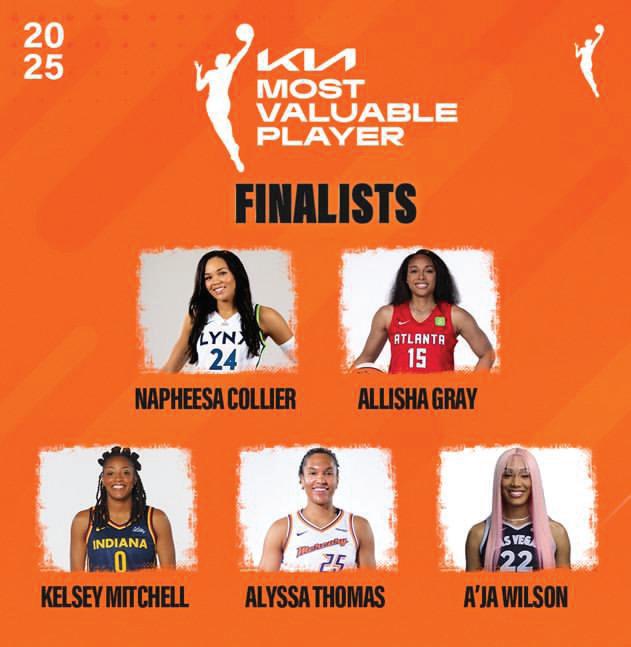
This “hate the best” mentality has been most evident on social media throughout this season as the Lynx earned the number-one seed for the playoffs and are a favorite to win the ’25 crown this season. This includes the “Phee vs. A’ja” conjured-up feud between the league’s two stars — Minnesota’s Naphessa Collier and Las Vegas’ A’ja Wilson — who are among five sistah finalists for MVP with Allisha Gray, Kelsey Mitchell and Alyssa Thomas.
But in Collier’s case, why the hater-aide? Is it because she is vice-president of the players’ union, Unrivalled cofounder, or her low-key, justget-the-job-done mentality and on-court demeanor? Or has a combination of all three brought out the worst among some fans on social media?
Last week, however, Collier’s teammate Alanna Smith became collateral damage after she and Wilson were named co-Defensive Player of the Year, the first time in league history that this happened. Both players garnered 29 votes each from the national voting panel. But this didn’t stop the haters, ignoring the fact that four times in NBA history dual winners of an individual award have been named.
Also overlooked is that the 6’3” Aussie who played at Stanford, was drafted by Phoenix in 2019, and signed as a free agent by Minnesota last season has been a defensive bedrock all season for the Lynx, helping them to a 97.5 defensive rating, tops in the league. And that Smith often effectively guards the opponent’s big in every game.
Wilson at 6’4” is no slouch — the Aces’ center is considered one of the league’s most dominant two-way players and leads in several offensive and defensive categories.
But it’s not always stats that tell the whole story, es-
her alma mater, had more to say, indicating that while Combs will be missed, there is still some unfinished business. “I will miss him deeply this year and no one could ever replace him,” she said.
“In the remaining time I’m at
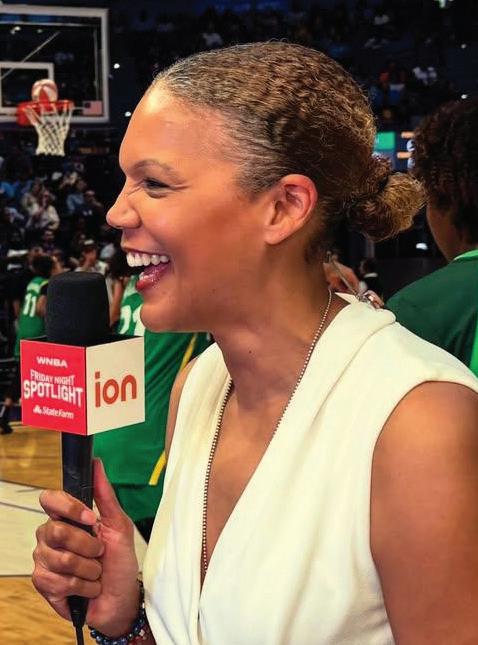
Chicago Sky broadcaster Shimmy Miller deftly avoided the noise and offered us her post-season analysis after the first round completed last week in which three of four closeout games went down to the final shot before a winner was decided.
“First of all,” observed Miller, “I love the 1-1-1 format for the first round. It’s made for a more competitive playoff so far. There is no way Seattle would’ve won game 2 without having that home court advantage, and Golden State really used their fan base to almost pull off the upset [against Minnesota].
“It was the right move. Not just for the competitive balance of the teams but for the fans that have supported their teams all season long. They deserve the right to have at least one home playoff game.
“I still don’t think anyone can beat Minnesota in a seven-game series.”
“I still don’t think anyone can beat Minnesota in a seven-game series,” continued Miller, “so they continue to be my team to beat. And I’ve been pretty consistent with this all season. They have depth, balanced insideoutside scoring experience, star power, and they can outscore you or win with defense.
“Vegas and New York [who lost to Phoenix] showed a lot of vulnerabilities, but I think Indiana upsetting Atlanta was a blessing for the Aces. I think the Fever is a much more favorable matchup for Las Vegas than Atlanta would’ve been.
“So, I’m predicting a Vegas vs. Minnesota matchup in the Finals,” concluded Miller.
Charles Hallman welcomes reader comments to challman@ spokesman-recorder.com.
Harding I will do whatever I can to get the track and field named after him in his honor.”
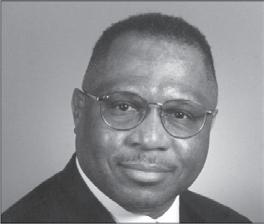
Dr. Mitchell Palmer McDonald welcomes reader comments to mcdeezy05@gmail.com.
ccording to MLBbro.com, a dedicated website spotlighting Black and brown pro baseball players, there are nine Black MLB pitchers this season. The Minnesota Twins joined the Cincinnati Reds a couple of months ago as the only teams with two Black pitchers.
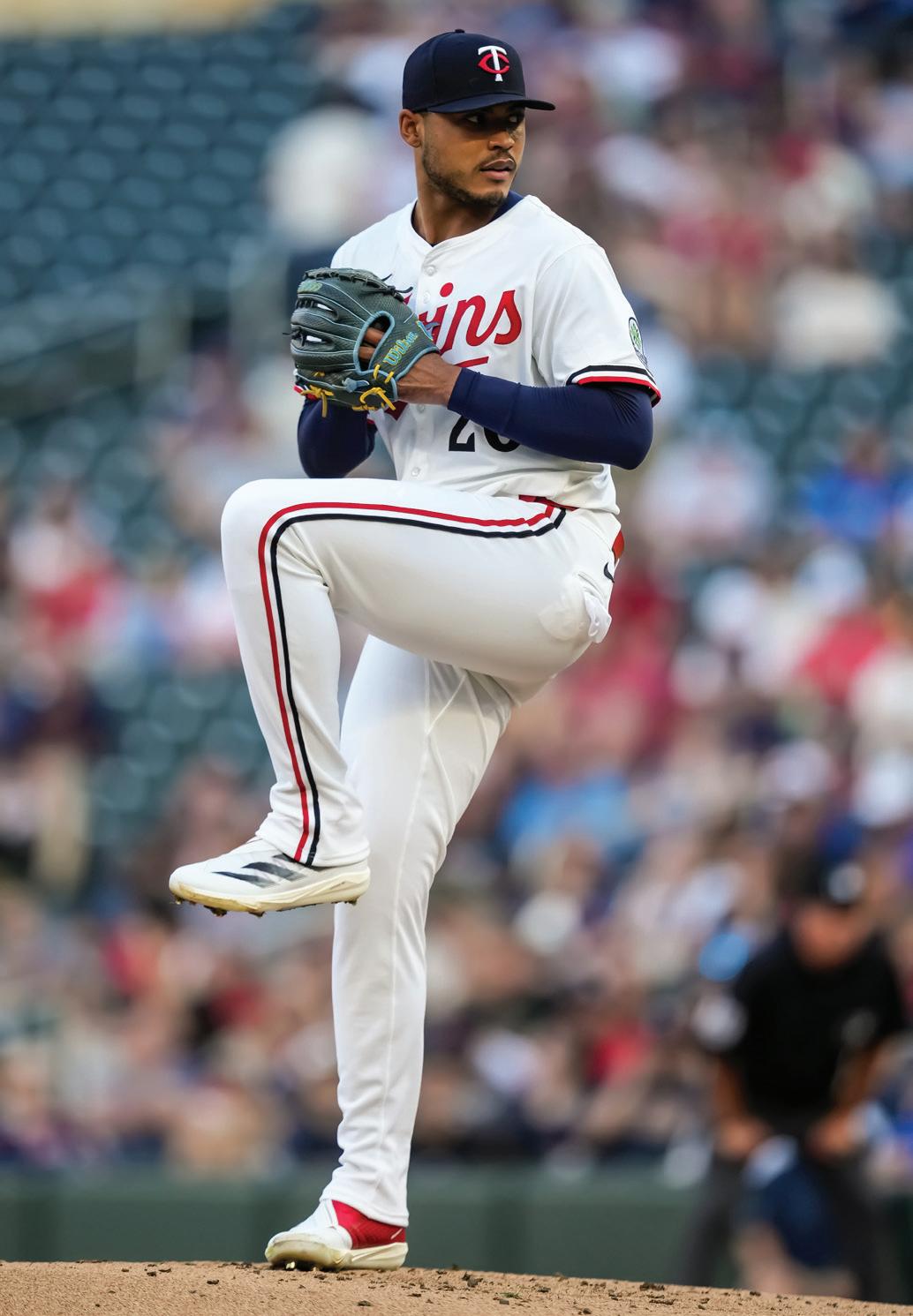
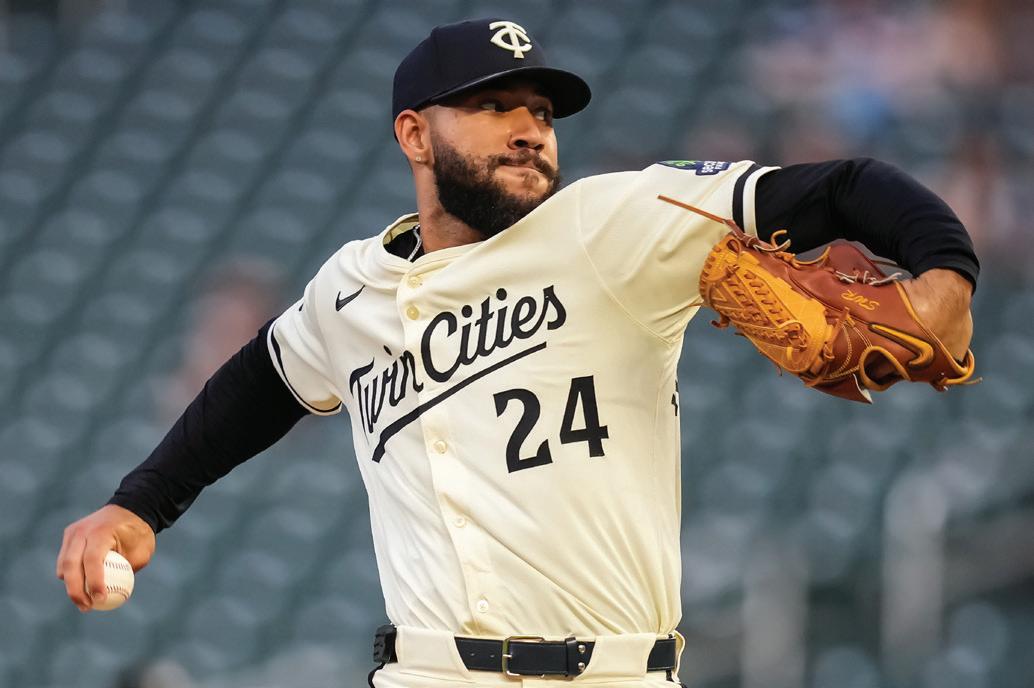
Taj Bradley was acquired on July 31 from Tampa Bay in a trade for pitcher Griffin Jax. He was the team’s third starter for the first time this season with the Rays. After a stint with Triple-A St. Paul, the 6’2” hurler joined 6’4” Simeon Woods Richardson in the Twins’ starting rotation.
The two hurlers both started last week against the New York Yankees at the Twins’ downtown ballpark. Woods Richardson gave up two hits and struck out a career-high 11 for his seventh win of the season, a 7-0 shutout Sept. 15. However, Bradley allowed
In majors, only Twins and Reds have two Black pitchers
seven runs in four innings, only the fourth time he’d done so this season, and was tagged with the 10-5 loss to the Yankees Sept. 17.
We witnessed both performances in person and talked to Twins skipper Rocco Baldelli about both pitchers. “He went out there and he just simply beat them,” said Baldelli of SWR’s win over the visiting Yankees battling for a playoff spot. “He has the ability to do this often, and he has
good stuff.”
When told that we would be seeing Bradley pitch in person for the first time, Baldelli pointed out, “After you see him, you’ll see really elite ability, the stuff that you can turn into a guy that can go pitch in these important games, that have the type of ability to beat any lineup on any given day.”
Later, after Bradley’s performance last week, Baldelli told reporters during his postgame comments, “His stuff
Strength, development coaches mostly work
trength and Condition-
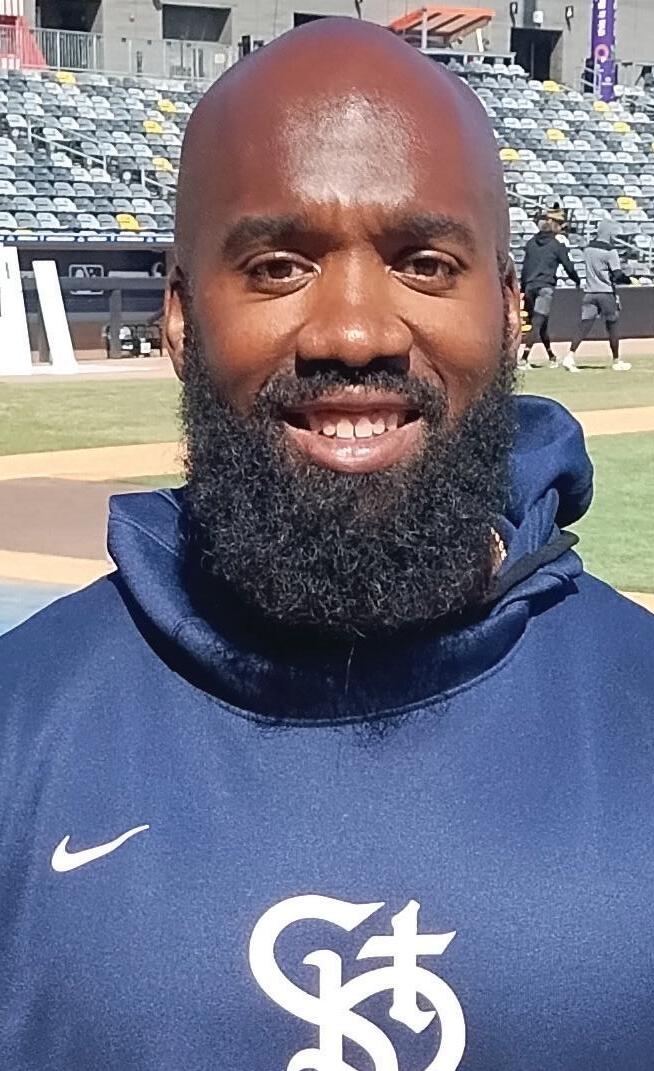
ing Coach Stephen Hopkins recently completed his second season with the St. Paul Saints. He is the only Black member on the staff.
Hopkins played college football at Michigan (201014) and is studying for his master’s degree in sports administration at Tennessee State University.
“I was born in Kansas City, Missouri,” said Hopkins.
“When I was young, I moved to Dallas, Texas. So I grew up in the suburbs. I got recruited by a lot of different schools, but I think it was a combination of academics and the Michigan tradition of football that got me.”
grams [for each player] and make sure we’re actually doing them correctly, and just making sure guys stick to the routines,” explained the Saints strength coach. “Just making sure the guys continually get in the work, make sure guys stay healthy.”
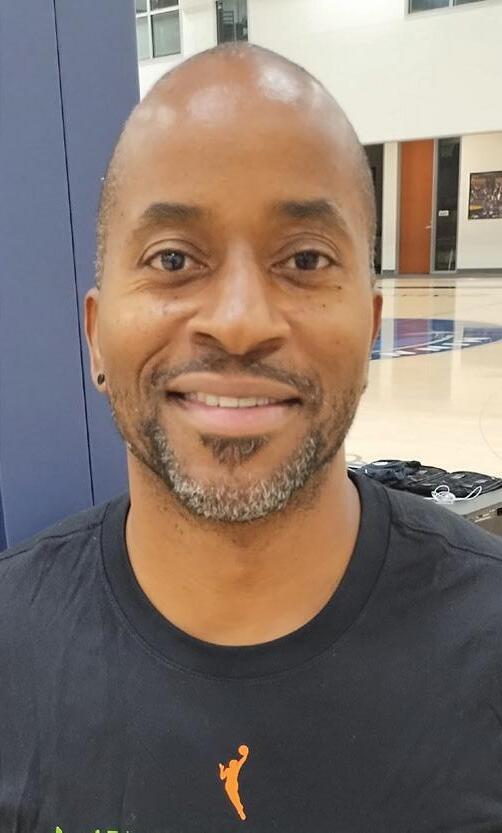
efu Bernard was named Director of Player Development for the Minnesota Lynx in late April just weeks before the start of the 2025 season. He held a similar position with the Washington Mystics from 2015-2024.
After working against them, Bernard said he is glad to be on the Lynx’s side: “I had the conversation with Cheryl [Reeve, Minnesota head coach and basketball operations president], he recalled, “about some of the opportunities to help support the development of the team and the players within the team.”
is so good that his success comes with the ability to mix and mix [pitches] in all counts. A lot of the time if he’s mixing and throwing his off speed pitches in the zone and just below the zone, he’s going to have a lot of success.”
“I’m
draft pick by Tampa Bay in 2018, the same draft in which Woods Richardson was selected by the New York Mets in the second round. Last season Bradley set career highs in nearly every major category and led the Rays in strikeouts, wins, and quality starts.
“I put myself in good spots to make the roster for three years,” explained Bradley. “I just feel like sometimes I’ve been a little bit inconsistent. That’s what I need to better myself and figure out more
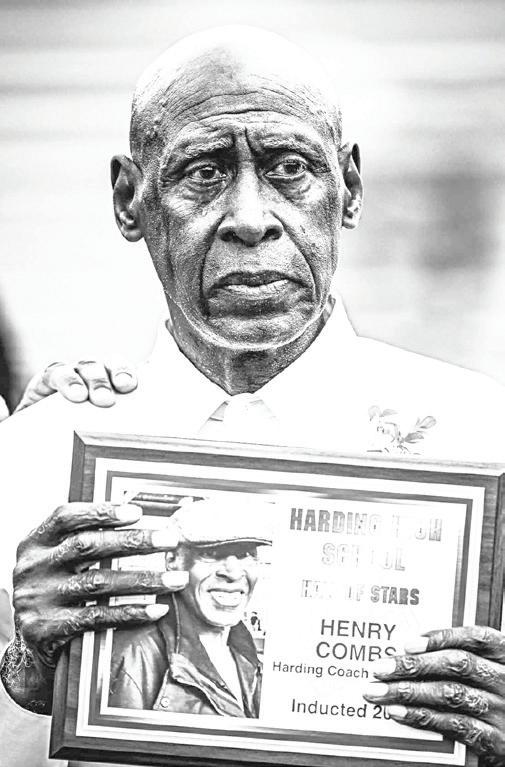
enry Combs! You can’t mention the sport of track and field in the state of Minnesota without his name entering the conversation.
Combs, a track and field phenom as an athlete at St. Paul Mechanic Arts in the early 1970s, and later as a coach of the AAU I.C.A.A/ Breeze at St. Paul Harding High School, has had an impact on the sport the past four decades.
Last Saturday, during halftime of the Harding/ Humboldt-Como Park football game at Bakken Field, as family, friends and colleagues
On working with the Twins’ top minor league club, “There’s 27 guys. I make pro-
What drew him into his current field? “I think for one, I wanted to impact people. I knew that I could connect with guys… I knew I could pass on some knowledge in that department to help guys avoid those shortcomings,” said Hopkins. “But also, I just had a passion for performing and human performance.”
Every day all season long, Hopkins said, he stresses to the players how important “the big picture” is. “I work with the team nutritionist to make sure the meals get here to the ballpark. There’s guys who have weight goals, making sure these guys stay [on them]. We kind of motivate the guys to just keep up with their routines and the routines they have to keep on the field.”
Sometimes, he noted, Hopkins must deal with a player’s
Bernard easily could be called a hoops lifer, spending nearly a decade in D.C. before a season in Connecticut (2011-12), and before that working with the old Detroit Shock in the 2000s before they bolted to Tulsa, and now in Dallas.
Before joining the W, Bernard was a senior director of basketball operations for NBA Asia, national development coach for Canada Basketball, and player development manager for the NBA’s Toronto Raptors.
“Those preliminary conversations, we realized it was a fit, and I was excited about being here,” continued Bernard. “This is one of the, if not the most storied franchises in the W, and I’ve had a high reverence for what Cheryl has done, what the team has accomplished, the people, the players. So I was excited to join when the opportunity came up.”
He is the only Black male on the Lynx coaching staff. As Reeve and the other coaches are devising practice and game plans, “My job is to support them in player development as it is in chess, to turn the pawns into the rooks, the rooks and knights into kings and queens so that their tactical staff can be that much better.
looked on, Combs was inducted into the Harding High School Hall of Fame.
It’s been a stellar journey for Combs. At Mechanic Arts he was quite the student athlete, becoming a St. Paul City champion as a hurdler
and starring in basketball and football as well.
But it was in coaching where the man with the calm and college demeanor made his mark. While leading the Breeze, he coached a young student athlete from Irondale High School named Juriad Hughes Jr. By the time he was a junior in 2023, Hughes Jr., now a sophomore on scholarship at the University of Arkansas, broke the 41-year-old long jump record set by St. Paul Central’s Von Sheppard in 1982. In 1994 Combs started his coaching journey at Harding.
From 2005-2008 he coached Sade Pollard, one of the most dominant sprinters in state history. In 2018, St. Paul Johnson senior Keylon Jackson, yet another member of the Breeze, was the St. Paul
By Charles Hallman Sports Columnist
The Los Angeles native was a fifth-round
Simeon Woods Richardson Photos courtesy of MN Twins
Simeon Woods Richardson Photos courtesy of MN Twins