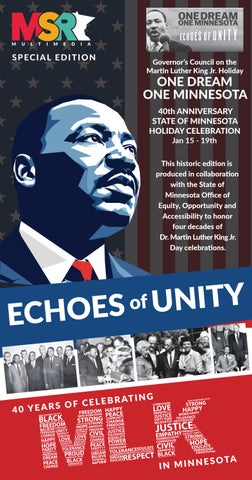
SPECIAL EDITION
Governor’s Council on the Martin Luther King Jr. Holiday
ONE DREAM ONE MINNESOTA 40th ANNIVERSARY STATE OF MINNESOTA HOLIDAY CELEBRATION Jan 15 - 19th This historic edition is produced in collaboration with the State of Minnesota Office of Equity, Opportunity and Accessibility to honor four decades of Dr. Martin Luther King Jr. Day celebrations.
40 YEAR
IN T A R B E L S OF CE
G
T O S E N N I IN M
A
2 January 15 - 19, 2026
M
U
LL
TT
II
M M
EE
D D
II AA
State Letters Dear Minnesotans,
I am proud to recognize Minnesota’s 40th annual Dr. Martin Luther King, Jr. Day celebration. This day serves as a poignant reminder that the work of justice, the courageous fight that Dr. King began decades ago, is not finished. Dr. King’s profound legacy serves not only as a guide, but as a call to action, a reminder that the pursuit of justice is reliant on our ability to unite across lines of difference. The work of my administration is guided by the principles set forth by Dr. King: unity, justice, and compassion. I know that we cannot fulfill our mission to make Minnesota Governor Tim Walz Courtesy Minnesota the best state to raise a family without standing up against injustice, and we cannot build One Minnesota without ensuring that all Minnesotans are heard, supported, and valued. This work is also deeply inspired by the Black leaders who came before me and those who I have the privilege to work alongside today. In 2022, we saw the election of the first Black women to the Minnesota Senate: Senators Erin MayeQuade, Zaynab Mohamed, and Clare Oumou Verbeten. And in 2023, Chief Justice Natalie Hudson became the first Black Chief Justice in the Minnesota Supreme Court. These are trailblazers who, despite so much fear and division coming from Washington, D.C., have made their voices heard. Their work is paving the way for so many others. Our vision of One Minnesota has influenced the work that we have done to improve the lives of all Minnesotans, built around the things that matter most, children and families, economic opportunity, health and safety, and strong local communities. We’ve maintained a focus on removing inequality. As a state we have invested billions of dollars in expanding access to child care and comprehensive health care, strengthening public safety and public schools, reducing child poverty, and investing directly in the economic vibrancy of our communities. And we are seeing the impacts of this work every day in our classrooms, workplaces, spaces of worship, and throughout our communities. By choosing empathy and showing up for one another we’re countering the hatred that threatens to divide us and building a stronger, more equitable Minnesota. Today, as the federal government stokes fear, threatens entire communities, and cuts funding that millions rely on, we’re seeing the importance of our unity. When we fail to listen to one another, when we stop seeing each other as human beings, we lose sight of Dr. King’s work and veer dangerously toward the division that sets us back. Yet, I remain hopeful that Minnesotans will continue to rise up together with the love, courage, and collective responsibility that drives our vision of One Minnesota. As Governor, I will continue to prioritize unity, and together we will carry Dr. King’s legacy forward to build the future he imagined. Sincerely, Governor Tim Walz
spokesman-recorder.com
Dear Minnesotans,
Forty years ago, our state made a commitment to honor Dr. King with this holiday. But that action wasn’t just focused on honoring Dr. King as a leader of the past, but as a guide for the work we are still called to do. His dream of justice, equality, and unity belongs not only to history, but to our present and our future. Dr. King’s work was rooted in Black Americans’ lived experience and their ongoing struggle for dignity, safety, and opportunity in the face of racism and injustice. Forty years later, Black Minnesotans Minnesota Lieutenant Governor Peggy continue to lead, organize, and demand Flanagan Courtesy change; and they continue to face disparities in housing, health care, education, and the criminal justice system that requires real action. Honoring that legacy means listening to the communities most impacted by injustice. I have always felt a deep connection to this day and what it represents. I grew up in St. Louis Park with a single mom who did everything she could to make sure we had what we needed. We relied on public programs like SNAP and a Section 8 housing voucher. Our community was essential to our survival, and I learned early that we don’t make it on our own. As my role model the late Senator Paul Wellstone was known for saying, “we all do better when we all do better.” As a member of the White Earth Nation and the Wolf Clan, I was taught that our role is to ensure no one is left behind. That teaching lives with me every day. It shows up in how I lead, how I serve, and how I fight for our communities. I rolled up my sleeves a long time ago because I know that you don’t get what you don’t fight for, and boy does it matter when you win. Dr. King reminded us that,“injustice anywhere is a threat to justice everywhere.” Those words echo the lessons I learned growing up about how the future we build for our communities depends on how we care for one another. Minnesota has known moments of pain and division, but we have also witnessed extraordinary solidarity, courage, and hope. Those moments have carried us forward and helped us build strong protections for people and families across our state. From the Iron Range to the Twin Cities, from Red Wing to Moorhead, Minnesotans continue to show that when we stand together, we can build a state where everyone belongs. This 40th anniversary is not just about reflection. It’s a call to action. It’s time to lace up our shoes and move forward, grounded in the past and committed to the future. Our diversity is our strength: Indigenous peoples whose stewardship of this land grounds us, immigrants who bring new traditions and dreams, and generations of families who have worked to make Minnesota a place of opportunity. Minnesotans, this moment demands more than remembering history. It calls on us to look forward and make the choice to leave our own fingerprints on history. Let us honor Dr. King not only with our words, but with our actions. Let us choose hope, justice, and love, and ensure that we never leave anyone behind. Sincerely, Lt. Governor Peggy Flanagan
Beloved community,
MEDA proudly carries on the principles of Martin Luther King Jr.'s legacy, with capital, consulting, and connections that create lasting economic equity for BIPOC entrepreneurs. Learn more at
meda.net
For more than 40 years, our community has honored, observed, and cherished the life and legacy of Dr. Martin Luther King Jr. As we stand at a pivotal moment in history, one truth remains clear: some of the best parts of Minnesota were built on the bedrock of Black labor, powered by Black genius and unapologetic demands for justice. This year’s 40th anniversary theme, “Echoes of Unity,” reminds everyone that we did not arrive here by faint whispers from a distant past. We are carried by strong, resonant echoes. Voices of genState of Minnesota Chief Equity Officer erations who, in the face of impossible Ashley Oolman Courtesy barriers, wove the fabric of community, business, and culture that we all inherit today. We honor those who dared to dream of a future they might never touch, but knew we deserved. One Dream. One Minnesota. The belief that a state can only truly prosper when every person, of every race in every zip code, has a real pathway to thrive. This starts with listening to wisdom that emerges at the margins. And amplifying the voices that have consistently and courageously called Minnesota to its highest ideals, urging every part of the ecosystem to reach for our collective potential. As Chief Equity Officer, I am charged with translating community priorities into systems change, to stand with you in the grind. This administration is committed to building an equitable, engaging, and effective government that solves problems and does the right thing, even when it’s hard. The work of democracy has always been collective and nonpartisan; it is a moral and economic imperative that benefits all, and we’re not backing down. Now to the horizon of emerging generations of Black artists, engineers, and policy makers of our shared future: your presence is felt. You are not merely inheriting this legacy, you are already shaping and propelling it. You are the true torchbearers of a “One Minnesota” that will be more just, more innovative, and more connected than ever before. In a time when echo-chambers are at our fingertips, Echoes of Unity is the call to action. A reverberation for where we must go, and how we move together. Let us continue building a state that truly honors the sacrifices of the past, by ensuring that the dreams of our ancestors come true. Towards One Minnesota, Ashley (Storm) Oolman Chief Equity Officer, State of Minnesota
January 15 - 19, 2026
Mayors
spokesman-recorder.com
M
U
L
T
I
M
E
D
I
3
A
Minneapolis Mayor says King’s legacy demands structural justice By Scott Selmer Assigning Editor Minneapolis Mayor Jacob Frey says honoring Dr. Martin Luther King Jr.’s legacy requires more than commemorations or calls for togetherness. It requires dismantling inequities that were built into systems and replacing them with structures that deliver ownership, stability, accountability and opportunity, particularly for Black residents long excluded from wealthbuilding pathways. Speaking as part of the Minnesota Spokesman-Recorder’s Echoes of Unity series, Frey said unity, as King envisioned it, cannot be symbolic. It must be visible in outcomes: more Black families building assets, remaining rooted in their neighborhoods, and experiencing city institutions that operate with dignity and fairness in practice, not just promise. The true measure, he said, is whether Minneapolis can finally close gaps that have persisted for generations. “Economic inclusion is one of our core priorities,” Frey said, describing an approach centered on “access to capital, ownership and opportunity.” He pointed to the city’s Ownership & Opportunity Fund as a key tool. One designed not simply to help Black entrepreneurs open businesses, but to secure ownership of property and assets that make genera-
tional wealth possible. Progress, Frey said, must be measurable. His administration is tracking indicators such as growth in Black-owned businesses, increases in Black homeownership, and whether families are able to remain and thrive in the neighborhoods they call home. Housing, Frey said, is where justice becomes tangible, and where inequity was intentionally engineered. He described the Minneapolis 2040 Plan as an effort to reverse decades of exclusionary zoning by allowing more housing options in every neighborhood. Alongside that, he said the city is expanding deeply affordable housing, arguing that stable housing is foundational to educational success, public health and economic mobility. On public safety, Frey rejected the idea that racial equity and safety are competing priorities. “Public safety and racial equity don’t compete, they rely on each other,” he said. He pointed to reforms that include building the most diverse police force in city history, strengthening accountability systems, clarifying use-of-force standards and improving supervision. Those reforms, Frey said, are advancing under a settlement agreement and consent decree. Success, he added, should be felt at the most basic level: whether residents trust that when they call 911, help will arrive with care, pro-
underserved neighborhoods. In response to the overdose crisis, the city has deployed Narcan vending machines that have distributed thousands of doses and launched a targeted opioid treatment pilot with community partners. Frey said city dollars have also been invested in food shelves to help families bridge gaps when federal benefits fall short, paired with housing stability programs designed to prevent displacement and homelessness. The goal, he said, is straightforward: save lives and reduce harm.
Minneapolis Mayor Jacob Frey fessionalism and respect. Frey also tied unity to the quality of work available to residents, describing Minneapolis as a “proud union city” where jobs should come with living wages, benefits and dignity. He said the city is partnering with labor unions, employers and training providers to connect residents to careers in construction, public works, health care and clean energy. Programs such as the Business Technical Assistance Program (BTAP), he said, are helping small and BIPOC-owned businesses build capacity and compete for contracts. Small business stability, Frey emphasized, is inseparable from neighborhood sta-
City of Minneapolis
“Justice has to be structural, and unity has to be measured by outcomes, not rhetoric.”
ity must hold real power in shaping solutions. He cited George Floyd Square, where community members are leading the vision for redevelopment, and the Upper Harbor project, where North Minneapolis residents have helped shape plans for housing, jobs, arts and public space. He said the city is expanding culturally specific engagement and compensating residents for their time, expertise and leadership. Education-to-career pipelines are another pillar of that approach. Frey pointed to Step Up and Urban Scholars, programs that connect thousands of Minneapolis students, many of them BIPOC, to paid internships with city departments, local businesses and nonprofits. Asked how King’s legacy should be understood in Minneapolis today, Frey was direct: “Justice has to be structural, and unity has to be measured by outcomes, not rhetoric.” He said King’s work is carried forward when equity is embedded in housing policy, ownership, public safety and economic opportunity, concluding that when unity is measured not by rhetoric, but by whether growth produces dignity, fairness and real results for everyone.
bility. Beyond access to capital, he highlighted ownership of commercial property as a bulwark against displacement. Through the Ownership & Opportunity Fund, he said, the city is helping Black For youth opportunity and entrepreneurs own “the prop- violence prevention, Frey said erty beneath their businesses,” the city is prioritizing prevennot just rent it. He also point- tion over reaction. He highed to initiatives like Vibrant lighted Stable Homes Stable Storefronts and the creation Schools, which has connected of cultural districts as ways thousands of families to housto reactivate vacant spaces ing stability, noting that most while anchoring neighbor- students served are Black, Inhood identity. digenous or students of color. Addressing health and eco- The city, he said, is also innomic disparities, Frey said the vesting in youth employment, city is taking a “meet people mentoring and communitywhere they are” approach. Min- rooted violence interruption neapolis has launched its first strategies. Scott Selmer welcomes Mobile Medical Unit to bring Frey stressed that those reader responses at sselmer@ care directly into historically most affected by inequal- spokesman-recorder.com.
Due to the timing of the recent mayoral transition in St. Paul, The Minnesota Spokesman-Recorder was unable to secure interviews with former Mayor Melvin Carter or current Mayor Khaoly Her for this edition. This series, however, highlights the ways both leaders contribute to the local community and carry forward Dr. King’s vision of unity and justice.
40 years of Dr. King day: Why it matters in Minnesota This year marks the 40th anniversary of the official observance of the Martin Luther King Jr. holiday, guided by the theme “Echoes of Unity.” It is a fitting theme that reminds us Dr. King’s voice did not end with his final speech, nor did his impact fade with time. His words, leadership and moral clarity continue to echo across generations, calling us toward unity, justice and shared responsibility. For The Minnesota Spokesman-Recorder, honoring the Rev. Dr. Martin Luther King Jr. is not optional or symbolic. It is foundational. Dr. King’s leadership transformed this nation. Through disciplined nonviolence and moral courage, he helped dismantle legalized segregation, expand voting rights and challenge America to live up to its democratic ideals. He was not only a civil rights leader. He was also a truth-teller who
Tracey Williams-Dillard, publisher and CEO of the Minnesota Spokesman-Recorder. Courtesy understood the power of institutions, including the Black press, to shape public understanding and sustain movements for change. That understanding aligns directly with why The Min-
nesota Spokesman-Recorder was founded. This newspaper was established at a time when Black Minnesotans were largely excluded from mainstream media, their concerns overlooked
M
U
L
T
I
M
E
D
I
and their achievements ignored. Like many Black newspapers across the country, the Spokesman-Recorder emerged to fill that void. Its mission was to inform, to advocate and to unify a community too often fragmented by discrimination and neglect. In doing so, it echoed the very principles Dr. King championed: dignity, visibility and collective progress. The theme “Echoes of Unity” resonates deeply with both Dr. King’s legacy and our mission. Unity, as Dr. King taught, is not passive agreement. It is active engagement across differences, generations and lines of power. Unity requires listening, accountability and a willingness to confront uncomfortable truths. These are values the SpokesmanRecorder has upheld for decades, using its pages to bring communities together while also challenging systems that
perpetuate inequality. Recognizing Dr. King’s legacy also means acknowledging that the work he began remains unfinished. While progress has been made, disparities in education, housing, health care, employment and criminal justice persist, both in Minnesota and across the nation. Dr. King warned against the danger of silence and complacency, urging society not merely to celebrate progress but to continue pushing forward. His words still echo because the issues he addressed remain with us. That is why it is important for the Minnesota Spokesman-Recorder to join the state in celebrating the Martin Luther King Jr. holiday. This day is not simply a commemoration of the past. It is a call to action in the present. It invites Minnesotans to reflect on our shared history, serve our communities and recom-
A
M
U
L
T
I
M
E
D
I
A
@spokesman-recorder.com or call 612-827-4021
mit to the principles of equity and justice. By recognizing this holiday, the state affirms that Dr. King’s legacy is not confined to one community. It belongs to all who believe in the promise of democracy. At 40 years, the echoes of unity are still being heard through acts of service, community dialogue and institutions like the Minnesota Spokesman-Recorder that continue to amplify voices too often marginalized. Honoring Dr. King is not just about remembering what he did. It is about carrying forward what he stood for. As we reflect on this anniversary, may we listen closely to those echoes and may they guide us toward a more united, just and inclusive Minnesota. Sincerely, Tracey Williams-Dillard Publisher and CEO of the Minnesota Spokesman-Recorder
4 January 15 - 19, 2026
M
U
LL
TT
II
M M
EE
D D
II AA
Policy Leaders
spokesman-recorder.com
Dr. King’s work lives in the cases Minnesota Attorney General Keith Ellison litigates By Scott Selmer Assigning Editor
nomic losses on families. He also pointed to a major housing enforcement case Minnesota Attorney Gen- concluded in October against eral Keith Ellison says Dr. a private equity firm he idenMartin Luther King Jr.’s legacy tified as Pridium. Tenants, lives not only in speeches “mostly low-income, people and commemorations, but in of color,” Ellison said, were courtrooms where civil rights, living in deteriorating condieconomic justice and human tions. The settlement returned dignity are enforced through money to residents, forgave some rent and loans, and rethe rule of law. In an interview for the Min- quired the sale of more than nesota Spokesman-Recorder’s 600 properties. Those homes Echoes of Unity series, El- were purchased by nonprofit lison said his office is using housing organizations, he said, the state’s legal authority to creating a path toward stable, advance what he described as affordable housing. While that case centered the “fundamental principles” King championed, pursuing on the Twin Cities, Ellison fairness through consumer emphasized that enforcement protection, housing enforce- against predatory landlords manufactured-housing ment, worker advocacy, police and accountability and oversight owners has extended statewide. “We’ve done them literof technology-driven harms. Ellison framed unity not as ally all over the state of Minconsensus, but as account- nesota,” he said. Ellison described his office ability: the idea that systems must work for everyone, and as a frequent litigant in civilthat powerful actors must be rights disputes, particularly held responsible when their since President Donald Trump returned to office. Minnesota, choices cause harm. One recent example, Ellison he said, has sued to defend said, was a settlement reached voting rights and civil rights, in December following an in- including the state’s ability to vestigation into Kia and Hyun- maintain diversity, equity and dai over vehicle vulnerabilities inclusion initiatives; proteche said contributed to wide- tions for LGBTQ people; and spread auto thefts. “They were the right of women to make never held accountable until their own reproductive health we initiated that effort,” El- decisions. In total, Ellison said, lison said, describing the case his office has filed more than as a reminder that corporate 50 lawsuits. He cited ongoing litigation decisions can impose real eco-
Minnesota Attorney General Keith Ellison Minnesota Attorney General Office after the federal government warned Minnesota it could lose emergency management funding unless it required state law enforcement officers to act as federal immigration agents. Minnesota refused, Ellison said, and “we went to court over it.” On policing and public trust, Ellison pointed to prosecutions handled by his office, including the case stemming from George Floyd’s death. “Our office prosecuted people who murdered George Floyd,” Ellison said, adding that it was not an isolated instance. He cited the prosecution of former
Brooklyn Center officer Kim Potter and other cases as part of a broader commitment to law enforcement accountability. Ellison also connected his work to King’s emphasis on labor rights, noting that King viewed labor justice as civil rights and was supporting striking sanitation workers in Memphis when he was assassinated. In Minnesota, Ellison said, that legacy continues through worker-rights litigation, including an amicus filing after Trump fired National Labor Relations Board Chair Gwynne Wilcox. Beyond litigation, Ellison
Bobby Joe Champion: Minnesota’s first Black senate president, called to serve By Alaysia Lane Contributing Writer When Sen. Bobby Joe Champion reflects on his journey, from a young boy in north Minneapolis to becoming the first Black president of the Minnesota Senate, he doesn’t begin with policy victories. He begins with community. Born in 1963, Champion is the fifth of six children. His parents migrated from the South. His mother from Hooks, Texas, and his father from Hope, Arkansas, with hopes of building a better life and expanding opportunities for Black families. They carried with them a belief in civil rights, dignity and collective progress. In north Minneapolis, they found and helped cultivate a neighborhood where cultures intertwined and where community was not just a place but a promise. The north side of Champion’s childhood was evolving from a predominantly Jewish neighborhood into a diverse, multicultural mosaic. Black, Latino, Indigenous and Jewish families lived side by side. Although discriminatory housing policies and city planning labeled the area “the ghetto,” residents defined it differently. Neighbors looked after one another, and respect crossed fences and faith traditions. “Through that lens, you got a chance to understand not just our history as African Americans, but how history was tied to other people’s history,” Champion said. “That personal experience allowed me to understand what true community is all about.” Champion’s sense of justice first sparked while watching “Perry Mason,” the TV series about a defense attorney fighting for the wrongly ac-
said his office works to expand two years that would reflect access to justice across Min- King’s moral and legal legacy, nesota. The Attorney Gener- Ellison said the goal is simple al’s Office receives more than but urgent: help Minnesotans 80,000 calls each year, he “afford their lives.” He argued that racism often said, responding with actions that range from letters to law- operates through the economy: suits. Staff conduct about 40 shaping who gets housing, who community meetings annually gets paid fairly, and who bears and host expungement clinics the cost of exploitation. “Racto help Minnesotans remove ism blows through the econbarriers to housing and em- omy,” Ellison said, describing ployment. Ellison urged resi- scenarios in which housing is dents seeking legal help to call suddenly unavailable once a 651-296-3353. “brown face” appears. He pointed to wage-theft enforcement, actions against predatory landlords, antitrust cases protecting small businesses, and investigations into for-profit colleges he said disproportionately recruit students of color and leave them burdened with debt. The throughline, Ellison said, is making legal rights real, and ensuring that those most vulEllison also outlined a civil- nerable are not left to absorb rights agenda for the digital the costs of injustice alone. age, citing consumer privacy, “We don’t write laws. We data security and algorithmic enforce laws that already exdecision-making. Minnesota ist,” Ellison said, noting that is suing Meta, he said, over an the attorney general’s leveralgorithm he described as ad- age is “generally a lawsuit or dictive to children. He also ref- the threat of one.” erenced enforcement actions For Ellison, that work is following major data breaches constant. “No day goes by that at companies including Equifax we’re not fighting for the funand Target, as well as antitrust damental principles of MLK,” he cases involving algorithm-driv- said. “Civil rights. Human rights. en market behavior, including The rule of law. Due process.” matters he identified as Agri Stats and Rent-A-Page. Scott Selmer welcomes Asked what outcomes he reader responses at sselmer@ hopes to achieve in the next spokesman-recorder.com.
“We don’t write laws. We enforce laws that already exist.”
Jr. King, he said, remains consequential not only for his speeches but for his understanding of collective action. “He does nothing alone,” centuries of underestimation, Champion said, noting that narratives questioning Black true leadership is rooted in intellectual capacity and per- service, humility and human sistent doubts imposed by so- connection. King taught that ciety. But he also knows that greatness is not defined by every first widens the path for comfort or accolades, but by how we respond in moments those who follow. Champion never set out of challenge.
and the day we leave. “What did you do while you were here?” he asks. To him, the substance of a life is not longevity but purpose: the courage to confront inequity, the compassion to uplift others and the commitment to strengthen community. He sees King’s vision alive in the unfinished work before Minnesota today: closing gaps in wealth, education, health and opportunity; ensuring every child grows up in a stable home; and creating a state where every community can flourish. Guided by his belief in humanity, Champion says progress is possible when people lead with unity and shared purpose. In the hyphen of our lives, he reminds us we are bound “If you want to be great, together, and our truest legaserve,” Champion said, echo- cy, our echo of unity, is meaing King’s message that the sured by how we lift others measure of a life is its impact along the way. on others. Champion often describes Alaysia Lane is a multimedia life as a hyphen; the space journalist and commerce writer between the day we are born based in Minneapolis.
to run for office. In fact, he resisted it. But community members urged him forward, saying his fairness, steadiness and temperament were needed. He had already been the first in his family to attend college and the first to earn a law degree. Stepping into public service without a blueprint felt familiar. He eventually said yes; not for a title, but for the people of District 59, who Sen. Bobby Joe Champion, Minnesota’s first Black Senate trusted him to represent them. That guiding belief, that president, says true leadership begins with service and the leadership begins with serbelief that communities rise together. Photos courtesy Minnesota Senate DFL vice, shapes Champion’s connection to the teachings of cused. He became fascinated Senate in 2012 and, in 2023, the Rev. Martin Luther King with the power of voice, and made history as its first Black the courage required to stand president. with vulnerable people. His legislative work has cenMusic also shaped his un- tered on family, equity and opderstanding of unity. As a portunity. He co-authored the teenager, he co-founded the Minnesota African American Grammy-nominated Excelsior Family Preservation and Child Choir, an experience he calls Welfare Disproportionality Act, a master class in leadership. a landmark effort to strengthen Directing the choir taught him families and address racial ineqthat harmony is created not uities in the child welfare system. by one dominant voice but by He has advocated closing racial many voices learning to move disparities in housing, education together. He learned when to and wealth, calling stable houslead, when to step back and ing and homeownership essenhow trust can turn individual tial to economic empowerment. notes into something greater As a founding member of the than the sum of their parts. United Black Legislative Caucus, After law school, Champion he has worked to elevate voices carried those lessons into the that are often left out of policyLegal Rights Center, where he making. SOCIAL RESPONSIBILITY | ETHICAL BANKING | BRIGHTER FUTURES defended people accused of For Champion, becoming serious crimes and insisted “the first” was less about indion fairness, due process and vidual achievement than reLearn more at equal access to justice. Those sponsibility. “Because in order sunrisebanks.com values would guide him when for there to be a second, someor scan the QR code: he entered politics. He won one has to be a trailblazer,” he Member FDIC his first legislative seat in said. He acknowledges the NMLS# 640909 2008, joined the Minnesota emotional weight of that role:
“That personal experience allowed me to understand what true community is all about.”
Your dreams can grow here.
spokesman-recorder.com
Philanthropic
January 15 - 19, 2026
M
U
L
T
I
M
E
D
I
5
A
Saint Paul & Minnesota Foundation uplifts leaders advancing racial equity By Jasmine McBride Editor
and convene stakeholders to advance shared goals.” Founded in 1969 as the As Minnesota continues to St. Paul Foundation, the orwrestle with long-standing ra- ganization merged with the cial disparities, the Saint Paul Minnesota Foundation in & Minnesota Foundation is 2017 to form the Saint Paul & celebrating leaders who are Minnesota Foundation, now working to build a more just the state’s largest commuand equitable state. The foun- nity foundation. Its mission is dation’s annual Facing Race to harness philanthropy and Awards, now in its 18th year, community resources to adhighlights local change-mak- dress both immediate needs ers who challenge systemic in- and long-term structural chalequities and reimagine oppor- lenges, supporting initiatives ranging from education and tunities for all communities. economic development to racial equity and arts and culture. Over the years, the foundation has built a reputation for using its convening power to foster collaboration across diverse communities and political perspectives. Smith Baker brings decades of community-based leadership to her new role. A MinneChanda Smith Baker, newly apolis native, she previously appointed president and CEO served as president and CEO of the Saint Paul & Minnesota of Pillsbury United CommuniFoundation, brings decades ties and as senior vice presiof community leadership and dent and chief impact officer philanthropy experience to her at the Minneapolis Foundarole, guiding the state’s largest tion. Her career has spanned community foundation in ad- nonprofits, philanthropy, and vancing equity and celebrating civic leadership, often focused on addressing inequities in leaders across Minnesota. education, housing, and ecoChanda Smith Baker, the nomic opportunity. “My work has always been foundation’s newly appointed president and CEO, said her about building equitable opvision for the organization is portunities in neighborhoods rooted in collaboration, equity, and communities,” she said. and community-centered lead- “Stepping into this role is a natership. “Making sure communi- ural extension of that work.” ty is our compass is central to Smith Baker, a 2025 Bush Felhow we move forward,” Smith low, emphasized the imporBaker said. “We listen to resi- tance of sustainable leaderdents, respond to their needs, ship and self-care in her new
position. “The fellowship has are unique, the work of imagbeen helping me understand ining a more just Minnesota how to maintain balance, de- connects us all,” Tamene said. velop as a storyteller, and sup- This year, the foundation report other leaders in advanc- ceived 156 nominations, reping their own visions,” she said. resenting 85 unique nominees. The foundation’s Facing A committee of past awardees Race Awards, first established and community leaders rein 2007, recognize individuals viewed the submissions to seacross Minnesota who are ad- lect the honorees. “Many of the leaders we vancing racial justice through innovative, community-driven celebrate don’t do this work work. Recipients are chosen for recognition,” Tamene said. not for self-promotion but for “This is hands-on, often extheir demonstrated impact in hausting work, yet taking a challenging inequities, often moment to pause, reflect, and quietly and consistently. This celebrate their contributions year, the foundation honored is essential. Joy and rest are five leaders representing di- forms of resistance.” Smith Baker emphasized verse communities from both the Twin Cities and greater that the foundation’s role in convening stakeholders is esMinnesota. pecially important in a politically charged climate. “People are living with fear, disparities are more obvious, and mistrust of institutions exists,” she said. “Our responsibility is to show that we understand the struggle and can work alongside the community to identify solutions.” In her personal life, Smith Baker values simplicity and Tsega Tamene, Associate Vice restoration. “I’m a reader, love President of Community Impact spending time with family and at the Saint Paul & Minnesota friends, and travel when I can. Foundation, leads initiatives Downtime feeds my spirit and that recognize and support allows me to show up fully in community leaders driving antimy work,” she said. She also racism work and advancing eqhopes her leadership will inuity across Minnesota. spire the next generation of Tsega Tamene, who man- Minnesota leaders. “Invest ages the awards program, in yourself, learn your own highlighted the significance of leadership style, and build recognizing work beyond the relationships. Everyone has a metro area. “It’s important to path; find yours and lean into honor leaders across the state, it intentionally,” she said. The Saint Paul & Minnebecause while communities
The “Facing Race Awards” were established in 2007 to address racial inequities and celebrate and honor community members courageously working to eliminate racism and its effects throughout the state of Minnesota. All photos courtesy of the Saint Paul and Minnesota Foundation From honoring leaders with sota Foundation’s emphasis on celebrating leadership and the Facing Race Awards to fostering equity underscores convening diverse stakeholda broader vision of communi- ers, the foundation continues ty-led change. By combining to be a vital force in Minnephilanthropy with deep en- sota’s efforts to address racial gagement and recognition of disparities and uplift all resigrassroots efforts, the founda- dents. As Smith Baker noted, tion seeks to create lasting im- “It’s about listening, respondpact across the state. As Smith ing, and building together. Baker steps into her role, she Community is the compass, aims to strengthen those con- and collective action is our nections, leveraging the foun- path forward.” dation’s resources to support communities that have historThe Saint Paul & Minneically been underrepresented sota Foundation is Minnesota’s in decision-making. largest community foundation, leveraging philanthropy and partnerships to strengthen communities, advance racial equity, and support leaders driving positive change across the state. For more information, visit www. spmcf.org.
“Community is the compass, and collective action is our Jasmine McBride welcomes path forward.” reader responses at jmcbride@ spokesman-recorder.com.
Foundation’s approach. Mola encourages anyone interested in supporting the mission to give, participate, and stay connected. “Give, give, give,” she said. “Stay connected, help Mola said that Black people By Jasmine McBride build what is an asset to all of continue to face worsening Editor us.” economic conditions, includReflecting on the past ing shrinking safety nets, limIn 2020, amid a national three years, Mola said the ited access to stable jobs, and racial justice uprising, Lulete foundation’s progress has exrising costs. “It’s critical that Lulete Mola, co-founder of ceeded expectations. By the Mola and her co-founders we build our own,” she said. the Black Collective Founda- end of 2025, it will have allaunched the Black Collective Through partnerships with tion, emphasizes the power located nearly $4 million into Foundation, Minnesota’s first community development fi- of collective leadership and the community through creBlack Community Foundanancial institutions, nonprof- community support in ad- ative and abundant programs, tion, to advance the genius of its, and social-impact busi- vancing Black-led change ranging from youth and elder Black-led change through parnesses, the foundation helps and economic empowerment initiatives to support for artticipatory philanthropy. create pathways for Black-led “We realized we must build Courtesy ists, entrepreneurs, and Blackeconomic success. Initiatives institutions that can outlast led organizations. “My hope like Groundbreak, focused on to be our brother and sister’s and prayer is that the Black the moment,” Mola said. “We wealth building, illustrate how keeper now more than ever.” must build self-determined Collective can continue carMola highlighted the im- rying the essence and dreams vision translates into tangible ways of resourcing and ampliportance of participatory phi- of our people so that it can be change. fying the change we want to The foundation’s mission lanthropy, where community here beyond me,” she said. see.” extends beyond economics. members directly shape the The foundation operates as Through participatory phiMola said collective libera- foundation’s work. “Every- lanthropy, holistic empowera community-first organization, providing resources and Lulete Mola, co-founder of the Black Collective Foundation, tion means creating a com- body from our board to our ment, and intentional cominitiatives that are exclusively embraces a participant at the foundation’s Rooted & Radiant munity in which Black people staff to the people who help munity building, Mola and the for Black people while also Juneteenth celebration, held at the Glass House in Minneapo- live with dignity, wellness, and make grant decisions are from Black Collective Foundation creating opportunities for all. lis on June 19. Jasmine McBride/MSR prosperity. Achieving that re- this community,” she said. are redefining what it means quires restoring kinship net- “That truly makes it a Black to lead and thrive collectively. Mola said their approach is both locally rooted and broad- from collective leadership. this work without my village.” works and cultivating connec- collective. The work is held up Their work exemplifies a modMola is also committed tions across generations. “We by so many people, and that’s el where leadership is shared, ly visionary, redefining phi- “Sustainable leadership is relanthropy in Minnesota and ally about the collective… to engaging young people in build kinship networks one re- what makes it sustainable. It’s the community shapes the leading collectively, mov- shaping the foundation’s work. lationship at a time,” she said. not about any one person.” nationally. mission, and resources are Community engagement used to cultivate long-term Despite being only five ing collectively, strategically She said youth bring fresh “It’s time to go back and focus years old, the foundation has aligning, and understanding perspectives, energy, and lon- on them, to provide resources and connection are at the change that benefits current already moved nearly $4 mil- your lane,” she said. “It’s not gevity to initiatives, and she and opportunities for folks, heart of the Black Collective and future generations. lion into the community, sup- about me; it’s about all of us. described them as essential porting legacy organizations, The smartest thing I did was to the foundation’s future. “If The Black Collective Founemerging initiatives, and pro- be a co-founder. I am not a your vision does not include dation Minnesota, co-founded grams that empower Black sole founder. This work is big- young people, that means you by Lulete Mola and two fellow are building your vision to die,” girls, young men, elders, art- ger than one person.” leaders, is the state’s first Black Her leadership philosophy she said. Young leaders parists, and entrepreneurs. The community foundation dediorganization has also pub- extends beyond professional ticipate in grant committees, cated to advancing Black-led lished national research high- work. A new mother herself, program development, and change through participatory lighting Black philanthropy in Mola credits her ability to community engagement, enphilanthropy, youth engageMinnesota, convened leaders lead to the village of support suring the foundation’s misment, and economic empowto foster new networks, and around her. “We do not lead sion remains regenerative and erment. For more information, launched initiatives support- alone,” she said. “Whether forward-looking. visit www.minnesotablackcolEconomic empowerment ing legal literacy for organi- it’s someone who’s been here lectivefoundation.org. zations across cultures and for generations or someone is a central focus of the founlike me who immigrated from dation, echoing the principles Fashion designer and business owner Brandon Blackwood races. Jasmine McBride welcomes Mola emphasized that the Ethiopia, leadership alone is Dr. Martin Luther King Jr. (left), Lulete Mola (center), and Adair Mosley (right) at The Col- reader responses at jmcbride@ Courtesy spokesman-recorder.com. foundation’s impact stems not sustainable. I couldn’t do emphasized in his later years. lective Sum on Nov. 20.
Leading with purpose: Lulete Mola and the Black Collective Foundation
6 January 15 - 19, 2026
M
U
LL
TT
II
M M
EE
D D
II AA
Educational Leaders
spokesman-recorder.com
Dr. Artika Tyner: Building unity through education and community leadership By Jasmine McBride Editor
man-Recorder commemorates Martin Luther King Jr. through its “Echoes of Unity” series, Tyner’s reflections offer a timely reminder. “Education, culture, and history aren’t just restoring our kinship networks,” unveiled possibilities across about learning; they’re about she said. “We build these net- multiple dimensions,” she said. empowering each other,” she works one relationship at a “We must cultivate leadership said. “When we understand time with family, neighbors, within ourselves and across our ourselves and each other, we elders, and community leaders. communities to meet the chal- can build a stronger, more unified community.” That’s how we ensure our col- lenges of today.” For Tyner, the work is onThe educator emphasizes lective future thrives.” going, and the measure of that real change starts with a success is clear. “I keep the mindset shift from scarcity to “Our biggest challenge scorecard in the community,” abundance. “If you only see is rekindling and she said. “If someone says, what’s in front of you, you can’t ‘You inspired me,’ or ‘I’m steprestoring our kinship imagine what’s ahead of you,” ping into leadership because she said. For Tyner, this perspec(L-R) Dr. Artika Tyner, Nasra Noor, and Akinyi Williams networks. We build of you,’ that tells me I’m fulfilltive is rooted in her experience these networks one ing my mission.” end Carl Walker, and her music can make a difference,” she said. as a first-generation college and Through decades of teachteachers at Walker West Music “We have a chance to bring peo- relationship at a time.” law student and informs her efing, writing, and organizing, Academy, she witnessed lead- ple together, understand our
For Dr. Artika Tyner, education is more than a profession; it is a lifelong mission rooted in history, culture, and community. As a scholar, educator, and author, Tyner has spent decades nurturing programs that elevate Black voices, preserve African American history, and cultivate leadership across generations. Her passion for learning began at home. “My mother is an educator, and every day was a learning opportunity,” Tyner ership grounded in service and said. “She taught me that the cultural pride. “As I became an more you learn, the more you educator myself, I realized that can think critically and make many people weren’t grounded an impact in the community.” in history, culture, or legacy,” Those lessons laid the founda- Tyner said. “I felt compelled to tion for a career devoted to change that.” Over the years, Tyner has mentorship, scholarship, and authored 40 books, 30 of cultural preservation.
Tyner approaches this work shared humanity, and act on it.” Central to Tyner’s philoso- with a practical philosophy she phy is the idea that effective calls her “community scorecard.” leadership requires growth on “If my work makes someone’s multiple levels: personal, inter- day better or inspires them to personal, organizational, and reach their potential, then I’ve societal. “The challenge for achieved my goal,” she said. She leaders today is capturing all invites students, community four dimensions,” she said. “It’s members, and colleagues into a labor of love, but it’s essential her home and her programs, if we want to be effective and turning learning into a shared, intergenerational experience. impactful.” The educator’s approach reHer work transcends borders. Inspired by King’s travels flects a belief in both equality to Ghana and his support of the and equity. “Equality is the valnation’s independence, Tyner ue and essence of our shared leads initiatives there in edu- humanity,” she said. “Equity is cation, economic development, the process that helps us emand public health. She organizes bark on that journey.” Tyner’s youth leadership summits, lit- work embodies both: advocateracy programs, and healthcare ing for fairness while creating projects. Efforts that connect structures that empower indi(L-R) Planting People Growing Justice (PPGJ) Creative Arts communities across the African viduals to realize their potential. Tyner’s vision for commudiaspora and strengthen the Director Lanell Lightfoot and Dr. Artika Tyner shared resilience of Black com- nity and leadership also draws on historical perspectives. She Tyner’s roots run deep in which highlight African Ameri- munities worldwide. Yet her commitment remains often references the leaders Rondo, the historic African can leaders. Among her favorAmerican neighborhood of St. ites is Dr. Martin Luther King deeply local. Tyner emphasizes of the civil rights era and the Paul, Minnesota. Growing up Jr.’s “Where Do We Go From kinship and collective responsi- African diaspora. “When you surrounded by local examples Here: Chaos or Community?” bility as essential to building a look at leaders like Dr. King, of Black excellence, mentors “Dr. King invites all of us to look thriving community. “Our big- Dr. Kwame Nkrumah, Malcolm like Thelma Buckner, Rever- in the mirror and ask how we gest challenge is rekindling and X, and Maya Angelou, they
Dr. Artika Tyner with youth at the Senchi Ferry Library in Ghana All photos courtesy forts to guide others toward re- Tyner embodies the principles Dr. King championed: unity, alizing their ambitions. service, and leadership rooted In practical terms, this in love. Her message resonates means creating programs that allow communities to learn across local and global comcollectively, connect across munities: the path to a stronger, generations, and share re- more equitable future is built sources. Tyner has facilitated not only on knowledge but on trips for community members the bonds we forge and the from Rondo to Ghana, bringing lives we touch.
back cultural experiences and lessons that strengthen local kinship networks. She believes that rebuilding these connections: family, friends, mentors, and neighbors, is essential to thriving as a community today. As the Minnesota Spokes-
For more information on Dr. Tyner’s work, visit www.artikatyner.com. Jasmine McBride welcomes reader responses at jmcbride@ spokesman-recorder.com.
spokesman-recorder.com
Educational Leaders
January 15 - 19, 2026
M
U
L
T
I
M
E
D
I
7
A
King’s unity required economic justice, Williams says By Scott Selmer Assigning Editor Historian Yohuru Williams said many Americans celebrate the Rev. Dr. Martin Luther King Jr. while overlooking the parts of his message that challenged economic inequality, militarism and the nation’s moral priorities. Williams said those issues remain central to any meaningful definition of unity. Williams, a historian and public scholar, spoke with the Minnesota SpokesmanRecorder as part of the paper’s “Echoes of Unity” series. He said King is often reduced to what he called a “truncated” memory centered on the March on Washington and selective lines from the “I Have a Dream” speech, a framing that makes King easier to praise but harder to follow. “People want to shoehorn him into a truncated view,” Williams said, describing King as a “very deep thinker” whose work extended far beyond a single iconic moment. Williams said a fuller understanding of King requires examining the final years of his life, when King expanded the civil rights agenda to confront poverty and economic exclusion. In King’s last book, “Where Do We Go From Here: Chaos or Community?” Williams said King warned the
equality. That framework, Williams said, also explains his concern about the rapid rise of artificial intelligence. The most serious danger, he said, is “artificial intelligence wedded to white supremacy,” which he described as an existential threat to communities of color, particularly Black communities.
“Civil rights without economic justice are dead rights,”
Dr. Yohuru Williams
Courtesy
movement made a “grievous ployment. Efforts to address error” by focusing on access racial inequality without conand opportunity without se- fronting poverty, he said, ofcuring the economic ability to ten lead to symbolic victories followed by persistent disparibenefit from those rights. “Civil rights without eco- ties. Asked what King might nomic justice are dead rights,” Williams said, summarizing view as today’s most urgent King’s argument that legal civil rights frontier, Williams gains become hollow when pointed to what King depeople lack the resources to scribed late in his life as the “triplets” of injustice: racism, use them. That critique, Williams said, materialism and militarism, remains visible in present-day which Williams said “work debates over housing and em- in concert” to perpetuate in-
The risk, Williams said, extends beyond biased systems to economic displacement. When major shocks hit society, he said, they often affect Black communities first, but the consequences do not remain contained. “As goes the Black community,” Williams said, “everyone is vulnerable,” adding that King warned the nation would suffer collectively if it failed to protect those most at risk. Williams contrasted artificial intelligence with earlier waves of technological change. Mechanization in Southern agriculture displaced Black workers and helped drive migration to cities, where factory jobs could absorb some of the workforce.
AI, he said, differs because it crises. In that climate, Williams threatens not only manual labor but also complex work said journalists have a respononce associated with profes- sibility to pursue truth and sional stability. amplify voices most likely to “It’s not just taking entry- be ignored. The Black press, level jobs,” Williams said. “No he said, has historically been jobs are really safe now.” “at the vanguard of truth tellHe said AI can produce in ing” and remains essential for minutes the kind of analytical connecting policy decisions to work that once anchored ca- lived experience. reer paths, raising questions Despite the challenges, about who benefits from pro- Williams said he does not ductivity gains and what hap- “lose hope.” He compared the pens to workers whose skills current moment to a “winter are rapidly devalued. Beyond of our discontent,” but said economics, Williams said, hope requires shared responwidespread displacement sibility across education, jourthreatens people’s sense of nalism, politics and business. identity and purpose. “No one gets to walk away To illustrate the danger of from that responsibility right technological progress di- now,” he said. vorced from human need, For Minnesotans, Williams Williams cited Gil Scott-Her- said one of King’s most uron’s 1969 poem “Whitey on gent messages is that justice, the Moon,” which questions and unity, begin locally. Durnational priorities when in- ing a visit to Minnesota, King novation advances while basic warned that “no community needs such as health care and exists in a vacuum,” Williams food remain unmet. said, and called for everyday Williams said the technol- commitments in the places ogy debate is unfolding along- where people live and have side what he called the “death influence. of the public square,” with “You can’t control what’s communities increasingly di- happening across the street,” vided into information silos Williams said. “But you can and shared facts harder to still control what’s happening sustain. The resulting “assault three feet in front of us.” on truth,” he said, has fueled disillusionment, particularly Scott Selmer welcomes readamong young people who er responses sselmer@spokeshave experienced overlapping man-recorder.com.
Carrying the dream forward: How Black Men Teach is shaping Minnesota’s classrooms By Margaret Sullivan Contributing Writer Dr. Martin Luther King Jr. believed education was one of the most powerful tools for justice. He understood that classrooms could either reinforce inequality or become sites of liberation, and that real change requires both collective action and sustained service. In Minnesota, that vision is being carried forward by the nonprofit organization Black Men Teach. Founded in 2018, Black Men Teach emerged in response to a stark reality: Black male educators remain among the most underrepresented professionals in Minnesota’s education system, particularly in elementary and middle schools where early representation can have a lasting impact. In a state with nearly 60,000 teachers, Black men account for less than onehalf of one percent of the workforce, and fewer than 50 teach in elementary schools statewide. For Black boys across Minnesota, the absence of educators who share their lived experience has real consequences. Research consistently shows that having even one Black teacher can improve academic performance, reduce disciplinary disparities, and increase long-term outcomes such as graduation and college enrollment. Yet for many students, that opportunity never materializes. Black Men Teach was created as a direct response to that gap. For executive director Markus Flynn, the connection to the organization was immediate. Before moving to Minnesota, Flynn learned about Black Men Teach and felt its mission aligned with his own purpose and experiences as a Black educator.
“I kept asking how I could That approach aligns directly support the work,” Flynn said. with Dr. King’s belief that That persistence led him education must cultivate both to help develop the organiza- intellect and character. Some of the organization’s tion’s college program and latmost meaningful milestones er step into the role of execuextend beyond the classroom. tive director. A journey that Through partnerships, Black reflects one of Dr. King’s core Men Teach has supported teachings: meaningful change educators in achieving longrequires showing up, again term stability, including helpand again. ing teachers purchase homes Despite growing awarein the communities where ness around educator diverthey work. sity, Flynn notes that progress “Seeing teachers invest in has been uneven. the neighborhoods they serve “There’s more acknowlwas a full-circle moment,” Flyedgement now,” he said, “but nn said. “It’s about stability, recruitment hasn’t been belonging, and impact.” matched by retention.” That work is unfolding amid Across Minnesota, teacher renewed legal and political shortages, political pressures, scrutiny. In December, the U.S. and budget constraints have Department of Justice filed a often pushed equity efforts lawsuit against Minneapolis to the margins. For Black male educators, retention is espe- Public Schools challenging cially challenging. Many find provisions in the district’s themselves isolated as the teachers union contract, inonly Black man in a school cluding protections intended building, carrying unspoken to retain educators from unexpectations around disci- derrepresented populations pline, cultural translation, and and a partnership with Black leadership, often without ad- Men Teach. Supporters of the policy say it was designed to equate institutional support. “Black Men Teach provides address longstanding dispariwhat too many systems do ties in recruitment and retennot,” Flynn said. “Belonging, tion, particularly for Black mentorship, coaching, and male educators who remain dramatically underrepresenttangible support.” ed in Minnesota classrooms. While Flynn is not able to “Our work is comment on pending litigation, the moment underscores about treating an example of current resistance towards overcoming Black male lingering disparities that are educators as addressed by programs like Men Teach. human beings Dr. King believed collaboration was essential to justice, whose presence and Black Men Teach operates transforms with that same philosophy. The organization partners communities,” with school districts, universities, nonprofits, and comBy centering community munity groups to build clear and culturally responsive pathways from high school leadership, Black Men Teach to teacher licensure, and to supports educators as whole strengthen retention once edpeople, not just employees. ucators enter the profession.
man beings whose presence transforms communities,” Flynn said. When asked about the long-term vision, his hope is simple: that Black boys across Minnesota grow up seeing themselves reflected in classrooms and leadership, and that teaching becomes a viable, respected, and dignified career path for Black men. “The quote that guides me is, ‘The arc of the moral universe is long, but it bends toward justice,’” Flynn said. “We see our work as one of the hands bending that arc.” On this Dr. Martin Luther King Jr. Day, Black Men Teach reminds Minnesotans that the dream is not only rememBlack Men Teach Executive Director Markus Flynn Courtesy bered: it is practiced, taught, and lived in classrooms across “This work is too big for any Teach reflects Dr. King’s val- the state. single organization,” Flynn ues of dignity, justice, service, said. “Collaboration isn’t op- and equity in education. Margaret Sullivan welcomes tional, it’s the strategy.” “Our work is about treating reader responses at msullivan@ At its core, Black Men Black male educators as hu- spokesman-recorder.com.
8 January 15 - 19, 2026
M
U
L
T
I
M
E
D
I
A
Artistic Preservation
spokesman-recorder.com
The Givens Collection: Preserving a legacy of African American culture tory.” In the current political the next generation.” climate, he notes, safeguardThe Givens Collection of African American Literature ing these materials and their encompasses more than For 40 years, the Givens community connections is 10,000 books, magazines and Collection at the University especially important, ensurpamphlets by or about African of Minnesota has stood as a ing the collection remains a Americans, spanning nearly cornerstone of African Ameriresilient resource for African 250 years of American culture. can cultural preservation, American scholarship and culIts holdings include novels, connecting past, present and tural memory. poetry, plays, short stories, future generations. Curated The Givens Collection essays, literary criticism, peritoday by Davu Seru, who first stands as a testament to foreodicals and biographies, with engaged with the collection sight, resilience and the power as a graduate research fellow, Guided by curator Davu Seru, particular strength in the of community stewardship. the Givens Collection remains the Givens Collection stands Harlem Renaissance and the For Seru, working with the a living archive that reflects as a testament to the power Black Arts Movement. collection is deeply personal. The collection is far more both the richness of African of community stewardship “I’ve spent decades immersed American artistic expression and the enduring legacy of than a repository of literary The Givens Collection includes novels, poetry, plays, short in this history, building relaand the vision of those who African American arts and let- works. It holds a significant stories, essays, literary criticism, periodicals, and biographies tionships with the families number of materials relat- that span nearly 250 years of African American culture. brought it to campus in 1985. ters in Minnesota. and artists who have shaped Named after philanthropist Jasmine McBride/MSR it,” he says. “It enriches not University of Minnesota ed to African American art, education, social sciences, Archie Givens Jr., the colleconly my understanding of Afrition was made possible by a to ensure the collection’s ac- sports and entertainment, as currents of the early 20th cen- searchers, students and com- can American cultural history dedicated circle of civic lead- cessibility and longevity. “The well as works by and about tury; first editions of histori- munity members to connect but also my connection to the ers and families, including Givens Collection has always continental Africans and Af- cally significant works, includ- with the lived experiences, broader arts and literary comSharon Sayles Belton, Josie been about community,” Seru ricans in the diaspora. With ing Phillis Wheatley’s “Poems artistry and intellect of African munities.” Johnson and the Estes family. says. “It’s about remembering tens of thousands of archival on Various Subjects, Religious Americans across centuries.” The collection is not just These individuals contributed those who came before us, and manuscript materials, and Moral” (1773), Sojourner Beyond preserving materi- about the past. It is a tool for correspondence, Truth’s “Narrative” (1850) and als, the Givens Collection ac- shaping the future. By prenot only financial support but preserving their stories and including screenplays, works by Frederick Douglass; tively cultivates community serving these works and conalso their time and expertise passing that knowledge on to pamphlets, newspaper clippings, photo- and oral histories collected engagement. Under Seru’s necting them with the comgraphs, sheet music and oth- during the Depression from leadership, a new advisory munity, the Givens Collection er ephemera, the collection formerly enslaved individuals board draws on historical ensures that African American offers an unmatched window in Mississippi, the only surviv- practices to connect the col- cultural achievements contininto African American cul- ing records of these firsthand lection to audiences both on ue to inspire and educate for tural history. and off campus. Programs generations to come. accounts. Among its notable treasuch as “Embracing Our Roots” sures are the Penumbra TheThe Givens Collection, curatfacilitate intergenerational atre Company Archives, docu- “The Givens Collection dialogue, pairing younger and ed by scholar and cultural hismenting the legacy of one has always been about elder African American artists torian Davu Seru, remains one of the nation’s leading Black and cultural leaders to share of Minnesota’s most significant community, about theater companies; the pertheir work, origin stories and archives of African American honoring those who sonal papers of civic leader literature and cultural history, visions for the future. Josie R. Johnson, chronicling came before us and Seru emphasizes that the stewarded for the community decades of advocacy and socollection is not static. “This by the community. For more inspiring those who cial leadership; a 20-year coris about continuity,” he says. information, visit www.lib.umn. come next.” respondence between Harlem “It’s about linking generations, edu/collections/special/givens. Renaissance poet Countee honoring those who came Jasmine McBride welcomes The oldest recorded African American book published in the Cullen and William Fuller “The Givens Collection is before us while inspiring the US, “Poems on Various Subjects, Religious and Moral” by Brown, offering unique insight a resource unlike any other,” next generation to see them- reader responses at jmcbride@ Phillis Wheatley (1773). Jasmine McBride/MSR into the literary and cultural Seru explains. “It allows re- selves as part of a living his- spokesman-recorder.com. By Jasmine McBride Editor
Museum carries King’s vision of unity through history “They have a different view something Cowens describes are makes you stronger.” Black communities come from different regions and back- of their history and maybe as deeply healing. Cowens emphasized that “Dr. King is right that history MAAHMG is a space for evgrounds, their histories reflect of themselves,” Cowens said. common threads. Under- “That’s what this is about. It is foundational to anything that eryone, not just African AmerIn the heart of North Minstanding that shared past, she makes us stronger as individu- we do,” she said. “We need to icans. neapolis, across from the notes, is key to building what als, and we’re able to connect know where we’ve come from “When I say community, I Urban League Twin Cities, Dr. King described as “a com- with each other, which gets us in order to move forward. We mean not just African Ameristands the Minnesota African don’t want to make the same can, not just African, but also to having more unity.” munity at peace with itself.” American Heritage Museum For many, MAAHMG is mistakes again.” “Each of us are from differand Gallery (MAAHMG), a the broader community,” she ent parts, but all of us have more than a museum. It’s a cultural archive and commusomething in those parts that cultural hub, a welcoming nity gathering space rooted in are basically similar to how we place where people can learn preservation, connection and not only about history, but truth-telling. Coventry Royster Cowens, got here,” she said. about one another. For many visitors, espe- co-founder and museum man“It is a space that people can cially young people, it’s the ager of the Minnesota African “We should know come to,” Cowens said. “And first time they encounter the American Heritage Museum full scope of Black history in and Gallery (MAAHMG). our history in order people always leave with a sense of being emboldened in Minnesota. The museum highCourtesy to move forward, in their own history… that they lights a legacy that stretches have a history.” back to the 1800s and weaves that echo Dr. Martin Luther order to build better Cowens noted that many through generations of strug- King Jr.’s vision of the beloved Black Minnesotans, including “Courage in the face of adversity” at the Minnesota African gle, courage and community community. unity with our own more recent migrants, have American Heritage Museum and Gallery in Minneapolis. building. “I think it’s all about Dr. community and the not always seen themselves For Coventry Cowens, co- King’s vision,” Cowens said. Lizzy Nyoike / MSR reflected in the state’s historifounder of MAAHMG, the “That we should know our hisbroader community.” cal narratives. The museum She said she sees healing said. museum represents far more tory in order to move forward, happening inside the museum helps fill that void. than displaying artifacts or art. in order to build better unity She believes the museum “Some people don’t think every day. One of the museum’s core It embodies a collective com- with our own community and can be a “beginning,” a place “What we’ve done here is where visitors start the progoals is ensuring that people, of themselves as having a mitment to unity, shared iden- the broader community.” tity and healing; principles Cowens said that although especially students, under- history,” she said. “This is a create history as well as art, cess of learning about themstand that Black history is space we’ve established to al- which can be very healing,” selves and each other. deeply intertwined with Min- low people to embrace more Cowens said. “I’ve seen so “History, art, culture… we nesota’s development. Cow- about themselves, their his- many different reactions to offer that,” Cowens said. just this exhibit as people take “We’re a starting place for evens said many visitors who tory and their ancestors.” MAAHMG also serves as it in and identify with it.” arrive unaware of this history erybody who comes here to Visitors often discover sto- know more about themselves a bridge for the broader comleave transformed. “In many ways, it is a shared munity, helping Minnesotans ries they never knew: stories and their history.” identity, knowing who we are,” of all backgrounds understand of Black farmers, business At a time when division can she said. “What our ancestors that Black history is American owners, innovators and fami- feel easier than connection, lies who helped shape Min- MAAHMG stands as a redid to get this far and our his- history. “You can’t change that,” nesota long before the Civil minder that unity begins with tory is so key to how we think Cowens said. “We work really Rights Movement. Those re- understanding one another’s about ourselves.” She regularly sees school hard to tell the story of this alizations, Cowens said, spark stories. validation and a sense of groups enter the museum heritage.” Dr. King believed that grounding. with little knowledge of AfriFor more information, visit “Yes, we are a part of this www.maahmg.org. can American history in Min- knowing the past was essennesota, dating back to the tial to building justice. MAAH- state. We are a part of this Students explore the Minnesota African American Heritage 1800s. By the time they leave, MG carries that belief forward country,” she said. “Knowing Lizzy Nyoike is a Hubbard Museum and Gallery during a school tour, learning about she said, their sense of self not only through historical your history is healing to the School of Journalism & Mass education, but also through art, soul, and knowing who you Communication student. Black history and art in Minnesota. Courtesy has shifted. By Lizzy Nyoike Contributing Writer
spokesman-recorder.com
Artistic Preservation
Penumbra Theatre’s work toward unity in a divided time
system in Minnesota is the envy of many states,” she said. “We are fortunate that so many brave artists not only make a living here, but, thanks to incredible philanthropic support,
crease our window of tolerance to sit with discomfort and disagreement,” she said. In Minnesota’s arts commuWith so much conflict and nity, Penumbra Theatre holds violence happening across the a special place. For decades, country, it can be tempting it has been a home for Black to avoid difficult conversastorytelling, cultural healing, tions or step back from comand performances that speak munity work. Bellamy argues directly to the lived experiencthat true healing requires the es of Black communities. opposite. Today, Penumbra continues Penumbra Theatre Company main header Courtesy photos “It seems like expending that work with a renewed fo- Sarah Bellamy, president of more energy will deplete us, not going to be able to prescus on unity, echoing the values Penumbra. they can also make a life.” but when you’re in a healthy ent a united front against tyrDr. Martin Luther King Jr. called Beyond economic stability, communal practice, the en- anny and injustice,” she said. perspective-taking,” she said. the “beloved community.” Penumbra provides a space Minnesota is home to a Racial healing programs are ergy you expend will be reAccording to Sarah Bellamy, where artists can take crepresident of Penumbra The- central to Penumbra’s mission. turned with reciprocity and strong performing arts ecoative risks and tell the truth system, and Penumbra’s work atre, many people misunder- They help individuals explore gratitude,” she said. without fear. Through proSupporting one another, extends beyond its own walls. stand what Dr. King meant by historic trauma and develop ductions and programs, artthe beloved community. “It’s stronger ways of relating to especially during hard times, Bellamy says this community ists explore the complexities not simply about being kind one another. Bellamy sees builds stronger connections gives local artists power and of identity, race, and justice, or loving one another, even one of the greatest challenges and a shared sense of purpose. stability that other regions challenging both themselves “If we can’t be with each may lack. though those acts matter,” today as learning to remain and their audiences. Bellamy “Our performing arts ecoBellamy said. “It’s about doing open when situations feel un- other when it gets hard, we’re believes art creates conversathe hard work of making sure comfortable. tions that might not happen “Most urgent from my pereveryone’s needs are met, and otherwise, and those converthat the comfort of one does spective is our ability to insations can shift perspectives not come at the expense of in meaningful ways. another’s suffering.” “We model freedom on our “If we can’t be with For Bellamy, the beloved stages so that we can practice community is a daily practice. each other when it it in the streets. We depict our At Penumbra, this practice struggles through drama so gets hard, we’re not shows up in storytelling dethat we can develop a deeper going to be able to signed to grow empathy and analysis about how to do bethelp people understand perpresent a united ter the next time,” she said. spectives beyond their own. Looking ahead, Penumbra’s front against tyranny “We use storytelling as a way commitment is not only to the and injustice.” to address false narratives, to present but to the next genPenumbra Theatre entrance through Hallie Q. Brown practice the essential work of eration. The theatre nurtures By Lizzy Nyoike
Carolyn Holbrook passes the baton to Minnesota’s Black writers
January 15 - 19, 2026
M
U
L
T
I
M
E
D
I
9
A
artists, organizers, and community leaders who will carry the work forward. Bellamy hopes young leaders inherit creativity, resilience, courage, and interdependence. “We want to resource our rising leaders to be creative, resilient, brave, and interdependent,” she said. Bellamy envisions communities where young leaders feel seen, supported and understood, where their ideas are welcomed and grounded in an awareness of history and humility. “We want them to know they can benefit from a community that sees and loves them, that welcomes their ideas and leadership, and supports them in doing the work of understanding history and the importance of humility,” she said. Penumbra aims to cultivate leaders capable of sprinting toward urgent justice work while maintaining the endurance needed for long-term transformation. “As we both sprint together and run the long marathon to bend the moral arc of the universe toward justice, as Dr. King so eloquently said,” Bellamy added. For more information on Penumbra Theatre, visit www. penumbratheatre.org. Lizzy Nyoike is a Hubbard School of Journalism & Mass Communication student.
writers at all stages. In a cultural moment that continues to demand attention to equity and representation, Carolyn Holbrook’s work reminds Minnesotans necessary to counteract these By Jasmine McBride that nurturing Black creativinequities. By investing time, Editor ity is essential. By fostermentorship, and resources ing talent, mentoring writinto Black writers, she aims In Minnesota’s literary ers, and creating intentional to cultivate a generation of community, Carolyn Holbrook space for their voices, Holcreators whose work will inhas carved out a space that brook contributes to a literfluence culture, thought, and centers Black voices, stories, ary and cultural ecosystem policy. and creativity. Through her that is richer, more inclusive, Holbrook’s vision is deeply work as a writer, educator, and more reflective of the relational. She notes that and mentor, Holbrook encourcommunity it serves. mentorship and community Carolyn Holbrook’s memoir ages Black writers to see their Through programs like support are central to sustain- “Tell Me Your Names and I Will “Go Back and Fetch It,” she experiences as valuable and ing Black creative leadership. Testify” won the 2021 Minne- ensures that the next gentheir perspectives as neces“You can’t do this work in iso- sota Book Award in the Mem- eration of Black writers is not sary to the broader cultural lation,” she said. “You need oir and Autobiography cate- only seen and heard but celconversation. a network, a village, a com- gory and was recognized as a ebrated. Holbrook’s dedicaHolbrook is the founder of munity that lifts each other 2021 honoree by the Society tion exemplifies the power of “Go Back and Fetch It,” a nine- Carolyn Holbrook, writer, educator, and literary activist, was up. That’s what makes it pos- of Midland Authors in Biogra- leadership grounded in vision, month program designed spe- named the recipient of McKnight’s 2025 Distinguished Artsible to thrive, even when the phy and Memoir. cifically for Black writers. The ist Award, honoring her decades-long impact on Minnesota’s Courtesy mentorship, and collective world doesn’t always make program provides participants cultural and artistic landscape and her work mentoring Black care, echoing the values of eqspace for you.” with intensive guidance on writers through programs like Go Back and Fetch It. what has always been ours,” uity and justice central to the Beyond her program, Hol- she explained. “It’s about con- broader legacy of Dr. Martin craft, publishing, and storyMcKnight Foundation brook is active in the Twin Cit- necting with traditions, hon- Luther King Jr. telling, emphasizing self-desure that those voices have a fessionals. Over the course of ies literary and cultural eco- oring ancestors, and asserting termination and cultural pride. sustainable path forward.” the nine months, participants system, participating in panels, that our stories matter. When Holbrook’s goal is to create Carolyn Holbrook is a longMinnesota’s literary scene are encouraged to explore a readings, and collaborations an ecosystem in which Black you write from that place, it time writer, educator, and literwriters are supported not variety of forms, from poetry has grown more diverse in with local organizations. She changes not just the work but ary activist dedicated to amplionly to produce work but to to fiction to nonfiction, and the writer, and the community fying Black voices in Minnesota. thrive sustainably in the liter- to think about the ways their around them.” She hosts the nine-month menwork can impact readers and ary world. Readers and potential torship program Go Back and “Too often, Black writers communities alike. participants can support Fetch It for Black writers and Holbrook situates her work are asked to adapt their stoHolbrook’s work in multiple has spent decades shaping the ries to fit mainstream norms,” within the broader context of ways: engaging with events, state’s cultural and artistic landHolbrook said. “We wanted to collective liberation and compromoting Black authors, or scape. For more information on create a space where people munity building, ideas closely applying to “Go Back and Carolyn Holbrook, visit www. can bring their full selves, their tied to Dr. Martin Luther King Fetch It.” Information about carolynholbrook.com. histories, and their truths, and Jr.’s vision of justice and opthe program and other Holbe guided in a way that hon- portunity for all. “What we’re brook-led initiatives is availJasmine McBride welcomes doing is about more than writ- Participants at Go Back and Fetch It’s workshop, Nov. 2025 ors that genius.” able on her website, where reader responses at jmcbride@ The program combines ing; it’s about creating cultural Skulldogs Media she also shares resources for spokesman-recorder.com. workshops, mentorship, and infrastructure,” she said. “It’s networking opportunities, al- about showing young Black recent years, but systemic encourages other writers, artlowing emerging writers to writers that their voices are barriers remain. Holbrook ists, and community leaders to connect with established au- not just important… they are emphasizes that programs think critically about how they thors, editors, and literary pro- essential. And we want to en- like “Go Back and Fetch It” are can create structures that elevate marginalized voices. Holbrook’s approach is not only about professional development but also about cultural affirmation. She believes that storytelling is a tool for healing, reflection, and transformation. By centering Black experiences, histories, and imaginations, Holbrook helps participants see the power of their own narratives. “The idea of ‘going back and Go Back and Fetch It’s kick off retreat, Sept. 2025 Skulldogs Media fetching’ is about reclaiming
10 January 15 - 19, 2026
M
U
L
T
I
M
E
D
I
A
Racial Justice
spokesman-recorder.com
Fighting the good fight: Nekima Levy Armstrong on justice and unity By Alaysia Lane Contributing Writer There are moments that define who we are. Moments when we must decide whether to look away or face injustice with conviction. For civil rights attorney and activist Nekima Levy Armstrong, that choice has always been clear. She meets the moment head-on. Armstrong’s journey is a reminder that unity is work. It is often uncomfortable. It demands accountability. And it requires a fierce love for one’s community. Her understanding did not come from textbooks but from the realities of her upbringing. Born in Jackson, Mississippi, Armstrong grew up in a closeknit Black community where families worked tirelessly yet still struggled to make ends meet. In nearby Terry, Mississippi, she saw something different: Black families with land, stability and a sense of autonomy. Her first experiences with racism came early. In third grade, a white teacher would “pop me on the hand with a ruler for no reason,” she said. The experience left her shocked and confused, and it planted an early awareness of racialized power. When her family moved to South Central Los Angeles during the early years of the War on Drugs, she saw systemic injustice up close: young Black men cycling through the courts and families suffering under poverty, over-policing and criminalization. By 9 years old, she knew she wanted to
become a lawyer because she believed advocacy could change lives. Recognizing her talent, teachers encouraged her public speaking and recommended her for A Better Chance, a program connecting high-achieving students of color with elite prep schools. She earned a full scholarship to Brooks School in Massachusetts. Brooks was a world apart, filled with resource-rich surroundings and classmates whose generational wealth sometimes dated back to slavery. In that environment, Armstrong began to sharpen her voice. “Whenever we had the opportunity to write a paper about any subject, I would choose race relations and Black history,” she said. A project on Harriet Tubman reshaped her understanding of slavery; after seeing the
Courtesy film “Malcolm X,” she helped lead campus dialogue; and she confronted Confederate symbols that had long gone unchallenged. She learned that speaking up could shift culture. A lesson that would anchor her life’s work. A call to act Armstrong’s commitment to activism crystallized at the University of Southern California. The reopening of the African American studies pro-
Nekima Levy Armstrong (right) and Jaylani Hussein, executive director of the Minnesota Chapter of the Council on IslamicAmerican Relations, at Target headquarters in Minneapolis on Jan 30. 2025, kicking off the Target boycott contingent with Black History Month. Chris Juhn/MSR
gram became a turning point, up call,” she said, “I knew I revealed in collective acgiving her space to study needed to shift from family tion: neighbors who opened their homes after Clark was Black history, its triumphs, law to civil rights.” killed; witnesses who shared its trauma, and the laws that what they saw; and the peoshaped Black life. She stepped Unity as accountability By the time Armstrong be- ple who brought food, tents into leadership early, organizing events and hosting cul- came president of the Min- and firewood to sustain the tural figures like Chuck D of neapolis NAACP in 2015, she 18-day Fourth Precinct ocwas already, as she put it, cupation. That, she believes, Public Enemy. And she spoke out when “knee-deep” in the work. She is unity rooted in responcampus traditions clashed was advocating in courtrooms, sibility, not performance. with the lived realities of Black marching in the streets and “There were consequences,” students. During a pep rally, navigating the fallout of cases she said. “But it was necessary.” USC students set a giant UCLA that would define a generation. Armstrong is clear about Her leadership was tested what sustains her through teddy bear on fire. Armstrong and others pushed back. “As immediately, from the charg- work that can feel heavy and Black students, it made us es she faced after the 2014 unending. Advocacy, she said, think about Black bodies burn- Mall of America protest to is not about recognition, it is ing,” she said. Their advocacy the national uprisings follow- a calling. She draws strength ing Ferguson. Just days after from the resilience of generaended the practice. In law school at the Uni- Judge Peter Cahill dismissed tions before her, people who versity of Illinois, she found the charges against her, Jamar survived horrors far worse yet community within a diverse Clark was killed in Minneapo- passed down stories, stratestudent body and worked di- lis, plunging the city into an- gies and faith. Their endurrectly with low-income Black other wave of grief and mobi- ance reminds her that when clients through the civil litiga- lization. Black communities take on tion clinic. She later became a a fight and win, “it’s going to student supervisor, an experibenefit everyone.” “When Black ence that opened the door for That legacy is her comher to begin teaching law impass. And like the Rev. Marcommunities take mediately after graduating. tin Luther King Jr., she sees on a fight and win, Her most pivotal shift came today’s struggles as part of a at 27, when she moved to it’s going to benefit long continuum; a consistent Minnesota to teach at the resistance to leaders and sysUniversity of St. Thomas tems that misuse their power. everyone.” School of Law. While directing King’s final speech, “I’ve Been a family-law clinic centered on to the Mountaintop,” still resShe speaks openly about onates for her, with its call to domestic violence and child advocacy, she began reading the emotional toll of the work. persevere even when the path the Minnesota Spokesman- “I allow those emotions to sur- is steep. Recorder and other Black face when they need to,” she Today’s struggles, she said, newspapers. What she found said, describing how faith, are not new, but part of that stunned her. The Minnesota prayer and grounding prac- same continuum. One in she had been told was pro- tices help her move through which unity becomes a shield, gressive looked, in her words, doubt, grief and exhaustion. a catalyst and the collective Empathy, she emphasized, is will to keep climbing together.’ like “the Jim Crow North.” Stories of police violence, not enough. Unity must conracial disparities and systemic front harm directly, even when Alaysia Lane is a multimedia discrimination forced a reck- doing so invites backlash. journalist and commerce writer For Armstrong, unity is based in Minneapolis oning. “Once I had that wake-
Rondo Community Land Trust revives unity and generational wealth in St. Paul For a community long afhousing. It was about farming, Black Wall Street, education fected by freeway construccenters. It was about Black tion, redlining and racial people carving their own way wealth inequities, creating In St. Paul’s Rondo neighpathways to in development, cooperative- low-barrier borhood, signs of renewal are homeownership is one of the ly, together.” everywhere. New businesses Rondo CLT carries that leg- most powerful ways to rebuild are opening, families are reacy forward by removing land unity. turning, and artists are finding Rondo Community Land Trust executive director and CEO, “Unity looks like shared eco- Mikeya Griffin (center), leads a Rondo tour through the hisfrom speculative real estate space to create. Yet beneath markets and guaranteeing nomic stability and opportu- toric neighborhood in St. Paul. the energy of revitalization Courtesy nity,” Griffin said. “A thriving long-term affordability. lives a history of deep genera“We’re intentional about Under the CLT model, resi- ecosystem where residents chase of Golden Thyme Café, tional trauma, one the comdents purchase their homes and businesses can succeed a beloved Black-owned coffee connecting with all generamunity still carries. shop in the Rondo community. tions,” Griffin said. while the land trust retains together.” Programs like financial literHousing is only one part of When founders Mychael and ownership of the land through Stephanie Wright prepared to acy and estate planning worka 99-year renewable ground that ecosystem. Rondo CLT also manages retire, Rondo CLT stepped in shops help families strengthlease. The approach stabilizes housing costs and preserves affordable commercial spaces, to preserve the business’s leg- en and protect generational affordability for future gen- leasing storefronts at about acy. Today, Golden Thyme has wealth, resources historically $7 per square foot, far below expanded into Golden Thyme stolen from the neighborhood. erations. Dr. Martin Luther King Jr. “We want people to move the $20 to $35 market rate. Restaurant & Bar, employalong on their own continuum,” The goal is to help local entre- ing 38 people and continuing believed economic justice Griffin said. “We have people preneurs build and retain gen- to serve as an anchor for the was the “final frontier” of civil neighborhood. rights, a vision grounded not who have been in their com- erational wealth. Rondo today includes Black only in moral arguments but in “We were the first commumunity land trust home for almost 40 years, and they’ve nity land trust in the state of residents, immigrants, elders, land, wealth and opportunity. Minnesota to apply the model youth, renters, homeowners, Griffin sees Rondo CLT as a passed it on to their kids.” Much of the organization’s to commercial development,” artists, activists and entrepre- continuation of that work. neurs. Creating unity across “When we talk about generwork focuses on repairing Griffin said. One of the CLT’s recent such diversity requires a ational wealth, we can’t have multigenerational wounds. that unless we are working Mikeya Griffin (left) adds to mural developed in the St. Paul One of its key programs, the success stories is the pur- shared foundation. across generations and helpRondo neighborhood. Courtesy Right to Return to Rondo, creing families secure their propates homeownership opporerty,” she said. When Interstate 94 cut Griffin noted that the first CLT, tunities for people displaced The Rondo community is through the heart of Rondo New Communities Inc. in Al- by I-94 or their descendants. rebuilding what was lost and in the 1950s and 1960s, it bany, Georgia, was founded The goal is to repair economic, protecting what remains. In did more than separate more in 1969 by civil rights activists, social and cultural harm that doing so, it is reclaiming its than 700 Black families from including members of the Stu- continues to shape the neighlegacy, and creating a new their homes and local busi- dent Nonviolent Coordinating borhood. model of unity rooted in Rondo CLT also offers forenesses. It dismantled an entire Committee. Built on nearly shared ownership, shared ecosystem of culture, stability 6,000 acres, it represented a closure prevention, tax forpower and shared possibility. and belonging. Generations of radical experiment in self-de- feiture assistance and critical repair programs for elders to Black families lost the wealth termination. For more information, visit “In the beautiful words of help families maintain equity they had built and the comwww.rondoclt.org. munity that had sustained Dr. Rev. Sherrard, we went and keep their homes. Everything the organizafrom having no civil rights to them. Lizzy Nyoike is a Hubbard Today, the Rondo Commu- exercising them,” Griffin said. tion does, Griffin said, is rootSchool of Journalism & Mass nity Land Trust (Rondo CLT) is “What they started in 1968 on ed in meeting people where Rondo Community Land Trust on Selby Ave, St. Paul. working to repair that harm 6,000 acres wasn’t just about they are. Lizzy Nyoike/MSR Communication student.
By Lizzy Nyoike Contributing Writer
and reimagine what unity can look like when a community rebuilds together. “We directly address the loss of generational wealth caused by the I-94 displacement,” said Mikeya Griffin, president and CEO of Rondo CLT. While community land trusts may feel like a modern tool, the model is rooted in the Civil Rights Movement.
spokesman-recorder.com
January 15 - 19, 2026
Legacy
M
U
L
T
I
M
E
D
I
11
A
Cliff Johnson: From Jacksonville Juke Joints to West Point’s First African American Bandsman but maintained a resilient, forward-looking attitude. “Being confronted by racism never made me prejudiced,” he says. In 1968, Cliff Johnson His time at West Point inmade history as the first Africluded occasional slights, yet can American assigned to the he was largely treated with United States Military Acaderespect and friendship by his my Band at West Point, a milepeers in the band. He believes stone that reflected not only in gradual societal change, his musical talent but also a emphasizing the role of edulifetime of perseverance and cation and parental guidance resilience. Now 80, Johnson in shaping future generations. looks back on a life defined Family has been central to by music, military service, and Johnson’s life. He has been the pursuit of opportunities married four times and has that were often scarce for a young Black man growing up Cliff Johnson (left), the first African American assigned to the West Point Band, performs with children who have pursued At just 17, Cliff Johnson enunder Jim Crow laws in Jack- his rock band, The Beginnings, showcasing the musical talent that helped define his ground- impressive careers, includ- listed in the U.S. Army, besonville, Florida. breaking career. All photos courtesy of Cliff Johnson ing one daughter who retired ginning a journey that would from the Navy after 30 years lead him from his first uniBorn in 1945, Johnson grew up in a family of ten won out. Through dedication ambitions. “Coming from foundations of his success. “I and another working in urban form to making history as the children, where music was and mentorship from band Florida, I traveled all over the wanted to be a musician since planning in Sweden. Music first African American in the both a pastime and a lifeline. members, Johnson earned Southeast, playing music,” he I was three years old. The remains a connecting thread, West Point Band. His father, Collie, played the a special bandsman Military says. After leaving the Army, West Point Band is the most with siblings and extended blues guitar, inspiring a young Occupational Specialty, offi- he moved to Minneapolis in prestigious band in the land, family sharing his love for gui- I hit a good note, it feels good. That’s what keeps me going.” Cliff to follow in his footsteps. cially joining the USMA Band 1981, where he immersed and to come from a juke joint tar and song. As Johnson considers the Looking back on more than “Already by the age of three, I on January 11, 1968. He per- himself in the local music in Jacksonville to that was evknew I wanted to be a guitar- formed in the rock band, fo- scene, performing in polka erything I ever dreamed of,” he eight decades, Johnson re- future of his community and ist and singer,” Johnson recalls. cusing on genres like rock and bands, blues ensembles, and says. His autobiography, aptly flects on a life shaped by tal- the nation, he emphasizes He learned to repair, tune, and roll, James Brown classics, and jazz groups. Even today, he titled “From the Juke Joint to ent, hard work, and a commit- hope, perseverance, and eduplay the guitar using strings soul hits such as Wilson Pick- occasionally plays at George West Point,” chronicles this ment to pursuing his passions. cation. He sees progress in “I’ve had a good life,” he says, representation, entrepreneurmade from old car tires, a tes- ett’s “Funky Broadway.” Floyd Square, connecting with remarkable journey. tament to his ingenuity and Despite being the only Af- new generations of musicians. Johnson also shares in- noting that respect, curiosity, ship, and opportunities for passion. At age 12, his father rican American in the band, Reflecting on his experi- sights on race, both past and and dedication have guided young Black Americans but gave him a guitar, cementing Johnson found camaraderie ences, Johnson credits per- present. Growing up in the him through challenges. “Even also recognizes ongoing chala love for music that would and support. “There were a severance, mentorship, and segregated South, he experi- at 80, I still play music. I still lenges. “Things have gotten shape his life. lot of guys from the North, passion for music as the enced discrimination firsthand enjoy it. It’s satisfying. When better, but there’s still a lot of work to do,” he says. At 17, Johnson enlisted in and I got along well,” he says. Cliff Johnson’s story is a testhe Army. Initially trained as Though he did not read music tament to the power of music, an Armor Crewman at Fort professionally, lessons from the significance of trailblazers Knox, Kentucky, he was sent bandmates and corresponin breaking barriers, and the to Germany to serve with dence courses from the Maenduring impact of resilience the 2-64 Armor, where he rine Corps Institute helped and dedication. From the segworked as a cook. Yet even him excel. His skill earned him regated streets of Jacksonville there, music found him. John- the nickname “the Resident to the hallowed halls of West son formed a band with fel- Soul Brother,” and he thrived Point, Johnson’s journey relow soldiers, the Thrill Tones, in a culture that, while not flects both personal triumph performing at local nightclubs free from bias, allowed him to and the broader evolution while off duty. “It was God pursue his craft. of American society. His life preparing things,” Johnson Johnson’s career in the underscores that, sometimes, says, reflecting on the seren- Army extended until 1977, following one’s passion can dipitous path that eventually with stops in Fort McPherson, create history. led him to West Point. Atlanta, and even Hawaii. In By Jasmine McBride Editor
In 1966, he reported to West Point as a cook, assigned either to Headquarters Company or the band. Music
Atlanta, he led a rock band at the base and performed Cliff Johnson (far right of the front row) with fellow West Point Band alumni, celebrating in local clubs, balancing mili- decades of music, camaraderie, and the legacy of being the first African American assigned tary duties with his musical to the prestigious USMA Band.
Jasmine McBride welcomes reader response at jmcbride@ spokesman-recorder.com.
The Minneapolis NAACP’s continued fight for justice relevant today. The NAACP, the nation’s oldest and largest civil rights organization, was founded in 1909 by a diverse group of Black and white activists. Black leaders W.E.B. Du Bois, Ida B. Wells, and Mary Church Terrell were among those who responded to racial violence, Courtesy particularly lynching, as well as systemic discrimination and the rise of Jim Crow laws. By Lizzy Nyoike From its earliest years, the Contributing Writer organization focused on legal Minneapolis, still grappling advocacy, voting rights, and with the trauma of 2020 and protecting Black Americans the long history that pre- from racial violence. Minnesota’s involvement ceded it, has seen conversations about policing, housing, began shortly after, with the education, and equity grow Minneapolis branch establouder and more urgent. At lished in 1913, making it one the center of many of these of the oldest in the Midwest. discussions is the Minneapolis Over the decades, the Minbranch of the National Asso- neapolis NAACP has fought ciation for the Advancement against school segregation, of Colored People, an organi- housing discrimination, police zation with roots stretching brutality, and voter suppresback more than a century and sion; often addressing these a mission that remains deeply issues before they captured
Cynthia Wilson, president of the Minneapolis NAACP, emphasizes the organization’s work to advance justice in education, housing, policing, and voting rights as part of a broader vision of collective liberation. Courtesy
national attention. Its legacy continues today. Cynthia Wilson, president of the Minneapolis NAACP, says the organization’s work is a direct continuation of Dr. Martin Luther King Jr.’s philosophy, blending courage, community building, and a deep belief in the dignity of every human being. “The Minneapolis NAACP continues Dr. King’s legacy by fighting for justice in many areas at once: education, housing, policing, health, and voting rights,” Wilson said in a statement. “Our work reflects King’s belief in collective liberation and building a ‘beloved community,’ where everyone Cynthia Wilson (right) with partner at Minneapolis NAACP’s has dignity and opportunity.” Wilson emphasizes that 2025 MLK Day Luncheon, Jan. 20. Courtesy
unity is not an abstract idea but a daily practice, a commitment to bringing people together to fight for fairness and opportunity. Dr. King often spoke broadly about civil rights, but his work was deeply rooted in everyday needs: safe homes, fair schools, access to healthcare, the right to vote, and protection from violence. Through advocacy, legal action, and community organizing, the Minneapolis NAACP challenges systems that continue to disproportionately affect Black families. The organization addresses school segregation, racial disparities in health outcomes, police accountability, and voting access, viewing each of these issues as interconnected. Minneapolis is home to diverse Black communities, including African-American families with long local roots, East African immigrants, Afro-Caribbeans, youth, elders, artists, business owners, and activists with varying perspectives. Building unity across these communities can be challenging, but the NAACP intentionally creates structures to bring people together. “We bring people together through committees focused on youth, education, criminal justice, and community building,” Wilson said. These committees allow elders to share wisdom, young organizers to bring new ideas, and neighbors from different parts of
activists and longtime leaders may sometimes disagree on strategies, Wilson sees strength in their willingness to work together. “Unity isn’t about everyone being the same. It’s about moving together toward justice and a thriving future,” she said. “It’s through love, hope, and the village mentality that our community can thrive and be well.” Wilson acknowledges that unity today is often complex and emotional, but she believes this does not weaken it; rather, it strengthens it. “Unity today is often imperfect and complex, but it is still powerful. What matters is the shared commitment to dignity, safety, and opportunity for all Black people in Minneapolis,” she said. Every moment of connection, she says, contributes to the long-term work of collective liberation. “The work continues because every voice Cynthia Wilson at past and every generation has a role in shaping collective libNAACP Freedom Fund gala Chris Juhn/MSR eration,” Wilson said. In a city still healing and Asked what “echoes of envisioning a more just fuunity” look like in Minneapo- ture, the Minneapolis NAACP lis today, Wilson highlighted remains one of the strongest collective civic engagement, echoes of unity. particularly efforts to mobilize voters and empower people For more information, visit whose rights were recently www.naacpmpls.com. restored. Unity is also visible in collaboration between genLizzy Nyoike is a Hubbard erations on issues like hous- School of Journalism & Mass ing and policing. While young Communication student.
the city to meet over shared concerns. The NAACP also partners with legal clinics, healing circles, neighborhood associations, and voting initiatives to ensure advocacy reaches every corner of Minneapolis. “By working on both local issues and citywide policy, we connect diverse parts of the community under shared goals,” Wilson said.
12 January 15 - 19, 2026
M
U
L
T
I
M
E
D
I
A
Archival photos page
spokesman-recorder.com
spokesman-recorder.com
Draw for Your Dream
January 15 - 19, 2026
M
U
L
T
I
M
E
On December 19, Friendship Academy of the Arts’ 8th grade morning enrichment class participated in “Draw for Your Dream,” an art project inspired by Dr. Martin Luther King Jr. and his legacy. During the class, led by Friendship Academy founder Dr. Nell Collier, students explored artistic expression through the themes of civil rights, equality, justice, and transformation.
763-754-2505
Call and Plan Your Visit!
www.marytinc.com facebook.com/maryt.inc
Be Part of Our Community! Margaret Place Senior Living Rental Villas & Townhomes by Mary T Memory Care Homes by Mary T Hospice Care Home Health Services Individualized Service Options Residential Living & Services for People with Disabilities
D
I
13
A
14 January 15 - 19, 2026
M
U
L
T
I
M
E
D
I
spokesman-recorder.com
A
YOU ARE INVITED TO JOIN A UNITED FRONT AND SHAPE MINNESOTA’S TOMORROW. This year marks the 40th anniversary of our state’s Dr. Martin Luther King Jr. Holiday celebration—one of the longest-running and largest in the nation. From Rochester to Red Lake, communities across Minnesota will gather to honor Dr. King’s enduring legacy and bring his vision to life in our neighborhoods, schools, workplaces, and public spaces. Dr. King reminded us, “Life’s most persistent and urgent question is: ‘What are you doing for others?’” This milestone occasion invites Minnesotans to answer that question together—with courage, creativity, and care. Through collective learning, civic dialogues, connective programming, and calls to action, we transform a one-day holiday into a week-long wave of positive forward motion across differences and diasporas to last the year. The 40th anniversary series centers unity and amplifies opportunities for community and civic engagement. Explore the full lineup below—then invite your neighbors, family, and friends. When we stand as one, we carry our dreams forward into a more just and inclusive One Minnesota. See live updates on our MLK Event Page Facebook and LinkedIn pages. All events are being hosted by the State of Minnesota and the Governor’s Council on the Dr. Martin Luther King Jr. Holiday.
SCHEDULE Thursday, January 15th, 2026, 10am - 2pm
Sunday, January 18th, 2026, 1pm - 4pm
Historical Landmark Tour: A Journey Through Civil Rights Location: Minnesota Humanities Center, 987 Ivy Ave E, St Paul, MN 55106 Audience: General public Program: You’re invited to join the first-ever Minnesota Historical Landmark Tour—an exploration of our state’s most powerful civil rights and unity sites. In partnership with the Minnesota Humanities Center and the Minnesota Historical Society, this inaugural experience will carry participants on a discovery of cultural and historical landmarks that have shaped Minnesota’s pursuit of justice.
Community March: Uniting Across Difference Location: St. Paul College, 235 Marshall Ave, St. Paul, MN 55102 Audience: General public Program: You’re invited to join faith communities and neighbors across Minnesota in fellowship and forward motion. On Sunday, January 18, 2026, churches, synagogues, temples, and mosques will lift up Dr. King’s message of boundless hope and solidarity. This year’s Community March journeys from the Minnesota Historical Society to the State Capitol—symbolizing our shared commitment to systems change and One Minnesota. When we walk together, we carry our dreams forward into a more just, inclusive One Minnesota.
Friday, January 16th, 2026, 10am - 2pm Youth Summit: Solidarity & STEM for Systems Change Location: Science Museum MN, 120 Kellogg Blvd. W, St Paul, MN 55102 Audience: Around 200 youth, grades 6-12, from selected schools in Minneapolis Program: You’re invited to join middle and high school students from across Minnesota for a dynamic day of innovation, collaboration, and civic leadership. Dr. King reminded us, “Through our scientific and technological genius we’ve made this world a neighborhood. And now through our moral and ethical commitment we must make it a brotherhood. This Youth Summit harnesses that vision—bringing youth voices, STEM thinking, and solidarity into action for systems change.
Saturday, January 17th, 2026, 10am - 2pm State Career Fair: Building Futures in Service Location: St. Paul College, 235 Marshall Ave, St. Paul, MN 55102 Audience: General public seeking careers Program: Dr. King Reminded us, “Whatever your life’s work is, do it well.” The One Dream, One Minnesota Career Fair, hosted by the State of Minnesota, is back by popular demand, part of a week-long celebration of Dr. King’s memory and his mission, coordinated by the Governor’s Council on the Martin Luther King, Jr. Holiday. This is your chance to explore career opportunities with the State of Minnesota and connect with representatives from multiple state agencies. Whether you’re actively job hunting, thinking about a major career change, or just want to network, this event is for YOU!
Monday, January 19th, 2026, 10am - 12pm MLK Holiday Celebration Location: Ordway Center for Performing Arts, 345 Washington St., St Paul, MN 55102 Audience: General public, elected officials, and community leaders Program: Join us on Monday, January 19, 2026, for the grand finale of Minnesota’s 40th Anniversary MLK Holiday celebration—a closing show that brings together artistry, storytelling, and community honor under one roof. Reserve your seat and be part of a historic moment—when we stand together, our shared rhythm becomes the heartbeat of a more just and inclusive One Minnesota.
January 15 - 19, 2026
spokesman-recorder.com
M
U
L
TO ALL “Welcome to all” is our open invitation to anyone seeking financial success, however they might define it. So come as you are to Huntington and experience appreciation. Acceptance. Respect. And, most importantly, care.
Member FDIC. ˙ Huntington Bank is a service mark of Huntington Bancshares Incorporated. ©2025 Huntington Bancshares Incorproated.
T
I
M
E
D
I
15
A
16 January 15 - 19, 2026
M
U
LL
TT
II
M M
EE
D D
spokesman-recorder.com
II AA
M
U
L
T
I
M
E
D
I
A
MSR Multimedia Platforms connect your message to an engaged, trusted audience across print, digital, social, video, and audio. With decades of journalistic integrity and deep community impact, the Minnesota Spokesman-Recorder delivers storytelling and advertising that resonate, influence, and drive real results. Watch and listen to MSR original podcasts, including Tracey’s Keepin’ It Real and Blacklight on Sports, featuring authentic conversations, local voices, and informed perspectives that center our community and culture.
STAY CONNECTED BEYOND THE SCREEN.
Subscribe to MSR and receive the print edition delivered directly to your mailbox, with full access to our digital and multimedia platforms.
Scan here
TO SUBSCRIBE ONLINE
M
U
L
T
I
M
E
D
I
A
Partner with MSR.
To advertise and amplify your brand or to submit a story, in spaces where trust, legacy, and impact matter most. Call
612-827-4021.
Follow Us! @MNSpokesmanRecorder