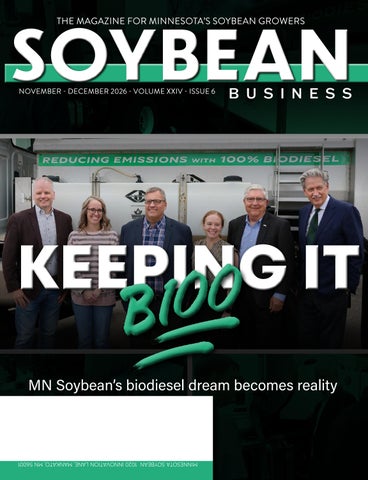
SOYBEAN THE MAGAZINE FOR MINNESOTA’S SOYBEAN GROWERS
NOVEMBER - DECEMBER 2026 - VOLUME XXIV - ISSUE 6
B U S I N E S S
KEEPING IT
B
MN Soybean’s biodiesel dream becomes reality
MINNESOTA SOYBEAN 1020 INNOVATION LANE, MANKATO, MN MINNESOTA SOYBEAN 1020 INNOVATION LANE, MANKATO, MN 56001
SeedIQ
™
THE NEXT ERA OF YIELD STARTS NOW. We’ve all seen it. Two farmers across the road plant the same hybrid, in the same soil, on the same day, yet their results are drastically different. Why? Because performance isn’t determined by genetics alone. It’s influenced by how that hybrid is managed throughout the season, including population, fertility, stress management, and fungicide timing.
Don’t Just Manage Your Fields. Master Your Product Management.
2027
MN AG January 19-20, 2027
EXPO Mankato
Mayo Clinic Health System Event Center, Mankato
Over 1,500+ attendees
10+ educational or keynote sessions
Two days of non-stop networking
Over 150 booths
Two trade show floors
Get in the Game at MN Ag Expo! MN Ag Expo is the premier two-day, indoor agricultural conference and trade show for Minnesota’s farmers. Hosted by the Minnesota Soybean Growers Association (MSGA) and the Minnesota Corn Growers Association (MCGA) this event features two days of non-stop learning, networking and is home to both MSGA and MCGA’s annual meetings and resolution sessions. You won’t want to miss being part of the action at the 2027 MN Ag Expo!
Tuesday Keynote Speaker Minnesota Vikings Legend
Chad Greenway
Ready to Sponsor or Reserve Your Exhibit Booth? Contact Erin Rossow at erossow@agmgmtsolutions.com
mnagexpo.com
CONTENTS
10
TABLE OF
08
08 True ‘grit’
18
38
MN farmers set to grow skills through ASA Vylor Young Leader Program
10 ‘New demand’
MSGA president, executive director promote MN soybeans during Nordic trade mission
18 Leaders in the field
Female grower leaders reflect on industry progress, challenges
38 Making waves
MSR&PC steps into radio ‘Spotlight’
4 - SOYBEAN BUSINESS - NOVEMBER - DECEMBER - 2026
MISSION
STATEMENT
Tell the compelling stories behind Minnesota’s soybean farmers and their industry, from the field to Capitol Hill to international markets — and everywhere in between.
Minnesota Soybean Growers Association Officers and ASA Directors OFFICERS
County/at-large directors
President Ryan Mackenthun | McLeod County
Marcus Meiners | Todd County
Vice President Kyle Jore | Pennington-Red Lake Counties
Robert Nelsen | Murray County Dusty Neugebauer | Nobles County
Joe Smentek | jsmentek@mnsoybean.com
Treasurer Rose Karau | Watonwan County
Lucas Peters | Rock County
Managing Editor
Secretary Bob Lindeman | McLeod County
Andy Pulk | Roseau-LOW Counties
EDITORIAL STAFF
Bruce Nelsen | Mower County
Vernon Pooch | Pope County Matt Purfeerst | Dakota-Rice Counties Tim Rasmussen | Otter Tail-Grant Counties
ASA Directors
Parker Revier | Renville County
Jamie Beyer | Traverse County
Cal Spronk | Pipestone County
Adam Guetter | Redwood County Darin Johnson | Faribault County Jim Kukowski | Roseau-LOW Counties Jeff Sorenson | Redwood County Bob Worth | Lincoln County
Gary Schoenfeld | Waseca County
MSGA Executive Director
Drew Lyon | drew@mnsoybean.com Ag Management Solutions Art Director Alex Troska | atroska@agmgmtsolutions.com Graphic Designer Ag Management Solutions
Jamie Seitzer | Nicollet-Sibley Counties Jeremy Tischer | Clay-Wilkin Counties Doug Toreen | Renville County Tim Wolf | Dodge-Steele Counties
ADVERTISING Sales Manager Erin Rossow | erossow@agmgmtsolutions.com 507-902-9191
ASA Young Leaders
Advertising space reservations can be made by the 15th
Nick Daugherty | Redwood County
day of the month prior to publication. In consideration
Katie Yarger | Brown County
of the acceptance of the advertisement, the agency and the advertiser must, in respect of the contents of
County/at-large directors Trevore Brekken | Polk County Mark Brown | Watonwan County Steve Brusven | Yellow Medicine County Jason Cadieux | Kittson County Nick Daugherty | Renville County Brian Fruechte | Lincoln County Tom Grundman | Douglas County Justin Hendricksen | Martin County Ray Hewitt | Le Sueur-Scott Counties Brad Hovel | Goodhue County Brent Imker | Cottonwood County Jordan Jacobson | Lyon County Mark Knutson | Marshall County Andrew Mages | Clay-Wilkin Counties
About the Cover Nearly 25 years since the state of Minnesota first adopted B2, the city of Edina made history this year by becoming the first municipality to adopt B100 (100% biodiesel) in its heavy-duty vehicles. The long road to B100 wasn’t always a smooth one, but homegrown biodiesel is firmly in the driver’s seat and delivering value to Minnesota’s farm economy. Photo courtesy of the City of Edina. Read more, starting on page 22.
the advertisement, indemnify and save the publisher harmless against any expense arising from claims or actions against the publisher because of the publication of the content of the advertisement. Advertisements within this publication contain the opinions and information of the advertisers and do not necessarily reflect the opinions or views of the Minnesota Soybean organizations or affiliated groups.
CIRCULATION Soybean Business is published six times a year on behalf of the Minnesota Soybean Growers Association. Comments and suggestions can be submitted to: Membership Manager Jodie Arndt | jodie@mnsoybean.com 507-388-1635
mnsoybean.org NOVEMBER - DECEMBER - 2026 - SOYBEAN BUSINESS - 5
A LETTER FROM THE PRESIDENT As I travel across Minnesota and visit with farmers, industry partners and agricultural leaders, I’m reminded of our state’s diverse landscape. From the Red River Valley to southcentral Minnesota, while we may grow many of the same crops, the challenges RYAN MACKENTHUN we face can look different from one President, MSGA region to the next. Prior to harvest, I attended Big Iron in West Fargo, N.D., for the first time. Events like Big Iron are a great opportunity to connect with farmers and industry representatives, and discuss issues affecting agriculture. Those conversations are important because they help us understand what is happening beyond our backyard and bring new insights back to the Minnesota Soybean Growers Association. From there, I traveled to Faribault to visit with USDA Risk Management Agency Administrator Pat Swanson. This was an especially important conversation as we look at the role crop insurance plays in managing on-farm risk. With changing weather patterns, unpredictable growing seasons and tight margins, crop insurance remains an important tool for Minnesota soybean farmers. It is also critical that policies and programs reflect the realities of farming. What works well in one region may not always fit the conditions and challenges in another region. Having the opportunity to share those perspectives directly with USDA leadership is key to having a voice in policy decisions. This year’s growing season is a great example. The differences in crop conditions across Minnesota have been remarkable. Some areas saw outstanding yields; other areas dealt with drought stress, uneven rainfall and disappointing results. It is a good reminder that we cannot look at a statewide crop report and assume
every farmer is having the same experience. Even within a relatively small geographic area, rainfall, soil types and growing conditions can make a difference. We’re also watching what is happening around the world. Global conflicts, trade uncertainty and changes in international markets can affect our bottom line here at home. When energy markets become volatile, the impact can reach our farms through higher diesel, fertilizer, transportation and other input costs. As farmers, we must make decisions about fertilizer, seed, chemicals, fuel and land costs months ahead of harvest, often without knowing what the global economic picture will look like once we sell our grain. This is where MSGA plays an important role. We cannot control every global event or market fluctuation, but we can make sure decision makers understand how policies affect the farmers who produce the food, fuel and fiber our world depends on. This winter, we are also preparing for MSGA’s preresolution process. These meetings are an important first step in developing policy priorities that guide our association throughout the coming year. The issues we address in these sessions ultimately influence our work at both the state and federal levels. MSGA is strongest when we reflect the experiences and priorities of farmers from every corner of Minnesota. I encourage you to participate in the resolution sessions, share the challenges you are facing and help us identify solutions that will benefit Minnesota soybean farmers. I look forward to continuing these conversations and working together on the issues that matter most to our farms, families and the future of agriculture.
-2026 2026 6 - SOYBEAN BUSINESS --SEPTEMBER NOVEMBER-DECEMBER NOVEMBER--OCTOBER DECEMBER - 2026
MSGA ANNUAL MEETING NOTICE
MSGA’s Delegate Session & Annual Meeting When: Wednesday, Jan. 20, 2027, at 8 a.m. Where: Mayo Clinic Health System Event Center in Mankato during MN Ag Expo All active MSGA members are invited to attend.
DEPARTMENT DISPATCH BY COMMISSIONER
PALMER AMARANTH FIGHT SEES SUCCESSES
This column is a series in Soybean Business featuring leaders from the Minnesota Department of Agriculture. Minnesota has successfully kept Palmer amaranth, a fast-growing noxious weed that is extremely harmful to crop production, from establishing and spreading since the weed was first discovered in the state in 2016. Our success in controlling Palmer amaranth is in great contrast to other states, particularly to our south, where the plant is costing farmers time, money and productivity. Gaining control over Palmer amaranth has been a multifaceted effort led by the Minnesota Department of Agriculture (MDA) and University of Minnesota Extension and coordinated with farmers, landowners, crop consultants and commodity organizations like the Minnesota Soybean Growers Association. Efforts have included an aggressive education and outreach campaign through social media, websites and advertisements. This has included the MDA and Extension leading year-round identification training and resources for farmers, crop consultants and other interested parties to learn how to properly identify the weed and who to contact with suspected findings. There is also a significant emphasis placed on detection and response efforts. The MDA and University of Minnesota Extension respond to suspected reports of Palmer amaranth within 24 hours and begin developing management plans immediately if the weed is detected. Identification of pathways and new research is also an important
step in controlling Palmer amaranth in Minnesota. Since 2016, the MDA has investigated every confirmed Palmer infestation. The following pathways of introduction and spread have been found: Contaminated Planting Seed • Sunflowers, millet, certain cover crop mixes and other small sized or mixed seed offerings that originate from another state with established Palmer amaranth can spread the weed. Screenings Disposal • Both seed and grain cleanings, when disposed of improperly, can spread Palmer amaranth. Manure • This mostly occurs when contaminated screenings or uncleaned whole grains are fed to livestock — in particular cattle. Equipment • Palmer amaranth can spread to new areas through contaminated equipment, especially if this equipment has come from out-of-state. Livestock and Bedding • Purchasing livestock or bedding from a state that has established Palmer amaranth can introduce this weed onto your property. Hay • Forage bales purchased from states where Palmer amaranth is established have been a common pathway for spread throughout the U.S., including cases in Minnesota.
THOM PETERSEN
Minnesota’s combined control efforts have led the MDA to investigate a total of 142 suspected locations of Palmer amaranth over the last 10 years. Forty-five of those sites have been confirmed to have Palmer and continue to be heavily monitored. Of the 45 sites with the confirmed weed, only two sites in Minnesota — Polk and Todd counties — had reemergence this year. These sites are being intensely managed by hand pulling to keep seed banks at bay. In 2026, nine new areas of suspected Palmer amaranth were reported, but none were confirmed. Through continued collaboration between industry partners and farmers, including you, Minnesota can continue to keep Palmer amaranth out of our farm fields.
True ‘grit’ Two Minnesota farm families selected to join ASA Young Leader program
By Drew Lyon The next generation of farmer advocates has arrived, and they’re ready to share their struggles, realities, hopes and views on shaping and improving farming’s future. Two Minnesota farm families have been tapped to do just that, and more, by representing the Minnesota Soybean Growers Association (MSGA) as part of the American Soybean Association Vylor Young Leader Program. Renville County farmer Nick Daugherty is joining Katie Yarger of New Ulm in the 2027 ASA Young Leader class. Both are excited to participate in one of agriculture’s most prestigious leadership development workshops. Katie’s husband, Leon, runs a farm equipment repair business and will also participate in the program. Together, Katie and Leon are in their second year as operators of YARBROS farms, “a tiny but mighty” operation raising soybeans, corn, Shorthorn cattle and Suffolk sheep. A native of Madelia, Katie traces her interest in advocacy back to her parents’ involvement in local politics. Yarger participated in the National Corn Growers Association’s Women & Mentors program, which led to her first visit to the Capitol in Washington, D.C. She’s also a 4-H and FFA county mentor and board member for a local athletics association. In addition to her new role on the Brown County Corn & Soybean Growers Board, Yarger
8 - SOYBEAN BUSINESS - NOVEMBER - DECEMBER - 2026
“We make all our farm decisions together.” Katie Yarger and her husband, Leon, are all-in as owners and operators of YARBROS Ag & Livestock.
Checkoff Sponsorship
hopes the Young Leader program will help her go even further. “The Young Leader program will allow me the opportunity to be involved in agriculture, even though it’s not my full-time job,” said Yarger, who also works off farm in healthcare. “We’re beginning farmers and we’re very small, so it’s important to tell our story. It took a lot of grit and perseverance for us to be able to farm.” Daugherty is currently an MSGA at-large director and serves on the Renville County Corn & Soybean Growers Board while farming with his parents and two brothers. “I want to be on the state board for quite a while, even though I really didn’t grow up with any formal leadership training,” said Daugherty, who grows soybeans, corn and sugar beets. “I really want to get more familiar with that to make an impact, whether it’s in church or school, and I just really want to be well rounded in the process of how to go about issues and promote agriculture.” Nick and his wife, Alannah, have three kids of their own, with a fourth on the way in early 2027. Daugherty’s family has a legacy of farmer leadership. His late grandfather, Jerry Mulder, farmed for nearly 50 years and was just the third recipient of Minnesota Corn’s Lifetime Membership. Nick’s grandmother, Connie Mulder, continues to stay active at the county level and serves as a Renville County delegate at MSGA’s Annual Meeting. “(My grandfather) encouraged me to get involved, and grandma Connie is still on the county board,” Daugherty said. “It’s just a good group of people on the board, and I just love the impact they have on the community and the events they do to give back to farmers and be an advocate for them. It’s very important work, even at the county level.” Sustaining profitability Phase I of the 2027 Young Leader program is held Nov. 30-Dec. 3 at Vylor Global Business Center in Johnston, Iowa. The second portion continues March 1-4, 2027, in New Orleans, in conjunction with Commodity Classic. A third, invite-only segment typically is held in July in Washington, D.C., during ASA’s summer Hill Visits. For more than 40 years, the Young Leader program has helped identify and train soybean farmers to become industry advocates. MSGA is ASA’s first state affiliate and counts many Young Leader alum among
Nick Daugherty (left) applied for the ASA Young Leader Program after attending the 2026 Future of Soy Summit.
its directors. One of those farmer leaders, fellow Renville County farmer and MSGA Director Parker Revier, encouraged Daugherty to apply. “Nick has been a very active member of the county board,” said Revier, a 2023-2024 Young Leader. “He’s very engaged and a strong advocate for farmers locally, so I’m sure he’s going to be a great advocate for farmers in Minnesota.” Yarger also has an MSGA director in her corner. Treasurer Rose Karau has known Yarger for a decade and says Katie and Leon’s journey to become younger farmers is one worth sharing. “Kate is incredibly ambitious, and she’s seen some adversity and continues to want to learn and expand her knowledge while advocating for the industry and Continued on page 10
“Being part of the ASA Young Leader program will help me not just as a soybean farmer, but as a good role model in the community.” - Nick Daugherty NOVEMBER - DECEMBER - 2026 - SOYBEAN BUSINESS - 9
other young farmers,” Karau said. “I know she’s excited, and we’re excited to have her.” As the next generation takes hold in agriculture, Daugherty and Yarger both see similar issues affecting agriculture: finding new markets, addressing skyrocketing input costs, protecting crop inputs, improving soil health and supporting programs that promote economic growth within agriculture. “We want to ensure that the opportunity is in place for our sons and future generations and keep that at the core of a lot of the decisions that we make that this isn’t just for us; it’s also for them,” Yarger said. “We want to make sure that we have a sustainable program to pass down for future generations.” ‘Training ground’ Both Daugherty and Yarger were motivated to apply for the Young Leader program after participating in two Minnesota Soybean development programs: The Young & Emerging Farmer Workshop and the Future of Soy Summit, where Director Bob Worth urged Yarger to pursue a Young Leader position. Yarger attended both programs in 2026 and said the experience exceeded her expectations, helping to understand the differences between MSGA and MSR&PC while also receiving tips on how to navigate a complex and turbulent, yet rewarding, industry. “The workshop was great because my husband and I were both able to go, and because, we always say, ‘We don’t know what we don’t know,’” she said. “And the best way to learn is to surround yourself with people that do know. And that program at MN Ag Expo was excellent.” Daugherty also came away from the 2026 Future of Soy Summit energized. “I had a lot of interesting conversations with people all over the industry, from growers themselves to end users of soybeans, and researchers,” he said. “It really set the mindset of that there is still a
Nick’s grandmother, Connie Mulder (left), is a fellow member of the Renville County Corn & Soybean Growers Board and longtime MSGA member. positive future and that soybeans aren’t going anywhere.” The Young Leader program is funded through checkoff support from MSR&PC. A group of Council directors, with advisement from MSGA President Ryan Mackenthun, elected Yarger and Daugherty to represent Minnesota in this year’s class. Yarger and Daugherty plan to attend MSGA’s first post-harvest meeting Dec. 16, 2026, in Mankato, where they’ll continue their leadership journey. “We’re thrilled that Katie and Nick are taking the next step in their leadership careers,” said Mackenthun, a proud Young Leader alum. “This program is prime training ground for our directors to grow their advocacy attributes, and a chance to build connections across U.S. agriculture.”
10 - SOYBEAN BUSINESS - NOVEMBER - DECEMBER - 2026
‘The next generation’ Over half of MSGA’s governing board are past ASA Young Leaders, including recent graduates Andrew Mages and Raymond DeMars. “I liked it a lot,” DeMars said. “It was great to meet other people who have the same mindset and the same goals in life, to farm and grow their farm for the next generation. How they all want to reach out and make more people aware of what they do and how it affects everyone else in the world.”
NOVEMBER - DECEMBER - 2026 - SOYBEAN BUSINESS - 11
How ‘Swede’ it is MSGA president, executive director work to grow EU markets
By Drew Lyon With the 2026 harvest approaching, Ryan Mackenthun was thousands of miles from the farm while touring Denmark and Sweden. Maybe he was feeling a little homesick, but he felt right at home talking shop with a Danish farmer. Talk about an energy boost. Heck, Mackenthun didn’t even need his favorite beverage, Mountain Dew, to perk up while talking with a fellow farmer. “I could see that Ryan was dragging a bit — these trade missions have really busy itineraries — but once he got to the farm, his eyes lit up,” said Minnesota Soybean Growers Association (MSGA) Executive Director Joe Smentek, who joined Mackenthun on the trade mission to Denmark and Sweden. “He told me, ‘This meeting is what gets me excited.’” Mackenthun and a local Danish farmer discussed their unique growing practices; in Denmark, Mackenthun learned, growing a cover crop is required by the government. “We learned we had similar challenges as producers,” Mackenthun said. “It was also interesting to see his storage and how he dries his seed.” Low carbon footprint, high quality Mackenthun and Smentek attended the tour of the Nordics alongside agriculture officials, including Minnesota Department of Agriculture Deputy Commissioner Andrea Vaubel; MDA International Trade Supervisor Christina Connelly; Kate Ferguson of the Duluth Seaway Port Authority; and fellow commodity group leaders. The trade mission was Mackenthun’s first since becoming MSGA president in June 2026. In addition to meeting one-on-one with a Danish farmer, Mackenthun and the delegation also visited the Danish Agriculture and Food Council and the Danish Feed & Grain Association (DAFOKO), where they discussed a range of topics, including trade via the Port of Duluth.
“With new demand for our soybean oil, people often ask, ‘What will we do with soybean meal?’” he said. “Well, Denmark wants it. They can’t import GMO whole beans, but they can import soybean meal. My question was, with their deforestation regulations, will they import more soybean meal? Right now, they’re feeding a lot of wheat in their feed rations, which surprised me, because I would think soymeal would be better, but (wheat) is probably a cheaper source. We’ll see what they do going forward.” Both Mackenthun and Smentek emphasized to Danish officials how Minnesota’s soybean production boasts a lower carbon footprint than its competitors, thanks in part to a one-of-a-kind, voluntary program like the Minnesota Agricultural Water Quality Certification Program, which, Smentek underscored, meets the EU’s deforestation regulations. “We got a lot of good feedback from the Danish groups about U.S. soy quality and had some good conversations about policies and the practices that we’re doing on our farms to meet our water quality goals,” Smentek said. SAF soars in Sweden The delegation’s second portion brought the agriculture delegation to Sweden. Mackenthun noted the difference between the two countries: In Denmark, about 60% of agriculture land is tillable; in Sweden, it’s just 7%. Denmark exports around 75% of their agricultural goods, while Sweden is a net importer and produces only 50% of their food. The agenda in Sweden included discussions with a Swedish biofuels group, Svebio, and Business Sweden. Gov. Tim Walz joined those meetings and promoted Minnesota’s ongoing commitment to using soybean oil in the sustainable aviation fuel (SAF) market. During the 2026 legislative session, MSGA successfully supported a fiveyear extension of the SAF tax credit program through 2035 and a raise of the total tax credit limit to $36.9 million.
12 - SOYBEAN BUSINESS - NOVEMBER - DECEMBER - 2026
Building Markets
Mackenthun was impressed by Sweden’s embrace of clean energy. The country has a goal of adopting 6% by 2030 and a 70% SAF mandate by 2040. “Sweden only uses one percent fossil fuels; everything else is from alternate sources of energy,” he said. “So, biofuels are a huge, huge supplier of their energy demand over there. They’re ahead of us with their SAF production and overall use of renewable sources, but we’re ahead of them in other aspects too.” In one of their final meetings, Mackenthun and Smentek engaged with a Swedish co-op and the Federation of Sweden Farmers, which represents over 110,000 producers. “We had a great conversation about water quality and their PFAS (forever chemicals) issue and their forest industry, because 70% of Sweden is covered in forests,” Mackenthun said. “It was interesting to hear about their heating units. Overall, we had a lot of similarities.” While harvest had already begun back home in McLeod County, technology allowed Mackenthun to keep tabs on the progress after long days of meetings. Harvest is where the heart is. “It was midnight where I was, and I was constantly watching my John Deere Operations Center,” Mackenthun said. “I saw them moving and I was watching all the combines moving. The guys I worked with seemed to have it under control. We’ve got each other’s backs.” Within days of returning home, Mackenthun had already addressed his stack of business cards and connected with his European contacts via LinkedIn. “With these trade missions, the visit to the country is really the first step,” Mackenthun said. “From there, you’ve got to continue building those relationships, and I look forward to continuing those conversations we started in Denmark and Sweden.”
Ryan Mackenthun (front middle) learns more about Danish farming practices during a Nordic trade mission.
Ryan Mackenthun (back) looks on as Gov. Tim Walz visits with Swedish business leaders.
NOVEMBER - DECEMBER - 2026 - SOYBEAN BUSINESS - 13
OpPORTunity knocks
MSR&PC bolsters two-way Great Lakes shipping during trade mission in North Africa, Europe
By Soybean Business Staff Trade relationships are often shaped and strengthened by meeting international partners where they are. “We want to get more trade focused on the Great Lakes, and you’ve got to have product moving both ways for this to work, and there are many opportunities to make that happen,” said Minnesota farmer Paul Freeman. Freeman, a director with the Minnesota Soybean Research & Promotion Council, was joined by Council colleague Ron Obermoller on the U.S. Identity Preserved Alliance’s St. Lawrence Seaway Trade Revitalization Program’s 2026 trade mission to North Africa and Europe. The week-long tour, which took place prior to the 2026 harvest, began with visits to ports in Casablanca and Tangier. The trip followed USIP Alliance-led efforts, with checkoff support, to promote trade via the Great Lakes-St. Lawrence Seaway in 2023 and 2024 to Halifax, Nova Scotia and Rotterdam. Freeman and Obermoller both participated in the trade mission to Rotterdam. “I’m one who never misses the opportunity to talk about the quality of our beans,” Freeman said. Morocco has a free trade agreement with the United States and continues to be a growing market for U.S. agriculture and is an important geographic location as a global passage and key crossroad to the Mediterranean and Middle East, as well as to the rest of Africa. More than 100,000 commercial ships per year – 300 per day – pass through the Strait of Gibraltar, the narrows between Morocco and Spain along which Tangier’s Tanger Med port sits. The USIP Alliance held a seminar for port representatives in Casablanca, highlighting opportunities and challenges for two-way trade between Moroccan ports and U.S. inland ports along the Great Lakes and St. Lawrence River. Along with presentations from Freeman and Obermoller, speakers included Gary Williams, USIP Alliance director of transportation and regulatory affairs; Jazmine Jurkiewicz, St. Lawrence Seaway
Development Corporation international trade specialist; Emily Jerve, Minnesota Department of Agriculture domestic marketing supervisor; and Jacob Leum, Wisconsin Department of Agriculture, Trade and Consumer protection international trade representative. "I know the importance of keeping my product moving," Freeman, who farms in Starbuck, said during his presentation. "The value of the last bean sold is very important to me." Two-way trade is important to the north-central states, including Minnesota, as the imports of products into the St. Lawrence Seaway bring vital equipment, such as containers, to inland ports that could take value-added agricultural exports back out. “We have to get creative to make that (two-way trade) happen,” Freeman said. “This was a reverse trade mission to see what products we can get into the Great Lakes so we can get soybeans out of the Great Lakes.” Since opening in 2017, Tanger Med has become the largest container port in Africa and 17th largest in the world. The port’s terminals operate well above original capacity design, meaning continued expansion of the container market in Morocco is strong. This coincides with burgeoning container capabilities on the Great Lakes, including upcoming opportunities in Burns Harbor, Ind., Monroe, Mich., and recently renewed capacity at Duluth-Superior (Minn., Wis.). At Casablanca, officials from the National Ports Agency discussed expansion of Casablanca and other ports in Morocco, noting plans to deepen ports to accommodate Panamax and post-Panamax vessels. While the port moved 32 million metric tons of cargo in 2025, there is capacity to handle 50 million metric tons, along with future expansion. Other Moroccan ports, including a deep-water port project in Dakhla, provide more opportunities to satisfy consumer demand and the growing population throughout Africa, with dry-port movement to landlocked countries Mali, Chad, Niger and Burkina Faso. The delegation was impressed with the connectivity
14 - SOYBEAN BUSINESS - NOVEMBER - DECEMBER - 2026
Checkoff Trade Mission
Trade mission attendees look at a diorama of the Port of Casablanca, one of the world’s largest ports.
among Moroccan ports, particularly after seeing firsthand the benefits of its geographic location. And one seminar participant explained that Morocco’s crossing point benefits new repair and distribution opportunities, allowing for reuse of products to meet consumer demand elsewhere on the African continent. Northern advantages Following the Moroccan leg of the trade mission, the delegation moved on to Portugal for port visits and seminars in Lisbon and Porto. Other seminar speakers for those events included Christina Connelly, Minnesota Department of Agriculture international trade supervisor. Freeman and Obermoller continued their participation in the transportation trade mission to Portugal to explore how increased two-way trade could strengthen the Great Lakes-St. Lawrence Seaway as an export route for identity preserved crops and other value-added agricultural products. "We really had a chance to let their transportation
folks know the advantages we have across the Great Lakes," Freeman said. "And it's always good as a farmer to speak to how we're growing our soybeans in a sustainable way." In Morocco, the delegation toured port facilities in Casablanca and Tangier and held a seminar with Moroccan port representatives. Discussions focused on bringing additional imports and shipping containers into inland Great Lakes ports, creating more reliable opportunities to move agricultural products back through the Seaway to international customers. Delegates also learned about Casablanca’s expansion plans and Tanger Med’s position as Africa’s largest container port and an important gateway to markets across Africa, the Mediterranean and the Middle East. In Portugal, the delegation visited ports in Lisbon, Aveiro and Leixões and also delivered its seminar. Speakers and participants included Freeman and Obermoller representatives from the Alliance; the Great Lakes St. Lawrence Seaway Development
Continued on page 16 NOVEMBER NOVEMBER--DECEMBER DECEMBER--2026 2026 -- SOYBEAN SOYBEAN BUSINESS - 15
Corporation; Minnesota and Wisconsin departments of agriculture; farmer leaders from Wisconsin and Ohio; and the Ports of Indiana. Obermoller, who also serves on the Minnesota Soybean Processors, said he was pleased to see the ports' adoption of renewable fuels. "The new ports are green ports; one of them had a great, big biodiesel port ,and they basically produce everything they need for the port," Obermoller said. "Every port we saw was impressive." ‘Quality work’ Overall, the mission reinforced the Alliance’s strategy of pairing international market development with practical transportation solutions. By building relationships with overseas ports and demonstrating the Seaway’s direct connection to the U.S. agricultural heartland, the Alliance aims to generate more balanced cargo flows, improve container availability and establish new export channels for U.S. value-added agriculture. The trade mission was made possible with funding from the Minnesota Soybean Research & Promotion Council, Wisconsin Soybean Marketing Board, Ohio Soybean Council and Illinois Soybean Association. "It was a very good trip. Our job over there was to plant seeds, because for a lot of them, getting grain
THE SEASON AHEAD
U.S. IDENTITY INTERNATIONAL SUMMIT
Up next for the Alliance, with support from MSR&PC, is the U.S. Identity Preserved International Summit Feb. 22-24, 2027, in Tokyo, Japan. The annual Summit connects key players across the identity preserved agriculture value chain — from growers, suppliers, exporters, equipment and input companies to global soy and specialty grain buyers and food manufacturers.
Learn more at usipsummit.com
Council Director Paul Freeman never passes up a chance to promote his farm’s commitment to conservation.
STARTS NOW. The combines may be parked, but the work isn't over. As the growing season winds down, winter becomes a time to evaluate, plan, and prepare for the year ahead. Whether you're reviewing operating expenses, considering equipment purchases, exploring land opportunities, or planning for growth, having the right financial partner can make all the difference.
Third party fees for internet, QR codes, messaging, or data plans may apply.
Fairmont | Truman | Owatonna | Mankato
from the middle of the U.S. wasn't on their radar," said Ron Obermoller, who farms in Brewster. "It's amazing what you can do with brand-new ports, and they've had boats out to the Great Lakes." Following the mission, USIP Alliance staff toured Spain for visits to ports at Huelva, Cadiz, Algeciras and Malaga in preparation for future trade mission. Council Chair Gail Donkers currently represents MSR&PC on the USIP Alliance Board. “The USIP Alliance is doing really quality work promoting identity preserved soybeans and helping us build markets,” Freeman said. “They’re a great partner.”
www.profinium.com/ ag-banking
Profinium Inc. NMLS# 402979. Loans are subject to credit and underwriting approval. Products and services may require enrollment, other terms and conditions and fees may also apply.
16 - SOYBEAN BUSINESS - NOVEMBER - DECEMBER - 2026
“THE IMPORTANCE OF U.S. SOY IN FEED IS REFLECTED IN THE HEALTH OF OUR FISH.” Luis Antonio Cazarez Administrator Piscicola Tumburagua Pez in Huila, Colombia.
Feeding tilapia at Piscicola Tumburagua Pez in Huila, Colombia.
YOU GROW THE WORLD’S MOST SUSTAINABLE SOY. WE GROW DEMAND FOR IT. Fish health starts with feed quality. USSEC supports aquaculture producers with education, expertise and resources that demonstrate U.S. Soy’s nutritional value and help build demand for the soybeans you grow.
SCAN TO SEE HOW USSEC SUPPORTS THE GROWING AQUACULTURE INDUSTRY IN COLOMBIA.
Leaders in the field
Female growers reflect on meaning of International Year of the Woman Farmer By Allison Wright The United Nations General Assembly declared 2026 the International Year of the Woman Farmer, showcasing women's involvement in agriculture throughout history. Across decades, the Minnesota Soybean Research & Promotion Council (MSR&PC) and Minnesota Soybean Growers Association (MSGA) have developed and promoted outstanding women leaders who have made — and continue to make — indelible contributions to the agriculture industry and their surrounding communities. “I would say women play just as much of an equal role as men in agriculture,” said MSGA Treasurer Rose Karau, who farms in St. James. “With the ability to both learn, network, produce and analyze the needs within the industry, women also have the natural instinct of community and family support that is needed to hold everything together.” Karau joined the Nicollet/Sibley County Corn & Soybean Growers board in 2018 and later served as the treasurer. But she found herself wanting more. In 2022, she applied and was accepted into the American Soybean Association (ASA) Young Leader Program. Now, Karau is in her third year on MSGA’s officer team and farms alongside her husband, Andrew, while maintaining a small herd of highland cows.
Soybean Business Feature
“I've been watching different articles throughout the year on different platforms, and it's just been inspiring to see all of the different ways that women have excelled within the industry,” Karau said. “It reminds us all that the world really does take everybody, and true passion has no boundaries.” According to the latest USDA Census of Agriculture published in 2024, women comprise 31% of Minnesota farmers, totaling 35,623 women, an increase of nearly 1,100 since the 2017 Census. More than 75% of these women are key decision makers on their farms. “It is just fun to see the development,” said Lake Crystal farmer Barb Overlie. “Finally, you know, it dawned on them that women are involved in agriculture.” Overlie dedicated decades to leadership and service. In the 1970s, she began representing farmers on the Volunteer Soy Promoters, which connected growers with consumers. She later served on the Blue Earth County Corn & Soybean Board from 1994-2014, was a MSGA director from 1986-2006, MSGA director-at-large from 2012-2013 and represented Minnesota on the American Soybean Association from 2002-2012. “I was like a token female on the national (ASA) board,” said Overlie, who also helped build markets through the World Initiative for Soy in Human Health (WISHH). “There were at least two or three of us on the state board, but when I went to the national level there were only two of us and it was that way for quite a while but now that has changed immensely.” Originally having a career in teaching overseas, Overlie fell in love with a Minnesota farmer and found herself driving truck and combine to keep up with the farm chores. “Women look at things differently than men do,” Overlie said. “Most of the women now, if they’re involved anyway in the operation, are no longer just the bookkeeper.” Nationally, women make up 36%
of all U.S. agricultural producers, totaling 1.2 million female farmers according to the USDA 2022 Census of Agriculture. One-third of female producers are beginning farmers, having farmed on their current operation for 10 years or less. In 1989, Sharon Clark became the first female to preside over a major Minnesota commodity board when she was elected president of the Minnesota Corn Growers Association. “Women are very well informed and probably know more about the operation or just as much as the men do,” Overlie said. “In my husband’s mother’s age, they knew nothing and were strictly fixing meals.” Global context In the over 100-year history of the American Soybean Association, a woman has never served as president. However, Wheaton farmer Jamie Beyer currently serves on ASA’s Executive Committee and earlier in 2026 testified in front of the House Agriculture Committee in support of the United States Mexico Canada Agreement (USMCA). Sometimes, leadership excellence
means embracing strengths and recognizing areas of improvement. “There’s a lot of things I can’t do,” said Beyer, who served as MSGA president from 2019-2021. “But some of the things I can do include translating what my husband does in the field to our political leaders and politicians, and I really love figuring out how different legislation will affect the farm.” Beyer traveled on behalf of the United States Department of Agriculture (USDA) in 2021 to Dubai for the World’s Fair. There, she joined four other international women for a panel titled “From Farmers to Boss Lady,” focusing on the barriers women feel in the agricultural industry. “For me, it was one of the most humbling experiences you can ever imagine,” Beyer said. “In other countries, women can’t enter contracts, secure funding and they are really limited in what they can do on their own without legal authorities of their family or husbands.” Walking away from the panel, Beyer said she gained a greater understanding of the unique advantages U.S. agriculture holds compared to the other countries, continued on page 20
MSGA Director Jamie Beyer was the only U.S. farmer to testify during a June 2026 House Ag Committee hearing in support of the USMCA.
NOVEMBER - DECEMBER - 2026 - SOYBEAN BUSINESS - 19
including the role female farmers play in the U.S. To Beyer, the acknowledgment of the International Year of the Woman Farmer has revealed the gender challenges women in other countries still face. “We’ve kind of moved past all of that in the U.S.,” she said, “but globally it is a really big challenge.” Recognition of progress Faribault farmer Gail Donkers knows her history; women in farming, she says, is as old as the hills. “Women have been farming since the dawn of time right along with men,” Donkers said during the 2026 harvest. “Actually, when the men were the hunter gatherers, the women were the ones that were actually doing the farming.” As the role of female producers becomes more prominent in USDA data, Donkers brings up a relevant question. “At what point does it become natural that we don’t have to designate a year for (women farmers)?” Donkers said. Donkers is in her second year of serving as the first female chair of
MSR&PC in its over 50-year history. She credits her success to the many mentors, both female and male, who took the time to leave an impression. Being a mentor to others to help build people up in agriculture is a strong passion for Donkers. “I’m a farmer first and, yep, I am a woman, too,” Donkers said. “I want to make sure that (being a woman) is not the only thing people talk about when they see me as the Council chair.” The Council continues to support female ag leaders by sponsoring the University of Minnesota Extension’s Women in Ag Network. “I hope at some point the stigma drops and women farmers can just be farmers,” Donkers said. “I feel blessed to be a farmer because there's so few of us and such a low percentage of us across the world that actually farm. I feel blessed to be in this role and feel lucky every morning that I get to do what I do.” Words of wisdom The future belongs to those who want, and insist upon, a seat at the table. “I would tell (a young woman)
Left: Council Director Gail Donkers looks at her soybean crop during the 2025 harvest. Right: Lake Crystal farmer Barb Overlie served on MSGA for nearly 30 years, and became one of MSGA’s most high-profile advocates.
20 - SOYBEAN BUSINESS - NOVEMBER - DECEMBER - 2026
that she belongs in agriculture and not to let anyone make her feel different,” Karau said. “She doesn't need to feel that she needs to prove her worthiness, she just needs to show up and show the work ethic and passion to make a meaningful impact for the industry.” Karau has pursued her goals wholeheartedly, never allowing outsides voices or the status quo to determine what she can accomplish. “I have never let the intimidation of the old idea that agriculture is a men's industry stop or define what my ambitions were,” Karau said. “Any opportunity that I sought out I was respectful of the industry and knowing my capabilities and how being able to serve the industry at the best of my ability as a woman in agriculture.” Donkers appreciates that times have changed for women taking roles in agriculture — for the better. “I feel really lucky for the youth now that it is more accepted that women are farmers nowadays,” Donkers said. “When I got out of college, all I wanted to do was go on to farm with my dad, but it was not really an acceptable role (for women). Now it is.”
We put soybeans first because you put performance first. At Asgrow® brand, not only are we all about the beans, we’re all about your success as well. That’s why we offer localized products with leading genetics, weed management systems and maximum profit potential – all developed by soybean experts who put soybeans first.
DISCOVER HOW IT’S ALL ABOUT THE BEANS.
Asgrow.com
ALWAYS READ AND FOLLOW PESTICIDE LABEL DIRECTIONS. Asgrow and the A Design®, Bayer and Bayer Cross are registered trademarks of Bayer Group. ©2026 Bayer Group. All rights reserved.
ASA_2026_Minnesota_Half Page_Print_.indd 1
21/07/26 7:33 p.m.
MORE OPPORTUNITY. MORE DEMAND.
The clean fuels industry is creating new opportunities for soybeans. See what’s next and be part of the conversation.
JOIN US IN PHOENIX Feb. 1-4, 2027
CleanFuelsConference.org
Materials supported by the United Soybean Board, soybean farmers and their checkoffs.
NOVEMBER - DECEMBER - 2026 - SOYBEAN BUSINESS - 21
MSR&PC, MSGA join forces to bring biodiesel beyond the norm By Drew Lyon For years — decades, even — Minnesota farmer Bob Worth has endured relentless pushbacks from skeptical farmers and industry partners: Minnesota winters are too cold for trucks to operate on B100. It’ll never happen. We’re not ready. It won’t work. Well, 100 percent biodiesel can, in fact, fuel the cold North Country, thanks to a combination of innovative technology, education, farmer collaboration, checkoff investments and civic leadership. Worth saw B100’s advancement up close in August 2026, when he joined Minnesota Soybean Sr. Director of Product Development & Commercialization Mike Youngerberg on a visit to the Minnesota Department of Transportation’s Farmfest booth. Worth and Youngerberg assessed a truck used by MnDOT’s Willmar office that runs on B50 in the summer and B100 in the winter as part of a five-truck MnDOT pilot program. “B100 is a dream come true,” said Worth, who served as Minnesota Soybean Growers Association president in 2005, when the state first moved to B2 (2% biodiesel). “We’ve had to correct so many myths about biodiesel over the years. To see the state of Minnesota adopt B100, when we started with B2 over 20 years ago is a huge win for Minnesota Soybean, our farmers and our state’s economy and environment.” The City of Edina is taking B100 on a new path. In 2024, the City began its Biodiesel Fueling Project in the hopes of becoming the first Minnesota city to run its heavy-duty municipal fleet on B100 year-round. The Minnesota Soybean Research & Promotion Council (MSR&PC) brought the City of Edina’s former equipment operations supervisor to a checkoffled See for Yourself mission alongside MEG Corp during the Clean Fuels Conference. The Council also contributed over $71,000 in checkoff funds to the project, which aims to promote domestic, value-added energy sources; showcase B100 as a method of reducing municipal emissions; and aid Edina in its goal to reduce greenhouse gas emissions 45% by 2030. “It’s amazing,” said Thom Petersen, commissioner of the Minnesota Department of Agriculture (MDA). “This has been something we’ve been talking about for
years, and to see it actually come to fruition is really exciting for not just farmers, but Minnesotans. It’s taken a lot of hard work to get here, but it proves that we can get things done, and we hope this brings more opportunity in other cities and fleets.” During a ribbon-cutting ceremony in October 2026 at Edina Public Works, City officials joined Minnesota Soybean staff, state legislators, MPCA and Commerce Dept. staff, and MDA leaders in celebrating a cleanenergy milestone: Ten of Edina’s municipal trucks are now upfitted to run on B100. The City estimates it will consume nearly 10,000 gallons of B100 annually and increase that amount as more heavy-duty vehicles are upfitted. “Edina is proud to be the first municipality in Minnesota to establish the capability to use its fuel in heavy-duty municipal equipment with B100 biodiesel: A fuel made from renewable resources, including agricultural products — soybeans — grown right here in our state,” Edina Mayor Jim Hovland said. “When we use biodiesel, we are not simply buying fuel. We are supporting an industry that begins with Minnesota farmers and Minnesota agriculture.” Farmer directors were unable to attend the ceremony. They had a valid excuse, however. After a wet stretch to start harvest, a run of dry, sunny days kept growers busy in the field. But producers were there in spirit as a key link in the chain bridging the Twin Cities and Greater Minnesota. “One of the things that’s important to me for this project is it does help to reconnect us, right?” Edina City Manager Scott Neal said. “It reconnects our folks that live in rural areas with people that live in city areas.” The Council’s checkoff investment was a critical portion of the City financing package and helped to fund design, labor and installation costs for the new biodiesel storage tank. “Farmers have been willing to invest in opportunities that create markets for all of the soybean products,” said Youngerberg, a biodiesel industry trailblazer for nearly 30 years. “They’re out there doing their part, and the City of Edina is doing their part. Without the checkoff investment of the soy checkoff, we wouldn’t be here.”
22 - SOYBEAN BUSINESS - NOVEMBER - DECEMBER - 2026
Checkoff Investments
Edina’s transition to B100 was a team effort, including checkoff funding, MSGA advocacy, technical support from MEG Corp, a clear vision from the City of Edina and crucial guidance from the Minnesota Department of Agriculture.
Built for Minnesota winters In transitioning to B100, Edina partnered with Optimus Technologies, one of the industry’s leading diesel engine decarbonization companies. Optimus has reduced carbon emissions for over 1,300 vehicles across 200 fleets, from municipalities (including Ames, Iowa; Madison, Wisc.; and Washington, D.C.) to Fortune 50 companies (PepsiCo., for example) seeking to reduce their carbon emissions. Optimus’ Vector System upgrades any medium or heavy-duty engine to operate on 100% biodiesel — even in colder climates — to allow for near-zero carbon emissions. In addition to dramatic carbon reductions, using biodiesel reduces particulate matter by up to 50%; B100 cuts greenhouse gas emissions by over 80%, compared to petroleum diesel. “The Optimus Vector System helps the vehicle to be able to warm the fuel and serve it to the engine,” said Brian Simmons, district sales manager with Optimus Technologies “This was an important project for us. We understand the projects’ goal. … The Optimus ecosystem is one of the most efficient ways to decarbonize these heavy-duty fleets.” Most diesel engines are designed to only run on B100 in temperatures above 40 degrees Fahrenheit. To prepare for Minnesota’s frigid winters, Edina installed an 8,600-gallon aboveground, temperature-controlled BENECOR fuel tank to allow for all-year operation in
Minnesota. Although Edina began fully implementing B100 in spring 2026, the big test arrives this winter. “These trucks play an important role in snow and ice operations. So, reliability and maintaining service levels will always be our top priority. Overall, it’s been a positive experience so far,” said Davion Conover, Edina’s fleet operations supervisor. “We’re continuing to learn, monitor performance and make adjustments as needed. This winter will give us a much better understanding of how the system performs under our most demanding conditions.” Protecting biodiesel The B100 project wouldn’t have made it to Minnesota’s roads without strong advocacy from MSGA. Grower leaders, Executive Director Joe Smentek and MSGA’s lobbying team continue to urge lawmakers and department officials to promote higher blends of biodiesel. In 2027, MSGA will mark 25 years since the original B2 bill went into law. “There’s no better replacement than our farmers for their advocacy,” Smentek said. “They grow these soybeans and crush these soybeans in Minnesota, and that helps their farms and their economies and help cities meet their climate goals.” Paving the way for B100 in city and state fleets initially met a roadblock with the Minnesota State Fire Code. Undaunted, MSGA worked with MDA Deputy
continued on page 24 NOVEMBER - DECEMBER - 2026 - SOYBEAN BUSINESS - 23
“We’re off to see the blizzard.” MnDOT’s Dan Bonnema (middle) gives MSGA Director Bob Worth (right) a demonstration of MnDOT’s first B100 snowplow during the 2026 Farmfest.
Commissioner Andrea Vaubel and the state fire marshal to develop a biodiesel toolkit that clears the way for other agencies to seek a variance and adopt B100 (see accompanying article on page 25). “That was all really done by the advocacy work of MSGA and MDA,” Smentek said. “We’ve got to protect our mandates, and MSGA tends be that voice in St. Paul and D.C., saying ‘Biodiesel is a good thing.’ If we didn’t have this market, it would be a drag on the (soy) meal market.” For more than 25 years, MSGA’s advocacy, in tandem with checkoff investments, transformed Minnesota’s biodiesel industry, which now helps to raise demand for soybeans by 13%, adding $676 million in farm-level impact in Minnesota alone. Wider adoption of B100 across the state means adding even more value to Minnesota farmers’ bottom lines. “Biodiesel continues to be a huge checkoff success story for our farmers and industry,” said Cole Trebesch, a District 8 director who chairs the product development action team. “We hope this is the start of a B100 movement across Minnesota.” Now, the City of Edina is proving the naysayers wrong: B100 is possible — right here, right now. “We’re a long way from where we started,” Youngerberg said. “Now we have fleets and other cities that are very interested in going beyond B20.”
HOMEGROWN ENERGY
Edina will be sourcing its B100 fuel from Chevron’s biodiesel refinery facility less than 100 miles away in Albert Lea. The refinery, in production since 2005, produces over 30 million gallons of biodiesel each year.
Proud to help Minnesota Soybean drive biodiesel forward Biodiesel questions? Contact MN Diesel Helpline: (800) 929-3437 • info@megcorpmn.com
24 - SOYBEAN BUSINESS - NOVEMBER - DECEMBER - 2026
Follow Minnesota Diesel Helpline on Facebook
MSGA Advocacy
‘Expanding access’ Toolkit clears path for greater biodiesel use in Minnesota
By Soybean Business staff The Minnesota Soybean Growers Association (MSGA) and Minnesota Department of Agriculture (MDA) welcome a new resource published by the Minnesota Department of Public Safety State Fire Marshal to support greater use of B100 (100% biodiesel) in public and private fleets across the state. The Biodiesel Fire Code Variance Toolkit was developed in collaboration with MSGA, MDA, the Minnesota Department of Transportation (MnDOT) and Minnesota Department of Administration. Made from renewable resources including soybean oil, B100 offers fleets a homegrown alternative to petroleum diesel. For fleets that rely on trucks, buses, snowplows and other heavy-duty vehicles, B100 offers a practical, near-term way to reduce greenhouse gas emissions, diversify fuel supplies and advance sustainability goals. B100 also reduces greenhouse gas emissions by over 70% on average compared to conventional diesel. “Expanding access to B100 creates another important domestic market for the soybeans grown by Minnesota farmers,” said Joe Smentek, executive director of MSGA. “This toolkit brings us one step closer to giving more fleets the option to use a reliable, renewable fuel produced here at home. MSGA appreciates the Minnesota Department of Agriculture’s work on making this a reality for heavyduty diesel fleets.” The Minnesota State Fire Code requires all fueldispensing equipment to be listed by a nationally recognized testing laboratory for the fuel being dispensed. Although manufacturers have confirmed that their equipment is compatible with B100, formal equipment listings have not kept pace with growing interest among Minnesota’s public and private fleets. Because no complete fuel-dispensing systems are currently listed for biodiesel blends above 20%, fleets must obtain a fire code variance before installing and operating B100 fuel-dispensing systems. The new toolkit provides fleet operators and local
fire officials with a clear roadmap for navigating the variance process. It identifies the site plans, fuel specifications, equipment information, and manufacturer compatibility documentation that local officials may need when reviewing variance requests. “Through strong collaboration across state agencies, we’ve made progress working with the State Fire Marshal to create a more streamlined process for fleets and local fire officials navigating requests to dispense biodiesel blends above 20%,” said Minnesota Agriculture Commissioner Thom Petersen. “Removing this practical barrier strengthens our state’s renewable fuels industry.” This interagency collaboration advances Minnesota Climate Action Framework, first published in 2022 and updated in 2026. The framework calls for a safe, equitable and sustainable transportation system, including continued innovation in clean fuels and technologies. By helping more fleets use B100, the toolkit supports those goals while strengthening demand for renewable fuel produced from Minnesota-grown soybeans. As public and private fleets look for ways to manage costs amid high and volatile diesel prices, interest in B100 is growing, particularly for heavy-duty vehicles that may be more difficult or costly to electrify. In 2026, the city of Edina became the first Minnesota city to adopt B100 within their municipal biodiesel fleet and fuel pump. “With this toolkit, other fleet operators will be able to better navigate the regulatory hurdles we faced when implementing B100 in our fleet,” said Marisa Bayer, sustainability manager for the city of Edina. Fleet operators interested in storing and dispensing biodiesel blends above 20% are encouraged to review the Biodiesel Fire Code Variance Toolkit and contact their local fire department or fire code official early in the planning process. The toolkit is available on the Biodiesel Dispensing page of the State Fire Marshal website.
NOVEMBER - DECEMBER - 2026 - SOYBEAN BUSINESS - 25
Made to market MSR&PC’s new trade head arrives with global trade experience
By Drew Lyon Since Minnesota launched the first state checkoff program over 50 years ago, soybeans have become Minnesota’s most profitable agriculture export — accounting for nearly 25% of all the state’s farm exports. Over 50 percent of Minnesota’s soybean crop is delivered to international markets, often via Pacific Northwest and Gulf Coast ports, reaching end-use destinations across the world. Cultivating a more than $2 billion trade market for Minnesota soybeans required decades of relationship-building, outreach, farmer leadership, checkoff investments, staff expertise, research and education. “We have the highest quality beans in the world — our low FM (foreign material) is second to none, but it takes constant, consistent communication to deliver that message,” said Patrick O’Leary, District 4 director with the Minnesota Soybean Research & Promotion Council (MSR&PC) and United Soybean Board director. “There’s a lot to the process of growing and exporting soybeans for our buyers to understand.” In an always-evolving trade landscape, MSR&PC continues to improve existing trade partnerships while
building new international markets, including Southeast Asia, North Africa and Europe. In fall of 2026, MSR&PC tapped Chris Sevcik to help lead the organization’s trade efforts in a newly created position: Director of International Markets. While his new role with Minnestoa Soybean is his first dealing directly in agriculture, Sevcik’s family has a farm in North Dakota. He’s no stranger to international business relations, having worked across four continents, including spending a decade in Asia. Sevcik also served as director of international trade services with the World Trade Center of Greater Philadelphia. “Basically, most of my life I’ve bounced around the world,” said Sevcik, who’s planning to relocate to southern Minnesota. “I’ve worked with various local, provincial and national governments all over the world, helping develop various educational seminars and conferences.” Sevcik is eager to learn and contribute to a new team that helps to improve profitability on behalf of Minnesota’s over 25,000 soybean farmers. Boosting the farm economy goes hand in hand with strengthening international markets.
26 - SOYBEAN BUSINESS - NOVEMBER - DECEMBER - 2026
International Markets
“I like to be able to help out however I can. Agriculture is a newer area for me, but it’s a vital necessity not only for our country today, but also for the future,” he said. “I’m hopeful that I can be able to utilize some of my knowledge from across the world to be able to help connect people, help them better understand internationally not only why they need to buy U.S. soybeans and Minnesota soybeans, but also what is it that we have in regard to research and development.” From Minnesota to the world Sevcik began his new role at the ground level during the 2026 harvest. He started by visiting O’Leary’s farm in Danvers while a Southeast Asian trade team toured O’Leary’s operation, learning how Minnesota soybeans are kept cool and dry following harvest. Sevcik later joined the delegation on a tour of the University of Minnesota’s Soybean Research Center, a facility supported by checkoff resources. As part of Northern Soy Marketing’s annual Crop Tour, the delegation continued with visits to a processing facility and elevator before concluding at AGP’s export terminal at Grays Harbor in Washington state. “Patrick was great — he allowed us to come over on his farm, see how it runs,” Sevcik said. “The delegation loved it, to be able to see the farm equipment, see the soybeans.” Later in harvest, Sevcik toured the farms of three other Council officers: Chair Gail Donkers, Vice Chair Ben Storm and Treasurer Glen Groth for a closer look at their farms, growing practices and international market priorities. In October, Sevcik attended his first U.S. Soybean Export Council state staff meeting. “Chris is going to be a great asset to our team as he learns more about the complexities of the global soybean industry,” said Donkers, who helps promote Minnesota and U.S. soybeans in her roles on the U.S. Identity Preserved Alliance and Soy Excellence Center Global Advisory Panel. “Growing markets is a core priority of the checkoff and we’re looking forward to tapping into Chris’ knowledge to assess the markets where there are prospects for growth.” Groth, who’s also a director with Northern Soy Marketing, said he spoke with Sevick on ways to best invest checkoff dollars into market development. “We’re really excited to have Chris on board,” Groth said. “He brings a deep wealth of experience that will benefit Minnesota soybean farmers as we build markets around the world to deliver the best return on In 2024/2025, U.S. soybean farmers investment.” Soybean oil accounted for around 4% of U.S. exported 51 million metric tons, totaling soybean exports in marketing year 2024/2025, $29.6 billion. China continues to be the up from 1.1% in 2023/2024. India and Mexico were top market for U.S. soybeans. In his new the top two markets last year for U.S. soybean oil exports, and Sevcik sees more market opportunities role, MSR&PC Director of International in the future, for not just soybean oil, but growing Markets Chris Sevcik will use his trade markets for U.S. soymeal in aquafeed. experience to diversify global markets “We can use soy for so many different aspects, and clearly biodiesel is going to continue to be for Minnesota’s soybean farmers. important in the future,” he said. “If we can have more research into how we can utilize soy, it’s going to pay off. We don’t have an exponential amount of oil on Earth, but soy, we can grow every year.” NOVEMBER - DECEMBER - 2026 - SOYBEAN BUSINESS - 27
MAWQCP-enrolled farmers see seven straight years of higher profits Year after year, farmers enrolled in the Minnesota Agricultural Water Quality Certification Program (MAWQCP) continue to show stronger and more reliable profitability than noncertified farms, according to data released in summer 2026 from the Minnesota State Agricultural Centers of Excellence. The findings reinforce a clear, long-term trend: For the seventh consecutive year, MAWQCP certified farms reported higher gross cash farm income and higher net farm income than comparable non certified operations. The 2026 Influence of Intensified Environmental Practices on Farm Profitability study analyzed financial and production data from farms participating in the Minnesota State Farm Business Management program. The results show that efficient input use, diversified cropping systems and conservation practices that reduce risk and improve long term productivity all contribute to stronger financial performance. These approaches help stabilize yields, build resilience, and support more consistent profitability over time. In 2025, certified farms earned an average net income of just more than $197,500, compared to $129,400 for noncertified farms. Median net income followed the same pattern, demonstrating that the financial advantage holds across farm sizes and sectors. “Seven years of data make one thing unmistakably clear: Conservation is a long-term profitability strategy.
Certified farms aren’t just seeing better results in good years — they’re holding strong in the tough ones, too,” said MDA Commissioner Thom Petersen. “That kind of steady, repeatable return is invaluable in today’s farm economy. I strongly encourage Minnesota farmers to explore certification and see how this program can strengthen both their operation and the natural resources we all depend on.” Keith Olander, executive director of AgCentric and Agricultural Partnerships, noted the resilience of certified farms during a challenging year. “Row crop producers faced real financial pressure in 2025, yet water-quality certified farms continued to come out ahead,” Olander said. “Livestock operations in particular saw notable gains. The management approach required for certification continues to translate into stronger financial performance year after year.” The study can be viewed at agcentric.org. With support from farm groups across Minnesota, including the Minnesota Soybean Growers Association, MAWQCP began as a Minnesota Department of Agriculture (MDA) initiative to protect water quality statewide. Since launching statewide in 2016 with Clean Water Fund support, the program has enrolled more than 1.25 million acres across 1,800-plus certified farms. Those farms have implemented conservation practices that prevent more than 1.25 million pounds of nitrogen, 60,500 tons of sediment and 78,000 pounds of phosphorus from entering Minnesota waters each year. Certification starts with a one on one, field by field review conducted by local conservation experts who walk the operation with the farmer to identify potential water quality risks. Together, they develop a customized conservation plan that fits the farm’s goals and addresses those risks with practical, effective solutions. Farmers receive priority access to technical and financial assistance to complete any needed improvements. Once all risks are resolved, the farm is certified and granted 10 years of regulatory certainty, recognizing it as fully in compliance with Minnesota’s water quality laws. Farmers and landowners interested in learning more about MAWQCP or enrolling in the program can contact their local Soil and Water Conservation District or visit MyLandMyLegacy.com.
28 - SOYBEAN BUSINESS - NOVEMBER - DECEMBER - 2026
IT’S NOT JUST YOUR LAND. IT’S YOUR LEGACY. The Minnesota Agricultural Water Quality Certification Program rewards farmers like you for what you do best, taking care of your land and its natural resources. To get started and learn more, contact your local soil and water conservation district or go to:
MyLandMyLegacy.com
NOVEMBER - DECEMBER - 2026 - SOYBEAN BUSINESS - 29
Feeding communities McLeod, Olmsted-Wabasha counties give back to local food shelf
Olmsted-Wabasha soybean farmers donated nearly 900 pounds of locally raised beef, pork and poultry to four area food shelves.
By Allison Wright and Grace Britton Minnesota’s organized county program is doing its part to promote soybeans while helping to provide food for their communities. Each September, prior to harvest, the McLeod County Soybean & Corn Growers can be found at their local grocery store walking the aisles to find soybean and corn-based products to donate to the McLeod County Food Shelf. “The McLeod County Soybean & Corn Growers board looks forward to this donation every year,” Board Secretary Ryan Zimmerman said. “We understand how important this time of year is in supporting the food shelf and the families in our community. Being able to use our checkoff dollars to give back and support these important efforts is very meaningful to us.” While walking around the grocery store, farmer leaders have become accustomed to spotting the labels of soups, pasta, cooking oil, baby formula and protein-heavy foods that contain soybeans and corn. While filling carts, many grocery store shoppers approached the board members to inquire about their activities. This gave board members the opportunity to talk about the mission of promoting soybeans within the county and sharing the importance of consumers to know where the food comes from. As the holidays approach, demand at food shelves increases. “We are seeing our shelves become increasingly empty,” said Carrie Opheim, McLeod County Food Shelf executive director. “It is helping us refill our shelves with a variety of foods that have become increasingly expensive for us to keep in stock.” In 2025, the McLeod County Food Shelf relied on 50% of its financial support from individuals and organizations in the community. Opheim said the food shelf is grateful for the diversity of products the local corn and soybean farmers provided. “The truth is, without generous donors like (the McLeod County Board) and the volunteers who give their time, McLeod Food Shelf simply could not exist,” Opheim said. “What makes their donation especially meaningful is the variety it brings to our shelves.”
30 - SOYBEAN BUSINESS - NOVEMBER - DECEMBER - 2026
Checkoff Promotions
Food for thought Many other county boards across Minnesota are also involved in similar donations to local food shelves. The Nicollet-Sibley board typically makes semiannual donations, once in the spring and again during the holiday season. “Our board looks forward to our annual food shelf shopping trip,” Nicollet-Sibley County Corn and Soybean Board Chair Brett Annexstad said. “It’s incredibly rewarding to give back and support those in need in our community. By selecting soy-based products and labeling them with our county logo, we’re not only providing nutritious food but also raising awareness about the benefits of soy among the very people we’re helping.” This year marked the largest donation the McLeod County Soybean & Corn Growers have purchased for the local food shelf. In 2025, they donated just over 600 pounds. In 2026, the board purchased seven shopping carts totaling 850 pounds of food. “As farmers, we’re proud to be a part of a community that comes together to help its neighbors, and it’s especially rewarding to see products made from soybeans and corn represented in the food we’re able to donate,” Zimmerman said. “It’s a great reminder of the important role these crops play in feeding our communities.” Supporting neighbors, one meal at a time For local farmers, feeding people is just one of their passions. Prior to harvest, the Olmsted-Wabasha County Corn & Soybean Growers put that idea into action by using checkoff funds to donate nearly 900 pounds of locally sourced beef, pork and poultry products to four food shelves in the area: the Plainview Elgin Area Food Shelf, Zumbro Valley Food Shelf, Wabasha Food Share and the Lake City Food Shelf. The donation included hamburger, pork loins and chops; chicken breasts, drumsticks and chicken thighs. The meat was divided among the four food shelves, providing local families with high-quality protein and helping fill an important need in each community. Beef, pork and poultry products and Minnesota soybeans go hand in hand. Soybean meal makes up 42% of the meal fed to livestock, and animal agriculture consumes nearly 1.7 million tons of Minnesota soybean meal each year. For the farmers involved, the donation is about more than simply delivering food. It is a chance to
support the people and communities that are right in their own backyard. “As farmers, we’re lucky to be able to provide food for people every day, and we wanted to find a way to help provide for our local communities as well,” said Judy Kahn, treasurer of the Olmsted-Wabasha County Corn & Soybean Growers. “We know there is a need for meat at food shelves throughout the year, and we’re happy to be able to contribute something that can make a difference for these families.” The four food shelves serve communities throughout the area and see a consistent need for food each month. Together, they serve about 2,450 people and distribute an estimated 84,475 pounds of food each month. At the Lake City Food Shelf alone, more than 1,000 people received assistance in July, with more than 43,000 pounds of food distributed. The Wabasha Food Share serves hundreds of individuals and families each month and distributes between 25,000 and 30,000 pounds of food monthly. The Zumbro Valley Food Shelf serves around 250 to 300 families and individuals each month. Meat continues to be an important need for food shelves, making the donation a meaningful way for local farmers to give back. The organization has supported the Plainview Elgin Area Food Shelf in the past and expanded its reach this year to support additional food shelves throughout the area. Giving back to the communities they call home is an important part of the county board’s mission. Through their checkoff investments and local efforts, these donations give local farmers an opportunity to come together, support their neighbors and make a difference — all while underscoring agriculture’s impact on Minnesota.
NOVEMBER - DECEMBER - 2026 - SOYBEAN BUSINESS - 31
Checkoff Investments
SWINGING FOR THE FENCES
Nobles County farmers support first-of-its-kind, bio-based softball field in Worthington
By Grace Britton Minnesota soybean farmers’ checkoff dollars are stepping up to the plate and hitting a grand slam to help bring home a sustainable athletic facility. The Minnesota Soybean Research & Promotion Council (MSR&PC) and Nobles County Corn & Soybean Growers (NCCSG) are donating $25,000 and $10,000, respectively, to support the construction of a new AstroTurf softball field at Worthington School District 518. The project will feature Minnesota’s first softball field that’s constructed with bio-based artificial turf technology by incorporating soybean-derived materials. In addition to providing a durable, weatherresistant playing surface for student athletes, the field showcases how soybeans can be converted into sustainable products used beyond the farm. NCCSG board members gathered in late September to celebrate the construction of the facility and formally present their donation. The facility is expected to be completed by spring 2027. “We are incredibly grateful for the support from the Minnesota Soybean Research & Promotion Council and the Nobles County Corn & Soybean Growers Association,” said Joel Heitkamp, superintendent of Worthington District 518. “This project not only improves our athletic facilities, it connects our students to the importance of sustainability and innovation in agriculture, which is essential to our community. It deepens the understanding that the soybeans — (which) even our own students’ plant, grow and harvest each year on the District’s Ag Lab farm ground — touch our daily lives in more ways than we might expect.” Supporting soy, uplifting communities The AstroTurf product uses BioCel technology, which incorporates soybean-derived polymers into the
turf backing. By replacing a portion of the traditional petroleum-based materials with renewable soybeanbased content, the product offers a more sustainable alternative without sacrificing performance or durability. Research has shown that soybean oil can replace up to 60% of the petroleum-based polyurethane commonly used in artificial turf manufacturing. To date, more than 1,000 soy-based products are commercially available. “As farmers, we’re proud to support projects that strengthen our communities while highlighting the many ways soybeans contribute to everyday life,” said Dusty Neugebauer, Minnesota Soybean Growers Association director and NCCSG board member. “This field shows how agricultural innovation can extend beyond the farm, creating benefits for students, families and the entire community.” For MSR&PC, the investment reflects the organization’s commitment to developing new uses for soybeans and expanding markets for Minnesota-grown soy. “The future of agriculture depends on finding new opportunities and markets for soybeans,” said Cole Trebesch, chair of MSR&PC’s product development action team. “Projects like this show how farmerfunded research and innovation can create practical, sustainable solutions while introducing consumers to the versatility and value of soy-based products.” This contribution reflects a shared commitment by local and state soybean farmers to invest in projects that support communities, promote sustainability and highlight the versatility of soybeans. Through research, promotion and market development efforts, Minnesota soybean farmers continue working to expand valueadded opportunities for soy-based products both on and off the farm.
THE POWER OF YOUR SOY INVESTMENT GLOBAL DEMAND. LOCAL RETURN.
The value of your state and national Soy Checkoff is stronger than ever.
IN THE LAST 5 YEARS, YOUR INVESTMENTS HAVE… CREATED JOBS AND GROWN THE ECONOMY
DRIVEN DEMAND FOR U.S. SOY
DELIVERED VALUE TO YOUR FARM
$9.8B
1.8B* BUSHELS
$12.30
added to the U.S. GDP
30,932
U.S. jobs created
~$1B
generated in tax revenue in 2023 alone $36M county $244M state $655M federal
$2.6B*
OR 18% INCREASE IN U.S. SOYBEAN EXPORTS Increase in meal exports by 5.2M short tons and oil exports by 3.4B pounds
1B BUSHELS OR 9% INCREASE IN DOMESTIC DEMAND
Increase in meal demand by 10M short tons and oil demand by 4.6B pounds
in U.S. employment income
LEARN MORE AT SOYCHECKOFF.ORG * Export initiatives supported by United Soybean Board, Qualified State Soybean Boards, the U.S. Soybean Export Council and USDA Foreign Agricultural Service. Source: Kaiser, H.M. 2024. An Economic Analysis of the United Soybean Board and Qualified State Soybean Boards’ Demand- and Supply-Enhancing Programs. Cornell University.
return for every $1 invested
AT LEAST 4.5-TO-1 RETURN ACROSS FOUR CATEGORIES: 1. Export market development 2. Domestic demandenhancing research 3. On-farm production research 4. Soybean promotion
ANSWER THE CALL MSR&PC announces 2027 election timeline
By Deanna Kanne Calling all Minnesota soybean farmers! Now’s your chance to have direct input in how checkoff funds are invested to deliver profitability back to Minnesota soybean family farms. The Minnesota Soybean Research & Promotion Council (MSR&PC) will have five director seats up for election in 2027, with the openings representing districts across a majority of the state. The five seats up for election in 2027 represent: • District 1, 2, & 3 (currently held by Corey Hanson) • District 4 (Paul Freeman) • District 7 (Joel Schreurs) • District 8 (Cole Trebesch) • District 9 (Ben Storm) MSR&PC is seeking farmers with diverse perspectives and innovative ideas to help guide checkoff investments that benefit Minnesota soybean producers and the state’s soybean industry, which generates nearly $10 billion in economic activities. Directors play a crucial role in determining how checkoff dollars are invested by supporting initiatives that fund research, developing domestic and international markets, promoting value-added new uses for soybeans and investing in the next generation of agricultural professionals and leaders. “We’re always looking for fresh ideas to help guide checkoff investments,” said MSR&PC Vice Chair Ben Storm, a Dover farmer who also serves as election chair. “There’s always an opportunity to explore new ideas and find ways to bring even more value back to Minnesota soybean farmers.” Making your voice heard MSR&PC CEO Tom Slunecka emphasized the importance of farmer involvement in the election process, noting that these elections give soybean
farmers a voice in who represents their districts and how their checkoff dollars are invested. “MSR&PC board elections are held each year, giving soybean farmers the opportunity to elect representatives from their districts to help guide how their checkoff dollars are invested,” said Slunecka, who will mark 15 years as CEO in 2027. “It’s important for farmers to take the time to request their ballots and vote. These are important positions that help shape the future of Minnesota’s soybean industry, and every vote makes a difference.” Unsure how to request a ballot? The process is now easier than ever, with a form located on the Council’s website. Simply fill out the information, and MDA verify that qualifications are met. Even if you’re unsure if you’ve received a ballot in the past, filling out the form is simple and allows your voice to be heard. Benefits of serving Representation on the Council offers directors the opportunity to attend one national United Soybean Board (USB) board meeting each year, develop strategic business management skills and help shape the future of Minnesota soybean farming by directing checkoff investments. Each of the five seats carries a three-year term, beginning July 1, 2027. For MSR&PC Chair Gail Donkers, who was first elected to the Council in 2019, serving on the Council provides an opportunity to uplift fellow farmers and rural communities while participating in checkoff investments that help improve Minnesota’s farm economy. “I would definitely like to encourage anyone who’s interested to run for the board and learn about what we’re doing and volunteer your time for MSR&PC,” Donkers said. “A lot of farmers are curious about what the checkoff is doing and where their dollars are going, and I can tell you from experience that having that firsthand look at how we’re investing those dollars really shows the ways the checkoff is bringing value
34 - SOYBEAN BUSINESS - NOVEMBER - DECEMBER - 2026
Checkoff Elections
back to our farms and our communities.” Interested candidates must be at least 18 years of age and a Minnesota soybean producer who directly shares in the risk, or loss from, soybean production. Candidates must fill out a candidate certification form and information form, and email completed forms to Melinda Roberts at melinda@ mnsoybean.com, or mail completed forms to the Minnesota Soybean office no later than Jan. 25, 2027. Forms can be found online at mnsoybean.org/msrpc. Ballots will be mailed by the Minnesota Department of Agriculture on March 15, 2027, and all ballots must be postmarked by April 1, 2027. A preview of the candidates will be featured in the March-April 2027 issue of Soybean Business. “We highly encourage our farmers to participate in the election process, whether as candidates or voters,” Slunecka said. “The more voices we have, the stronger our checkoff will be in the future.”
CHECKOFF ROI
Since Minnesota’s checkoff program was created, Minnesota’s soybean production has increased by over 300%, while global demand has increased by over 200%. For each dollar Minnesota farmers pay into the checkoff, growers earn $12.30 in return value.
2027 MSR&PC elections MSR&PC Directors
1 4 7
as of July 1, 2026
2 5 8
3 6 9
Corey Hanson Dave Garry Paul Freeman Patrick O’Leary Tom Frisch Joe Serbus Pat Sullivan George Goblish Joel Schreurs Ron Obermoller Cole Trebesch Open Seat Gail Donkers Glen Groth Ben Storm
Dist. 1,2, & 3 Dist. 1,2, & 3 Dist. 4 Dist. 4 Dist. 4 Dist. 5 & 6 Dist. 5 & 6 Dist. 5 & 6 Dist. 7 Dist. 7 Dist. 8 Dist. 8 Dist. 8 Dist. 9 Dist. 9
NOVEMBER - DECEMBER - 2026 - SOYBEAN BUSINESS - 35
Checkoff Research
CREATIVITY COUNTS MSR&PC seeking FY2027 research proposals
By Soybean Business Staff The Minnesota Soybean Research & Promotion Council (MSR&PC) is now accepting research project proposals for fiscal year 2027. The purpose of this Request for Proposal (RFP) is to solicit pre-proposals from various investigators and collaborators to help enhance environmental stewardship and increase the production profitability of Minnesota soybean producers. To submit a proposal for checkoff-funding consideration, email the cover sheet, three-minute video, full project proposal and budget template to projects@mnsoybean.com by 5 p.m. on Dec. 14, 2026. The Council is seeking projects in the following areas:
Council Director Corey Hanson is chair of the research action team.
• Soybean pest management • Agronomic research and technology transfer • Soybean breeding, molecular genetics and functional genomics Tasked with wisely directing Minnesota soybean checkoff investments, MSR&PC invests in three core areas: research, education and promotion. The RFP process is a critical component to ensure that checkoff investments represent and address the myriad difficulties and opportunities for Minnesota soybean growers. “Minnesota’s diverse growing regions offer exciting opportunities for research and innovation,” said Sergio Cabello Leiva, MSR&PC director of research. “From excessive rainfall and pest pressure to drought and seed yield and quality concerns, every growing season brings new challenges and opportunities. We invite researchers to think creatively, bring fresh ideas, and help shape the future of Minnesota soybean production.” Successful research proposals will increase profitability to Minnesota soybean farmers, while promoting, educating and increasing awareness of the state’s nearly 26,000 soybean farmers and the importance of soybeans and soybean products to industry, influencers and consumers. “Our farmer-led group is passionate about addressing the needs of Minnesota farmers, from addressing Iron Deficiency Chlorosis to developing new breeds,” Council Director Corey Hanson said. “I’m looking forward to the review process and continuing to keep our checkoff research program among the very best in our industry.” After reviews by the MSR&PC’s research committee, the accepted proposals will be approved by the Council in spring 2027. 36 - SOYBEAN BUSINESS - NOVEMBER - DECEMBER - 2026
Checkoff research provides farmers resources to manage yield-robbing soybean aphids.
Research Reaps Rewards The Minnesota Soybean Research & Promotion Council continues to set the standard in sponsoring cutting-edge research. Join us Dec. 10 at the Prairie Grains Conference in Grand Forks, N.D., to hear the latest research updates and learn how soy checkoff investments continue to provide farmers with timely production research that’s improving farmer profitability.
Soybean Research Reporting Session at the 2026 Prairie Grains Conference 7 a.m.
Farmer-Directed Research: Turning Soybean Checkoff Investments into Better Production – Sergio Cabello-Leiva, Director of Research, Minnesota Soybean Research & Promotion Council
7:20 a.m.
Precision Laser-Based Weed Management System for Soybean – Ahmed Rabia, Research Assistant Professor, North Dakota State University
7:40 a.m.
Assessing the Efficacy of Seed Treatment Victrato and ILEVO for Managing Sudden Death Syndrome and Soybean Cyst Nematode in Minnesota Soybean Fields – Fariba Heydari Soreshjan, Postdoctoral Associate, University of Minnesota
8 a.m.
2026 Soybean Plant Health and White Mold Product Impact on Yield – Jenna Whitmore, Field Research Manager, Next Gen Ag LLC
8:20 a.m.
Soybean Biotic and Abiotic Diseases and Pests – Angie Peltier, Extension Educator, University of Minnesota
Breakout Sessions 11:15 am.
University of Minnesota Soybean Breeding: New Varieties, New Traits, New Opportunities – Aaron Lorenz, Professor, UMN
2:30 p.m.
Developing a Clearer Vision on Management of Difficult to Control Weeds – Andrew Lueck, Owner and Research Lead, Next Gen Ag
Visit us on the trade show floor at booth #56!
Register for the Prairie Grains Conference at mnwheat.org
ON T By Drew Lyon In Minnesota farm country, terrestrial radio still rules. Surveys show that radio is still the top platform for farmers – an estimated 90% of producers consume AM/FM radio within a 48-hour window. By hailing the soy checkoff’s impact to the masses, there’s no such thing as “dead air.” “Like everyone else, farmers are using many different mediums to consume media: satellite radio, Spotify, podcasts, streaming, you name it,” said Glen Groth, a Ridgeway, Minnesota, farmer and treasurer of the Minnesota Soybean Research & Promotion Council (MSR&PC). “We recognize that it’s not easier to reach farmers and consumers with so many options available, but radio still plays a big role in our industry and rural culture.” During the year ahead, MSR&PC continues to reach Minnesotans by partnering with radio stations across the State of Soy. Starting in September 2026, the Council is collaborating with the Linder Farm Network
(LFN) on the Minnesota Soybean Spotlight, a yearlong weekly series hosted by Linda Brekke featuring Council directors and staff leaders promoting the latest checkoff projects, promotions and events. The first episode debuted in September with an interview with MSR&PC Chair Gail Donkers. “We’re thrilled to partner with Linder on this series,” said Donkers, who also attended LFN’s 50th anniversary celebration this fall at the Steele County Fairgrounds. “They have a huge farming audience in southern Minnesota, reaching about 80% of all the soybean farmers in southern Minnesota.” All episodes of the MN Soybean Spotlight air Fridays on Linder stations around 12:45 p.m. In addition, each episode is shared on the Council’s Facebook page and via MSR&PC’s weekly Minneline e-newsletter. The Council is also collaborating with other radio stations, including longtime partner Brownfield Ag News, which has stations primarily in southern
38 - SOYBEAN BUSINESS - NOVEMBER - DECEMBER - 2026
Checkoff Promotions
THE AIR Council shares its message across airwaves
Minnesota but also reaches producers in northwestern Minnesota. Starting in early 2027, the Council will air a 13-week promotional campaign featuring farmer leaders and “un-bean-lievable” ROI on checkoff projects. The four-minute features will air on Brownfield stations, nine streaming platforms and will be shared via social media. Starting in October 2026, the Council began running audio advertorials targeting consumers on the Minnesota News Network, which airs on nearly 100 radio stations across Minnesota. The Council is continuing its partnership with the Red River Farm Network, through a “Tractor Time” radio series in the spring, advertisement placements throughout the year and interviews across 23 stations in Minnesota, North Dakota and South Dakota. Farmer leaders are also active through interviews on WNAX in southwest Minnesota and with farm broadcaster Joe Gill on KASM. While soybeans work their magic, MSR&PC is broadcasting the little bean’s big benefits to farmers, Minnesota’s economy and environment.
Council Chair Gail Donkers shares checkoff news during interviews with radio partners like Don Wick (left) of the Red River Farm Network.
NOVEMBER - DECEMBER - 2026 - SOYBEAN BUSINESS - 39
MSR&PC seeking applicants for District 8 seat The Minnesota Soybean Research & Promotion Council is seeking candidates across District 8 to fill an open position that will help guide checkoff investments and bring profitability back to family farmers and rural communities. Applications for the open seat are due by Dec. 1 and will be reviewed and voted on by the Council. Once appointed, the director’s District 8 term will run through June 30, 2029. Interested farmers must live in one of the following District 8 counties:: Blue Earth, Brown, Faribault, Freeborn, Le Sueur, Martin, Nicollet, Rice, Steele, Waseca and Watonwan. Interested soybean farmers should fill out the Candidate Certification Form and Candidate Information Form available at mnsoybean.org/msrpc/electioninformation/special-appointment/ and email Melinda Roberts at melinda@mnsoybean.com. New USB CEO begins tenure This fall, Courtney Knupp took over as CEO of the United Soybean Board (USB). “Today marks the start of an exciting new chapter for the Soy Checkoff,” said Brent Gatton, USB chair. “Courtney’s energy and vision give us every reason to be optimistic about what’s ahead, not just for USB, but for the future of U.S. Soy. Our farmer-leaders are confident she will build on the checkoff’s momentum and help U.S. soybean farmers meet the opportunities in front of them.” In her first months, Knupp plans to meet with farmer leaders and staff across the Qualified State Soybean Boards and prioritize diversifying demand for U.S. soybeans, growing the markets that already work for feed, oil and biofuels while strategizing where future demand will come from. MSR&PC Tom Slunecka met with Knupp during a gathering of state soybean executives. “She’s a fantastic person and seems very open and different in her approach to dealing with the state soybean groups,” Slunecka said. “In Minnesota, we’re looking forward to a long and positive relationship with USB and how we interact with one another.” Knupp grew up on her family’s soybean farm in Iowa and holds a bachelor’s degree in agricultural business and international agriculture from Iowa State University. USDA announces Harvest Fuel Relief Program In late October, the USDA announced it will make $8 billion available for one-time payments to American farmers this harvest season to provide relief during temporary market disruptions and increased input costs. The Harvest Fuel Relief (HFR) program will provide simple, proportional support to producers using a uniform formula to cover a portion of modeled losses during the 2026 crop year. This national loss average will be based on FSA reported planted acres, Economic Research Service cost of 40 - SOYBEAN BUSINESS - NOVEMBER - DECEMBER - 2026
Minnesota Soybean News
production estimates, and World Agricultural Supply and Demand Estimates yields and prices. Commodity-specific payment rates for Title I commodities will be released in November. Payment methodology for other eligible commodities will be announced at a later date. Crop insurance linkage will not be required for participation in the Harvest Fuel Relief program; however, USDA urges producers to take advantage of enhanced risk management tools to best protect against price risk and volatility in the future. Visit usda.gov for the latest information on the HFR program. Eligible producers are encouraged to create a Login.gov account. Pre-filled applications will be available online to producers with a Login.gov account linked to USDA. MDA awards Beginning Farmer grants The Minnesota Department of Agriculture (MDA) has awarded $723,200 through the second round of the Beginning Farmer Equipment and Infrastructure Grant program. The funding will help 91 beginning farmers in 51 Minnesota counties purchase equipment and infrastructure that is crucial to the future of their farm businesses. The grant, which is available thanks to advocacy efforts from the Minnesota Soybean Growers Association, supports Minnesota farmers in their first 10 years of farming. Examples of funded projects include grain handling and storage equipment; cold storage units; strip tillers; and more. Demand for the program continues to exceed available funding; during the upcoming 2027 Legislative Session, MSGA will urge lawmakers to pass legislation that expands the program. Grant awards range from $1,000 up to $10,000, with awards of more than $2,000 requiring matching funds. For more information, including descriptions of funded projects, please visit the Beginning Farmer Equipment and Infrastructure Grant webpage. MSGA, MN Corn partner on protecting ag drainage MSGA is working with the Minnesota Corn Growers Association on pursuing litigation to defend ag drainage on behalf of Minnesota farmers. Prior to the 2026 harvest, MSGA President Ryan Mackenthun, past MCGA President Wes Beck and Gislason & Hunter Managing Partner Dean Zimmerli offered updates on court proceedings and how MSGA and MCGA’s shared advocacy brings value to their members. Visit Minnesota Soybean’s YouTube page (@MinnesotaSoybean) to learn more about MSGA’s legal efforts.
NOVEMBER - DECEMBER - 2026 - SOYBEAN BUSINESS - 41
Steven and Matthew Geis
By Allison Wright Growing up in South Minneapolis with his four siblings, Steven Geis took an unconventional path into farming. “In 1970, so many people had cabins and lake places, but my father said absolutely not and purchased a quarter of land in a small town where my mother was raised,” Steven said. Although Steven’s father rented out the land, Steven spent some time rock-picking and walking soybean fields early on. Steven’s oldest brother, David, went to the Waseca Ag School, and in 1986 David bought his own land and started farming. Steven took a career in teaching but invested in farmland with his brother starting in 1991. “I always called it the best of both worlds,” Steven said. “I got to work in the cities and invest in farm ground.” David died from cancer at a young age. Steven followed in his late brother’s farming footsteps; now retired from teaching, he devotes his time to being a full-time farmer. Steven and his wife have four children, three daughters and one son. Their youngest, Matthew, has developed a strong interest in following the same footsteps his father did. “I am absolutely floored that he wants to go into farming, and I am so proud of him wanting to learn, take risks and make mistakes,” Steven said. Just turning 16, Matthew harvested his own soybeans this year for the first time. “I just enjoy farming,” Matthew said. They both attended the Future of Soy Summit in July 2026 to learn more about how the Minnesota Soybean Growers Association and Minnesota Soybean Research & Promotion Council work together to benefit soybean farmers. “I remember learning about the different things soybeans can be used for, like biofuels, roof coatings, or ways to increase soybean yields,” Matthew said. “Those aren’t things you always hear about in everyday conversations. Sometimes, you have to go to specific places, learn from others and hear about their experiences to discover information.” Another big part of Steven and Matthew’s lives are being good stewards of the land. “We’ve just got premier choice hunting ground, where we’ve taken poor ground and restored back into prairie,” Steven said. “People that help on the farm get the privilege and luxury of going hunting.” Matthew joined MSGA while attending the Summit and left feeling inspired to get more involved in the organization. He hopes to establish a county program in their home county, Washington. Steven, a longtime MSGA member, stays informed on agricultural topics through Soybean Business. He also looks forward to getting more involved by attending the Redwood County Corn & Soybean Growers annual meeting in spring 2027. “Farming is so challenging and difficult, and we need people out there looking out for us like MSGA,” Steven said. “This is an organization that’s truly worthwhile and is looking out for the farmers.”
42 - SOYBEAN BUSINESS - NOVEMBER-DECEMBER NOVEMBER - DECEMBER2026 - 2026
A Soy Salute to Our Members! The Minnesota Soybean Growers Association (MSGA) salutes the 27 members who joined MSGA before and during the 2026 harvest. We also extend our appreciation to the nearly 95 producers, industry professionals and supporters who renewed their membership from August through October. Following the 2026 election, MSGA is staying true to our nonpartisan ethos and preparing to work with a new Legislature and governor in St. Paul. We’re also looking forward to working with our congressional delegation in
Member Hayden Prestegard Hudson Prestegard Lilleberg Farms Austin Schoolmeester Scott R. Fitterer Spencer Sullivan Ronald Wendinger Parker Sullivan Sutton Melberg Saxton Melberg Mallory Meiners Madelynn Meiners Gary LeVan David Bigelow
County Faribault Faribault Kandiyohi Murray Nicollet Renville Renville Renville Renville Renville Todd Todd Wabasha Wabasha
Washington, D.C., during the upcoming lame-duck session to see a Farm Bill finally come to fruition. Wherever our advocacy takes us, we have a united objective in mind: Protecting the profitability of Minnesota soybean farmers. To support your industry by becoming a member of the nation’s premier state soybean association, visit mnsoybean.org/msga/membership/. Membership levels start at just $20 for students, and a 3-year membership costs just 22 cents per day. At any level, joining MSGA delivers a value that just makes sense.
Member Kiara Hinz Matilda Lewison Ashlynn Heise Lexi Mandelkow Emma Jacobson Julian Jimenez Lyla Louwagie Julia Louwagie Oscor Massnys Emma Brusven Teagen Kompelien Aubrey Nething Quinton Hansen
County Yellow Medicine Yellow Medicine Yellow Medicine Yellow Medicine Yellow Medicine Yellow Medicine Yellow Medicine Yellow Medicine Yellow Medicine Yellow Medicine Yellow Medicine Yellow Medicine Yellow Medicine
Name:____________________________________Date of Birth:______/________/_______ Farm/Company Name:_________________________________________________________ Address:___________________________________________________________________ City:_____________________________State:______Zip:_________County:_____________ Email:*________________________Phone:*_________________Cell:__________________ 3 Year Membership: $250 (includes MSGA jacket and $100 biodiesel rebate) Pullover size (circle one): S M L XL XXL XXXL Biodiesel Coupon (Value $100)
Payment information:
Check Enclosed (payable to MSGA) CC: (VISA/MASTER?DISC/AMEX) Card:______-______-______-______ Exp. Date (M/Y):____/____ CVV:____ Signature_______________
1 Year Membership: $120 Yes I want to save $20! 1 Year Membership: $100 (with auto renew payment via credit card). By checking this option, I understand my annual membership to MSGA will renew automatically, charging the credit card on file at the time my membership expires Young Professional (age 35 and under) & Retired: $70 Student (age 22 and under): $20
I’m a new member
Minnesota Soybean Growers Association 1020 Innovation Lane Mankato, MN 56001 507-388-1635 Online applications also available at mnsoybean.org/msga/invest
Renewing member ID#____________Recruiter Name:______________ NOVEMBER - DECEMBER - 2026 - SOYBEAN BUSINESS - 43
. .m p 0 :0 0 1 0 :0 7 | 9 1 ry a u Tuesday, Jan
tem | Next to the Mayo Clinic Health Sys ato nk Ma | n oo Sal ose Mo se Location: Loo
All food and drink included with
Event Center
your ticket purchase!
e QR code or at the door th via ed as rch pu t ke tic r pe 5 $2 ybean Growers Association! So ta eso nn Mi the of rk wo the ort Join us for an evening to supp e Auction Games | Silent Auction | Liv s and perks at After Hours!
al benefit Join MSGA’s 500 Club for addition
Register here!
44 - SOYBEAN BUSINESS - NOVEMBER - DECEMBER - 2026