ARBORETUM MAGAZINE
FALL 2026
This Page The brilliant foliage of sugar maples transforms Three-Mile Walk into a golden glade in October. Photo by Jason Boudreau-Landis
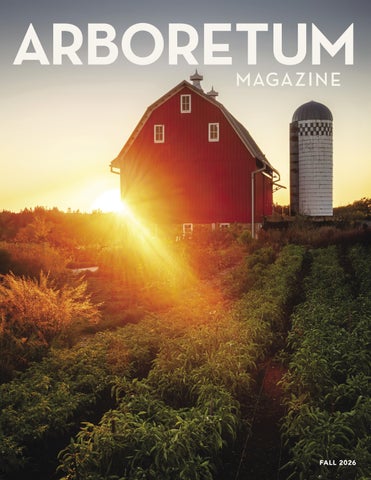
ON THE COVER
Fall brings a bountiful harvest to the Farm at the Arb. Photo by Sara Pace
I TA B L E O F C O N T E N T S I
3
PLANT PROFILE Fall color from the ground up!
10
RESEARCH & CONSERVATION What’s in a name?
ARBORETUM MAGAZINE
FALL 2026, VOL. 45, NO. 3 Elise Bremer Editor Brenda Drake Lesch Art Director Andrew Gapinski Executive Director Matthew Clark, Ph.D. Director of Research
13
JOY OF GIVING
6
NEWS Celebrating the final season in the historic AppleHouse
14
EDUCATION Q & A with Chef Cheo Smith
16
HORTICULTURE
& COLLECTIONS
18
ROOTSTOCK Sweet potato cheesecake swirl bars
Rachelle Crosby Director of Facilities & Project Management Timothy S. Kenny Director of Education Jared Rubinstein Director of Horticulture & Collections David Senior Director of Business & Finance Susan Taylor, Ph.D. Director of Advancement Tom Lany Senior Marketing & Communications Manager Alene Sussman President, Arboretum Foundation Arboretum Magazine is published by the University of Minnesota Landscape Arboretum. The Arboretum is part of the College of Food, Agricultural and Natural Resource Sciences (CFANS) at the University of Minnesota. The magazine is a benefit of Arboretum membership. To request a copy of this publication in an alternate or digital format, please call 612-301-1257.
8
© 2026 Regents of the University of Minnesota. All rights reserved. The University of Minnesota is an equal opportunity educator and employer.
9
arb.umn.edu 612-624-2200 arbpr@umn.edu
NATURE FOCUS
PEOPLE
19
WHAT’S IN SEASON
Arboretum Magazine is printed on paper containing 100% sustainable recycled fiber. ARB.UMN.EDU // FALL 2026
1
I F R O M T H E E X E C U T I V E D I R E C TO R I
A
utumn is a spectacular time at the Arboretum as we welcome visitors to celebrate the ever-evolving display of fall color. While we tend to look up in search of seasonal reds, oranges and yellows, the Arboretum’s Curatorial team recommends a slightly different approach. On the next pages, they’ve highlighted three unexpected plants that showcase the brilliant layers of the autumn landscape. Of course, in late August, we Minnesotans start thinking about all things apple as the anticipation for the harvest season grows. First Kiss® — released by the University of Minnesota in 2016 — is one of the earliest apples to ripen, signaling the start of the parade of varieties ahead. It remains my favorite apple for that reason, as well as its sweetness and crisp texture. Apples are a key focus at the Arboretum this fall as we celebrate our final season at the existing AppleHouse at the Horticultural Research Center (HRC) and look ahead to the future of the new Betty’s Apple House, which will open to visitors in time for the 2027 apple season. The AppleHouse began in an old barn at the HRC, where it served as an outlet for the apples produced in the research orchards for decades. Today, it’s a popular fall field trip destination for school groups; a source for pumpkins, squashes, and other produce and seasonal products; and it remains a vital source of funding to support the research programs. Betty’s Apple House — located near the Farm at the Arb — builds on this legacy, connecting guests to the University’s fruit breeding journey by highlighting the people and stories behind the work. Read about the history of the AppleHouse and our exciting plans for the new space on page 6. As we wrap up major construction work on Betty’s Apple House, we’re also nearing completion on our new entry experience. This fall, construction will be completed on the entryway and gatehouses, and we’ll turn our attention to establishing the landscape, including around the 550 new trees planted throughout the area, ahead of the fall 2027 opening. Thank you for your support during this era of transformation and growth. See you at the Arboretum this fall.
Andrew Gapinski
2
ARBORETUM MAGA ZINE // FALL 2026
I PLANT PROFILE I
Fall Color From the Ground Up! Looking for the best leaf-peeping spots at the Arboretum this fall? To see the widest range of autumn color and seasonal texture, the Arboretum’s Curatorial team encourages visitors to start their search below the tree canopy. Read on to find profiles of the team’s picks for unexpected
fall color favorites — including a perennial, shrub and tree — and where to find them at the Arboretum this season. For weekly updates from the Curatorial team on what plants to see on your next visit to the Arboretum, visit arb.umn.edu/garden-highlights.
Little bluestem ‘Ha Ha Tonka’ BOTANICAL NAME: Schizachyrium scoparium ‘Ha Ha Tonka’ LOCATION: Ornamental Grass Collection WHEN TO SEE IT: October to November
Nick Kreevich l Curatorial Manager
Autumn is celebrated for the
kaleidoscopic colors that blanket the landscape. While we are typically awed by the vibrant hues of the tree canopy, similar seasonal shows occur at ground level within the herbaceous layer, specifically among ornamental grasses. Little bluestem (Schizachyrium scoparium), native to North America, is both an ecological and horticultural masterpiece. Adapted to harsh conditions, it thrives in droughts and variable soils. It serves as a vital habitat for nesting and roosting, provides seeds for wildlife and is a host plant for the endangered Dakota skipper (Hesperia dacotae). In 2016, the cultivar ‘Ha Ha Tonka’ was introduced by landscape designers Cassian Schmidt and Piet Oudolf. Discovered in Germany from seeds originally collected at Ha Ha Tonka State Park in Missouri, this plant stands out for its unique aesthetic qualities. What makes ‘Ha Ha Tonka’ exceptional is its
densely pubescent, or hairy, foliage. These fine hairs trap dew and catch the sunlight, creating a soft, radiant glow in the autumn garden. As the season progresses, the stems and nodes develop vibrant shades of green and red, producing a striking botanical candy-cane effect. With an upright, stiff habit and sparse foliage that creates a “window” to neighboring plants, ‘Ha Ha Tonka’ provides structure without crowding the landscape. To see this specimen during its fall show, visit the Ornamental Grass Collection, Elizabeth Carr Slade Perennial Garden or the Ankeny-Lang Rose Walk from October to November.
Top: Schizachyrium scoparium ‘Ha Ha Tonka’; photo by Natalia Ungashick Inset: The upright habit and sparse foliage of ‘Ha Ha Tonka’ provides a “window” to neighboring plants in the garden. Photo by Nick Kreevich ARB.UMN.EDU // FALL 2026
3
I PLANT PROFILE I
Blueberry BOTANICAL NAME: Vaccinium spp. LOCATION: Home Demonstration Gardens WHEN TO SEE IT: October to November Natalia Ungashick l Plant Recorder
Not only do blueberries produce
abundant bell-shaped, light pink to white flowers and eye-catching fruit, their leaves also put on a colorful show in the fall. Their foliage changes from green to different shades of brilliant red or orange before the season ends. These shrubs expand the vibrant highlights of fall by providing a much-needed pop of color in the lower landscape. Blueberries are classified within the genus Vaccinium, which encompasses more than 450 species, including blueberry relatives such as huckleberry
4
ARBORETUM MAGA ZINE // FALL 2026
and cranberry. While not all blueberries are native to the United States, the blueberries typically used in commercial production are. Vaccinium corymbosum, or highbush blueberry, is native to the eastern U.S., and Vaccinium angustifolium, or lowbush blueberry, is native to the northeast, including Minnesota! Many blueberry cultivars on the market are crosses of these two species, specifically blueberries developed by the University of Minnesota’s breeding program. These hybrids were created to be cold hardy and provide prolific yields of large berries. The first cultivars released by the University include ‘Northblue’, ‘Northsky’ and ‘Northcountry’. These were followed by the slightly taller, chest-height ‘St. Cloud’, ‘Chippewa’ and ‘Polaris’ in the ‘90s. While many blueberry cultivars are technically self-fertile, meaning they do not need another plant to produce fruit, they may produce very small quantities if planted on their own. To ensure your blueberries have a bountiful harvest, research a compatible cultivar to plant nearby.
In the fall months of October and November, blueberries can hold onto their brilliant red foliage for multiple weeks. Their dependability and beautiful, contrasting green and red leaves during their initial color change make this plant my favorite shrub to admire in the autumn! Visitors can find University of Minnesota-developed blueberries in the Home Demonstration Gardens across from the Annual Garden. Bottom: In the fall, blueberry plants undergo a transformation as their foliage takes on brilliant shades of red or orange. Inset: Blueberries provide landscape benefits throughout the seasons with flowers in the spring, fruit in mid-summer and brilliant foliage in the fall. Photos courtesy of CFANS/ University of Minnesota
Black tupelo BOTANICAL NAME: Nyssa sylvatica LOCATION: Pillsbury Shade Tree Exhibit WHEN TO SEE IT: Early to mid-October Brandon Miller Curator of Plant Collections
In Minnesota, maples renowned for
their yellow, orange and red fall displays are often celebrated as the harbingers of autumn. But in the Arboretum’s collections, trees less frequently encountered in the everyday landscape can often steal the show. On a crisp fall day, with a clear blue sky as a backdrop, our three Nyssa sylvatica, or black tupelo
trees, in the Pillsbury Shade Tree Exhibit are bound to inspire every passerby. Native to the eastern United States, black tupelo is a deciduous tree that is typically less than 50 feet tall and 30 feet wide at maturity. In the wild, black tupelo occurs in woodlands anywhere from wet bottomland locations to dry upland sites. In fact, “sylvatica” means “of the woods.” This species sports glossy leaves that keep a deep green color during the growing season. As it ages, black tupelo develops an attractive furrowed bark and strong horizontal branching, creating a formal appearance. Black tupelo is a tough plant, known in the eastern U.S. for its tolerance to drought, flooding, heat, wind, ice and salt spray. But its true “claim to fame” is its awe-inspiring autumnal display. Ablaze with a fire-engine-red color, our black tupelo trees burst forth from the collections as a truly magnificent trio!
Top: Black tupelo (Nyssa sylvatica) exhibits brilliant foliage and dark blue fruits on female trees in early to mid-October. Inset: A trio of black tupelo trees lights up the Pillsbury Shade Tree Exhibit in the fall. Photo by Brandon Miller
Upon close inspection, two of the three trees exhibit dark blue fruits that contrast beautifully with the colorful canopy. On your next early to mid-October visit to the Arboretum, stop by the Pillsbury Shade Tree Exhibit to view our uniquely cold-hardy specimens of this true fall showstopper. ARB.UMN.EDU // FALL 2026
5
I NEWS I
A new home of the
Elise Bremer l Editor
HONEYCRISP Celebrating the final season in the historic AppleHouse at the Horticultural Research Center
Every year in late August, shoppers eagerly await
the opening of the AppleHouse at the Arboretum’s Horticultural Research Center (HRC) for that first bite of a fresh, locally grown University of Minnesota apple. It’s a tradition that likely started more than 100 years ago, around the time that the Haralson apple — developed at the HRC and named for the fruit farm’s first superintendent — was released by the University of Minnesota. The arrangement benefited both the University’s apple breeders, who found
1940s 6
ARBORETUM MAGA ZINE // FALL 2026
an outlet for the produce that resulted from the thousands of apple trees growing in the research orchards, and the general public, who got to sample the newest fruit releases from the University. “We’ve collected our data; now what do we do with the fruit?” said David Bedford, a University of Minnesota apple breeder who has worked at the HRC since the late ‘70s and helped launch the Honeycrisp apple to international renown. Today, the AppleHouse sells University of Minnesota-developed apples grown
in the Arboretum’s production orchards, including favorites such as Honeycrisp, SweeTango® and Haralson, as well as other unique apple varieties from local farms. It’s also a destination for canned and pickled goods from makers throughout the region; apple strudels and pies; and meat and dairy products from the College of Food, Agricultural and Natural Resource Sciences (CFANS). While visitors and staff love the rustic farm feel of the AppleHouse, as well as its proximity to apple research at the HRC, this will be the final season of
1970s
Above: Putting out bushels of apples to sell to the public at the Horticultural Research Center (HRC). Right: Loading apples into the sorting machine in the old AppleHouse barn behind the current building.
2027
Below: Betty’s Apple House will feature triple the square footage of the current building and provide dedicated space for retail, a cafe and creamery, apple sorting and processing, and visitor interpretation and learning.
today
Above: Bags of apples await shoppers at the current AppleHouse, which has been operating out of the metal barn at the HRC since 1979.
apple sales in the current space ahead of the opening of the new Betty’s Apple House in the fall of 2027. The beloved old steel pole barn, situated among the HRC’s majestic oaks, has charm to spare, but it hasn’t kept up with the growing needs of shoppers and AppleHouse staff, who sort, grade and bag apples from the orchards on site. The AppleHouse has operated out of the metal barn since 1979, and before that, apples were processed and sold out of an old wooden storage barn located just behind the current building, which wasn’t an ideal fit either. “Everything was on the second floor! All the apples had to be brought in from the side with a forklift,” said Bedford.
A NEW APPLE EXPERIENCE
Though the character of the current AppleHouse location will be missed, Arboretum staff are enthusiastic about the future of Betty’s Apple House. The new location — near the Farm at the Arb within the main footprint of the Arboretum — strengthens the connection to both agricultural education at the Farm and key research orchards in the surrounding area utilized by researchers for apple breeding. From the new Apple House, visitors will be able to look out over the orchards where
the next Honeycrisp might be growing. With nearly triple the square footage of the current building, the new space will provide dedicated zones for apple sales and retail, a cafe and creamery, apple sorting and processing, an immersive learning lobby, and indoor and outdoor classrooms. Named for longtime Arboretum supporter Betty MacMillan, Betty’s Apple House will bring education to the forefront and give visitors a behind-thescenes look at how apples from the Arboretum’s orchards are sorted and graded by Apple House staff. The Apple House’s new sorting line will not only be more modern and efficient, but it will also be visible to visitors through a glass partition, allowing shoppers to get an up-close look at how apples are carefully evaluated before making it to the sales floor. Interpretive exhibits throughout the space will invite visitors to learn about the history and science of apple breeding through a storytelling lens that will capture the minds and hearts of kids and adults alike. “We want people to feel pride and excitement about shopping at the home of the Honeycrisp apple,” said Annie Klodd, Manager of Interpretation at the
Arboretum. “There’s a lot of really cool science that goes into apple breeding. These apples are created by people, out in the field, hand-pollinating apple trees. My hope is that kids might see this and want to become plant scientists or breeders.”
THIS YEAR
Visit the AppleHouse at 7485 Rolling Acres Road — just 1.5 miles west of the Arboretum’s entrance — to celebrate the final season in the current space. Shop locally grown apples, grapes and squash; CFANS meat and dairy products; apple pies and strudels; and more. Open Aug. 20-Dec. 20, 9 a.m.-6 p.m. daily.
NEXT YEAR
Look for announcements about the opening of the new Betty’s Apple House — located near the Farm at the Arb — just in time for the 2027 harvest season. To learn more about the Arboretum’s plans for Betty’s Apple House and the Building a Better Arboretum Project visit arb.umn. edu/betterarboretum.
ARB.UMN.EDU // FALL 2026
7
I N AT U R E I
Turtleheads bloom in August and September and can be found growing near Green Heron Pond at the Arboretum. Photo by Natalia Ungashick
Turtleheads Flower Into Fall
Matt Schuth l Naturalist
Matt Schuth
has contributed a nature column to Arboretum Magazine for more than 30 years and hosts seasonal guided “Walks With Matt” exploring the natural world at the Arboretum. Minnesota Bound tagged along with Matt on a recent nature walk at the Arboretum. See Matt in action at z.umn.edu/ MNBoundMatt.
8
“They wear a pink or pearly white, a turtle’s mouth without the bite, a turtle’s head upon a stem, a quiet, leafy, forest gem.” These poetic lines beautifully describe the flowers of the turtlehead, which come in two distinct colors of creamy, pearl white (Chelone glabra) and rose pink (Chelone lyonii). “Chelone” derives from the Greek word for turtle. In Greek mythology, Chelone was a river nymph who said she was too busy to attend the marriage of Zeus and Hera. Because of this disrespect, Zeus turned her into a turtle and had her and her house thrown into the river. Her house became a shell that she could never leave. The turtlehead flower resembles the mouth of a turtle, with a one- to two-inch-long flower tube. It has fluffy, furry hairs on its lower lip to keep out crawling insects. Most flying insects are not strong enough to push the lips open and get past the arm-like stamen, which protects the nectar. Only larger bees, such as bumble bees, are strong enough to force their way into the flower and pollinate it. The bees’ movements inside the
ARBORETUM MAGA ZINE // FALL 2026
flower make it appear as if the flower is chewing them. Plucking a turtlehead and squeezing the sides of the flower will open and close its mouth like a ventriloquist with a little puppet. Turtleheads prefer damp, shaded soil but are adaptable to somewhat drier and semi-sunny areas. Flowers open from the bottom to the top of the stalk. Female flowers open wider for bees to access the flowers and deposit pollen more easily. Turtleheads symbolize resilience and endurance because of their capacity to bloom late after many other flowers have wilted. Historically, turtlehead has been used to treat both topical and internal medical maladies. Topically, it was used to treat skin conditions such as ulcers, sores and skin inflammation. The Cherokee people used the flowering tops as a treatment for worms. The Malecite used turtlehead tea as a contraceptive. Look for turtleheads blooming along the boardwalk at Green Heron Pond in August and September. Their beauty will lift your spirits as you walk by.
I PEOPLE I
Where Passion and Talent Converge
Elise Bremer l Editor
A normal day at the Arboretum
for Facilities team member Susan Snegosky might involve setting up for a wedding reception in the MacMillan Auditorium, tearing down tents and tables after Field Fest at the Farm at the Arb, and even arranging tables and chairs for a floral design workshop in the Snyder Auditorium. “There’s almost no part of the Arboretum I don’t get to!” said Snegosky. After criss-crossing the Arboretum (Snegosky said she gets about 20,000 steps per day), it’s also Snegosky who is instructing the floral design students on how to cut the flower stems and arrange them in the vase! The multi-talented Snegosky, who began working at the Arboretum in 2021 and transferred to the Facilities team in 2023, has always had a passion for plants and nature. Growing up on a dairy farm in Lester Prairie, she was inspired by her mom, who “had a magical way with plants.” Snegosky first started visiting the Arboretum in 2007 when she moved to Eden Prairie, and became a member around 2010. The first floral design class Snegosky taught at the Arboretum was on Ikebana, the traditional Japanese art of flower arrangement, which she studied during her training as a florist. Since then, she has partnered with the Arboretum’s Education team to host classes on floral centerpiece design, hand-tied bouquets, wreath making and kokedama — or moss ball — workshops. Snegosky also owns her own floral design studio, Fiddles and Fronds, which she started after being laid off from her corporate office job in 2010. After many years spent working at a desk, Snegosky loves that her work at the Arboretum brings something new every day and allows her to explore every corner of the Arboretum’s 1,200 acres. Snegosky loves sharing her passion for flowers with her students at the Arboretum, and hopes that they come away with the freedom to explore and permission to simply buy themselves flowers. “I try to bring in something a little special so they can just play around and learn about a new flower,” said Snegosky. “It gives them the space to try something new.” Find upcoming floral design classes by Susan Snegosky at arb.umn.edu/gardening-classes.
Left: In addition to floral design, Facilities team member Susan Snegosky also teaches wreath making and kokedama (moss ball) workshops. Photo by Susan Snegosky Below: Snegosky leads a floral design workshop at the Arboretum. Photo by Phil Zumsteg
ARB.UMN.EDU // FALL 2026
9
SCIENCE, STRATEGY &
SWEET SUCCESS
A look behind the scenes at the high-stakes art of apple naming Carolyn Bernhardt l Contributing Writer
10 ARBORETUM MAGA ZINE // FALL 2026
E
I R E S E A R C H & C O N S E RVAT I O N I
very time you bite into a Honeycrisp apple, you’re tasting just one success story of many. Since 1908, the University of Minnesota has been developing cold-hardy fruits at the Arboretum’s Horticultural Research Center (HRC). The program has released 115 varieties of apples, grapes, berries and more since the program’s inception, redefining coldclimate fruit growing and consumer expectations for generations. But of all these cold-hardy fruit releases, the program’s apples have stolen the spotlight and hearts across the globe. Today, the University has released more than 30 apple varieties, each with an iconic name that hints at the apple’s unique characteristics and history. The University’s apple-naming journey began more than 100 years ago with an apple dubbed Minnehaha in 1920. The program’s modern branding era began in 1991 with Honeycrisp, the University’s first patented apple. A legal misstep prevented the University from trademarking the same name, teaching breeders the importance of separating legal variety names from consumer-facing brands. So, since the release of Zestar® in 1996, every new apple has carried both a patent variety name (‘Minnewashta’ for Zestar®) and a carefully developed trademark. A core group of University of Minnesota researchers and technology commercialization staff is behind it all. One team member in particular typically gets the ball rolling — David Bedford, M.S., a University of Minnesota apple breeder based at the HRC, who has been a part of the process for more than 45 years. “David always says it’s much harder to name new apples than it is your children!” said another crucial team member, Anne Hall, Technology Portfolio Manager in the Research & Innovation Office. Hall has been a part of this team for more than 20 years now, as well. She said that, in its early stages, the naming process looks a little different each time — from informal brainstorming with partners to formal committees, large public naming contests involving thousands of University members and even collaboration with a local branding firm. Whatever the approach, proposed names undergo a complex, scrutinous analysis that the naming team has developed over time. “If a name doesn’t fit most of our criteria, it’s discarded and we continue the search for a better option,” said Hall.
SWEET AND SNAPPY GOODNESS
David Bedford, a University of Minnesota apple breeder based at the Horticultural Research Center, has been instrumental in naming University of Minnesota apple releases for more than 45 years.
According to Bedford, names that instantly grab consumers are always the top priority. “The name is the one thing you have to distinguish yourself from your competition,” he said. “Studies show a shopper only looks at a new item for around 1.3 seconds. Nobody’s stopping to read the fine print.” Over the years, the team has also learned that naming fruit after a person or place presents issues. “There has been a long history of place-based names in fruit breeding,” said Matt Clark, Ph.D., Associate Professor in the Department of Horticultural Science and Director of Research at the Arboretum. “This often uses Native American words, which is exploitative, or places named after colonizers. We’ve moved away from this.” Now, the team intentionally avoids naming fruit after places, colonizers or any living person. An apple’s name needs to be short, snappy and memorable. “We’re trying to make it easy to remember, easy to tell your friends about and appealing,” said Bedford. “And we have to convey all of that in a short word or two.” ARB.UMN.EDU // FALL 2026
11
I R E S E A R C H & C O N S E RVAT I O N I It also needs to be timeless, because once the team finalizes the name, growers propagate trees, plant orchards and wait for fruit production — creating a lag of several years before apples reach consumers at scale. “It takes 20 years for us to develop and introduce a variety, and then another five to 10 for a variety to be recognized in the marketplace,” said Bedford. For example, Kudos®, which was released in 2023, is still in the early stages of the production process and won’t be widely available for a few more years.
BRANDING THE BITE
The name should also be marketingfriendly, hinting at the fruit’s taste, texture or feel. However, the name cannot state those qualities outright without jeopardizing its ability to stand out with terms like “sweet” or “red.” These more common and generic words aren’t just run-ofthe-mill — they can also pose issues when the team works with trademark attorneys to screen their top choices for any conflicts with other existing trademarked fruit or plant names. More recently, Mara Sanders, a plant material and IP logistics manager in the Research & Innovation Office, has looped in designers and marketing staff to develop logos and branding around new fruit names, using these assets to create merchandise. “Not only am I getting to see what the name conveys about the apple, but also what an image does,” she said. After many rounds of evolution over the years, the University’s longstanding excellence in both fruit breeding and naming has connected experts with the community — a tradition that continues today. “Whenever we present names, there are always the people who pull you aside and say, ‘What the heck were you thinking?’” said Clark. “And then there are the other people who you can just see on their faces that they’re so excited about that name.”
Above: It takes more than 20 years for an apple to be developed by breeders, introduced and gain recognition in the market, so its name needs to be timeless. Kudos®, pictured here, was released in 2023, and is still in the early stages of production in orchards. Photos courtesy of CFANS/University of Minnesota
12 ARBORETUM MAGA ZINE // FALL 2026
Superior Fruit Innovations network opens the orchard gates For the first time, small and mid-sized growers can now access premium apple and table grape varieties previously limited to large-scale distribution — thanks to the University of Minnesota’s new Superior Fruit Innovations (SFI) network, which launched last November. Previously, the University relied on a single large commercial partner to grow, distribute and market new fruit varieties at scale for national grocery chains. Instead, SFI opens access to growers of all sizes — especially direct-market producers who sell through orchards, farm stands and local markets. While wholesale fruit markets face rising costs and oversupply, local growers are better positioned to showcase what the University’s breeding program does best: fruit with standout flavor, texture, color and cold hardiness. “It makes the season really special when you can have an amazing apple from your local orchard,” said Mara Sanders, a plant material and IP logistics manager in the Research & Innovation Office. “We [also] released three new table grapes into the program, and we’re hoping to keep introducing more cold-hardy fruits that fit the pick-your-own kind of model.” Early response has been strong, with interest spreading beyond Minnesota and spurring plans to expand across the U.S. and into Canada. The result is a more flexible, grower-centered system — one that reconnects cutting-edge fruit breeding with the local orchards and communities it was originally meant to serve. Learn more about the program at superiorfruitinnovations.umn.edu.
I J OY O F G I V I N G I
Longtime Arboretum supporters Chris and Sandi Johnson in front of the Arboretum’s iconic ginkgo tree near the Dwarf Conifer Collection. The tree bears a memorial plaque to Chris’ grandparents. Photo by Lily Smith
The resilience of renewal N Jeff Iseminger l Contributing Writer
ear the coastal town of Big Sur, California, you can sometimes see fog wafting its gauzy way from the Pacific Ocean toward land…then slowly, slowly retreating…then coming back again in a beautiful dance of reengagement. The relationship between fog and land is never broken. You can see that very act of rekindling connection — in this case to the University of Minnesota Landscape Arboretum — in the lives of Chris and Sandi Johnson. They met at the University of Minnesota (they’ve been married 55 years), began their professional lives in the Twin Cities, then moved to Rochester. Sandi worked there as a nurse at the Mayo Clinic and Chris as a construction manager for Best Buy. Chris originally engaged with the Arboretum as a child. “I remember coming to the Arboretum with my uncle,” he said, “and my mother loved an apple grown there with a certain numbered research name. It was her favorite.” Sandi grew up on a farm near Elk River with — count ‘em — 13 siblings and a big garden. The Johnsons live outside Rochester on 80 wooded
acres — their own arboretum — bordering the Root River. Despite Chris’ family ties to the Arboretum, the 100-mile drive between them and the Arboretum has been daunting. But the Johnsons’ retirement has allowed them to reignite their relationship with the Arboretum. It’s not just driving convenience; it’s also the pull of what the Arboretum offers them: “There are so many ecosystems you can observe,” said Chris. “You won’t find anything like that in Minnesota.” “People at the Arboretum seem excited about their jobs,” said Sandi, “and I like that it’s a research extension of the University.” They’re so taken with the Arboretum that they bring their kids, grandkids and great-grandkids. The Johnsons clearly get joy from the Arboretum, but they also know how joy can flow from giving. They’re members of the Leon Snyder Heritage Society and generous supporters of the Annual Fund, children’s education, and research and plant conservation. Adult education is a plus for Chris: “It’s amazing how much you can learn at the Arboretum.” And for Sandi as well: “I love what I can put in my brain from the Arboretum and reflect back on it.” ARB.UMN.EDU // FALL 2026
13
I E D U CAT I O N I
Connecting Land & Table
Meet Chef Cheo Smith Maria Klein l Editor, Statewide Master Gardener Newsletter
14 ARBORETUM MAGA ZINE // FALL 2026
For the past year, Chef Cheo
Smith has brought a unique blend of culinary science, cultural heritage and a deep connection to the land to his popular cooking classes in the Kitchen Classroom at the Burton and Virginia Myers Education Center at the Farm at the Arb. Drawing from his Native roots and diverse culinary background, Chef Cheo empowers students to intimately connect with their food, their environment and the history of their ingredients. Whether demonstrating the chemistry behind a perfect sear or explaining the microbiology of wild-harvested rice, Chef Cheo makes learning delicious. We sat down with him to discuss his journey, teaching philosophy and what makes cooking at the Arboretum so meaningful.
Q. How have your Native roots helped shape your career path?
A. My earliest years were on the Sisseton Wahpeton Oyate Reservation, and I also have family on the White Earth Reservation. By age 5, we moved to the Twin Cities, but my connection to my Native roots drives me toward things I want to explore here at the Arboretum. Here, I have easy access to plants, land and untouched nature. I really want to explore what foods we have forgotten.
Q. When did you start
thinking about food as a profession?
A. The spark was probably watching
PBS cooking shows with my dad: Jacques, Julia and America’s Test Kitchen. We would watch and recreate a recipe later that day. After some college, I realized I wasn’t doing anything with my hands and felt the need to be “playing with fire.” I went to culinary school, and straight out of it, a friend wanted to start a food truck.
Opposite: Chef Cheo Smith’s culinary classes are rooted in food science, cultural heritage and connection to the land. Photo by Jason Boudreau-Landis
Q. Tell us about your journey
from cooking school to running a food truck to teaching.
A. My friend knew how to cook and
Below: In the Kitchen Classroom, Chef Cheo’s teaching philosophy is “food as it could be, not as it should be.” Photo by Kristen Olson
had his grandma’s traditional Colombian recipes, but he needed to know how to mince 10 pounds of onions at once and turn a “touch” of this into measurable amounts. I trained him and his employees. When I moved to other venues, I became the person who trained new employees and eventually, I created a training style. That led to my class philosophy: Food as it could be, not as it should be. Recipes are just jumping-off points.
Q. What advice would you give to a home cook who wants to cook more locally and seasonally?
A. Do some prep before you head to the farmers market or grocery store. Know your recipe and what the food should be like and how it should feel before you go. Being ready allows you to explore a little more once you get there.
Q. What are some of your goals for teaching at the Arboretum?
A. I want people to see the connection
between the land and the table. I like sharing information about the land and its history. I also try to bring an education in science. Every class features a small food chemistry lesson — the Maillard reaction, chemical leavening in quick breads or how salt and pH change vegetable texture. I’ve been able to bring all of those things together, especially for my wild rice class.
Q. What’s significant about your wild rice class?
A. Each wild-harvested rice variety is its
own distinct micro-species because each comes from a single lake with its own biology and chemistry. One’s swampy, one’s grassy, one has a toasty flavor. It’s influenced by the lake and the people who harvest it. It’s a special class for sharing my culture; it’s about people, places, food and how we connect.
Q. What do you like about
teaching at the Arboretum?
A. When I look out the Kitchen
Classroom’s windows, there are plants and trees as far as the eye can see. I know what will be coming out of the Foodscape out front. I can hold up an herb, point out the window, and say, “That’s where this came from.” It grounds me and brings me back to ideas of place and belonging. I’ve visited beautiful places worldwide, but this is ancestral Dakota land, and I don’t want to be anywhere else. Ready to play with fire and explore the connections between land and table? Join Chef Cheo Smith in the Kitchen Classroom! Browse upcoming culinary classes — including his signature wild rice and seasonal cooking sessions at arb.umn.edu/culinary. ARB.UMN.EDU // FALL 2026
15
I H O R T I C U LT U R E & C O L L E C T I O N S I
From GreenCorps to Green Thumb Nina Charlier l Minnesota GreenCorps Member
T
his past April, there was an eight-acre fire in the BennettJohnson Prairie. But it wasn’t the Chanhassen Fire Department on the scene; it was the Arboretum’s Natural Resources team performing a prescribed prairie burn. After days of waiting for the right conditions — not too dry, not too wet and just enough wind — it was finally the perfect day to burn. Prescribed burns are an important part of prairie management, used to remove unwanted woody plants and make space for native prairie plants. It was my very first time participating in a prescribed burn, something I’d wanted to do since learning about them in high school. This was just one of the many incredible experiences I had while serving as a Minnesota 16 ARBORETUM MAGA ZINE // FALL 2026
GreenCorps member at the Arboretum. Minnesota GreenCorps is an environmental professional development program run in collaboration with AmeriCorps and the Minnesota Pollution Control Agency. The program places members at a host site where they serve full-time, working on a variety of environmental projects. Over the course of 17 successful program years, the program has had 599 members, serving at 256 host sites across our state. GreenCorps’ goal is to strengthen communities through projects in four key environmental areas: Community Readiness and Outreach, Energy Conservation and Green Transportation, Waste Reduction and Recycling, and Stormwater and Forestry. In 2025, the Arboretum applied to be a GreenCorps placement site for the first
Above Left: Nina Charlier (center) with members of the Arboretum’s Natural Resources team conducting a prescribed burn in the Bennett-Johnson Prairie. Above Right: Charlier in the woods near Green Heron Pond with bloodroot, a spring ephemeral wildflower.
time; I am the first member placed at the Arboretum in its history. My service was centered around forestry topics, rotating between three teams in the Horticulture department: arboriculture, natural resources management and plant health. Before starting at the Arboretum last October, I earned my degree in biological sciences from the University of Minnesota, but I couldn’t tell a hackberry from an elm tree, much less use a chainsaw. Working with our expert horticulture staff over the next 11 months, I learned things I never could’ve in a class.
I spent a month with our talented arborists, learning the physics behind felling a tree, pruning techniques, and all the other hard work in tree care. Much of my service term was spent removing invasive species from the Arboretum’s 660 acres of natural areas with the Natural Resources team. The work was rewarding, but it was also a joy to work alongside staff who took the time to teach me native and invasive plant identification. I now recognize more plants on walks through my Minneapolis neighborhood.
Working with our expert horticulture staff over the next 11 months, I learned things I never could’ve in a class. I also helped the Arboretum’s plant health specialist by researching emerging plant pests and writing management plans, and applying this knowledge while scouting for insects and diseases on the grounds last spring. I performed trunk injections to protect trees facing serious health threats, such as emerald ash borer and pine wilt nematode. Beyond developing my horticultural knowledge, I built relationships within the Arboretum community. Throughout my term, I also worked with the Arboretum’s volunteers in many capacities. Each volunteer had a reason why they wanted to give back to the Arboretum, and it was great to see how special our grounds are to so many people. One volunteer fondly recalled going on walks with his parents, later donating a bench in their memory.
Another volunteer had also served in AmeriCorps, and she was excited to hear that the Arboretum had become a host site. In the spring, I helped our Youth Education staff with field trips at the Marion Andrus Learning Center. I spoke with elementary school students about the importance of habitats for pollinators and planted a pollinator-friendly plant with each student to take home. As part of my role, I also conducted community outreach about invasive species. I contributed posts to the Arboretum’s blog on the ongoing removal of Siberian squill, alder and buckthorn at the Arboretum, and hosted tabling events to engage visitors on topics including emerald ash borer. One of my favorite aspects of the
program was building a network with the other 58 GreenCorps members in my cohort. We support each other at various volunteer events and conferences. I was able to host 12 members out at the Arboretum for a day of service: pulling invasive garlic mustard. It was the first visit to the Arboretum for many of them, and they were all eager to come back and continue exploring. AmeriCorps programs, such as Minnesota GreenCorps, increase the capacity of nonprofit organizations across the nation, while members develop professional skills. I’m so grateful for the time I was able to spend as part of the Arboretum family, thanks to GreenCorps! To learn more about the Minnesota GreenCorps program and its members’ impact, visit www.pca.state.mn.us/ minnesota-greencorps.
Charlier’s work at the Arboretum included public outreach and tabling, service work with other GreenCorps members, and rotations with teams within the Arboretum’s Horticulture department. ARB.UMN.EDU // FALL 2026
17
I R O OT STO C K I
SWEET POTATO CHEESECAKE SWIRL BARS Melinda Alves l Rootstock Sous Chef Makes one 8-by-8-inch pan of bars
INGREDIENTS
For the crust 1 cup butter ¾ cup sugar 1 ¼ cups flour 1 teaspoon salt 1 ¼ cups chopped pepitas (other seeds or nuts work, too)
Preheat the oven to 350 degrees. To prepare the crust, cream together the butter and sugar and mix in the flour, salt and seeds. Press into a well-greased and floured 8-by-8-inch pan and bake until golden brown, about 15 to 25 minutes. You may not need all the crust mixture; ¼ inch in the bottom of the pan is enough. Once cooled, prepare the filling. In a bowl, beat the cream cheese, sugar, 1 egg, vanilla and 2 tablespoons of sweetened condensed milk until smooth, set aside. In another bowl, mix together the mashed sweet potato, remaining eggs, pumpkin pie spice, salt and the remaining
sweetened condensed milk and pour over the crust. Dollop spoonfuls of the cream cheese mixture over the sweet potato layer; use a knife to swirl or mix in the cream cheese to form a decorative pattern. Bake again for 35 to 45 minutes; until the bars are set and have developed a golden color on top. Allow to cool completely before cutting. Find a rotating variety of seasonal bars and desserts by Chef Melinda at Rootstock — open daily in the Oswald Visitor Center. Learn more about Rootstock and the culinary team and find daily menus at arb.umn.edu/rootstock. Photo by Sara Pace
For the filling 8-ounce package cream cheese ½ cup sugar 3 eggs, divided 1 teaspoon vanilla 14-ounce can sweetened condensed milk, divided 3 cups mashed sweet potato (pumpkin or squash can also be used) 2 teaspoons pumpkin pie spice 1 teaspoon salt
PREPARATION
18 ARBORETUM MAGA ZINE // FALL 2026
Photo by Katie Knapp
I EVENTS & CLASSES I
What’s in Season EVENTS, CLASSES AND MORE
Discover something new at the Arboretum this season. In addition to 1,200 acres of gardens, collections and natural areas, the Arboretum offers a wide range of events, art exhibitions and classes so visitors can learn something new on each visit and deepen their connection with nature. Find a few upcoming events and classes highlighted here and view the full selection online.
Arboretum Glass Pumpkin Patch
Sept. 12, 10 a.m.-3 p.m. Celebrate the family farms that feed and fuel the world at the Farm at the Arb’s annual harvest celebration! This year’s festivities include hands-on activities (dig up a sugar beet!) that shine a spotlight on Minnesota’s vital sugar beet industry and grower Mary Sue Kruger. Discover the essential link between Minnesota’s expansive beet fields and the sugar found in your kitchen while exploring the profound impact of this local crop on our regional food systems. This event is included with Arboretum general daily admission; advance registration is required.
Sept. 18-19, 9:30 a.m.-4 p.m. and Sept. 20, 10 a.m.-3 p.m. The Arboretum Auxiliary is proud to present the sixth-annual Arboretum Glass Pumpkin Patch in support of the Arboretum and the event’s talented glass artists. This year, the patch will move to the Farm at the Arb, where more than 6,000 stunning handmade glass pumpkins and glass art pieces will be displayed. Special timed entry tickets are required for this event; ticket includes Arboretum general daily admission.
Presented by
Photo by Sara Pace
Field Fest
SCAN HERE
to view all upcoming events and browse by topic at arb.umn. edu/events.
Opening Night
Sept. 17, 4:30-7:30 p.m. SCAN HERE
to register or visit arb.umn.edu/fieldfest.
Looking for the perfect pumpkin to add to your collection? Browse the sale early during a special sip-and-shop Opening Night celebration — special ticket required.
SCAN HERE
to register or visit z.umn.edu/arbglasspumpkin.
ARB.UMN.EDU // FALL 2026
19
I EVENTS & CLASSES I
Full Moon Hikes
DISCOVER AND LEARN
See the Arboretum in a new light! Explore the Arboretum under the glow of the full moon during these special after-hours events that invite visitors to learn about astronomy and the natural world. Wander tea-light-lit paths to find the best moonviewing locations, then gather by a cozy bonfire to roast marshmallows.
Learn something new at the Arboretum this season at expert-led classes for adults and kids that are designed to spark creativity and cultivate a deeper connection to nature. Find a few class highlights for the season ahead on these pages and browse the full catalog of upcoming classes online. Need help with registration or gifting a class? Contact our Education team by phone at 612-301-1210 or via email at arbedu@umn.edu.
Full Harvest Moon Hike Sept. 26, 7:30-10:30 p.m.
SCAN HERE to browse our
Photo by Phil Zumsteg
Full Hunter’s Moon Hike Oct. 26, 6:30-9:30 p.m.
SCAN HERE
to reserve tickets or visit arb.umn.edu/fullmoonhikes.
Northern Lights
Photo by Sara Pace
full selection of class offerings or visit arb.umn.edu/learn.
New Event!
Nov. 20, 2026-Jan. 3, 2027 A brand-new light display is coming to the Arboretum this season! Northern Lights, an illuminating winter experience among the trees, highlights the beauty of the Arboretum’s nighttime landscape and transforms the grounds into a light-filled wonderland with trees in the spotlight. SCAN HERE
to learn more or visit arb.umn.edu/northernlights. Photo courtesy of Lightswitch
The event will feature new experiences indoors and out that celebrate the best of our northern winter.
Culinary Classes in the Myers Kitchen Chefs Beth Fisher and Cheo Smith invite you into the Kitchen Classroom for a season of harvest cooking. From apples and squash to wild rice, participants will discover new flavors and techniques to inspire fall meals and seasonal entertaining. Special Access: All About Apples Oct. 24, 1-4 p.m. A Toast to the Roast Nov. 12, 5-7 p.m.
20 ARBORETUM MAGA ZINE // FALL 2026
SCAN HERE
to view upcoming classes or visit arb.umn.edu/culinary.
I EVENTS & CLASSES I
Art and Botanical Illustration The Arboretum’s expansive selection of art classes welcomes artists of all levels, offering students the space to learn and grow at their own pace. Each program provides a unique opportunity to connect with nature through a creative lens. Painting in Acrylics: Georgia O’Keeffe-Inspired Squash Blossoms Two-session series: Sept. 17 and 24, 10 a.m.-12:30 p.m.
SCAN HERE
to view upcoming classes or visit arb.umn.edu/art-classes.
Art by Aryn Lill
Barn Quilt Painting Oct. 14, 10 a.m.-12:30 p.m.
Gardening and Horticulture Classes
Classes On-the-Go: Late Summer Flora and Fauna or Fall Color Tree Study Sept. 17, 5:30-7 p.m. or Oct. 15, 5-6:30 p.m. Houseplants: From Surviving to Thriving Sept. 27, 1-3 p.m.
Photo by Mark MacLennan
Deepen your horticulture knowledge and build practical skills that help your landscape thrive with instruction from Arboretum horticulture professionals! Leave each class ready to put new ideas into practice in your yard and garden.
SCAN HERE
to view upcoming programs or visit arb.umn.edu/gardening-classes.
Photography Workshops Expand your photography skills at the Arboretum this fall with hands-on classes and guided sessions led by experienced photographers who will share their techniques, insights and passion for capturing the beauty of nature during this vibrant season. Intro to Your Camera: Beginner Photography Skills Sept. 10 or Oct. 29, 9:30 a.m.-1:30 p.m. Photographing Fall Color Oct. 15 or 24, 9:30 a.m.-2:30 p.m.
SCAN HERE
to view upcoming classes or visit arb.umn.edu/photography-classes.
ARB.UMN.EDU // FALL 2026
21
3675 Arboretum Drive Chaska, Minnesota 55318-9613
Give today! Your gift supports the
Photo by Sara Pace
Arboretum’s gardens, educational programs and horticultural research. Scan the QR code or visit arb.umn.edu/supportus to donate today.