Solutions Manual for Social Research v3 1st Edition
by Blackstone
ISBN: 9798887942308

ISBN: 9798887942308
In this chapter, students will consider the variety of ways that we know things and what makes social scientific knowledge unique. The rest of the book will also be previewed.
Learning Objectives
Define research methods.
Identify and describe the various ways of knowing presented in this section.
Understand the weaknesses of nonsystematic ways of knowing.
Define ontology and epistemology and explain the difference between the two.
Teaching
Students can be asked to come up with various methods of gaining knowledge. They can also be asked to suggest real-life examples of such methods.
Research methods are a systematic process of inquiry applied to learn something about the social world. Research methods are but one of the many sources of knowledge.
Different sources of knowledge:
o Many people come to know about things through direct experiences. In such cases, the observation process isn’t really deliberate or formal. Instead, it is through informal observation that they came to know what they believe to be true.
The problem with informal observation is that sometimes it is right and sometimes it is wrong.
Without any systematic process for observing or assessing the accuracy of our observations, we can never really be sure that our informal observations are accurate.
o Selective observation occurs when we see only those patterns that we want to see or when we assume that only the patterns we have experienced directly exist.
o Overgeneralization occurs when we assume that broad patterns exist even when our observations have been limited.
o Authority is a socially defined source of knowledge that might shape our beliefs about what is true and what is not true.
o Our parents, the government, our schools and teachers, our churches and ministers; all of these are other common authorities that we might rely on as sources of knowledge.
Ontology refers to one’s analytic philosophy of the nature of reality.
o In sociology, a researcher’s ontological position might shape the sorts of research questions s/he asks and how those questions are posed.
Epistemology deals with questions of how we know what is.
o Our epistemological perspective shapes our beliefs about how we know what we know, and the best way(s) to uncover knowledge.
1. Think about a time in the past when you’ve made a bad decision (e.g., wore the wrong shoes for hiking, dated the wrong person, chose not to study for an exam, dyed your hair green). What caused you to make this decision? How did any the ways of knowing described above contribute to your error-prone decisionmaking process? How might sociological research methods help you overcome the possibility of committing such errors in the future?
Suggested response: Student answers will vary. They should discuss their personal experiences, how their own informal and selective observation led to their decisions, and how they could have prevented these bad decisions by using research tools before acting
2. Describe your own ontological and epistemological perspectives. Impress your friends by correctly using these terms in a sentence!
Suggested response: Student answers will vary but should include their perception and beliefs about the nature of reality, what is, what can be known about what is, and the best way to learn about and uncover knowledge about what is.
Online Resource
http://www.umsl.edu/~keelr/010/method.html
Key Terms
Research methods A systematic process of inquiry applied to learn something about our social world
Informal observation—Making observations without any systematic process for observing or assessing accuracy of what is observed.
Selective observation—Noticing only patterns that one has experienced directly or wishes to find.
Overgeneralization Assuming that broad patterns exist based on very limited observations
Authority—A socially defined source of knowledge.
Ontology An analytic philosophy concerning the nature of reality
Epistemology An analytic philosophy concerning how we know what we know
3. Science, Social Science, and Sociology
Learning Objectives
Define science.
Describe what the phrase “sociology is a social science” means.
Describe the specific considerations of which social scientists should be aware.
Teaching Tips
In order to introduce the concept of sociology as a science, you can ask students to choose one or two headlines from recent newspapers and come up with socially relevant questions related to those topics. Next, you can ask them to evaluate how, if at all, can those questions be answered scientifically.
The aim of sociologists is to contribute to and enhance knowledge. This is because sociology is a science
o Science is a particular way of knowing that attempts to systematically collect and categorize facts or truths.
o Scientists gather information about facts in a way that is organized, intentional, and usually follows a set of predetermined steps.
o Sociology is a social science.
Sociology uses organized and intentional procedures to uncover facts or truths.
It is the scientific study of humans in groups.
Two key elements of sociology are its focus on human social behavior and its scientific approach toward understanding that behavior.
Specific considerations for the social sciences:
o Sociologists aim to explain patterns in society.
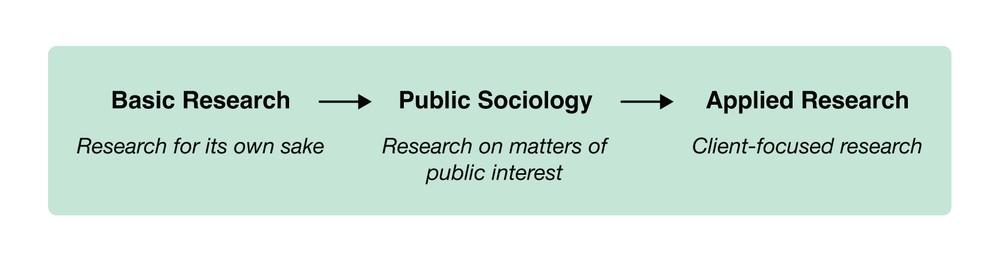
o Another matter for consideration of sociologists is where they stand on the value of basic as opposed to applied research.
Basic and applied research can be thought of as resting on either end of a continuum.
In sociology, basic research is sociology for sociology’s sake. Nothing more, nothing less.
Applied research lies at the other end of the continuum.
In sociology, applied research refers to sociology that is conducted for some purpose beyond or in addition to a researcher’s interest in a topic.
Applied research is often client-focused, meaning that the researcher is investigating a question posed by someone other than themselves.
Public sociology lies near the middle of the basic/applied continuum.
It refers to the application of sociological theories and research to matters of public interest.
o One final consideration that social scientists must be aware of is the difference between qualitative and quantitative methods.
Qualitative methods are ways of collecting data that yield results such as words or pictures.
Some of the most common qualitative methods in sociology include field research, intensive interviews, and focus groups.
Quantitative methods, on the other hand, result in data that can be represented by and condensed into numbers.
Survey research is probably the most common quantitative method in sociology but methods such as content analysis and interviewing can also be conducted in a way that yield quantitative data.
While qualitative methods aim to gain an in-depth understanding of a relatively small number of cases, quantitative methods offer less depth but more breadth because they typically focus on a much larger number of cases.
1. What do you think the purpose of sociology should be? Challenge yourself to posit an argument in favor and against both applied and basic research. Suggested response: Students should discuss the value of each type of research, and what motivates social scientists to conduct either type. They should point out the personal motivation to do basic research and the aspect of research for research’s sake with applied research.
2. Listen to an episode of the podcast, Office Hours, hosted by The Society Pages, https://thesocietypages.org/officehours/. Office Hours contains conversations with top social scientists about their research and the social world. Suggested response: Student answers will vary, but they should note what episode they listened to and the scientists who presented.
Online Resources
This website provides quite a few ideas for simple and interesting social science projects: http://www.sciencebuddies.org/science-fair-projects/recommender_interest_area.php? ia=Soc&dl=9
Key Terms
Science—A way of knowing that attempts to systematically collect and categorize facts or truths
Sociology—The scientific study of humans in groups.
Basic research—Sociology for sociology’s sake; research that is motivated solely by researcher interest.
Applied research—Research that is conducted for some purpose beyond, or in addition to, researcher interest.
Public sociology—The application of sociological theories and research to matters of public interest.
Qualitative methods Ways of collecting data that yield results such as words or pictures.
Quantitative methods Ways of collecting data that can be represented by and condensed into numbers.
Learning Objectives
Be able to describe and discuss some of the reasons why students should care about social scientific research methods.
Identify the types of employment opportunities that exist for those with an understanding of social scientific research methods.
Teaching Tips
You can ask students to suggest a few reasons why social scientific research methods are relevant. You can also ask students about their views on employment opportunities that exist for social scientists.
Understanding research methods and how they work can give you the skills to respond intelligently and persuasively when you encounter false claims.
o In addition to having to live with laws and policies that have been crafted based on social research, you are also a consumer of all kinds of research, and understanding methods can help you be a smarter consumer.
o You can’t have an informed opinion about laws and policies without understanding where they come from, how they were formed, and what understandings our policymakers relied on to craft them.
There are many potential jobs out there for people with knowledge about how to conduct research.
o Since 1972, General Social Survey researchers have collected data on social trends, demographics, behaviors, beliefs, and change using survey interview techniques.
o Evaluation research is conducted to assess the effects of specific programs or policies.
1. Page or scroll through a few popular magazines or news sources. Pull out any examples you see of results from social science research being discussed. How much information about the research is provided? What questions do you have about the research? To what extent will the research shape your own actions or beliefs? How, if it at all, is your answer to that question based on your confidence in the research described?
Suggested response: Student answers may vary, but should include at least one example of current social science research with the supporting information about the source of the information, the credibility of the work, and how that research might influence the student’s own life.
2. Want to know more about jobs and career possibilities for people with undergraduate sociology degrees? Check out the American Sociological Association’s career resources for undergraduate students: http://www.asanet.org/career-center/careers-sociology
3. Still not convinced about the value of sociology? If you happen to be someone who is swayed by “star power” you might wish to peruse the following, which contains a list of famous sociology majors: http://www.asanet.org/students/famous.cfm.
Evaluation research—Research conducted to assess the effects of specific programs or policies.
General Social Survey—The General Social Survey (GSS) is one of the largest sources of social scientific data in the United States. Since 1972, GSS researchers have collected data on social trends, demographics, behaviors, beliefs, and change using survey interview techniques.
Identify and describe the three main goals of this text.
Review the chapter layout for the text.
Section Outline
The three overriding objectives of this text are clear relevance to your career goals, balanced information between qualitative and quantitative research methods , and accessibility with an engaging and readable text.
o This text contains fifteen chapters in all, each contained within some overarching subject group.
Chapters 4–7 outline the procedures involved in planning a research project. Topics discussed include: how to begin a research project, how to design a project, and some issues related to measurement and sampling.
Chapters 8–12 grant equal time to qualitative and quantitative research methods and examine the methods most commonly used in sociological research.
The final set of chapters focus on the social context of research.
Exercises
1. Look ahead and get a better idea of what’s to come by perusing the book’s table of contents. What are you looking forward to learning about in this class? What seems most daunting? Be sure to share any questions or concerns you have with your instructor.
Suggested response: Student answers will vary, but should reflect specific examples of topics listed in the table of contents.
2. Go old school and create a set of flash cards to help you learn the key terms and definitions featured in this chapter. Swap flash cards with a classmate and see if they found any key terms you may have missed.
Suggested response: Students should have flash cards that represent all the key terms listed in this IM.

Amy Blackstone

© 2025 by FlatWorld. All rights reserved. Your use of this work is subject to the license agreement available on our website at www.flatworld.com/terms.
No part of this work may be used, modified, or reproduced in any form by any means except as expressly permitted under the licensing agreement.

• Define research methods.
• Identify and describe the various ways of knowing presented in this section.
• Understand the weaknesses of nonsystematic ways of knowing.
• Define ontology and epistemology and explain the difference between the two.
• research methods: a systematic process of inquiry applied to learn something about our social world
• informal observation: making observations without any systematic process for observing or assessing the accuracy of what is observed
• The problem with informal observation is that sometimes it is right, and sometimes it is wrong.
• Without any systematic process for observing or assessing the accuracy of our observations, we can never really be sure that our informal observations are accurate.
• selective observation: an analytic philosophy concerning how we know what we know
• overgeneralization: assuming that broad patterns exist based on very limited observations
• authority: a socially defined source of knowledge
Informal observation
Selective observation
Overgeneralization
Authority
Research methods
Occurs when we make observations without any systematic process for observing or assessing the accuracy of what we observed.
Occurs when we see only those patterns that we want to see or when we assume that only the patterns we have experienced directly exist.
Occurs when we assume that broad patterns exist even when our observations have been limited.
A socially defined source of knowledge that might shape our beliefs about what is true and what is not true.
An organized, logical way of learning and knowing about our social world.
• ontology: an analytic philosophy concerning the nature of reality
• In sociology, a researcher’s ontological position might shape the sorts of research questions they ask and how those questions are posed.
• epistemology: an analytic philosophy concerning how we know what we know
• Differentiate between ontology and epistemology. What are the different sociological perspectives in ontology?
There are several different ways that we know what we know, including informal observation, selective observation, overgeneralization, authority, and research methods. Research methods are a much more reliable source of knowledge than most of our other ways of knowing.
A person’s ontological perspective shapes their beliefs about the nature of reality, or what “is.”
A person’s epistemological perspective shapes their beliefs about how we know what we know, and the best way(s) to uncover knowledge.
Define science.
Describe what the phrase “sociology is a social science” means.
Describe the specific considerations of which social scientists should be aware.
• science: a way of knowing that attempts to systematically collect and categorize facts or truths
• sociology: the scientific study of humans in groups
• Sociology uses organized and intentional procedures to uncover facts or truths about society.
One of the first and most important things to keep in mind about sociology is that sociologists aim to explain patterns in society.
Fact about sociology: It is both fascinating and frustrating.
• It is fascinating because, even though the individuals who create a pattern may not be the same over time and may not even know one another, collectively they create a pattern.
• Those new to sociology may find these patterns frustrating because they may believe that the patterns that describe their gender, or their age, or some other facet of their lives don’t really represent their experience.
• basic research: research that is motivated solely by researcher interest
• Sociology for sociology’s sake
• applied research: research that is conducted for some purpose beyond or in addition to researcher interest
• public sociology: the application of sociological theories and research to matters of public interest
• qualitative methods: ways of collecting data that yield results such as words or pictures
• quantitative methods: ways of collecting data that can be represented by and condensed into numbers
Social scientists should be aware of the following:
• Social science is concerned with patterns in society.
• While individuals make up patterns, every individual need not be a part of a pattern in order for a pattern to exist.
• Sociological research projects typically rest somewhere on a continuum from basic research to public sociology to applied research.
• Qualitative methods are those that yield data such as words or pictures; quantitative methods are those that yield data such as numbers.
How is basic research different from applied research?
Sociology is a social science focused on patterns in society.
Sometimes social science research is conducted for its own sake; other times it is focused on matters of public interest or on client-determined questions.
Social scientists use both qualitative and quantitative methods. While different, these methods are often complementary.
Be able to describe and discuss some of the reasons why students should care about social scientific research methods.
Identify the types of employment opportunities that exist for those with an understanding of social scientific research methods.
Whether we know it or not, our everyday lives are shaped by social scientific research.
In addition to having to live with laws and policies that have been crafted based on social research, you are also a consumer of all kinds of research, and understanding methods can help you be a smarter consumer.
• evaluation research: research conducted to assess the effects of specific programs or policies
• General Social Survey: one of the largest sources of social scientific data in the United States
• Since 1972, researchers for this survey have collected data on social trends, demographics, behaviors, beliefs, and change using survey interview techniques.
• Knowledge about social scientific research methods is useful for a variety of jobs or careers.
Discuss how people who know how to conduct research can take it up as a profession.
Whether we know it or not, our everyday lives are shaped by social scientific research. Understanding social scientific research methods can help us become more astute and more responsible consumers of information. Knowledge about social scientific research methods is useful for a variety of jobs or careers.
Identify and describe the three main goals of this text.
Review the chapter layout for the text.
Relevance to the reader
Accessibility of writing
Equal coverage of qualitative and quantitative approaches to research
Relevance to you, the reader, and accessibility of writing are two major goals of this text. The text will provide equal coverage of qualitative and quantitative approaches to research.