ISBN: 9781319496647
1. Environmental science relies or draws on:
a. natural sciences such as ecology.
b. applied sciences such as engineering.
c. social sciences such as anthropology.
d. humanities such as literature.
e. All of these choices are related to environmental science.
ANSWER: e
2. Which example describes an environment?
a. fish living in a stream
b. bacteria living in a human's intestinal tract
c. mold growing on a wood stump in a forest
d. a cat living in a house
e. All of these choices describe an environment.
ANSWER: e
3. Which phrase BEST describes the term environment?
a. the climate where an organism lives
b. the living surroundings in which an organism exists
c. the living and nonliving surroundings in which an organism exists
d. the nonliving surroundings where an organism lives
e. the domination of nonliving systems by living systems
ANSWER: c
4. Which statement is TRUE of environmental science?
a. It relies only on natural sciences such as ecology and geology.
b. It examines only the workings of the natural world.
c. It examines the natural world and our relationship to it.
d. It is focused on areas without human impact.
e. It focuses on the future of Earth.
ANSWER: c
5. Which question would be asked by a social scientist?
a. What is the daily mean temperature in October?
b. How can flooding be prevented?
c. What type of mammals live here?
d. What environmental policies best fit this culture and place?
e. How does energy source use in the area impact the environment?
ANSWER: d
6. Which type of scientist would NOT be a natural scientist?
a. a chemist
b. an economist
c. an ecologist
d. a geologist
e. an engineer
ANSWER: b
7. What does an environment include?
ANSWER: An environment includes the biological (living) and physical (nonliving) surroundings in which any given living organism exists.
8. What is environmental science, and what fields of study does it rely on?
ANSWER: Environmental science is an interdisciplinary field of research that draws on the natural (for example, ecology) and social sciences (for example, anthropology) as well as the humanities (for example, literature) in order to understand the natural world and our relationship to it.
9. Why are nonliving things included in the definition of an environment?
ANSWER: Nonliving things such as rocks, water, and oxygen are included in the definition of an environment because although they are not living, they still have a tremendous impact on the organic beings that do live in that environment. Imagine an environment that contains several species of fish, some of which suddenly start to die off. Fish can die for many reasons, including in response to changes in the nonliving parts of their environment. Examining the nonliving components, such as water quality, can help researchers identify what may have changed.
10. What is the purpose of applied science?
a. to study interactions of humans and the environment
b. to understand the natural world
c. to help solve practical problems
d. to perform experiments in a laboratory setting
e. to observe natural phenomena
ANSWER: c
11. An example of applied science is:
a. studying the properties of materials that can be used for more efficient solar panels.
b. observing chimpanzee behavior in a rainforest.
c. collecting ice core samples to determine carbon dioxide levels 100,000 years ago.
d. determining the diet of Greenland Vikings based on analysis of their garbage.
e. counting the number of geese on a pond.
ANSWER: a
12. Which example illustrates an empirical study?
a. developing more efficient photovoltaic cells for electricity production
b. investigating the relationship between various greenhouse gas concentrations and global temperature
c. developing ultrafast passenger trains
d. improving the efficiency of electricity transmission
e. developing pest control methods that do not include pesticides
ANSWER: b
13. What is empirical science?
a. a scientific approach using observation and experimentation
b. research findings that help solve practical problems
c. a scientific approach to predict climate problems in the future
d. a method limited to examining the nonliving components of the world
e. a field of research including humanities and social sciences
ANSWER: a
14. What did mud cores from lake beds around Viking settlements tell scientists?
a. The temperature was unusually higher than average over the past 1,000 years.
b. The Vikings vanished during the Little Ice Age.
c. There were not enough people in the Viking settlements.
d. Soil erosion was a significant problem for the Vikings.
e. Vikings ate sheep, seal, and walrus.
ANSWER: d
15. Which statement is NOT an example of self-inflicted environmental damage done by the Greenland Vikings?
a. They overgrazed livestock.
b. They used grassland to insulate their houses.
c. They chopped down forests for fuel and home construction.
d. They grew to a few thousand individuals.
e. They caused the climate to cool.
ANSWER: e
16. What evidence did scientists use in Greenland to study atmospheric conditions at the time of the Viking settlements?
a. air bubbles trapped in ice cores
b. mud core samples
c. animal bones collected from middens
d. insect fossils
e. the law of superposition
ANSWER: a
17. Which would likely come first when studying an environmental issue: an applied science study or an empirical science study? Why?
ANSWER: It is likely that an empirical science study would occur first. These studies investigate the environmental issue through rigorous scientific testing to determine the impact and extent of the issue. An applied science study may take the findings of the empirical study to design and test a potential solution to the problems uncovered.
18. Due to their complexity, any given response to an environmental problem involves significant _____, and no one response is likely to present the ultimate solution.
a. sliding reinforcers
b. trade-offs
c. wicked problems
d. anthropogenics
e. tragedies
ANSWER: b
19. What is the name of the groups of people who are affected by an issue?
a. stakeholders
b. sects
c. tribes
d. financiers
e. scientists
ANSWER: a
20. Which factors make up the triple bottom line?
a. human, natural, and solar
b. international, national, and local
c. social, economic, and environmental
d. agricultural, financial, and environmental
e. solar energy, water, and air
ANSWER: c
21. What does it mean when an environmental issue is a "wicked problem"?
a. It is created by people who care only about themselves.
b. It is global in nature.
c. It involves trade-offs that not everyone will be happy with.
d. It is a problem that cannot be solved.
e. It involves the destruction of a specific habitat.
ANSWER: c
22. Potential trade-offs to reforestation efforts include:
a. high cost.
b. water shortages.
c. fragmentation of habitats.
d. less land for agriculture.
e. All of these answers are potential trade-offs to reforestation efforts.
ANSWER: e
23. Which example illustrates a consequence of climate change?
a. deforestation
b. sea level rise
c. overconsumption
d. irrigation
e. burning fossil fuels
ANSWER: b
24. What is environmental literacy? Why is it important for individuals to have a strong understanding of environmental literacy when discussing environmental problems caused by humans?
ANSWER: Environmental literacy is a basic understanding of how ecosystems function and of the impact of our choices on the environment. Most environmental problems can be traced to three causes: human population growth, overuse of resources, and pollution. It is important that people understand the impact that a growing human population has on Earth and how our increasing numbers are consuming resources at unsustainable rates. Additionally, it is important that individuals understand how our activities generate pollution and how this pollution affects our health and the environment.
25. Refer to Infographic 3. The Green Revolution brought modern industrialized agricultural techniques to developing countries so that they could better feed their growing populations. The idea is to achieve higher yields by taking advantage of better seed types, irrigation, chemical fertilizers, and pesticides. By doing this, less land, such as rainforest, would need to be converted to agriculture. Using the infographic as a reference, describe the pros and cons of the Green Revolution on the environment and who the different stakeholders are.
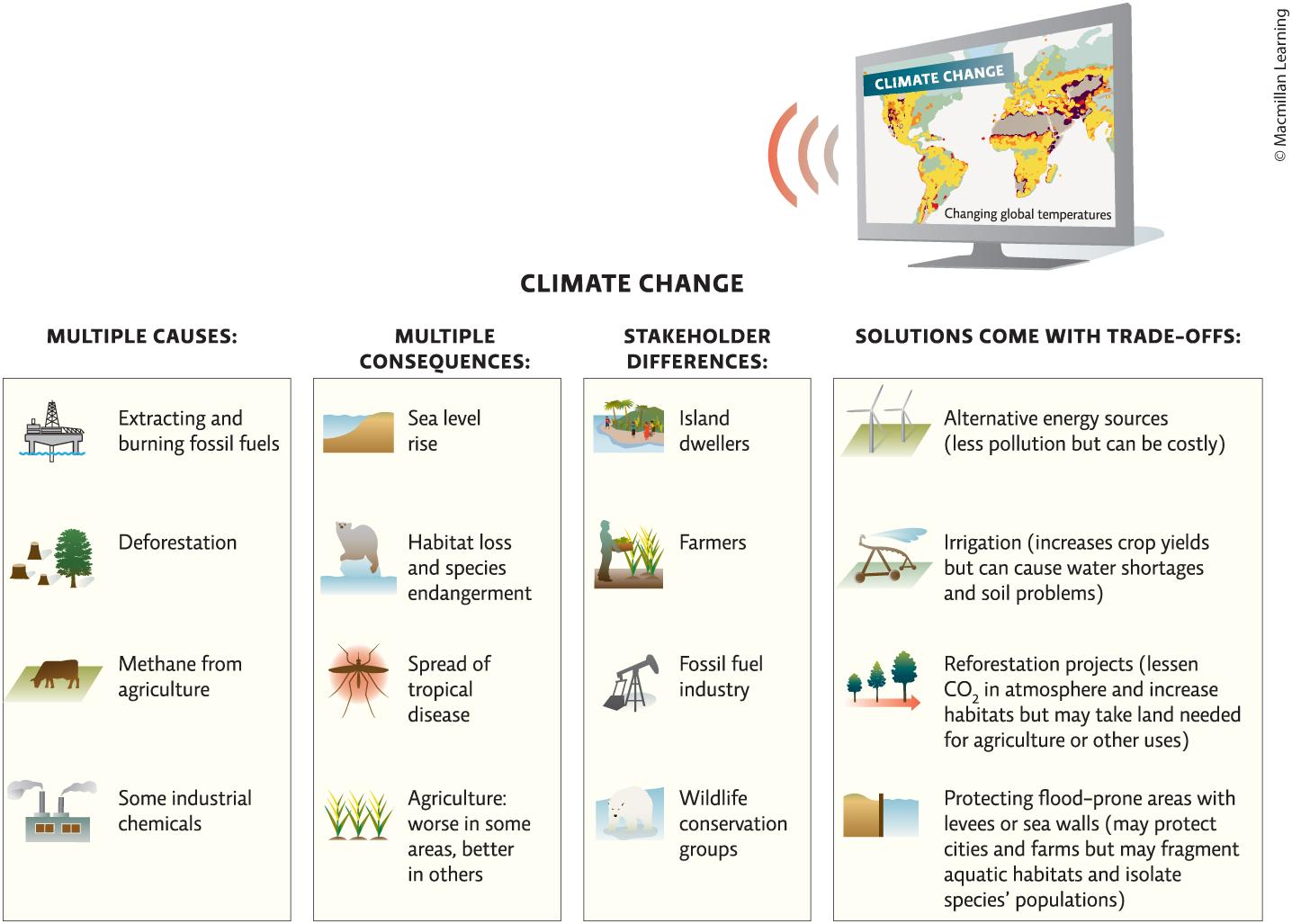
ANSWER: When deforestation is prevented, more carbon dioxide is taken out of the atmosphere, which helps to prevent global warming. Also, when habitats are kept intact, biodiversity is better protected in those areas not converted into agriculture. However, by adding use of tractors, fossil fuels need to be combusted, and this contributes to global warming. Chemicals added to crops will run off into water and soil. Added irrigation can cause water shortages and soil problems.
26. Refer to Infographic 3. What is the triple bottom line of climate change?
ANSWER: The triple bottom line includes the environmental, social, and economic impacts of our choices. In the instance of climate change, our choices, such as burning fossil fuels, deforestation, and overconsumption, have led to global warming. Some of the environmental impacts of these choices include increased average atmospheric temperature, sea level rise due to melting of polar ice caps, and habitat and species endangerment and loss. Some of the social impacts of our choices that have led to climate change are the suffering of agriculture in certain regions, the spread of tropical disease (which impacts socioeconomic factors when people are too sick to work or contribute to their societies or when the cost of treating the disease increases), human habitat destruction (such as mining, conversion of forest to farmland, and so on), and the development of political issues surrounding the causes of and potential solutions to climate change. Some of the economic impacts of climate change are decreased food production due to poor climate conditions and lack of water for farming; financial crises in some industries such as commercial fishing, since some species of fish can no longer survive in the warmer waters; and increased costs in food production and energy production.
27. What food source was absent from the animal bones found in the Greenland middens?
a. seal
b. caribou
c. walrus
d. cattle
e. fish
ANSWER: e
28. Some of the most revealing clues to the demise of the Greenland Vikings come from:
a. ice cores.
b. mud samples.
c. animal bones.
d. the Inuit.
e. the climate.
ANSWER: d
29. Which statement is NOT a goal of the UN 2030 Sustainable Development Agenda?
a. Develop more uses for fossil fuels.
b. End hunger and all forms of malnutrition.
c. Increase efficient use of water to reduce waste.
d. Prevent or significantly reduce ocean pollution.
e. Eliminate poverty.
ANSWER: a
30. Unlike the Icelandic Vikings or Inuit, the Greenland Viking society was not sustainable. Describe what we know about their collapse.
ANSWER: From ice cores, we know the climate cooled due to natural causes, and this made life difficult for the population in terms of growing food and raising livestock. In terms of self-inflicted environmental damage, evidence from mud cores indicates that soil erosion was a significant problem. This was due to overgrazing livestock (cows); using grassland to insulate Viking homes; and cutting down forests for fuel, homes, and other wooden products. These impacts on the environment were particularly severe because the environment was sensitive to begin with. As the population swelled to several thousand, the environment could no longer support the population and it crashed.
31. Why do scientists suggest that we have entered a new geologic time interval?
a. The Holocene is so long, it is time for a new interval on the Geological Time Scale.
b. The human population will be 11 billion in 2100.
c. Geologic evidence from humans is accumulating and will be found after we are gone.
d. Climate change from greenhouse gas–emitting fossil fuels is melting too much polar ice.
e. The previous natural climate cycle is ending.
ANSWER: c
32. What is the name of the new proposed geologic epoch that will come after the Holocene Epoch?
a. Miocene
b. Sapiencene
c. Human
d. Anthropocene
e. Cretaceous
ANSWER: d
33. How is anthropogenic climate change different from the climate change experienced by the Greenland Vikings?
a. It involves new chemical compounds.
b. It is caused by human actions.
c. It is a natural cycle Earth goes through.
d. It causes average atmospheric temperature to decrease.
e. It is caused by increased tectonic activity.
ANSWER: b
34. Which one of the following is NOT a result of the Great Acceleration?
a. a radioactive layer left from nuclear bomb fallout
b. greater biodiversity seen in plants and animals
c. the presence of conglomerate rocks that include natural sediments and plastics
d. industrial chemicals and sediments found in the Earth's crust
e. an increased presence of greenhouse gases in the atmosphere
ANSWER: b
35. What was the conclusion of the UN Millennium Ecosystem Assessment?
a. Human actions have no impact on the planet's ecosystems.
b. Human actions will impact the planet's ecosystems only in the far future.
c. Human actions are straining the ability of the planet's ecosystems to sustain the current generation.
d. The damage of human actions on the planet's ecosystems cannot be reversed.
e. Human actions are straining the ability of the planet's ecosystems to sustain future generations.
ANSWER: e
36. Which example illustrates a disconnect between our actions and their environmental consequences?
a. buying sustainably raised fish
b. leaving lights on and the air conditioning running when no one is home
c. driving an electric car
d. using sustainable farming practices
e. learning seasonal cycles of the area to respond accordingly
ANSWER: b
37. A new approach to evaluate how human actions were affecting the ability of the planet to sustainably support humanity is called:
a. the Planetary Boundaries framework.
b. the Earth Systems theory.
c. the Unsustainability vs. Sustainability framework.
d. the Anthropocene Epoch.
e. the Doppler Effect.
Name: Class: Date:
Module
ANSWER: a
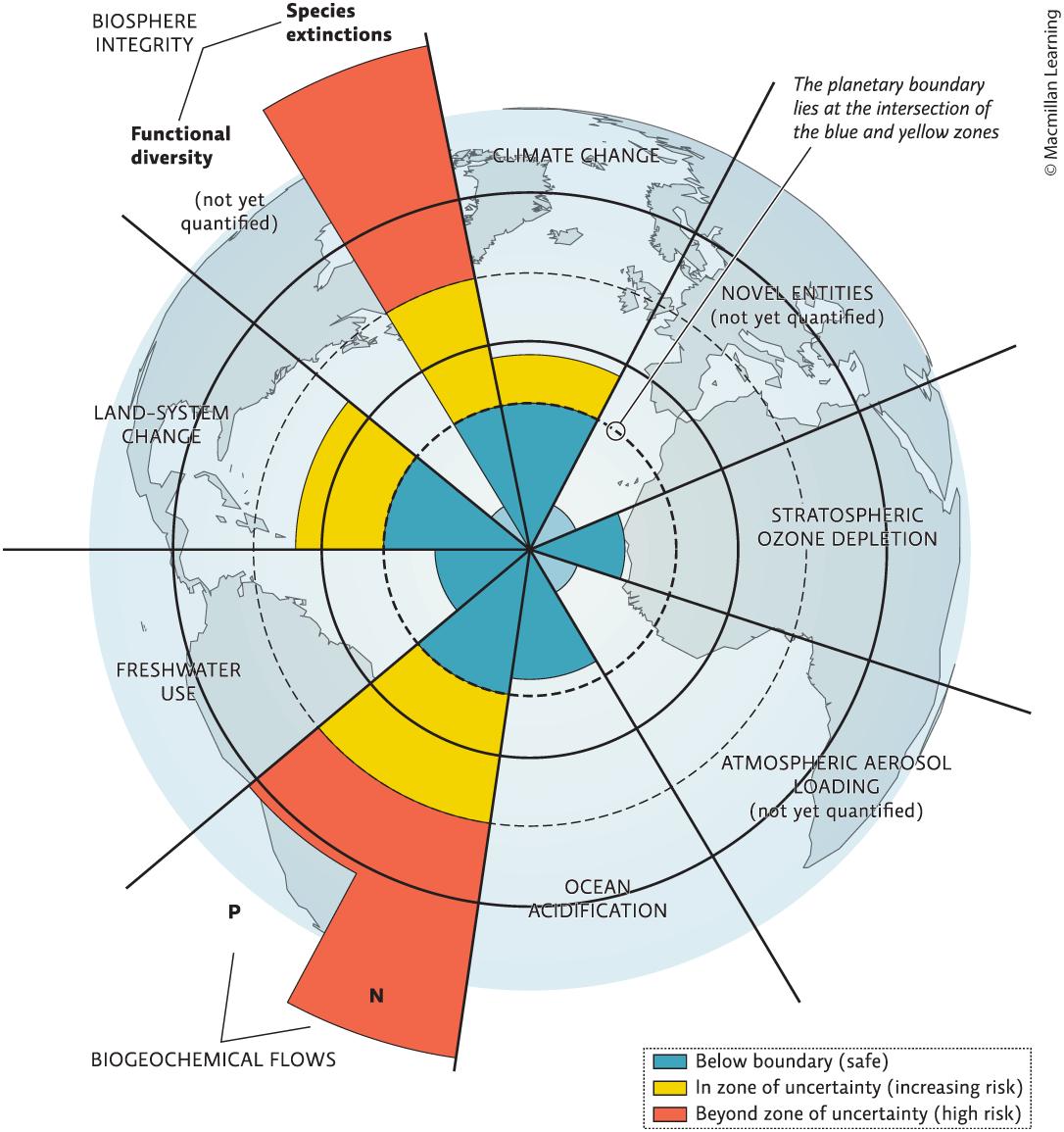
38. Considering Infographic 5B, which one of the following sectors of Earth systems is LEAST likely to be at its tipping point?
a. species extinctions
b. biogeochemical flows
c. land-system change
d. climate change
e. freshwater use
ANSWER: e
39. Considering Infographic 5B, which planetary boundaries are least likely to recover and why?
ANSWER: As indicated by the red areas that extend the farthest from the center of the chart in Infographic 5B, biosphere integrity and biogeochemical flows are beyond the zone of uncertainty, or high risk. Researchers have developed the Planetary Boundaries framework to identify levels of human impact that keep us within the safe operating zone for vital Earth processes. Values outside these quantitatively determined boundaries (e.g., atmospheric CO2 levels greater than 350 ppm) put us in a zone of uncertainty as to whether Earth's systems can recover from damage or continue to operate at needed levels. Beyond this zone of uncertainty, there is a greater possibility of unacceptable, and irreversible, environmental change that puts humans in jeopardy.
40. Which statement is NOT characteristic of a sustainable ecosystem?
a. It makes the most of renewable energy.
b. It recycles or reuses so nothing is wasted.
c. It keeps populations in check.
d. It depends on local biodiversity.
e. It is able to support an ever-increasing number of species.
ANSWER: e
41. Which statement describes the role of ecosystem services?
a. They are provided by using renewable energy.
b. They create higher biodiversity.
c. They make life on Earth possible.
d. They only recycle matter.
e. They occur as a result of sustainable human activity.
ANSWER: c
42. What does it mean for sustainable ecosystems to rely on renewable energy?
a. Population size is kept in check.
b. Energy that comes from an easily replenished source.
c. Energy can be recycled.
d. No new energy arrives on Earth.
e. Waste from one organism can be used by another.
ANSWER: b
43. Which factor does NOT provide population control in sustainable ecosystems?
a. disease
b. predators
c. competition
d. abundant food and water
ANSWER: d
44. The key to sustainability is:
a. using one source of energy at a time.
b. not using energy faster than it can be replenished.
c. generating energy on demand.
d. acquiring new energy resources.
e. not generating energy around the clock.
ANSWER: b
45. What does it mean to be sustainable, and what are four characteristics of a sustainable ecosystem?
ANSWER: Sustainable methods use resources in such a way that we can continue to use them indefinitely. A sustainable ecosystem (1) makes the most of renewable energy, (2) wastes nothing by recycling and reusing resources, (3) keeps populations in check so that resources are not overused, and (4) depends on local biodiversity to perform many of these tasks.
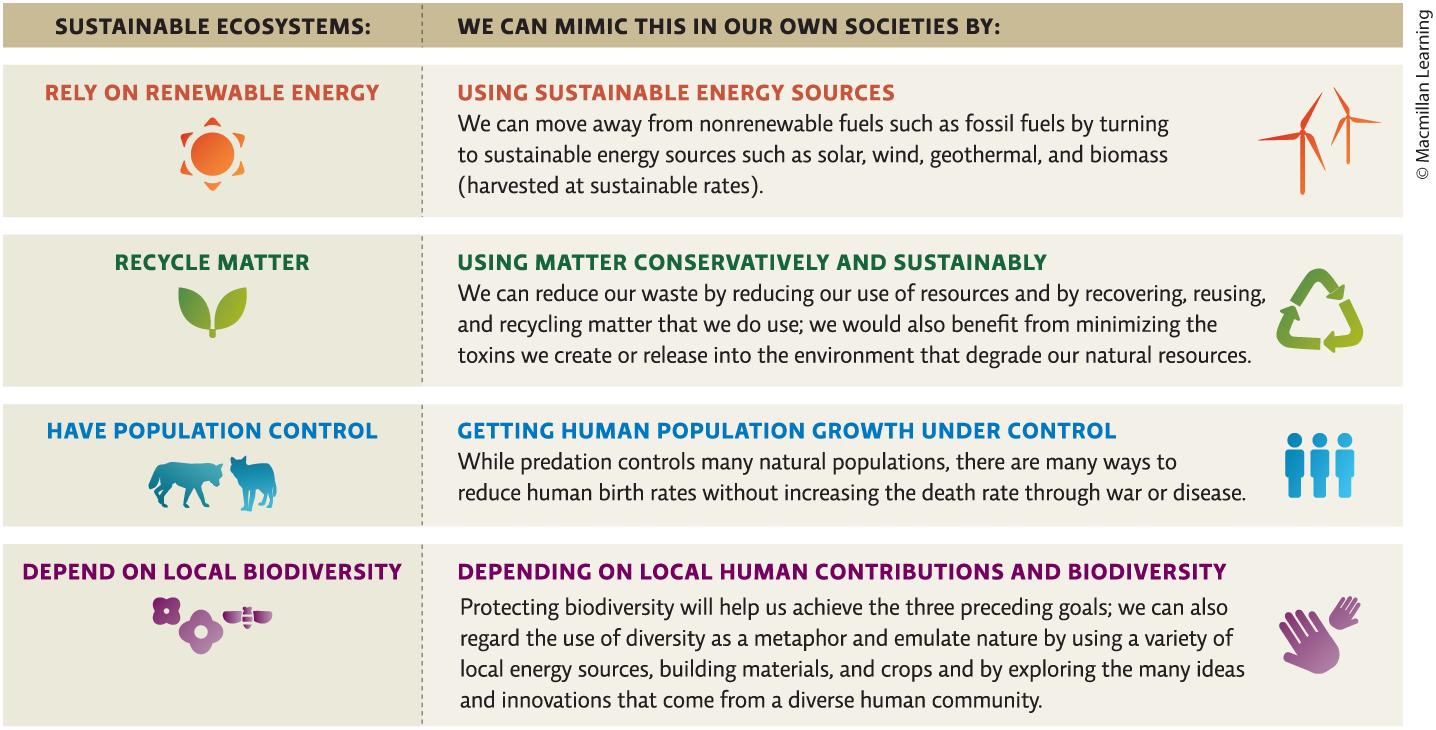
46. Is our modern society acting sustainably? What are some areas of concern? Refer Infographic 6 and compare and contrast a sustainable ecosystem to our current human ecosystem.
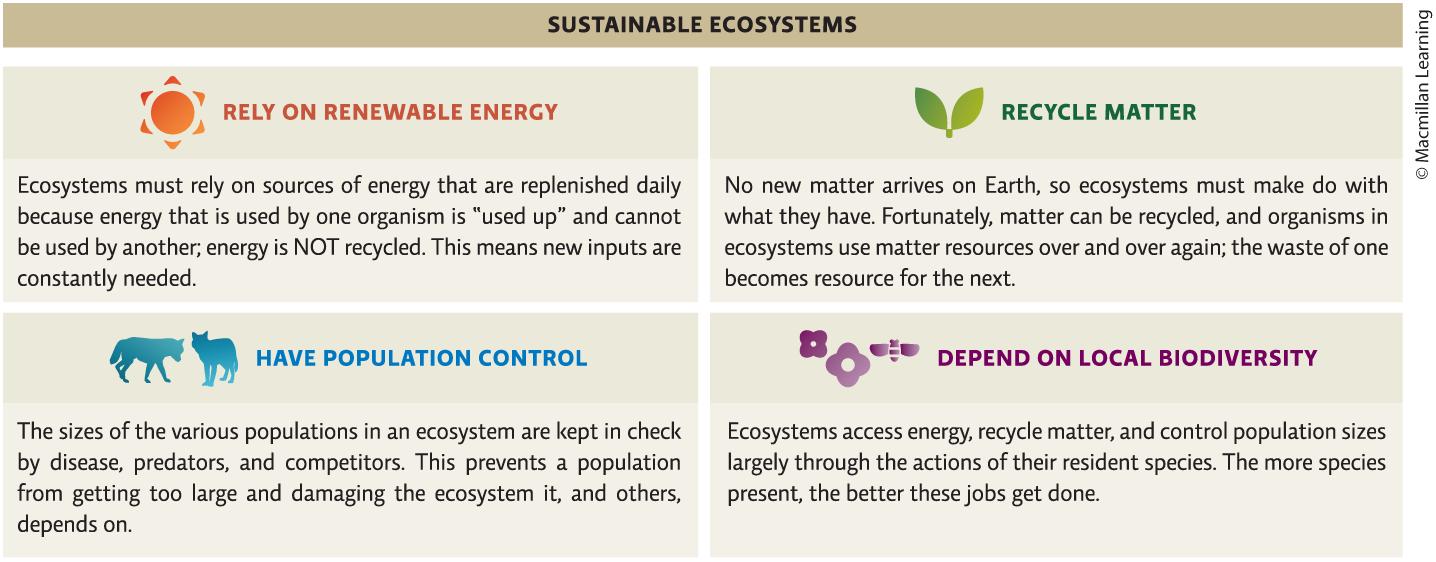
ANSWER: Experts claim that humans are already living beyond the means our planet has to support us, and if we continue along this path, a population crash could occur, similar to the collapse of the Greenland Vikings.
In our society, we do not use matter sustainably. We use farming practices that erode topsoil faster than it can form. We have overharvested forests at the expense of habitat and biodiversity loss, soil erosion, and water pollution. In a sustainable ecosystem, systems would be in place to prevent topsoil erosion and curb the overharvesting of forests. We would find ways to make our waste usable by other organisms in the environment, thus keeping with the idea that to use matter sustainably, it must be recycled.
We also do not depend on local biodiversity and have actually driven ecosystem biodiversity in some places to an alarmingly low level. We have overfished and overhunted and allowed invasive species to further degrade natural ecosystems, thus reducing biodiversity. In a sustainable ecosystem, the value of having a high biodiversity is seen, as it better prepares the ecosystem for weather disturbances. Biodiversity should be protected through regulations of hunting, fishing, and the introduction of invasive species.
Our human ecosystem certainly does not have population control, at least for humans. The population continues to grow exponentially, and our consumption of resources and generation of waste continue unabated. Although fraught with ethical issues, the population of humans currently living on Earth is not sustainable and is damaging almost every ecosystem. In a sustainable ecosystem, every population is kept in check so that resources are evenly distributed and shared.
We also do not rely on renewable energy. We depend largely on nonrenewable resources for energy, which has all sorts of implications for ecosystem health. If we continue to use only nonrenewable energy sources, we will eventually run out. In this process, we also damage ecosystems through pollution, habitat destruction, and many other negative actions. In a sustainable ecosystem, organisms must rely on inputs of energy that are renewable and sensitive to environmental effects.
47. Coal, natural gas, and oil are examples of:
a. renewable resources.
b. nonrenewable resources.
c. alternative forms of energy.
d. infinite resources.
e. unlimited resources.
ANSWER: b
48. Solar, wind, geothermal, and biomass energy sources are examples of:
a. nonrenewable energy.
b. finite energy.
c. renewable energy.
d. fossil fuels.
e. nonsustainable energy.
ANSWER: c
49. Which one of the following is an example of sustainability?
a. limiting commercial fishing to amounts that allow the fish population to repopulate
b. using solar panels to generate electricity
c. riding a bicycle to work
d. purchasing products in packaging that can be recycled
e. All of the choices are good examples of sustainability.
ANSWER: e
50. Which personal attitude will lead to the GREATEST long-term sustainability?
a. The forest is there for humans to use for things like lumber and recreation.
b. The lake will be able to handle the raw sewage because it always has.
c. It does not matter what we do because we do not have the power to change anything.
d. I wonder how using this product will affect the environment; maybe there's a better choice available.
e. Scientists will figure out a way to reduce the effects of pollution.
ANSWER: d
51. Refer to Infographic 7 and describe ways that you could live more sustainably.
ANSWER: One of the first things a person can do is become environmentally literate. This includes becoming informed about the issues but also learning to appreciate the natural areas near where you live. Small behavioral changes are important. Can you walk, bicycle, or take public transportation at least one day per week to go to school, work, or shopping? Shopping behavior can be changed bring your own shopping bags and question what you buy. Do an inventory of your trash. How many items were not necessary or could have been reused, recycled, or composted? Buy locally produced goods and foods. Do an inventory of your possessions. Donate or recycle unwanted items. Join a group by asking others: Are you interested in increasing the sustainability of your town? Do you like to go hiking? Are you interested in wildlife? Many small steps add up. Begin today and continue to add sustainable behaviors to your lifestyle.
52. How would you go about convincing a company to switch to renewable sources of energy?
ANSWER: There are a growing number of companies that are obtaining more of their energy from renewable sources of energy. You would need to explain how switching to renewable sources of energy will save money over the long term and also how the switch will result in less pollution and improved health for workers and the environment. You can also use your consumer dollars to send a message that it is profitable to use renewable energy because their consumers demand it.
53. Which situation BEST describes the tragedy of the commons?
a. A fisherman uses his net to catch a large quantity of fish.
b. Increasing amounts of pesticides need to be used over time to maintain the same effect on pests.
c. An oil pipeline running through a wildlife refuge has several leaks.
d. Sustainable forestry practices are applied to a plot of land in the rainforest.
e. Herders put too many sheep in a public field because they think, "If I don't use this available
resource, someone else will."
ANSWER: e
54. Which one of the following would be the BEST approach to managing a common resource like the oceans or atmosphere?
a. delegation
b. privatization
c. regulation
d. deregulation
e. fractionalization
ANSWER: c
55. How can the tragedy of the commons be applied to anthropogenic climate change?
ANSWER: No one entity owns the atmosphere. It is common to all countries. We combust fossil fuels and then greenhouse gases enter the atmosphere, where they trap heat and enhance the greenhouse effect. Unless regulations are enacted, each industry/nation will benefit from burning fossil fuels because it is in their own best interest. However, if everyone does this, the entire planet will suffer. This type of problem is difficult to solve because it is global and thus requires all nations to agree to reforms, without causing undue suffering to any particular participant.
56. You have been given the task of making the fishing industry more sustainable. How will you accomplish this task?
ANSWER: You will have to educate fishermen that the oceans can support only a certain catch size and that overfishing will make the industry unsustainable. By restricting catch size and the fishing season, you can make the industry sustainable and ensure abundant catches in future seasons. You will also need to address the international fishing industry and try to get governments to realize that the fishing industry is a global concern. All countries will need to protect the oceans to ensure the future of the fishing industry.
57. Which statement about environmental ethics is TRUE?
a. All people with environmental ethics recycle.
b. Environmental ethics have no control over how people resolve problems in the environment.
c. People with environmental ethics tend to have an anthropocentric worldview rather than a biocentric worldview.
d. Each person has a philosophy surrounding environmental ethics that influences his or her interactions with the natural environment.
e. Worldviews do not tend to influence people's environmental ethics.
ANSWER: d
58. Which statement is FALSE?
a. In a biocentric worldview, all life is valued.
b. An ecocentric worldview values the ecosystem as an intact whole.
c. An ecocentric worldview includes all of the organisms and nonliving processes that occur in an
Name: Class:
ecosystem.
d. In an anthropocentric worldview, human beings have an instrumental value.
e. An anthropocentric worldview places human lives and interests as the most important.
ANSWER: d
59. Which of the following choices is NOT an example of an anthropocentric worldview?
a. clear-cutting a forest to sell timber
b. testing a nuclear bomb
c. large commercial fishing ships processing tons of fish per day
d. purchasing a rice product stored in a recycled cardboard container instead of one stored in a plastic container
e. clearing land to build shopping malls
ANSWER: d
60. Which of the following is an example of a biocentric worldview?
a. catching a spider in your house and releasing it outside
b. exterminating all insects
c. viewing nature as existing only for us to use its resources
d. thinking the nitrogen and water cycles are as important as humans
e. believing animals exist to provide food for humans
ANSWER: a
61. What type of worldview did the Vikings have?
a. anthropocentric
b. biocentric
c. ecocentric
d. intrinsic
e. geologic
ANSWER: a
62. The window through which we view our world and existence is called our:
a. ethic.
b. value.
c. worldview.
d. ecoview.
ANSWER: c
63. If the Vikings had a worldview, they would have protected the forests and grasslands not just for the resources provided but also for the natural processes in those areas.
a. anthropocentric
b. biocentric
Module 01.1 Copyright Macmillan Learning. Powered by Cognero.
Name: Class: Date:
Module 01.1
c. ecocentric
d. intrinsic
ANSWER: c
64. The worldview that considers interactions between organisms and between living and nonliving components of a system is called:
a. ecocentric.
b. anthropocentric.
c. biocentric.
d. geocentric.
ANSWER: a
65. What is the difference between an anthropocentric worldview, a biocentric worldview, and an ecocentric worldview?
ANSWER: An anthropocentric worldview considers human life and interests as the most important. Environmental resources such as forests and other species are valued only for what they provide for humans. A biocentric worldview considers all organisms as having the right to exist, regardless of the benefit or harm to humans. A biocentric worldview values a mosquito as much as a dolphin. An ecocentric worldview values the living and nonliving components of an ecosystem as being equally important.
1. The first step of the scientific process is a(n):
a. prediction.
b. hypothesis.
c. experiment.
d. peer review.
e. observation.
ANSWER: e
2. A(n) is a possible explanation for what is observed that is based on some previous knowledge.
a. peer review
b. prediction
c. hypothesis
d. theory
e. anecdote
ANSWER: c
3. Which sequence lists the steps of the scientific process in the CORRECT order?
a. observe, create a testable prediction, form a hypothesis, experiment, support or refute the hypothesis
b. observe, form a hypothesis, create a testable prediction, experiment, support or refute the hypothesis
c. form a hypothesis, create a testable prediction, observe, experiment, support or refute the hypothesis
d. create a testable prediction, form a hypothesis, observe, experiment, support or refute the hypothesis
ANSWER: b
4. Which question can be solved with empirical evidence?
a. Do ghosts exist?
b. What is the meaning of life?
c. What is my cat thinking?
d. What causes the changing of the seasons?
e. Is the death penalty wrong?
ANSWER: d
5. What is TRUE regarding the following statements? (1) "Higher levels of greenhouse gases cause increased warming of the troposphere." (2) "People who are good go to heaven when they die."
a. Both statements are faulty.
b. Both statements have been proven true by long-standing scientific theories.
c. Only statement (1) is a scientific hypothesis testable by scientific methods.
d. Only statement (2) can generate falsifiable predictions.
e. Neither statement is suitable for science.
ANSWER: c
6. Which statement is NOT falsifiable?
a. Car exhaust contributes to ozone depletion.
b. Iced wings of a plane contribute to some plane crashes.
c. Dogs become tired when they are hungry.
d. People should not litter because it is wrong to do so.
e. All of these statements are falsifiable statements.
ANSWER: d
7. Which hypothesis is NOT testable?
a. The white fungus is causing death of bats.
b. Bacterial water pollution increases risk of infectious disease.
c. Increased salt intake leads to high blood pressure.
d. Reincarnation exists.
e. Increased UV exposure increases the risk of skin cancer.
ANSWER: d
8. Peer review is:
a. the process a scientist undergoes to analyze the results of the experiment.
b. a measure of how well the report is received by the general public.
c. a method for measuring the results of an experiment.
d. a panel of editors who proofread the report after it is accepted for publication.
e. a process by which a group of scientists in the field evaluate the report and determine if it is of high enough quality to publish in a journal.
ANSWER: e
9. Which factor ensures that only quality scientific studies that have been well controlled and avoid bias appear in scientific journals?
a. peer review
b. funding agencies
c. an independent variable
d. anecdotal evidence
e. the scientist responsible for the experiment
ANSWER: a
10. How does a peer-reviewed article differ from an Internet blog?
a. Both are equally analyzed and evaluated by scientists in the field prior to publication.
b. Any person can easily create and publish a peer-reviewed article.
c. A peer-reviewed article is likely to contain opinions that are not supported by data.
d. A blog must be written by a researcher and not a reporter.
e. The results of a study are evaluated by fellow scientists in a peer-reviewed article.
ANSWER: e
11. What criteria must be met for a hypothesis to be valid?
ANSWER: A valid hypothesis must be testable. It must be possible to create predictions from the hypothesis that we can objectively observe if we run a test. Predictions based on a hypothesis also must be falsifiable. It must be possible to refute them by evidence.
12. Is the following a valid hypothesis? Cancer patients who are prayed for will have better outcomes compared with patients with similar prognoses (likely outcomes) who are not prayed for.
ANSWER: Yes. Predictions from the hypothesis are testable and falsifiable.
13. Natural disasters around the world are a result of a supernatural deity punishing humanity for our actions. Is this hypothesis valid? Explain.
ANSWER: No. Predictions from the hypothesis are not testable, nor are they falsifiable.
14. Scientists use the scientific method to investigate the natural world. The scientific method is based on gathering empirical evidence. What is empirical evidence, and why are empirical data a hallmark of good science?
ANSWER: Empirical evidence is information gathered by means of observation of physical phenomena. The same data can be objectively observed by anyone in the same place (using the same equipment). Phenomena that are not objectively observable cannot be empirically studied and are therefore not under the purview of science.
15. Describe the importance of peer review to the scientific process.
ANSWER: Prior to publication in a scientific journal, a study is rigorously analyzed by peers in that scientific area, whose expertise can determine if the study is of acceptable quality. This type of review ensures only quality scientific reports (unbiased, well-controlled studies, etc.) appear in the scientific literature.
16. A(n) is a widely accepted explanation of a natural phenomenon that has been extensively and rigorously tested scientifically.
a. theory
b. fact
c. explanation
d. definition
e. proof
ANSWER: a
17. Which statement is FALSE regarding a scientific theory?
a. It can be modified over time as new information is discovered.
b. It is the result of a hypothesis being repeatedly supported by many lines of inquiry.
c. It has strong predictive powers that can explain observed phenomena.
d. It is an idea based only on observations.
e. It is a very well-supported hypothesis.
ANSWER: d
18. Cell theory states that all living organisms are made up of one or more cells, and these cells are the basic structure and function of living organisms and arise from preexisting cells. Which statement is FALSE regarding this theory?
a. All living organisms discovered so far have been made of one or more cells.
b. A newly discovered organism is very likely to be made out of one or more cells.
c. Cells are the basic units of structure for all known living organisms.
d. No living organism will ever be discovered that is not made out of cells.
e. One-celled organisms come from a previous cell.
ANSWER: d
19. Why can scientific opinions change over time?
a. All conclusions in science are considered tentative and open to revision.
b. Our understanding of a concept or process can change as scientists learn more.
c. New evidence may be used to overturn a prevailing conclusion.
d. All of these statements are true.
e. None of these statements is true.
ANSWER: d
20. The HIGHEST level of certainty a scientific explanation can attain is a(n):
a. observation.
b. inference.
c. hypothesis.
d. theory.
e. study.
ANSWER: d
21. What did the researchers suspect about the fungus that was affecting bats and its effect on the bats?
a. Hibernating bats were more susceptible to the fungus, since their body temperature was lower than normal and their immune system was suppressed.
b. Active bats were more susceptible to the fungus, since their body temperature was lower than normal and their immune system was suppressed.
c. Hibernating bats were more susceptible to the fungus, since their body temperature was higher than normal and their immune system was suppressed.
d. Active bats were more susceptible to the fungus, since their body temperature was higher than normal and their immune system was suppressed.
e. None of these reflects what researchers thought about the fungus and the bats.
ANSWER: a
22. Bats found with white-nose syndrome appeared to die because:
a. the fungal infection affected their wings and they could not fly, making them easy prey for other animals.
b. the fungal infection attacked the areas needed to maintain body temperature, so the bats froze to death.
c. the fungal infection caused them to wake more often and use up their fat reserves, so they died of starvation.
d. their immune system was suppressed, so they contracted other deadly infections.
e. their torpor became so deep they could not wake from their hibernation.
ANSWER: c
23. How would you respond to someone who says, "Evolution is just a theory"?
ANSWER: The word "theory" in casual usage means "an idea." In contrast, a "scientific theory" is a very wellsupported hypothesis with strong predictive powers. It is very likely not going to be refuted by additional studies.
24. In this chapter it has been made clear that the process used to obtain a body of knowledge (facts and explanations) is more important than the body of knowledge itself. Why is this?
ANSWER: Facts may change as additional information is collected through the scientific process. Consequently, it is important that the entire process be open-ended and that the investigators be open-minded to change.
25. Refer to Infographic 2. Explain why in science absolute proof is not required.
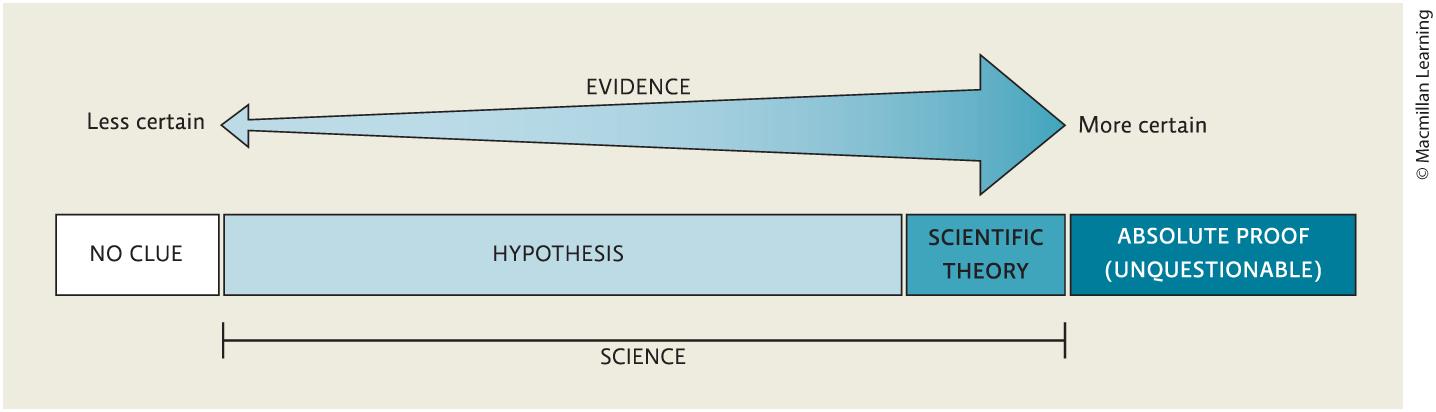
ANSWER: Since all scientific information is open to further investigation, it is not expected or required that there will be absolute proof in science.
26. Describe the difference between a hypothesis and a scientific theory.
ANSWER: A hypothesis is a possible explanation for what we have observed that is based on some previous knowledge. A scientific theory is a widely accepted explanation of a natural phenomenon that has been extensively and rigorously tested scientifically.
27. Why did scientists initially think bats with white-nose syndrome were dying?
ANSWER: During hibernation, the bats are in a state of reduced metabolism called torpor. To wake up, the bats
must use lots of energy. Scientists thought the fungal infection was causing the bats to wake up more often than usual, causing them to use more energy. This caused them to use their fat reserves up too soon, and since there were no insects to eat in the winter, the bats starved to death.
28. Which type of study manipulates a variable in a test group and compares the responses to a control group?
a. anecdotal
b. observational
c. experimental
d. inferential
e. natural ANSWER: c
29. Which type of experiment collects data in the real world, without manipulating the subject of study?
a. experimental
b. anecdotal
c. theoretical
d. observational
e. randomized
ANSWER: d
30. In an experimental study, what is TRUE about the independent variable?
a. It shows a response.
b. It is charted on the y-axis (vertical axis).
c. It is what you manipulate.
d. It is what you measure.
e. It is the same for both the control and experimental groups.
ANSWER: c
31. In an experimental study, what is TRUE about the dependent variable?
a. It is charted on the x-axis (horizontal axis).
b. It pertains only to the experimental group.
c. It is what you manipulate.
d. It is a measured response.
e. It is what can be changed to see if it produces an effect.
ANSWER: d
32. When data are shown in a graph, the independent variable should be plotted on the:
a. vertical axis.
b. x-axis.
c. response.
d. ordinate.
e. y-axis.
ANSWER: b
33. In the following example, what is the independent variable?
Hypothesis: Mice on a restricted low-caloric diet will live longer than mice that can eat as much as they want. Experiment: A large population of genetically identical mice is divided into two groups. Half receive as much food as they care to eat each day. The other half receive 20% less food than a typical mouse eats each day. The day of death (life span) is recorded for all mice. All mice live in the same room, in the same type of cage, with access to water.
a. amount of food available
b. volume of water available
c. genetically identical mice
d. happiness of each mouse
e. life span of each mouse
ANSWER: a
34. A researcher wants to know how effective a new suntan lotion is at preventing skin cancer caused by UV radiation. She uses mice as test subjects to model the effects on humans. Which statement describes the BEST control for this experiment?
a. Only mice in the control group are shaded during the experiment.
b. Mice in the test group receive twice as much UV radiation as those in the control group.
c. No suntan lotion is applied to mice in the control group; lotion is applied only to the test group.
d. Mice in the test group are from a genetic line that increases their susceptibility to UV radiation.
e. Mice in the control group are provided lotion in their drinking water to maximize effectiveness.
ANSWER: c
35. When conducting an experimental study, scientists manipulate the variable and measure the variable to see if it is affected.
a. dependent; independent
b. independent; dependent
c. observational; dependent
d. experimental; independent
e. observational; experimental
ANSWER: b
36. In an experiment examining the effect of the Pd fungus on the torpor of bats, the presence of Pd fungus would be the variable.
a. independent
b. dependent
c. non-independent
d. control
Name: Class: Date:
Module 01.2
e. extraneous ANSWER: a
37. The group in an experimental study that is manipulated such that it differs from the control group in only one way is the group.
a. confirmation
b. test
c. validation
d. placebo
e. independent ANSWER: b
38. Refer to Infographic 3. Which study depicted in the infographic provides stronger support for the stated hypothesis? Briefly explain why.
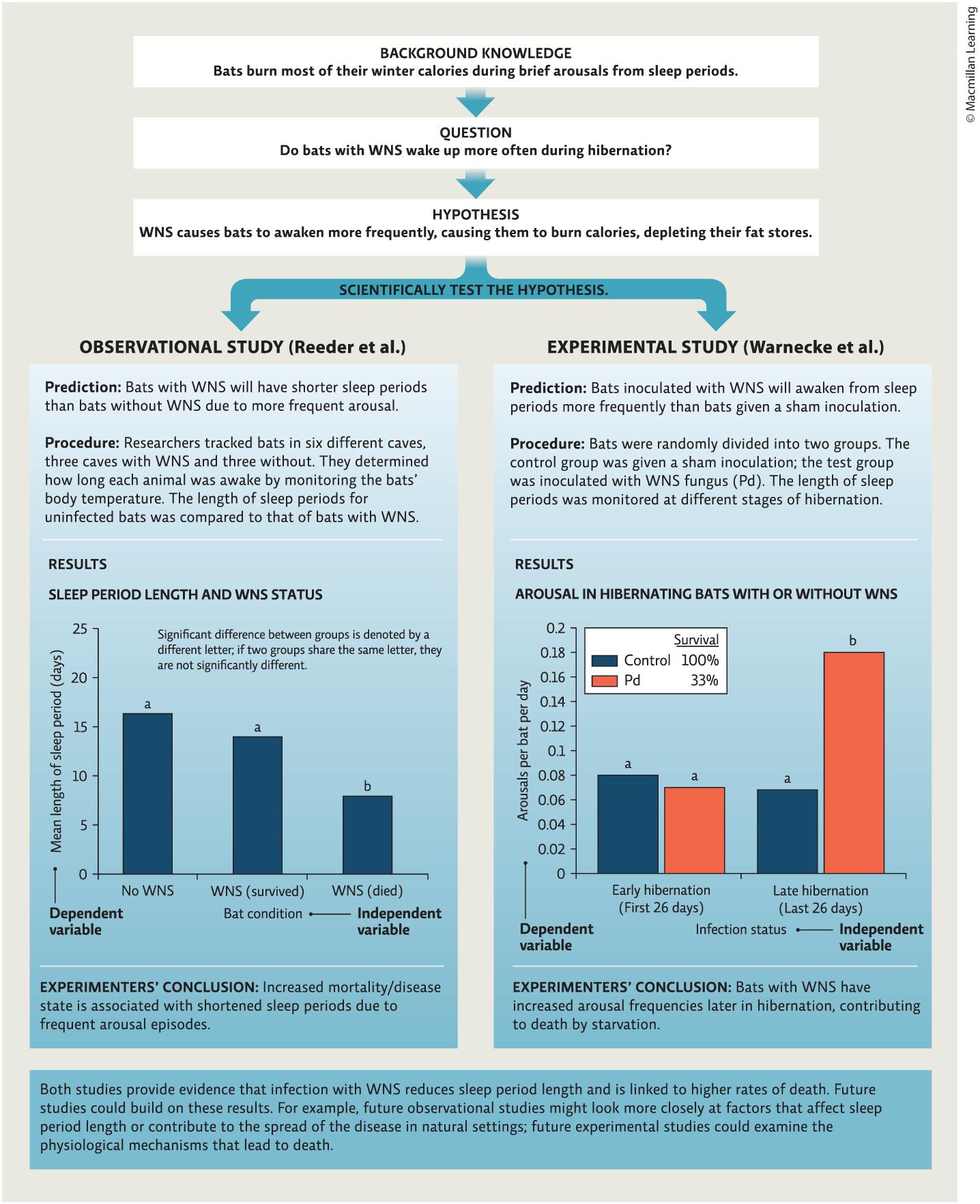
ANSWER: By manipulating the independent variable (infection status), the experimental study (Warnecke et al.) provides stronger support because it allows researchers to compare the response in the test group to the control group that was not exposed.
39. The health and lifestyle of 10,000 nurses are tracked for a period of 30 years. It is discovered that of the nurses who smoked cigarettes for at least 10 years, 35% had lung cancer. Is this an observational or an experimental study? Does this study demonstrate that cigarettes cause lung cancer?
ANSWER: This is an observational study which shows a correlation between smoking and lung cancer. It is not an experimental study, where variables can be directly manipulated. It would be unethical to directly test this cause-and-effect relationship using human subjects.
40. Explain the function of a control group in an experimental study.
ANSWER: A control group validates the experiment. The control group should be identical to the test group except for the independent variable. This allows conclusions to be drawn about the outcome by comparing the experimental group with the control group. Any differences are due to the independent variable.
41. Explain how scientists use probability to apply a level of certainty to their conclusions.
ANSWER: Scientists generally require a high level of certainty that their conclusions are correct. Once scientists collect data from their study (observational or experimental), they perform statistical analysis to calculate the probability that the variable being tested had any influence on the results. They determine if the results are statistically significant based on the differences between two groups being either a natural variation or genuine differences.
42. Refer to Infographic 3. In Warnecke et al., what is the independent variable? What is the dependent variable? List as many qualities as possible that should be the same between bats in the two groups (control and test groups). Ideally, what should be the only difference between the two groups of bats?
ANSWER: The independent variable is the infection status. The dependent variable is the arousals per bat per day. Bats in both groups should be handled the same way, and arousals should be measured the same way. The bats should be the same age and same sex, or there should at least be a balance across the groups, given the same diet, housed in the same conditions, and so on. The only difference between the groups should be the independent variable.
43. Refer to Infographic 3. In the observational study (Reeder et al.), explain why the bat condition is the independent variable and the mean torpor length is the dependent variable.
ANSWER: The bat condition is the independent variable because this is the variable in the experiment that is being compared by the investigator to see if it produces an effect. The mean torpor length is the dependent variable because this is what is measured to see if it changes due to the conditions of the experiment.
44. What type of studies can provide correlations?
a. experimental
b. variable
c. correlational
d. observational
e. demonstrative
ANSWER: d
45. What is a correlation?
a. when changing one variable affects a change in another variable
b. when two things occur together, but one does not necessarily cause the other to happen
c. a study where a variable is manipulated in one group to compare the response to another group
d. research that gathers data in a real-world setting without manipulating any variables
e. the mathematical evaluation of experimental data to determine likely differences due to an observed variable
ANSWER: b
46. What type of evidence shows that smoking causes lung cancer in humans?
a. cause-and-effect
b. experimental
c. correlational
d. statistical
e. hypothetical
ANSWER: c
47. In Warnecke's experimental study, fewer individual bats exposed to WNS fungus survived than did bats not exposed. This is an example of a(n):
a. correlation.
b. cause-and-effect relationship.
c. observation.
d. relationship.
e. variable.
ANSWER: b
48. A formalized plan that addresses a desired outcome of goal is a(n): a. policy.
b. treaty.
c. law.
d. correlation.
e. outcome.
ANSWER: a
49. What is TRUE about establishing environmental policy?
a. It is easy and straightforward to establish good environmental policy.
b. Stakeholders all agree on the same way to deal with an environmental issue.
c. Policies need to wait until we have all the data on an issue.
d. Policies must be flexible and adapt to new scientific findings.
e. Policies need to address only the environmental problem.
ANSWER: d
50. What is a correlation, and how does it differ from a cause-and-effect relationship? Give an example of each and note what type of study can provide that information.
ANSWER: In an observational study, data can provide a correlation between, for example, a bat colony being exposed to WNS and most bats in the colony dying shortly after. Both occur together, which suggests a cause-and-effect relationship. An experimental study, where variables can be directly manipulated and controlled, can be used to test a cause-and-effect relationship, for example, showing that exposure to WNS fungus decreased bat survival.
51. In terms of manipulating variables, what is the difference between an observational study and an experimental study? Which type of study can test cause-and-effect relationships?
ANSWER: In an observational study, data are gathered in a real-world setting, without intentionally manipulating any variable. This can lead to correlative conclusions. In an experimental study, the independent variable is manipulated by the researcher to evaluate a cause-and-effect relationship.
52. When it rains, you often notice people outside holding open umbrellas. You hypothesize that opening an umbrella causes rain to fall. What type of experiment can be used to test this? Explain what is meant by the phrase "correlation is not causation."
ANSWER: Although the appearance of rain and open umbrellas is correlated, it is not clear yet if one variable is causing the other to happen. We need an experimental study to test if rain is causing people to open umbrellas or if opening umbrellas causes rain to fall. "Correlation is not causation" means that just because two things happen at the same time does not mean that one is caused by the other.
53. Why is it difficult to establish policies to deal with environmental problems?
ANSWER: There are often conflicts between protecting the environment and serving the short-term interests of one societal group or another. Stakeholders often have differing needs, and policy makers must balance all these considerations while still protecting human populations and the environment.
54. The ability to distinguish between reliable and unreliable sources of information is called information: a. decoding.
Name: Class:
b. literacy.
c. reasoning.
d. deduction.
e. analysis.
ANSWER: b
55. Papers that are published in scientific journals are examples of sources.
a. primary
b. secondary
c. tertiary
d. review
e. report
ANSWER: a
56. Textbooks are examples of sources.
a. primary
b. secondary
c. tertiary
d. review
e. report
ANSWER: c
57. Blogs, websites, and news shows that provide additional commentary on reports from the popular press are considered sources.
a. primary
b. secondary
c. tertiary
d. review
e. report
ANSWER: c
58. Which type of source is the MOST likely to perpetuate errors that have previously appeared?
a. primary
b. secondary
c. tertiary
d. review
e. report
ANSWER: c
59. Which information source is peer reviewed?
Module 01.2 Copyright Macmillan Learning. Powered by Cognero.
a. primary
b. secondary
c. tertiary
d. review
e. report
ANSWER: a
60. Explain the differences between primary, secondary, and tertiary sources of information. Provide an example of each type.
ANSWER: Primary sources present new and original data or information, including novel scientific experiments and firsthand accounts of any given observation. An example would be a peer-reviewed journal article. Secondary sources come from reputable sources and present and interpret information from primary sources. An example would be a report from a scientific journalist on a recent research discovery. Tertiary sources are those that present and interpret information from secondary sources. Tertiary sources may be accurate; however, they may introduce errors because they do not rely on primary sources for facts. Many blogs, websites, and even news shows are examples.
61. What is information literacy, and why is it important in issues and topics related to public health and science?
ANSWER: Information literacy is the ability to distinguish between reliable and unreliable sources. It is the ability to find and evaluate the quality of information in order to be able to then draw reasonable, evidence-based conclusions about an issue or topic. It is especially important in issues related to public health and science, where misinformation or biased reports can create panic (or false security) in the public.
62. A student is assigned a research paper looking at the effects of CFCs on the ozone layer. The student gathers information by looking at blogs, websites, and news shows that summarize recent magazine and newspaper articles written on this topic. What type of information source is the student using, and what if any problems are associated with this type of source?
ANSWER: The student is using tertiary sources to investigate the effects of CFCs on the ozone layer. Tertiary sources may contain errors because they do not rely on original sources for facts. Tertiary sources may also perpetuate any errors that have appeared in secondary sources.
63. Jenny McCarthy has a son with autism, which she believes was directly caused by childhood vaccinations he received. She has drawn attention to this anecdotal evidence in numerous magazine and newspaper articles. Her appearance on the Oprah Winfrey Show caused parents across the nation to question whether they should immunize their children. In fact, several diseases that had been controlled in the United States have recently reappeared as more children now go unvaccinated. Meanwhile, no peer-reviewed scientific study to date has shown a correlation between the immunizations and autism. Your spouse recently asked you for your opinion as to whether or not your child should be vaccinated. Explain to him or her the difference between primary, secondary, and tertiary sources in this example and which should carry more weight in making an informed decision. What other information would you want to know in order to form an opinion?
ANSWER: Peer-reviewed scientific reports are primary sources of information. These reports are objective,
avoid bias, and should be used to make informed decisions. The public is often unaware of these studies because they are not readily available and often contain jargon that can be hard to understand. The public is more likely to form opinions based on secondary or tertiary sources (for example, magazine articles or television shows) that can be susceptible to bias and agendas that can obscure the actual information. These studies are therefore not ideal for making informed decisions. In forming an opinion on this matter, you might be interested in learning more about how studies were carried out (for example, how many people were included in the study and which vaccinations were tested).
64. Your uncle Barney goes with you to the gas station to fuel up your car. He strongly indicates his disapproval of ethanol-blended gasoline. His good friend used ethanol fuel once and it "killed his engine." He went on to add that his friend's fuel efficiency (miles per gallon) was at least 30% worse when using gasoline with the additive. Use critical thinking skills to assess Uncle Barney's input. What additional information do you need in order to decide which fuel to use in your vehicle?
ANSWER: The input from Barney is anecdotal. It is likely that something else may have been wrong with his friend's car, or it may have not been approved to use flex fuels. You should consult reliable sources to investigate if ethanol can be used in your fuel tank and what the expected mpg with or without ethanol blending is. You might also be interested in researching the level of emissions generated by your car with each fuel type. In addition, you might wish to consider how much energy was required to make the ethanol and if that is enough to offset potential benefits of burning a cleaner fuel.
65. Which factor is a component of a critical thinker's skill set?
a. being skeptical
b. evaluating the evidence
c. being open minded
d. watching out for biases
e. All of these answers are correct.
ANSWER: e
66. Which example is NOT a part of critical thinking?
a. logically assessing and reflecting on information
b. reaching one's own conclusion based on evidence
c. uncovering and rejecting logical fallacies in arguments or claims
d. refusing to believe anything
e. avoiding bias
ANSWER: d
67. Consumer groups called for a ban on BPA, a chemical known to be an endocrine disrupter, suggesting that financial interests from companies that profit from BPA-made products cause them to suppress data and discredit scientists whose studies show BPA to be harmful. Which common logical fallacy is at work here?
a. appeal to authority
b. false dichotomy
c. appeal to ignorance
Module 01.2
d. ad hominem attack
e. hasty generalization
ANSWER: d
68. Which common logical fallacy draws a broad conclusion based on too little evidence?
a. appeal to authority
b. false dichotomy
c. appeal to ignorance
d. ad hominem attack
e. hasty generalization
ANSWER: e
69. Which common logical fallacy presents extraneous information that does NOT directly support the claim but that might confuse the reader/listener?
a. red herring
b. false dichotomy
c. appeal to ignorance
d. ad hominem attack
e. hasty generalization
ANSWER: a
70. Which common logical fallacy is used when claiming there is no way to know the effect of lead, since humans are exposed to so many toxins; thus, we should do nothing about the use of lead?
a. red herring
b. false dichotomy
c. appeal to ignorance
d. ad hominem attack
e. hasty generalization
ANSWER: c
71. Which common logical fallacy is an argument that sets up an either/or choice that is NOT valid?
a. red herring
b. false dichotomy
c. appeal to ignorance
d. ad hominem attack
e. hasty generalization
ANSWER: b
72. The claims that a chemical either must be completely avoided or it is totally safe for everyone are which type of common logical fallacy?
a. hasty generalization
b. red herring
c. ad hominem attack
d. false dichotomy
e. appeal to ignorance
ANSWER: d
73. What did scientists find that could help treat WNS in bats?
a. a different fungus
b. an antibiotic
c. a bacterium
d. a vaccine
e. a virus
ANSWER: c
74. When we are presented with evidence that supports our current beliefs, we strengthen our beliefs. If evidence contradicts our beliefs, we dismiss it. This is called a:
a. belief bias.
b. confirmation bias.
c. validation belief.
d. contradiction belief.
e. scientific evidence.
ANSWER: b
75. Describe what it means to be a critical thinker. List four measures that should be included in a critical thinker's skill set.
ANSWER: Critical thinkers have skills that enable them to logically assess the information they find, reflect on that information, and reach their own conclusions. The relevant skills include being skeptical, evaluating the evidence, being open minded, and watching out for biases.
76. Refer to Infographic 6. Which logical fallacies listed in the figure are used to sway the reader in the following example? The proposed Keystone pipeline from Canada to refineries in the Gulf is not safe and should be opposed. The British Petroleum (BP) Deepwater Horizon oil spill wreaked havoc even while top oil executives made record-breaking profits.
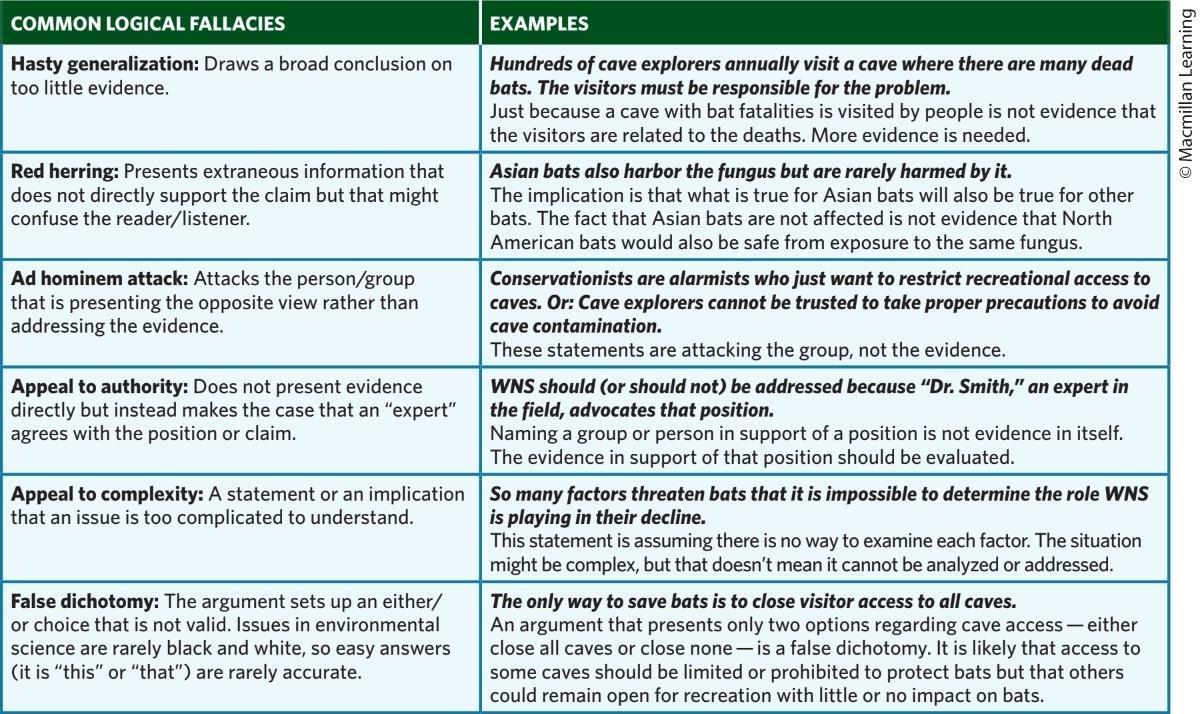
ANSWER: Red herring. Information regarding the offshore drilling oil spill does not tell us anything about the safety of the proposed pipeline, but it may confuse readers into thinking all oil projects must result in catastrophes. Ad hominem attack. The fact that oil executives made record profits may upset the reader, but it does not have anything to do with the safety of the project.
77. Refer to Infographic 6. Which logical fallacies listed in the figure are used to sway the reader in the following example? Marijuana should be the preferred treatment for glaucoma. It is effective and safe, as it is a naturally occurring plant. The only reason it is not used more is government opposition.
ANSWER: False dichotomy. It omits data that other treatments (eye drops) work just as well or better without the side effects. Hasty generalization. Some naturally occurring plants can be harmful. Ad hominem attack. Government opposition to legalization does not inform the reader as to whether the product is safe or effective.
78. Refer to Infographic 6. Which logical fallacies listed in the figure are used to sway the reader in the following example? Genetically modified (GM) foods do not pose a safety concern and should not be labeled. We would need to label the majority of food products available today, since most already contain GM products. By including GM crops in agriculture, we have been able to greatly increase yields and feed more people. If GM foods were dangerous, we would have seen the effects already in the population.
ANSWER: Red herring. The fact that it would be overwhelming to label all GM products does not have anything to do with safety. Ad hominem attack against regulators. False dichotomy. It is not an either/or choice to have GM foods or not have food security. Hasty generalization. Not enough time has passed to know if GM foods have longer-term effects. Appeal to ignorance. GM foods are already in so many food items and there are so many chemicals in our environment that we are not capable of understanding such a big situation.
79. A lobbyist for the oil and gas industry points out that as the global temperature rises, the level of carbon dioxide increases in the atmosphere; he shows you ice-core evidence of this occurring after an ice age. He goes on to say that since rising temperatures lead to increased levels of carbon dioxide, and not vice versa, we shouldn't worry about current rising levels of carbon dioxide because it shouldn't affect temperature in the future. As a critical thinker, what do you notice here?
ANSWER: Watch out for biases. A lobbyist for the oil and gas industry wants to promote the sale and combustion of fossil fuels such as oil and coal. Caps on carbon dioxide emissions would harm the industry; there could be an agenda here. Let's also evaluate the evidence. It is true that an increase in temperature causes an increase in carbon dioxide, but there is an important omission of data. An increase in carbon dioxide also leads to an increase in temperature (the greenhouse effect). This is a false dichotomy (argument sets up an either/or choice that is not valid). The relationship between temperature and carbon dioxide is complicated, and it works both ways.
80. What are some approaches used to protect bats from WNS?
ANSWER: The Pd fungus is very sensitive to UV radiation, so researchers are testing its effectiveness as a possible treatment. Scientists have conducted experimental tests of a vaccine to WNS, and the results are encouraging, with 88% of vaccinated bats surviving versus only 30% of unvaccinated bats. There is also a bacterium being tested to see if it can reduce the amount of fungus growing on bats. Cave visitors should decontaminate clothing after leaving caves. Education about the
ecological role of bats can help dispel myths.