Test Bank for Quantitative Chemical Analysis 11th Edition by Harris, Lucy
ISBN: 9781319487706
Chapter 01: Chemical Measurements
1. Which constant is NOT used to define the fundamental SI units?
a. Avogadro’s number
b. speed of light in vacuum
c. elementary charge
d. Planck’s constant
e. π
ANSWER: e
2. Which of the following is NOT a fundamental SI unit of a quantity?
a. second (s)
b. meter (m)
c. gram (g)
d. ampere (A)
e. mole (mol)
ANSWER: c
3. A satellite in low Earth orbit with a circular orbit has an orbital speed of 7.3 km/s relative to the Earth’s surface. Calculate the satellite’s speed in miles per hour. (1 mi = 1.609 km)
a. 1.6 × 10⁴ mi/h
b. 1.3 × 10⁻³ mi/h
c. 4.2 × 10⁴ mi/h
d. 3.3 × 10⁻³ mi/h
e. 3.1 × 10² mi/h
ANSWER: a
4. The planet Mars orbits 2.279 1011 m from the Sun. Express the distance using the appropriate prefix.
a. 227.9 Gm
b. 227.9 mM
c. 2.279 km
d. 22.79 nm
e. None of these is correct.
ANSWER: a
5. The calorie content of a candy bar is 230. Calories per serving (1 bar). Calculate the specific energy (kJ/g) of the candy bar. (1 candy bar = 52.7 g, 1 Calorie = 1 000 calories, 1 calorie = 4.184 J)
a. 2.90 × 10³ kJ/g
b. 18.3 kJ/g
c. 1.83 × 10⁻² kJ/g
d. 5.07 × 10⁴ kJ/g
Chapter 01: Chemical Measurements
e. 9.59 × 10⁻¹ kJ/g
ANSWER: b
6. The gas mileage for a new car model destined for sale in Europe must be determined for regulatory and promotional purposes. If the car uses 10.5 gallons to travel 250. miles, what is the gas mileage in km/L? (1 mi = 1.609 km, 1 gal = 3.785 L)
a. 174 km/L
b. 3.25 km/L
c. 67.3 km/L
d. 14.9 km/L
e. 10.1 km/L
ANSWER: e
7. Calculate the mass of NaCH3CO2 contained in 500.0 mL of a 0.150 0 M NaCH3CO2 solution. (NaCH3CO2 = 82.034 3 g/mol)
a. 914.3 µg
b. 283.4 g
c. 24.61 µg
d. 6.153 g
e. 24.61 g
ANSWER: d
8. Which statements are TRUE regarding the expression of the concentration of a 54.9-ppm Fe solution in terms of molarity?
I. The molar mass of iron is needed to calculate the moles of iron in solution.
II. The density of iron is needed to calculate the mass of iron in solution.
III. The solution density is needed to calculate the solution volume.
IV. The type of glassware used to prepare the solution must be known.
a. I, III, and IV
b. I and II
c. I and III
d. II and III
e. None of these statements is true.
ANSWER: c
9. Calculate the molarity of a 30.0 cg/g hydrogen peroxide (H2O2, FM 34.014 7) solution. The density of 30 cg/g hydrogen peroxide is 1.135 g/cm3
a. 7.77 M
b. 0.0100 M
c. 0.100 M
Chapter 01: Chemical Measurements
d. 10.0 M
e. 8.82 M
ANSWER: d
10. Arrange the molecular views of four different solutions in order of increasing concentration. Diamond shapes represent solute particles, and circle shapes represent solvent particles.
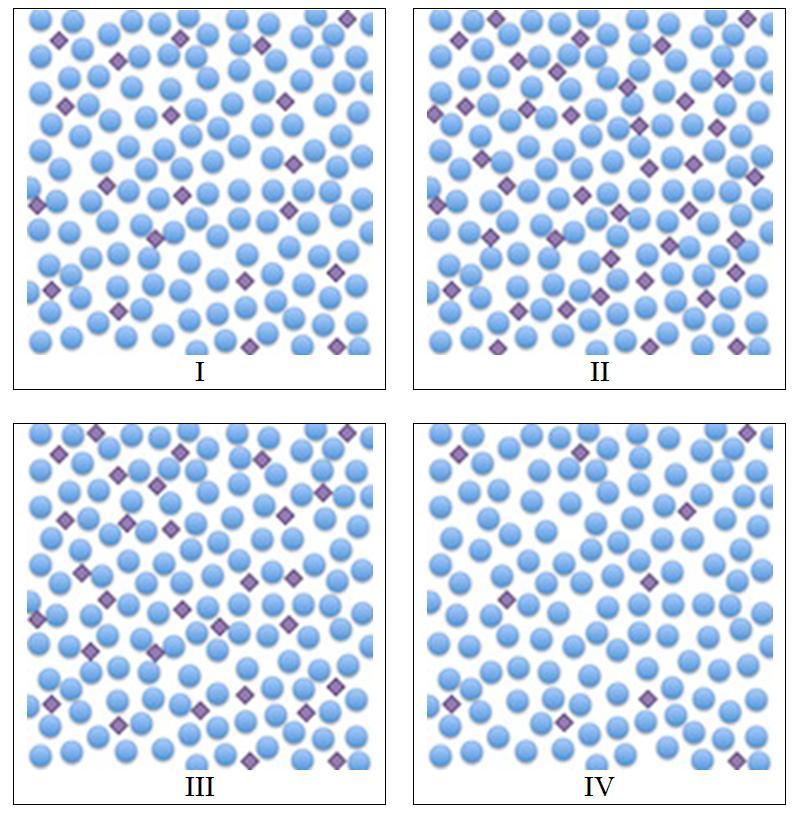
a. I < II < III < IV
b. II < III < I < IV
c. IV < II < III < I
d. IV < I < III < II
e. III < IV < II < I
ANSWER: d
11. Calculate the molarity of a 2.0-ppm Mg2+ solution.
a. 8.2 × 10⁻⁵ M
b. 8.2 × 10⁻² M
Chapter 01: Chemical Measurements
c. 1.2 × 10⁻² M
d. 1.2 × 10⁻⁵ M
e. 4.9 × 10⁻² M
ANSWER: a
12. Calculate the mass of Na2CO3 (FM 105.988 8) needed to prepare a 15.00 mM solution with a volume of 500.0 mL.
a. 1.258 g
b. 3.180 g
c. 0.794 9 g
d. 7.076 g
e. 0.014 1 g
ANSWER: c
13. What volume of 12.1 M HCl must be diluted to prepare a 0.250 0 M HCl solution with a volume of 2.000 L?
a. 41.3 mL
b. 96.8 mL
c. 10.3 mL
d. 24.2 mL
e. 6.05 mL
ANSWER: a
14. What volume of a 36.0 cg/g HCl (FM 36.458) solution must be diluted to prepare 1.000 L of a 0.100 0 M HCl solution? The density of 36.0 cg/g HCl is 1.18 g/mL.
a. 11.7 mL
b. 8.58 mL
c. 1.20 mL
d. 10.1 mL
e. 64.6 mL
ANSWER: b
15. How many grams of CaCO3 (FM 100.086) are needed to prepare 150.0 mL of an 80.0-ppm Ca2+ solution?
a. 0.012 0 g
b. 0.030 0 g
c. 1.875 g
d. 0.533 g
e. 29.9 g
ANSWER: b
Name: Class: Date:
Chapter 01: Chemical Measurements
16. A student needs to prepare 500.0 mL of a solution containing 0.999 g of solid copper(II) sulfate. Which of the statements regarding the proper procedure to prepare this solution are FALSE?
I. The 0.999 g of solid copper(II) sulfate is added to a 500.0-mL volumetric flask containing 500.0 mL of distilled water.
II. The 0.999 g of solid copper(II) sulfate is added to a 500.0-mL volumetric flask containing approximately 400 mL of distilled water before dilution to 500.0 mL.
III. The 0.999 g of solid copper(II) sulfate is placed in an empty 500.0-mL volumetric flask, diluted to 500.0 mL with distilled water, and allowed to dissolve.
a. I and II
b. II and III
c. I and III
d. I, II, and III
e. None of the statements is false.
ANSWER: c
17. The sulfur content of an ore is determined gravimetrically by reacting the ore with concentrated nitric acid and potassium chlorate, which converts all of the sulfur to sulfate. The excess nitrate and chlorate is removed by reaction with concentrated hydrochloric acid, and the sulfate is precipitated using Ba2+
Ba2+(aq) + (aq) → BaSO4(s)

Analysis of 10.183 0 g of a sulfur-containing ore yielded 13.022 1 g of BaSO4 (FM 233.43). What is the percent by mass (cg/g) sulfur in the ore?
a. 32.18 cg/g
b. 52.63 cg/g
c. 10.74 cg/g
d. 17.56 cg/g
e. The answer cannot be calculated with available data.
ANSWER: d

18. When solutions of Pb2+ and are mixed, the precipitate PbCrO4 is produced. What volume of 0.175 0 M CrO4 2− removes all Pb2+ from 50.00 mL of a 0.340 0 M Pb2+ solution?
a. 97.14 mL
b. 25.74 mL
c. 48.57 mL
d. 194.3 mL
e. 75.00 mL
ANSWER: a
19. A mixture of 50.00 g propane (C3H8, FM 44.10) and 100.00 g oxygen (O2, FM 31.998) is combusted to form carbon dioxide and water. is the limiting reactant, and of _________is in excess.
Chapter 01: Chemical Measurements
C3H8(g) + 5O2(g) → 3CO2 (g) + 4H2O (g)
a. Propane; 22.44 g; oxygen
b. Oxygen; 63.71 g; propane
c. Oxygen; 22.42 g; propane
d. Propane; 27.44 g; oxygen
e. None of these answers is correct.
ANSWER: c
20. Which of the following statement(s) is/are TRUE regarding the properties of the limiting reagent in a chemical reaction?
I. The limiting reagent in a chemical reaction is the one that is consumed first.
II. Once the limiting reagent in a chemical reaction is gone, the reaction ceases.
III. The limiting reagent in a chemical reaction is the one that has the least mass.
a. I
b. II
c. III
d. I and II
e. I, II, and III
ANSWER: d
21. On average, one gallon of kerosene contains 135 000 BTU of heat energy per gallon combusted. Convert the energy content of kerosene to SI units. (1 BTU = 1 055 J, 1 gal = 3.785 L)
ANSWER: 3.76 × 10⁷ J/L or 37.6 MJ/L
22. Tidal volume is the amount of air breathed in with each normal breath. The average tidal volume is 0.50 L, and the average breathing rate is 12 breaths/min. Calculate the total volume (in m 3) of air a person breathes in one hour.
ANSWER: 0.36 m 3/h
23. An NaCl (FM 58.44) solution has a concentration of 33.5 cg/g and a density of 1.049 2 g/mL. What is the molarity of the solution?
ANSWER: 6.01 M
24. Find the molarity and molality of a 44.0 cg/g H2SO4 (FM 98.079) solution with a density of 1.338 g/mL.
ANSWER: 6.00 M; 6.80 m
25. The maximum contaminant level for arsenic is 0.010 ppm for drinking water per EPA regulation. The arsenic concentration for the drinking water of a municipality was measured to be 4.92 x 10⁻⁶ M arsenic. What is the arsenic concentration of the water sample in ppm? Does the water sample meet EPA guidelines? Assume the drinking water sample has a density of 1.000 0 g/mL.
ANSWER: 0.369 ppm; exceeds EPA regulation
Chapter 01: Chemical Measurements
26. What volume of a 50.0 cg/g NaOH (FM 40.00) solution is needed to prepare a 0.350 0 M NaOH solution with a volume of 500. mL? The density of 50 cg/g NaOH solution is 1.515 g/mL at 25°C.
ANSWER: 9.24 mL
27. What volume of a 25.0 mM Li+ solution is needed to prepare 100.0 mL of a 10.0 ppm Li+ solution?
ANSWER: 5.76 mL

28. The recommended daily allowance of calcium for men between the ages of 19 and 50 is 1000 mg Ca. Three multivitamin tablets are analyzed for calcium gravimetrically with the precipitation of Ca2+ by the oxalate ion, If the mass dry calcium oxalate (FM 128.097) obtained is 2.013 6 g, how many tablets must a man take in a given day to meet the recommended daily allowance?
Ca2+(aq) + (aq) → CaC2O4(s)
ANSWER: 0.210 00 g Ca per tablet; 5 vitamin tablets
29. Lead(II) carbonate precipitates when aqueous lead(II) is mixed with aqueous carbonate.
Pb2+(aq) + (aq) → PbCO3(s)

If 5.000 g Pb(NO3)2 (FM 331.2) and 2.500 g Na2CO3 (FM 105.988 8) are mixed in water, which ion is the limiting reactant? What mass of PbCO3 (FM 267.21) is precipitated?
ANSWER: Pb2+ is the limiting reactant and 4.035 g PbCO3 is precipitated.
30. A 15.3-g sample of an organic compound is completely combusted in air, producing 21.0 g CO2 and 8.61 g H2O. What is the weight percent of C in the organic compound?
ANSWER: 37.5 cg/g