Solutions Manual for Principles of Talent Development v1 1st Edition by Crews
ISBN: 9781453397091
COPYRIGHT PAGE
Published by:
© 2024 by FlatWorld. All rights reserved. Your use of this work is subject to the License Agreement available here http://www.flatworldknowledge.com/legal. No part of this work may be used, modified, or reproduced in any form or by any means except as expressly permitted under the License Agreement.
Chapter 1
Talent Development: Impact and Emerging Issues
Chapter Learning Objectives
Explain the scope of talent development and the impact upon organizations.
Recognize the issues and changing trends that impact workplace talent development.
Describe the influence of business strategy and organizational competitiveness on workplace talent development.
Identify the various steps in the talent development process.
Discuss the career options available in talent development and the competencies necessary for these roles.
Chapter Overview
Before learning the principles of talent development, students should understand the environment and context in which workplace learning occurs. Talent development plays a major role in the competitiveness of individuals, organizations, regions, and societies.
The talent development industry is influenced by a rapid pace of change in factors such as demographics, diversity, globalization, and technology. This chapter provides students with an overview of these factors and introduces them to the different approaches and models that are used for content development and delivery, which then will help them to understand the organization of the textbook. The chapter closes with a discussion of career options in talent development.
Section 1.1 Banking on Talent Development
Although there are many ways Bank of America has maintained its success, the true contributor is through the investment they make by providing employees with proper training and developmental opportunities.
The Academy is Bank of America’s voluntary three-level training program for employees who interact with customers and managers.
The three levels include new-to-role, in-role development, and mastery.
Case Discussion Questions
1. Why should employers, such as Bank of America, invest so much time and expense in their employees’ training and development?
Possible response: This question can be used to introduce the impact of talent development on organizations.
2. What are some ways that a company measures the success of its training and developmental programs?
Possible response: Students might comment on the cost of disengagement as mentioned in the case and suggest that engaged employees lead to higher profits. This would be correct, but the question is also an excellent way to introduce the chapter section on evaluating learning impact.
3. What other factors or opportunities can contribute to employee engagement?
Possible response: This question will encourage students to think about the connection between talent development and employee engagement.
Section 1.2 Introduction to Talent Development
Explain the difference between training and development.
Describe the impact and benefits of talent development for organizations and individuals.
Recognize the scope of talent development and how it relates to the employee life cycle.
Section Outline
What Is Talent Development?
Talent development is the strategic process of developing the knowledge, skills, abilities, and other characteristics of employees, often collectively referred to as KSAOs
o Knowledge is the state of having a correct idea or understanding of something or the possession of information about something.
o Skill is the capability of accomplishing something with precision and certainty. It refers to practical application of theoretical knowledge. Skills can also be distinguished among three categories: basic, advanced, and expert.
o An ability is a quality in a person or thing that makes an action possible.
Technology has changed the delivery modality of training (e.g., remote learning through computers, tablets, or smartphones), offering access to learners at their times and places of convenience.
What remains constant are training principles, such as needs assessment, transfer of training, and outcomes evaluation.
Training refers to the process of learning the skills necessary to perform a particular job or activity more effectively.
Development refers to learning experiences designed to prepare employees for different and expanded roles in the organization.
The
Impact of Talent Development on Organizations
Talent development plays a major role in the competitiveness of individuals, organizations, regions, and societies.
Gallup found that organizations that have made a strategic investment in employee development report 11 percent greater profitability and are twice as likely to retain their employees.
Turnover refers to individuals who leave the company and are replaced. It includes voluntary (individuals who quit their jobs) and involuntary (individuals who are fired) turnover.
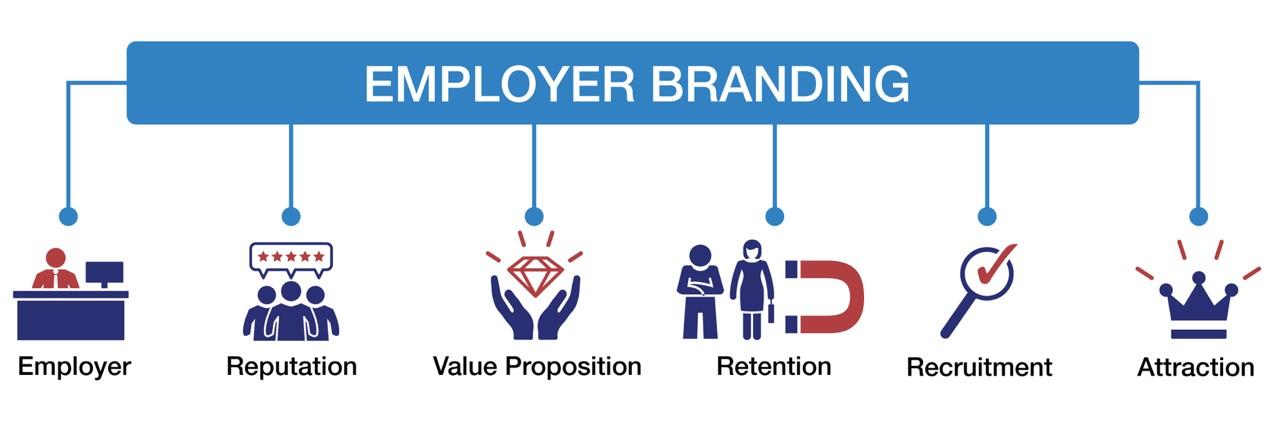
The employer brand describes an employer’s reputation as a place to work.
Just as a brand reputation is a potential customer’s opinion about the value of the products or services of the company, the employer brand represents the opinions that potential new hires (and existing employees) have of the firm.
From the individual perspective, jobs are more motivating when employees have the opportunity to develop their KSAOs. One method by which this occurs is job enrichment.
o Job enrichment is the process of increasing job satisfaction by adding more meaningful tasks and giving employees more responsibility and autonomy.
Herzberg divided job aspects into two categories:
o Hygiene factors. Job aspects such as a decent salary, safe working conditions, and job security, which can lead to job dissatisfaction when inadequate.
o Motivating factors. Job aspects such as the meaningfulness of tasks, recognition, learning and growth, promotion opportunities, sense of achievement, and responsibility, which can lead to job satisfaction.
Employee engagement is the emotional and attitudinal commitment employees have to the organization and its goals, which influences their behaviors and level of effort in work activities.
Engaged employees are motivated to exert more effort to do whatever it takes to achieve high levels of performance.
Discretionary effort is the difference between the level of activity one is capable of bringing to a work task and the minimum level required.
From the individual perspective, jobs are more motivating when employees have the opportunity to develop their KSAOs. One method by which this occurs is job enrichment.
The Scope of Talent Development
Talent development is much more than a department within a company or a function within the human resources (HR) department that is called upon whenever there is a new training need.
One way to comprehend the scope is through the employee life cycle concept.
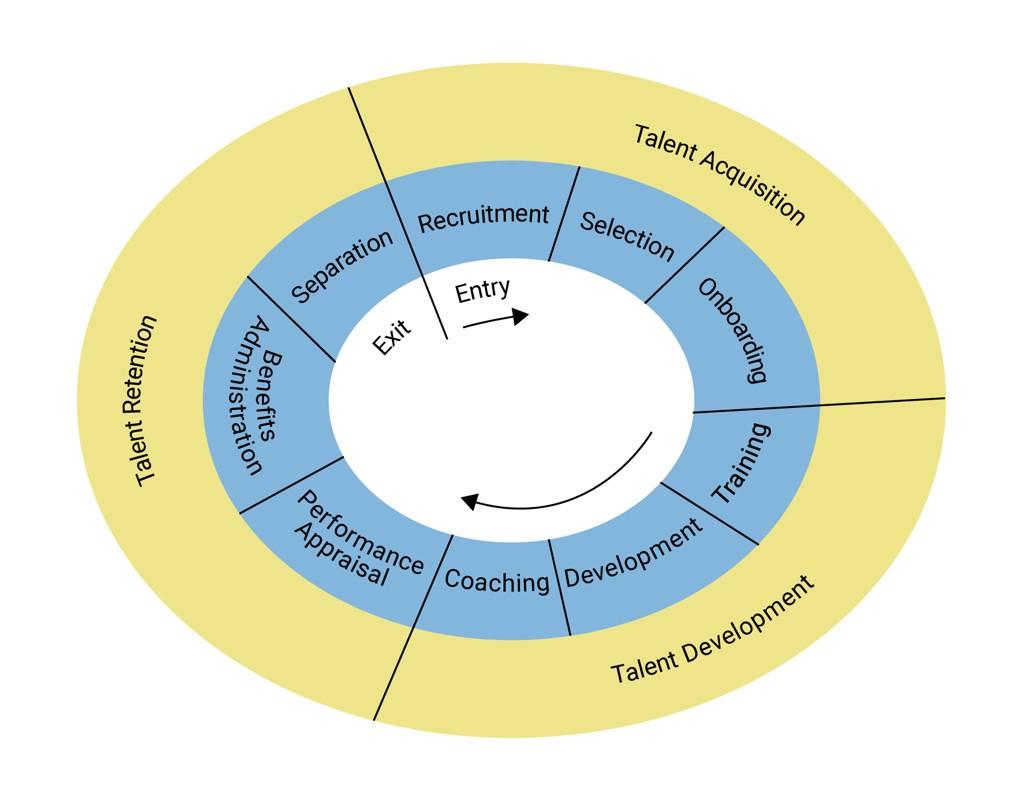
The employee life cycle is a model that portrays the journey of a typical employee from the time they first learn about an opening at the organization, through the recruitment and hiring process, until their employment ends.
The nine stages of the ELC are recruitment, selection, onboarding, training, development, coaching, performance appraisal, benefits administration, and separation. These nine stages can also be grouped under three overall categories of talent acquisition, talent development, and talent retention.
Onboarding refers to a series of events (including orientation) that helps prepare the employee to be successful in their job and engaged with the organization.
Providing effective talent development programs helps employees understand how their role contributes to the success of the organization. It also provides regular opportunities to enhance skillsets and development for career progression.
As an employee moves along through the ELC, the nature of talent development initiatives evolves. Two powerful employee development methods are related to interpersonal relationships in the workplace. These methods are mentoring and coaching
Career development can help motivate employees who might be experiencing a career plateau. This occurs when an employee reaches the point in their career where there are no further advancement opportunities.
Key Takeaways
Talent development is the strategic process of developing the knowledge, skills, abilities, and other characteristics of employees.
Knowledge is the state of having a correct idea or understanding of something or the possession of information about something.
Skill is the capability of accomplishing something with precision and certainty. It refers to practical application of theoretical knowledge. Skills can also be distinguished among three categories: basic, advanced, and expert.
An ability is a quality in a person or thing that makes an action possible. It refers to an innate capacity that enables a person to develop a skill.
Training refers to the process of learning the skills necessary to perform a particular job or activity more effectively.
Development refers to learning experiences designed to prepare employees for different and expanded roles in the organization.
Talent development plays a major role in the competitiveness of individuals, organizations, regions, and societies.
Turnover refers to individuals who leave the company and are replaced. It includes voluntary turnover (individuals who quit their jobs) and involuntary (individuals who are fired).
The employer brand describes an employer’s reputation as a place to work.
Job enrichment is the process of increasing job satisfaction by adding more meaningful tasks and giving employees more responsibility and autonomy.
Employee engagement is the emotional and attitudinal commitment an employee has to the organization and its goals, which influences their behaviors and level of effort in work activities. Employee engagement matters because of the impact on employee turnover and business results.
Discretionary effort is the difference between the level of activity one is capable of bringing to a work task and the minimum level required.
The employee life cycle (ELC) is a model that portrays the journey of a typical employee from the time they first learn about an opening at the organization, through the
recruitment and hiring process, until their employment ends. The nine stages of the ELC are recruitment, selection, onboarding, training, development, coaching, performance appraisal, benefits administration, and separation.
What Do You Think?
1. What is the difference between training and development? Can you think of examples of each?
Possible response: Training refers to the process of learning the skills necessary to perform a particular job or activity more effectively. Development refers to learning experiences designed to prepare employees for different and expanded roles in the organization. Thus, training generally refers to learning activities designed to help employees in their current role, and development is future focused.
2. How do you think an effective talent development program would help an organization have less turnover?
Possible response: Gallup found that organizations that have made a strategic investment in employee development are twice as likely to retain their employees. Bank of America, in the opening case, is an excellent example of this in action.
3. Can you think of an organization with an outstanding employer brand? What makes their brand a positive influence on recruiting and employee retention?
Possible response: Student answers will vary but just as a brand reputation is a potential customer’s opinion about the value of the products or services of the company, the employer brand represents the opinions that potential new hires (and existing employees) have of the firm. Satisfied employees are an organization’s loudest voice, particularly in an age of social media and user-generated feedback where employers aren’t always completely in control of their own reputation.
4. Have you, or someone you know, had a positive or negative onboarding experience? What made it effective or disappointing?
Possible response: This question is an opportunity to emphasize the importance of onboarding which is typically the first development experience that an employee has with an organization. Onboarding is discussed in more detail in chapter 10.
Key Terms
talent development: The strategic process of developing the knowledge, skills, abilities, and other characteristics of employees, often collectively referred to as KSAOs.
knowledge: The state of having a correct idea or understanding of something or the possession of information about something.
skill: The capability of accomplishing something with precision and certainty.
ability: The quality in a person or thing that makes an action possible.
training: Refers to the process of learning the skills necessary to perform a particular job or activity more effectively.
development: Refers to learning experiences designed to prepare employees for different and expanded roles in the organization.
turnover: Refers to individuals who leave the company and are replaced. It includes voluntary (individuals who quit their jobs) and involuntary (individuals who are fired) turnover.
employer brand: Describes an employer’s reputation as a place to work.
job enrichment: The process of increasing job satisfaction by adding more meaningful tasks and giving employees more responsibility and autonomy.
hygiene factors: Job aspects such as a decent salary, safe working conditions, and job security, which when inadequate can lead to job dissatisfaction.
employee engagement is the emotional and attitudinal commitment employees have to the organization and its goals, which influences their behaviors and level of effort in work activities.
discretionary effort: The difference between the level of activity one is capable of bringing to a work task and the minimum level required.
employee life cycle (ELC): A model that portrays the journey of a typical employee from the time they first learn about an opening at the organization, through the recruitment and hiring process, until their employment ends.
onboarding: A series of events (including orientation) that helps prepare employees to be successful in their jobs and engaged with the organization.
mentoring: A professional relationship in which an experienced colleague (the mentor) assists another (the mentee) in developing skills and knowledge.
coaching: Conducted by a professional coach, who offers advice on issues such as time management, effectiveness, communication skills, organizational politics, and many other areas.
career plateau: Occurs when an employee reaches the point in their career where there are no further advancement opportunities.
Section 1.3 The Changing Landscape of Talent Development
Recognize the role of talent development in closing the skills gap.
Consider how talent development professionals can build awareness of diversity and create a culture of inclusion.
Explain how advances in technology are changing the way that talent development is conducted.
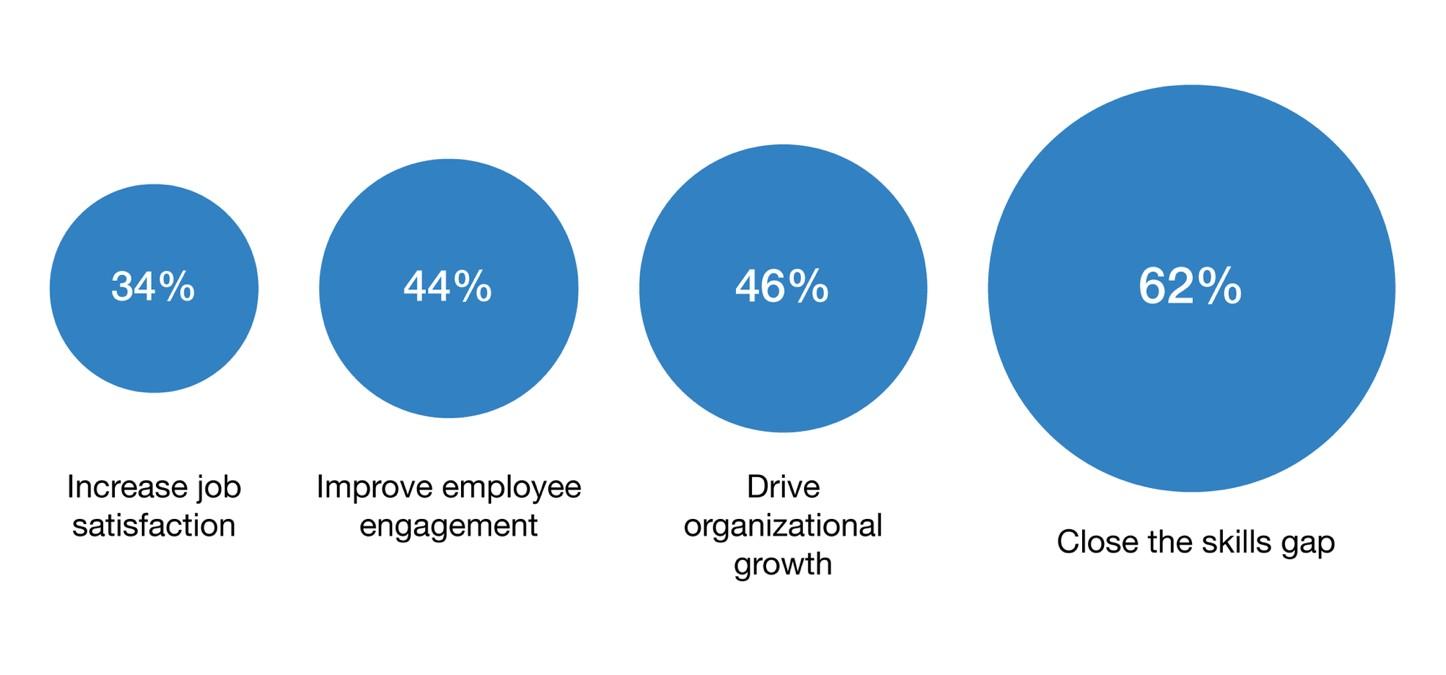
The most significant driving force in talent development today is the need to close skills gaps.
A skills inventory, a searchable list of the knowledge, skills, abilities, and qualifications of the workforce, is another useful tool for understanding and analyzing the labor supply.
Few organizations today have a system in place for tracking the skills they have, and even fewer apply that knowledge to gauge what skills they lack, both now and in the future.
Building a skills inventory involves first identifying all of the employees by position, tenure, and employment status (full time or part time). Knowledge, education levels, skills, abilities, and credentials (such as industry-approved certificates) should be included.
The skills gap is not just a U.S. phenomenon but is occurring in many developed countries.
HR leaders can address these challenges by building a skills-based organization through the following four actions:
o Share ownership for skills throughout the organization.
o Gather dynamic skills data.
o Use skills, not just roles, in talent decisions.
o Embed skills in talent management processes.
Workplace Demographics, Diversity, and Inclusion
Diversity refers to identity-based differences among and between two or more people that affect their lives as applicants, employees, and customers.
o These identity-based differences include such categories as race, ethnicity, gender, sexual orientation, religion, age, disability, and veteran status.
Inclusion is the degree to which employees are accepted and treated fairly by their organization.
o In the context of talent development, it is important to strive for an inclusive approach in needs assessment, in selection of employees for training and development programs, and in instructional design.
A generation is a social grouping of people born within a defined period who share similar cultural traits, values, and preferences.
Generations can be divided into cohorts, which provide a method for analyzing changes over time.
o Cohorts provide a way to understand how different formative experiences (such as world and economic events, technology, and social changes) interact with the life cycle and aging process to shape people’s views of the world.
The workforce will continue to increase in racial and ethnic diversity. By 2024, less than 60 percent of the U.S. labor force is likely to define itself as “white non-Hispanic,” although as recently as 1994, more than 75 percent of the workforce fell into that category.
Women are expected to continue to become a larger proportion of the U.S. workforce, rising from 46.8 percent to 47.2 percent in 2024.
Digital technology is impacting virtually every aspect of talent management, including needs assessment, instructional design, program delivery, evaluation of learning impact, and employee development through coaching and mentoring.
A learning management system (LMS) is a software application for the administration, documentation, tracking, reporting, and delivery of learning and development programs.
o An LMS makes it easy and efficient to create and store content, organize it into courses, deliver the content, enroll participants, and monitor and assess course progress.
Technology is also having a significant impact on the need for upskilling and retraining. By 2030, 375 million workers—approximately 14 percent of the global workforce—are expected to switch occupational categories due to advances in digitization, automation, and artificial intelligence.
Key Takeaways
The most significant driving force in talent development today is the need to close skills gaps.
A skills inventory is a searchable list of the knowledge, skills, abilities, and qualifications of the workforce.
Diversity refers to identity-based differences among and between two or more people that affect their lives as applicants, employees, and customers.
Inclusion is the degree to which employees are accepted and treated fairly by their organization. In the context of talent development, it is important to strive for an inclusive approach in needs assessment, in selection of employees for training and development programs, and in instructional design.
A generation is a social grouping of people born within a defined period who share similar cultural traits, values, and preferences.
The workforce will continue to increase in racial and ethnic diversity. By 2024, less than 60 percent of the U.S. labor force is likely to define itself as “white non-Hispanic,” although as recently as 1994, more than 75 percent of the workforce fell into that category.
Women are expected to continue to become a larger proportion of the U.S. workforce, rising from 46.8 percent to 47.2 percent in 2024.
Digital technology is impacting virtually every aspect of talent management including needs assessment, instructional design, program delivery, evaluation of learning impact, and employee development through coaching and mentoring.
A learning management system (LMS) is a software application for the administration, documentation, tracking, reporting, and delivery of learning and development programs.
By 2030, 375 million workers—approximately 14 percent of the global workforce—are expected to switch occupational categories due to advances in digitization, automation, and artificial intelligence.
What Do You Think?
1. What are some examples you have seen of a skills inventory being used? If you haven’t seen one, can you think of some examples?
Possible response: Unless a student is already working in talent development or HR, they probably have not seen an organizational skills inventory. However, they have probably created a resume that includes their skillsets. This is their own personal skills inventory.
2. What are some benefits of having an inclusive workforce?
Possible response: Organizations (and the individuals that work in them) experience positive outcomes in terms of knowledge, empathy, and skills related to interactions with people from different groups.
3. If you were a talent development manager in an inclusive and diverse organization and an employee refuses to have a mentor who is of a different race or sexual orientation, what would you do to rectify the issue?
Possible response: This question requires students to think about how they would respond in this real-world situation. This is an opportunity to emphasize the importance of communication skills for a talent development manager and the ability to resolve conflict.
4. Can you think of any disadvantages to using an LMS?
Possible response: The text describes many of the advantages of using an LMS but does not discuss the potential disadvantages. Examples might be the training needed, customer support issues, need for backup systems in event of a systems failure, and the time spent entering and updating data.
Key Terms
skills inventory: A searchable list of the knowledge, skills, abilities, and qualifications of the workforce.
diversity: Refers to identity-based differences among and between two or more people that affect their lives as applicants, employees, and customers.
inclusion: The degree to which employees are accepted and treated fairly by their organization.
generation: A social grouping of people born within a defined period who share similar cultural traits, values, and preferences.
learning management system (LMS): A software application for the administration, documentation, tracking, reporting, and delivery of learning and development programs.
Section 1.4 The Talent Development Process
Describe the importance of needs assessment in the talent development process.
Compare and contrast the ADDIE development model and the agile development model.
Identify the major types of delivery modalities.
Recognize why the evaluation of learning impact is a crucial component in the talent development process.
Section Outline
Needs Assessment
The talent development process should always begin with an assessment of needs.
A needs assessment is the process of determining what training is designed to accomplish and helps to ensure that it will be well received by employees, that transfer of training will take place, and that it will produce positive organizational outcomes.
An effective needs assessment looks at three levels of need: organizational, task, and person analyses.
Content Design and Development Models
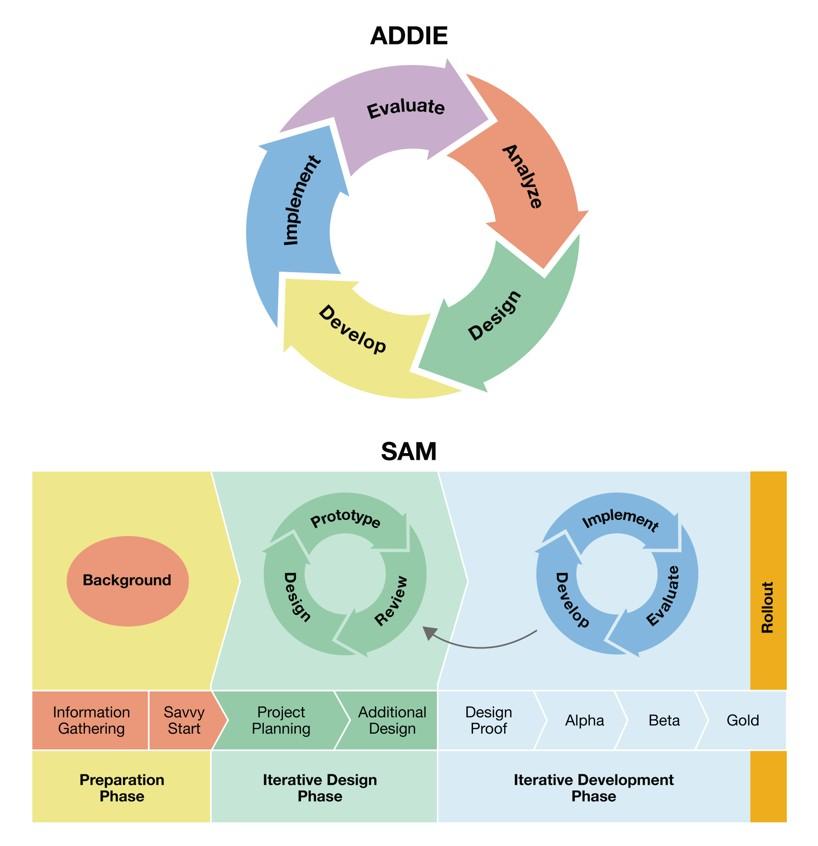
Two content models (also referred to as instructional design models) are popular in the talent development field: ADDIE and SAM.
ADDIE is the mainstream instructional design model since the 1970s, following the linear steps of analysis, design, development, implementation, and evaluation.
The steps in the ADDIE model are as follows:
o Analyze. Identify the problem or opportunity and the target audience, define the learning objectives, choose delivery modality, and determine scope of the project, budget, and timeline.
o Design. Outline the content into modules and lessons using flowcharts and storyboards, sequence content, select or design assessment instruments, and choose multimedia elements.
o Develop. Create curriculum prototype, then beta and pilot test.
o Implement. Facilitator training occurs, then final product is made available to learners. Assessment is performed and feedback is obtained from learners and trainers.
o Evaluate. Identify successes and lessons learned. Review learning objectives to ensure needs were met. Revise curriculum accordingly.
The Successive Approximation Model (SAM) is an agile development model with multiple steps happening at the same time.
Delivery Modality
One of the most important decisions when designing a talent development initiative is how the content will be delivered.
Delivery modality refers to the mode or method of instruction by which a course is delivered.
A mode is a particular way of experiencing or doing something, and thus modalities are simply a way of categorizing talent development delivery options.
We will explore the following major modalities in this text:
o Classroom instruction.
o E-Learning and remote learning.
o Employee development.
Virtual instructor-led training involves an instructor leading a group of students through a course using virtual technology such as distance learning, remote classrooms via satellite, and webinars.
Synchronous distance learning is online learning in which all participants and the instructor are signed into the training at the same time.
Asynchronous distance learning is online learning in which the participants and the instructor do not all have to be signed in at the same time.
Evaluating Learning Impact
Talent development is a significant investment, and the sponsor (the organization or person paying for the training) wants to know that the learning outcomes are achieved.
Evaluation is about collecting the data to demonstrate that the outcomes were achieved.
Evaluation is also about continually improving the learning initiative.
Key Takeaways
The talent development process should always begin with an assessment of needs.
A needs assessment is the process of determining what training is designed to accomplish and helps to ensure that it will be well received by employees, that transfer of training will take place, and that it will produce positive organizational outcomes.
Two content models (also referred to as instructional design models) are popular in the talent development field: ADDIE and SAM.
ADDIE (which stands for analysis, design, development, implementation, and evaluation) has been the mainstream instructional design model since the 1970s.
SAM is an agile development model with multiple steps happening at the same time. The SAM process is nonlinear and iterative, allowing for evaluation and changes to the project as needed (as opposed to evaluation happening at the end of the project in the ADDIE approach).
Delivery modality refers to the mode or method of instruction by which a course is delivered.
A mode is a particular way of experiencing or doing something, and thus modalities are simply a way of categorizing talent development delivery options.
Virtual instructor-led training involves an instructor leading a group of students through a course using virtual technology, such as distance learning, remote classrooms via satellite, and webinars. The primary advantage of virtual instructor-led training is that it provides immediate interaction between the instructor and student, but it saves on travel
costs and time. This type of training is considered synchronous distance learning because all participants and the instructor are signed into the training at the same time.
In self-paced e-learning, participants complete the learning experience on their own schedule. This category includes online courses, podcasts, mobile learning, and virtual reality. This type of training is considered asynchronous distance learning because participants do not all have to be signed in at the same time.
Talent development is a significant investment and the sponsor (the organization or person paying for the training) wants to know that the learning outcomes are achieved. Evaluation is about collecting the data to demonstrate that the outcomes were achieved. Evaluation is also about continually improving the learning initiative.
What Do You Think?
1. Can you identify any situations in an organization you are working for, or have worked for, that would benefit from a needs assessment?
Possible response: Student answers will vary but this is an opportunity to emphasize that the purpose of a needs assessment is to identify what type of problem needs to be solved, and whether it is truly a training problem.
2. Do you think ADDIE or SAM is more effective? Why?
Possible response: This question requires the student to think about the criticisms of ADDIE which resulted in the creation of the SAM model. Some criticisms of ADDIE are that the process can lead to prolonged development cycles, cumbersome processes, and communication challenges between designers and users. Some of the criticisms stem from the linear perception of the model and the suggestion that it is not agile.
3. Have you participated in virtual instructor-led training? What did you enjoy about it? What did you not like?
Possible response: With the increase in Zoom training and also Zoom class sessions in college courses, many students have had some experience with virtual instructor-led training. You may wish to make a note of the some of their comments and revisit them when this topic is covered in more depth in Chapter 7.
4. If you worked for a nonprofit organization, what is one method you would use to evaluate the learning impact of a recently implemented talent development program?
Possible response: This question encourages students to view the course concepts as applicable to any type of organization, not just for-profit companies.
Key Terms
• needs assessment: The process of determining what training is designed to accomplish and helps to ensure that it will be well received by employees, that transfer of training will take place, and that it will produce positive organizational outcomes.
• ADDIE: The mainstream instructional design model since the 1970s, following the linear steps of analysis, design, development, implementation, and evaluation.
• Successive Approximation Model: An agile development model with multiple steps happening at the same time.
• delivery modality: Refers to the mode or method of instruction by which a course is delivered.
• mode: A particular way of experiencing or doing something, and thus modalities are simply a way of categorizing talent development delivery options.
• Virtual instructor-led training: Involves an instructor leading a group of students through a course using virtual technology such as distance learning, remote classrooms via satellite, and webinars.
• Synchronous distance learning: Online learning in which all participants and the instructor are signed into the training at the same time.
• Asynchronous distance learning: Online learning in which the participants and the instructor do not all have to be signed in at the same time.
Section 1.5 Careers in Talent Development
Identify the types of positions and career options that are available in the talent development profession.
Explain how to best prepare for a career in talent development.
Describe the skillsets and competencies necessary for an individual to perform well in a talent development career.
Positions and Career Options
New entrants to the field typically begin either as a trainer, specialist, or coordinator and then may advance into a management position after gaining experience and demonstrating competence.
According to the Occupational Outlook Handbook of the Bureau of Labor Statistics, the job category of “Training and Development Specialist” is growing at 9 percent a year, much faster than the national average, with an average salary of $62,700 per year.
The job category of “Training and Development Managers” is growing at 7 percent a year, with an average of salary of $115,640 per year.
Preparing for a Career in Talent Development
Three general paths lead to an entry-level position in the Human Resources (HR) field, which includes talent development:
o A college degree in talent development or HR;
o A college degree in a related subject, such as business administration or instructional design, and then applying those skills to talent development through experience and/or earning appropriate certification; and
o Working for several years in an operational role in a company, then transitioning into talent development.
Talent Development Capabilities and Ethics
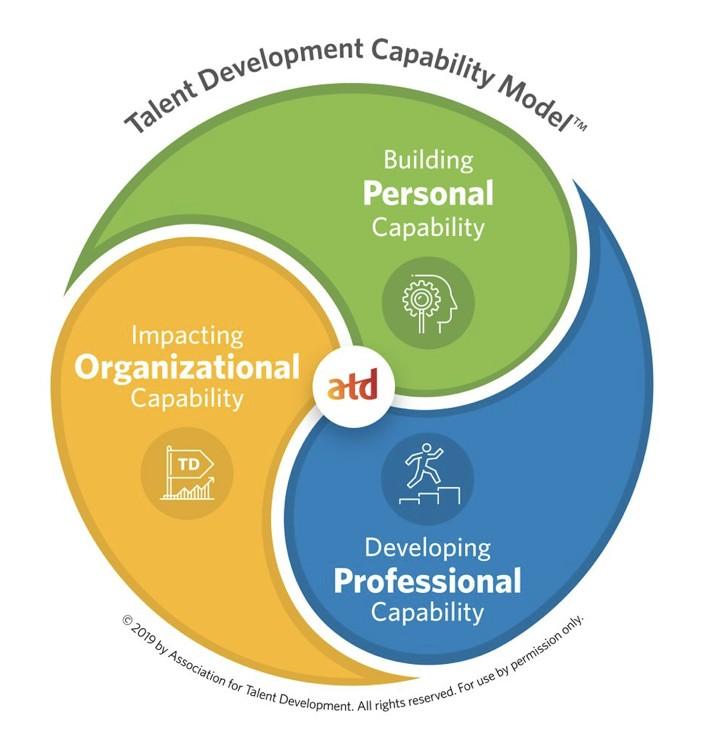
The ATD Talent Development Capability Model summarizes the knowledge, skills, abilities, and other characteristics (KSAOs) needed to be successful in the field in response to recent trends such as digital transformation, data analytics, information ability, and partnerships between talent development and business.
Each aspect of the ATD Talent Development Capability Model is covered at some point in this book. However, one specific topic should be called out now, and that is compliance and ethical behavior.
This topic involves a knowledge of laws and regulations that impact talent development and compliance with those laws.
Ethics, though, is much more than just compliance with legal standards. Ethics refers to the set of moral principles that guide a company’s conduct.
Key Takeaways
As with many professions, new entrants to the field typically begin either as a trainer, specialist, or coordinator and then may advance into a management position after gaining experience and demonstrating competence.
Large organizations may have separate training departments within various areas of business functions. For example, it is common for sales and customer service departments to manage their own sales and service training in very large organizations.
Many individuals working in the talent development profession are also self-employed and work as trainers or consultants or work for small companies who specialize in providing talent development services to other organizations.
Three general paths lead to an entry-level position in the HR field, which includes talent development: a college degree in talent development or HR; a college degree in a related subject, such as business administration or instructional design, and then applying those skills to talent development through experience or earning appropriate certification; or working for several years in an operational role in a company, then transitioning into talent development. For example, most sales training is conducted by people who have demonstrated success in a sales role.
What Do You Think?
1. Which positions in talent development most interest you? Why?
Possible response: Students may not be aware of how many different job roles exist in talent development (instructional designers, facilitators, coordinators, managers, etc.). The growth of remote learning has also created new job categories such as digital training designers, graphics designers, web developers, and LMS administrators.
2. What do you think is the best path to beginning a career in talent development?
Possible response: This question refers to the three general paths that lead to an entrylevel position in the Human Resources (HR) field, which includes talent development, as discussed in the text.
3. What are some other ways to build relationships in the talent development industry beside networking? Have you done any?
Possible response: Answers might include mentoring, attending meetings of local professional chapters such as SHRM or ATD, internships, or job shadowing.
4. Do you think it is important to be a “people person” if employed in the field of talent development?
Possible response: This question is an opportunity for students to discover that there can be a role in talent development for anyone, regardless of whether they prefer to work with people, instructional design, software systems, or data analysis.
Key Terms
Ethics: Refers to the set of moral principles that guide a company’s conduct.
Section 1.6 Conclusion
This chapter began with an overview of the environment and context in which workplace learning occurs.
The role of talent management in the competitiveness of individuals, organizations, regions, and societies was examined. How organizations strive to align talent development with their strategic goals to gain competitive advantage in their industry, whether for-profit or nonprofit, was then discussed.
The influence of the rapid pace of change in factors such as demographics, diversity, globalization, and technology were discussed.
The chapter introduced the different approaches and models that are used for content development and delivery, which then will help you to understand the organization of the textbook.
The chapter closed with a discussion of career options in the talent development industry.
1. Contact a representative of your local or state economic development agency. Ask them about the skills shortages that exist in your area and the impact this is having on the growth of the local economy. Also inquire about what is being done to close the skills gaps.
Possible response: Most cities in America, even small towns, have an economic development agency. This exercise is an opportunity to learn more about the role of a skilled workforce in regional economic growth. Another option is to invite an economic development professional to speak to your class, in person or via Zoom.
2. a. Write down your primary career interest.
b. Identify your long-term professional goal (e.g., become a talent development manager).
c. Identify the short-term goals that will contribute to reaching your long-term goal (e.g., complete a college degree, spend five years as a talent specialist).
d. List two to three activities that will help you reach each short-term goal. For each activity, write down when you will start and complete it.
Then exchange plans with a classmate and provide each other with feedback and suggestions.
Possible response: Students might refer to Section 1.5, Preparing for a Career in Talent Development, to complete this exercise. You may wish to discuss the importance of internships and professional certification as well.
3. Practice choosing a vendor for an LMS. Choose three vendors from the 15 Best Learning Management Systems list (under Resources). Go to each vendor’s website and read about the features and benefits. Do a web search for each vendor and read reviews written by talent development professionals. Then check with the Better Business Bureau to find out each company’s rating and how and what types of complaints have been filed. Based on your findings, which vendor would you select, and why?
Possible response: Learning Management Systems are covered in more detail in Chapter 7, but it can be helpful to encourage students to start becoming familiar with learning technology now.
Case Study: Live from New York! It’s Talent Development!
Lorne Michaels, one of the creators of SNL, has been developing talent through his mentorship of writers, comedians, and producers for more than forty years.
When asked how he motivates his team to be creative on a deadline, he replied, “You lead by example. If people sense how committed you are, what the standard is, what you believe in, what you expect, then they respond to that.”
Two other characteristics possessed by Lorne Michaels are setting clear and specific expectations and bringing out a great team dynamic.
Case Discussion Questions
1. Why is mentoring so important in talent and career development?
Possible response: Mentoring is discussed in more depth in Chapter 10, but this question can be used to introduce the students to the concept of development in contrast to training.
2. What makes a mentor effective?
Possible response: This discussion should include the importance of the mentor leading by example and demonstrating commitment to the mentee.
3. How do people benefit from having a mentor help guide them with their development?
Possible response: There is no right or wrong answer of course, but the question can spark a discussion that encourages students to seek out a professional mentor while they are still in college, instead of waiting until later.
4. What happens when talented mentees move on?
Possible response: An effective mentor prepares someone to advance to the next level even if it means moving on to another opportunity. It demonstrates that the mentor has their best interests in mind.
Resources
1. 15 Best Learning Management Systems. A 2021 comparison of leading providers of learning management systems with descriptions, features, and links to the providers.
https://www.softwaretestinghelp.com/learning-management-system/
2. ATD Certification. Information about the Associate Professional in Talent Development (APTD) and Certified Professional in Talent Development (CPTD) certification from the Association for Talent Development, including eligibility requirements, exam windows, and exam preparation resources.
https://www.td.org/
3. Employment and Training Administration. A part of the U.S. Department of Labor, the ETA’s mission is to provide training, employment, and labor market information.
https://www.dol.gov/agencies/eta
4. The Training and Development World. Free resources for trainers, facilitators, and organizational development practitioners, including articles, FAQs, training activities, and icebreakers.
http://thetrainingworld.com