Test Bank for Principles of Microeconomics Canadian Edition 2
Edition by Milligan, Oreopoulos, Stevenson, Wolfers
ISBN: 9781319574482
TB2 Chapter 1
1. Tim Hortons is the largest food franchise in Canada. Due to declining sales, a Tim Hortons franchisee must consider closing up to three of her least profitable locations. She meets with two consultants to discuss potential plans. The first consultant offers two plans. Plan A keeps one location open with certainty. Plan B has a one-inthree chance of saving all three locations but a two-in-three chance of saving no locations. The second consultant also offers two plans. Plan C will result in losing two locations with certainty. Plan D has a two-inthree chance of losing all locations but a one-in-three chance of losing no locations. If the franchisee chooses Plan A, she should also choose Plan:
a. No plan results in the same outcome as Plan A.
b. B.
c. C.
d. D.
ANSWER: c
2. Tim Hortons is the largest food franchise in Canada. Due to declining sales, a Tim Hortons franchisee must consider closing up to four of his least profitable locations. He meets with two consultants to discuss potential plans. The first consultant offers two plans. Plan A will result in losing two locations with certainty. Plan B has a three-in-four chance of losing all locations but a one-in-four chance of losing no locations. The second consultant also offers two plans. Plan C keeps two locations open with certainty. Plan D has a one-in-four chance of saving all four locations but a three-in-four chance of saving no locations. If the franchisee chooses Plan B, he should also choose Plan:
a. No plan results in the same outcome as Plan B.
b. B.
c. C.
d. D.
ANSWER: d
3. Tim Hortons is the largest food franchise in Canada. Due to declining sales, a Tim Hortons franchisee must consider closing up to three of her least profitable locations. She meets with two consultants to discuss potential plans. The first consultant offers two plans. Plan A will result in losing two locations with certainty. Plan B has a two-in-three chance of losing all locations but a one-in-three chance of losing no locations. The second consultant also offers two plans. Plan C keeps one location open with certainty. Plan D has a one-in-three chance of saving all three locations but a two-in-three chance of saving no locations. If the franchisee applies the cost-benefit principle, which combination of plans reflects a consistent decision?
a. Plan C and Plan A
b. Plan B and Plan A
c. Plan D and Plan A
d. Plan C and Plan B
ANSWER: a
4. You are a small business owner preparing to launch your first ad campaign to attract new customers, and must decide whether to learn about advertising yourself or hire a professional to launch the campaign. The campaign will last three months. If you hire a professional, you'll have to pay them a lump sum of $1,000 for the entire campaign. But if you decide to do it yourself, you'll take a course that costs $200 to introduce you to the skill. You'll also pay an employee $340 per month to work some of the hours you normally work while you
TB2
1
manage the campaign. Would it be better to hire a professional rather than doing the campaign yourself?
a. Yes, because your economic surplus is $220.
b. Yes, because your full set of costs is only $540.
c. No, because the benefit of not having to do it yourself is greater than the cost of the professional.
d. No, because you can increase your economic surplus if you do it yourself.
ANSWER: a
5. You are a small business owner preparing to launch your first ad campaign to attract new customers, and must decide whether to learn about advertising yourself or hire a professional to launch the campaign. The campaign will last three months. If you hire a professional, you'll have to pay them a lump sum of $1,200 for the entire campaign. But if you decide to do it yourself, you'll take a course that costs $200 to introduce you to the skill. You'll also pay an employee $320 per month to work some of the hours you normally work, while you manage the campaign. If you hire the professional, your total benefit would be all the money you avoid spending on doing the campaign yourself. What is the total benefit of hiring the professional?
a. $1,160
b. $200
c. $320
d. $960
ANSWER: a
6. Your $10 donation to a charity provides one blanket to an unhoused person. Given that you followed the Rational Rule for Consumers in the transaction, you can conclude that your willingness to pay for this type of generosity is at least:
a. $1.
b. $5.
c. $8.
d. $10.
ANSWER: d
7. You are a math tutor, and you offer in-home tutoring on weekday afternoons for $20 an hour. On Saturdays, you tutor students hourly for free at the community centre. Since you follow the Rational Rule for Consumers, which statement can you conclude is TRUE?
a. Your economic surplus rises or at least remains unchanged when you tutor at the community centre.
b. You couldn't gain any economic surplus from tutoring at the community centre since you earn $0 per hour.
c. You can't compare the two types of tutoring because you can't quantify how much donating your time means to you.
d. The time you spend tutoring the students on weekday afternoons lowers your economic surplus.
ANSWER: a
8. A few years back, Netflix signed a $100 million deal with Jerry Seinfeld, which included two new stand-up specials and the rights to some of Seinfeld's previous work. Which statement can you conclude is TRUE?
a. The $100 million deal lowered Netflix's economic surplus.
b. Netflix is worse off because of the cost of the $100 million.
TB2
1
c. The $100 million deal provided fewer total benefits than total cost to Netflix.
d. The cost of the $100 million deal was no greater than the benefits of the deal.
ANSWER: d
9. A few years back, Netflix signed a $100 million deal with Jerry Seinfeld, which included two new stand-up specials. Which statement can you conclude is FALSE?
a. The transaction lowered the comedian's economic surplus.
b. The deal was a voluntary exchange between Netflix and the comedian.
c. For Netflix, the cost of the deal was no greater than the benefits of the deal.
d. The benefits of the deal were at least equal to the cost for the comedian.
ANSWER: a
10. You are on the marketing team for Lactalis Canada, which produces Black Diamond cheese. Knowing that most people base their decisions on how things are described, your team must determine the best language to entice people to buy Black Diamond cheese. Your team is choosing between describing the package content as containing "5% fat" or as "95% fat-free." What is the term for why most people would react differently to the two phrases?
a. framing effect
b. cost-benefit analysis
c. willingness to pay
d. economic surplus
ANSWER: a
11. When you're shopping at Loblaws, you notice a sign in large bold letters that reads, "Free $5 gift card." Deciphering the fine print, you determine that you would have to spend $60 on laundry detergent to receive the gift card. Which term explains why Loblaws puts the word "Free" in large bold letters?
a. framing effect
b. cost-benefit analysis
c. willingness to pay
d. economic surplus
ANSWER: a
12. You just got a new puppy, and you need to determine the best way to have him cared for while you are at work. You could enroll your puppy in a doggy daycare in your neighbourhood for $22 per day. Alternatively, your friend, who works from home, could care for your puppy for only $10 per day. However, your friend lives a few kilometers away, so it would cost you $6 per day in gas and $10 per day in time to drop your puppy off and pick him up. If you choose to take your puppy to daycare, are you correctly applying the cost-benefit principle?
a. Yes, because you are maximizing your economic surplus by enrolling him in daycare.
b. Yes, because you are maximizing your willingness to pay by paying $22 per day.
c. No, because your economic surplus would be higher if you only paid $10 per day.
d. No, because your costs would be lower if you choose your friend's house.
ANSWER: a
13. You just got a new puppy, and you need to determine the best way to have her cared for while you are at work. You could enroll your puppy in a doggy daycare in your neighbourhood for $24 per day. Alternatively, your friend, who works from home, could care for your puppy for only $10 per day. However, your friend lives a few kilometers away, so it would cost you $6 per day in gas and $12 per day in time to drop your puppy off and pick her up. If you choose to take your puppy to daycare, what is your economic surplus?
a. $4
b. $14
c. $24
d. $18
ANSWER: a
14. You own a food truck, and you've been operating in the parking lot of your friend's business. You pay your friend $900 per month to park at their business, and your food truck revenue is $6,000 per month. You're considering whether you should continue to park in your friend's lot or move to another location. Your revenue in the new location would be $10,500 per month, but you'd have to pay $1,500 per month to park there. You would also have to buy more fresh ingredients to meet the increased sales, so your monthly operating costs would increase by $600. If you choose to keep parking in your friend's lot, are you correctly applying the costbenefit principle?
a. Yes, because you are maximizing your economic surplus by parking in your friend's lot.
b. Yes, because moving to the new location would decrease your economic surplus.
c. No, because your economic surplus varies depending on how you frame your costs.
d. No, because you could increase your economic surplus by moving to the new location.
ANSWER: d
15. You just moved into your new apartment, which has washer and dryer hookups, but your apartment complex doesn't provide washers and dryers. You don't want to go to a laundromat. You can rent a washer and dryer set from an appliance rental company for $30 per month. Alternatively, you could buy a set for $1,100, which you could sell after one year for $700, or $600 after two years. Should you buy or rent the set? Choose the correct statement.
a. If you plan to stay in the apartment for one year, you should rent the set to earn $40 worth of economic surplus.
b. If you plan to stay in the apartment for one year, you should buy the set to earn $40 worth of economic surplus.
c. If you plan to stay in the apartment for two years, you should rent the set to earn $220 worth of economic surplus.
d. If you plan to stay in the apartment for two years, you should buy the set to earn $500 worth of economic surplus.
ANSWER: a
16. You just moved into your new apartment, which has washer and dryer hookups, but your apartment complex doesn't provide washers and dryers. You don't want to go to a laundromat. You can rent a washer and dryer set from an appliance rental company for $30 per month. Alternatively, you could buy a set for $1,100, which you could sell after one year for $700, or $600 after two years. You plan to stay in this apartment for two
TB2
1
years, since it's near your job. Should you buy or rent the set?
a. You should rent the set because renting earns $40 worth of economic surplus.
b. You should rent the set because renting earns $400 worth of economic surplus.
c. You should buy the set because buying earns $220 worth of economic surplus.
d. You should buy the set because buying earns $500 worth of economic surplus.
ANSWER: c
17. An investor is franchising a new type of fitness studio that will be the first in the city and must determine how many locations to open. For each location, they will hire a manager for a salary of $4,000 per month and two part-time employees who will earn $1,500 each per month. Additional operating costs, including rent and utilities, will be $5,000 per month at each location. The investor projects that after the business gains traction, the first location will have 1,100 members. The second location will bring in 900 members. The third and fourth locations will bring in 400 and 200 members, respectively. The monthly membership fee will be $50 per member. How many locations should the investor franchise?
a. one
b. two
c. three
d. four
ANSWER: c
18. An investor is franchising a new type of fitness studio that will be the first in the city and must determine how many locations to open. Each location will have a manager with a salary of $4,000 per month and two parttime employees with salaries of $2,000 each per month. Additional operating costs, including rent and utilities, will be $6,000 per month at each location. The investor projects that after the business gains traction, the first location will have 1,100 members. The second location will bring in 950 members. The third and fourth locations will bring in 350 and 200 members, respectively. The monthly membership fee will be $45 per member. How many locations should the investor franchise?
a. one
b. two
c. three
d. four
ANSWER: c
19. An investor is franchising a new type of fitness studio that will be the first in the city and must determine how many locations to open. For each location, they will hire a manager for a salary of $4,000 per month and two part-time employees who will earn $2,000 each per month. The investor values their time spent overseeing each location at $7,500 per month. Additional operating costs, including rent and utilities, will be $6,000 per month at each location. The investor projects that when the business gains traction, the first location will have 1,000 members. The second location will bring in 900 members. The third and fourth locations will bring in 300 and 200 members, respectively. The monthly membership fee will be $70 per member. The investor has decided to definitely open two locations. Should they open a third location?
a. Yes, because marginal benefit would exceed marginal cost.
b. Yes, because marginal cost would exceed marginal benefit.
TB2 Chapter 1
c. No, because marginal cost would exceed marginal benefit.
d. No, because marginal benefit would exceed marginal cost.
ANSWER: c
20. A social media influencer is quickly gaining followers, and he's offered his first brand deals. Each deal offers a $175 payment. In exchange, the influencer must advertise the brand by creating posts and responding to comments. To have time for each deal, the influencer must give up additional time working at his primary job. For the first brand deal, his total foregone earnings are $150. For the second and third brand deals, his total foregone earnings are $375 and $675, respectively. How many brand deals should he accept?
a. zero
b. one
c. two
d. three
ANSWER: b
21. A social media influencer is quickly gaining followers, and he's offered his first brand deals. Each deal offers a $200 payment. In exchange, the influencer must advertise the brand by creating posts and responding to comments. He would use his personal time for each brand deal. To accept the first deal, he would give up his Friday night, which he values at $150. For the second and third deals, he would give up his Saturday and Sunday afternoons, which he values at $200 and $250, respectively. He has already accepted two brand deals. Should he accept a third deal?
a. Yes, because marginal benefit would exceed marginal cost.
b. Yes, because marginal cost would exceed marginal benefit.
c. No, because marginal cost would exceed marginal benefit.
d. No, because marginal benefit would exceed marginal cost.
ANSWER: c
22. Blake has successfully launched a massage therapy business, but he now receives more booking requests than he can accommodate. How should Blake proceed in growing his business? He should experiment by hiring:
a. one more massage therapist to determine if the marginal benefit is greater than the marginal cost.
b. one more massage therapist to determine if the total benefit is greater than the total cost.
c. three more massage therapists to determine if the marginal benefit is greater than marginal cost.
d. three more massage therapists to determine if the total benefit is greater than the total cost.
ANSWER: a
23. Blake has successfully launched a massage therapy business, but he now receives more requests for bookings than his availability. He must determine how many new therapists to hire. Blake currently provides 15 total weekly massages. Hiring the first therapist would bring the total to 40 massages per week. Adding a second therapist will result in 60 total massages per week. The third and fourth therapists will result in 75 and 80 total weekly massages. A client pays $120 for a massage, and Blake pays therapists $1,000 per week. How many therapists should Blake add to his team?
a. one
Copyright Macmillan Learning. Powered by Cognero.
b. two
c. three
d. four
ANSWER: c
24. You're ready to launch your first ad campaign to attract new customers to your small business. You consider hiring an ad agency to launch the campaign because you have no background in marketing. However, you discover a YouTube channel of a marketing expert who teaches small businesses how to create and launch their own marketing campaigns. You learn so much from this channel that you decide to do it yourself. Since you follow the Rational Rule, which of these statements explain how the interdependency between markets changes your choice?
a. You earn more surplus by doing it yourself now that you understand more about marketing.
b. You earn less surplus by doing it yourself now that you understand more about marketing.
c. You would have been better off hiring the professional and you misused the framing effect in your decision.
d. You earn more surplus by using the professional now that you understand more about marketing.
ANSWER: a
25. An investor is franchising a new type of fitness studio that will be the first in the city and must determine how many locations to open. For each location, they will hire a manager for a salary of $4,000 per month and two part-time employees who will earn $1,500 per month each. Additional operating costs, including rent and utilities, will be $5,000 per month at each location. The investor projects that after the business gains traction, the first location will have 1,100 members. The second location will bring in 900 members. The third and fourth locations will bring in 400 and 200 members, respectively. The monthly membership fee will be $50 per member. However, looking at the most recent population data, the investor learns that the city's population growth rate is declining. This change in expectations about the future decreases their membership forecast by 200 members for each potential location. How does this change in expectations change the investor's franchising decision?
a. They will franchise two locations instead of three.
b. They will franchise one location instead of two.
c. They will franchise the same number of locations.
d. The data would not impact the investor's decision.
ANSWER: a
26. Nissan manufactures sedans and pickup trucks. As one of Nissan's economists, you're in charge of ensuring efficient management of costs. At one manufacturing plant, if Nissan devotes all of its resources to manufacturing sedans, it can produce 480,000 sedans per year. If Nissan devotes all of its resources to manufacturing trucks, it can produce 240,000 trucks per year. What is Nissan's opportunity cost of producing one sedan at this manufacturing plant?
a. half of a truck
b. two trucks
c. half of a sedan
d. two sedans
ANSWER: a
27. Nissan manufactures sedans and pickup trucks. As one of Nissan's economists, you're in charge of ensuring efficient management of costs. At one manufacturing plant, if Nissan devotes all of its resources to manufacturing sedans, it can produce 480,000 sedans per year. If Nissan devotes all of its resources to manufacturing trucks, it can produce 240,000 trucks per year. What is Nissan's opportunity cost of producing one truck at this manufacturing plant?
a. half of a truck
b. two trucks
c. half of a sedan
d. two sedans
ANSWER: d
28. Nissan manufactures sedans and pickup trucks. As one of Nissan's economists, you're in charge of ensuring efficient management of costs. In the past, if Nissan devoted all of its resources to manufacturing sedans, it could produce 480,000 sedans per year at one manufacturing plant. If Nissan devoted all of its resources to manufacturing trucks, it could produce 240,000 trucks per year. A new production technique now allows Nissan to produce either 600,000 sedans or 360,000 trucks per year. How would Nissan's production possibilities frontier reflect this new production technique?
a. A movement along the production possibilities frontier to manufacture more sedans.
b. A movement along the production possibilities frontier to manufacture more trucks.
c. An inward shift of the production possibilities frontier.
d. An outward shift of the production possibilities frontier.
ANSWER: d
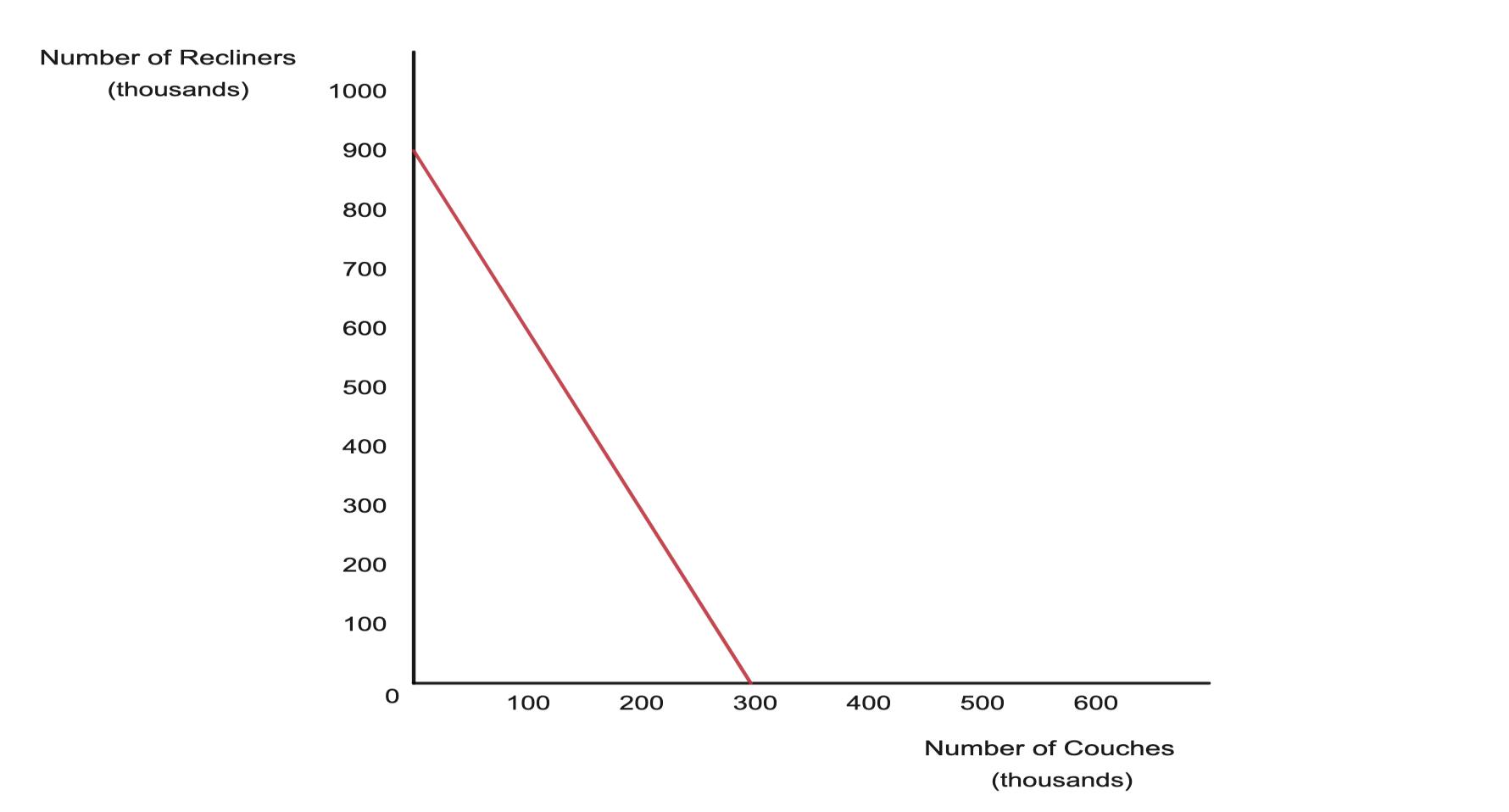
29. (Figure: Recliners and Couches) Superstyle Furniture is a furniture company based in Ontario, Canada. The graph illustrates the number of couches and recliners that Superstyle can manufacture in a year. Select the term that correctly identifies the graph.
a. production possibility frontier
b. sunk cost curve
c. economic surplus curve
d. framing effect frontier
ANSWER: a
30. (Figure: Recliners and Couches) Superstyle Furniture is a furniture company based in Ontario, Canada. The graph represents Superstyle’s production possibility frontier for manufacturing couches and recliners.
The sales team at Superstyle has reported that sales of couches have increased. The company would like to increase manufacturing from 100,000 couches to 200,000 couches. As the company's economist, what is the opportunity cost of producing the 100,000 additional couches?
a. 300,000 recliners
b. 100,000 recliners
c. 300,000 couches
d. 100,000 couches
ANSWER: a
31. (Figure: Recliners and Couches) Superstyle Furniture is a furniture company based in Ontario, Canada. . The graph represents Superstyle’s production possibility frontier for manufacturing couches and recliners.
If Superstyle manufactures 100,000 couches and 400,000 recliners, the company's use of resources would be _____, and the company could production.
a. inefficient; increase
b. inefficient; decrease
c. efficient; increase
d. efficient; decrease
ANSWER: a
32. (Figure: Tablets and Phones) Samsung Electronics uses its resources to produce tablet computers and cell phones.
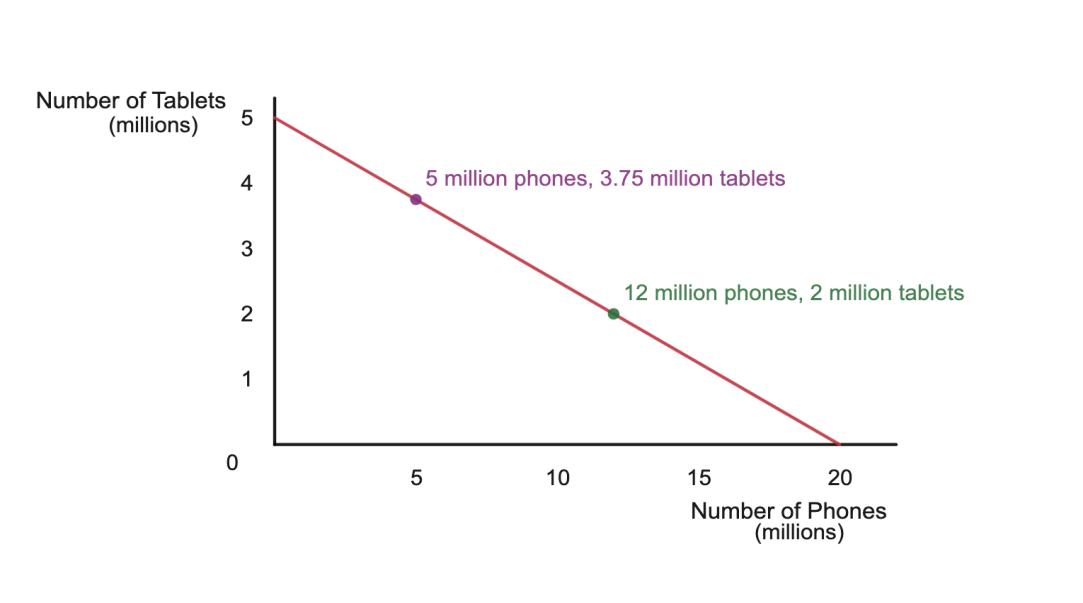
When Samsung reallocates its resources to produce 12 million phones instead of 5 million phones, the opportunity cost is:
a. 7 million phones.
b. 7 million tablets.
c. 1.75 million phones.
d. 1.75 million tablets.
ANSWER: d
33. Samsung Electronics uses its resources to produce tablet computers and cell phones. The of manufacturing more phones is manufacturing fewer tablets, which Samsung can illustrate with its _____.
a. opportunity cost; production possibility frontier
b. marginal benefit; willingness to pay
c. productivity; production possibility frontier
d. opportunity cost; voluntary exchange
ANSWER: a
34. (Figure: Tablets and Phones) Samsung Electronics uses its resources to produce tablet computers and cell phones.
At a company meeting, someone suggests that Samsung would be better off if it uses its resources to manufacture 25 million phones and 1.75 million tablets. As one of Samsung's analysts, how do you explain the feasibility of the suggestion to the other team members in your company?
a. The combination is attainable, and this level of production is efficient.
b. The combination is currently unattainable but could be possible with decreased efficiency.
c. The combination is attainable, but this level of production would be inefficient.
d. The combination is currently unattainable but could be possible with increased production capacity.
ANSWER: d
35. (Figure: Tablets and Phones) Samsung Electronics uses its resources to produce tablet computers and cell phones.
When Samsung reallocates its resources to produce 3.75 million tablets instead of 2 million tablets, the opportunity cost is: a. 7 million phones.
TB2 Chapter 1
b. 7 million tablets.
c. 1.75 million phones.
d. 1.75 million tablets.
ANSWER: a
36. Netflix cancelled its original series Ozark after season 4, indicating that Netflix determined producing season:
a. 5 was not worth the marginal cost.
b. 2 was not worth the marginal cost.
c. 6 was a sunk cost.
d. 5 was a sunk cost.
ANSWER: a
37. According to Insider, the pilot episode of HBO's original series Westworld cost $25 million. Using the Rational Rule, HBO's analysts predicted that the future revenue from subscriptions, advertising, and licensing because of Westworld would be:
a. greater than $25 million plus the production cost of subsequent episodes.
b. less than $25 million more than the cost of subsequent episodes.
c. less than HBO's next best alternative.
d. less than HBO's cost of production.
ANSWER: a
38. Your aunt tells you that although she has been in the same career for multiple years, she really doesn't enjoy it. Instead of her bachelor's degree, she always wished she had pursued vocational training instead. She thinks she should definitely keep her job since she paid $24,000 for tuition. The cost of vocational training would be $10,000.
Your advice to her is that she should:
a. consider the $24,000 a sunk cost and unrelated to her choice of vocational training.
b. include the $10,000 in her estimation of sunk costs.
c. pursue the vocational training only if she is willing to pay $34,000 for her education.
d. continue her current line of work since she already paid for it.
ANSWER: a
39. A doctor has worked as a general practitioner for several years, earning an annual salary of $125,000. They are now deciding whether they want to open their own private practice or continue as a team member in the existing office. One-time start-up costs for the practice would be $100,000. If they open their own practice, they will receive $50,000 in salary from the business annually until the practice is well-established. They anticipate the practice will take one year to become fully established. They paid $200,000 for medical school. They should open their own practice if the future benefits exceed:
a. $175,000.
b. $200,000.
c. $375,000.
d. $75,000.
ANSWER: a
40. A doctor has worked as a general practitioner for several years, earning an annual salary of $150,000. They are now deciding whether they want to open their own private practice or continue as a team member in the existing office. One-time start-up costs for the practice would be $100,000. If they open their own practice, they will receive a salary of $50,000 from the business annually until the practice is well-established. They anticipate the practice will take two years to become fully established. They paid $200,000 for medical school. They should open their own practice if the future benefits exceed:
a. $300,000.
b. $200,000.
c. $500,000.
d. $400,000.
ANSWER: a
41. You are considering whether to invest in your friend's business or keep your money in your savings account. What is the opportunity cost of investing in your friend's business?
a. investing in a different business
b. foregone income
c. your time
d. interest you could have earned from the savings account
ANSWER: d
42. You just finished your doctorate in economics and have received two different job offers. The first is a position as an assistant professor, which will require you to move to a location you consider undesirable. You value living in one of your favourite cities at $20,000 per year. The second offer pays $10,000 a year more to work remotely as an economist for a private company. You have $40,000 in student loan debt. You should only accept the job as a professor if you have benefits that outweigh your opportunity cost of:
a. $30,000 per year.
b. $10,000 per year.
c. $40,000 per year.
d. $20,000 per year.
ANSWER: a
43. You just finished your doctorate in economics and have received two different job offers. The first is a position as an assistant professor, which will require you to move to a location you consider undesirable. You value living in one of your favourite cities at $10,000 per year. The second offer pays $20,000 a year more to work remotely as an economist for a private company. You have $40,000 in student loan debt. You should only accept the job as a professor if you have benefits that outweigh your opportunity cost of:
a. $30,000 per year.
b. $10,000 per year.
c. $40,000 per year.
d. $20,000 per year.
TB2
ANSWER: a
1
44. Kawartha Dairy is deciding the direction it wants to take its business over the course of the next year. The company could develop a new flavour of ice cream to sell in supermarkets, or it could open a new companyowned location. The cost of research, development, and bringing the new flavour to market would be $200,000. The company spent $75,000 developing the last new flavour profile, which was unsuccessful. If it doesn't develop the new flavour, the start-up cost for the new store location would be $50,000. Over the course of the next year, operating costs for already existing locations will be $100,000. What is Kawartha Dairy’s opportunity cost of developing a new ice cream flavour?
a. $150,000
b. $100,000
c. $200,000
d. $75,000
ANSWER: a
45. Scarcity occurs in everyday life because:
a. resources are limited.
b. the wants of individual consumers are limited.
c. there are people with low incomes even in wealthy countries.
d. taxes keep prices higher than they would otherwise be.
ANSWER: a
46. If resources are scarce:
a. they are insufficient to provide enough goods and services to satisfy all human material wants and needs.
b. there are not enough of them for firms to produce goods and services.
c. they are probably overvalued by consumers.
d. their supply is unlimited.
ANSWER: a
47. A central and fundamental theme in economics is that:
a. for me to have something, someone else must be willing to give it up.
b. Canada is a wealthy country, but we are simply not aware of it.
c. resources are limited and cannot satisfy all the ways a society wants to use them.
d. we can build as much as we want, since resources are unlimited.
ANSWER: c
48. Which of these forces us to make choices?
a. opportunity cost
b. marginal decision making
c. scarcity
d. market failure
ANSWER: c
49. There are many freshwater lakes in Canada. However, freshwater is scarce because:
a. it has no alternative uses.
b. there is not enough of it to meet all needs.
c. the government limits its use through regulations.
d. it has a high opportunity cost.
ANSWER: b
50. The problem of determining what goods and services society should produce:
a. exists because we can produce any amount of a good we need or want, making choice difficult.
b. exists because there are not enough resources to provide all the goods and services that people want.
c. would not exist if all levels of government would agree to supply goods and services to those who do not have enough.
d. would not exist if a central planning bureau were to decide how to allocate resources.
ANSWER: b
51. We have to make choices because:
a. we have unlimited income and must decide what to purchase.
b. the resources available to us are limited.
c. the resources we would like to use in production are infinite.
d. with good planning, trade-offs can be avoided.
ANSWER: b
52. The opportunity cost of something is:
a. the amount you pay to take advantage of a lucrative opportunity.
b. a payment not made for a product.
c. the benefit derived from a product.
d. the next best alternative you have to give up to get it.
ANSWER: d
53. The opportunity cost of a good is:
a. smaller during periods of economic recession.
b. equal to the monetary cost of the good.
c. larger during economic booms.
d. the value of the next best alternative given up to acquire the good.
ANSWER: d
54. Whenever a good is purchased:
a. the cost of the good is its opportunity cost.
b. the cost of the good is easy to measure in terms of the price paid for it.
c. overall efficiency increases.
d. scarcity will increasingly constrain the future availability of the good.
TB2 Chapter 1
ANSWER: a
55. You can spend $300 on either a pair of new Air Jordan sneakers or a new skateboard. If you choose to buy the Air Jordans, the opportunity cost is:
a. $300.
b. your enjoyment of the new skateboard.
c. both the $300 and your enjoyment of the new skateboard.
d. impossible to determine.
ANSWER: b
56. Emma spends $40,000 for one year's attendance at university. The opportunity cost of one year at university for Emma is:
a. $40,000.
b. whatever she would have purchased with the $40,000 had she not attended university.
c. whatever she would have earned had she not attended university.
d. whatever she would have purchased with the $40,000 plus whatever she would have earned had she not attended university.
ANSWER: d
57. If the province of Alberta allocates additional spending on after-school programs for at-risk youths, then the opportunity cost of these expenditures is:
a. zero if the province is running a budget surplus.
b. the dollar amount of the additional spending.
c. relevant only if taxes must be raised to fund the spending.
d. the value of alternative expenditures forgone in making this allocation.
ANSWER: d
58. Ralph is offered a free ticket to a hockey game a ticket he cannot resell. His opportunity cost of going to the hockey game is:
a. zero the ticket was free.
b. the price listed on the ticket.
c. whatever Ralph would have done had he not gone to the game.
d. the price listed on the ticket and whatever Ralph would have done had he not gone to the game.
ANSWER: c
59. A new Tim Hortons location has offered a prize a free meal (valued at $5) each week for a year to its first 100 customers on opening day. Isabella camped out for 48 hours before the opening to be one of the first 100 customers and successfully obtained the prize. The cost to Isabella of obtaining the "free meal a week for a year" prize was:
a. zero, since it was free.
b. $260 the amount that would have to be paid if it were not free.
c. whatever else she would have done with the 48 hours.
TB2
Chapter
1
d. the amount that would have to be paid if it were not free plus whatever else she would have done with the 48 hours.
ANSWER: c
60. King Taco charges the same price for everything on its menu: $5 will buy a taco, a burrito, or nachos. You buy the burrito and think that if you had not purchased the burrito, you would have purchased the taco. The opportunity cost of the burrito is:
a. $5.
b. your forgone enjoyment of the taco.
c. $5 and your forgone enjoyment of the taco.
d. $5 and your forgone enjoyment of the taco and the nachos.
ANSWER: b
61. For an economist, the cost of a good is:
a. the dollar amount of money you paid to get it.
b. what you gave up to get it.
c. always equal to the true market value of the good.
d. the quantity of resources used to produce it.
ANSWER: b
62. The cost of postponing the Tokyo Olympics to 2021 in the wake of the COVID-19 virus outbreak an opportunity cost of hosting the 2020 Olympic Games _____.
a. is not; because few people attending the 2020 Olympics will spend much time outside Olympic venues
b. is; if the costs of the Tokyo postponement are equal to a significant percentage of the total amount spent by Tokyo taxpayers to host the 2020 Olympics
c. is; if the cost of postponing the Tokyo games would not occur unless Tokyo was hosting the 2020 Olympic games
d. is not; because the cost of postponing the Tokyo Olympics is a necessary expense
ANSWER: c
63. While buying refreshments for an upcoming party, you notice that a six-pack of Labatt Blue beer costs $4 and that a six-pack of Moosehead beer costs $8. You buy the six-pack of Moosehead, although you wonder if maybe two six-packs of Labatt Blue would have been a better choice. The opportunity cost of the Moosehead beer is:
a. $8.
b. a six-pack of Labatt Blue.
c. two six-packs of Labatt Blue.
d. $8 and the six-pack of Labatt Blue.
ANSWER: c
64. A friend comes up to you and offers you a free ticket to a Toronto Blue Jays game that night, and you decide to attend the game. The game takes five hours and costs you $25 for transportation. If you had not attended the game, you would have worked at your part-time job for $12 an hour. What is the cost to you of attending the game?
Copyright Macmillan Learning. Powered by Cognero.
TB2
1
a. The cost is zero the ticket is free.
b. $85
c. $60
d. $55
ANSWER: b
65. A university student faces the difficult decision of how to spend one hour tonight. She could babysit at an hourly wage of $10; she could work at the college library at a wage of $12; or she could finish her economics homework assignment. If she chooses to complete her homework assignment, she has incurred an opportunity cost equal to:
a. $6.
b. $12.
c. $18.
d. $0.
ANSWER: b
66. Decisions made about quantities are:
a. the same as making either-or decisions.
b. best made when comparing prices and costs.
c. best made using the marginal principle.
d. optimal when costs equal benefits.
ANSWER: c
67. A choice made using the marginal principle:
a. involves distinguishing between microeconomics and macroeconomics.
b. is an analysis of costs, benefits, and trade-offs.
c. is a choice regarding whether to do a little more or a little less of an activity.
d. involves comparing the costs and benefits of an activity.
ANSWER: c
68. The marginal principle helps individuals decide:
a. whether to live on the margins of society.
b. whether to do a bit more of an activity or a bit less of it.
c. whether to attend a university or not.
d. how large a down payment to make when buying a new house.
ANSWER: b
69. You are analyzing a trade-off when you compare the:
a. direct costs and opportunity costs of doing something.
b. marginal benefits and total benefits of doing something.
c. costs and benefits of doing something.
d. money costs and marginal benefits of doing something.
ANSWER: c
70. Which statement is TRUE according to standard economic theory?
a. Resources are scarce when they can satisfy everyone's wants.
b. The true cost of a choice is what you must give up when choosing between alternatives.
c. People typically do not make choices that will make them better off.
d. Rational people use trade-off analysis when making "how much" decisions.
ANSWER: b
71. The penthouse apartment in most high-rise apartment buildings usually costs more to rent than other apartments. This BEST illustrates the economic concept of:
a. specialization.
b. scarcity.
c. equilibrium.
d. opportunity cost.
ANSWER: b
72. In Nova Scotia, apple production is limited by the number of acres available for agricultural production. Which economic concept does this statement BEST represent?
a. scarcity
b. marginal analysis
c. equilibrium
d. opportunity cost
ANSWER: a
73. You like to read Canadian Geographic and Macleans’. You have only $35 to spend and can buy only one online subscription, so you buy only Canadian Geographic. Which economic concept does this statement BEST represent?
a. scarcity
b. equilibrium
c. the marginal principle
d. specialization
ANSWER: a
74. Samsung finds it difficult to hire enough skilled software engineers to program the popular Galaxy cell phone. Which economic concept does this statement BEST represent?
a. scarcity
b. specialization
c. ceteris paribus
d. trade-off
ANSWER: a
75. In Saskatchewan, there has been a drought, and rural communities are fighting with urban areas over water. Which economic concept does this statement BEST represent?
a. scarcity
b. specialization
c. incentives
d. equilibrium
ANSWER: a
76. The study of economics arises because of the necessity of choice, and the necessity of choice arises because of the fundamental problem of:
a. inefficiency.
b. equilibrium.
c. inequity.
d. scarcity.
ANSWER: d
77. A trade-off involves weighing:
a. social costs.
b. private costs.
c. external costs.
d. costs and benefits.
ANSWER: d
78. The cost-benefit principle states that are the incentives that shape decisions.
a. costs and benefits
b. incomes
c. opportunity costs
d. framing effects
ANSWER: a
79. The cost-benefit principle states that a decision should be pursued only if the:
a. benefits are greater than the costs.
b. costs are greater than the benefits.
c. benefits are positive.
d. costs are negative.
ANSWER: a
80. The cost-benefit principle states that the full set of should be evaluated when making any choice.
a. opportunity costs
b. economic surpluses
c. costs and benefits
d. interdependencies
ANSWER: c
81. Economists convert costs and benefits into money equivalents by evaluating an individual's:
a. sunk costs.
b. marginal benefits.
c. opportunity costs.
d. willingness to pay.
ANSWER: d
82. Estimating willingness to pay quantifies:
a. financial costs or benefits associated with a choice.
b. nonfinancial costs or benefits associated with a choice.
c. opportunity costs or benefits associated with a choice.
d. marginal costs or benefits associated with a choice.
ANSWER: b
83. is assessed by asking: "What is the I am willing to pay to get this benefit, or avoid that cost?"
a. Willingness to pay; least
b. Willingness to pay; most
c. Opportunity cost; least
d. Opportunity cost; most
ANSWER: b
84. Economists use money equivalents to compare costs and benefits because money is:
a. critical to keeping an economy working smoothly.
b. what is used to measure opportunity costs.
c. a common measuring stick.
d. what economic agents are trying to maximize.
ANSWER: c
85. The key to using the cost-benefit principle is to think about:
a. both financial and nonfinancial aspects of a decision.
b. only financial aspects of a decision.
c. only nonfinancial aspects of a decision.
d. neither financial nor nonfinancial aspects of a decision.
ANSWER: a
86. The cost-benefit principle evaluates costs and benefits, and willingness-to-pay considerations quantify costs and benefits.
TB2 Chapter 1
a. both monetary and nonmonetary; only nonmonetary
b. only monetary; both monetary and nonmonetary
c. only nonmonetary; only monetary
d. both monetary and nonmonetary; only monetary
ANSWER: a
87. Nerida could either commute to work via Uber or purchase a new car. The average cost of her one-way Uber trip is $15. Nerida works five days a week for 50 weeks a year. Based solely on avoiding the cost of an Uber, Nerida should purchase a car if the cost of the car is:
a. less than $150 per week.
b. less than $75 per week.
c. greater than $150 per week.
d. greater than $75 per week.
ANSWER: a
88. Nerida can either commute to work by taking the bus or purchasing a new car. The bus fare each way is $2. Nerida works five days a week for 50 weeks a year. Based solely on the benefit of avoiding the cost of her bus tickets, Nerida should purchase a car if the cost of the car is:
a. less than $20 per week.
b. less than $10 per week.
c. greater than $20 per week.
d. greater than $10 per week.
ANSWER: a
89. Nerida is thinking of buying a new car to avoid taking the bus to work. Each of these is a cost she should consider when using the cost-benefit principle to evaluate this decision EXCEPT:
a. parking.
b. car insurance.
c. bus fare.
d. repairs.
ANSWER: c
90. Nerida is thinking of buying a car to avoid taking Uber to work. She is using the cost-benefit principle to evaluate this decision and is calculating the costs and benefits to owning the car over the next year. The car costs $15,000 to purchase, but she can resell it after a year of use for $13,500. The cost of the car for the year is:
a. $15,000.
b. $13,500.
c. $1,500.
d. $28,500.
ANSWER: c
91. The cost-benefit principle will lead you to make unselfish decisions if you:
Copyright Macmillan Learning. Powered by Cognero.
TB2
a. account for unselfish motivations.
b. maximize monetary costs and benefits.
c. pursue only decisions for which the benefits outweigh the costs.
d. maximize economic surplus.
ANSWER: a
92. How is the economic surplus generated by a decision calculated?
a. It is the total benefits minus total costs arising from the decision.
b. It is the total benefits plus total costs arising from the decision.
c. It is the sum of benefits arising from the decision.
d. It is the sum of costs arising from the decision.
ANSWER: a
93. is a measure of how much your decision has your well-being.
a. Willingness to pay; improved
b. Willingness to pay; reduced
c. Economic surplus; increased
d. Economic surplus; decreased
ANSWER: c
94. Kevin goes to a local coffee shop and orders a medium-sized latte. He is willing to pay $6 for it. The price of the latte is $2. The cost to the coffee shop to produce the latte is $1. How much economic surplus does Kevin gain when he purchases the latte?
a. $6
b. $4
c. $2
d. $1
ANSWER: b
95. Kevin goes to a local coffee shop and orders a medium-sized latte. He is willing to pay $6 for it. The price of the latte is $2. The cost to the coffee shop to produce the latte is $1. How much economic surplus does the coffee shop receive when Kevin purchases the latte?
a. $6
b. $4
c. $2
d. $1
ANSWER: d
96. Amanda goes to a local café and orders a sandwich. She is willing to pay $10 for it. The price of the sandwich is $4. The cost to the café to produce that sandwich is $1. How much economic surplus does Amanda receive when she purchases the sandwich?
a. $10
Chapter 1 Copyright Macmillan Learning. Powered by Cognero.
b. $6
c. $4
d. $3
ANSWER: b
97. Amanda goes to a local café and orders a sandwich. She is willing to pay $10 for it. The price of the sandwich is $4. The cost to the café to produce the sandwich is $1. How much economic surplus does the café receive when Amanda purchases the sandwich?
a. $6
b. $4
c. $3
d. $1
ANSWER: c
98. Gary is willing to pay $700 for a new iPad. The Apple Store is selling a new iPad for $600. It costs Apple $400 to produce this iPad. How much economic surplus does Gary receive if he purchases this iPad?
a. $700
b. $600
c. $200
d. $100
ANSWER: d
99. Gary is willing to pay $700 for a new iPad. The Apple Store is selling a new iPad for $600. It costs Apple $400 to produce this iPad. How much economic surplus does Apple receive if Gary purchases this iPad?
a. $700
b. $600
c. $200
d. $100
ANSWER: c
100. In a voluntary economic transaction between a buyer and a seller, can earn economic surplus from the transaction.
a. only the buyer
b. only the seller
c. both the buyer and the seller
d. neither the buyer nor the seller
ANSWER: c
101. Juan is willing to pay $600 for a new iPad. Apple is selling its new iPad for $700. It costs Apple $400 to produce this iPad. A voluntary economic transaction between Juan and Apple occur because would be better off due to the transaction.
a. will; neither Juan nor Apple
TB2 Chapter 1 Copyright Macmillan Learning. Powered by Cognero.
TB2 Chapter 1
b. will; both Juan and Apple
c. will not; only Juan
d. will not; only Apple
ANSWER: d
102. Juan is willing to pay $800 for a new iPad. Apple is selling its new iPad for $700. It costs Apple $400 to produce this iPad. A voluntary economic transaction between Juan and Apple occur because would be better off due to the transaction.
a. will; neither Juan nor Apple
b. will; both Juan and Apple
c. will not; only Juan
d. will not; only Apple
ANSWER: b
103. Juan is willing to pay $650 for a new iPad. He offers to pay $600 for an iPad at the Apple store. It costs Apple $700 to produce this iPad. A voluntary economic transaction between Juan and Apple occur because would be better off due to the transaction.
a. will; neither Juan nor Apple
b. will; both Juan and Apple
c. will not; only Juan
d. will not; only Apple
ANSWER: c
104. Juan is willing to pay $900 for a new iPad. He offers to pay $800 for an iPad at the Apple store. It costs Apple $700 to produce this iPad. A voluntary economic transaction between Juan and Apple occur because would be better off due to the transaction.
a. will; neither Juan nor Apple
b. will; both Juan and Apple
c. will not; only Juan
d. will not; only Apple
ANSWER: b
105. Ivan has inherited his grandmother's 1963 Chevrolet Corvette, which he values at $50,000. He decides that he might be willing to sell it, so he posts it on AutoTrader.ca for $55,000. Samantha is interested and willing to pay up to $72,000 for such a car. A voluntary economic exchange between Ivan and Samantha because positive economic surplus from the transaction.
a. occurs; both Ivan and Samantha receive
b. occurs; only Samantha receives
c. does not occur; only Ivan receives
d. does not occur; neither Ivan nor Samantha receives
ANSWER: a
Copyright Macmillan Learning. Powered by Cognero.
TB2 Chapter 1
106. Ivan has inherited his grandmother's 1963 Chevrolet Corvette, which he values at $60,000. Samantha is interested in buying the car and offers Ivan $55,000 for the car. Samantha is willing to pay up to $60,000 for such a car. A voluntary economic exchange between Ivan and Samantha because positive economic surplus from the transaction.
a. occurs; both Ivan and Samantha receive
b. occurs; only Ivan receives
c. does not occur; only Samantha receives
d. does not occur; neither Ivan nor Samantha receives
ANSWER: c
107. Ivan has inherited his grandmother's 1963 Chevrolet Corvette, which he values at $60,000. Samantha is interested in buying such a car and is willing to pay up to $55,000. Ivan hears Samantha is looking for this particular car and offers to sell it to her for $70,000. A voluntary economic exchange between Ivan and Samantha because positive economic surplus from the transaction.
a. occurs; both Ivan and Samantha receive
b. occurs; only Samantha receives
c. does not occur; only Ivan receives
d. does not occur; neither Ivan nor Samantha receives
ANSWER: c
108. According to the cost-benefit principle, framing effects or how a choice is described should:
a. affect a decision.
b. not affect a decision.
c. be considered costs.
d. be considered benefits.
ANSWER: b
109. You are considering whether you should go out to dinner at a restaurant with your friend. The meal is expected to cost you $50, you typically leave a 20% tip, and a round-trip Uber ride will cost you $15. You value the restaurant meal at $30 and the time spent with your friend at $50. You should to dinner with your friend because the benefit of doing so is than the cost.
a. go; greater
b. go; less
c. not go; greater
d. not go; less
ANSWER: a
110. You are thinking of going out to dinner at a restaurant with your friends. The meal is expected to cost you $50, you typically leave a 20% tip, and a round-trip Uber ride will cost you $20. You value the restaurant meal at $20, and the time spent with your friends at $30. If you did not go out to the restaurant, you would eat at home using groceries that cost you $10. You should to dinner with your friends because the benefit of doing so is than the cost.
a. go; greater
TB2
b. go; less
1
c. not go; greater
d. not go; less
ANSWER: d
111. It is a rainy day, and you are considering taking an Uber one kilometer to meet some friends. You have decided you are willing to pay $20 to avoid getting wet from the rain. The trip would normally cost you $8, but because of the weather the surcharge is twice the regular cost. You should because the benefit to you of taking the Uber is than the cost.
a. walk; less
b. walk; more
c. take an Uber; less
d. take an Uber; more
ANSWER: d
112. It is a rainy day, and you are considering taking an Uber one kilometer to meet some friends. You have decided you are willing to pay $20 to avoid getting wet from the rain. The trip would normally cost you $8, but due to the weather the surcharge is triple the regular cost. You should because the benefit to you of taking the Uber is than the cost.
a. walk; less
b. walk; more
c. take an Uber; less
d. take an Uber; more
ANSWER: a
113. Which principle tells you that the true cost of something is the next best alternative you have to give up to get it?
a. the cost-benefit principle
b. the opportunity cost principle
c. the marginal principle
d. the interdependence principle
ANSWER: b
114. The opportunity cost principle states that the true cost of something is the:
a. next best alternative you have to give up to get it.
b. least desired alternative you have to give up to get it.
c. economic surplus you give up to get it.
d. economic surplus you receive from getting it.
ANSWER: a
115. Decisions should reflect the:
a. financial costs, rather than just the marginal costs.
TB2
Chapter
1
b. opportunity costs, rather than just the nonfinancial costs.
c. opportunity costs, rather than just the financial costs.
d. nonfinancial costs, rather than just the financial costs.
ANSWER: c
116. Opportunity cost arises from the fundamental economic problem of: a. interdependence.
b. marginal costs.
c. unlimited resources.
d. scarcity.
ANSWER: d
117. The opportunity costs of attending university includes the:
a. cost of tuition.
b. cost of room and board.
c. cost of clothes to wear at school.
d. time spent studying.
ANSWER: a
118. The opportunity costs of attending university include the:
a. potential income that could be earned working.
b. cost of a spring-break trip.
c. cost of clothes to wear at school.
d. amount of effort exerted and hard work.
ANSWER: a
119. The opportunity costs of a decision may include each of these types of costs EXCEPT:
a. out-of-pocket financial costs.
b. forgone financial costs.
c. sunk costs.
d. nonfinancial costs.
ANSWER: c
120. Jonathan is deciding whether to study for his economics exam at a café or go to a concert with friends tonight. The cost of dinner at a fancy restaurant on the way to the concert is in the calculation of his opportunity cost and represents a cost.
a. included; financial
b. included; nonfinancial
c. not included; financial
d. not included; sunk
ANSWER: a
Copyright Macmillan Learning. Powered by Cognero.
121. Jonathan is deciding whether to study for his economics exam at a café down the street or go to a concert a few cities over. The time spent commuting to the concert is in his opportunity cost calculations and represents a cost.
a. included; financial
b. included; nonfinancial
c. not included; financial
d. not included; sunk
ANSWER: b
122. Jonathan is deciding whether to study for his economics exam at a café or go to a concert with friends tonight. The cost of tuition for his economics course is in his opportunity cost calculations for this decision and represents a cost.
a. included; financial
b. included; nonfinancial
c. not included; financial
d. not included; sunk
ANSWER: d
123. It is a beautiful afternoon, and you are considering taking a leisurely stroll through the park. Your alternatives to walking are streaming a movie that you value at $5, taking a nap that you value at $7, or reading a new book that you value at $12. What is the opportunity cost to you of taking the stroll through the park?
a. $0
b. $5
c. $7
d. $12
ANSWER: d
124. Sunk costs are costs that are incurred:
a. regardless of which decision is made.
b. if a particular decision is made.
c. if a particular decision is not made.
d. only for some decisions.
ANSWER: a
125. Sunk costs are costs that:
a. are potential costs associated with a particular decision.
b. are part of the opportunity costs of a decision.
c. are incurred in the past and cannot be reversed.
d. should be considered in any decision.
ANSWER: c
TB2 Chapter 1
126. Jonathan is deciding whether to study for his economics exam at a café or go to a concert with friends tonight. The cost of the concert ticket that he purchased yesterday is in his opportunity cost and represents a cost.
a. included; financial
b. included; nonfinancial
c. not included; financial
d. not included; sunk
ANSWER: d
127. Rose's parents have booked and paid for a family trip to Whistler, British Columbia during her reading week. Rose's friends recently decided to drive to San Diego, California, for reading week. Rose needs to decide whether to join her parents in Whistler or drive to the beach with her friends. The opportunity costs of joining her friends on the trip to San Diego include each of these EXCEPT:
a. her parents' anger if she skips the family trip to Whistler.
b. her contribution to gas money for the drive to San Diego.
c. the ski lift ticket her parents have already purchased for her.
d. the hotel costs she will split with her friends in San Diego.
ANSWER: c
128. Rose's parents have booked a family trip to Whistler, British Columbia, during her reading week. They have agreed to pay for everything except her plane ticket. Rose's friends recently decided to drive to San Diego, California, for reading week. Rose must now decide whether to join her parents in Whistler or drive to the beach with her friends. The opportunity costs of joining her parents in Whistler include each of these EXCEPT:
a. the cost of her plane ticket to Whistler.
b. memories she will miss with her friends.
c. the stress of traveling via plane and navigating airports.
d. the nonrefundable deposit her friends paid for the beach house in San Diego.
ANSWER: d
129. Carolyn is a third-year student in university studying economics. She has created a new software application that applies the four principles of economic decision making to any potential decision that a user may face. She is considering leaving school after this academic year to pursue further development of her app. Carolyn should consider all of these costs when calculating the opportunity costs of leaving university EXCEPT the:
a. potential future job security from her university degree.
b. 90 credit hours she has already completed for her degree.
c. potential memories from her fourth year of university.
d. skills she may gain from her final year of economics courses.
ANSWER: b
130. Carolyn is a third-year student in university studying economics. She has created a new software application that applies the four principles of economic decision making to any potential decision that a user may face. She is considering leaving school after this academic year to pursue further development of her app.
TB2 Chapter 1
Carolyn should ignore all of these costs when calculating the opportunity costs of leaving university EXCEPT the:
a. time she will spend working on the app instead of studying.
b. 90 credit hours she has already completed for her degree.
c. tuition costs she has already paid to her university.
d. skills she may gain from her final year of economics courses.
ANSWER: d
131. Carolyn is a third-year student in university studying economics. She has created a new software application that applies the four principles of economic decision making to any potential decision that a user may face. She is considering leaving school after this academic year to pursue further development of her app. Carolyn should consider all of these costs when calculating the opportunity costs of staying in university EXCEPT the:
a. time she will spend studying instead of working on the app.
b. potential forgone profits from selling her app.
c. potential fame that could come from creating a useful app.
d. cost of supplies and the technology fees she paid during the first three years of university.
ANSWER: d
132. Alan is a university student living alone in a campus apartment. He finished cooking dinner when his friends text him to join them at the dining hall on campus for dinner. He now must decide whether to eat the dinner he prepared or walk to campus to meet his friends at the dining hall. Alan should consider all these costs when making this decision EXCEPT the:
a. time he spent cooking the dinner.
b. time it will take to walk, meet his friends, and walk back.
c. amount of money he will spend at the dining hall.
d. value he places on eating dinner with his friends.
ANSWER: a
133. Patel is a university student living alone in a campus apartment. He is finishing cooking dinner when his friends text him to join them at the dining hall on campus for dinner. He now must decide whether to eat the dinner he prepared or walk to campus to meet his friends at the dining hall. Patel should consider all these costs when making this decision EXCEPT the:
a. time it will take to go meet his friends and walk back.
b. amount of money he will spend at the dining hall.
c. money spent on the groceries he used to cook dinner.
d. value he places on not eating dinner alone.
ANSWER: c
134. You are thinking of starting a tutoring service. You already have a part-time job on campus that pays $10 per hour. You think you can tutor fellow students for five hours each Saturday at $25 per hour. If you were not tutoring, you could work another five hours at your campus job. How much economic surplus will you generate each week if you start tutoring?
Copyright Macmillan Learning. Powered by Cognero.
TB2
a. $125
b. $75
c. $65
d. $50
ANSWER: b
135. You are thinking of starting a tutoring service. You already have a part-time job on campus that pays $20 per hour. You think you can tutor fellow students for five hours each Saturday at $25 per hour, and you have already printed $10 worth of flyers to hang on campus for advertising your tutoring service. If you were not tutoring, you could work another five hours at your campus job. How much economic surplus will you generate each week if you start tutoring?
a. $125
b. $100
c. $25
d. $15
ANSWER: c
136. You have paid $100 for student season tickets to the hockey games at your university. It is halfway through the season, and the team has not won any games. You are considering whether you will attend any future games this season. All of these are costs or benefits you should consider when making this decision EXCEPT the:
a. cost of a hotdog and soda you will inevitably buy at a future game.
b. time spent at the game rather than studying.
c. frustration experienced from watching the team lose in previous games.
d. $5 you will earn per game by selling the remaining tickets.
ANSWER: c
137. You have paid $100 for student season tickets to the hockey games at your university. It is halfway through the season, and the team has not won any games. You are considering whether you will attend any future games this season. All of these are costs or benefits you should consider when making this decision EXCEPT the:
a. $100 you spent on the season tickets.
b. time spent to go to the game instead of studying.
c. satisfaction you will get if your team wins a game.
d. $5 you can make per game by selling your remaining tickets.
ANSWER: a
138. Which of these principles suggest that decisions about quantities are best made incrementally?
a. cost-benefit principle
b. opportunity cost principle
c. marginal principle
d. interdependence principle
ANSWER: c
139. The marginal principle says that decisions about quantities are best made:
a. incrementally.
b. arbitrarily.
c. all at once.
d. in total.
ANSWER: a
140. The marginal benefit from an additional worker is:
a. the additional benefit from hiring one more worker.
b. the total benefit from all workers hired.
c. always equal to the benefit from the first worker hired.
d. always equal to the cost of hiring the additional worker.
ANSWER: a
141. The marginal cost of an additional worker is:
a. always equal to the cost from the first worker hired.
b. always equal to the benefit of hiring the additional worker.
c. the total cost of all workers hired.
d. the additional cost of hiring one more worker.
ANSWER: d
142. Joshua is planning on studying late into the night for his economics exam. He is contemplating how many cups of coffee to buy tonight. Joshua should keep buying coffee throughout the evening until the marginal:
a. benefit of purchasing one more coffee equals the marginal cost.
b. benefit of purchasing one more coffee is less than the marginal cost.
c. benefit of purchasing one more coffee is positive.
d. cost of purchasing one more coffee is positive.
ANSWER: a
143. Joshua is planning on studying late into the night for his economics exam. He is contemplating how many cups of coffee to buy tonight. Joshua should NOT buy an additional coffee during the evening if the marginal:
a. benefit of purchasing one more coffee exceeds the marginal cost.
b. benefit of purchasing one more coffee is less than the marginal cost.
c. benefit of purchasing one more coffee is positive.
d. cost of purchasing one more coffee is positive.
ANSWER: b
144. Kathleen is binge-watching her favourite show on Netflix. She is attempting to decide how many more episodes to watch. Kathleen should continue watching episodes as long as the marginal:
a. benefit of watching another episode exceeds the marginal cost.
TB2
1
b. benefit of watching another episode is less than the marginal cost.
c. benefit of watching another episode is positive.
d. cost of watching another episode is positive.
ANSWER: a
145. Kathleen is binge-watching her favourite show on Netflix. She is trying to decide how many more episodes to watch. Kathleen should continue watching episodes until the marginal:
a. benefit of watching another episode exceeds the marginal cost.
b. benefit of watching another episode is equal to the marginal cost.
c. benefit of watching another episode is positive.
d. cost of watching another episode is positive.
ANSWER: b
146. According to the marginal principle, keep increasing quantity until the marginal benefit of an additional item is:
a. greater than the marginal cost of an additional item.
b. equal to the marginal cost of an additional item.
c. less than the marginal cost of an additional item.
d. greater than or less than the marginal cost of an additional item.
ANSWER: b
147. When evaluating how much to produce, increase the quantity produced if the marginal benefit of an additional item is:
a. greater than or equal to the marginal cost of the additional item.
b. equal to the marginal cost of the additional item.
c. less than or equal to the marginal cost of the additional item.
d. less than the marginal cost of the additional item.
ANSWER: a
148. The marginal principle breaks quantity decisions into iterative decisions that use the:
a. cost-benefit principle.
b. opportunity cost principle.
c. interdependence principle.
d. sunk cost evaluation.
ANSWER: a
149. The Rational Rule summarizes the marginal principle. It says that if something is worth doing, keep doing it until your marginal:
a. benefits equal your marginal costs.
b. benefits exceed your marginal costs.
c. benefits are zero.
TB2 Chapter 1
d. costs are less than your marginal benefits.
ANSWER: a
150. The Rational Rule suggests you should continue with an activity until your:
a. total benefit equals your marginal cost.
b. total benefit exceeds your marginal cost.
c. marginal benefit equals your marginal cost.
d. marginal benefit is less than your marginal cost.
ANSWER: c
151. Ron is buying jeans online and has to decide how many to buy. He should buy an additional pair if the:
a. marginal benefit of the next pair is less than the price of the jeans.
b. marginal benefit of the next pair is at least as high as the price of the jeans.
c. total benefit when purchasing one more pair is less than the total cost of the jeans.
d. total benefit when purchasing one more pair is at least as high as the total cost of the jeans.
ANSWER: b
152. Taryn is buying shirts online and has to decide how many shirts to buy. She should buy another shirt if the:
a. marginal benefit of the next shirt is less than the price of the shirt.
b. marginal benefit of the next shirt is at least as high as the price of the shirt.
c. total benefit when purchasing one more shirt is less than the total cost of the shirts.
d. total benefit when purchasing one more shirt is at least as high as the total cost of the shirts.
ANSWER: b
153. Following the Rational Rule, the maximum economic surplus occurs when:
a. total benefits equal total costs.
b. total benefits exceed total costs.
c. marginal benefits equal marginal costs.
d. marginal benefits exceed marginal costs.
ANSWER: c
154. To maximize economic surplus, keep increasing output as long as:
a. total benefits equal total costs.
b. total benefits exceed total costs.
c. marginal benefits equal marginal costs.
d. marginal benefits exceed marginal costs.
ANSWER: d
155. When faced with a quantity decision, the economic surplus stops increasing when:
a. total benefits equal total costs.
b. total benefits exceed total costs.
TB2 Chapter 1
c. marginal benefits equal marginal costs.
d. marginal benefits exceed marginal costs.
ANSWER: c
156. When faced with a quantity decision, the economic surplus is always maximized by following the:
a. Rational Rule.
b. framing effect.
c. opportunity cost principle.
d. interdependence principle.
ANSWER: a
157. The cost of your favourite coffee is $6.50 per cup at the coffee shop. The marginal cost of each cup you drink is _____. The first cup of coffee you drink gives you a marginal benefit of $8. The marginal benefit from the second cup is $6, $4 from the third, $2 from the fourth, and $0 from the fifth. You should drink of coffee.
a. $6.50; one cup
b. $0; five cups
c. $1; six cups
d. $1; five cups
ANSWER: a
158. The cost of your favourite coffee is $5 per cup at the coffee shop. The marginal cost of each cup you drink is _____. The first cup of coffee you drink gives you a marginal benefit of $8. The marginal benefit from the second cup is $6, $4 from the third, $2 from the fourth, and $0 from the fifth. You should drink cups of coffee.
a. $5; two
b. $0; three
c. $2; five
d. $2; three
ANSWER: a
159. Marie is a manager at an electronics store and has to decide how many workers to hire. If she hires one worker, her revenue is $500 per day. If she hires another worker, she can make another $400 per day. The marginal benefit of hiring another worker decreases by $100 with each additional hire. Assuming that workers are paid $15 per hour and work eight hours, how many employees should Marie hire, and what will the total revenue of her store be?
a. She should hire three workers and the revenue of the store will be $1,200.
b. She should hire four workers and the revenue of the store will be $1,400.
c. She should hire five workers and the revenue of the store will be $1,400.
d. She should hire six workers and the revenue of the store will be $1,500.
ANSWER: b
TB2 Chapter 1
160. Marie is a manager at an electronics store, and she has to decide how many workers to hire. If she hires one worker, her revenue is $400 per day. If she hires another worker, she can make another $350 per day. The marginal benefit of hiring another worker decreases by $50 with each additional hire. Assuming that workers are paid $20 per hour and work eight hours, how many employees should Marie hire, and what will be the total revenue of her store?
a. She should hire four workers and the revenue of the store will be $1,300.
b. She should hire five workers and the revenue of the store will be $1,500.
c. She should hire six workers and the revenue of the store will be $1,650.
d. She should hire seven workers and the revenue of the store will be $1,750.
ANSWER: b
161. Marie is a manager at an electronics store and has to decide how many workers to hire. If she hires one worker, her revenue is $800 per day. If she hires another worker, she can make another $600 per day. The marginal benefit of hiring another worker decreases by $200 with each additional hire. Assuming that workers are paid $20 per hour and work eight hours, how many employees should Marie hire, and what will be the total revenue of her store?
a. She should hire two workers and the revenue of the store will be $1,400.
b. She should hire three workers and the revenue of the store will be $1,800.
c. She should hire four workers and the revenue of the store will be $2,000.
d. She should hire five workers and the revenue of the store will be $2,000.
ANSWER: c
162. Marie is a manager at an electronics store and has to decide how many workers to hire. If she hires one worker, her revenue is $800 per day. If she hires another worker, she can make another $600 per day. The marginal benefit of hiring another worker decreases by $200 with each additional hire. Assuming that workers are paid $20 per hour and work eight hours, how many employees should Marie hire, and what will be her total cost for labour?
a. She should hire two workers at a total cost of $160.
b. She should hire three workers at a total cost of $480.
c. She should hire four workers at a total cost of $640.
d. She should hire five workers at a total cost of $2,000.
ANSWER: c
163. Charles is a manager at a coffee shop, and he has to decide how many workers to hire. One worker can make 25 drinks that sell for $5 on average in one hour. A second worker can make another 20 drinks in one hour. The marginal benefit of each additional worker decreases by five drinks, with each additional hire. Given that workers are paid $15 per hour and have eight-hour shifts, how many employees should Charles hire for each hour?
a. three
b. four
c. five
d. six
ANSWER: c
TB2 Chapter 1
164. Charles is a manager at a coffee shop and is making hiring decisions. With one worker, he can make 15 drinks that sell for $3 on average in a single hour. With a second worker, he can make an additional 12 drinks in a single hour. The marginal benefit of each additional worker decreases by three drinks with each additional hire. Assuming that workers are paid $12 per hour and work eight hours, how many employees should Charles hire for each hour?
a. three
b. four
c. five
d. six
ANSWER: b
165. Charles is a manager at a coffee shop, and he has to decide how many workers to hire. One worker can make 20 drinks that sell for $4 on average in one hour. A second worker can make another 16 drinks in one hour. The marginal benefit of each additional worker decreases by four drinks with each additional hire. Given that workers are paid $15 per hour and have eight-hour shifts, how many employees should Charles hire for each hour?
a. four
b. five
c. six
d. seven
ANSWER: b
166. Sarah is a coffee farmer trying to decide how many tonnes of coffee to produce. She can sell each tonnes of coffee for $2,500. The cost of producing the first tonne of coffee is $500, for the second tonne, it's $1,000. For each additional tonne of coffee produced, the marginal cost increases by $500. How many tonnes of coffee should Sarah produce, and what is the total cost of her coffee production?
a. She should produce four tonnes at a total cost of $5,000.
b. She should produce five tonnes at a total cost of $7,500.
c. She should produce six tonnes at a total cost of $10,500.
d. She should produce seven tonnes at a total cost of $14,000.
ANSWER: b
167. Sarah is a coffee farmer trying to decide how many tonnes of coffee to produce. She can sell each tonne of coffee for $3,000. The cost of producing her first tonne of coffee is $600, and the second tonne costs $1,200. Each additional tonne of coffee costs $600 more to produce. How many tonnes of coffee should Sarah produce, and what is the total cost of her coffee production?
a. She should produce three tonnes at a total cost of $3,600.
b. She should produce four tonnes at a total cost of $6,000.
c. She should produce five tonnes at a total cost of $9,000.
d. She should produce six tonnes at a total cost of $12,600.
ANSWER: c
TB2 Chapter 1
168. Sarah is a coffee farmer trying to decide how many tonnes of coffee to produce. She can sell each tonne of coffee for $1,500. The cost of producing her first tonne of coffee is $300, and the second tonne costs $500. Each additional tonne of coffee costs $200 more to produce. How many tonnes of coffee should Sarah produce, and what is the total cost of her coffee production?
a. She should produce six tonnes at a total cost of $4,800.
b. She should produce seven tonnes at a total cost of $6,300.
c. She should produce eight tonnes at a total cost of $8,000.
d. She should produce nine tonnes at a total cost of $9,900.
ANSWER: b
169. Vincent makes handcrafted dining tables, and he is trying to decide how many tables to produce. He can sell each dining table for $2,000. The cost of the first table is $750, and for the second it's $1,000. For each additional table he produces, the marginal cost of each table increases by $250. How many dining tables should Vincent produce, and what is the total cost of his production?
a. He should produce four tables at a cost of $4,500.
b. He should produce five tables at a cost of $6,250.
c. He should produce six tables at a cost of $8,250.
d. He should produce seven tables at a cost of $10,500.
ANSWER: c
170. Vincent makes handcrafted dining tables, and he is trying to decide how many tables to produce. He can sell each dining table for $3,000. The cost of the first table is $1,000, for the second it's $1,500. For each additional table he produces, the marginal cost of each table increases by $500. How many dining tables should Vincent produce, and what is the total cost of his production?
a. He should produce four tables at a cost of $12,000.
b. He should produce five tables at a cost of $10,000.
c. He should produce six tables at a cost of $13,500.
d. He should produce seven tables at a cost of $17,500.
ANSWER: b
171. Vincent makes handcrafted dining tables, and he is trying to decide how many tables to produce. He can sell each dining table for $1,000. The cost of the first table is $900, for the second it's $1,100. For each additional table he produces, the marginal cost of each table increases by $200. How many dining tables should Vincent produce, and what is the total cost of his production?
a. Vincent should not make any tables.
b. He should produce one table at a cost of $900.
c. He should produce two tables at a cost of $2,000.
d. He should produce three tables at a cost of $3,300.
ANSWER: b
172. The price of coffee at a local coffee shop is $3. Cheryl is willing to pay $6 for her first cup of coffee each day. The marginal benefit to her of each additional cup of coffee falls by $2. How many cups of coffee should Cheryl purchase?
TB2
a. one
b. two
c. three
d. four
ANSWER: b
1
173. The price of coffee at a local coffee shop is $2.50. Cheryl is willing to pay $8 for her first cup of coffee each day. The marginal benefit to her of each additional cup of coffee falls by $2. How many cups of coffee should Cheryl purchase?
a. one
b. two
c. three
d. four
ANSWER: c
174. The principle that your best choice depends on your other choices, the choices others make, developments in other markets, and expectations about the future is known as the:
a. cost-benefit principle.
b. opportunity cost principle.
c. marginal principle.
d. interdependence principle.
ANSWER: d
175. The interdependence principle states that your best choice today depends on all of these EXCEPT:
a. past decisions you have made.
b. expectations about the future.
c. other decisions you are currently making.
d. decisions others are currently making.
ANSWER: a
176. Diane is a student studying economics and currently working on her class schedule for next semester. When she considers taking another economics course rather than taking a math course in the same time slot, she is acknowledging that dependencies exist:
a. between her own choices.
b. between people or businesses in the same market.
c. between markets.
d. through time.
ANSWER: a
177. Diane is a student studying economics and currently working on her class schedule for next semester. When she considers taking another economics course and how to meet prerequisites for future economics courses, she is acknowledging dependencies that exist:
Name: Class:
TB2 Chapter 1
a. between her own choices.
b. between people or businesses in the same market.
c. between markets.
d. through time.
ANSWER: d
178. Diane is a student studying economics and is currently working on her class schedule for next semester. When she considers the fact that a popular course may fill up if she does not act quickly, she is acknowledging the dependencies that exist:
a. between her own choices.
b. between people or businesses in the same market.
c. between markets.
d. over time.
ANSWER: b
179. Diane is a student studying economics and currently working on her class schedule for next semester. She considers the fact that more and more data is available every day and that data interpretation skills are learned by taking additional economics courses in her course selection. This acknowledgment highlights the dependencies that exist:
a. between her own individual choices.
b. between people or businesses in the same market.
c. between markets.
d. through time.
ANSWER: c
180. Harry is an engineering student taking an economics elective in his final year of university. He has the option after university to work as a petroleum engineer or to design rollercoasters. He is using concepts from his economics course to help with this decision. By considering that he cannot be both a petroleum engineer and a rollercoaster designer, he is acknowledging the dependencies that exist:
a. between his own choices.
b. between people or businesses in the same market.
c. between markets.
d. through time.
ANSWER: a
181. Harry is an engineering student taking an economics elective in his final year of university. He has the option to work as a petroleum engineer or to design rollercoasters after university. He uses concepts from his economics course to help with this decision. When he considers how demand for petroleum engineering jobs may decline in the future, he is acknowledging the dependencies that exist:
a. between his own choices.
b. between people or businesses in the same market.
c. between markets.
Copyright Macmillan Learning. Powered by Cognero.
TB2
Chapter
1
d. over time.
ANSWER: d
182. Harry is an engineering student taking an economics elective in his final year of university. He has the option after university to work as a petroleum engineer or to design rollercoasters. He is using concepts from his economics course to help with this decision. By considering the effects that reduced financial investments in petroleum companies will have on his expected salary, he is acknowledging the dependencies that exist:
a. between his own choices.
b. between people or businesses in the same market.
c. between markets.
d. through time.
ANSWER: c
183. Harry is an engineering student taking an economics elective in his final year of university. He has the option after university to work as a petroleum engineer or to design rollercoasters. He is using concepts from his economics course to help with this decision. He thinks many engineers would prefer to design rollercoasters and expects a lower salary in this field. With this analysis, he is acknowledging the dependencies that exist:
a. between his own choices.
b. between people or businesses in the same market.
c. between markets.
d. through time.
ANSWER: b
184. Dependencies between your own choices reflect the fact that:
a. you have limited resources.
b. society has limited resources.
c. resources are spread across varying markets.
d. resources can be spread across time.
ANSWER: a
185. Dependencies between various people's choices reflect the fact that:
a. you have limited resources.
b. society has limited resources.
c. resources are spread across different markets.
d. resources can be used across time.
ANSWER: b
186. Dependencies between markets reflect the fact that:
a. you have limited resources.
b. society has limited resources.
c. resources are spread across different markets.
d. resources can be used across time.
Copyright Macmillan Learning. Powered by Cognero.
ANSWER: c
187. Dependencies over time reflect the fact that:
a. you have limited resources.
b. society has limited resources.
c. resources are spread across varying markets.
d. resources can be spread across time.
ANSWER: d
188. According to the interdependence principle, when faced with a decision, you should ask what:
a. else might my decision affect?
b. else might affect my decision?
c. else might my decision affect and what else might affect my decision?
d. past decisions might my decision affect?
ANSWER: c
189. The order in which you should apply the four core principles of economics is the:
a. cost-benefit principle, the opportunity cost principle, the marginal principle, the interdependence principle.
b. interdependence principle, the opportunity cost principle, the cost-benefit principle, the interdependence principle.
c. opportunity cost principle, the marginal principle, the cost-benefit principle, the interdependence principle.
d. marginal principle, the cost-benefit principle, the opportunity cost principle, the interdependence principle.
ANSWER: d
190. Asking "One more?" allows the principle to be analyzed as a simple question.
a. cost-benefit
b. opportunity cost
c. marginal
d. interdependence
ANSWER: c
191. Asking "Benefit beat cost?" allows the principle to be boiled down to a simple question.
a. cost-benefit
b. opportunity cost
c. marginal
d. interdependence
ANSWER: a
192. Asking "Or what?" allows the principle to be analyzed as a simple question.
a. cost-benefit
b. opportunity cost
c. marginal
d. interdependence
ANSWER: b
193. Asking “What else?” is a simple way to apply the principle.
a. cost-benefit
b. opportunity cost
c. marginal
d. interdependence
ANSWER: d
194. Consider the decision to read your economics textbook. Which of the four core principles of economics applies to the notion that reading this textbook will help you establish a solid foundation of understanding economics, which will be beneficial for future courses?
a. the cost-benefit principle
b. the opportunity cost principle
c. the marginal principle
d. the interdependence principle
ANSWER: d
195. Consider the decision to read your economics textbook regularly. Which of the four core principles of economics applies to the notion that reading this textbook will require time and effort, but that doing so will improve your grade in this course?
a. the cost-benefit principle
b. the opportunity cost principle
c. the marginal principle
d. the interdependence principle
ANSWER: a
196. Consider the decision to read your economics textbook. Which of the four core principles of economics applies to the notion that instead of reading this textbook you could be studying for your upcoming exam in a different course?
a. the cost-benefit principle
b. the opportunity cost principle
c. the marginal principle
d. the interdependence principle
ANSWER: b
197. Consider the decision to read your textbook on economics regularly. Which of the four core principles of economics applies to the notion that each extra page you read and each extra problem you complete will help you increase your understanding of the material?
a. the cost-benefit principle
b. the opportunity cost principle
TB2
1
c. the marginal principle
d. the interdependence principle
ANSWER: c
198. Consider your decision to attend class each day or skip it. Which of the four core principles of economics applies to the notion that attending class will MOST likely help you understand the material better and perform well on future exams?
a. the cost-benefit principle
b. the opportunity cost principle
c. the marginal principle
d. the interdependence principle
ANSWER: d
199. Consider your decision to attend class each day or skip it. Which of the four core principles of economics applies to the notion that by attending class you are not doing the next best activity you would prefer to do, such as napping or going to the gym?
a. the cost-benefit principle
b. the opportunity cost principle
c. the marginal principle
d. the interdependence principle
ANSWER: b
200. Consider your decision to attend class in university or skip it. Which of the four core principles of economics applies to the notion that attending class today will require you to give up time and energy to pay attention, but in doing so you will gain a better understanding of the material?
a. the cost-benefit principle
b. the opportunity cost principle
c. the marginal principle
d. the interdependence principle
ANSWER: a
201. Consider your decision to attend class in university or skip it. Which of the four core principles of economics applies to the notion that each additional class you attend helps increase your likelihood of mastering the material?
a. the cost-benefit principle
b. the opportunity cost principle
c. the marginal principle
d. the interdependence principle
ANSWER: c
202. Roger has inherited his grandmother's home which he values at $150,000. He decides that he might be willing to sell it, so he lists it on Zillow as for sale by owner for $185,000. Donna is interested in the home and
Copyright Macmillan Learning. Powered by Cognero.
TB2
1
willing to pay $200,000 for it. Would Roger and Donna want to voluntarily engage in this exchange? How much economic surplus is created for each of them as a result of this exchange? What is the total surplus?
ANSWER: Roger and Donna will engage in a voluntary economic exchange in this situation. Roger will receive a $35,000 economic surplus from the exchange, and Donna will receive an economic surplus of $15,000. The total economic surplus for the exchange is $50,000.
203. Roger has inherited his grandmother's home which he values at $150,000. He decides that he might be willing to sell it, so he lists it on Zillow as for sale by owner for $185,000. Donna is interested in the home and willing to pay $175,000 for it. Would Roger and Donna want to voluntarily engage in this exchange? How much economic surplus is created for each of them as a result of this exchange? What is the total surplus?
ANSWER: Roger and Donna will not engage in a voluntary economic exchange in this situation. Although Roger would receive a $35,000 economic surplus from the exchange, Donna would receive a negative economic surplus of $10,000. Thus, Donna does not want to engage in the exchange even though there would be a total economic surplus of $25,000.
204. (Table: Hours of Study) Bruce has midterm exams tomorrow in economics and chemistry. He only has four hours left to study tonight. This table provides the combinations of time spent studying economics and chemistry and his expected exam scores.
Suppose that Bruce spends the first three hours studying economics. What is the opportunity cost of spending a fourth hour? If Bruce's goal is to maximize his combined scores, how many hours should he spend studying economics, and how many hours should he spend studying chemistry?
ANSWER: The opportunity cost to Bruce of spending a fourth hour studying economics is 10 points on his chemistry exam. That is, if he spends the fourth hour studying chemistry, he will improve his chemistry grade by 10 points. If Bruce wants to maximize his combined score of the two exams, he should study two hours for each exam.
205. (Table: Hours of Study) Bruce has midterms tomorrow in economics and chemistry. He has only four hours left to study tonight. This table provides the combinations of time spent studying economics and chemistry and his expected exam scores.
Hours spent studying
Suppose that Bruce spends the first two hours studying economics. What is the opportunity cost of spending a third hour? If Bruce's goal is to maximize his combined scores, how many hours should he spend studying economics, and how many hours should he spend studying chemistry?
ANSWER: The opportunity cost to Bruce of spending a third hour studying economics is eight points on his chemistry exam. That is, if he spends three hours studying economics, he can study chemistry for only one hour. The marginal benefit to him of studying chemistry for a second hour is eight points. If Bruce wants to maximize his combined score of the two exams, he should study two hours for each exam.
206. (Table: Workers and Units) Maria is a manager at a cell phone store and is making hiring decisions. The number of cell phones her store sells per day depends on the number of workers she hires, as shown in the table. She sells each cell phone for $300. Assuming that workers are paid $20 per hour and work eight hours, how many employees should Maria hire? What will be the total revenue of her store per day?
ANSWER: Maria should hire five workers. Each additional worker she hires will be paid $160 per day, and the marginal benefit of the fifth worker is $300. The total revenue for her store each day will be $6,900.
207. (Table: Workers and Units) Maria is a manager at a cell phone store and is making hiring decisions. The number of cell phones her store sells per day depends on the number of workers she hires, as shown in the table. She sells each cell phone for $200. Assuming that workers are paid $20 per hour and work eight hours, how many employees should Maria hire? What will be the total revenue of her store per day?
and the marginal
of the fifth worker is $200. The total revenue for her store each day will be $4,600.
208. (Table: Coffee Bean Tonnes) Albert grows coffee beans and faces a decision about how many tonnes to produce. He can sell each tonne of coffee for $2,000. The total cost of production depends on the number of tonnes he decides to produce, as shown in the table. How many tonnes of coffee beans should Albert produce? Number of tonnes produced
ANSWER: Albert should produce six tonnes of coffee beans. The marginal benefit to him of each tonne of coffee beans is $2,000. The marginal cost of the sixth tonne of coffee is $2,000. According to the Rational Rule, Albert should produce six tonnes of coffee beans.
209. (Table: Coffee Bean Tonnes) Albert grows coffee beans and faces a decision about how many tonnes to produce. He can sell each tonne of coffee for $1,500. The total cost of production depends on the number of
tonnes he decides to produce, as shown in the table. How many tonnes of coffee beans should Albert produce? Number of tonnes produced
ANSWER: Albert should produce three tonnes of coffee beans. The marginal benefit to him of each tonne of coffee beans is $1,500. The marginal cost of the third tonne of coffee is $1,400. The marginal cost of the fourth tonne of coffee is $1,600. According to the Rational Rule, Albert should produce three tonnes of coffee beans.
210. You are an engineer working at an engineering firm but are considering returning to school to get a master's degree in business administration. You know that an MBA is required for any further advancement at your current firm. Describe four types of dependencies that will affect your decision, with at least one example for each.
ANSWER: Four types of dependencies that will affect the decision include the following: dependencies between each of your individual choices (example), dependencies between people or businesses in the same market (example), dependencies between markets (example), and dependencies through time (example).
211. You are a third-year university student working as a summer intern at a tech firm. The firm is satisfied with your performance over the summer and offers you a job that does not require you to finish your degree. Describe four types of dependencies that will affect your decision to accept this job or return to school, with at least one example for each.
ANSWER: Four types of dependencies that will affect the decision include the following: dependencies between each of your individual choices (example), dependencies between people or businesses in the same market (example), dependencies between markets (example), and dependencies through time (example).