Manual for Principles
Macroeconomics
ISBN: 9781264845378
ISBN: 9781264845378
1. a) P
b) N
c) N
d) P
2. a) Mi
b) Ma
c) Mi
d) Ma
3. a) K
b) C
c) K
d) C
e) B
f) K
4. a) K
b) N
c) N
d) L
e) E
f) K
5. a) 400 guns
b) 100 guns. (This means going from combination b to combination c. As a result,\ the number of guns would drop from 400 to 300)
c) greater (since it costs 150 guns going from c to d compared to only 100 guns from b to c)
6. a) and b) See the following figure:
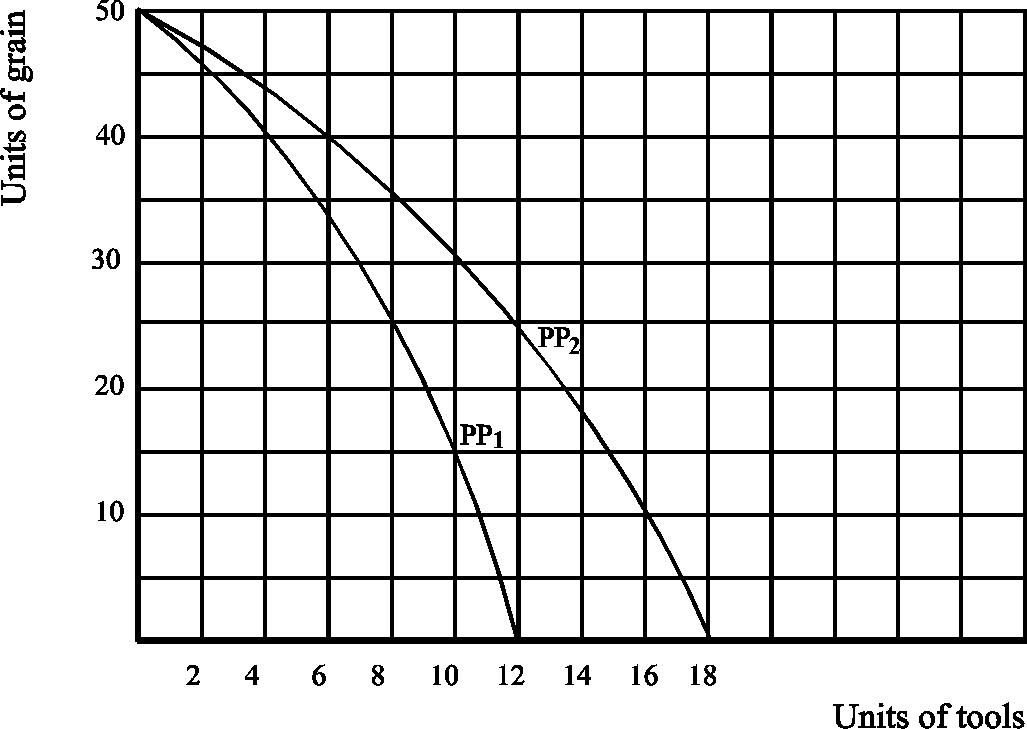
c) 25 units of grain (old combination C would now be 25 grain and 12 tools)
I. d) (Any activity that uses resources has an opportunity cost and is therefore not free)
II. c) (One could argue that taking a deep breathe on a remote mountain top is free)
III. b) (This is the answer that reveals the concept of opportunity costs, i.e., what other uses those resources could have been used for)
1. a) 20 tea is gained at a cost of 10 coffee. (Point u means 0 tea and 120 coffees; point v is 20 tea and 110 coffees)
b) 20 tea is gained at a cost of 30 coffee (Point w means 35 tea and 100 coffees; point x is 55 tea and 70 coffees)
c) 5 tea is gained at a cost of 30 coffee (Point y means 65 tea and 30 coffees; point z is7 0 tea and 0 coffees)
2. a) 10 beef (half-way between D and E)
b) 70 rice (half- way between B and C)
c) no (100 rice is between C and D but that means production of beef is between 20 and 35)
d) yes (combination C is 90 rice and 35 beef so it can certainly produce less than this)
3. a) 15 units of beef (This means going from combination A to combination C, where beef drops from 50 to 35)
b) 15 units of beef. (The increase in rice from 90 to 120 causes beef to drop from 35 to 20)
c) ½ unit of beef. (30 more rice costs 15 beef; therefore 1 more rice costs 15/30 beef)
d) 30 units of rice (The increase in beef from 20 to 35 causes rice to drop from 120 to 90)
4. a) See the following table: Table 1.9 (Completed)
0 30 50 65 75 80
b) No (If it produced 65 cheese – combination D – the maximum wine would be 70)
c) 30 wine (This would mean going from combination D to E. Production of wine would drop from 70 to 40, a difference of 30)
d) 15 cheese (This would mean going from combination D to C. Production of cheese would drop from 65 to 50, a difference of 15)
5. a) 40 wheat (This is half-way between combinations C and D. Half-way between 35 and 45 wheat is 40 wheat)
b) 4 cars (This means going from combination C to D. Car production would drop from 18 to 14, a difference of 4)
c) 2 ½ wheat (This means going from combination D to C. 4 more cars would cost 10 wheat; so 1 car would cost 10/4 or 2 ½ wheat)
6. a) See the following table: Table 1.12 (Completed)
b) 100 balls (Going from combination C to combination B, ball production drops from 250 to 150).
c) No. (The closest is combination C at 250 balls and 46 bats).
d) See the following table: Table 1.12 (Completed)
Bats 55 52 46 36 20 0 Bats 2 80 72 61 46 25 0 (Bat production increases by ½ unit per worker – this is not a 50% increase in production!)
e) Yes. This is shown in the revised production possibilities table: New combination C gives exactly 250 balls and 61 bats.
7. a) 0.75 trucks (12/16)
b) 1.75 trucks (14/8)
c) 1.33 kiwis (16/12)
d) 0.57 kiwis (8/14)
e) 12 kiwis and 13 trucks (8 kiwis and 6 trucks in Kitchener and 4 kiwis and 7 trucks in Waterloo)
f) 16 kiwis and 14 trucks (Kitchener produces only kiwis and Waterloo only trucks).
g) 4 kiwis and 1 truck (The difference between answers e) and f)).
8. a) See the following table: Table 1.13 (Completed)
b) 24 more capital goods (If it still wants 30 consumer goods, it could now have 64 capital goods – 24 more than previously)
c) 10 more consumer goods (If it still wants 40 capital goods, it can get them at the new combination B, which will also give 40 consumer goods – 10 more than previously)
d) 33 capital goods (This is a movement from combination F to combination B, which would result in capital goods falling from 58 to 25)
e) 52.8 capital goods (This is a movement from combination F to combination B in the table above which would result in capital goods in the capital 2 row falling from 92.8 to 40)
9. a) See the following table: Table 1.15 (Completed)
b) See the following figure: Figure 1.10 (completed)
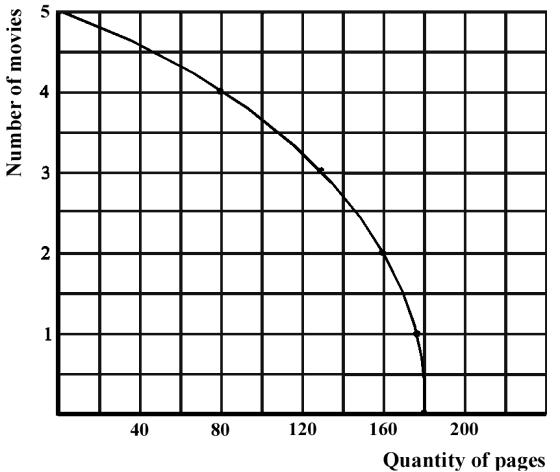
c) 20 pages of reading. It might be helpful to produce a production possibilities table as follows: From combination A to C gives 2 movies watched, pages studies drops from 180 to 160.
d) No. Combination C shows the best she can do is 3 movies and 130 pages studied.
e) 80 pages of reading. Going from combination B to combination A, pages studied drops from 80 to 0.
10. a) Oz: 20 food units and 10 equipment units; Zas 10 food units and 15 equipment units (This represents one-half of the quantities for each country shown in the question).
b) 30 food units and 25 equipment units (Found by adding together the totals for each country shown in answer a)).
c) Oz: 40 food units and 0 equipment units; Zas: 0 food units and 30 equipment units (Since Oz is more productive in food than is Zas, it would produce the amount of food as shown in the question and zero equipment. Since Zas is more productive in equipment than is Oz, it would produce the amount of equipment as shown in the question and zero food).
d) 40 food units and 30 equipment units. (Found by adding the quantities in answer c)).
e) 10 food units and 5 equipment units. (The difference between the quantities in answer d) and answer b)).
1. a)incorrect b)impossible c)correct
→ Communism is an example of a command economy where the state has central control over all aspects of the economy.
→ Consensus is not one of the four types of economies (the Four Cs).
2. a)impossible b)incorrect c)correct
→ A tractor is a piece of capital – the human made resource that is used to produce other products.
→ Money is not one of the four factors of production.
3. a)incorrect b)correct c)impossible
→ “When to produce” is not one of the three fundamental questions.
→ By technology, economists mean the method of production used, i.e., how to produce.
In Chapter One, we decided to begin by giving students an idea of how diverse and how engaged our discipline is by looking at a number of current controversies. This, we hope helps to correct the perception that many students have of economics as being a dry and theoretical subject with little relevance to the real world. We then focus on what is, arguably, the most important idea in economics: that scarcity forces choice and choice involves the concept of opportunity cost. We look at the three fundamental questions in economics and four methods of co-ordinating an economy and we have found that students react well to a discussion of both of these topics. Perhaps we should remind ourselves that introductory chapters are probably the only opportunity for us to encourage students to look beyond the market structure and realize that it is only one of various possible ways for society to organize its economic affairs.
We discuss the fact that the discipline’s methodology is, by necessity, abstract, since this is the only way one can deal with such a broad range of topics. The discussion of the use of abstract methodology leads naturally into a discussion of the role of models in economics.
We then look at our first model in economics, production possibilities, and show how illuminating this idea can be since it allows us to illustrate some of the basic, but vital topics in economics: choice, cost, economic growth, technological improvement and the immense importance of investment.
Starting with 1st edition, we have felt that a first chapter in Macroeconomics should discuss economic goals. Doing so illustrates the importance of relating economic theory to the policy decisions that governments have to make. In addition, we wanted to ensure that students had immediate exposure to the most important macro terms such as economic growth, unemployment, and inflation. We present several tables and figures, using the most recent data available, in order to give students some idea of how the Canadian economy has performed in recent years.
As a starting point in a new course, it may be useful for you to walk students through the Study Guide (as well as the Test your Understanding questions in the body of each chapter) and explain that answers can be found in the Student Solutions Manual. Answers to all questions, including Problems for Further Study, are found below
Many years of teaching the Principles of Microeconomics has convinced both of your authors that the vast majority of students can get a good grade in this supposedly tough course if they do all of the questions in the Study Guide. For some, this will, at first, take a lot of time but inevitably they will get faster and faster at answering questions as the term progresses and this will do wonders for their self-confidence.
It is our experience that if we spend enough time on production possibilities, we can illustrate six distinct aspects of economics: the necessity of choice, economic growth, unemployment, efficiency, technological change and opportunity cost. This makes production possibilities a powerful model and, more importantly, demonstrates what we mean by the word model. Given the huge role that models play in economic theory, understanding exactly what a model is can be an important step for any student.
In presenting this introductory chapter, we have also found it instructive to find out just how much students are aware of how well or badly Canada has fared in recent years in achieving its economics goals. It’s interesting to hear their estimates of the present rates of unemployment, inflation etc. The wide range of answers can be astonishing!
1. a) P
b) N
c) N
d) P
2. a) Mi
b) Ma
c) Mi
d) Ma
3. a) K
b) C
c) K
d) C
e) B
f) K
4. a) K
b) N
c) N
d) L
e) E
f) K
5. a) 400 guns
b) 100 guns. (This means going from combination b to combination c. As a result,\ the number of guns would drop from 400 to 300)
c) greater (since it costs 150 guns going from c to d compared to only 100 guns from b to c)
6. a) and b) See the following figure:
c) 25 units of grain (old combination C would now be 25 grain and 12 tools)
I. d) (Any activity that uses resources has an opportunity cost and is therefore not free)
II. c) (One could argue that taking a deep breathe on a remote mountain top is free)
III. b) (This is the answer that reveals the concept of opportunity costs, i.e., what other uses those resources could have been used for)
1. a) 20 tea is gained at a cost of 10 coffee. (Point u means 0 tea and 120 coffees; point v is 20 tea and 110 coffees)
b) 20 tea is gained at a cost of 30 coffee (Point w means 35 tea and 100 coffees; point x is 55 tea and 70 coffees)
c) 5 tea is gained at a cost of 30 coffee (Point y means 65 tea and 30 coffees; point z is7 0 tea and 0 coffees)
2. a) 10 beef (half-way between D and E)
b) 70 rice (half- way between B and C)
c) no (100 rice is between C and D but that means production of beef is between 20 and 35)
d) yes (combination C is 90 rice and 35 beef so it can certainly produce less than this)
3. a) 15 units of beef (This means going from combination A to combination C, where beef drops from 50 to 35)
b) 15 units of beef. (The increase in rice from 90 to 120 causes beef to drop from 35 to 20)
c) ½ unit of beef. (30 more rice costs 15 beef; therefore 1 more rice costs 15/30 beef)
d) 30 units of rice (The increase in beef from 20 to 35 causes rice to drop from 120 to 90)
4. a) See the following table: Table 1.9 (Completed)
b) No (If it produced 65 cheese – combination D – the maximum wine would be 70)
c) 30 wine (This would mean going from combination D to E. Production of wine would drop from 70 to 40, a difference of 30)
d) 15 cheese (This would mean going from combination D to C. Production of cheese would drop from 65 to 50, a difference of 15)
5. a) 40 wheat (This is half-way between combinations C and D. Half-way between 35 and 45 wheat is 40 wheat)
b) 4 cars (This means going from combination C to D. Car production would drop from 18 to 14, a difference of 4)
c) 2 ½ wheat (This means going from combination D to C. 4 more cars would cost 10 wheat; so 1 car would cost 10/4 or 2 ½ wheat)
6. a) See the following table: Table 1.12 (Completed)
b) 100 balls (Going from combination C to combination B, ball production drops from 250 to 150).
c) No. (The closest is combination C at 250 balls and 46 bats).
d) See the following table: Table 1.12 (Completed)
0 150 250 325 375 400 Bats 55 52 46 36 20 0
Bats 2 80 72 61 46 25 0
(Bat production increases by ½ unit per worker – this is not a 50% increase in production!)
e) Yes. This is shown in the revised production possibilities table: New combination C gives exactly 250 balls and 61 bats.
7. a) 0.75 trucks (12/16)
b) 1.75 trucks (14/8)
c) 1.33 kiwis (16/12)
d) 0.57 kiwis (8/14)
e) 12 kiwis and 13 trucks (8 kiwis and 6 trucks in Kitchener and 4 kiwis and 7 trucks in Waterloo)
f) 16 kiwis and 14 trucks (Kitchener produces only kiwis and Waterloo only trucks).
g) 4 kiwis and 1 truck (The difference between answers e) and f)).
8. a) See the following table: Table 1.13 (Completed)
b) 24 more capital goods (If it still wants 30 consumer goods, it could now have 64 capital goods – 24 more than previously)
c) 10 more consumer goods (If it still wants 40 capital goods, it can get them at the new combination B, which will also give 40 consumer goods – 10 more than previously)
d) 33 capital goods (This is a movement from combination F to combination B, which would result in capital goods falling from 58 to 25)
e) 52.8 capital goods (This is a movement from combination F to combination B in the table above which would result in capital goods in the capital 2 row falling from 92.8 to 40)
9. a) See the following table: Table 1.15 (Completed)
b) See the following figure: Figure 1.10 (completed)
c) 20 pages of reading. It might be helpful to produce a production possibilities table as follows: From combination A to C gives 2 movies watched, pages studies drops from 180 to 160.
d) No. Combination C shows the best she can do is 3 movies and 130 pages studied.
e) 80 pages of reading. Going from combination B to combination A, pages studied drops from 80 to 0.
10. a) Oz: 20 food units and 10 equipment units; Zas 10 food units and 15 equipment units (This represents one-half of the quantities for each country shown in the question).
b) 30 food units and 25 equipment units (Found by adding together the totals for each country shown in answer a)).
c) Oz: 40 food units and 0 equipment units; Zas: 0 food units and 30 equipment units (Since Oz is more productive in food than is Zas, it would produce the amount of food as shown in the question and zero equipment. Since Zas is more productive in equipment than is Oz, it would produce the amount of equipment as shown in the question and zero food).
d) 40 food units and 30 equipment units. (Found by adding the quantities in answer c)).
e) 10 food units and 5 equipment units. (The difference between the quantities in answer d) and answer b)).
1. 1. d; 2. c; 3. b; 4. a
2. a) normative; b) positive; c) positive; d) normative.
3. a) K; b) L; c) N; d) N; e) E
4. a) C; b) K; c) C; d) B
5. Economics is interested in how society makes choices about the production and allocation of resources and products. All societies must make choices since theywill never be able to produce everything that people want. The reason for this is that resources are scarce in relation to unlimited human wants.
6. Factors of Production Factor Explained Factor Payments
Labour human physical and mental effort wages
Capital human made resources interest Land natural made resources rent
Enterprise
The innovator and risk-taker profit
7. Normative statement: Too many people lost their jobs in Canada due to COVID-19. Positive statement: In April 2020, the unemployment rate rose to 13% which is the highest since 1982.
8.
There are two major causes of economic growth:
→ an increase in the quantity or quality of productive resources
→ an improvement in technology
9. The production possibility curve would look as follows:


The production possibilities curve would plot as a straight line because the per unit cost of production would remain constant. In other words, it would always cost the same number of moccasins (leather slippers) to produce additional shirts, and vice versa. Both a map and a theory abstract from reality and highlight only the most important relationships.
10. Both a map and a theory abstract from reality and highlight only the most important relationships.
11. Command comes in the form of parents insisting that children do certain things such as cleaning their room. Most “big” decisions, like where to take a holiday, are often made co-operatively. Custom comes in the form of parents using the same values to raise their children as was used by their own parents. Competition might be used, for example, where siblings compete to earnincrements of allowance. The second half of the question is asked only to stimulate thought on the effectiveness of incentives (rewards) and dis-incentives (penalties) within the family structure.
12. Since Kant is a high school dropout with no work experience, we would have to recognize that his next best alternative is probably a minimum wage job. (On the other hand, if some employers consider Kant enough of celebrity to hire him for a public image job, then Kant might do better.) Assuming a minimum wage job, his opportunity cost of continuing to play hockey would the minimum wage rate (say
$10 and hour) times 40 (hours per week) times 52 (weeks per year) which equals $20.800 per year.
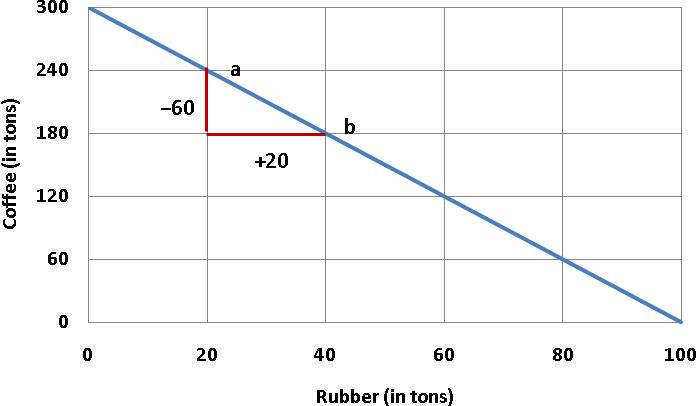
13. See the following figure:
14. It might be said that a high level of income is necessary for a higher standard of living because a higher income usually implies more goods and services for people as well as better health and education services. However, just because the average income of a country increases, this does not necessarily mean that the income of the average citizen increases. This is because not everyone may share in the increased prosperity. In addition, higher incomes as a result of increased production might also be accompanied by higher levels of resource depletion, pollution, a loss of leisure and higher levels of stress
15. An economy might well grow too fast if the country is not able to adjust to rapid change. Fast change will undoubtedly affect many aspects of life and cause a great disruption in people’s lives. There are a number of possible costs associated with fast economic growth and these include: a high rate of resource depletion; increased pollution of land, air and water; an increased level of traffic congestion and stress; and a loss of leisure. It may also lead to a great deal less parks and open spaces.
16. The five methods of allocation are:
a) First come, first served. It means that products are given according to the order in which people apply whether that's done by lining up, by phoning in or registering on a website.
b) By lottery. Everyone is entered into a draw and has an equal chance of obtaining the product.
c) Sellers' preference. This means that the seller of the product makes the decision on who gets what and what criteria will be used.
d) By government decree. The ruling authority decides on the allocation.
e) The market decides. This Is is where the forces of demand and supply determine how much each buyer obtains. To a large extent, this is based upon how much people are willing to pay and how much they can afford.
17. The two major factors which has led to the increased pressure on natural resources is the massive increase in the size of the world’s population along with the increase in standards of living brought about by economic growth thus causing a huge increase in the demand for goods and, therefore, natural resources.
1. a)incorrect b)impossible c)correct
→ Communism is an example of a command economy where the state has central control over all aspects of the economy.
→ Consensus is not one of the four types of economies (the Four Cs).
2. a)impossible b)incorrect c)correct
→ A tractor is a piece of capital – the human made resource that is used to produce other products.
→ Money is not one of the four factors of production.
3. a)incorrect b)correct c)impossible
→ “When to produce” is not one of the three fundamental questions.
→ By technology, economists mean the method of production used, i.e., how to produce.