
Test Bank for Principles of Biology 2026 Release 1st Edition by Brooker, Widmaier, Graham, Stiling
ISBN: 9781266522154
Correct Answers are located at the end of each chapter.
TRUE/FALSE - Write 'T' if the statement is true and 'F' if the statement is false.
1) All tissues are composed of cells.
⊚ true
⊚ false
2) The capacity to maintain a fairly constant body temperature is a homeostatic process.
⊚ true
⊚ false
3) A community is composed of different populations of animals and plants.
⊚ true
⊚ false
4) A defining characteristic that distinguishes prokaryotic and eukaryotic organisms is the lack of a cell membrane in prokaryotes.
⊚ true
⊚ false
5) The modification of a limb that was used for walking in a preexisting ancestor to one that is used as a wing for a species today is called biological organization.
⊚ true
⊚ false
6) A bacterial infection such as pneumonia is most likely caused by organisms derived from the kingdom fungi.
⊚ true
⊚ false
7) All genetic mutations are harmful to an organism.
⊚ true
⊚ false
8) Vertical evolution, whereby living organisms evolve from a common ancestor ("tree of life"), is the only mechanism of evolution on Earth.
⊚ true
⊚ false
9) Proteins, rather than genes, are most directly responsible for the structure, function, and appearance of organisms.
⊚ true
⊚ false
10) Little scientific evidence is necessary when formulating a theory.
⊚ true
⊚ false
11) The maintenance of cell structure requires energy.
⊚ true
⊚ false
12) Discovery-based science and hypothesis testing are the two major scientific approaches that help us understand biology.
⊚ true
⊚ false
CHECK ALL THE APPLY. Choose all options that best completes the statement or answers the question.
13) A journal article that you are reading explains the difference between DNA sequences of a species of plant that is found in diverse environments. These sequences lead to structural change in the size of the flowers due to environmental differences. The areas of science incorporated in this article include __________.
A) ecology
B) anatomy
C) cell biology
D) molecular biology
E) systems biology
14) When performing hypothesis testing, the steps that most accurately describe the process you must go through include __________.
A) analyze data to support or reject hypothesis
B) create a natural phenomenon
C) observe a natural phenomena
D) develop a theory based on observations
E) develop hypotheses to explain phenomena
F) design experiments to determine if predictions are supported or not
15) Which of the following are related to biological sex?
A) The terms male and female
B) Socially constructed characteristics of men and women
C) External and internal structures associated with reproduction
D) The type of gamete an individual has the potential to produce
E) The composition of sex chromosomes present in the cells
MULTIPLE CHOICE - Choose the one alternative that best completes the statement or answers the question.
16) Plant photosynthesis and the consumption of plants by animals is best explained by what unifying principle of life?
A) All living organisms use energy.
B) All living organisms maintain organization.
C) All living organisms have evolved over the course of many generations.
D) All living organisms maintain some level of homeostasis.
E) All living organisms are composed of similar structures.
17) A plant will begin flowering in response to changes in length of daylight, temperature, and light quality. This is an example of which unifying principle of life?
A) Plants conduct photosynthesis.
B) Living organisms maintain homeostasis.
C) Living organisms interact with their environment.
D) Living organisms grow and develop.
E) Populations of organisms evolve from one generation to the next.
18) Whether the external temperature is hot or cold, birds maintain an internal body temperature of approximately 40°C. This is an example of
A) metabolism.
B) cellular respiration.
C) growth and development.
D) homeostasis.
E) proteomics.
19) Proteins are largely responsible for the traits of living organisms while __________ provides the blueprint for the organization, development, and function of living things.
A) DNA
B) protein
C) carbohydrate
D) lipid
E) metabolite
20) Which level of organization includes all of the others in the list?
A) cell
B) tissue
C) organ
D) organism
E) population
21) Which level of organization is common to all life forms?
A) cell
B) tissue
C) organ
D) organism
E) population
22) When cells in an organism associate with each other they form
A) atoms.
B) molecules.
C) macromolecules.
D) tissues.
E) populations.
23) A community of organisms interacting with their physical environment is a/an
A) population.
B) organism.
C) biosphere.
D) ecosystem.
E) macromolecular community.
24) In life, which is the simplest of all levels of organization?
A) atom
B) cell
C) organ
D) organism
E) population
25) Molecules are made up of __________.
A) atoms
B) cells
C) organs
D) organisms
E) populations
26) The boa constrictors located on an island are an example of __________.
A) a cell
B) an organ
C) an organism
D) a population
E) an ecosystem
27) A flower on a plant represents the __________ level of organization.
A) atom
B) cell
C) organ
D) organism
E) population
28) The phenomenon through which populations of organisms change over several generations is termed
A) homeostasis.
B) growth and development.
C) reproduction.
D) biological evolution.
E) organization.
29) Changes in __________ represent the predominant cause for biological evolution.
A) homeostasis
B) growth and development
C) reproduction
D) genetic makeup
E) energy
30) A variety of finch species within the Hawaiian Islands have acquired different types of beaks needed for utilizing specific food resources. What is the likely process by which these different species of finches came about?
A) vertical descent with mutation
B) horizontal gene transfer
C) an accumulation of harmful genetic mutations
31) What feature of genetic mutations can eventually lead to the evolution of new species?
A) Mutations always produce harmful effects.
B) Mutations never affect protein structure or function.
C) Mutations are not a mechanism through which biological evolution occurs.
D) Mutations always produce beneficial effects.
E) Mutations produce changes in the DNA sequence of a gene.
32) New species evolve from pre-existing species by the accumulation of
A) metabolic events.
B) genetic mutations.
C) proteins.
D) reproductive events.
E) developmental events.
33) How does evolutionary change occur?
A) Through the modification of characteristics in a preexisting population.
B) It may involve vertical descent with mutation.
C) It may involve horizontal gene transfer.
D) All of these choices are correct.
E) None of these choices are correct.
34) In the process of biological evolution, new species may evolve through exchange of genes from one species to another. This process is called
A) proteome transfer.
B) horizontal gene transfer.
C) vertical evolution.
D) vertical descent with mutation.
E) genomic sciences.
35) The grouping or classification of species is termed
A) genus.
B) kingdom.
C) taxonomy.
36) When grouping organisms, which classification is most general for a particular type of organism?
A) Kingdom
B) Phylum
C) Order
D) Family
E) Species
37) All organisms in the Kingdom __________ can perform photosynthesis.
A) Animalia
B) Protista
C) Fungi
D) Plantae
E) Bacteria
38) Our species is called Homo sapiens. The first word refers to which taxonomical grouping?
A) Kingdom
B) Phylum
C) Order
D) Genus
E) Species
39) When considering nomenclature for scientific names, what is the difference between the two primates, Homo sapiens and Homo erectus?
A) One is a primate but the other is not.
B) They are animals of a different kingdom.
C) They are animals of a different order.
D) They are animals of a different species.
E) They are animals of a different genus.
40) Which domain of life contains the most multicellular organisms?
A) Archaea
B) Bacteria
C) Prokarya
D) Eukarya
E) Microorganisms
41) An explanation for a biological process that is substantiated by a large body of evidence is called a
A) hypothesis.
B) theory.
C) systems biology.
D) reductionism.
E) prediction.
42) Collecting data without a specific hypothesis in mind is called
A) reductionism.
B) hypothesis testing.
C) discovery-based science.
D) theoretical.
E) All of these choices are correct.
43) What is the appropriate order of the stages of investigating whether maple trees drop their leaves in the autumn because of colder days?
1. Maple trees are grown in two greenhouses where the only variable is temperature (15°C vs. 10°C).
2. The hypothesis is rejected.
3. There is no statistical difference in the number of leaves dropped at 10°C as compared to 15°C.
4. The observation is that maple trees drop their leaves in autumn.
5. The hypothesis is that maple trees drop their leaves because of colder temperatures.
A) 1, 2, 3, 4, 5.
B) 3, 4, 5, 1, 2.
C) 5, 4, 3, 1, 2.
D) 4, 5, 1, 3, 2.
E) 3, 4, 2, 1, 5.
44) “All living organisms are composed of cells” is best related to what kind of scientific statement?
A) Hypothesis
B) Theory
C) Discovery
D) Prediction
E) Fact
45) A wristwatch suddenly stops working. After replacing the battery, the watch starts working again. Which of the following statements correctly describes the situation from the perspective of the scientific method?
A) This proves that a dead battery was the reason the wristwatch stopped working.
B) This substantiates the theory that all wristwatches require functional batteries.
C) This is consistent with the hypothesis that a dead battery caused the wristwatch to stop working.
D) This leads to the prediction that a battery is required for wristwatch operation.
46) A researcher decides to test the scientific validity of the common phrase “An apple a day keeps the doctor away.” What would be a valid hypothesis to investigate this specific question?
A) Eating apples decreases the frequency of contracting a cold.
B) The daily consumption of a single apple does not change the number of visits to the doctor.
C) Eating one apple every day is good for you.
D) Apples are high in vitamin C.
E) Those who consume apples have longer lifespans than those who do not consume apples.
47) A researcher tests the hypothesis that large, daily doses of vitamin C help protect against catching the common cold. What would be the best experimental and control group to test this hypothesis?
A) Experimental group: takes a large dose of vitamin C daily; Control group: takes nothing.
B) Experimental group: people with a cold are administered vitamin C daily; Control group: people without a cold are not administered vitamin C.
C) Experimental group: takes a large dose of vitamin C daily; Control group: takes a large weekly dose of vitamin C.
D) Experimental group: takes a large, daily dose of vitamin C; Control group: takes a daily dose of a sugar pill disguised as vitamin C.
48) A researcher hypothesizes that crocodile gender is determined by the incubation temperature of the egg. The hypothesis states that an average nest temperature of 32–33°C results in the birth of male crocodiles, while nest temperatures above or below that incubation temperature range result in female crocodiles.
What is a valid, testable prediction based on this hypothesis?
A) Male crocodiles will prefer temperatures of 32–33°C.
B) Incubation of any crocodile egg at 32°C, will result in a male crocodile.
C) Male eggs will hatch at 32°C, while female eggs will not hatch at 32°C.
D) Male eggs will be more fragile than female eggs.
E) Crocodiles arrange the gender of offspring by manipulating incubation temperatures.
49) A researcher hypothesizes that crocodile gender is determined by the incubation temperature of the egg. The hypothesis states that an average nest temperature of 32–33°C results in the birth of male crocodiles, while nest temperatures above or below that incubation temperature range result in female crocodiles.
The researcher observes that an average nest temperature of 32–33°C results in the birth of male crocodiles, while nest temperatures above or below that incubation temperature range result in female crocodiles. What is the most likely explanation for this phenomenon?
A) Incubation temperature results in a change in crocodilian genes.
B) Incubation temperature results in a change in crocodilian proteins.
C) Incubation temperature changes both the crocodilian genes and proteins.
D) Since this phenomenon is influenced by an external stimulus (temperature), it cannot be attributed to changes in either the genes or the proteins.
50) A researcher hypothesizes that crocodile gender is determined by the incubation temperature of the egg. The hypothesis states that an average nest temperature of 32–33°C results in the birth of male crocodiles, while nest temperatures above or below that incubation temperature range result in female crocodiles.
Researchers find a group of crocodiles where an expanded incubation temperature gives rise to male crocodiles. This particular group of crocodiles hatch male crocodiles even with incubation temperatures as low as 29 °C. What type of scientific approach has led to this observation?
A) Discovery-based science
B) Hypothesis testing
C) Theoretical testing
D) Scientific method
51) A researcher hypothesizes that crocodile gender is determined by the incubation temperature of the egg. The hypothesis states that an average nest temperature of 32–33°C results in the birth of male crocodiles, while nest temperatures above or below that incubation temperature range result in female crocodiles.
What is the most likely explanation for how a group of crocodiles acquired the trait in which lower incubation temperatures give rise to male crocodiles?
A) Horizontal gene transfer from a related species has introduced changes in this group’s genes.
B) Horizontal gene transfer from a related species has introduced changes in this group’s proteins.
C) One or more mutations in the genes have been passed through the group by vertical descent.
D) One or more mutations in the proteins have been passed through the group by vertical descent.
52) A scientist isolates a single-celled organism from the bottom of a sulfur hot spring. When examined under the microscope, it is clear that the cell is very small and contains no nucleus. Based on this evidence alone, in what domain of life is this organism?
A) Eukarya
B) Bacteria
C) Archaea
D) Either bacteria or archaea
E) It is impossible to determine anything based on this evidence alone.
53) Which statement is true about all eight bear species shown in the evolutionary tree?
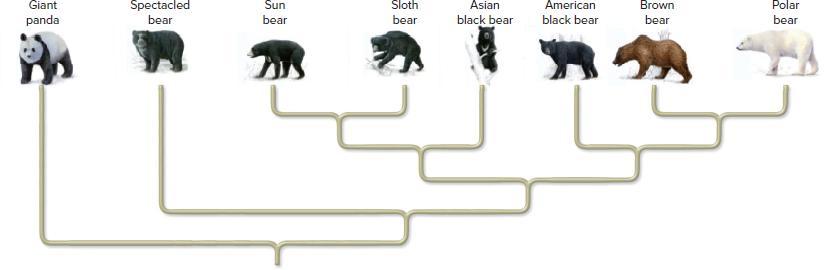
A) All bears have similarities because they evolved from a common ancestor.
B) All bears are genetically identical because they have a common ancestor.
C) All bears have adapted to live in cold temperatures.
D) All bears are similar because they mate with each other.
54) Which of the following is NOT an example of a biological model?
A) Computer-generated structure of amino acids found in proteins
B) Growth equations for population growth
C) One of two pathways describing how plants transport minerals into their roots
D) Pictures of different ecosystems
E) Taxonomic classification of species in the kingdom Animalia
55) Which of the following describes biodiversity?
A) Biodiversity includes both the variety of species and their genetic diversity.
B) Biodiversity is the term for the collection of species found in a particular location.
C) Biodiversity is the relationship of humans and other species in the environment.
D) Biodiversity is the term for the genes present in all organisms in a population.
56) Humans can impact the biodiversity in an ecosystem. Which of the following could result in less biodiversity?
A) Humans reducing sustainability.
B) Humans reducing consumption.
C) Humans reducing pollution.
D) Humans enacting conservation and restoration projects.
Answer Key
Test name: Chapter 01
[A, B, D] 14) [A, C, E, F] 15) [A, C, D, E] 16) A 17) C 18) D 19) A 20) E 21) A 22) D 23) D 24) A 25) A
D
C 28) D 29) D
A
E
B
D
B
C
A
D
38) D
39) D
40) D
41) B
42) C
43) D
44) B
45) C
46) B
47) D
48) B
49) B
50) A 51) C
52) D
53) A 54) D
55) A
56) A