Solutions Manual for Practical Business
Math Procedures 2025 Release 1st
Edition by Slater, Wittry
ISBN: 9781266015526
ISBN: 9781266015526
Cats cost more than owners think.
Recent finding: When asked about the lifetime cost of owning their pet, about half of cat owners guessed a figure that was too low. Actual costs to own a cat:
Average annual expenses are about $351 to $584 for food...$374 to $965 for medical...$169 to $698 for treats, supplies and grooming...and $66 to $239 for other miscellaneous items. Assuming your cat lives 15 years, expect to spend anywhere from $15,055 to $45,790 over the pet’s lifetime.

Survey by researchers at consumer financial services company Synchrony, parent company of CareCredit and Pets Best Pet Insurance. Synchrony.com
“Bottom Line on the News,” BottomLine Personal. 06/01/23. pg. 31. Used with Permission.
1. Use place values to read and write numeric and verbal whole numbers.
2. Round whole numbers to the indicated position.
3. Use blueprint aid for dissecting and solving a word problem.
1. Add whole numbers; check and estimate addition computations.
2. Subtract whole numbers; check and estimate subtraction computations.
1. Multiply whole numbers; check and estimate multiplication computations.
2. Divide whole numbers; check and estimate division computations.
Traditional book or ebook
Check box as you complete each step.
Steps
☐ Read learning unit.
☐ Complete practice quiz at the end of the learning unit. (Video available in Connect.)
☐ Grade practice quiz using provided solutions. (For more help, watch the learning unit video in Connect and have a Study Session with the authors. Then complete the additional practice quiz in Connect.)
☐ Repeat above for each of the three learning units in Chapter 1.
☐ Review chapter organizer.
☐ Complete assigned homework.
☐ Finish summary practice test. (Go to Connect via the ebook link and do the interactive video worksheet to grade.)
☐ Complete instructor ’s exam.
The chapter opener clip shows that owning a cat has many costs associated with it. Over a 15-year period expect to spend between $15,055 and $45,790. Numbers, or math calculations, should play a big part in your decision-making process of whether or not to buy a cat or any other pet.
Your study of numbers begins with a review of basic computation skills that focuses on speed and accuracy. You may think, “But I can use my calculator.” Even if your instructor allows you to use a calculator, you still must know the basic computation skills. You need these skills to know what to calculate, how to interpret your calculations, how to make estimates to recognize errors you made in using your calculator, and how to make calculations when you do not have a calculator.
The United States’ numbering system is the decimal system or base 10 system. Your calculator gives the 10 single-digit numbers of the decimal system—0, 1, 2, 3, 4, 5, 6, 7, 8, and 9. The center of the decimal system is the decimal point. When you have a number with a decimal point, the numbers to the left of the decimal point are whole numbers and the numbers to the right of the decimal point are decimal numbers (discussed in Chapter 3). When you have a number without a decimal, the number is a whole number and the decimal is assumed to be after the number.
This chapter discusses reading, writing, and rounding whole numbers; adding and subtracting whole numbers; and multiplying and dividing whole numbers.
Let’s begin our study of whole numbers.
The decimal system is a place-value system based on the powers of 10. Any whole number can be written with the 10 digits of the decimal system because the position, or placement, of the digits in a number gives the value of the digits.
To determine the value of each digit in a number, we use a place-value chart (Figure 1–1) that divides numbers into named groups of three digits, with each group separated by a comma. To separate a number into groups, you begin with the last digit in the number and insert commas every three digits, moving from right to left. This divides the number into the named groups (units, thousands, millions, billions, trillions) shown in the place-value chart. Within each group, you have a ones, tens, and hundreds place. Keep in mind that the leftmost group may have fewer than three digits.
In Figure 1–1, the numeric number 1,605,743,891,412 illustrates place values. When you study the place-value chart, you can see that the value of each place in the chart is 10 times the value of the place to the right. We can illustrate this by analyzing the last four digits in the number 1,605,743,891,412:
1,412 = (1 × 1,000) + (4 × 100) + (1 × 10) + (2 × 1)
So we can also say, for example, that in the number 745, the “7” means seven hundred (700); in the number 75, the “7” means 7 tens (70), and the “5” means 5 ones (5).
To read and write a numeric number in verbal form, you begin at the left and read each group of three digits as if it were alone, adding the group name at the end (except the last units group and groups of all zeros). Using the place-value chart in Figure 1–1, the number 1,605,743,891,412 is read as one trillion, six hundred five billion, seven hundred forty-three million, eight hundred ninety-one thousand, four hundred twelve. You do not read zeros. They fill vacant spaces as placeholders so that you can correctly state the number values. Also, the numbers twenty-one to ninety-nine must have a hyphen. And most important, when you read or write whole numbers in verbal form, do not use the word and. In the decimal system, and indicates the decimal, which we discuss in Chapter 3.
By reversing this process of changing a numeric number to a verbal number, you can use the place-value char t to change a verbal number to a numeric number. Remember that you must keep track of the place value of each digit. The place values of the digits in a number determine its total value.
Before we look at how to round whole numbers, we should look at how to convert a number indicating parts of a whole number to a whole number. Ford Motor is investing $3.5 billion
Whole Number Groups
In 2050 the world population will reach almost 10 billion.
F ord M otor plans to invest
$3.5 billion to build a battery plant in Michigan to help produce 2 million electric vehicles by 2026
to build a battery plant. (See “Did you know?”) The following steps explain how to convert decimal numbers into whole numbers.
Step 1. Drop the decimal point and insert a comma.
Step 2. Add zeros so the leftmost digit ends in the word name of the amount you want to convert. Be sure to add commas as needed.
EXAMPLE Convert $3.5 billion to a regular whole number.
Step 1. $3.5 billion
$3.5 Change the decimal point to a comma.
Step 2. $3,500,000,000 Add zeros and commas so the whole number indicates billions.
Many of the whole numbers you read and hear are rounded numbers. Government statistics are usually rounded numbers. The financial reports of companies also use rounded numbers. All rounded numbers are approximate numbers. The more rounding you do, the more you approximate the number.
Rounded whole numbers are used for many reasons. With rounded whole numbers you can quickly estimate ar ithmetic results, check actual computations, report numbers that change quickly such as population numbers, and make numbers easier to read and remember.
Numbers can be rounded to any identified digit place value, including the first digit of a number (rounding all the way). To round whole numbers, use the following three steps:
Step 1. Identify the place value of the digit you want to round.
Step 2. If the digit to the right of the identified digit in Step 1 is 5 or more, increase the identified digit by 1 (round up). If the digit to the right is less than 5, do not change the identified digit.
Step 3. Change all digits to the right of the rounded identified digit to zeros.
EXAMPLE 1 Round 9,362 to the nearest hundred.
Step 1. 9,362 The digit 3 is in the hundreds place value.
Step 2. The digit to the right of 3 is 5 or more (6). Thus, 3, the identified digit in Step 1, is now rounded to 4. You change the identified digit only if the digit to the right is 5 or more.
9,462
Step 3. 9,400 Change digits 6 and 2 to zeros, since these digits are to the right of 4, the rounded number.
By rounding 9,362 to the nearest hundred, you can see that 9,362 is closer to 9,400 than to 9,300.
Next, we show you how to round to the nearest thousand.
EXAMPLE 2 Round 67,951 to the nearest thousand.
Step 1. 67,951 The digit 7 is in the thousands place value.
Step 2. The digit to the right of 7 is 5 or more (9). Thus, 7, the identified digit in Step 1, is now rounded to 8
68,951
Step 3. 68,000 Change digits 9, 5, and 1 to zeros, since these digits are to the right of 8, the rounded number.
By rounding 67,951 to the nearest thousand, you can see that 67,951 is closer to 68,000 than to 67,000.
Now let’s look at rounding all the way. To round a number all the way, you round to the first digit of the number (the leftmost digit) and have only one nonzero digit remaining in the number.
Today the average cost to raise a child through the age of 18 is about $310,0 00
EXAMPLE 3 Round 7,843 all the way.
Step 1. 7,843 Identified leftmost digit is 7
Step 2. Digit to the right of 7 is greater than 5, so 7 becomes 8.
8,843
Step 3. 8,000 Change all other digits to zeros.
Rounding 7,843 all the way gives 8,000. In the “Did you know?” box to the left, the $310,000 rounds all the way to $300,000.
Remember that rounding a digit to a specific place value depends on the degree of accuracy you want in your estimate. For example, in the Ford Motor “Did you know?” box, $3.5 billion rounded all the way would be $4 billion. Note the digit to the right of the identified digit is 5 or greater so the identified digit (3) is rounded up to 4.
$3,500,000,000 $4,000,000,000 5 or more Identified digit
Before concluding this unit, let’s look at how to dissect and solve a word problem.
As a student, your author found solving word problems difficult. Not knowing where to begin after reading the word problem caused the difficulty. Today, students still struggle with word problems as they try to decide where to begin.
Solving word problems involves organization and persistence. Recall how persistent you were when you learned to ride a two-wheel bike. Do you remember the feeling of success you experienced when you rode the bike without help? Apply this persistence to word problems. Do not be discouraged. Each person learns at a different speed. Your goal must be to FINISH THE RACE and experience the success of solving word problems with ease.
To be organized in solving word problems, you need a plan of action that tells you where to begin—a blueprint aid. Like a builder, you will refer to this blueprint aid constantly until you know the procedure. The blueprint aid for dissecting and solving a word problem appears below. Note that the blueprint aid serves an important function—it decreases your math anxiety.
Remember to RTDQ2: Read the darn question and then read it again before trying to solve it.

The facts Solving for? Steps to take Key points
UEPRINT
BL


Do not carry your Social Security card in your wallet. Keep it and other important documents in a safe deposit box or fireproof container. Shred any document that contains personal information, such as anything with your Social Security number on it, old bank statements, applications for loans, and so on.
Now let’s study this blueprint aid. The first two columns require that you read the word problem slowly. Think of the third column as the basic information you must know or calculate before solving the word problem. Often this column contains formulas that provide the foundation for the step-by-step problem solution. The last column reinforces the key points you should remember.
It’s time now to try your skill at using the blueprint aid for dissecting and solving a word problem.
The Word Problem On the 100th anniversary of Tootsie Roll Industries, the company reported sharply increased sales and profits. Sales reached one hundred ninety-four million dollars and a record profit of twenty-two million, five hundred fifty-six thousand dollars. The company president requested that you round the sales and profit figures all the way.
Study the following blueprint aid and note how we filled in the columns with the information in the word problem. You will find the organization of the blueprint aid most helpful. Be persistent! You can dissect and solve word problems! When you are finished with the word problem, make sure the answer seems reasonable.
The facts Solving for? Steps to take Key points
UEPRINT
BL
Sales: One hundred ninety-four million dollars.
Profit: Twenty-two million, five hundred fifty-six thousand dollars.
Steps to solving problem
1. Convert verbal to numeric.
Sales and profit rounded all the way.
Express each verbal form in numeric form. Identify leftmost digit in each number.
Rounding all the way means only the leftmost digit will remain. All other digits become zeros.
One hundred ninety-four million dollars
Twenty-two million, five hundred fifty-six thousand dollars
2. Identify leftmost digit of each number.
3. Round.
$194,000,000
$ 22,556,000
$194,000,000 $22,556,000
$200,000,000 $20,000,000
Note that in the final answer, $200,000,000 and $20,000,000 have only one nonzero digit. Remember that you cannot round numbers expressed in verbal form. You must convert these numbers to numeric for m.
Now you should see the importance of the information in the third column of the blueprint aid. When you complete your blueprint aids for word problems, do not be concerned if the order of the information in your boxes does not follow the order given in the text boxes. Often you can dissect a word problem in more than one way.
Your first Practice Quiz follows. Be sure to study the paragraph that introduces the Practice Quiz. LO 3
Complete this Practice Quiz to see how you are doing.
At the end of each learning unit, you can check your progress with a Practice Quiz. If you had difficulty understanding the unit, the Practice Quiz will help identify your area of weakness. Work the problems on scrap paper. Check your answers with the worked-out solutions that follow the quiz. Ask your instructor about specific assignments and the videos available in Connect for each unit Practice Quiz.
1. Write in verbal form: a. 7,948 b. 48,775 c. 814,410,335,414
2. Round the following numbers as indicated:
For extra help from your authors–Sharon and Jeff–see the videos in Connect.
3. Kellogg’s reported its sales as five million, one hundred eighty-one thousand dollars. The company earned a profit of five hundred two thousand dollars. What would the sales and profit be if each number were rounded all the way? (Hint: You might want to draw the blueprint aid since we show it in the solution.)
1. a. Seven thousand, nine hundred forty-eight b. Forty-eight thousand, seven hundred seventy-five c. Eight hundred fourteen billion, four hundred ten million, three hundred thirty-five thousand, four hundred four teen
2. a. 90 b. 700 c. 8,000 d. 5,000
3. Kellogg’s sales and profit:
Rounding all the way means only the leftmost digit will remain. All other digits become zeros. Steps to solving problem
1. Convert verbal to numeric.
Five million, one hundred eighty-one thousand
$5,181,000 Five hundred two thousand
2. Identify leftmost digit of each number.
Round.
Let’s assume in the Ford Motor “Did you know?” box that currently Ford has invested $3,150,000,000. How much more investment will Ford need to make to reach its goal of $3.5 billion?
This unit teaches you how to manually add and subtract whole numbers. When you least expect it, you will catch yourself automatically using this skill.
To add whole numbers, you unite two or more numbers called addends to make one number called a sum, total, or amount. The numbers are arranged in a column according to their place values—units above units, tens above tens, and so on. Then, you add the columns of numbers from top to bottom. To check the result, you re-add the columns from bottom to top. This procedure is illustrated in the steps that follow.
Step 1. Align the numbers to be added in columns according to their place values, beginning with the units place at the right and moving to the left.
Step 2. Add the units column. Write the sum below the column. lf the sum is more than 9, write the units digit and carry the tens digit.
Step 3. Moving to the left, repeat Step 2 until all place values are added.
Adding top to bottom 1,362 Checking bottom to top
Alternate check 5,913
Add each column as a separate total and then combine. The end result is the same.
Did You Know? Math in the Media
Current Odometer Reading
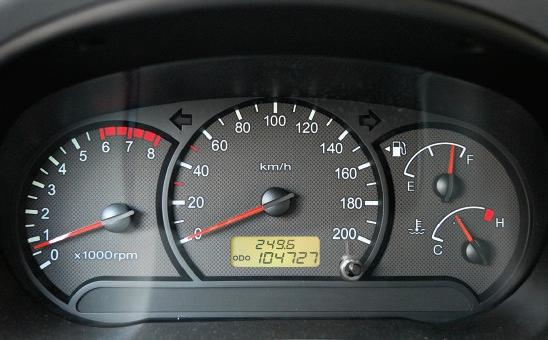
How to Quickly Estimate Addition by Rounding All the Way In Learning Unit 1–1, you learned that rounding whole numbers all the way gives quick arithmetic estimates. Using the current odometer reading chart shown on the left, note how you can round each number all the way and the total will not be rounded all the way. Remember that rounding all the way does not replace actual computations, but it is helpful in making quick commonsense decisions.
Rounded all the way
Rounding all the way means each number has only one nonzero digit.
Note: The final answer could have more than one nonzero digit since the total is not rounded all the way.
Subtraction is the opposite of addition. Addition unites numbers; subtraction takes one number away from another number. In subtraction, the top (largest) number is the minuend. The number you subtract from the minuend is the subtrahend, which gives you the difference between the minuend and the subtrahend. The steps for subtracting whole numbers follow.
Step 1. Align the minuend and subtrahend according to their place values.
Step 2. Begin the subtraction with the units digits. Write the difference below the column. If the units digit in the minuend is smaller than the units digit in the subtrahend, borrow 1 from the tens digit in the minuend. One tens digit is 10 units.
Step 3. Moving to the left, repeat Step 2 until all place values in the subtrahend are subtracted.
EXAMPLE The current odometer reading chart illustrates the subtraction of whole numbers:
What is the difference in miles between the Toyota Tundra and the Ford Bronco? As shown below you can use subtraction to arrive at the 19,354 difference.
241,845
Minuend (larger number)
−222,491 Subtrahend 19,354 Difference Check
Checking subtraction requires adding the difference (19,354) to the subtrahend (222,491) to arrive at the minuend (241,845).
Accurate subtraction is important in many business operations. In Chapter 4 we discuss the importance of keeping accurate subtraction in your checkbook balance. Now let’s check your progress by dissecting and solving a word problem.
The Word Problem Hershey’s produced 25 million Kisses in one day. The same day, the company shipped 4 million to Japan, 3 million to France, and 6 million throughout the United States. At the end of that day, what is the company’s total inventory of Kisses? What is the inventory balance if you round the number all the way?
College is worth it! College graduates earn substantially more money each year than high school graduates and that wage premium is increasing steadily—almost twice as much. Stay in school.
Produced: 25 million. Shipped: Japan, 4 million; France, 3 million; United States, 6 million.
Steps to solving problem
all the way.
1. Calculate the total Kisses shipped. 4,000,000 3,000,000 + 6,000,000 13,000,000
2. Calculate the total Kisses left in inventory. 25,000,000 13,000,000 12,000,000
3. Rounding all the way.
Rounding all the way means rounding to last digit on the left.
Identified digit is 1. Digit to right of 1 is 2, which is less than 5. Answer: 10,000,000 .
Complete this Practice Quiz to see how you are doing.
The Practice Quiz that follows will tell you how you are progressing in your study of Chapter 1.
For extra help from your authors–Sharon and Jeff–see the videos in Connect.
Did you k now that people check their inboxes about 80-times per day? Did You Know? Math in the Media
1. Add by totaling each separate column:
2. Estimate by rounding all the way (do not round the total of estimate) and then do the actual computation:
3. Subtract and check your answer:
4. Jackson Manufacturing Company projected its year 202X furniture sales at $900,000. During 202X, Jackson earned $510,000 in sales from major clients and $369,100 in sales from the remainder of its clients. What is the amount by which Jackson over- or underestimated its sales? Use the blueprint aid, since the answer will show the completed blueprint aid.
✓ Solutions
1.
4. Jackson Manufacturing Company over- or
1. Calculate total actual sales.
2. Calculate overestimated or underestimated sales.
(overestimated)
Check out the “Did you know?” box to the left. Did you know that after 7 days you would have checked your inbox 560 times?
This unit will sharpen your skills in two important arithmetic operations—multiplication and division. These two operations frequently result in knowledgeable business decisions.
From calculating the number of times people check their inbox for 2 weeks you know that multiplication is a shortcut to addition:
560 × 2 = 1,120 or
560 + 560 = 1,120
Before learning the steps used to multiply whole numbers with two or more digits, you must learn some multiplication terminology.
Note in the follo wing example that the top number (number we want to multi ply) is the multiplicand. The bottom number (number doing the multiplying) is the multiplier. The final number (answer) is the product. The numbers between the multiplier and the product are partial products. Also note how we positioned the partial product 2090 . This number is the result of multiplying 418 by 50 (the 5 is in the tens position). On each line in the partial products, we placed the first digit directly below the digit we used in the multiplication process.
EXAMPLE
418 Top number (multiplicand) × 52 Bottom number (multiplier)
2 × 418 836 = 50 × 418 = + 20,900 Product answer
We can now give the following steps for multiplying whole numbers with two or more digits:
Step 1. Align the multiplicand (top number) and multiplier (bottom number) at the right. Usually, you should make the smaller number the multiplier.
Step 2. Begin by multiplying the right digit of the multiplier with the right digit of the multiplicand. Keep multiplying as you move left through the multiplicand. Your first partial product aligns at the right with the multiplicand and multiplier.
Step 3. Move left through the multiplier and continue multiplying the multiplicand. Your partial product right digit or first digit is placed directly below the digit in the multiplier that you used to multiply
Step 4. Continue Steps 2 and 3 until you have completed your multiplication process. Then add the partial products to get the final product.
Checking and Estimating Multiplication We can check the multiplication process by reversing the multiplicand and multiplier and then multiplying. Let’s first estimate 52 × 418 by rounding all the way.
EXAMPLE
By estimating before actually working the problem, we know our answer should be about 20,000. When we multiply 52 by 418, we get the same answer as when we multiply 418 × 52—and the answer is about 20,000. Remember, if we had not rounded all the way, our estimate would have been closer. If we had used a calculator, the rounded estimate would have
helped us check the calculator’s answer. Our commonsense estimate tells us our answer is near 20,000—not 200,000.
Before you study the division of whole numbers, you should know (1) the multiplication shortcut with numbers ending in zeros and (2) how to multiply a whole number by a power of 10.
Step 1. When zeros are at the end of the multiplicand or the multiplier, or both, disregard the zeros and multiply.
Step 2. Count the number of zeros in the multiplicand and multiplier.
Step 3. Attach the number of zeros counted in Step 2 to your answer.
3 zeros + 1 zero 4 zeros
No need to multiply rows of zeros 65,000 × 420 00 000 1 300 00 26 000 0
Step 1. Count the number of zeros in the power of 10 (a whole number that begins with 1 and ends in one or more zeros such as 10, 100, 1,000, and so on).
Step 2. Attach that number of zeros to the right side of the other whole number to obtain the answer. Insert comma(s) as needed every three digits, moving from right to left.
EXAMPLES 99 × 10 = 990 = 990
Add 1 zero
99 × 100 = 9,900 = 9,900 Add 2 zeros
99 × 1,000 = 99,000 = 99,000 Add 3 zeros
When a zero is in the center of the multiplier, you can do the following:
EXAMPLE
3 × 658=1,974
400 × 658= + 263,200
Division is the reverse of multiplication and a time-saving shortcut related to subtraction. For example, in the “Did you know?” box in the introduction of this learning unit, the number of times people check their inbox for 2 weeks resulted in 1,120 times. You multiplied 560 × 2 to get 1,120. Since division is the reverse of multiplication, you can also say that 1,120 ÷ 2 = 560 (2 weeks) (1 week)
Division can be indicated by the common symbols ÷ and ⟌ , or by the bar — in a fraction and the forward slant / between two numbers, which means the first number is divided by the second number. Division asks how many times one number (divisor) is contained in another number (dividend). The answer, or result, is the quotient. When the divisor (number used to divide) doesn’t divide evenly into the dividend (number we are dividing), the result is a
partial quotient, with the leftover amount the remainder (expressed as fractions in later chapters). The following example reflecting how much is spent on coffee for 15 weeks illustrates even division (this is also an example of long division because the divisor has more than one digit).
EXAMPLE
This example divides 15 into 27 once with 12 remaining. The 0 in the dividend is brought down to 12. Dividing 120 by 15 equals 8 with no remainder; that is, even division. The following example illustrates uneven division with a remainder (this is also an example of short division because the divisor has only one digit).
(7 × 24) + 1 =
Divisor × Quotient + Remainder = Dividend
Note how doing the check gives you assurance that your calculation is correct. When the divisor has one digit (short division) as in this example, you can often calculate the division mentally as illustrated in the following examples:
EXAMPLES
Next, let’s look at the value of estimating division.
Estimating Division Before actually working a division problem, estimate the quotient by rounding. This estimate helps you check the answer. The example that follows is rounded all the way. After you make an estimate, work the problem and check your answer by multiplication.
EXAMPLE
Now let’s turn our attention to division shortcuts with zeros.
Division Shortcuts with Zeros The steps that follow show a shortcut that you can use when you divide numbers with zeros.
Step 1. When the dividend and divisor have ending zeros, count the number of ending zeros in the divisor.
Step 2. Drop the same number of zeros in the dividend as in the divisor, counting from right to left.
Note the following examples of division shor tcuts with numbers ending in zeros. Since two of the symbols used for division are ÷ and ⟌ , our first examples show the zero shortcut method with the ÷ symbol.
EXAMPLES
One ending zero
95,000 ÷ 10 95,000 = 9,500
Drop 1 zero in dividend
95,000 ÷ 100 95,000 = 950 Drop 2 zeros
95,000 ÷ 1,000 95,000 = 95 Drop 3 zeros
In a long division problem with the ⟌ symbol, you again count the number of ending zeros in the divisor. Then drop the same number of ending zeros in the dividend and divide as usual.
You are now ready to practice what you learned by dissecting and solving a word problem.
How to Dissect and Solve a Word Problem
The blueprint aid presented in LU 1-1(3) will be your guide to dissecting and solving the following word problem.
The Word Problem Dunkin’ Donuts sells to four different companies a total of $3,500 worth of doughnuts per week. What is the total annual sales to these companies? What is the yearly sales per company? (Assume each company buys the same amount.) Check your answer to show how multiplication and division are related.

Be vigilant about sharing personal information. Change passwords often and do not share them.
Complete this Practice Quiz to see how you are doing.
Steps to solving problem
1. Calculate total annual sales.
2. Calculate yearly sales per company,
$3,500 × 52 weeks = $182,000
$45,500 × 4 = $182,000 It’s time again to check your progress with a Practice Quiz.
1. Estimate the actual problem by rounding all the way, work the actual problem, and check: Actual Estimate Check 3,894 × 18
2. Multiply by shortcut method: 3. Multiply by shortcut method: 77,000 × 1,800 95 × 10,000
4. Divide by rounding all the way, complete the actual calculation, and check, showing remainder as a whole number.
26⟌5,325
5. Divide by shortcut method: 4,000⟌96,000
6. Assume General Motors produces 960 Chevrolets each workday (Monday through Friday). If the cost to produce each car is $6,500, what is General Motors’ total cost for the year? Check your answer.


For extra help from your authors–Sharon and Jeff–see the videos in Connect.
Solutions
1. Estimate
4. Rounding Actual Check
5. Drop 3 zeros = 24 4⟌96
6. General Motors’ total cost per year:
Cars produced each workday: 960. Workweek: 5 days. Cost per car: $6,500.
Steps to solving problem
Whenever possible, use multiplication and division shortcuts with zeros. Multiplication can be checked by division.
1. Calculate total cars produced per week. 5 × 960 = 4,800 cars produced per week
2. Calculate total cars produced per year
3. Calculate total cost per year.
cars × $6,500 = $1,622,400,000 (multiply 2,496 × 65 and add zeros)
$1,622,400,000 ÷ 249,600 = $6,500 (drop 2 zeros before dividing)
Topic/Procedure/Formula
Reading and writing numeric and verbal whole numbers
Placement of digits in a number gives the value of the digits (Figure 1–1). Commas separate every three digits, moving from right to left. Begin at left to read and write number in verbal form. Do not read zeros or use and. Hyphenate numbers twenty-one to ninety-nine. Reverse procedure to change verbal number to numeric.
Rounding whole numbers
1. Identify place value of the digit to be rounded.
2. If digit to the right is 5 or more, round up; if less than 5, do not change.
3. Change all digits to the right of rounded identified digit to zeros.
Rounding all the way
Round to first digit of number. One nonzero digit remains. In estimating, you round each number of the problem to one nonzero digit. The final answer is not rounded.
Adding whole numbers
1. Align numbers at the right.
2. Add units column. If sum is more than 9, carry tens digit.
3. Moving left, repeat Step 2 until all place values are added.
Add from top to bottom. Check by adding bottom to top or adding each column separately and combining.
Subtracting whole numbers
1. Align minuend and subtrahend at the right.
2. Subtract units digits. If necessary, borrow 1 from tens digit in minuend.
3. Moving left, repeat Step 2 until all place values are subtracted.
Minuend less subtrahend equals difference
Multiplying whole numbers
1. Align multiplicand and multiplier at the right.
2. Begin at the right and keep multiplying as you move to the left. First partial product aligns at the right with multiplicand and multiplier.
3. Move left through multiplier and continue multiplying multiplicand. Partial product right digit or first digit is placed directly below digit in multiplier
4. Continue Steps 2 and 3 until multiplication is complete. Add partial products to get final product.
Shortcuts: (a) When multiplicand or multiplier, or both, end in zeros, disregard zeros and multiply; attach same number of zeros to answer. If zero is in center of multiplier, no need to show row of zeros. (b) If multiplying by power of 10, attach same number of zeros to whole number multiplied.
643
Thus, 643 rounds to 640 .
468,451 500,000
The 5 is the only nonzero digit remaining.
Round to nearest ten 691
Round all the way 429,685
Topic/Procedure/Formula
Dividing whole numbers
1. When divisor is divided into the dividend, the remainder is less than divisor
2. Drop zeros from dividend right to left by number of zeros found in the divisor Even division has no remainder; uneven division has a remainder; divisor with one digit is short division; and divisor with more than one digit is long division.
KEY TERMS
Addends
Decimal point Decimal system Difference Dividend Divisor
Minuend Multiplicand Multiplier Partial products Partial quotient Product
Quotient Remainder Rounding all the way Subtrahend Sum Whole number
*Worked-out solutions are in Appendix B.
Critical Thinking Discussion Questions with Chapter Concept Check
1. List the four steps of the decision-making process. Do you think all companies should be required to follow these steps? Give an example.
2. Explain the three steps used to round whole numbers. Pick a whole number and explain why it should not be rounded.
3. How do you check subtraction? If you were to attend a movie, explain how you might use the subtraction check method.
4. Explain how you can check multiplication. If you visit a local supermarket, how could you show multiplication as a shor tcut to addition?
5. Explain how division is the reverse of multiplication. Using the supermarket example in question 4, explain how division is a timesaving shortcut related to subtraction.
6. Chapter Concept Check. Using all the math you learned in Chapter 1, create a “Did you know?” box using math calculations.
Check figures for odd-numbered problems in Appendix B.
DRILL PROBLEMS
Add the following: LU 1-2(1)
Subtract the following: LU 1-2(2)
Multiply the following: LU 1-3(1)
Divide the following by short division: LU 1-3(2) 1–20. 400 4⟌1,600 1–21.
Divide the following by long division. Show work and remainder. LU 1-3(2) 1–24. 143 R49
Add the following without rearranging: LU 1-2(1) 1–25. 95 + 310 = 405 1–26. 1,055 + 88 = 1,143 1–27. 666 + 950 = 1,616 1–28. 1,011 + 17 = 1,028 86 R4 6⟌520
1–29. Add the following and check by totaling each column individually without carrying numbers: LU 1-2(1) Check 8,539 6,842 + 9,495 24,876 16 16 17 23 24,876
Estimate the following by rounding all the way and then do actual addition: LU 1-1(2), LU 1-2(1) Actual Estimate
Estimate
1–30. 7,700 9,286 + 3,900
Subtract the following without rearranging: LU 1-2(2)
1–32. 190 − 66 = 124 1–33. 950 − 870 = 80
1–34. Subtract the following and check answer: LU 1-2(2) 591,001 −375,956
Multiply the following horizontally: LU 1-3(1) 1–35. 19 × 7 = 133 1–36. 84 × 8 = 672
Divide the following and check by multiplication: LU 1-2(2)
1–39. 19 R21 45⟌
×
= 1,932 + 18(R) 1,950
Complete the following: LU 1-2(2)
1–41. 9,200 − 1,510 7, 690 − 700 6,990 1–42. 3,000,000 − 769,459 2,230,541 − 68,541 2,162,000
1–43. Estimate the following problem by rounding all the way and then do the actual multiplication: LU 1-1(2), LU 1-3(1)
Divide the following by the shortcut method: LU 1-3(2)
1–44. 1,000⟌
Drop 3 zeros
1–46. Estimate actual problem by rounding all the way and do actual division: LU 1-1(2), LU 1-3(2) Actual Estimate
1–47. The cost for lightbulbs over a 10-year period at a local Target parking lot in Kansas would be $241,400 if standard lightbulbs were used. If LED lightbulbs were used over the same period, the total cost would be $210,450. What would Target save by using LED bulbs? LU 1-2(2)
$241,400 − 210,450
$ 30,950
1–48. An education can be the key to higher earnings. In a U.S. Census Bureau study, high school graduates earned $30,400 per year. Associate’s degree graduates averaged $38,200 per year. Bachelor’s degree graduates averaged $52,200 per year. Assuming a 50-year work-life, calculate the lifetime earnings for a high school graduate, associate’s degree graduate, and bachelor’s degree graduate. What’s the lifetime income difference between a high school and associate’s degree? What about the lifetime difference between a high school and bachelor’s degree? LU 1-3(1), LU 1-2(2)
High school: $30,400 × 50 = $1,520,000
Associate’s degree : $38,200 × 50 = $1,910,000
Bachelor’s degree : $52,200 × 50 = $2,610,000
Difference between high school and associate’s degree:
$1,910,000 − 1,520,000 = $390,000
Difference between high school and bachelor’s degree:
$2,610,000 − 1,520,000 = $1,090,000
1–49.Assume season-ticket prices in the lower bowl for the Buffalo Bills will rise from $480 for a 10-game package to $600. Fans sitting in the best seats in the upper deck will pay an increase from $440 to $540. Don Manning plans to purchase two season tickets for either lower bowl or upper deck. (a) How much more will two tickets cost for lower bowl? (b) How much more will two tickets cost for upper deck? (c) What will be his total cost for a 10-game package for lower bowl? (d) What will be his total cost for a 10-game package for upper deck? LU 1-2(2), LU 1-3(1)
a. $ 600 −480
$ 120 per ticket × 2
$ 240 for 2 tickets
b.
1–50. Some ticket prices for Lion King on Broadway were $70, $95, $200, and $250. For a family of four, estimate the cost of the $95 tickets by rounding all the way and then do the actual multiplication: LU 1-1(2), LU 1-3(1)
Estimate Actual
$100 × 4
$400 $ 95 × 4
$380
1–51. Walt Disney World Resort and United Vacations got together to create a special deal. The all-inclusive package features accommodations for three nights at Disney’s All-Star Resort, hotel taxes, and a four-day unlimited Magic Pass. Prices are $609 per person traveling from Washington, DC, and $764 per person traveling from Los Angeles. (a) What would be the cost for a family of four leaving from Washington, DC? (b) What would be the cost for a family of four leaving from Los Angeles? (c) How much more will it cost the family from Los Angeles? LU 1-3(1)
a $ 609 × 4
$ 2,436cost
b $ 764 × 4
$ 3,056 cost
c $3,056 −2,436 $ 620more
1–52. NTB Tires bought 910 tires from its manufacturer for $36 per tire. What is the total cost of NTB’s purchase? If the store can sell all the tires at $65 each, what will be the store’s gross profit, or the difference between its sales and costs (Sales − Costs = Gross profit)? LU 1-3(1), LU 1-2(2)
Cost = 910 × $36 = $32,760 Sales = 910 × $65 = $59,150
$59,150 sales
− 32,760 cost
$26,390 gross profit
1–53. What was the total average number of visits for these websites? LU 1-2(1), LU 1-3(2)
Website Average daily unique visitors
1. Orbitz.com 1,527,000
2. Mypoints.com 1,356,000
3. Americangreetings.com 745,000
4. Bizrate.com 503,000
5. Half.com 397,000
1,527,000 1,356,000 745,000 503,000 + 397,000 4,528,000 visitors
1–54. Alice Long checks her email 30 times per day while Jill French checks her’s 5 times per day. After one week, how many more times does Alice check her email than Jill? LU 1-3(1), LU 1-2(2)
Alice 7 × 30 = 210
Jill 5 × 7 = 35
Difference 175
1–55. A report from the Center for Science in the Public Interest—a consumer group based in Washington, DC— released a study listing calories of various ice cream treats sold by six of the largest ice cream companies. The most highly caloric treat tested by the group was 1,270 total calories. People need roughly 2,200 to 2,500 calories per day. Using a daily average, how many additional calories should a person consume after eating ice cream? LU 1-2(1), LU 1-3(2)
1–56. At Rose State College, Ijemma Adeyemi received the following grades in her online accounting class: 90, 65, 85, 80, 75, and 90. Ijemma’s instructor, Professor Clark, said he would drop the lowest grade. What is Ijemma’s average? LU 1-2(1)
90 + 85 + 80 + 75 + 90 = 420 ÷ 5 = 84 average
1–57. The Bureau of Transportation’s list of the 10 most expensive U.S. airports and their average fares is given below. Please use this list to answer the questions that follow. LU 1-2(1, 2)
1. Houston, TX $477
2.Huntsville, AL 473
3. Newark, NJ 470
4.Cincinnati, OH 466
5. Washington, DC 465
6. Charleston, SC 460
7.Memphis, TN 449
8. Knoxville, TN 449
9. Dallas–Fort Worth, TX 431
10.Madison, WI 429
a. What is the total of all the fares?
b. What would the total be if all the fares were rounded all the way?
c. How much does the actual number differ from the rounded estimate?
a. Total: $4,569
b. Round all the way
$500 + 500 + 500 + 500 + 500 + 500 + 400 + 400 + 400 + $400 = $4,600
c. $4,600
−$4,569
$ 31 Difference
1–58. Ron Alf, owner of Alf’s Moving Company, bought a new truck. On Ron’s first trip, he drove 1,200 miles and used 80 gallons of gas. How many miles per gallon did Ron get from his new truck? On Ron’s second trip, he drove 840 miles and used 60 gallons. What is the difference in miles per gallon between Ron’s first trip and his second trip? LU 1-3(2)
1,200 ÷ 80 = 15 miles per gallon
840 ÷ 60 = 14 miles per gallon
Difference = 1 mile per gallon
1–59. Assume your heart beats 110,000 times per day. How many times does your heart beat per week?
LU 1-3(1)
110,000 × 7 = 770,000
1–60. Assume BarnesandNoble.com has 289 business math texts in inventory. During one month, the online bookstore ordered and received 1,855 texts; it also sold 1,222 on the web. What is the bookstore’s inventory at the end of the month? If each text costs $59, what is the end-of-month inventory cost? LU 1-2(1), LU 1-2(2)
289 + 1,855 = 2,144 2,144
922 × $59 = $54,398
−1,222
922 end-of-month inventory
1–61. Assume Cabot Company produced 2,115,000 cans of paint in August. Cabot sold 2,011,000 of these cans. If each can cost $18, what were Cabot’s ending inventory of paint cans and its total ending inventory cost? LU 1-2(2), LU 1-3(1)
2,115,000
−2,011,000
104,000 paint cans × $18 = $1,872,000
1–62. A local community college has 20 faculty members in the business department, 40 in psychology, 26 in English, and 140 in all other departments. What is the total number of faculty at this college? If each faculty member advises 25 students, how many students attend the local college? LU 1-2(1), LU 1-3(1)
20 + 40 + 26 + 140 = 226 faculty
226 × 25 = 5,650 students
1–63. Hometown Buffet had 90 customers on Sunday, 70 on Monday, 65 on Tuesday, and a total of 310 on Wednesday to Saturday. How many customers did Hometown Buffet serve during the week? If each customer spends $9, what were the total sales for the week? LU 1-2(1), LU 1-3(1)
90 + 70 + 65 + 310 = 535 customers × $9
$4,815
If Hometown Buffet had the same sales each week, what were the sales for the year?
$4,815 × 52 = $250,380
1–64. A good credit utilization ratio, measuring your credit card debt divided by your credit card limits, is 30% or less, according to Forbes.com. Surprisingly, the credit utilization ratio fell from 29% in 2019 to 25% in 2020 despite the coronavirus pandemic, as stated by one of the credit agencies, Experian. How many percentage points did the credit utilization ratio fall?
2019 29%
2020 25%
Decrease 4% My Money
1–65. Ryan Seary works at U.S. Airways and earned $71,000 last year before tax deductions. From Ryan’s total earnings, his company subtracted $1,388 for federal income taxes, $4,402 for Social Security, and $1,030 for Medicare taxes. What was Ryan’s actual, or net, pay for the year? LU 1-2(1, 2)
$71,000
− 6,820 +$4,40
$64,180 ($1,388 2 + $1,030)
1–66. CompareCards.com lists credit card offers by such categories as low interest, no annual fee, cash back, and so on. A top card offers no interest payments for 18 months. If 11 credit card companies make this offer and 25,652 people are approved, on average how many new customers does each credit card company gain? LU 1-3(2)
25,652/11 = 2,332
1–67. Roger Company produces beach balls and operates three shifts. Roger produces 5,000 balls per shift on shifts 1 and 2. On shift 3, the company can produce 6 times as many balls as on shift 1. Assume a 5-day workweek. How many beach balls does Roger produce per week and per year? LU 1-2(1), LU 1-3(1)
10,000 balls (shifts 1 and 2) + 30,000 balls (shift 3)
40,000 balls per day × 5
200,000 balls per week
200,000 × 52
10,400,000 balls per year
1–68. Assume 6,000 children go to Disneyland today. How much additional revenue will Disneyland receive if it raises the cost of admission from $31 to $41? LU 1-2(1), LU 1-3(1)
$41 − 31
$10 more per child
6,000 children × $10
$60,000 additional revenue per day
1–69. Moe Brink has a $900 balance in his checkbook. During the week, Moe wrote the following checks: rent, $350; telephone, $44; food, $160; and entertaining, $60. Moe also made a $1,200 deposit. What is Moe’s new checkbook balance? LU 1-2(1, 2)
$ 900 + 1,200
$2,100
− 614 ($350 + $44 + $160 + $60)
$1,486
1–70. A local Dick’s Sporting Store, an athletic sports shop, bought and sold the following merchandise: LU 1-2(1, 2)
What was the total cost of the merchandise bought by Dick’s Sporting Store? If the shop sold all its merchandise, what were the sales and the resulting gross profit (Sales − Costs = Gross profit)?
Sales $22,047
−Costs − 12,125
= Gross profit $ 9,922
1–71. Rich Engel, the bookkeeper for Engel’s Real Estate, and his manager are concerned about the company’s telephone bills. Last year the company’s average monthly phone bill was $32. Rich’s manager asked him for an average of this year’s phone bills. Rich’s records show the following: LU 1-2(1), LU 1-3(2)
What is the average of this year’s phone bills? Did Rich and his manager have a justifiable concern? $228 + $168 = $396 ÷ 12 = $33 No justifiable concern.
1–72. On Monday, a local True Value Hardware sold 15 paint brushes at $3 each, six wrenches at $5 each, seven bags of grass seed at $3 each, four lawn mowers at $119 each, and 28 cans of paint at $8 each. What were True Value’s total dollar sales on Monday? LU 1-2(1), LU 1-3(1) $45+$30+$21+$476+$224=$796 (15 × $3) + (6 × $5) + (7 × $3) + (4 × $119) + (28 × $8)
1–73. While redecorating, Lee Owens went to Carpet World and bought 150 square yards of commercial carpet. The total cost of the carpet was $6,000. How much did Lee pay per square yard? LU 1-3(2) $6,000 ÷ 150 = $40 per square yard
1–74. Washington Construction built 12 ranch houses for $115,000 each. From the sale of these houses, Washington received $1,980,000. How much gross profit (Sales − Costs = Gross profit) did Washington make on the houses? LU 1-2(2), LU 1-3(1, 2)
$1,980,000
− 1,380,000 ($115,000 × 12)
$ 600,000
The four partners of Washington Construction split all profits equally. How much will each partner receive?
$600,000 ÷ 4 = $150,000
1–75. A mall in Lexington has 18 stores. The following is a breakdown of what each store pays for rent per month. The rent is based on square footage.
5 department/computer stores
Calculate the total rent that these stores pay annually. What would the answer be if it were rounded all the way? How much more each year do the drugstores pay in rent compared to the bakeries? LU 1-2(2), LU 1-3(1)
5 × $1,250 = $ 6,250
5 × 860 = 4,300
3 × 750 = 2,250
2 × 500 = 1,000
2 × 820 = 1,640
1 × 1,450 = 1,450 $16,890 × 12 = $202,680
Drugstores: $1,640 × 12 = $19,680 Bakeries: 1,000 × 12 = −12,000 $ 7,680
$200,000
1–76. Paula Sanchez is trying to determine her 2025 finances. Paula’s actual 2024 finances were as follows: LU 1-1, LU 1-2, LU 1-3
Net worth = Assets − Liabilities (own) (owe)
Paula believes her gross income will double in 2025 but her interest income will decrease $150. She plans to reduce her 2025 living expenses by one-half. Paula’s insurance company wrote a letter announcing that her insurance premiums would triple in 2025. Her accountant estimates her taxes will decrease $250 and her medical costs will increase $410. Paula also hopes to cut her investment expenses by one-fourth. Paula’s accountant projects that her savings and checking accounts will each double in value. On January 2, 2025, Paula sold her automobile and began to use public transportation. Paula forecasts that her personal property will decrease by one-seventh. She has sent her bank a $375 check to reduce her bank note. Could you give Paula an updated list of her 2025 finances? If you round all the way each 2024 and 2025 asset and liability, what will be the difference in Paula’s net worth?
Gross
Interest
($69,000 × 2)
($450 $150)
Living $ 12,250 ($24,500 ÷ 2)
Insurance premium 1,050 ($350 × 3) Taxes 14,550 ($14,800 $250)
Medical 995 ($585 + $410)
Investment 3,000 ($4,000 1 4 of $4,000)
Total estimated difference is $12,000 in favor of 2025.
Assets:
Checking account $ 3,900 ($1,950 × 2)
Savings account 17,900 ($8,950 × 2)
Personal property 12,000 ($14,000 1 7 of $14,000)
Total $33,800
Liabilities:
Note to bank 4,125 ($4,500 $375)
$29,675


Do you need help? Connect videos have step-by-step worked-out solutions.
1. Translate the following verbal forms to numbers and add. LU 1-1(1), LU 1-2(1) a. b. c.
Four thousand, eight hundred thirty-nine 7,000,012
Seven million, twelve 12,392
Twelve thousand, three hundred ninety-two
2. Express the following number in verbal form. LU 1-1(1)
9,622,364 Nine million, six hundred twenty-two thousand, three hundred sixty-four
3. Round the following numbers. LU 1-1(2) Nearest ten Nearest hundred Nearest thousand Round all the way a. 68 70 b. 888 900 c. 8,325 8,000 d. 14,821 10,000
4. Estimate the following actual problem by rounding all the way, work the actual problem, and check by adding each column of digits separately. LU 1-1(2), LU 1-2(1)
Actual Estimate Check 1,886 9,411 + 6,395
5. Estimate the following actual problem by rounding all the way and then do the actual multiplication. LU 1-1(2), LU 1-3(1)
Actual Estimate 8,843 × 906 53 058 7 958 70 8,011,758 9,000 × 900 8,100,000
6. Multiply the following by the shortcut method. LU 1-3(1) 829,412 × 1,000 = 829,412,000
7. Divide the following and check the answer by multiplication. LU 1-3(1, 2) 379 R19
Check
8. Divide the following by the shortcut method. LU 1-3(2) 6,000 ÷ 60 = 600 ÷ 6 = 100
9. Ling Wong bought a $299 pair of Bluetooth earbuds that was reduced to $205. Ling gave the clerk three $100 bills. What change will Ling receive? LU 1-2(2) $300 − $205 = $95
10. Sam Song plans to buy a $16,000 Ford Focus with an interest charge of $4,000. Sam figures he can afford a monthly payment of $400. If Sam must pay 40 equal monthly payments, can he afford the Ford Focus? LU 1-2(1), LU 1-3(2) $16,000 + $4,000 = $20,000 ÷ 40 = $500 No
11. Lester Hal has the oil tank at his business filled 20 times per year. The tank has a capacity of 200 gallons. Assume (a) the price of oil fuel is $3 per gallon and (b) the tank is completely empty each time Lester has it filled. What is Lester’s average monthly oil bill? Complete the following blueprint aid for dissecting and solving the word problem. LU 1-3(1, 2)
Steps to solving problem
1. Calculate
2. Calculate total cost of oil. 4,000 gallons × $3 = $12,000
3. Calculate the average monthly bill. $12,000 ÷ 12 = $1,000 4,839
Go to the summary practice test video in Connect (or click on it here in the ebook). Grade your summary practice test while viewing the video.
If you achieved 100%, you are ready for your instructor’s exam.
If any of the problems were incorrect, list the questions you missed and show steps to solve the problem correctly.
Replay the video to see if you have made the correct fixes to your mistakes. If you have any questions, contact your instructor as soon as possible.
“If you fail to plan, then plan to fail” is a quote you may have heard before. This saying is applicable in many situations including your finances. A solid financial plan will guide your current and future financial decisions. Creating and following good financial habits now will pay huge dividends in the future and prepare you for the financial ups and downs you will most likely experience. There are many sources of information on the topic of financial planning. It is important you seek out assistance matching up with the financial goals you have set for yourself. Any assistance you can find is only helpful if you are able to apply the knowledge to your unique financial situation. Therefore, personal financial planning is not a one-size-fits-all strategy but needs to be customized to your unique situation and finances.
Create a monthly budget, build an emergency savings of six times your monthly expenses, and save and invest 20% of all monies received. Manage your money. Pay off all credit cards monthly. Make certain you are earning rewards for your credit card spending. Maximize your 401k. Diversify your investments. Pay at least one additional month’s mortgage payment each year. Plan for your retirement, bearing in mind inflation and long-term care needs. Plan your estate. Have a will, a general power of attorney, a medical power of attorney, and a living trust.
Obtaining financial excellence is possible and realistic. Budgeting is important no matter your income level. Establishing a personal budget based on current earnings will develop skills you need to continue budgeting in the future. Identify and document your current income and expenses. Be realistic with your budget amounts and review regularly to make any adjustments. Be sure your budget includes dollars directed to an emergency savings account for those unexpected events. It is acceptable to start small with your savings contributions and increase over time as your income allows. Establishing a habit of saving is more important in the beginning than the dollar amount you can save at first. Make smart decisions to manage your money. If your credit card balances are more than you can pay off every month, reduce your credit card spending. Use credit cards offering rewards (e.g., airline miles, cash back) on your purchases and pay off the entire balance monthly to avoid costly interest. Begin investing early in life to maximize the benefit of time Starting your investments early gives your money more time to work in your favor. Time will also help to even out the volatility you will experience with your investment accounts.
1. Create a realistic budget for yourself and commit to following it.
2. Provide for yourself by saving and investing for your future.
3. Protect your loved ones through planning your estate
• Mint: Personal Finance & Money (mobile app)—create your personal budget and track your progress.
• https://www.thebalance.com/five-steps-to-an-effective-financial-plan-2386045—steps for creating a personal financial plan.
• Record your current expenses and income by tracking all activity for one month.
• Create a personal budget for the next month, then year using the monthly figures.
• Track actual versus estimated amounts and make any adjustments.

Dorottya Mathe/iStock/Getty Images
The up-front cost of adopting a dog in 2020 ranges from $610 to $2,350, according to Rover.com. And that’s just the initial tab. The annual costs of owning a dog can range from $650 to $2,115. The most budget-minded dog owners spend less than $1,000 per year, but nearly half of owners spend about $3,400 on their dogs annually, according to a survey by Rover.
Adoption fees
Spay/neuter
Other medical care
Flea and tick protection
Toys
Bed
Crate
Puppy vaccinations
Potty pads
Food & water bowls
Collar/harness/leash
Microchip
Shampoo & brush
Miscellaneous costs
$50–$500
$35–$400
$250–$275
$40–$200
$10–$200
$5–$200
$30–$150
$75–$100
$10–$50
$10–$50
$14–$90
$45
$5–$20
$30–$60
Pet insurance is a must for dog owners.
1. List the key points of the article and information to support your position.
2. Write a group defense of your position using math calculations to support your view. If you are in an online course, post to a discussion board.
Design elements: Colorful spheres with spots and stripes: edge69/Getty Images; Paper money, vector icon: Pro Symbols/Shutterstock; Puzzle solution: frender/Getty Images; Set of flat icons for mobile app and web: PureSolution/Shutterstock; Blueprint icon: McGraw Hill; Icon money tree with leaves in dollars, vector illustration: Cherkas/ Shutterstock; Author portrait of Jeff and Sharon: McGraw Hill; Excel logo: McGraw Hill; Mobile phone and tablet PC, vector illustration: Can Yesil/Shutterstock