Solutions Manual for Personal Finance
15th Edition by Garman, Fox
ISBN: 9798214057224

ISBN: 9798214057224
1. Explain the five steps in the financial planning process.
Answer: There are five fundamental steps to the personal financial planning process: (1) evaluate financial health relative to education and career choice; (2) define financial goals; (3) develop a plan of action to achieve goals; (4) implement spending and saving plans to monitor and control progress toward goals; and (5) review financial progress and make changes as appropriate.
2. Distinguish among financial success, financial security, and financial happiness.
Answer: Financial success is the achievement of financial aspirations that are desired, planned, or attempted. Success is defined by the individual or family that seeks it. Financial success may be defined as being able to live according to one’s standard of living. Financial security is that comfortable feeling that our financial resources will be adequate to fulfill our needs as well as our wants. Financial happiness is the experience we have when we are satisfied with money matters. People who are happy about their finances will experience a spillover into positive feelings about life in general.
3. Summarize what is accomplished by studying personal finance.
Answer: Several things can be accomplished by studying personal finance. We recognize how to manage unexpected and expected financial events. We pay as little as legally possible in income taxes. We understand how to effectively comparison shop for vehicles and homes. We protect what we own and invest wisely. We accumulate and protect the wealth that we may choose to spend during our nonworking years (e.g., retirement) or donate.
4. What are the building blocks to achieving financial success?
Answer: The building blocks for achieving financial success include a foundation of regular income that provides the means to support -our lifestyle and save for our desired goals in the future. The foundation supports a base of various banking accounts, insurance protection, and employee benefits. Then we can establish goals, a recordkeeping system, a budget, and an emergency savings fund. We will also manage various expenses such as housing, transportation, insurance, and the payment of taxes. We will also need to handle credit, savings, and educational costs. Finally, we invest in various investment alternatives such as mutual funds, stocks, and bonds, often for retirement. As a result of all these building blocks, we are more apt to have a financially successful life.
SUCCESS.
1. Summarize the phases of the business cycle.
Answer: The business cycle involves a wavelike pattern of rising and falling economic activity as measured by economic indicators like unemployment rates or the gross domestic product. The phases of the business cycle include expansion (preferred stage production is high, unemployment low, interest rates low or falling, stock market and consumer demand high), peak, contraction, downturn, trough, and recovery.
2. Describe two statistics that help predict the future direction of the economy.
Answer: Forecasting the state of the economy involves predicting, estimating, or calculating in advance what will happen. We need to be able to forecast the state of the economy, inflation, and interest rates so that we have advance warning of the directions and strength of changes in economic trends, because they will affect our personal finances. Two statistics we could watch are the consumer confidence index (how consumers feel about the economy and their personal finances) and the index of leading economic indicators (composite index, which averages ten components of economic growth).
3. Give an example of how inflation affects income and consumption.
Answer: Inflation reduces the purchasing power of the dollar. This means that our income will not go as far; in real terms, it will be lowered by inflation. Because items cost more, we will have to consume less and may cut back on some expenditures in order to be able to afford those with a higher priority.
1. Define opportunity cost and give an example of how opportunity costs might affect financial decision making.
Answer: The opportunity cost of a decision is measured as the value of the nextbest alternative that must be forgone. If we, for example, put our retirement savings in a regular savings account instead of in a tax-sheltered retirement account, we may be forgoing the tax benefits associated with investing in retirement accounts such as IRAs or 401(k) plans. In another example, if we decide to borrow the maximum student loan amount for which we qualify to live a bit more comfortably while in college, later we will not be able to live as well, save as much for the down payment on a home, or save for retirement once we graduate, because our student loan payments will be higher
2. Explain and give an example of how marginal utility and marginal cost make some financial decisions easier.
Answer: Marginal analysis focuses on the next increment of usefulness (utility) or cost when making financial decisions. Marginal utility is the extra satisfaction derived from having one more incremental unit of a product or service. Marginal cost is the additional cost of that one unit. When marginal utility exceeds marginal cost, and we compare the two, we can make better financial decisions. To maximize utility, we seek options where the added utility per last dollar spent is maximized. As an example, if one must fly to some destination, is the marginal cost of checking a bag versus using a carry-on worth the marginal utility? We continually ask, Is this the best way to spend those last few dollars now?
3. Describe and give an example of how the marginal income tax rate can affect financial decision making.
Answer: As our income rises, we will find ourselves in higher and higher tax brackets. One type of decision that is affected by income taxes is how we should invest for retirement. We might want to invest through a 401(k) plan instead of keeping our retirement money in a savings account, which is taxable. Because most types of income are taxable, it is important that we understand the impact of income taxes on financial decisions. Of particular importance is the marginal tax rate (the tax rate at which our last dollar earned is taxed). If we are in the 22 percent marginal tax bracket, we will get to keep 78 percent (100 percent minus 22 percent) of our last taxable dollar earned. If the income is tax-free income, on the other hand, we would get to keep 100 percent of it. Therefore, it is important to know our marginal tax rate as well as what types of income are subject to federal income taxes. It is also important to remember the impact of state income taxes and Social Security taxes.
1. What are the two common time value of money questions?
Answer: The two common questions about money are its future value and its present value. Future value is what lump-sum investments or series of investments will be at a point in the future. Present value is how much we would need to invest today and/or in a series of future investments to provide some amount in the future.
2. Explain the difference between simple interest and compound interest, and describe why that difference is critical for long-term financial planning.
Answer: Simple interest is money paid on a principal amount for a given number of years. The interest is paid only on the principal (the original amount invested). For example, we might put $1,000 in a bank savings account at 5 percent interest for one year. We would have accumulated $50 in that year. Compound interest is interest paid on interest and principal. For example, if we leave the $1,000 on deposit and do not withdraw the $50 interest at the end of the year, we will earn interest on both the deposit and the interest earned during the first year. This difference in the types of interest paid is important; compound interest is one of the most basic principles of accumulating wealth. If we invest regularly over time, our money will grow due to the power of compound interest.
3. Use Table 1-1 to calculate the future value of (a) $2,000 at 5 percent for four years, (b) $4,500 at 9 percent for eight years, and (c) $10,000 at 6 percent for ten years.
Answer:
a. $2,000 at 5 percent for four years would equal $2,431 ($2,000 × 1.2155).
b. $4,500 at 9 percent for eight years would equal $8,966.70 ($4,500 × 1.9926).
c. $10,000 at 6 percent for 10 years would equal $17,908 ($10,000 × 1.7908).
[return to top]
After reading the chapter on thinking like a financial planner, what do you recommend to Jing Wáng in the case at the beginning of the chapter?
1. Participating in her employer’s 401(k) retirement plan?
Answer: Jing should participate in her employer’s plan because her contributions reduce her taxable income and will grow tax-sheltered until withdrawn at retirement. By doing so, she will qualify for her employer match, thereby receiving additional tax-sheltered income that will go directly into her retirement account. If Jing contributed 8 percent of her salary, her employer would match it with 4 percent for a total of 12 percent. Her total contribution would be $9,600 based on her salary of $80,000.
2. Understanding the effects of her marginal tax rate on her financial decisions?
Answer: Jing should use her marginal tax rate to assess how changes in her income and the financial decisions she will make would be affected by taxes. For every extra dollar that she contributes to her retirement plan, for example, she will save $0.25 in taxes if she is in the combined state and federal 25 percent tax bracket. Also, if she earns an extra dollar investing it will be taxed at her marginal rate. The higher the tax rate paid, the more appealing it is to avoid these taxes with tax-exempt investments like municipal bonds.
3. Considering the current state of the economy in her personal financial planning?
Answer: Jing should stay informed about economic trends as indicated in changes in the gross domestic product, index of leading economic indicators, and consumer price index. She should also keep track of the federal funds rate as an indicator of interest rates in the economy. She should be able to make her own estimate for economic growth, inflation, and interest rates over the next couple of years.
4. Using time value of money considerations to project what her Roth-IRA might be worth at age 63?
Answer: Jing could use Appendix A-1 to calculate how much her IRA fund (currently $2,000) would grow in 40 years. She would need to assume a rate of return on the funds. An 8 to 10 percent rate would be appropriate given the investment opportunities available to her in her IRA. At 8 percent, her account would be worth about $43,449 (21.7245 × $2,000).
5. Using time value of money considerations to project what her 401(k) plan might be worth at age 63 if she were to participate fully?
Answer: Jing could use Appendix A-3 to calculate how much her contributions would grow in 40 years. She would need to assume a rate of return on the funds. An 8 percent rate would be appropriate given the investment opportunities available to her in her 401(k). At 8 percent, her account would be worth about $2,486,942 (259.0565 × $9,600; $6,400 of Jing’s money and $3,200 from her employer).
6. Saving for retirement versus paying off student loans?
Answer: At a minimum Jing should contribute 8 percent of her salary to her retirement savings to take advantage of her employer’s match. Jing’s retirement savings capitalizes on compounding and the time value of money. Employer matching for retirement is free money and should not be left on the table. Jing is paying off $35,000 in student loans, and paying off any loan does provide a guaranteed rate of return. However, it is unlikely that the return from paying off the student loan will exceed the value of the retirement savings when it is combined with the employer match. Of course, this decision depends on the interest rate paid on the student loan and how it compares to the expected rate of return in the retirement account.
[return to top]
1. Economic Growth. How do federal government efforts help stimulate economic growth? How do these efforts affect consumers?
Answer: Answers will vary depending on the student’s own financial situation. Efforts to revive the economy like lowering interest rates and issuing stimulus payments will help students keep or obtain jobs. Education-related credits will help college students. Efforts to help people buy their first home will help students who might be so interested.
2. The Business Cycle. Where do you think the United States is in the economic cycle now, and where does it seem to be heading? List some indicators that suggest in which direction it may move.
Answer: Responses will vary based on current economic conditions. Students should access and summarize information from a source like the Conference Board at: https://www.conference-board.org/topics/us-leading-indicators
3. Personal Finance Mistakes. What are some common mistakes that people make in personal finance? Name two that might be the worst, and why?
Answer: Some mistakes that people make in personal finance are failing to: (1) engage in long-term personal financial planning, (2) engage in budgeting, (3) establish a cash reserve in case of emergencies, (4) save at a rate that is sufficiently high, (5) establish adequate insurance protection, (6) manage income tax liabilities advantageously, (7) limit credit card debt, (8) manage expenditures so as to prevent unexpected expenditures on a credit card, (9) engage in investment planning, and (10) engage in retirement and estate planning. All of these mistakes can be avoided by applying the principles shared in this course and textbook. The three most costly mistakes are likely saving at a rate that is too low, inadequate retirement planning, and inadequate estate planning.
4. Federal Reserve. Describe some economic circumstances that might persuade the Federal Reserve to lower short-term interest rates.
Answer: This is a potential “Class Activity” exercise related to page 15 in the text. Have students discuss how the economy is currently performing and where they
Solution and Answer Guide: Garman/Fox, Personal Finance 15e, Chapter 1: Thinking Like a Financial Planner
think things are headed. Ask if there is need for stimulus (lower interest rates) or cooling (higher interest rates). Ask students to back their response with evidence from some leading indicators mentioned in the text.
The Federal Reserve Board might be persuaded to lower interest rates if the economy is in a downturn, a trough, or even in the early stages of recovery. The goal would be to make borrowing easier and provide a boost to the economy.
5. Opportunity Costs. People regularly make decisions in personal finance that have opportunity costs. Share financial decisions you have made recently and identify the opportunity cost for each.
Answer: Students’ examples of decisions in personal finance that have opportunity costs will vary. Each should focus not only on the direct cost of the decision but also on the lost opportunity that results from that decision. Why did they have to give up in order to get the thing or service attained?
6. Inherited Money. What would you do if you inherited $30,000 from a distant relative? Identify three options.
Answer: Students’ options will vary by their financial circumstances. Common options might include paying off debt, paying future schooling costs, or beginning a retirement savings program.
[return to top]
1. Real Income. After his first year on the job, Joshua Vermier of Topeka, Kansas, received a raise to $45,800 from his initial salary of $44,000 (LO2 and LO3). What was Joshua’s raise, stated as a percentage? If inflation averaged 2.8 percent for the year, what was his real income after the raise? What was his real raise, stated as a percentage?
Solution: This is a potential “Class Activity” exercise related to page 13 in the text. Joshua received a $1,800 raise. As a percentage of his pre-raise income, this was a raise of 4.1 percent ($1,800/$44,000 × 100). His real inflation-adjusted income after the raise is $44,553 ($45,800/1.028). As a percentage, his real raise was 1.3 percent (4.1% − 2.8%).
2. Future Value. As a graduating senior, Chun Kumora of Charleston, West Virginia, is eager to enter the job market at an anticipated annual salary of $54,000 (LO3 and LO4). Assuming an average inflation rate of 3 percent and an equal cost-of-living raise, what will his salary possibly become in 10 years? In 20 years? (Hint: Use Appendix A-1.)
To make real economic progress, how much of a raise (in dollars) does Chun need to receive next year and the year after?
Solution: This is a potential “Class Activity” exercise related to page 21 in the text. Assuming an average inflation rate of 3 percent and an equal cost-of-living raise, Chun’s salary in 10 years will be $72,571 ($54,000 × 1.3439). In 20 years, his income will be $97,529 ($54,000 × 1.8061). To make real economic progress, Chun must receive raises greater than each year’s rate of inflation. Otherwise he is standing still, because
his raises must compensate for the inflationary increase in the cost of living. In dollars, he needs a raise of more than $1,620 after one year, with a new salary of 55,620 ($54,000 × 1.03), to make progress in real terms. After two years his salary would need to be above $57,289 to make real progress. This is a $1,669 raise after the second year.
3. Present and Future Values. Megan Berry, a freshman horticulture major at the University of Minnesota, has some financial questions for the next three years of school and beyond (LO4). Answers to these questions can be obtained by using Appendix A or the financial calculator linked in the text digital resources.
a. If Megan’s out-of-pocket tuition, fees, and expenditures for books this year total $22,000, what will they be during her senior year (three years from now), assuming costs rise 4 percent annually? (Hint: Use Appendix A-1.)
b. Megan is applying for a scholarship currently valued at $5,000. If she is awarded it at the end of next year, how much is the scholarship worth in today’s dollars, assuming inflation of 3 percent? (Hint: Use Appendix A-2.)
c. Megan is already anticipating graduation and a job, and she wants to buy a new car not long after her graduation. If after graduation she begins an investment program of $2,400 per year in an investment yielding 4 percent, what will be the value of the fund after three years? (Hint: Use Appendix A-3.)
d. Megan’s Aunt Karroll, from Austin, Texas, told her that she would give Megan $1,000 at the end of each year for the next three years to help with her college expenses. Assuming an annual interest rate of 2 percent, what is the present value of that stream of payments? (Hint: Use Appendix A-4.)
Solution:
a. Assuming a 4 percent increase over the next three years, Megan’s tuition, fees, and books will cost $24,748 ($22,000 × 1.1249).
b. Assuming an inflation rate of 3 percent, the scholarship is worth $4,855 in today’s dollars ($5,000 × 0.9709).
c. With an annual contribution of $2,400 and an expected return of 4 percent, in three years Megan’s savings will total $7,492 ($2,400 × 3.1216).
d. Assuming a 2 percent interest rate, the stream of payments from Megan’s aunt is presently worth $2,884 ($1,000 × 2.8839).
4. Present and Future Values. Using the tables in Appendix A, calculate the following (LO4):
a. The future value of a lump-sum investment of $4,000 in four years that earns 5 percent.
b. The future value of $1,500 saved each year for three years that earns 6 percent.
c. The difference in return of the following investments made annually for four years: $1,200 at 3 percent, and $1,200 at 4 percent.
d. The amount a person would need to deposit today with a 5 percent interest rate to have $2,000 in three years.
Solution:
This is a potential “Class Activity” exercise related to page 23 in the text.
a. The future value of $4,000 in four years, assuming a 5 percent rate of return, would be $4,862 ($4,000 × 1.2155). The factor comes from Appendix A-1.
b. Assuming a 6 percent return, $1,500 saved each year for three years would be $4,775 ($1,500 × 3.1836). The factor comes from Appendix A-3.
Solution and Answer Guide: Garman/Fox, Personal Finance 15e, Chapter 1: Thinking Like a Financial Planner
c. The $1,200 would grow to $5,020 ($1,200 × 4.1836) after four years at 3 percent and $5,096 ($1,200 × 4.2465) at 4 percent. The difference is $76. The factors are found in Appendix A-3.
d. One would need to invest $1,728 now to have $2,000 in three years, assuming a 5 percent return ($2,000 × 0.8638). The factor comes from Appendix A-2.
5. Using the present value and future value tables in Appendix A, or an alternate financial calculator, calculate the following (LO4):
a. The amount a person would need to deposit today to be able to withdraw $6,000 each year for 10 years from an account earning 6 percent.
b. A person is offered a gift of $5,000 now or $8,000 five years from now. If such funds could be expected to earn 8 percent over the next five years, which is the better choice?
c. A person wants to have $3,000 available to spend on an overseas trip four years from now. If such funds could be expected to earn 6 percent, how much should be invested in a lump sum to realize the $3,000 when needed?
d. A person invests $50,000 in an investment that earns 6 percent. If $6,000 is withdrawn each year, how many years will it take for the fund to run out?
Solution:
a. One would need to invest $44,160 now to withdraw $6,000 per year for 10 years, assuming a 6 percent return ($6,000 × 7.3601). This is a present value of an annuity problem, so we use Appendix A-4.
b. $8,000 in five years is the better choice because the future value of $5,000 in five years, assuming an 8 percent return, is $7,347 ($5,000 × 1.4693). This is a future value of a single amount, so Appendix A-1 is the right table to use.
c. One would need to invest $2,376 now to have $3,000 in four years, assuming a 7 percent return ($3,000 × 0.7921). The factor comes from Appendix A-2, as this is a present value of a single amount.
d. The $50,000 investment will last approximately 12 years if it earns 6 percent and $6,000 is withdrawn annually ($50,000/$6,000 = 8.33. Find the factor close to 8.33 in the 6% column of the present value of a stream of equal payments table in Appendix A-4).
6. Inflation. Last year Laureen Mauer, from Baton Rouge, Louisiana, earned a salary of $52,000 (LO2 and LO3). If inflation during the year was 3.5 percent where she lives, how much did her purchasing power decline over the course of the year? Also, what would be her purchasing power if deflation of 1 percent occurred?
Solution:
This is a potential “Class Activity” exercise related to pages 13 and 15 in the text.
The 3.5 percent inflation resulted in a $1,758 reduction in purchasing power for Laureen ($52,000/1.035). The 1 percent deflation would result in $525 increase in purchasing power for Lauren ($52,000/.99 = $52,525).
If the inflation rate last year was 3.5 percent, the prices of goods and services will increase by that proportion, which means that something that costs $1 last year will cost $1.035 this year.
To find the purchasing power of the salary, note that the salary is not changing from last year to this year, so this year Laureen will end up buying fewer goods and services
Solution and Answer Guide: Garman/Fox, Personal Finance 15e, Chapter 1: Thinking Like a Financial Planner
than she did last year. Her decrease in purchasing power can be calculated by taking the reciprocal of the price increase.
Her salary this year is worth only: $52,000 × (1/1.035) = $50,241.55.
Therefore, her purchasing power decrease is: $52,000 – $50,241.55 = $1,758.45.
Deflation is the opposite of inflation. When deflation occurs, the prices of goods and services decline. If the deflation was 1% this year, that means something worth $1 last year will be worth only $0.99 this year (1 – 0.01 = 0.99).
Again, to find the purchasing power increase for the case of deflation, we have to take the reciprocal of the price decrease.
In the case of deflation, Laureen’s salary will be worth $52,000 × (1/0.99) = $52,525.25.
Therefore, her purchasing power has increased by $52,525.25 – $52,000 = $525.25.
7. Use the Rule of 72. Using the Rule of 72, calculate how quickly $1,000 will double to $2,000 at interest rates of 2 percent, 4 percent, 6 percent, 8 percent, and 10 percent (LO2).
Solution:
To calculate the years until an investment would double, divide the rate into 72. For 2 percent it would be 36 years, 4 percent would be 18 years, 6 percent would be 12 years, 8 percent would be 9 years, and 10 percent would be 7.2 years.
8. Use the Rule of 72. Based on the Rule of 72, determine how long it would take to double an investment of $5,000 if you could invest it at 7 percent. How long would it take to triple the investment? (LO4)
Solution:
This is a potential “Class Activity” exercise related to page 23 in the text. The investment would double in about 10.3 years (72/7). It would take just over 16 years for the investment to triple. For this tripling time use Appendix A-1, and in the 7% column find the year that most closely approximates a factor of 3. [return to top]
Throughout this book, we will present a continuing narrative about Harry and Belinda Johnson. The following is a brief description of the lives of this couple. Get to know them, for we will be helping them with their financial planning throughout the course.
Harry is 28 years old and graduated five years ago with a bachelor’s degree in interior design from a large Midwestern university near his hometown in Indiana. Since graduation Harry has been working in a small interior design firm in Kansas City, earning a salary of about $50,000.
Belinda is 27, has a degree in business administration from a university on the West Coast, and has been employed in a medium-size manufacturing firm in California for about five
years. Harry and Belinda both worked on their schools’ student newspapers. They met at a conference during their junior year in college.
After all these years they met again socially in January in Kansas City, Missouri, where Belinda was visiting relatives and by chance she and Harry were at the same museum. After getting reacquainted they started dating. In only a matter of months Belinda got transferred from California to work in Kansas City, and in June they got married. Belinda is now employed as an associate financial planner, earning about $77,000 annually.
After the wedding they moved into Harry’s small apartment. They will face many financial challenges over the next few decades as they buy their first home, decide on life insurance needs, begin a family, change jobs, and invest for retirement.
a. Annually Harry receives $3,000 in interest income payments from a trust fund set up by his deceased father’s estate. The amount will never change until it ends in 20 years. What will be the buying power of $3,000 in 10 years if inflation rises at 3 percent a year? (Hint: Use Appendix A-2.)
b. Belinda and Harry have discussed starting a family but decided to wait for perhaps five more years to get their careers moving along well and getting their personal finances solidly on the road to success. They also know that having children is expensive. The government’s figure is that the extra expense of a child would be about $23,000 a year through high school graduation. If they didn't have children, and instead invested the $23,000 a year for 18 years at 5 percent, how much would they accumulate? Is this the opportunity cost of having a child? (Hint: Use Appendix A-3.)
Solution:
a. $2,232 = $3,000 × 0.7441.
b. $647,045 = $23,000 × 28.1324 This is one way to think of the opportunity cost of having a child, but most parents are likely to consider this cost of a child well worth the investment.
Throughout this book, we will also follow the financial journey of Victor and Maria Hernandez. Victor and Maria, both in their late 30s, have two children: Jacob, age 13, and Nicholas, age 15. Victor works in sales with a retail appliance store in Fargo, North Dakota, earning $53,000 annually. Maria works as a medical records assistant, earning $32,000.
a. Victor and Maria regularly buy and sell a number of items through social media sites, from which they profit about $4,000 each year. What is the accumulated future value of those amounts over 20 years if the annual earnings were invested regularly and provided a 5 percent return each year? (Hint: Use Appendix A-3.)
b. What would Victor and Maria’s annual income be after 20 years if they both received an average 3 percent raise over their current $85,000 salary ($53,000 + $32,000) every year? (Hint: Use Appendix A-1.)
Solution:
a. $132,264 = $4,000 × 33.0660.
b. $153,519 = $85,000 × 1.8061
Throughout this book, we will also present a continuing case about Julia Price. Six years ago, Julia graduated with a degree in aeronautical engineering and went to work as an engineer in Alabama. Last year she moved to Seattle, Washington, to start a job as a mid-level systems engineer on jet aircraft, and some of her design and coordination responsibilities include Department of Defense projects. Julia thinks that the economy is going to get worse in the next two to three years, perhaps even with prices declining (deflation). Offer your opinions about her thinking.
Solution:
Responses to this question will vary depending upon the state of the economy when the students respond to this question. The students’ responses should include valid rationales, such as recent changes in the inflation rate, rising/falling gross domestic product data, increasing/decreasing unemployment rate, and changes in the consumer confidence index. An excellent observation for Julia will include the difference between the cost of living in Alabama and Seattle, Washington. There are many costof-living estimators online, and using one to show the relative cost difference is a good response to Julie.
Samantha Beliveau of Honolulu, Hawaii, is a senior in college, majoring in nutrition. She anticipates getting married a year or so after graduation. Samantha has only one elective course remaining and is going to choose between an advanced class in sociology and one in personal finance. As Samantha’s friend, you want to persuade her to take personal finance. Give some examples of how Samantha might benefit from the study of personal finance.
Solution:
Samantha will benefit from acquiring financial knowledge, because this knowledge will enable her to make better decisions about how to spend or invest money and will help her to eventually acquire some degree of personal wealth. Samantha will learn about recordkeeping and budgeting, banking, and credit use, saving and borrowing, protecting her income and assets, and planning for retirement and estate transfer. Examples of using opportunity cost, marginal utility and marginal cost, and economic data to help with financial decisions are excellent responses.
You have been asked to give a brief speech on how to achieve financial success and financial security. In your speech, use the five steps in the financial planning process and the building blocks to achieving financial success. Outline your speech.
Solution:
Financial success is defined by the individuals or families that seek it. Success is the achievement of financial aspirations that are desired, planned, or attempted. Financial happiness is the experience we have when we are satisfied with money matters. People who are happy about their finances will experience a spillover into positive feelings about life in general.
A speaker could discuss the financial building blocks, including having a foundation of a regular income to support our lifestyle and saving for desired goals in the future. The
foundation supports a base of various banking accounts, insurance protection, and employee benefits. Then we can establish goals, a recordkeeping system, a budget, and an emergency savings fund. We will also manage various expenses such as housing and transportation and the payment of taxes. We will also need to handle credit, savings, and educational costs. Finally, we invest in various investment alternatives such as mutual funds, stocks, and bonds, often for retirement. As a result of all these building blocks, we are more apt to have a financially successful life.
[return to top]
1. Opportunity and Marginal Costs. Survey two relatives or friends and ask about their decision-making process when they most recently bought a vehicle. Find out if they thought about the opportunity costs when making the purchase. Also ask if they used marginal costs in their thinking. Make a written summary of your findings.
Solution:
A written paragraph about each person should include their thoughts about both opportunity costs (could have spent the money on something else?) and marginal costs (for x extra dollars I obtained y options on the vehicle).
2. Research Future Direction of the Economy. Survey three people to determine their opinions on the direction of the economy over the next 12 months. Even though they may not know the meaning of these exact terms, ask about their perceptions on such indicators as (a) the gross domestic product, (b) the consumer confidence index, (c) inflation and deflation, (d) interest rates, and (e) the federal fund rate. Make a table that summarizes your findings.
Solution:
Show a table of responses People are not likely to know the meaning of each of the five terms utilized, so the summary may be a bit muddled with misconceptions about the terms. The exercise may be most insightful in helping students measure and observe the general level of financial literacy of the individuals interviewed.
[return to top]
The purpose of this chapter is to help one recognize the keys to achieving financial success. While one key element is to spend less and save more, there is more to consider. Understanding the economy, inflation, and interest rates can help in making better financial decisions. A basic understanding of the economy as well as the time value of money helps as well.
The following objectives are addressed in this chapter:
1. Recognize the keys to achieving financial success.
2. Understand how the economy affects our personal financial success.
3. Apply economic concepts in financial decisions.
4. Perform time value of money calculations in personal financial decision making.
The following elements are improvements in this chapter from the previous edition:
• Added section entitled “Spend Less, Save, and Invest More.”
• Added section entitled “What Will Be Accomplished by Studying Personal Finance.”
• Updated section on the economy
• Updated section on recessions, including discussions of the recession in the last 20 years
• Updated discussion on the economy
• Added section entitled “Apply Economic Concepts in Financial Decisions”
• Added section entitled “Perform Time Value of Money Calculations”
[return to top]
The following outline organizes activities (including any existing discussion questions in PowerPoint slides or other supplements) and assessments by chapter (and therefore by topic), so that you can see how all the content relates to the topics covered in the text.
Introduction
Personal finance is the study of personal and family resources important to achieving financial success and involves spending, saving, protecting, and investing resources.
Financial responsibility means you are accountable for your future financial wellbeing and strive to make wise personal financial decisions.
Financial literacy means knowledge of facts, concepts, principles, and technological tools used with money.
Financial capability means a combination of knowledge and ability to take action to improve one’s financial conditions.
Financial well-being means where a person can fully meet current and ongoing financial obligations, feel secure in their financial future, and make choices that allow them to enjoy life.
To-Do Soon!
1. Get up to date on future economic conditions by going to conferenceboard.org scroll down to “Economic Indicators” and read expectations for economic growth.
2. Do some time value of money calculations until you are comfortable using tables in Appendix A or a financial calculator.
3. Harness the power of compounding by starting to save a consistent amount each month for a long-term goal.
4. When employed, take advantage of tax sheltering some income through your employer’s retirement benefits program.
5. Use the concepts of marginal and opportunity costs when making important financial decisions.
I. Recognize the keys to achieving financial success.
a. Key terms
• Personal finance is the study of personal and family resources important for achieving financial success and involves
o Spending
o Saving
o Protecting
o Investing resources
• Financial responsibility
o You are accountable for your future financial well-being.
o You should strive to make wise personal financial decisions.
• Financial literacy
o Knowledge of facts, concepts, principles, and technological tools used with money.
• Financial capability means
o Combination of knowledge and ability to take action to improve your financial condition.
• Financial well-being
o Where a person can fully meet current and ongoing financial obligations, feel secure in their financial future, and make choices that allow them to enjoy life.
b. Financial Planning Process
• Evaluate our financial health relative to your education and career choice.
• Define our financial goals.
• Develop a plan of action to achieve our goals.
• Implement spending and saving plans to monitor and control progress toward goals.
• Review your financial progress and make changes as appropriate.
c. Achieving Financial Success
• Financial Success: Achievement of financial aspirations.
• Financial Happiness: Satisfaction about money matters.
• Financial security: The comfortable feeling that your resources will be sufficient to meet your needs and most wants.
d. Spend less, save, and invest more
• Savings: Income not spent on current consumption.
• Investments: Assets purchased with the goal of providing additional future income from the asset itself.
• Standard of living: The comfortable feeling that your resources will be sufficient to meet your needs and most wants.
• Level of living: Refers to the level of wealth, comfort, material goods, and necessities you are currently living.
e. What will be accomplished by studying personal finance?
• Recognize how to manage unexpected financial events.
• Pay as little as legally possible in income taxes while meeting your income needs.
• Understand how to effectively comparison shop for vehicles and homes.
• Protect your capacity to earn and what you own.
• Invest wisely.
• Accumulate and protect wealth, which you may choose to spend during your nonworking years or to donate.
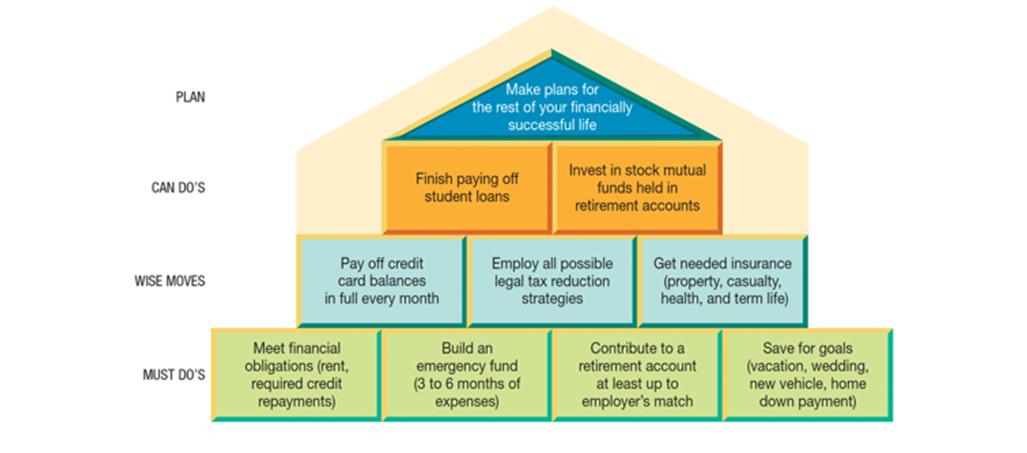
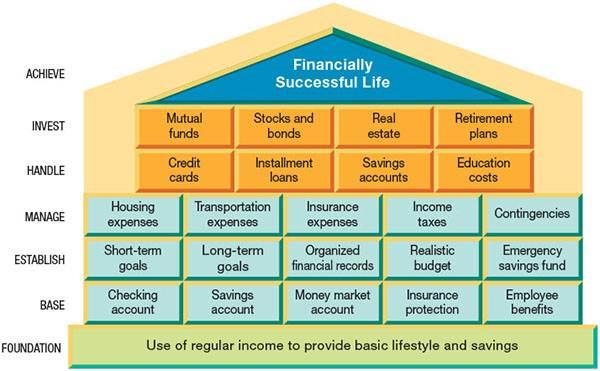
Discussion Activity 1 (10 minutes, PPT Slide #12)
• Looking at Figure 1-1, consider which are the hardest and easiest to complete at this point in your life.
• Looking at Figure 1-2, do you agree with the assessments on what is considered “must do” through what is considered “easy”?
Concept Check 1.1 (5 minutes, PPT Slide #13)
1. Explain the five steps in the financial planning process.
2. Distinguish among financial success, financial security, and financial happiness.
3. Summarize what is accomplished by studying personal finance.
4. What are the building blocks to achieving financial success?
II. The Economy Affects Our Personal Financial Success
a. The Economic System
• Capitalism: A system where a country’s trade and industry are controlled by private owners who seek profit.
• Economic growth: Increasing production and consumption in the economy.
• Business Cycle: A process by which the economy grows and contracts over time.
• Deleveraging: A time period when credit use shrinks in an economy instead of expanding as during normal economic times.
b. Business Cycle Where are we in the business cycle as the economy grows and contracts over time?
• Expansion
• Peak
• Contraction
• Downturn
• Trough
• Recovery
c. Recession: A recurring period of decline in total output, income, employment, and trade. There have been six recessions since 1980.
• The Great Recession
o The Great Recession began in 2007 and lasted 18 months, which makes it the longest of any recession since the Great Depression of the early 1930s, which lasted 43 months.
o The Great Recession reduced families’ wealth. Many families saw the value of their homes shrink (by 25 to 65 percent in some places).
• 2020 Recession
o The 2020 Recession, spurred by the COVID-19 pandemic, was the worst and shortest recession since the Great Depression.
o In April 2020 the unemployment rate was 14.7 percent.
o The stock market crashed in the spring of 2020, declining by over 30 percent.
d. A future of economic expansion
• Occurs when the economy moves beyond the trough toward recovery and expansion.
• While business cycles can be severe, the trend line has always been upward
• As political tides turn, the American economic experiment continues, providing evidence for and against an active role of government in managing the natural cycle of the economy
e. Indicators of the Direction of the Economy
• These indicators are statistics that change before the economy changes, helping predict the economy in the future.
• Index of leading economic indicators (LEI) is a composite index based on a variety of segments of the economy.
f. Cyclical indicators
• A procyclical economic indicator is one that moves in the same direction as the economy.
• Examples of procyclical indicators are retail sales, industrial production, new orders for durable goods (like household appliances), number of employees on nonagricultural payrolls, and the gross domestic product.
g. Gross domestic product (GDP)
• The nation’s broadest measure of economic health.
• It is the broadest measure of the economic health of the nation. Every quarter the federal government reports the value of all the goods and services produced in the country.
h. Leading Economic Indicators
• These indicators are statistics that change before the economy changes, helping predict the economy in the future.
• Index of leading economic indicators (LEI) is a composite index based on a variety of segments of the economy.
i. Inflation
• Inflation is a steady rise in the general level of prices
o Inflation affects income and consumption
• How inflation is measured:
o Consumer price index (CPI)
o Personal inflation rate
• Real income: income measured in constant prices relative to some base time period
• Nominal income: income that has not been adjusted for inflation
• Find percentage change in income
nominalannualincome afterraisenominal annual income last year
Percentagechange
100 nominalannual income last year =×
Find real income
nominalannualincomeafterraise Realincome
1.0previous inflation rate = +
j. How inflation affects consumption
• When prices are rising, an individual’s income must rise at the same rate to maintain purchasing power.
• Purchasing power: The amount of goods and services that your income will buy.
• Rule of 70: A formula to determine how long it will take for the value of a dollar to decline by one-half.
o Inflation pushes up the costs of the products and services we consume by eroding the value of the dollars we earn.
o Inflation is like rust on a car—eventually it is going to reduce the value to almost nothing.
• Deflation: A broad, sustained decline in prices of goods and services that is hard to stop once it takes hold, causing:
o Less consumer spending.
o Lower corporate profits.
o Declining home values.
o Rising unemployment.
o Lower incomes.
k. Interest:
• The price of borrowing money, most often reported as an annual percentage of the amount borrowed.
• During times of high inflation, interest rates rise on new loans for cars, homes, and credit cards.
l. Fed:
• The Federal Reserve Board is an agency representing the central banking system of the United States
• One of the mandates of the Federal Reserve Board (an agency representing the central banking system of the United States and commonly referred to as the “Fed”) is to “promote maximum employment and price stability.”
m. Federal funds rate
• The short-term rate at which banks lend funds to other banks overnight so that the borrowing bank has sufficient reserves as mandated by the Fed.
• The short-term rate at which banks lend funds to other banks overnight so that the borrowing bank has sufficient reserves as mandated by the Fed.
Discussion Activity 2: (10 minutes, PPT Slide #35)
• Find a graphic showing the federal funds rate over the past 10 or 20 years, or more.
• What do you notice?
• Find the most recent statements from the Federal Reserve Chairperson; what was stated and what is the expected future direction of interest rates?
Concept Check 1.2 (10 minutes, PPT Slide #36)
1. Summarize the phases of the business cycle.
2. Describe two statistics that help predict the future direction of the economy.
3. Give an example of how inflation affects income and consumption.
III. Apply economic concepts in financial decisions.
a. Think Like an Economist
• Opportunity cost is the cost of decision measured by the value of the next best alternative that must be foregone.
• Trade-off means giving up one thing for another.
• Marginal utility/cost is the usefulness or cost of the next increment of something valuable.
• Marginal tax rate is the tax rate at which your last dollar earned is taxed.
b. Type of Income
• Tax-exempt income:
o Income from an investment whose earnings are free, or exempt, from taxation. The best kind of income is taxexempt income.
• Tax-deferred income:
o Income on which a person does not make a current payment on income taxes owed and instead pays the tax at a future point in time.
c. Compounding
• The addition of interest to prin cipal; the effect of compounding depends on the frequency with which interest is compounded and the periodic interest rate that is applied.
Concept Check 1.3 (10 minutes; PPT Slide #40)
1. Define opportunity cost and give an example of how opportunity costs might affect financial decision making.
2. Explain and give an example of how marginal utility and marginal cost make some financial decisions easier.
3. Describe and give an example of how the marginal income tax rate can affect financial decision making.
IV. Perform time value of money calculations
a. Time value of money addresses two questions about money:
• What will an investment (or a series of investments) be worth after a period of time? This question asks for a future value
• How much has to be put away today (or as a series of investments) to provide some dollar amount in the future? This question asks for a present value
b. Compound Interest occurs when interest on an investment is left on deposit so you can earn interest on interest. Compound interest (compounding) is the key to building wealth.
c. Key Terms
• Simple interest: The calculation of interest involves:
o The dollar amount, called the principal
o The rate of interest earned on the principal
o Amount of time the principal is invested.
• Principal: The original amount invested.
• Compound interest occurs when interest on an investment is left on deposit so you can earn interest on interest; key to building wealth
• Annuity: A stream of payments to be over time at fixed intervals, typically annually.
d. Future value of a lump sum:
• Future value of a lump sum: Valuation of an asset projected to the end of a particular time period in the future.
FV = (Presentvalueof sumofmoney)(1.0 i)n
o Rule of 72 reveals the number of years for the principle to double.
$1,000 invested at 8 percent would double to $2000 in 9 years (72/9)
$50,000 would double to $100,000 in 8 years at 9 percent (72/8)
e. Future value of an annuity: A stream of payments to be received in the future.
• The $2,000 will grow to $91,524 in 20 years (read across the interest rate row in Appendix A.3 to 8 percent and them down the column to 20 years to obtain the factor of 45.762 to multiply by $2,000) and to $226,5 66 in 30 years at an 8 percent rate. Compounding $2,000 at 10 percent yields $114,550 in 20 years and $328,988 over 30 years; at 14 percent, it becomes $713,574 after 30 years.
f. Present Value
• Present value of a lump sum: What is the equivalent value today of a dollar amount to be received in the future?
PV = (Futurevalueof sumofmoney)(1.0 i)n
• Present value of an annuity: What is the equivalent value today of a series of payments to be received in the future?
• Suppose you want to have $30,000 per year for 20 years during your retirement to supplement your expected pension payments. What amount would you need to have invested at retirement to reach this goal if you could invest your money and + +
Instructor Manual: Garman, Personal Finance 15e, ©2027, 9798214057224; Chapter 1: Thinking Like a Financial Planner
receive a 7 percent return? Using Appendix A.4 you could look across the interest rate columns to 7 percent and then down to 20 years to obtain the factor of 10.5940. Multiplying $30,000 by this factor reveals that $317,820 (10.5940 × $30,000) set aside at retirement would fund this stream of payments.
Group Activity (20 minutes; PPT Slide #48)
• Using future values of a single payment, consider the impact of interest rates over a 25-year period. Share your examples and insights with the class.
• Using future values of an annuity, consider the impact of how much is deposited each year over a 25-year period. Share your examples and insights with the class.
Concept Check 1.4 (10 minutes; PPT Slide #49)
1. What are the two common questions about money?
2. Explain the difference between simple interest and compound interest, and describe why that difference is critical for long-term financial planning.
3. Use table 1-1 to calculate the future value of (a) $2,000 at 5 percent for 4 years, (b) $4,500 at 9 percent for 8 years, and (c) $10,000 at 6 percent for 10 years.
The following are activities and assignments not included in the text, PPTs, or courseware—they are for you to use if you wish.
1. Allocate classroom time to have the students work in groups or individually on one or more of the end-of-chapter exercises highlighted by the “Class Activity” icons on pages 28–29 of the Garman/Fox text. These activities are designed to foster enhanced understanding and analytical skills. To ensure maximized outcomes, you can assign reading of the pages indicated in the icons for the chosen exercise(s).
2. Engage in a classroom discussion of one or more of the “Let’s Talk About It” exercises found at the end of the chapter on page 28 of the Garman/Fox text.
3. Assign as homework one or more of the “Be Your Own Personal Financial Planner” exercises found at the end of the chapter on page 30 of the Garman/Fox text.
4. Explore the current state of consumer confidence at http://www.conferenceboard.org/.
Instructor Manual: Garman, Personal Finance 15e, ©2027, 9798214057224; Chapter 1: Thinking Like a Financial Planner
5. Explore the current state of the economy at the BLS “Economy At a Glance” web page (www.bls.gov/eag/eag.us.htm).
6. Check the most recent report of the index of leading economic indicators at https://www.conference-board.org/data/bcicountry.cfm?cid=1.
7. Have the students complete Do the Math exercise #1 but substitute their own projected salary for the figures in the exercise.
8. Review the 13 examples of good financial behaviors listed on page 25 in the Garman/Fox text. Ask the students to write a short paper on three of the examples that they already practice and three that they plan to put into practice in the next year.
9. Ask the students to write a short paper on how they would personally know that they have attained financial success.
10. Visit the Web site of the JumpStart Coalition and explore its reality check interactive assessment of what it costs to live various lifestyles (http://www.jumpstart.org/reality-check.html). Work through various scenarios with your students to illustrate the costs involved.
[return to top]