Test Bank for Nutrition Research 2nd
Edition by Drummond, Reyes, Cooke, Stage
ISBN: 9781284227116
Multiple Choice
1. The systematic process used in much research is referred to as the:
A) research protocol.
B) research methods
C) scientific method.
D) research design.
Ans: C
Complexity: Easy
Ahead: What Is Research?
Subject: Chapter 1
Title: Introduction to Research
2. A __________ provides the context for why a research study is needed.
A) statement of the problem
B) research objective
C) hypothesis
D) statement of need
Ans: A
Complexity: Easy
Ahead: What Is Research?
Subject: Chapter 1
Title: Introduction to Research
3. Which of the following is a categorical variable?
A) BMI
B) Height
C) Blood glucose level
D) Gender
Ans: D
Complexity: Easy
Ahead: What Is Research?
Subject: Chapter 1
Title: Introduction to Research
4. The specific goal of a research study that directs the research is referred to as the:
A) research problem
B) research objective.
C) literature review.
D) research methods
Ans: B
Complexity: Easy
Ahead: What Is Research?
Subject: Chapter 1
Title: Introduction to Research
5. “Substituting whole grains for refined grains will reduce inflammatory markers in healthy adults” is an example of:
A) a research objective.
B) a research goal.
C) a hypothesis
D) both a research objective and hypothesis.
Ans: C
Complexity: Moderate
Ahead: What Is Research?
Subject: Chapter 1
Title: Introduction to Research
6. “We aimed to evaluate the association between dairy fat and incident stroke in U.S. adults” is an example of:
A) a research objective.
B) a research goal.
C) a hypothesis.
D) both a research objective and hypothesis.
Ans: A
Complexity: Moderate
Ahead: What Is Research?
Subject: Chapter 1
Title: Introduction to Research
7. A study compared the effects of regular-fat cheese or an equal amount of reduced-fat cheese on LDL cholesterol levels. Which of the following is the dependent variable?
A) Both of the cheeses
B) LDL level
C) Reduced-fat cheese
D) Regular-fat cheese
Ans: B
Complexity: Moderate
Ahead: What Is Research?
Subject: Chapter 1
Title: Introduction to Research
8. A study recruited participants for an Internet-delivered weight-loss program to see if the program produced behavior change and weight loss. Which of the following is the independent variable?
A) Weight-loss program
B) Behavior change and weight loss
C) Weight loss
D) Behavior change
Ans: A
Complexity: Moderate
Ahead: What Is Research?
Subject: Chapter 1
Title: Introduction to Research
9. A cohort study of white U.S. adults looked at how lifestyle factors, such as smoking and physical activity, were related to whether someone got certain cancers. Which of the following was an outcome variable?
A) Lifestyle factors
B) Lifestyle score
C) Cured foods
D) Certain cancers
Ans: D
Complexity: Moderate
Ahead: What Is Research?
Subject: Chapter 1
Title: Introduction to Research
10. The research plan that states precisely what data are required, where the data will come from, which methods will be used to collect the data, and how the data will be analyzed is called the:
A) research design.
B) research method
C) experiment.
D) intervention
Ans: A
Complexity: Moderate
Ahead: What Is Research?
Subject: Chapter 1
Title: Introduction to Research
11. Researchers collected data for their study on nutrition and diabetes at one time early in March. What type of study is this?
A) Longitudinal
B) Cross-sectional
C) Prospective
D) Retrospective
Ans: B
Complexity: Easy Ahead: What Is Research?
Subject: Chapter 1
Title: Introduction to Research
12. In a(n) ________ study, participants are observed and measurements taken at different points in time.
A) descriptive
B) cross-sectional
C) internal
D) longitudinal
Ans: D
Complexity: Moderate Ahead: What Is Research?
Subject: Chapter 1
Title: Introduction to Research
13. Which section of a research paper describes the research design?
A) Introduction
B) Methods
C) Results
D) Discussion
Ans: B
Complexity: Moderate
Ahead: What Is Research?
Subject: Chapter 1
Title: Introduction to Research
14. In a research study, measurement devices are often referred to as:
A) instruments.
B) methods.
C) extraneous.
D) variables
Ans: A
Complexity: Moderate
Ahead: What Is Research?
Subject: Chapter 1
Title: Introduction to Research
15. In an experimental study, participants are placed into the intervention group or the group.
A) experimental
B) control
C) controlled
D) extraneous
Ans: B
Complexity: Moderate
Ahead: What Is Research?
Subject: Chapter 1
Title: Introduction to Research
16. In a study about the effect of coffee on cardiovascular disease, which of the following could be an extraneous variable?
A) Smoking
B) Physical activity level
C) HDL level
D) LDL level
E) Both smoking and physical activity level
Ans: E
Complexity: Moderate
Ahead: What Is Research?
Subject: Chapter 1
Title: Introduction to Research
17. Factors (other than the variables being studied) that might influence the outcome of a study are referred to as:
A) controlling variables.
B) outcome variables.
C) extraneous variables.
D) All of these are correct.
Ans: C
Complexity: Easy
Ahead: What Is Research?
Subject: Chapter 1
Title: Introduction to Research
18. The purpose of nutrition research is to:
A) solve nutrition-related problems.
B) build a body of knowledge to improve client outcomes.
C) act as the foundation for evidence-based practice.
D) All of these are correct.
Ans: D
Complexity: Easy
Ahead: Purposes of Nutrition Research
Subject: Chapter 1
Title: Introduction to Research
19. Studies that provide information about relevant variables but do not examine possible cause and effect are considered:
A) descriptive
B) experimental.
C) analytic.
D) predictive
Ans: A
Complexity: Easy
Ahead: Purposes of Nutrition Research
Subject: Chapter 1
Title: Introduction to Research
20. Studies that examine possible cause and effect are called:
A) descriptive.
B) exploratory
C) analytic.
D) predictive.
Ans: C
Complexity: Easy
Ahead: Purposes of Nutrition Research
Subject: Chapter 1
Title: Introduction to Research
21. A study entitled “Nightworkers’ Nutrition: A Qualitative Study” is most likely to be a(n) ______ study.
A) descriptive
B) exploratory
C) analytic
D) predictive
Ans: B
Complexity: Moderate
Ahead: Purposes of Nutrition Research
Subject: Chapter 1
Title: Introduction to Research
22. A study entitled “A Culturally-Based Dietary Intervention with Obese Native American Women: A Randomized Controlled Trial” is most likely to be a(n) _____ study.
A) descriptive
B) exploratory
C) analytic
D) predictive
Ans: C
Complexity: Moderate
Ahead: Purposes of Nutrition Research
Subject: Chapter 1
Title: Introduction to Research
23. A study entitled “Sodium Intake among U.S. School-Aged Children” is most likely to be a(n) _____ study.
A) descriptive
B) exploratory
C) analytic
D) predictive
Ans: A
Complexity: Moderate
Ahead: Purposes of Nutrition Research
Subject: Chapter 1
Title: Introduction to Research
24 A study entitled “Does Beverage Intake by Children Predict Weight Status?” is most likely to be a(n) _____ study.
A) descriptive
B) exploratory
C) analytic
D) predictive
Ans: D
Complexity: Moderate
Ahead: Purposes of Nutrition Research
Subject: Chapter 1
Title: Introduction to Research
25. A study entitled “The Role of Diet in Irritable Bowel Syndrome Symptoms: A Narrative Review” is an example of which type of research?
A) Original research
B) Primary research
C) Secondary research
D) Tertiary research
Ans: C
Complexity: Moderate
Ahead: Ways to Classify Research
Subject: Chapter 1
Title: Introduction to Research
26. A study entitled “Influence of Fruit Consumption on Risk of Type 2 Diabetes in Southeast Asia” is an example of which type of research?
A) Design research
B) Primary research
C) Secondary research
D) Tertiary research
Ans: B
Complexity: Moderate
Ahead: Ways to Classify Research
Subject: Chapter 1
Title: Introduction to Research
27. The concept of control is most important in which type of study?
A) Exploratory
B) Quantitative
C) Qualitative
D) All of these are correct.
Ans: B
Complexity: Moderate
Ahead: Ways to Classify Research
Subject: Chapter 1
Title: Introduction to Research
28. Which of the following is a typical qualitative method used in nutrition research?
A) Focus groups
B) Observations
C) Document analysis
D) Focus groups and observations
E) Focus groups, observations, and document analysis
Ans: E
Complexity: Moderate
Ahead: Ways to Classify Research
Subject: Chapter 1
Title: Introduction to Research
29. Much nutrition research is based on a _________ paradigm in which reality is ordered and events can be studied empirically.
A) positivist
B) negativist
C) constructivist
D) quantitative
Ans: A
Complexity: Moderate
Ahead: Ways to Classify Research
Subject: Chapter 1
Title: Introduction to Research
30. Which type of research may report results as themes?
A) Translational
B) Quantitative
C) Qualitative
D) Basic
Ans: C
Complexity: Easy
Ahead: Ways to Classify Research
Subject: Chapter 1
Title: Introduction to Research
31. Which type of research prefers to use a random sample and large numbers of participants?
A) Translational
B) Quantitative
C) Qualitative
D) Basic
Ans: B
Complexity: Easy
Ahead: Ways to Classify Research
Subject: Chapter 1
Title: Introduction to Research
32. Which type of research uses an interpretive analysis?
A) Translational
B) Quantitative
C) Qualitative
D) Basic
Ans: C
Complexity: Easy
Ahead: Ways to Classify Research
Subject: Chapter 1
Title: Introduction to Research
33. _________ research uses an inductive reasoning process.
A) Basic
B) Quantitative
C) Qualitative
D) Clinical
Ans: C
Complexity: Easy
Ahead: Ways to Classify Research
Subject: Chapter 1
Title: Introduction to Research
34. A mixed methods research study uses:
A) quantitative research
B) qualitative research.
C) meta-analysis.
D) quantitative and qualitative research.
E) quantitative research, qualitative research, and meta-analysis.
Ans: D
Complexity: Easy
Ahead: Ways to Classify Research
Subject: Chapter 1
Title: Introduction to Research
35. A study entitled “Eating School Breakfast is Associated with Higher Diet Quality Among Elementary Students in Texas” would be considered an example of:
A) basic research
B) quality improvement.
C) applied research
D) quality improvement and applied research.
Ans: C
Complexity: Easy
Ahead: Ways to Classify Research
Subject: Chapter 1
Title: Introduction to Research
36. A study entitled “Active Transport of Sodium and Potassium Ions – Mechanism and Regulation” would be considered an example of:
A) basic research.
B) qualitative research
C) applied research.
D) basic and qualitative research.
Ans: A
Complexity: Easy
Ahead: Ways to Classify Research
Subject: Chapter 1
Title: Introduction to Research
37 After a hospital foodservice director implemented a new menu for patients, she surveyed patients about the menu and then compared the results to surveys done before the menu changed. This type of study would be considered:
A) quantitative research.
B) quality improvement.
C) intervention research.
D) outcomes research.
Ans: B
Complexity: Moderate
Ahead: Ways to Classify Research
Subject: Chapter 1
Title: Introduction to Research
38. __________ studies test the efficacy of an intervention, while _______ studies test the effectiveness of an intervention.
A) Epidemiological, translational
B) Translational, epidemiological
C) Intervention, outcomes
D) Outcomes, intervention
Ans: C
Complexity: Moderate
Ahead: Diversity of Nutrition Research
Subject: Chapter 1
Title: Introduction to Research
39. __________ test new treatments, drugs, or medical devices to help in treatment, diagnosis, and prevention of diseases and conditions.
A) Clinical trials
B) Outcome trials
C) Effectiveness trials
D) Translational trials
Ans: A
Complexity: Moderate
Ahead: Diversity of Nutrition Research
Subject: Chapter 1
Title: Introduction to Research
40 Which type of research would test the cost-effectiveness of a new treatment?
A) Intervention research
B) Outcomes research
C) Translational research
D) Epidemiological research
Ans: B
Complexity: Moderate
Ahead: Diversity of Nutrition Research
Subject: Chapter 1
Title: Introduction to Research
41. Which of the following is an example of outcomes?
A) LDL levels
B) Risk of Type 2 diabetes
C) Level of pain
D) Costs
E) All of these are correct.
Ans: E
Complexity: Moderate
Ahead: Diversity of Nutrition Research
Subject: Chapter 1
Title: Introduction to Research
42. Which type of research would look at the strength of the association between a risk factor (such as dairy intake) and stroke using a cohort study?
A) Intervention research
B) Outcomes research
C) Translational research
D) Epidemiological research
Ans: D
Complexity: Moderate
Ahead: Diversity of Nutrition Research
Subject: Chapter 1
Title: Introduction to Research
43. Which type of research tries to speed up the process of getting research from the researcher's bench to the hospital patient and to the community?
A) Intervention research
B) Outcomes research
C) Translational research
D) Epidemiological research
Ans: C
Complexity: Easy
Ahead: Diversity of Nutrition Research
Subject: Chapter 1
Title: Introduction to Research
44. ____________ is a field of research that focuses on changes in the DNA sequence that can make individuals more susceptible to diseases such as cancer or heart disease.
A) Nutrigenetics
B) Nutrigenomics
C) Epigenetics
D) Metabolomics
Ans: A
Complexity: Moderate
Ahead: Diversity of Nutrition Research
Subject: Chapter 1
Title: Introduction to Research
45. The study of how environment, including diet, influences the expression of our genes is called:
A) nutrigenetics.
B) nutrigenomics.
C) epigenetics.
D) metabolomics.
Ans: C
Complexity: Moderate
Ahead: Diversity of Nutrition Research
Subject: Chapter 1
Title: Introduction to Research
46. A rapidly evolving field of study that examines metabolites present in humans or other organisms is called
A) nutrigenetics.
B) nutrigenomics.
C) epigenetics.
D) metabolomics.
Ans: D
Complexity: Moderate
Ahead: Diversity of Nutrition Research
Subject: Chapter 1
Title: Introduction to Research
47. ____________ link practicing clinicians (such as dietitians) from different facilities to create and run studies.
A) Professional associations
B) Hospital networks
C) Grants
D) Practice-based research networks
Ans: D
Complexity: Moderate
Ahead: Practice-Based Research Networks
Subject: Chapter 1
Title: Introduction to Research
True/False
1. Research is when you locate, read, and summarize a number of research articles on a specific topic.
Ans: False Complexity: Easy
Ahead: What Is Research?
Subject: Chapter 1
Title: Introduction to Research
2. Experimental designs are exploratory in nature.
Ans: False
Complexity: Moderate
Ahead: Purposes of Nutrition Research
Subject: Chapter 1
Title: Introduction to Research
3. Systematic reviews are more rigorous than narrative reviews.
Ans: True Complexity: Moderate
Ahead: Ways to Classify Research
Subject: Chapter 1
Title: Introduction to Research
4. Like quantitative research, qualitative research is a systematic process, involves rigor in implementation, and generates knowledge.
Ans: True
Complexity: Moderate
Ahead: Ways to Classify Research
Subject: Chapter 1
Title: Introduction to Research
5. Qualitative study results are more generalizable than quantitative studies.
Ans: False Complexity: Moderate Ahead: Ways to Classify Research
Subject: Chapter 1
Title: Introduction to Research
6. The complexity of diseases such as obesity provides the impetus for using animal models in much basic research.
Ans: True Complexity: Moderate Ahead: Ways to Classify Research
Subject: Chapter 1
Title: Introduction to Research
7. Intervention studies often use a research design known as a clinical trial.
Ans: True Complexity: Moderate Ahead: Diversity of Nutrition Research
Subject: Chapter 1
Title: Introduction to Research
8. An intervention that works in a clinical trial should work equally well in a physician's office.
Ans: False
Complexity: Moderate
Ahead: Diversity of Nutrition Research
Subject: Chapter 1
Title: Introduction to Research
Matching
1. Match each study title to the type of research is most likely represents.
1. “Impact of Gastroesophageal Reflux on Pediatric Lung Transplant Outcomes”
2. “Bridging the Gap Between Long-Term Weight Loss Maintenance Research and Practice: A Randomized Controlled Trial”
3. “Milk, Fruit, and Vegetable, and Total Antioxidant Intakes in Relation to Mortality
Rates: Cohort Studies in Women and Men”
4. “Impact of Health Promotion Program on Nutrition Behaviors”
5. “How People Interpret Healthy Eating”
A. Outcomes research
B. Translational research
C. Epidemiological research
D. Intervention research
E. Qualitative research
Ans: 1-A, 2-B, 3-C, 4-D, 5-E
Complexity: Moderate
Ahead: Diversity of Nutrition Research
Subject: Chapter 1
Title: Introduction to Research
Essay
1. Explain what scientific research is and is not.
Ans: Scientific research is the neutral, planned, and systematic process of collecting, analyzing, and interpreting information/data to answer questions to advance knowledge.
A systematic process means that research is completed using a system, and that system is usually the scientific method. The scientific method is a step-by-step process used for investigating questions, interpreting data, and expanding our understanding.
Research is not when you look really hard for information or read a number of journal articles. Research is also not when you simply transfer and summarize facts from what you read.
Complexity: Moderate
Ahead: What Is Research?
Subject: Chapter 1
Title: Introduction to Research
2. List and briefly describe the steps in the scientific method.
Ans:
1. First the researcher considers and develops a research question designed to shed light on a current or potential problem, such as obesity. A research question poses a relationship between two or more variables. A statement of the problem explains the problem and provides the context for why this research is needed.
2. The statement of the problem is based on a literature review.
3. Based on the literature review and the research question, the researcher clearly states the objective of the study, including the variables.
4. Many, but not all, studies state a hypothesis. A hypothesis is a statement of what the researchers predict the relationship will be between the independent variable(s) and dependent variable(s), and it must be able to be tested.
5. Next the researcher works on a detailed research plan that states precisely what data are required, where the data will come from, which methods will be used to collect the data, and how the data will be analyzed. This series of decisions is called research design, and it focuses on the end product: getting the evidence required to adequately and accurately answer the research question(s).
6. The Methods section explains how the variables will be measured, the setting, how participants will be chosen and the intervention implemented (if used), and the statistical analysis.
7. Once the data are collected and statistical tests have been run, researchers interpret the meaning of the results as related to the problem, the research question, and other literature.
8. The last step is to report/disseminate the results.
Complexity: Moderate
Ahead: What Is Research?
Subject: Chapter 1
Title: Introduction to Research
3. Read this study summary and answer the questions.
Summary: This study included three groups of participants who shopped at 18 New York City Farmers' Markets where SNAP cards are used and a SNAP educational program was offered. The educational program ran interactive workshops lasting 30 minutes and covered topics such as planning healthy meals on a budget. Each workshop also included a demonstration on how to prepare an inexpensive recipe, often highlighting fresh fruit or vegetables in season, and recipes were handed out. The three groups included a control group of shoppers who did not attend a workshop, another group of shoppers who attended one workshop, and a final group of shoppers who attended at least two workshops. The study looked at how effective the workshops were at changing behaviors and attitudes regarding fruit and vegetables consumption.
A. What was the research objective?
B. Why was this research important?
C. Describe the intervention.
D. Name the independent variable(s).
E. Name the dependent variable(s).
F. Name one possible extraneous variable.
G. Name one possible instrument used.
Ans: A. To evaluate the effectiveness of the SNAP educational program.
B. This research was important to test if the SNAP educational program was increasing fruit and vegetable consumption because diets rich in fruits and vegetables are associated with less heart disease and cancer.
C. The intervention was the educational program. The educational program ran interactive workshops lasting 30 minutes and covered topics such as planning healthy meals on a budget. Each workshop also included a demonstration on how to prepare an inexpensive recipe, often highlighting fresh fruit or vegetables in season, and recipes were handed out.
D. IV = Educational program
E. DV = Attitudes toward fruits and vegetable consumption, eating behaviors for fruits and vegetables – in other words, many fruits and vegetables are eaten.
F. Perhaps the participants who attended workshops had more interest in nutrition and healthy eating,
G. You could use a pre-test/post-test questionnaire to find out how many servings participants ate of fruits and vegetables. You can also hand out a questionnaire using a Likert scale to probe participants’ attitudes toward fruits and vegetables.
Complexity: Difficult
Ahead: What Is Research?
Subject: Chapter 1
Title: Introduction to Research
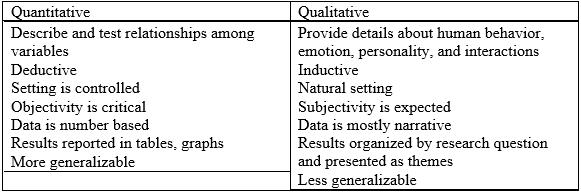
4. List five differences between quantitative and qualitative research.
Ans:
Complexity: Moderate
Ahead: Ways to Classify Research
Subject: Chapter 1
Title: Introduction to Research
5. Name one strength and one weakness of both quantitative research and qualitative research.
Ans: Quantitative Research – Strengths:
• Allows for greater objectivity, control, and accuracy
• Can examine possible causes under controlled circumstances
• Tests theories or hypotheses
• Can be replicated
Quantitative Research – Weaknesses:
• Does not work as well with phenomena that are hard to measure accurately (such as stress) or complex phenomena
• Does not provide information on the context of the situation
• Does not capture the full breadth of human experiences
Qualitative Research – Strengths:
• Provides a holistic view and understanding of complex situations through rich detail of participants’ personal experiences, etc.
• Gains initial insights into a new area of research
• Describes phenomena and possibly generate a theory
• Can respond to changes that occur during the study
Qualitative Research – Weaknesses:
• Time consuming to collect and analyze data
• Smaller number of participants
• Not usually generalizable
• Results more easily influenced by researcher’s personal biases
• Difficult to compare to other studies
Complexity: Moderate
Ahead: Ways to Classify Research
Subject: Chapter 1
Title: Introduction to Research
6. Give two examples of outcomes in a study and how you would measure each one.
Ans:
1. Specific nutrition and food intakes – such as carbohydrate intake, saturated fat intake, fruit intake – measure using 24-hour diet recall, food frequency questionnaire
2. Nutrition-related behaviors – such as eating or skipping meals, exercising – measure using questionnaires or observation
3. Lab values – such as change in LDL
4. Anthropometrics – such as change in weight, waist circumference
5. Psychological factors – such as quality of life – measure using a scale designed for that area
6. Costs – such as reduced costs
Complexity: Moderate
Ahead: Diversity of Nutrition Research
Subject: Chapter 1
Title: Introduction to Research
7. Explain why quality improvement is not really research.
Ans: Although QI uses many components of the research process, it is not considered research using the definition provided by the Department of Health and Human Services (DHHS). DHHS defines research as “a systematic investigation, including research development, testing, and evaluation, designed to develop or contribute to generalizable knowledge” (U.S. DHHS, 2009, Code of Federal Regulations, Title 45, Part 46.112). The knowledge gained from QI is for a single institution and is not generalizable outside of that institution, so QI really cannot be considered research. Also, whereas a protocol in a research study is fixed, the steps taken in a QI project are flexible because the goal is improvement.
Ahead: Ways to Classify Research
Subject: Chapter 1
Title: Introduction to Research