
ISBN: 9781264896905
Correct answers located at the end of the chapter.
1) Spontaneous generation refers to the idea that organisms came from other organisms.
⊚ true
⊚ false
2) The human body only contains bacteria during illness.
⊚ true
⊚ false
3) Bacteria and eukarya both contain membrane-bound organelles.
⊚ true
⊚ false
4) The scientific name of an organism indicates its domain.
⊚ true
⊚ false
5) Viroids are naked (lacking a protein shell) pieces of RNA that infect plants.
⊚ true
⊚ false
6) A viral particle consists of DNA, RNA, and protein.
⊚ true
⊚ false
7) Viruses, viroids, and prions are obligate intracellular agents.
⊚ true
⊚ false
8) Viruses and bacteria are both unicellular.
⊚ true
⊚ false
9) An organism is categorized in a domain according to its cell size.
⊚ true
⊚ false
10) Archaea are very similar to bacteria and have rigid cell walls made of peptidoglycan. ⊚ true
⊚ false
11) Thiomargarita namibiensis can not be a eukaryote because it is only 1 mm in width.
⊚ true
⊚ false
12) Digestive tract microbiome plays no role in maintaining a person's health.
⊚ true
⊚ false
13) <p>Identify three factors that cause certain infectious diseases to become more common. <!-Markup Copied from Habitat ></p>
A) Reduction of vaccination against certain diseases such as measles.
B) Diseases under control by antimicrobial medications become resistant to the medications.
C) Vaccines are no longer protecting against the most common diseases.
D) The aging population is more susceptible to infectious diseases.
E) People's immunity against pathogens is significantly decreasing due to global warming.
14) Identify two features that distinguish prokaryotic cells form eukaryotic cells.
A) Prokaryotic cells have a cytoplasmic membrane while eukaryotic cells do not.
B) Eukaryotic cells have a nucleus while prokaryotic cells do not.
C) Eukaryotic cells have membrane-bound orgnelles while prokaryotic cells do not.
D) Prokaryotic cells are motile while eukaryotic cells are not.
E) Prokaryotic cells are unicellular while eukaryotic cells are multicellular.
F) Prokaryotic cells have a wall while eukaryotic cells lack a cell wall.
15) Identify which three of the following Antonie van Leeuwenhoek would not have observed.
A) SARS-CoV-2
B) Prions
C) Mycobacterium tuberculosis
D) Smallpox virus
E) Escherichia coli
F) Algae
16) The scientist usually credited with seeing the first microorganisms, which he called "animalcules", was_________.
A) Redi
B) van Leeuwenhoek
C) Pasteur
D) Tyndall
E) Lister
17) The word "animalcule" was first used by_________.
A) Pasteur
B) Redi
C) van Leeuwenhoek
D) Tyndall
E) Hooke
18) The idea of spontaneous generation postulated that
A) organisms could evolve into the next generation of organisms.
B) organisms could spontaneously turn into other types of organisms.
C) living organisms could spontaneously arise from non-living material.
D) living organisms could spontaneously arise from other living organisms.
E) living organisms must contain at least ten cells.
19) Which of these scientists were involved in investigating the idea of spontaneous generation?
A) Redi and van Leeuwenhoek
B) Redi and Pasteur
C) van Leeuwenhoek and Pasteur
D) Pasteur and Escherich
E) Escherich and Redi
20) The work of Tyndall and Cohn
A) supported the idea of spontaneous generation rather than the idea of biogenesis.
B) explained why some spontaneous generation investigators got different results from those of Pasteur.
C) showed that all microbes caused spontaneous disease if they enter the human body.
D) allowed scientists to see microorganisms (called "animalcules") using a simple microscope.
E) showed that boiling fails to kill vegetative bacteria, leading to biogenesis.
21) The structures present in the hay infusions used in experiments on spontaneous generation that made them difficult to sterilize are _________.
A) chloroplasts
B) endospores
C) organelles
D) toxins
E) nuclei
22) The contradictory results obtained by different scientists apparently doing the same experiments in investigating spontaneous generation
A) show that doing experiments once should be enough to prove something.
B) show the importance of exactly duplicating experimental conditions.
C) led to further experiments that ultimately proved spontaneous generation.
D) could not be explained by anyone involved in the work.
E) led to the development and production of swan-necked flasks.
23) If Pasteur had done his experiments investigating spontaneous generation in a horse stable,
A) the results would probably have supported the idea of spontaneous generation.
B) the results would probably not have supported the idea of spontaneous generation.
C) the results would probably been the same as those obtained in a laboratory.
D) the results would probably have supported the idea of spontaneous biogenesis.
E) it would probably have taken several years to obtain any results.
24) Cellulose is a major component of plants and is only directly digested by
A) carnivores.
B) termites.
C) herbivores.
D) microorganisms.
E) birds.
25) Plants are dependent on microorganisms for
A) providing oxygen in a usable form.
B) providing water and carbon dioxide.
C) changing atmospheric nitrogen to a usable form.
D) providing simple carbohydrates in a usable form.
E) providing simple and complex proteins.
26) Microorganisms are involved in all of the following EXCEPT
A) production of medicinal products.
B) food production.
C) pollution cleanup.
D) converting nitrogen to a form useful to plants.
E) There are no exceptions here. There are microorganisms that participate in each of these activities.
27) Bacteria have been used to help produce or modify all of the following food products EXCEPT
A) cheeses.
B) beer and wine.
C) pickled products.
D) bread.
E) peanuts.
28) Microorganisms are involved in all of the following EXCEPT
A) production of medicinal products.
B) food production.
C) pollution cleanup.
D) converting nitrogen to a form useful to plants.
E) There are no exceptions here. There are microorganisms that participate in each of these activities.
29) Bioremediation refers to
A) rehabilitating wayward pathogenic bacteria.
B) using bacteria to clean up environmental pollutants.
C) development of new vaccines.
D) monitoring newly discovered disease organisms.
E) destroying organisms causing infectious diseases.
30) Which of the following about the Golden Age of Medical Microbiology is FALSE?
A) It started with the development of the first microscopes.
B) It occurred during the late 1800s to the early 1900s.
C) It is a time when the knowledge of bacteria and work with them expanded.
D) It was the time when people realized that diseases could be caused by invisible agents.
E) It was a time when several major advances were made in microbiology.
31) Which of the following statements about newly emerging or reemerging diseases is FALSE?
A) They may be caused by changing lifestyles.
B) Examples include hepatitis C, Ebola disease and COVID-19.
C) They may result from a breakdown in sanitation and social order.
D) They are all caused by drug-resistant pathogens.
E) They may result when microbes evolve and develop new characteristics.
32) Lyme disease is an example of a disease that is due to
A) increased interaction between humans and tick-carrying animals.
B) failure to effectively vaccinate children.
C) a mutation in the human genome.
D) climate change leading to a significantly greater mosquito population.
E) an increase in the number of people travelling to Asia and Africa.
33) The outbreak of measles within the last few years is due to
A) mutation of the measles virus.
B) change in the environment and climate.
C) a decline in vaccination of children in the previous years.
D) increase in sensitivity of detection techniques.
E) emergence of novel measles viruses.
34) Which of the statements regarding smallpox is TRUE?
A) Smallpox has been eliminated as a naturally occurring infection in human beings through vaccination.
B) Smallpox still occasionally occurs in developing countries though failure to vaccinate everyone.
C) Smallpox outbreaks sometimes occur in chimpanzee populations but seldom kills the animals.
D) Smallpox outbreaks sometimes occur in chimpanzee populations and kills all the animals affected.
E) Smallpox continues to be a common, naturally occurring infection in human beings.
35) Smallpox
A) has occurred in a few countries since 1977.
B) has little potential as a weapon of bioterrorism.
C) has not occurred anywhere in the word since 1977.
D) very seldom kills people, but does scar them.
E) is an emerging infectious disease.
36) Ulcers, previously thought to be caused by stress, are in fact often caused by
A) a bacterial infection.
B) an insufficient diet.
C) a genetic mutation.
D) a fungal pathogen.
E) a viral infection.
37) Bacteria are useful to study because
A) they produce protein in a simpler manner than more complex organisms.
B) <p>they have the same fundamental metabolic and genetic properties as higher organisms. <! Markup Copied from Habitat ></p>
C) they produce energy in a simpler manner than more complex organisms.
D) they both synthesize and are resistant to all known antibiotics.
E) they produce peptidoglycan in a simpler manner than more complex organisms.
38) Which of the following regarding normal microbiota is TRUE?
A) Normal microbiota are only found in the lungs or digestive tract.
B) Normal microbiota protect us from disease by competing with pathogenic bacteria.
C) Normal microbiota are only found on small select parts of the human body.
D) Normal microbiota typically cause disease when growing in or on our bodies.
E) Normal microbiota play little or no role in the general health of humans.
39) Bacteria are good research models because they
A) vary in size from microscopic to macroscopic.
B) share many properties with more complex organisms.
C) can be assembled into complex multicellular organisms.
D) have similarly complicated growth requirements.
E) develop the same diseases as humans and animals.
40) Select the FALSE statement regarding bacteria.
A) They are usually rod, sphere, or spiral in shape.
B) They reproduce by binary fission.
C) They contain a peptidoglycan cell wall.
D) They are found as single cells.
E) They are never photosynthetic.
41) Which is usually NOT true of archaea?
A) They move using flagella.
B) They reproduce by mitosis.
C) They contain rigid cell walls.
D) They are found as single cells.
E) They are prokaryotes.
42) All of the statements regarding archaea are true EXCEPT
A) they contain peptidoglycan in their cell walls.
B) they reproduce by binary fission.
C) they contain a rigid cell wall.
D) they are found as single cells.
E) they often grow in extreme environments.
43) An extreme environment in which archaea have been found is
A) lakes and oceans.
B) boiling hot springs.
C) marshes and swamps.
D) refrigerators.
E) animal digestive tracts.
44) The cell types that lack a membrane-bound nucleus and have rigid cell walls of peptidoglycan are
A) eukaryotes.
B) fungi.
C) bacteria.
D) archaea.
E) protozoa.
45) The prokaryotic domain includes
A) bacteria AND fungi.
B) archaea AND viruses.
C) fungi AND bacteria.
D) bacteria, archaea, AND fungi.
E) bacteria AND archaea.
46) Select the TRUE statement(s) regarding eukaryotes.
A) Eukaryotes are all multicellular organisms AND have a membrane around the DNA.
B) Eukaryotes have a more complex internal structure than archaea or bacteria.
C) Eukaryotes have a simpler internal structure than archaea or bacteria AND have a membrane around the DNA.
D) Eukaryotes have a membrane around the DNA.
E) Eukaryotes have a more complex internal structure than archaea or bacteria AND have a membrane around the DNA.
47) Which group(s) below contain single-celled and multicellular organisms?
A) Algae AND bacteria
B) Fungi AND archaea
C) Protozoa AND bacteria
D) Algae AND fungi
E) Fungi AND protozoa
48) All living organisms
A) may be classified in four domains.
B) may be classified in three domains.
C) probably do not have a common ancestor.
D) have never shared genes between domains.
E) are capable of causing disease.
49) The system by which organisms are named is referred to as
A) systematics.
B) naming.
C) nomenclature.
D) binomialism.
E) bioinformatics.
50) The scientific name of an organism includes its
A) family and genus.
B) first name and last name.
C) genus and species.
D) domain and genus.
E) domain and species.
51) Which are the correctly written scientific name?
A) Staphylococcus aureus
B) Staphylococcus a.
C) St. aureus
D) Staph
52) Which of these applies to the term strain?
A) E. coli0157:H7
B) E coli
C) Minor variation of a species
D) Major variation of a species
E) E coli0157:H7 AND minor variation of a species
53) Select the statement that is TRUE regarding viroids.
A) They are naked (lacking a protein shell) pieces of RNA.
B) They are naked (lacking a protein shell) pieces of DNA.
C) They are known to cause neurodegenerative diseases in animals.
D) They are composed of protein encasing a DNA genome.
E) They are composed of both RNA and DNA within a lipid coat.
54) Outside of a host cell, viruses are
A) carrying out a few biochemical reactions.
B) synthesizing proteins necessary for entry into the host.
C) inert, and not capable of replication.
D) constructing a membrane known as an envelope.
E) capable of a few replication cycles.
55) Viruses may only be grown
A) in sterile growth media.
B) in living cells.
C) at body temperature.
D) in darkness.
E) in liquid broths.
56) Viruses are in the domain(s)
A) viridae.
B) eukarya.
C) archaea AND bacteria.
D) bacteria AND viridae.
E) None of the answer choices is correct.
57) Which if the following is TRUE regarding viruses?
A) They are obligate intracellular parasites.
B) They are single-celled organisms.
C) They are composed of only proteins.
D) They belong to the domain Archaea.
E) They contain only of DNA or RNA.
58) What do viruses, viroids, and prions all have in common?
A) They contain only RNA and protein.
B) They are acellular agents of disease.
C) They contain only DNA or protein.
D) They infect only animals.
E) They cause neurodegenerative diseases.
59) Viruses and viroids are
A) capable of independent reproduction.
B) obligate intracellular parasites.
C) members of the domain Bacteria.
D) larger than most bacteria in size.
E) agents that cause disease in animals.
60) Which is TRUE about prions?
A) They are only composed of RNA.
B) They are only composed of DNA.
C) They are only composed of protein.
D) They cause diseases in plants.
E) They are only composed of RNA and DNA.
61) A new organism was found that was unicellular and 1 cm long. The "large" size of this organism alone would
A) mean that it could not be a bacterium.
B) mean that it must be a protozoan.
C) not be useful for identifying it.
D) mean that it belongs in the domain Eukarya
E) suggest that it is a virus.
62) Although it is said that the twentieth century was the Age of Physics, it is predicted that the twenty-first century will be the age of
A) chemistry.
B) computers.
C) microbial biodiversity.
D) mathematics.
E) psychology.
63) An illness outbreak occurs in New York City birds in the late 1990s. After an investigation, the Centers for Disease Control (CDC) determine that the agent causing the is the West Nile virus. Outbreaks of this illness have been observed in several other countries in Asia and the Middle East across the last 50 years, but not in the United States. With this information, what would be the best categorization of this infectious agent/disease?
A) This is a reemerging infection. It is been around for a long time, and it is reappearing in a susceptible population again.
B) This is a nosocomial (hospital-acquired) infection. It is transmitted from animals to humans in urban environments.
C) This is an emerging infection. It hasn't been around that long, and it has made a jump across continents into a new susceptible population.
D) This is an unimportant infection that not a concern to human beings because it occurs in birds, so there is no need to classify it.
E) This is a chronic infection. It has been around for many years, and it has made a jump across continents into a new susceptible population.
64) Why is monitoring emerging and reemerging infectious diseases important?
A) These represent growing threats to human health that will require new scientific research and resources to effectively combat.
B) Because globalization leads to more chances for spread of illnesses into new areas and populations. Monitoring these illnesses will help us to protect people.
C) Because the speed of travel has increased, so it is far more likely that a serious pathogen can spread rapidly across the globe. Monitoring these illnesses will help us protect populations.
D) All of the answer choices are correct.
E) None of the answer choices is correct.
65) A microbiologist obtained two pure isolated biological samples: one is a virus, and one is a viroid. The labels came off the samples during a move from one lab to the next, however. The scientist felt she could distinguish between the two samples by analyzing for the presence of a single type of molecule. What would she be looking for to differentiate between the two?
A) DNA
B) Protein
C) Lipid
D) RNA
E) Carbohydrate
66) A scientist has two samples the first is a prion, while the second is a viroid. However, the samples are in unlabeled tubes. The scientist wants to run a simple analysis to determine which tube contains the prion and which one contains the viroid. What type of molecule would she look for to do this?
A) Lipids
B) DNA
C) Protein
D) Polysaccharides
E) Peptidoglycan
67) A scientist discovers a new species near coral reefs in Australia. He finds that this singlecelled species is photosynthetic (using sunlight for energy), has a rigid cell wall structure with no peptidoglycan, uses a flagellum for motion, and contains a variety of internal structures that are membrane-bound. Given this information, this new species is most likely a(n) _________ cell in the _________ domain.
A) bacterial; Eukarya
B) fungal; Prokarya
C) viral; Archaea
D) algal; Eukarya
E) protozoan; Bacteria
68) Scientists recently cloned Louis Pasteur and put him to work in a modern lab. He immediately developed a topical gel (used externally) that breaks down proteins. Since he hasn't been around for some time, he's unsure what the best application for his invention might be. Help him out. What pathogenic agent would this gel be most effective and safe at eliminating?
A) Viroids on the surface of agricultural plant tissues.
B) Prions inside the central nervous system of cows.
C) Viruses on the surface of the skin.
D) Bacteria in the intestines of human beings.
E) The fungus that causes infections under people's toenails.
69) Select the TRUE statement regarding viruses.
A) Most viruses are smaller than bacteria but bigger than mitochondria.
B) Viruses may be unicellular or multicellular.
C) Viruses contain either DNA or RNA, not both.
D) Viruses always cause death of the host cells they infect.
E) Virus are considered living because they contain nucleic acid.
70) You are examining a pea plant that is showing signs of disease brown leaves and no pea pods. You isolate an agent from the plant that only contains RNA and protein. This is a(n)_________.
A) viroid
B) virus
C) bacterium
D) fungus
E) protozoan
71) Which terms refer to bacterial morphology?
A) Bacillus AND polyhedral
B) Coccus AND polyhedral
C) Coccus AND Bacillus
D) Polyhedral, coccus, AND Bacillus
E) Coccus AND squarish
72) What was important about the shape of the flasks used by Pasteur in his experiments proving biogenesis?
A) The flask shape allowed Pasteur to use less broth, so the experiments were cheaper and could be repeated more often.
B) The swan neck of the flasks allowed “vital force” to enter them but prevented bacteria from falling into the broth.
C) Swan-necked flasks have an opening too small for entry of microbes, while conical flasks have a wide neck that allows microbial entry.
D) Pasteur could place gel in the bend of the swan-necked flask, trapping any entering microbes.
E) There is no significance; Pasteur simply used any flasks available in his laboratory, in this case swan-necked.
73) A patient’s throat swab yields organisms that appear as long chains of round cells under light microscope. Given this information, it is possible that the organism is
A) Streptococcus pyogenes.
B) Staphylococcus aureus.
C) Bacillus species.
D) a virus.
E) Streptococcus pyogenes OR Staphylococcus aureus.
74) Which statement about normal microbiota is TRUE?
A) The body carries 100 times as many microbial cells as human cells.
B) Normal microbiota is restricted to the gut and only plays a role in digestion and vitamin synthesis.
C) The microbiome includes members of a microbial community and the genetic makeup of that community.
D) The majority of microbes in a microbiome can be identified by culturing them in a laboratory.
E) Bacterial species associated with gum disease also always cause Alzheimer’s disease.
75) Which of the following bacterial pairs is LEAST related?
A) Escherichia coliK AND Escherichia coliB12
B) Bacillus subtilisAND Bacillus cereus
C) Vibrio choleraeO1 AND Vibrio choleraeO139
D) Escherichia coliO157:H7 AND E. coliO157:H4
E) Streptococcus pneumoniaeAND Mycoplasma pneumoniae
76) Consider the Venn diagram pertaining to the three domains, and select the CORRECT characterization. Remember that characteristics shared by two or more items are found in the circle overlaps.
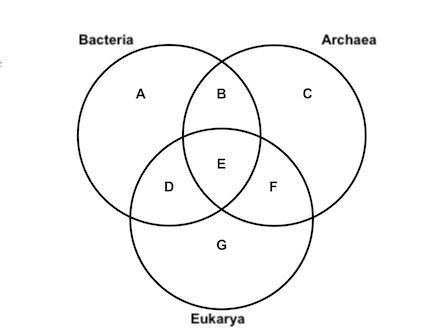
A) Prokaryote AND peptidoglycan - B
B) Eukaryote AND multicellular - G
C) Prokaryote AND multicellular - D
D) Prokaryote AND nucleus - E
E) Prokaryote - F
77) Consider the Venn diagram pertaining to prokaryotes, eukaryotes and acellular agents, and select the INCORRECT classification. Remember that in a Venn diagram, common characterisitcs are found in the circle overlaps.
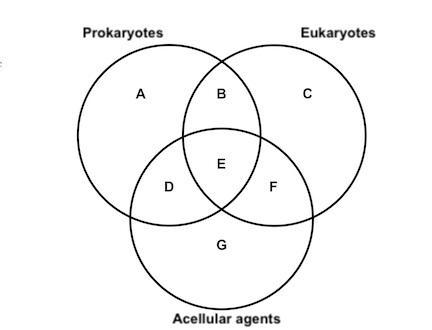
A) Peptidoglycan, 70S ribosomes and nucleoid - A
B) Cytoplasm, ribosomes and DNA - B
C) DNA or RNA, lipid and protein - G
D) 80S ribosomes, cytoplasm and nucleic acid - E
E) Mitochondria, Golgi and chloroplasts - C
78) <p>The Earth BioGenome Project aims to <!--Markup Copied from Habitat--></p>
A) <p>determine the DNA sequence of all known animal, plant, protozoan, and fungal species. <! Markup Copied from Habitat ></p>
B) <p>determine the 16S RNA sequence of all known animal, plant, protozoan, and fungal species. <! Markup Copied from Habitat ></p>
C) <p>determine the DNA sequence and 16 SRNA sequence of all known animal, plant, protozoan, and fungal species. <! Markup Copied from Habitat ></p>
D) <p>determine the DNA sequence of previously unidentified animal, plant, protozoan, and fungal species. <! Markup Copied from Habitat ></p>
E) <p>determine the DNA and 18S RNA sequences of all known environmental bacterial species. <! Markup Copied from Habitat ></p>
79) <p>Which of the following is NOT an emerging infectious disease? <! Markup Copied from Habitat ></p>
A) Smallpox
B) COVID-19
C) Mad cow disease
D) Candida aurisinfection
E) Mpox
80) <p>Which of the following would Antonie van Leeuwenhoek not have observed? <!-Markup Copied from Habitat--></p>
A) Human immunodeficiency virus
B) Candida albicansyeast
C) Neisseria gonorrhoeae
D) Paramecium
E) Algae
81) Bacteria are present on the body
A) only during disease-causing infections.
B) at all times.
C) only in certain areas.
D) only after intense exercise.
E) only after using public transport.
82) HIV/AIDS can be categorized as a new or emerging infectious disease. By putting it into this category, we are indicating that
A) this infection hasn't been observed in the human population prior to recent (within the last 50 years) outbreaks.
B) this disease has been in susceptible populations for centuries, but has only recently achieved infection levels that became detectable.
C) the infectious agent is still evolving and changing, unlike with older, more established diseases such as plague or polio.
D) the disease has always been in susceptible populations and causing disease, but we lacked the technology to detect it.
E) this infection hasn't been observed in the human population prior to recent (within the last 5 years) outbreaks.
Answer Key
Test name: Chapter 01
FALSE
FALSE
FALSE
TRUE
FALSE 9) FALSE
FALSE 11) FALSE 12) FALSE 13) [A, B, D] 14) [B, C] 15) [A, B, D] 16) B 17) C 18) C 19) B 20) B 21) B 22) B 23) A 24) D 25) C 26) E 27) E 28) E 29) B 30) A 31) D
A
C 34) A
C
A
B
38) B
39) B
40) E
41) B
42) A
43) B
44) C 45) E
46) E
47) D
48) B
49) C
50) C 51) A 52) E
53) A 54) C 55) B 56) E 57) A 58) B 59) B 60) C 61) C 62) C 63) C 64) D 65) B 66) C
67) D 68) C
69) C
70) B
71) C
72) B
73) A
74) C
75) E
76) B
77) D
78) A
79) A
80) A 81) B
82) A