Test Bank for Microeconomics 6
Edition by Chiang
ISBN: 9781319330545
Chapter 1
1. Which statement represents a microeconomic issue?
a. The unemployment rate fell by 2%.
b. All businesses in the United States experienced a decrease in revenues of 5% due to the recession.
c. The price of textbooks rose by 15% last year.
d. GDP increased by 6% last quarter.
ANSWER: c
2. Which topic is MOST likely to be studied in a microeconomics course?
a. rent control
b. unemployment
c. inflation
d. recessions
ANSWER: a
3. Which topic is MOST likely to be studied in a macroeconomics course?
a. taxation methods
b. recessions
c. public utility regulation
d. game theory
ANSWER: b
4. Macroeconomics does NOT concern:
a. recessions.
b. inflation.
c. job creation rates.
d. the determinants of a rise in the price of semiconductor chips.
ANSWER: d
5. Which topic is a microeconomic topic?
a. the U.S. inflation rate in 2009
b. the price of an iPad sold by Apple
c. the U.S. unemployment rate in March 2010
d. the rate of growth of GDP in the first quarter in 2010
ANSWER: b
6. Which topic is a macroeconomic topic?
a. the study of the business cycle
b. the price of a pair of Nike shoes
c. total sales of GE in 2009
d. the labor market for computer analysts
ANSWER: a
Chapter 1
7. Supply and demand analysis is used:
a. only in microeconomics.
b. only in macroeconomics.
c. in both microeconomics and macroeconomics.
d. in neither microeconomics nor macroeconomics.
ANSWER: c
8. Which topic would a microeconomic analysis address?
a. the national unemployment rate
b. the reasons for a decline in a country's total output
c. the price of college tuition that an individual student pays
d. the inflation rate in Brazil
ANSWER: c
9. International finance is generally studied in:
a. microeconomics.
b. macroeconomics.
c. deductive logic.
d. inductive logic.
ANSWER: b
10. The economics of uranium mining would be studied in:
a. microeconomics.
b. macroeconomics.
c. deductive logic.
d. inductive logic.
ANSWER: a
11. Which statement does NOT concern microeconomics?
a. Profits for some manufacturing firms fell in 2009.
b. In 2009, the unemployment rate in the United States rose to nearly 10%.
c. Salaries of top executives fell in 2009.
d. Competitive markets promote efficiency.
ANSWER: b
12. Which statement regarding macroeconomics and microeconomics is true?
a. Microeconomics examines consumer behavior, while macroeconomics studies business behavior.
b. Macroeconomics employs many of the same analytical tools as microeconomics.
c. Because it focuses on national economies, macroeconomics does not study international trade and finance.
d. Neither macroeconomics nor microeconomics is concerned with prices.
ANSWER: b
13. Which effect is NOT macroeconomic?
a. the effect of the budget deficit on the economy
b. the effect of monetary policy on inflation
c. the effect of Walmart's pricing policies on consumers
d. the effect of government policies on the country's unemployment rate
ANSWER: c
14. Which is the BEST example of a microeconomic issue?
a. The Federal Reserve will raise interest rates this week.
b. The unemployment rate will exceed 6% this month.
c. The country's price level has increased over the last quarter.
d. The production of automobiles decreased last year.
ANSWER: d
15. Belinda's favorite recreational activity is sailing, followed by fishing and shopping in that order. When Belinda has a day off work for a holiday, she prepares to go sailing, then discovers that there's no wind, forcing her to settle for a day of fishing. Belinda's opportunity cost of fishing is:
a. sailing.
b. sailing and shopping.
c. shopping.
d. the items she would have purchased if she had gone shopping.
ANSWER: d
16. Which statement is NOT a macroeconomic issue?
a. The Federal Reserve will raise interest rates this week.
b. The unemployment rate will exceed 6% this month.
c. The country's price level has increased over the last quarter.
d. The production of automobiles decreased last year.
ANSWER: d
17. Which statement correctly describes economic models?
a. They try to boil down an economic situation to its most basic elements.
b. They are always complex because the economy is complex.
c. They attempt to reproduce reality exactly.
d. They try to avoid invoking the ceteris paribus assumption.
ANSWER: a
18. Which statement is NOT true of economic model building?
a. There may be exceptions to economic models.
Chapter
b. Adding more complexity to models does not always provide greater insights.
c. Economic models always reach verifiable results.
d. Economic models provide generalizations about economic behavior.
ANSWER: c
19. Economists like to use graphs and equations primarily because:
a. these tools efficiently express economic concepts.
b. economics should be difficult.
c. mathematical aptitude is necessary to understand economics.
d. the use of mathematics reduces rigor.
ANSWER: a
20. A theory composed of a number of assumptions and facts boiled down to their basic relevant elements is called a:
a. metaphor.
b. model.
c. conclusion.
d. practice.
ANSWER: b
21. The purpose of an economic model is to:
a. be a complex, exact replica of reality.
b. demonstrate which values and beliefs are best for the economy.
c. explain the behavior of the issue being examined.
d. manage the economy like an automatic pilot.
ANSWER: c
22. Which statement does NOT describe model building in economics?
a. Models are developed to cover specific behaviors only.
b. Models are created and then tested.
c. Models are used to help understand the general economy.
d. Assumptions are used to analyze an economic issue.
ANSWER: a
23. Economic models must:
a. be completely realistic to be useful.
b. include all relationships that exist in the relevant issue to be modeled.
c. completely represent the real world.
d. rely on the ceteris paribus assumption.
ANSWER: d
1 Copyright Macmillan Learning. Powered by Cognero.
Chapter 1
24. Stylized economic models must include:
a. assumptions.
b. inflation.
c. money.
d. complexity.
ANSWER: a
25. An economy achieves when goods are produced at the lowest possible cost and when the individuals who most desire a product (as measured by willingness to pay) receive the product.
a. production efficiency; allocative efficiency
b. production possibilities; allocative possibilities
c. allocative possibilities; production possibilities
d. allocative efficiency; production efficiency
ANSWER: a
26. is how well resources are used and allocated.
a. Equity
b. Efficiency
c. Choice
d. Scarcity
ANSWER: b
27. Equity is:
a. a measure of how well resources are used and allocated.
b. a measure of the fairness of an outcome.
c. the value of the next best option given up to get something.
d. the idea that people have unlimited wants but limited resources.
ANSWER: b
28. When goods are produced at the lowest possible cost, an economy is said to have achieved:
a. production efficiency.
b. allocative efficiency.
c. cheap production.
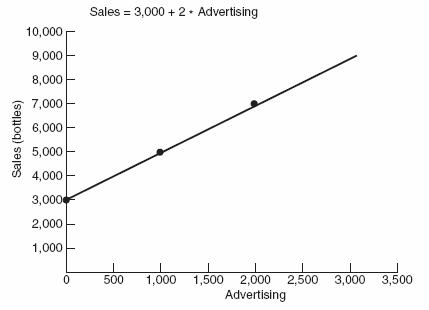
d. inferior quality goods.
ANSWER: a
29. An economy achieves allocative efficiency when:
a. production is allocated equally among all citizens.
b. the consumers who most desire a product get it.
c. goods are produced at the lowest possible cost.
d. resources are equally allocated between the private and public sectors of the economy.
Chapter 1
ANSWER: b
30. Which statement is NOT true?
a. There are often tradeoffs between efficiency and equity.
b. Both equity and efficiency are subjective concepts.
c. There are often disagreements over what is an equitable distribution of income.
d. Another term for equity is fairness.
ANSWER: b
31. A society that produces goods and services at the lowest possible cost is exhibiting:
a. allocative efficiency.
b. production efficiency.
c. opportunity costs.
d. scarcity.
ANSWER: b
32. In the study of economics, the goals of efficiency and equity are often:
a. compatible.
b. in conflict with one another.
c. objectively definable.
d. given equal emphasis.
ANSWER: b
33. An economy exhibits production efficiency when goods are:
a. produced at the lowest possible cost.
b. allocated to all consumers equally.
c. delivered to those who have the greatest willingness and ability to pay.
d. allocated to those with the greatest need.
ANSWER: a
34. Production inefficiency implies that:
a. goods are produced at too high a cost.
b. people who want certain goods cannot get them at any price.
c. too many Twinkies and too few Ding Dongs are produced.
d. workers are lazy.
ANSWER: a
35. Efficiency:
a. means that firms charge the highest potential prices for their goods.
b. means that firms earn the highest potential profits.
c. is a measure of how well resources are used and allocated.
Chapter 1
d. is a measure of the fairness of economic outcomes.
ANSWER: c
36. Production efficiency:
a. reflects how often economists make assumptions about important variables.
b. obtains when goods are produced at the lowest cost.
c. reflects the fact that all labor is equally productive.
d. is an assumption used by economists that holds important variables constant.
ANSWER: b
37. If a society produces a pie at the lowest possible cost and then distributes the pie evenly among its population, then:
a. production and allocative efficiency are achieved.
b. only production efficiency is achieved.
c. neither production efficiency nor allocative efficiency is achieved.
d. only allocative efficiency is achieved.
ANSWER: b
38. Allocative inefficiency implies that:
a. goods are produced at too high at cost.
b. people who want certain goods cannot get them at any price.
c. too many Twinkies and too few Ding Dongs are produced.
d. workers are lazy.
ANSWER: b
39. Economists generally have to say about equity than efficiency.
a. less
b. a little bit more
c. about the same amount
d. much more
ANSWER: a
40. An economy exhibits production efficiency if:
a. it produces more than enough clothes to clothe everyone.
b. economic growth increases every year.
c. it produces goods at the lowest possible cost.
d. it eliminates poverty.
ANSWER: c
41. Efficiency concerns:
a. how well resources are used and allocated.
Chapter
b. the fairness of various policies.
c. how quickly a task can be completed.
d. calculations of opportunity cost.
ANSWER: a
42. When goods are produced at the lowest possible cost, the economy is experiencing:
a. allocative efficiency.
b. production efficiency.
c. equity.
d. deflation.
ANSWER: b
43. A distribution is Pareto efficient if it's not possible to redistribute income or wealth in a way that makes one individual (or some group of individuals) better off without making at least one other individual worse off. Which of these distributions is Pareto efficient?
a. Wealth is evenly divided among citizens.
b. Ninety-nine percent of wealth is owned by the top 1% of the wealth distribution, while the remaining 1% of wealth is owned by the bottom 99% of the wealth distribution.
c. All wealth is owned by one citizen, while no wealth is owned by all remaining citizens.
d. All of these distribution are Pareto efficient.
ANSWER: d
44. An economy contains two people, Cindy and Ralph, and two goods, apples and oranges. Cindy likes apples and dislikes oranges (the more oranges she has, the worse off she is), and Ralph likes oranges and dislikes apples (the more apples he has, the worse off he is). Which of these distributions is Pareto efficient?
a. Cindy has all the oranges, and Ralph has all the apples.
b. Cindy has half of the oranges and half of the apples, and Ralph has half of the oranges and half of the apples.
c. Cindy has all but one of the apples and has one of the oranges, and Ralph has all but one of the oranges and has one of the apples.
d. Cindy has all the apples, and Ralph has all the oranges.
ANSWER: d
45. When the individuals who get a good or service are the ones who desire that product the most, the economy experiences:
a. allocative efficiency.
b. production efficiency.
c. equity.
d. deflation.
ANSWER: a
46. Government policies must often account for the: a. tradeoff between equity and efficiency.
1 Copyright Macmillan Learning. Powered by Cognero.
Chapter
b. positive relationship between equity and efficiency.
c. independence of equity and efficiency.
d. subjectivity of measures of efficiency.
ANSWER: a
47. The problem of the medically uninsured involves:
a. opportunity cost.
b. equity.
c. production efficiency.
d. allocative efficiency.
ANSWER: b
48. Which question requires a normative analysis?
a. How do interest rates influence employment?
b. How should a society achieve full employment?
c. How do unemployment rates differ among nations?
d. What are the long-term effects of unemployment?
ANSWER: b
49. Which of these statements reflect positive analysis?
I. Main Street needs more coffee shops.
II. A new parking garage on campus will reduce parking congestion.
III. Last winter, the state should have spent more money on snow removal.
a. I
b. I and II
c. II only
d. I, II, and III
ANSWER: c
50. Resources are:
a. unlimited, but wants are limited.
b. limited, but efficiency is unlimited.
c. limited, but wants are unlimited.
d. unlimited, but efficiency is limited.
ANSWER: c
51. Scarcity:
a. is synonymous with poverty.
b. is eliminated with improved technology.
c. is faced by all individuals and societies.
1 Copyright Macmillan Learning. Powered by Cognero.
d. can be eliminated with adequate resources.
Chapter
ANSWER: c
52. The idea that wants are virtually unlimited but that the resources needed to satisfy those wants are limited is called:
a. the want–resource paradox.
b. the economic gap.
c. the dismal conclusion.
d. scarcity.
ANSWER: d
53. A common definition of economics is the study of:
a. the allocation of scarce resources to satisfy competing wants.
b. maximizing net personal disposable income.
c. the factors underlying financial markets.
d. maximizing personal financial wealth.
ANSWER: a
54. There would be no economic problems in a world where all resources are:
a. unlimited.
b. privately owned.
c. owned by the government.
d. scarce.
ANSWER: a
55. people are forced to make tradeoffs.
a. Only wealthy
b. Only middle-class
c. Only poor
d. All
ANSWER: d
56. Scarcity:
a. exists in all societies.
b. affects only greedy people.
c. is the cause of poverty.
d. used to be a problem but is not an issue for industrialized nations.
ANSWER: a
57. Scarcity:
a. is the same thing as something being scarce.
b. refers to unlimited resources.
Chapter 1
c. refers to unlimited wants.
d. implies that people and societies face tradeoffs.
ANSWER: d
58. The core problem in economics is:
a. unemployment.
b. economic growth.
c. inflation.
d. scarcity.
ANSWER: d
59. Opportunity costs:
a. are generally the same from individual to individual.
b. involve monetary rather than nonmonetary costs.
c. decrease as individuals become wealthier.
d. influence all economic decisions.
ANSWER: d
60. What would be a possible opportunity cost of going to a doctor for a check-up?
a. the cost of getting nontraditional care
b. the opportunity to make an acquaintance in the waiting room
c. lost income due to not being at work for those hours
d. the cost of the insurance reimbursing the doctor
ANSWER: c
61. An airline finds that its 6 A.M. flights are half-empty but that the mid-afternoon flights are full. Which would be the MOST plausible statement for an economist to make?
a. Cut the price of the early morning flight, and raise the price of the afternoon flight.
b. Nothing can be done to rectify the situation because of consumer sovereignty.
c. Fewer flights should be scheduled in the afternoon to force travelers to take the morning flight.
d. Nothing can be done because travelers are inflexible with their schedules.
ANSWER: a
62. The opportunity cost of attending college does NOT include:
a. expenditures on food.
b. the costs of textbooks or eBooks.
c. the forgone wages that could have been earned working.
d. required student activity fees.
ANSWER: a
63. The opportunity cost of buying a ticket to a major league baseball game and then going to the game is:
Copyright Macmillan Learning. Powered by Cognero.
Chapter 1
a. the price of the ticket.
b. the value of the next best alternative that could have been chosen.
c. the time spent at the game.
d. all other alternative activities that could have been undertaken.
ANSWER: b
64. costs include the time and money that could have been spent on another highly valued activity.
a. Opportunity
b. Marginal
c. Social
d. Total
ANSWER: a
65. John chose to buy a pizza. If he had not bought the pizza, he would have bought either a hot dog or a burger. John's opportunity cost of buying the pizza is:
a. the hot dog.
b. the burger.
c. both the burger and the hot dog.
d. whichever alternative, the hot dog or the burger, has the next highest value for John.
ANSWER: d
66. The basic idea of opportunity cost is that:
a. buyers miss opportunities to find better bargains.
b. using resources in an activity imposes costs on other people.
c. the decision to use resources in one activity means that the resources cannot be used elsewhere.
d. economic agents are always looking for better opportunities.
ANSWER: c
67. The of parking at school include(s) the amount of time a person has to search for a parking space.
a. opportunity cost
b. equity concerns
c. efficiency
d. productivity
ANSWER: a
68. If you were not studying economics, you could be doing one of these: sleeping in (which you value at $5), playing cards with your friends (which you value at $10), or working (you would have earned an extra $8). The opportunity cost of studying economics is therefore:
a. $23.
b. $10.
c. $8.
Chapter
d. $5.
ANSWER: b
69. When the government chooses to use resources to build tourist centers, the selected resources are no longer available to build highways. This BEST illustrates the concept of:
a. macroeconomics.
b. scarcity.
c. opportunity cost.
d. efficiency.
ANSWER: c
70. Suppose Mike has three hours of time to spend, so he ranks the following activities in order of priority: (1) see a movie, (2) attend a ball game, (3) study economics. Assume that each activity takes three hours. What is Mike's opportunity cost of seeing the movie?
a. attending a ball game and studying economics
b. studying economics
c. attending a ball game
d. either attending a ball game or studying economics
ANSWER: c
71. The the opportunity cost of an activity, the a person will do that activity.
a. higher; more
b. higher; less
c. lower; less
d. It doesn't matter. Price alone will determine the action.
ANSWER: b
72. Opportunity costs exist because:
a. using resources in one activity means they can't be used in a different activity.
b. sellers are unwilling to give up their product without a price.
c. there are opportunities to find ways to reduce costs.
d. buyers always have an opportunity to go to another seller.
ANSWER: a
73. The highest valued alternative that is forgone when you choose an action is called its:
a. opportunity cost.
b. utility.
c. scarcity.
d. benefit.
ANSWER: a
74. The opportunity cost of undertaking an activity is defined as the:
Chapter
a. cost forgone by not undertaking another activity.
b. monetary cost of undertaking that activity.
c. benefit forgone by not undertaking the next-best activity.
d. monetary benefit of undertaking that activity.
ANSWER: c
75. Which scenario can arise from specialization and trade?
a. gains for all parties
b. gains for one party and losses for the other parties
c. losses for all parties
d. gains for all parties but only is there is government intervention
ANSWER: a
76. When specialization is used:
a. society is more productive, while individuals are less productive.
b. there are greater gains in material well-being.
c. there is more emphasis on self-reliance.
d. opportunity costs tend to be constant.
ANSWER: b
77. Which statement is true regarding specialization and trade between two individuals?
a. It benefits the poorer individual at the expense of the richer individual.
b. It benefits the richer individual at the expense of the poorer individual.
c. It benefits the poorer individual as well as the richer individual.
d. It benefits neither the poorer individual nor the richer individual.
ANSWER: c
78. Which of these is NOT a reason specialization leads to a larger total output and thus widespread gains?
a. Specialization enables individuals to focus on what they have a natural talent in producing.
b. Specialization enables individuals to produce what they've become specialized in through training.
c. If a product is an amalgam of individual products, specialization eliminates time between tasks that would be needed if the product were product in a single production process.
d. Specialization enables one to perform all the tasks needed for one's sustenance independently, without any interference from outside forces.
ANSWER: d
79. Employers give stock options to full-time employees who have been on the job more than three years. Compensation in the form of stock options assumes that people:
a. respond to incentives.
b. think on the margin.
c. are irrational.
d. don't account for opportunity costs.
1 Copyright Macmillan Learning. Powered by Cognero.
Chapter
ANSWER: a
80. Which example illustrates economic incentives?
a. tax deductions for individual retirement accounts
b. investment tax credits for businesses
c. tax deductions for education saving accounts
d. All of these are incentives.
ANSWER: d
81. Which of these represents a bad incentive?
a. charging drivers a gasoline tax to fund green energy projects
b. offering factories tax credits for reducing pollution
c. rewarding students for studying and earning high grades
d. raising homeowners' property taxes because of home improvements
ANSWER: d
82. What might be an effective way to encourage people to save more?
a. Raise capital gains taxes.
b. Lower interest rates.
c. Raise sales taxes.
d. Increase the mortgage deduction.
ANSWER: c
83. Which statement about incentives is true?
a. Each of us is motivated by the same incentives.
b. Each of us is motivated by different incentives.
c. Incentives can be manipulated with precision.
d. Price is the only relevant economic incentive.
ANSWER: b
84. Tax policy is partly based on the notion that:
a. high taxes are preferable to low taxes.
b. governments must always run budget surpluses.
c. markets never work efficiently.
d. people respond to financial incentives.
ANSWER: d
85. Sold-out movie screenings for matinees when ticket prices are discounted demonstrate that:
a. people respond to incentives.
b. government intervention in markets is economically beneficial.
c. market outcomes are always equitable.
1
d. the cost of living is decreasing.
ANSWER: a
86. Which statement is a key idea in economic thinking?
a. Scarcity exists for the poor but not the rich.
b. Incentives matter.
c. The value of a good can be objectively measured and is the same for everyone.
d. All of these are key ideas in economic thinking.
ANSWER: b
87. A basic assumption of economics is that:
a. people always respond to incentives.
b. in general, people respond to incentives.
c. history shows that tax incentives rarely work.
d. people do not respond to changes in costs and prices.
ANSWER: b
88. Marginal analysis would emphasize:
a. total monetary costs and benefits.
b. total opportunity costs and benefits.
c. additional costs and benefits.
d. total tangible costs and benefits.
ANSWER: c
89. Rational behavior requires thinking at the margin. Which example represents this type of thinking?
a. deciding whether a second burger is worth an extra $2
b. deciding whether overtime pay is worth working an additional hour beyond your normal work day
c. deciding how many watermelons to purchase
d. All of these examples represent thinking at the margin
ANSWER: d
90. Thinking at the margin involves:
a. influencing how individuals make decisions.
b. making wiser decisions, given limited information.
c. maximizing a firm's or individual's well-being.
d. weighing the impact of one additional activity.
ANSWER: d
91. Suppose that a store sells candy bars for $0.89 for one and $1.50 for two. The marginal cost of the second candy bar is:
a. $0.61.
Chapter 1
b. $0.75.
c. $0.89.
d. $1.50.
ANSWER: a
92. Which question does NOT involve marginal analysis?
a. Should a university offer another section of a class?
b. Should a restaurant stay open another hour?
c. Should K-Mart rebrand all its stores to using the Sears name?
d. Should Boeing hire another assembly-line worker?
ANSWER: c
93. When economists use the word "additional," they generally mean:
a. rational.
b. economics.
c. marginal.
d. opportunity cost.
ANSWER: c
94. Hitting your snooze alarm before you get out of bed is an example of:
a. thinking at the margin.
b. efficiency.
c. equity.
d. market equilibrium.
ANSWER: a
95. Rational behavior:
a. means incentives don't matter.
b. requires people to consider the total costs and total benefits of their decisions.
c. requires thinking at the margin.
d. requires perfect information.
ANSWER: c
96. Choosing to work an extra hour of overtime is an example of:
a. thinking at the margin.
b. efficiency.
c. equity.
d. market equilibrium.
ANSWER: a
97. If a restaurant that traditionally has served only lunch and dinner wants to open for breakfast, which of these
Copyright Macmillan Learning. Powered by Cognero.
Chapter 1
factors should it consider?
a. its rent
b. furniture
c. the cost of the additional food
d. insurance costs
ANSWER: c
98. People use to determine how many hours to work, and businesses use to determine how much of their product to supply to the market.
a. marginal analysis; marginal analysis
b. allocative efficiency; production efficiency
c. production efficiency; marginal analysis
d. marginal analysis; allocative efficiency
ANSWER: a
99. The extra cost associated with undertaking some action is its:
a. marginal benefit.
b. marginal cost.
c. net cost.
d. total cost.
ANSWER: b
100. Because people make decisions at the margin, when deciding whether to purchase a second car, they compare:
a. the dollar cost of having two cars and the potential income the two cars may generate.
b. the expected benefit of a second car and the total cost of the two cars.
c. the expected benefit of a second car and the additional cost of the second car.
d. None of the answers is correct.
ANSWER: c
101. You will take the day off work if:
a. the marginal cost exceeds the marginal benefit.
b. the marginal cost is less than the marginal benefit.
c. you can make up the missed work tomorrow.
d. you have additional sick days to spare.
ANSWER: b
102. Which statement does NOT involve thinking at the margin?
a. If I work another hour, I will beat the traffic.
b. I worked eight hours today.
c. My supervisor asked me to work an extra four hours this week.
1
d. If I work on my day off, I will make an additional $300.
ANSWER: b
103. Heather has one employee in her sweater shop who can sew six sweaters a day. When she hires a second person, the two employees can make ten sweaters together. The extra benefit received from hiring a second worker is sweaters.
a. sixteen
b. ten
c. four
d. six
ANSWER: c
104. Markets provide an incentive structure to:
a. maximize equity.
b. eliminate scarcity.
c. maximize market information.
d. maximize efficiency.
ANSWER: d
105. Private markets typically maximize production efficiency because they provide:
a. incentives in the form of profit.
b. equity.
c. market information.
d. tax revenue for the government sector.
ANSWER: a
106. It must be recognized that private markets:
a. will always produce the most rational level of production.
b. can fail.
c. satisfy everyone.
d. will never produce the most rational outcome.
ANSWER: b
107. Efficiency in markets is generally increased by the discipline of:
a. planning and profits.
b. prices and planning.
c. prices and profits.
d. production and planning.
ANSWER: c
108. Which statement about markets is true?
a. They always operate efficiently.
b. They bring buyers and sellers together.
c. Profits are never an effective discipline on the market.
d. Markets must always be controlled by the government.
ANSWER: b
109. What drives and disciplines markets?
a. equity
b. prices and profits
c. ceteris paribus assumptions
d. efficiency
ANSWER: b
110. An inefficient distribution of goods and services in the free market is called:
a. market failure.
b. uneconomic efficiency.
c. market collapse.
d. government failure.
ANSWER: a
111. Adam Smith:
a. originated capitalism.
b. was the first economist to distinguish between microeconomics and macroeconomics.
c. founded economics as the study of how individuals and firms allocate resources to their best uses, given limited resources.
d. demonstrated how individuals, pursuing their self-interest, act in ways that enhance the welfare of society as a whole.
ANSWER: d
112. Which of these is NOT an example of market failure?
a. Water is polluted by a paper company located by a river.
b. Air is polluted by a manufacturing firm.
c. Competition leads firms to provide products at the lowest possible price.
d. Consumers must buy water from one local water utility.
ANSWER: c
113. Government intervention in the market is helpful when:
a. consumers are free to buy from many different firms.
b. consumers are forced to buy from just one firm.
c. firms face increasing competition from new entrants into the market.
d. firms always use the cleanest technologies available to mitigate pollution.
ANSWER: b
Chapter 1 Copyright Macmillan Learning. Powered by Cognero.
Chapter 1
114. Information plays an important role in the market because it allows:
a. market participants to make good decisions based on cost-benefit analysis.
b. sellers to enhance their sales pitch.
c. the media to grow in importance.
d. managers to make more risky decisions.
ANSWER: a
115. One of the key ingredients in making rational choices is access to:
a. sufficient funds.
b. information.
c. foreign markets.
d. a university psychology department.
ANSWER: b
116. When consumers have no choice but to buy from one firm (e.g., a local utility):
a. they usually end up paying too much for the good or service.
b. government regulation is often used to protect consumers.
c. they will always get the good or service at the lowest price available.
d. None of these occur.
ANSWER: b
117. Which statement describes a time when the government should intervene in the economy?
a. Consumers cannot make up their minds what they want to purchase.
b. Sellers make poor business decisions.
c. Producers use the least-cost methods of production.
d. The market fails to provide goods efficiently.
ANSWER: d
118. Which situation(s) may require government intervention?
I. A local business has made a profit in each of the last 10 years.
II. Students are having difficulty deciding whether to go to the beach or hiking for their class trip.
III. A manufacturing firm on a river is dumping production run-off into the water.
a. I and II
b. II and III
c. II only
d. III only
ANSWER: d
119. Government intervention in the market is helpful when:
a. consumers are free to buy from a number of different firms.
b. consumers and firms have good information.
c. firms face increasing competition from new entrants into the market.
d. firms engage in production activities that pollute the air and water.
ANSWER: d
120. People tend to make rational choices for which they rely on:
a. scarcity.
b. utility.
c. information.
d. ceteris paribus
ANSWER: c
121. Economists believe that:
a. making information available to market participants improves market function.
b. information should be sold to the highest bidder.
c. the flow of information has a minimal impact on market efficiency.
d. data are more important to traders than information.
ANSWER: a
122. When the of given information outweigh(s) the of the information, people will attempt to obtain it.
a. costs; benefits
b. benefits; costs
c. equity; efficiency
d. efficiency; equity
ANSWER: b
123. Joan is trying to gather information on the membership at her Zen Center. She estimates that it will cost around $1,000 to gather the information but expects the information to lead to increased membership revenue of $1,100. Based on this information, Joan should:
a. not gather the information, since she will only gain $100.
b. gather the information, since the net gain will be $100.
c. not gather the information, since it will cost money, and the Zen Center is a not-for-profit organization.
d. gather the information regardless of the cost.
ANSWER: b
124. Which statement is true?
Chapter 1 Copyright Macmillan Learning. Powered by Cognero.
a. Low productivity and low pay go together.
b. High productivity and low pay go together.
c. Low productivity and high pay go together.
d. The most productive countries are those with the lowest average per capita incomes.
Chapter
ANSWER: a
125. For a nation, productivity growth leads to standards of living.
a. high; low
b. low; high
c. high; unchanging
d. high; high
ANSWER: d
126. Which of these would economists generally NOT consider a "good" institution, that is, an institution that positively affects the wealth of a nation?
a. a government that is relatively free of corruption
b. a government that controls resource allocation
c. a legal system that enforces contracts and laws
d. a strong monetary system
ANSWER: b
127. A nation's standard of living is primarily a function of:
a. natural resource availability.
b. government benefits.
c. national defense.
d. productivity.
ANSWER: d
128. The country of Economia has higher productivity than Productstan. Which statement is correct?
a. Economia likely to have a lower standard of living than Productstan.
b. It cannot be determined, based on the given information, which country is likely to have the higher standard of living.
c. Economia is likely to have a higher standard of living than Productstan.
d. Both countries have the same high standard of living because productivity and living standards are unrelated.
ANSWER: c
129. Which statement is NOT considered a key principle of economics?
a. Scarcity exists for everyone.
b. People face economic incentives on a regular basis.
c. Irrational behavior requires thinking at the margin.
d. Information is important to producers and consumers.
ANSWER: c
130. Which statement is NOT a key principle of economics?
a. People follow incentives.
1 Copyright Macmillan Learning. Powered by Cognero.
b. Productivity determines our standard of living.
c. Rational thinking requires perfect information.
d. Government can sometimes correct market failure.
ANSWER: c
131. Economists use graphs because:
a. they represent relationships between variables.
b. they are more efficient than models.
c. they are less efficient than models.
d. their use makes the analysis more complicated.
ANSWER: a
132. Time series graphs:
a. show data that can be split into percentages that, when combined, make up the whole.
b. show the relative importance of some variable's components as a share of the whole.
c. include the value of a variable on the horizontal axis and minutes, hours, days, months, quarters, or years on the vertical axis.
d. include the value of a variable on the vertical axis and minutes, hours, days, months, quarters, or years on the horizontal axis.
ANSWER: d
133. Pie charts:
a. depict two variables to see if any correlation exists.
b. show how data can be split into percentages by category.
c. include a variable for time.
d. show trends of data over time.
ANSWER: b
134. A graph of a business cycle that plots output on the vertical axis and quarters of the year on the horizontal axis is an example of a:
a. bar chart.
b. pie chart.
c. scatter plot.
d. time series.
ANSWER: d
135. If you plot temperature on the y-axis and time on the x-axis, you have created a: a. time series.
b. scatter plot.
c. pie chart.
d. bar chart.
ANSWER: a
Chapter 1 Copyright Macmillan Learning. Powered by Cognero.
Chapter 1
136. (Figure: Graph Examples) Which graph is an example of a scatter plot?
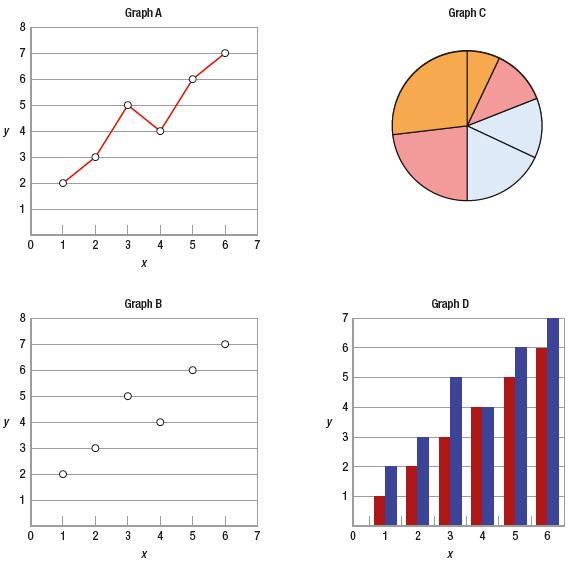
a. graph A
b. graph B
c. graph C
d. graph D
ANSWER: b
137. (Figure: Graph Examples) Which graph is an example of a pie chart?
a. graph A
b. graph B
c. graph C
d. graph D
ANSWER: c
138. (Figure: Graph Examples) Which graph in the figure is an example of a bar chart?
a. graph A
b. graph B
c. graph C
d. graph D
ANSWER: d
139. If you plot temperature on the y-axis and world carbon emissions on the x-axis, you have created a:
a. time series.
b. scatter plot.
c. pie chart.
d. bar chart.
ANSWER: b
140. (Figure: Mileage and Speed by Car Weight) Which statement about the graph is correct?
Chapter 1
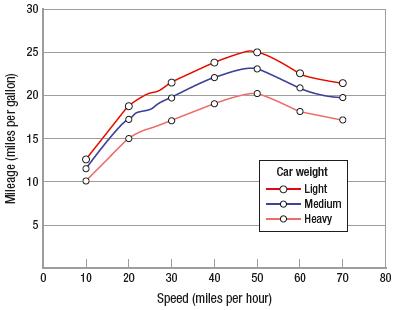
a. Mileage is related only to speed, not car weight.
b. Speed is related to mileage and car weight.
c. Mileage is related to both speed and car weight.
d. Mileage is unrelated to speed and car weight.
ANSWER: c
141. (Figure: Mileage and Speed by Car Weight) Which statement about the graph is correct?
I. The heavier the vehicles, ceteris paribus, the lower the mileage.
II. The higher the speed of the vehicle past 50 miles per hour, ceteris paribus, the lower the mileage.
III. Weight and speed are linearly related to mileage.
a. I only
b. II only
Chapter
c. I and II
d. I, II, and III
ANSWER: c
142. If two variables are positively related, then, as one variable:
a. decreases, the other variable decreases, and as one variable increases, the other variable decreases.
b. increases, the other variable increases, and as one variable decreases, the other variable increases.
c. decreases, the other variable increases, and as one variable increases, the other variable decreases.
d. increases, the other variable increases, and as one variable decreases, the other variable decreases.
ANSWER: d
143. If temperature and ice cream sales are positively related, as the temperature:
a. rises, ice cream sales fall.
b. rises, ice cream sales stay the same.
c. falls, ice cream sales decline.
d. falls, ice cream sales rise.
ANSWER: c
144. If a graph between hot chocolate sales and temperature is downward sloping, then sales of hot chocolate:
a. fall as temperature falls.
b. rise as temperature falls.
c. rise over time.
d. fall over time.
ANSWER: b
145. (Figure: Weight Loss and Exercise Time) According to the data in the graph, where weight loss is shown on the y axis, every two extra hours of exercise:
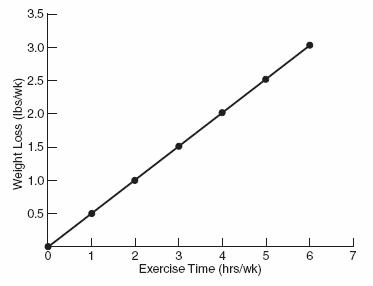
a. increases weight by 1 pound.
b. decreases weight by 1/2 pound.
c. decreases weight by 1 pound.
d. increases weight by 1/2 pound.
ANSWER: c
146. (Figure: Education and Earnings) The hypothetical graph shows the relationship between years of education and salary. Which statement is NOT correct?
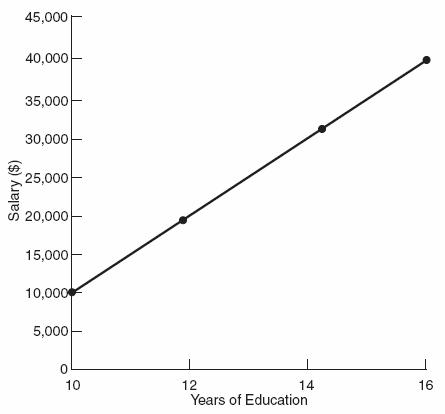
a. A person with 13 years of education can expect to earn $25,000.
b. The slope of the line is 5,000.
c. The line represents a simple model of the relationship between education and earnings.
ANSWER: d
Chapter 1 Copyright Macmillan Learning. Powered by Cognero.
d. The relationship between the two variables is nonlinear.
147. (Table) If the numbers in the table were placed on a graph, with hot chocolate sales on the vertical axis and temperature on the horizontal axis, a:
Hot Chocolate Sales
a. positive, nonlinear curve would result.
b. negative, linear relationship between temperature and hot chocolate sales would be shown.
1
c. positive, linear relationship between temperature and hot chocolate sales would be shown.
d. negative, nonlinear curve would result.
ANSWER: b
148. (Table) If the numbers in the table were placed on a graph, with hot chocolate sales on the vertical axis and temperature on the horizontal axis, the slope would be:
a. +2.
b. –1/2.
c. –2.
d. –10.
ANSWER: c
149. (Table) Using the information in the table, the equation that represents the relationship between temperature (T) on the horizontal axis and hot chocolate (C) sales on the vertical axis would be:
a. C = 150 – 2T
b. C = 50 – 1/2T
c. T = 75 – 2C
d. T = 25 – 1/2C.
ANSWER: a
150. (Figure: Crop Yield and Fertilizer) The graph shows a hypothetical relationship between tons of fertilizer used and crop yields. Which statement is NOT correct?
Chapter
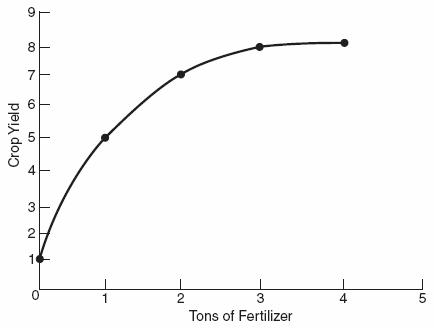
a. The slope of the curve between one and two tons of fertilizer is approximately 2.
b. The relationship between fertilizer usage and yield is nonlinear.
c. Because the relationship is nonlinear, it is difficult to create an economic model describing the relationship between the two variables.
d. Using more than three tons of fertilizer has minimal effect on yield.
ANSWER: c
151. If a graph showed that as the amount of time a person spent partying increased, her GPA decreased, then this relationship would be:
a. negative.
b. positive.
c. normative.
d. nonlinear.
ANSWER: a
152. Ceteris paribus means:
a. everything changes.
b. everything is held constant.
c. other things being equal.
d. nothing changes.
ANSWER: c
153. If the price of carrots drops, ceteris paribus, people will buy more carrots. Which statement BEST describes this phenomenon?
a. The relationship between the price of carrots and the number of carrots that people buy is independent of other things.
b. If carrots are the only available good, people will buy more of them if the price decreases.
c. If the price of carrots drops and everything else remains the same, the number of carrots people buy will increase.
d. As the price of carrots decreases, and all other prices decrease, then the quantity of carrots purchased will increase.
ANSWER: c
Chapter 1
154. When we analyze the relationship between inflation and the money supply, we assume that:
a. all other factors that affect the rate of inflation remain constant.
b. this relationship holds only in a democratic country.
c. this relationship is nonlinear.
d. the money supply is backed by gold alone.
ANSWER: a
155. When the ceteris paribus assumption is violated in economics, the effect is shown by:
a. a movement down along the curve.
b. a movement up along the curve.
c. a shift of the entire curve.
d. correlation but not causation.
ANSWER: c
156. The purpose of invoking ceteris paribus is to:
a. simplify the analysis being done.
b. make the economic model more realistic.
c. allow the model to take more complexity into account.
d. introduce risk into the model.
ANSWER: a
157. (Table) Assume the relationship between temperature (T) and hot chocolate (C) sales can be written as C = 150 – 2T. An updated study shows that the amount of hot chocolate sales at every temperature has actually doubled. The new equation for this relationship would be:
a. C = 150 – 2T
b. C = 75 – T
c. C = 300 – 4T
d. C = 300 – 2T.
ANSWER: d
158. (Figure: Graph Interpretation) In the graph, is the dependent variable and the slope of the line is _____.
Chapter 1
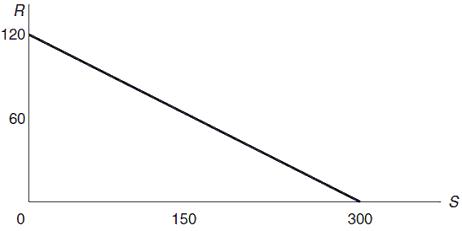
a. R; negative
b. R; positive
c. S; negative
d. S; positive
ANSWER: a
159. (Figure: Graph Interpretation) In the graph, the equation for the line is:
a. R = 120 – 0.4S.
b. R = 120 – 300S.
c. R = 120 + 0.4S
d. S = 300 + 120R
ANSWER: a
160. In the equation S = 130 – 2T, where S is hot chocolate sales and T is temperature, the slope is:
a. 130.
b. –2.
c. 2.
d. –65.
ANSWER: b
161. (Figure: Interpreting Equations on a Graph) The graph illustrates:
Chapter 1
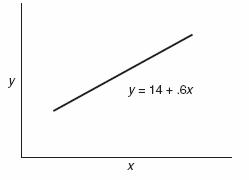
a. a nonlinear equation.
b. a linear equation.
c. the concept of efficiency.
d. a rectangular hyperbola.
ANSWER: b
162. (Figure: Interpreting Equations on a Graph) In the graph, if x is 0, then the y-intercept is:
a. 0.
b. 14.6.
c. 14.
d. 0.6.
ANSWER: c
163. (Figure: Interpreting Equations on a Graph) In the graph, the slope of the line is:
a. 0.
Chapter 1
b. 14.6.
c. 14.
d. 0.6.
ANSWER: d
164. (Figure: Interpreting Equations on a Graph) In the graph, if y stands for inflation and x stands for the money supply, then:
a. for every 1% increase in the money supply, inflation increases by 0.6%.
b. for every 1% increase in inflation, the money supply increases by 0.6%.
c. if the money supply increases by 14, then inflation goes up 0.6%.
d. if inflation increases by 14, then inflation goes up 0.6%.
ANSWER: a
165. In the equation S = 130 – 2T, where S is hot chocolate sales and T is temperature, sales:
a. increase by 20 if temperature increases by 10 degrees.
b. increase by 2 if temperature increases by 10 degrees.
c. decrease by 20 if temperature increases by 10 degrees.
d. decrease by 2 if temperature increases by 10 degrees.
ANSWER: c
166. In the equation S = 130 – 2T, where S is hot chocolate sales and T is temperature, sales:
a. decrease by 10 if temperature falls by 5 degrees.
b. decrease by 2 if temperature falls by 5 degrees.
c. increase by 10 if temperature falls by 5 degrees.
d. increase by 2 if temperature falls by 5 degrees.
ANSWER: c
167. Suppose that your car gets 40 miles to the gallon. Assuming D = distance or number of miles your car can drive and that G = the number of gallons of gasoline in your fuel tank, the relationship between the number of miles your car can drive and the amount of gas in your fuel tank is captured by which equation?
a. G = 40D
b. D = 1 + 40G
c. G = D – 40
Chapter
d. D = 40G
ANSWER: d
168. Suppose that if you don't study at all for you upcoming economics exam, you'll score 40 points but that your score will rise by 5 points for each hour of study you put in. Assume S = exam score, and H = the number of hours of study. The relationship between your exam score and the number of hours you spend studying is captured by which equation?
a. S = 40 – 5H
b. S = 40 + 5H
c. H = 5 + 40S
d. H = 5 – 40S
ANSWER: b
169. Consider the equation Y = e + fX. Which letter represents the slope?
a. e
b. f
c. X
d. Y
ANSWER: b
170. Consider the equation Y = e + fX. Which letter represents the intercept?
a. e
b. f
c. X
d. Y
ANSWER: a
171. In the equation Y = e + fX, is the independent variable and is the slope.
a. Y; e
b. Y; f
c. X; e
d. X; f
ANSWER: d
172. Suppose the equation Y = a – bX is plotted graphically. If the value of a rises, the
a. slope of the curve will become shallower.
b. slope of the curve will become steeper.
c. curve will shift upward.
d. curve will shift downward.
ANSWER: c
173. Suppose the equation Y = a – bX is plotted graphically. If the value of b falls, the:
Chapter 1
a. slope of the curve will become shallower.
b. slope of the curve will become steeper.
c. curve will shift upward.
d. curve will shift downward.
ANSWER: a
174. (Figure: Sales and Advertising) The graph shows the advertising expenditures and the resulting sales (in bottles) of a new caffeinated beverage called Jump. If the company that manufactures Jump spends $3,000 on advertising, how many bottles of Jump will it sell?
a. 13,500
b. 9,000
c. 10,000
d. 7,000
ANSWER: b
175. (Figure: Sales and Advertising) The graph shows the advertising expenditures and the resulting sales (in bottles) of a new caffeinated beverage called Jump. If consumer tastes change in the region where Jump is marketed and base sales increase by 1,500 bottles, what is the equation for the shifted line?
Chapter 1
a. Sales = 1,500 + 2 × Advertising
b. Sales = 4,500 + 2 × Advertising
c. Sales = 3,000 + 1,502 × Advertising
d. Sales = 3,000 + 2 × Advertising
ANSWER: b
176. (Figure: Sales and Advertising) The graph shows the advertising expenditures and the resulting sales (in bottles) of a new caffeinated beverage called Jump. If a new health advisory is released that warns consumers about problems associated with too much caffeine consumption and the level of base sales of Jump then decreases by 2,000 bottles, what is the equation of this shifted line?
a. Sales = 1,000 + 2 × Advertising
b. Sales = 3,000 + 2,002 × Advertising
Chapter 1
c. Sales = 3,000 + 2 × Advertising
d. Sales = 5,000 + 2 × Advertising
ANSWER: a
177. In the equation S = 130 –2T, where S is hot chocolate sales and T is temperature, hot chocolate sales are:
a. 130 when the temperature is 0.
b. 65 when the temperature is 0.
c. 132 when the temperature is 0.
d. 128 when the temperature is 0.
ANSWER: a
178. Suppose an economist discovers that the relationship between grades and hours of tutoring is Grade = 60 + 5(Hours). Based on the equation, which statement is true?
a. Tutoring is not worthwhile because each hour raises the grade by only 5 points.
b. If no tutoring is done, then the grade will be zero.
c. The expected grade with 5 hours of tutoring is 85.
d. The relationship between tutoring and grades is weak.
ANSWER: c
179. Which paired variables might indicate a correlation but NOT causation?
a. advertising expenditures and sales
b. snowfall amounts and stock market performance
c. age and health care expenditures
d. grade point average and future income
ANSWER: b
180. Which statement is correct?
a. Correlation and causation are synonyms.
b. Shortly after a new president takes office, the unemployment rate goes down. One must conclude that the new president's economic policies are responsible for the economic upturn.
c. The fact that two variables are correlated with each other does not mean that one causes the other.
d. If two variables move together, then they are causally related.
ANSWER: c
181. An increase in the price of gold is always associated with the outbreak of wars; increasing gold prices cause wars. This would be an example of what logical misconception?
a. ceteris paribus
b. correlation is causation
c. laissez-faire
d. nonlinearity
ANSWER: b
Copyright Macmillan Learning. Powered by Cognero.
Name: Class: Date:
Chapter 1
182. The observation that highly productive countries have taller populations is an example of:
a. cause and effect.
b. correlation.
c. causation.
d. allocative efficiency.
ANSWER: b
183. Economic analysis cannot be applied to concepts outside economics.
a. True
b. False
ANSWER: b
184. The broad scope of economic analysis allows us to reflect on everyday choices, in addition to more global issues.
a. True
b. False
ANSWER: a
185. Economic analysis gives us a structure for making decisions in a rational manner.
a. True
b. False
ANSWER: a
186. Economics is only about money.
a. True
b. False
ANSWER: b
187. Economics is about allocating limited resources to maximize an individual or society's well-being or satisfaction.
a. True
b. False
ANSWER: a
188. Economics deals only with financial issues.
a. True
b. False
ANSWER: b
189. Scarcity is best defined as when the quantity demanded exceeds the quantity supplied.
a. True
b. False
Name: Class: Date:
Chapter 1
ANSWER: b
190. A rich person does not experience scarcity.
a. True
b. False
ANSWER: b
191. Economists often start their analyses by considering how rational people would respond to the incentives present in specific situations.
a. True
b. False
ANSWER: a
192. Whether the country's price level has increased in the last quarter is a macroeconomic topic.
a. True
b. False
ANSWER: a
193. Macroeconomics concerns issues that pertain to the economy as a whole, and microeconomics concerns the behavior of individual economic agents.
a. True
b. False
ANSWER: a
194. Microeconomics concerns how markets are structured.
a. True
b. False
ANSWER: a
195. Decisions of individuals and firms are analyzed in microeconomics.
a. True
b. False
ANSWER: a
196. Macroeconomics focuses on decisions that affect the entire economy.
a. True
b. False
ANSWER: a
197. A microeconomic analysis may examine the reasons for increases and decreases in the price of bread.
a. True
b. False
Name: Class:
Chapter 1
ANSWER: a
198. Microeconomics may focus particular markets in an economy.
a. True
b. False
ANSWER: a
199. Microeconomics focuses on decision making by individuals, businesses, industries, and governments.
a. True
b. False
ANSWER: a
200. Macroeconomics concerns broader issues in the economy, such as inflation, unemployment, and national output of goods and services.
a. True
b. False ANSWER: a
201. Macroeconomics studies outcomes in individual markets.
a. True
b. False ANSWER: b
202. Economic models must fully reflect reality.
a. True
b. False
ANSWER: b
203. Complex models are always better than simple ones.
a. True
b. False ANSWER: b
204. To be useful, an economic model must include every possible detail and avoid abstraction.
a. True
b. False
ANSWER: b
205. Stylized models simplify information and facts to their basic relevant elements.
a. True
b. False
ANSWER: a
Name: Class: Date:
Chapter 1
206. Model building leads to theories that must then be tested.
a. True
b. False
ANSWER: a
207. Economists create simplistic models in order to explain complex economic topics.
a. True
b. False
ANSWER: a
208. The ceteris paribus assumption holds some variables constant in order to aid in model building.
a. True
b. False
ANSWER: a
209. A situation in which output is produced at the lowest possible cost is characterized by allocative efficiency.
a. True
b. False
ANSWER: b
210. There are no instances where efficient solutions to problems conflict with equity issues.
a. True
b. False
ANSWER: b
211. Much of economic analysis is directed toward ensuring an efficient allocation of resources.
a. True
b. False ANSWER: a
212. It is impossible to have a conflict between allocative efficiency and production efficiency.
a. True
b. False
ANSWER: b
213. The concept of equity relates to how quickly something can be produced. a. True
b. False
ANSWER: b
214. There is general agreement as to which economic policies are fair, or equitable.
a. True
Chapter 1
b. False
ANSWER: b
215. Positive analysis concerns how things ought to be.
a. True
b. False ANSWER: b
216. Positive analysis involves an understanding of basic facts.
a. True
b. False
ANSWER: a
217. Normative analysis focuses on societal beliefs regarding what should or should not be done.
a. True
b. False
ANSWER: a
218. The question "How do interest rates influence employment?" may arise as part of a normative analysis.
a. True
b. False
ANSWER: b
219. "The stimulus program under consideration by Congress will add three percentage points to GDP over the following year" is a statement. "Congress should enact the stimulus program currently under consideration" is a statement. "Most economists advocate that Congress enact the stimulus program currently under consideration" is a statement.
a. positive; normative; normative
b. positive; positive; normative
c. normative; positive; normative
d. positive; normative; positive ANSWER: d
220. The assumption that people will act in such a way as to maximize their self-interest is a reasonable one for most cases that economists analyze.
a. True
b. False
ANSWER: a
221. Scarcity arises when an individual's resources exceed their wants.
a. True
b. False
Chapter 1
ANSWER: b
222. The notion of scarcity implies that our wants always exceed our resources.
a. True
b. False ANSWER: a
223. Scarcity is not a problem faced by Bill Gates or Warren Buffet.
a. True
b. False ANSWER: b
224. Scarcity implies that people must make choices among alternatives.
a. True
b. False
ANSWER: a
225. Tradeoffs arise from the fact that resources are scarce.
a. True
b. False ANSWER: a
226. One definition of opportunity cost is the value of the next best alternative.
a. True
b. False
ANSWER: a
227. Opportunity cost is the value of the good you receive when you make a trade.
a. True
b. False ANSWER: b
228. Individuals do not incur any opportunity costs unless there is market failure.
a. True
b. False ANSWER: b
229. Opportunity cost involves nonmonetary costs rather than monetary costs.
a. True
b. False
ANSWER: b
Chapter 1
230. Specialization and trade between two individuals generally benefit the poorer individual at the expense of the richer individual.
a. True
b. False
ANSWER: b
231. Incentives are factors that force individuals and firms to undertake certain behaviors.
a. True
b. False
ANSWER: b
232. Which headline identifies a topic LEAST likely to be studied in macroeconomics?
a. Economic Growth Rises Slow and Steady
b. Unemployment Falls to a 7-Year Low
c. GM Expands Car Sales in China
d. The Fed Raises Interest Rates
ANSWER: c
233. When a consumer engages in marginal analysis, she purchases additional units of a good until the value to the consumer of the next unit is zero.
a. True
b. False
ANSWER: b
234. When economists model a problem, they:
a. make sure as many details and facts as possible are included in the model.
b. simplify information and facts to their basic relevant elements.
c. avoid assumptions as much as possible to avoid misrepresenting reality.
d. maximize complexity to accurately capture the complexity of reality.
ANSWER: b
235. Thinking on the margin means that, when deciding how much to consume or produce, the individual compares the additional cost and benefit of each successive unit.
a. True
b. False
ANSWER: a
236. When an economy uses the most efficient means of farming to grow as much corn as possible, it has achieved:
a. production efficiency and allocative efficiency.
b. neither production efficiency nor allocative efficiency.
c. production efficiency but not necessarily allocative efficiency.
Chapter 1
d. allocative efficiency but not necessarily production efficiency.
ANSWER: c
237. Thinking on the margin is defined as maximizing a firm's or individual's well-being.
a. True
b. False
ANSWER: b
238. Which scenario pertains to equity rather than efficiency?
a. The Red Sox signs a star player for $35 million a year, which is more than 10 times the average salary of the rest of the team.
b. Due to a lack of customers, Jamie's Pizza reduces the number of pepperoni slides on each pizza.
c. Mike's Auto Shop invests in a new hydraulic lift that makes it easier to change oil and rotate tires.
d. Howard's Realty offers his sales staff a bonus incentive if the annual sales goal is reached.
ANSWER: a
239. A store sells candy bars for $0.89 for one bar and $1.50 for two. The marginal cost of the second candy bar is $0.75.
a. True
b. False
ANSWER: b
240. Which of these questions involves normative analysis?
a. How many people participated in obstacle course racing last year?
b. How much does an entry into an obstacle course race cost?
c. When and where are the major obstacle races held?
d. Should obstacle races be regulated to ensure the safety of participants?
ANSWER: d
241. The government can always successfully intervene in cases of market failure.
a. True
b. False
ANSWER: b
242. Tim woke up this morning with a stomachache and decided to skip class to get more rest. What is the opportunity cost of Tim's decision to sleep in?
a. his improved restedness, resulting from getting more sleep
b. the pain the stomachache he suffered
c. the value of attending the class he decided to miss
d. the enjoyment of lying in bed instead of sitting in class
ANSWER: c
Chapter 1
243. Generally speaking, private markets are the most efficient institutions available for providing goods and services.
a. True
b. False
ANSWER: a
244. If a student never misses class and studies hard, they will likely earn a high grade. This is an example of:
a. an incentive.
b. specialization.
c. market failure.
d. marginal cost.
ANSWER: a
245. Excessive pollution is an example of market failure.
a. True
b. False
ANSWER: a
246. On a scale of 1 to 10, Sue rates her enjoyment of her first roller coaster ride 10 and her enjoyment of her second roller coaster ride 6. The marginal benefit of her second ride is:
a. 4.
b. 6.
c. 8.
d. 16.
ANSWER: b
247. Most economists agree that there is no legitimate role for government in the economy.
a. True
b. False
ANSWER: b
248. In which market is the government MOST likely to intervene to prevent market failure?
a. the restaurant market
b. the market for local utilities
c. the market for designer clothing
d. the jewelry market
ANSWER: b
249. Economists are MOST likely to disagree about which of these?
a. the efficiency of markets
b. whether income taxes are too high
c. the benefits of free trade
d. the importance of incentives in shaping economic behavior
ANSWER: b
250. Economists point out that the quality of economic decisions depends on the quality of the information underlying those decisions.
a. True
b. False
ANSWER: a
251. Which policy is MOST likely to contribute to an improved standard of living?
a. addressing teacher shortages by closing schools and busing students to other schools
b. allowing individuals the freedom to circumvent laws due to personal objections to them
c. reducing the years that drug patents are valid to speed up production of generic versions
d. increasing government funding for scientific research
ANSWER: d
252. A free flow of information promotes market efficiency.
a. True
b. False
ANSWER: a
253. Economics can be described as the study of how:
a. to classify resources used to produce final goods and services.
b. the financial system governs the exchange of goods and services.
c. individuals, firms, and society allocate limited resources to competing wants.
d. technology can be used to change scarce resources into free resources.
ANSWER: c
254. Scatter plots use time and one other variable to determine possible relationships.
a. True
b. False
ANSWER: b
255. The study of economics:
a. primarily focuses on the stock market.
b. concerns how individual and firms make decisions regarding their utilization of scarce resources.
c. does not apply to decisions made by businesses.
d. states that efficiency and equity do not conflict.
ANSWER: b
256. Time series graphs include the value of a variable on the vertical axis and minutes, hours, days, months, quarters, or years on the horizontal axis.
Chapter 1 Copyright Macmillan Learning. Powered by Cognero.
Chapter 1
a. True
b. False
ANSWER: a
257. Economics is a:
a. natural science.
b. physical science.
c. life science.
d. social science.
ANSWER: d
258. The height of the bars in a bar chart may depict the number of data points in each of several categories.
a. True
b. False
ANSWER: a
259. Economics is a social science that involves the study of how individuals, firms, and societies:
a. maximize happiness.
b. maximize incomes.
c. choose among alternatives to satisfy unlimited wants.
d. develop their tastes and preferences.
ANSWER: c
260. Simple graphs never provide information about relationships between variables.
a. True
b. False
ANSWER: b
261. Because of scarcity:
a. resources are limitless.
b. wants are limited.
c. choices are unlimited.
d. we face tradeoffs in nearly every choice we make.
ANSWER: d
262. Titles, labels for axes, and a statement of how the data are measured help in interpreting graphs.
a. True
b. False
ANSWER: a
263. Scarcity is BEST defined as when:
Copyright Macmillan Learning. Powered by Cognero.
Chapter 1
a. the quantity demanded exceeds the quantity supplied.
b. the quantity supplied exceeds the quantity demanded.
c. unlimited resources exceed limited wants.
d. unlimited wants exceed limited resources.
ANSWER: d
264. Time series graphs allow us to see trends in one variable over a set time frame.
a. True
b. False
ANSWER: a
265. Scarcity refers to the fact that:
a. some goods are scarce.
b. something is scarce.
c. a person must make choices, given the resource limitations they face.
d. there is no long-term benefit to studying economics.
ANSWER: c
266. A pie chart is useful for business presentations but not for macroeconomic analysis.
a. True
b. False
ANSWER: b
267. Why is it useful for students to study economics?
a. Most students will work as professional economists.
b. It helps us reduce our personal income taxes.
c. It can help us make better and wiser decisions, given our limited resources.
d. There is no long-term benefit to studying economics.
ANSWER: c
268. Linear relationships show the same slope between any two points on a line.
a. True
b. False
ANSWER: a
269. Which of these is a linear equation?
a. Y = (a/b)X
b. Y = a + bX
c. Y = a + b2X
d. Y = X2
ANSWER: b
Chapter 1
270. Reasons to study economics include all of these EXCEPT that you:
a. will always live in a world of scarcity and choices.
b. will understand more about how governments and businesses interact.
c. may become a better prepared voter.
d. will learn exactly how to invest your cash in the short term for the highest return on investment.
ANSWER: d
271. Suppose variable X rises as variable Q falls. Then the slope of a curve showing this relationship is positive.
a. True
b. False
ANSWER: b
272. Economists tend to approach economic questions by considering:
a. costs first and then turning to benefits.
b. benefits first and then turning to costs.
c. how rational people would respond to incentives in given scenarios.
d. the macro picture.
ANSWER: c
273. If variable S falls as variable X falls, then the slope of a curve showing the relationship between these variables is positive.
a. True
b. False
ANSWER: a
274. In analyzing how people make rational decisions, economists assume that people:
a. don't consider the costs of their decisions.
b. consider only monetary factors in their decisions.
c. respond to incentives.
d. are irrational.
ANSWER: c
275. (Figure: Graph Interpretation) The curve depicted in the graph has a slope of –0.4.
1
a. True
b. False
ANSWER: a
276. The assumption that people make rational decisions implies that people:
a. never make mistakes.
b. never appear to make irrational decisions.
c. are always selfish.
d. respond to incentives.
ANSWER: d
277. (Figure: Sales and Advertising) The graph shows the advertising expenditures and the resulting sales (in bottles) of a new caffeinated beverage called Jump. The vertical intercept of the function is 3,000 bottles.
a. True
b. False
ANSWER: a
278. A key tool of economic analysis is the assumption that people respond to:
a. laws.
b. incentives.
c. threats more than rewards.
d. positives but not negatives.
ANSWER: b
279. (Figure: Sales and Advertising) The graph shows the advertising expenditures and the resulting sales (in bottles) of a new caffeinated beverage called Jump. The slope of the function is 3,000.
Chapter 1
a. True
b. False
ANSWER: b
280. Paying a salesperson more for increased sales is an example of:
a. an incentive.
b. an opportunity cost.
c. efficiency.
d. equity.
ANSWER: a
281. In the equation Y = b – aX, a is the intercept.
a. True
b. False
ANSWER: b
282. Which statement is correct?
a. Economists do not believe that criminals behave rationally.
b. Economics has little to say about moral issues.
c. Economists consider how rational people respond to incentives.
d. Economists assume that people don't respond to incentives.
ANSWER: c
283. In the equation C = a + bY, Y is the dependent variable and a is the intercept.
a. True
b. False
ANSWER: b
Name: Class:
Chapter 1
284. The field of economics that focuses on decision making by individuals, businesses, industries, and governments is called:
a. macroeconomics.
b. decision science.
c. minieconomics.
d. microeconomics.
ANSWER: d
285. Correlation between two variables is not enough evidence to conclude that there is a causal relationship between the two variables.
a. True
b. False
ANSWER: a
286. The field of economics that concerns broader issues in the economy, such as inflation, unemployment, and national output, is called:
a. macroeconomics.
b. microeconomics.
c. national economics.
d. labor force economics.
ANSWER: a
287. When two variables appear to be related in a scatter plot, changes in one variable must be causing changes in the other variable.
a. True
b. False
ANSWER: b
288. Microeconomics concerns issues such as:
a. inflation.
b. unemployment.
c. how demand for a good is influenced by prices and incomes.
d. how to combat a recession.
ANSWER: c
289. If two variables are correlated with one another, it is possible but not necessary that changes in one variable cause changes in the other.
a. True
b. False
ANSWER: a
290. Macroeconomics concerns issues such as:
a. how information affects consumer choice.
b. the determinants of economic growth.
c. how individuals and firms influence prices through their demand and supply.
d. the tradeoffs individuals and firms face, given their limited resources.
ANSWER: b
291. Changes in stock prices are negatively correlated with the amount of rainfall. Therefore, rainy weather causes the stock market to fall.
a. True
b. False
ANSWER: b
292. Macroeconomics and microeconomics differ in that:
a. microeconomics focuses on the economy as a whole, and macroeconomics focuses on decision-making by and interactions among individual economic actors in markets.
b. macroeconomics focuses on the economy as a whole, and microeconomics focuses on decision-making by and interactions among individual economic actors in markets.
c. macroeconomics concerns how individuals make choices, and microeconomics concerns the aggregation of those choices.
d. microeconomics focuses on domestic economic policy, and macroeconomics focuses on international economic policy.
ANSWER: b
293. A recent decision by the Federal Reserve to raise interest rates is a topic. The impact of the emergence of Uber on local taxi businesses is a topic.
a. microeconomic; macroeconomic
b. macroeconomic; macroeconomic
c. microeconomic; microeconomic
d. macroeconomic; microeconomic
ANSWER: d
294. Macroeconomics focuses on decisions:
a. made by individuals.
b. made by firms.
c. to purchase consumer items.
d. affecting the entire economy.
ANSWER: d
295. In 2020 and 2021, the U.S. government enacted several stimulus programs designed to shore up employment in the face of the severe economic downturn caused by the COVID-19 pandemic. A possible negative consequence of these efforts is:
a. stagflation.
b. higher inflation.
Chapter 1 Copyright Macmillan Learning. Powered by Cognero.
c. decreased efficiency.
d. decreased equity.
ANSWER: b
296. Economic policymakers generally:
a. wind up keeping both inflation and unemployment high, owing to the impossibility of lowering both simultaneously.
b. keep inflation low, regarding low unemployment as a secondary concern.
c. keep unemployment low, regarding low inflation as a secondary concern.
d. seek to maintain low inflation and low unemployment, despite the inherent tension between these two objectives.
ANSWER: d
297. Which scenario is NOT microeconomic in nature?
a. Cooks at McDonalds supply labor in return for wages.
b. Real income has fallen due to rising housing and food prices.
c. Jonathan decided to go to the movies instead of going to work.
d. Pepsi experienced an increase in revenue last quarter.
ANSWER: b
298. Which of these is not a resource that can be used to address the problem of scarcity?
a. money
b. time
c. one's work ethic
d. choices
ANSWER: d
299. Determining how a restaurant sets prices to reflect current economic conditions is a topic of _____, and determining how restaurants contribute to total job growth in an economy is a topic of _____.
a. microeconomics; macroeconomics
b. microeconomics; microeconomics
c. macroeconomics; macroeconomics
d. macroeconomics; microeconomics
ANSWER: a
300. Which of these is not a characteristic of economic models?
a. the use of the ceteris paribus assumption
b. They are generally stylized.
c. They include many details to reflect unique circumstances.
d. They are used to determine relationships between variables.
ANSWER: c
301. If the various medications produced by the pharmaceutical industry reflect each consumer's willingness to
Chapter 1 Copyright Macmillan Learning. Powered by Cognero.
Chapter 1
pay, the market has achieved:
a. both production efficiency and allocative efficiency.
b. neither production efficiency nor allocative efficiency.
c. production efficiency.
d. allocative efficiency.
ANSWER: d
302. Which of these would be an example of normative analysis?
a. determining the optimal time of year to grow tomatoes
b. determining whether the minimum wage should be increased
c. estimating the cost of sending a human to Mars
d. estimating the risk of flood damage from building a house near the ocean
ANSWER: b
303. Instead of spending five hours studying for an economics exam, Oksana could have spent the time at the beach or pick up an extra shift at work. If Oksana enjoys the beach more than the extra money earned from work, what is Oksana's opportunity cost of studying for the exam?
a. the value of the money Oksana forgoes by not working
b. the value of the higher grade Oksana earns from studying more
c. the value of the money Oksana forgoes by not working plus the value of going to the beach
d. the value that Oksana places on going to the beach
ANSWER: d
304. Which of these would not be an example of an incentive used by a teacher to encourage students to submit their work on time?
a. Imposing a rule that no late assignments are accepted for any reason.
b. Providing an extra credit point for each day an assignment is submitted before the due date.
c. Allowing a three-day grace period before imposing penalties for late submissions.
d. Allowing students to re-attempt missed questions up until the due date.
ANSWER: c
305. Francesca's pizza shop offers two menu options: "pay by the slice" at $3 per slice, or "all you can eat pizza" for $12. The marginal cost of consuming the third slice of pizza is $_____ under the "pay by the slice" option and $_____ under the "all you can eat" option.
a. 9; 12
b. 9; 0
c. 3; 0
d. 3; 12
ANSWER: c
306. Why would relying on the private market for the distribution of a vaccine be considered a market failure if it does not cause any harm on society?
Chapter 1
a. The private market would result in prices so low that manufacturers would not produce enough vaccine.
b. The price charged in the private market would lead to less vaccine demanded than the socially desirable level.
c. Manufacturers in a private market would not have sufficient incentives to develop new vaccines.
d. The private market would lead to excessive demand for vaccines over time even as prices adjust to equilibrium.
ANSWER: b
307. Countries that have achieved greater wealth over time tend to share all of these characteristics EXCEPT:
a. greater self-reliance by limiting a country's dependence on imported goods
b. an emphasis on promoting innovative products and industrial processes
c. the development of strong legal and monetary institutions
d. the establishment of rules to limit corruption
ANSWER: a
308. What are some examples of the types of issues analyzed by microeconomics? What are some topics examined by macroeconomics?
ANSWER: Micro-oriented economists tend to focus on particular market outcomes, for example, pricing, employment in a particular trade, monopolization in a particular industry, changing demand in a given market, and resource usage by individual firms or in particular markets are all microeconomic topics. Macroeconomics, by contrast, concerns the economy as a whole. Most macroeconomic outcomes are captured in several categories of indicators: employment, price stability, production, and international trade. Students can cite the business cycle, unemployment rate, inflation, or the balance of trade.
309. Briefly describe how macroeconomics and microeconomics are related. How do they differ?
ANSWER: Microeconomics is the study of decision-making by individuals, firms, and businesses and the interactions among these economic agents. Macroeconomics concerns the economy as a whole. For example, a microeconomic analysis might concern demand for a particular product, such as SUVs, while a macroeconomic analysis might examine the overall demand for goods and services.
310. Are recessions a microeconomic or a macroeconomic issue? Explain.
ANSWER: Recessions pertain to the economy as a whole; thus, they are a macroeconomic issue.
311. Evaluate the following statement: To be useful, a model must be completely realistic.
ANSWER: This statement is NOT true. To be useful, a model must be fairly realistic, but it does not have to feature every aspect of the real world. The model must capture the essential relationships that figure into the problem we are concerned about. A model is useful so long as it sheds light on the problem at hand.
312. Describe how economists use models and how the results of stylized models may compare with those from more complex models.
ANSWER: By creating "stylized" models, economists simplify facts to their basic relevant elements to more effectively analyze an issue. Economists generalize about economic behavior and reach generally applicable results. We can add more dimensions and make models more complex. Often, however, complexity does not provide greater insight than a simple model.
313. Why might economists "begin most questions by considering how rational people would respond to the incentives that specific situations provide"?
ANSWER: A common objective of economic analysis is to predict economic outcomes that arise in given circumstances. Since a crucial variable in any economic outcome is human behavior, it's crucial to be able to predict how people will respond
Chapter 1
to the incentives present in given environments. The assumption that people behave rationally, that is, in a manner consistent with their self-interest, provides that predictability. By contrast, if economists assumed that people responded randomly to circumstances, so that incentives could not shape human behavior, there would be no clear way to predict behavior hence, no way to predict economic outcomes.
314. Explain the following statement: Economic theories must be tested.
ANSWER: Economists build models to explain economic relationships. As the purpose of such models is to gain insights into the real world, as in any scientific endeavor, economists test models against real-world data. If a model does a poor job of explaining empirical observations, then new models must be developed.
315. Why do economists develop models (stylized facts) to help with analysis? Discuss the strength and weakness of such an approach.
ANSWER: By using stylized facts, economists distill economic phenomena to their most basic relationships. The main advantage of this approach is that it simplifies reality so that it is easier to grasp and analyze. The disadvantage is that an economic model may omit some important details.
316. Describe the ceteris paribus assumption, and discuss how it might facilitate an analysis of your purchases of fast-food meals this week.
ANSWER: Economists use the ceteris paribus assumption to aid in model building. Holding all other things equal means that we hold some important variables constant, so that we can isolate the relationships between variable of interest. For example, to determine how many fast-food meals you might purchase in a given week based on their price, we might hold your weekly income constant, then change the price to see how changes in price impact quantity purchased.
317. Why do economists focus on efficiency rather than equity?
ANSWER: Economists generally stay out of discussions about fairness, leaving the issue to philosophers and politicians. When it comes to public policy issues, economics will help you see the tradeoffs between equity and efficiency, but given these tradeoffs, you will ultimately have to make up your own mind about the wisdom of a given policy. Economists tend to focus on efficiency and avoid sweeping judgments about equity, leaving each one of us to decide what is fair.
318. Discuss the difference between efficiency and equity.
ANSWER: Efficiency concerns how well resources are utilized and allocated. No one likes waste. Much of economic analysis is directed toward ensuring that public policies produce efficient outcomes. On the other hand, there is the issue of equity or fairness, about which views greatly diverge. There are instances in which the goals of efficiency and equity collide. You may agree that a specific policy is efficient, but you may also think it is unfair to a particular group of people.
319. Evaluate this statement: There is more than one concept of economic efficiency.
ANSWER: There are two concepts of efficiency: production efficiency and allocative efficiency. When a firm achieves production efficiency, it produces its product using the mix of inputs (labor, raw materials, and so on) that is least costly. Allocative efficiency, by contrast, concerns what is produced and who gets it. A society that produces large quantities of laptop computers, even at a minimal cost, would not be allocatively efficient if consumer demand favors other technologies, such as tablet computers. In that scenario, society would be better off if more tablet computers and fewer laptop computers were produced.
320. Explain what is meant by economic efficiency.
ANSWER: Efficiency is a measure how well resources are used and allocated. There are two kinds of efficiency: production efficiency when goods are produced at the lowest cost and allocative efficiency when those consumers who most desire a product, as expressed by willingness to pay, receive it. Additionally, there is the overarching concept of Pareto efficiency. A Pareto efficient distribution is one in which it's not possible to reallocate income or wealth so as to make anyone better off without making at least one other person worse off. Much economic analysis seeks to ensure that public policy produces the most efficient outcomes.
321. Explain the difference between positive analysis and normative analysis.
Chapter 1
ANSWER: Some issues, such as how large the government budget deficit is projected to be next year or what effect migration into an area will have the labor supply, require an understanding of basic facts. These issues are examined using positive analysis: the use of statements or questions that are based on an understanding of information. Other issues, such as whether the government should provide healthcare for all or whether extreme sports should be banned, concern not what is but what should be. Such matters are examined using normative analysis: the use of questions or statements that are based on opinions or society-wide beliefs regarding what should or should not take place.
322. At the start of the war in Iraq, homeowners in the United States found it difficult to find plywood. At the same time, the U.S. military was constructing buildings in Iraq. How do the two situations reflect economic tradeoffs?
ANSWER: All economic resources, including plywood, are limited. The decision to send and supply an army in the Middle East meant that resources had to be diverted to military use. The tradeoffs involved more than building material, because many workers were sent to Iraq, whether as members of the National Guard or as contractors.
323. How do the concepts of scarcity and opportunity cost relate to each other?
ANSWER: We have limited resources (scarcity), so we must make tradeoffs in nearly everything we do. In fact, economics is often defined as the study of the allocation of scarce resources to competing wants. We have to decide between alternatives. We have limited resources. Every activity involves opportunity costs. Sleeping, eating, studying, partying, running, hiking, and so on all require spending resources that could be used in another activity. The activity not chosen represents the opportunity cost of the current activity that was chosen.
324. What is the opportunity cost of you taking this economics class?
ANSWER: Each student will have a different response. The opportunity cost is the value of what is given up in order to study and to come to class. Some students may be giving up sleeping late, the chance to go on a trip because they use their money to pay tuition, or a job.
325. Explain why incentives are important, and give examples of incentives that a business might provide to its customers to increase product sales on weekdays.
ANSWER: Incentives cause people to change their behavior. By providing the proper incentives, businesses can help increase their sales. A 40%-off sale, like that used by Macy's on Wednesdays only, can bring more customers into the store and increase weekday sales. Not everyone leaps to use the incentives all the time, but they are helpful. Another possibility is early-bird previews of seasonal merchandise on Mondays only.
326. Explain the meaning of the phrase: People respond to incentives.
ANSWER: People are rational, that is, they make decisions based on cost-benefit analyses. If the price of something rises, people buy less of it. For example, higher taxes on certain items discourage buyers from purchasing them. Retailers discount items they wish to sell more of. Rising gasoline prices discourage people from buying cars that are not fuel-efficient.
327. What are some ways you use marginal analysis in your life?
ANSWER: Students can provide many examples of marginal analysis. Should the student stay up an extra hour to study or go to sleep? Should the student take on an extra course when they register? Should the student work an extra hour at a parttime job?
328. Why are markets efficient?
ANSWER: Private markets and the incentives they provide are the best mechanisms known today for providing products and services. Markets bring buyers and sellers together. Competition for the consumer dollar forces firms to provide products at the lowest possible price; otherwise, some other firm will undercut their high prices. New products enter the market and old products die out.
329. Provide two examples of what economists view as good institutions, that is, institutions that enhance the wealth of a nation?
Chapter 1
ANSWER: Beneficial economic institutions include a legal system that enforces contracts and laws and protects the rights of citizens and the ideas they create; a legislative process that develops laws and policies that provide incentives to individuals and firms to work engage in productive activity; a government free of corruption; and a strong monetary system.
330. What assumption about human motivation is made in economics? Explain.
ANSWER: In economics, we assume that people act as if motivated by self-interest and that people respond predictably to opportunities for gain. That is, people look out for their own self-interest and do so in a rational manner. A central assumption about human motivation is that people respond to incentives.
331. What are the benefits of learning the techniques and tools involved in economic analysis?
ANSWER: The techniques and tools of economics provide an analytical structure that can be used to make decisions rationally. Importantly, it can be applied not just to narrowly "economic" decisions but decisions broadly to any decision that involves comparing costs and benefits, given limited resources.
332. Distinguish between macroeconomics and microeconomics.
ANSWER: Macroeconomics concerns the behavior of the economy as a whole, whereas microeconomics concerns economic decisions by individuals and firms. Thus, macroeconomic topics include the total output of an economy and unemployment, whereas microeconomic topics include the effects of prices, incomes, and preferences on demand for a good and decisions by firms about the scale of production and when to enter or exit a market.