
Solutions Manual for Microbiology 1st
Edition by Parker, Schneegurt, Tu, Forster, Lister
ISBN: 9781938168147

Chapter 1: An Invisible World
Multiple Choice
OpenStax Microbiology
Chapter 1: An Invisible World
1. Which of the following foods is NOT made by fermentation?
A. beer
B. bread
C. cheese
D. orange juice
Answer
2. Who is considered the “father of Western medicine”?
A. Marcus Terentius Varro
B. Thucydides
C. Antonie van Leeuwenhoek
D. Hippocrates
Answer
3. Who was the first to observe “animalcules” under the microscope?
A. Antonie van Leeuwenhoek
B. Ötzi the Iceman
C. Marcus Terentius Varro
D. Robert Koch
Answer
4. Who proposed that swamps might harbor tiny, disease-causing animals too small to see?
A. Thucydides
B. Marcus Terentius Varro
C. Hippocrates
D. Louis Pasteur
Answer
5. Which of the following was NOT a kingdom in Linnaeus’s taxonomy?
A. animal
B. mineral
C. protist
D. plant
Answer
6. Which of the following is a correct usage of binomial nomenclature?
A. Homo Sapiens
B. homo sapiens
C. Homo sapiens
D. Homo Sapiens
Answer
7. Which scientist proposed adding a kingdom for protists?
1 of 7
Chapter 1: An Invisible World
A. Carolus Linnaeus
B. Carl Woese
C. Robert Whittaker
D. Ernst Haeckel
Answer
8. Which of the following is NOT a domain in Woese and Fox’s phylogenetic tree?
A. Plantae
B. Bacteria
C. Archaea
D. Eukarya
Answer
9. Which of the following is the standard resource for identifying bacteria?
A. Systema Naturae
B. Bergey’s Manual of Determinative Bacteriology
C. Woese and Fox’s phylogenetic tree
D. Haeckel’s General Morphology of Organisms
Answer
10. Which of the following types of microorganisms is photosynthetic?
A. yeast
B. virus
C. helminth
D. alga
Answer
11. Which of the following is a prokaryotic microorganism?
A. helminth
B. protozoan
C. cyanobacterium
D. mold
Answer
12. Which of the following is acellular?
A. virus
B. bacterium
C. fungus
D. protozoan
Answer
13. Which of the following is a type of fungal microorganism?
A. bacterium
B. protozoan
C. algae
D. yeast
OpenStax Microbiology
Answer
D
14. Which of the following is not a subfield of microbiology?
A. bacteriology
B. botany
C. clinical microbiology
D. virology
Answer B
Fill in the Blank
15. Thucydides is known as the father of _______________.
Answer Scientific history
16. Researchers think that Ötzi the Iceman may have been infected with _____ disease.
Answer
Lyme
17. The process by which microbes turn grape juice into wine is called _______________.
Answer fermentation
18. In binomial nomenclature, an organism’s scientific name includes its ________ and __________.
Answer genus, species
19. Haeckel proposed adding the kingdoms ________ and ________ to his phylogenetic tree.
Answer Protista and Monera
20. __________ are organisms without membrane-bound nuclei. Answer Prokaryotes
21. ______ are microorganisms that are not included in phylogenetic trees because they are acellular.
Answer
Viruses
22. A ________ is a disease-causing microorganism.
Answer pathogen
23. Multicellular parasitic worms studied by microbiologists are called ___________. Answer helminths
24. The study of viruses is ___________.
Answer virology
25. The cells of prokaryotic organisms lack a _______. Answer nucleus
Chapter 1: An Invisible World Page 3 of 7
Chapter 1: An Invisible World
Short Answer
26. What did Thucydides learn by observing the Athenian plague?
Answer
He saw that people who had been infected by the disease but recovered did not become infected again when they came into contact with sick people. This shows an early understanding of the concept of immunity.
27. Why was the invention of the microscope important for microbiology?
Answer
With a light microscope, scientists could finally see different kinds of microbes and observe their characteristics.
28. What are some ways people use microbes?
Answer
People can use microbes to make fermented foods, to clean up the environment, and to prevent and treat infectious diseases.
29. What is a phylogenetic tree?
Answer
A phylogenetic tree is a diagram showing how different organisms are thought to be evolutionarily related.
30. Which of the five kingdoms in Whittaker’s phylogenetic tree are prokaryotic, and which are eukaryotic?
Answer
Prokaryotic: Monera; Eukaryotic: Protista, Animalia, Fungi, Plantae
31. What molecule did Woese and Fox use to construct their phylogenetic tree?
Answer
small subunit rRNA
32. Name some techniques that can be used to identify and differentiate species of bacteria.
Answer
Gram staining, DNA/RNA analysis, biochemical assays, and serological testing
33. Describe the differences between bacteria and archaea.
Answer
Archaea and bacteria have different evolutionary histories, genes, metabolic pathways, cell walls, and membrane lipids.
34. Name three structures that various protozoa use for locomotion.
Answer
They can use hair-like cilia, tail-like flagella, or pseudopods (“false feet”).
35. Describe the actual and relative sizes of a virus, a bacterium, and a plant or animal cell.
Answer
A virus is about 100 nm and is 10 times smaller than a bacterium (~1 µm), which is at least 10 times smaller than a plant or animal cell (10–100 µm).
Critical Thinking
36. Explain how the discovery of fermented foods likely benefited our ancestors. Answer
Chapter 1: An Invisible World
Besides enhancing the taste of many foods, fermentation is one of the oldest methods of preserving perishable foods. This means fermented foods lasted longer and were less likely to spoil and cause illness.
37. What evidence would you use to support this statement: Ancient people thought that disease was transmitted by things they could not see.
Answer
The Romans built sewer and water systems to protect against disease. The concept of quarantining people with leprosy is found in the Bible. The Roman Marcus Terentius Varro proposed that disease could be caused by “certain minute creatures . . . which cannot be seen by the eye.”
38. Why is using binomial nomenclature more useful than using common names?
Answer
In binomial nomenclature, each organism has a unique name. Common names can vary between different countries or even within a country. It can also be difficult to come up with common names for very similar organisms.
39. Label the three Domains found on modern phylogenetic trees.
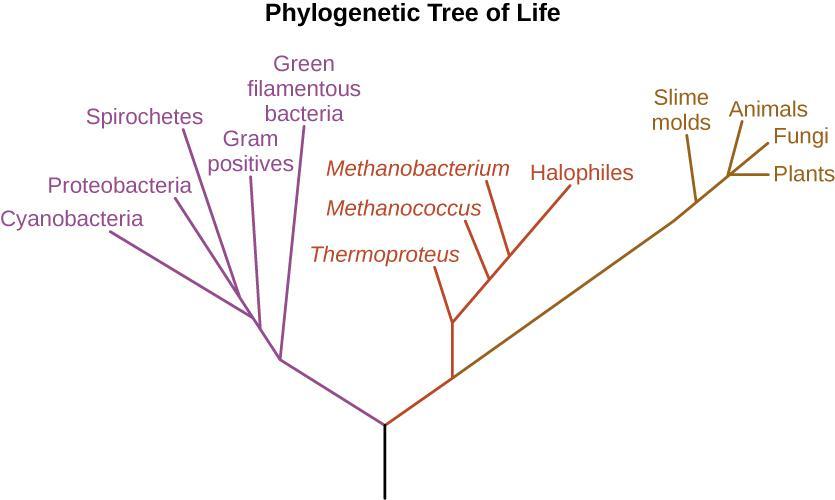
Answer
Bacteria (purple), Archaea (red), Eukarya (brown)
40. Contrast the behavior of a virus outside versus inside a cell.
Answer
Inside a host cell, viruses are able to reproduce. A virus is unable to reproduce when it is outside of a cell.
41. Where would a virus, bacterium, animal cell, and a prion belong on this chart?
Chapter 1: An Invisible World
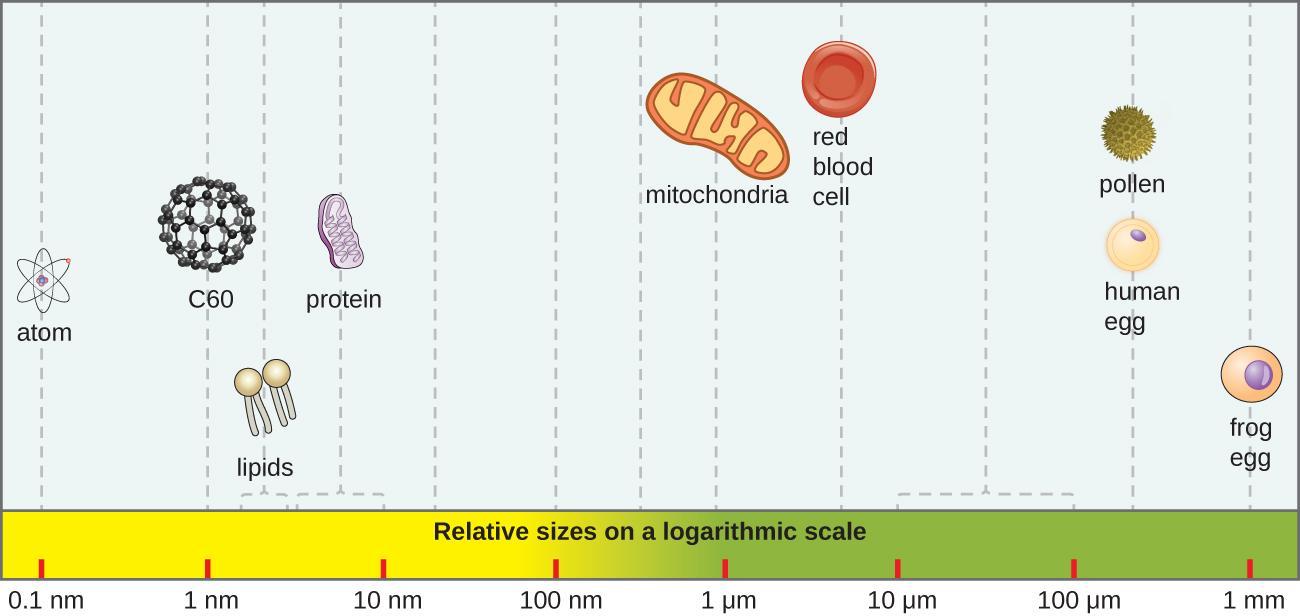
Answer
Virus at ~100 nm, bacterium at ~1 μm, animal cell at between 10–100 µm. Since a prion is a protein, it would be located at about 10 nm.
This file is copyright 2016, Rice University. All Rights Reserved.
6 of 7