Solutions Manual for Mastering Human Resource Management v2 1st Edition by Crews
ISBN: 9798887941974
Chapter 1
Human Resource Management: Challenges, Emerging Issues, and Roles
Chapter Learning Objectives
Describe the impact of human capital on organizational success.
Identify the challenges that HR managers must address as a result of business, economic, and social change.
Recognize the emerging issues and trends that impact human resource management.
Compare and contrast the responsibilities of HR managers and line managers.
Discuss the career options available in HRM and the competencies necessary for these roles.
Chapter Overview
Human resources (HR) is often thought of as a department in an organization that hires, does payroll, manages employee benefits such as health insurance and retirement plans, and handles the termination process when an employee separates from the company.
This chapter describes the impact of human capital on the success of the organization, and it presents an overview of the challenges and emerging issues that managers should consider when designing the policies and practices that affect the employees in an organization. The various responsibilities of HR managers and line managers are then discussed. The chapter concludes with an overview of the various opportunities available to those interested in HR as a career field, along with suggestions for gaining the necessary competencies and skillsets for a career in HR.
Section 1.1 Opening Case: Googleyness and Googlegeist
As part of the interview process, applicants are asked questions to determine their Googleyness, which some describe as the ability to thrive in an environment of ambiguity, uncertainty, and change.
They conduct an annual employee survey, referred to as the Googlegeist. It boosted its parental-leave policies, for example, after finding that mothers were leaving at higher rates. The result was a 50 percent reduction in attrition rates for working moms.
Case Discussion Questions
Do you think Google’s success could have been achieved without engaged employees?
Answer: This question can be used to introduce the role of human capital in the success of an organization,
How might the employer brand impact your decision whether to go to work for a particular organization?
Answer: Students will learn more about employer branding and the employer value proposition in chapter 5, but this is a good time to introduce the terms.
If you were interviewing for a position at Google, how would you respond to a question about your Googleyness?
Answer: There is no right or wrong answer but this can be an interesting and engaging way to introduce the topic of talent selection.
Can Google’s approach to perks be applied to all companies? For example, if a company is strapped for cash, what innovations might they implement without increasing expenses?
Answer: This question will encourage students to think about the connection between employee benefits and employee engagement.
Section 1.2 Introduction to Human Resource Management
Define human capital and human resource management.
Explain the impact of human capital on organizations, specifically in terms of organizational culture and competitive advantage.
Describe how the management of human resources has evolved from scientific management to the modern era of employee engagement.
Section Outline
What Is HRM?
Organizations collect and combine various types of capital, such as buildings, equipment, vehicles, investments, and loans that are needed to produce their product or service.
Organizational leaders and other experts in the field have come to recognize that the most vital type of capital in any organization is the human assets.
Individuals have human rights and cannot be bought or sold like other assets. They can be leased or contracted with, but the individual can terminate the arrangement because they, and not the organization, own their own human capital.
The human resources of an organization also differ from other assets in that they have the capability to think, to learn, and to analyze situations.
Competitive advantage is created by attracting, developing, and retaining human resources with superior knowledge, skills, and abilities than those at competing organizations.
Human resource management is the set of policies and practices that attract, develop, and retain a qualified workforce, in ways that result in engaged employees who contribute positively to organizational performance.
The Impact of Human Capital on Organizations
The role of HR is to develop the type of workforce that is necessary to accomplish organizational goals and objectives.
Human resource management is not just a functional area concerned with things such as government compliance, payroll, employee benefits, etc. Rather, HR is a vital component to a competitive business strategy.
Many businesses worry about the ability to grow and compete because they cannot find workers with the right skills. At the same time, many Americans continue to struggle with unemployment and underemployment and finding full-time work that pays a competitive wage. A growing skills gap has created a mismatch between the demand and supply of skills.
Organizational culture is the beliefs, philosophies, values, assumptions, attitudes, and expectations of an organization. The culture represents the type of behavior that is acceptable and expected. It includes conduct, skills, and attitudes.
Consider how human resource policies and practices impact the organizational culture, and how the culture subsequently impacts competitive advantage.
Evolution of HRM
Human resource management has evolved through several major eras or schools of thought. Those eras are Scientific Management, Unionization, and the Human Relations Movement.
The Scientific Management era began around the 1880s, during the Industrial Revolution. Scientific management involved creating work performance standards and established routine operating procedures that employees were expected to adhere to. The main
criticism of this school of thought is that it led to repetitive, monotonous jobs, and treated employees like machines to be programmed.
The Unionization movement began during the 1930s and peaked around 1960. The growth of unions began with the passage of the National Labor Relations Act in 1935. Many of us enjoy job benefits such as vacation pay, 40-hour work weeks, weekends off, and health insurance, largely because unions negotiated these benefits. On the other hand, the union movement sometimes creates an adversarial relationship between labor and management and can hamper productivity and competitiveness if union wage and benefit demands are unreasonable.
The Human Relations era began with the Hawthorne Studies in the 1920s. The movement did not really begin to take hold until the 1960s, but the Hawthorne Studies are generally credited with being the first research into the human element of human resource management. From the 1990s to the present, there has been a shifting emphasis from viewing employees as resources to be managed, towards viewing them as valuable assets that should be respected, valued, and developed.
Key Takeaways
An organization is a collection of people working together to achieve a common purpose.
Human capital is defined by the OECD as the knowledge, skills, competencies, and attributes embodied in individuals that facilitate the creation of personal, social, and economic well-being.
Human resource management is the set of policies and practices that attract, develop, and retain a qualified workforce, in ways that result in engaged employees who contribute positively to organizational performance. Business location decisions today increasingly are made based on the presence of a workforce with the appropriate skills.
Human resource management has evolved through several major eras. The Scientific Management era began around the 1880s, during the Industrial Revolution, and revolved around three concepts: work rules, work methods, and standardized times. The Unionization movement began during the 1930s and peaked around 1960. The Human Relations era began with the Hawthorne Studies in the 1920s. The movement did not really begin to take hold until the 1960s, but the Hawthorne Studies prompted managers to begin thinking about the importance of the individual in organizational structure and job design.
Interactive Activities
1. Think of a company that you currently work for, or have in the past. What made the workforce different than that of the competitors, and did these differences result in a competitive advantage or disadvantage?
2. Contact a representative of your local or state economic development agency. Ask them about the skills shortages that exist in your area and the impact this is having on the
growth of the local economy. Also inquire about what is being done to close the skills gaps.
3. What was the most useful lesson learned for HR managers from the Hawthorne studies?
Key Terms
Organization: A collection of people working together to achieve a common purpose.
Human capital: The knowledge, skills, competencies and attributes embodied in individuals that facilitate the creation of personal, social and economic well-being.
Human resource management: The set of policies and practices that attract, develop, and retain a qualified workforce, in ways that result in engaged employees which contribute positively to organizational performance.
Organizational culture: The beliefs, philosophies, values, assumptions, attitudes, and expectations of an organization.
Section 1.3 The Changing Landscape of Human Resource Management
Describe the challenges for HR managers created by the changing demographics and diversity of the modern workforce.
Explain how technologies such as applicant tracking systems and human resource information systems are changing the practice of HR.
Consider how the recruitment, management, and retention of talent differs in a multinational enterprise.
Define the term knowledge economy and recognize how it impacts HRM, especially in regard to recruiting, training, and development of the workforce.
Workplace Demographics and Diversity
The changing nature of the workforce is a major challenge facing HR managers and other business leaders.
The trends indicate that the future workforce will be multigenerational, older on average, more racially and ethnically diverse, and more female.
When considering the age of the workforce, it can be helpful to look at the generations that comprise the general population.
Generations can be divided into cohorts, which provide a method for analyzing changes over time. Cohorts provide a way to understand how different formative experiences
(such as world and economic events, technology, and social changes) interact with the lifecycle and aging process to shape people’s views of the world.
The workforce will continue to increase in racial and ethnic diversity. By 2024, less than 60 percent of the U.S. labor force is likely to define itself as “white non-Hispanic”, while as recently as 1994, over 75 percent of the workforce fell into that category.
HR managers play a crucial role in building awareness of diversity and creating a culture of inclusion.
Technologies
Digital technology is impacting virtually every aspect of HR including recruiting, hiring, training and development, and benefits administration. For example, the development of the applicant tracking system has transformed the way in which recruitment is conducted.
As the name implies, an ATS tracks each candidate through the application process, and automates much of the process, saving labor time for the HR department and keeping applicants informed of their status.
An HRIS typically integrates with a payroll system and tracks paid time off (PTO), attendance, compensation history, positions and pay grades, disciplinary actions, training, development, and other types of data.
The Forbes Human Resource Council, composed of successful human resource executives, has identified the following ways that technology has streamlined their HR processes:
o Digital interviews save time and money.
o Everyone can connect through social media, allowing employees to be more open and connect with others in the workplace.
o Paper records are now digital, helping HR staff to locate needed data quickly.
o More focus can be placed on relationship building, providing HR professionals to do what humans can do better than machines, which is interact with employees (giving them opportunities to positively impact the culture of the organization).
o Geographical boundaries are eliminated, which allows even small companies to access a global talent pool.
Artificial intelligence (AI) is being increasingly used in human resource management to streamline processes, improve decision-making, and enhance the overall efficiency of HR operations.
Here are some common ways AI is applied in HR:
o Resume Screening
o Candidate Matching
o Chatbots and Virtual Assistants
o Employee Onboarding
o Predictive Analytics
o Employee Engagement and Feedback
o Performance Management
o Diversity and Inclusion
o Skill Gap Analysis
o Employee Benefits Management
o Employee Wellness
o Compliance and Risk Management
o Exit Interviews and Analysis
o HR Analytics and Reporting
o Recruitment Marketing
Globalization
Recruiting, managing, and retaining human resources at a firm with extensive global operations is especially challenging.
Global business is expanding rapidly, as trade agreements (such as the United StatesCanada-Mexico Agreement, or USMCA, and the European Union) are reducing tariffs and other barriers to trade.
Consider some of the following challenges that international human resource management (IHRM) poses:
o International staffing policy: Activities directed at recruiting, selecting, and placing employees.
o Preparation and training of international employees: Onboarding, training and development, and preparing employees for international assignments.
o International performance appraisal: Providing feedback for employees’ professional development.
o Compensation of employees: Includes formulation of benefit packages that can vary greatly from country to country.
o International labor relations: Managing relationships with unions and collective bargaining processes.
o Diversity in an international workforce: The challenges of differences in country cultures, religion, and attitudes toward women and minorities.
The Knowledge Economy and the Nature of Work
Advances in technology and a better-educated workforce have led to what is often referred to as the knowledge economy
The production of goods and services and the jobs that this entails are heavily based upon knowledge and education.
Competitive advantage is increasingly reliant upon a workforce with a high level of knowledge, skills, abilities, and other characteristics, which collectively are referred to as KSAOs.
Advances in technology are fundamentally changing the nature of work in many industries and creating an imperative for continual lifelong learning.
Key Takeaways
The changing nature of the demographics and diversity of the workforce is a major challenge facing HR managers and other business leaders.
More than one in three American labor force participants are millennials, making them the largest generation in the U.S. labor force.
By 2024, less than 60 percent of the U.S. labor force is likely to define itself as “white non-Hispanic,” while as recently as 1994, over 75 percent of the workforce fell into that category.
Digital technology is impacting virtually every aspect of HR including recruiting, hiring, training and development, benefits administration, and others.
Recruiting, managing, and retaining human resources at a firm with extensive global operations is especially challenging.
The knowledge economy is a system of production and services based on knowledgeintensive activities that contribute to an accelerated pace of technical and scientific advances, as well as rapid obsolescence.
Interactive Activity
1. Practice choosing a vendor for an HRIS system. Choose three vendors from the Best HR Software Comparison List (under Resources number 4). Go to each vendor’s website and read about the features and benefits. Do a web search for each vendor and read reviews written by HR professionals. Then check with the Better Business Bureau to find out each company’s rating and how many and what types of complaints have been filed. Based on your findings, which vendor would you select, and why?
Key Terms
Generation: A social grouping of people born within a defined time period that share similar cultural traits, values, and preferences.
Applicant tracking system (ATS): A software program that manages the recruitment and hiring process, including job postings and applications.
Human resource information system (HRIS). A software or online solution that is used for data entry, data tracking and the data information requirements of an organization's HR management.
Knowledge economy: A system of production and services based on knowledgeintensive activities that contribute to an accelerated pace of technical and scientific advance, as well as rapid obsolescence
KSAO’s: Knowledge, skills, and abilities, and other characteristics.
Knowledge: The that state of having a correct idea or understanding of something or the possession of information about something.
Skill: The capability of accomplishing something with precision and certainty.
Ability: The quality in a person or thing which makes an action possible.
Section 1.4 Emerging Issues and Trends in HRM
Explain why the HR industry is moving towards a balanced approach that focuses on employee engagement, while also achieving organizational goals for competitive advantage, productivity, and profitability.
Recognize how a societal interest in sustainability and corporate social responsibility impacts HR practices.
Describe how advances in data analytics and artificial intelligence are improving decision-making in HRM.
Discuss the skill-shortage problem in the United States and other developed countries and the impact on business location decisions.
Section Outline
Employee Engagement
The HR industry is undergoing a shift from focusing solely on the employer perspective, to a more balanced approach that focuses on employee engagement and work-life balance, while also achieving organizational goals for competitive advantage, productivity, and profitability.
SHRM’s Effective Workplace Index consists of the following seven components:
o Job challenge and learning opportunities
o Supervisor support for job success
o Autonomy
o Culture of respect, trust and belonging
o Work-life fit
o Satisfaction with wages, benefits, and opportunities to advance
o Co-worker support for job success
Sustainability and Corporate Social Responsibility
Sustainability has become a popular buzzword among the business sector, government, and the non-profit entities, and business leaders find themselves wondering if this is just the latest management fad or a concept that will fundamentally change how businesses are managed and measured.
When a business adopts a sustainable approach, they are not just driven by business profits but consider the human and environmental impacts of their actions.
Organizations today are increasingly judged on their relationships with their employers, customers, and communities, transforming them from mere business enterprises to social enterprises.
In the context of HR, social responsibility includes creating and maintaining a workplace culture that respects everyone equally, and in which all individuals and groups are treated with dignity and respect.
HR managers play a crucial role in making sure that new hires understand the organizational code of ethics and values, and providing a process whereby potential violations of ethics or harassment can be reported.
Talent Analytics
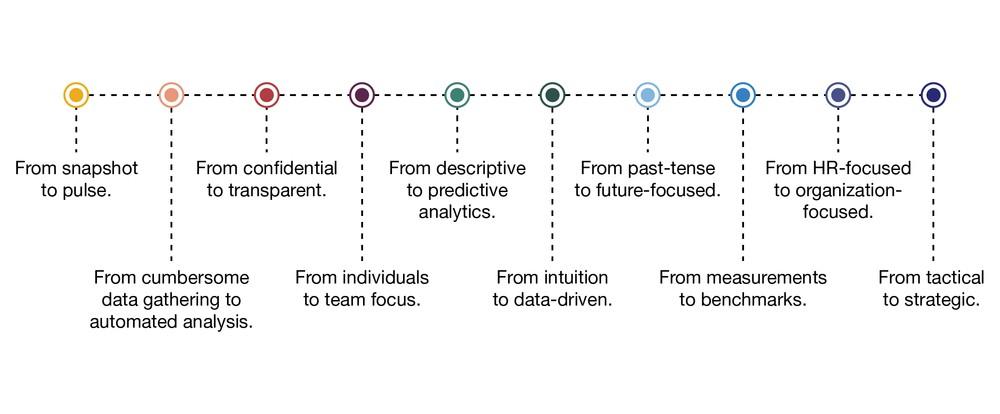
Increased capabilities in data analytics and artificial intelligence are transforming the practice of HR by automating many of the mundane functions and providing the tools for HR managers to make data-driven decisions.
There are five areas in which workforce analytics can be particularly useful:
o Workforce planning: Analytics can provide the capability to analyze every stage of the employee life cycle, from hiring to retirement.
o The management and improvement of business performance.
o Learning and developing new skills, training, and onboarding all form a key part of HR activities.
o Retention of employees and their overall loyalty to the organization are key to organizational success and long-term profitability.
o Analytics can help to monitor payroll costs and other expenses associated with employees, such as health insurance, payroll taxes, and retirement plans.
Key Takeaways
The HR industry is undergoing a shift away from human resource management solely focused on the employer perspective, to a more balanced approach that focuses on employee engagement and work-life balance, while also achieving organizational goals for competitive advantage, productivity, and profitability.
Sustainability is a business approach that creates long-term shareholder value by embracing opportunities and managing risks deriving from economic, environmental, and social developments.
In the context of HR, social responsibility includes creating and maintaining a workplace culture that respects everyone equally and in which all individuals and groups are treated with dignity and respect.
A socially responsible organization ensures that all employees conduct themselves in an ethical manner and maintain high standards of integrity.
Increased capabilities in data analytics and artificial intelligence are transforming the practice of HR by automating many of the day-to-day functions and providing the tools for HR managers to make data-driven decisions.
Business location decisions today increasingly are made based on the presence of a workforce with the appropriate skills.
1. In small groups, discuss: What companies do you think do a good job of being socially responsible? What are these companies doing that gives you this impression?
2. How do you feel when you work for a company or an individual who does not seem to care about your work-life balance or your personal well-being?
Key Term
Sustainability: A business approach that creates long-term shareholder value by embracing opportunities and managing risks deriving from economic, environmental, and social developments
Section 1.5 Responsibilities and Roles in HRM
Identify the responsibilities of HR managers.
Explain the unique challenges faced by solo HR practitioners.
Compare and contrast the HR responsibilities of line managers and HR managers.
Section Outline
Responsibilities of HR Managers
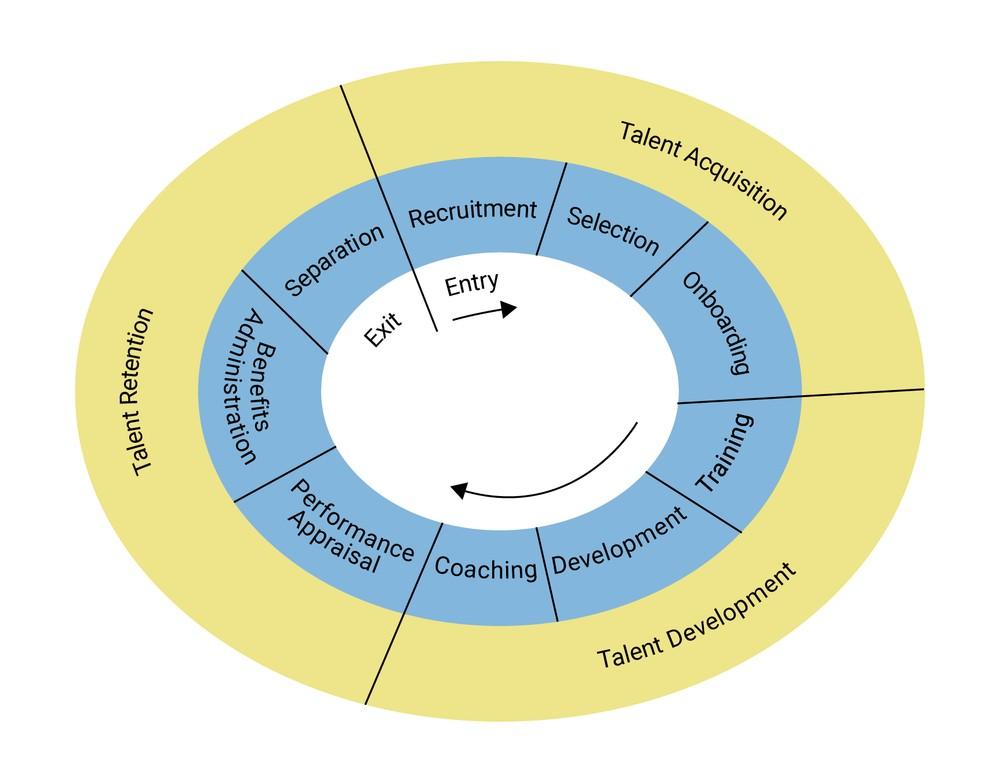
The Employee Life Cycle (ELC) is a model that portrays the journey of a typical employee from the time they first learn about an opening at the organization, through the recruitment and hiring process, until their employment ends.
The nine stages of the ELC are: recruitment, selection, onboarding, training, development, coaching, performance appraisal, benefits administration, and separation. These nine stages can also be grouped under three overall categories:
o Talent Acquisition: During the talent acquisition phase, the focus is on attracting a qualified pool of applicants and then selecting the individuals that are the best fit for each position.
o Talent Development: Once an employee has been hired, then the talent development process begins with onboarding. However, training, coaching, and other forms of development should continue as long as the employee is with the organization.
o Talent Retention: Retention refers to motivating employees to stay with the organization. Compensation is certainly one method, but research indicates that it is not the top motivator. One of the most effective tools in employee retention is to focus on employee engagement, thus increasing commitment to the company.
In addition to managing the events that occur as part of the ELC, HR managers often are responsible for a variety of organizational functions that are not directly related to talent acquisition, development, or retention. These may include labor relations and workplace health, safety, and security.
HR Talk: Lauren Billings
What are some of the challenges when the HR function is split between three people?
Answer: Having to communicate between three people could create cumbersome processes that will delay taking action on HR issues. There also could be miscommunication to employees and as a result, disgruntled employees.
What steps could Lauren take to enhance her knowledge of compliance with employment laws?
Answer: Lauren might consider pursuing a SHRM Certification or professional development courses in HR and employment law.
Solo HR Practitioners
In many small businesses, there is only one individual that is responsible for all of the HR functions.
The solo HR practitioner is pulled in many directions and does not have the time or expertise to adequately address all of the responsibilities previously described.
Their top concerns have to do with engagement, acquisition, leadership, communications, and relations.
If you find yourself in a position as an HR department of one, then you might consider outsourcing some of the day-to-day tasks, freeing yourself up to focus on communications, leadership, engagement, and employee relations.
HR Responsibilities of Line Managers
Line managers are responsible for day-to-day supervision, motivation, and performance management of their direct reports.
Human resources, accounting, marketing, and customer service are examples of staff departments.
Line managers and HR managers should share the responsibility for talent recruitment, development, and retention.
In companies with successful human resource practices, the line and staff managers have learned that they both have some responsibility for HR management and have learned to support each other to implement effective HR practices and procedures.
Key Takeaways
The employee life cycle (ELC) is a model that portrays the journey of a typical employee from the time they first learned about an opening at the organization, through the recruitment and hiring process, and all of the stages the employee progresses through
until their employment ends. The nine stages of the ELC are: recruitment, selection, onboarding, training, development, coaching, performance appraisal, benefits administration, and separation.
During the talent acquisition phase, the focus is on attracting a qualified pool of applicants and selecting the individuals that are the best fit for each position.
Once an employee has been hired, then the talent development process begins with onboarding and then continues with ongoing job skills training, policy and legal training, performance management, team building activities, and coaching and mentoring, as long as the individual is employed with the organization.
One of the most effective tools in ensuring that employees stay with an organization in the long run is to focus on employee engagement, thus increasing commitment to the company.
If you find yourself in a position as an HR department of one, then you might consider outsourcing some of the day-to-day tasks, freeing you up to focus on communications, leadership, engagement, and employee relations.
Line managers and HR managers should share the responsibility for talent recruitment, development, and retention.
Interactive Activity
1. Think of a time when you first started working in a new company. How would you describe the onboarding experience? What did you like about it, and what would you suggest they do differently?
Key Terms
Employee life cycle (ELC): A model that portrays the journey of a typical employee from the time they first learned about an opening at the organization, through the recruitment and hiring process, and all of the stages the employee progresses through until their employment ends.
Line manager: A person who directly manages the employees and operations of an organization that create products and services
Staff manager: A person that manages a department that serves the line managers in a support or advisory capacity by providing information and advice and ensuring compliance with government laws and regulations.
Section 1.6 Careers in HRM
Identify the types of positions and career options that are available in the HR profession.
Explain how to best prepare for a career in HRM.
Describe the skillsets and competencies necessary for an individual to perform well in an HR career, in accordance with the SHRM Competency Model.
Section Outline
Positions and Career Options in HR
Human resources is one of the fastest growing professions, and the demand for highly skilled HR professionals will continue to increase.
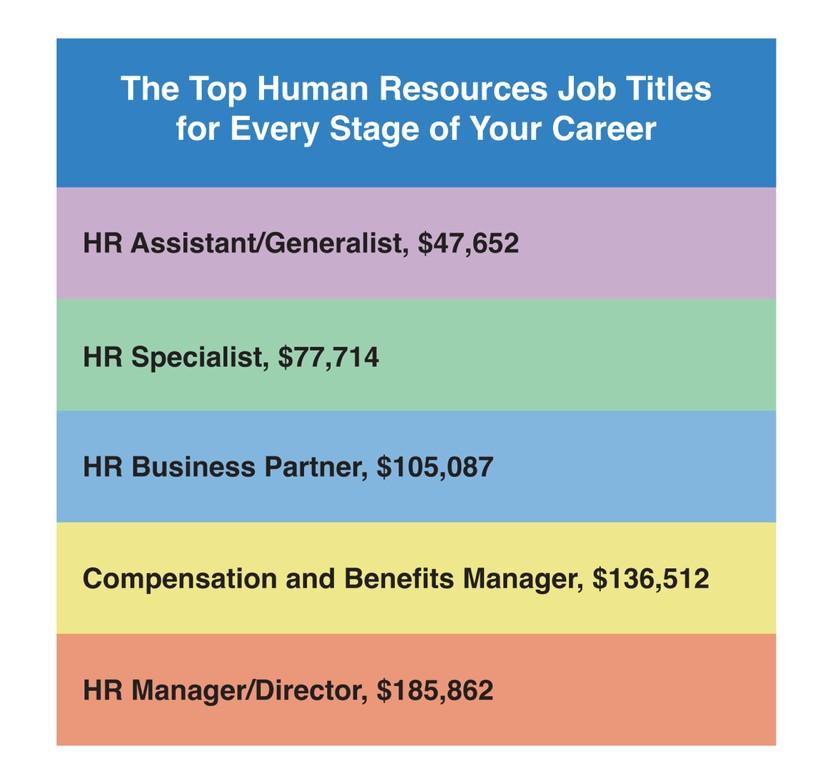
An HR generalist is a person who handles a wide variety of duties that may range from administrative duties, recordkeeping and reporting, tracking applicants, to a wide variety of other tasks.
An HR specialist is a person who has expertise in a specific area of human resources and is usually a more experienced HR professional.
The most experienced HR staff may move into roles as HR managers or directors. In larger organizations, the most senior HR employee may be a member of the senior executive team, with titles such as VP for human resources, VP for people, or chief human resources officer (CHRO).
Preparing for a Career in HRM
There are three general paths to an entry-level position in the HR field:
o A college degree in HR.
o A college degree in a related subject, such as business administration, or industrial/organizational psychology, then applying those skills to HR through experience and/or earning appropriate certification.
o Working for several years in an operational role at a company, then transitioning to HR.
Research indicates that professional experience is vital to securing employment after graduation from college, with the most valuable internships lasting at least three months.
Another way to build experience is to seek an HR rotational, which is typically a fulltime job lasting two to three years, in which the participant rotates through various aspects of HR within a company.
The value of an HR certification is that it demonstrates to prospective employers that you have attained a specific level of knowledge and behaviors related to HR.
HR Talk: Cindie Melton
Have you participated in an internship? If so, did you receive feedback about your strengths and weaknesses?
Answer: If students did receive feedback, ask them to share if they are comfortable with that, along with how they acted on that information.
What resources does your college/university provide to help students find an internship opportunity?
Answer: This is an opportunity to encourage students to participate in an internship and to become familiar with school resources to assist them in locating opportunities.
HR Skillsets and Competencies
Competencies simplify the process of tying examples of performance expectations to organizational or professional missions and goals, which increases the likelihood of a positive impact on organizational outcomes.
Competencies are expressed as either technical or behavioral.
Both SHRM and HRCI have identified bodies of knowledge that outline the competencies and skills that are essential for HR professionals.
Key Takeaways
Human resources is one of the fastest growing professions, and the demand for highly skilled HR professionals will continue to increase.
There are three general paths to an entry-level position in the HR field: (1) a college degree in HR; (2) a college degree in a related subject, such as business administration, or industrial/organizational psychology, then application of those skills to HR through experience and/or earning appropriate certification; or (3) working for several years in an operational role at a company, then transitioning to HR.
The SHRM Body of Applied Skills and Knowledge SHRM BASK™ is designed for all HR professionals as a resource for identifying and defining proficiency in the technical and behavioral aspects of HR.
HRCI’s HR Body of Knowledge (HRBoK) provides a comprehensive overview of the profession and essential HR practices.
Activity
1. Create a personal career development plan including the following steps:
a. Write down your primary career interest.
b. Identify your long-term professional goal (e.g., become an HR Director).
c. Identify the short-term goals that will contribute to reaching your long-term goal (e.g., complete a college degree in HR, spend five years as an HR generalist, etc.).
d. List two to three activities that will help you reach each short-term goal. For each activity, write down when you will start and complete it. Then exchange plans with a classmate and provide each other with feedback and suggestions.
Key Terms
Competency: A cluster of observable and measurable knowledge, skills, abilities, and other characteristics (KSAO’s) needed for effective job performance.
KSAOs: Knowledge, skills, abilities, and other characteristics.
Section 1.7 End-of-Chapter Case: The Spec-Tacular Culture Crush at Warby Parker
Warby Parker makes all aspects of their employees’ life cycles extraordinary, showing that regular communications keep their employees feeling connected, informed, and engaged.
They place a major focus on doing good in the world. This
Case Discussion Questions
Is it crucial for companies to make such an exceptional first impression when hiring new employees? Why or why not?
Answer: Students will learn more about onboarding in chapter 11. This question is an opportunity to make the connection between onboarding and employee engagement.
What are the benefits of having weekly meetings rather than monthly or semi-annual meetings?
Answer: This discussion should introduce the importance of communication between management and employees, and the role that plays in building trust, respect, and loyalty.
How important is the treatment and management of employees to the success of a company?
Answer: As students will learn later in the text, the relationship between employees and management, and in particular the immediate supervisor, is one of the primary factors in employee retention and turnover.
Warby Parker’s founders and team leaders are present in the day-to-day lives of their employees. What positive attributes can this provide for both employers and employees?
Answer: This approach can build a positive organizational culture where every employee feels valued and has a voice. Regular interaction between the leaders and the employees is a key factor in employee engagement.
Does Warby Parker’s Special Projects program provide their employees with a new perspective and perhaps give them a break from their usual work, to aid in their job becoming less mundane?
Answer: This question is good opportunity to discuss chapter 4 (Job Analysis and Design) and the role of job enrichment and job enlargement.
What are some other ways to encourage communication between new and existing employees?
Answer: Answers will vary.


© 2025 By FlatWorld. All rights reserved. Your use of this work is subject to the license agreement available on our website at https://catalog.flatworldknowledge.com/terms.
No part of this work may be used, modified, or reproduced in any form by any means except as expressly permitted under the licensing agreement.