7) In the history of marketing, the production orientation utilized all aspects of marketing in order to satisfy customer needs.
true
false
8) The marketing concept strategy was short lived, giving way to what is the dominant strategy in today's marketplace, that of sales orientation.
true
false
9) Platforms like Facebook and X are changing how firms interact with customers to better meet the needs of the marketplace. ⊚ true
false
10) Marketers create value for customers when they develop products that allow consumers to satisfy their needs and wants through exchange relationships.
⊚ true ⊚ false
11) In a marketing sense, there is really no difference between a need and a want.
true
false
12) When it comes to marketing products and services, marketers do not need to be concerned with any ethical implications of their actions because the consumer bears the ultimate responsibility to determine whether or not a product is needed.
true ⊚ false
13) The marketing concept is also referred to as the marketing mix. ⊚ true
false
14) Christy is looking to open a bakery. She wants to make sure her bakery is successful, so she hires a consultant to help her determine the best location for her new business. In this example, the information given to Christy by the consultant is considered a product.
⊚ true
⊚ false
15) Price is typically the hardest marketing mix element to change. ⊚ true ⊚ false
16) The place element of the marketing mix involves the activities a firm undertakes to make its product available to potential customers.
⊚ true
⊚ false
17) Firms that use social media for promotion try to create content that attracts attention and encourages readers to share the content with their social networks.
⊚ true
⊚ false
18) The interconnected nature of the world economy is referred to as internationalization.
⊚ true
⊚ false
19) In 2018, the trade agreement known as NAFTA was renamed the USMCA, but the trade agreement itself remained unchanged.
⊚ true
⊚ false
20) The Snap, Crackle and Pop characters are part of the brand that differentiates Kellogg's cereal from that of other firms.
⊚ true
⊚ false
21) The practice of measuring, managing, and analyzing market performance is referred to as logistics.
⊚ true
⊚ false
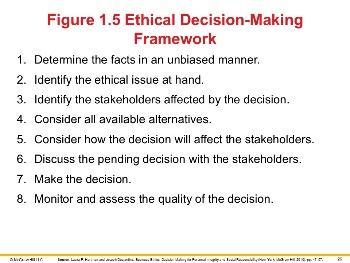
22) The first step in the ethical decision-making framework is to identify the ethical issue at hand.
⊚ true ⊚ false
23) Determining if an advertising message represents the product’s benefits honestly is an ethical issue that relates to the product element of the marketing mix.
⊚ true ⊚ false
24) Since they are not in the business of generating revenue or making profits, nonprofit organizations do not need to rely on marketing efforts to be successful.
⊚ true
⊚ false
25) Professionally speaking, you need different marketing principles than those used in business settings to help you market yourself and help you to reach your professional goals.
⊚ true
⊚ false
26) AI marketing relies on large datasets to generate insights.
true
false
MULTIPLE CHOICE
- Choose the one alternative that best completes the statement or answers the question.
27) Marketing is defined as
A) the process of targeting and selecting a group of consumers or organizational buyers in order to promote a product or service with the aim of achieving a profit.
B) the process of creating, communicating, delivering, and exchanging offerings that have value for customers, clients, partners, and society at large.
C) the set of activities needed to produce and deliver a product that produces the highest return on investment.
D) the institutions and set of activities that work together to advertise and promote a product or service.
E) the process of managing the supply chain to ensure that products are delivered where and when customers want them.
28) As it relates to customers, the aim of marketing is to
A) provide customers with value.
B) increase profits through brand awareness.
C) accurately and truthfully advertise the product.
D) generate repeat sales from each and every customer.
E) reduce the number of customer complaints.
29) Marketers define customer value as
A) selling a product regardless of whether or not it meets a customer's needs and/or wants.
B) the perceived benefits, both monetary and nonmonetary, that customers receive from a product compared with the cost associated with obtaining it.
C) the ability to provide a product at the lowest possible price after covering all production expenses.
D) providing a product or a service to a customer such that the customer will purchase that same product or service again in the future.
E) being able to sell products that generate little to no customer returns or complaints.
30) What is the key to creating value?
A) being the first to create a new product or service
B) making sure that products are priced lower than the competition
C) providing consumers with benefits that meet their needs and wants
D) convincing consumers that they need a product, even if they do not perceive that they do
E) accurately advertising a product
31) After listening to customer requests for cruise destinations to unique places, a luxury cruise line added routes to Greenland, Antarctica, and the Galapagos Islands. By providing its customers with benefits that meet their needs, this cruise line is providing
A) customer value.
B) benefit segmentation.
C) a marketing mix.
D) benefit marketing.
E) customer service.
32) What percentage of new products fail in the marketplace?
A) 5 to 10 percent
B) approximately 25 percent
C) over 80 percent
D) 50 percent
E) less than 3 percent
33) According to your text, what is the secret of great marketing when it comes to creating value?
A) figuring out how to charge the highest price for a product that customers are willing to pay
B) understanding the marketplace demands before competitors do
C) consistently creating new products for the marketplace
D) convincing customers that they need a product even if they do not
E) saturating the market with all forms of advertising promotions
34) A pet grooming facility just opened a new location in your neighborhood. The owner mailed a flyer to all households in the area that contains information about its grooming service—its location, hours, the services it offers, the qualifications of its employees, etc. and a coupon for $25 dollars off the first grooming appointment. In doing so, the facility is most attempting to_____ value.
A) market
B) explain
C) communicate
D) deliver
E) forecast
35) On a personal level, as you begin looking for a job after you graduate, it will be critical for you to know how to_____ value with your resume in order to secure job opportunities and interviews that will lead to a job.
A) explain
B) communicate
C) forecast
D) deliver
E) market
36) Having an efficient supply chain is directly related to which component of value?
A) producing value
B) communicating value
C) marketing value
D) delivering value
E) forecasting value
37) The Well Suited Man manufactures men’s suits to be sold in retail stores. After the suits are manufactured, they are shipped to wholesalers who, in turn, use transportation companies to ship the product to various retail outlets. The manufacturer, wholesaler, transportation company, and retailer all work together to create and deliver the product. This is an example of______ value.
A) forecasting
B) communicating
C) exchanging
D) delivering
E) marketing
38) The set of multiple companies directly linked by one or more of the upstream and downstream flows of products, services, finances, and information from a source to a consumer is referred to as the
A) production cycle.
B) retail chain.
C) supply chain.
D) value proposition.
E) marketing chain.
39) What do manufacturers, shipping companies, wholesalers, and retailers all have in common?
A) They are all components of the marketing mix.
B) They are all integral parts of both for-profit and not-for-profit firms.
C) They are all members of the supply chain.
D) They all help to define a firm's brand.
E) They are all involved in the promotion of a firm's product.
40) The process of planning, implementing, and controlling the flow of goods, services, and information between the point of origin and the point of consumption in order to meet customer requirements is
A) operations.
B) logistics.
C) the supply chain.
D) production.
E) marketing.
41) The set of companies that allows products to flow from the source to the consumers is referred to as a______, whereas the actual management process of planning, implementing, and controlling such flow is called______.
A) supply chain; logistics
B) distribution network; channel management
C) marketing chain; supply chain management
D) transportation network; transit management
E) delivery chain; logistics management
42) Conrad works for a consumer products company. Conrad’s job is to coordinate the flow of the goods from the factory to retail outlets, and everything in between. Conrad works
A) in logistics.
B) for the marketing department.
C) in a warehouse.
D) for a retail chain.
E) with outsourced companies.
43) Which order accurately depicts the eras in the evolution of marketing?
A) marketing concept, production orientation, sales orientation, relationship marketing
B) production orientation, sales orientation, marketing concept, relationship marketing
C) sales orientation, production orientation, marketing concept, relationship marketing
D) sales orientation, production orientation, relationship marketing, marketing concept
E) production orientation, marketing concept, relationship marketing, sales orientation
44) Which era in the history of marketing began in the early years of the United States and lasted until the mid-1920s when the growth in production outpaced consumer demand?
A) sales orientation
B) marketing concept
C) customer orientation
D) relationship marketing
E) production orientation
45) During what era in the evolution of marketing did firms believe that quality products would sell themselves?
A) customer orientation
B) production orientation
C) marketing concept
D) relationship marketing
E) sales orientation
46) A marketing strategy in which the firm focused on efficient processes and production to create quality products and reduce unit costs was referred to as the_____ era.
A) relationship marketing
B) marketing concept
C) customer orientation
D) sales orientation
E) production orientation
47) Which approach to marketing was especially important during the Great Depression when consumers did not have much money and firms competed intensely for customer sales?
A) sales orientation
B) production orientation
C) marketing concept
D) customer orientation
E) relationship marketing
48) Which era in the history of marketing continued until the end of World War II?
A) relationship marketing
B) customer orientation
C) production orientation
D) sales orientation
E) marketing concept
49) Compare the following statements to determine which one best reflects the thinking behind the sales orientation era of marketing.
A) Our entire company needs to be focused on satisfying our customers' needs.
B) We need to find more efficient means of creating quality products.
C) It's time we develop a strategy to attract and maintain more customers.
D) We'd better persuade our customers to buy our products, or they will buy from our competitors.
E) Our products are of such great quality, they practically sell themselves.
50) What is the premise behind the marketing concept?
A) an interest in streamlining production processes
B) a company-wide focus on increasing profits
C) a focus on satisfying the needs of the customer
D) focusing on keeping the company stakeholders satisfied
E) utilizing all aspects of marketing to persuade consumers to buy
51) The marketing concept began to emerge in the
A) 1930s.
B) 1990s.
C) 1920s.
D) 1970s.
E) 1950s.
52) What era in the history of marketing best reflects the idea that a firm's long-term success must include a company-wide effort to satisfy customer needs?
A) marketing concept
B) production orientation
C) sales orientation
D) customer orientation
53) The focus of the marketing concept era was on
A) competition.
B) sales.
C) production.
D) customers.
E) technology.
54) A local sandwich shop has recently implemented an app that allows customers to receive a free sandwich for every 10 sandwiches purchased, gives birthday rewards, and provides recommendations for new menu items to try based on prior purchasing history. This app attempts to maintain and enhance customers’ connection to the sandwich shop and reflects
A) tech orientation.
B) sales orientation.
C) relationship marketing.
D) guerrilla marketing.
E) production orientation.
55) Which statement about relationship marketing is most accurate?
A) Relationship marketing is best described as the use of personal selling to persuade consumers to buy products.
B) Relationship marketing depends upon the large-scale customer data sets in order to craft customized offers to customers.
C) Relationship marketing is most successful when firms focus on attracting, maintaining, and enhancing customer relationships.
D) Relationship marketing has waned as a viable strategy with the advent of the Internet.
E) Very few companies in today's marketplace are engaged in relationship marketing.
56) Wilderness Apparel is a company that sells clothing and gear related to all types of outdoor activities. In an effort to stave off competition, the company has begun keeping a log of customer interests and hobbies so it can alert them to local events of relevance, as well as send them articles that pertain to their favorite activities. In addition, Wilderness Apparel has added a section to its website where customers can post pictures of themselves using the store's gear. These efforts illustrate how the firm is engaged in
A) logistics.
B) relationship marketing.
C) a sales orientation.
D) personal selling.
E) societal marketing.
57) Which trend regarding the future of marketing is accurate?
A) Posting news and information online on social media sites has not proven to be as successful as marketers thought since consumers often doubt the accuracy of the information posted.
B) As technology impacts the business world, firms will need to explore new models that address what customers want and how they prefer to receive information.
C) The number of cable television subscribers has increased in recent years, signaling to marketers that television advertising is still the preferred choice for marketing products.
D) With the advent of technology, the basic goal of marketing has changed from how to create, communicate, and deliver value to consumers to how to better segment and target consumer markets.
E) Even though newspaper circulation has decreased in recent years, it is still the preferred way to advertise because of its low cost.
58) In marketing, an exchange refers to
A) updating or replacing a nonprofitable product in hopes of generating more revenue.
B) buyers and sellers trading things of value so that each is better off as a result.
C) replacing a noneffective form of advertising for a more effective one.
D) the money paid by a consumer for a product or service.
E) two people bartering products and services for other products and services.
59) A local family is advertising a 5K run to raise awareness for cystic fibrosis since one of their children suffers from the disorder. Ternan likes to run, so he decides to pay the fee to participate in the event. Afterward, he is pleased that he went and felt good about helping out the family. Would this be considered a marketing exchange?
A) No, because Ternan did not receive anything in return for participating in the event.
B) No, because the consumer needs of Ternan were not met.
C) Yes, because the family had to pay for advertising and therefore was engaged in marketing.
D) No, because the event involved a service but not a good.
E) Yes, because participating in the run was exchanged for Ternan’s feeling of satisfaction for helping the family.
60) According to your text, what is the most basic concept in marketing?
A) satisfying the needs of all stakeholders
B) streamlining production costs to generate maximum profits
C) determining the best advertising outlet for a product
D) determining the difference between consumer needs and wants
E) getting all members of an organization to agree on a marketing plan
61) In marketing, states of felt deprivation are referred to as
A) opportunities.
B) desires.
C) wants.
D) cravings.
E) needs.
62) In marketing terms, what is a person looking to satisfy if that person feels deprived of basic necessities such as food, clothing, shelter, transportation, or safety?
A) a desire
B) a craving
C) a want
D) a dilemma
E) a need
63) Karena used to work in the city where she would take public transportation to work. However, she just took a new job in the suburbs and must find a place to live and buy a car to get to and from her job. As it relates to marketing, these things represent a_____ for Karena.
A) dilemma
B) want
C) need
D) desire
E) luxury
64) Compare the actions of each person to determine which one is satisfying a consumer need.
A) Although Gary’s vacation home is nice, he would rather be closer to the ocean, so he is going to look for a new place.
B) The crime rate in Nelly’s neighborhood has increased dramatically, so she is going to invest in a home security system.
C) Emerald green is the "in" color right now, so Esha decides to replace her winter coat for a new one in that color.
D) Tytus heard his coworkers rave about a new mini-series shown on Netflix, so he decides to sign up for the app.
E) Katelyn is throwing a dinner party. To impress her guests, she orders lobster from the local seafood market.
65) Wants are the form that human needs take and are shaped by
A) culture, money, and geography.
B) personality, culture, and buying situation.
C) money, desire, and ability.
D) lifestyle, demographics, and economic conditions.
E) time, money, and expense.
66) An advertisement shows a group of boys playing soccer on a hot day. When they take a break, the boys run to a cooler to find something to quench their thirst. Inside the cooler are water bottles, cans of soda, fruit juices, and Gatorade. Immediately, the boys fight over the Gatorade showing that it is clearly the best choice. In this ad, liquid refreshment represents a_____, and Gatorade represents a_____.
A) craving; preference
B) need; want
C) want; need
D) want; preference
E) craving; need
67) Jamie and Flynn decided to buy a home together, even though they had a beautiful rentcontrolled apartment. They pooled their money for a down payment and a realtor convinced them they could afford a very expensive house. They soon found out that they could not keep up the payments and they lost the house. Jamie and Flynn most likely
A) wanted the apartment and the house.
B) needed the apartment and the house.
C) wanted and needed a new house.
D) needed a house but couldn’t afford it.
E) wanted a new house but didn’t need one.
68) As consumers spend more time online and have more technological tools that enable them to avoid exposure to TV ads, marketers will most likely
A) invest in flashier television advertisements to attract attention to themselves.
B) lobby for legislation that will prohibit the sale of devices that allow consumers to avoid advertising on the basis that such devices are anticompetitive.
C) block out any mention of brand names during regular programming.
D) buy more airtime in an attempt to crowd out their competitors' advertisements.
E) shift dollars from traditional display advertising to sites like Facebook or X that can deliver huge audiences.
69) The 4Ps that make up the marketing mix are
A) product, price, promotion, and perception.
B) product, price, place, and promotion.
C) promotion, place, profit, and preference.
D) production, promotion, profit, and participation.
E) perception, preference, participation, and payment.
70) In her position at Mainland Marine, Aubrey was responsible for deciding how many salespeople to hire. Which element of the 4Ps does this fall under?
A) price
B) profit
C) promotion
D) place
E) product
71) Rowan had a decision to make. Should he use a slower, less expensive method of shipping the company’s goods, like trucks, or should he use a faster, more expensive mode of transportation, like airplanes? Which of the 4Ps was Rowan considering?
A) price
B) profit
C) promotion
D) place
E) product
72) The element of the marketing mix that is also known as distribution is
A) price.
B) profit.
C) promotion.
D) place.
E) product.
73) The combination of activities that represent everything a firm can do to influence demand for its good, service, or idea is referred to as the marketing
A) concept.
B) plan.
C) model.
D) matrix.
E) mix.
74) Mia is called “the deal diva” by her friends. She seldom buys anything if she doesn’t have a coupon for it or get a “good deal.” Which of the 4Ps is impacting Mia’s buying behavior?
A) price
B) profit
C) promotion
D) place
E) product
75) The four Ps are more formally referred to as the
A) consumer buying concept.
B) marketing mix.
C) marketing plan.
D) retail matrix.
E) promotion framework.
76) Which question relates to the place element of the marketing mix?
A) How do I want the public to view my product?
B) Do I need to hire salespeople?
C) Should I offer customers a discount?
D) How much inventory should I have?
E) How long has my product existed?
77) According to your text, any discussion of the marketing mix typically begins with which of the four Ps?
A) place
B) product
C) price
D) promotion
E) plan
78) Which marketing mix element describes what a buyer exchanges with a seller?
A) product
B) place
C) perception
D) promotion
E) price
79) Which marketing mix element is typically the easiest to change?
A) price
B) product
C) perception
D) promotion
E) place
80) Which marketing mix element involves decisions regarding logistics and managing the supply chain?
A) price
B) perception
C) place
D) product
E) promotion
81) The owners of a community bank have decided to place an advertisement in the local minor league baseball team's program booklet. Which element of the marketing mix does this represent?
A) purpose
B) promotion
C) product
D) place
E) price
82) A new ice cream shop in town allows customers to create their own individual ice cream sundaes using various toppings. The store owners have decided to have a contest for the most unique customer creation. They are asking customers to create a sundae, take a picture of their creation, and post it on the shop’s Facebook page as well as on Instagram so people can vote for their favorite. The winning creation will be featured on the shop's menu. This use of social media relates to which element of the marketing mix?
A) price
B) product
C) promotion
D) participation
E) place
83) You have recently been hired by a logistics company. In your new role, you must coordinate and manage the transportation of the products between suppliers. Which element of the marketing mix does your job represent?
A) promotion
B) price
C) profit
D) place
E) product
84) The group of Internet-based applications that enable users to create their own content and share it with others who access the sites is called
A) online retailing.
B) web media.
C) network marketing.
D) social media.
E) Internet marketing.
85) Determining the message that salespeople should use to communicate the value of the product and persuade customers to buy it, relates to the_____ element of the marketing mix.
A) promotion
B) price
C) place
D) product
E) profit
86) What term is used to describe the increasingly interconnected nature of the world economy?
A) relationship marketing
B) internationalization
C) globalization
D) the marketing mix
E) the World Wide Web
87) The USMCA is an international trade agreement between the United States
A) and mainland China.
B) Canada, and Mexico.
C) Columbia, and Mexico.
D) and Central Asia.
E) India, and China.
88) Compare statements to determine which one accurately describes the impact NAFTA had on U.S. farmers.
A) Even though NAFTA relaxed trade restrictions, farmers were reluctant to ship products into other countries for fear of improper storage and/or contamination of their product.
B) Even though NAFTA allowed farmers to ship and sell their products to other countries, the fees imposed for doing so have did not allow farmers to generate any profit.
C) Because of the heavy regulations imposed on exports, farmers avoided exporting goods to participating NAFTA countries.
D) Because they have been able to ship and sell their produce to other countries, NAFTA gave farmers the opportunity to expand their business and increase profits.
E) Because of the negative view of NAFTA in other countries, U.S. farmers had a difficult time getting their products shipped into those countries.
89) In 2018, the United States, Canada, and Mexico agreed to terms of a trade agreement. What is the name of this agreement?
A) NAFTA
B) USMCA
C) CAFTA
D) CMUSTA
E) MEXCAUS
90) What type of marketing strategy is a company using if it consciously addresses customers, markets, and competition throughout the world?
A) a domestic market strategy
B) a foreign investment agreement
C) an international trade agreement
D) a global marketing strategy
E) an import/export strategy
91) The name, term, symbol, design, or any combination of these that identifies and differentiates a firm's products is known as its
A) brand.
B) trademark.
C) identifier.
D) patent.
E) logo.
92) Sonny the Cuckoo Bird appears on a cereal box with the slogan "I’m coo-coo for Coco Puffs." These are elements that help to identify General Mills’_____ from that of its competitors.
A) style
B) brand
C) trademark
D) logo
E) patent
93) The practice of measuring, managing, and analyzing market performance is referred to as
A) supply chain management.
B) logistics.
C) the marketing concept.
D) marketing analytics.
E) global marketing.
94) When marketers evaluate whether a marketing campaign was successful by using metrics to measure performance, they are engaged in
A) brand management.
B) marketing analytics.
C) corporate social responsibility.
D) logistics.
E) global marketing.
95) Which statement is accurate regarding marketing analytics?
A) Marketing analytics has not proven to be helpful in the allocation of resources.
B) The pressure to be more data driven has played a large role in the growing use of marketing analytics.
C) The advent of the Internet has reduced the need for marketers to engage in marketing analytics.
D) Budgets related to marketing analytics are expected to decline in the coming years.
E) Marketing analytics is useful for analyzing the performance of products, but not for analyzing the performance of services or ideas.
96) Your text defines ethics as moral standards expected by
A) an organization.
B) employees.
C) a society.
D) the AMA.
E) consumers.
97) As noted in your text, what was the result when some of the world's most ethical companies were compared with a comparable index of global companies on a profitability measure?
A) The firms that were identified as ethical were significantly less profitable on the whole than the mix of companies included in the index of global companies.
B) The firms that were identified as ethical took a long time to reach a profit but then showed a pattern of unprecedented profit increase when compared with the mix of companies included in the index of global companies.
C) The firms that were identified as ethical outperformed the mix of companies included in the index of global companies through different political, regulatory, and economic circumstances.
D) The firms that were identified as ethical were equally profitable on the whole to the mix of companies included in the index of global companies.
E) The firms that were identified as ethical were more profitable initially but then showed a pattern of declining profitability compared with the mix of companies included in the index of global companies.
98) How many steps are there in the ethical decision-making framework?
A) five
B) six
C) seven
D) eight
E) ten
99) What is the first step in the ethical decision-making framework?
A) Discuss the issue with the stakeholders.
B) Consider how the issue will affect the stakeholders.
C) Determine the facts in an unbiased manner.
D) Identify the ethical issue at hand.
E) Identify the stakeholders impacted by the decision.
100) What step in the ethical decision-making framework is sometimes referred to as seeing through a problem to the other side?
A) Consider how the decision will affect the stakeholders.
B) Identify the ethical issue at hand.
C) Discuss the pending decision with the stakeholders.
D) Make the decision.
E) Consider all available alternatives.
101) You are designing a marketing campaign to help The Salvation Army recruit new members and volunteers to assist its organization. This type of marketing is referred to as
A) services.
B) for-profit.
C) social media.
D) head hunting.
E) nonprofit.
102) Which organization is most likely to be a nonprofit organization?
A) Bakersfield Zoo
B) Steve’s Sub Shoppe
C) an electronics repair shop
D) a grocery store
E) a home builder
103) What represents the third-largest employment sector in the U.S.?
A) service sector
B) government
C) for-profit
D) nonprofit
E) global
104) In ethical decision making, what element of the marketing mix is affected when a firm is deciding whether to outsource jobs to other members of the supply chain?
A) place
B) product
C) price
D) promotion
E) profitability
105) What question would a firm ask if it were using the ethical decision-making framework regarding its product?
A) Should the firm increase prices due to a lack of local competition?
B) Are the relationships between wholesalers and retailers inappropriate?
C) What default privacy settings should be built into a website?
D) Does the advertising message attack competing products rather than highlight the benefits of the firm's product?
E) Does the advertising message represent the product's benefits honestly?
106) What impact can a successful marketing campaign have on nonprofit organizations?
A) It would have no impact since nonprofit organizations do not require marketing campaigns.
B) It can help nonprofit organizations achieve a for-profit status.
C) It can allow nonprofit organizations to receive tax breaks from the government.
D) It can help to increase revenue and profits for the firm.
E) It can help nonprofit organizations attract members and raise much-needed funds.
107) AI marketing uses AI technologies and_____ to deliver precise insights into consumer behavior and market trends.
A) social media posts
B) customer and brand experience data
C) sales performance data
D) market share data
E) competitor analysis
FILL IN THE BLANK. Write the word or phrase that best completes each statement or answers the question.
108) The organizational function and set of processes for creating, communicating, and delivering value to customers and managing customer relationships in ways that benefit the organization and its employees, customers, investors, and society as a whole is referred to as_____.
109) Customer_____ refers to the perceived benefits, both monetary and nonmonetary, that customers receive from a product compared with the cost associated with obtaining it.
110) Regardless of whether economic conditions are favorable or unfavorable, over_____ percent of products introduced in the marketplace will fail.
111) The linked set of companies that perform or support the delivery of a company's products to customers is referred to as the__________.
112) is the process of coordinating the flow of goods, information, and services among members of the supply chain.
113) In the history of marketing, firms with a_____ orientation believed that quality products would simply sell themselves.
114) In the history of marketing, the_____ orientation era started in the mid-1920s and continued until the end of World War II.
115) The_____ concept reflects the idea that the long-term success for a firm must include a company-wide effort to satisfy customer needs.
116) A company that institutes a loyalty program in order to reward its most loyal customers and maintain a relationship with them is practicing_____ marketing.
117) The marketing strategy that focuses on attracting, maintaining, and enhancing customer relationships is called_____ marketing.
118) When a buyer and a seller trade things of value with each party being better off as a result, a(n)_____ has taken place.
119) A_____ can be described as a state of felt deprivation.
120) A_____ is expressed when a person feels deprived of basic necessities such as food, clothing, shelter, transportation, and safety.
121) The job of marketers is to focus on providing products that fulfill customers' wants, which in turn will satisfy their underlying_____.
122) The four Ps are elements that make up the__________.
123) The four Ps are product,_____ place, and promotion.
124) The combination of activities that represent everything a firm can do to influence demand for its good, service, or idea is called the__________.
125) The central element in the marketing mix is_____, which is the element that all other decisions revolve around.
126) The element of the marketing mix that can be used to quickly adjust a firm’s market share or revenue is_____.
127) In the marketing mix,_____ decisions relate to locations, transportation, logistics, and managing the supply chain.
128) When people think of what marketing entails, they typically think about the marketing mix element referred to as_____.
129) The marketing mix element referred to as_____ includes advertising, public relations, personal selling, and sales promotion.
130) A group of Internet-based applications that allow the creation and exchange of usergenerated content is referred to as__________.
131) marketing is a marketing strategy that consciously addresses customers, markets, and competition throughout the world.
132) The increasingly interconnected nature of the world economy is referred to as_____.
133) is the 2018 revision to the international trade agreement between the United States, Canada, and Mexico.
134) The two red fighting bulls on its cans and the slogan "Red Bull gives you wings" are elements that help to identify Red Bull’s_____ from other firms' products.
135) Marketing_____ is the practice of measuring, managing, and analyzing market performance.
136) As a way to measure, manage, and analyze performance, marketing_____ is an essential tool for helping organizations make better decisions.
137) Moral standards expected by a society are referred to as_____.
138) According to the AMA's Code of Ethics, to acknowledge the basic human dignity of all stakeholders represents the ethical value of_____.
139) Large companies like Enron, WorldCom, Arthur Andersen, and AIG all failed due to their lack of_____.
140) Determining the facts in an unbiased manner is the_____ step in the ethical decisionmaking framework.
141) The question, "Should jobs be outsourced to other members of the supply chain?" relates to the_____ element of the marketing mix.
SHORT ANSWER. Write the word or phrase that best completes each statement or answers the question.
142) How do organizations create value for the customer?
143) How is the marketing concept different from the sales orientation strategy?
144) How are consumer wants different from consumer needs?
145) You are interested in selling your homemade crafts. You have chosen a retail location to sell your crafts. What other factors in distribution ("place" from the marketing mix) do you need to consider besides the location?
146) You work in an electronics store, and your supervisor has told you to decrease the price of a line of laptops that are not selling well in the hope that the remainder of the inventory will sell quickly. Why might this strategy be effective in selling the remaining units of this line of laptops?
147) As an American small business owner, why would you want to think global in developing your marketing plan?
148) What is marketing analytics and how does it benefit marketers?
149) Sunita owns a small shoe store. She has heard about the marketing concept and thinks she should implement it in her store. What is the marketing concept? What are some things Sunita can do to implement this concept in her shoe store?
150) Len has extra inventory of a product that he needs to get rid of. Using the elements of promotion, what might Len do in order to sell his inventory quickly?
151) What is a brand? Give some examples of real-world brands that you have identified and explain what elements make up those brands.
134) brand 135) analytics 136) analytics 137) ethics 138) respect 139) ethics 140) first 141) place 142) Short Answer 143) Short Answer 144) Short Answer 145) Short Answer 146) Short Answer 147) Short Answer 148) Short Answer
149) Short Answer 150) Short Answer
151) Short Answer
Chapter 1: Why Marketing Matters to You
Students should use this Learning Worksheet to organize their thoughts, take notes, and prepare for class discussion.
LEARNING OBJECTIVES
LO 1-1 Describe a marketer’s role in creating, communicating, and delivering value.
LO 1-2 Differentiate among the various eras in the history of marketing.
LO 1-3 Distinguish between consumer needs and consumer wants.
LO 1-4 Explain the four elements in the marketing mix.
LO 1-5 Discuss the importance of globalization and AI in the field of marketing.
LO 1-6 Explain the role of analytics in marketing.
LO 1-7 Demonstrate the relationship between ethical business practices and marketplace success.
LO 1-8 Analyze the functions of marketing beyond the for-profit firm.
KEY TERMS
AI marketing brand customer value ethics exchange global marketing logistics marketing
The following section outlines the flow of information, using the LEARNING OBJECTIVES as a roadmap. FIGURES and TABLES visually expand on key concepts, KEY TERMS highlight essential takeaways, and dedicated space is provided for you to record LECTURE NOTES and deepen understanding.
EXECUTIVE PERSPECTIVE NOTES
Bryan Bedford, Global Industry Director, Cisco
How does clarity influence effective leadership?
Why are writing and networking critical to career success?
How does collaboration between marketing and sales strengthen results?
What do you consider your personal brand to be?
THINK LIKE A MARKETER
How do organizations create value for their customers?
THINK LIKE A MARKETER
Once value is created, how do you communicate it?
THINK LIKE A MARKETER
Why is it important to communicate value?
LO-1
Describe a marketer’s role in creating, communicating, and delivering value.
The Value of Marketing
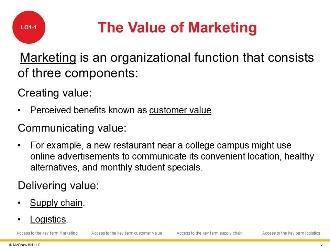
• Marketing is the activity, set of institutions, and processes for creating, communicating, delivering, and exchanging offerings that have value for customers, clients, partners, and society at large
• Marketers manage customer relationships in ways that benefit the organization and its employees, its customers, its investors, and society as a whole
• Organizations are constantly looking for new ways to create value for customers
• If the benefit of the product or service equals or exceeds its cost, the organization has created value
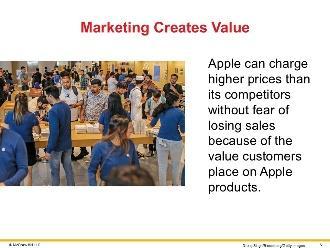
• Apple can charge higher prices than its competitors without fear of losing sales because of the value customers place on Apple products
• The key ingredient for creating value is providing consumers with benefits that meet their needs and wants
• Over 80 percent of all new products fail, a percentage that remains consistent in good and bad economic conditions
Communicating Value
• A firm must communicate not only what its product is but what value that product brings to potential customers
Delivering Value
• A supply chain encompasses multiple companies that are directly linked by one or more of the upstream and downstream flows of products, services, finances, and information from a source to a customer
• Members of the supply chain can include manufacturers, wholesalers, retailers, transportation companies, and other groups, depending on the specific industry
• The part of supply chain management that plans, implements, and controls the flow of goods, services, and information between the point of origin and the final customer is called logistics
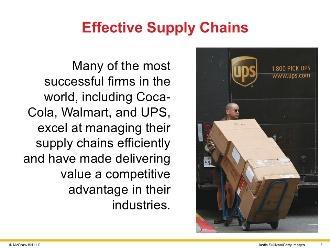
• Many of the most successful firms in the world, including Coca-Cola, Walmart, and UPS, excel at managing their supply chains efficiently and have made delivering value a competitive advantage in their industries
LO-2 Differentiate among the various eras in the history of marketing.
Production Orientation
• Prior to the 1920s, most firms throughout the United States and the rest of the developed world focused on production
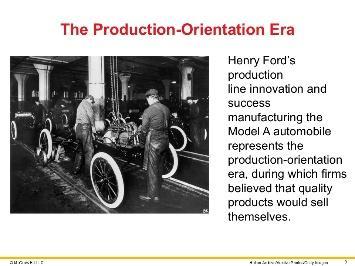
• Firms had a production orientation in which they focused on efficient processes and production to create quality products and reduce unit costs, e.g. “build a better mousetrap, and the world will beat a path to your door”
• In the mid-1920s, companies facing excess production developed sales forces to boost consumer demand and sell their growing output
• As the size and impact of sales forces grew, many firms shifted to a sales orientation, in which personal selling and advertising were used to persuade consumers to buy new products and more of existing products
• During the Great Depression, companies relied heavily on personal selling and advertising to persuade cash-strapped consumers to buy their products over competitors’
• Even efficient producers like Ford had to compete aggressively for limited consumer spending, marking the sales-orientation era that lasted until the end of World War II
Marketing Concept
• After two decades of economic depression and world war, the U.S. entered an era of expansion beginning in the early 1950s
• Demand for goods and services increased significantly, as did the reliance on personal selling and advertising
• Products that had been in limited supply during the war flooded the market, forcing firms to develop new strategies to compete
• The marketing concept emphasizes a customer orientation, meaning everyone in a company should focus on identifying and satisfying consumer needs
• Walmart exemplifies this by aligning every department around customer satisfaction, offering value through low prices, convenience, and service rather than unique products
• Over time, technology has advanced the concept, enabling customization and personalization, seen in examples like Dell’s customizable computers and Amazon’s data-driven recommendations
• Today, relationship marketing has become central, as firms use technology to build lasting connections with customers most likely to remain loyal
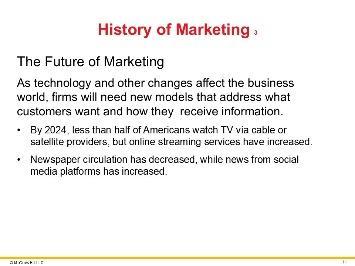
The Future of Marketing
• As technology and media habits evolve, firms must develop new marketing models that meet changing customer preferences for information and engagement
• With traditional media use declining and streaming and social platforms rising, social media is now reshaping how companies reach and interact with consumers
• The basic goal of marketing to create, communicate, and deliver value doesn’t change, and marketers must use all the tools and strategies at their disposal to satisfy the needs and wants of customers
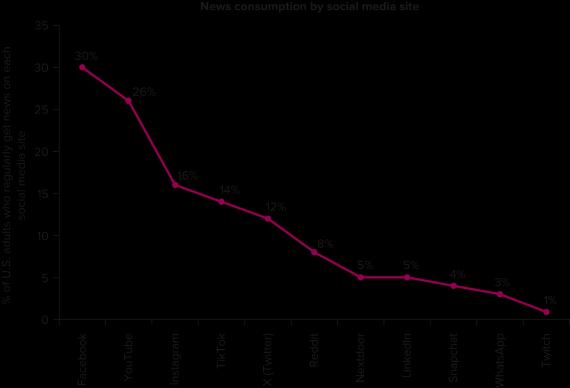
Figure 1.1 Social Media as a Pathway to News: Percentage of adults who regularly get news on each social media site. INSIGHT QUESTIONS
Which social media platforms are the most common sources of news for adults today?
(Answer: Platforms like Facebook and YouTube remain leading sources of news for adults, while X (formerly Twitter), Instagram, and TikTok have grown significantly as younger audiences rely on them for real-time updates and trending stories.)
How has the use of social media for news changed over time?
(Answer: Over the past decade, the percentage of adults getting news from social media has steadily increased, reflecting a shift away from traditional news outlets like television and newspapers toward digital platforms that deliver personalized, on-demand content.)
What are the implications of using social media as a primary news source?
(Answer: While social media allows for faster access and wider perspectives, it also raises challenges such as misinformation, algorithmic bias, and echo chambers that can shape how people perceive current events.)
LO-3 Distinguish between consumer needs and consumer wants.
Needs versus Wants
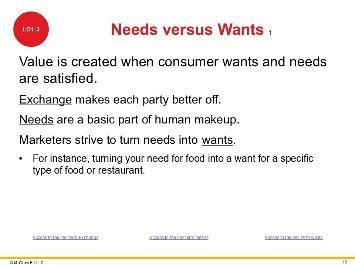
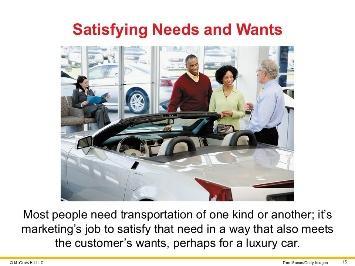
• Marketers create value for customers when they develop products that allow consumers to satisfy their needs and wants through exchange relationships
• Exchange happens when a buyer and seller trade things of value so that each is better off as a result
• Needs are states of felt deprivation
• Consumers feel deprived when they lack something useful or desirable like food, clothing, shelter, transportation, and safety
• Marketers do not create needs; they are a basic part of our human makeup
• Wants are the form that human needs take as they are shaped by personality, culture, and buying situation
• Wants are influenced by numerous things, including a consumer’s family, job, and background
Distinguishing Needs from Wants
• Distinguishing between needs and wants affects the way firms market their products to customers
THINK LIKE A MARKETER
What do marketers do with value?
THINK LIKE A MARKETER
How do marketers communicate value to consumers?
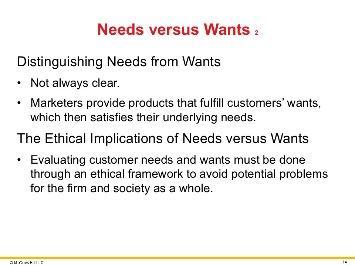
• The distinction between needs and wants is important and not always clear
• The better a firm understands the difference between customers’ needs and wants, the more effectively it can target its message and convince customers to buy its good or service, for the simple reason that the firm’s offering will meet its customers’ needs and wants better than any competing good or service
• Evaluating customer needs and wants must be done through an ethical framework to avoid potential problems for the firm and society as a whole
• The 2007 global recession illustrates the tension between needs and wants: marketers turned the basic need for shelter into an inflated want for luxury homes beyond consumers’ means
• What seemed like a mutually beneficial exchange-dream homes for buyers and profits for firmsultimately led to widespread financial collapse beginning in December 2007
LO-4 Explain the four elements in the marketing mix.
The Marketing Mix: The Four Ps
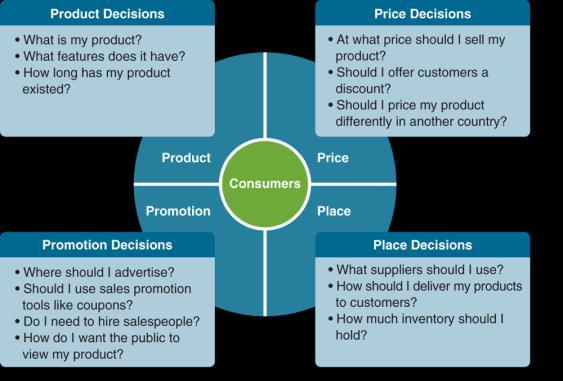
• The marketing mix (product, price, place, promotion) represents everything that a firm can do to influence demand for its good, service, or idea
• The four Ps of the marketing mix provide marketers with the tools to increase customer awareness, sales, and profitability
• The marketing mix typically begins with the product because, without it, a firm has few, if any, decisions to make when it comes to price, place, or promotion
Product
• Product is a specific combination of goods, services, or ideas that a firm offers to consumers
• Products can also take the form of services, such as those provided by an attorney or electrician, or ideas, like those offered by a consultant
Price
• Price is the amount of something money, time, or effort that a buyer exchanges with a seller to obtain a product
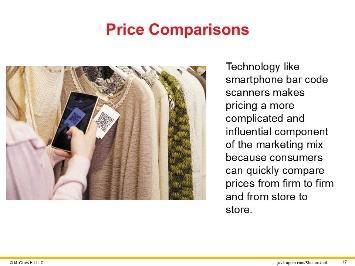
• Setting a price is one of the most important strategic decisions a firm faces because it relates to the value consumers place on the product
• Pricing’s power is a result of the signal it can send about product quality
• Pricing is typically the easiest marketing mix element to change, making it a powerful tool for firms looking to quickly adjust their market share or revenue
• Revenue is the amount earned from selling products to customers, and it is a function of the price of a product multiplied by the number of units sold
• If the firm sets the price too high, it will sell fewer units, thus reducing revenue
• If the firm sets the price too low, it may sell more units, but could still see a reduction in overall revenue if the money earned from the additional units sold isn’t enough to offset the lower price
Place
• Place includes the activities a firm undertakes to make its product available to potential consumers
• Companies must be able to distribute products to customers where they can buy and consume them without difficulty
• Even if you have the right product at the right price, if customers cannot easily purchase the product, they will likely find a substitute
• Place decisions relate to locations, transportation, logistics, and supply chain management
Promotion
• Promotion is all the activities that communicate the value of a product and persuade customers to buy it
• Promotion includes advertising, sales promotion, personal selling, and public relations
• A successful firm’s whole promotional strategy is better than the sum of its parts; it effectively integrates the value of advertising, sales promotion, personal selling, and public relations to communicate a product’s value to potential customers
• An integrated approach will always be important to the success of a promotional strategy, but in recent years, the way a firm executes its promotional activities has evolved
• Social media refers to a group of Internet-based applications that enable users to create their own content and share it with others who access the sites
• Social media communication is driven by word of mouth, meaning it results in free media rather than paid messages
Figure 1.2 The Marketing Mix and Decisions That Affect It INSIGHT QUESTIONS
Why must the marketing mix begin with decisions about the product?
(Answer: The product is the foundation of the marketing mix; decisions about price, place, and promotion all depend on what the product is and the value it offers.)
What are the key considerations when determining the product?
(Answer: Marketers must define what the product is, its features and benefits, how it satisfies customer needs and wants, and whether it’s a new offering or an improved version of an existing one.)
What are the key considerations when determining the price?
(Answer: Pricing decisions involve setting domestic and international prices, deciding on discounts or payment terms, and understanding how urgency or demand affects what consumers are willing to pay.)
What are the key areas of consideration for determining the place?
(Answer: Place decisions focus on how the product reaches consumers selecting suppliers, managing inventory, coordinating delivery, and ensuring availability where and when customers want to buy.)
What are the key considerations when determining the promotion?
(Answer: Promotion decisions include choosing where and when to advertise, how to use sales promotions, whether to employ personal selling, and how to shape public perception of the product.)
How does social media use convenience and promptness to reach consumers?
(Answer: Social media enables organizations to connect with consumers instantly, allowing them to browse, order, and communicate in real time. However, this convenience also raises concerns about data privacy and the security of transactions and refunds.)
Does social media give retail organizations a competitive advantage?
(Answer: Yes when used strategically, social media can provide a strong competitive edge by enabling innovation, engagement, and real-time responsiveness. Still, success depends on how effectively organizations manage challenges such as customer trust, brand reputation, and data integrity.)
LO-5 Discuss the importance of globalization and AI in the field of marketing.
Trends Affecting Marketing
• Marketers face new challenges resulting from global competition
• Consumers seek out firms that emphasize social responsibility and ethical practices
Global Marketing
• Global forces impact everything we do in marketing, from pricing to product development to supply chain management
• Much of the growth in U.S. firms, ranging from Walmart to General Motors, comes from their expansion into international markets
• When the United States entered a significant recession starting in December 2007, manufacturing at Chinese plants of products targeted to American consumers declined significantly, increasing unemployment and slowing growth in China
• As the European Union dealt with a continent-wide banking crisis, U.S. firms saw their stock prices drop as investors feared possible exposure to the problems in Europe
• Over 40 million jobs in the United States are supported by exports
• In 2023, total U.S. exports were worth more than $2.0 trillion even with the impact of the COVID-19 pandemic
• The United States is the world’s leading exporter of services
• Exports account for over 10 percent of the total U.S. economy
The Interconnected World
• The idea of globalization, the increasingly interconnected nature of the world economy, evokes different reactions from different people
• International trade agreements, such as the North American Free Trade Agreement (NAFTA) that relaxed trade restrictions between the U.S., Canada, and Mexico, can be viewed both positively and negatively depending on an individual’s circumstances
• Less than 5 percent of the world’s population lives in the United States, which leads marketers to seek ways to promote and sell their products to the billions of potential consumers living outside the U.S.
• Global marketing is a marketing strategy that consciously addresses customers, markets, and competition throughout the world
• Brand refers to the name, term, symbol, design, or any combination of these that identifies and differentiates a firm’s products
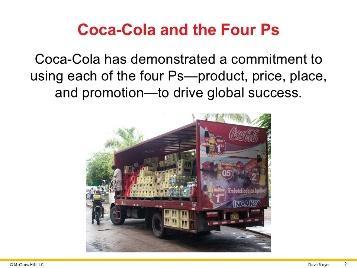
• Coca-Cola has demonstrated a commitment to using each of the four Ps product, price, place, and promotion to drive global success
• Coca-Cola is at the cutting edge of delivering its products to places where global customers can buy them, whether that means moving bottling operations to Turkey or coordinating deliveries to remote places in Africa
Artificial Intelligence
• Artificial intelligence is transforming marketing by combining advanced technology with customer data to deliver deeper insights, personalized experiences, and more efficient strategies
• From automating content creation to optimizing social media and inventory management as seen with Wendy’s 2024 $1 Frosty promotion AI is helping firms boost engagement, efficiency, and profitability across industries
LO-6 Explain the role of analytics in marketing.
Marketing Analytics INSIGHT QUESTIONS
Firms seeking to market on a global scale must carefully evaluate whether the potential benefits outweigh the costs. How can marketers leverage analytics to make this determination effectively?
(Answer: Marketers can use analytics to measure performance indicators such as customer engagement, market reach, brand awareness, and revenue growth, helping determine whether global marketing efforts deliver returns that justify the investment.)
What key insights or metrics should a firm focus on when analyzing data?
(Answer: Firms should analyze trends in sales and revenue over time, evaluate marketing ROI, identify unusual spikes or declines, and explore correlations or anomalies that reveal opportunities or risks in their strategy.)
Marketing Analytics
• Marketing analytics is the practice of measuring, managing, and analyzing market performance
• It is the processes and technologies that enable marketers to evaluate the success of marketing initiatives by measuring performance using business metrics
• Marketing analytics can be used for issues ranging from justifying how advertising dollars get spent to what to do with large amounts of consumer data that are now available
• During presidential campaigns, candidates sought a marketing advantage using analytics
• It is anticipated that the percentage of marketing budgets allocated for marketing analytics will almost double in the next three years
LO-7 Demonstrate the relationship between ethical business practices and marketplace success.
Ethics in Marketing
• Ethical decision making should be a key component of a successful marketing approach
• Ethics are moral standards expected by a society
• Marketers should clearly understand the norms and values expected of them and act in a way that reflects their company, their profession, and themselves in a positive, ethical light
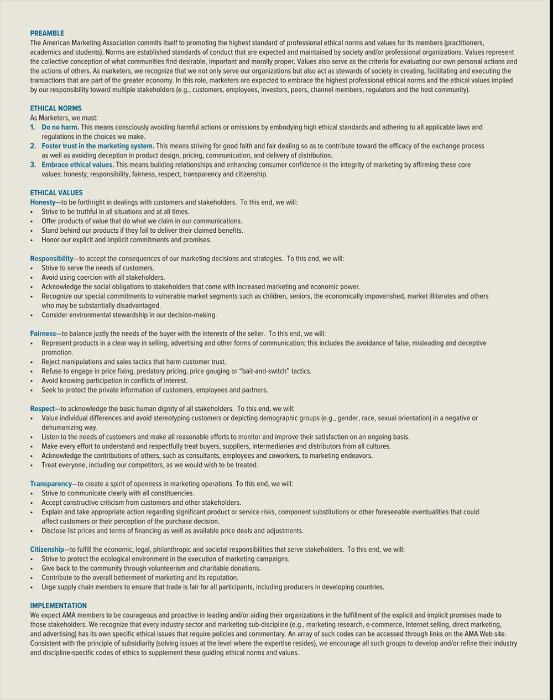
• The American Marketing Association has published a thorough Code of Ethics, which marketers should read and adhere to
The Impact of Ethics on Business
• The consequences of not adhering to an ethical code can be serious
• Ignoring ethical considerations has destroyed some of the largest companies in the world over the past 20 years, including Wells Fargo, Enron, telecommunications giant WorldCom, Arthur Andersen, and AIG
• Making ethical decisions not only makes good business sense, it can also generate profits, even during a recession
Figure 1.3 American Marketing Association Code of Ethics INSIGHT QUESTIONS
Which ethical value focuses on balancing the needs of the buyer with the interests of the seller?
(Answer: Fairness)
What does it mean to practice transparency in marketing?
(Answer: Promoting openness and honesty in all marketing communications and operations.)
Which ethical value emphasizes improving the marketing profession and contributing to society’s well-being?
(Answer: Citizenship)
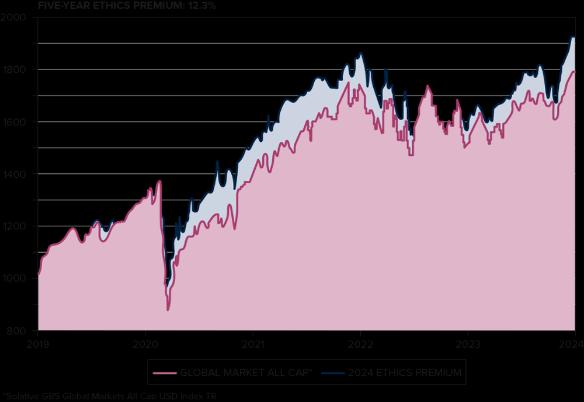
Figure 1.4 Performance Comparison of the 2024 World’s Most Ethical Companies and a Comparable Index of Global Companies INSIGHT QUESTIONS
What does the “ethics premium” shown in the chart suggest about the relationship between ethics and profitability?
(Answer: It indicates that companies recognized for strong ethical practices tend to deliver higher long-term returns, showing that doing good and doing well can align.)
How might investors or marketers interpret this data when evaluating a company’s reputation and performance potential?
(Answer: They may view ethical leadership and responsible governance as indicators of stability, consumer trust, and sustainable growth factors that can make a company more resilient through changing economic conditions.)
• Despite the positive impact ethical decision making can have on a firm, the ethical choice is not always clear
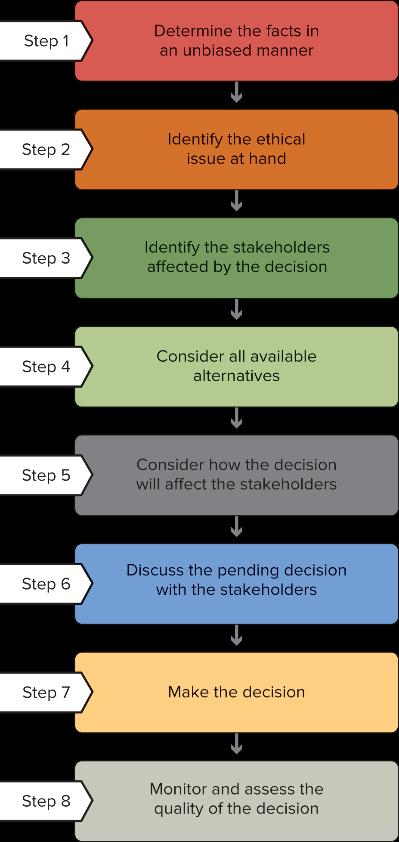
• You can apply this systematic, decision-making framework to ethical problems
• The steps are as follows:
• Step 1: Determine the facts in an unbiased manner
• Step 2: Identify the ethical issue at hand
• Step 3: Identify the stakeholders affected by the decision
• Step 4: Consider all available alternatives
• Step 5: Consider how the decision will affect the stakeholders
• Step 6: Discuss the pending decision with the stakeholders
• Step 7: Make the decision
• Step 8: Monitor and assess the quality of the decision
THINK LIKE A MARKETER
What ethical decisions might you encounter as a marketing professional, and how could this framework guide your actions within your organization?
• Some common ethical questions that marketers may face with each element of the marketing mix in a career include:
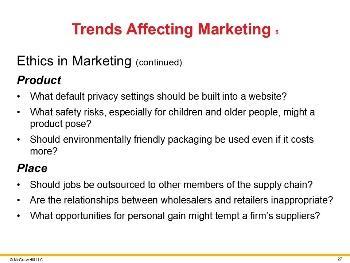
• Product-related questions
• What default privacy settings should be built into a website?
• What safety risks, especially for children and the elderly, might a product pose?
• Should environmentally friendly packaging be used even if it costs more?
• Place-related questions
• Should jobs be outsourced to other members of the supply chain?
• Are the relationships between wholesalers and retailers inappropriate?
• What opportunities for personal gain might tempt a firm’s suppliers?
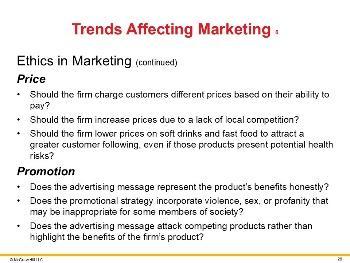
• Price-related questions
• Should the firm charge customers different prices based on their ability to pay?
• Should the firm increase prices due to a lack of local competition?
• Should the firm lower prices on soft drinks and fast food to attract a greater customer following, even if those products present potential health risks?
• Promotion-related questions
• Does the advertising message represent the product’s benefits honestly?
• Does the promotion strategy incorporate violence, sex, or profanity that may be inappropriate for some members of society?
• Does the advertising message attack competing products rather than highlight the benefits of the firm’s product?
THINK LIKE A MARKETER
What ethical dilemmas do you expect to face in your career, and how might you approach them?
Even though ethical decision making can benefit a firm, is the ethical choice always obvious?
(Answer: No, ethical choices are often complex and influenced by both personal values and professional circumstances.)
Which step in the ethical decision-making process do you believe is most critical, and why?
(Answer: Many would argue that identifying the ethical issue is the most critical step, because recognizing that a dilemma exists is what allows thoughtful evaluation and responsible action. Without awareness, even well-intentioned professionals may make decisions that overlook ethical consequences.)
CONNECT BACK: Reference Connect Assignment 1-2
Which part of the framework was most difficult to connect to a real situation?
(Answer: Many find it hardest to connect the evaluation or alternatives step to a real scenario, since in practice, it can be difficult to identify all possible options and predict their consequences before making a decision.)
What are the potential risks of not selecting an ethical approach in business or marketing decisions?
(Answer: Beyond conflicting with personal values, unethical actions can damage consumer trust, weaken brand loyalty, and ultimately reduce sales and profitability.)
LO-8 Analyze the functions of marketing beyond the for-profit firm.
Marketing for Nonprofit Organizations
• Nonprofit organizations are a big part of the U.S. economy, and include hospitals, charities, universities, zoos, and churches
• Nonprofit organizations employ about 11 million American workers and have increased employment more than private-sector firms during the past decade
• As with for-profit firms, marketing efforts are an essential part of the success of nonprofit organizations
Leanna Fino, Retail Sales Representative, The Hershey Company
What different roles or “hats” does Leanna take on as a retail sales representative managing multiple brands and projects?
How did Leanna learn to confidently communicate and collaborate with business professionals in her field?
How can you begin building your own personal brand one that reflects both your professionalism and your individuality?
Marketing Yourself
• Your ability to market yourself will be critical to your success after you leave college
• Don’t consider the information in this book as a collection of random concepts that you can forget about once you take your final exam
• Instead, think about how it will help you position yourself relative to others competing for the same job
• Think about how to communicate your value so that you get an interview over hundreds of other candidates, and be able to successful respond to, “Why should I hire you?”
• Ultimately, wherever your career leads you, you will need to market yourself effectively to reach the professional goals you have set
CONNECT BACK: Reference Connect Assignment 1-3
How can you discover your passion to help guide your career in marketing?
(Answer: Explore your interests by talking with advisors or career counselors, job shadowing, attending industry events or job fairs, joining LinkedIn marketing communities, and following CMOs or marketing leaders for inspiration.)
Which areas of marketing appeal to you most, and why?
(Answer: Possibilities include advertising, sales, social and digital marketing, public relations, brand strategy, market research, analytics, and content creation.)
MARKETING PLAN EXERCISE
As a professional in any field, it is important to have a comprehensive understanding of what a marketing plan is and why it is there. A marketing plan is an action-oriented document or playbook that guides the analysis, implementation, and control of all marketing activities. Throughout this book, you will develop a
professional marketing plan. The twist is that your marketing plan will focus on how to market yourself to achieve your career goals.
Many businesses fail to execute on their marketing plans because they did not spend adequate time clearly identifying what they wanted or expected to do. As a first step in developing your personal marketing plan, you will need to identify the specific objectives that you want to achieve. In developing these objectives, you should ask yourself several questions, such as:
• Do I want to attend graduate school? If so, where and what program?
• Where do I want to work?
• Where do I want to live?
• What kind of life do I want to have?
• How much will I need to earn to have that life?
Such questions will help you focus on what specific things you need to do to achieve your goals. The more clearly you define your objectives, the more likely you are to realize them.
Student Task: Clearly state three to five specific objectives for your future, and include a brief one- to twosentence description of each objective.
Insert your responses to the above in Chapter 1’s section of the Personal Marketing Plan.
The following section outlines the flow of information, using the LEARNING OBJECTIVES as a roadmap. FIGURES and TABLES visually expand on key concepts, KEY TERMS highlight essential takeaways, and dedicated space is provided for you to record LECTURE NOTES and deepen understanding.
EXECUTIVE PERSPECTIVE NOTES
Bryan Bedford, Global Industry Director, Cisco
How does clarity influence effective leadership?
Why are writing and networking critical to career success?
How does collaboration between marketing and sales strengthen results?
What do you consider your personal brand to be?
THINK LIKE A MARKETER
How do organizations create value for their customers?
THINK LIKE A MARKETER
Once value is created, how do you communicate it?
THINK LIKE A MARKETER
Why is it important to communicate value?
LO-1 Describe a marketer’s role in creating, communicating, and delivering value.
The Value of Marketing
• is the activity, set of institutions, and processes for creating, communicating, delivering, and exchanging offerings that have value for customers, clients, partners, and society at large
• Marketers manage in ways that benefit the organization and its employees, its customers, its investors, and society as a whole
Creating Value
• Organizations are constantly looking for new ways to create for customers
• If the benefit of the product or service equals or exceeds its , the organization has created value
• Apple can charge higher prices than its competitors without fear of losing sales because of the value customers place on Apple products
• The key ingredient for creating value is providing consumers with benefits that meet their
• Over percent of all new products fail, a percentage that remains consistent in good and bad economic conditions
Communicating Value
• A firm must communicate not only what its product is but what value that product
Delivering Value
• A supply chain encompasses multiple companies that are directly linked by one or more of the of products, services, finances, and information from a source to a customer
• Members of the can include manufacturers, wholesalers, retailers, transportation companies, and other groups, depending on the specific industry
• The part of supply chain management that plans, implements, and controls the flow of goods, services, and information between the point of origin and the final customer is called
• Many of the most successful firms in the world, including Coca-Cola, Walmart, and UPS, excel at managing their supply chains efficiently and have made delivering value a in their industries
LO-2 Differentiate among the various eras in the history of marketing.
Production Orientation
• Prior to the 1920s, most firms throughout the United States and the rest of the developed world focused on
• Firms had a in which they focused on efficient processes and production to create quality products and reduce unit costs
• In the mid-1920s, companies facing excess production developed to boost consumer demand and sell their growing output
• As the size and impact of sales forces grew, many firms shifted to a , in which and advertising were used to persuade consumers to buy new products and more of existing products
• During the Great Depression, companies relied heavily on and to persuade cash-strapped consumers to buy their products over competitors’
• Even efficient producers like Ford had to compete aggressively for limited consumer spending, marking the sales-orientation era that lasted until the end of
Marketing Concept
• After two decades of economic depression and world war, the U.S. entered an era of beginning in the early 1950s
• Demand for goods and services increased significantly, as did the reliance on and advertising
• Products that had been in limited supply during the war flooded the market, forcing firms to develop new strategies to
• The emphasizes a customer orientation, meaning everyone in a company should focus on identifying and satisfying consumer needs
• Walmart exemplifies this by aligning every department around customer satisfaction, offering through low prices, convenience, and service rather than unique products
• Over time, technology has advanced the concept, enabling and personalization, seen in examples like Dell’s customizable computers and Amazon’s data-driven recommendations
• Today, has become central, as firms use technology to build lasting connections with customers most likely to remain loyal
The Future of Marketing
• As technology and media habits evolve, firms must develop new marketing models that meet changing customer preferences for information and
• With traditional media use declining and streaming and social platforms rising, is now reshaping how companies reach and interact with consumers
• The basic goal of marketing to create, communicate, and deliver value doesn’t change, and marketers must use all the tools and strategies at their disposal to satisfy the needs and wants of customers
Figure 1.1 Social Media as a Pathway to News: Percentage of adults who regularly get news on each social media site. INSIGHT QUESTIONS
Which social media platforms are the most common sources of news for adults today?
How has the use of social media for news changed over time?
What are the implications of using social media as a primary news source?
LO-3 Distinguish between consumer needs and consumer wants.
Needs versus Wants
• Marketers create for customers when they develop products that allow consumers to satisfy their needs and wants through exchange relationships
• happens when a buyer and seller trade things of value so that each is better off as a result
• are states of felt deprivation
• Consumers feel deprived when they lack something useful or desirable like food, clothing, shelter, transportation, and safety
• Marketers do not create needs; they are a basic part of our human makeup
• are the form that human needs take as they are shaped by personality, culture, and buying situation
• Wants are influenced by numerous things, including a consumer’s family, job, and
Distinguishing Needs from Wants
• Distinguishing between needs and wants affects the way firms market their _________ to customers
THINK LIKE A MARKETER
What do marketers do with value?
THINK LIKE A MARKETER
How do marketers communicate value to consumers?
• The distinction between needs and wants is important and not
• The better a firm understands the difference between customers’ needs and wants, the more effectively it can and convince customers to buy its good or service, for the simple reason that the firm’s offering will meet its customers’ needs and wants better than any competing good or service
The Ethical Implications of Needs versus Wants
• Evaluating customer needs and wants must be done through an to avoid potential problems for the firm and society as a whole
• The 2007 global recession illustrates the tension between needs and wants: marketers turned the basic need for shelter into an inflated want for luxury homes beyond consumers’ means
• What seemed like a mutually beneficial exchange dream homes for buyers and profits for firms ultimately led to widespread financial collapse beginning in December 2007
LO-4 Explain the four elements in the marketing mix.
The
Marketing Mix: The Four Ps
• The (product, price, place, promotion) represents everything that a firm can do to influence demand for its good, service, or idea
• The four Ps of the marketing mix provide marketers with the tools to increase customer
• The marketing mix typically begins with the because, without it, a firm has few, if any, decisions to make when it comes to price, place, or promotion
Product
• is a specific combination of goods, services, or ideas that a firm offers to consumers
• Products can also take the form of , such as those provided by an attorney or electrician, or ideas, like those offered by a consultant
Price
• is the amount of something money, time, or effort that a buyer exchanges with a seller to obtain a product
• Setting a price is one of the most important strategic decisions a firm faces because it relates to the consumers place on the product
• Pricing’s power is a result of the signal it can send about product
• is typically the easiest marketing mix element to change, making it a powerful tool for firms looking to quickly adjust their or
• is the amount earned from selling products to customers, and it is a function of the price of a product multiplied by the number of units sold
• If the firm sets the price too high, it will sell fewer units, thus revenue
• If the firm sets the price too low, it may sell more units, but could still see a reduction in overall revenue if the money earned from the additional units sold isn’t enough to offset the lower price
Place
• includes the activities a firm undertakes to make its product available to potential consumers
• Companies must be able to distribute products to customers where they can buy and consume them without difficulty
• Even if you have the right product at the right price, if customers cannot easily purchase the product, they will likely find a
• Place decisions relate to locations, , logistics, and supply chain management
• is all the activities that communicate the value of a product and persuade customers to buy it
• Promotion includes advertising, sales promotion, , and public relations
• A successful firm’s whole promotional strategy is better than the of its parts; it effectively integrates the value of advertising, sales promotion, personal selling, and public relations to communicate a product’s to potential customers
• An approach will always be important to the success of a promotional strategy, but in recent years, the way a firm executes its promotional activities has evolved
• refers to a group of Internet-based applications that enable users to create their own content and share it with others who access the sites
• Social media communication is driven by , meaning it results in free media rather than paid messages
Figure 1.2 The Marketing Mix and Decisions That Affect It INSIGHT QUESTIONS
Why must the marketing mix begin with decisions about the product?
What are the key considerations when determining the product?
What are the key considerations when determining the price?
What are the key areas of consideration for determining the place?
What are the key considerations when determining the promotion?
How does social media use convenience and promptness to reach consumers? Does social media give retail organizations a competitive advantage?
LO-5 Discuss the importance of globalization and AI in the field of marketing.
Trends Affecting Marketing
• Marketers face new challenges resulting from
• Consumers seek out firms that emphasize and ethical practices
Global Marketing
• impact everything thing we do in marketing, from pricing to product development to supply chain management
• Much of the growth in U.S. firms, ranging from Walmart to General Motors, comes from their into international markets
• When the United States entered a significant recession starting in December 2007, manufacturing at Chinese plants of products targeted to American consumers declined significantly, increasing and slowing in China
• As the European Union dealt with a continent-wide banking crisis, U.S. firms saw their stock prices drop as investors feared possible to the problems in Europe
• Over 40 million jobs in the United States are supported by
• In 2023, total U.S. exports were worth more than $ even with the impact of the COVID-19 pandemic
• The United States is the world’s leading of services
• Exports account for over percent of the total U.S. economy
The Interconnected World
• The idea of , the increasingly interconnected nature of the world economy, evokes different reactions from different people
• International trade agreements, such as the (NAFTA) that relaxed trade restrictions between the U.S., Canada, and , can be viewed both positively and negatively depending on an individual’s circumstances
• Less than 5 percent of the world’s population lives in the , which leads marketers to seek ways to promote and sell their products to the billions of potential consumers living outside the U.S.
• is a marketing strategy that consciously addresses customers, markets, and competition throughout the world
• refers to the name, term, symbol, design, or any combination of these that identifies and differentiates a firm’s products
• Coca-Cola has demonstrated a commitment to using each of the four Ps product, price, place, and promotion to drive
• Coca-Cola is at the cutting edge of delivering its products to places where global customers can buy them, whether that means moving bottling operations to Turkey or coordinating deliveries to remote places in Africa
Artificial Intelligence
• Artificial intelligence is transforming marketing by combining advanced technology with to deliver deeper insights, personalized experiences, and more efficient strategies
• From automating content creation to optimizing social media and inventory management as seen with Wendy’s 2024 $1 Frosty promotion AI is helping firms boost engagement, efficiency, and profitability across industries
LO-6 Explain the role of analytics in marketing.
Marketing Analytics INSIGHT QUESTIONS
Firms seeking to market on a global scale must carefully evaluate whether the potential benefits outweigh the costs. How can marketers leverage analytics to make this determination effectively?
What key insights or metrics should a firm focus on when analyzing data?
Marketing Analytics
• is the practice of measuring, managing, and analyzing market performance
• It is the processes and technologies that enable marketers to evaluate the success of marketing initiatives by measuring performance using business metrics
• Marketing analytics can be used for issues ranging from justifying how
get spent to what to do with large amounts of consumer that are now available
• During presidential campaigns, candidates sought a marketing advantage using
• It is anticipated that the percentage of marketing budgets allocated for marketing analytics will almost in the next three years
LO-7
Demonstrate the relationship between ethical business practices and marketplace success.
Ethics in Marketing
• Ethical decision making should be a key component of a successful marketing approach
• are moral standards expected by a society
• Marketers should clearly understand the and expected of them and act in a way that reflects their company, their profession, and themselves in a positive, ethical light
• The American Marketing Association has published a thorough , which marketers should read and adhere to
The Impact of Ethics on Business
• The consequences of not adhering to an can be serious
• ethical considerations has destroyed some of the largest companies in the world over the past 20 years, including Enron, telecommunications giant WorldCom, Arthur Andersen, and AIG
• Making ethical decisions not only makes good business sense, it can also , even during a recession
Figure 1.3 American Marketing Association Code of Ethics INSIGHT QUESTIONS
Which ethical value focuses on balancing the needs of the buyer with the interests of the seller?
What does it mean to practice transparency in marketing?
Which ethical value emphasizes improving the marketing profession and contributing to society’s well-being?
Figure 1.4 Performance Comparison of the 2024 World’s Most Ethical Companies and a Comparable Index of Global Companies INSIGHT QUESTIONS
What does the “ethics premium” shown in the chart suggest about the relationship between ethics and profitability?
• Should the firm lower prices on soft drinks and fast food to attract a greater customer following, even if those products present potential health risks?
• -related questions
• Does the advertising message represent the product’s benefits honestly?
• Does the promotion strategy incorporate violence, sex, or profanity that may be inappropriate for some members of society?
• Does the advertising message attack competing products rather than highlight the benefits of the firm’s product?
THINK LIKE A MARKETER
What ethical dilemmas do you expect to face in your career, and how might you approach them?
As a professional in any field, it is important to have a comprehensive understanding of what a marketing plan is and why it is there. A marketing plan is an action-oriented document or playbook that guides the analysis, implementation, and control of all marketing activities. Throughout this book, you will develop a professional marketing plan. The twist is that your marketing plan will focus on how to market yourself to achieve your career goals.
Many businesses fail to execute on their marketing plans because they did not spend adequate time clearly identifying what they wanted or expected to do. As a first step in developing your personal marketing plan, you will need to identify the specific objectives that you want to achieve. In developing these objectives, you should ask yourself several questions, such as:
• Do I want to attend graduate school? If so, where and what program?
• Where do I want to work?
• Where do I want to live?
• What kind of life do I want to have?
• How much will I need to earn to have that life?
Such questions will help you focus on what specific things you need to do to achieve your goals. The more clearly you define your objectives, the more likely you are to realize them.
Student Task: Clearly state three to five specific objectives for your future, and include a brief one- to twosentence description of each objective.
Insert your responses to the above in Chapter 1’s section of the Personal Marketing Plan.
Joan Cros/NurPhoto/AP Images
Chapter 1: Why Marketing Matters to You
Use this Instructor’s Manual to guide class discussions and integrate the text’s key features. Encourage students to complete the LEARNING WORKSHEET (found in the Instructor’s online resources) before class so that lectures serve as review. Worksheets can be accessed through the learning platform (e.g., Canvas, Moodle, Blackboard), and the Chapter 1 answer key is included in the Instructor’s resources.
LEARNING OBJECTIVES
LO 1-1 Describe a marketer’s role in creating, communicating, and delivering value.
LO 1-2 Differentiate among the various eras in the history of marketing.
LO 1-3 Distinguish between consumer needs and consumer wants.
LO 1-4 Explain the four elements in the marketing mix.
LO 1-5 Discuss the importance of globalization and AI in the field of marketing.
LO 1-6 Explain the role of analytics in marketing.
LO 1-7 Demonstrate the relationship between ethical business practices and marketplace success.
LO 1-8 Analyze the functions of marketing beyond the for-profit firm.
KEY TERMS
AI marketing brand customer value ethics exchange global marketing logistics marketing
marketing analytics marketing concept marketing mix needs place (distribution) price product production orientation
THOUGHT-PROVOKING ACTIVITY
promotion relationship marketing sales orientation social media supply chain wants
(This activity is included in the chapter PowerPoint.) Begin each class with a 10-minute Thought-Provoking Activity (TPA) to connect real-world insights to chapter concepts in an engaging, icebreaker format.
How it Works: Randomly select two to three students each class to share their responses at least once per semester. Two activity sets are available for teaching a chapter over two sessions or for broader participation. Instructors may collect worksheets or assign points for verbal responses.
Supporting Materials: A sample grading rubric and Learning Worksheet references are available in the Instructor’s online resources.
Set 1: What are the three marketing philosophies/orientations? Provide one example of a product or service in each.
Set 2: What are the 4 Ps? Provide an example for each.
This section outlines the flow of instruction using LEARNING OBJECTIVES, FIGURES/TABLES, and KEY TERMS to guide teaching. It notes when to use POWERPOINT slides, LECTURE NOTES, CONNECT activities, and SOCIAL MEDIA IN ACTION examples to reinforce concepts and real-world applications, helping you lead effective in-class or online discussions.
Executive Perspective
Bryan Bedford Global Industry Director, Cisco
Finding a company that matched his drive for clarity and collaboration, Bryan Bedford has spent over 13 years shaping the future of global industries. His team supports major brands like Hilton, Marriott, Home Depot, the Dallas Cowboys, Real Madrid, and NBC, driving innovation, enablement, and strategic growth across $4B in global revenue. Drawing from his background in business administration, mass communications, and collegiate athletics, Bryan has built his leadership approach on focus, communication, and connection. He shares insight in answering the following questions:
1. What has been the most important thing in making you successful at your job?
2. What advice would you give soon-to-be graduates?
3. How is marketing relevant to your role at Cisco?
4. What do you consider your personal brand to be?
Woven in the chapter, you see how Bryan later elaborates on:
• The importance of clarity in leading teams and aligning global stakeholders.
• Why strong writing and networking are vital skills for every graduate.
• How integrating sales and marketing creates a unified, effective strategy.
Review with students:
• How does clarity influence effective leadership?
• Why are writing and networking critical to career success?
• How does collaboration between marketing and sales strengthen results?
Describe a marketer’s role in creating, communicating, and delivering value.
• The Value of Marketing
o Creating Value
o Communicating Value
o Delivering Value
PowerPoint Slides Lecture Notes:
Key Terms:
• Marketing
• Customer value
• Supply chain
• Logistics
THINK LIKE A MARKETER
How do organizations create value for their customers?
THINK LIKE A MARKETER
Once value is created, how do you communicate it?
THINK LIKE A MARKETER
Why is it important to communicate value?
The Value of Marketing
• Marketing is the activity, set of institutions, and processes for creating, communicating, delivering, and exchanging offerings that have value for customers, clients, partners, and society at large
• Marketers manage customer relationships in ways that benefit the organization and its employees, its customers, its investors, and society as a whole
Creating Value
• Organizations are constantly looking for new ways to create value for customers
• If the benefit of the product or service equals or exceeds its cost, the organization has created value
• Apple can charge higher prices than its competitors without fear of losing sales because of the value customers place on Apple products
• The key ingredient for creating value is providing consumers with benefits that meet their needs and wants
• Over 80 percent of all new products fail, a percentage that remains consistent in good and bad economic conditions
Communicating Value
• A firm must communicate not only what its product is but what value that product brings to potential customers
Delivering Value
• A supply chain encompasses multiple companies that are directly linked by one or more of the upstream and downstream flows of products, services, finances, and information from a source to a customer
• Members of the supply chain can include manufacturers, wholesalers, retailers, transportation companies, and other groups, depending on the specific industry
• The part of supply chain management that plans, implements, and controls the flow of goods, services, and information between the point of origin and the final customer is called logistics
• Many of the most successful firms in the world, including Coca-Cola, Walmart, and UPS, excel at managing their supply chains efficiently and have made delivering value a competitive advantage in their industries
LO 1-2 Differentiate among the various eras in the history of marketing.
• History of Marketing
o Production Orientation
o Sales Orientation
o Marketing Concept
o The Future of Marketing
Key Terms:
• Production orientation
• Sales orientation
• Marketing concept
• Relationship marketing
THINK LIKE A MARKETER
How has marketing evolved to its current state?
Production Orientation
• Prior to the 1920s, most firms throughout the United States and the rest of the developed world focused on production
• Firms had a production orientation in which they focused on efficient processes and production to create quality products and reduce unit costs, e.g. “build a better mousetrap, and the world will beat a path to your door”
• In the mid-1920s, companies facing excess production developed sales forces to boost consumer demand and sell their growing output
Sales Orientation
• As the size and impact of sales forces grew, many firms shifted to a sales orientation, in which personal selling and advertising were used to persuade consumers to buy new products and more of existing products
• During the Great Depression, companies relied heavily on personal selling and advertising to persuade cash-strapped consumers to buy their products over competitors’
• Even efficient producers like Ford had to compete aggressively for limited consumer spending, marking the sales-orientation era that lasted until the end of World War II
Marketing Concept
• After two decades of economic depression and world war, the U.S. entered an era of expansion beginning in the early 1950s
• Demand for goods and services increased significantly, as did the reliance on personal selling and advertising
• Products that had been in limited supply during the war flooded the market, forcing firms to develop new strategies to compete
• The marketing concept emphasizes a customer orientation, meaning everyone in a company should focus on identifying and satisfying consumer needs
• Walmart exemplifies this by aligning every department around customer satisfaction, offering value through low prices, convenience, and service rather than unique products
• Over time, technology has advanced the concept, enabling customization and personalization, seen in examples like Dell’s customizable computers and Amazon’s data-driven recommendations
• Today, relationship marketing has become central, as firms use technology to build lasting connections with customers most likely to remain loyal
The Future of Marketing
• As technology and media habits evolve, firms must develop new marketing models that meet changing customer preferences for information and engagement
• With traditional media use declining and streaming and social platforms rising, social media is now reshaping how companies reach and interact with consumers
• The basic goal of marketing to create, communicate, and deliver value doesn’t change, and marketers must use all the tools and strategies at their disposal to satisfy the needs and wants of customers
Figure 1.1
Figure Information: Social Media as a Pathway to News: Percentage of adults who regularly get news on each social media site.
This data shows the percentage of adults who regularly get news from each social media site. As this trend grows, marketers will shift focus from traditional channels like TV, newspapers, and magazines toward digital platforms where consumers now spend most of their time.
Insight Questions:
1. Which social media platforms are the most common sources of news for adults today? (Answer: Platforms like Facebook and YouTube remain leading sources of news for adults, while X (formerly Twitter), Instagram, and TikTok have grown significantly as younger audiences rely on them for real-time updates and trending stories.)
2. How has the use of social media for news changed over time? (Answer: Over the past decade, the percentage of adults getting news from social media has steadily increased, reflecting a shift away from traditional news outlets like television and newspapers toward digital platforms that deliver personalized, on-demand content.)
3. What are the implications of using social media as a primary news source? (Answer: While social media allows for faster access and wider perspectives, it also raises challenges such as misinformation, algorithmic bias, and echo chambers that can shape how people perceive current events.)
Distinguish between consumer needs and consumer wants.
• Needs Versus Wants
o Distinguishing Needs from Wants
o The Ethical Implications of Needs versus Wants
Key Terms:
• Exchange
• Needs
• Wants
Needs versus Wants
• Marketers create value for customers when they develop products that allow consumers to satisfy their needs and wants through exchange relationships
• Exchange happens when a buyer and seller trade things of value so that each is better off as a result
• Needs are states of felt deprivation
• Consumers feel deprived when they lack something useful or desirable like food, clothing, shelter, transportation, and safety
• Marketers do not create needs; they are a basic part of our human makeup
• Wants are the form that human needs take as they are shaped by personality, culture, and buying situation
• Wants are influenced by numerous things, including a consumer’s family, job, and background
Distinguishing Needs from Wants
• Distinguishing between needs and wants affects the way firms market their products to customers
THINK LIKE A MARKETER
What do marketers do with value?
THINK LIKE A MARKETER
How do marketers communicate value to consumers?
• The distinction between needs and wants is important and not always clear
• The better a firm understands the difference between customers’ needs and wants, the more effectively it can target its message and convince customers to buy its good or service, for the simple reason that the firm’s offering will meet its customers’ needs and wants better than any competing good or service
The Ethical Implications of Needs versus Wants
• Evaluating customer needs and wants must be done through an ethical framework to avoid potential problems for the firm and society as a whole
• The 2007 global recession illustrates the tension between needs and wants: marketers turned the basic need for shelter into an inflated want for luxury homes beyond consumers’ means
• What seemed like a mutually beneficial exchange dream homes for buyers and profits for firms ultimately led to widespread financial collapse beginning in December 2007
Explain the four elements in the marketing mix.
• The Marketing Mix: The Four Ps
o Product
o Price
o Place Promotion
Key Terms:
• Marketing mix
• Product
• Price
• Place
• Promotion
• Social media
The Marketing Mix: The Four Ps
• The marketing mix (product, price, place, promotion) represents everything that a firm can do to influence demand for its good, service, or idea
• The four Ps of the marketing mix provide marketers with the tools to increase customer awareness, sales, and profitability
• Successful marketing managers can make strategic decisions focusing on a specific element of the marketing mix
• The marketing mix typically begins with the product because, without it, a firm has few, if any, decisions to make when it comes to price, place, or promotion
Product
• Product is a specific combination of goods, services, or ideas that a firm offers to consumers
• Products can also take the form of services, such as those provided by an attorney or electrician, or ideas, like those offered by a consultant
Price
• Price is the amount of something—money, time, or effort—that a buyer exchanges with a seller to obtain a product
• Setting a price is one of the most important strategic decisions a firm faces because it relates to the value consumers place on the product
• Pricing’s power is a result of the signal it can send about product quality
• Pricing is typically the easiest marketing mix element to change, making it a powerful tool for firms looking to quickly adjust their market share or revenue
• Revenue is the amount earned from selling products to customers, and it is a function of the price of a product multiplied by the number of units sold
• If the firm sets the price too high, it will sell fewer units, thus reducing revenue
• If the firm sets the price too low, it may sell more units, but could still see a reduction in overall revenue if the money earned from the additional units sold isn’t enough to offset the lower price
• Place includes the activities a firm undertakes to make its product available to potential consumers
• Companies must be able to distribute products to customers where they can buy and consume them without difficulty
• Even if you have the right product at the right price, if customers cannot easily purchase the product, they will likely find a substitute
• Place decisions relate to locations, transportation, logistics, and supply chain management
Promotion
• Promotion is all the activities that communicate the value of a product and persuade customers to buy it
• Promotion includes advertising, sales promotion, personal selling, and public relations
• A successful firm’s whole promotional strategy is better than the sum of its parts; it effectively integrates the value of advertising, sales promotion, personal selling, and public relations to communicate a product’s value to potential customers
• An integrated approach will always be important to the success of a promotional strategy, but in recent years, the way a firm executes its promotional activities has evolved
• Social media refers to a group of Internet-based applications that enable users to create their own content and share it with others who access the sites
• Social media communication is driven by word of mouth, meaning it results in free media rather than paid messages
Figure 1.2
Figure Information: The Marketing Mix and Decisions that Affect It
The combination of activities that comprise the marketing mix, or four Ps, highlight some of the strategic decisions that can affect
Insight Questions:
1. Why must the marketing mix begin with decisions about the product? (Answer: The product is the foundation of the marketing mix; decisions about price, place, and promotion all depend on what the product is and the value it offers.)
2. What are the key considerations when determining the product? (Answer: Marketers must define what the product is, its features and benefits, how it satisfies customer needs and wants, and whether it’s a new offering or an improved version of an existing one.)
3. What are the key considerations when determining the price? (Answer: Pricing decisions involve setting domestic and international prices, deciding on discounts or payment terms, and understanding how urgency or demand affects what consumers are willing to pay.)
4. What are the key areas of consideration for determining the place? (Answer: Place decisions focus on how the product
PowerPoint Slides Lecture Notes: each of the marketing mix elements. Beginning with the product, the marketing mix flows clockwise to uncover communication made to consumers.
Connect Assignment 1-1
Social Media in Action
reaches consumers selecting suppliers, managing inventory, coordinating delivery, and ensuring availability where and when customers want to buy.)
5. What are the key considerations when determining the promotion? (Answer: Promotion decisions include choosing where and when to advertise, how to use sales promotions, whether to employ personal selling, and how to shape public perception of the product.)
Topic: Social Media
The role of social media in marketing entered a new phase as organizations across the world responded to the COVID-19 pandemic. Global ad spending across Facebook and Instagram soared 43 percent in 2021 in the wake of the pandemic, while TikTok came out on top for global app downloads in the first quarter of 2021. As many consumers remained under full or partial lockdown restrictions across the world, it was clear that people of all ages were continuing to flock to social media for entertainment and a bit of escapism.
They were also increasingly going to social media to shop. In the United Kingdom for example, one in four online purchases in 2020 were made as a result of interacting with a social media platform. Furthermore, close to one-fifth of consumers specifically went to social apps for shopping. Of those that do, 35 percent cited convenience as a key purchase driver, while 26 percent also said they liked how quick it is to check out.
While these increases helped brands navigate sales during the pandemic, there are warning signs for marketers. For example, 58 percent of respondents claimed they were dissatisfied with their social media purchases and 38 percent were in the process of trying to process a refund or return of such items. Even more concerning, from a customer service standpoint, is that just 20 percent of the consumers who attempted to return an item said they have received a full refund via the method with which they first paid, and 88 percent said they have been left out of pocket for at least one purchase. As social media becomes increasingly important for consumer purchases across the world, marketers will have to constantly assess how best to balance potential sales with meeting the demands of buyer expectations.
Source: See eConsultancy, “Stats Roundup: How Social Media Marketing Has Changed after COVID-19” December 6, 2021 https://econsultancy.com/statsroundup-how-social-media-marketing-has-changed-after-covid-19/
CONNECT BACK Insight Questions:
1. How does social media use convenience and promptness to reach consumers? (Answer: Social media enables organizations to connect with consumers instantly, allowing them to browse, order, and communicate in real time. However, this convenience also raises concerns about data privacy and the security of transactions and refunds.)
2. Does social media give retail organizations a competitive advantage? (Answer: Yes when used strategically, social media can provide a strong competitive edge by enabling innovation, engagement, and real-time responsiveness. Still, success depends on how effectively organizations manage challenges such as customer trust, brand reputation, and data integrity.)
LO 1-5
Discuss the importance of globalization and AI in the field of marketing.
• Trends Affecting Marketing
o Global Marketing
o The Interconnected World
o Marketing on a Global Scale
▪ Artificial Intelligence
Key Terms:
• Global marketing
• Brand
• AI marketing
Trends Affecting Marketing
• Marketers face new challenges resulting from global competition
• Consumers seek out firms that emphasize social responsibility and ethical practices
Global Marketing
• Global forces impact everything we do in marketing, from pricing to product development to supply chain management
• Much of the growth in U.S. firms, ranging from Walmart to General Motors, comes from their expansion into international markets
• When the United States entered a significant recession starting in December 2007, manufacturing at Chinese plants of products targeted to American consumers declined significantly, increasing unemployment and slowing growth in China
• As the European Union dealt with a continent-wide banking crisis, U.S. firms saw their stock prices drop as investors feared possible exposure to the problems in Europe
• Over 40 million jobs in the United States are supported by exports
• In 2023, total U.S. exports were worth more than $2.0 trillion even with the impact of the COVID-19 pandemic
• The United States is the world’s leading exporter of services
• Exports account for over 10 percent of the total U.S. economy
The Interconnected World
• The idea of globalization, the increasingly interconnected nature of the world economy, evokes different reactions from different people
• International trade agreements, such as the North American Free Trade Agreement (NAFTA) that relaxed trade restrictions between the U.S.,
PowerPoint Slides Lecture Notes:
Canada, and Mexico, can be viewed both positively and negatively depending on an individual’s circumstances
Marketing on a Global Scale
• Less than 5 percent of the world’s population lives in the United States, which leads marketers to seek ways to promote and sell their products to the billions of potential consumers living outside the U.S.
• Global marketing is a marketing strategy that consciously addresses customers, markets, and competition throughout the world
• Brand refers to the name, term, symbol, design, or any combination of these that identifies and differentiates a firm’s products
• Coca-Cola has demonstrated a commitment to using each of the four Ps product, price, place, and promotion to drive global success
• Coca-Cola is at the cutting edge of delivering its products to places where global customers can buy them, whether that means moving bottling operations to Turkey or coordinating deliveries to remote places in Africa
Artificial Intelligence
• Artificial intelligence is transforming marketing by combining advanced technology with customer data to deliver deeper insights, personalized experiences, and more efficient strategies
• From automating content creation to optimizing social media and inventory management as seen with Wendy’s 2024 $1 Frosty promotion AI is helping firms boost engagement, efficiency, and profitability across industries
1. Firms seeking to market on a global scale must carefully evaluate whether the potential benefits outweigh the costs. How can marketers leverage analytics to make this determination effectively? (Answer: Marketers can use analytics to measure performance indicators such as customer engagement, market reach, brand awareness, and revenue growth, helping determine whether global marketing efforts deliver returns that justify the investment.)
2. What key insights or metrics should a firm focus on when analyzing data? (Answer: Firms should analyze trends in sales and revenue over time, evaluate marketing ROI, identify unusual spikes or declines, and explore correlations or anomalies that reveal opportunities or risks in their strategy.) Marketing Analytics
• Marketing analytics is the practice of measuring, managing, and analyzing market performance
• It is the processes and technologies that enable marketers to evaluate the success of marketing initiatives by measuring performance using business metrics
PowerPoint Slides Lecture Notes:
• Marketing analytics can be used for issues ranging from justifying how advertising dollars get spent to what to do with large amounts of consumer data that are now available
• During presidential campaigns, candidates seek a marketing advantage using analytics
• It is anticipated that the percentage of marketing budgets allocated for marketing analytics will almost double in the next three years
LO 1-7
Demonstrate the relationship between ethical business practices and marketplace success.
• Ethics in Marketing
o The Impact of Ethics on Business
o Ethical Decision-Making Framework
Key Terms:
• Ethics Ethics in Marketing
• Ethical decision making should be a key component of a successful marketing approach
• Ethics are moral standards expected by a society
• Marketers should clearly understand the norms and values expected of them and act in a way that reflects their company, their profession, and themselves in a positive, ethical light
• The American Marketing Association has published a thorough Code of Ethics, which marketers should read and adhere to
The Impact of Ethics on Business
• The consequences of not adhering to an ethical code can be serious
• Ignoring ethical considerations has destroyed some of the largest companies in the world over the past 20 years, including Wells Fargo, Enron, telecommunications giant WorldCom, Arthur Andersen, and AIG
• Making ethical decisions not only makes good business sense, it can also generate profits, even during a recession
Figure Information: American Marketing Association Code of Ethics
The AMA addresses six key areas of ethical values (honesty, responsibility, fairness, respect, transparency and citizenship). Use this information as a guide as you develop your marketing knowledge throughout this text and beyond the course.
Figure 1.4
Figure Information: Performance
Comparison of the 2024 World’s Most Ethical Companies and a Comparable Index of Global Companies
Ethical decisions can also lead to profits. This chart highlights how companies
Insight Questions:
1. Which ethical value focuses on balancing the needs of the buyer with the interests of the seller? (Answer: Fairness)
2. What does it mean to practice transparency in marketing? (Answer: Promoting openness and honesty in all marketing communications and operations.)
3. Which ethical value emphasizes improving the marketing profession and contributing to society’s well-being? (Answer: Citizenship)
Insight Questions:
1. What does the “ethics premium” shown in the chart suggest about the relationship between ethics and profitability? (Answer: It indicates that companies recognized for strong ethical practices tend to deliver higher long-term returns, showing that doing good and doing well can align.)
2. How might investors or marketers interpret this data when evaluating a company’s reputation and performance potential? (Answer: They may view ethical leadership and responsible governance as indicators of stability, consumer trust, and sustainable growth-factors that can make a company more resilient through changing economic conditions.)
recognized as the World’s Most Ethical Companies (WME Index) outperformed a comparable group of global large-cap firms from 2019 to 2024. Despite fluctuations in political, regulatory, and economic conditions, organizations committed to integrity and responsible leadership consistently delivered stronger financial returns, demonstrating that ethics and profitability can go hand in hand.
Ethical Decision-Making Framework
• Despite the positive impact ethical decision making can have on a firm, the ethical choice is not always clear
• You can apply this systematic, decision-making framework to ethical problems
• The steps are as follows:
• Step 1: Determine the facts in an unbiased manner
• Step 2: Identify the ethical issue at hand
• Step 3: Identify the stakeholders affected by the decision
• Step 4: Consider all available alternatives
• Step 5: Consider how the decision will affect the stakeholders
• Step 6: Discuss the pending decision with the stakeholders
• Step 7: Make the decision
• Step 8: Monitor and assess the quality of the decision
THINK LIKE A MARKETER
What ethical decisions might you encounter as a marketing professional, and how could this framework guide your actions within your organization?
• Some common ethical questions that marketers may face with each element of the marketing mix in a career include:
• Product-related questions
• What default privacy settings should be built into a website?
• What safety risks, especially for children and the elderly, might a product pose?
• Should environmentally friendly packaging be used even if it costs more?
• Place-related questions
• Should jobs be outsourced to other members of the supply chain?
• Are the relationships between wholesalers and retailers inappropriate?
• What opportunities for personal gain might tempt a firm’s suppliers?
• Price-related questions
• Should the firm charge customers different prices based on their ability to pay?
• Should the firm increase prices due to a lack of local competition?
PowerPoint Slides Lecture Notes:
• Should the firm lower prices on soft drinks and fast food to attract a greater customer following, even if those products present potential health risks?
• Promotion-related questions
• Does the advertising message represent the product’s benefits honestly?
• Does the promotion strategy incorporate violence, sex, or profanity that may be inappropriate for some members of society?
• Does the advertising message attack competing products rather than highlight the benefits of the firm’s product?
THINK LIKE A MARKETER
What ethical dilemmas do you expect to face in your career, and how might you approach them?
Illustrating an ethical decision-making framework that you can use in your future career and in almost any marketing challenge you will encounter, the eight-step process of ethical decision-making is made clear.
Connect Assignment 1-2
Topic: Ethics
Insight Questions:
1. Even though ethical decision-making can benefit a firm, is the ethical choice always obvious? (Answer: No, ethical choices are often complex and influenced by both personal values and professional circumstances.)
2. Which step in the ethical decision-making process do you believe is most critical, and why? (Answer: Many would argue that identifying the ethical issue is the most critical step, because recognizing that a dilemma exists is what allows thoughtful evaluation and responsible action. Without awareness, even well-intentioned professionals may make decisions that overlook ethical consequences.)
PowerPoint Slides Lecture Notes:
Applying the ethical decision-making framework to a real-world scenario helps reveal how to assess ethical challenges and understand the risks that arise when ethical choices are not made.
CONNECT BACK Insight Questions:
1. Which part of the framework was most difficult to connect to a real situation? (Answer: Many find it hardest to connect the evaluation or alternatives step to a real scenario, since in practice, it can be difficult to identify all possible options and predict their consequences before making a decision.)
2. What are the potential risks of not selecting an ethical approach in business or marketing decisions? (Answer: Beyond conflicting with personal values, unethical actions can damage consumer trust, weaken brand loyalty, and ultimately reduce sales and profitability.)
LO 1-8
Analyze the functions of marketing beyond the forprofit firm.
• Marketing for Nonprofit Organizations
• Marketing Yourself
Key Terms: (none)
Marketing for Nonprofit Organizations
• Nonprofit organizations such as hospitals, universities, charities, zoos, and churches exist to serve the public good rather than generate profit, employing about 11 million people and ranking as the third-largest employment sector in the U.S.
• The nonprofit sector has grown faster than the for-profit sector, expanding by an average of 2.1% annually from 2000 to 2010, while for-profit employment declined by 0.6% per year during the same period
• As with for-profit firms, marketing efforts are an essential part of the success of nonprofit organizations
• The marketing principles that apply to for-profit firms also impact nonprofit firms
Retail Sales Representative, The Hershey Company
Finding a position that combined her analytical skills with her creative drive, Leanna Fino now thrives as a retail sales representative, managing multiple brands and projects across stores. Her journey began with a simple online application on LinkedIn, proof that digital networking works when paired with a polished profile and professional image. What started as an opportunity quickly became a full-time career centered on organization, communication, and collaboration. Leanna shares insight in answering the following questions:
1. Describe your job.
Today’s Professional
Photo provided by Leanna Fino
Leanna Fino
PowerPoint Slides Lecture Notes:
2. How did you get your job?
3. What has been the most important thing in making you successful at your job?
4. What advice would you give soon-to-be graduates?
5. What do you consider your personal brand to be?
Review with students:
• What different roles or “hats” does Leanna take on as a retail sales representative managing multiple brands and projects?
• How did Leanna learn to confidently communicate and collaborate with business professionals in her field?
• How can you begin building your own personal brand one that reflects both your professionalism and your individuality? Marketing Yourself
• Your ability to market yourself will be critical to your success after you leave college
• Don’t consider the information in this book as a collection of random concepts that you can forget about once you take your final exam
• Instead, think about how it will help you position yourself relative to others competing for the same job
• Think about how to communicate your value so that you get an interview over hundreds of other candidates, and be able to successful respond to, “Why should I hire you?”
• Ultimately, wherever your career leads you, you will need to market yourself effectively to reach the professional goals you have set Connect Assignment 1-3 Topic: Careers in Marketing
Match personal and job characteristics to specific marketing careers to better understand how your passion may be best served through a career in marketing.
CONNECT BACK Insight Questions:
1. How can you discover your passion to help guide your career in marketing? (Answer: Explore your interests by talking with advisors or career counselors, job shadowing, attending industry events or job fairs, joining LinkedIn marketing communities, and following CMOs or marketing leaders for inspiration.)
2. Which areas of marketing appeal to you most, and why? (Answer: Possibilities include advertising, sales, social and digital marketing, public relations, brand strategy, market research, analytics, and content creation.)
MARKETING PLAN EXERCISE
Your Marketing Plan. As a professional in any field, it is important to have a comprehensive understanding of what a marketing plan is and why it is there. A marketing plan is an action-oriented document or playbook that guides the analysis, implementation, and control of all marketing activities. Throughout this book, you will develop a professional marketing plan. The twist is that your marketing plan will focus on how to market yourself to achieve your career goals.
Many businesses fail to execute on their marketing plans because they did not spend adequate time clearly identifying what they wanted or expected to do. As a first step in developing your personal marketing plan, you will need to identify the specific objectives that you want to achieve. In developing these objectives, you should ask yourself several questions, such as:
• Do I want to attend graduate school? If so, where and what program?
• Where do I want to work?
• Where do I want to live?
• What kind of life do I want to have?
• How much will I need to earn to have that life?
Such questions will help you focus on what specific things you need to do to achieve your goals. The more clearly you define your objectives, the more likely you are to realize them.
Student Task: Clearly state three to five specific objectives for your future, and include a brief one- to twosentence description of each objective.
How it Works: Host a series of Personal Marketing Plan classes succeeding course exams. Each student should build a Personal Marketing Plan and realize that everyone is a marketer.
Supporting Materials: At the end of each chapter’s Learning Worksheet is a place for students to immediately relate the course content to their Personal Marketing Plan. Additionally, a Personal Marketing Plan Worksheet is provided in the Instructor’s online resources. The worksheet recaps the chapter’s content and outlines the supporting topics for reference. It is recommended that the Personal Marketing Plan be a semester-long, graded project and outcome for the course.
DISCUSSION QUESTIONS
1. Identify a firm that you think effectively markets its goods, services, or ideas, and describe how the firm creates, communicates, and delivers value. (Answer: Smoothie King is a strong example of a brand that creates and delivers value through health-centered innovation. As an international franchise with over 1,300 locations across three continents, it positions itself around purpose-driven nutrition, helping customers “Rule the Day.” The company creates value through menu innovation and transparency, offering products that align with lifestyle goals like fitness or weight management. It communicates this value through consistent branding, digital storytelling, and targeted campaigns that appeal to health-conscious consumers. Smoothie King delivers value through convenience, quality ingredients, and franchise consistency, ensuring each customer experience reinforces the brand promise.)
2. Reflect on the evolution of marketing over the past century. Then describe three major changes that you think will affect the field of marketing over the next decade. (Answer: Over the past century, marketing has evolved from simple product promotion to an integrated, data-driven discipline focused on customer experience and brand relationships. Looking ahead, three major shifts will continue to redefine the field: (1) Artificial Intelligence and Automation AI will personalize marketing at scale, optimizing campaigns in real time; (2) Ethical and Sustainable Branding Consumers increasingly expect transparency, inclusivity, and social responsibility in brand behavior; (3) Global Digital Integration With e-commerce and social platforms reaching every corner of the world, marketers must tailor strategies across cultures while maintaining brand authenticity.)
3. Ask five people you know to list their needs and wants. Are their lists accurate reflections of the definition of each? Are there any differences due to age or gender? (Answer: When asking five individuals to identify their needs and wants, patterns often emerge that reflect both their life stage and personal values. Needs, such as food, shelter, and security, represent essential states of deprivation. Wants, like dining out, travel, or owning luxury items, express how culture and personality shape those needs. Younger participants may prioritize technology or experiences as “needs,” while older individuals may classify health care or financial stability as essential. Gender can also influence perceptions, but the key takeaway is that marketing taps into how people perceive needs versus wants, not just how they are defined academically.)
4. Illustrate each step of the ethical decision-making framework by examining whether the state you live in should use a lottery to help pay for part of your college tuition. What are the ethical issues? Who are the relevant stakeholders? How are those stakeholders affected by potential outcomes? What decision would you make? (Answer: Using a state lottery to fund college tuition raises several ethical considerations. (1) Recognize the ethical issue: Lotteries can be viewed as exploiting vulnerable populations, as lower-income individuals often spend a higher percentage of income on tickets. (2) Identify stakeholders: Students, families, taxpayers, educational institutions, and communities are all affected. (3) Evaluate alternatives: States could consider other funding models, such as corporate partnerships or need-based grants. (4) Make and test the decision: While the lottery provides accessible funding, it may contradict ethical standards around fairness and responsibility. (5) Reflect on outcomes: The benefit of increased educational access must be weighed against the social costs of promoting gambling. Overall, while the intent to fund education is positive, equitable and sustainable solutions should be considered.)
5. Describe three examples of promotion that caught your attention in your hometown. Why do you think each worked so well? (Answer: (1) Local Coffee Shop Mural: A visually striking mural near downtown became a social media hotspot. It worked because it encouraged user-generated content and community engagement. (2) High School Sports Sponsorship: A local auto dealer sponsored halftime giveaways at football games, effectively reaching families and reinforcing its role as a community supporter. (3) Seasonal Billboard Campaign: A regional hospital ran a “Heart Health Month” campaign featuring real patient stories, which built emotional trust and credibility. Each promotion succeeded because it matched the right message to the right audience through the most relevant local channel.)
SOCIAL MEDIA APPLICATION
Choose three products that you currently use for example, clothes that you wear, restaurants where you eat, or the car that you drive. Analyze the social media presence of these products using the following questions and activities as a guide:
1. What is being done to market each product on social media?
2. What are people saying about each product on social media?
3. Give each of the three products a grade (A-F) based on how effective you feel its social media presence is.
4. Describe why you gave each the grade that you did, and make recommendations for how the product’s firm could improve its social media marketing activities (e.g., modifying content or utilizing a different social media platform).
Hill LLC. All rights reserved. No reproduction or distribution without the prior written consent of McGraw Hill LLC.
This activity is located in an additional worksheet that can be used with group interaction, and can be found in the student learning resource section of the Instructor’s online resources. A sample grading rubric for this activity is also provided.
How it Works: Host a series of Social Media Application classes preceding course exams. This serves as a review for exams and emphasizes social media as a major marketing focus in today’s environment. Put students in learning groups, and have them complete the worksheets together. After 20-30 minutes of facilitated learning, call on students to respond to the questions and discuss responses as a class.
Supporting Materials: Social Media Application Worksheets and a sample grading rubric are provided in the Instructor’s online resources. The worksheets recap the chapter’s content and outline the supporting topics for reference. It is important for students to be able to connect social media to real world examples as it is conveyed in the chapter; therefore, the grading rubric focuses on this.
MARKETING ANALYTICS EXERCISE
Have students complete the Connect exercise in Chapter 1 that introduces the topic of marketing analytics. The exercise gives you a basic overview of an Excel model used in marketing analytics activities.
ETHICAL CHALLENGE
Marketing decisions are driven increasingly by analytics produced from massive amounts of consumer data. Every time you shop online or post something on a social media platform like Instagram, marketers capture lots of information about you that can be helpful, but also can create potential problems.
Facebook faced significant backlash from consumers and legislators in 2021, but ethical questions had been raised much earlier. For example, a Facebook study in 2012 sparked criticism from consumers when researchers from Facebook and Cornell University manipulated the news feeds of nearly 700,000 Facebook users for a week to gauge whether emotions spread on social media. The research found that users who saw more positive posts tended to write more positive posts themselves. The results were interesting for marketers who are increasingly trying to engage with and persuade consumers through social media. However, Facebook admitted that the study may have included users younger than 18. Facebook said it had changed its guidelines since the research was conducted, and new studies now are vetted through three internal reviews, including one focused on privacy for user data.
The incident highlights how marketers can utilize the massive amount of data created online. A variety of companies, including Facebook and Google, routinely test adjustments to their sites to examine different effects. These changes include prompts to users to click on more links, or view more advertisements, which are the companies’ main source of revenue.
The trade-offs between marketing information and consumer privacy are likely to be a strongly debated issue in the decade ahead. Use the ethical decision-making framework to answer the following questions:
1. What are the major ethical issues surrounding Facebook’s study? Who are the affected stakeholders? How will those stakeholders be affected? (Answer: The major ethical issues in Facebook’s study center on informed consent, privacy, and psychological manipulation. Users were unknowingly part of an experiment that altered their newsfeeds to measure emotional responses, which violates the principle of transparency. Stakeholders include Facebook users, who experienced unconsented emotional influence; the company, which risked reputational damage and public trust;
and advertisers and regulators, whose relationships with the platform depend on ethical data practices. Users may feel exploited or lose confidence in how their information is handled, while Facebook faces long-term scrutiny over its data ethics and research standards.)
2. Reviewing this case years later, monitor and assess the quality of Facebook’s decision. (Answer: With time and reflection, Facebook’s decision to conduct the study without explicit user consent is widely viewed as a failure in ethical judgment, not data analysis. Although the research provided insight into emotional contagion online, it exposed the dangers of prioritizing innovation over integrity. The backlash reshaped expectations for transparency and data use in tech and marketing. Today, the case stands as a cautionary tale, prompting companies to develop stricter review processes, ethical oversight boards, and clearer consent mechanisms. The quality of Facebook’s decision, in hindsight, was poor, but its consequences sparked essential dialogue about digital ethics and user rights.)
3. As a consumer, how do you personally feel about the information that is captured about you and used to market products to you? Do your feelings affect your online buying behavior? (Answer: As a consumer, one may recognize that personal data helps companies tailor products and experiences to individual preferences yet also remain aware of the trade-off between convenience and privacy. While personalized marketing can be beneficial, excessive tracking or data breaches raise valid concerns. A consumer’s comfort level often depends on a company’s transparency and the responsibility with which it manages data. If privacy violations become frequent or severe, consumers may reduce online purchases, restrict data-sharing permissions, or favor brands with stronger ethical reputations. Ultimately, trust is the key factor influencing participation in the digital marketplace.)
Source: See Reed Albergotti and Elizabeth Dwoskin, “Facebook Study Sparks Soul-Searching and Ethical Questions,” The Wall Street Journal, June 30, 2014, http://www.wsj.com/articles/facebook-study-sparksethical-questions-1404172292
VIDEO CASE
Have students go to Connect to access the video case featuring the National Park Service that accompanies this chapter.
PODCAST
Have students go to Connect to access the podcast that accompanies this chapter.
CAREER TIPS
To help students think about how to market themselves and develop their own personal brand, follow these tips.
Steve DeVore, Global Chief Creative Officer at Mars United Commerce, provides 10 marketing tips for landing the job of your dreams by successfully marketing yourself.
1. Realize what your résumé is and isn’t.
2. Break all the rules…in a smart way.
3. Customize your approach.
4. Be concise, but be meaningful.
5. Make your resume visually appealing. (Consider adding color, for example.)
6. Know what you want.
7. Go beyond Google.
8. Understand as much as you can about the people interviewing you.
9. Be prepared with unobvious answers.
10. Know what message you want to leave behind.
Review with students:
• How will you customize your interview materials?
• What will your elevator pitch be?
• What sources will you consult to do research on an organization prior to an interview?
• What questions will you practice beforehand?
• What kinds of questions will you ask the interviewers?