Test Bank for Macroeconomics 12
Edition by Mankiw
ISBN: 9781319473471
1. Macroeconomics does NOT try to answer the question of:
a. why some countries experience rapid growth.
b. what is the rate of return on education.
c. why some countries have high rates of inflation.
d. what causes recessions and depressions.
ANSWER: b
2. A typical trend during a recession is that:
a. the unemployment rate falls.
b. the popularity of the incumbent president rises.
c. incomes fall.
d. the inflation rate rises.
ANSWER: c
3. Macroeconomics is the study of the:
a. activities of individual units of the economy.
b. decision making by households and firms.
c. economy as a whole.
d. interaction of firms and households in the marketplace.
ANSWER: c
4. Which branch of economics examines the overall performance of the economy?
a. microeconomics
b. macroeconomics
c. econometrics
d. forecasting
ANSWER: b
5. The study of the economy as a whole is called:
a. household economics.
b. business economics.
c. microeconomics.
d. macroeconomics.
ANSWER: d
6. The ability of macroeconomists to predict the future course of economic events:
a. is no better than a meteorologist's ability to predict the next month's weather.
b. is much better than a meteorologist's ability to predict the next month's weather.
c. has gotten worse over time.
d. is less precise than it was in the 1920s.
ANSWER: a
7. Which of these combinations is NOT a U.S. president and an important economic issue of his administration?
a. President Carter; inflation
b. President Reagan; budget deficits
c. President G. H. W. Bush; budget deficits
d. President Clinton; inflation
ANSWER: d
8. All of these are types of macroeconomics data EXCEPT the:
a. price of a computer.
b. growth rate of real gross domestic product (GDP).
c. inflation rate.
d. unemployment rate.
ANSWER: a
9. All of these EXCEPT are important macroeconomic variables.
a. real gross domestic product (GDP)
b. the unemployment rate
c. the marginal rate of substitution
d. the inflation rate
ANSWER: c
10. All of these are types of macroeconomics data EXCEPT the:
a. price of a computer.
b. growth rate of real gross domestic product (GDP).
c. inflation rate.
d. unemployment rate
ANSWER: a
11. The total income of everyone in the economy adjusted for the level of base year prices is called:
a. a recession.
b. an inflation.
c. real gross domestic product (GDP).
d. a business fluctuation.
ANSWER: c
12. A measure of how fast the general level of prices is rising is called the:
a. growth rate of real gross domestic product (GDP).
b. inflation rate.
c. unemployment rate.
d. market-clearing rate.
ANSWER: b
13. The inflation rate is a measure of how fast:
a. the total income of the economy is growing.
b. unemployment in the economy is increasing.
c. the general level of prices in the economy is rising.
d. the number of jobs in the economy is expanding.
ANSWER: c
14. Which of these represents the average level of prices in the economy at any point in time?
a. price level
b. inflation rate
c. economic growth rate
d. unemployment rate
ANSWER: a
15. The annual inflation rate measures how the average level of prices has changed from one:
a. month to the next.
b. year to the previous year.
c. quarter to the next.
d. decade to the next.
ANSWER: b
16. Real gross domestic product (GDP) over time, and the growth rate of real GDP _____.
a. grows; fluctuates
b. is steady; is steady
c. grows; is steady
d. is steady; fluctuates
ANSWER: a
17. Two striking features of a graph of U.S. real gross domestic product (GDP) per capita over the twentieth century are:
a. an overall upward trend interrupted by a large downturn due to the economic depression in the 1930s.
b. nearly constant level with a large downturn in the 1930s.
c. a downward trend in the first half of the century followed by the upward trend in the second half.
d. a constant level in the first half of the century followed by the upward trend in the second half.
ANSWER: a
18. In the U.S. economy today, real gross domestic product (GDP) per person, compared with its level in 1900, is about:
a. 50 percent higher.
b. twice as high.
c. three times as high.
d. eight times as high.
ANSWER: d
19. Recessions are periods when real gross domestic product (GDP):
a. increases slowly.
b. increases rapidly.
c. decreases mildly.
d. decreases severely.
ANSWER: c
20. Compared with real gross domestic product (GDP) during a recession, real GDP during a depression:
a. increases more rapidly.
b. increases at approximately the same rate.
c. decreases at approximately the same rate.
d. decreases more severely.
ANSWER: d
21. Real gross domestic product (GDP) during a recession is trend and is trend during an economic expansion:
a. below; below
b. below; above
c. above; above
d. above; below
ANSWER: b
22. A severe recession is called a(n):
a. depression.
b. deflation.
c. exogenous event.
d. market-clearing assumption.
ANSWER: a
23. The annual inflation rate in the United States averaged:
a. nearly zero between 1900 and 1950.
b. nearly zero between 1950 and 2000.
c. about 10 percent between 1900 and 1950.
d. about 10 percent between 1950 and 2000.
ANSWER: a
24. Deflation occurs when:
a. real gross domestic product (GD decreases.
b. the unemployment rate decreases.
c. prices fall.
d. prices increase but at a slower rate.
ANSWER: c
25. A period of falling prices is called:
a. deflation.
b. inflation.
c. a depression.
d. a recession.
ANSWER: a
26. A graph of the rate of inflation in the United States over the twentieth century shows:
a. an overall upward trend interrupted by a large downturn in the 1930s.
b. periods of deflation mixed with positive rates of inflation before 1955 but only positive rates of inflation after 1955.
c. a relatively steady, positive level throughout the century except for deflation in the 1930s.
d. a constant rate of inflation in the first half of the century followed by an upward trend in the second half.
ANSWER: b
27. The rate of inflation in the United States over the period 2000–2020 was:
a. on average higher than during the Great Depression.
b. negative throughout the whole period.
c. low and stable and never exceeded 5 percent.
d. on average as high as during the Vietnam War.
ANSWER: b
28. A graph of the U.S. unemployment rate over the twentieth century shows:
a. an overall upward trend in the unemployment rate interrupted by a large upturn in the 1930s.
b. an overall downward trend in the unemployment rate interrupted by a large upturn in the 1930s.
c. rates of unemployment always greater than zero with substantial variations from year to year.
d. alternating periods of positive and negative rates of unemployment.
ANSWER: c
29. During the period between 1900 and 2000, the unemployment rate in the United States was HIGHEST in the:
a. 1920s.
b. 1930s.
c. 1970s.
d. 1980s.
ANSWER: b
30. The unemployment rate:
a. was zero during the 1990s in the United States.
b. was zero on average between 1900 and 1950 in the United States.
c. has never been zero in the United States.
d. is usually zero when the economy is not in a recession or depression.
ANSWER: c
31. Macroeconomists are like scientists in that they both:
a. design data and conduct controlled experiments to test their theories.
b. rely on data analyzed from experiments they set up in a laboratory.
c. are unlimited in their use of controlled experiments.
d. collect data, develop hypotheses, and analyze the results.
ANSWER: d
32. One of President Trump's first major economic policy initiatives after taking office in 2017 was a(n):
a. increase in the government spending on defense.
b. decrease in government spending on defense.
c. increase in the taxes levied on corporations.
d. decrease in taxes levied on corporations.
ANSWER: d
33. Prior to the Covid-19 pandemic, the United States experienced its longest expansion in history with the unemployment rate in February 2020 falling to:
a. 0 percent.
b. 3.5 percent.
c. 5 percent.
d. 7.5 percent.
ANSWER: b
34. Exogenous variables are:
a. determined outside the model.
b. determined within the model.
c. the outputs of the model.
d. explained by the model.
ANSWER: a
35. Endogenous variables are:
a. fixed at the moment they enter the model.
b. determined within the model.
c. the inputs of the model.
d. from outside the model.
ANSWER: b
36. In an economic model:
a. exogenous variables and endogenous variables are both determined outside the model.
b. endogenous variables and exogenous variables are both determined within the model.
c. endogenous variables affect exogenous variables.
d. exogenous variables affect endogenous variables.
ANSWER: d
37. Variables that a model tries to explain are called:
a. endogenous.
b. exogenous.
c. market clearing.
d. fixed.
ANSWER: a
38. Variables that a model takes as given are called:
a. endogenous.
b. exogenous.
c. market clearing.
d. macroeconomic.
ANSWER: b
39. Macroeconomic models are used to explain how variables influence variables.
a. endogenous; exogenous
b. exogenous; endogenous
c. microeconomic; macroeconomic
d. macroeconomic; microeconomic
ANSWER: b
40. Important characteristics of macroeconomic models include all of these EXCEPT:
a. simplifying assumptions.
b. functional relationships based on randomized control trials.
c. endogenous and exogenous variables.
d. implicit or explicit consistency with microeconomic foundations.
ANSWER: b
41. In a simple model of the supply and demand for pizza, the endogenous variables are:
Copyright Macmillan Learning. Powered by Cognero.
a. the price of pizza and the price of cheese.
b. aggregate income and the quantity of pizza sold.
c. aggregate income and the price of cheese.
d. the price of pizza and the quantity of pizza sold.
ANSWER: d
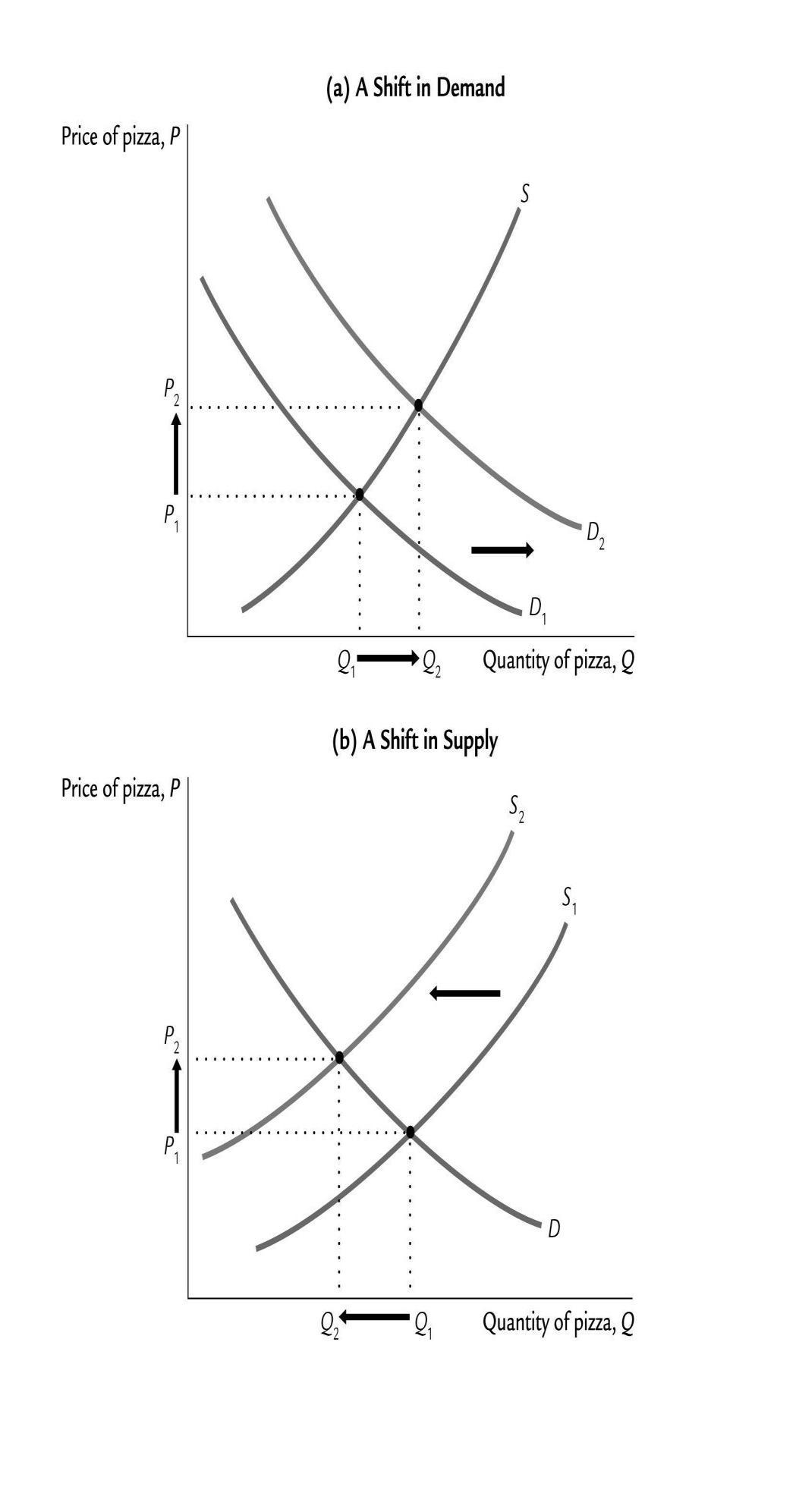
42. In a simple model of the supply and demand for pizza, when buyers' income increases, the price of pizza and the quantity purchased _____.
a. increases; decreases
b. increases; increases
c. decreases; increases
d. decreases; decreases
ANSWER: b
43. In a simple model of the supply and demand for pizza, when the price of cheese increases, the price of pizza and the quantity purchased _____.
a. increases; increases
b. decreases; increases
c. decreases; decreases
d. increases; decreases
ANSWER: d
44. In a simple model of the supply and demand for oranges, a frost that destroys half of the oranges on all the orchards will lead to in the price of oranges and in the quantity purchased.
a. increases; decreases
b. increases; increases
c. decreases; decreases
d. decreases; increases
ANSWER: d
45. Which statement BEST illustrates the "art," rather than the "science," of macroeconomics?
a. Macroeconomic data provide the motivation for new macroeconomic theory.
b. Macroeconomic relationships can be expressed using symbols and equations.
c. Macroeconomists must determine which simplifying assumptions clarify our thinking and which ones mislead us.
ANSWER: c
TB12 Chapter 1 Copyright Macmillan Learning. Powered by Cognero.
d. Graphs and charts can be used to illustrate the history of macroeconomic variables.
46. Why is macroeconomics often characterized as more of an "art" than a "science"?
a. Because macroeconomics relies exclusively on empirical data and mathematical models.
b. Because macroeconomics deals with human behavior and complex economic systems, often requiring subjective judgment.
c. Because macroeconomics is a rapidly evolving field, constantly producing new scientific laws.
d. Because macroeconomics is primarily focused on examining graphs of economic variables.
ANSWER: b
47. In the relationship expressed in functional form Y = G(K, L), Y stands for real GDP, K stands for the amount of capital in the economy, and L stands for the amount of labor in the economy. In this case, G( ):
a. is the growth rate of real gross domestic product (GDP) when the amount of capital and labor in the economy is fixed.
b. indicates that the variables inside the parentheses are endogenous variables in the model.
c. is the symbol that stands for government input into the production process.
d. is the function telling how the variables in the parentheses determine real GDP.
ANSWER: d
48. Which statement about economic models is TRUE?
a. There is only one correct economic model.
b. All economic models are based on the same assumptions.
c. The purpose of economic models is to show how endogenous variables affect exogenous variables.
d. Economists use different models to address different economic phenomena.
ANSWER: d
49. How does macroeconomics use models in economic analysis?
a. Macroeconomics employs a single to address all economic questions.
b. Macroeconomists use different models depending on the season.
c. Macroeconomists use diverse models to explain various economic phenomena.
d. Macroeconomics employs exclusively mathematical models.
ANSWER: c
50. Macroeconomic models:
a. assume that all wages and prices are sticky.
b. assume that all wages and prices are flexible.
c. make different assumptions to explain different aspects of the macroeconomy.
d. focus primarily on the optimizing behavior of households and firms.
ANSWER: c
51. The assumption of continuous market clearing means that:
a. sellers can sell all that they want at the going price.
b. buyers can buy all that they want at the going price.
c. in any given month, buyers can buy all that they want and sellers can sell all that they want at the going price.
d. at any given instant, buyers can buy all that they want and sellers can sell all that they want at the going price.
ANSWER: d
52. All of these statements about sticky prices are true EXCEPT:
a. in the short run, some wages and prices are sticky.
b. the sticky-price model describes the equilibrium toward which the economy slowly gravitates.
c. for studying year-to-year fluctuations, most macroeconomists believe that price stickiness is a better assumption than is price flexibility.
d. magazine publishers tend to change their newsstand prices only every three or four years.
ANSWER: b
53. The assumption of flexible prices is a more plausible assumption when applied to price changes that occur:
a. from minute to minute.
b. from year to year.
c. in the long run.
d. in the short run.
ANSWER: c
54. An assumption of is more plausible for studying the short-run behavior of the economy, while an assumption of is more plausible for studying the long-run, equilibrium behavior of the economy.
a. deflation; inflation
b. inflation; deflation
c. flexible prices; sticky prices
d. sticky prices; flexible prices
ANSWER: d
55. Why is the idea of continuous market clearing often criticized in economics?
a. Because it assumes that markets consistently achieve equilibrium instantly, which is not realistic.
b. Because it promotes government intervention in market operations.
c. Because it overlooks supply and demand roles in price determination.
d. Because it encourages speculative behavior among market participants.
ANSWER: a
56. When studying the short-run behavior of the economy, an assumption of is more plausible, whereas when studying the long-run equilibrium behavior of an economy, an assumption of is more plausible.
a. inflation; unemployment
b. unemployment; inflation
c. flexible prices; sticky prices
d. sticky prices; flexible prices
ANSWER: d
57. Which is the BEST example of a sticky price?
a. the price of a barrel of oil
TB12 Chapter 1 Copyright Macmillan Learning. Powered by Cognero.
b. the price of the U.S. dollar in terms of euros
c. the price of a share of stock
d. the price of a soda in a vending machine
ANSWER: d
58. Which is the BEST example of a flexible price?
a. the price of a cup of coffee in a coffee shop
b. the price of gasoline at a service station
c. the price of a ticket at a movie theater
d. the price of a book in a bookstore
ANSWER: b
59. How does technological progress typically affect the market clearing model in the labor market?
a. It shifts the demand curve for labor to the left, decreasing wages.
b. It causes an increase in labor supply, leading to higher unemployment rates.
c. It leads to an increase in the equilibrium wage rate and employment levels.
d. It has no impact on the market clearing model in the labor market.
ANSWER: c
60. Using a market-clearing model to analyze the labor market is because wages usually change _____.
a. realistic; frequently
b. realistic; infrequently
c. unrealistic; frequently
d. unrealistic; infrequently
ANSWER: d
61. What is the difference between recession and depression in an economy? Provide an example of depression from the real world that has hit the global economy.
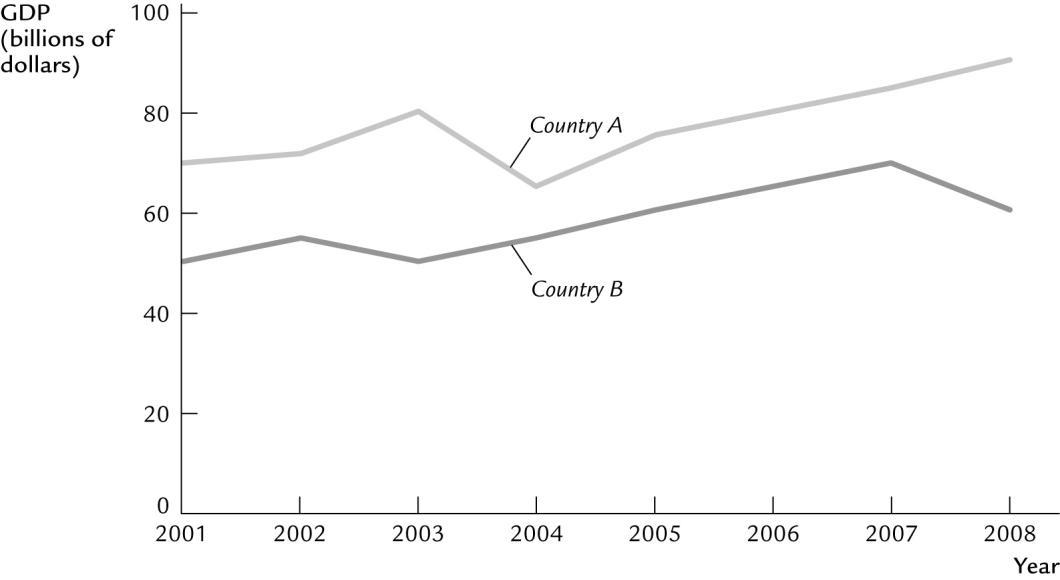
ANSWER: When there is a mild fall in the real gross domestic product (GDP) of an economy over a period of time, it is called a recession in the economy. If the intensity of the fall in GDP is severe over a period of time, then it turns into a depression. Recession is cyclic in nature; that is, it repeats itself over a period of time in an economy. A famous example of depression is the Great Depression of the 1930s that occurred in the United States and affected the global economy. Even the financial crisis of 2008–2009 in the United States was very much reminiscent of the Great Depression.
62. Refer to the following graph and identify the years for which Country A and Country B experienced recession.