Test Bank for Macroeconomics 12
Edition by Colander
ISBN: 9781266394973

ISBN: 9781266394973
1. As newly elected President of your school's Economics Club, you must prepare the Club's annual budget of $5,000. Past budgets have included: 1) fees for guest speakers; 2) tours of local businesses; 3) charges for downloading economic statistics; 4) an end-ofsemester party; and 5) the Club President's salary. How would the central coordination problems faced by any economic system apply to your task of deciding how to allocate the $5,000?
Answer:
The problem of preparing a club’s budget is similar to the problem facing any economic system. The club has limited funds and unlimited wants. It must deal with scarcity. In preparing the budget, the club must decide for whom the services of the club will be provided. It must decide what services (and how much of each service) to provide. Finally, it must determine how to provide the services. For example, if it decides to tour a local pizza parlor, will it charter a bus or use school vehicles?
2. Explain how the government might apply economic reasoning in deciding on which of many techniques it should employ to reduce or eliminate terrorist attacks on airlines. What problems can arise when using such an approach?
Answer:
If the government believes that the marginal benefits of a particular method of reducing or eliminating terrorist attacks outweigh the marginal costs, then the economic reasoning suggests that the government should do it. One problem with this approach is that, although some of the costs and benefits are clear and measurable, one cannot clearly assign a monetary value to the intangible costs and benefits that arise from the added security measures (e.g. racial profiling or invasion of privacy).
3. In the late 1970's, the U.S. mandated a maximum highway speed of 55 miles per hour to economize on fuel. Evidence showed that the lower 55-miles-per hour speed limit also significantly reduced traffic fatalities. Nevertheless, when the gas shortage eased, we returned to the higher speed limits. Provide an economic rationale for not permanently lowering the speed limit to 55 miles per hour when we know that it will save lives.
Answer:
Although experience proves that lower speed limits would almost certainly save lives, the opportunity costs of such a policy are considered to be excessive by most policy makers (and voters). If speed limits were set at 55 miles per hour, much more valuable time would be required for everything from commuting, to shipping goods, to leisure travel. Since people's time is scarce, it has a high opportunity cost. We are willing to trade off the costs of higher speed limits a greater risk of fatalities in order to avoid the even greater cost of increased time spent traveling from place to place.
4. What are theorems? What are precepts? If two economists agree on a theorem, do they necessarily agree on precepts? If two economists agree on a precept, do they necessarily agree on theorems?
Answer:
Theorems are propositions that are logically true based on the assumptions of a model. A precept is policy rule in favor of a particular course of action. With a theorem, an economist can explain how the world may work. With a precept, an economist turns that explanation into a recommendation for action. Because precepts are based on theorems combined with empirical evidence and the goals of society, two economists who agree on a theorem may not necessarily agree on the precept; they might disagree on whether the assumptions of the model hold (which could be tested empirically), or they might disagree on what the goals of society should be. Two economists might also arrive at the same precepts, but based on altogether different theorems, empirical evidence and goals.
5. Explain how each of the following scenarios illustrates the interaction of economic forces, social and cultural forces, and political and legal forces.
(a) State officials are trying to move welfare recipients into jobs during a period of economic weakness, rising unemployment, and declining federal funding.
(b) The European Union is funding a massive program to explore ways of using hydrogen to replace fossil fuels both to increase energy availability and to protect the environment.
(c) In some states, many types of retail stores are prohibited from opening before noon on Sunday.
(d) In North Dakota, most colleges and universities are located in small towns. Despite shrinking student populations, state law mandates that all of these schools remain open.
Answer:
(a) The plight of these state officials illustrates both economic forces and political and legal forces. The social welfare program is administered and regulated by the government (political and legal forces), and the need to move recipients out of the program and help them getting jobs is due to economic forces.
(b) The European research program finding new sources of energy illustrates both economic forces and political and legal forces. The need to develop an alternative power source is more pressing today as the supply of current resources are dwindling (economic force), and also as a result of the strict laws and regulations imposed by the government to reduce fossil fuel emissions (legal and political forces).
(c) Laws to prevent certain types of stores from opening on Sunday mornings are an example of the impact of social and cultural forces and political and legal forces on retail markets. These laws (legal forces) exist to allow people to go to church (social and cultural forces) before they go to work.
(d) The survival of colleges and universities in small towns is an example of both political and legal forces combined with social and cultural forces. Political and legal forces are at work in
that state law mandates that the schools remain open. Social and cultural forces appear in that the underlying reason for keeping the schools in small towns is the desire to maintain the rural way of life within the state.
6. Explain how microeconomics differs from macroeconomics. Explain why the following headlines, taken from various issues of The Wall Street Journal, deal with either microeconomics or macroeconomics.
(a) “Microsoft posted a 26% increase in sales”
(b) “Housing starts soared 13.3% in September”
(c) “Honeywell Plans to Slash More Jobs”
(d) “Germany to Breach Key Deficit Target it Helped to Create”
(e) “China's Output Grew 8.1%”
(f) “Washington Is Urging Canada to Increase Military Spending”
Answer:
Microeconomics is the study of individual choice and how economic forces influence that choice, while macroeconomics is the study of inflation, unemployment, business cycles, and growth. In macroeconomics we generally go from the whole to the parts. Microeconomics focuses on individual choices while macroeconomics focuses on aggregate relationships. Headline (a) is clearly microeconomic since it deals with a particular firm. Headline (b) lies at the border of micro and macroeconomics since it deals with a large sector of the overall economy (housing) but not the economy as a whole. Headline (c) is also microeconomic since it also applies to a single firm. Headline (d) is clearly macroeconomic since it deals with an economywide phenomenon the government deficit. Headline (e) is clearly macroeconomic since it deals with an economy-wide phenomenon the growth of total output. Headline (f) also lies at the border of micro and macroeconomics since it deals with a large sector of the overall economy (military spending) but not the economy as a whole.
7. Explain the differences between positive economics, normative economics, and the art of economics. Explain why you would categorize each of the following three statements as belonging to positive economics, normative economics, or the art of economics.
(a) The unemployment rate is 4.5 percent.
(b) The unemployment rate is unacceptably high.
(c) If the government wants to reduce the unemployment rate, it should try cutting taxes.
Answer:
Positive economics is the study of what is, and how the economy works without regard to the goals of an economy. On the other hand, normative economics is the study of what the goals of the economy should be without regard to how the economy works. The art of economics applies what is known about how the economy works (positive economics) to achieve the goals of an economy (normative economics).
Statement (a) is an example of positive economics because it is a statement of fact and in theory it can be proven true or false. Statement (b) is an example of normative economics because the phrase, “unacceptably high,” implies a value judgment over which reasonable people could disagree. It cannot be proven true or false. Statement (c) is an example of art of economics, in which a policy option is offered to try to satisfy a goal. That option may or may not be a “good” one.
8. How did Adam Smith deal with the problem of moving from theorems in positive economics to policy precepts in the art of economics?
Answer:
He used the impartial spectator tool to decide on moral judgments developed in moral philosophy and then integrated those moral judgments into the theorems and empirical facts determined in positive economics. The impartial spectator tool required economists to focus on policy that would achieve the greatest good for the greatest number, and to determine that greatest good through introspection and constructive argumentation with individuals who held opinions different than yours. It required reaching out and placing yourselves in other people’s shoes.
9. What is economics, and what are the three coordination problems an economy must solve?
Answer:
Economics is the study of how human beings coordinate their wants and desires, given the decision-making mechanisms, social customs, and political realities of the society. An economy must solve these three problems: What to produce? How to produce it? For whom to produce it?
10. How are the three central economic questions What, How, and For Whom related to the concept of scarcity?
Answer:
Given that we have scarce resources and essentially unlimited wants, an economic system must make choices to prioritize wants by answering the What problem. In order to produce as much as possible from limited resources, the resources must be used efficiently. This is at least one of (and for economists, usually the most important) the criteria for solving the How problem. Since everyone can't have everything they want, the available goods must be allocated. That is, the For Whom problem must also be solved, and frequently is implicitly answered in large part by the answers to the What and How questions.
11. What is scarcity? Why is it so difficult to eliminate it?
Answer:
Scarcity refers to the problem in an economy wherein the goods available are too few to satisfy individuals' desires. Scarcity is difficult to eliminate because new wants are constantly developing. As technology changes and more goods and services become available people decide that they need or want these new goods.
12. What role does coercion play in an economy?
Answer:
Coercion has historically been a part of all economies as they try to solve coordination problems. Specifically, coercion involves limiting people's wants and desires and increasing the amount of work individuals are willing to do.
13. What is economic reasoning? Give an example.
Answer:
Economic reasoning is making decisions on the basis of costs and benefits. Any example that clearly states the relevant cost and benefit of an activity is acceptable.
14. What is the economic decision rule?
Answer:
The economic decision rule is an application of economic reasoning that focuses on a comparison of marginal benefits and marginal costs. Specifically, the economic decision rule has two parts:
If the marginal benefits of doing something exceed the marginal costs, do it. If the marginal costs of doing something exceed the marginal benefits, don't do it.
15. What is opportunity cost? Give an example.
Answer:
Opportunity cost is the benefit foregone of the next best alternative to the activity you've chosen. Any example that clearly distinguishes between the benefit foregone (rather than the explicit costs) of the next best alternative is acceptable.
16. What is the “invisible hand”, and how does it work as a market force?
Answer:
The invisible hand is a phrase that refers to the price mechanism as a means for allocating resources. The key point is that it is the rise and fall of prices that guide our actions in a market. If there is a shortage in a market (quantity demanded exceeds quantity supplied), the invisible
hand applies an upward pressure on the market price. Conversely, if there is a surplus, the invisible hand applies a downward pressure on the market price.
17. What are the three forces that control economic reality? Give an example of each.
Answer:
The three forces are economic forces (the invisible hand), social and cultural forces, and political and legal forces. An example of an economic force is that, when there is an excess supply of some good, price tends to fall. Social and cultural forces include such things as churches, accepted norms or standards of behavior. Political and legal forces include such things as antitrust laws, and agricultural price supports.
18. What is the difference between economic forces and market forces?
Answer:
Economic forces are the necessary reactions to scarcity. Any mechanism that performs a rationing function in order to deal with scarcity may be considered an economic force. A market force is one type of economic force. Specifically, a market force is an economic force that is given relatively free reign by society to work through the market.
19. What does the term efficiency mean?
Answer:
Efficiency means achieving a goal as cheaply as possible.
20. What is the invisible hand theory?
Answer:
The invisible hand theory is the name for a(n) insight/lesson of the economy, which states that a market economy, through the price mechanism, will allocate resources efficiently.
21. Why are empirical results in economics often subject to dispute?
Answer:
Economic models are used to generate natural experiments, which, in turn, provide the empirical results. These models are built on certain assumptions that may not hold at all times. In natural experiments, a researcher cannot hold “other things constant” all the time thus creating disputes.
22. What is experimental economics?
Answer:
Experimental economics is a field of economics that studies the economy through controlled laboratory experiments.
23. What is a natural experiment?
Answer:
A natural experiment is a naturally occurring event that approximates a controlled experiment.
24. How does microeconomics differ from macroeconomics?
Answer:
Microeconomics involves an analysis of individual parts of an economy whereas macroeconomic analysis looks at the big picture, the economy as a whole. Microeconomics is the study of individual choice, and how choice is influenced by economic forces. Macroeconomics is the study of the economy as a whole, which includes inflation, unemployment, business cycles and growth.
25. What is an economic institution? Why is it important? Describe three economic institutions that regularly impact our daily lives.
Answer:
An economic institution is any structural aspect of an economy that influences the outcome of economic decisions. Such things as corporations, governments and cultural norms are all economic institutions. Economic institutions are important because the predictions of economic theory often need to be adjusted to include the impact of economic institutions in order to more accurately explain real world economic events. Examples of economic institutions are endless, but some obvious ones include money, credit, advertising, telemarketing, shopping malls, mail order, etc.
26. Describe the difference between positive economics, normative economics, and the art of economics.
Answer:
Positive economics is the study of what is, and how the economy works. Normative economics is the study of what the goals of the economy should be. The art of economics is the application of the knowledge learned in positive economics to the achievement of the goals one has determined in normative economics.
27. Observers have noted that people often vote against what is in their economic self-interest. It has been called the Kansas paradox because a famous article discussed the phenomenon in relation to the state of Kansas. Would Adam Smith see this as a paradox?
Answer:
No, not necessarily. He would see it as likely reflecting the fact that people are using the impartial spectator tool and are voting for what they see as benefitting all society, even though it might not be in their specific interest.
28. How do you use the concept of scarcity to explain why a highly paid, star basketball player makes more money than the average player in the league?
Answer:
A highly paid basketball player possesses special talents that other players in the league do not have. These 'scarce' talents may be a major contribution to the dominance of that team, and the reason why the owners of the team are willing to pay a star-player more money than the average player.
29. You are trying to decide which professor to take for Economics. (You don't want to take it at all, but you have to.) Professor A is known to have great classes (fascinating lectures with lots of fun stuff thrown in), but she gives very challenging exams. Professor B's classes are quite dull, but his exams are quite easy. What are the marginal costs and benefits of taking Economics from Professor A rather than from Professor B? Who would you pick?
Answer:
I would choose that class for which the difference between marginal benefit and marginal costs are the greatest. The marginal cost of taking a class is the time spent in class and studying. The marginal benefit is the enjoyment of attending class, the amount learned, increased job performance based on increased knowledge, and grade adjusted credit hours. How do each rate? The following table is suggestive of an answer. Each student will come to different conclusions.
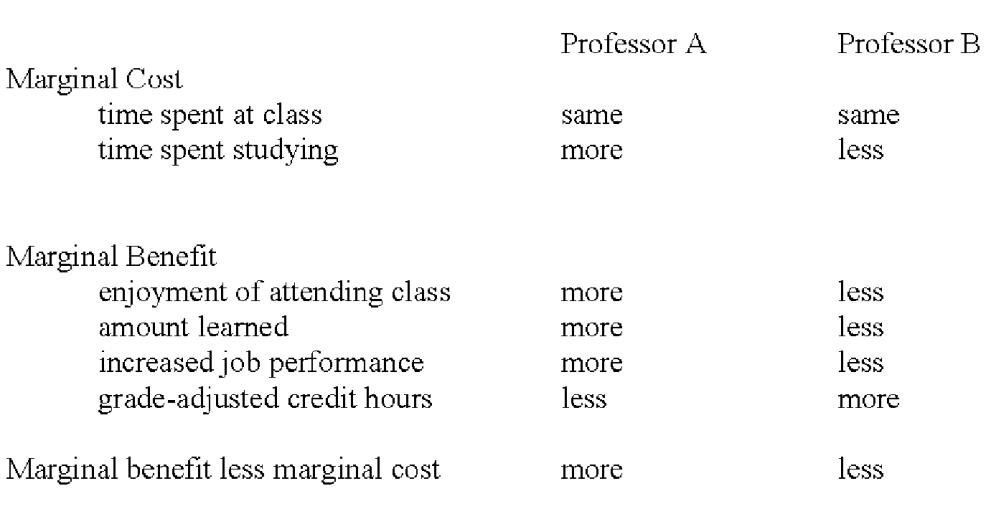
30. Why does classroom attendance rise during exam days and fall during other days?
Answer:
Students apply economic reasoning and the economic decision rule to decide whether to go to class or not. The marginal benefit of missing a class is almost the same in the case of exam day and non-exam day the extra one hour of sleep a student gains that morning. However, the
marginal cost of missing an exam day (forgone points, disciplinary action) is significantly higher than the marginal cost of missing a non-exam day (forgone lecture notes).
31. Comment on the following statement that appeared in a local newspaper: “Our junior high school serves a splendid hot meal for one dollar without costing the taxpayer anything, thanks in part to a government subsidy.”
Answer:
There ain't no such thing as a free lunch. In order for the government to subsidize the school's menu, it has to collect taxes, part of which come from those who go to this particular school. The person who is responsible for this statement failed to incorporate the principle of opportunity cost in his/her analysis.
32. What is opportunity cost? What would be the opportunity cost of having a date on Saturday night? Alternatively, why is there no such thing as a free date (even if she/he pays)?
Answer: Opportunity cost is the benefit forgone by undertaking an activity. Even if no monetary costs are involved on your part, your time is still scarce, and using it to go on a date means that it cannot be used for some alternative purpose. You may have been considering spending the evening alone, going out with “the guys” or “the gals,” or participating in some group activity in a nondating situation. The best alternative forgone is your opportunity cost. On the other hand, if you really had no other plans and would have sat in your room feeling sorry for yourself for not having a date, your opportunity cost could indeed have been zero.
33. Consider the following statement: Keith purchased an entire week's groceries for his family of four for $200 while Jerry spent $250 for a week's groceries for his family of four. Can we conclude that Keith is more efficient than Jerry at grocery shopping? Why or why not?
Answer:
The answer is it depends. Efficiency refers to achieving a goal as cheaply as possible. Since we don't know what the goal of each person is, we can't accurately evaluate the efficiency of their shopping. If the goal of Keith and Jerry is to buy a week's worth of groceries for their respective families, then we can say that Keith is more efficient than Jerry. On the other hand, if the goal was to buy a specific set of food items, we can't evaluate the relative efficiency of the two shoppers unless we know that each was purchasing exactly the same items; and we are not given this information.
34. Explain how microeconomics differs from macroeconomics and then categorize the following questions as either microeconomic or macroeconomic questions:
(a) How will interest rates change when the Federal Reserve Bank increases money supply?
(b) How will Nike's market share change when Reebok increases their marketing expenditures?
(c) How does a tariff on imported steel affect the U.S. steel industry?
(d) Should Walmart renovate its stores nationwide?
(e) Should the government lower income taxes to stimulate consumption?
Answer:
Microeconomics is the study of individual choice and how that choice is influenced by economic forces, while macroeconomics is primarily the study of inflation, unemployment, business cycles, and growth from the whole to the parts. Micro focuses on individual choices while macro focuses on aggregate relationships.
(a) Macroeconomics
(b) Microeconomics
(c) Microeconomics
(d) Microeconomics
(e) Macroeconomics
35. Three different ways (approaches) can be used to study economics: positive, normative, and their combination (the art of economics). Describe each approach and give an example of each. Which do you think is the best approach to study economic issues? Explain why you picked the approach you did.
Answer:
(a). Positive economics is the study of what is, and how the economy works without regard to the goals of an economy. Using economic reasoning to determine how tax revenue would change in response to a 5% income tax increase is an example of positive economics.
(b). Normative economics is the study of what the goals of the economy should be. Deciding whether government tax revenue should be used to build more tanks or to provide education grants is an example of normative economic analysis.
(c). The art of economics is the application of the knowledge learned in positive economics to the achievement of the goals in normative economics. Determining that a 5% income tax increase will generate $50 billion in tax revenue, which can be used to provide $10,000 grants to 5,000,000 students to help with college tuition is an example of the art of economics. Which is best? There is no single “correct” answer here. It depends upon what questions you are addressing. If you are trying to understand how an economy functions, positive economics is the best approach. If you are trying to make policy recommendations, the art of economics is the best approach. Although one hopes that the art of economics receives the most votes.
36. You have just finished paying off the $10,000 loan on your car, and it stops working. Your mechanic tells you that it will cost $1,000 to repair it. Your car is quite old, and you are hesitant to put another $1,000 into it. Instead, you are contemplating purchasing a much newer car for $15,000. You want to get your wheels back. What should you do? How
would your answer change if you took the expected life of the vehicle into consideration?
NOTE: Answer this question by applying the economic decision rule.
Answer:
To answer this question using the economic decision rule, you should compare the marginal benefit of each option to its marginal cost. If your goal is simply to “get your wheels back” then the marginal benefit is that you have your wheels again. However, the marginal cost of each option is quite different. Recall that marginal cost is the additional cost you will incur, ignoring all past expenditures. In this case you either spend $1,000 to repair your current car or spend $15,000 to get a different one. Clearly the cheapest way to “get your wheels back” is to repair your current car, so this is what you should do.
If you take into consideration the expected life of the vehicle, then your marginal benefit is no longer simply getting your wheels back, but rather the length of time you will have those wheels. In this situation, the marginal cost is unknown, since you cannot be certain about which of the cars will require additional repairs in the future. This makes the use of economic reasoning more difficult (but not impossible) to apply. You need to make some educated guesses (or assumptions) about the future repair records of each car in order to determine the marginal cost of each option. Or take the bus.
37. State the economic decision rule and apply it to the following situations:
(a) A personal computer costs about 2 cents per hour to operate. Every time it is turned on and off, there is a .00005 probability that the computer will fail, costing $700 to repair. Is it worthwhile to turn off your computer?
(b) Should you try out for the soccer or the baseball team?
(c) The date to withdraw from a course and get the $300 refund has passed. With 30 more classes left in the semester, should you drop the course?
(d) Your employer has offered you a 20% raise. Do you work more hours?
Answer:
The economic decision rule is: If the marginal benefits of doing something exceed the marginal costs, do it; if the marginal costs of doing something exceed the marginal benefits, don't do it.
(a) Choose that option that provides the maximum net benefit. The cost of turning off your computer is the possibility of having to repair it [$700 × .00005 = 3.5 cents]. The benefit is the energy savings, 2 cents per hour. Don't turn off the computer for periods of less than one hour and forty-five minutes since the marginal benefits do not exceed the marginal costs.
(b) The cost of playing on each team is the practice time and cost of equipment. The benefit is the joy of playing on a team and winning games. Choose that option that provides the maximum net benefit.
(c) The cost of tuition is not a relevant benefit of dropping the course since it is a sunk cost. The cost of dropping the course is the lost opportunity of gaining knowledge and course credits. The
benefit is the gained free time for other activities. Choose that option that provides the maximum net benefit.
(d) The benefit of working more hours is the wages earned. The cost is the time spent working. After the 20 percent raise, the benefit of working additional hours has increased. If you value the wages more than you value alternative uses of those additional hours, work the extra hours.
Correct answers located at the end of the chapter.
TRUE/FALSE - Write 'T' if the statement is true and 'F' if the statement is false.
1) The answers to an economy's three central economic problems are determined by the interaction of three forces: economic forces, political forces, and social forces.
⊚ true
⊚ false
2) Scarcity exists because economies cannot produce enough to meet the perceived desires of all individuals.
⊚ true
⊚ false
3) Only marginal costs, not sunk costs, affect economic decisions if individuals are rational.
⊚ true
⊚ false
4) The economic decision rule is to undertake an action only when the marginal benefits of that action are greater than its total costs.
⊚ true
⊚ false
5) The opportunity cost of undertaking an activity includes any sunk cost.
⊚ true
⊚ false
6) The "invisible hand" is the price mechanism that guides people’s actions in the market.
⊚ true
⊚ false
7) Social and political forces affect the way in which the invisible hand works.
⊚ true
⊚ false
8) Macroeconomics is the study of how individual choices are affected by economic forces.
⊚ true
⊚ false
9) Deciding what the distribution of income should be is an example of normative economics.
⊚ true
⊚ false
- Choose the one alternative that best completes the statement or answers the question.
10) Say a pill existed that made people selfless. After taking it they were only interested in others, not themselves. Under the coordination definition of economics:
A) no economic problem would exist.
B) there still would be an economic problem.
C) there would be a political problem but not an economic problem.
D) there would be a social problem but not an economic problem.
11) According to the text, economics is the study of how:
A) governments allocate resources in the face of constraints.
B) government policies can be used to meet individuals' wants and desires.
C) human beings coordinate their wants and desires.
D) scarce resources are allocated between capitalists and workers.
12) Dorm rooms usually are not allocated by markets. Allocating dorm rooms is:
A) not an economic problem.
B) an economic problem.
C) not affected by economic forces.
D) determined by prices.
13) If allocating dorm rooms changes from allocation by lottery to allocation by the market:
A) it becomes an economic problem.
B) it becomes a political problem but not an economic problem.
C) it becomes a social problem but not an economic problem.
D) the allocation problem is still an economic problem.
14) Which of the following is not one of the three central coordination problems of the economy given in the book?
A) What
B) Whether
C) For whom
D) How
15) The quantity of goods and services available to society:
A) is fixed.
B) depends on human action.
C) is not of economic importance.
D) will always grow to meet individuals' wants and desires.
16) Economic systems:
A) can eliminate scarcity.
B) address the questions what is produced, how it is produced, and for whom it is produced.
C) provide all the goods people want and desire.
D) provide equal distribution of well-being among its participants.
17) Scarcity exists because:
A) individuals cannot solve the three central coordination problems.
B) governments cannot solve the three central coordination problems.
C) the supply of goods is always less than the demand.
D) new wants continue to develop and willingness to meet them is limited.
18) People can reasonably expect that an economic system will decide all of the following except:
A) what goods to produce.
B) how to produce the goods.
C) how to assign initial property rights.
D) for whom to produce the goods.
19) To engage in economic reasoning, one must compare:
A) total cost and total benefit.
B) marginal cost, sunk cost, and total benefit.
C) sunk cost and marginal cost.
D) marginal cost and marginal benefit.
20) Alexandra has determined that studying an hour for her economics quiz will improve her grade on the quiz from a 75 to a 100. She also determines that this improvement is worth $20. To study for an hour for her economics quiz, however, she will have to work one fewer hour at her part-time job.
Alexandra should:
A) study for the quiz as long as her hourly wage rate is less than $20.
B) study for the quiz as long as her hourly wage rate is more than $20.
C) study for the quiz only if her hourly wage rate is exactly $20.
D) not study for the quiz because earning a higher grade cannot have a dollar value.
21) Microsoft filed a lawsuit against people who sent spam (junk email) and a website owner who hosted spam services. A spokesman for Microsoft said that Microsoft was "trying to change the economics of spam" by increasing the cost of being a spammer. An economist most likely would agree with which statement about Microsoft's actions?
A) A more effective approach would be to educate spammers about the costs they impose on others.
B) A more effective approach would be to appeal to the morals of the spammers and tell them to follow the Golden Rule.
C) Microsoft's approach of trying to change the costs of spamming is the most efficient way to change behavior.
D) Microsoft should not be involved because spamming is just part of the invisible hand at work and should be left alone.
22) The marginal benefit from consuming another unit of a good:
A) must equal the marginal cost or the unit will not be consumed.
B) must be less than the marginal cost or the unit will not be consumed.
C) equals the increase in total benefits from consuming the unit.
D) equals the total benefit obtained from the consumption of all prior units.
23) The marginal cost of consuming another unit of a good:
A) must equal the marginal benefit or the unit will not be consumed.
B) must exceed the marginal benefit or the unit will not be consumed.
C) equals the increase in total cost when another unit is consumed.
D) equals the total cost of consuming all prior units.
24) Mary buys cell-phone services from a company that charges $30 per month. For that $30 she is allowed 600 minutes of free calls and then pays 25 cents per minute for any calls above 600 minutes. Mary has used 300 minutes this month so far. What is her marginal cost per minute of making two more calls lasting 10 minutes each?
A) $2.50
B) 25 cents
C) 4 cents
D) $0
25) Mary buys cell-phone services from a company that charges $30 per month. For that $30 she is allowed 600 minutes of free calls and then pays 10 cents per minute for any calls above 600 minutes. Mary has used 600 minutes this month so far. What is her marginal cost per minute of making additional calls?
A) 25 cents
B) 10 cents
C) 5 cents
D) $0
26) Mary buys cell phone services from a company that charges $40 per month. For that $40 she is allowed 500 minutes of free calls and then pays 8 cents per minute for any calls above 500 minutes. Mary has used 495 minutes this month so far. What is her marginal cost per phone call of making an additional 5minute call?
A) 80 cents
B) 8 cents
C) 0 cents
D) 40 cents
27) Sunk costs:
A) are an essential part of economic decision making.
B) are irrelevant to economic decision making.
C) should be considered, but only when marginal cost is less than marginal benefit.
D) should be considered only when there is no information about marginal cost and marginal benefit.
28) Suppose the marginal cost of dating Chris is $30 and the marginal benefit is worth $40 to you. Following economic reasoning, you should:
A) date Chris.
B) not date Chris.
C) determine what your sunk costs are.
D) determine what your total benefits and total costs are.
29) The table below shows how the marginal benefit of car washes varies for Marisol with the number purchased per month. Car washes per month Marginal benefit of purchasing an additional car wash
30) The table below shows how the marginal benefit of car washes varies for Marisol with the number purchased per month. Car washes per month Marginal benefit of purchasing an additional car wash
The price of each car wash is reduced from $2.99 to $1.99. Assuming that the price of a car wash accurately reflects the marginal cost to Marisol and that she is rational, she will increase the number of car washes purchased per month from:
A) one to two.
B) two to three.
C) three to four.
D) four to five.
The price of each car wash is reduced from $4.99 to $3.99. Assuming that the price of a car wash accurately reflects the marginal cost to Marisol and that she is rational, she will increase the number of car washes purchased per month from:
A) two to three.
B) one to two.
C) three to four.
D) four to five.
31) The table below shows how the marginal benefit of pizza dinners varies for Luigi with the number consumed per month. Dinners per month Marginal benefit per dinner
4.00
3.00
1.00
Suppose the price per dinner is $4.99 and accurately reflects the marginal cost of the dinners to Luigi. Assuming that Luigi is rational, he will:
A) not consume any pizza dinners this month.
B) consume one pizza dinner this month.
C) consume two pizza dinners this month.
D) consume three pizza dinners this month.
32) The table below shows how the marginal benefit of pizza dinners varies for Luigi with the number consumed per month. Dinners per month Marginal benefit per dinner
Suppose the price per dinner is $6.25 and accurately reflects the marginal cost of the dinners to Luigi. Assuming that Luigi is rational, he will:
A) consume two pizza dinners this month.
B) consume three pizza dinners this month.
C) consume four pizza dinners this month.
D) consume one pizza dinner this month.
33) The price of a new model of iPad tends to fall significantly a year after it is introduced. Suppose Jane bought an iPad as soon as it was introduced (a year ago) and paid a premium price for it. Now she wants to buy an iPad cover. Which of the following should she consider before buying the new accessory?
A) The price she paid for her iPad, the price of the iPad cover, and the benefit she'll receive from using the iPad cover
B) The price of replacing her iPad, the price of the iPad cover, and the benefit she'll receive from using the iPad cover
C) The price of the iPad cover and the benefit she'll receive from using the iPad cover
D) The price of the iPad cover had she bought it with the iPad, the current price of the iPad cover, and the benefit she'll receive from using the iPad cover
34) You bought one share of McDonald’s stock for $10, one share of Coca-Cola for $15, and one share of Pepto-Bismol for $20. Currently, each stock is priced at $15. Assuming that there are no tax issues and that you cannot predict the future price of any of the stocks, if you needed $15, which stock would you sell?
A) McDonald's
B) Coca-Cola
C) Pepto-Bismol
D) Any one of them
35) Which of the following best defines rational behavior?
A) Analyzing the total gains from a decision
B) Improving net gain by pursuing decisions as long as the marginal benefits exceed the marginal costs
C) Seeking to gain by choosing to undertake actions as long as the marginal costs exceed the associated marginal benefits
D) Seeking to maximize total gain regardless of cost
36) Alan is sitting in a bar drinking beers that cost $4 each. According to the economic decision rule, Alan will stop drinking when the marginal:
A) benefit to him of an additional beer is less than $4.
B) cost to him of an additional beer is less than the marginal benefit.
C) cost remains at $4.
D) benefit to him of an additional beer is greater than $4.
37) Carlos offers $240,000 for a house. The seller turns down the offer but says she will sell the house for $260,000. However, Carlos refuses to pay the higher price. If Carlos is following the economic decision rule, the marginal benefit of the house to:
A) Carlos must be less than $260,000.
B) Carlos must be greater than $260,000.
C) The seller must be less than $260,000.
D) The seller must be less than $240,000.
38) Carlos offers $150,000 for a house. The seller turns down the offer but says she will sell the house for $165,000. Carlosrefuses to pay the higher price. If both Carlos and the seller are following the economic decision rule, the marginal benefit of the house to:
A) Both Carlos and the seller must be less than $150,000.
B) Both Carlos and the seller must be greater than $150,000.
C) The seller must be greater than $165,000.
D) The seller must be less than $150,000.
39) The marginal benefit of another T-shirt this month to Mary is $15. If the $10 price of a T-shirt reflects its marginal cost to Mary and Mary uses economic reasoning, she:
A) will sell the T-shirts she has to others who are willing to pay $10.
B) will not gain anything by buying another T-shirt.
C) will buy another T-shirt this month.
D) will not buy a T-shirt this month.
40) The marginal benefit of you going to a movie during the week is currently $12. Assume that the $8 price of going to the movies measures its marginal cost. Following the economic decision rule, you will:
A) continue going to movies until the marginal benefit of doing so falls to zero.
B) choose not to go to any movies during the week.
C) continue going to movies until the marginal benefit of doing so falls below $4.
D) not be able to enjoy a net gain from going to the movies during the week.
41) Marginal analysis suggests that you will engage in more of an activity if the:
A) total benefit of the activity is less than the total cost.
B) additional benefit from the activity exceeds the additional cost.
C) total benefit from the activity exceeds the total cost.
D) additional cost of the activity exceeds the additional benefit.
42) You've purchased a car for $20,000 and now are deciding whether to have a sunroof installed for $800 and a security system installed for $200. The marginal cost of adding both the sunroof and the security system is:
A) $21,200.
B) $20,000.
C) $800.
D) $1,000.
43) You're deciding whether to install an $800 moonroof and a $400 security system in your car. Suppose the marginal benefit from the moonroof is $700 and the marginal benefit from the security system is $600. The economic decision rule dictates that you should:
A) purchase only the moonroof because that will provide you with the greatest marginal benefit.
B) purchase only the security system because its marginal benefit exceeds its marginal cost.
C) purchase both options because the combined cost of both is less than the combined benefit.
D) not purchase either because the benefits of each do not exceed the costs.
44) Your opportunity cost of taking this course is the:
A) tuition you paid for the course.
B) net benefit of the activity you would have chosen if you had not taken the course.
C) net benefit of taking this course.
D) cost of the activity you would have chosen if you had not taken the course.
45) Economic reasoning would argue that there is an opportunity cost to:
A) all choices.
B) more choices.
C) only choices that involve money.
D) only choices that do not involve money.
46) Suppose you paid $300 to take this economics course, which meets 30 times for one hour a class during the course of the semester. Instead of attending class you could have either flipped hamburgers for $10 an hour or waited tables for $8 an hour. Given this information, the opportunity cost of attending each class session is:
A) $30.
B) $10.
C) $8.
D) $13.
47) Suppose you paid $360 to take this economics course, which meets 30 times for one hour a class during the course of the semester. Instead of attending class you could have either flipped hamburgers for $9 an hour or waited tables for $7 an hour. Given this information, the opportunity cost of attending each class session is:
A) $8.
B) $7.
C) $12.
D) $9.
48) Opportunity cost:
A) includes only monetary expenses.
B) is the net benefit forgone by not undertaking the next best alternative.
C) is nonexistent for some choices.
D) is the same as sunk cost.
49) Based on scientific nutritional studies, in most countries an income of $1 a day does not provide sufficient food, shelter, and clothing to live. Under these conditions the medical risk of death is high. This statement is:
A) a normative statement.
B) a subjective statement.
C) an art-of-economics statement.
D) a positive statement.
50) The opportunity cost of attending college for one year is best measured by the:
A) benefit received by the student.
B) tuition paid for the year.
C) value of the next-best activity forgone by attending college.
D) total money expenses associated with attending college.
51) Brooke and Sandy both attend the same college and have the same expenses for tuition, books, and supplies. However, Brooke is a famous actress who could earn $2 million per year if she were not attending college whereas Sandy could earn $10,000 a year serving hamburgers if he were not attending college. It follows that the opportunity cost of attending college:
A) is the same for both Brooke and Sandy.
B) is greater for Brooke than for Sandy.
C) is greater for Sandy than for Brooke.
D) for Brooke and Sandy cannot be compared.
52) When your wages rise, the:
A) opportunity cost of an hour of work decreases.
B) opportunity cost of an hour of leisure stays the same.
C) cost of working increases.
D) opportunity cost of an hour of leisure increases.
53) If it takes you an hour to make a rational decision and the opportunity cost of that hour is $100, you will:
A) always make rational decisions.
B) make rational decisions only if the benefit from doing so exceeds $100.
C) make rational decisions only if the benefit from doing so is less than $100.
D) never make rational decisions.
54) Applying the concept of opportunity cost to the pollution of a lake, an economist probably would conclude that:
A) all pollution in the lake should be eliminated regardless of cost.
B) no pollution in the lake should be eliminated regardless of benefit.
C) pollution should be eliminated as long as the benefit from a cleanup exceeds the opportunity cost.
D) pollution should be eliminated as long as the opportunity cost of a cleanup exceeds the cost of the resources required for the cleanup.
55) For a given benefit, a rational person chooses the option that has:
A) the lowest opportunity cost.
B) the highest opportunity cost.
C) the average opportunity cost.
D) no opportunity cost.
56) More than 10,000 visitors waited up to two hours in line to see the rare flower titan arum at the Cambridge Botanical Gardens. What does this situation illustrate to an economist about rationing?
A) Goods don't have to be rationed by lottery or first-come, firstserved. Goods can be rationed by price.
B) When goods are not fully rationed by monetary price, other rationing mechanisms such as waiting arise.
C) When goods are not rationed by monetary price, other rationing mechanisms such as lottery must be introduced.
D) There is no need for rationing if anyone who waits long enough can see the flower.
57) Dogfighting is against the law in New Jersey, resulting in high-priced events held illegally in the state. What idea from Chapter 1 of the text does this story best illustrate?
A) There ain't no such thing as a free lunch.
B) The invisible hand is always invisible.
C) Social and political forces sometimes rein in market forces.
D) Maintaining objectivity is easiest in positive economics.
58) Prostitution is legal in Churchill County, Nevada, but a referendum threatened to close two brothels (prostitution businesses) in that county. What idea from Chapter 1 of the text does this story best illustrate?
A) Sunk costs do not matter in making decisions.
B) Marginal revenue should equal marginal cost
C) Social and political forces sometimes rein in market forces.
D) Microeconomics and macroeconomics are very much interrelated.
59) Nepalese villagers sell their kidneys as a way to earn much-needed money. Unfortunately, although the demand for such kidneys in developed economies is high and the medical facilities are available to conduct kidney transplants, the selling and buying of organs is illegal. What idea from Chapter 1 of the text does this situation best illustrate?
A) Sunk costs do not matter in making decisions.
B) Marginal revenue should equal marginal cost.
C) Social and political forces sometimes rein in market forces.
D) Microeconomics and macroeconomics are very much interrelated.
60) Countries such as Brazil, India, and Moldova well-known sources of organ donors—have banned buying and selling organs. This legal action comes at the risk of driving the trade underground. What idea from Chapter 1 of the text does this story best illustrate?
A) Legal and social forces can eliminate economic forces.
B) Marginal revenue should equal marginal cost.
C) Economic forces always operate despite legal forces.
D) The invisible hand is not always invisible.
61) Economic forces:
A) are a reaction to scarcity.
B) give rise to scarcity.
C) are not related to scarcity.
D) are not related to rationing.
62) An economic force given relatively free rein by society to work through the market is a:
A) market force.
B) social force.
C) price mechanism.
D) political force.
63) The price mechanism that guides people's actions is called the:
A) invisible market force.
B) invisible hand.
C) invisible handshake.
D) invisible foot.
64) Antitrust laws are an example of:
A) social forces.
B) political forces.
C) economic forces.
D) the invisible hand.
65) Microsoft has just taken some senators out to dinner in Paris in a private jet. This is probably an example of an attempt to influence:
A) economic forces.
B) political forces.
C) social forces.
D) the price mechanism.
66) The price of computers has fallen each year for the last 30 years. This is probably an example of the working of:
A) economic forces.
B) political forces.
C) social forces.
D) nonmarket forces.
67) A cultural norm is a(n):
A) economic force.
B) social force.
C) political force.
D) market force.
68) The price mechanism is:
A) not affected by social and political forces.
B) affected by social but not political forces.
C) affected by political but not social forces.
D) affected by both political and social forces.
69) Political forces:
A) affect the price mechanism through cultural norms.
B) affect the price mechanism through the legal system.
C) affect the price mechanism through scarcity.
D) do not affect the price mechanism.
70) Social forces:
A) affect the price mechanism through cultural norms.
B) affect the price mechanism but not the legal system.
C) affect the price mechanism through scarcity.
D) do not affect the price mechanism.
71) Even though more than 90,000 individuals in the United States wait for kidney transplants and, for a price, there are many individuals who would be willing to supply a kidney (a healthy person can donate one kidney without any problems), it remains illegal to buy and sell organs in the United States. A market for kidneys does not exist because of:
A) political forces.
B) social forces.
C) economic forces.
D) market forces.
72) Many drugs are illegal in the United States. Despite this law, illegal drugs are usually available at a price many times higher than they would be if the drugs weren't illegal. The high price of illegal drugs is an example of:
A) the market affecting political forces.
B) political forces affecting the market.
C) the failure of the market.
D) the failure of political forces.
73) The fact that the price of a gallon of milk is likely to be more expensive at a convenience store than at a supermarket is an example of:
A) market forces.
B) political forces.
C) social forces.
D) normative economics.
74) Economic forces:
A) are more powerful than social and political forces.
B) are more powerful than social forces but less powerful than political forces.
C) are less powerful than social and political forces.
D) can be more or less powerful than political and social forces depending on the circumstances.
75) An economic model:
A) applies economic theory to understand real-world events.
B) is so abstract that it cannot be applied to real-world events.
C) can be used only to understand free markets.
D) is an action taken to influence the course of economic events.
76) An economic principle:
A) should be used to make every individual decision.
B) generally is stated as a normative statement.
C) can be combined with knowledge of economic institutions to make policy proposals.
D) is an action taken to influence the course of economic events.
77) Economics is primarily:
A) a normative science.
B) an observational science.
C) a laboratory science.
D) a natural science.
78) Experimental economics:
A) includes naturally occurring events that approximate a controlled experiment.
B) is not possible given that economists study real-world events.
C) creates its own data rather than using data from the real world.
D) is what all economists do when they develop their models.
79) An economist secures volunteers from her college campus and divides them into two groups that are ushered into different rooms. Both groups are given a test. Those in the first group who score 90 percent or more receive an Apple iPad. Upon exiting the room, those given iPads are offered the choice of receiving $150 in exchange for the iPad. Only a few take the exchange. Those in the second group who score 90 percent are offered either an Apple iPad or $150. About half the students choose $150. The professor uses this data to support a principle known as the endowment effect. The professor is engaging in:
A) experimental economics.
B) natural experiments.
C) the economic decision rule.
D) a market coordination mechanism.
80) A natural experiment is:
A) a naturally occurring event that approximates a controlled experiment.
B) not possible given that economists study real-world events.
C) a branch of economics that studies the economy through controlled lab experiments.
D) what all economists do when they develop their models.
81) New Jersey raises its minimum wage while neighboring state, Pennsylvania, does not. Economists compared the labor market in both states to draw conclusions about the effect of a minimum wage on employment and wages. This is an example of:
A) simulation economics.
B) a natural experiment.
C) an economic principle.
D) the economic decision rule.
82) A theorem is:
A) the application of models combined with judgment.
B) a policy rule that concludes that a particular course of action is preferable.
C) a proposition that is logically true based on the assumptions of a model.
D) a set of equations that define a model.
83) Propositions that are logically true based on the assumptions of a model are known as:
A) precepts.
B) theorems.
C) insights.
D) policies.
84) A precept is:
A) the application of models combined with judgment.
B) a policy rule that concludes that a particular course of action is preferable.
C) a proposition that is logically true based on the assumptions of a model.
D) a set of equations that define a model.
85) A policy rule that concludes that a particular course of action is preferable is known as a(n):
A) precept.
B) theorem.
C) insight.
D) policy.
86) The statement, "because the invisible hand allocates resources efficiently, economies ought to minimize government interference" is an example of:
A) an economic theorem.
B) an economic precept.
C) a natural experiment.
D) efficiency.
87) Which statement best summarizes the invisible hand theorem?
A) Government policies direct people's selfish desires (tempered by social and economic forces) to the benefit of society.
B) Cultural norms direct people's selfish desires (tempered by political and economic forces) to the common good.
C) Markets direct people's selfish desires (tempered by political and social forces) to the common good.
D) Social, political, and economic forces act against people's selfish desires to promote the common good.
88) A necessary assumption behind the invisible hand theorem is that:
A) market forces are determined by cultural norms.
B) market forces produce inefficient outcomes.
C) the price mechanism is not constrained by political or social forces.
D) people behave rationally.
89) An economist who is studying the relationship between the money supply, interest rates, and the rate of inflation is engaged in:
A) microeconomic research.
B) macroeconomic research.
C) theoretical research because there is no data on these variables.
D) empirical research because there is no economic theory related to these variables.
90) The invisible hand theorem comes from:
A) microeconomics.
B) macroeconomics.
C) sociology.
D) political science.
91) Microeconomics and macroeconomics are:
A) not related because they are taught as separate courses.
B) virtually identical, though one is much more difficult than the other.
C) interrelated because what happens in the economy as a whole is based on individual decisions.
D) interrelated because both are taught by the same teacher.
92) Which of the following is least likely to be studied in macroeconomics?
A) Inflation
B) Unemployment
C) Business cycles
D) Advertising
93) Which of the following is least likely to be studied in macroeconomics?
A) Unemployment
B) Business cycles
C) Advertising
D) Inflation
94) Macroeconomics is:
A) the study of individual choice and how that choice is influenced by economic forces.
B) the study of the pricing policies of firms and the purchasing decisions of households.
C) the study of aggregate economic relationships.
D) an analysis of economic reality that proceeds from the parts to the whole.
95) Which of the following topics is best categorized as a macroeconomic issue?
A) The choices a student makes in selecting college courses
B) The decision by Apple to produce fewer Macintosh computers
C) The effect of a drought on the price of corn
D) The effect of an increase in federal spending on the unemployment rate
96) Who would probably argue that you need to study the forest before you can understand the trees?
A) A microeconomist
B) A macroeconomist
C) A normative economist
D) A classical economist
97) Who probably would argue that you need to study the trees before you can understand the forest?
A) A microeconomist
B) A macroeconomist
C) A positive economist
D) A Keynesian economist
98) Microeconomics includes the study of:
A) inflation.
B) unemployment.
C) business cycles.
D) a firm's pricing policies.
99) Macroeconomics includes the study of:
A) inflation.
B) firm pricing policies.
C) the relative prices of oil and coal.
D) individual choice.
100) The invisible hand theorem relates mostly to:
A) microeconomics.
B) macroeconomics.
C) normative economics.
D) supra-economics.
101) The study of individual choice is a focus in:
A) microeconomics.
B) macroeconomics.
C) normative economics.
D) Ricardian economics.
102) The study of inflation is a topic in:
A) microeconomics.
B) macroeconomics.
C) classical economics.
D) normative economics.
103) A basic difference between microeconomics and macroeconomics is that:
A) microeconomics focuses on the choices of individual consumers, whereas macroeconomics considers the behavior of large businesses.
B) microeconomics focuses on financial reporting by individuals, whereas macroeconomics focuses on financial reporting by large firms.
C) microeconomics examines the choices made by individual participants in an economy, whereas macroeconomics considers the economy's overall performance.
D) microeconomics focuses on national markets, whereas macroeconomics concentrates on international markets.
104) Which of the following topics is most appropriately studied in a microeconomics course?
A) The decision by a nurse to change professions
B) When the next recession will arrive
C) Why unemployment is so low and inflation has not accelerated
D) How the presidential candidates' tax plans might affect economic growth
105) Which of the following is not an economic institution?
A) Corporations
B) Government
C) Cultural norms
D) None of the answers is correct.
106) An economic policy is:
A) a generalization about the workings of an abstract economy.
B) a physical or mental structure that significantly influences economic decisions.
C) an action taken by the government to influence the course of economic events.
D) a standard people use when they determine whether a particular activity or behavior is acceptable.
107) Positive economics seeks to:
A) determine the most appropriate economic goals for society.
B) determine what government economic policies are best.
C) objectively explain how the economy functions.
D) objectively explain how societies value different economic outcomes.
108) Normative economics seeks to:
A) determine the most appropriate economic goals for a society.
B) determine how government policies affect the economy.
C) objectively explain how the economy functions.
D) objectively explain economic problems such as inflation and unemployment.
109) The statement "government should provide affordable health care coverage for every member of society" is:
A) a statement that everyone agrees with.
B) a statement that everyone disagrees with.
C) a positive statement.
D) a normative statement.
110) The statement "when the U.S. dollar appreciates, net exports will fall" is:
A) a statement that does not make value judgements.
B) a negative statement.
C) a statement that makes value judgements.
D) a normative statement.
111) Say that an economic model concludes that “government raising payroll taxes is a measure that can maintain current Social Security benefit levels for every retiree.” This conclusion is:
A) a normative statement because there is disagreement over whether Social Security benefits should be maintained.
B) a positive statement because raising payroll taxes is one way to maintain Social Security benefits.
C) a statement in the art of economics because it is about policy.
D) false because there is no payroll tax rate high enough to maintain current benefits.
112) Which of the following statements about urban sprawl and traffic congestion is the best illustration of a normative statement?
A) Snarled traffic cost motorists in the 85 largest U.S. cities 3.5 billion hours.
B) The average U.S. urban traveler is stuck in road traffic 46 hours a year.
C) Traffic congestion has increased in the last 20 years.
D) Because urban sprawl is the result of individual choice, it is okay.
113) Which of the following is the best example of a positive question?
A) How should the government deal with the next recession?
B) Should the government reduce inflation?
C) How are price and quantity demanded related?
D) Should government allow two large companies to merge?
114) Positive economics is:
A) subjective.
B) neither objective nor subjective.
C) more objective than normative economics.
D) more subjective than normative economics.
115) Value judgments in economics:
A) are necessary when objective analysis cannot address a question.
B) can always be avoided with the use of objective analysis.
C) are essential parts of positive economics.
D) can be avoided through the use of normative economics.
116) Which of the following tools did Adam Smith argue provided a reasonable way to address normative questions objectively?
A) The impartial spectator tool
B) The invisible observer tool
C) The scientific observer tool
D) The reasoned spectator tool
117) Using the impartial spectator tool, one arrives at normative judgments based on your estimation of:
A) your own normative judgments.
B) the best science available.
C) what the blended judgment of all members of society would arrive at.
D) the goals of those individuals most harmed by the policy being considered.
118) Someone using the reasoning process consistent with the impartial spectator tool would argue that the minimum wage is a:
A) bad policy since, based on one’s reasoned judgment, it will cause unemployment.
B) good policy since based on one’s reasoned judgment, it will raise one’s wage.
C) bad policy because, based on one’s reasoned judgment, it interferes with the market.
D) good policy because, based on one’s reasoned judgment, it would lead to the greatest good for the greatest number.
119) The art of economics is:
A) the application of the knowledge gained by positive economics to the goals set in normative economics.
B) purely technical and therefore more objective than positive or normative economics.
C) purely subjective so that the economist does not have to strive for the same level of objectivity that positive or normative economists do.
D) the branch of economics farthest removed from practical application, since its goal is to create the most elegant mathematical models.
120) "We should support the market because it is efficient" is an example of:
A) positive economics.
B) normative economics.
C) objective economics.
D) negative economics.
121) "The distribution of income should be left to the market" is an example of:
A) positive economics.
B) normative economics.
C) the art of economics.
D) negative economics.
122) What relates positive economics to normative economics?
A) Microeconomics
B) Macroeconomics
C) The art of economics
D) The science of economics
123) "Price controls in competitive markets cause shortages" is an example of:
A) positive economics.
B) normative economics.
C) the art of economics.
D) Keynesian economics.
124) "Government should not use price controls" is an example of:
A) positive economics.
B) normative economics.
C) the art of economics.
D) Marshallian economics.
125) Maintaining objectivity is easiest in:
A) positive economics.
B) the art of economics.
C) normative economics.
D) subjective economics.
126) Identifying the effect of an increase in the money supply on prices requires the use of:
A) positive economics.
B) the art of economics.
C) normative economics.
D) subjective economics.
127) Which of the following is a normative statement?
A) Reducing the budget deficit will also reduce the balance of trade deficit.
B) Tariffs on imported cars result in higher prices for domestic auto consumers.
C) A tax cut will cause higher inflation.
D) The government should spend more to help the poor.
128) Which of the following is the best example of a normative question?
A) How does the market for corn work?
B) How do prices affect the market for coffee?
C) Will increasing the money supply affect interest rates?
D) Will the redistribution of income make society better off?
SECTION BREAK. Answer all the part questions.
129) Watch this video for an overview of Application-Based Activities.

%media:_viddler_1bdae63d_135701647 54013922.ext%
Copyright © McGraw Hill
129.1) Where do you find the instructions, learning objectives, evaluation and scoring for this ABA assignment?
A) Under the help button in the top right corner
B) The avatars explain what's expected and how I am scored
C) On the opening welcome message and the Score tab
D) The Activity Completion screen
129.2) Once you start an ABA assignment, you ____________.
A) must complete it in one sitting
B) can close it, then start the ABA again from the beginning
C) can close it and come back to the same location in the ABA another time
D) can close it and complete it later, but will receive a lower overall score for that attempt
129.3) Once you select an answer to a question, you ____________.
A) cannot change your answer within the same attempt
B) can change your answer at any time during that attempt and earn all of the available points
C) can still change your answer, as long as you do so immediately
D) can change your answer at any time during that attempt, but will not receive of all the available points
129.4) After the ABA due date has passed, you ____________.
A) cannot review or study from any of your previous attempts
B) need instructor approval to review your previous attempts
C) can still review and study from any of your previous attempts
D) can only review and study from your highest scoring attempt
Test
1) TRUE 2) TRUE 3) TRUE 4) FALSE 5) FALSE 6) TRUE 7) TRUE 8) FALSE 9) TRUE 10) B 11) C 12) B 13) D 14) B 15) B 16) B 17) D 18) C 19) D 20) A 21) C 22) C 23) C 24) D 25) B 26) C 27) B 28) A 29) D 30) A 31) A
B
C
D
B
A
A
B
B
D
B
D
C
B
D
B
C
A
B
C
C
C
C
A
A 63) B 64) B 65) B 66) A 67) B 68) D
B
A
A
B
A
D
A
C
B
78) C
79) A
80) A
81) B 82) C 83) B 84) B 85) A 86) B 87) C 88) D 89) B 90) A 91) C 92) D 93) C 94) C 95) D 96) B 97) A 98) D 99) A 100) A 101) A 102) B 103) C 104) A 105) D 106) C 107) C 108) A 109) D 110) A 111) B 112) D 113) C 114) C 115) A 116) A 117) C
118) D 119) A 120) B 121) B 122) C 123) A 124) B 125) A 126) A 127) D 128) D 129) Section Break 129.1) C 129.2) C 129.3) A 129.4) C