Test Bank - Chapter 01
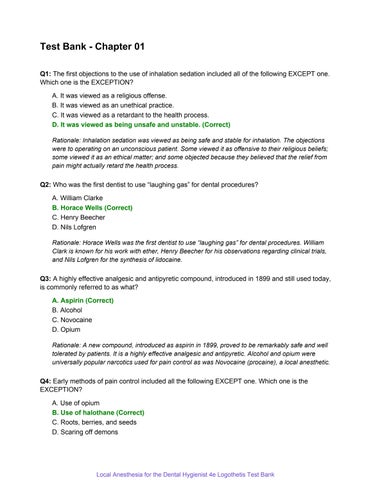
Q1: The first objections to the use of inhalation sedation included all of the following EXCEPT one. Which one is the EXCEPTION?
A. It was viewed as a religious offense.
B. It was viewed as an unethical practice.
C. It was viewed as a retardant to the health process.
D. It was viewed as being unsafe and unstable. (Correct)
Rationale: Inhalation sedation was viewed as being safe and stable for inhalation. The objections were to operating on an unconscious patient. Some viewed it as offensive to their religious beliefs; some viewed it as an ethical matter; and some objected because they believed that the relief from pain might actually retard the health process.
Q2: Who was the first dentist to use “laughing gas” for dental procedures?
A. William Clarke
B. Horace Wells (Correct)
C. Henry Beecher
D. Nils Lofgren
Rationale: Horace Wells was the first dentist to use “laughing gas” for dental procedures. William Clark is known for his work with ether, Henry Beecher for his observations regarding clinical trials, and Nils Lofgren for the synthesis of lidocaine.
Q3: A highly effective analgesic and antipyretic compound, introduced in 1899 and still used today, is commonly referred to as what?
A. Aspirin (Correct)
B. Alcohol
C. Novocaine
D. Opium
Rationale: A new compound, introduced as aspirin in 1899, proved to be remarkably safe and well tolerated by patients. It is a highly effective analgesic and antipyretic. Alcohol and opium were universally popular narcotics used for pain control as was Novocaine (procaine), a local anesthetic.
Q4: Early methods of pain control included all the following EXCEPT one. Which one is the EXCEPTION?
A. Use of opium
B. Use of halothane (Correct)
C. Roots, berries, and seeds
D. Scaring off demons
Rationale: Halothane was not an early method of pain control as it was introduced in 1956. Early methods of pain control included the use of opium, religious techniques of scaring off demons; and the use of plants and herbs for treating pain.
Q5: Pain threshold is best described as which of the following?
A. The physical and emotional response to a particular situation.
B. The relationship between human need fulfillment and human behavior.
C. A neurologic experience of pain.
D. The point at which a sensation starts to be painful and discomfort results. (Correct)
Rationale: Pain threshold is best described as the point at which a sensation starts to be painful and discomfort results. The physical and emotional response to a particular situation describes stress; the relationship between human need fulfillment and human behavior is known as the Human Needs Paradigm; and a neurologic experience of pain describes pain perception.
Q6: The neurologic experience of pain is referred to as what?
A. Pain control
B. Pain threshold
C. Pain perception (Correct)
D. Pain reaction
Rationale: Pain perception is the neurologic experience of pain. It differs little between individuals. Pain control refers to the mechanism to alleviate pain; pain threshold is the point at which a sensation starts to be painful and discomfort results; and pain reaction is the personal interpretation of and response to the pain message and is highly variable between individuals.
Q7: An unpleasant sensory and emotional experience is called what?
A. Pain (Correct)
B. Pain control
C. Pain threshold
D. Pain reaction
Rationale: Pain is an unpleasant sensory and emotional experience. Pain control refers to the mechanism to alleviate pain; pain threshold is the point at which a sensation starts to be painful and discomfort results; and pain reaction is the personal interpretation of and response to the pain message.
Q8: The personal interpretation and response to the pain message is called what?
A. Pain
B. Pain control
C. Pain threshold
D. Pain reaction (Correct)
Rationale: The personal interpretation and response to the pain message is called one’s pain reaction. It is highly variable among individuals. Pain is an unpleasant sensory and emotional experience; pain control refers to the mechanism to alleviate pain; and pain threshold is the point at which a sensation starts to be painful and discomfort results.
Q9: The creation of the loss of sensation in a circumscribed area, without loss of consciousness, best defines which of the following?
A. Inhalation anesthesia
B. Local anesthesia (Correct)
C. General anesthesia
D. All options are correct.
Rationale: Local anesthesia creates a numbing feeling or the loss of sensation in a circumscribed area, without loss of consciousness. Inhalation and general anesthesia involve loss of consciousness.
Q10: The newest amide to arrive on the dental market in the United States is which one of the following?
A. Articaine (Correct)
B. Mepivacaine
C. Lidocaine
D. Bupivacaine
Rationale: The newest amide local anesthetic, introduced to the dental field in 2000, is articaine. Mepivacaine and bupivacaine were introduced in 1957, and lidocaine was introduced in 1943.
Q11: Lidocaine is said to have revolutionized pain control in dentistry. Why?
A. It is more potent than prilocaine.
B. It is less potent than procaine.
C. Patients experience fewer allergic reactions with lidocaine. (Correct)
D. Some combination of the options.
Rationale: Lidocaine is said to have revolutionized pain control in dentistry because it is less allergenic and more potent than procaine. Lidocaine is less potent than prilocaine.
Q12: Procaine was used extensively in dentistry for a number of years; however, it was not the ideal local anesthetic. All of the following are reasons why procaine was not an ideal anesthetic EXCEPT one. Which one is the EXCEPTION?
A. It took a long time to produce the desired anesthetic result.
B. It wore off quickly.
C. It had a high potential for triggering allergic reactions.
D. It was too potent. (Correct)
Rationale: Procaine was not considered an ideal anesthetic because it was not as potent as cocaine. In addition, procaine took a long time to produce the desired anesthetic results and it had a high potential for triggering allergic reactions. Procaine wore off quickly.
Q13: The first local anesthetic used in dentistry was which of the following?
A. Novocaine
B. Cocaine (Correct)
C. Procaine
D. Lidocaine
Rationale: Cocaine was the first anesthetic used in dentistry (in 1884); followed by Novocaine (procaine) in 1905; and later, lidocaine in 1943.
Q14: The benefit of local anesthesia is not limited to pain control but could also include which of the following?
A. Hemostasis
B. Time management
C. Patient-centered stress reduction
D. All options are correct. (Correct)
Rationale: All options are correct. The benefit of local anesthesia is not limited to pain control but could also include hemostasis, achieved via the vasoconstrictor in the anesthetic; time management, because the dental hygienist can administer the anesthesia and obviate the need for the dentist and the patient to wait for anesthesia to take effect; and patient-centered stress reduction, which addresses the relationship between human need fulfillment and human behavior.
Q15: Jon presents to your dental office in pain with an abscessed tooth. Utilizing the Visual Analog Scale (VAS), Jon indicates that his pain level measures about 95 mm in length from the left hand end of the horizontal line. What is an appropriate translation of this action?
A. Jon is experiencing a significant amount of pain. (Correct)
B. Jon is experiencing a moderate amount of pain.
C. Jon is uncomfortable but able to tolerate the pain.
D. No options are correct because the pain scale is subjective.
Rationale: Operationally, a VAS is usually a horizontal line, 100 mm in length. The VAS score is determined by measuring in millimeters from the left end of the line to the point that the patient indicates. Since Jon indicated that his pain threshold was close to the definitive end of 100 mm, one can assume that Jon is experiencing a significant amount of pain. The VAS scores would be lower for moderate and uncomfortable levels of pain. Although the scale is subjective, it is nonetheless useful.
Q16: Considering the human needs paradigm, freedom from fear and stress includes which of the following?
A. The need to receive appreciation, attention, and respect from others
B. The need to be free from emotional discomfort
C. The need to feel safe
D. All options are correct. (Correct)
Rationale: All options are correct. Considering the human needs paradigm, freedom from fear and stress includes the need to receive appreciation, attention, and respect from others. It also includes the need to be free from emotional discomfort and the need to feel safe.
Q17: An astute practitioner looks for signs of patient anxiousness. All of the following are signs of patient anxiousness EXCEPT one. Which one is the EXCEPTION?
A. Overwillingness to cooperate with clinician
B. History of emergency dental care only
C. Long drawn out responses to questions (Correct)
D. Elevated blood pressure and heart rate
Rationale: An astute practitioner looks for signs of patient anxiousness. These signs may include an overwillingness to cooperate with clinician, which could be portrayed through nervous conversations and/or quick answers; a history of emergency dental care only or a history of canceled appointments; and physical symptoms including elevated blood pressure and fast heart rate. An anxious patient will respond to questions with quick answers and not by long drawn out responses.
Q18: The best method to manage an anxious patient is by
A. prevention. (Correct)
B. general sedation.
C. referral to an anxiety specialist.
D. All options are correct.
Rationale: The best method to manage an anxious patient is by prevention. General sedation and referral to an anxiety specialist may be avoided using stress reduction principles.
Q19: Performing a complete health history review at every appointment helps practitioners recognize stressors and health conditions that may complicate dental procedures. Taking a patient’s vital signs does not play an important role in assessing a patient’s level of apprehension.
A. Both statements are true.
B. Both statements are false.
C. The first statement is true; the second statement is false. (Correct)
D. The first statement is false; the second statement is true.
Rationale: The first statement is true; the second statement is false. Performing a complete health history review at every appointment helps practitioners recognize stressors and health conditions that may complicate dental procedures. Taking vital signs also plays an important role in helping to understand a patient’s total health history and in assessing a patient’s level of apprehension.
Q20: The use of anesthesia as needed is an important key to what?
A. Understanding why patients are fearful of dental appointments
B. Preventing fear associated with pain (Correct)
C. Understanding the cause of pain
D. All options are correct.
Rationale: The use of anesthesia as needed is an important key to preventing the fear associated with pain. Understanding why patients are fearful of dental appointments and the cause of pain assists in implementing a patient-centered approach to stress reduction.
Q21: Considerations that have the potential of influencing a dental patient’s pain reaction threshold include all of the following EXCEPT one. Which one is the EXCEPTION?
A. Gender (Correct)
B. Culture
C. Fatigue
D. Age
Rationale: Pain reaction threshold may be influenced by the patient’s emotional state, fatigue, age, culture, and fear and apprehension. There is no data that is statistically significant indicating that gender has an affect on a person’s pain reaction threshold.
Q22: Patients who frequently miss dental appointments because of apprehension often demonstrate what kind of pain reaction threshold?
A. A lower pain reaction threshold, which means that they have a high tolerance for pain
B. A lower pain reaction threshold, which means that they have a low tolerance for pain (Correct)
C. A higher pain reaction threshold, which means that they have a high tolerance for pain
D. No options are correct.
Rationale: Patients who frequently miss dental appointments because of apprehension will generally demonstrate a lower pain reaction threshold, which means that they have a low tolerance for pain and they will likely experience pain more quickly and/or intensely than if they were calm. Patients who demonstrate a higher pain reaction threshold generally have a higher tolerance to pain.
Q23: Patients who are overly tired or stressed at the time of their dental appointment will generally demonstrate what kind of pain reaction threshold?
A. A lower pain reaction threshold, which means that they have a high tolerance for pain
B. A lower pain reaction threshold, which means that they have a low tolerance for pain (Correct)
C. A higher pain reaction threshold, which means that they have a high tolerance for pain
D. No options are correct.
Rationale: Patients who are overly tired or stressed at the time of their dental appointment will generally demonstrate a lower pain reaction threshold, which means that they have a low tolerance for pain and they will likely experience pain more quickly and/or intensely than if they were well rested and calm. Patients who are not overly tired or stressed can demonstrate a higher pain reaction threshold, which means that they will have a higher tolerance for pain.
Q24: The difference between the legal wording that states that the dental hygienist may monitor nitrous oxide and that the dental hygienist may administer nitrous oxide is best explained by which of the following statements?
A. When it is said that the dental hygienist may administer nitrous oxide, this indicates that the hygienist may change the nitrous oxide and/or oxygen settings during the appointment as needed.
B. When it is said that the dental hygienist may monitor nitrous oxide, this means that the hygienist may turn on the nitrous oxide and/or oxygen settings during the appointment as needed.
C. In legal terms, someone with the authority to monitor nitrous oxide may change the nitrous oxide and/or oxygen settings; someone with the authority to administer nitrous oxide may turn on the apparatus. (Correct)
D. In state law the terms monitor and administer can be used interchangeably.
Rationale: In legal terms someone with the authority to monitor nitrous oxide may change the nitrous oxide and/or oxygen settings during the appointment as needed; someone with the authority to administer nitrous oxide may turn on the nitrous-oxide/oxygen apparatus.
Q25: The most popular dental local anesthetic used in the United States today is which of the following?
A. Procaine
B. Mepivicaine
C. Prilocaine
D. Lidocaine (Correct)
Rationale: Lidocaine remains the most popular dental local anesthetic used in the United States today. Procaine is no longer available, but mepivacaine and prilocaine are available in the United States.
Q26: Which drug, added to dental local anesthetics, is helpful for achieving hemostasis?
A. Halothane
B. Epinephrine (Correct)
C. Cocaine
D. No options are correct.
Rationale: Epinephrine, a vasoconstrictor, may be added to dental local anesthetics and is helpful in achieving hemostasis. Halothane, an inhalation drug, and cocaine, an ester local anesthetic no longer used in dentistry, are not added to dental local anesthetics.
Q27: Dental anxiety may be attributed to which of the following?
A. Unpleasant dental experiences in the past
B. Learned dental fear from a parent
C. All options are correct. (Correct)
D. No options are correct.
Rationale: All options listed. Patients who are anxious may have had unpleasant experiences in the past or may have a learned fear of dental care. Most studies confirm a relationship between parental and child dental fear.
Q28: The physical and emotional response to a specific situation is referred to as which of the following?
A. Pain reaction
B. Stress (Correct)
C. Pain perception
D. Pain control
Rationale: Stress is a physical and emotional response to a particular situation. Pain reaction refers to the personal interpretation and response to a pain message that differs greatly between individuals; pain perception is a neurologic experience of pain that differs little between individuals; and pain control is the mechanism to alleviate pain.
Q29: In 1842, who was known for assisting a dentist by administering ether to a patient?
A. William Clarke (Correct)
B. Horace Wells
C. Henry Beecher
D. Francesco Di Stafano
Rationale: In 1842, it was reported that William Clarke administered ether via a towel to a woman as one of her teeth was extracted by a dentist. Horace Wells is best known for his work with nitrous oxide; Henry Beecher for his observations regarding clinical trials; and Francesco Di Stafano for his work isolating cocaine from coca leaves.
Q30: Opium was used as an early method for pain reduction. Later, when converted to morphine, it became even more effective when injected into the bloodstream.
A. Both statements are true. (Correct)
B. Both statements are false.
C. The first statement is true; the second statement is false.
D. The first statement is false; the second statement is true.
Rationale: Both statements are true. Opium was most useful for pain control. In fact, opium proved even more effective when converted into a more potent form, morphine, and injected into the bloodstream.