
Test Bank for Linear Algebra-A Modern Introduction 5th Edition by Poole
ISBN: 9798214013053
Name: Class: Date:
Sections 1.0 - 1.4
1. If a = [1, –2, 3], b = [4, 0, 1], c = [2, 1, –3], compute 2a – 3b + 4c. ANSWER: [–2, 0, –9]
2. Simplify the following vector expression: 4u – 2(v + 3w) + 6(w u).
ANSWER: a

3. Solve for the vector x in terms of a and b: 2x – a = 3b = 2(a + b) – (x – b). ANSWER:
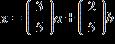
4. Find values of the scalar k for which the following vectors are orthogonal. u = [k, k, –2], v = [–2, k – 1, 5]
ANSWER: k = 5, –2
5. If u is orthogonal to v, then which of the following is also orthogonal to v?
ANSWER: (cu) v = c(u v) = 0
6. Find all values of k such that d(a, b) = 6, where a = [2, k, 1, –4] and b = [3, –1, 6, –3].
ANSWER: k = 2, –4
7. Suppose that the dot product of u = [u1, u2] and v = [v1, v2] in 2 were defined as u v = 5u1 v1 + 2u2 v2 Consider the following statements for vectors u, v, w, and all scalars c.
a. u · v = v · u
b. u (v + w) = u v + u w
c. (cu) v = c(u v)
d. u u ≥ 0 and u u = 0 if and inly if u = 0
ANSWER: (a) true (b) true (c) true (d) true
8. Suppose that the dot product of two vectors u and v in 3 were defined as the product of the lengths of the vectors. Which (if any) of the following statements would be true for all vectors u, v, w, and all scalars c?
a. u·v = v·u
b. u (v + w) = u v + u w
c. c(u) ·v = c(u·v)
d. u u ≥ 0 and u u = 0 if and only if u = 0
ANSWER: (a) true (b) false (c) false (d) true
9. What is the vector represented by an arrow from the origin (1,2) to the point (4,5) in 2?
a. (3, 3)
b. (3, -3)
c. (4, 3)
d. (3, 4)
ANSWER: a
10. Solve for x in vector equation: x – 2(1,2) = (3,4) – (2,3)
Sections 1.0 - 1.4
a. (5,6)
b. (3,5)
c. (7,8)
d. (1,2)
ANSWER: b
11. Given p = [1, –2, 1], q = [4, –4, 7], find:
a. p · q
b. ||p - q||
c. projqp
d. the cosine of the angle between p and q ANSWER: (a) 19 (b) 7 (c) (d)


12. Let ABCDEF be a regular hexagon whose sides are of length 5. If = a and = b, find the projection of along a. ANSWER: (5/2)a
13. Find the distance between the planes and . ANSWER:

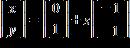
14. Find the distance between the parallel lines. and ANSWER:

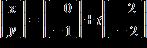
15. Find the acute angle between the planes 3 and ANSWER: 1.76 radians


16. In a parallelogram ABCD let = a, b. Let M be the point of intersection of the diagonals. Express , and as linear combinations of a and b

ANSWER:

17. Find all solutions of 3x + 5 = 2 in , or show that there are no solutions.
a. 2
b. 4
c. 6
Name: Class: Date:
Sections 1.0 - 1.4
d. 8
ANSWER: x = 6
18. Final all solutions of 7x = 1 in , or show that there are no solutions.
ANSWER: x = 8
19. Find the check digit that should be appended to the vector u = [2, 5, 6, 4, 5] in if the check vector is c = [1, 1, 1, 1, 1, 1].
ANSWER: 6
20. Let u = (2, 1) and v = (1, 3) be two vectors in 2 . What is the coordinate grid determined by these vectors?
a. A grid with lines of slope ½ spaced 5 units apart and lines of slope 3 spaced 10 units apart.


b. A grid with lines of slope ½ spaced units apart and lines of slope 3 spaced units apart.
c. A grid with lines of slope ½ spaced 1 unit apart and lines of slope 3 spaced 3 units apart.
d. A grid with lines of slope ½ spaced 2 units apart and lines of slope 3 spaced 3 units apart.
ANSWER: b
21. . Given the vectors a = [–1, 2, 0], b = [–1, 1, 1], c = [ 3, 0 1], the first component of the vector v = a – 2b + c is:
a. –2
b. 0
c. 2
d. 4
ANSWER: c

22. In a triangle ABC, let K be the midpoint of the side , and let M be the midpoint of . Let p = and q = Then can be expressed in terms of p and q as:

a. (p + q)
b. p – p
c. (p – q)
d. (p – q)
ANSWER: d

23. Given a = [2, 3, 0], b = [0, –3, –2], then the orthogonal projection of a + b along [0, 1, 1] is:
a. [0, –2, –2]
b. [2, 0, –2]
c. [0, 6, 0]
d. [0, 2, –2]
ANSWER: a
24. If a = [1, 3, z], b = [x, –6, 2], then a and b are collinear vectors if:
a. x = 2, z = 1
b. x = –2, z = –1
c. x = –1, z = 2
d. x = 1, z = 2
ANSWER: b
25. Suppose || p || = 3 and || q || = 5. Then the vectors p + kq and p – kq are orthogonal if:


ANSWER: d
26. Suppose that the dot product of two vectors in were defined as the product of the lengths of the vectors. Which of the following would be false?
a. u v = v u
b. u u ≥ 0
c. u ∙ (v + w) = u ∙ v + u ∙ w
d.

ANSWER: c
27. If u1 and u2 are unit vectors and a = u1 + 2u2 is perpendicular to b = 5u1 – 4u2, then the angle between u1 and u2 is:


ANSWER: b
28. Which of the following is not true for all vectors u, v?
a. ||u – v|| ≤ ||u|| – ||v||
Sections 1.0 - 1.4 Copyright Cengage Learning. Powered by Cognero.
Name: Class:
Sections 1.0 - 1.4
b. ||u + v||2 + ||u – v||2 = 2||u||2 + 2||v||2
c. u ∙ v =

d. |u v| ≤ ||u|| ||v||
ANSWER: a
29. For all vectors v in , the nonzero vector u is orthogonal to:
a. proju (v)
b. projv (u)
c. v + proju (v)
d. v – proju (v)
ANSWER: d
30. Which of the following expresses the fact that the vectors u and v have the same length?
a. ||u + v|| = ||u|| – ||v||
b. ||u + v|| = ||u|| + ||v||
c. u ∙ u = v ∙ v
d.

ANSWER: c
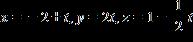
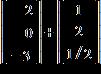
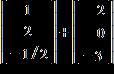
31. The vector form of the equation of the line in through P = (2, 0, –3) and parallel to the line with parametric equations: is



Name: Class: Date:
Sections 1.0 - 1.4
ANSWER: b
32. The equation of the plane that is equidistant from the two planes 5x – 3y + z = –3 and 10x – 6y + 2z = –7 is: a.
b.
c. d. ANSWER: d
33. Let L be the line with parametric equations x = 1 + 2t, y = t, z = –1. The distance from L to the point P = (0, 1, 2) is: a. b.


ANSWER: c
34. The distance between the two planes 2x – y + z = 1 and –4x + 2y – 2z = 1 is: a. b.
c. d.


ANSWER: a
35. Which of the following equations has no solution?
a. 7x = 1 in
b. 3x + 5 = 2 in
c. 6x = 2 in
d. 7x + 1 = 2 in
ANSWER: c
36. What digit should be appended to the vector u = [2, 5, 6, 4, 5] in if the check vector is: c = [1, 1, 1, 1, 1, 1] ?
a. 5
b. 6
c. 4
Sections 1.0 - 1.4
d. 3
ANSWER: b
37. A certain check digit code uses the check vector c = [9, 8, 7, 6, 5, 4, 3, 2, 1] and appends a ninth digit to an eight-digit number u = [u1, u2, ., u8] so that u c = 0 in If the first eight digits of a valid number in this scheme are 1372423, what is the ninth digit?
a. 4
b. 5
c. 6
d. 7
ANSWER: b
38. Which of the following is not equal to a b × c for all a, b, c in 3?
a. b ∙ c × a
b. c a × b
c. –b × a c
d. b ∙ a × c
ANSWER: d
39. Suppose that three vectors satisfy a + 2b + c = 0. Which of the following is equal to a × b?
a. c × b
b. a × c
c. (a × c)
d. (c × a)
ANSWER: d
40. The cosine of the angle between the planes x + 2y – z + 1 = 0 and –x + 3z + 1 = 0 is:
a.

b.

c.

d.

ANSWER: c
41. If v is any nonzero vector, then 6v is a vector in the same direction as v with a length of 6 units.
a. True
b. False
Sections 1.0 - 1.4
ANSWER: False
42. The vectors [1, 2, 3] and [k, 2k, 3k] have the same direction for all nonzero real numbers k?
a. True
b. False
ANSWER: False
43. Let u = (3,2) and v = (1,4) be two vectors in 2 Which of the following best describes the coordinate grid determined by these vectors?
a. A grid with lines of slope 2/3 intersecting lines of slope 4 at 45-degree angles.
b. A grid with lines of slope 2/3 parallel to lines of slope 4.
c. A grid with lines of slope 2/3 perpendicular to lines of slope 4.
d. A grid with lines of slope 2/3 intersecting lines of slope 4 at 90-degree angles.
ANSWER: a
44. If u • v = u • w, then either u = 0 or v = w.
a. True
b. False
ANSWER: False
45. The only real number c for which [c, –2, 1] is orthogonal to [2c, c, –4] is c = 2.
a. True
b. False
ANSWER: False
46. The distance between two points in n located by the vectors u and v is ||u – v||.
a. True
b. False ANSWER: True
47. The zero vector is orthogonal to every vector except itself.
a. True
b. False
ANSWER: False
48. The projection of a vector v onto a vector u is undefined if v = 0.
a. True
b. False
ANSWER: False
49. The projection of a vector v onto a vector u is undefined if u = 0.
a. True
b. False
ANSWER: True
Sections 1.0 - 1.4
50. The projection of vector v onto vector u is equal to v if:
a. u and v are orthogonal
b. u = 0
c. v = 0
d. u and v are parallel
ANSWER: d
51. The length of the projection of vector u onto vector v is:
a. less than or equal to length of u
b. greater than or equal to length of u
c. equal to length of v
d. equal to length of u
ANSWER: a
52. The distance between the planes n • x = d1 and n • x = d2 is |d1 – d2|.
a. True
b. False
ANSWER: False
53. The area of the parallelogram with sides a and b with |a| = 3 and |b| = 4 is 6. What is the angle between vectors a and b?
a. 30°
b. 45°
c. 60°
d. 90°
ANSWER: a
54. a • b × c = 0 if and only if the vectors a, b, c are coplanar.
a. True
b. False
ANSWER: True
55. The products a × (b × c) and (a × b) × c are equal if and only if b = 0.
a. True
b. False
ANSWER: False
56. If a, b, c are mutually orthogonal vectors in , then (a × b • c)2
a. True
b. False
ANSWER: True
57. If a parity check code is used in the transmission of a message consisting of a binary vector, then the total number of
Sections 1.0 - 1.4
1’s in the message will be even.
a. True
b. False
ANSWER: True
58. If u • v = 0, then ||u + v|| = ||u – v||.
a. True
b. False ANSWER: True
59. For all vectors u, v, w in n , u – (v – w) = u + w – v.
a. True
b. False ANSWER: True
60. For all vectors v and scalars c, ||cv|| = c||v||.
a. True
b. False ANSWER: True
61. The area of the parallelogram with sides a, b, is || ||
a. True
b. False ANSWER: True
62. Given the vectors a = [–1, 2, 1], b = [3, 1, 1], c = [4, 3, 0], the orthogonal projection of 2a – 3b along c is:
a.

b.
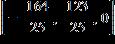
c. [–164, –123, 0]
d. [11, –1,1]
ANSWER: a
63. The angle between u = [–1, 2, 0] and e2 = [0, 1, 0] is:
a. acute
b. obtuse
c. 90°
d. 0°
ANSWER: a
64. Which of the following vectors x is collinear with a = [2, 1, –1] and satisfies the condition a ∙ x = 3?
Name: Class:
a.

b. [1, 1, 0]
c.

d.

ANSWER: a
a.

b. 3
c.

d.

ANSWER: a
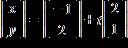
65. The distance from the point Q = (l, l) to the line is:
66. The equation of the plane in 3 passing through the points P = (1, 2, 0), Q = (2, 1, 1) and parallel to the vector v = [3, 0, 1] is:
a. –x + 2y – 3z = 3
b. x + 2y + 3z = –3
c. x – 2y – 3z = 3
d. x – 2y + 3z = –3
ANSWER: a
67. Find a unit vector in 3 in the opposite direction to v = [1, 2, –2].
ANSWER:

68. Find the vector parametric equation of the line in 3 that is perpendicular to the plane 2x – 3y + 7z – 4 = 0 and which passes through the point P = (l, –5, 7).
ANSWER: x = [1, –5, 7] + t[2, –3, 7]
69. Show that the quadrilateral with vertices A = (–3, 5, 6), B = (1, –5, 7), C = (8, –3, –1) and D = (4, 7, –2) is a square.
ANSWER: Let points A,B,C,D be located by vectors a, b, c, d Then the lengths of the sides are ||b – a|| = ||c – d|| = ||d –a || = ||c – b|| = , and dot products of each side with the adjacent ones are all zero.

70. Find a value of k so that the angle between the line 4x + ky = 20 and the line 2x – 3y = –6 is 45°.
Sections 1.0 - 1.4 Copyright Cengage Learning. Powered by Cognero.
Name: Class: Date:
Sections 1.0 - 1.4
ANSWER:

71. What is the distance of the point P = (2, 3, –1) to the line of intersection of the planes 2x – 2y + z = –3 and 3x – 2y + 2z = –17?
ANSWER: 6/

72. Let u1 and u2 be unit vectors, and let the angle between them be radians. What is the area of the parallelogram whose diagonals are d1 = 2u1 – u2 and d2 = 4u1 –5u2?
ANSWER:
73. Simplify the following expressions: (a) (a + b + c) × c + (a + b + c) × b + (b – c) × a (b) (v + 2w) ∙ (w + z) × (3z + v)
ANSWER: (a) 2(a × c) (b) 5w z × x
74. Find a vector of length that is orthogonal to both a = [2, 1, –3] and b = [1, –2, 1].
ANSWER:


75. Find the orthogonal projection of v = [–1, 2, 1] onto the xz-plane.
ANSWER: [–1,0,1]
76. Show that if a vector v is orthogonal to two noncollinear vectors in a plane P, then v is orthogonal to every vector in P
ANSWER: If v ∙ a = v ∙ b = 0, then v ∙ (c1a + c2b) = 0.
77. Which vector in 2 has the same direction as the vector (3,4)?
a. (6,8)
b. (4,3)
c. (–3,–4)
d. (3,–4)
ANSWER: a
78. Let us consider two vectors in 2 : a = (2,3) and b = (4,1). Which is the linear combination of these vectors?
a. (6,5)
b. (3,2)
c. (8,4)
d. (10,7)
Name: Class:
Sections 1.0 - 1.4
ANSWER: c
79. Which vector in 2 can be drawn as an arrow from the point (2,1) to the point (6,5)?
a. (4,4)
b. (8,6)
c. (2,3)
d. (6,4)
ANSWER: a
80. Find the normal form of the equation of the line passing through point (2,3) and having a slope of 4 in 2?
a.




ANSWER: a
81. Find the normal form of the equation of the line passing through points (1,2) and (3,4) in 2? a.

b.
c.


d.

ANSWER: b
82. Find the vector form of the equation of the line passing through points and ( ) in 2?
a.
b.


c.
d.


ANSWER: a
83. Which of the following equations is in the general form of a line in 2?
a.
b. c. d.

ANSWER: c
Sections 1.0 - 1.4
84. Find the parametric equation of the line passing through point (2,3) and having direction vector = [4, 5] in 2?
a.
b.
c.
d.
ANSWER: a
85. Find the normal form of equation of the plane passing through the point (2,3,4) and having a normal vector (3,4,5) 3 .
a.
b.
c.
d.
ANSWER: c
86. Find the vector form of equation of the plane passing through the point (2,3,4), (1,2,3) and (3,4,5) 3 . a.
b. c.
d.
ANSWER: a
87. Find the parametric form of equation of the plane passing through the point (1,2,3) and having a normal vector [2, 3,4] in 3
a.
b. c.
d.
ANSWER: d
88. Find the distance of the point (4,5,6) from the plane in 3 .
a. 3/
b. 5/

c. 7/
d. 9/
ANSWER: c
89. A plane in 3 has the parametric equation:
Sections 1.0 - 1.4
Which of the following statements is TRUE?
a. The plane passes through the origin (0,0,0).
b. The plane contains the line .
c. The plane is parallel to the vector [1,1,1].
d. The plane intersects the x-axis at (2,0,0).
ANSWER: d
90. When finding the distance from a point to a plane in 3 , what is the role of the normal vector of the plane?
a. It determines the orientation of the plane.
b. It determines the position of the plane.
c. It determines the direction of the shortest distance.
d. It determines the length of the shortest distance.
ANSWER: c
91. What is the method to compute the resultant force of two or more force vectors?
a. Subtract the magnitude of the forces.
b. Add the magnitude of the forces.
c. Take the average of the magnitude of the forces
d. Use the vector addition method.
ANSWER: d
92. A force vector F = 25N at an angle of 30° to the horizontal acts on an object. What is the vertical component of the force?
a. 12.5N
b. 15N
c. 20N
d. 25N
ANSWER: a
93. What is the range of values for the Pearson correlation coefficient (r)?
a. [–1,1]
b. [0,1]
c. [–0.5,0.5]
d. [0.5,1.5]
ANSWER: a
94. Given two data sets X = {1,2,3,4} and Y = {2,3,5,7}, what is the value of the Pearson correlation coefficient (r)?
a. 0.94
b. 0.96
c. 0.98
Sections 1.0 - 1.4
d. 0.99
ANSWER: b
95. A set of forces , , acts on an object. What is the resultant force (in vector form)?
a. b. c.
d.
ANSWER: a
96. A force vector acts on an object. What is the magnitude of the force in the -plane?
a. 20N
b. 25N
c. 15N
d. 40N
ANSWER: b
97. A correlation coefficient of 0.85 indicates that two data sets are:
a. Weakly correlated in opposite directions
b. Moderately correlated in the same direction
c. Strongly correlated in same direction
d. Not correlated at all
ANSWER: c
98. What does a scatter diagram with a cluster of points in the top right and bottom left corners indicate about the correlation between two variables?
a. Positive correlation
b. Negative correlation
c. No correlation
d. Non-linear correlation
ANSWER: a
99. What is the key difference between a scatter diagram that shows a strong correlation and one that shows weak correlation?
a. The direction of correlation
b. The amount of data points in the diagram
c. The closeness of the data points to a straight line
d. The scale of - and -axes
ANSWER: c
100. A data set has a mean of 20 and a Standard Deviation of 4. Which of the following values is most likely to be included in the data set?
a. 10
Sections 1.0 - 1.4
b. 15
c. 35
d. 40
ANSWER: b
101. What does a small SD in a data set indicate about the data?
a. The data points are spread out over a large range of values.
b. The data points are clustered close together, with little variation.
c. The data points are randomly and evenly distributed.
d. The data points are all identical, with no variation.
ANSWER: b
102. Which statement best describes the correlation between two data sets with a correlation coefficient of –0.67?
a. An increase in one variable is associated with a decrease in the other, but the relationship is weak.
b. An increase in one variable is associated with a decrease in the other, and the relationship is moderate.
c. An increase in one variable is associated with an increase in the other, but the relationship is weak.
d. No meaningful relationship exists between the two variables.
ANSWER: b
103. The SD of the data 2, 4, 6, 8, 10 is approximately:
a. 2.5
b. 3
c. 3.5
d. 4
ANSWER: b
104. A researcher finds a correlation coefficient of 0.7 between the amount of time spent studying and exam scores. Which of the following conclusions can be drawn from this result?
a. Studying longer causes higher exam scores.
b. Higher exam scores cause longer study sessions.
c. There is a strong linear relationship between studying and exam scores.
d. 70% of exam scores can be predicted by the amount of time spent studying.
ANSWER: c